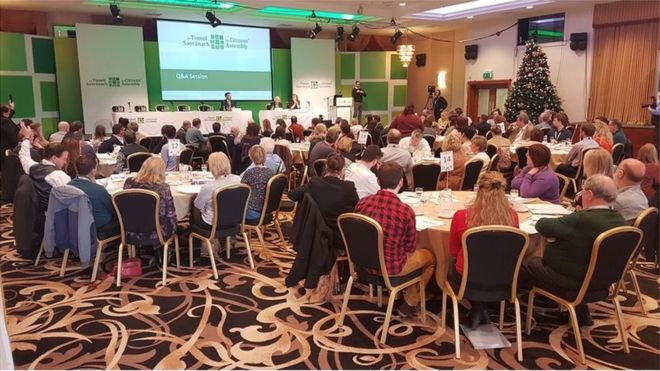
A group that advises the Irish government on abortion has been told poorer women are accepting crisis pregnancies because they cannot afford a legal termination.
The group was meeting to consider if it should recommend a new referendum on abortion law in the Republic.
Currently abortions are permitted only when the mother’s life is in danger.
The Citizens’ Assembly is meeting for a weekend-long session in Malahide, County Dublin.
Speaking at the meeting, Dr Brendan O’Shea, a member of the regulatory body for general practitioners, said financial constraints were leading some women to carry on with unwanted pregnancies.
Meanwhile, a speaker from the HSE’s Sexual Health and Crisis Pregnancy Programme, Janice Donlon, said that between 2010 and 2012 an average of 821 women on the island of Ireland were sent abortion pills annually.
Cork obstetrician and gynecologist, Professor John Higgins, said over 2014 and 2015, the Protection of Life During Pregnancy Act had facilitated 26 terminations.
Most arose from a mother’s life-threatening physical illness, with just three involving the threat of suicide.
Consultant Perinatal Psychiatrist, Anthony McCarthy, quoted international research on the damaging effects of pressurising women in crisis pregnancies.
The specialist at the National Maternity Hospital said that the surveys consistently found that women who are pressurised to have an abortion, or not to have one, suffer significant mental health problems because of that.
The chair of the assembly, the Supreme Court Judge Mary Laffoy, told members their meetings between now and March will be their most difficult as they debate the issue.
On Saturday morning, the assembly heard an address on the history of the Eighth Amendment.
The amendment, introduced in 1983, essentially gives constitutional protection to an unborn child.
Outside the meeting, a small group of protestors staged a demonstration.
Prof Eoin Carolan of UCD said that although abortion had been illegal in Ireland since 1861, the 1983 amendment made it clear for the first time that the right to life applied to the unborn.
Prof Carolan recalled that in 1992, the Supreme Court ruled in the X case that abortion is allowed where there is a real and substantial risk to the life, as distinct from the health, of the mother and where the risk could only be avoided by the termination of her pregnancy.
He said that the risk could be from either a threat of suicide or because of a physical condition.
http://www.bbc.com/news/world-europe-38117838
Source: BBC

 Abortion - Abortion Clinics, Abortion Pill, Abortion Information
November 27, 2016 at 8:36 pm
Yup, as both “Angela’s Ashes” and “Philomena” illustrated, the Irish traditionally have believed in making low-income fetuses get punished for at least 18 years after they’re born…
LikeLike
November 28, 2016 at 4:55 am
So now they’re not human beings till they’re nineteen years old?
LikeLike
November 28, 2016 at 8:11 am
What problem do you have, Mr. Dunkle, with the fact that a fetus only attains personhood when somebody decides to dedicate their time, energy, money, talents and priorities to making it into a person?
LikeLike
November 28, 2016 at 12:39 pm
My problem is the same I have with all lies.
LikeLike
November 28, 2016 at 3:36 pm
You “rescued” Ted Bundy, didn’t you? His nearly five dozen victims thank you for sending them into eternity. Too bad you didn’t rescue any of them.
LikeLike
November 29, 2016 at 9:33 am
Hey Chuck, I can’t do everything!
LikeLike
November 29, 2016 at 10:57 am
And very high on your list of things you won’t do is “care for human life.”
LikeLike