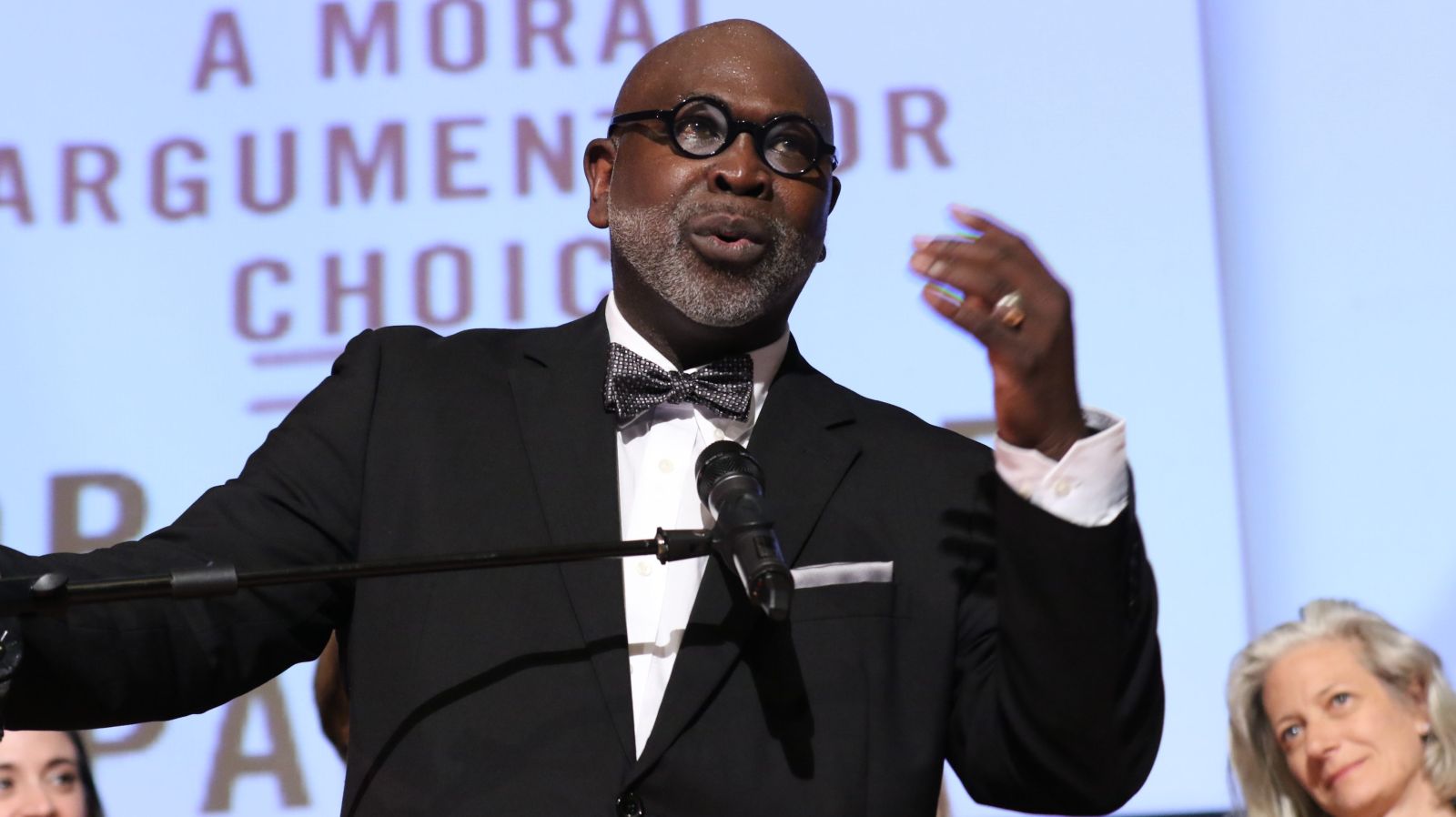
To those working in reproductive rights in the US, doctor Willie Parker is a hero. “A colored boy from Birmingham,” Alabama, as his 1962, pre-Civil Rights Act birth certificate described him, Parker grew up in abject poverty, fourth of six children, raised by a fierce single mother. Against all of the obstacles his country stacked against poor, African-American boys and young men, he became a doctor. Parker progressively expanded the horizon of his dreams and ambitions. First, he aimed to get any education at all. Then he made it to college, summer school at Harvard, and eventually onto med school.
It’s perhaps because of all those obstacles that he became a crusader. After years as an ob-gyn, in 2005 he had what he calls his “come to Jesus moment.” As a devout Christian, he realized he could not justify his choice to not perform abortions—not as a doctor, and not as a believer.
Since then, he’s been on the front line of what in the US is a war, and not just a legal one. While over 200 state laws have been passed in the past decade to try and curtail the right to abortion, 11 health practitioners, including Parker’s own mentor, Dr. George Tiller, have been murdered by anti-abortion activists. “No one on earth expects a large, bald black man in sweats and a baseball cap to be a doctor at all, let alone one of the last abortion doctors in the south,” Parker writes in his memoir Life’s Work: a Moral Argument for Choice. With courage and just enough lightness, he does not let threats deter him or racist insults provoke him. He continues providing safe and compassionate abortion care to the women who need it in the southern states where they are least likely to see their rights honored—Alabama, Georgia and Mississippi.
As the Trump administration moves forward to cut funding to clinics that provide abortions—the main providers of reproductive care and education for millions of American women—and opposes support for women’s reproductive rights at home and abroad, Parker’s book provides a tight moral and religious case in favor of choice. It has the potential to speak to an audience far beyond those who are pro-choice.
As a doctor and as an advocate (Parker chairs Physicians for Reproductive Health), Parker debunks the myths around abortion with scientific precision and moral clarity, stripping away political interests, social prejudice and religious misconceptions to show it exactly for what it is, a medical procedure that offers women control over their own bodies. The scientific rationality with which he speaks about the practical, routine elements of his work are educational and eye-opening. Yet what’s most poignant about his book is how Parker demonstrates that he has made his medical and ethical choices, not despite his faith, but because of it.
For Parker, the moral and religious arguments against abortion are misguided at best: The will of God, he says, manifests itself in human’s free will. That extends to the freedom to choose whether or not to take part in the reproductive process, a divine freedom accorded to women as it is to men, regardless of their biologies.
“Decision-making should not stratify by gender,” Parker told Quartz, “and so if the most essential thing is to men so to be self-determining, and to be able to make complex decisions, women are no less capable of that.” Yet, as he writes, abortion is subject unparalleled social and government oversight and stigma, something that finds no equivalent in medicine. “By accidental biology, the procreation process plays out in the body of a woman,” the writer told Quartz, so “if women have equal agency to men, that process should not trump the ability to be self-governing, to have bodily integrity, or moral authority to make decisions about her body, including reproduction.”
In the US, one in three women have an abortion in their lifetime—and fewer than 5% ever regret doing so. Anti-abortion activists describe women who seek or contemplate abortion as full of doubt, misery, and regret. Parker says his experience is quite the opposite. He serves women who overwhelmingly know exactly what they want, and why, and are capable of making the choices they need to make with rationality and conviction.
“How can a pregnancy be more important that the woman herself?” Parker asked rhetorically during the interview. Any attempts to force a woman to carry forward a pregnancy she does not wish to have denies rights to a life that already exists. Limiting a woman’s right to self-determination renders the label “pro-life” disingenuous. Parker highlights how abortion is exploited as political currency to get votes, most notably in the election of 2016 when US president Donald Trump turned anti-abortion only when he sought to the Republican nomination.
Parker traces how opposition to abortion rights has become an “effort to save a patriarchy that is in its last vestige as a society becomes more diverse, with gender identity, race, class, religious identity.” In that, he doesn’t spare just conservatives politicians and their supporters. He takes on religion, too.
“In the world of the Bible, bearing many children was a woman’s most important job,” writes Parker. Yet “in that ancient cultural context, however, abortion is never mentioned…The death of a fetus is regarded as a loss but not a capital crime. Throughout Jewish scripture, a fetus becomes human when—and only when—its head emerges from the birth canal.” The New Testament doesn’t mention abortion at all. Thus, for Parker, the idea that life begins with the mere meeting of sperm and egg is offensive to God.
What he calls a “theology of abortion” is an appeal to religious people of all faiths to look beyond what they are taught by the patriarchal ranks of their churches:
“[I]f you set aside the idea that God is like Siri, telling you to go left and go right, then the whole business is sacred. All of it. A pregnancy that intimates a baby is not more sacred than an abortion. …The God part is in your agency. The trust—the divine trust—is that you have an opportunity to participate in the population of the planet. And you have an opportunity not to participate…The process is bigger than you are. The part of you that’s like God is the part that makes a choice. That says, I choose to, Or, I choose not to. That’s what’s sacred. That’s the part of you that’s like God to me.”
Parker uses his personal journey to shed light on an often foggy matter with compassion and understanding. He speaks about finding inspiration for his work, and life, in Martin Luther King Jr.’s work, learning from him “not to be compassionate by proxy.” He identifies a thread of radical solidarity that runs through all civil progress—be it for race, gender, or income equality.
“My decision to go home and to practice was informed by the reality of people who look like me,” he explains.
Parker understands oppression in its most pervasive and insidious forms—masked as a right to suppress, determined to blame the victim. In this light, being able to provide abortions for the women who need it most is nothing more, and nothing less, than a form of social justice.
Source: Quatz

 Abortion - Abortion Clinics, Abortion Pill, Abortion Information
April 17, 2017 at 10:34 am
Conservative Christians don’t realize that theirs is not the only theology of abortion. Many of us hold the Breath of Life tenet that the soul enters at birth, and abortion is not murder because no soul is present.
LikeLike
April 17, 2017 at 12:48 pm
This might just be the worst thing that can happen when you grow up without a father.
LikeLike
April 17, 2017 at 12:53 pm
Sorry again, that should be a second comment. My response to Cheryel is that many others hold that sex is sinful and no children should be conceived, others that Jews and priests may be killed, others that medicine is evil. People hold all kinds of crazy beliefs. Just listen to me, Cheryel and I’ll tell you the trurth.
LikeLike
April 17, 2017 at 4:57 pm
The real sin is to not care for the child you insisted be born. So-called “pro-lifers” have a LOT to answer for.
LikeLike
April 18, 2017 at 8:08 am
And lots of other ugly, hateful thing are not mentioned in the Bible — porn, human trafficking, drunken driving, et al. Pro-choice arguments are so lame.
LikeLike
April 18, 2017 at 9:59 am
Actually, abortion IS mentioned in the Bible: Ecclesiastes IV, 1-3:
1 Again I looked and saw all the oppression that was taking place under the sun:
I saw the tears of the oppressed—
and they have no comforter;
power was on the side of their oppressors—
and they have no comforter.
2 And I declared that the dead,
who had already died,
are happier than the living,
who are still alive.
3 BUT BETTER THAN BOTH
IS THE ONE WHO HAS NEVER BEEN BORN, [emphasis added]
who has not seen the evil
that is done under the sun.
So, the so-called “pro-lifers” are committing a grievous sin by deliberately flouting the Word of God, exposing children to evils God wishes to spare them!!!
I would feel more kindly disposed to them if they actually cared for the children they compel women to bear.
LikeLike
April 18, 2017 at 11:02 am
Ain’t Chuck something? Who else would have discovered this? I’m not in this business for the “never been born.” I’m in it for the born — Chuck, David, Hillary Clinton, Donald Trump, but mostly myself. We’re the ones who face eternal hellfire. The “never been born” gain eternal happiness.
LikeLike
April 18, 2017 at 3:42 pm
I ran across that passage simply by happenstance. The bible fell open to that page; I started reading, and lo! There it was.
Glad to see that you admit that anyone choosing abortion is granting the fetus eternal happiness! That belief alone absolves you of a lot of the wrong you and the other so-called “pro-lifers” have done to women and their families all these years.
Maybe you can start spreading the word to them, so they have a chance to save their souls.
LikeLike
April 19, 2017 at 4:41 am
You’re committing the Hamlet sin here, Chuck. Remember his sparing Claudius’s life because the latter was at prayer and H didn’t want him to gain heaven?
LikeLike
April 19, 2017 at 8:16 am
??????????????????
LikeLike
April 18, 2017 at 3:51 pm
JD surprised me! I figured he would claim this is OT stuff, but once Jesus hit the streets, only the good OT stuff remained valid. Throw out the Sodom and Gomorrah, flood, Jericho and all the rest of the violence gods unleashed on human kind until he finally came to love us all and forgive all our sins as long as we believe. When JD dies, he can enjoy chatting it up with Hitler; the best I can do is Ganhdi.
LikeLike
April 19, 2017 at 7:32 am
We have to do more even than believe, David. We have to act on our beliefs (actions speak louder . . .). That’s what upsets me.
LikeLike
April 19, 2017 at 9:31 am
I am not a biblical scholar, but I never heard any such claim. Where is that in your bible? Again, pardon my lack of detailed knowledge of Catholicism, but I thought purgatory was where bad people went for a while before getting to heaven.
“What upsets me” is that you are required to act! So you really don’t like harassing women seeking abortions, but you do so because you are required to act in order to get into heaven? If you followed Chuck’s idea and helped post birth, that would be a heaven worthy act.
LikeLike
April 19, 2017 at 1:36 pm
Too many ideas mixed here, David, so I’ll start with the first one. That claim, that action as well as belief is required to attain salvation, distinguishes Catholicism from Protestantism, which claims that faith alone will open the heavenly gates.
LikeLike
April 19, 2017 at 2:04 pm
Hey, I can do the others too. Yup, purgatory, that’s where some bad people go. And yup, that’s why I do it. And Chuck’s idea is a heaven worthy act too.
LikeLike
April 19, 2017 at 2:41 pm
Harassing women cannot be considered a good act. Your intent, in your mind, may be good, but the actual act itself is not. Surely, god is not be in “the ends justifies the means” camp.
Everyone does good things and bad things in life. God keeps score, but it would not be god-like to keep us uninformed as to how he scores.
But give me more info: Does one good act keep you out out of an eternity in Hell, and confession followed by purgatory cleans the slate of the rest? (Which raises an interesting question – do you confess your anti-choice acts and, if so, what is the penance?)
LikeLike
April 19, 2017 at 3:43 pm
David, a deathbed confession is all it takes for the converted to get to the Christian heaven. Viz., Constantine. Mr. Dunkle only has to time it right for his last confession. Up to that minute, he can do whatever he wants. As W. H. Auden quoted Herod musing on the new-born child he’d heard about, ” “God likes forgiving sins; I like committing them. Really, the world is admirably arranged.’ ” A win-win for so-called “pro-lifers.”
LikeLike
April 20, 2017 at 9:05 am
Harassing women cannot be considered a good act. Your intent, in your mind, may be good, but the actual act itself is not. Surely, god is not be in “the ends justifies the means” camp. [It’s not harassing to ask a woman to save the baby’s life.]
Everyone does good things and bad things in life. God keeps score, but it would not be god-like to keep us uninformed as to how he scores. [I don’t understand]
But give me more info: Does one good act keep you out out of an eternity in Hell [It might.] and confession followed by purgatory cleans the slate of the rest? [It might] (Which raises an interesting question – do you confess your anti-choice acts and, if so, what is the penance?) [My anti-choice acts are not sins, they’re prayers.]
LikeLike
April 20, 2017 at 12:47 pm
Good attempt at rationalization.
Do you yell at women that abortions causes breast cancer? That is harassment and is not prayer. You have stated you visit providers’ homes and I am sure you are not silent – that is harassment. I suspect you yell out at escorts using verbiage that would not be found in prayers – more harassment.
LikeLike
April 20, 2017 at 4:48 pm
Do you yell at women that abortions causes breast cancer? That is harassment and is not prayer.
[First I offer them a card about the connection. If they refuse it, I have to yell to give them the information because by then they’re about fifty yards away. Prayer can be loud, David. Most prayer of course is quiet, but not all.]
You have stated you visit providers’ homes and I am sure you are not silent – that is harassment.
[I sit quietly with one of these signs on either side of me — A KILLER LIVES HERE. I guess that could be considered harassment, but I say I’m advertising their services.]
I suspect you yell out at escorts using verbiage that would not be found in prayers – more harassment.
[I have to admit that I do yell to deathscorts but for the same reason I yell to clients. I would prefer talking to them as I do with you and Chuckles, but you two are rare pro-deathers. Pat Richards was the rarest.]
LikeLike