Let’s face it: most people view late term abortions as a pretty hideous thing, and that opinion is one of the few to cross the pro-choice/pro-life divide. The pro-life side is aware of this, which is why a substantial amount of propaganda focuses on the method of late term Dilation and Evacuation procedures and attempts to conflate it with earlier term abortions, to pair a false equivalence with emotional appeal. (I’ve seen the following picture—or one very much like it–shared from multiple conservative sites online, as well as handed out by abortion protesters at clinics or demonstrations.)
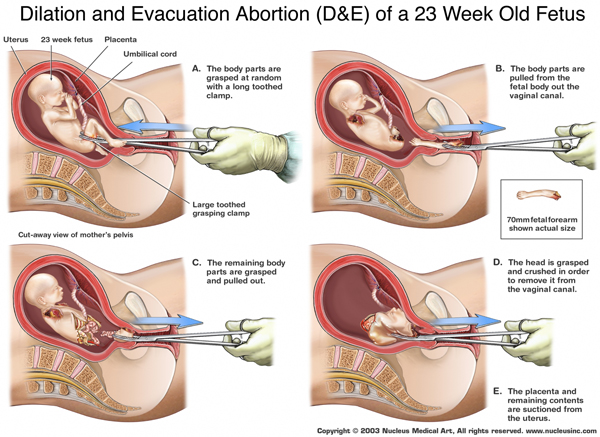
What has been striking to me, however, is how prevalent the ignorance of issues relevant to late term abortion tends to be on both sides of the divide. On both sides, I often encounter ignorance as to why women might choose to seek late term abortions in the first place (although this is more prevalent among pro-lifers), and about the relevant physiological details in terms of fetal development near viability.
Is there a secular argument for late term abortion bans?
Actually—surprisingly—yes. Essentially, the ethical considerations around abortion all center on the question of what defines a “person.” While it remains a hotly debated philosophical and religious question, it’s also one that we can attempt to answer scientifically. One answer is viability, and the landmark decision in Roe v. Wade adheres to this measurement. This in itself is a somewhat blurred line because each pregnancy is unique and the point at which different fetuses becomes viable is variable. Still, the court decision defined viability as between 24 and 28 weeks’ gestation. With new medical advances over time, the limit of viability (the gestational age that ensures a significant chance of survival outside the womb) has fallen to earlier in pregnancy, but a survey of just over 700 members of the American College of Obstetricians and Gynecologists (ACOG) showed that most would still not attempt to rescue fetuses younger than 24 weeks with a caesarian section if there were signs of fetal distress. Respondents who judged viability to be earlier than 24 weeks tended to have practiced for a shorter period of time and to be from southern or central states (I wonder what that could mean?).
There are other medically sound arguments that can be made, however, for abortion bans prior to viability. If we measure the beginning of meaningful life by the same benchmark we use to measure the end of meaningful life for comatose patients, a secular argument can be made that the beginning of brain function, which actually precedes viability, is more important in determining the beginning of meaningful personhood than likelihood of survival outside the mother’s body. Even here, however, the answer gets a little dicey: which benchmark is the most important to use?
From the review article “Pain and its Effects in the Human Neonate and Fetus,” we have the following description of the beginning of fetal brain function: “intermittent electroencephalograpic bursts in both cerebral hemispheres are first seen at 20 weeks gestation; they become sustained at 22 weeks and bilaterally synchronous at 26 to 27 weeks.”
Cortical functioning is crucial to higher order cognitive processes necessary to all attributes we associate with personhood (thought, memory, emotion, perception, reasoning, etc.), so using it as a measure for the beginning of meaningful personhood is sound logic, in theory. Philosopher Mary Anne Warren’s often-touted 5 criteria of personhood (consciousness, reasoning, self-motivated activity, capacity to communicate, and self-awareness), and other personhood definitions that require higher levels of cognitive or physical functioning, have troubled critics who point out that such a high bar may eliminate not only fetuses from “personhood,” but also many mentally or physically handicapped people and children up to several years of age. Lowering the bar instead to brain development necessary to support the most basic form of sentience is more inclusive: sentience is something of which all “people” are capable no matter how cognitively impaired, and in normal cases precedes other, higher forms of brain functioning. Below it, there is nothing indicative of personhood, and without it, all higher forms of awareness (such as self-awareness or the ability to reason) are impossible. This definition notably excludes those with brain death and early term fetuses.
What makes late term abortion bans a bad idea?
Despite their deep unpopularity that spans the abortion divide, and even despite a secular argument that could be used to support them, late term abortion bans are currently unfeasible, and likely a very bad idea. Why? There are several reasons:
1) Many severe fetal abnormalities can’t be caught until after the 20th week. Only about 1% of abortions are performed after the 20th week, according to the Guttmacher Institute, but many of those are due to severe developmental or genetic fetal abnormalities that are found by ultrasonography after 20 weeks. Of these, many are unsalvageable pregnancies, in which the fetus will almost inevitably die close to birth or shortly after. Forcing women to carry wanted but doomed pregnancies to term is cruel and unnecessary.
Still, in the debate for late abortion bans, there remains huge controversy about the legality of abortion for less severe defects, such as Down Syndrome. This has led, on the pro-life side, to a sometimes prevalent impression that abortions for fetal defects are never necessary, but rather an excuse for “lazy” women to get rid of children that don’t meet their ideals. North Dakota recently became the first state in the country to pass a law banning abortions because of fetal defects, and dubbed the practice a form of “discrimination.” Meanwhile, in Texas, lawmakers who recently passed a 20 week abortion ban with no exception for severe but not definitively lethal fetal defects remained deaf to testimony from women who had received late term abortions for that reason.
There are multiple problems with this particular pro-life perspective. First and foremost is the severity of the misperception of why women have abortions for non-lethal fetal defects. The blanket judgment that they are lazy or refuse to have imperfect children fails to acknowledge the very real psychological burden that mothers of impaired children bear. A study of mothers of disabled children of various types found they suffered from significantly higher psychological distress compared to other mothers, even after education, income, and race were controlled for. Many more studies of individual disorders among children (ADHD, asthma, cystic fibrosis, Duchenne muscular dystrophy—the list goes on, and yes, it includes Down Syndrome) consistently reveal poor mental health in their mothers compared to controls (depression and anxiety are most commonly studied). And while it is true that there appears to be gradation in the psychological effects on mothers concomitant with the severity of their children’s defects (for instance, one study showed Down Syndrome children’s mothers have better mental health than mothers of children with Fragile X syndrome or autism), this is no reason to discount the idea that not all women are psychologically or financially prepared to deal with raising a disabled child. (It’s also worth noting that many women can receive earlier term abortions after discovering their child has Down Syndrome, since early tests are available that can screen for it in the first trimester, so it is much less relevant to the late term abortion debate than most pro-lifers imply.)
The second problem with the pro-life view that abortions are never necessary for fetal defects is that it heavily downplays the importance of abortions of wanted pregnancies performed for almost invariably fatal defects like anencephaly, a condition (seen below) in which much or all of the brain fails to form.

Lastly, even when pro-lifers do recognize the importance of abortions for fatal disorders (instead of merely supporting perinatal hospice/palliative care instead), we run into another problem: the slippery slope. Where do fatal disorders fall that don’t cause death immediately, but invariably cause death over time? Cystic Fibrosis and Huntington Disease fall into this category, and prenatal testing options are available for both. If abortion bans are to be instated, and allow only some fetal defects to be used as an exception, who should draw the line in the sand, and where should that line be?
2) Many abortion bans make exceptions for maternal life, but not maternal health. It’s difficult to overstate the severity of this oversight. The major problem with this kind of legislation is embodied by Savita Halappanavar, who recently began a firestorm in Ireland over women’s reproductive rights. Savita sought hospital care while undergoing a miscarriage, and though her physicians were well aware her pregnancy was doomed, their hands were tied by Irish law until the fetus’s heartbeat stopped, because Savita, despite being in extreme physical pain and distress, was not deemed to be in mortal danger. Unfortunately, when the heartbeat ended and Savita’s physicians were able to intervene, it was too late: Savita died of an entirely preventable case of septicemia. If you think the case will make a difference in Ireland’s laws, I’d urge you not to hold your breath: their new law doesn’t allow exceptions for rape, incest, or even lethal fetal abnormalities, but only for the life of the mother. Unfortunately, it doesn’t actually fix the problem that led to Savita’s death: as is, the legislation still requires doctors to wait for a preventable problem to become potentially lethal before they are legally allowed to intercede.

Sadly, recent state level abortion bans in the US that make exceptions for the life but not the health of the mother suffer from the exact same problem. Addressing the Arkansas House about a recent proposed “fetal heartbeat bill,” the chairman of the Department of Gynecology and Obstetrics at the University of Arkansas for Medical Sciences (UAMS) pointed out that, under the law, doctors who perform abortions for women with congenital heart problems who have a 50% chance of surviving childbirth, or for women who suffer a rupture of the amniotic membrane surrounding the fetus (which inevitably causes miscarriage but may lead to severe infection while the fetus still lives) could be charged as felons.
3) Abortion bans are put in place without addressing the reasons women have abortions later in pregnancies besides fetal defects. A report by the Guttmacher Institute showed that black women, adolescents, women with lower levels of education, and women with insurance policies that covered abortion procedures were more likely to have second trimester abortions than other women. For the first three categories, the report may indicate significant issues in lack of access: “The overwhelming majority of second-trimester patients would have preferred to have had their abortion earlier, and our findings suggest that black women and those with less education would most benefit from increased access to early abortion services.”
Unfortunately, and ironically, anti-abortion legislation in multiple states aimed at reducing access by closing abortion clinics with unnecessary restrictions or requiring extra hurdles for women to obtain abortions (like mandatory delay, ultrasounds, and/or counseling), has a counterproductive effect. Most women affected by these laws still have abortions, but many seek them later due to their difficulty accessing services. This is further supported by a Guttmacher Institute report that studied the effects of a mandatory delay law in Mississippi on the timing of women’s abortions. It found that after the law was implemented, the rate of second-trimester abortions rose by 53% for all women who didn’t live close to an out-of-state provider! When coupled with laws aimed at eliminating early access to abortion, current late term abortion bans seem more about further preventing women from accessing abortion than a good-faith attempt at balancing women’s reproductive rights with bioethical concerns.
What does this mean for late term abortion bans?
While very strongly pro-choice, even I have serious moral qualms about the ethicality of very late term abortions in unexceptional cases, because of concerns that they may be performed after there is enough brain function to support a primitive form of sentience. Since I’m of the notion that “I think, therefore I am,” I feel there’s a serious case to be made that fetuses with intermittent or sustained cortical function (at 20 or 22 weeks’ gestation, 2-4 weeks prior to the current general bar for viability) are in fact “people.” Still, I have to say that late term abortion bans are not currently feasible, because implementing them successfully would require the type of compromise between the pro-choice and pro-life community that neither side appears at all comfortable making.
For a late term abortion ban to be at all fairly implemented, it would require the pro-choice side to give up the notion that all elective abortions should be legal up to viability. In return, the pro-life side would have to concede several things: first, that exceptions should be made for rape, incest, maternal life and health, and all fetal defects discovered by ultrasonography or prenatal testing. Second, that early term abortion access should be encouraged and expanded, making it readily available for poor and minority women. This would, of course, require overturning the many, many laws passed in recent years by the GOP at the state-level aimed at doing the precise opposite, and may even require overturning the Hyde Amendment, which bars federal funding for abortion, thus preventing poor women from receiving elective abortions except in cases of rape, incest, and their lives.
As you can see, putting in place a late term abortion ban that could actually be considered a moderate proposal and which is supported by one secular argument for personhood is a near-impossibility, as it would require actual compromise between pro-choice and pro-life legislators and the willingness to lose ground on either side. In a political climate where ‘compromise’ is a dirty word, and one side refuses to even listen to opposing viewpoints, let alone negotiate, getting to a point where both sides meet in the center will be a long, uphill battle.
References:
1) Morgan, M.A., Goldenberg, R., Schulkin, J. 2008. Obstetrician-gynecologists’ practices regarding preterm birth at the limit of viability. Journal of Maternal-Fetal and Neonatal Medicine 21(2): 115-21. http://www.ncbi.nlm.nih.gov/pubmed/18240080
2) Anand, K.J.S., Hickey, P.R. 1987. Pain and its Effects in the Human Neonate and Fetus. The New England Journal of Medicine 317(21): 1321-29.
http://www.cirp.org/library/pain/anand/
3) Mary Anne Warren’s essay “On the Moral and Legal Status of Abortion”: http://instruct.westvalley.edu/lafave/warren_article.html
4) Guttmacher Institute’s “Facts on Induced Abortion in the United States,” including rates of early vs. late term abortion: http://www.guttmacher.org/pubs/fb_induced_abortion.html
5) For more on the extreme anti-abortion laws passed by North Dakota, including one barring abortion for gender preference or genetic defects (the first of its kind in the United States): http://www.nytimes.com/2013/03/27/us/north-dakota-governor-signs-strict-abortion-limits.html?pagewanted=all&_r=1&
6) Here are several papers on the psychological effects of raising disabled children:
–Breslau, N., Staruch, K.S., Mortimer, EA Jr. 1982. Psychological distress in mothers of disabled children. American Journal of Diseases of Children 136(8): 682-6. http://www.ncbi.nlm.nih.gov/pubmed/6213143
–Yilmaz, O., Sogut, A., Gulle, S., et al. 2008. Sleep quality and depression-anxiety in mothers of chidren with two chronic respiratory diseases: asthma and cystic fibrosis. http://www.ncbi.nlm.nih.gov/pubmed/18585104
–Bourke, J., Ricciardo, B., Leonard, Helen. 2008. Maternal physical and mental health in children with Down syndrome. http://www.ncbi.nlm.nih.gov/pmc/articles/PMC2586647/
–Abi Daoud, M.S., Dooley, J.M., Gordon, K.E. 2004. Depression in parents of children with Duchenne muscular dystrophy. Pediatric Neurology 31(1): 16-19.
–Abbeduto, L., Seltzer, M.M., Shattuck, P., et al. 2004. Psychological well-being and coping in mothers of children with autism, Down syndrome, or fragile X syndrome. American Journal of Mental Retardation 109(3): 237-54. http://www.ncbi.nlm.nih.gov/pubmed/15072518
–Hobdell, E. 2004. Chronic sorrow and depression in parents of children with neural tube defects. Journal of Neuroscience Nursing 36(2). http://journals.lww.com/jnnonline/Abstract/2004/04000/Chronic_Sorrow_and_Depression_in_Parents_of.5.aspx
7) For information on prenatal testing for Huntington Disease (http://predictivetestingforhd.com/testing-for-hd/prenatal-testing/) and Down Syndrome (http://www.mayoclinic.com/health/down-syndrome/DS00182/DSECTION=tests-and-diagnosis)
8) For more information on Savita Halappanavar’s death: http://www.irishtimes.com/news/health/report-identifies-multiple-failures-in-treatment-of-savita-halappanavar-1.1427332
9) For more on the new Irish abortion bill: http://www.bbc.co.uk/news/world-europe-23507923
10) For more on Dr. Curtis Lowery’s testimony in opposition to Arkansas’ proposed fetal heartbeat bill in February: http://www.arktimes.com/ArkansasBlog/archives/2013/02/08/a-doctor-speaks-out-on-abortion-bills
11) Jones, R.K., Finer, L.B.. 2011. Who has second-trimester abortions in the United States? Contraception 85(6): 544-51. http://www.guttmacher.org/pubs/journals/j.contraception.2011.10.012.pdf
12) Joyce, T., Kaestner, R. 2000. The impact of Mississippi’s mandatory delay law on the timing of abortion. Family Planning Perspectives 32(1). http://www.guttmacher.org/pubs/journals/3200400.html
13) For more on state-level abortion restrictions so far into 2013: http://www.guttmacher.org/media/inthenews/2013/07/08/
14) Last, but certainly not least, this website is dedicated to sharing the stories of women who received late term abortions for medical reasons: http://1in10blog.wordpress.com/

 Abortion - Abortion Clinics, Abortion Pill, Abortion Information
September 4, 2013 at 5:19 am
Hi interesting and well written article.
There was a discussion about the UK limit among UK doctors some years ago, but there was no platform to have it lowered from 24 to 22 weeks. Note only 1.5% of abortions are after 20 weeks, of which 2/3rd are due to issues found with genetic testing. Eg 1% of abortions total in UK. Some problems can only be found during the 20 week scan.
Until genetic testing massively improves I feel lowering the limit to 20-22 weeks will push abortions due to abnormalities into much more difficult legal territory for no clear benefit as the surrounding issues with disability (lack of resources, social attitudes, health issues) are nowhere near resolved.
To me it seems (in UK too) pro-life is looking for any reason to give the fetus legal rights by giving the fetus a moral value overriding the woman’s moral value. If it had to do with health of women solely, or social value of women, there’s be no pushes to lower the limits to 8 weeks, or make abortion extremely inaccessible.
To circumvent the disability moral issues, you could have a limit that’s below 20 weeks. None of those things would however be acceptable as it cuts at the rule that any pregnancy must be carried to term, which is basically the pro-life position of many groups.
LikeLike
September 4, 2013 at 8:18 am
Do people from Ireland go to the UK for late term abortions?
Do they go to other European countries?
LikeLike
September 4, 2013 at 11:30 am
People from Ireland go to the UK for very nearly any abortion: There are only legal exceptions for risk to life in Republic of Ireland, in Northern Ireland (part of the UK…not on abortion though!) theoretically health is an exception, but in practice not. Both countries have no legal exceptions for genetic issues incompatible with life, or very serious genetic conditions discovered during the pregnancy at any time.
http://www.terminationformedicalreasons.com/ is an Irish (IRE) group to get exceptions written in IRE law.
The new NI guidelines define being capable of born alive as breathing unassisted which also covers encephalitis…often the babies breathe and then die. So no exceptions even in such incurable cases.
Though there have been no cases brought against doctors that would perform such an abortion in NI. It would stir a hornets nest as the current ignorance on NI abortion law coupled with stigma serves the politicians that want to keep it outside NI well. A very public case in the EHRC like in Ireland would kick up a stink and I can guarantee they’d lose.
LikeLike
September 4, 2013 at 9:55 am
Exactly–I agree. Abortion bans without exceptions for all fetal defects are really unacceptable, and this is part of the reason the bans, despite being supportable by a pretty reasonable argument, are currently unfeasible. I also agree about issues with disability. I didn’t note it above, but a study of parents of disabled children in Vietnam showed that mothers have higher psychological stress associated with poverty and lack of government resources, as well as social stigma surrounding their children’s disorders. While the paper dubbed it a cultural phenomenon, it also noted that impoverished women have a much harder time raising disabled children. I think that’s very relevant in the US as well: the conservative movement has done much in recent years to cut budgets for resources poor mothers might take advantage of in caring for their children. This might even further encourage abortion, but the GOP appear to be unaware of the hypocrisy of the stance.
LikeLike
September 4, 2013 at 8:18 am
Another incredible & scholarly article.
Great read.
Tx!
LikeLike
September 4, 2013 at 8:22 am
Are there actually people that believe you shouldn’t be allowed to have an abortion for that defect where the top of the head and brain is gone?
LikeLike
September 4, 2013 at 9:59 am
You’d be surprised. Despite the fact that the new Irish abortion law doesn’t actually fix much, but allows abortion to save a woman’s life only, it was still strongly opposed by a significant pro-life movement and the Catholic Church. Looking into it, I found several pro-life websites that instead counsel perinatal palliative/hospice care. Basically, the websites didn’t want abortion to be allowed, but wanted to offer mothers better hospice care for their doomed babies instead. They also used the fact that Americans have many abortions for less severe fetal defects like Down Syndrome as justification for this stance. I find it disgustingly unempathetic, myself.
LikeLike
September 4, 2013 at 8:30 am
I’m a scrub tech. Lots of surgeries are unpleasant to watch.
It doesn’t matter.
If the patient needs a surgery then it should be made available.
LikeLike
September 4, 2013 at 10:05 am
Two points: 1) The basis for my saying that there may be a logical argument for late term bans isn’t that they’re “unpleasant to watch.” I think a logically sound argument can be made for basic fetal sentience preceding viability by 2 or more weeks, although I can understand why some pro-choicers disagree with the argument for late-term bans, and respect that. 2) I think this entire article is a hypothetical pipe dream, in any case. As unwilling as you or the rest of the pro-choice movement is to give up elective late-term abortions in unexceptional cases, how much more unwilling would the GOP be to give up TRAP laws, transvaginal ultrasounds, mandatory pro-life counseling, waiting periods, restrictions in private insurance companies that limit abortion coverage, the Hyde Amendment, et al?
LikeLike
September 4, 2013 at 6:21 pm
Excellent blog post, this information is so easy to access and read up on and common sense, it is very unfortunate that you have to keep trying to educate the uneducatedable (spelling)..people that refuse to be educated…on why women need access to late-term abortions, also further complicated by the fact that there are only a handful of late-term abortion providers that are qualified to do late-term abortions in the U.S.
The number of women seeking late term-abortions is so so small and the anti-choicers know that but they use late-term abortions as wedge a scare tactic to make people afraid that once people are afraid they are easily controlled and stop thinking. Fear sells and if you can market it well, people will buy it…
LikeLike
September 5, 2013 at 8:01 am
A great piece! Amazing research. The one thing that has always bothered me is that many in the pro-choice movement choose to totally ignore the later abortions. Yes, they are a small percentage but they are real – and they are very difficult to fathom. I met with Doctor Tiller many years ago and he showed me the pictures of the fetuses that he had aborted and it was not pretty. But he kept telling me he focused on the woman’s situation. But when it comes to later abortions, our movement runs away or starts apologizing for them by pointing to the fetal deformity cases. That is a problem and it was quite evident when we were confronted with the “partial birth abortion” mess. The movement said they were only used in rare circumstances of fetal deformity of when the womans’ health/life was in danger. And, ultimately, the public learned that was not the case.
A very very tough issue. And if I were the anti-abortion folks, that is exactly where I would put my focus which, of course, they have done for many years….
LikeLike
September 5, 2013 at 11:41 am
I agree with you. Of course, other reasons a woman might choose to have a late term abortion include that one of two twins is dying, or a dire change in personal or financial circumstances (lost job, separation from partner, etc.). These are very real cases. Late term abortions are somewhat heinous from most people’s perspectives, no matter their position on whether they should be legal, so I wanted to bring attention to the reasons women might choose to have one. Still, it’s worth wondering (even hypothetically) if even the pro-choice side would be willing to give up very late term, wholly elective abortions in exchange for better early access (both proximity-wise and financially) and the full complement of exceptions for late term abortions. Does this strike you as a moderate proposal?
LikeLike
September 5, 2013 at 7:26 pm
No I for one would not budge an inch, once you give and inch they will want a foot and then a yard and then they won’t stop…
LikeLike
September 7, 2013 at 8:32 am
Sarah Rose, what about the bigger picture, namely, what happens after a child is born? Are you ready to take care of the next child you insist be born?
Unfortunately, calmed1’s excellent monograph has no effect on people like you, because it comes from a rational basis. Your “give them an inch” argument is typical of the ingrained sense of persecution the so-called “pro-lifers” bear. Why do they revel in a mild form of paranoia rather than consider the full spectrum of life and fight for responsibility toward actual children?
There is a huge chasm between their professed concern for “human life” and their actual care for it, which indicates an underlying emotional problem.
This hypothesis is borne out by the fact that you, indeed, are not raising a child you don’t want to.
LikeLike
September 7, 2013 at 9:34 am
Well it’s clear we cannot rely on the religious anti choice crowd to pass humane legislation . . .
LikeLike
September 10, 2013 at 6:13 pm
People like me??? what exactly do you by people like me??? I am a pro-choicer and I guess you have never bothered to read my comments or else you would of known that…what I MEANT was that as a pro-choicer I will not give an inch because I was responding to calmed1’s comment: “Still, it’s worth wondering (even hypothetically) if even the pro-choice side would be willing to give up very late term, wholly elective abortions in exchange for better early access (both proximity-wise and financially) and the full complement of exceptions for late term abortions. Does this strike you as a moderate proposal?”….no I would not give an inch because if you give an inch then they will want a foot…are we clear now..Responsible?
LikeLike
July 27, 2014 at 3:54 pm
Women’s rights clearly include their right to health and to make fully informed decisions regarding their bodies. Does a woman’s right to decide what she will and will not do with her body extend to cover actions affecting the fetus who may reside in her body? Does a woman’s right to control her own reproduction include a right to induced abortion?
Granting the notion that our bodies are our own property, does it follow that a pregnant women can choose to kill her fetuses because the fetus is also her own property? Or, if we grant that a fetus is a separate individual with future of value like ours, does it follow that women can choose to kill fetuses on the ground that they are trespassers?
These questions get to the heart of the abortion debate. At Secular Pro-Life, we do believe that women have a right to make reproductive decisions. They have a right to control their own bodies. They may exercise these rights by, for instance, using contraception or natural family planning. But do they have a right to do what they please to their fetuses?
Imagine the following scenario: Jane decides to chop off the legs of her embryo, at week 7. Believing that Jane has the right to choose what happens to her body, Dr. John, with help of modern technology, performs the operation and chops the legs off Jane’s embryo. In week 10, Jane decides to chop the hands of off her fetus and Dr. John again performs what he reasons to be Jane’s personal choice and right. Taking it to an extreme, Jane decides to pluck her fetus’ eyes out. I’ll refrain from continuing this gruesome tale, but it ends in one of two ways: Jane finally decides to have an abortion, or Jane decides to give birth to an blind, amputated child. This second possible outcome reveals the obvious fact that Jane’s actions were not done to her own body, but to the body of another individual.
If it is true that a woman’s right to control her own body extends to her unborn child, then Jane’s actions are permissible. Assuming we are not sociopaths, however, we naturally condemn Jane’s hypothetical actions as inhumane and morally repugnant. Clearly, Jane’s right to control her own body does not extend to her fetus. A woman’s right to bodily autonomy does not go that far.
If it is not true that a woman’s right to control her body encompasses a right to control what happens to her fetus, then the argument for abortion rights is fatally flawed
LikeLike
September 11, 2013 at 9:03 pm
hi heather.
very interesting and informative entry!
LikeLike
October 9, 2013 at 8:27 pm
Rob and Danielle’s Story aka Why 20 Week Abortion Bans Are BAD
LikeLike
October 23, 2013 at 7:19 am
Should herniation occurs within the upper body, it automatically sends pain to the neck,
shoulders and arms. Their can be an investment of energy and effort required.
This technique is done by using an especially designed
apparatus.
LikeLike
January 23, 2014 at 9:53 pm
I really do think about all the concepts you may have made available with your write-up. These are extremely genuine and may unquestionably perform. Even now, your threads are so rapid for newbies. Could you desire stretch them a bit out of following time? Thank you for your submit.
LikeLike
February 21, 2014 at 3:46 am
[…] Let’s face it: most people view late term abortions as a pretty hideous thing, and that opinion is one of the few to cross the pro-choice/pro-life divide. The pro-life side is aware of this, which is why a substantial amount of propaganda focuses on the method of late term Dilation and Evacuation procedures and attempts to conflate it with earlier term abortions, to pair a false equivalence with emotional appeal. (I’ve seen the following picture—or one very much like it–shared from multiple conservative sites online, as well as handed out by abortion protesters at clinics or demonstrations.) Read more… […]
LikeLike
May 13, 2014 at 12:16 pm
I read this article completely about the resemblance of most recent and earlier technologies,
it’s remarkable article.
LikeLike
June 23, 2014 at 9:52 am
I am sure this article has touched all the internet users, its really really fastidious paragraph
on building up new weblog.
LikeLike
August 23, 2014 at 2:20 am
Hello all, here every person is sharing these kinds of experience, thus it’s fastidious to read this
webpage, and I used to go to see this webpage all the
time.
LikeLike
September 10, 2014 at 1:16 pm
Just wish to say your article is as amazing. The clearness in your publish
is simply spectacular and that i could suppose
you are an expert on this subject. Fine with your permission let me to seize your feed to
stay up to date with forthcoming post. Thanks a million and please keep up the rewarding work.
LikeLike
September 23, 2014 at 2:20 am
Attractive section of content. I just stumbled
upon your blog and in accession capital to assert that I acquire actually enjoyed account your blog posts.
Any way I’ll be subscribing to your augment and even I achievement you
access consistently quickly.
LikeLike
September 28, 2014 at 11:44 pm
Hey There. I found your blog the usage of msn. That is a very neatly written article.
I’ll be sure to bookmark it and return to learn more of your helpful info.
Thank you for the post. I will certainly comeback.
LikeLike
October 3, 2014 at 4:23 pm
Thanks , I’ve just been looking for information about
this topic for ages and yours is the bezt I have found out so far.
However, what in regards to thee bottom line?
Are you certain in regards to the source?
LikeLike
August 29, 2019 at 4:19 pm
If you are going for best contents like I do, only go to see this web site everyday
since it presents feature contents, thanks
LikeLike
August 29, 2019 at 4:21 pm
Readership seems to have fallen off to just one person– me. It has been months since I’ve seen anybody else comment– and you’re commenting in a thread that started six years ago….
LikeLike
August 7, 2020 at 4:40 pm
[…] Late Term Abortion Bans: the Pros and Cons — Abortion – Abortion Clinics, Abortion Pill, Abo… […]
LikeLike