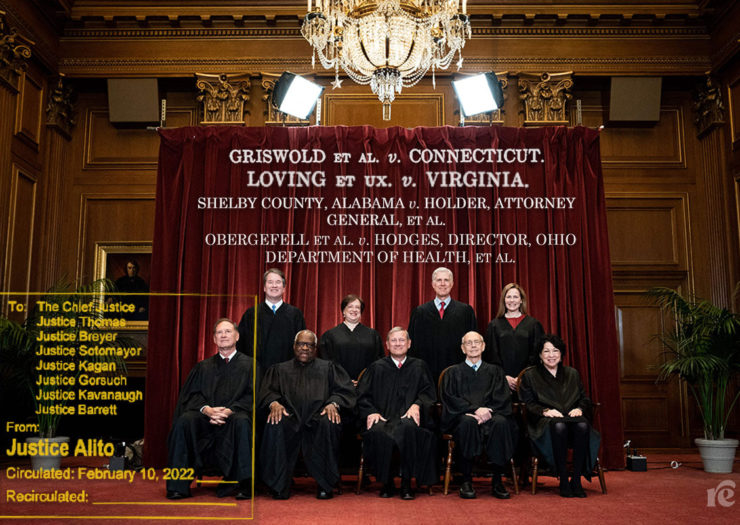
The United States can become a country where the rights and privileges of liberty are consolidated in the hands of a white Christian male-dominated nationalist minority—because quite frankly, we’ve been this country before.
 Erin Schaff/Getty Images/Rewire News Group illustration

Conservatives have been working toward this moment for decades—and they’re not slowing down after, either.

The Supreme Court draft opinion that would overturn Roe v. Wade and end abortion rights in this country is likely to be released formally soon, fulfilling a 50-year fear of activists—the official overturning of abortion rights in this country.

But that’s not where it will end with this conservative supermajority on the Court. They also want to erode: LGBTQ rights, voting rights, civil rights—and, yes, even with the horrific tragedy of the worst and most recent mass shootings—the little gun control that exists because this was always part of a larger plan.

I came to work in politics because of the many issues I care about—such as reproductive rights and justice—but my career came in part because of a deep interest and education in history. I wanted to know more about the people who worked so hard in their opposition to abortion rights, and it was there that I found my answer about how all this is related to movement to convert (or revert) our nation to a white, Christian nationalist country.

While Roe v. Wade became the law of the land in 1973, the religious community in the United States actually didn’t mobilize around abortion. In fact, they began to mobilize around race desegregation in their schools because a new civil rights law stated that schools that were deemed racially discriminatory could not qualify for IRS exemption. An astute, religious former political staffer (and then-recent co-founder of the Heritage Foundation) named Paul Weyrich had been toying with ways to organize conservatives in the religious community on issues including abortion, but nothing quite landed.

In the IRS exemption fight, he finally found the pressure point with religious leaders, like Liberty University founder Jerry Falwell Sr., who did not want to desegregate their private white Christian schools. Weyrich believed deeply in fusing evangelical faith with politics, writing in 1970:

The new political philosophy must be defined by us [conservatives] in moral terms, packaged in non-religious language, and propagated throughout the country by our new coalition … . If the moral majority acts, results could well exceed our wildest dreams.

The words “moral majority” became the name of Falwell’s religious political organization, and thus the modern white evangelical conservative political movement was born.

In this white evangelical religious political movement, the origins of voter suppression as a tool to win can be found in a prescient speech Weyrich gave at a 1980 convention of white evangelical faith leaders, where Falwell and Ronald Reagan were in attendance.

“Now many of our Christians have what I call the ‘goo-goo syndrome.’ Good government. They want everybody to vote. I don’t want everybody to vote,” Weyrich said. “Elections are not won by a majority of people. They never have been from the beginning of our country, and they are not now. As a matter of fact, our leverage in the elections, quite candidly, goes up as the voting populace goes down.”

In 1980, Reagan won the presidential election, and by the 1984 election, a rise in self-identified evangelical Christians voting Republican (partly in response to the social changes of the 1960s and 1970s) committed the GOP further to white evangelicals. In their 1984 platform, Republicans reversed their party’s once formal support for the Equal Rights Amendment, introduced support for a constitutional ban on abortion (which included support for federal judges who opposed abortion), and support for voluntary prayer in schools.

Over time, the Republican Party platform came to formally include opposing LGBTQ rights. And as we know, the Republican partnership with white evangelicals is felt to this day. Three-fourths of white evangelicals voted for Trump in the 2020 election, and they make up two-thirds of the party’s rank and file members, according to CNN. It was mostly Republican lawmakers who led the passage of 1,336 abortion restrictions in states across the country, 44 percent of which passed in the last decade alone. Republicans also passed a number of anti-LGBTQ bills across the country using the 2004 re-election of George W. Bush to push same-sex marriage bans in multiple states.

Today it’s anti-trans and nonbinary legislation. Combine this with the “Southern Strategy” that President Richard Nixon fine-tuned in the 1970s to pander to white racial grievance, and you end up with the GOP-manufactured Black woman “welfare queen” and the “war on drugs” in the 1980s, the conservative protests and legal challenges to affirmative action in schools in the 1990s, and today’s railing against critical race theory in public schools along with banning books that acknowledge race, gender, and sexual orientation in ways they refuse to accept—just so they can win elections.

Over the last 40 years, though, the white evangelical electorate decreased while racial, ethnic, and religious minorities (including atheism and agnosticism) have increased in number. Around the same time, the nation’s first Black president, Barack Obama, was elected in 2008. Conservatives’ panic for power kicked into high gear. Organizations like the American Legislative Exchange Commission—which was co-founded by Weyrich and is funded in part by the Charles Koch Foundation and Charles Koch Institute—equipping conservative legislators with model legislation, from lowering taxes and corporate breaks to anti abortion, anti-LGBQ, pro-gun legislation, now included even more voter suppression legislation tactics for gerrymandering districts after the 2010 census.

While the conservative political and legislative arms were mobilizing, a conservative legal network called the Federalist Society was coming into power. Formed in the 1980s to challenge perceived left-wing ideology permeating law schools and the legal system, by the 2000s, it was becoming the place to vet legal conservatives and effect judicial appointments. In 2005 it helped scuttle Bush’s appointment of Harriet Miers to the Supreme Court, and in her place, he appointed Samuel Alito, the lead writer on the leaked draft opinion to overturn Roe v. Wade.

So it is unsurprising that the draft opinion in Dobbs v. Jackson Women’s Health Organization also confirms the conservatives’ next logical steps. Using the 14th Amendment, Alito questioned Roe‘s legal grounding as he also questioned and cited landmark rulings on gay rights, Obergefell v. Hodges and Lawrence v. Gaines. To him, and, evidently, the Court’s conservative majority, they are not rights “deeply rooted in the nation’s history and tradition” and “implicit in the concept of ordered liberty.” The Supreme Court also used the 14th Amendment to establish the right to an equal education with the ruling of Brown v. Board of Education, the right to interracial marriage in Loving v. Virginia, and the right to contraception through Griswold v. Connecticut and Eisenstadt v. Baird.

All of these rulings and more, legal analysts surmise, are in danger. And given the National Rifle Association’s reach with the GOP, those same conservative justices are eager to use their long sought after perch to eradicate gun control laws in politically liberal governed states like New York because of their beloved Second Amendment.

White evangelical conservatives are a voting minority in this country. They can be outvoted at the polls—they know this, which is why voting rights suppression was a critical piece of their work to enact their white evangelical Christian nationalist agenda. But not everyone accepts this. There are many elected officials, pundits, journalists, and strategists who don’t believe our country can become this extreme—even after the January 6, 2021 insurrection attempt to stop the peaceful transfer of power.

Understandably, it’s shocking to absorb given how far we have come since the mid-20th century. But the United States can become a country where the rights and privileges of liberty are consolidated in the hands of a white Christian male-dominated nationalist minority—because quite frankly, we’ve been this country before. What do you think these folks meant when they talked about missing the good old days where “men were men and women were women” or things weren’t “sanitized with political correctness”? Their frustration over “identity politics” is because they don’t like when those who have been politically marginalized, like people of color, disabled people, and LGBTQ folks, start to finally have political and economic power.

The sooner everyone begins understanding that these are people who will fight tooth and nail against a multiracial, multireligious, and multiethnic democracy no matter what it takes, the sooner we can work to organize against them effectively and protect the folks who could be harmed.

Source: https://rewirenewsgroup.com/article/2022/06/14/for-conservatives-ending-legal-abortion-is-just-a-pit-stop/

GETTY IMAGES

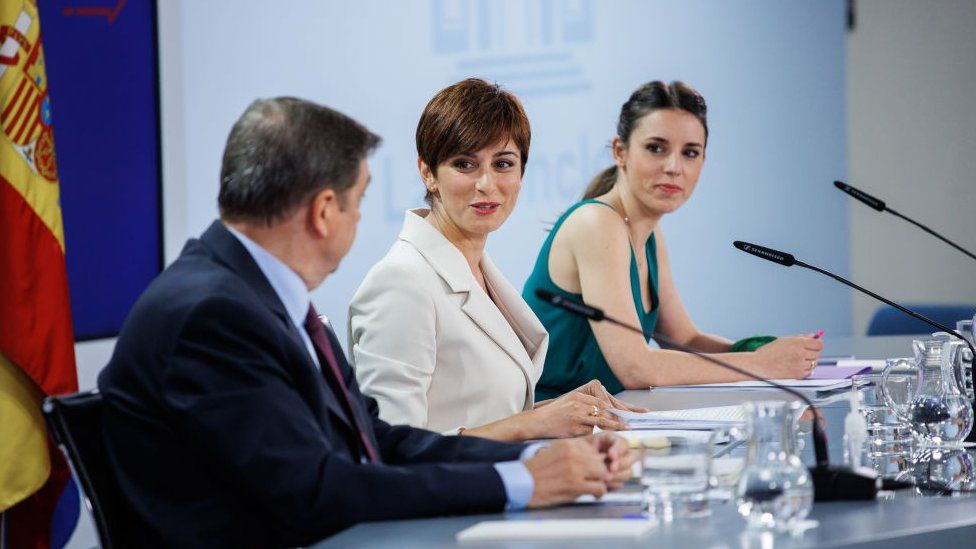
Spain has approved a draft bill that would remove the requirement for 16 and 17-year-old girls to have parental consent before terminating a pregnancy.

The new bill is aimed at reforming a previous abortion law approved by the conservative People’s Party in 2015.

Government spokeswoman Isabel Rodriguez said the bill represented “a new step forward for democracy”.

If the bill is approved, Spain will become the first country in Europe to offer its workers paid menstrual leave.

In Spain, voluntary abortion is allowed up until the 14th week of pregnancy.

But doctors in traditionally Roman Catholic Spain will still be able to sign up to a register of conscientious objectors, El País reports.

Equality Minister Irene Montero said government institutions had to “discard taboos, stigmas and guilt regarding women’s bodies”.

The sexual and reproductive health bill also aims to give employees three days of sick leave for painful periods, the draft says, potentially extending it to five days for particularly intense or incapacitating pain.

Spain says the state social security system, not employers, will pay for this sick leave.

Abortions for 16 and 17-year-olds and sick leave for severe menstrual pain are all components of the new bill.

Spain has also said it will impose tighter restrictions on surrogacy, which is already banned in the country.

The government has pledged to go one step further and ban advertisement for surrogacy agencies.

It says surrogacy is a form of violence against women and categorises any type of forced pregnancy, abortion, sterilisation or contraception in the same way.

The proposals in the sexual and reproductive health bill aim to boost the development of hormonal contraception for men, stressing that contraception is not the responsibility of women alone.

Spain’s left-wing coalition government came to power almost four years ago and has made women’s rights one of its key areas.

Source: https://www.bbc.com/news/world-europe-61483868

“I’m proud that we were able to provide a model for them—a blueprint for folks to refer to,” Shannon Olivieri Hovis, director of NARAL Pro-Choice California, said about how California is serving as a model for other states.
 Austen Risolvato/Shutterstock/Rewire News Group

From working to enshrine abortion rights into the state constitution and become a “sanctuary” for access, California is becoming a blueprint for other states.

It’s inevitable that Roe v. Wade will be overturned, throwing abortion access and rights into further chaos in this country. Thanks to Justice Samuel Alito’s leaked draft opinion, whether the Supreme Court overturns Roe in its ruling in Dobbs v. Jackson Women’s Health Organization seems to be a matter of when, not if.

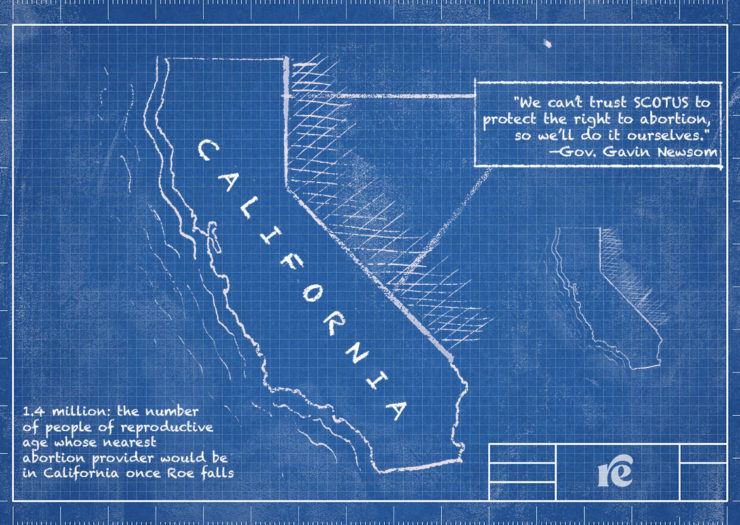
When Roe falls, the number of people of reproductive age whose nearest provider would be California would be up to 1.4 million—or a staggering increase of nearly 3,000 percent, the Guttmacher Institute estimates. Since the leak, California lawmakers have been moving to protect abortion access.

On Wednesday, the California Senate introduced a bill to enshrine abortion rights—and explicitly mention the word abortion—in the state constitution. Similarly to Vermont, if the bill passes the California legislature, the amendment would go before voters in the November election; however Vermont’s Prop 5 does not say abortion, as Politico reported.

But even before the leaked draft opinion was published earlier in early May, the state was digging heels into the silt, preparing to safeguard abortion access in anticipation of the Court’s ruling in Dobbs v. Jackson Women’s Health.

Last December, the California Future of Abortion Council, which includes providers, researchers and advocacy groups, released 45 policy recommendations to strengthen and expand abortion care in the Golden State. A package of 13 legislative bills, which were created from the recommendations, advanced out of its “house of origin” in late May. The package covers a swath of issues about abortion access like protecting patients and providers from criminalization and boosting infrastructure to cover an influx of out-of-state patients who’ll travel to California for care.

Democratic Gov. Gavin Newsom, who started the council last fall, seems undoubtedly focused on securing abortion rights in California: Last month, he announced a $125 million budget increase for reproductive health and in December said the state would be a “sanctuary” for abortion access.

California is setting a precedent for other states to follow.

“We can’t trust SCOTUS to protect the right to abortion, so we’ll do it ourselves,” Newsom tweeted.

A shield for access

Around 40 percent of California counties have no clinics that provide abortions, as of 2017.

Despite this, California is poised to be a refuge for abortion and serve not only its residents but patients from all over the country whose states have enacted extreme abortion laws or “trigger” bans that will immediately outlaw abortion once the Supreme Court overturns Roe.

However, as Brandon Richards, director of communications for Planned Parenthood Affiliates of California, notes that even in counties that do have a provider, a host of issues—traveling time, lack of accessible public transportation, language barriers, and the inability to take time off work—can leave care out of reach.

Since Texas SB 8 went into effect nine months ago, California’s Planned Parenthood clinics have seen an increase of 500 out-of-state patients a month, Richards said.

“Out-of-state patients are at least three times more likely to be seeking abortion services than Californians when visiting a California Planned Parenthood with the majority of the patients coming from Arizona and Texas,” Richards said.

Planned Parenthood is not the only abortion provider in the state, which means “these numbers are only a fraction of the real picture on the ground,” Richards added.

Gearing up for a rush of patients

Is California equipped for the influx of patients? That’s a question that Shannon Olivieri Hovis, director of NARAL Pro-Choice California, receives frequently, to which she responds that the state already provides more abortions than its proportion of the national population.

The state provides 1 in 6, or around 17 percent, of abortions in the country, and California accounts for about 12 percent of the U.S. population.

SB 1375, introduced by Senate President Pro Tempore Toni Atkins, who formerly operated women’s health clinics, seeks to expand providers by allowing nurses, nurse practitioners, and midwives to provide first-trimester abortions without a doctor’s oversight after undergoing training.

Increasing staffing, appointment slots, and expanding or building new facilities are some of the ways that Planned Parenthood is gearing up for the anticipated volume of patients, Richards explained.

To cover cost burdens, Newsom signed into law this year a bill that prohibits health insurance plans from charging co-pays and deductibles for abortion services. For those without insurance, AB 2134 will provide grants to providers who offer uncompensated abortion care to uninsured or low-income patients.

But what if you can’t afford to travel here?

“Nothing will ever replace being able to access health care, including abortion care, where a person resides,” Richards said. Those who face abortion restrictions impact individuals who encounter persistent barriers most.

“We really must ensure that we keep in mind the folks who will not easily (if at all) be able to leave their state to access an abortion: Undocumented individuals, young people who may require parental consent, and of course, those who just can’t get the time off, the childcare, or the necessary resources to fly to another state and be away from work and family responsibilities for two to five days to access their abortion,” Jessica Pinckney, executive director of Access Reproductive Justice, the only statewide abortion fund, said in an email.

“There will be some who cannot travel to California for the care they need or desire, but we’re working here in CA to reduce as many barriers to accessing care here as humanly possible.”

In the legislative package, some of the bills seek to address these potential disparities and ensure that people “can access their abortions without financial burden or barrier,” Pinckney said.

“If SB 1142 passes, the state will provide funds to practical support organizations that do defray costs for travel, as well as lodging, childcare, food, doula support and more,” Pinckney said.

Protection from criminalization

“Abortions can and will continue to take place in a variety of environments and we need to do everything possible to ensure people are not criminalized for self-managing abortion or making the decisions that are best for themselves, their families and their communities,” Pinckney said.

AB 1666 will protect abortion providers and patients from civil liability when the laws are based on claims from hostile states. Connecticut recently signed a similar bill into law.

“The mechanism to do that is to ensure that provider assets cannot be seized, essentially, based on laws from hostile states and against California’s public policies,” Hovis of NARAL said.

Another bill, AB 2626, will prevent abortion providers from having their licenses revoked or suspended.

“It is unconscionable to me,” Hovis said about the idea that a California telehealth provider offering medication abortion in another state could be extradited to that state and face criminalization.

“We need to make sure that we can protect against all of these different scenarios,” Hovis said, adding that this is “an ongoing conversation about how we do everything that we can to protect folks.”

The quickly shifting landscape of abortion access and legislation throughout the country will likely continue to inform how California shapes its policies. In response to the Supreme Court’s leaked draft opinion, California proposed an amendment to enshrine abortion rights in the state’s constitution.

Other states seem to be taking note, which advocates say is encouraging.

Sixteen states and the District of Columbia have laws that protect the right to abortion, according to Guttmacher, and other states currently have bills under consideration to safeguard and increase abortion access.

“I’m proud and relieved at the same time that we are not going at this alone,” Hovis said. “There are so many states that are really trying to do the same kinds of things that we are doing, and I’m proud that we were able to provide a model for them—a blueprint for folks to refer to.”

Source: https://rewirenewsgroup.com/article/2022/06/10/how-california-plans-to-serve-the-nation-and-safeguard-abortion/

I’d be directly affected by Oklahoma SB 1100 because I would never be able to have my birth certificate match my gender identity.
 Cage Rivera/Rewire News Group illustration

Oklahoma’s gender marker ban is just one injustice in a long list the state has enacted, including a total abortion ban and a trans sports ban.

In the past year, attacks against LGBTQ folks, especially trans, nonbinary, gender nonconforming, and two-spirit individuals, have been escalating in legislative bills across the country. Oklahoma has been one of the most volatile states in these attacks, from banning trans kids in sports and essentially banning abortion in the state to advancing bills that would out queer and trans students to their parents if they disclose their identities to school counselors. The legislative violence against queer and trans people in Oklahoma continues with each week of the 2022 legislative session.

Although I have lived in California for a long time, starting as a child actor flying between Los Angeles and New York City, I was born and raised in Tulsa, Oklahoma, which is why Gov. Kevin Stitt and the Oklahoma legislature have been on my watch list. And now, the state’s attacks against LGBTQ people have directly affected me as a queer, nonbinary person.

Learning about organizations like Freedom Oklahoma, a statewide LGBTQ advocacy organization that tracks state bills and provides public education on the legislature, gave me the connection I desired in being able to keep tabs on what Oklahoma was doing. While the news focuses on other prominent states like Texas and Florida, a lot of the reporting on Oklahoma comes after bills have been passed in the state house and are on their way to Stitt’s desk. At that point, it generally is too late. So I started using the bill tracker database that Nicole McAfee, the executive director of Freedom Oklahoma, compiles weekly during the legislative sessions, which is when my heart stopped while reading about SB 1100.

SB 1100 bans third gender markers (aka, X) on birth certificates and refuse corrections to amend birth certificates, thereby erasing Oklahoma’s trans, nonbinary, two-spirit, and gender nonconforming communities. As it made its way through committees and began rapidly going through the legislative process, it was largely ignored by national news outlets. It seemed that the only people discussing it were trans and nonbinary people, including Oklahoma state Rep. Mauree Turner, who is the first nonbinary state legislator in the country and one of the few out nonbinary people in U.S. politics.

As I connected the dots and realized I’d be directly affected by this bill because I would never be able to have my birth certificate match my personhood, I panicked. How would this affect changing my passport? What happens if I have to provide my California driver’s license and my Oklahoma birth certificate any time I book a job and they don’t match?

It has genuinely been a fearful and stressful time for all of Oklahoma’s gender expansive community. But in my trying to sound the alarm and build power against SB 1100, I was met with virtual silence outside of queer and trans people who knew what was at stake.

While I have been out publicly as nonbinary since 2018 and used she and they pronouns (primarily using they, but was OK with she here and there), the pandemic, sudden death of my father in August 2020, and the aftermath of that trauma made me reassess my identity and relationship with being gender expansive. I realized I was holding onto ideas of gender that did not serve me—and had not served me in a long time. I was only holding on for fear of professional backlash (of which I had already suffered career backlash coming out publicly as bisexual and some form of nonbinary). In reality, life is too short to not live as authentically as who you actually are, and in my youth, I was not given the vocabulary and resources to explore and discover my identities.

With incredible support from my partner, my reps, and my friend network, I dropped the she pronoun and solely use they/them now, and I began to look into gender affirming care, including the processes of changing my documents to reflect my personhood. In California, the ability to self-report gender changes is a recent development; prior to self-reporting, a doctor or a therapist had to sign off on gender marker changes for driver’s licenses. California is also one of a handful of states to allow gender changes on both birth certificates and driver’s licenses or state IDs. The day I marched into the DMV to change my gender on my driver’s license when getting my California REAL ID was one of the coolest days in my life, and getting my brand-new ID with “X” on it in the mail was a day filled with ugly crying and feeling like a weight was lifted off my shoulders.

Then I discovered that it would be the complete opposite in Oklahoma.

While I consider myself a Californian now, I still have major ties to Oklahoma; both of my parents are from there, and when he was alive, my father was a prominent attorney in the state. He once earned the moniker of “scariest attorney in Oklahoma” for his work in workers’ compensation and malpractice as well as a multistate mediator, and he was even published for his work on class actions against pedicle screws and going after gun manufacturers. I always kept an eye on Oklahoma’s politics because while folks want to write it off as a “red” state, in reality, there are progressive pockets of the state that want a better society, and those pockets have incredible organizers and advocates building community.

While the Biden administration announced on March 31—on Trans Day of Visibility—that people could soon apply to have the X gender marker on their passports without medical documentation, it provided little comfort. In the same week, SB 1100 passed an Oklahoma house committee, and then in late April, Stitt signed it into law. Turner tweeted, “Have you ever had your colleagues vote on your personal documentation, which will ultimately affect how you show up, right in front of your eyes and say nothing to you about it?” It was a gut punch.

Shortly after Stitt signed SB 1100 into law, the Oklahoma legislature passed the nation’s strictest abortion ban, which Stitt signed into law about two weeks ago. While folks tend to get incredibly binary and gendered when talking about reproductive rights, abortion access is lifesaving health care for all, and coupled with SB 1100, the erasure of gender diverse individuals who have a uterus is incredibly damaging and mentally draining.

But the one thing I know about Oklahomans is that we are resilient, especially queer, trans, and gender expansive Oklahomans. We know we are fighting an uphill battle, but we also have the people on our side. Oklahoma will most likely face lawsuits for its discrimination against trans and nonbinary individuals between the trans sports ban, prohibiting gender marker changes, and other bills attacking trans youth and gender affirming care. We will continue to build power against them. We just need cis folks who say they are allies to pay attention and show up to do the work.

This is not a “vote harder” situation—Oklahoma has some wild gerrymandering and voter suppression tactics. This is a community organizing situation, and power can be built anywhere, even from 1,500 miles away. Keep your eyes on Oklahoma and other states besides Texas and Florida; at any point, legislation attacking trans people, like the heartbreaking ban of gender affirming care for trans youth in Alabama, will pop up, and we need collective power to stop these assaults on our communities.

Source: https://rewirenewsgroup.com/article/2022/06/08/oklahoma-lawmakers-dont-want-my-birth-certificate-to-match-my-gender-identity/

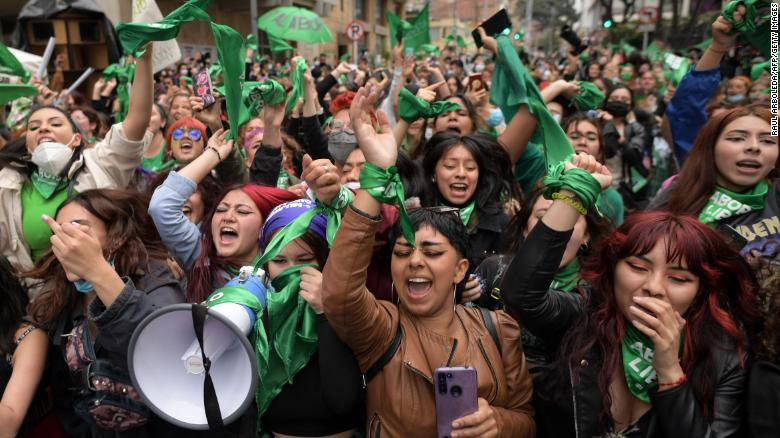
Abortion rights activists in Bogota, Colombia, celebrate the High Court’s February decision to decriminalize abortion.

Bogota, Colombia (CNN) – The prospect of the United States overturning decades of abortion rights, which materialized this week in a leaked draft opinion by Supreme Court Justice Samuel Alito, triggered shock waves in many countries in Latin America, where many feminist organizations have often looked at the US as a model of greater reproductive rights and freedoms.

However, that model has flipped on its head in recent years. Just as several US states have put in place further barriers to abortion access through various restrictions, some countries in Latin America have moved in the other direction, with a growing number of countries liberalizing such laws.

Laura Gil, a gynecologist and abortion rights activist in Bogota, Colombia has experienced this turnaround firsthand. “I remember we would meet with health professionals in the US, and for years they would always look at us with admiration for our struggle to expand reproductive rights. Now it’s the opposite,” she told CNN.

The doctor was in Florida when news of the leak broke on Monday. Her US colleagues were disparaged, she said. “They come from an environment where abortion is legal, while for us, abortion used to be banned and now it’s not,” she said.

Gil was at the forefront of a yearslong popular campaign to legalize abortion in Colombia, a movement that achieved its goal in February when the Constitutional Court ruled in favor of legalizing abortion up until 24 weeks of a pregnancy.

Colombia’s decision followed similar recent measures in Mexico and Argentina, where abortion rights advocates demonstrating collectively as the “green wave” — the color of choice for the movement — celebrated their victories.

Argentina’s Senate voted to legalize abortion up to 14 weeks in December 2020, making the country the largest nation in Latin America at the time to legalize the practice.

In September, Mexico’s Supreme Court unanimously ruled that penalizing abortion is unconstitutional, a decision expected to set precedent for the legal status of abortion nationwide, although individual states have moved at different paces on its implementation.

And just last month, after years of court battles, Ecuador took a first step to liberalize its laws by legalizing abortion for pregnancies that occurred as a result of rape up to 12 weeks.

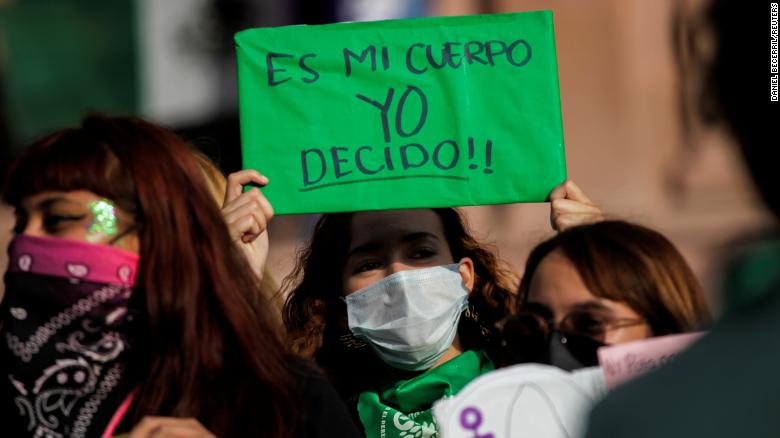
A woman holds up a banner that reads "My body, I decide" in Saltillo, Mexico, after the country's Supreme Court ruled that penalizing abortion is unconsitutional in September.

A woman holds up a banner that reads “My body, I decide” in Saltillo, Mexico, after the country’s Supreme Court ruled that penalizing abortion is unconsitutional in September.

Valuable lessons

Now that it appears the tables could be turning, some Latin American activists say they can offer valuable lessons to their US counterparts to defend the right to abortion.

Giselle Carino, an Argentinian political scientist who took part in the campaign for legal abortion in her country, now serves as the New York-based CEO of Fos Feminista, a feminist alliance of more than 170 organizations around the world.

“I look at Argentina with a lot of pride, of course, because that was a truly democratic effort,” Carino told CNN.

“It took 20 years for us, and we had many defeats. When we succeeded, it was because mobilization was huge: People would talk abortion at the dinner tables, in bars, cafes — and at the same time we managed to put women in positions of power. We elected feminist representatives who would try to expand our struggle,” she said.

“Those were the two lessons: To make abortion a mainstream topic and to advance through political victories, bit by bit,” she added.

Abortion rights activists celebrate in Buenos Aires after Argentina's Senate approved a bill to legalize abortion up to 14 weeks in December 2020.

Abortion rights activists celebrate in Buenos Aires after Argentina’s Senate approved a bill to legalize abortion up to 14 weeks in December 2020.

Carino points to Donald Trump’s presidential win in 2016 as a turning point for abortion rights. “This is his legacy because, who put those judges to the Supreme Court? It’s a legacy of authoritarianism and attacks on basic human rights. When you elect a leader like Trump, the damage is far more profound than four years in power,” she said.

But Carino views the striking down of Roe v. Wade as far from a defeat. Instead, she sees it as a call for progressive activists to renew their struggle for full reproductive rights and as an opportunity to elect politicians who support those goals in the upcoming US midterm elections.

“The US know how to put people in the street, look at Black Lives Matter. Now it’s the time to elect feminist leaders,” she said.

Despite the marked gains for the pro-abortion movement in some Latin American countries, activists still worry about the fragile state of abortion rights in several nations across their region.

Social justice

Society has long been hostile to women seeking abortion in Latin America, where the Catholic church remains a major influence, although the influence of Protestant churches are increasingly impacting policies in countries such as Brazil.

In many Latin American countries, women face prosecution and lengthy jail sentences for the procedure — and in some countries, for even for miscarrying.

In El Salvador, for example, Sara Rogel spent almost 10 years in prison after being convicted of murder after she lost her pregnancy in what she said was a fall at home when she was 22 years old.

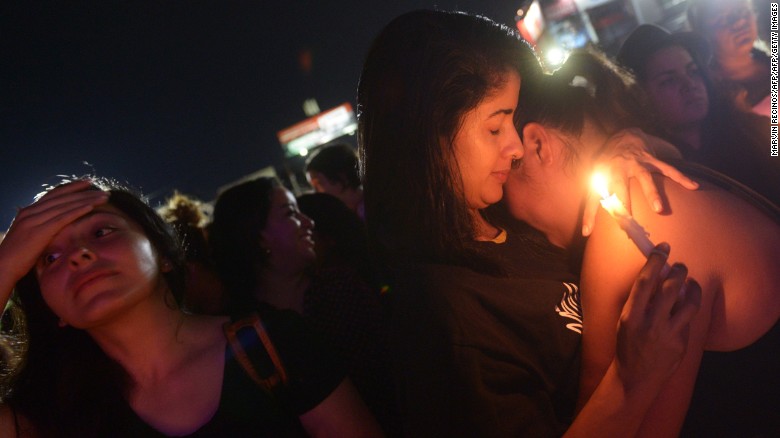
Activists in El Salvador demonstate against gender-based violence and in favor of abortion rights in San Salvador in 2016.

Activists in El Salvador demonstate against gender-based violence and in favor of abortion rights in San Salvador in 2016.

Abortion rights activists fear that that could be the state of some US states in a few years’ time.

“A great victory of the feminist struggle in Latin America is to show that abortion is a social justice issue,” says Luisa Kislinger, a Venezuelan abortion rights activist who now lives in the US.

Venezuela only allows abortion when the life of the pregnant person is at risk, with thousands of clandestine abortions performed in the country each year by people who can’t afford to travel abroad for the procedure, Kislinger told CNN.

While data on illegal abortions is hard to collect, organizations such as Faldas-R, a Caracas based NGO that provides counseling to people looking to terminate their pregnancies, say that more than 70% of the people seeking their assistance live in poverty.

“In Venezuela, abortion is effectively off limits for poor women, and that often means Black women, indigenous, disabled… all these are minorities,” Kislinger said.

“It’s exactly what might happen in the US, because communities like African Americans, Latinos, or migrants often do not have the resources to receive an abortion (there too),” she said.

Data from the Guttmacher Institute, a research organization that supports abortion rights, supports this concern.

Abortion is “increasingly concentrated among low-income women,” according to the group, which says that “women who are low-income and lack insurance coverage for abortion often struggle to come up with the money to pay for the procedure.”

“As a result, they often experience delays obtaining an abortion or are forced to carry their unintended pregnancy to term.”

This fall, Latin American abortion rights activists will have all eyes on Brazil, where presidential front runner and former president Luiz Inácio Lula da Silva recently said everyone should be allowed to access an abortion.

Da Silva and incumbent Brazilian President Jair Bolsonaro — who is a staunch opponent of legalizing abortion — are likely to go head-to-head in October’s elections. Brazil’s own Ministry of Health acknowledges that the country is among the top 25% of countries with the most restrictive abortion laws.

By the time Brazil chooses its path, in the US, a federal right to abortion could well be a thing of the past.

Source: https://edition.cnn.com/2022/05/07/americas/abortion-analysis-latin-america-activists-intl-latam/index.html

GETTY IMAGES

Medical leaders in the UK have launched a fresh call for buffer zones to be set up around abortion clinics to prevent activists targeting patients and staff.

The Faculty of Sexual and Reproductive Healthcare (FSRH) wants a nationwide network of legally-protected spaces to be set up to shield patients from harassment and intimidation.

Anti-abortion groups said their gatherings are designed to offer help.

The government says it is reviewing the issue in England and Wales.

It comes as Scotland’s First Minister, Nicola Sturgeon is expected to chair an emergency summit on buffer zones next month. She has said the Scottish Government is now “actively considering” how Holyrood can legislate on the issue.

The UK’s first so-called buffer zone was set up outside an abortion clinic in the London borough of Ealing in 2018.

Pro-choice campaigners had hoped buffer zones would become the norm. But only two more have been created in England since 2018.

The FSRH represents more than 14,000 UK doctors,

FSRH president Dr Asha Kasliwal said harassment and intimidation outside clinics affected both patients and staff and caused “great distress” for women and girls accessing abortion care.

“The only way to ensure patients are able to access healthcare free of harassment and intimidation is the legal implementation of buffer zones,” she said.

Anti-abortion campaigners described their gatherings outside abortion clinics as prayer vigils meant to offer support and said that rolling out buffer zones would “criminalise prayer”.

‘Unacceptable’

The British Pregnancy Advisory Service said 50 new clinics had been targeted by protesters in England and Wales since 2018.

Dr Edward Morris, president of the Royal College of Obstetricians and Gynaecologists said abortion care was “an essential sexual and reproductive health service” and buffer zones “must be introduced to ensure that the privacy and rights of those who access these services are respected”.

“The harassment and ongoing intimidation of women and staff outside of abortion clinics is unacceptable and would not be tolerated for any other healthcare service,” he added.

The idea of buffer zones for England and Wales was rejected by the government in 2018, following a review.

But in 2020 Home Secretary Priti Patel pledged the government would again review the rules around protests in the vicinity of abortion clinics.

An amendment to the Public Order Bill to introduce protest-free areas around clinics has been tabled by a cross-party group of MPs and is expected to be debated in June.

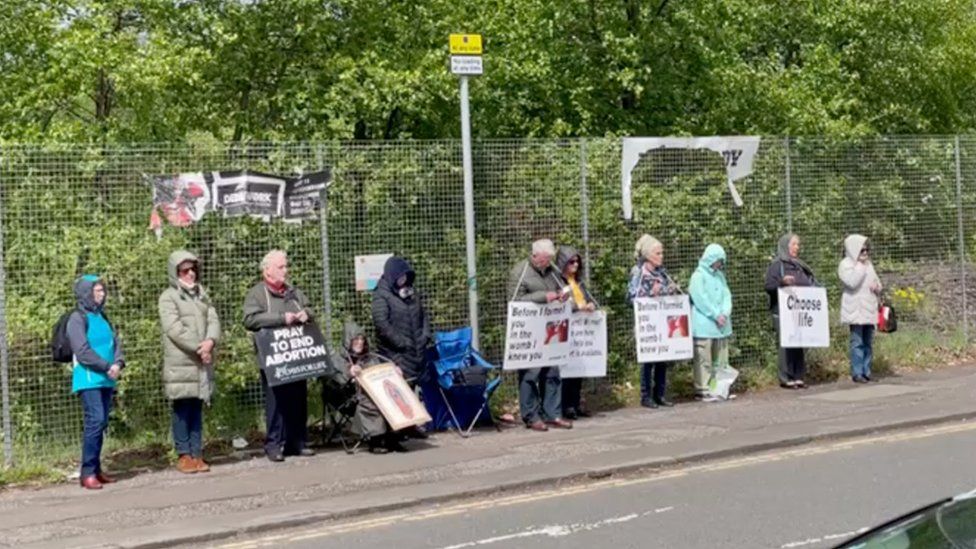
40 Days for Life campaigners outside Queen Elizabeth hospital in Glasgow
Image caption,In April more than 100 people attended a vigil outside Queen Elizabeth University Hospital Glasgow

The Home Office said police and local authorities already have powers to restrict harmful protests but confirmed buffer zones remains under review.

A spokeswoman said: “The right to protest is a vital part of a democratic society, but it is completely unacceptable that women accessing healthcare services should feel harassed or intimidated.”

Source: https://www.bbc.com/news/uk-61624480

Reproductive rights activists are worried about women losing abortion access in parts of the United States. Economists are worried, too, because restricting reproductive freedom comes at an economic cost to the nation.

The US Supreme Court may be poised to overturn the landmark 1973 Roe v. Wade ruling as soon as next month, as indicated by a recently leaked draft opinion. Thirteen states have trigger laws that would immediately ban abortions if the ruling was overturned.

The decision is widely thought to be more ideologically and politically motivated, rather than driven by an attempt to protect women from worse outcomes. Those might include financial hardship, restricted ability to attain a higher education and move up the socio-economic ladder, as well as overall poorer health outcomes for women reliant on clinics for preventative care. All of this would affect the state of the workforce, economic output and increase the need for government support, economists say.

The consequences are likely so extensive and far-reaching that it is hard to quantify them, said Jason Lindo, professor of economics at Texas A&M.

It also comes at a time when the share of women in the labor force, which dropped dramatically during the Covid recession, has still not recovered to pre-pandemic levels.

The economic burden

Taking away a woman’s right to choose if and when she has a child has serious consequences for her career and economic circumstances, Lindo told CNN Business.

Last week, Treasury Secretary Janet Yellen told lawmarkers during a hearing that restricting women’s reproductive rights would have “very damaging effects on the economy.”

“Roe v. Wade and access to reproductive health care, including abortion, helped lead to increased labor force participation,” Yellen said. “It enabled many women to finish school. That increased their earning potential. It allowed women to plan and balance their families and careers.”

Last year, after Texas lawmakers moved to effectively ban abortion in the state, 154 economists filed an amicus brief with the Supreme Court in support of maintaining reproductive freedoms in the United States so that women can realize their full economic and educational potential.

Data from the prominent Turnaway Study from the University of California San Francisco, shows that household finances are a major driver of the decision to terminate an unwanted pregnancy. An analysis of the data by the National Bureau of Economic Research shows that the majority of women seeking to terminate a pregnancy near the gestational limits had incomes below the poverty line.

Women who were denied an abortion, meanwhile, had higher rates of poverty, higher unemployment and greater need for government assistance. This, in turn, affects the economic well-being and prospects of their children, according to economists.

“There is a huge [body of] literature showing long-run effects of the economic circumstances of the household in which a child grows up. On educational attainment, adult earnings, use of social assistance programs, involvement in crime, etc. The list goes on and on,” said Lindo.

Health and safety

Economists are also worried that overall female health care will suffer as a result of restricting or prohibiting abortions. For many women, clinics that offer family planning services are often also the local option for preventative care, including cancer screenings and pap tests. Having easy access to these clinics plays a crucial role in their health care.

“When distance to the nearest clinic increases, rates of preventative care go down,” said David Slusky, associate professor of economics at the University of Kansas. And that can lead to worse health outcomes.

“If a woman of childbearing age dies, it has enormous economic consequences,” he added. “It’s someone who society has invested in and who has many productive economic years ahead of them.”

Source: https://edition.cnn.com/2022/05/14/economy/abortion-restriction-economic-impact/index.html

PHOTO: GUY SMALLMAN/GETTY IMAGES

A British anti-abortion group that gives talks in schools has received over £72,000 from the US over the last 2 years, VICE World News can reveal.

An anti-abortion group in the UK that gives talks to schoolchildren and medical professionals about what it terms “coerced abortion” is receiving tens of thousands of dollars from anonymous US-based backers, VICE World News can reveal.

Nearly £73,000 ($91,885, €85,330) has been donated anonymously via a donor agency called NPT Transatlantic in the past two years to the Society for the Protection of the Unborn Child’s (SPUC) registered charity, one of the UK’s most active anti-abortion groups. The agency allows US and UK taxpayers to donate to organisations across the Atlantic without revealing their name and without qualifying for any tax deduction.

It is believed to be the first time that a donation of this kind – from a US donor to a British anti-abortion group – has been revealed. 

While experts have been aware that funding may have been happening for some time, many groups have set up private companies or process grants through shell charities in order to hide where the money is coming from or going, or support has been targeted at providing resources for individuals, like the organiser of a recent anti-abortion protest outside a Scottish abortion clinic. 

In its accounts, SPUC said it used the funding to teach primary school children about development in the womb and to organise a conference “aimed at medics to help them understand the tell-tale signs of coercive control from partners, sex traffickers, parents etc. who may force a woman/girl to have an abortion against her will” and to “train medics to recognise and prevent cases of coerced abortion.” 

Rachael Clarke from the British Pregnancy Advisory Service said that the funding was “deliberately obfuscated and shadowy” and that the group’s agenda “dangerously blurs the lines between value judgement and social and clinical reality.”

Ruth Wareham, Education Policy Researcher at Humanists UK, said: “Any external organisation delivering Relationships and Sex Education [RSE] in schools ought to be doing so in a factually accurate, balanced manner, not using it as a vehicle to spread harmful, ideologically driven anti-abortion messages. 

“The fact that SPUC is disingenuously trying to link their agenda to the very real problems of sexual coercion, abuse, and trafficking is particularly alarming. It also flies in the face of Government guidance which says that RSE teaching resources must be evidence-based and feature robust facts and statistics.”

Pam Lowe, Senior Lecturer at Aston University who researches anti-abortion sentiment in the UK, says that in Britain “the overwhelming majority of anti-abortion activists are motivated by conservative Christian beliefs” where women are seen as natural mothers, and that the high proportion of abortions is explained by seeing “all abortion as an outcome of pressure and coercion. This could be direct from partners, friends or family members, or indirectly from cultural ideas. 

“By exposing, and giving support from this alleged coercion, anti-abortion activists believe that they will give space to women to recognise their natural maternal feelings and reject abortion.”

Although coerced abortion does happen, experts believe that organisations such as SPUC are falsely inflating the issue to persuade individuals to support an anti-abortion agenda. On its website, information around coerced abortion does not reference the research that has said findings in this area “do not support the assertion that women are frequently coerced into abortions, but rather, that they are more often coerced into continuing a pregnancy.”

SPUC also seem to be involving what they call ‘DIY abortion’ in its materials around coercion, a term that they use to describe telemedicine abortion. Also known as pills-by-post or at-home abortion, telemedicine abortion is widely supported by health bodies and gender violence charities – but often erroneously labelled by anti-abortion groups as ‘DIY abortion’ to make it sound less safe. 

Recent legislative changes around telemedicine abortion in England and Scotland have made the practice permanent after countries introduced it during the pandemic. SPUC was active in campaigning against this law change, and announced a flurry of new initiatives in May, many of which appear to discuss this type of abortion.

In a YouTube video posted on the 17th of May, SPUC’s education and outreach manager Emmet Dooley says that he has a new presentation on “coercion and DIY abortion”, in which he goes from talking about any form of coercion to a section on “how this drastic change in abortion law was pushed through at the beginning of the COVID pandemic; what the reality of at-home abortion looks like. We read some stories that made the news and we hear from a courageous girl who regrets her abortion.” 

Dr Jonathan Lord, consultant obstetrician and spokesperson for the Royal College of Obstetricians and Gynaecologists, said: “We are concerned that some anti-choice organisations and websites are providing biased and incorrect information that will further stigmatise abortion, and mislead young people to believe that at home early medical abortions are unsafe.

“The UK Government has approved the permanent provision of telemedicine for early medical abortions because there is a wealth of evidence to show that this telemedicine pathway is a safe and effective service which is preferred by women, and enables women to access abortion care sooner.

“It is vital that Relationships and Sex Education in schools provide factual, unbiased and evidence-based information about abortion care. All women and girls have the right to access non-judgemental abortion services, as an essential healthcare service.”

The presentation is one of nine that SPUC gives in schools as part of its “Love and Responsibility” package, which also teaches young people that sex is something to be “saved through the virtue of chastity.” Extensive research has demonstrated that comprehensive sex education delays sexual initiation and encourages safe sex practices more than abstinence-only education, which has additionally been found to promote sexist values

In the same video, Dooley states that these presentations have been delivered in 10 percent of Scottish schools and are now being made available in the UK. His Instagram account shows he has spoken at schools in the last month in London, Plymouth and Birmingham.

In early May, SPUC also announced an “innovative new drama-based approach to key topics within the Relationships & Sex Education curriculum, which respects and promotes pro-life values” called Life Voice. 

On its website, it states that the dramas are based on six real life testimonies surrounding crisis pregnancy and abortion. Its creative, cultural and youth development manager Tom Rogers said in a press release: “We have already delivered these sessions to over 1,000 students during our pilot period.” 

In an email to a teacher obtained by VICE World News, Rogers said that they would also be sending a play to the Edinburgh Fringe, the world’s largest arts festival that takes place in Scotland every year, about “coercion and sexting”. SPUC told VICE World News that all of Life Voice’s upcoming performances this summer and autumn were about abortion, but the Edinburgh Fringe confirmed that the performance they had listed from Life Voice also did not mention the word. 

Last month SPUC also ran two days of discussions with medical professionals in Edinburgh and London, where medics heard from anti-abortion speakers including a midwife who in 2014 lost a case in the Supreme Court that found she and a colleague did not have the right to avoid supervising other nurses involved in abortion procedures. 

“Anti-choice groups like to claim they are concerned about coercion, but the answer to reproductive coercion is more choice, fewer barriers, and stronger reproductive rights,” said Louise McCudden, advocacy and public affairs adviser at MSI Reproductive Choices. She added that 9 out of 10 people in the UK support abortion rights.

“They’re deliberately using language which implies there is no support, safeguarding or scrutiny. In fact, abortion is one of the most heavily regulated areas of healthcare,” she said.

“SPUC has no pretence at impartiality and has shared untrue information in the past. The idea that this organisation should be trusted to manage sensitive discussions with young people on complex topics is truly alarming.” 

McCudden added that the tactics anti-choice groups use to attack abortion rights in the UK is often “cut and paste” from the US. “Misinformation and feigning concern about young people are all textbook anti-choice moves from the US.”  

In a statement, SPUC’s executive director of public affairs and legal services Michael Robinson said:  “We agree with the Government that educational resources must be evidence-based and feature robust facts and statistics. We, therefore, follow this standard.”

SPUC did not respond to further requests for comment regarding the transparency of their US funding or claims that it links its agenda to other issues.

A spokesperson for NPT Transatlantic said: “NPT Transatlantic donors recommend grants that support a variety of organizations, all in good standing with the IRS or the Charity Commission of England and Wales (as applicable), which may be on differing sides of a cause. 

“NPT Transatlantic does not take a position on which causes our donors support, however we carefully follow strict due diligence procedures to ensure compliance with all applicable laws and regulations.”

Source: https://www.vice.com/en/article/93be83/anti-abortion-schools-uk

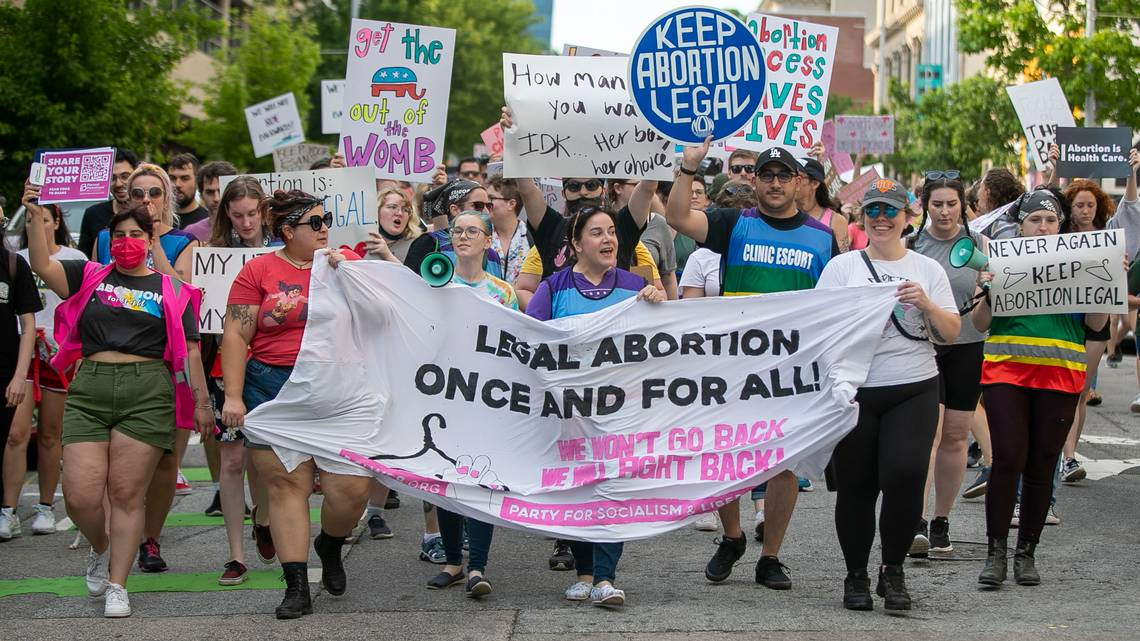
Hundreds of demonstrators marched down Salisbury Street in Raleigh on May 3, 2022, calling for the preservation of abortion rights after a leaked draft opinion of a Supreme Court decision indicated the court could be poised to overturn Roe v. Wade.

In the days following the leak of the Supreme Court draft overturning Roe v. Wade, a refrain kept appearing on parts of social media: “donate to an abortion fund.”

This call to action was different than previous ones, where people opposed to the rollback of reproductive rights were told to donate to Planned Parenthood, which provides abortions. Both are sound advice, but in different ways; abortion funds, in particular, were highlighted because of the way they help ease financial burden across the country, and can be beneficial to pregnant people in your home state specifically.

An abortion fund, in the simplest of terms, is a non-profit that helps people pay for an abortion when they need one. Here, we have Carolina Abortion Fund, which helps cover the cost of the service, transportation, lodging, and more in North and South Carolina.

Right now, an abortion costs $300 at minimum in North Carolina, and it gets more expensive the further along a person is in their pregnancy. Even when taking an abortion pill, North Carolina requires the patient to visit a doctor in-person, and requires them to wait 72 hours between their initial appointment and the procedure.

For some, $300 or more is inconvenient but not impossible. For others, like the 13 percent of people living in poverty in North Carolina — or even the half of the population making less than $56,000 annually — it’s a burden. Three hundred dollars is multiple shifts at many jobs and doesn’t account for the money lost if you have to take off work, buy gas, stay at a hotel, pay for childcare. CAF can’t pay for every single case in full – the fund received 4,000 requests so far in 2022 – but pledges about $260 per person on average.

Carolina Abortion Fund is part of the National Network of Abortion Funds, a network that helps provide money to individual funds and pays the four full-time staff members at CAF so that individual donations go directly to patients. CAF also has about 40 volunteers who help callers get connected to the funds and assistance they need.

The money for their services comes from grants and through individual donations. Carolina Abortion Fund is the only state-specific option in North Carolina, but there are others you can turn to. The Brigid Alliance, Indigenous Women Rising, and the Women’s Reproductive Rights Assistance Project are all national funds that financially support people seeking abortion.

Right now, abortion funds are necessary everywhere, but especially in a state like North Carolina, where getting an abortion comes with extra expenses and can be hard to access. Abortion funds already struggle to meet current demand; CAF has only been able to fund 61 percent of the cases they’ve received in 2022.

If North Carolina becomes one of the only states in the southeast without an immediate ban on abortion, as it likely will with the Supreme Court decision, there will be a flood of people coming into our state to get the care they need, and a flood of people who need even more money to get the transportation and lodging they need.

CAF officials also expect the North Carolina’s 20-week abortion ban from 1973 to be reinstated when Roe falls. Those restrictions will join our state’s current line-up of medically unnecessary restrictions, including a 72-hour waiting period, on abortion care. NC Opinions newsletter Commentary that’s driving the conversations across our state. SIGN UP This site is protected by reCAPTCHA and the Google Privacy Policy and Terms of Service apply.

“We’ve been preparing for this enemy, now it has an even clearer face,” a Carolina Abortion Fund staffer told me via email. “We’re just going to dig into our community, into our strength, and figure out a game plan because no matter what people are going to get the care that they need and that they deserve.”

CAF has seen a recent jolt in funding, but the organization has asked people to consider becoming monthly sustainers, so that they can continue doing their work. If Roe v. Wade does get overturned, abortions will be harder to get in- and out-of-state, making them likely to become more expensive either by demand or just by forcing people to have abortions later into their pregnancies, which costs more.

The stigma surrounding abortion keeps us from talking about it, much less being vocal about funding it. But given the reality of our health care system, especially the restrictions on funding abortion through state and federal dollars, it falls on groups like Carolina Abortion Fund, with a total workforce of less than 50 people that mostly volunteer their time, to fill in the gaps. In a few months, those gaps could become abysses.

Source: https://www.newsobserver.com/opinion/article261371037.html

In the 49 years since the U.S. Supreme Court established a constitutional right to abortion, the experience of being a woman in this country has transformed.

Birth control access has expanded, and more women have entered the workforce, pursued higher education, won protections from being fired for getting pregnant, and become bread-winners. Through it all, abortion has remained one of the nation’s most fraught topics. While support for legal abortion has mostly gone unchanged—about 60% of Americans believe it should be legal in most or all cases—so has opposition to the procedure. Since the early ’70s, activists and lawmakers who believe abortion is immoral have waged a long, careful battle in state legislatures and the courts in hopes that one day the Supreme Court would overturn Roe v. Wade.

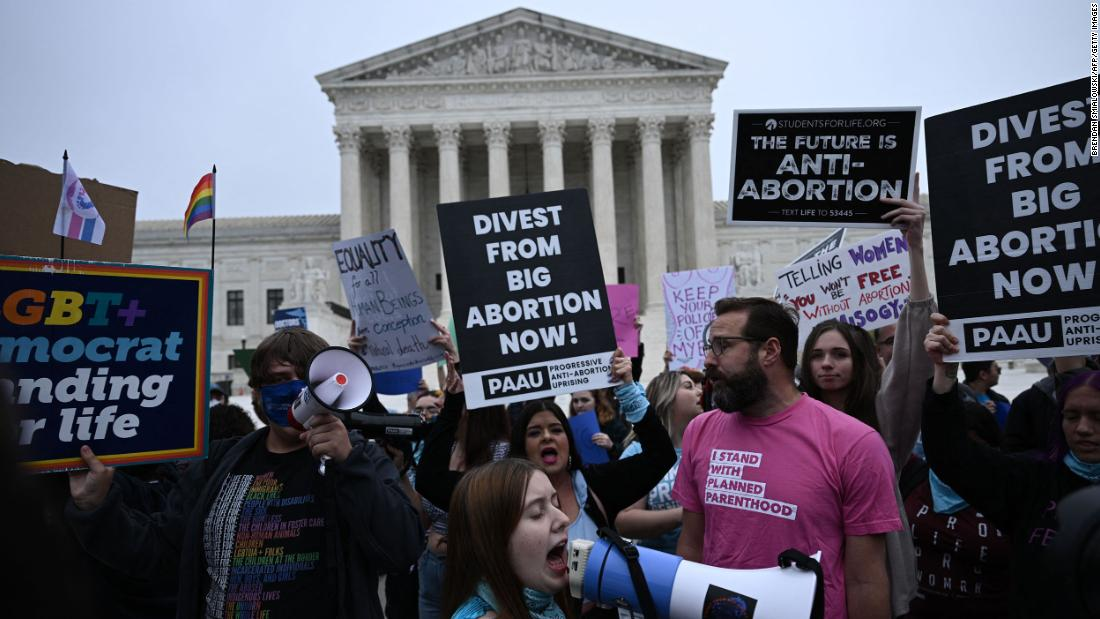
On May 2, it seemed that day was imminent. A leaked draft opinion on Dobbs v. Jackson Women’s Health Organization, a case directly challenging existing precedent, showed the majority of Justices poised to overturn Roe in its entirety. The news landed like a bomb. Within hours, protesters on both sides of the debate crowded outside the Supreme Court building in Washington, dancing in triumph or shaking with rage. Pastors declared victory, politicians sprinted to stake positions, and lawyers scrambled to understand the extraordinary implications of the draft text, pointing to a list of other constitutional rights suddenly in jeopardy, including access to birth control and the ability to marry the person of your choice, regardless of sex or race.

While the opinion leaked to Politico may well change before a final version is released, likely in June, its mere existence reshaped American politics in an instant—upending midterm races and political agendas, and refuting any argument that overturning Roe would affect only a small number of people in conservative states. The fierce and immediate political fallout made clear that any Supreme Court decision changing the precedent that Roe set will affect us all.

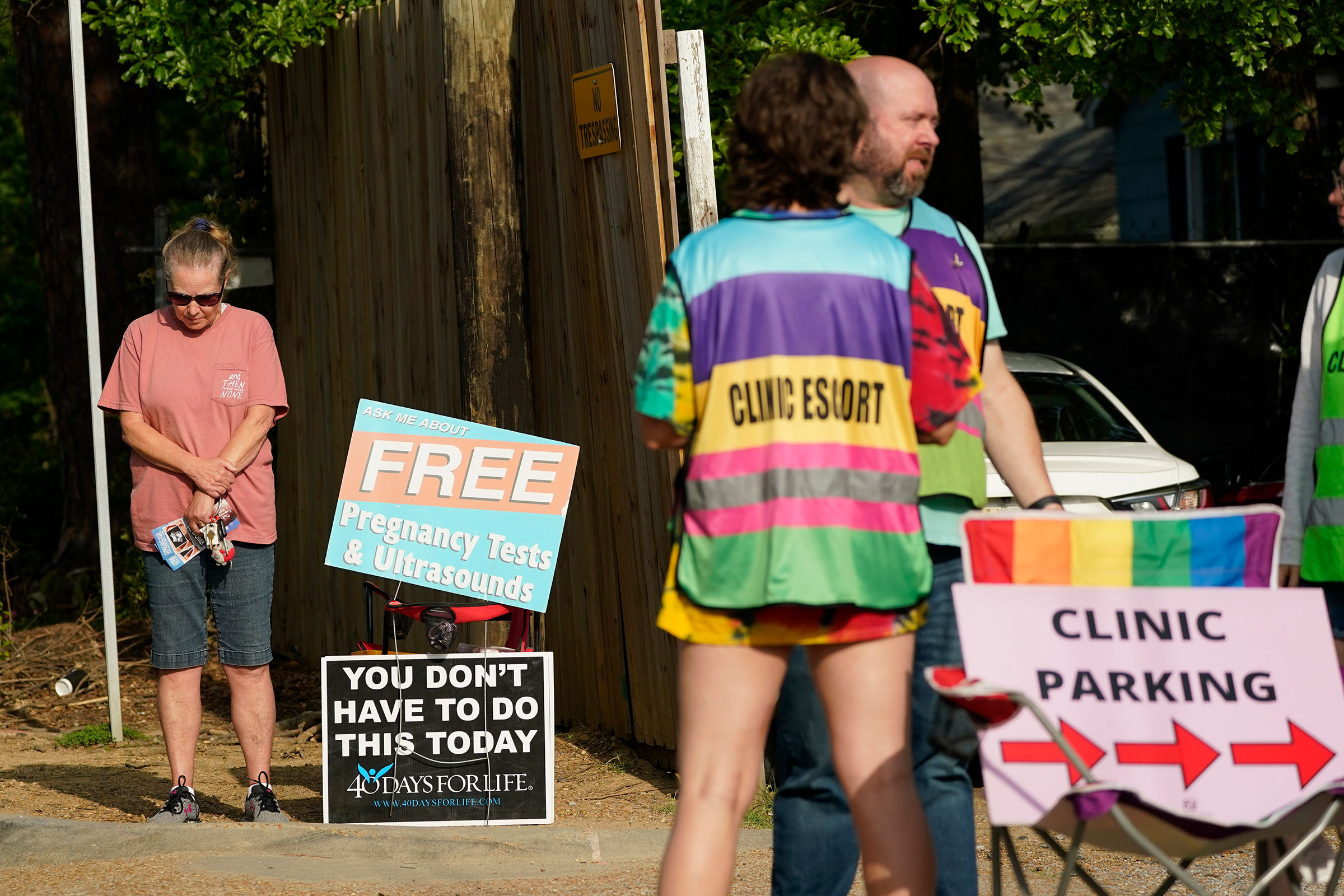
Activists gather in front of Jackson Women’s Health Organization, the abortion clinic in Jackson, Miss., at the center of the Supreme Court case

Rogelio V. Solis—AP

For many liberals, the draft marked the worst-case scenario, the doomsday outcome they’d been warning about for years. “It’s devastating, but it’s also a critical wake-up call,” Mini Timmaraju, president of NARAL Pro-Choice America, told reporters. The day after the draft appeared, NARAL saw a 1,403% increase in donations. Planned Parenthood reported a 650% uptick in donations and engagement. Democratic fundraising platform ActBlue raised $12 million in the 24 hours after draft was made public, and the Abortion Care Network, which supports independent abortion clinics nationwide, raised $250,000 in the first three days after the leak from more than 12,000 donors, about 95% of whom were new. Abortion providers also reported a flood of patients seeking birth control appointments, hoping to stockpile emergency contraception, or asking to proactively order abortion pills. Just 16 states and Washington, D.C., have laws on their books that explicitly protect abortion rights, should Roe cease to be the law of the land.

For conservatives, the draft decision was cause for celebration. “If this is the opinion of the Court, it will be one of the greatest opinions in Supreme Court history. It will save millions of lives,” Republican Senator Josh Hawley of Missouri tweeted on May 3. The draft was seen as validation of both conservatives’ strategy and their core belief: that Roe was wrongly decided and that the only way to redress that error was to deliver conservatives onto the highest court. On social media, religious leaders thanked former President Donald Trump, whose three Supreme Court appointments brought this moment to fruition. If the court’s final opinion is similar to the leaked draft, 13 states with “trigger laws” will ban abortion almost immediately; at least 10 more are likely to implement abortion bans or restrictions soon after.

In the days after the draft’s publication, many national Republicans focused on condemning the leak rather than addressing the substance of the draft, as political strategists debated the political risk of opposing a procedure that the majority of Americans support in some form. A leaked memo from the National Republican Senatorial Committee advised candidates that “our position should be based in compassion and reason,” and emphasized, “Republicans DO NOT want to throw doctors and women in jail.” But at the same time, some GOP members of Congress also floated passing a national abortion ban.

The real action was in the states, where Republican legislators rushed to ready abortion bans, advance criminal penalties for performing abortions, and consider defining life as starting at conception, a move that carries major implications for everything from miscarriages to contraception like intrauterine devices (IUDs) to the so-called morning-after pill. “No compromises, no more waiting,” said Brian Gunter, a pastor who helped write a Louisiana bill classifying abortion as homicide. In Georgia, state representative Ed Setzler, who sponsored a 2019 abortion ban, cheered his colleagues’ ambitions. “I think perhaps we’re coming to a place where we recognize that the deep brutality of Roe v. Wade,” he told TIME, “may be coming to an end.”

Supporters of Abortion Access Front before a protest in Manhattan on May 3, the day after an early draft of the Supreme Court opinion was made public

Caitlin Ochs—The New York Times/Redux

For the average American not tuned in to the nuances of state and federal political battles, the leak mostly produced a cloud of confusion. Abortion-rights advocates rushed to assure patients, while simultaneously pushing out information about what may come next. If the Supreme Court does indeed overturn Roe, many expect that abortion pills, which can be prescribed via telehealth and sent in the mail, will become the next arena of legal and legislative warfare. Others point to the likelihood that the nation will be split in half, with Democrat-led states seeing an influx of out-of-state patients seeking abortions within their borders. Several Democratic state legislatures have moved to protect providers and out-of-state patients, and to allocate money to help pay for their care. Katie Quinonez, executive director of West Virginia’s only abortion clinic, says that if her state makes the procedure illegal, she and her staff will help more patients travel to Pennsylvania, Maryland, and Virginia.

In the age of the internet, we are unlikely to return to the back-alley abortions of the pre-Roe era, but that, Quinonez says, is not the same as having access to legal care. Many would-be patients in places where abortion is illegal will likely struggle to take time off work, find transportation, or arrange childcare to get an abortion. Studies show that people who are denied abortions have worse mental health, more physical health issues including pregnancy-related death, higher rates of poverty and debt, and less financial security. Most people who seek abortions already have at least one child. The U.S., which has the highest maternal mortality rate of any wealthy nation, is also unique among its peer nations in failing to provide robust, state-funded childcare, paid family leave, or other parental support.

While the country, awash in uncertainty, awaits the court’s final ruling, one thing is now clear. The U.S. is on the cusp of a monumental shift in which issues surrounding women’s autonomy, privacy, and the government’s role in its citizens’ health will become central to our lives and our politics. The Justices’ final decision will shape not only reproductive rights, but also the health care system, criminal justice, workforce participation, and what it means to create a family in America.

Source: https://time.com/6176180/overturn-roe-transform-america/