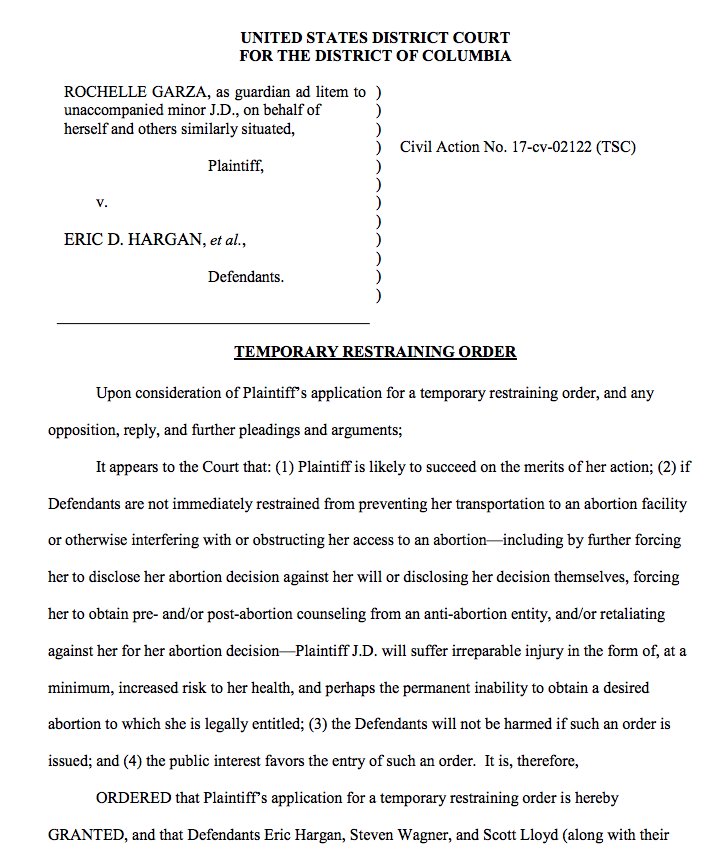
It’s the latest in a series of attempts to restrict abortion access.
Earlier this month, the House of Representatives voted to ban abortion after 20 weeks. Now, the GOP is officially aiming to ban abortions considerably earlier — at six weeks, before many women even realize they’re pregnant.
Back in January, the GOP introduced a bill banning abortion “in cases where a fetal heartbeat is detectable.” Last night, news broke that next Wednesday, November 1, a judiciary committee will hold a hearing to discuss the bill, entitled H.R. 490: Heartbeat Protection Act of 2017. The proposed bill, which is sponsored by Rep. Steve King of Iowa, would make it a federal crime to knowingly perform abortions “without determining whether the fetus has a detectable heartbeat,” “without informing the mother of the results,” or “after determining that a fetus has a detectable heartbeat.”
“Since Roe v. Wade was unconstitutionally decided in 1973, nearly 60 million innocent babies’ lives have been ended by the abortion industry, all with a rubber stamp by the federal government,” King said in a press release in January. “If a heartbeat is detected, the baby is protected.”
The only exception to the bill is if a woman has a physical — but, notably, “not psychological or emotional” — condition or illness that makes the pregnancy life-threatening for her; otherwise, physicians who perform the procedure could face up to five years in prison, a fine, or both.
If all this sounds vaguely familiar, it’s because a similar bill in Ohio led to an uproar before Governor John Kasich vetoed it. The same could happen H.R. 490, which as Refinery29highlights, likely won’t pass in the House and the Senate — but it’s clear that this is a battle that’s far from over.
In a statement emailed to Teen Vogue, NARAL Pro-Choice America senior vice president Sasha Bruce said, “the GOP’s crazy obsession with banning all abortions in this country knows no end, no boundary, and no common sense.
“Americans are clear: they want their elected officials addressing the crises our country faces instead of wasting time and taxpayer dollars attempting to ban abortion,” Bruce said. “The majority of Americans stand on the side of abortion access, and seven in 10 Americans believe abortion should remain legal and accessible. That’s not just a majority, that’s consensus, and we will keep mobilizing and organizing to ensure that all women can make decisions about their lives, bodies, and futures.”
Reproductive rights advocates had a reason to celebrate on Thursday when a federal judge blocked two abortion restrictions in Alabama. One prevented clinics from operating abortions within 2,000 feet from public schools, signed into law after abortion opponents claimed a Huntsville abortion clinic and demonstrations there disrupted students attending nearby schools. The other law banned dilation and evacuation, a procedure commonly used to terminate pregnancies in the second trimester.
Former Alabama Gov. Robert Bentley signed the two laws in May 2016. On Thursday, U.S. District Judge Myron Thompson declared both laws were “unconstitutional” and would place “undue burden on a woman’s ability to choose an abortion.”
Thompson wrote in his decision that there was no evidence that the Alabama Women’s Center for Reproductive Alternatives concerned the schools’ students or parents. He also wrote that the closure or relocation of the that clinic, located in Huntsville, would neither minimize disruption nor hinder a parent’s right to control their children’s exposure to the subject of abortion. The Alabama Women’s Center for Reproductive Alternatives sits near an elementary school and across the street from a magnet school. Local Rev. James Henderson and other anti-abortion protesters have clashed with patients and escorts coming in and out of the clinic.
Thompson also struck down the law banning a safe and common procedure for second trimester abortions. Anti-abortion activists have dubbed the dilation and evacuation method with the non-medical term “dismemberment abortion.” The American Congress of Obstetricians and Gynecologists released a statement opposing such bans that “represent legislative interference at its worst: doctors will be forced, by ill-advised, unscientifically motivated policy, to provide lesser care to patients.”
Had Thompson ruled in favor of the laws, Alabama would have to close two abortion clinics, the one in Huntsville and one in Tuscaloosa, leaving only three remaining in the state. Doctors perform 72 percent of the state’s abortions at the two clinics that were on the chopping block. The limited options would disproportionately affect low-income women who would have to drive further away or out of state to get abortions, Thompson wrote.
Thompson’s decision comes just a few months after a federal judge struck down a previous abortion restriction in the state as unconstitutional. Alabama law requires that a minor either have parental consent for an abortion or a court order to bypass parental consent. Usually a judge and the minor’s lawyer is involved in the legal process, where the bypass court determines if the minor is mature and well-informed enough to make a decision.
Judge Susan Walker struck down 2014 amendments to that law that gave the court power to appoint a legal representative for the fetus. The amendments also required a district attorney to be involved, and permitted the abortion seeker’s parents or guardians at the hearing. All involved parties, including the fetus’ representative ad litem, would be allowed to call witnesses to testify for or against the minor’s choice.
Reproductive rights advocates and the judge argued that adding more people to the process violated the minor’s privacy. “The bypass court is hardly the appropriate setting for such counseling, in any event; it is neither a physician’s office, nor a classroom, nor any other such place of instruction or guidance,” Walker wrote.
Alabama is not the only state dealing with attempts to chip away atRoe v. Wade. Legislation in Texas — which used to have more than 40 abortion clinics — set up tight measures that eventually forced several clinics to shut down. By the time the restrictions reached the Supreme Court, where they were ultimately struck down, Texas had only 19 abortion clinics.
As of August 2017, seven states have only one abortion clinic: Kentucky, Mississippi, Missouri, North Dakota, South Dakota, West Virginia, and Wyoming. And while conservative states have garnered the most attention in such cases, abortion clinics are disappearing in liberal states as well.
“Everything that we provide is on our website, so there will be no comment,” Howard said, before hanging up on Rewire.
It’s only deep in the “About” section that the center acknowledges it does “not offer, recommend or refer for abortions or abortifacients.”
Lauryn Gutierrez / Rewire
Attleboro Women’s Health Center in Massachusetts, like many abortion clinics,has a website offering information about the steps involved in surgical and medication abortion care, price estimates, reassuring imagery of personnel in white coats, and appointments “to discuss the abortion methods that may be available to you.”
There’s only one hitch.
This center doesn’t offer abortion—or even accurate information about the procedure. Attleboro Women’s Health Center is a crisis pregnancy center, or fake clinic, whose mission is to deter patients from abortion care. The center’s website is registered to Darlene Howard, executive director of Abundant Hope Pregnancy Resource Center, which is a self-described “Christian pro-life ministry.” The two organizations share an address.
Melissa Simas, who lives in the area, told Rewire that she noticed within the past week that the center had installed a green awning with the words “Attleboro Women’s Health Center.”
The fake clinic is about half a mile from Four Women Health Services, an abortion clinic. (Disclosure: This Rewire reporter worked at Four Women several years ago.) While it’s not unusual for anti-choice centers to try to lure abortion clinic patients by offering the false impression that they provide abortion care, the extent of this center’s efforts shocked pro-choice advocates.
“It’s one of the most egregious cases of deceptive rebranding of a CPC I can personally remember seeing in over a decade of advocating for reproductive freedom,” Rebecca Hart Holder, executive director of NARAL Pro-Choice Massachusetts, told Rewire, after reviewing the website.
The site, which has been active for months, was recently changed to add tabs on the abortion pill and surgical abortion. It features a detailed breakdown of the procedures for varying gestational ages; unscientific terms like “dismember” and “unborn baby” may alert discerning readers that this is biased information. When a Rewire reporter registered for an appointment and inquired by email about the center’s services, a representative promised the “initial appointment will include a free pregnancy test and an abortion consultation to discuss which methods may be available to you based on your individual circumstances.”
It’s only deep in the “About” section that the center acknowledges it does “not offer, recommend or refer for abortions or abortifacients.”
“Everything that we provide is on our website, so there will be no comment,” Howard said, before hanging up on Rewire.
The website features unsubstantiated claims about the purported psychological risks of abortion—contradicting research that shows abortion does not damage mental health—and a phone number for so-called abortion reversal, a misleading and unproven protocol promoted by anti-choice activists.
Abundant Hope is listed as an affiliate of Heartbeat International, which describes itself as the largest network of crisis pregnancy centers in the world, and instructs these centers to conceal their true intentions by scrapping religious language, for example. (Someone who answered the phone at Attleboro Women’s Health Center acknowledged it is under the same “umbrella” as Abundant Hope.) Attleboro Women’s Health Center’s website claims it “was founded to empower women to make informed decisions about an unplanned pregnancy that support their privacy, dignity and self-respect.”
That’s a near-verbatim repetition of the stated mission of the abortion clinic nearby: “to empower women to make informed decisions that support their privacy, dignity and self-respect.”
While it has relatively few restrictions on abortion care, Massachusetts allows the sale of “Choose Life” license plates and donates a portion of the proceeds to anti-choice organizations—one of 15 states to do so. Crisis pregnancy centers outnumber abortion clinics in the state by more than three to one, with 30 operating across the state, according to a 2011 NARAL report.
“I think it’s wrong for us to fall into the trap of thinking, ‘Well, we’re in a state historically friendly to women’s rights,’ particularly in this climate where we have anti-choice forces emboldened by our leadership on the federal level,” said Holder of NARAL Pro-Choice Massachusetts.
Indeed, these anti-choice fake clinics have found key allies in the Trump administration.
The family of Education Secretary Betsy DeVos has funneled money to crisis pregnancy centers, including one in Grand Rapids, Michigan, that, like the one in Attleboro, lists detailed information about abortion procedures and touts abortion reversal on its website. Vice President Mike Pence divertedmillions intended for needy families to fake clinics while he was Indiana governor. And a Rewire reviewfound the Trump administration has already awarded such clinics millions in taxpayer dollars.
“The deceptive and false things they’re saying [on the Attleboro website] about the harms of abortion are part of this general narrative that has taken hold within many areas in the federal government,” Kelli Garcia, director of reproductive justice initiatives at the National Women’s Law Center, told Rewire.
While a number of states have used public dollars to support fake clinics, Hawaii was the most recentstate to attempt to crack down on their deceptive tactics, following California. Both states have faced legal challenges from anti-choice groups over these regulations, as have cities like Baltimore, which defended its truth-in-advertising ordinance in court this week.
Rewire contacted the office of Massachusetts Attorney General Maura Healey to ask if the Attleboro clinic’s behavior might constitute fraud or other illegal behavior.
“Every woman has a right to make decisions about her own reproductive health care without being subjected to intimidation or harassment,” Emalie Gainey, a spokesperson for Healey, said in an emailed statement. Following a Rewirereport last year, Healey announced a settlement agreement to prohibit a Boston-based firm hired by anti-choice groups from targeting “abortion-minded women” in Massachusetts with digital propaganda while they visit abortion clinics.
Meanwhile, grassroots groups are taking action. The Expose Fake Clinics campaign, which involves dozens of organizations, including Lady Parts Justice, encourages people to submit and “like” accurate reviews on platforms like Yelp and Google to expose the ideological goals of fake clinics.
“Our whole thing is, you should be up front,” Lizz Winstead, founder of Lady Parts Justice, told Rewire. “If you are a Christian-based organization that would like to encourage people who are pregnant to have a baby, then you should say that’s who you are. But the fact that you don’t leads me to believe that you can’t get people in your doors by saying that about yourself.”
Scott Lloyd, the head of the Office of Refugee Resettlement who has long promoted controversial views on women’s health, is at the center of a federal abortion case after he tried to block an undocumented teenager from getting an abortion.
Brendan Smialowski / AFP / Getty Images
Free condoms handed out by the AIDS Healthcare Foundation staff and volunteers in Washington, DC.
A Trump administration appointee who blocked an undocumented, pregnant teenager from obtaining an abortion before the courts weighed in in her favor, has a history of controversial statements about contraception and abortion.
Scott Lloyd, the current director of the Office of Refugee Resettlement (ORR), suggested in multiple opinion articles that women receiving contraception through federal funding should have to sign a “pledge” promising not to have an abortion and that the Supreme Court’s rulings on abortion infringe on men’s “right to procreation.”
Lloyd’s early writings on the subject of abortion shed light on his decision to decline to give permission to a government-funded shelter to release a pregnant, undocumented 17-year-old to get an abortion. That decision became the subject of a federal lawsuit brought by the Jane Doe at the center of the case and the American Civil Liberties Union. (Doe was ultimately successful.)
“I suggest that the American people make a deal with women: So long as you are using the condom, pill or patch I am providing with my money, you are going to promise not to have an abortion if the contraception fails, which it often does,” Lloyd wrote in an article for the National Catholic Register in 2009.
“We can do this by having the woman sign a pledge,” he continued. “If they go on to have an abortion, they become ineligible for more taxpayer-bought contraception. They would have to buy it themselves or turn to private sources of funding for the contraception. Or, they could stop having sex until they are ready to have a child.”
In this article, titled “Bailing Out Abortionists?”, Lloyd suggests that much of the Title X family planning fund, which provides free or inexpensive contraception and reproductive care to low-income women, would increase abortion rates. At the time of the op-ed, Democrats in Congress were pushing to increase Title X funding, arguing that access to contraception decreases abortion rates.
Lloyd argues that the increased budget would go toward buying “truckloads of condoms” to distribute for free. Many of those condoms would fail, he argues, causing unplanned pregnancies and abortions, therefore, “bailing out” abortion providers. Following that logic, he went on to compare places like Planned Parenthood that distribute free contraception and perform abortions, to those on Wall Street who caused the 2008 financial crisis.
In fact, Title X funding is used for many different kinds of more effective contraception, such as the Pill, IUDs, and other long-lasting contraception methods, as well as STD testing and prevention, and sex education.
In another article, written for Ethika Politika (the blog for the Center for Morality in Public Life) in 2011, Lloyd recommended that anti-abortion state legislators across the country write laws that “women must notify the men of their decision to abort, and gain their consent.”
Lloyd wrote that the laws would help to prove a point to the Supreme Court. “The Supreme Court has implied, perhaps without realizing it, that the physical realities of pregnancy for the woman will serve to imbue her most weightless rationales with the magic ability to trump a man’s right to procreation, and his right in his children,” he wrote.
“Savvy state legislators should make the Supreme Court say this outright, if that is the type of regime they support,” he continued, suggesting that, when these laws are inevitably challenged, these arguments could be used to overturn Roe v. Wade, the 1973 Supreme Court decision that made abortion legal.
HHS declined to comment on Lloyd’s writings.
Before his appointment as ORR director, Lloyd had a long history of being involved with anti-abortion organizations. Just prior to his appointment to the Trump administration, Lloyd served on the board of directors for the Front Royal Pregnancy Center, an anti-abortioncounseling center. He also worked as a general counsel at HHS under President George W. Bush, during which he coauthored a controversial “conscience rule” enabling health care providers to decline to pay for or provide abortions.
In court arguments last week, ACLU lawyer Brigitte Amiri told the court that under the Lloyd-led ORR’s guidance, Doe had been taken her to an anti-abortion counseling center. They also highlighted a previous case in which Lloyd, as ORR director, personally visited another undocumented pregnant minor to talk her out of getting an abortion.
The majority of ORR’s duties do not involve medical decisions; it’s the wing of the Department of Health and Human Services charged with helping undocumented, unaccompanied children and newly arrived refugees. A 2008 policy issued under George W. Bush gave ORR “heightened involvement” in significant medical procedures such as surgeries and abortions. But in early March, the Trump administration issued a new interpretation of the policy, which explicitly prohibited federally funded shelters are “from taking any action that facilitates an abortion without direction and approval from the Director of ORR.” Lloyd had not yet been officially appointed to ORR when the memo was released, but was already working as an adviser to HHS.
Lloyd employed this policy in mid-September, when he refused to let the pregnant teenager leave the shelter to get an abortion. Court documents show that the shelter was okay with letting her leave the premises to get the abortion, and a state judge waived the law requiring she obtain permission from a parent or guardian.
Lawyers for the Trump administration defended Lloyd’s position in the hearing Friday that the government shouldn’t be “complicit in facilitating” the minor’s abortion and that, in not facilitating the abortion, the government is fulfilling its duty to “act in the best interest” of the minor.
But on Tuesday, a federal appeals court in Washington, DC, ruled that she can get an abortion, over the objections of Trump administration lawyers. She successfully underwentthe procedure soon after.
HHS responded to requests for comment for this story with a statement, saying: “For however much time we are given, the Office of Refugee Resettlement and HHS will protect the well-being of this minor and all children and their babies in our facilities. And we will defend human dignity for all in our care.”
You’re off your tether, Missouri, and you’re lumbering around knocking over telephone poles and stripping pregnant people of their human rights.
Gov. Eric Greitens (R) meets with Vice President Mike Pence at the White House on January 28. Wikimedia Commons
Hello, Missouri? Do you mind if I call you Missouri?
It just has a nicer ring than “Missouri State Legislature,” though of course there are plenty of people inside the state working against anti-choice machinations. I’m just going to call you Missouri for short, though. You don’t mind, do you?
I thought it might be nice for us to sit down and catch up. It’s been two years since we last had a chat: In 2015, I wrote you an open letter about your herculean efforts to regulate the last clinic in your state out of existence.
Fortunately, despite your best efforts, clinic access in Missouri is actually getting better. Prior to September of this year, there was only one standalone abortion clinic—the same one you tried for years to shut down. Now, as Rewire reported back in September, Planned Parenthood has opened a second. And according to this report from Christina Cauterucci at Slate, the state might soon have five clinics.
Five! That’s good news for pregnant people that live inside you, Missouri.
But you haven’t given up trying to stick it to them.
During the 2017 regular legislative session, you tried to pass more than 20 bills. All of them failed. And then in June, your Republican governor, Eric Greitens, called a second special session—to focus on cracking down on abortion. It was a Hail Mary attempt to ram through ten more bills restricting abortion access.
SB 5 is an omnibus Frankenbill—pieces of different bills grafted together—that Gov. Greitens signed into law on July 26. It contains pieces of bills that the legislature couldn’t get passed during the regular session.
One provision of SB 5, which gives your attorney general “concurrent original jurisdiction”(legalese for “allows the AG to open independent investigations into alleged clinic violations”) comes from two failed regular session attempts to pass the same policy—one in the house and one in the senate. That section was rammed through out of concerns that local governments—in St. Louis, for example—are run by Democrats and are too progressive, according to GOVERNING. “The prosecuting attorney in St. Louis is a pro-choice Democrat, so we just wanted another set of eyes there,” Andrew Koenig (R-Manchester), the state senator who sponsored SB 5, is reported to have said.
It takes a red-blooded Republican to harass clinics out of existence, I reckon.
Another section of SB 5, meanwhile, comes from a failed regular session bill—HB 989—that purported to prohibit cities or towns from declaring themselves “sanctuaries” for abortion. Some readers may be asking: What the hell is an abortion sanctuary?
Great question. First and foremost, the language is probably a scare tactic that Republicans are using to capitalize on the pervasive, racist, and unwarranted fear of undocumented immigrants, what with cities around the country refusing to kowtow to President Donald Trump by announcing that they would become “sanctuaries” for undocumented immigrants to live without worrying, at least in theory, that any interaction with a public official or agency would result in deportation. The “abortion sanctuary” term is tacky at best, but tackiness is no stranger to you, is it Missouri? (Remember the “All Lives Matter” Act, which your legislature tried to pass in 2016? HB 1794? Exactly. Tacky.)
But aside from that, what is an abortion sanctuary city? Anyone’s guess is as good as mine, although St. Louis is apparently one. This actually gets a little bit weird: St. Louis passed an ordinance in February that prohibits discrimination on the basis of a person’s reproductive health-care decisions. So, for example, an employer couldn’t refuse to hire you because you use birth control, have had an abortion, or are pregnant. Seems pretty straightforward.
Not to Gov. Greitens, though. Apparently, by calling the special session, he intended to make do on his promise at an anti-abortion rally back in March to stop those “crazy liberals and their allies at organizations like NARAL that are trying to create an abortion sanctuary city right here in the state of Missouri.”
Why your governor has his knickers in a twist about St. Louis’ ordinance is anybody’s guess. The “no country for old abortion” provision of SB 5 really has nothing to do with the city’s ordinance. It bans local governments from enacting laws that would force a person to participate in an abortion if they didn’t want to, or force a property owner to sell or lease property to a clinic, or interfere with the operations or free speech rights of “crisis pregnancy centers.”
Is there something in the statehouse water? Because Republicans there aren’t make any sense.
Another section of SB 5 requires abortion providers to create a “complication plan” for medical abortions and to get that plan approved by the Missouri Department of Health and Human Services (DHHS). It’s a TRAP law (that’s Targeted Regulation of Abortion Provider, for those who don’t know) that the house tried to pass on its own, to no avail.
In the wake of SB 5’s passage, DHHS issued a memo on October 2 stating that it would be filing emergency rules setting out the standards for complication plans this week, according to St. Louis Public Radio. Doctors who provide medical abortions would be required to contract with an OB/GYN to treat any complications that arise. If that sounds sort of like an admitting privileges law—the kind that the Supreme Court struck down in Whole Woman’s Health v. Hellerstedtbecause Texas provided no evidence that the law would actually improve women’s health and safety—that’s because it kind of is. And that’s why I’m pretty sure once the DHHS issues standards for these complication plans, Planned Parenthood or another group will file a lawsuit challenging them. (Planned Parenthood has not done so yet, likely because the lawsuit is not “ripe”—in other words, there are no standards yet with which clinics have to comply, so clinics have nothing to sue about. As soon as those standards are issued, however, the lawsuit will become “ripe” and Planned Parenthood will be able to file a lawsuit challenging them.)
And then there’s the provision that has landed SB 5 in court: the “same physician” requirement, which you added to your “informed consent” requirements. This is where it gets truly ridiculous.
You already have a pretty extensive regulatory framework about consent, Missouri. Pregnant people must go to a clinic to receive state-mandated information in a private setting both in writing and orally. And pregnant people have to do all of this 72 hours before the abortion. This means that someone who, say, lives four hours away from a clinic might have to make at least two eight-hour trips in a week to access care. It’s a pain in the ass, is what I’m saying, Missouri.
And now, in addition to all of that, SB 5 requires that the state-mandated information be given by the same physician who is going to perform the abortion. It used to be that the information could be provide by a “qualified professional.” But that wasn’t enough. Now you want to stretch already thinly stretched abortion doctors even further, by forcing them to take on added counseling responsibilities?
What is the health benefit of that, Missouri? Oh, there is none and you know it.
And I’d be willing to bet that your little law doesn’t pass the Whole Woman’s Health v. Hellerstedt smell test, which requires a law that is touted as being for the benefit of women’s health and safety to actually be for the benefit of women’s health. States just can’t claim it is and rest smugly on their laurels. The resident U.S. Supreme Court data nerd—Justice Stephen Breyer—isn’t having any of that. States have to prove it.
And I don’t think you can prove it, Missouri. And neither does Comprehensive Health of Planned Parenthood Great Plains, which is why it sued you in the first place. Sure, the district court judge Monday said that the waiting period is constitutional and that the same-physician requirement is constitutional. Jackson County Circuit Court Judge S. Margene Burnett said that the scarcity of abortion doctors isn’t your fault, Missouri, and that the law doesn’t impose an undue burden on the right to an abortion. Really, Marge?
Pfft. We’ll just have to see what happens when the Supreme Court gets their hands on this one. First, the scarcity of abortion doctors actually is your fault, Missouri: You tried to pass over a hundred bills regulating the one clinic out of existence. And now that you have successfully whittled down the number of abortion doctors in the state—either because they have no practice or because they fear criminalization—suddenly it’s not your fault?
That’s not how this works. At least, that’s certainly not how it should work.
Aside from your looming court battles, let’s chat about some of the other nonsense you tried to pull this year, Missouri.
You tried four times to make 20-week abortion bans happen. Like so much “fetch,” it didn’t. You also took several stabs at trying to make personhood happen. That didn’t happen either. You tried to ban abortion outright (HB 1177) and also tried to ban it at six weeks (SB 408), which is when a heartbeat can be detected. Neither of those laws is constitutional, Missouri. You know better.
You introduced several bills that regulated or banned fetal tissue donation, severalbills dedicated to making it more difficult for pregnant teens to obtain abortion care, and a couple bills that criminalize prenatal drug and alcohol use, virtually ensuring that pregnant people who happen to be addicted to drugs won’t seek care out of fear of imprisonment.
And you also tried to pass severalbills that would let CPCs continue to prey on pregnant people, by prohibiting local governments from regulating them.
Plus, there were a couple of bills that defy logic and categorization: laws that seem designed just to piss me off. Yes, me, specifically. A bill requiring that the state museum include an abortion exhibit? And that the abortion exhibit must be near the exhibit on slavery? (This, of course, was introduced by the same guy who introduced the All Lives Matter Act personhood bill.)
You’re out of control, Missouri. More than 35 bills and you managed only to pass one, which is already in court.
You’re like one of those unmoored oversized floats you see at the Thanksgiving Day parade in New York City—you know the one that gets loose because it was manned by a dude who accidentally put too much whisky in his coffee?
You’re off your tether, Missouri, and you’re lumbering around knocking over telephone poles and stripping pregnant people of their human rights.
And let’s face it, you’re probably going to get your ass handed to you by Planned Parenthood, and then your taxpayers are going to have to pay Planned Parenthood’s attorneys’ fees, and it seems that money could be better spent on—I don’t know—expanding Medicaid?
Look, Missouri, I know it’s not the entire state that has been making some questionable decisions. There are plenty of lawmakers and grassroots activists working hard to make life better for pregnant people in Missouri. Many Missourians love their state and just want to be healthy and to prosper. That doesn’t seem to be Republicans’ bag, though.
So I don’t know what to tell you, Missouri.
You’re the “show me” state, right? So show me some thing good. Show me that people in Missouri can rest assured that they will have access to affordable health care, including abortion. Maybe show Republicans the door. Otherwise you’ll remain—as a friend from Missouri once told me—the “show me the way out” state. And you don’t want that, do you?
Of course not.
Good walk and talk Missouri. Let’s not have this conversation again. It’s exhausting.
Undocumented teen gets abortion after Trump admin tried to stop her
After weeks of legal battles, the undocumented teenager known only as “Jane Doe” got an abortion in Texas Wednesday morning.
The Trump administration had sought to prevent the 17-year-old Doe, as she’s known in court papers, from getting an abortion even after the Central American teen secured permission from the state of Texas. Doe has been in the custody of a shelter operated by the Office of Refugee Resettlement since she entered in the United States in September, and the administration has argued in court that federal policy forbids “any action that facilitates” abortion without the approval of the Office of Refugee Resettlement Director Scott Lloyd.
The full D.C. Circuit Court of Appeals on Tuesday disagreed with that argument Tuesday, ruling that the Trump administration had to allow Doe to get her abortion.
“The government has insisted that it may categorically blockade exercise of her constitutional right unless this child (like some kind of legal Houdini) figures her own way out of detention,” Judge Patricia Millett wrote in a concurring opinion, calling the government’s position “constitutionally untenable.”
That decision reversed a Friday ruling, by three of the panel’s judges, mandating that Doe secure an immigration sponsor before she could get the procedure. It also allowed Doe’s lawyers to get a temporary restraining order from a federal district court, so Doe could leave the shelter and receive her abortion.
In a statement, Doe said:
My name is not Jane Doe, but I am a Jane Doe.
I’m a 17 year old girl that came to this country to make a better life for myself. My journey wasn’t easy, but I came here with hope in my heart to build a life I can be proud of. I dream about studying, becoming a nurse, and one day working with the elderly.
When I was detained, I was placed in a shelter for children. It was there that I was told I was pregnant. I knew immediately what was best for me then, as I do now – that I’m not ready to be a parent. Thanks to my lawyers, Rochelle Garza and Christine Cortez, and with the help of Jane’s Due Process, I went before a judge and was given permission to end my pregnancy without my parents’ consent. I was nervous about appearing in court, but I was treated very kindly. I am grateful that the judge agreed with my decision and granted the bypass.
While the government provides for most of my needs at the shelter, they have not allowed me to leave to get an abortion. Instead, they made me see a doctor that tried to convince me not to abort and to look at sonograms. People I don’t even know are trying to make me change my mind. I made my decision and that is between me and God. Through all of this, I have never changed my mind.
No one should be shamed for making the right decision for themselves. I would not tell any other girl in my situation what they should do. That decision is hers and hers alone.
I’ve been waiting for more than a month since I made my decision. It has been very difficult to wait in the shelter for news that the judges in Washington, D.C., have given me permission to proceed with my decision. I am grateful for this, and I ask that the government accept it. Please stop delaying my decision any longer.
My lawyers have told me that people around the country have been calling and writing to show support for me. I am touched by this show of love from people I may never know and from a country I am just beginning to know – to all of you, thank you.
This is my life, my decision. I want a better future. I want justice.
Should you use birth control pills, condoms or an intrauterine device (IUD)? Women choose their birth control based on many factors, like effectiveness or comfort—but cost has been less of a consideration, ever since the Affordable Care Act. A provision in the act required employers to provide contraception to all women in their health plans without charging a copay or coinsurance fee. Estimates suggest that more than 55 million women had access to birth control without co-pays because of the mandate.
Going forward, the price of birth control may matter more. On Oct. 6, President Donald Trump rolled back that coverage and issued a new rule that offers exemptions for any employer, regardless of industry, who objects to offering contraception coverage due to his or her personal religious beliefs or moral convictions.
Experts don’t yet know what effect the new rule will ultimately have on women’s ability to access birth control. But some worry that the IUD—one of the most effective and low-maintenance types of birth control—could become prohibitively expensive. Without insurance, it’s one of the priciest methods up front, costing about $900. And though an IUD may be a better financial investment over time, since women can use the device for several years, such a high initial price tag is beyond the means of many women.
Health care analytics company Amino analyzed billions of health insurance claims from 2014 to mid-2017 to understand how much an IUD could cost women if their insurance no longer covered it. They analyzed the Mirena and the Skyla IUD, which use the hormone progestin, and the ParaGard IUD, a non-hormonal copper-releasing device.
On average, an IUD could cost about $1,000 out of pocket across the country, the group reported. Below is an interactive map using data from Amino of what the typical cost of an IUD could be in each state. (The price estimates are for the total cost of an IUD, including the insertion procedure.)
As the data show, the lowest estimated cost is about $800. “[An IUD] is not cheap, and the median price is well outside affordability for many women,” says Sohan Murthy, a data scientist at Amino.
Compared to the condom, which has a typical use failure rate of 18%, or the birth control pill, which has a failure rate of 9%, the IUD has a failure rate of 0.8% or less. IUDs also require little to no maintenance for years, and hormone-free versions are available. Once IUDs became more affordable under the ACA, public health groups across the nation launched public awareness campaigns to encourage more women to consider using long-acting reversible contraception like the IUD.
The method is growing more popular. About 6% of women in the U.S. had tried the method in 2002, but that grew to 15% in 2011-2015. Studies have also shown that when women have access to all forms of birth control without financial barriers, they are more likely to choose the kind that’s most effective. A long-term study based out of St. Louis called the The Contraceptive CHOICE Project enrolled nearly 10,000 women and found that when the women were counseled about all methods of birth control, 75% chose a long-active reversible method, like the IUD.
Even before the new rule was announced, many women sought IUD consultations with providers, potentially in anticipation of changes to insurance coverage of birth control. A January report found that the number of women who visited their physician to discuss the birth control method rose nearly 19% after Donald Trump was elected as President.
Methodology
Data is from Amino. Cost per state is determined by taking the median cost of the three types of IUDs in each state.
Six out of ten give the procedure their backing in the cases of rape, incest and foetal malformation
Over half of people support a woman’s decision to have an abortion, a survey has found.
Six out of ten give the procedure their backing in the cases of rape, incest and foetal malformation, but 51% say they respect a woman’s right to choose regardless.
The number in favour of legalisation soars to 77% when the woman’s life is at risk.
The news comes after the Oireachtas Committee on Abortion moved to recommend “not to retain the Eighth Amendment in full”.
The motion was proposed by Sinn Fein and seconded by Fianna Fail. The late-night sitting at Leinster House saw members vote by 15 votes in favour, two against, with two members, James Browne and Anne Rabbitte of Fianna Fáil abstaining.
Denise Walker, GMB Organiser, said: “This ground-breaking survey shows attitudes to abortion in Ireland are softening.”
The trade union network is pushing for a “mature debate” on legalising the procedure.
The poll of over 3,000 people north and south found that 62% say the government should fast track the expansion of access to abortion.
Overwhelmingly, one-in-nine say women who have the procedure should not be criminalised.
Earlier this year a Citizen’s Assembly on the matter voted by majority in favour of recommending that abortion without restriction should be lawful.
They also voted on various gestational limits.
Groups representing workers’ rights say it is something which effects employees and their bosses alike.
Ms Walker said: “Abortion is a serious workplace issue particularly on the island of Ireland, where woman often have to travel abroad for medical treatment.
“They often experience stigma after having an abortion, which has to be managed in the workplace and it may be the case that this also applies in England, Scotland and Wales.
“In addition, financial pressures and access to sick pay and sick leave lead to some women to use their annual leave to recover from an abortion – and often return to work too early.”
Of the respondents, 20% said they had direct experience of abortion.
73% of these did not tell their colleagues.
While, 42% struggled to pay for the costs involved and 28% took annual leave at the time.
Ms Walker said: “It is clear from the research that this is a matter for trade unions and we must move forward to ensure that this subject is firmly on the trade union agenda, both in terms of campaigning for reform but also in the arena of workplace negotiations in the UK and in Ireland.
“The trade union movement must provide the space for dialogue and help to bring an end to the stigma of abortion.”
If the undocumented teen would have been granted access to abortion care when she initially requested it, the procedure would have taken ten minutes.
Jane Doe supporters gathered near the D.C. courthouse where her case was heard October 20 in Washington, D.C. to demand #JusticeforJane.
Lauryn Gutierrez / Rewire
Texas has seen some of the nation’s most regressive abortion restrictions in recent years. This series chronicles the fall-out of those laws, and the litigation that has followed.
A teenage immigrant who had been barred by federal officials from accessing abortion care can now have the medical procedure after the full U.S. Court of Appeals for the D.C. Circuit on Tuesday overruled a three-judge panel of the court that had temporarily blocked the teen from having an abortion.
It has been an arduous legal battle for the unaccompanied 17-year-old from Central America, who has been “held hostage” by the Office of Refugee Resettlement (ORR), the agency that oversees unaccompanied immigrant minors. Advocates told Rewire that ORR Director Scott Lloyd, who is vehemently anti-choice and refuses to allow the teen to access abortion care, is a sign of “anti-choice fanaticism” making its way into the federal immigration system.
After having an initial emergency order denied that would have allowed the teen to access abortion care, the American Civil Liberties Union (ACLU), acting on behalf of Jane Doe, sought a second emergency order last week. U.S. District Court Judge Tanya S. Chutkan on Wednesday ordered the federal government to allow the teenager to have the medical procedure, but the Trump administration late Wednesday filed an appeal with the D.C. Court of Appeals asking for an emergency ruling to block the ruling recognizing Jane Doe’s right to abortion care. The circuit court on Thursday issued an administrative stay, which delayed abortion care for the undocumented teenager. A three-judge panel heard arguments from the government and ACLU attorney Brigitte Amiri on Friday, later issuing a 2-1 decision on Jane Doe’s case, giving the undocumented teen until October 31 to secure a sponsor. Once a sponsor is secured, Jane Doe would be released from the custody of Health and Human Services (HHS), which oversees ORR, and she could access the medical procedure.
On Sunday night, the teen’s attorneys petitioned for en banc review, “asking the full bench of a federal appeals court in Washington to permit her to have an abortion immediately,” Politico reported.
Jane’s Due Process, a Texas organization that helps pregnant teens with legal issues, is assisting the ACLU with Jane Doe’s case. In a statement Friday, the organization said the court’s decision avoids “addressing the issue before them: whether the federal government holding Jane hostage and refusing to release her to obtain the abortion care to which she won the right to consent without anyone telling her parents or legal guardian causes her irreparable harm and violates her constitutional rights.”
Jane Doe, who is being detained at a shelter in Texas, has complied with all of the state laws required to access abortion care, including obtaining a judicial bypass when she was nine weeks pregnant. This week she will be 16 weeks pregnant. The state of Texas bans abortion after 20 weeks and in the Rio Grande Valley, where Jane Doe is detained, there is only one clinic.
“Every additional day she must remain pregnant against her will places a severe strain on [Jane Doe], both physically and emotionally. Every additional week the government delays her abortion increases the risks associated with the procedure,” the teen’s attorneys wrote in the petition for en banc review. “In a matter of weeks, J.D. will no longer be able to get an abortion at all, and the government will have forced [Jane Doe] to have a child against her will.”
Source: Jane’s Due Process
Jane’s Due Process outlined how as ORR forces Jane Doe to carry an unwanted pregnancy, not only do her chances of accessing abortion care become slimmer, but the procedure becomes more complicated. If the undocumented teen would have been granted access to abortion care when she initially requested it, the procedure would have taken ten minutes.
There are far-reaching concerns for Jane Doe’s case, including whether ORR will now make a practice of attempting to veto or block teens in its care who are granted judicial waivers to access abortion care.
The government’s stance is that its refusal to facilitate transportation for Jane Doe’s abortion care, meaning its refusal to provide transportation and its refusal to allow her guardian to provide transportation, does not constitute an undue burden.
Jane Doe could have accessed an abortion by now if she were an adult in an immigrant detention center overseen by Immigration and Customs Enforcement or as an undocumented adult in prison for committing a crime. But because she is a minor in legal custody of ORR—and ORR maintains an interest in “fetal life and child birth,” as it made clear in Friday’s arguments—the teen is being forced to carry an unwanted pregnancy.
The court set an October 31 deadline for the government to find Jane Doe a sponsor
ACLU files emergency petition for a rehearing by the full appeals court
(CNN)The ACLU is asking a federal appeals court for help in clearing the way for an undocumented teen in detention in Texas to end her pregnancy.
The group filed an emergency petition Sunday night in the matter of 17-year-old “Jane Doe,” who is 15-and-a-half weeks pregnant and wants an abortion. “Every additional week the government delays her abortion increases the risks associated with the procedure,” it stated.
The case was heard last week by a three-judge panel, but the ACLU is now asking it to be reviewed by the entire appellate court.
Because the teenager is a minor, Texas law required that she get parental consent or a judicial waiver to obtain an abortion. She came to the US without her parents, so she went to court with a guardian and was granted the right to consent to the abortion herself. However, the shelter in which she is living — which houses unaccompanied immigrant minors and is run by the Office of Refugee Resettlement — refused to transport her to have the procedure.
The ACLU filed a lawsuit on October 13 against the Trump administration.
“This administration has no shame and no regard for a woman’s health or decisions,” said Brigitte Amiri, senior staff attorney with the ACLU Reproductive Freedom Project. “Weeks ago, our client decided to end her pregnancy. Her decision has been disregarded and she’s now been dragged into a protracted legal battle over her ability to get the care she needs.”
The teen’s case has bounced around the court system for weeks.
On Wednesday, a federal judge ordered officials at the Department of Health and Human Services to allow her to be transported by a guardian or attorney “promptly and without delay” to an abortion provider to obtain state-mandated counseling and then to obtain the abortion.
But a three-judge panel from the DC Circuit Court of Appeals issued an administrative stay of that ruling Thursday — with one judge dissenting — to “give the court sufficient opportunity to consider the emergency motion” filed by the government.
On Friday, after hearing oral arguments, the panel of judges ruled the teenager could have the abortion but delayed the process. The ruling set a deadline of October 31 for the US Department of Health and Human Services (HHS) to get a sponsor for the girl.
But in a declaration filed Sunday with the DC District Court, Robert Carey — who served as director of the Office of Refugee Resettlement from March of 2015 to January of this year — said it will take weeks or even months to approve a sponsor.
“The entire process involves many steps, including: ‘the identification of sponsors; the submission by a sponsor of the application for release and supporting documentation; the evaluation of the suitability of the sponsor, including verification of the sponsor’s identity and relationship to the child, background checks, and in some cases home studies; and planning for post-release,'” the declaration says.
“Under the panel’s order, she will be pushed into November, pushing her closer to the point at which abortion is barred under Texas law,” according to the ACLU. Texas law restricts most abortions after 20 weeks.
The ACLU says that the teen is not seeking assistance from the government to obtain the abortion, as her court-appointed representatives will transport her to the health facility and private funds will pay for the procedure.
“Our government has held her in this unlawful position for almost a month; this Court should not allow this injustice to continue any longer,” the ACLU stated.
Texas Attorney General Ken Paxton issued a statement Friday saying he was “disappointed” with the federal appeals court’s decision because it gives the federal government time to find a sponsor for the teen “so she can be taken for an abortion.”
“Unlawfully present aliens with no substantial ties to the US do not have a right to abortion on demand,” Paxton said. “Texas must not become a sanctuary state for abortions.”
The HHS division that presumably would be responsible for finding a sponsor — the Administration for Children and Families — issued a statement Friday night saying, “For however much time we are given, the Office of Refugee Resettlement and HHS will protect the well-being of this minor and all children and their babies in our facilities, and we will defend human dignity for all in our care.”






 Abortion - Abortion Clinics, Abortion Pill, Abortion Information