In a 1932 case, US Supreme Court Justice Louis D. Brandeis argued that the state of Oklahoma had the right to regulate companies selling ice, a vital commodity in the days before electric refrigerators were widely adopted.
States must have the power to reshape “our economic practices and institutions to meet changing social and economic needs,” he wrote in a dissenting opinion.
Under America’s federal system, “a single courageous state may, if its citizens choose, serve as a laboratory” and conduct “social and economic experiments without risk to the rest of the country.” Even though he was on the losing side, Brandeis’ opinion would be remembered for casting the states as “laboratories of democracy.”
Inherent in that view is the possibility some state experiments will go wrong; even wildly wrong, as many believe is happening today amid an intensifying culture war.
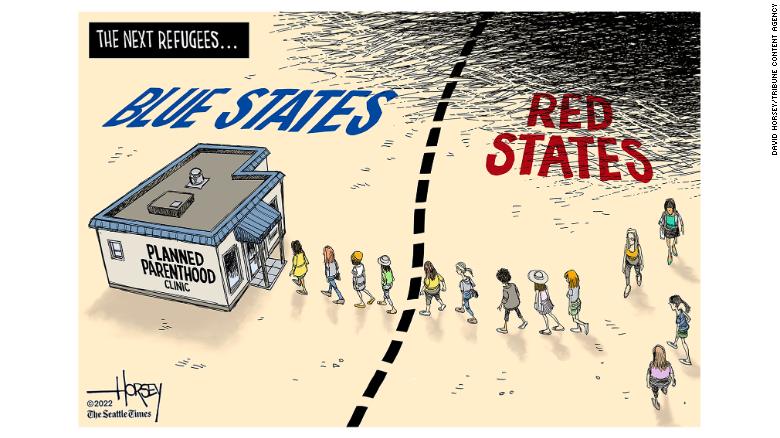
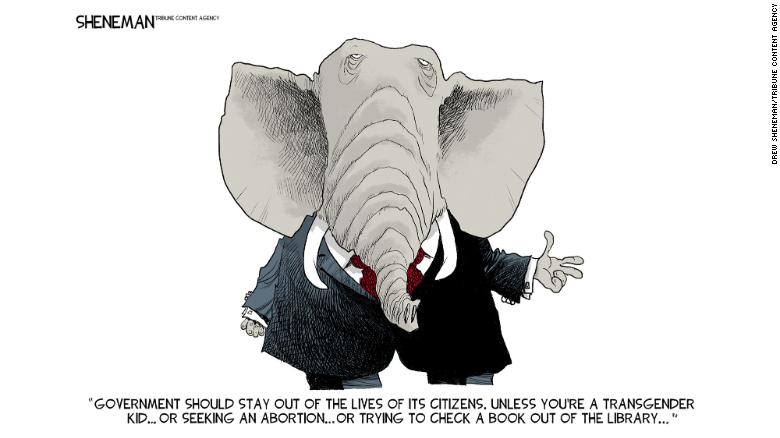
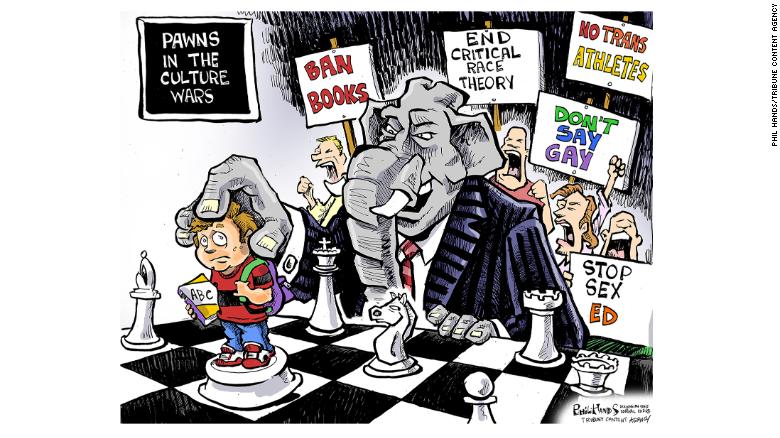
Red states are enacting measures restricting what can be taught in schools — with Florida’s “don’t say gay” law and Virginia’s executive order banning the teaching of critical race theory among them — and reducing access to voting in the wake of former President Donald Trump’s lies about widespread fraud in the 2020 election. And, last week, Oklahoma, Kentucky and Florida put in place new restrictions on abortion that appear to violate the landmark Supreme Court decision Roe v. Wade.
“In red states, it’s open season on women’s rights,” wrote Jill Filipovic. “Several Democratic-dominated states, on the other hand, are taking proactive steps to ensure abortion access. In Maryland, a new law means that trained medical professionals other than doctors will be able to legally perform abortions in the state.”
Four years before the Oklahoma ice decision, Justice Brandeis invoked the right to privacy in another dissenting opinion with long-lasting implications. Wiretapping someone’s phone without a warrant violates the Fourth Amendment, Brandeis contended. The framers of the Constitution “conferred, as against the government, the right to be let alone — the most comprehensive of rights and the right most valued by civilized men.”
The “right to be let alone” became the basis for the Supreme Court’s 1973 ruling in favor of abortion rights, which now is under assault.
In the Washington Post, Paul Waldman wrote “when the history of how American women lost their reproductive rights is written, the bill-signing that took place in Oklahoma City on Tuesday should be acknowledged as a key moment when the shrinking window of possibility that the Supreme Court might hold back from overturning Roe v. Wade essentially closed forever.” Gov. Kevin Stitt, a Republican, signed a “plainly unconstitutional bill” which outlaws almost all abortions.
“Faced with upholding or striking down a near-total ban such as Oklahoma’s, the court can’t take half-steps,” Waldman observed. “The justices can’t find refuge in debating the number of weeks into a pregnancy restrictions might be allowed, or whether some hoops states make women jump through are acceptable and others aren’t. They’ll have to decide on the fundamental question: Either women have a right to abortions, or they don’t. And the court’s conservative majority clearly thinks they don’t,” he argued.
“The reemergence of the culture war is downright chilling,” LZ Grandersonwrote in the Los Angeles Times. “Florida Gov. Ron DeSantis may be hogging all the attention for starting the flood of so-called ‘Don’t Say Gay’ bills across the country (we’re up to 12 and counting), but don’t sleep on the ‘don’t read gay’ effort that’s been working in the shadows.” Granderson noted “the American Library Assn. tracked 729 book challenges in 2021 and found the ‘most targeted books were by or about Black or LGBTQIA+ persons.’ “
Advocates say HB 989 will turn judicial bypass in Louisiana into an adversarial process that will be even more onerous and traumatic than it already is. Joshua Roberts/Getty Images
HB 989 could be a test case to undermine the judicial bypass in Louisiana—and set up the next big abortion rights fight at the Supreme Court.
Last week, Louisiana lawmakers introduced a bill that would create the most restrictive judicial bypass system in the country, putting abortion care out of reach for minors in a state where access already hangs by a thread—and possibly setting up the next big abortion rights fight at the Supreme Court.
“Accessing an abortion in Louisiana is extremely difficult for anyone, but for young people who cannot involve their parents, it is almost impossible,” said Michelle Erenberg, executive director of Lift Louisiana.
Over half of U.S. states have laws aimed at restricting young people’s access to abortion. These so-called parental involvement laws require minors to either obtain consent from a parent or notify them that they’re getting an abortion, and half a dozen states require both. While some states include exceptions for rape, incest, and/or the life of the pregnant person, others do not. Every state with a parental involvement law on the books must also offer the option of a judicial bypass, a process by which young people who cannot involve a parent in their abortion decision can ask a judge to grant them permission.
In 2021, Louisiana passed Act 482, which “changed the jurisdiction for minors seeking abortion through judicial bypass,” Erenberg said. “Since that law took effect, only two minors have been able to get a judicial bypass. That’s compared to approximately 20 in previous years.”
The latest bill, HB 989, sponsored by Louisiana state Rep. Raymond Crews, takes the judicial process a step further—by adding approximately ten more steps, that is.
“The new provisions are almost too many to even list in this article,” said Erenberg, adding that HB 989 will turn judicial bypass into an adversarial process even more onerous and traumatic than it already is.
If passed, HB 989 would:
Authorize the court to appoint an attorney to represent the interests of the “unborn child” and/or the minor’s parents.
Mandate that the minor undergo an evaluation by a medical professional other than the abortion provider to evaluate the “potential health risks” involved.
Force young people to produce photo identification (something that’s difficult to come by if you don’t have a driver’s license) or a copy of their birth certificate.
Demand “clear and convincing evidence” from the minor that they are mature enough to give informed consent to have an abortion.
Completely remove the “best interests” standard in explicit violation of family law, creating a presumption that minors under 13 are automatically incapable of being “sufficiently well-informed and mature” to make the abortion decision on their own, effectively compelling anyone under the age of 13 to stay pregnant.
If a minor does receive a judicial bypass, HB 989 makes it so that the order expires after ten days.
“The three remaining clinics in Louisiana are overburdened with patients from Louisiana and those from Texas [who are being] barred from care based on that state’s abortion ban,” Erenberg said. “Currently, patients are waiting three weeks or more to get an appointment. With this provision, minors seeking abortion, even with a valid court order, would not be able to get an appointment before the order expired.”
History of the judicial bypass
In Bellotti v. Baird, the Supreme Court ruled in 1979 that no one individual should have total veto power over someone else’s abortion decision—therefore, states with parental involvement laws must give young people a second option if going to a parent isn’t feasible. Thus, the judicial bypass process was born.
Despite its initial framing as a compromise to make parental involvement laws less burdensome, judicial bypass is far from the “easy way out” some conservative lawmakers purport it to be. Statistically speaking, most young people already involve a parent in their abortion decision. In fact, nearly all young people involve a trusted adult, and the younger a teen is, the likelier they are to do so. In other words, for young people who can involve a parent in their abortion decision, these laws are essentially moot.
The requirements of judicial bypass come down hardest on the most marginalized: teens living in rural or underserved areas, teens of color, teens living in homes with abuse or where disclosing a pregnancy could be dangerous, and teens living apart from their parents, such as in foster care. These young people are forced to go through an arduous and often dehumanizing experience where they must argue before a judge that they’re mature enough to make the abortion decision on their own. If the judge finds they’re not, they then have to decide whether it’s in the minor’s best interests to have the abortion.
Broader implications
Advocates say HB 989 is likely a trial balloon, a piece of legislation lawmakers float in hopes it will pass and then be challenged in court. The idea is to create a test case for the courts to change the law by affirming said trial balloon—and in this instance, given the makeup of Louisiana courts and the federal judiciary (not to mention the Supreme Court’s conservative supermajority), uphold Louisiana’s attempt to end judicial bypass entirely.
Before the Court ends its current term in June, the justices will release their decision in Dobbs v. Jackson Women’s Health Organization, which will, at the very least, gut the “undue burden” standard that safeguards access. More likely, though, the decision will reverse Roe v. Wade, opening the floodgates for abortion bans in states across the country. Bills like HB 989 promise to be the new normal: laws that, if allowed to go into effect, flagrantly violate the constitutional principles that protect the right to abortion, as flimsy as they are.
In the fight for abortion rights, parental involvement laws are too often relegated to the sidelines, deprioritized, and stigmatized. And as egregious as HB 989 is, conservative lawmakers know it won’t draw the same attention as six-week bans or other restrictions that all but make abortion illegal. As their likelihood of passing and being affirmed in a court challenge—especially in a judicial system that a conservative president spent four years stacking with anti-choice judges—is high, so too are the chances it will happen under the cover of obscurity, thanks in part to a movement that largely ignores the rights of young people.
If HB 989 is allowed to go into effect, it will mean the end of abortion access for young people in Louisiana who cannot involve a parent in their abortion decision. And if affirmed by a federal court, it will mean the end of abortion access for young people across the country.
AFTER GETTING AN ILLEGAL ABORTION WHEN SHE WAS 15, RENEE CHELIAN WENT ON TO OPEN THREE ABORTION CLINICS AROUND DETROIT. (PHOTOGRAPHY BY CASSANDRA GIRALDO, GRAPHICS BY RAQUEL REI, VICE NEWS GRAPHICS)
She was 15 when she got an illegal abortion in a dirty Detroit warehouse. Now, she’s terrified others will experience something similar.
Renee Chelian still doesn’t know who performed her abortion.
In 1966, Chelian was 15 years old and living in the Detroit area when she got pregnant. She had no idea what an abortion was, until her parents asked her if she wanted one. But Chelian soon underwent one—after being blindfolded and taken to a dirty warehouse crowded with women looking for illegal abortions.
Determined to keep pregnant people from facing the kind of uncertainty and danger she did, Chelian eventually become an abortion provider herself. She now runs three abortion clinics around Detroit.
In the 1950s and ’60s, somewhere between 200,000 and 1.2 million illegal abortions were performed annually. Banning abortion doesn’t make the procedure disappear. It just keeps the public in the dark about it.
With the advent of abortion-inducing pills, the technology of abortion has evolved since the days of Chelian’s procedure; experts now believe that using pills to self-manage an abortion can be safe. But Chelian fears a moment where people will be cut off from the procedure she’s devoted her life to providing. The Supreme Court is now deliberating over a case that threatens to topple Roe v. Wade, the 1973 ruling that legalized abortion nationwide.
In order to understand what this future might look like, VICE News turned to the past—to the stories of the people who’ve had front-row seats to the last half-century’s fight over abortion. Chelian spoke to VICE News about her illegal abortion and her abortion clinic network, the Detroit-based Northland Family Planning, as part of our series about the legacies left by veterans of the U.S. abortion wars.
This article, told in Chelian’s words, has been edited for clarity and length.
I learned about abortion when I was 15 years old. I knew I was pregnant, but my mother took me to a doctor to confirm it because I just couldn’t tell her. My parents were getting ready to send me to Ohio to marry my boyfriend, who was 16, and my dad and mom came into my bedroom and asked me if I wanted to have an abortion. I said, “I don’t know what that is.” They said, “Well, you won’t be pregnant anymore… You won’t have to get married. You can finish high school.”
Because in 1966, pregnant girls were expelled from high school. Boys weren’t. But girls were. And I would have done anything at that point not to have a baby, not to be thrown out of school, and to be able to go forward with my life.
My boyfriend’s father made the arrangements. Everything was done by secret and by code. We had party lines—you shared a phone with a neighbor, so you couldn’t talk freely to someone on the telephone.
My parents were given the information on where to go. My mom was six months pregnant with my youngest sister, and my father was afraid for her to go. He took me and we drove to some spot in Detroit, and both of us were then blindfolded and put in another car and driven to this place. When the blindfolds were taken off, we were inside some kind of warehouse. The floors were greasy.
“Well, you won’t be pregnant anymore… You won’t have to get married. You can finish high school.”
I was scared to look around. I was afraid that if they hurt me, my father was going to kill somebody and he would end up in jail. I didn’t really understand the other kinds of consequences.
Around me, there were a lot of women. I only looked at people’s feet. I was afraid to look up at their faces because if I did, I was afraid they’d make me go home. They gave me something to put me to sleep. When I woke up, my father and the person who did my abortion explained to me that I was a little farther along than they thought and that they couldn’t finish the abortion, that it was going to happen at home. What I know now is they packed my uterus with gauze in hopes that I would go into labor and pass the pregnancy at home. They said it would happen in a couple of days.
My mother had told our family physician, who told a young OB-GYN doctor from Colombia, who had just opened a practice in the small city within Detroit where I lived. He called my mom and said that, if there were any problems at all, that she should call him and he would take care of me. I found out later his sister had died from an illegal abortion in Colombia.
That OB-GYN put me on antibiotics, which was probably the best thing that happened to me, because it was more than a week and nothing had happened. In that week’s time, the people who did my abortion sent my dad and I to a pharmacy. We gave a fake name and a code word, and they gave us a bottle of quinine pills. All they did was make my ears ring.
Another appointment was made for my dad and I to meet them at another spot. We were taken, blindfolded, to the same sort of situation as the first appointment. I’m sure my dad was terrified, though he didn’t really let me know. I was scared.
My mother closed all the windows and doors in the house because she didn’t know if I would scream.
This time, I think they ruptured the membranes or amniotic sac, and repacked my uterus with gauze. They were certain I was going to go into labor this time. And within 24 to 48 hours, I started having contractions.
I lived in an inner-city neighborhood. If you reached your hand out the window and your neighbor reached their hand out the window, you could touch them. We had one bathroom and I had three younger siblings. So my dad took the kids for the day, and my mother closed all the windows and doors in the house because she didn’t know if I would scream.
I passed the pregnancy in the toilet, which unfortunately then presented another problem for my parents: What to do with the fetus? My mother asked me if I wanted to see it, and I didn’t need to. I was exhausted and I just knew I wasn’t pregnant anymore.
My mom must have gotten hold of my boyfriend’s dad, because the people who did my abortion told my mother that it would be a couple of hundred dollars more to come and pick up the fetus, which my parents didn’t have. My boyfriend’s father paid for the abortion. It was $2,000 total. I’m pretty sure my parents bought the house we were in right around then and paid six or eight thousand dollars.
My father is this Arabic man who doesn’t talk about menstruation or Kotex or girls’ things. He went to the store and he bought pads for me as well as a steak and beets. He bought things that only a dad would think would build up your blood, because he was scared I was going to be bleeding too much. He sat down on my bed and said, “You’re going to be OK, and we’re never going to speak of this again. You can never tell anyone. It could get us all in trouble. No man would marry you if he knew. This is something you don’t ever tell anybody.”
I hadn’t told any of my friends. My boyfriend’s dad had sent my boyfriend away during this time so that he didn’t come over to the house. When he came home, he did come to see me. But because I couldn’t talk about anything, he probably suffered more emotionally than I did.
Still, I felt very supported, very loved. The Colombian doctor I knew was watching out for me.
I never knew who did my abortion. I’m guessing someone with some sort of medical training, but probably not a doctor. But I was lucky I didn’t die. I was lucky I was not infertile.
[In the late 1960s and early ’70s, a handful of states started to loosen their abortion restrictions. In 1970, New York legalized abortion up till the 24th week of pregnancy, turning the state into a hub for people seeking the procedure. By 1972, health officials had estimated that more than 400,000 abortions had been performed in New York. The vast majority of the procedures were done on patients who had traveled in from out of state.]
I didn’t start out thinking that I would work in abortion because I had one. When I was a senior in high school, the doctor who took care of me offered me a part-time job. He got his license to practice in New York, where abortions became legal. He offered me a job to fly to Buffalo with him on the weekends. He had set up a clinic. So I started working Monday through Thursday in his office here, and we flew to Buffalo on Friday mornings.
When I showed up to work, there were at least 100 patients every day—women who had come from a six-state area and Canada. Every weekend, usually, there was someone sleeping in my hotel room because I couldn’t send a hitchhiker back out on the street. I just remember thinking, “I am in the beginning of the women’s movement, because this is about women taking care of women. And nobody has a better hands-on experience right now than I do.”
“You can never tell anyone. It could get us all in trouble. No man would marry you if he knew. This is something you don’t ever tell anybody.”
We’d start at 7 o’clock in the morning and sometimes we were working until 7 or 8 at night. We would go out to get something to eat, go to bed, and get up the next morning and start all over again. We did that Friday, Saturday, and Sunday.
There wasn’t really time to talk to the patients. I never stopped from the minute I got there until the last patient left. When I went in to work in the procedure room with the patient, I held her hand. I helped get her dressed. Then I had to take the instruments and the products of conception out of there into another room. We dumped them down the garbage disposal, which was not illegal. That was the standard of care. And I put the instruments in the sink, ran water on them. Once the patients were dressed, I helped them out the back door where I scrubbed instruments.
I actually didn’t know there was a case making its way to the Supreme Court; I don’t even know that my boss knew. But on the day that it was announced that abortions were legal, it was my first wedding anniversary. So we pretty much spent our first wedding anniversary helping my boss with getting the equipment from Buffalo back to Highland Park—which was the small city within Detroit where his office was—and starting doing abortions in Highland Park instead of in Buffalo.
That’s my memory of Roe—that, and being ecstatic. I was thinking of my sisters, that they would not ever have to face what I had to face, and neither would my future daughters.
I worked for the same doctor for several months after. I loved him, but I didn’t like the way the patients were being treated in our Michigan office. If I answered the phone and a woman was asking me questions about abortion, I got in trouble. If I was answering them, he would walk by, put the phone on hold and remind me that he was the doctor, not me. If somebody had questions, they could make an appointment for an office visit.
[Chelian eventually quit that job, to open up a clinic for another abortion provider.]
It wasn’t exactly what I wanted, but it was definitely closer. I hated the doctor, however. I thought he was mean and punitive towards patients who were obese or women of color, and I had no control over that.
I was thinking of my sisters, that they would not ever have to face what I had to face, and neither would my future daughters.
Then, in 1976, I decided to open my own clinic. I was going to find a doctor who believed in women’s health care the way I did. I went to my husband. We had saved almost $100,000 dollars between 1972 and 1976. I asked him how he would feel about letting me use that money to open a clinic. He said, “Do you think that you can succeed?” I said, “Well, I don’t think I can fail.” If I had been any older, I would never have probably taken that risk. But I 100 percent believed I could do this.
In 1976, I opened Northland Family Planning Clinic.
I had my first baby in 1980, and my husband was a police officer—something that he loved. I would never have asked him to quit. However, when I was pregnant, he came home one night after getting shot at on a drug raid with machine guns, and said, “I’m never going to live to see this baby being born.” I told him to come work with me. “We can job-share,” I said. “We can take turns taking care of the baby and you can do the jobs I hate, like paying bills and ordering medical supplies, and I get to work with patients.” And he did.
At that time in 1980, there really weren’t men staying home with babies. Together, we grew the clinics, and together we took care of our kids in the way that we dreamed. He thought he was only going to be doing this temporarily, and we’re still working together.
Around 1986, national NARAL was doing a speakout. [NARAL Pro-Choice America is one of the largest pro-abortion rights organizations in the United States.] They were looking for women who had an abortion pre-Roe to tell their stories. I went home that night and I decided I was going to tell my story.
The first person I needed to tell was my husband. It was a really teary night, because what he said to me was, “My god, you could have died.” As a police officer, part of his job was showing up at the hospital when women have illegal abortions, when they were sick and feverish. The police were supposed to interrogate them. He said it was the worst part of his job and sometimes he just refused to do it. After I talked to him, I called my mother. We had never, ever spoken of my abortion. I called her up and told her that I was going to go public with this story. We spent a couple of hours on the phone sobbing.
Then I also needed to tell my mother-in-law, because I have my husband’s last name. When I told her, she said, “Good for you. I almost died of an illegal abortion in Syria.” We were shocked. It was the first time another woman had told me her story.
[The spread of antibiotics, in the 1940s, likely greatly diminished the number of deaths from abortions. In 1965, fewer than 200 people died of illegal abortions. But death wasn’t the only potential consequence of an abortion gone wrong. In 1968, one Los Angeles hospital admitted 701 women for abortions that had turned septic, per the Guttmacher Institute. That’s one admission for every 14 deliveries admitted to the hospital that year.]
I ended up opening three clinics, all in the Detroit metropolitan area. That was our balance: three clinics, two kids. We were managing. Then the anti-abortion activity got worse.
We lived for two and a half years with clinic blockades. Anti-abortion activists would meet in a parking lot, get handed a map on where they were going, and they would blockade all of the doors—block the building. You couldn’t get in. Patients couldn’t get in.
The worst for me was the home picketing, because they terrified my young children. These people who claim to be so “pro-life” and care so much about kids took great pleasure in terrifying my children.
This other provider and I went to every Christian bookstore in the area and picked up all their literature. We got our families on every mailing list possible. So we always knew when there was going to be a blockade.
We’ve had two arson attacks in our clinics. I’ve had numerous death threats. We’ve had bomb threats. The worst for me was the home picketing, because they terrified my young children. These people who claim to be so “pro-life” and care so much about kids took great pleasure in terrifying my children. My youngest daughter wanted her bedroom windows bricked in. She wouldn’t play in the yard unless I was out there with her. She wouldn’t go to the end of the driveway. She closed her blinds the minute she got home from school and wouldn’t open them, well into her teenage years. She would lie in bed at night and scream, “Somebody is going to break in and kill us! Somebody is going to break in and kill us!”
I can’t tell you what it’s like to know that that kind of innocence is taken away from your child. Eventually, I got an ordinance passed in my city against residential picketing. It still let them come, but they had to protest feet away from our property.
We also once had a chemical bomb at one office. They used something called butyric acid, and all they had to do was use a very long needle and put a few drops of it in a syringe under the door. When we walked in in the morning, it smelled like a thousand people lined up and vomited. These butyric acid attacks were happening at clinics all over the country. You had to strip the wallpaper, take out the ceiling tile, rip up your carpeting. After the first couple of days in the clinic, every night that I went home, we just burned our clothes. We couldn’t get the smell out of them. A year and a half later, when you walked into the buildings, there was still the faint smell of vomit.
We have had protesters on and off since the day I opened the clinic.
One of the worst memories for me was when my oldest daughter was around 12. There was an attack at a clinic in the Boston area and I called all the doctors to tell them. We only had one clinic seeing patients that day, but two of the husbands of my staff were headed in their pickup trucks with rifles to go sit in the parking lot. I felt like I needed to go there and make sure that there wasn’t going to be any trouble. My oldest daughter grabbed me and begged me not to go.
I told her, “I have to do this. Freedom isn’t free. You have to stand up for what you believe in, sweetheart, and that’s what I’m doing. But I will be careful.” She wouldn’t let go of my legs. I had to peel her off me to get out the door. You shouldn’t have to do that to go to work.
My daughters, I thought, would never want to work in the clinic. However, one of my daughters went to law school and when she graduated decided that she wanted to work on public policy and advocacy for and on behalf of the clinic, both in the state and on the federal level. And that’s what she does. My younger daughter, who was terrified, never wanted to work at the clinic and didn’t for a long time—until the night Donald Trump was elected. She started crying so hard that her future children could be subject to an illegal abortion. She said, “I’m going to quit my job and come to work with you and fight this fight too.” And so I have two amazing daughters that, in spite of what they saw and lived through, are both working with me.
We have had protesters on and off since the day I opened the clinic, but since 9/11, they got worse. They were much more emboldened. And since Donald Trump won the election, they’re way worse. Almost every Saturday we have between 100 and 150 protesters.
I put shrubs outside as a fence—and then they try to scream in between them. They put a ladder up, so they can see over them. The guys who are on the ladder wear AK-47s with a fully loaded magazine on their back. You can see their sidearms under their shirt. It’s an effort to intimidate the patients in the parking lot.
We have a lot of security measures here and there hasn’t been a murder in a long time. But I don’t take that for granted. We have armed security guards and we had this amazing, amazing group of escorts who are out there every single Saturday. When the protesters find out that some of the escorts are in the LGBTQ community, they harass them even more.
These people think the ends justify the means, that they can do whatever they want to do to stop someone from having an abortion.
[Eight states, including Michigan, still have unenforced abortion bans that predate Roe and that remain on the books, according to the Guttmacher Institute. Authorities could try to enforce those bans if Roe is overturned. Thirteen states have also put so-called “trigger bans” into place, which are meant to outlaw all or nearly all abortions as soon as Roe is overturned.]
We’re going to see a public health crisis in this country like we haven’t seen since before Roe. I think that many are going to try dangerous methods of ending a pregnancy. And my heart breaks for that. Women of means can fly to a state that’s safe. New York will be safe. California will be safe. Colorado will probably be safe. And there will be a couple of others, but not everybody can fly to one of those states. They can’t afford the airfare, much less babysitters and time away from work. The reason that most of our patients tell us that they are choosing abortion is to take care of the children they already have. And they can’t provide for another.
I can’t fix this. Northland can’t fix this. Only the public can fix this.
A group of us have been working for more than a year to get ready for a ballot initiative. This ballot initiative will put in the Michigan state constitution a protection of abortion and reproductive rights in the state of Michigan for every pregnant person. And then we will be able to keep the clinics open. We’re going to have to work very hard, but I’m very, very optimistic about winning. If we don’t, abortion will be completely illegal in the state of Michigan. Everywhere. And we’re a state surrounded on three sides by water.
What worries me is that women will face exactly what I faced. There will be illegal abortion shops set up again. While some people may feel that they’re going to be able to get pills online or through friends, it’s going to be more and more difficult.
I’m 70 years old. I will fight, but the battle has to be picked up by younger people now—men and women, or however they identify, to protect this right. I can’t fix this. Northland can’t fix this. Only the public can fix this.
(PHOTO BY JEREMY HOGAN/SOPA IMAGES/LIGHTROCKET VIA GETTY IMAGES)
The state is a central access point for Texans seeking abortions. Two proposed bills would push Texans and Oklahomans to a narrow network of clinics in other nearby states.
Since their state passed its six-week abortion bill in September, Texans have headed north to Oklahoma in droves. But though it has emerged as a critical access point, Oklahoma is on the verge of passing its own strict abortion ban, and clinics in nearby states are bracing for a new surge in patients seeking care. Many worry that without Oklahoman clinics, they will be unable to account for everyone hoping to obtain an abortion.
Oklahoma’s state Senate passed a bill earlier this month that essentially copies the legislation, enforcing a ban on abortions past six weeks through private civil lawsuits that target abortion providers and anyone who “aids and abets” someone obtaining the procedure after that mark. Last week, the House passed an even stricter bill. It would use the same model of enforcement but ban all abortions, unless one was being performed to “save the life” of the pregnant person. If passed, it would be the strictest active abortion ban in the country.
Both bills are awaiting hearings in a second chamber — something local advocates expect could happen as early as next week — and the governor is expected to sign whichever ban reaches his desk first. Both would take effect immediately upon signing. Much like Texas’ ban, the bills in Oklahoma are expected to survive legal challenges because of their unusual punitive structure, even though they violate the principles established in Roe v. Wade, the 1973 case that guaranteed the right an abortion that could be weakened or upended this summer.
The laws would decimate access for Oklahomans and have massive ramifications for people seeking abortions across the region. Abortion providers in nearby states say regional infrastructure has already been stretched to its limit.
“These state-level laws have an impact that goes beyond their state borders,” said Kari White, the lead investigator of the Texas Policy Evaluation Project, which has studied the impact of Texas’ six-week abortion ban. About 1,400 Texans have gone to another state for an abortion each month since September, per her research. About 45 percent are traveling to Oklahoma.
“We are already stretched to our limits trying to see Texas folks,” said Rebecca Tong, the co-executive director for Trust Women, which operates an abortion clinic in Oklahoma City and another Wichita, Kansas. “This? It will make it worse. It will make it much, much worse.”
Since Texas’ abortion ban took effect, the Trust Women Oklahoma City clinic has seen mostly Texans. Wichita’s clinic has seen a combination of Texas-based patients as well as Oklahomans who were already unable to get care in their home state because clinics no longer had enough room for everyone. In Kansas, they are trying to hire more people to accommodate the demand. But finding support staff has posed a challenge, Tong said.
And even if the clinic operated at maximum capacity, she fears, it wouldn’t be enough.
“Even if we ran the clinic 24 hours a day 7 days a week, there would be people turned away. There would be people unable to get an appointment, unable to travel and some people who don’t make it to the point of calling a clinic,” Tong said. “It is not easy to reach us right now. It is not one simple phone call. People have to call multiple times because our phones are just ringing endlessly — and they have for the past six months.”
Data from the Centers for Disease Control and Prevention as well as data from the Guttmacher Institute suggest that close to 5,000 abortions are typically performed in Oklahoma each year. Prior to Texas’ six-week ban taking effect, about 55,000 abortions per year occurred in that state.
If care is unavailable in Oklahoma, it’s not entirely clear where people will go or who will have capacity. Kansas, just north of Oklahoma, has four clinics. Arkansas, to the east, has three. Both have already been seeing a surge in patients coming from Texas. And access in those states is tenuous, too. Kansas voters are weighing a constitutional amendment this August that would remove the state’s abortion protections. Arkansas has passed a so-called trigger law that could end access to the procedure if Roe v. Wade is overturned.
“It is going to be incredibly difficult for the facilities in these areas to absorb the volume, even if it were just Oklahoma alone,” White said.
New Mexico and Colorado, to the west, have fewer restrictions on the procedure and could become destinations for people seeking abortions. But providers there worry that they are already at their limit .
“We are trying to absorb as many as we can,” said Dr. Kristina Tocce, the medical director of Planned Parenthood Rocky Mountains, who is based in Denver. “But that being said, the sheer volume is formidable. And we are not going to be able to serve every patient that needs abortion care.”
There is another pressure point for Colorado, specifically. Idaho has also enacted a Texas-inspired six-week ban. For patients seeking care, and who can afford the airfare, Boulder or Denver — cities with direct flights to Boise and Idaho Falls – could be the most viable option.
The crush of patients and shortage of providers is already affecting what kind of care is available. Since September, clinics in all the states neighboring Texas and Oklahoma have reported longer wait times for patients seeking an abortion — at least two weeks, if not three. That pushes many patients out of the first trimester, when medication abortion is a viable option, and into the second trimester, when the only choice is a more expensive, more invasive surgery.
That has another ripple effect: Surgical procedures take longer, and clinics are already short on time to see everyone.
“What’s going to happen in Oklahoma, it will very likely increase our volume,” said Dr. Eve Espey, who chairs the OB-GYN department at the University of New Mexico and founded its center for reproductive health. “There are only three clinics in Albuquerque that provide abortion care, so there’s a limit. We’re talking about how we can ramp up more. We thought we’d have more medication abortion, and that’s not happening.”
She, along with other providers, worries that wait times will only grow longer with fewer clinics providing care for more people, pushing more abortions later in pregnancy.
So far, many people have been able to travel for care, often at great personal expense. But increasing restrictions could make those barriers eventually insurmountable, White said – especially for those who cannot afford a plane ticket, or who have never been on a plane.
“There are going to be some people for whom this is just not going to be possible. They could get themselves to Oklahoma, and they’re not going to be able to drive the extra two hours to get to Kansas,” she said. “There is going to be someone who is able to figure it out because they did end up having just enough social support or financial assistance. And there are going to be other folks who just aren’t going to be able to do it.”
Emily Wales, interim CEO of Planned Parenthood Great Plains Votes, speaks to a group of abortion rights advocates outside the state Capitol in Oklahoma City on Tuesday. The Oklahoma House gave final legislative approval to a bill that would make performing an abortion a felony. Sean Murphy/AP
Oklahoma lawmakers have approved a bill that would make performing an abortion a felony except in the case of a medical emergency.
It’s the latest conservative legislature to approve a new restriction on abortion, as Republican-led states across the country push to limit reproductive rights.
The recent wave of bills restricting abortion comes as the country awaits the U.S. Supreme Court’s decision in a landmark reproductive rights case. Some legal experts predict the conservative court could weaken or even overturn the constitutional right to an abortion in the first two trimesters of pregnancy guaranteed in Roe v. Wade.
“The only person who should have the power to decide whether you need an abortion is you — no matter where you live, or how much money you make,” Tamya Cox-Touré, executive director of the ACLU of Oklahoma, said in a statement after the bill was passed. “But Oklahoma is facing an abortion access crisis that poses an immediate threat to our community’s health and reproductive freedom.”
What the Oklahoma bill would do
The legislation, SB-612, prohibits people in Oklahoma from performing abortions unless they are doing so to “save the life of a pregnant woman in a medical emergency.”
A person convicted under the bill would be guilty of a felony and could face a fine up to $100,000 or a maximum 10-year prison sentence.
A pregnant woman could not be charged with a crime for having an abortion.
The Oklahoma House approved the measure by a 70-14 vote on Tuesday. It had been approved by the Senate in March of last year.
“Senate Bill 612 is the strongest pro-life legislation in the country right now, which effectively eliminates abortion in Oklahoma,” Republican State Sen. Nathan Dahm, one of the bill’s authors, said in a statement.
The bill now goes to Gov. Kevin Stitt for his signature. The Republican has previously said that he would sign all anti-abortion bills the legislature sends him, according to NPR member station KOSU.
Stitt’s office did not respond to a request for comment from NPR.
In March, the Oklahoma House passed a bill that would ban many abortions and allow private citizens to file civil lawsuits against anyone who performed an abortion, a legal framework similar to a Texas law.
After that law took effect in Texas in September, Oklahoma reportedly saw a surge in women from Texas seeking abortions. Nearly half of the patients being seen by Oklahoma providers are from Texas, the ACLU said.
GOP lawmakers are counting on Roe to be overturned
Although the Oklahoma bill will most certainly invite a legal challenge if it becomes law, experts say the measure’s supporters are likely unmoved by that prospect.
“I think that this is just a reflection of the fact that lawmakers in Oklahoma, as in much of the country, are pretty confident that the Supreme Court is going to overrule Roe and that it’s just a matter of time until a law like this can go into effect,” Mary Ziegler, visiting professor of constitutional law at Harvard Law School, told NPR.
Ziegler said the law may even be blocked from being enforced in the short term, but that Republican lawmakers in Oklahoma are likely counting on the Supreme Court to toss out Roe in the summer, clearing the way for such a law to take effect.
“They may lose the battle but they will think that they’re going to win the war,” Ziegler said.
Even as the constitutional right to an abortion has remained in place, states have left pre-Roe abortion bans in place or passed “trigger” laws that would prohibit the procedure if the Supreme Court ever allowed states to make that decision. More recently, lawmakers in conservative states from Alabama to Idaho to Arizona have passed new restrictions on abortion.
Laws criminalizing abortion used to be common
Some states are passing laws that would be enforced by private citizens filing civil lawsuits, while others like Oklahoma make performing an abortion a crime.
Laws that explicitly criminalize performing an abortion were common at the end of the 19th century, Ziegler said. “At one point in time almost every state had such a law,” he said.
But that changed in the 1960s and 1970s as advocates pushed to repeal such restrictions in the years before the Roe decision, which ultimately guaranteed the constitutional right to an abortion nationwide.
States with some of the nation’s strictest abortion laws are also some of the hardest places to have and raise a healthy child, especially for the poor, according to an analysis of federal data by The Associated Press.
The findings raise questions about the strength of the social safety net as those states are poised to further restrict or even ban abortion access following an expected U.S. Supreme Court decision later this year. The burden is likely to fall heaviest on those with low incomes, who also are the least able to seek an abortion in another state where the procedure remains widely available.
Mississippi has the nation’s largest share of children living in poverty and babies with low birth weights, according to 2019 data from the U.S. Census Bureau and the Centers for Disease Control, the latest available. Texas has the highest rate of women receiving no prenatal care during their first trimester and ranks second worst for the proportion of children in poverty who are uninsured, the data show.
Laws from both states are at the center of the nationwide fight over abortion access. The Supreme Court’s conservative majority signaled willingness in a Mississippi case to gut or strike down Roe v. Wade.
Anti-abortion lawmakers there say they will further promote adoption and foster-care programs if abortion is banned, as well as funding alternatives to abortion programs.
If Roe is overturned, 26 states are certain or likely to quickly ban abortion, according to the Guttmacher Institute, a think tank that supports abortion rights. Many of those states ranked poorly in measurements that nonpartisan advocacy groups consider key to ensuring children get a healthy start.
Data analyzed by the AP illustrates the hurdles pregnant women and their children face in states with the most stringent abortion restrictions and how access to resources can lag behind that of states that also have more permissive abortion laws.
Jazmin Arroyo, a 25-year-old old single mom in Kokomo, Indiana, had to stop working as a receptionist after her first child was born because she couldn’t afford day care.
Arroyo found a job as a restaurant host, but it didn’t offer insurance and her second child has a heart defect. She now has thousands in unpaid medical bills.
“I never could have imagined how hard it would end up being,” she said.
Indiana has the second-highest rate of women — 18% — who don’t receive prenatal care during their first trimester and has a high percentage of children in poverty without insurance, more than 9%.
The AP analyzed figures from several federal government agencies in seven categories — metrics identified by several nonprofits and experts as essential to determining whether children get a healthy start.
Generally, states that had passed preemptive abortion bans or laws that greatly restrict access to abortion had the worst rankings. Alabama and Louisiana joined Mississippi as the top three states with the highest percentage of babies born with low birth weights. Texas, Indiana and Mississippi had the highest percentage of women receiving no prenatal care during their first trimester.
In response to AP’s findings, many conservative state lawmakers said women can give their newborns up for adoption and said they would support funding increases for foster-care programs. In Oklahoma, GOP Senate President Pro Tem Greg Treat said he would work to increase salaries for child-welfare workers and state money for adopting foster parents.
“There’s going to be a commitment there, but it won’t be a new commitment. It will be a continuing effort on our part,” he said.
Some Democratically controlled states with more permissive abortion laws also measured poorly in some categories.
New Mexico ranks third highest for the share of its children living in poverty, Delaware ranks fifth highest for the percentage of women who receive no early prenatal care and California is among the top five states — between Oklahoma and Arkansas — for the share of women and children on food stamps.
Those states are generally outliers. Overwhelmingly, the data show far more challenges for newborns, children and their parents in states that restrict abortion.
Abortion restrictions and troubling economic data aren’t directly linked, but finances are a major reason why women seek abortions, according to research by Diana Greene Foster, a professor of reproductive science at the University of California, San Francisco.
Children born to women who were denied an abortion are more likely to live in a household where there isn’t enough money for basic living expenses, her work has found.
Texas last year passed an unusual law that leaves enforcement of an abortion ban after six weeks to civilians — a law the Supreme Court largely left in place.
Maleeha Aziz, an organizer for the Texas Equal Access Fund, had an abortion when she was a 20-year-old college student, after birth control failed. She’s also experienced a condition called hyperemesis gravidarum, which causes persistent, extreme nausea and vomiting.
“I was a vegetable. I could not move,” said Aziz, who later had a daughter. “Pregnancy is not a joke. It is the hardest thing that a person’s body will ever go through.”
In Texas, 20% of women don’t get prenatal care in their first trimester, according to pregnancy-risk assessment data collected by the CDC in 2016, the most recent data available from that state. The lack of prenatal care increases the risk of the mother dying or delivering a baby with low birth weight.
Texas abortion foes also point to a program called Alternatives to Abortion. As with similar groups in other states, it funds pregnancy counseling, adoption services and classes about life skills, budgeting and parenting.
“This social service network is really critical in our mind to right now supporting pregnant women and expecting families,” said John Seago, the legislative director for Texas Right to Life.
Most such groups, known generally as crisis pregnancy centers, are not licensed to provide medical care.
“The fiction of separateness for eggs, embryos, and fetuses has been used to justify denying the rights to life, liberty, equality, and privacy to pregnant people,” Lynn Paltrow, National Advocates for Pregnant Women’s founder and executive director, told Rewire News Group. Alex Edelman/AFP via Getty Images
Anti-abortion activists are already pushing for a world where a fetus has more rights than pregnant people.
For decades, anti-abortion lawmakers have operated under the false pretense that their only target was abortion providers. Pregnant people, depicted mostly as victims of the predatory abortion industrial complex—or some other unhinged, alarmist framework—were safe from their wrath.
But their tone has shifted as of late. The concept of fetal “personhood,” which defines life as beginning at conception, has become mainstream, and those advocates are pushing for the laws around abortion to reflect that.
For folks working in the abortion movement, this comes as no surprise. The absence of explicit references to so-called personhood never meant this wasn’t the endgame. It was always going to end up here: with abortion legally construed as murder, and anyone who performs one or has one a murderer. Fetal personhood is the most extreme manifestation of the anti-abortion agenda. While it’s framed as a means to create “equity” between fetuses and people, in actuality, it creates a world where a fetus’ rights are regarded with more sanctity than those of pregnant people. A sort of fetal supremacy, if you will.
Few people know more about the impacts of fetal personhood than the team at National Advocates for Pregnant Women, who for decades has been fighting for the rights of people charged with crimes related to their pregnancy and birth and parenting.
Lynn Paltrow, NAPW’s founder and executive director, spoke with Rewire News Group about the impact of fetal personhood on all pregnant people, the white-supremacist roots of personhood, and how these laws fit into the landscape of a larger attack on abortion access.
Rewire News Group: Let’s start with some background. How do you define “personhood”?
Lynn Paltrow: Roe v. Wade did more than recognize a fundamental right to choose abortion. Consistent with the plain language of the 14th Amendment to the Constitution (“all persons born or naturalized in the United States”), it also rejected the argument that fetuses at any stage of development are constitutional persons, and by doing so effectively recognized the personhood of pregnant people at every stage of pregnancy.
Advocates seeking to overturn Roe believed that if they could get fetuses recognized as separate persons under various state and federal laws—such as wrongful death and criminal feticide laws—that recognition could be used to persuade the Supreme Court to revisit Roe and, eventually, overturn it. The so-called fetal personhood movement grew out of that strategy and now argues that the “unborn,” from the moment of fertilization, should be treated as if they are actually rights-bearing persons separate from the pregnant person.
This argument not only threatens to remove from the community of constitutional persons the people who get pregnant, it also distracts attention from true personhood movements, such as Black Lives Matter.
How does personhood legislation impact the rights of all pregnant people?
LP: Adopting the legal and biological fiction that fertilized eggs, embryos, and fetuses still inside the pregnant person’s body are somehow already separate provides the basis for denying pregnant people virtually every right guaranteed by the Constitution.
The fiction of separateness for eggs, embryos, and fetuses has been used to justify denying the rights to life, liberty, equality, and privacy to pregnant people. The argument that the unborn are entitled to “equal” rights was used to justify forced cesarean surgery on Angela Carder, even though the judge who ordered that surgery knew it could kill her. Neither Angela nor the baby survived. The argument that the unborn are entitled to “equal” rights has justified the interpretation of numerous criminal laws—such as child abuse, child endangerment, contributing to the delinquency of a minor—to permit arrest and prosecution of women who were pregnant and fell down a flight of stairs, delayed having cesarean surgery, planned to have a home birth, didn’t get to the hospital quickly enough on the day of delivery, or used any amount of alcohol or a controlled substance, including marijuana.
If the unborn are full constitutional persons, then exercising the right to travel while pregnant becomes the crime of kidnapping, and experiencing a pregnancy loss or having an abortion becomes the crime of homicide and its numerous variations—including manslaughter, depraved-heart homicide, and first-degree murder. If the unborn are separate children, we have to presume that from the moment a person becomes pregnant, they will lose rights to privacy in medical information, since the state can claim a “parens patriae” interest—as the legal protector of citizens (the unborn) unable to protect themselves.
All threats to the health of the unborn could be prohibited, including some or all kinds of employment by pregnant people. And decisions people make about their pregnancies based on their religious beliefs could be denied, and one religious view of when legal personhood is recognized would be established under the law.
Lawmakers who support fetal personhood argue that it’s about giving a fetus equal rights to a human being, but can you explain how they act to put the rights of a fetus over those of the pregnant person?
LP: Courts have consistently ruled that no living person has the right to force someone else to undergo surgery or any medical procedure for their benefit—even if refusing to donate an organ, bone marrow, or blood could result in the other person’s death. So-called fetal rights or personhood would empower the state to take custody of pregnant people and force them to submit to surgery for the benefit of another. The pregnant woman loses her status as a full constitutional-rights-bearing person, and the fertilized egg, embryo, or fetus is given more rights than any born person.
In a post-Roe, fetuses-as-persons world, not only would the state presumably have the power to review a pregnant person’s medical records (to protect the unborn child), [it] would also have the legal authority to appoint a guardian ad litem or legal representative for the unborn from the moment of fertilization, and in every legal context involving a pregnant person.
The nightmare just keeps growing.
This concept of fetal supremacy—like all restrictions on abortion and pregnancy—is rooted in white supremacy. Can you talk a little about that connection?
LP: The United States was founded on the principle that some people could own and control the lives and bodies of other people. State-enforced restrictions on abortion and pregnancy are based on the premise—rooted in both white supremacy and male supremacy—that the government and people acting on its behalf may deny some people the right to own and control their own lives and bodies.
What can you tell us about the endgame of fetal personhood, and how does it prove that this is really about putting the rights of a fetus ahead of the pregnant person?
LP: The endgame of claims of personhood for eggs, embryos, and fetuses still inside of and dependent upon the pregnant person is to have Roe v. Wade overturned and to undermine legal precedent protecting principles of privacy and equality that protect LGBTQIA people; Black, brown, and Indigenous people; women; and religious minorities.
The endgame is to empower the state—legislators, law enforcement, child welfare authorities—and others to have power and control over certain populations that can be carried out in the guise of “protecting unborn lives,” while actually increasing risks to their lives and health. For example, we know that threatening arrest of pregnant women for fetal endangerment deters them from getting prenatal care and from speaking openly with their health-care providers and getting whatever help they may need.
The future of abortion rights is in flux in the U.S. as the Supreme Court is expected to weigh in on the issue in June. Since September, Texas has banned abortions after six weeks.
Amy, a spoken-word poet, recently had an abortion. And it was no easy task. The divorced mother of a 3-year-old said she barely had time to think once she realized she was pregnant — because she is in Texas.
“If I would have had a little bit more time, lowered my blood pressure a little bit — maybe I would have made a different decision. We’ll never know,” she said.
In September, the state enacted the most restrictive abortion law in the U.S. Amy, who declined to give her last name, knew she had just days to make her decision, find a place to get an abortion, and then go through with it.
“I don’t even think I had gotten the results from the pregnancy test, and I was already googling where to get an abortion in Texas, just so that I could have the option,” she said.
Amy’s experience in Texas may soon become reality for more women in the U.S.
The Supreme Court is expected to decide on an abortion case in June that could spur a wave of abortion rights restrictions throughout the nation.
Worried abortion rights advocates point to life in Texas under the new law, where abortion is illegal after a fetal heartbeat is detected, which is around six weeks of being pregnant for most women.
The law also carries the ability to sue anyone who helps a woman get an abortion after six weeks.
The reality for most women is the deadline is even shorter. When Amy missed her period, two weeks after having sex, she was considered to be four-and-a-half to five weeks pregnant, since pregnancy is calculated from the first day of a woman’s last period. Amy had less than a week, but after multiple phone calls, she was able to get into a clinic.
“I didn’t even have time to assess my own thoughts, I felt the clock ticking,” she said.
For anti-abortion activists, this time constraint is a big step in the right direction.
“Our goal is to make a society such that no woman would even consider having an abortion because she feels there are no alternatives. We do have vast alternatives,” said Joe Pojman, founder of Texas Alliance for Life.
Instead of seeking an abortion, Pojman wants pregnant women to visit Texas’ nearly 200 crisis pregnancy centers, where he says they can find support.
Brittany Green-Benningfield, who heads the Pflugerville Pregnancy Resource Center, said such groups offer a variety of resources for pregnant women.
“So this is our baby boutique for our moms,” she said while offering a tour of the center. “This is where, when they come and take lessons with us, they get an opportunity to shop. Through classes, they earn points, and then they are able to take what they need. We have a licensed sonographer, and she provides ultrasounds for any of our clients that come in. We are giving our moms a first glimpse to see their baby.”
The centers also help women make doctor’s appointments and offer things like canned goods until the child is 2-and-a-half to 3 years old. Pojman said it’s all a big step in the right direction, but that much more work is needed.
“While the number of abortions has substantially decreased and women are seeking more agencies that provide alternatives to abortions, there are still tens of thousands of abortions in Texas going on,” he said.
In some ways, Amy was a best-case scenario for someone seeking an abortion in Texas. She knew the law, she knew she had to move quickly, and she had resources to get an abortion and possibly travel out of state, if necessary. That’s not the case for poorer women who are being harmed most by the law, say abortion rights advocates.
Sarah Wheat, a spokesperson for Planned Parenthood, said she sees the obstacles women can face.
“Once they find out and are informed that Texas law prevents them from accessing an abortion right here as they’re sitting already in our health center, it’s too much, the barriers are too great, whether that is that they don’t have access to reliable transportation or they can’t get time off of their job or they don’t have somebody to take care of their children. It is totally out of reach,” she said.
In each month between September and December, 1,400 Texas women went out of state for an abortion, according to the University of Texas. That’s more than 4,000 women. Many others who missed the deadline ordered abortion pills online, which come with risks when not taken under medical supervision.
Amy said this makes her worry.
“Women are going to get abortions,” she said. “They’ve done it for centuries, even when they were fully illegal, and that’s how women died from abortions. So if you take away this decision, you’re ultimately just taking away women’s lives.”
Kentucky’s pre-viability abortion ban is modeled after the Mississippi ban that’s before the Supreme Court. Getty Images
Whether or not Democratic Gov. Andy Beshear signs the latest abortion restrictions likely won’t matter, as the Kentucky legislature holds veto power.
Kentucky has joined other states in ushering in a post-Roe era of abortion bans.
Last week, Kentucky lawmakers passed an unconstitutional pre-viability abortion ban as an amendment to HB 3, which is poised to decimate abortion access in the state, as Planned Parenthood Great Northwest, Hawai’i, Alaska, Indiana, Kentucky explains in an op-ed in the Courier-Journal.
The 15-week ban is modeled after the Mississippi 15-week ban that is currently before the Supreme Court. That case, Dobbs v. Jackson Women’s Health Organization, is expected to be the final blow to Roe v. Wade. A decision is expected to come before the Court ends its term at the end of June.
The Kentucky legislation is headed to Democratic Gov. Andy Beshear, who claims to be “pro-choice” but has supported abortion restrictions in the past. Whether or not he signs the bill, however, is not likely to matter as the Kentucky legislature holds the power to override the governor’s veto.
One of the restrictions included in the legislation involves medication abortion, which accounted for almost half of all abortions in the state in 2019. The bill would ban telehealth for medication abortion; the state already requires counseling on medication abortion “reversal”—which is a myth.
As Kim Greene wrote in the Courier-Journal op-ed:
So why this spasm of anti-abortion legislation in Kentucky and other states? Don’t think it’s what most Americans want. It is not. Like most Kentuckians, most Americans are compassionate and able to empathize with the plight of someone in need of this care. They want access to safe, legal abortion.
The Republican Senate president, Robert Stivers, center, arriving at the Kentucky State Capitol in Frankfort on Tuesday, when legislators passed a bill restricting abortion access.Credit…Luke Sharrett for The New York Times
The measure, approved by the Republican-controlled legislature, mirrors the Mississippi law now before the Supreme Court.
The Republican-controlled legislature in Kentucky passed sweeping legislation this week that would make abortion illegal after 15 weeks of pregnancy and grant no exemptions in cases of rape or incest.
The legislation, which resembled a restrictive Mississippi law that is being reviewed by the U.S. Supreme Court, folded together half a dozen bills that were introduced by Republicans in the state House and Senate.
Opponents of the bill, passed on Tuesday, said the legislation is even more restrictive than measures passed in Mississippi, Idaho, Florida and Texas and could effectively end abortion in Kentucky, where there are two abortion providers for the entire state.
“That’s not hyperbolic,” said Tamarra Wieder, the state director of Planned Parenthood Alliance Advocates, in an interview on Wednesday. “When the bill becomes law we are going to have to cease our abortion services.”
The legislation was approved one week after Arizona passed similar legislation banning abortion after 15 weeks. Gov. Doug Ducey of Arizona, a Republican, signed the measure into law on Wednesday. In doing so, he said, the state has affirmed “Arizona’s commitment to protecting the lives of preborn children.”
Max Wise, a Republican senator in Kentucky who sponsored the Senate version of the bill, said the legislative measures “show the strength of the pro-life movement in this Commonwealth.”
The legislation “will help take the necessary steps to value the sanctity of life and protecting the unborn,” he said in a statement.
Abortion rights supporters protested during debate on the abortion legislation Tuesday in the Kentucky State Senate.Credit…Debby Yetter/Courier Journal, via Associated Press
Opponents of the bill in Kentucky have called on Gov. Andy Beshear, a Democrat who has expressed support for abortion rights, to veto the legislation. His office referred a request for comment to a March 14 briefing with reporters, when he was asked about the bills.
“I believe that health care decisions should be between a patient and their doctor,” Mr. Beshear said. He said a bill that would force a young teenage girl “impregnated by a violent act” by a relative to potentially get permission from that person to seek options was “extreme.”
“That’s pretty wrong, and I think most Kentuckians don’t agree with that,” he said.
Mr. Wise said Republicans have “super majority” control of both chambers.
“We easily have the votes to override his expected veto,” he said in his statement.
The votes followed weeks of intense debate by legislators as well as opponents and supporters of the bill.
During one hearing over the Senate portion of the legislation, Karen Berg, a Democrat in the State Senate and a diagnostic radiologist, called the bill a “medical sham.”
“It does not follow medicine. It does not even purport to listen to medicine,” she said. She said legislators were “putting a gun to women’s heads.”
“Abortion will continue,” Dr. Berg said. “Women will continue to have efficacy over their own body, whether or not you make it legal.”
The legislation passed in the House 74 to 19. The Senate passed the bill 29 to 0, with seven of the state’s eight Senate Democrats walking out in protest rather than voting.
Addia Wuchner, the executive director of Kentucky Right to Life, which helped draft the legislation, said she was “very pleased to see the bill move forward.”
She said the legislation would establish “best practices for women’s health.”
Ms. Wuchner, a licensed registered nurse and a former Kentucky state representative, said the goal of the legislation is not to end abortion but “to make sure that women have access to all the health care they need.”
For example, she said, the bill requires women who want an abortion to get a blood test to determine whether they are Rh negative, which can lead to runaway immune reactions in Rh-positive babies born to Rh-negative mothers. Under the bill, a woman who tests negative would receive an injection of Rh immunoglobulin to avoid complications and miscarriage in future pregnancies, Ms. Wuchner said.
But Ms. Wieder said that such requirements are a “red herring” because abortion providers in the state provide that shot if necessary.
“We are already providing standard, quality care,” she said.
Instead, Ms. Wieder said, the legislation puts in place an onerous certification process on pharmacists that would make it virtually impossible for them to provide medically-inducing abortion medication.
The legislation would also require that fetal remains from abortions or miscarriages be cremated or buried. That requirement means that abortion providers would need to contract with a funeral home willing to take fetal tissue removed during an abortion, Ms. Wieder said.
“We have not been able to find funeral homes that would work with us,” she said. “And in this environment we don’t expect to.”
On Tuesday, opponents of the measure briefly disrupted the Senate session in an attempt to stop the vote, screaming from the balcony at legislators. “You’re killing women,” one of them yelled.
After the vote, protesters gathered in the statehouse, holding pink placards that read, “Keep safe, legal abortion,” and chanting, “Bans off our bodies.”
The ban would make exceptions in cases of a medical emergency that “so complicates the pregnancy” an abortion is required, according to the legislation.
With modern medical technology, viability is possible at about 23 weeks of pregnancy. But the Supreme Court’s six conservative justices appeared willing to abandon Roe when they heard oral arguments in December about the Mississippi law, which makes abortion illegal after 15 weeks.
Ms. Wieder said lawyers with Planned Parenthood are working with the American Civil Liberties Union to explore legal options.
In the meantime, Planned Parenthood is working on ways to transport people seeking an abortion out of state for the procedure should the legislation become law, which is a near certainty, Ms. Wieder said.
She said: “It’s going to be an incredible loss to Kentuckians.”










 Abortion - Abortion Clinics, Abortion Pill, Abortion Information