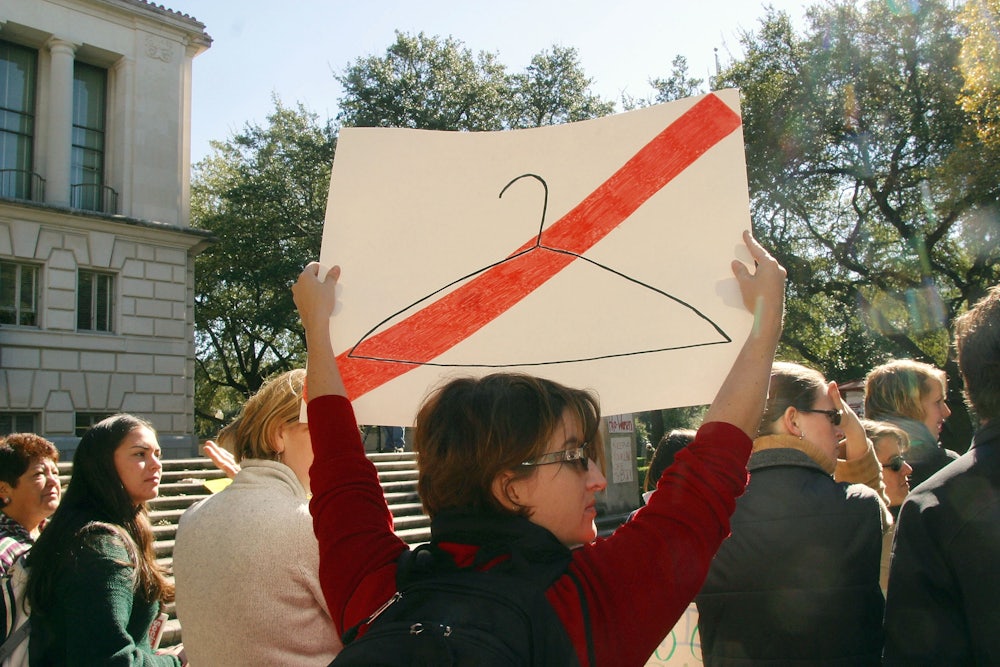
Abortion funds and youth nonprofits help young people navigate the legal system to get judicial approval for abortion, push repeal of parental notification laws, and support youth advocacy.

Since January, hundreds of anti-abortion bills have moved through state legislatures across the country, but historically, some of the most longstanding restrictions have targeted young people seeking abortion care. Minors face many barriers not always related to age, such as medically inaccurate sex education (or none at all), lack of birth control, and limited resources. But with a new round of parental notification laws, minors’ abortion access may be narrowing to the point of near-impossibility.

In the state of Indiana, a bill that would require minors to get parental consent prior to having an abortion was signed into law until a federal judge blocked it from taking effect this June. In West Virginia, a provision allowing doctors to grant waivers to minors seeking abortions due to health risks was repealed in April, leaving minors to either obtain a parent or guardian’s consent or a judge’s approval. And Alabama Attorney General Steve Marshall filed paperwork last month to appeal a July decision that blocked the state’s requirement that minors undergo a trial-like hearing to obtain a judge’s approval for an abortion.

“Young people, minors, are definitely the demographic facing some of the most serious restrictions on their bodily autonomy, and these laws regard their bodies as their parents’ property,” said Amanda Bennett, the client services manager at Jane’s Due Process in Texas. “Here in Texas, where there’s so few abortion clinics, the problem is really exacerbated.”

Jane’s Due Process is a nonprofit that supports reproductive justice for minors by offering help with navigating the process to obtain judicial bypass, the legal waiver that allows them to have abortions without parental consent. As of 2017, 37 out of 50 states have parental consent laws for minors seeking abortion. The 1979 U.S. Supreme Court decision of Bellotti v. Baird ruled that minors do not need parental consent to obtain the procedure, but granted that as long as they have the option of obtaining judicial bypass for the procedure, such parental requirements are feasible.

Jane’s Due Process also refers minors to Fund Texas Choice for financial assistance for other services they may need, such as transportation or lodging. In 2016, Jane’s Due Process completed intake with 307 minors, although only 200 went on to work toward obtaining bypass; some minors with unintended pregnancies will have miscarriages, travel out of state, or even end up telling their parents or trusted adults further down the line.

The judicial bypass process starts with minors seeking abortions calling Jane’s Due Process’ hotline or completing its online intake form. Next, the organization arranges for an ultrasound and an attorney paid for by the state. Within five business days, a hearing is scheduled with a judge. A recent law requires hearings to take place in the minor’s county of residence rather than where they will have their abortion, and this has sometimes complicated the judicial bypass process, according to Bennett.

“Judges in counties [without abortion clinics] tend to be less equipped to deal with these situations, and the hearings can get messy,” she said.

Young people receive judicial bypass if the judge deems that the minor is mature and informed enough to make the decision, or if the judge finds that the minor’s family situation merits the procedure. In many cases, minors are able to obtain the waiver. But in July, a 12-year-old victim of rape and child abuse in Alabama was denied an abortion by a district attorney and only granted judicial bypass when a circuit court intervened.

Still, according to Bennett, even though most hearings with judges do result in minors being granted judicial bypass, this doesn’t change the inherent problems with the hearings, which are not dependably confidential. In examples from Minnesota and Massachusetts, according to StopPNA.org, “one young woman was sitting in a court corridor when her sister’s civics class came through; another saw a neighbor in the courthouse; a third encountered her godmother, who was employed as a court officer; another had to hide in the bathroom to avoid being seen by a family member who worked in the courthouse; and a young woman ran into her father right outside of the courthouse.”

Young people can also face hostile gatekeepers. Quita Tinsley of the Access Reproductive Care-Southeast abortion fund in Georgia recalled when “a young person called us after she had been to her local courthouse in Georgia to ask about judicial bypass. They lied and told her they didn’t know what she was talking about. They tried to act like it didn’t exist. We knew it existed, and we were the ones who had to help her navigate that process and get her a lawyer to be able to get her judicial bypass.”

Abortion funds know firsthand that the circumstances surrounding young people accessing abortion are already incredibly difficult. From 2010 to 2015, the National Network of Abortion Funds’ George Tiller Memorial Fund served a total of 481 young people under the age of 18. The majority of adolescents were geographically located in the South (50 percent) and Midwest (20 percent), and had to travel an average of 185 miles. The young people who called for funding were predominantly Black (59 percent) and ages 14-to-15 (36 percent) or 16-to-17 (56 percent). Of the 204 adolescents who reported information on the reason for obtaining an abortion, the primary driver (61 percent) was not having access to birth control. And for many young people, there were extenuating life circumstances, such as some form of government assistance, having multiple children, seeking an abortion due to being raped, and having partial or unstable living situations.

The average cost of young people’s abortions funded by the Tiller Fund was $2,800, three times what the patients could afford. The cost was magnified because more than two-thirds of the adolescents sought abortion care in the second trimester of pregnancy.

Bennett noted that while minors are matched with attorneys at no cost, there is no public funding for abortion in Texas. A recent study associated the defunding of women’s health and family planning clinics in Texas with higher rates of abortion in teens. It’s worth noting that there’s also a statewide crisis of poor sexual health education in public schools and households that contributes to unplanned pregnancies among people of all ages.

West Virginia FREE is another abortion funding organization that helps minors access abortion care. Working with the Women’s Health Center of West Virginia, the last abortion clinic in the state, West Virginia FREE offers financial support for the abortion procedure, as well as transportation and lodging expenses for people who must travel out of state due to the state’s ban on 20-week abortions. The group also connects patients with an attorney from its judicial bypass network.

According to Julie Warden, West Virginia FREE’s communications director, only two waivers were used in 2015, and none in 2016. “It’s rare, but no less burdensome for the people who have to go through that process,” Warden said.

Yamani Hernandez, the executive director of the National Network of Abortion Funds, saw how difficult accessing abortion could be for youth when she was executive director of the Illinois Caucus for Adolescent Health (ICAH).

Hernandez noted: “Young people of color, undocumented youth, transgender youth, and others are already too often criminalized because of their very identities. Young people who have been neglected by the systems that are charged with supporting them are often hesitant to enter the court system. Too many youth experience stigma around their decisions at home, school, and in health-care environments. Legislators interested in targeting youth with these laws need to take a giant step back and reconsider the consequences of the obstacles they are setting up.”

Hernandez, current ICAH Executive Director Tiffany Pryor, and groups such as the ACLU of Illinois support youth and center their voices in the ongoing effort to end forced parental notification in that state. “Every young person is in a different situation when they seek abortion care,” Pryor said. “For reasons of safety, fear of homelessness or violence, abuse, and neglect, it’s not ethical to require parental notification.”

As anti-abortion lawmakers ramp up efforts to limit abortion access in the months to come, young people aren’t silent. They’re fighting back.

In Illinois, Pryor described local efforts led by youth. “Recently, young people at ICAH have organized and demanded Gov. [Bruce] Rauner sign HB 40, legislation that would allow every person, whether covered by private or government-funded health insurance, to have affordable and comprehensive health care, including abortion care.”

Paula Mejia, a young activist with ICAH, says of the HB 40 action in Illinois: “It’s been so incredibly rewarding to work with other young people who are passionate about issues of social justice. … We urge Governor Bruce Rauner to #SignHB40 and keep his promise to not interfere with reproductive rights. It’s already been passed by the House and the Senate of Illinois, and that’s why we say #MajorityforHB40.”

Another young person, Brie Garrett, says: “Health care is our human right, and everyone deserves to have access to opportunities and systems that help their lives. HB 40 helps lower-income people, people of color, women, and people who can get pregnant.”

In the abortion access movement, we often tout unapologetic abortion access for anyone who needs it. But until young people are heard loud and clear and supported in their reproductive decisions, abortion access for all will not be a reality.

https://rewire.news/article/2017/09/13/laws-minors-abortion-groups-help/

Photo by Donald Kravitz via Getty Images. Altered by Broadly Staff

Even though the Miss America pageant has tried to adapt to modern sensibilities, emphasizing “female empowerment,” it remains committed to an antiquated ideal of femininity.

In September of 1999, the Associated Press reported on a shocking national development: The Miss America Pageant would lift its long-standing ban that disqualified contestants who’d been divorced or gotten an abortion.

Since 1950, the Miss America Organization (MAO) had required entrants to sign a contract stating that they had never been married or pregnant. Forty-nine years later, the organization’s newly appointed CEO Robert Beck sought to overturn that ban, instead requiring contestants to assure that they weren’t currently married, pregnant, or the “natural or adoptive parent of any child.”

The change reportedly came at the recommendation of an attorney, who advised that the policy could be in violation of New Jersey’s anti-discrimination laws. (The pageant is held annually in Atlantic City.) But despite this seemingly logical rationale, the proposed changes were met with swift and decisive backlash: “Miss America has a long history of high moral standards and traditions, and I’m opposed to anything that changes that,” Libby Taylor, the president of the National Association of Miss America State Pageants, told the AP. Several current and former contestants publicly lamented that lifting the ban would change the pageant for the worse, and somehow deprive Americans of good role models.

The individual state chapters of MAO sued their parent organization in an effort to maintain the ban, and the national organization acquiesced, delaying the policy change for a year. Then, two weeks later, Robert Beck was fired.

Although the Miss America Pageant wouldn’t confirm that Beck’s firing had anything to do with the abortion-and-divorce policy, speculation was rampant. “Beck was fired after one year on the job because he had the audacity to ask the board to get rid of the archaic ban,” read an op-ed published in The Central New Jersey Home News one day after his termination was announced . (Four years later, the AP reported that Beck was awarded $80,000 in severance after suing MAO over his firing. The Miss America Organization told Broadly that they have no comment regarding Beck’s termination.)

The pageant board later “shelved” the policy changes, according to the AP, and it’s not exactly clear where they stand now. A spokesperson for Miss America told Broadly that married and divorced women are still prohibited from competing in the pageant. “Miss America must be childless,” she said. When asked directly about women who have had abortions, however, she responded, “We do not ask.”

The Miss America pageant, which has been criticized as a “modern relic,” was originally founded in 1921. At the time, contestants were judged based on “their general appeal in appearance, personality, conversations with the judges, and interactions with the crowds,” as the official Miss America website puts it, somewhat sheepishly. (“The pageant was a product of its times,” they later add.)

“Miss America must be childless.”

Since then, Miss America has tried to rebrand as the “nation’s leading advocate for women’s education and the largest provider of scholarship assistance to young women in the United States,” championing its role in empowering women. But critics remain skeptical, arguing that the Miss America Organization has spent nearly a century projecting an antiquated image of the ideal woman—one that’s necessarily coded as virginal and traditional.

Dr. Kimberly Hamlin, a professor of history and global intercultural studies at Miami University, has argued persuasively that the Miss America Pageant gained popularity starting in 1921 precisely because it challenged American women’s newfound political power. “In the 1920s, when the Miss America pageant as we know it began, women’s place in American life was rapidly changing,” Hamlin tells Broadly. ” Women were voting and running for office, serving on juries, working in an expanded number of professions, and enjoying new freedoms in many aspects of life.”

The first-ever winner of the Miss America pageant was Margaret Gorman, who was just 16 at the time. The Miss America website calls her “girlish and wholesome-looking;” Dr. Hamlin notes that she was “barely five feet tall when she was crowned.” A contemporary New York Times article praised her for looking “strong, red-blooded, able to shoulder the responsibilities of home-making and motherhood.”

“From the outset, the Miss America pageant has celebrated and popularized a more retrograde image of American womanhood,” says Hamlin, “even as it bills itself as a scholarship program for women and even though many contestants today go on to notable careers.”

It’s true that the pageant has changed with the times, and there have been several progressive contestants throughout the contest’s existence. Rebecca King, the pageant winner in 1974, was outspoken in favor of abortion rights during her reign, and in 1989—a full decade before the controversy over abortion and divorce—32 of 51 contestants identified as pro-choice. Still, the uproar over the proposed policy changes in 1999 underscores the fact that the pageant remains contingent on a very narrow view of idealized femininity.

Hamlin emphasizes that the pageant’s abortion rule was probably less of a political statement about the right to choose and more of a reflection of the organization’s preference “that contestants be virgins, at least plausibly”—which is, of course, troubling in its own right.

“Contestants are not supposed to be too sexy, or to be people who have obviously had sex before,” she adds. “Being a mother, being married, or having had an abortion is a pretty good indication that one is no longer a virgin.”

https://broadly.vice.com/en_us/article/qvjdxm/miss-america-used-to-ban-abortionand-still-bans-moms-wives-and-divorcees?utm_source=broadlytwitterus

They were participating in a “red rose rescue” demonstration.

On Friday morning, at least two abortion clinics in the U.S. were targeted by anti-abortion protesters who stormed the clinics’ waiting rooms, refusing to leave. The protesters were eventually arrested by local police for trespassing.

HuffPost confirmed the arrests with Northland Family Planning in Sterling Heights, Mich. and Alexandria Women’s Health Clinic in Alexandria, Va. Two other clinics, one in Columbus, Oh. and another in Albuquerque, New Mexico were also reportedly targeted, but HuffPost has yet to receive confirmation.

According to Lara Chelian, the Director of Advocacy at the Sterling Heights clinic, there were four arrests made at her clinic.

Chelian said that about 20 anti-abortion protesters showed up outside the clinic on Friday morning ― something that is far from unusual. However, she told HuffPost that five of those protesters “stormed the [Northland Family Planning clinic’s] waiting room and refused to leave.”

One protester reportedly left when staff threatened to call police. The other four remained, and were later arrested.

“They must have posted bail immediately because the ones who are arrested are back [protesting] already,” Chelian told HuffPost on Friday afternoon.

Created Equal, an anti-abortion group whose members participated in the demonstration on Friday posted video footage on Facebook.

Participants of the demonstrations appear to have been performing “red rose rescues,” a concept that originated with Canadian anti-abortion activist Mary Wagner. The 43-year-old was released from a Toronto jail on Tuesday after serving six months while awaiting trial for previous arrests on abortion clinic grounds. Rather than being sentenced with jail time, she was given 30 months of probation.

Wagner was photographed and filmed participating in the Sterling Heights demonstration on Friday

Chelian confirmed to HuffPost that anti-abortion protesters were indeed trying to hand out red roses to patients driving into the clinic, and one protestor outside the Sterling Heights clinic uploaded a Facebook selfie with another protester in which she appears to be holding a bouquet of roses.

 Monica Migliorino Miller, an anti-abortion rights activist and writer who also participated in the Sterling Heights demonstration, said in a video she published on YouTube, “the red rose rescue is an act of charity on behalf of the mom scheduled for abortions and, of course, for the innocent unborn who are about to be put to death. Those who took part were willing to embrace the risks for these women and their babies.”
Jana Birchum/Getty Images

A new slew of state laws are aimed at making sure abortion coverage is banned from private health insurance plans—putting the procedure still further out of reach.

In September 1977, a 27-year-old woman named Rosie Jimenez died from an illegal abortion in McAllen, Texas. Her insurance, Medicaid, no longer reimbursed abortions and she didn’t have the money to pay for a legal the procedure out of pocket. Bereft of options, the student and single mother visited a local midwife who performed a “back alley” abortion at a fraction of the price. A few days later, Jimenez began hemorrhaging and vomiting due to a bacterial infection in her uterus. After seven days in intensive care at McAllen General Hospital, she died from organ failure and became known as “first victim of the Hyde Amendment.”

Two months before Jimenez’s death, a law that barred federal money from paying for abortion services through Medicaid went into effect. “I certainly would like to prevent, if I could legally, anybody having an abortion, a rich woman, a middle-class woman, or a poor woman,” said the bill’s author, Henry Hyde of Illinois. “Unfortunately, the only vehicle available is the … Medicaid bill.”

Jimenez’s story illustrates the impact of laws that restrict insurance coverage of abortion. Forty-one years after the passage of the Hyde Amendment, insurance coverage, public and private, remains a key battleground in the fight over abortion rights. Last month, Texas and Oregon passed laws that banned private insurance coverage for abortion and required it, respectively. The diametric opposition of these laws, signed on the same day, threw into sharp relief the role that insurance coverage plays in ensuring affordability and accessibility of abortion care for all women, not just the privileged.


On August 15, Texas Governor Greg Abbott signed HB 214 into law, banning most insurance plans in the state from covering abortion, unless a woman’s life is in danger. Dubbed “Pro-Life Insurance Reform,” the measure means that private insurance plans, whether purchased through the Affordable Care Act exchange or provided through an employer, cannot cover abortion services. Regardless of insurance, Texan women have to cover the costs of abortion care out-of-pocket.

Two thousand miles away in Oregon, Governor Kate Brown signed the Reproductive Health Equity Act, which advocates are calling “the nation’s most progressive reproductive health policy.” Among other provisions, RHEA requires insurance companies to cover abortion care, as well as birth control, without charging a copay.

“For anyone who even dips their toe into this work, you soon realize that insurance coverage, or lack of coverage, is one of the biggest determining factors in whether or not someone can get an abortion,” said Katherine McGuiness, the Board President of the Network for Reproductive Options, or NRO, an abortion fund that serves Oregon and Idaho.

Abortions are expensive, which is why insurance coverage for abortion care is critical to making it accessible. The average out-of-pocket cost for abortionsbefore ten weeks ranges from $300-$800, while second trimester procedures can cost thousands of dollars. And those costs don’t include related expenses that a woman will accumulate while getting an abortion, such as travel, accommodation, lost work time, and child-care.

While the Hyde Amendment targets low-income women through the Medicaid program, coverage bans on private insurance impact anyone with limited resources. A middle income person who lives paycheck-to-paycheck, is saddled with student loan debt, has family members to support, or recently faced an unforeseen expense may also find $500 unattainable. Given that more than half of Americans have less than $1,000 in their savings accounts (including thirty-four percent with no savings at all), these restrictions affect a large swath of women and can force them to make untenable choices. In a study conducted by Advancing New Standards in Reproductive Health (ANSIRH) at the University of California, San Francisco, half of abortion patients said they spent more than one-third of their monthly income to cover the costs associated with their abortion, potentially foregoing rent, utilities, or even food.


Elizabeth Nash, Senior State Issues Manager at The Guttmacher Institute, said that in the 1990s, “nobody” covered contraception or abortion, but after a series of advocacy campaigns, private insurers began covering these services without much pomp. “Up until the early 2000s, abortion coverage was typical,” she said. “It was a normal part of the package of services that were covered.”

Then came the furious debate around the Affordable Care Act, which devolved into a furious debate about abortion. One of the concessions made to get the ACA through was that states had the option to limit abortion coverage in plans offered through the exchanges, and 25 states have taken advantage of that offer. This laid the groundwork for more types of insurance restrictions. With Texas, 11 states now have private insurance coverage bans on the books. Many insurers in Texas already fail to cover abortion, so while the ban has a whiff of political theater, it’s also a deliberate attempt to choke off access to care.

One of the arguments used to justify the ban on federal funding for abortion is that taxpayers should not be “forced” to pay for something they are religiously or morally opposed to. Similarly, Governor Abbot’s argument for the Texas ban on private insurance coverage is that “no Texan is ever required to pay for a procedure that ends the life of an unborn child.” Except that’s not how taxes—or insurance—work. People don’t pick and choose where their money goes. Someone who opposes war still pays taxes that fund the military. A Jehovah’s Witness who believes it’s a sin to receive a blood transfusion still pays insurance premiums into a pool that pays for someone else’s transfusion.“I find puzzling the conversation about taxpayers paying for people’s abortions, as if people who have abortions aren’t taxpayers and shouldn’t also be able to have the taxes they pay go to supporting their healthcare like everybody else,” said Yamani Hernandez, the Executive Director of the National Network for Abortion Funds.


An aspect of the Texas law that attracted particular attention was that it necessitated the purchase of what was called “rape insurance.” In theory, the law allows women to buy supplemental insurance for abortion care, also known as “riders.” Since the insurance ban does not include exceptions for rape or incest, that means a woman who was raped and got pregnant would not have insurance coverage for an abortion unless, in advance of getting raped, she had bought a rider. Hence “rape insurance.”

But the rider system also means that anyone who wanted their insurance to cover abortion would have to anticipate that need in advance, which again, makes no sense. Unplanned pregnancies are, by definition, unplanned. There are countless reasons why unplanned pregnancies occur and why women choose to have abortions, but a healthcare system in which quality coverage depends on omniscience seems unreasonable. The whole point of insurance is to protect against unforeseen risk.

Furthermore, just because states permit insurance companies to offer riders does not mean they actually do. According to a National Women’s Law Center (NWLC) survey, there is no evidence that supplemental coverage is available in the seven states where lawmakers have allowed it as an option. As a patchwork of regulations across states makes abortion coverage more costly and complicated, disincentives to offer this coverage are mounting for insurers nationwide.

The Reproductive Health Equity Act in Oregon aims to prevent this from happening. By requiring insurers to cover abortion, the state set the standard that abortion is healthcare and insurers have to cover it accordingly. In addition, creating a standard for coverage means Oregon women will definitively know they can use their insurance for abortion. Fifty-three percent of women pay out-of-pocket for abortion, even if they have insurance coverage, and this is often due to uncertainty.

“Many women with private insurance plans fail to use their coverage for reasons including because they assume abortion is not a covered service and because they were given incorrect information regarding their plan’s policies on covering abortions,” wrote Katrina Kimport and Brenly Rowland, two researchers from the University of California, San Francisco, in a study released in late August.

The opacity, complexity, and volatility of policies surrounding insurance coverage and abortion care don’t just cause financial problems for patients, but also for clinics. Independent abortion care providers perform sixty percent of abortions in the U.S., but they are rapidly disappearing. According to the Abortion Care Network (ACN), which tracks clinic closures, the number of independent providers has plummeted by nearly thirty percent in the past five years. Many such clinics have subsidy programs to keep costs low for their patients, and coverage bans will take an additional toll on their solvency. If the trend continues, more clinic doors will close. The fewer clinics there are, the farther women have to travel to get care and the more the costs stack up.  If abortion is unaffordable for the vast majority of American women, it’s a right in theory, not in practice.

https://newrepublic.com/article/144793/insurance-cover-abortion

Children’s Minister Katherine Zappone says the Government is working hard on the wording for next year’s abortion referendum.

Speaking at the opening of the Kennedy Summer School in Wexford, Minister Zappone stressed the need for “reproductive justice” in Ireland.

She told the audience: “Equality is a rich and complex concept. So much more than protections and guarantees, it is being empowered to see, take, and benefit from opportunities that arise.

“This often requires hard conversations and hard work.

“One of those hard conversations is about the 8th amendment, which denies women full reproductive rights.

“Instead, it oppresses us with the burden of choicelessness.

“Choicelessness is not only about the ability to decide whether to remain pregnant, but about the ability to decide what is done to our bodies, including in pregnancy and labour.

“That is why repealing the 8th amendment is about reproductive rights for all women, including those who want to continue with their pregnancies.

“Of course, for those who don’t the 8th Amendment means they cannot access abortion in Ireland.”

“As a woman, a progressive, a campaigner and a Government minister I firmly believe we need a system of reproductive justice – which must include a referendum on reproductive rights.

“We must trust women to make decisions for themselves and their families, and ensure that our structures mean those decisions really are choices.

“True reproductive justice means building a society where the care of children is a collective effort, properly supported by the State.”

“The referendum next year will be part but not all of ensuring reproductive justice in Ireland.”

“Without repealing the 8th amendment and the clear establishment of reproductive rights for all, those who can become pregnant in Ireland will be unequal to those who cannot.

“That situation simply cannot persist.”

She said the Taoiseach Leo Varadkar had already outlined his determination to hold the referendum before the Summer and she hoped they could meet that deadline.

She said: “I think there are two things we’re working on now: one is the wording of the referendum itself – and it seems many, many people want a full repeal of the 8th amendment.

“And we also have to listen to the citizens from the Citizens’ Assembly, who recommended that we should have an amendment to that to include and to insist that it really is the power of Oireachtas members to legislate for abortion.

“Secondly, I think what’s really important – and I know it’s important to the Taoiseach too – is that as we bring the wording of the referendum to the people that we will also have in front of them a scheme of a bill in relation to the kind of abortion legislation that would be put in place if a referendum were to succeed”.

http://www.breakingnews.ie/ireland/childrens-minister-stresses-need-for-reproductive-justice-as-govt-prepares-for-abortion-vote-805134.html

As researchers note in a new study, “the ability to access abortion care when needed—even if more than once—should be prioritized.”

Last month, the Guttmacher Institute released a new study examining characteristics of patients who’ve had more than one abortion. This study is the first of its kind to use data from a sample of U.S. abortion patients to explore if there are particular factors that contribute to people having multiple abortions over the course of their lives.

Even as stigma abounds, the study issues a clear directive: Maintaining access to care is of utmost importance, regardless of how frequently someone may need an abortion.

The researchers found that having multiple abortions is quite common, with about 45 percent of abortion patients nationally reporting having more than one abortion. The study also makes clear that structural inequalities play a detrimental role in health-care accessa point echoed by people sharing their abortion stories as part of We Testify, a program of the National Network of Abortion Funds, in interviews with Rewire.

“The health-care system is designed to fail you, not protect you, especially when we live in a world that makes birth control inaccessible, Plan B inaccessible, and sex education that covers pregnancy options is virtually nonexistent, especially in the South,” Stephanie Loraine, 25, told Rewire. The 25-year-old vice president of the Central Florida Women’s Emergency Fund said she experienced significant barriers to getting the abortions she needed. Her first pregnancy resulted from being sexually assaulted at a party, and after her abortion, she recalled that her father threw her birth control prescription out the window. When she found out she was pregnant again a year later, a local pharmacist refused to sell her partner emergency contraception (EC) because he wasn’t the one who was going to take it. The FDA, however, allows men to purchase EC for their partners.

Knowing that she didn’t want to involve her parents but not sure how to navigate the health-care system as a minor at the time, Stephanie Loraine panicked. “I googled everything I could find about self-abortion,” she told Rewire. She ended up saving money from her waitressing job to better navigate the appointments with both a lawyer and a judge to secure a judicial bypass and be able to have an abortion without parental consent. “My parents would’ve made me stay pregnant as a punishment for not saving myself [for marriage] after the first [abortion],” she said.

According to the new study, experiencing “disruptive life events” in the last year—such as exposure to violence, financial hardship, and unemployment—increased a person’s chances of needing more than one abortion, particularly if they experienced more than one of these events at the same time. These disruptive life events point to structural and institutional barriers to health-care access that are often rooted in racism, sexism, classism, and geographic location.

Kelsea, a 31-year old board member of the Carolina Abortion Fund, shared that after a clinic told her the cost of the abortion, “I hung up really quickly, and the first thing I researched was how to cause your own abortion.” Kelsea ended up using half of her unemployment check to pay for the abortion, and the other half “went to pay for my insurance premium, which wouldn’t cover the cost of the abortion.”

Twenty-five states restrict insurance coverage of abortion in exchange plans, and 21 states restrict abortion coverage for people who get their insurance through the government. The average cost of first-trimester abortion is $480, an often-impossible sum for people living paycheck-to-paycheck.

The study also found that increased age was also strongly associated with having more than one abortion, with people 30 and older having more than two times the odds of having had a prior abortion compared with people in their early 20s. “If we’re sexual beings who are able to get pregnant over the course of our lives, it only makes sense that people have multiple abortions,” Stephanie Loraine told Rewire. Indeed, if people must use contraception consistently and correctly for three decades to prevent pregnancy (and that’s if you want to have two children, the U.S. average), it makes logical sense that most people need access to abortion at different times in their lives.

The researchers discovered that more than half (54 percent) of Black women in the study reported having multiple abortions, a higher percentage than white women or Latinas. This is likely due to the compounding negative effects of racism and sexism on Black women’s health, which is also reflected in unjust policies like the Hyde Amendment. That amendment is attached as a rider to the federal budget every year and has the effect of disproportionately denying health care to women of color.

Community-level abortion stigma also affects how and why Black women access abortion care: “There’s a stigma in the Black community about being a single parent, being a Baby mama,” Kenya, a 42-year old abortion clinic employee in Texas, told Rewire. “For me, I didn’t want to be a statistic. I didn’t want to be a single mother with a lot of children. I [had a baby] once and didn’t want that to be my life.”

Kenya works at the clinic where she had her abortions, and realized that she was keeping her personal experiences from her patients for fear of their reaction. “I started to ask myself why I wouldn’t say that I’ve had multiple abortions aloud. Maybe it can help someone else not feel bad about their choices or not feel judged. There’s nothing to be ashamed about. Multiple abortions are necessary, and a lot of women do it.”

Because the Guttmacher study is quantitative in nature, it didn’t delve into the experience of having multiple abortions, particularly the worries about judgment and shame, an experience that even people in the reproductive health, rights, and justice community have. “I worried my friends would be like, ‘Seriously, another one though? There’s no reason for you to do this again,’” Kelsea told Rewire. “Despite fighting stigma every day, I still felt it and was mad at myself for letting this happen again.”

Megan, a 34-year old operations manager in Illinois, echoed this sentiment: “I don’t think I’ve ever said out loud that I’ve had two abortions, except to my husband and best friends, and I’m an abortion rights activist … I was surprised at how much weight saying that was for me, and then once I said it, it helped the shame dissipate a bit.”

Internalized stigma and fear of what others may think wasn’t the only factor keeping people from sharing their multiple abortion experiences with loved ones. “Online all the time I see memes about people who’ve had multiple abortions as serial killers,” Stephanie Loraine told Rewire. “The [anti-abortion] memes say things like, ‘if you’ve had multiple abortions, then your womb is a tomb.’” Despite the proliferation of these awful messages, there’s no reason to consider multiple abortions a negative health event or even something to be prevented.

As the study authors note, “the ability to access abortion care when needed—even if more than once—should be prioritized.” While some people may expect negative social consequences for sharing your experiences with abortion, having more than one abortion has no documented negative health outcomes, meaning that there is no medical reason to encourage women to have fewer abortions. Discouraging patients from seeking the health care they need, including multiple abortions, may in fact contribute to stigma instead of a patient’s physical and mental well-being.

“We’re good people making the best decisions we can for the circumstances we’re in,” Kelsea said. “We should approach people who’ve had multiple abortions with a genuine desire to appreciate where they’re at instead of a judgment about why they did what they did.”

https://rewire.news/article/2017/09/13/people-multiple-abortions-stigmatizing-counterproductive/

The Missouri Department of Health and Senior Services issued Planned Parenthood a license to provide abortion services at the Midtown Health Center of Kansas City, which is now taking appointments for medication abortion services.

Missouri is no longer a state with only one abortion clinic. Planned Parenthood Great Plains announced Monday that abortion services are now available at the organization’s health center in Kansas City.

Aaron Samulcek, interim president and CEO of Planned Parenthood Great Plains, said in a statement that approval from the state to provide abortion services represents a “hard fought victory” for the health-care organization.

“We celebrate this win for our patients who deserve greater access to comprehensive sexual and reproductive health care including safe, legal abortion,” Samulcek said.

The Missouri Department of Health and Senior Services issued Planned Parenthood a license to provide abortion services at the Midtown Health Center of Kansas City, which is now taking appointments for medication abortion services.

The clinic stopped providing abortion services five years ago, the Kansas City Star reported.

After the U.S. Supreme Court struck down portions of the Texas GOP omnibus anti-choice law known as HB 2, a federal judge in April blocked Republican officials in Missouri from enforcing a similar restrictions.

After the court ruling, Planned Parenthood Great Plains and Planned Parenthood of the St. Louis Region and Southwest Missouri said they would seek to expand abortion services to Kansas City, Columbia, Joplin, and Springfield.

The ruling sent Missouri lawmakers scrambling for ways to prevent abortion services from being expanded in the state. Gov. Eric Greitens (R), an outspoken opponent of reproductive rights, called a special of session of the GOP-held state legislature, and lawmakers passed sweeping abortion restrictions.

The new anti-choice laws are set to take effect October 24.

https://rewire.news/article/2017/09/11/abortion-access-just-got-little-better-missouri/


Planned Parenthood volunteers Kate Steir, 27, and Christian Deegan, 31, discuss their route while canvassing for Democratic gubernatorial candidate Ralph Northam in Arlington last month. (Photo by Astrid Riecken for The Washington Post)
 September 11

Abortion, a long-simmering issue in Virginia — a purple state where rural evangelicals sharply differ from urban progressives — has been elevated in this year’s gubernatorial contest because of changing dynamics on the federal level.

President Trump has vowed to appoint antiabortion judges who could unravel federal protections, turning the power to decide whether women can terminate pregnancies back to governors and state legislatures.

Virginia, the first to have a competitive statewide contest since Trump took office, offers a window into how abortion politics may reshape gubernatorial races to be held in about three dozen states in 2018.

“It’s so fundamentally different with a Republican in the White House and a national threat to Roe v. Wade, a threat that hasn’t existed in a decade,” said Jesse Ferguson, a Democratic strategist with roots in Virginia. “This has animated and motivated a lot of voters to move this issue even higher up as a priority.”

Democratic gubernatorial candidate Ralph Northam, the sitting lieutenant governor and a physician, has positioned himself as a champion of abortion rights. Republican rival Ed Gillespie said he’d like to see the procedure banned, with exceptions for rape, incest and to save the mother’s life.

Steir talks with voter Andy Leighton at his home in Arlington. (Photo by Astrid Riecken for The Washington Post)

The Republican-controlled state legislature has tried for years to restrict abortion, foiled by Gov. Terry McAuliffe (D), who has vetoed bills to defund Planned Parenthood and says the governor’s mansion is the “brick wall” against attempts to limit women’s reproductive rights.

If the Supreme Court overturns Roe v. Wade, the 1973 decision that established a woman’s right to an abortion, at any time in the next four years, McAuliffe’s successor could decide the legality of abortion in the Old Dominion.

Planned Parenthood’s Virginia arm has launched a $3 million field operationto support Northam and other Democrats — surpassing its spending to elect McAuliffe in 2013.

Foes of abortion rights, energized by success in Washington, see a chance to tear down McAuliffe’s wall.

Opponents of abortion are working with urgency, concerned that Virginia’s changing demographics — growing urban areas, more residents of color — are turning the swing state blue. All five of the current statewide officeholders — Sens. Tim Kaine and Mark R. Warner as well as McAuliffe, Northam and Attorney General Mark R. Herring — are Democrats who support abortion rights.

Northam’s election would mean “eight years of consecutive Democrat, anti-life leadership, and it would be very difficult to retract any of that and regain the ground we would lose,” said Don Blake, president of the Virginia Christian Alliance.

Democratic gubernatorial candidate Ralph Northam, left, and Republican rival Ed Gillespie. (Bob Brown/AP)
The Gorsuch appointment

Trump pleased abortion opponents when he appointed Neil M. Gorsuch, seen as favorable to their cause, to fill the vacancy left by Justice Antonin Scalia on the Supreme Court.

He’ll have a chance to change the court’s ideological balance if any of three justices older than 78 retire or die during his tenure. The GOP-controlled Senate has also scrapped the filibuster option for Supreme Court nominees, making it easier for the majority to advance antiabortion judges.

In addition to cutting funding for Planned Parenthood, abortion opponents in Virginia want to bar abortions after 20 weeks of pregnancy. Gillespie says he would support such bills; Northam opposes them.

Abortion rights activists lined up early behind Northam, citing the need for a steadfast ally in a changed national climate. During the Democratic primary, some abortion supporters attacked Northam’s opponent, former congressman Tom Perriello — even though Perriello was running as a progressive who backs abortion rights — because he once opposed public subsidies for insurers who cover abortion.

“We need someone who is unwavering,” said Tarina Keene, executive director of NARAL Pro Choice Virginia, which has deployed dozens of canvassers for Northam since March. “We have seen that happen before where our rights could be put on the table, on the negotiating block. We cannot tolerate that anymore.”

The national Democratic Party has been enmeshed this year in a debate about whether to back Democratic candidates who oppose abortion. In an effort to reach out to disaffected voters, particularly in rural areas, several party leaders, including House Minority Leader Nancy Pelosi, say Democrats should not use litmus tests. Others insist that reproductive rights are a core value of the party.

National antiabortion groups think that defeating Northam in Virginia would send a message that Democrats should not enforce party purity when it comes to abortion.

“We want to see Democrats see this extremism on this issue as a political vulnerability,” said Mallory Quigley, a spokeswoman for the Susan B. Anthony List, which is planning to run digital advertisements on behalf of Gillespie later this year.

But Democrats say that supporting abortion rights is a winning stance for them in Virginia.

A Washington Post poll in 2013 found 55 percent of Virginia voters favored allowing abortion in all or most instances. A poll from Christopher Newport University this year found a slim majority opposed bans on abortion after 20 weeks of pregnancy.

Geoffrey Garin, a pollster for the Northam campaign, said his initial surveys showed Gillespie’s comment during a primary debate that he would “like to see abortion be banned” drew some of the sharpest reaction from voters in the heavily populated areas of Northern Virginia, Richmond and Hampton Roads.

“The opposition to a woman’s right to choose is a dealbreaker for a lot of voters who otherwise would be willing to consider supporting a Republican,” Garin said. “It’s created an important bright red line for a lot of voters up and down the urban crescent and well into the exurbs.”

Other campaign issues

Gillespie has tried to play down abortion and instead focus on the economy and public safety. Asked about Gillespie’s views on abortion, his spokesman, Dave Abrams, responds that Northam’s views “are outside the mainstream” and that the lieutenant governor supports late-term abortions — which are illegal in Virginia and opposed by most voters.

Northam has said that the timing of abortions should be determined by a woman and her doctor, but he does not want to change the state law that limits late-term abortions.

The number of abortions performed in Virginia declined by one-third between 2009 and 2015, according to state data. The decline coincided with a rollback of abortion rights by the state’s past GOP governor, Robert F. McDonnell, whose term ended in 2014.

In 2011, he signed legislation regulating abortion clinics as hospitals — a move that critics said was meant to drive the clinics out of business. The regulations have since been dropped by the state health board dominated by McAuliffe appointees.

McDonnell in 2012 also signed a bill mandating abdominal ultrasounds before abortion. As originally written, the bill would have required women seeking an abortion early in a pregnancy to undergo a vaginal ultrasound. It made Virginia fodder for late-night comedians.

Northam, then a state lawmaker, raised his profile — and won the allegiance of abortion rights supporters — with a speech on the floor of the Senate where he said the ultrasounds would be about as useful as a probe of a bottle of Ga­tor­ade.

The proposed requirement of an invasive ultrasound was ultimately defeated. But it continues to resonate in this year’s down-ballot races.

The Republican candidate for lieutenant governor, state Sen. Jill Vogel, was the sponsor of the ultrasound legislation, and she is trying to defend it against attacks by Democratic rival Justin Fairfax.

In the race for attorney general, incumbent Herring issued a legal opinionpaving the way to liberate abortion clinics from requirements that they meet the same standards as hospitals. His Republican opponent, lawyer John Adams, has accused Herring of politicizing the office.

Mark Rozell, who has studied Virginia’s religious right, says the combination of Trump’s election, earlier policy debates and the defeat of an antiabortion Republican ticket in 2013 have made abortion an especially important issue this year.

“In this election cycle, it’s much more difficult for Republicans to maneuver,” said Rozell, the dean of the public policy school at George Mason University. “Democrats are not going to let that issue go. It’s going to come up relentlessly.”

On a recent Saturday in Arlington, Planned Parenthood volunteers knocked on doors in the deep-blue stronghold to get people to pay attention to the governor’s race amid a blizzard of news from Washington.

Andy Leighton, a 70-year-old retired musician, told a volunteer wearing a #PinkOutVa shirt that he had donated to the organization for at least 25 years. But asked if he was following the governor’s race, he responded, “Not until right now.”

“The choice is really, really stark,” said Kate Steir, the volunteer. “Ed Gillespie is very open about wanting to defund Planned Parenthood.”

Leighton promised to vote for Northam.

“I believe in a woman’s right to make decisions about her own life,” Leighton later told a reporter. “And I believe it’s under threat.”

Meanwhile, religious organizations are planning to assemble voter guides reminding people about the stakes for abortion in the governor’s race.

Some pastors are planning to impress upon their congregations the importance of the election.

Gary Hamrick, pastor of the Cornerstone Chapel in Leesburg where Gillespie recently attended, often gives Election Day sermons in presidential years touting the importance of family values and protecting Israel.

With a state-level contest this year, he plans to focus his sermon on one important theme.

“God values life from the womb to the tomb, and we need to also protect life ourselves,” Hamrick said. “And we need to do what we can to be involved in the political process, to protect life ourselves.”

https://www.washingtonpost.com/local/virginia-politics/for-both-sides-of-abortion-debate-unusually-high-stakes-in-virginia-governors-race/2017/09/11/d651a198-787d-11e7-8839-ec48ec4cae25_story.html?utm_term=.8468cb42657d

“Stop calling anti-abortion activists ‘pro-life.’ They’re not.”

Abortion

Getty

These are not great times for choice in America. These are not great times to be a woman in America.

At least, not if you are a woman who believes that your body is your own.

The Trump administration may be the most fervently anti-abortion since Reagan.

This will likely come as a surprise to every man who, prior to Trump’s election, assured me, “don’t worry, he’s really a democrat! He’s not going to do anything about abortion!”

It seems you guys were wrong.

Trump has reinstated the global gag rule, preventing funding for overseas reproductive health organizations that offer abortion related services. Closer to home, Trump signed a bill on April 13 that allows states to cut off funding from organizations like Planned Parenthood that provide abortions. He has suggested that federal funding could continue to go to the women’s health organization only if they stopped performing abortions.

All of this falls under the banner of a “pro-life” agenda.

Indeed, Vice President Mike Pence and counselor to the President, Kellyanne Conway, both spoke enthusiastically at the March for Life. There, the Vice President proclaimed, “We will not rest until we restore a culture of life in America.”

Perhaps when people enact these laws, they imagine what a world with more restrictive abortion rights—or a “culture of life”—looks like. I do not think these people are evil. I suspect they have a vision of a world that is flawed. I think when they imagine that world of outlawed abortions, they imagine a world full of adorable, bouncing babies. They imagine happy mothers, and fathers who are, unexpectedly, delighted and doting fathers.

That is not reality.

“The U.S. is a place where having a baby means risking your own life, as our Maternal Mortal Rate is the highest in the developed world.”

It’s not hard to see what a pro-life world looks like. It looks like a world with a lot of dead women in it.

El Salvador has a “culture of life.” There, abortion is banned for any reason. Estimates from the Ministry of Health put the number of illegal abortions performed at 19,290 between 2005 and 2008. However, it’s difficult to trace illegal activity properly, so some other estimates claim this is closer to the annual average. We do know, from a 2011 study by the World Health Organization that 11 percent of the women undergoing these illegal abortions die. That is, at the bare minimum, over 2,000 women.

Amnesty International reports that suicide now accounts for 57 percent of deaths of pregnant females ages 10-19 in El Salvador. Because in an attempt to terminate their pregnancies, women are “ingesting rat poison or other pesticides, and thrusting knitting needles, pieces of wood and other sharp objects into the cervix.”

It was not so long ago that women in the United States were in a position similar to the one women in El Salvador find themselves in today.

Before the passage of Roe. Vs. Wade in 1973, it’s estimated that between 250 and 8,000 American women were dying per year of illegal abortions.

Today, in the United States, women experience complications from safe, legal abortion less than one percent of the time. And whether or not anyone talks about it, it’s a common medical procedure—30 percent of women in the U.S. have had a safe, legal abortion.

There will be people—like Republican Sen. Dan Foreman, an Idaho lawmaker who recently proposed a bill that would try women who have abortions for first degree murder—who will reply, “why don’t they just give the baby up for adoption instead?”

I suspect if someone turned up and asked to live in Dan’s house for nine months he would decline, and that’s infinitely less invasive than something taking up residence in your body.

Still, the best answer to that is, perhaps because the United States is not such a wonderful place to have a baby. It is a place where, for many, the cost of prenatal care and birthing in a hospital runs around $3,500, and pre and post-natal care can raise that price to around $8,802. That doesn’t take into account the incredibly costly proposition of raising a child and the fact that most companies still don’t provide maternity leave.

Abortion protest
Getty

More troublingly, the United States is a place where having a baby means risking your own life, as our Maternal Mortality Rate is the highest in the developed world.

The Maternal Mortality Rate (MMR) in the United States is, according to a study published in Obstetrics & Gynecology, now 24 in every 100,000. For perspective, if that does not seem like a significant enough number to cause concern, the odds of being an American killed in a terrorist attack by a foreign born individual are one in 3.6 million.

But then, don’t we have it so much better than so many other countries? Well, in terms of women’s reproductive health, not especially.

The Federalist makes an argument that women should not be dressing up to protest restrictions on abortion in Ohio because, “To compare restrictions on abortion… to the abuses many women still suffer around the world today is both intellectually insulting and downright dishonest… In Saudi Arabia, women aren’t allowed to drive, wear makeup, or clothes that ‘show off their beauty.’”

Pretending that women should remain quiet on the topic of their rights because women have it worse in other countries is absurd. We do not live in other countries. This argument should carry all the weight of a C student, who, when told to do better by their parents, replies by shouting, “I could be getting Fs! I could be shooting heroin into my eyeballs!” Which is to say, it should carry no weight at all.

The comparison to Saudi Arabia as a country that doesn’t value women’s existence is interesting and timely, though. Our Maternal Mortality Rate puts us statistically on par with Saudi Arabia. Though, in fairness to Saudi Arabia, the CIA dates that statistic regarding their MMR to 2010. Maternal mortality rates are generally on the decline, so Saudi Arabia’s rate may have improved in the past seven years. The U.S. is the only country in the developed world where the Maternal Mortality Rate is rising.

So, it is very nice that we are allowed to wear makeup, but it might be nicer still if having a baby were not so likely to kill us. You want to talk about how much better the U.S. is for women than Saudi Arabia? Stop letting pregnant women die at the same rate as Saudi Arabia.

“It’s not hard to see what a pro-life world looks like. It looks like a world with a lot of dead women in it.”

If the goal of anti-abortionists is to protect life in all its forms, then our MMR should be cause for great concern. It’s especially high in places like Texas. While causes for women’s deaths during and post pregnancy can vary wildly, and range from drug abuse to cardiac events, The Nation notes that, “We do know that most of them died because they were low-income women who lacked good medical care.”

Today, as the Republican-led negotiations over the Affordable Care Act occur, experts, like Adriana Kohler, a senior health policy associate at Texans Care for Children, have voiced their concerns to Dallas News. She remarks that changes in funding—like those cutting back on Medicaid, which pays for more than 50 percent of the births in Texas—will “pose a real threat to prenatal care for Texas women and undermine efforts to address maternal mortality.”

This is not a change that a group that actually values the sacredness of human life should be enthused about.

So, if you live in the U.S.—especially if you live in the U.S. as a low income woman—pregnancy is a dangerous business.

But you know one good thing about living in the U.S.? Citizens are not required to risk their own lives to save another individual. You do not, for instance, have to fling yourself onto the subway tracks to pull out someone who has fallen in. Unless you are a woman carrying a collection of cells which may become an individual—in which case, it would appear some people really, bewilderingly, expect you to.

But, you are not required to.

Not yet, at least. We have, thank God, not yet restored Mike Pence’s “culture of life.”

Though we may be coming closer. Missouri just passed a bill imposing additional restrictions on facilities that perform abortions, making it harder for them to operate. A prayer walk of 600 people in Charlotte North Carolina just declared that abortion is “more a man’s issue than a woman’s issue.” (Spoiler: it is not.) In Ohio, a bill is being debated banning most abortions after the first trimester.

All of these changes may seem very slight. However, as The Handmaid’s Tale notes, “nothing happens all at once. In a slowly heating pot of water you’ll be boiled alive.”

So, it’s important to start regarding limitation on abortions as the profoundly anti-woman act it is.

A UN Special Rapporteur on Torture categorized denying women access to abortion as torture in 2013. That definition may seem hyperbolic. But then, demanding that women suffer through pain, expense and possibly death because they do not want to do something that a man in power wants them to do seems like the definition of torture.

Napoleon was fairly forthright about his reasons for outlawing abortion. He quippedthat he did it because he wanted more cannon fodder.

“We are not a generation that will be happy to be ‘hosts.’ We are not a generation who considers gestation our ‘sole purpose’.”

Today, we do it to “make America great again” by insuring that women are confinedto the same unthreatening maternal roles that they were in whatever ambiguous time America was “great.” Today, outside abortion clinics, “Patients are told that abortion is a violent act and that a woman’s sole purpose is to bear children.”

Their “sole purpose.”

Just like in the great old days.

Beyond the financial cost, the cost to a woman’s ability to pursue her own happiness if she has to birth a child and possibly raise an unwanted child is obvious—and of absolutely no interest to men like the Oklahoma lawmaker who regards pregnant women merely as “hosts.”

We are not a generation that will be happy to be hosts. We are not a generation who considers gestation our “sole purpose.” Acting as an unwilling host for a younger woman or a man is not an acceptable proposition for most women. But it is a proposition that thousands consider worth risking death over.

There are certainly going to be people who will reply to this by shouting, “then women should keep their damn legs shut.”

No. Go crawl back to the time capsule you came out of. Ninety-five percent of Americans have pre-marital sex. Nine months of unwanted pain and possibly death is not an acceptable punishment for being unlucky while engaging in an almost universally practiced past time. It is the punishment for 0 percent of men, which is the correct percentage.

Abortion protest
Getty

According to a study from the Transnational Family Research Institute, 49 percent of pregnancies in the United States are unintentional. The highest rate of unintended pregnancies fall to women of lower socioeconomic brackets between the ages of 18 and 24. So, the women with perhaps the most to lose by having to bear a child. In countries where abortion is an option, 54 percent choose to have one.

And in countries where abortion is not an option? Well, a mother raising an unwanted child doesn’t result in a child with the great home life that some conservatives might, bizarrely expect. Being “born unwanted” carries significant psychological risk. A study of children of women who were denied abortions experienced significantly more mental health problems and issues with conflict than wanted children. We also know that, legalized abortion accounts for a significant drop in crime by the time children are adults (in the ’90s, following the legalization of Roe vs. Wade in 1973), and studies indicate that post-legalized abortion, we also saw fewer social ills like infanticide, teen age drug use, and teen age childbearing.

That’s not because mothers raising children they didn’t want were necessarily cruel or neglectful or even unloving. Many of them were likely doing the absolute best they could with very limited help. And they do get very little help. Because anti-abortion advocates only love that baby so long as it’s utero—once it is born, they then expect a woman to raise it without childcare assistance or maternity leave. No matter that 40 percent of women cite financial concerns as their reason for having an abortion.

“If anti-abortionists are going to keep calling pro-choice people baby killers, then it’s time to start referring to them for what they are: people who would kill women.”

If anti-abortionists are going to keep calling pro-choice people baby killers, then it’s time to start referring to them for what they are: people who would kill women.

At the very least, they are people who will stand by cheerfully, smugly, while they enact a system that leads to 14-year-old girls drinking rat poison.

That is unconscionable.

We don’t need to bend over backwards to appease those people. We certainly don’t need to open the democratic party up to them, as some politicians, like Nancy Pelosiand Bernie Sanders, suggest. As nice as it is to be inclusive, the cost of budging on abortion is too high. The cost is too high, because the cost will be life itself for ourselves and our daughters.

It is easy for some politicians to bank on women being too polite to fight about gendered issues.

Don’t be. If we’re polite about this issue, we will die.

Start calling, start shouting, don’t be polite.

And if you don’t know where to start? Here are some ideas:

http://www.harpersbazaar.com/culture/features/a10033320/pro-life-abortion/