When the European Union’s top court this week cleared the way to cut billions of euros in funding for Poland and Hungary over violating democratic rights, it was a big win for women’s rights groups, who have been sounding the alarm against the conservative Polish leadership for chipping away at the rights of the country’s women and girls.
In a landmark decision, the European Court of Justice (ECJ) on Wednesday ruled in favour of making members’ access to EU cash handouts conditional on them complying with the EU’s core values and laws.
The ruling on the “conditionality mechanism” infuriated Poland and Hungary, who have both been treading on thin ice in recent years with regard to the EU’s wider rights principles. Warsaw responded by slamming the decision as “worrying and dangerous” for its sovereignty, while Hungary, whose populist government faces an election on April 3, denounced it as “politically motivated”.
Most of their fellow EU members, however, hailed the decision. France described it as “good news” while the Netherlands said it was an “important milestone”. The message from human rights groups was crisp and clear: ”Hungary and Poland have been rapidly backsliding on media freedom, independence of judges, the right to protest. Instead of trying to oppose EU funds being conditional on respect for the rule of law, they should respect people’s rights and clean up their act,” Amnesty International said in a statement. Women’s rights groups in particular, including the Centre for Reproductive Rights and the Federation for Women and Family Planning, welcomed the decision, noting Poland’s current laws “endangers women’s lives”.
“It is incredibly important that the European Union takes these kind of actions to put as much pressure as they can on the Polish government to stop this very grave crisis,” Leah Hoctor, the regional director for Europe at the Centre for Reproductive Rights told FRANCE 24, adding that withdrawing funds under the conditionality mechanism would be “perfectly legal”.
In its decision, the ECJ underscored just that. When Poland and Hungary joined the EU in 2004, they said, they both agreed to adhere to the bloc’s “common values … such as the rule of law and solidarity”, and the EU “must be able to defend those values”.
Strictest abortion laws in Europe
Hungary’s conservative government has long been at a loggerheads with Brussels over public procurement, conflict of interests, corruption and most recently a controversial anti-LGBT law banning schools from using any material that “promote” homosexuality or gender change.
Poland, on the other hand, has angered the EU by reforming its judicial system in a manner which critics say is undermining judges’ independence, while in October of last year, the country’s constitutional court ruled that Polish laws have a bearing over EU laws. The Polish government, which is led by the right-wing Law and Justice (PiS) party and has strong links to the country’s conservative Catholics, has also taken a swing at women’s rights, including the right to abortion.
On January 27 of last year, Poland tightened its already strict abortion laws, making it illegal to terminate pretty much any pregnancy, even if the fetus is suffering from severe defects. The only exceptions to the law is if the conception has taken place through rape or incest, or if the pregnancy poses a threat to the mother’s life.
“In practice, however, it is almost impossible for those eligible for a legal abortion to obtain one,” Amnesty said in a January 26, 2022, statement.
Poland, along with Malta, now has the strictest abortion laws in Europe.
‘Women have died’
In September last year, a 30-year-old Polish woman by the name of Izabela died of septic shock after her doctors refused to perform a life-saving abortion as long as the fetus was still alive. The event drove tens of thousands of people out into Polish streets to protest, and prompted the EU parliament in November to adopt a resolution stating that “no more women should die because of [Poland’s] restrictive law on abortion”.
In December, EU lawmakers again criticised Poland’s “backsliding on the rule of law and fundamental rights”, after a new government proposal that would oblige Polish doctors to report all pregnancies and miscarriages in a centralised register.
Hoctor likened the proposal to a witch-hunt. “It means that there will be a method of surveillance of all people during their pregnancy,” she said, noting that women travelling abroad to terminate their pregnancies may now risk sanctions upon their returns.
On January 25 of this year, almost to the day of the one-year anniversary of the controversial abortion law, another Polish woman lost her life after doctors refused to terminate her pregnancy.
“Women have now died as a result of the crisis,” Hoctor said. “They are paying a high price.”
Hoctor said her organisation is also deeply concerned with Poland’s new anti-sex education bill, which was adopted on January 13. Under the new legislation, supervisors and teachers should block any programming that are deemed to be “a threat to the morality of children”.
With the ECJ’s decision, Poland and Hungary now risk being sanctioned in two parts: through Article 7, which means they can temporarily be stripped of their EU voting rights, or through the conditionality mechanism, which can block them from receiving EU funds.
EU’s foreign ministers are set to meet on Article 7 on February 22. “We ask all EU ministers who will attend this hearing and who will speak to the government about the rule-of-law crisis to be a voice for the women and girls in Poland who have no voice,” Hoctor said. Up until now, however, Article 7 has proved almost impossible to trigger.
Activating the conditionality mechanism is whole other process, and will need to go through the European Commission. Since it has never been applied before, it may take weeks or months to trigger.
In the meantime, Poland and Hungary have threatened to retaliate against the bloc by stalling other EU decisions that require unanimity, including on climate and energy, as well as foreign policy.
“Abortions are still going on in Texas,” Dr. Ghazaleh Moayedi said. “And that there’s nothing to be done about it is actually one legal perspective. … There are other legal perspectives that are like, ‘We should just do things about it.'” Montinique Monroe/Getty Images
In a post-Roe world, it’s state courts that will determine the rights of pregnant people.
The lawsuits challenging Texas SB 8 aren’t really about abortion. Yes, the bounty hunter law criminalizes abortion at six weeks’ gestation, which is before many people know they’re pregnant. And yes, the law targets abortion providers—along with lawyers, abortion funds, clergy people, and other patient advocates—by turning the public into snitches on the off chance their efforts will garner them a $10,000 bounty. But still. The cases aren’t about abortion.
They’re about civil procedure.
You don’t have to take my word for it. That’s what state District Court Judge David Peeples, a Republican, said in the opening remarks of his order declaring SB 8’s enforcement mechanism unconstitutional. The ruling came in a group of cases being heard in state court in Travis County: Van Stean v. Texas Right to Life, which is actually 13 separate lawsuits consolidated into one; and Planned Parenthood of Greater Texas Surgical Health Services v. Texas Right to Life, which was filed on behalf of a group of Planned Parenthood affiliates.
This flurry of lawsuits occurred right around the time another group of providers and advocates, led by Whole Woman’s Health, filed a lawsuit in federal court against Austin Reeve Jackson and a slew of state officials.
But between the federal and state court cases, only one, Whole Woman’s Health v. Jackson, has dominated the national discourse over the past six months, and it hasn’t been the most successful in terms of protecting what little abortion access remains in Texas. The case has been before the Fifth Circuit Court of Appeals, then up again to the Supreme Court, after which it bounced back and forth between the two appellate courts a couple of times only to land in front of the Texas Supreme Court, which put the final nail in the case’s coffin last week.
Whole Woman’s Health v. Jackson was a Hail Mary from the outset. Advocates had a difficult time figuring out who they could sue for relief. Normally, they would have sued a government official. But SB 8 prohibits that. Rather than having state officials enforce the law as is customary, Texas Republicans deputized literally everyone in the world to help them stick it to pregnant people. If you’ve provided an abortion (or “aided or abetted” in the provision of an abortion, whatever that means), you could be on the hook for thousands of dollars in defense costs and, potentially, $10,000 or more in damages to the person who snitched on you.
Advocates and providers challenging SB 8 in federal court have watched as the Fifth Circuit, in concert with the U.S. Supreme Court, ghosted Roe v. Wade. And it has been astonishing: Here we have a blatantly unconstitutional law infringing upon a constitutional right that six of the nine justices on the highest court of the land have decided doesn’t matter simply because they don’t like it. The Supreme Court should have blocked the law and didn’t. The Fifth Circuit should have permitted the lower court’s order—U.S. District Court Judge Robert Pitman’s thorough order—to remain in effect. But that’s not what happened. And it’s infuriating.
And so it’s understandable that the fecklessness of the federal judiciary has sucked all the air out of the room. But it’s led to the development of some unfortunate narratives about the state of abortion access in Texas.
“Abortion is functionally illegal in Texas, and there’s nothing to be done about it.”
That’s the mainstream narrative. And I confess that I have fallen prey to that framing.
The situation in Texas is not hopeless
But it’s not true that there’s nothing to be done about the ongoing human rights crisis in Texas, and it does a disservice to the providers and patient advocates who are fighting in state court, trying to beat back the mercenary society grounded in reproductive tyranny that attorney Jonathan Mitchell, the architect of SB 8, as well as Texas Right to Life and its legislative director, John Seago, have built in Texas.
The “it’s hopeless!” narrative also does a disservice to patients inundated with messages about the lack of access in Texas, with little focus on what pockets of access remain.
Creating a sense of panic can be useful to engender a sense of urgency regarding flagging abortion rights in this country. It can be useful to create inflection points of activism.
But real people are affected by this law, by and large people of color and low-income people. And these people need abortion care, not a national messaging strategy that paints Texas as an abortion wasteland that the rest of the country should just ignore.
I spoke with Dr. Ghazaleh Moayedi, one of the plaintiffs in the Van Stean case, and she was adamant that the narrative is false: “Abortions are still going on in Texas,” she told me in a phone interview. “And that there’s nothing to be done about it is actually one legal perspective. … There are other legal perspectives that are like, ‘We should just do things about it.’”
“Yes, abortions have stopped in this huge capacity, and this law is really fucking terrible,” Moayedi added. “And also, we haven’t necessarily exhausted every way of pushing back. And we haven’t been able to actually have conversations more broadly about that, really.”
That’s because there’s not enough attention being paid to efforts challenging SB 8 in state court under Texas law, and almost no attention being paid to the political implications if the enforcement mechanism is allowed to stand.
Instead, the sort of sustained interest and attention demanded by the ongoing crisis in Texas has devolved, as it often does, to the false narrative that casts the state as “flyover country.” That false narrative is reinforced by nihilistic views about abortion access in Texas.
“We’re winning it on Texas civil procedural grounds”
Jenny Ecklund and Elizabeth Myers represent plaintiffs in the 13 lawsuits that comprise the Van Stean case. Their strategy, which has played out in a state court in Travis County, where the progressive city of Austin sits, has garnered far less attention than the federal lawsuit, Whole Woman’s Health v. Jackson, which was originally filed in the U.S. District Court for the Western District of Texas, less than a mile away.
Drew Angerer/Getty Images
“We were really concerned in Texas—and our clients were really concerned—that given the way SB 8 was drafted, there wasn’t going to be an easy way to get relief from the U.S. Supreme Court because it was drafted to evade federal jurisdiction,” Myers told me in a phone interview.
So Ecklund and Myers tailored their challenge to the overwhelming Republican body they would have to convince to block SB 8: the Texas Supreme Court.
“We recognize that because we were challenging the procedural mechanisms, we were going to have to focus on those issues and that the importance of the rule of law—and guaranteeing equal protection by the courts—is something we think all judges would be interested in,” Myers said.
Although Ecklund and Myers have yet to appear before the Texas Supreme Court, their success during the course of the Van Stean case thus far makes their confident predictions of success once the case reaches the state’s highest court entirely believable.
Ecklund and Meyer’s clients stipulated to an agreement under which the defendants in the case—Texas Right to Life, Jonathan Mitchell (architect of SB 8 and one of TRL’s attorneys), and John Seago (TRL’s legislative director)—agreed not to file any lawsuits against their clients while they fought it out in court. That freed up Moayedi, whose risk assessment fell on the side of “gonna keep providing abortions,” to keep providing abortions. And it presumably gave the abortion funds a bit of peace of mind, knowing that the main player when it comes to enforcement of SB 8 had agreed to leave them alone.
With this temporary agreement in place, Ecklund and Myers set about convincing Peeples of the enforcement regime’s unconstitutionality under Texas law.
A persistent problem remains: Even a final judgment in a state case won’t provide comprehensive relief. The relief will run only to the specific defendants in the case, and their agents and attorneys.
It’s this sort of detail that can mean the difference between a case capturing the national imagination—or not.
Everyone’s heard of Roe v. Wade, and therefore the outrage over the Supreme Court refusing to uphold its own precedent is understandable.
But who’s heard of the Texas Citizens Participation Act? Or the Texas Constitution’s open courts provision? I hadn’t, and I’m a lawyer. People cannot be expected to know the ins and outs of a state’s civil litigation process.
Still, these are the state-level statutory procedures governing litigation that will ultimately decide the outcome of the state cases.
Paying attention to state courts
Julie Murray, a senior staff attorney at Planned Parenthood Federation of America, was part of the legal team in Whole Woman’s Health v. Jackson, which challenged SB 8 in federal court on behalf of a group of Planned Parenthood affiliates. She’s also part of the legal team challenging SB 8 in state court, where they’re arguing that both the law’s bounty hunter provision and its underlying abortion ban are unconstitutional under the Texas Constitution.
Same attorneys. Different lawsuits. And still, Whole Woman’s Health is the only case that garners interest from the mainstream media, not the state court challenges.
Murray sees this as a result of the breadth of the remedy sought in Whole Woman’s Health compared with that of the state case she is also litigating.
“The federal court case could have provided comprehensive relief in a preliminary-injunction posture. Had it done so, we could have avoided the six-month interruption of services that we’ve had already,” Murray said by phone. “So I think the outrage about what the U.S. Supreme Court did, and what that means for people’s reproductive autonomy in Texas and around the country, was appropriate.”
She recognizes, however, that more attention should be paid to state court litigation.
“The availability of state court remedies and recognition of a state right to abortion may, at least in the short term, provide the key to restoring full access to abortion in Texas,” Murray said.
That’s why more focused and sustained interest in the state-level fights is critical.
Lawyers for providers and patient advocates in state court have made it clear that Texas’ arguments defending the law—and, indeed, the law itself—are disrespectful.
By attacking the penalty portion of Texas SB 8, lawyers in state court have removed Texas Right to Life and associates’ power to enforce the law, or even threaten to enforce the law, against their clients to dissuade them from providing care and assistance to providers and patients. This may not seem like much; after all, there are an infinite number of people who could become abortion snitches, and it’s not possible to name them all in a lawsuit. Still, it’s not nothing.
Lawyers for providers and patient advocates in state court have made it clear that Texas’ arguments defending the law—and, indeed, the law itself—are disrespectful.
That’s because Mitchell and Solicitor General Judd Stone II have approached this litigation with a level of smugness best described as ill-advised. It takes a fair lack of self-awareness to argue before state court judges that nothing they do matters, as Stone has.
Indeed, “it doesn’t matter what courts do” is at the core of Mitchell’s legal philosophy: The so-called writ of erasure fallacy, about which he has written extensively, posits that it is a mistake to assume a court decision striking down a law actually cancels or revokes that law. In other words, just because a court, which is empowered to review legislative acts, declares a law to be unconstitutional, that doesn’t mean the law can’t be enforced in some other way.
Private enforcement of civil statutes of the kind seen in SB 8 is that “other way.”
And it’s not likely that Mitchell plans to stop with SB 8.
SB 8 creates a massive surveillance state
Imagine a world where neighbors snitch on each other and keep track of whether their neighbors get their kids gender-affirming care. Imagine the mass surveillance state that people in this country will willingly erect in the name of ferreting out gay and trans people, or people who engage in behavior that right-wing Christian evangelicals believe is sinful.
Moayedi doesn’t have to imagine it. She’s flat-out warning people about it. She says the bounty hunter provision is going to become more prevalent.
“It’s going to be and is being used on gender-affirming therapy for kids,” she said, referring to SB 8’s enforcement mechanism. “It is going to keep creeping into these areas of daily life here, [and] that is horrible for all of us.”
“These sorts of laws can’t remain in place in this way in our state at all. It can’t be a precedent at all. We have to fight it on the state level, even if the federal case wins. Because this can’t be the case that laws are made like this.”
As copycat SB 8 legislation flourishes in other states, it’s clear Moayedi is right about it creeping into areas of daily life. One only has to dig into Mitchell’s history to understand his intentions.
Mitchell wants the U.S. Supreme Court to end not just abortion rights, but also the rights to gay sex and same-sex marriage. In a brief Mitchell and co-author Adam Mortara filed with the Supreme Court in Dobbs v. Jackson Women’s Health Organization, Mississippi’s direct challenge to Roe, they argue that Lawrence v. Texas, the 2003 ruling that decriminalized sodomy, and Obergefell v. Hodges, the 2015 case that legalized same-sex marriage, are as lawless as Roe.
It’s easy to imagine that SB 8 is a trial balloon for legislation that outsources the culture war to citizens deputized by states hostile to the civil and human rights of LGBTQ people, pregnant people, low-income people, people of color, or people with any intersection of these identities.
The surveillance apparatus that Mitchell has set up in Texas could just as easily be used to peer into people’s bedrooms to determine whether they’re having gay sex, or whether the parent of a transgender kid is committing child abuse by providing them with gender-affirming care.
Once we start snitching on each other, it’s going to be impossible to stop. Particularly given the allure of a $10,000 or more bounty at a time when many people are financially struggling. That’s why it’s critical to stop SB 8’s enforcement mechanism dead in its tracks.
Mitchell’s own philosophy posits that courts are powerless to do anything in the face of unconstitutional legislation. His argument for the writ of erasure fallacy proves that.
And that’s not an argument state court judges will take too kindly to, particularly if the Texas electorate becomes more intentional with respect to voting in local elections. State court judges are persuadable in a way that federal appellate court judges do not seem to be.
The state court fight to protect access
“There’s a lot of public education to be done on what … the post-Roe world look[s] like,” Murray, the Planned Parenthood attorney, said.
She’s right. For years, the federal courts have acted as a bulwark against the worst impulses of states opposed to abortion.
But the federal challenge to SB 8’s abortion ban is officially dead. And most abortion rights advocates and enthusiasts expect a ruling in Dobbs v. Jackson Women’s Health Organization that reverses Roe. It’s just not clear what form that reversal will take.
So even though the federal lawsuit has been smothered to death by Texas’ wholesale rewriting of its rules of civil procedure as applied only to abortion litigation, the still-ongoing state court lawsuits present an alternative source of relief for some of the providers and other patient advocates targeted by SB 8. At least initially, that relief would be limited, since the only people constrained by a trial court judgment would be the specific defendants, but a judgment forbidding them from suing some of these providers is a good thing. And a decision by the Texas Supreme Court affirming that judgment could set a precedent that SB 8 could not be enforced by anyone anywhere in the state.
But it’s not enough.
Ultimately, to protect abortion access, state court judges need to find a right to abortion in state constitutions.
A state supreme court finding a right to abortion in that state’s constitution may seem impossible, but it’s not, particularly in states like Texas where state judges are elected rather than appointed. (After all, Kansas did it in 2019!)
That puts a lot of power in the hands of Texas voters (likely another reason Republicans are hell-bent on voter suppression in Texas). Just this week, in fact, state court judges issued an order blocking Texas officials from investigating families of trans kids to determine whether they’re providing gender-affirming health care. Also, there are district attorneys in counties across the state that are refusing to attack trans kids as ordered by Gov. Greg Abbott.
Shining a light on local legal fights underscores the importance of state elections.
Meanwhile, it becomes the responsibility of providers to decide for themselves whether to provide care. And while that’s a risk assessment personal to each provider, each provider’s decision can impact another’s.
Some providers, like Moayedi, have opted to continue providing abortion care.
“We could just start doing the abortions and let them start suing,” she said.
Others have opted to discontinue service, unwilling to take that risk. Providers and patient advocates across the state are frustrated at the lack of access, and it’s not going to get any better unless reproductive justice enthusiasts in Texas become more intentional in the use of their resources and energy.
Inflection points around Roe will soon be a thing of the past. But new inflection points can be created. Focusing on the statewide election of judges could prove a more powerful inflection point in Texas—and in other states where judges are elected—than any Women’s March or national messaging tool kit.
The state-level lawsuits aren’t sexy. But they’re important. They highlight the ways in which Republicans in Texas are willing to rip apart the very fabric of the Texas judiciary. And they involve complex and likely boring (to anyone who doesn’t nerd out on civil procedure) concepts.
It’s understandable, then, that the national cases have garnered the most attention. And it’s understandable that people are inclined to tap out when it comes to tracking the goings-on in local courts.
But it’s crucial for anyone who cares about abortion rights to keep an eye on state court proceedings.
Because in a post-Roe world, it’s state courts that will determine the rights of pregnant people. And that’s something Texans can do something about.
Kentucky senator Karen Berg issued a passionate defence of women’s rights as she denounced legislation put forward to restrict abortion in the state.
Ms Berg, who is also a diagnostic radiologist, told her Senate colleagues that any law restricting the procedure is a “medical sham” that will endanger the lives of women.
She is the only woman – and only physician – on a committee debating a bill that would ban abortion after 15 weeks.
“What you are doing is putting a gun to women’s head… you are killing women,” Ms Berg said.
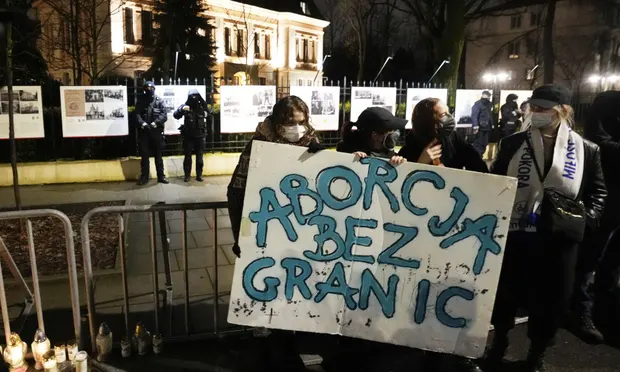
Activists with a sign reading ‘Abortion Without Borders’ protesting against Poland’s strict anti-abortion law at the constitutional court in Warsaw in January. Photograph: Czarek Sokołowski/AP
Justyna Wydrzyńska, who gave a woman experiencing domestic violence miscarriage-inducing pills, could be jailed for three years
The first pro-choice activist to be charged in Poland for breaking the country’s strict abortion law by providing miscarriage-inducing tablets to a pregnant woman is due to face trial next week.
Justyna Wydrzyńska, from the Polish group Aborcyjny Dream Team (ADT), is charged with illegally aiding an abortion and faces up to three years in prison if she is found guilty.
“I could be treated like most other people in this situation and be given a suspended six-month sentence, or they might want to make an example out of me and send me to jail, maybe even for years,” she said from her home outside Warsaw.
Abortion access has been subject to strict laws in Poland for decades but in January last year the country introduced legislation that made it all but impossible for women to access a safe termination legally. The case against Wydrzyńska is from February 2020.
“In the back of our minds, we knew something like this could happen. We were always public about what we do – we never hid it,” Natalia Broniarczyk, a member of ADT, said about the organisation’s work and its members’ media appearances.
The group had always been careful to operate within Polish law, which criminalises only abortion providers and not the patients on whom the procedure is carried out.
“The law about ‘aiding an abortion’ dates back to the 1990s,” said Kinga Jelińska, an ADT member based in Amsterdam. “Back then, surgical abortions were the only option, so it was written with a very direct involvement of doctors in mind.”
ADT evaded the regulations by referring women who sought abortions to organisations based abroad, where the most common abortion medication, mifepristone and misoprostol, can be obtained legally and sent through the post. ADT could therefore not be accused of directly providing abortions.
But in late February 2020, Wydrzyńska sent pills she had at home directly to a woman who had contacted her. “This woman was 12 weeks pregnant and experiencing domestic violence,” Wydrzyńska told the Guardian. “I had my abortion at 12 weeks and I have also been in an abusive relationship. I know what it means to be in this situation. Helping her was my first human response.”
The woman had previously tried to travel to Germany for the procedure but was prevented from doing so by her husband. Meanwhile, the Covid pandemic was starting to take hold. “Poland’s postal service had made announcements that international postage may be suspended or disturbed. We were running out of time,” Wydrzyńska added.
The day the package arrived, police officers – reportedly called by her husband – arrived at the woman’s house. She said the stress of the subsequent police investigation caused her to miscarry.
More than a year later, the police turned up at Wydrzyńska’s home and confiscated the medication she had at home, as well as the computers of her and her children.
“I guess it’s like an accidental pregnancy,” Wydrzyńska joked. “It was my first time taking a risk, and bam: I got an indictment.”
Wydrzyńska has been involved in abortion activism for more than 15 years, establishing the country’s first chatroom where Poles could exchange information on the few safe abortion avenues still available to them. She had been involved with ADT since 2019, which works to destigmatise abortion as well as put women in touch with foreign providers of abortion pills.
The group is launching a multilingual online campaign, #IamJustyna, to promote solidarity and sisterhood, as well as to raise international awareness of the situation in Poland.
“This law around aiding an abortion works to isolate the person who needs it, to make them feel alone. We want to show that they’re not alone. That they can count on us and they can count on their friends and family,” Jelińska said.
Broniarczyk said: “We’re encouraging people to message their friends and say, ‘if you ever need an abortion, you can count on me.’ Also, we’re hoping for international support and pressure, as well as funds.”
Following the restriction of abortion in Poland in 2021, the Belgian government helped ADT by providing funds for Polish women seeking abortion abroad. Broniarczyk hopes the court case can mobilise other international donors as well because, as she says, “abortions cost money”.
This article was amended on 28 March 2022. An earlier version stated that Wydrzyńska is the first person to be charged under the law. She is the first pro-choice activist.
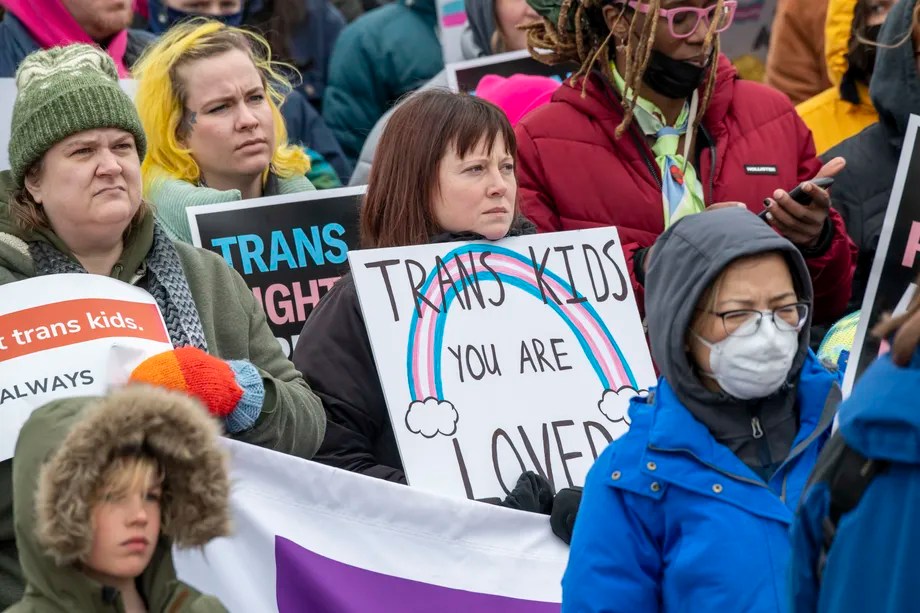
A rally on March 6, 2022, in support of transgender kids in St. Paul, Minnesota, as anti-trans bills targeting health care for trans youth spread across the US. Michael Siluk/UCG/Universal Images Group via Getty Images
The GOP is trying to win votes with a wave of “anti-woke” bills.
Republican-controlled state legislatures across the country are taking up anti-trans and anti-abortion bills at a shocking rate, as lawmakers seize on an enforcement mechanism first tested by Texas’s SB 8.
Multiple states — including Florida, Idaho, and Texas — have enacted, or hope to enact, new and draconian restrictions, including banning abortion after six weeks of pregnancy (functionally equivalent to an outright ban on abortion), or banning gender-affirming health care for transgender children.
Legislation regarding transgender youth, in particular, has also increased. In April 2021, Republican lawmakers in Arkansas passed Act 626, becoming the first state to outlaw gender-affirming treatment for trans youth (the bill is currently being blocked by a federal court order). Other states have since followed suit: A month later, Tennessee lawmakers passed a slew of anti-trans bills, including the state’s own ban on gender-affirming treatment for trans minors. And this year, Alabama is pushing one of the most extreme anti-trans health care laws to date with legislation that would jail doctors who provide health care treatment or perform gender-affirming procedures to trans minors.
“There has been an explosion of these bills,” Cathryn Oakley, who tracks legislation for the Human Rights Campaign, an LGBTQ advocacy group, told Mother Jones. She said that out of more than 130 anti-trans bills introduced in the country this year, at least 38 would deny trans children access to gender-affirming health care.
Part of the explanation could lie in an increasingly conservative Supreme Court. Though the constitutionality of many new state-level restrictions may be questionable at best, the 6-3 conservative bench may prove more receptive to Republican arguments.
There’s also an overtly political component, however. Out of power on a federal level and hoping to reclaim control of Congress in the 2022 midterm elections, Republicans have signaled that they view legislation targeting trans children as good politics for them.
Anti-abortion and anti-trans laws are getting more extreme
The success of Texas’s SB 8 has introduced an entirely new wave of anti-abortion legislative tactics in the US, which in some cases has also been extended to anti-trans measures.
SB 8, which was signed into law by Texas Gov. Greg Abbott last year, not only bans abortion after six weeks of pregnancy but also deputizes citizens to enforce it, allowing any person to bring a civil lawsuit against an entity who “aid or abets” in an abortion procedure for damages of at least $10,000. The law is facing multiple legal challenges, but it’s currently in effect and appears likely to stay that way.
Since then, Republicans in other states are using a similar enforcement mechanism to underpin even more draconian measures. Idaho lawmakers, copying Texas’s abortion ban, are pushing a bill that not only bans abortion after six weeks of pregnancy but uses a similar bounty-style component that would allow family members of rapists to sue medical providers who perform an abortion on the rapist’s victim. Lawmakers in Missouri have also followed the Texas model for a proposed anti-abortion bill, adding a dangerous provision that would force pregnant individuals to carry ectopic pregnancies to full term, which health professionals have made clear are 100 percent fatal if left untreated.
The argument for these anti-abortion laws hinges on the belief that a fetus should be considered a functioning human because its heartbeat can be heard on ultrasound (Texas’s SB 8 bill is also referred to as “the heartbeat law” by its proponents). But this claim has been repeatedly debunked by medical professionals, who explain the term “fetal heartbeat” is misleading. Any activity captured in an early gestation ultrasound is “actually electrical activity, and the sound that you ‘hear’ is actually manufactured by the ultrasound machine,” not a human heartbeat.
Protesters in New York participate in a rally organized by RiseUp4AbortionRights to oppose the growing erosion of abortion rights on International Women’s Day on March 8, 2022.
With the upcoming Supreme Court decision on Dobbs v. Jackson Women’s Health Organization, expected to be handed down by June or July, the right to an abortion could be eliminated entirely at the federal level — likely only increasing the proliferation of harsh state-level restrictions.
The accelerating extremism behind Republican anti-abortion laws is equally on display when it comes to legislation targeting trans people, and particularly trans children.
There are literally hundreds of anti-trans bills currently in the works across at a state level, but a handful of these laws have grabbed national attention due to their severity.
Among the most extreme is Alabama’s anti-trans bill, which has two notable components. First, it criminalizes doctors who provide hormone treatments and other gender-affirming care to trans teens, an offense punishable by up to 10 years in prison. Second, the bill requires teachers and staff to out transgender students whose trans identities are not already known to their parents. The bill has already passed the Alabama Senate and is expected to be approved by the House.
In Texas, parents of trans children are in danger of being investigated for “child abuse” following an order by Abbott, which criminalizes parents who allow their kids to receive gender-affirming treatment. The policy is currently on hold after a district court injunction, but it represents yet another new tactic for anti-trans lawmakers.
Specifically, Texas’s anti-trans policy is unusual since it was not passed through state legislation but enacted based on a non-binding opinion from Attorney General Ken Paxton, as a way to circumvent the governor’s lack of authority to put out such an order.
Republicans pushing new anti-trans measures often claim parents and health care professionals are “pressuring” young children into undergoing gender-affirming surgery which they argue could cause irreparable harm to the child, like infertility.
Advocates and doctors, however, say the reality is different. Research shows providing accessible gender-affirming health care to trans youth have an overall positive effect on young people, reducing the likelihood of depression and suicide among transgender youth.
And Texas’s new policy is poised to cause very real harm to trans children. Claudio, the parent of a trans teen in Texas, told Vox’s Nicole Narea pseudonymously that prior to coming out, “my child was suicidal. My child was hospitalized in a mental hospital because of suicidal ideation. And the moment they told us that they were transgender was the moment that they started getting better. A lot of the time, you don’t get to choose. Your kids are who they are.”
The endgame to these laws may be political for Republicans
Strict abortion restrictions in the US are part of a decades-old ideological project by the right, and anti-trans laws are nothing new either. In addition to a conservative Supreme Court majority apparently friendly to such restrictions, though, political expediency is giving the current surge of lawmaking additional traction.
As Katelyn Burns, a MSNBC columnist who has previously written for Vox, explained to Slate this month, “we are seeing institutional pushback against this order because I think a lot of people see this what it really is: posturing for a primary campaign that Abbott is facing against a much more conservative candidate.” (Abbott won his primary by a comfortable margin this month.)
Abbott strategist Dave Carney also admitted as much to reporters earlier this month, describing Texas’s policy of investigating the parents of trans children for “child abuse” as a “a 75-80% winner,” according to a tweet by Texas Tribune reporter Patrick Svitek.
“That is a winning issue,” Carney reportedly said. “Texans have common sense. This is why the Democrats across the country are out of touch.”
Similar considerations may also be playing into legislation in other states. South Dakota Gov. Kristi Noem and Florida Gov. Ron DeSantis are both widely thought to have future presidential aspirations — particularly if the 2024 Republican field doesn’t include former President Donald Trump — and their states have advanced harsh new legislation this year.
The political weight behind such measures is relatively new: As recently as 1984, data suggests, a person’s political affiliation was not closely tied to their position on abortion. But by 2020, the gap between pro-choice Democrats and anti-abortion Republicans had widened tremendously, reaching a 59 point-difference among “strong partisans, the group most likely to vote in primary elections.”
There is also evidence that racial attitudes have become closely intertwined with a person’s position on issues like welfare, gun control, immigration, and even abortion, which may explain why recent laws resonate with GOP base voters. Such identity politics, Republicans hope, could be a winning strategy to take back power in 2022.
It’s unclear, however, whether that will translate to general election contests, despite Carney’s claim. Such policies may play well with Republican primary electorates — as Abbott apparently calculated ahead of his gubernatorial primary earlier this month — but polling suggests Texas-style attempts to limit access to gender-affirming health care are sharply unpopular overall.
In one poll conducted last month by Data for Progress, 63 percent of all voters — and even 46 percent of Republicans — said they supported leaving decisions about health care “to children who identify as transgender, their parents, and their doctor” rather than the state.
So far, those numbers don’t appear to be impacting Republican fervor for new anti-trans and anti-abortion restrictions — but it raises the possibility that increasingly extreme Republican lawmakers could face a backlash rather than a political boost.
In the meantime, though, such measures are causing real harm. “It I don’t know how much risk we’re going to be willing to take, so at some point, we might decide to cut our losses and pick up and leave,” Claudio, the Texas parent of a trans teen, told Vox. “Persecution scares you extra.”
HB 2779, which includes a total abortion ban amendment, is scheduled to go before the full health committee on Wednesday. Getty Images
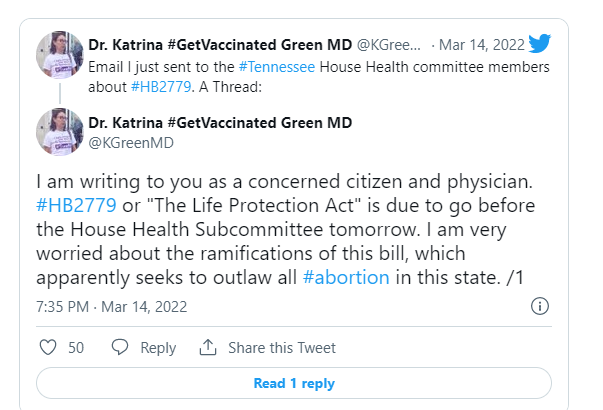
Tennessee lawmakers are using a Texas SB 8-style enforcement mechanism as a sneak-attack amendment to HB 2779.
Tennessee lawmakers are trying to sneak the total abortion ban as an amendment to HB 2779, a bill involving abortion providers, the state medical board, and some nonsense about “informed consent.”
We couldn’t even find the the full text of the amendment on the Tennessee Legislature’s website (which says there are no amendments to this bill), so you can see how seriously anti-abortion lawmakers are taking “democracy.” This screenshot here is the best we’ve got.
The amendment uses a Texas SB 8-style enforcement mechanism to get around the ~pesky~ problem of the constitution, setting a $10,000 bounty on abortion providers, pregnant people seeking an abortion, and anyone who helps them.
The only exceptions are in the case of imminent death or “substantial and irreversible impairment of a major bodily function”—although specifically excluding their mental health.
Oh, and there’s a whole section about “severability,” which means lawmakers are anticipating that some parts of the bill may be struck down by the courts (who, though, the Sixth Circuit? The Supreme Court?) and want to make sure they keep as much of it in place as possible.
Legalese aside, people in Tennessee are going to be hurt by this bill, as one local medical provider can attest to. And a disproportionate number of them will be Black and brown pregnant people, as all abortion bans do.
Tennessee lawmakers have already made it clear that they don’t care about any of this, especially consider that any family member of a rapist could use the law to sue the victim of rape for proceeding with an abortion.
We’ll say it. It’s fucked.
And why stop there? Tennessee lawmakers are also considering HB 2314, which would establish fetal “personhood” and further establish a system of criminalization for pregnant people.
The bill now goes before the full health committee for discussion, which is scheduled for Wednesday.
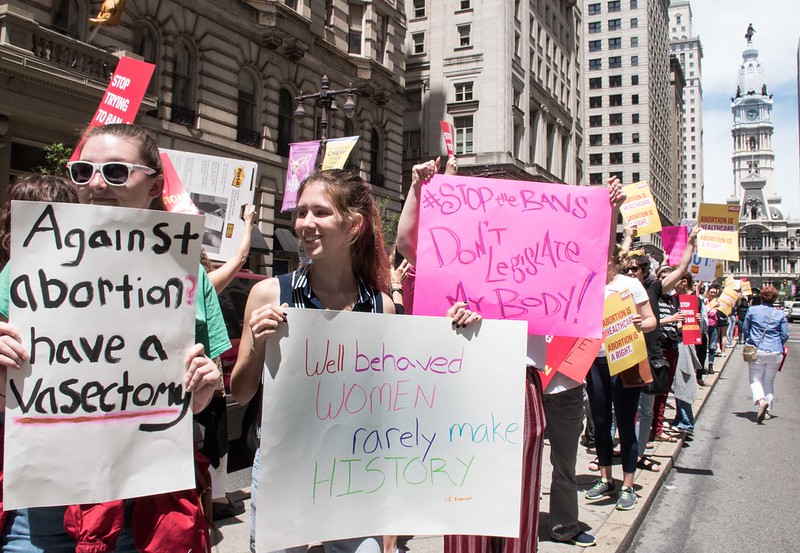
A 2019 rally in Philadelphia in support of abortion rights. (Joe Piette / Flickr)
We must all continue to normalize miscarriage and abortion care as essential components of reproductive healthcare—but especially those of us going into obstetrics and gynecology.
March 18 will be a regular Friday for most Americans. But for the thousands of medical students across the United States, the stakes could not be higher. For us, the past 20 years of education have culminated in Match Day, the day in which graduating medical students discover where they will continue their medical training in their chosen specialties.
This is a day of mixed emotions as some students celebrate going to their first-choice residency program while others are devastated when they do not match. For those of us going into obstetrics and gynecology, the pressure and nerves of Match Day are far greater this year. The upcoming Supreme Court case, Dobbs v. Jackson Women’s Health Organization, which challenges Mississippi’s state law banning abortion after 15 weeks of pregnancy, threatens the very foundation of reproductive care in the U.S.
This uncertain political landscape surrounding reproductive rights will affect the quality of our training and the care that we can provide for our future patients.
As we approach the end of medical school, we can’t help but reflect on our most interesting and unique experiences with patients. We vividly recall the case of a patient we saw who experienced a miscarriage. Although considered to be an underestimation, one in six pregnancies will end in miscarriage. However, its prevalence does not diminish the trauma and grief that patients often experience.
We tend to vilify those who need abortion care and victimize those who need miscarriage care. In reality, the people experiencing abortions and miscarriages are within the same community or they are even the same person.
Our patient was devastated by the news. While we helped grieve with her, we were able to offer her all of the appropriate medical options. She was able to make the decision that was right for her at the time. When her pain worsened, and she wanted a different treatment option, we had the training and ability to take care of her as soon as possible. Although not commonly discussed, the treatment for miscarriages is one of many things that will be affected if the Supreme Court overturns Roe v. Wade.
In this story, the procedures and the medications offered to this patient are essential components of miscarriage management. In a parallel story, they are the cornerstones of abortion care. Both are equally important and currently under threat. The upcoming Supreme Court case is not just about abortion—it will directly impact reproductive health as a whole.
Dobbs v. Jackson Women’s Health Organization directly threatens the current 50-year Supreme Court precedent, set by Roe v. Wade, which protects the right to an abortion up until a fetus could survive outside of the womb, typically around 24 weeks. If overturned, individual states can implement laws banning or limiting access to even very early in gestational age. Currently, 12 states have passed such laws and many more are likely to follow if this precedent is overturned.
In the short term, overturning Roe would devastate patients’ access to abortion. In the long term, it would limit every person’s ability to access comprehensive reproductive care as medical providers would not receive adequate training related to abortion care, miscarriage management, and pregnancy complications. Even prior to the Supreme Court case decision, a recent study suggests that ob-gyn residents without abortion training feel less prepared to treat miscarriages.
Although not commonly discussed, abortion as a treatment for miscarriages is one of many things that will be affected if the Supreme Court overturns Roe v. Wade.
If Roe is overturned, this phenomenon would only worsen, creating a generation of ob-gyns without adequate training in vital aspects of reproductive care. Regardless of our stance on abortion, this case will inevitability impact every person who seeks out reproductive care.
As a society, we tend to vilify those who need abortion care and victimize those who need miscarriage care. In reality, the people experiencing abortions and miscarriages are within the same community or they are even the same person.
These individuals are making the best decisions for themselves and their families. Statistically, we all know, have been, or will be someone who experiences a miscarriage or abortion. We must all continue to normalize miscarriage and abortion care as essential components of reproductive healthcare. As trainees, we are incredibly excited to head into the field of obstetrics and gynecology to normalize all patient experiences, advocate for our patients, and provide comprehensive and inclusive care to our future patients.
While Match Day on March 18 will be an incredible milestone in our careers, the course of our training will not truly be set until the Dobbs decision is released.
Reproductive rights advocates of color wrote a scathing letter to Congress after it failed to end a federal ban on abortion coverage
For the time being, reproductive rights advocates’ long-time dream of ending the Hyde Amendment, a half-century-old budget rider that prohibits federal funding of most abortions, is dead in Congress, despite President Joe Biden’s campaign promise to get rid of it.
Since Hyde disproportionately affects pregnant people of color, and particularly Black and Indigenous people, Black reproductive justice advocates have responded to the failure with a resounding warning to Democratic members: “Defend Black women’s rights or don’t count on our votes.”
Marcela Howell, president of In Our Own Voice: The National Black Women’s Reproductive Justice Agenda, criticized Congress on Thursday for being “willing to sacrifice the reproductive health and rights of Black women.” She pointed out that just earlier this month, Congress failed to pass the Women’s Health Protection Act to codify Roe v. Wade. “Black women expect that the politicians we voted for will represent our interests and our rights,” Howell said in the statement. “We must hold our elected leaders accountable and demand that our rights are respected and our lives prioritized.”
As part of a $1.5 trillion spending plan to fund the government and rush $14 billion in urgent aid to Ukraine, Hyde will remain intact largely because Democrats in Congress simply don’t have the necessary votes to pass a funding bill without Republican support. Some conservative Democratic senators, including Tim Kaine (Va.), Bob Casey (Pa.) and Joe Manchin (W.V.), have even expressed support for Hyde.
With the Supreme Court poised to gut abortion rights, and state legislatures across the country rapidly introducing abortion bans and restrictions that greatly increase costs to access care, advocates are frustrated that the federal government won’t even do the bare minimum and cover abortion. Black advocates’ sharp rebuke of Congress for enabling Hyde is all the more powerful considering not quite two years ago, Democrats were enthusiastically thanking Black women voters for their critical role in voting out Trump and installing a narrow Democratic majority in the Senate.
As Howell points out, Congressional inaction on abortion access at such a high-stakes time carries especially devastating harm for people of color, and especially Black women. Restrictions on Medicaid coverage of abortion can force an estimated one in four low-income pregnant people seeking the health service to carry an unwanted pregnancy to term, often pushing them deeper into poverty and making them more vulnerable to domestic violence. Black women and other women of color are significantly more likely than white women to be covered by Medicaid.
The inclusion of Hyde in the spending bill also comes as over 1,000 people who have had abortions on Thursday shared a historic open letter to President Biden, imploring Biden to take more urgent action—or really, any action at all—to save abortion rights as they hang in the balance. The president has notably yet to even say the word “abortion,” even as Texas has spent the past six months in a post-Roe world due to its near-total abortion ban. Roe technically remains in place, but the Hyde Amendment widens the already nearly insurmountable gap between the legal right to abortion and access to it.
And while contraception isn’t an alternative for abortion, the National Family Planning & Reproductive Health Association and Planned Parenthood have both expressed frustration that funding for Title X, a federal grant program dedicated to providing low-cost family planning services to low-income people, remains flat in the spending bill, too.
“With the constitutional right to an abortion hanging in the balance, this bill’s failure to make greater investments to expand access to family planning in the U.S. and around the world is inexcusable,” Planned Parenthood President Alexis McGill said in a statement on the spending bill. McGill also accused Congress members of using pregnant people’s health and rights as a political “bargaining chip.”
In response to Congress’ failure to end Hyde, as well as lack of meaningful action from the federal government to protect reproductive rights, in general, advocates are reminding lawmakers what they owe to their constituents and voters—and in particular, women of color, pregnant people, and those who have had abortions.
My experience helping pregnant Texans get abortions is one example of how faith leaders can do our part to protect life: by making abortion accessible.
As a rabbi who lives in Texas, I have long been active in local groups that organize clergy to fight for reproductive rights. Most recently, we have been working to resist SB 8, the Texas law that went into effect September 1 and which bans abortions at six weeks’ gestation, before many people even know they’re pregnant.
A small group has a stranglehold on the story of abortion and faith in this country. They have succeeded in equating religion with opposition to abortion. Judaism teaches something very different. In Judaism, the fetus is considered part of the pregnant person’s body, not independent of it. Abortion is sometimes mandated to save the pregnant person’s life. And according to one key rabbinic ruling, abortion is also permitted to save a pregnant person from “woe.”
When a Christian colleague, whose name I won’t reveal for the sake of his safety and that of his church, asked me if I would like to serve in January as chaplain for a group of 20 pregnant people on a one-day trip out of state to obtain abortions, I was glad to do it. The clinic we traveled to in New Mexico has a unique relationship with one in Dallas that provided abortions before SB 8 was passed. It continues to do so for those few patients who still qualify under the new restrictions. Since 2013, Texas law has required two visits to an abortion provider: the first for a sonogram and the second for the abortion itself. There is a minimum 24-hour waiting period between the two. Under SB 8, pregnant people must have a second sonogram when they come back for their second visit to make sure they still qualify.
The women I accompanied had both sonograms at the Dallas clinic but were deemed ineligible for an abortion. None of them were more than eight weeks pregnant, and several were less than six, but they could not get an abortion in Texas because their sonograms showed what is misleadingly referred to as “fetal cardiac activity.”
The patients were between the ages of 19 and 40, and all but the youngest were women of color. These are women who can’t afford an abortion and don’t have the flexibility to spend a night away from home. The New Mexico Religious Coalition for Reproductive Choice paid for their flights and other costs, while the Texas Equal Access Fund and other abortion funds, the names of which we can’t disclose due to security reasons, paid the medical fees. And yet they were the lucky ones. These 20 women represent a fraction of the patients who were able to access abortion care in Texas even before the passage of SB 8.
We met at 7 a.m. for breakfast at the church, then embarked on our flight. Most of the women received medication abortions; some had procedural abortions. One of the women dropped her children off at school before we left and picked them up from cheer practice at 8 p.m., after we returned. Another could get only one day off work by agreeing to work a double shift the next day. One has two toddlers and a serious medical condition. One has three older children and worried that if she had a baby now, she wouldn’t be able to parent them adequately as they enter and go through adolescence.
Before SB 8 passed, these women would have driven to the local clinic, either alone or with a loved one. Instead, they had to get on a plane with strangers and, as a safety precaution, be careful not to talk in public about what they were doing. It was a beautiful, sunny day in both cities, but 20 degrees cooler upon arrival in Albuquerque than when they departed Dallas. Many of the women shivered throughout the day.
We are fighting an uphill battle, yet we know that most people of faith are opposed to abortion bans, as well as restrictions that essentially amount to one.
Because of the need for discretion, I couldn’t talk to the women about what we were doing until we were in the clinic or at the church where they rested before and after their clinic visits. When we did have the chance to connect, I mostly listened. They berated themselves for not being careful enough. Some of them worried that God would punish them for their choice. None of the women were Jewish, but several of them seemed glad to learn about the Jewish perspective on abortion. I told them I’d had an abortion, and that Judaism doesn’t see abortion as killing a baby.
I learned that many of the women already were, or were studying to be, essential workers: teachers, social workers, and nurses. Having a baby would preclude them from not only caring for their families as they felt it necessary, but also from serving the populations they feel called to teach, counsel, and treat. These women were taking this step to preserve and protect life, not to snuff it out. One woman, whose husband drove her to Albuquerque from Dallas, sat on a bench in the courtyard outside the clinic and cried tears of rage. She was angry at herself for letting this happen, and angry at the legislators whose actions interfered with her private decision to such an extreme degree. I offered the hope that these women would look back on this day as one of salvation rather than judgment. That they would remember they all did this together, sharing the experience and developing a camaraderie.
Even if the Supreme Court weakens SB 8 in some way, which is unlikely, it will remain nearly impossible to get an abortion in Texas. Several cities in the state have placed municipal bans on abortion, and even on some forms of contraception.
And Texas is not unique. In fact, U.S. states enacted more than 100 abortion restrictions in 2021, the most in a single year. The experience I was privileged to share with these women is just one example of how leaders of all faiths are doing our part to protect life: by making abortion as safe and accessible as possible. We are fighting an uphill battle, yet we know that most people of faith are opposed to abortion bans, as well as restrictions that essentially amount to one.
Many people who hear my story say they envy my opportunity to do something tangible to help pregnant people continue to access reproductive health care, including abortion. Right now, there are two ways to help. First, make sure your elected officials know how you feel, that you want them to pass laws that help pregnant people rather than hurt them. But political and legislative change takes time, so for now, please contribute whatever you can to support organizations—like the New Mexico Religious Coalition for Reproductive Choice—that work to protect abortion access every day.
Already, a number of state bills have grabbed headlines for proposing outrageous and shocking abortion restrictions. Efforts from banning treatment for ectopic pregnancies to prohibiting people seeking abortions from leaving their home state show just how radical the anti-abortion agenda truly is. While these measures are attracting media coverage, often they are not the main focus of anti-abortion policymakers, but pull attention away from other abortion restrictions and bans that are moving quickly through some state legislatures. Moreover, these types of headline-baiting restrictions can make other devastating provisions, such as Texas-style bans or gestational age bans, seem less radical and harmful than they really are.
In addition, court cases continue to compound the harm of restrictions enacted in previous years, chief among them Texas’ ban on abortions at six weeks of pregnancy. The state’s top court recently rejected a challenge by abortion providers, ruling that there are no public officials who can be sued to stop the law. That decision exhausts the legal options to stop this immensely harmful law that has been in effect for more than six months and may embolden other states to adopt their own Texas-style bans this year.
Among restrictions introduced and moving since the start of state legislative sessions in January, two key themes emerging are anti-abortion policymakers’ continued pursuit of various types of abortion bans and restrictions on medication abortion.
State Policy Developments on Abortion January 1–March 15, 2022
So far this year, 1,844 total provisions related to sexual and reproductive health and rights have been introduced across 46 states and the District of Columbia. This includes both restrictions and proactive measures.
Abortion restrictions introduced: 519 restrictions in 41 states
Abortion restrictions passed at least one chamber: 46 in 13 states
Abortion restrictions enacted: None
Abortion Bans January 1–March 15, 2022
Even before the US Supreme Court rules on Mississippi’s 15-week abortion ban in Dobbs v. Jackson Women’s Health Organization by the end of June, anti-abortion policymakers are banking on the Court’s 6–3 anti-abortion majority to weaken or outright overturn Roe. They are preemptively flooding statehouses with restrictive bills in hopes that federal protections for abortion rights will soon be gone.
As part of this strategy, anti-abortion policymakers are attempting to pass abortion bans that blatantly violate the core holding of the Roe decision and that would devastate access to abortion care in their state if allowed to be enforced.
Bans introduced: 82 bans in 30 states
Bans passed at least one chamber: 7 (Arizona, Florida, Idaho, Kentucky, Oklahoma and West Virginia)
Bans enacted: 1 (Wyoming)
Out of all the proposed bans, anti-abortion policymakers have been focusing primarily on three types: 15-week bans, “Texas-style” bans and bans designed to be triggered if Roe is overturned.
Bans at 15 weeks of pregnancy
Introduced: 5 in 4 states
Passed at least one chamber: 4 (Arizona, Florida, Kentucky and West Virginia)
Enacted: None
“Texas-style” bans that rely on a bounty-hunter enforcement mechanism (with a total, six-week or other gestational age ban)
Introduced: 19 in 13 states
Passed at least one chamber: 2 (Idaho and Oklahoma)
Enacted: None
“Trigger” bans to quickly prohibit abortion in the state
Introduced: 12 in 9 states
Passed at least one chamber: 1 (Oklahoma)
Enacted: 1 (Wyoming)
Medication Abortion Restrictions January 1–March 15, 2022
With the US Supreme Court primed to severely weaken or overturn Roe, medication abortion is likely to become even more critical in the delivery of care to many people. Guttmacher research shows that following two decades of safe and effective use, medication abortion accounted for 54% of all US abortions in 2020—powerfully illustrating that the method has gained broad acceptance from both abortion patients and providers.
However, medication abortion has become a primary target of anti-abortion politicians and activists seeking to restrict care in and out of clinical settings. Anti-abortion state policymakers have shown they are focused on further restricting access to medication abortion this year.
Restrictions on medication abortion introduced: 104 restrictions in 22 states, including 8 measures that would ban medication abortion outright
Restrictions on medication abortion passed at least one chamber: 17 (Georgia, Kentucky, South Dakota and Wyoming)
Restrictions on medication abortion enacted: None
Among the total count of medication abortion restrictions that have been introduced are bills that seek to ban medication abortion entirely. Others would make it much harder to administer and access care, including by prohibiting the mailing of pills, limiting provision to physicians (leaving out other qualified medical professionals) and limiting the gestational age for use.
Bans use of medication abortion
Introduced: 8 in 8 states
Passed at least one chamber: 2 (South Dakota and Wyoming)
Enacted: None
Prohibits mailing of abortion pills
Introduced: 9 in 7 states
Passed at least one chamber: 2 (Georgia and Kentucky)
Enacted: None
Restricts administration to physicians
Introduced: 11 in 9 states
Passed at least one chamber: 3 (Georgia, Kentucky and South Dakota)



:no_upscale()/cdn.vox-cdn.com/uploads/chorus_asset/file/23331844/1383493407.jpg)






 Abortion - Abortion Clinics, Abortion Pill, Abortion Information