Foster teens experience staggering rates of pregnancy, but parental involvement laws make abortion all but inaccessible to them.1201

For Jamie Sabino’s client, a young woman who had been taken into state custody in Massachusetts, “court represented her family being torn apart.”

The young woman, Sabino said, was pregnant and wanted an abortion. But like everyone under 18 in Massachusetts, state policies required her to get consent from a parent or guardian, or else seek judicial approval. Because the teen was in foster care, she automatically needed to plead her case before a judge, and she was terrified.

Sabino, who is co-chair of the Judicial Consent for Minors Lawyer Referral Panel, an association of attorneys who are trained and certified to be appointed to represent petitioners in judicial bypass in Massachusetts, started the proceedings so the teen could obtain abortion care; her caseworker, though sympathetic, did not want the teen’s next placement to know about the pregnancy or the abortion. The foster teen was worried about her new placement, and embarrassed that she did not have what she considered to be a decent change of clothes to wear to her hearing.

“For her, the court hearing for the abortion was torture,” said Sabino.

“Parental involvement” laws like the one in Massachusetts currently exist in 36 other states. At best, they are unnecessary hurdles; at worst, they put teens through an arduous and humiliating process. Most teens involve a parent in their decision to have an abortion, and those who don’t often have a good reason, such as avoiding abuse. These parental involvement laws pose a special set of complications for foster teens, who are living outside of the care of their parents, and in the care of a system that generally does little to ensure they have access to abortion.

There are roughly a quarter million girls living in foster care. And while teen pregnancy rates have been steadily declining, they remain staggering among foster teens, due to a number of factors. Girls living in the foster care system are twice as likely to experience pregnancy by the time they turn 19 than their peers living outside of the system. Still, while research indicates the majority of pregnancies among foster teens are “unwanted,” most foster teens carry their pregnancies to term. One study conducted in 2009 found between 80 and 90 percent of foster teens’ pregnancies end in a live birth, and of the pregnancies they tracked, less than 5 percent ended in abortion; the national average among teens the same age is over 30 percent.

In general, parental involvement laws treat foster teens unequally, in that they fail to account for the population of minors living in the custody of someone other than their parents. Shoshanna Ehrlich, co-chair of the Judicial Consent for Minors Lawyer Referral Panel, points out that these policies and laws “deprive foster teens of options.” For foster teens, the state agency that oversees child welfare—usually the state’s department of children and families (DCF)—is technically their legal guardian, and it’s likely the relationship they have with their biological parents is not conducive to supporting them through the abortion decision. Rachel Rebouché, a law professor at Temple University, says in some states, foster parents and caseworkers are outright prohibited from consenting to or providing notification.

This leaves the judicial bypass process, which varies from state to state. In some states, there are organizations that guide minors through the steps, and the bulk of petitions are approved. But in other states, minors are largely on their own when it comes to finding an attorney and navigating the law. They may face judges who harbor anti-choice views and who ask them intrusive questions, or other abortion restrictions that incur delays on their procedure. The likelihood their petition will be approved also varies.

In Massachusetts, for example, state policy explicitly prohibits caseworkers and foster parents from consenting to the procedure for foster teens, and designates that unless they can get consent from both of their biological parents, foster teens must plead their case to a judge. This means most, if not all, foster teens in the state must go through the judicial bypass process to have an abortion. Massachusetts has a relatively well-functioning judicial bypass system: Planned Parenthood of Massachusetts has a hotline that teens can call to get information on their abortion decision, which refers teens directly to attorneys from the Judicial Consent for Minors Lawyer Referral Panel to help them through the process. Public hospitals in Massachusetts also cover abortion costs for uninsured people, including minors. Still, Sabino cautions that “even in the most perfect system, the judicial bypass process still creates trauma” and “delay … to no benefit.”

Jessica Berry of the Children’s Law Center of Massachusetts says that making foster teens who choose abortion to go through the judicial bypass process may also compromise a teen’s ability to control who knows about their abortion. She notes that, while caseworkers in Massachusetts cannot consent to an abortion, record of the procedure may be made in a minor’s file. As files move from caseworker to caseworker, it increases the number of people who may know about the abortion.

Beyond the issue of confidentiality, caseworkers, depending on their personal feelings about abortion, may see a foster teens’ decision to have one as a reason that they need counseling or as another indication of trauma.

When states don’t have explicit policies prohibiting child welfare agents from providing notification or consenting to a foster teen’s abortion, Rebouché says caseworkers often self-impose a kind of prohibition on it. Advocates like Sabino can, and do, help foster teens figure out the steps they need to take, but state agencies and employees are often less supportive. And while Berry points out that some caseworkers are willing to help minors through the undertaking, Sabino says that varies from DCF office to DCF office, and from caseworker to caseworker, meaning that the medical care foster teens receive as it pertains to abortion is largely luck of the draw.

This could be because state employees have personal views about abortion, or are unclear as to whether they are even allowed to aid a foster teen in the process. The Hyde Amendment, which prohibits federal funding from going to abortion care in most circumstances, and similar state laws could contribute to that confusion, as caseworkers may be unsure if being employed by the state prohibits them from even helping a minor obtain an abortion. Such laws also can have a direct impact on policy: In Alabama, for example, the state passed a regulation prohibiting child welfare agencies from consenting to abortions on the assumption that doing so would be in violation of the federal Hyde Amendment, and would result in them losing funding.

Sabino says one important thing to remember is that reproductive rights advocates know the number of teens they work with, but what they don’t know is the “negative”—how many teens start the process and never finish, who are put off by what it involves, or who are unaware of their rights all together.

Confusion about who can pay for a foster teen’s abortion may also impede access. In 2003, a Pennsylvania foster teen had her bypass petition initially denied because there was confusion among agency staff about who would pay for her procedure. And the truth of the matter is that many foster teens will face problems paying for their abortions, even after they obtain judicial permission. Because they are covered by Medicaid, they receive no insurance coverage for abortion except in cases of rape, incest, or life endangerment.

In states where foster parents or caseworkers can be involved, there can still be complications. Illinois is a notification state, meaning that minors need to notify their parents about their abortion, but do not need to get their consent. Emily Werth, the Judicial Bypass Coordination Project staff attorney at the American Civil Liberties Union of Illinois, says that when minors are wards of the state in Illinois—as in, when legal guardianship has been transferred—caseworkers simply call the same medical consent line they would for any other procedure and notify the state. But for minors in temporary or protective custody, for whom the state does not have legal guardianship, the state is not allowed to accept notifications on behalf of parents who still have parental rights. Those foster teens have to find some other way to comply with the law in Illinois, such as using its abuse or neglect exception or getting a judicial bypass.

For the vast majority of foster teens in the United States who chose to terminate their pregnancies, then, going to court can be their only option.

Even the court hearing itself puts foster teens at a disadvantage. The U.S. Supreme Court ruled that parental involvement laws were constitutional so long as a judicial bypass option was present in the 1979 case Bellotti v. Baird, and have largely upheld them since. In Bellotti, the court put forward a two-pronged test to determine whether a minor should have judicial permission to have an abortion; first whether the minor was mature enough, and second if the minor was not found to be mature enough, if it was in her best interest to have an abortion. But the Court has never clearly defined maturity, so it varies: Some of the standard factors that go into determining it can put foster teens at a disadvantage.

“They have all the strikes against them,” says Sabino, who notes the nature of life in foster care, and the stresses it puts on teens, often means that it’s hard for them to maintain a steady job or good grades, which judges might see as a sign of immaturity.

One Massachusetts foster teen, an orphan who was a recent Spanish-speaking immigrant to the United States, was living in a group home with no Spanish-speaking staff when she decided she wanted to terminate her pregnancy. An advocate with a children’s rights group in Massachusetts says she was contacted by the state’s Department of Children and Families (DCF), who provided the teen with the number for Planned Parenthood, but would not aid her any further in the process. The minor had little to no understanding of the U.S. government and law was almost nonexistent and she didn’t have any savings, a source of income, or a driver’s license. The advocate says she helped the teen called Planned Parenthood and schedule the procedure as well as secure counsel for her judicial bypass hearing, but because the minor was living in a group home, she was not allowed to place any calls on her own without her caseworker’s permission. When she tried, staff at the group home reached out to her advocate, who then tried to get in touch with her caseworker, but to no avail. The foster teen was eventually forced to disclose her pregnancy and her desire to terminate it to continue making calls related to the matter. The advocate communicated and coordinated with the minor’s English-speaking attorney on her behalf and transported her to and from her hearing, where her petition was approved. The group home staff agreed to transport the teen to the appointment, but would not be involved further, so the advocate provided support for the remainder of the appointment.

At first, medical staff at the clinic said they could not operate on the teen because a DCF caseworker was not present, but when the advocate explained that judicial consent allowed them to, they went ahead with the procedure.

Needless to say, had the advocate not stepped in, the system would have left this teen in an impossible situation: trying to terminate a pregnancy in an unfamiliar country, with a language barrier and no understanding of the law dictating her access to abortion, living in the care of people who refused to support her.

In some states, the same judge who hears a foster teen’s bypass case might also hear her child welfare case. This creates the potential for a conflict of interest for the presiding judge, and increases the risk of compromising the minor’s confidentiality as it pertains to the abortion decision.

And, of course, the teens may encounter the issue of judicial anti-choice stances. A Nebraska judicial bypass case involving a foster teen made headlines in 2013 when a Nebraska Supreme Court judge handed down a ruling that Rewire‘s vice president of law and the courts Jessica Mason Pieklo says effectively banned abortion for foster teens in the state by relegating them to the torturous bypass procedure. A teen, who had been placed with an Evangelical Christian family along with her siblings, testified that she was not ready to be a mother, and feared her child would end up in foster care. But after a tortuous hearing, in which a judge told the girl “when you have the abortion it’s going to kill the child inside you,” the minor’s petition was denied.

Sabino says there are several factors that make this situation even more fraught for foster teens. Practically all teens involve an adult in their decision to have an abortion, even if that person isn’t a parent. They might turn to grandparents, neighbors, or people they trust at school. But as Sabino points out, for foster teens who might be in an unfamiliar school or environment, turning to a trusted adult might be difficult or even impossible. “I’m sure there are kids who, because they’re out of their support system, are unable to access” abortion, she says.

Furthermore, getting to and from court or a clinic is presents challenges for many teens, but for those in foster care it can come with the added stress of living in an unfamiliar place.

“Sometimes they really need to tell somebody,” she says, “because they have no way of accessing the court process, because they’re living in a foster home or residential placement in a place where they don’t even know the bus system. And yet, if they reveal it, it can become a problem.”

Sabino also points out that teens living in a residential placement have their movements “closely monitored,” which means the option of slipping out for a court hearing and confidential medical procedure can be difficult, if not impossible altogether. She says she has also run into social workers who have told teens that they have to tell their foster families or the residential placement, or they’ll be removed.

“We’ve successfully beat those back,” she says, “but I suspect this happens all the time and we don’t know about it.”

Trauma, abuse, and neglect factor into a large number of foster care cases, and that this can make the judicial bypass process an even more tortuous one. Foster teens are also at an increased risk for sexual exploitation, which makes the need for comprehensive access to reproductive health care, including abortion, all the more urgent. A portion of minors in state care have parents who are incarcerated, who have been deported, or are going through the deportation processes, which can make going to court carry especially terrifying implications. Many of these minors are immigrants themselves, which presents another set of challenges.

Some advocates argue that foster teens should be able to consent to abortion the same way they can consent to other pregnancy-related care, without oversight of a legal guardian or judge. This would be the ideal situation for teens living in and outside of foster care. Unfortunately, though, parental involvement laws likely aren’t going anywhere. Other advocates argue that while parental involvement laws remain in place, allowing foster parents or caseworkers in all states to consent to abortion would at least provide minors with the option, and that for those few lucky foster teens who do have a supportive caseworker or foster parent, it would allow them to avoid the arduous bypass process.

While it is not possible to draw a direct correlation between high rates of teen parenting and birth among foster teens and a lack of access to abortion, what is clear is that parental involvement laws, which are unnecessary and harmful for all teens, make abortion all but inaccessible for those who are most at risk for unintended pregnancy.

When it comes down to it, Rebouché says, “these laws are just not written for minors in state care.”

Scott Olson/Getty Images News/Getty Images

Women’s rights and health services in Missouri could take a nosedive after the state Senate voted on Wednesday to pass a bill that would force unwarranted inspections on abortion providers, allow discriminatory hiring practices, and give law enforcement power to the attorney general. The legislation could effectively enable the legal discrimination of Missourians if they’ve had an abortion or use birth control.

For starters, the bill would overturn St. Louis’ ordinance banning discrimination in housing and employment based on “reproductive health decisions.” If nullified, employers and landlords would be allowed to refuse employment or tenancy to women who are pregnant, use contraceptives, or have had an abortion. Opponents of the St. Louis ordinance say it infringes on the religious rights of faith-based employers.

On top of that, health clinics that provide abortions could also face more scrutiny. The bill would require state health departments to conduct annual unannounced inspections at abortion facilities. (Arizona signed a similar law in 2014 permitting unwarranted inspections during working hours.) Lawmakers who support the requirement argue that clinics shouldn’t have anything to hide and that the surprise inspections are for the safety of the patients. Those who disagree say this gives inspectors permission to enter abortion facilities with the intention to harass patients and providers.

But laws need enforcement, and this bill has got that covered, too. One section of the legislation would grant power to the state attorney general to prosecute abortion law violators. Missouri’s current attorney general Josh Hawley, who was on the legal team that represented Hobby Lobby in arguing for an exemption to provide contraceptive coverage for employees under Obamacare before the Supreme Court, is a vocal anti-abortion proponent. Current law enforcement falls to local prosecutors, but the bill’s supporters distrust local prosecutors in more liberal areas, such as St. Louis and Kansas City, to enforce anti-abortion laws.

This legislation is the latest in Missouri’s onslaught of anti-abortion bills. It comes in response to a federal judge’s decision to strike down a previous attempt at regulating abortion providers on the grounds that the regulations were unconstitutional. After this decision, Gov. Eric Greitens called for state lawmakers to convene in a special late night legislative session behind closed doors.

This bill, sponsored by Republican Sen. Andrew Koenig, must still go through the House, where it will likely pass. A Greitens administration official described the bill as “a good start” and said that he hoped the House will improve it with stronger restrictions. Recent history indicates that the Missouri House would be in favor of abortion restrictions.

The Missouri House convenes next week, where they will either approve the legislation without changes and pass it on to the governor, or negotiate with the Senate for adjustments.

https://www.bustle.com/p/had-abortion-use-birth-control-in-missouri-you-could-be-disqualified-from-a-job-for-that-64833/amp?utm_term=share

Pete Marovich/Getty Images News/Getty Images

I’m one of those women who basically always thinks she’s pregnant. Seriously — at least once every month, some part of my brain convinces me that I must be pregnant, despite the fact that I’m really careful about birth control. In fact, making it to 30 without a pregnancy is somewhat of a miracle in the history of womanhood and that’s because I’m of a generation that has had the most access to birth control ever. Since I became sexually active at age 15, I’ve used a wide range of contraceptives, from the Pill to condoms to a diaphragm. But as we stare down potential moves by the Trump administration to limit easy and cheap access to contraception, it’s a good time to remember that the history of the reproductive rights movement is fairly recent — and the fight to get us here has been anything but easy.

“Over the past half century, birth control has provided enormous benefits to women and their families, and has been nothing short of revolutionary for women and society,” Dawn Laguens, Executive Vice President, Planned Parenthood Federation of America, says in a statement. “But under the Trump administration, we are now facing an immediate future where a woman’s ability to make a most basic and personal decision — when and if to have a child — could be limited by her boss.”

So as a reminder of what we have to lose, let’s take a look at some crucial moments in the history of the reproductive rights movement.

11916: Margaret Sanger Opens First Birth Control Clinic

Scott Olson/Getty Images News/Getty Images

Just over 100 years ago, on October 16, 1916, Margaret Sanger opened the country’s first birth control clinic in Brooklyn. She was arrested under the Comstock law, which forbade talking about or distributing information about birth control. That didn’t stop her, though — her one clinic later grew to become the international women’s health organization Planned Parenthood.

21938: Federal Ban On Birth Control Lifted

GIPHY

Over 20 years after that first clinic opened in Brooklyn, the federal ban on birth control was lifted. The ban — part of the Comstock laws — said that talking about contraception was “obscene” and doctors could be jailed for prescribing any time of contraception. (Remember, this is pre-Pill so we’re talking condoms and diaphragms, here.)

“It is one of the anomalies of modern civilization that the forces of bigotry, reaction and legalism could so long have kept on the federal statute books a law that classed contraceptive information with obscenity and was interpreted to prevent physicians from prescribing contraceptives,” Sanger wrote in the New Republic in 1938. “Year after year this vicious law legally tied the hands of reputable physicians, while quacks and purveyors of bootleg contraceptives and ‘feminine hygiene’ articles and formulas flourished. It was an absurd situation in which the federal law in effect nullified the laws of practically every state.”

31960: The Pill Is Approved As Contraception

Giphy

The initial funding for the Pill was provided by — you guessed it — Margaret Sanger, who raised $150,000 in 1950 while she was in her eighties. But it wasn’t until May 9, 1960 that the FDA approved of hormonal contraceptives. The Pill had been available before that but it was prescribed for irregular menstruation, with birth control listed as a possible side effect. By 1959, half a million women were using Enovid, the first Pill, specifically for its side effect.

41965: Griswold v. Connecticut

Giphy

While the federal ban on birth control was lifted in 1938, that doesn’t mean states couldn’t implement their own laws. (States rights, y’all.) But on June 6, 1965, the landmark case of Griswold v. Connecticut made it illegal for states to ban contraception for married couples. If you were unmarried, however, you’d still have to wait a few years…

51968: IUDs Are Approved

Giphy

IUDs, which are increasingly popular as a super effective form of long term, reversible birth control, have had a rocky history in the United States. They were invented in the early 1900s but weren’t approved by the FDA until 1968. But after the Dalkon Shied caused ectopic pregnancies, infections, and even sterilization in women, they were largely off the market for a couple of decades. These days, both the copper and low dose hormonal IUDs are considered safe and effective.

61970: The Nelson Pill Hearings

Drew Angerer/Getty Images News/Getty Images

Ten years after the approval of the Pill, feminist Barbara Seaman published a book calledThe Doctors Case Against the Pill. The book drew attention to the fact that some women were suffering from side effects from the Pill. It also led to Congressional hearings about oral contraceptives, at which only men testified. (So clearly this is issue of letting men decide things about women’s bodies is nothing new.)

Pissed off about the fact that no women were being heard at a hearing that was directly about women’s health, feminist Alice Wolfson jumped up and asked why there were no women testifying.

“Why had you assured the drug companies that they could testify?” Woflson asked. “Why have you told them that they could get top priority? They’re not taking the pills, we are!”

In a scene that’s all too similar to Mitch McConnell censoring Senator Elizabeth Warren, Wolfson was told to stand down. However, her boldness and the subsequent protests by her fellow feminists led to significant changes in hormone levels in the Pill and a patient insert about possible side effects included with every prescription.

Feminists testified about the safety of the Pill, particularly hormone levels and side effects, leading to changes in hormone levels of the contraception.

71972: Eisenstadt v. Baird

Giphy

In 1967, Professor William Baird gave vaginal foam and a condom to a woman after giving a lecture at Boston College about birth control and population. He was then arrested and convicted for violating Massachusetts state law, which said that contraception couldn’t be distributed to unmarried people and could only be distributed by a registered health care professional. He appealed and the case was resolved in his — and all single people’s — favor by the Supreme Court in 1972.

81973: Roe v. Wade

Giphy

Y’all know about Roe, right? The 1973 Supreme Court case made it illegal for states to interfere with first trimester abortions. The case overturned Texas state law and has stood at the front lines of abortion rights every since.

91998: Emergency Contraception Approved

Giphy

In 1998, emergency contraception — or “morning after pill” — was approved by the FDA, making it that much easier to prevent an unwanted pregnancy.

102010: The Affordable Care Act Makes Contraception Available Without A Copay

Chip Somodevilla/Getty Images News/Getty Images

The Affordable Care Act was signed on March 23, 2010. The ACA declared that contraception is a form of preventive care and that it would be available without a copay. For the first time in history, most forms of contraception were available for free to any woman with health insurance.

112016: Whole Woman’s Health v. Hellerstadt

Giphy

Texas has a long history of restricting access to abortion (see Roe v. Wade, above) but a year ago, on June 27, 2016, the Supreme Court ruled against Texas and for reproductive rights in the case of Whole Woman’s Health v. Hellerstadt. In this case, the court decided that it was unconstitutional for states to place “undue burden” via TRAP laws on women seeking abortion. TRAP stands for Targeted Regulation of Abortion Providers and includes laws that require abortion clinics to be ambulatory surgical centers, among others.

This history is by no means exhaustive — there have been big and small moments throughout the reproductive rights movement. But it’s a good reminder that this is fight is long and that the arch of history is on our side.

https://www.bustle.com/p/11-crucial-moments-in-the-history-of-the-reproductive-rights-movement-62745?utm_content=bufferc1212&utm_medium=social&utm_source=facebook.com&utm_campaign=buffer

Pro-choice and anti-choice groups have spent almost $1 million on the race.1783

Abortion access and reproductive health are being used to target voters in Georgia’s Sixth Congressional District, located in Atlanta’s conservative-leaning northwest suburbs, in the hopes of driving voter turnout ahead of the June 20 special election between Democrat Jon Ossoff and Republican Karen Handel.

The race has seen record-breaking sums of money raised and spent with most recent totals reportedly at roughly $40 million. Early voting turnout for the runoff has already exceeded 100,000 ballots, according to the Atlanta Journal-Constitution, nearly double the advance votes in the April 18 special election.

Just under $1 million has been spent on the race by pro-choice and anti-choice groups, according to campaign finance filings available through the Federal Election Committee as of June 13. More than $620,000 of those dollars have been spent by Planned Parenthood Action Fund Inc. in support of Ossoff, while another $240,000 has been spent by Planned Parenthood Action Fund Inc. and NARAL Pro-Choice America in opposition to Handel. The anti-choice groups involved in the race have spent a combined $66,000 supporting Handel, and just $16,000 opposing Ossoff.

James Owens, states communications director for NARAL, told Rewire in an interview that the organization decided to target a small universe of pro-choice voters who cast ballots in the April 18 election and urge them to vote again in the June 20 runoff.

“What NARAL sees as our mission is to specifically talk to those people who are pro-choice, who vote their values, and who might otherwise drop off and, for one reason or another, not be able to cast that ballot in the run-off election, and making sure that they do show up,” Owens said.

So far, NARAL has targeted these voters with an online video, three mailers, and regular calls from NARAL and their members.

NARAL Pro-Choice America’s political arm has spent about a tenth of what Planned Parenthood’s PAC has, just over $79,000. All of NARAL’s funds have been spent in opposition to Handel. Planned Parenthood has by far been the biggest spender among all the pro-choice and anti-choice groups with registered PACs. Planned Parenthood Action Fund Inc. has spent $784,000 in the district, nearly 80 percent of that spent in support of Ossoff’s candidacy.

Ossoff has said he is committed to defending reproductive rights, and his campaign site includes a promise to “defend women’s access to contraception and a woman’s right to choose and fight any legislation or executive action that would allow insurance companies to discriminate against women.”

The online video produced by NARAL focuses on Handel’s attempt to strip funds from Planned Parenthood for breast cancer screenings and mammogram referrals during her tenure at the Susan G. Komen Foundation. The 30-second spot asks why Handel “decide[d] to focus on her personal opposition to abortion [at Komen], even when it meant our mothers, sisters, and daughters might die of breast cancer.”

Handel’s time at the Komen Foundation has received a great deal of attention during the race, surfacing again during the most recent debate between the candidates. When asked directly about her involvement in the Komen Foundation’s decision to strip funding from Planned Parenthood, Handel defended the move.

Owens said Ossoff’s stance as a pro-choice candidate is clear, and the organization wanted to make sure the voters they are targeting were reminded of Handel’s anti-choice positions.

“Elections are yes, about our values and they’re about our plans for the future, and they are also as much about contrast,” Owens explained. “And in this case, painting that contrast has not only been very important for voters, because they already know that Jon Ossoff is a pro-choice candidate, it’s also been very effective.”

That contrast was noted by Emily Matson, chair of Georgia Life Alliance Action Fund, an anti-choice super PAC, and former executive director of its anchor organization, Georgia Life Alliance (GLA), in a Thursday interview with Rewire. “I think the issue of life is a very clear differential between the candidates, and everybody’s talking about it being one of the most clear distinctions between Karen Handel and Jon Ossoff,” Matson said.

The Georgia Life Alliance Action Fund has spent about $17,500 on the race so far, according to the most recent filings. Georgia Life Alliance is the state affiliate of National Right to Life. The National Right to Life Victory Fund has spent a little over $6,000 in support of Handel, while the Susan B. Anthony List has spent just under $58,000 so far, with about 75 percent of that going to support Handel.

Matson shared her belief that abortion is an issue that drives voter turnout.

“I think the issue of whether or not abortion on demand is something that our laws and our taxes should support, I think studies show that that has the ability to affect [election outcomes],” Matson said. (The Hyde Amendment already bans federal funding for abortion.) “I do think it’s probably one of the two main issues in this race.”

The ad spot produced by GLA Action Fund portrays Planned Parenthood and Ossoff as offering women “only one choice” when it comes to pregnancy outcomes. The video is primarily being shared with voters through online platforms.

GLA has certified Handel as a “pro-life” candidate. The organization’s criteria, Matson explained, includes multiple factors, not the least of which is a questionnaire that gets sent to all candidates.

“It’s more the overall value of humanity as being a priority that should be advanced legislatively,” Matson said. “When we pick someone to target our efforts toward, it has to do with the questionnaire, it has to do with their reputation, their public statements, it also has to do with just with their overall values. And that’s what’s going to play out, I think, when they are given legislation.”

On the GLA questionnaire, Handel agreed that abortion should be criminalized, noting she supports exceptions for cases of “reported” rape, “reported” incest, or life endangerment.

Handel answered the last question—“Under what circumstances, if any, do you believe that abortion should be legal?”—by saying, “Life begins at conception, and I believe that abortion under any circumstances is morally wrong. An America where all abortions are viewed as abhorrent and unthinkable in any situation is one we must all aspire to and work towards.”

“As we do this, legislation that includes these exceptions has a much better chance of passage, and I support efforts to create a more pro-life culture, even if we are doing so incrementally—because saving one baby is better than saving none,” Handel added.

“I think it’s clear that National Right to Life Victory Fund and Georgia Life Alliance Action Fund, you know, are aligned on hoping to get Karen Handel elected,” Matson said.

“This race highlights, I think, the duty and the opportunity that both National Right to Life Victory Fund and GLA Action Fund have. There’s a completely symbiotic relationship as far as the benefit in having a pro-lifer elected to the Sixth District,” she added.

“It’s a very clear difference between the candidates, and it’s something that has the potential to affect the ultimate outcome of the race,” Matson said.

Whichever candidate is sent to Washington, issues of abortion access and family planning are sure to surface again and again under the leadership of a decidedly anti-choice administration . The Trump administration has already reinstated the “global gag rule,” which prevents international organizations from receiving aid if they provide referrals or counseling about abortion, and is seeking to roll back the Affordable Care Act’s birth control benefit. Meanwhile, House Republicans sought to use their health care bill to defund Planned Parenthood for one year through their wildly unpopular health care repeal bill.

National Right to Life and Susan B. Anthony did not respond to requests for comment from Rewire. Planned Parenthood was unable to respond by publication time.

https://rewire.news/article/special-election-abortion-rights-send-georgia-voters-polls/

Josh Svaty cast ten votes against abortion rights during his time in the GOP-held Kansas legislature.5108

An anti-choice Democrat in Kansas is running for governor in the party’s first contested gubernatorial primary in two decades, further threatening abortion rights in a state where lawmakers have decimated access to the procedure.

Former Kansas legislator Josh Svaty supported the “Unborn Victims of Violence Act,” which defines life beginning at fertilization. He made ten anti-choice votes during his time in the Kansas house from 2003 to 2009, including voting for a bill allowing an abortion patient’s family member or partner to sue a doctor or support staff to prevent the patient from having an abortion. That measure passed but was vetoed by then-Gov. Kathleen Sebelius (D).

“Kansas is the wrong place for any candidate like Svaty who has consistently voted against one of the loudest majorities PPGPV has seen in its fight for sexual and reproductive health care,” Planned Parenthood Great Plains Votes (PPGPV) President and CEO Laura McQuade said in a blog post.

This is the second time this year an anti-choice Kansas Democrat has sought the party’s nomination. Dennis McKinney, a Democrat who has long opposed abortion rights and drawn support from the anti-choice group Kansans for Life, sought the Democratic nomination for the Fourth Congressional District special election in April. After outcry from activists, pro-choice Democrat James Thompson secured the nomination. While Thompson ended up losing to Republican Ron Estes, the narrow seven point margin of victory in an overwhelmingly red district demonstrates the progress reproductive rights activists have made in Kansas.

“Planned Parenthood has more than 44,000 highly engaged supporters in Kansas,” McQuade said in an email statement. “Access to safe, legal abortion is the will of the majority and a movement that represents a future our country desires. A candidate’s open embrace of abortion rights and support of Planned Parenthood is an asset, not a detriment in the state of Kansas.”

Kansas’ GOP-dominated legislature has enacted 30 abortion restrictions since 2010, when anti-choice Gov. Sam Brownback (R) took office. Kansans for Life in 2012 helped oust many rank-and-file Republicans in primary elections with aggressive campaign tactics, ensuring the legislature would be stocked with virulently anti-choice GOP legislators.

“You find more pro-life Democratic candidates in Kansas than you would perhaps other places,” said Alesha Doan, associate professor in the School of Public Affairs and Administration at the University of Kansas. “It’s not completely unique; there are pro-life Democrats elsewhere and there always have been. But in Kansas, running away from openly supporting reproductive rights is in part political strategy and survival.”

Anti-choice campaign and lobbying tactics, including flyers with vivid imagery and inflammatory language, along with the power and influence of Kansans for Life in the statehouse, have had an impact on how abortion rights are framed in Kansas. Even progressive candidates are sometimes unwilling to support reproductive rights because of this framing, Doan said.

“There’s a tremendous amount of fear because the tactics are really aggressive, and they are more so in Kansas than in other places. As a politician, it’s embarrassing and scary to deal with neighbors receiving awful flyers and your kids being asked questions at school. That kind of harassment has a really big impact on people,” Doan said. “The access anti-choice interest groups have to the governor and legislators also emboldens those groups. But an interest group is only as influential as politicians allow it to be.”

To combat this level of fear, Doan said people should talk more openly about abortion care and reproductive health and separate the stigma and shame associated with these issues.

“Women used to talk about abortion and reproductive health in the 70s and 80s much more openly than they do now, and a big part of that is connecting abortion to shame.” Doan said. “There’s a tremendous amount of silence that has fallen over this issue and as a result you hear one particular narrative.”

Although the Kansas Democratic Party platform includes support for reproductive rights, Svaty told theKansas City Star in May that he believes he is “like many Kansans” in being “right down the middle on this issue.” However, a majority of Kansans support keeping abortion safe and legal, according to a poll conducted last fall by Public Policy Polling.

For Democrats in Kansas who hold reproductive rights as core values, the primary election is an opportunity to demonstrate what kind of candidate they want, said Burdett Loomis a political science professor at the University of Kansas.

“Svaty’s position is a very difficult one to sell among Democratic voters,” Loomis told Rewire. “Some people might look at this and say the fact that we’re talking about abortion as an election issue for Democrats is kind of unusual. That’s why you have primary elections. Kansas Democrats can express themselves and I think that primary is very much worth having.”

Two-term Democratic Wichita Mayor Carl Brewer is also running for governor, and while he hasn’t officially filed, Kansas House Minority Leader Jim Ward has also expressed interest in running. Ward has a pro-choice voting record. Brewer has not publicly stated his position on abortion rights.

“Reproductive rights are fundamental to the progress of women in Kansas …. To treat the issue as anything less is to tell women they aren’t important to the [Democratic] party,” McQuade said. “Moreover, race, gender, and economic status are tied together. We would never dream of sidelining racial justice nor economic justice in our progressive movement, and neither should we marginalize reproductive rights.”

https://rewire.news/article/anti-choice-kansas-democrat-enters-gubernatorial-fray/

PHOTOGRAPHED BY NICOLAS BLOISE.
Along with instituting stricter regulations for abortion providers, Missouri lawmakers want to make it legal for employers and landlords to discriminate against women who are pregnant, have had an abortion, or use birth control.
The Missouri State Senate approved a bill late Wednesday night that would overturn a St. Louis statute prohibiting discrimination in housing and employment. The local law was only passed in February, adding pregnancy and reproductive health decisions — such as birth control, in vitro fertilization, and abortion — to the list of categories protected from unfair treatment under the city’s housing and employment ordinances.
Yep, that means if the Missouri House approves the bill, women could be fired or turned down for a job or housing if the employer or landlord knows they’re pregnant, have terminated a pregnancy, or use contraception. (The hypocrisy in punishing women for getting pregnant and for using birth control is unavoidable, but we’ll save that discussion for another time).
Missouri Republicans made the decision in an emergency legislative session specifically focused on abortion. The special session was called after a federal judge struck down the state’s regulations on abortion providers, which forced clinics to meet the same standards as ambulatory surgical centers and providers to have admitting privileges at a nearby hospital (both of which the Supreme Court found unconstitutional regarding a Texas law last summer).
The same bill that would overturn St. Louis’ anti-discrimination law also aims to require the state health department to conduct annual surprise inspections of abortion clinics. There’s currently only one facility in the whole state providing abortions, but Planned Parenthood announced it would start offering the procedure in four more clinics after the judge’s April decision.
“Instead of working on solutions to the real problems Missourians face, Gov. Greitens and his GOP allies are wasting time and taxpayer money to pursue an extreme ideological agenda,” said Alison Dreith, executive director of NARAL Pro-Choice Missouri, in a statement given to Refinery29. “This has nothing to do with the health and safety of Missourians and everything to do with pleasing an extreme base.”
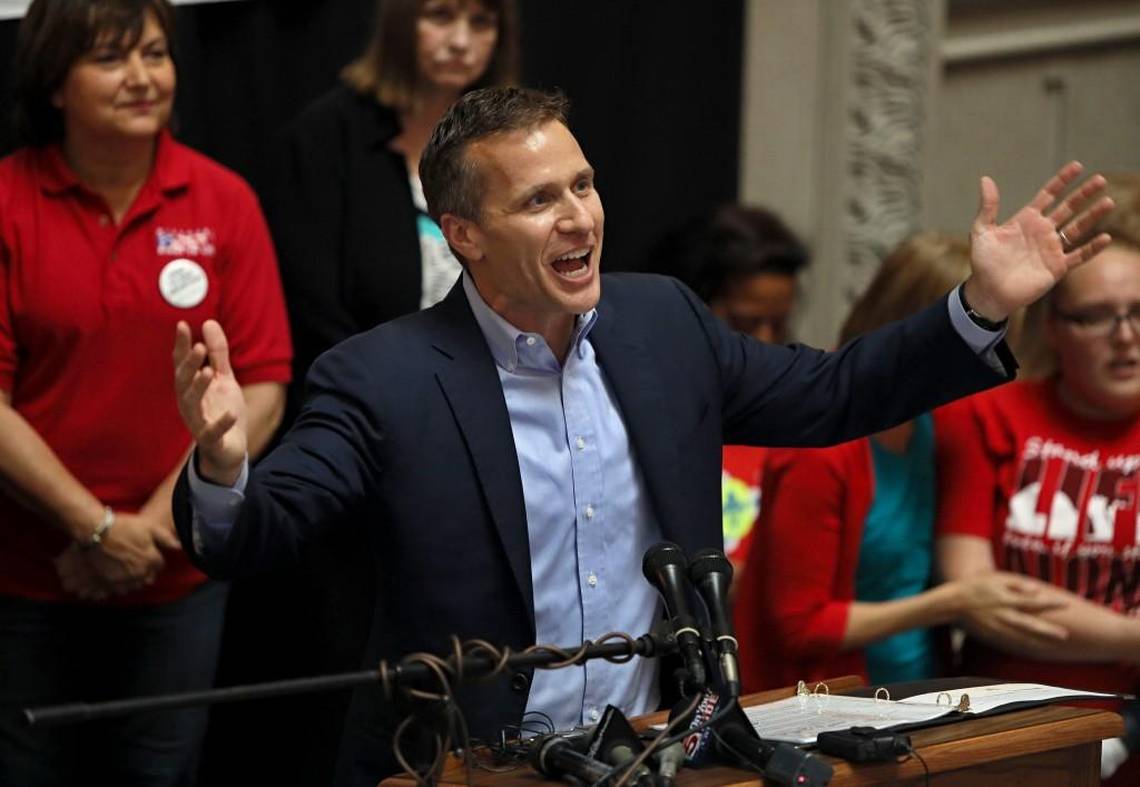
Missouri Gov. Eric Greitens addresses the crowd during an anti-abortion rally in the Statehouse in Jefferson City on Wednesday. Lawmakers were called back to special session by Gov. Greitens with the intent of modifying abortion laws in Missouri. David Carson AP

“The word ‘Christian’ has been stolen in 2017 in America by the Christian right.”

Actress Amy Brenneman had an abortion when she was 21 years old, and she refuses to be shamed for speaking about it.

“I absolutely think the word ‘Christian’ has been stolen in 2017 in America by the Christian right,” she says in the video. She said that her church is “prayerfully pro-choice” and believes in giving full “moral agency” to women. (In the past, Brenneman has said she attends an Episcopalian church, and that she’s also half-Jewish.)

Brenneman has long been outspoken about women’s right to have access to abortion care, and said that being open about her experience came at a cost.

In 2006, she joined celebrities like Gloria Steinem and Kathy Najimy in signing a Ms. Magazine petition called “We Had Abortions,” to normalize the procedure. In a 2015 HuffPost Live video, she said that she thinks abortion should not be “demonized” and went to bat for Planned Parenthood, too.

After the 2015 interview ― 10 years after initially coming out about having an abortion and, as she says in the Lives of Women video, “in the age of Twitter and Facebook” ― she had to endure trolling from the religious right and anti-abortion communities. She says in the video that she remains grateful for her decision to have an abortion regardless, and accepts that she will always be at odds with the anti-abortion community.

“I don’t feel like I’m in conflict with where I go every Sunday,” she says in the video. “To live alongside this hatred [from the anti-abortion community] has been really empowering, and ultimately freeing.”

http://www.huffingtonpost.com/entry/amy-brenneman-religious-and-pro-abortion-rights_us_5942d20be4b06bb7d271b471?utm_campaign=hp_fb_pages&utm_source=women_fb&utm_medium=facebook&ncid=fcbklnkushpmg00000046

Three in four people back legal abortions for women pregnant through rape or incest and in cases of fatal foetal abnormalities

Activists protest outside parliament in London
Activists protest outside parliament in London earlier this month against restrictions on abortion rights in Northern Ireland. Photograph: Justin Tallis/AFP/Getty

A large majority of Northern Ireland’s population are in favour of reforming the region’s strict anti-abortion laws and back legal terminations for women made pregnant through sexual violence, a new survey has found.

Nearly 80% of the public in the region believe abortion should be legal when a woman has become pregnant as a result of rape or incest, according to the latest Northern Ireland Life and Times Survey.

The public attitudes survey, regarded as one of the most accurate barometers of social option in the region, also found that 73% of those polled think abortion should be legal in local hospitals in cases of fatal foetal abnormalities – that is when if a pregnancy goes full term the baby will be born dead or die shortly after birth.

Amnesty International, which has been campaigning for abortion reform in Northern Ireland, said these latest findings show there is overwhelming support for liberalising the anti-abortion regime in the province.

Grainne Teggart, Amnesty’s campaign manager in Northern Ireland, said: “Not only do a huge majority of people in Northern Ireland want to see abortion made available to women and girls in the tragic circumstances of sexual crime or fatal foetal diagnosis, but we know from a previous Amnesty survey that they also want to see abortion decriminalised and dealt with through healthcare policy.”

She added: “Abortion is a healthcare and human rights issue. It is high time the law was changed in line with the overwhelming wishes of the public. Then women would no longer have to travel to England for an abortion and they and their medical carers would no longer be treated as potential criminals. Politicians in Northern Ireland and at Westminster must heed this demand for change.”

Many Northern Ireland politicians, including the Democratic Unionist party, who have been thrust into the role of potential kingmakers in Theresa May’s minority Conservative administration, oppose any liberalisation of the abortion laws. Northern Ireland is the only part of the UK where the 1967 Abortion Act does not apply.

This has resulted in thousands of women and girls having to travel to Britain for terminations in private clinics. Earlier this week the supreme court in London ruled against a mother and daughter from Northern Ireland who had wanted to establish the right to have a free abortion in an English NHS hospital.

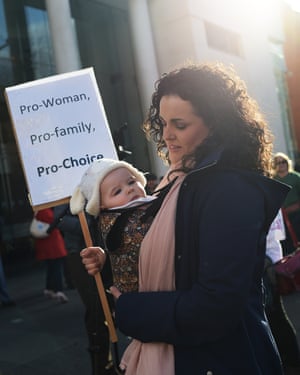
A mother and her baby protest alongside fellow pro-choice supporters outside the Public Prosecution Office in Belfast.
Pinterest
A mother and her baby protest alongside fellow pro-choice supporters outside the Public Prosecution Office in Belfast. They had gathered in support of a woman who was convicted for using abortion pills. Photograph: Charles McQuillan/Getty

Abortions in Northern Ireland’s hospitals are only available to women and girls where their life or health is in grave danger; only 23 were carried out in 2013-14.

The author of the report, Ann-Marie Gray, who is professor of Social Policy at Ulster University and policy director of the Access Knowledge Research institute, said: “Northern Ireland currently has some of the most restrictive abortion laws in the world. Women who are viewed as infringing these laws and those who assist them are subject to harsh criminal penalties.

“These findings, based on the views of a representative sample of the Northern Ireland public, show that abortion legislation in Northern Ireland is out of step with public opinion. There is very strong support for changes to the law in cases where the life or the health of the pregnant woman is at risk, in cases of fatal and serious foetal abnormality and where a pregnancy is a result of rape or incest.”

Attempts by the former Northern Ireland justice minister David Ford to bring in limited abortion reform and allow for terminations in the case of fatal foetal abnormalities have been vetoed by the combined votes of the DUP, some of the Ulster Unionist party and members of the Social Democratic and Labour party. In 2015 Sinn Féin changed its policy to support abortions in both parts of Ireland in cases of fatal foetal abnormality.

A number of Northern Irish women are facing prosecution over procuring abortion pills from pro-choice charities via the internet. In March on International Women’s Day the Police Service of Northern Ireland raided two premises searching for abortion pills, including a workshop belonging to pro-choice Belfast campaigner Helen Crickard. No pills were found but Crickard said she felt “violated and humiliated” over the raid in the south of the city.

In 2016, a 21-year-old woman was given a suspended prison sentence for buying drugs online to induce a miscarriage. She had been reported by her flatmates after they found out she had taken the abortion pills.

A mother is facing prosecution for procuring abortion pills for her then underage daughter.

https://www.theguardian.com/world/2017/jun/16/northern-ireland-strongly-backs-abortion-law-reform-survey


The U.K. Supreme Court ruled Wednesday that women in Northern Ireland are not entitled to access abortions via the National Health Service, a decision that’s being heavily criticized by pro-choice organizations.

The ruling came after a 20-year-old Northern Irish woman and her mother brought a case against U.K. Health Secretary Jeremy Hunt. The woman got pregnant in 2012 at age 15 but was forced to travel to the U.K. mainland for a termination – at a cost of over $1,000 – because abortion is only allowed in severely restricted circumstances in Northern Ireland.

While U.K. citizens in England, Wales, and Scotland all have access to abortions for free via the NHS, the government limits access in Northern Ireland in order to “respect” the policies of local politicians there.

While Jeremy Hunt conceded he had the power to give Northern Irish residents access to NHS abortions in England, the court narrowly rejected the women’s appeal. Despite saying they wanted to respect “the democratic decision of the people of Northern Ireland,” the judges also stressed they were “sharply divided” on the outcome, ruling 3-2 against the appellant.

Lady Hale and Lord Kerr said they would have allowed the latest appeal, because “the policy is incompatible with the Convention rights of women from Northern Ireland.”

Delivering the majority decision, Lord Wilson said the five judges were “sharply divided,” and he expressed sympathy for the “deeply unenviable position” women in Northern Ireland are put in.

View image on Twitter

Access to abortion in Northern Ireland has been in the spotlight in recent days as a result of the Democratic Unionist Party’s pivotal role in helping to form the next government in the U.K.

The Conservatives have been holding talks with DUP leadership to iron out a so-called “supply and confidence” arrangement that would enable them to remain in power after the recent U.K. election resulted in a hung Parliament.

Many have criticized Prime Minister Theresa May for choosing to go into partnership with the Northern Irish party, given its hard-line views on subjects like same-sex marriage and women’s rights – particularly abortion.

The DUP has long fought to stop any extension of abortion rights in Northern Ireland, with First Minister Arlene Foster quoted as saying she would not want abortion to be “as freely available here as it is in England.”

https://news.vice.com/story/no-free-abortions-for-women-from-northern-ireland-uk-court-rules