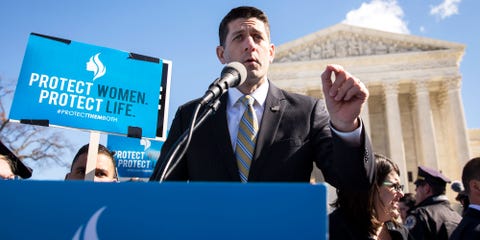
Demonstrators hold up signs outside the Supreme Court in Washington in 2016. (Andrew Harrer/Bloomberg)
Like a steady drip from a broken faucet, a lot of blame has been thrown around since Hillary Clinton’s shocking loss in November. Predictably, and without any evidence, some have begun drawing connections between Clinton’s loss and her support of abortion rights, specifically her call to end the Hyde Amendment, the law first passed in 1976 that effectively denies low-income women insurance coverage for abortion. A common thread has emerged: Women’s issues and racial justice — both of which intersect in support of abortion rights — are being positioned as a key vulnerability of today’s Democratic party, rather than part of its core.
Add to this argument Sen. Bernie Sanders’s (I) recent statements during the Democratic National Committee “unity tour” throwing abortion rights under the bus. The Vermont senator argued that Democrats need to back antiabortion candidates “if we’re going to become a 50-state party.” This isn’t really a surprise: In 2015, Sanders bluntly set economic issues against reproductive health: “Once you get off of the social issues — abortion, gay rights, guns — and into the economic issues, there is a lot more agreement than the pundits understand.”
Smack in the middle of this flirtation with abandoning support for abortion rights, where women’s health, racial justice and family economics intersect, sits the Hyde Amendment. Lifting the Hyde Amendment, and more broadly supporting legal, affordable abortion, isn’t an isolated idea. For many of us, it is deeply connected to our support for women’s health and rights, inseparable from economic and racial justice, and intrinsic to freedom from political interference with our most personal decisions.
Public support for ending Hyde has been echoed by Clinton, by members of Congress and by Sanders himself as a presidential candidate. As a result, we have a fair amount of data on what happens when politicians voice their support for abortion coverage. One thing is clear: The issue doesn’t lose elections. In 2015, 129 House Democrats co-sponsored the Equal Access to Abortion Coverage in Health Insurance (EACH Woman) Act, which would reverse the Hyde Amendment. In 2016, not a single one lost their seat to someone who did not support the bill.
The reality is that the public is more supportive of abortion rights than ever. In late 2016, polling from Pew Research Center found the highest levels of support for legal abortion since 1995, largely driven by a rise in support among Democratic women. Recent data show a majority of Americans oppose blanket bans on abortion coverage, and polling conducted last year by Hart Research Associates for All* Above Action Fund shows that 3 in 4 battleground voters agree with the statement, “However we feel about abortion, politicians should not be allowed to deny a woman’s health coverage for it just because she’s poor.” There is broad consensus on this point across party lines. The poll also found that a majority of voters in battleground states would support a bill requiring Medicaid to cover abortion. Opposition to the Hyde Amendment is especially strong among millennials, African Americans and Latinos, rebutting some ridiculous claims to the contrary.
Here’s what we do know: Abortion is important to voters, and is often used as a metric to judge a candidate’s other values. The most reliably Democratic voters — namely black and Asian American Pacific Islander women, Latinas, unmarried women and educated urbanites — want abortion to be legal and accessible.
Democrats are scrambling: The loss of the presidency was unexpected and painful. They feel like the ship is sinking around them, so they’re looking around, desperately, trying to jettison anything not needed to stay afloat. But support for abortion rights and a commitment to end the Hyde Amendment are not disposable issues or dead weight — they’re part of the engine that keeps the party moving forward and a piece of the moral fabric that gives the party integrity and relevance to people’s lives. Throwing abortion access and coverage overboard won’t keep the ship from sinking, but it may well leave it dead in the water.
State’s request could pave the way for other states to adopt the same aggressive tactics to defund the nation’s largest reproductive healthcare provider
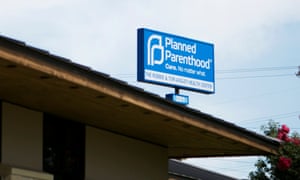
A Planned Parenthood center in Austin, Texas on 27 June 2016. Photograph: Ilana Panich Linsman/Reuters
Texas will ask the Trump administration to green-light the state’s unprecedented efforts to defund Planned Parenthood, according to documents seen by the Guardian.
The request could pave the way for dozens of other states to adopt the same aggressive tactics to defund the nation’s largest reproductive healthcare provider.
Under the Obama administration, Texas lost millions in federal family planning funds as a consequence of its unlawful efforts to block Planned Parenthood from participating in Medicaid.
In the aftermath, Texas created a state-funded family planning program which critics say failed to adequately replace the services of Planned Parenthood.
Now, in a letter obtained by the Guardian, Texas officials ask the US health department to fund its state program – the same one the state created after it defied federal laws that prohibit defunding Planned Parenthood.
In its letter, which is expected to be sent to the Trump administration as early as this week, Texas makes no indication that the state plans to comply with those laws and reinstate Planned Parenthood’s funding.
“We’re all terrified,” said Elizabeth Nash, senior state issue manager at the Guttmacher Institute, a think tank that supports abortion rights. “This is really huge, if they let Texas do this.”
A half dozen other states have attempted to exclude Planned Parenthood from their Medicaid programs. But only Texas, by giving up millions in such funding, has been successful.
If the Trump administration was to reinstate Texas’s funding, it would signal that other states could follow suit without suffering a financial hit.
“It would let all of these states start kicking Planned Parenthood out of Medicaid,” Nash said. “And Medicaid is by far the largest form of public funding for family planning.”
A report commissioned by the state of Texas found that its state-funded women’s health program served 30,000 fewer women than the old program. An independent study concluded that reimbursement claims for the most effective forms of contraception dropped by more than 30% after it defunded Planned Parenthood.
The cuts also forced several Planned Parenthood clinics to close, leaving patients to find another provider. “I hate to say it,” a community health provider in Midland recently told the Guardian, “but I think an awful lot of women just opted to go without care.”
A spokesman for the US health department declined to confirm whether Texas has already submitted the letter seen by the Guardian, and a spokeswoman for the Texas health department did not respond to similar inquiries.
But the state appears firmly committed to making its request official: an appropriations bill just introduced in the state Senate projects that the state will receive $90m in federal funds annually in fiscal years 2018 and 2019.
Texas has gone to greater lengths than any other state in its quest to defund Planned Parenthood.
In years prior, the state received roughly $30m a year to reimburse providers that offered no-cost contraception, cancer screenings, STI tests and treatment and well woman exams to low-income women.
By federal law, abortion services were not eligible for reimbursement. But in 2011, Texas lawmakers who opposed Planned Parenthood’s role as an abortion provider nevertheless voted to cut off its access to Medicaid funds for family planning.
The vote placed Texas in violation of a federal law that gives Medicaid enrollees the right to visit any qualified healthcare provider. Courts have said this means that states cannot exclude a provider just because it provides abortions. Texas was thus ineligible to receive any more federal Medicaid family planning funds – funds that accounted for 90% of state spending on family planning.
But instead of backing down, the state announced that it would provide 100% of the funding for a new women’s health program, one with rules that excluded all abortion providers.
Now Texas is seeking for the federal government to restore its Medicaid family planning funding – without having reinstated Planned Parenthood’s participation in the program.
“This shell game they’re playing has enormous implications,” said Dr George Benjamin, president of the American Public Health Association. “And while they’re focused on abortion providers today, if the Trump administration approves this, some other state can come along and object to any other type of provider for ideological reasons.”
Many public health experts cite evidence that defunding Planned Parenthood was devastating for Texas women. Previously, Planned Parenthood treated nearly 40% of women enrolled in the state’s women’s health program.
“We know public health has deteriorated in Texas. We know fewer women are getting care,” said Dr. Benjamin. “They clearly didn’t get the performance that they got when Planned Parenthood was part of the program.”
Texas maintains that its state-funded replacement, which was consolidated with another health program and renamed Healthy Texas Women, provides low-income women with a robust safety net. In its letter to request federal funding, the state makes no mention of the controversial origins of the program or potential conflict with federal law. Instead, it says provider participation has more than doubled.
The letter asks for “federal participation” in the state’s women’s health program “as soon as possible”. The request is addressed to the federal Centers for Medicare & Medicaid Services, the division of the health department that stripped Texas of its Medicaid funding in 2012.
Without the federal funding, the Senate budget bill states, “reductions to program funding or service levels” are a possibility.
The state would request the funding via a Medicaid waiver, a measure intended to help states experiment with delivering better healthcare to Medicaid recipients. Final authority rests within the agency run by Tom Price, a longtime advocate of defunding Planned Parenthood.
“It would be immensely troubling if this administration used their authority to grant this waiver, when these waivers are meant to actually expand access to healthcare,” said Adam Sonfield, executive policy manager at Guttmacher.
Planned Parenthood and its allies would likely launch a legal challenge if the health department reinstated federal funds for Texas’ program.
But there are signs the Trump administration may be willing to grant Texas its waiver.
Donald Trump recently signed a billencouraging states to cut off other forms of federal funding to Planned Parenthood. And the legislation the House of Representatives passed one week ago to repeal the Affordable Care Actincludes a provision to cut off all Medicaid reimbursements to Planned Parenthood, some $500m annually.
Supporters of defunding Planned Parenthood argue that the nation’s community health centers can provide the same services without the moral compromise that occurs when then government hands money over to an abortion provider.
But the evidence for their assertion is dubious, at best. As of 2010, in 67% of counties with a Planned Parenthood clinic, the organisation served at least half of women obtaining contraception through the public safety net. In 103 counties, Planned Parenthood is the only safety net provider for family planning.
In regions where targeted cuts have forced Planned Parenthood clinics to close, county health officials report that they have struggled to replace its services.
One of the best examples may be Texas.
“Texas’s experience illuminates what may happen on a larger scale,” Joseph Potter, a UT Austin researcher, said. His study found lower rates of contraception use and higher rates of unplanned pregnancy in regions of Texas where Planned Parenthood was suddenly slashed out of the safety net.
“These results … contradict the claim that Planned Parenthood could be removed from a statewide program with little or no consequence,” the study warned. “[They] should be cautionary to states considering similar measures.”
Page for Women on Web, which connects doctors with women in places that restrict abortion access, deleted over ‘promotion or encouragement of drug use’
This is the second censorship row between Facebook and Women on Web. Photograph: Regis Duvignau/Reuters
Facebook has censored the page of an organization that helps women obtain abortion pills, citing its policy against the “promotion or encouragement of drug use”.
Women on Web, which is based in Amsterdam, helps connect women with doctors who can provide abortion pills if they live in countries where abortion access is restricted. It is a sister organization to Women on Waves, which provides abortions and other reproductive health services on a ship in international waters.
Women on Waves announced that the page had been “unpublished” on its own Facebook account, writing: “Women on Web provides life-saving information to thousands of women worldwide. Its Facebook page publishes news, scientific information and the protocols of the World Health Organization and Women on Web has answered over half a million emails with women who needed scientific, accurate information essential for their health and life.
“We expect Facebook will [undo] this action soon enough, as access to information is a human right.”
This is the second censorship row between Facebook and Women on Web. In January 2012, Facebook deleted the profile photograph of the group’s founder and director, Dr Rebecca Gomperts. The image contained instructions for inducing an abortion using Misoprostol. Gomperts was locked out of her account for two days after re-posting the image, but Facebook subsequently apologizedand reinstated both the image and her account.
Facebook did not immediately respond to a request for comment.
With nearly 2bn users, the social media site plays a crucial role in disseminating news and information around the world. But Facebook has struggled to meet competing demands to allow for the free flow of information while cracking down on graphic material (such as the livestreamed murder of a baby in Thailand in April).
In 2016, the company faced international condemnation over its decision to censor the iconic Vietnam War photograph of a naked girl fleeing a Napalm attack. Facebook subsequently altered its policy to allow for editorial judgments about newsworthiness.
On 3 May, amid criticism over its handling of graphic videos, Facebook announced that it would hire 3,000 more content reviewers. Such content reviewers are tasked with applying the company’s “community standards”, often with uneven results.
Facebook’s has faced particular difficulty enforcing its rules for “regulated goods” – prescription drugs, marijuana, firearms, and ammunition. The company bars “attempts by private individuals to purchase, sell, or trade” such items, but has struggled to halt gun sales.
Decades after the Supreme Court ruled unconstitutional state laws banning abortions, the topic hasn’t become any less controversial. Anti-abortion advocates nationwide have fought to ban the procedure ever since Roe v. Wade, and in some states, they have succeeded in enacting abortion restrictions that aren’t based in science at all. Ironically, that particular fact is scientifically-backed: According to a recent analysis by the Guttmacher Institute, a reproductive health research organization, at least 10 major categories of abortion restrictions are based on “assertions not supported by rigorous scientific evidence.” In other words, although it’s a medical procedure, many policies regarding abortion conflict with established medical facts.
The report, released on Tuesday, analyzed the justification for abortion regulations across the country. The authors identified 10 abortion restrictions that have no basis in science, despite purporting to “protect women’s health” in many instances. They acknowledge that the new presidential administration is a source of concern for many reproductive health advocates, especially given its tendency to espouse “alternative facts.” However, the researchers also point out that anti-abortion rhetoric has historically relied on emotional appeal rather than fact, which is how reproductive rights has come to occupy an “evidence-free zone” today.
Chip Somodevilla/Getty Images News/Getty Images
Abortion is an emotional subject for many people, and unfortunately, that emotion is easily exploited by anti-abortion advocates. Some restrictions on the procedure may claim to have “women’s best interests” in mind, but upon closer inspection, they appear to be designed to punish women rather than help them get through a difficult time in their lives. According to a separate Guttmacher study, for example, prospective patients in 13 states receive “counseling” that includes information about a fetus’s ability to feel pain (even though it’sbeen proven that fetuses can’t feel pain at the 20 week mark), and six states require women to be told personhood begins at conception.
To read the recent Guttmacher report in its entirety, head over to the organization’s website. However, here are seven restrictions highlighted by the study that make zero scientific sense.
1Counseling Requirements
Spencer Platt/Getty Images News/Getty Images
According to the Guttmacher Institute, 35 states require counseling for women before an abortion is performed. Sometimes, this is designed to adhere to informed consent, but in many cases, researchers found that the information given to women was based on incorrect or unproven assumptions. In six states, for example, women are told that abortion is linked to mental health problems, but a growing heap of research studies have found no such association.
The same story plays out again and again in regards to other topics. There’s no demonstrated association between abortion and breast cancer or infertility, despite the information provided by counseling sessions in some states.
In more than half of the United States, counseling is followed by a mandated waiting period before the procedure can be performed. This period usually lasts between 18 hours and several days, often requiring multiple appointments. As NPR reported in 2015, several of these states are actually increasing the length of time someone must wait before receiving the procedure.
Being pro-life is not only about trying to reduce the abortion rate. And the GOP health-care plan will probably raise it anyway.
For all their talk about being the pro-life party, Republicans in the House of Representatives struck a deathblow to their own anti-abortion platform with the passing of the American Health Care Act (AHCA). The move to repeal the Affordable Care Act (ACA; commonly known as Obamacare) is the biggest and most egregious affront to a pro-life stance that we’ve seen from this Congress and administration, and it happened at the hands of the Republicans themselves.
I consider myself pro-life, but to me, that does not just mean reducing the abortion rate in this country. To be pro-life means to be pro-all-of-life, not just up until the moment of birth, and it means valuing all of life, regardless of one’s gender, race, income, immigration status, or ability. The Republicans in Congress have routinely failed to grasp this concept, and the health-care vote just reinforces their ignorance or indifference.
Access to health insurance is an explicitly pro-life issue.
For those of us who want to reduce the number of abortions, a good place to start is giving women access to affordable contraception and therefore more control over whether they get pregnant. It’s widelyknown that access to free birth control reduces the rate of abortions, and since Obamacare was signed into law, more than 55 million women gained access to zero-copay birth control. Birth control, when used correctly and depending on the method, is up to 99.9 percent effective, but without health insurance, birth control can cost around $1,200 out-of-pocket (including the required physician visits) per year, a crippling amount for poor and low-income women. Since the ACA passed, we have seen abortion rates drop to historic lows — the lowest since the procedure became legal via Roe v. Wade in 1973.
But the GOP bill seeks to undo all of these protections and provisions that were put into place in the Obama era. The Congressional Budget Office has yet to grade the newest version of the bill on its fiscal impact, but when it analyzed an earlier draft of the bill in March, it estimated that 24 million people would lose their health insurance with the repeal of the Affordable Care Act, which includes access to prescription contraceptives. Pro-life, indeed.
The ACA also mandated that insurers cover certain “essential benefits,” including maternity and newborn care and pediatric services, and it’s estimated that 9.5 million previously uninsured women gained access to maternity and prenatal care with the Affordable Care Act. That means 9.5 million women were able to access ultrasounds, gestational diabetes screenings, lab studies, medications, hospitalization, newborn baby care (including NICU services), lactation consulting and breast pumps, postpartum mental health care, and more for the very first time if they became pregnant. This was a monumental achievement for women and newborn children — one the GOP seems content to roll back.
There’s a lot of speculation about what exactly could happen with the GOP health-care bill in regards to preexisting conditions, and there is a lot of false information floating around on social media. But in short, under the Republican plan, pregnancy could deny you health insurance at worst, or force it to be more expensive at best. According to the Washington Post, “Under the GOP’s proposal, states are given the option of dumping an Obamacare rule that requires insurers to provide maternity coverage to all women and safeguards them from fee increases in the event of a pregnancy. In other words, maternity coverage, as dictated by the federal government, would no longer have to be an ‘essential benefit.’”
Here’s the thing about having babies. It often happens in hospitals, under the direction of medical care. And this medical care can be very expensive if you don’t have insurance — often more than $10,000 for an uncomplicated birth. But when women do have access to health insurance, evidence suggests they may be less likely to seek an abortion. If pregnancy qualifies as a preexisting condition and women can’t get coverage, what do Republicans in the House think is going to happen? By making health insurance less accessible to women of reproductive age, Republicans have undermined their own stated goal of eradicating abortion. Pro-life, indeed.
Lastly, President Barack Obama expanded Medicaid, our country’s dual-funded state and federal health insurance program for low-income and at-risk people that covers children, the elderly, the disabled, and people living in poverty who receive federal assistance, and gave coverage to an additional 11 million people. The new House bill would not only end that expansion, it would cut and restructure the Medicaid program, disproportionately affecting the ability of women — particularly women of color — to receive health care. The new GOP health-care bill also proposes to strip Medicaid of its funding by a whopping $880 billion over the next decade, which would make it nearly impossible for individual states to keep providing the same amount of coverage to everyone enrolled in Medicaid, including around 15 million women of reproductive age. In 2015, 20 percent of women of reproductive age in the U.S. were able to rely on Medicaid for no-cost birth control, maternity and prenatal coverage, cancer screenings, and all of their health-care coverage needs.
There are always a lot of moving parts when it comes to massive budget cuts. But if this deep Medicaid cut actually happens, it’s hard to imagine a scenario where there wouldn’t be a significant scale-back of family planning services and critical maternal care (which would only increase our rate of infant and maternal mortality). By slashing Medicaid and remaining strongly anti-abortion, the House GOP is putting women in an impossible position. Pro-life, indeed.
If Republicans had any interest in being truly pro-life, they would work to create a culture in which the lives they so vociferously defend would have a chance to thrive and flourish. If Republicans were truly pro-life, they wouldn’t want to give a woman another reason to choose abortion. But it seems to me that Republicans in the House want to force women to have their babies, but refuse to help give them the means in which to do so.
Hard-working families across the country have a lot on their minds these days. They care about good schools for their kids, earning enough at work to cover ever-growing expenses and keeping their health care affordable and accessible when they need it. These are the concerns of the Pennsylvania families I talk to every day. Yet there are still some politicians who would rather spend their time waging ideological battles instead of helping families get ahead.
Recently, we’ve seen a nationwide trend of disturbing billsdesigned to restrict women’s ability to make decisions about their own families and access the health care services they need. These attacks are spreading despite the fact that they undermine women’s status as equal members of our society and can make it more difficult to raise a family. In Oklahoma, legislators have presented a bill that would require women to get written consent from the fetus’ father before getting an abortion. In Arkansas, the governor signed a law that allows husbands to sue their wives’ doctors in order to stop their spouses from getting a particular type of abortion. In Wyoming, lawmakers assigned two anti-abortion bills to the Senate Agriculture committee — literally treating women like pigs.
Each of these examples shows politicians wasting time debating whether women deserve the right to make decisions about their own families rather than focusing on policies that would put more money in the family bank account.
I can’t change what happens in Oklahoma, Arkansas or Wyoming. But as governor of Pennsylvania, I can do something when similar restrictions crop up in my home state. Here, it’s my job to put the needs of Pennsylvanians ahead of partisan ideology. As a father and a husband, I believe that women should have the same opportunities as men. That’s why I am ready to veto a plan moving through the state legislature that would criminalize abortion, even in cases of rape and incest, and drastically restrict women’s access to health care.
This legislation, Senate Bill 3, has been pushed through the state legislature without a single public hearing that would allow Pennsylvanians the ability to express their concerns. I’ve heard from women across Pennsylvania who shared their heartbreaking stories with me. This bill would criminalize very personal and difficult decisions that should be between a woman and their doctor. This bill is also opposed by the Pennsylvania Medical Society, but that hasn’t stopped politicians in Harrisburg from pushing it through the legislature.
The legislation is wrong and the people of Pennsylvania deserve better from their elected representatives.
I’m proud to support the women I represent and to advance reproductive freedom and equality for every member of our society. I don’t pretend to know what’s best for a woman and her health, but everyone can get behind the idea that all women should have the same opportunity as men to make their own health care decisions.
If the politicians behind this unconstitutional bill truly want to help Pennsylvania’s families, they should champion policies that are proven to lift up women and families. This means expanding access to affordable health care, protecting pregnant women from discrimination at work and giving working people access to paid family leave so they can take care of their families without risking their jobs.
Until that happens, I will keep standing shoulder-to-shoulder with the vast majority of Pennsylvanians who support a woman’s constitutional right to make her own decisions about her body. It’s not my place to judge a woman’s personal decisions or to try and make them for her — and it’s not the state legislature’s place to make those decisions for other people, either. And if they try to do so, my veto pen will be ready.
Dr. Willie Parker with his family at a church in Montgomery, Ala., in a film still from “Trapped,” a documentary about abortion clinics in the South.CreditTrilogy Films
No issue in America is more toxic than abortion, and that’s partly because it is today so closely associated with religion. While many feminists see abortion as a matter of choice, some Christians see it as murder.
Then there are people like Dr. Willie Parker. Dr. Parker is black, feminist and driven by his Christian faith to provide abortions in the South, where women seeking to terminate a pregnancy have few options.
“I believe that as an abortion provider, I am doing God’s work,” Parker writes in his new memoir, “Life’s Work.” “I am protecting women’s rights, their human right to decide their futures for themselves, and to live their lives as they see fit.”
Since childhood, Parker had been taught that abortion was wrong, and for the first half of his career as an OB-GYN, he refused to perform abortions. But then he had what he calls his “come to Jesus moment,” an epiphany that his calling was to help women who wanted to end their pregnancies.
If that seems incongruous, let’s remember that conservative Christianity’s ferocious opposition to abortion is relatively new in historical terms.
The Bible does not explicitly discuss abortion, and there’s no evidence that Christians traditionally believed that life begins at conception. St. Thomas Aquinas, the father of much of Catholic theology, believed that abortion was murder only after God imbued fetuses with a soul, at 40 days or more after conception.
One common view was that life begins at quickening, when the mother can feel the baby’s kicks, at about 20 weeks. When America was founded, abortion was legal everywhere until quickening, and it wasn’t until the 19th century that states began enacting laws prohibiting abortions, beginning with Connecticut in 1821.
Even in the modern era, religion has taken a more complex view of abortion than is generally realized. In the 1960s, ministers and rabbis formed the Clergy Consultation Service on Abortion, advising pregnant women how to obtain abortions. More than 100,000 women sought their services.
In 1968, a symposium held by Christianity Today suggested that “family welfare” concerns were good enough reasons for an abortion. The Southern Baptist Convention passed resolutions in 1971, 1974 and 1976 calling on church members to work for the legalization of abortion in some situations.
In 1972, a Gallup survey found that Republicans were more likely (68 percent) than Democrats (59 percent) to say abortion should be “a decision between a woman and her physician.” That’s partly because abortion was seen as a Catholic issue but not a Protestant one, and most Catholics were Democrats.
“I have always felt that it was only after a child was born and had a life separate from its mother that it became an individual person,” the Rev. W. A. Criswell, one of America’s Southern Baptist leaders, said in agreeing with the Supreme Court’s legalization of some abortions in Roe v. Wade in 1973.
Yet today it’s taken as self-evident among conservative Christians that life begins at fertilization — without realizing that this would have astonished many Christians throughout the ages.
Parker accepts that a fetus is alive — but says that life doesn’t begin at conception, because an egg is alive as well, and so is a sperm. “Life is a process,” he writes. “It is not a switch that turns on in an instant, like an electric light.”
Parker is outraged at the profusion of laws around the country chipping away at abortion rights, and he objects that much of the critique of abortion is based on bad science — yet doctors are sometimes legally obliged to provide incorrect information to patients. Medical opinion is that a fetus cannot feel anything like pain until about 29 weeks, long after most abortions occur, he notes.
Parker tells of seeing a woman whose fetus had Potter syndrome, in which the lungs do not develop. The woman declined an abortion for religious reasons, and a baby girl was born at full term — and then, as was inevitable, died a painful death because she couldn’t breathe.
“In this case, an absolute reverence for life led to a situation that, to my eyes, consisted of nothing less than pure cruelty,” he writes.
In another case, a 12-year-old girl was with her mother in the waiting room of an abortion clinic in Alabama. When the mother stepped outside to smoke, another patient tried to offer maternal guidance and steer the girl away from boys. “Who were you messing with?” the woman asked. “Don’t you know not to go around with those boys?”
“He isn’t a boy,” the girl replied. “He’s 53 and he’s my daddy.”
Dr. Parker reminds us that abortion is complicated. And that is why, in my view, we need choice.
Earlier this month, Donald Trump quietly signed a bill allowing states to withhold federal family planning funds from organizations that provide abortion services.
A few weeks before that, the president offered a strange ultimatum to Planned Parenthood, proposing that his administration would stop its defunding efforts if the health care provider would stop performing abortions. (The offer was rejected.)
Proposals like this aim to make abortion inaccessible for as long as it remains legal. They can be incredibly effective, and there will be more of them. The United States is already a country in which one in four women with Medicaid coverage subject to the Hyde Amendment report carrying an unwanted pregnancy to term due to lack of insurance coverage for the procedure. A country where a lack of affordability or regional access or both means that women delay the procedure or come up short on rent, groceries, and utilities just to cover the expense.
Abortion is a constitutionally protected right as long as you have the money to pay for it. For poor women, particularly poor women of color, a right without access means nothing. That’s where we are now.
Anne got pregnant at 25 and wasn’t ready to have a kid. Brittany got pregnant at 22 and wasn’t ready, either. Anne could afford the abortion. Brittany couldn’t.
These are their stories.
Anne, 38, Brooklyn
It was the end of 2003 in Brooklyn, and my boyfriend and I got carried away and had sex without a condom. The next morning, I found the nearest hospital to get a prescription for the morning-after pill. Now it’s available over the counter, but it wasn’t back then, and your options were even more limited if you didn’t have insurance, which I didn’t at the time.
They gave me a pregnancy test at the hospital and it was negative, but they wrote me a prescription for the morning-after pill. Still, their pharmacy didn’t stock it. I still can’t get over that all these years later— it felt almost mean-spirited, making you jump through hoops like that. But because I had just been told I wasn’t pregnant, I didn’t rush to another drug store right away.
Instead, I went and got it later that day. I followed all the directions and thought everything was fine. The information on the package said it would likely mess with the schedule of my cycle, so I didn’t think too much of it when I didn’t get my next period. But around five weeks later, I still hadn’t gotten my period.
I took another home pregnancy test. Of course, I was pregnant.
I had just lost a job, and I didn’t have any insurance. I lived in a 400 square foot apartment. My boyfriend was living 3,000 miles away. I wasn’t ready to have a baby in any practical or emotional sense, so I went to Planned Parenthood and had an abortion.
I’m extremely thankful Planned Parenthood was available, and that I was able to afford it. It wasn’t easy coming up with the $300, but I was able to do it. It was stressful, but ultimately I was able to go back to my life as it was. And today I don’t have a 12-year-old child.
Brittany Mostiller, 32, Chicago
This was 2006, when I was 22 years old. A lot was happening that year. I was a parent of two and involved with the father of my children, but we weren’t in a relationship or anything. I was sharing an apartment with my sister, my niece, and my two other children. I can’t remember if I was working or not at the time, but I do know that I was poor. That has been the story of my life.
By the time I found out I was pregnant I was about 13 or 14 weeks along, and I knew I didn’t want to have another child right then. I remember thinking that I would just use my insurance, my Medicaid, to pay for the procedure. That wasn’t the case, obviously. I couldn’t use it, and I couldn’t come up with the money. I couldn’t even borrow the money.
There was no “choice” either way. Because of my income, and because Medicaid wouldn’t cover the procedure, there was just no choice. That really hit me I guess when I was 17 or 18 weeks into the pregnancy, after I had been calling around about the insurance and knew I couldn’t afford it. I thought, “OK, this is what it is.” I was forced to carry the pregnancy to term, and I didn’t want to. That’s rough. That was really rough for me.
It wasn’t anything I wanted at that time, but she was coming and ain’t a thing I could do about it. That was just it. To even say that aloud, even now—you don’t wish that on anyone. I wanted to have a happy experience, I wanted to look forward to seeing my child and meeting her. There was no moment when it felt like “This is OK,” there was no moment when I felt, “Let me get happy.” There was no switch for me to turn on. It’s still something I struggle with, that feeling. I struggle with it now even trying to talk about it.
The pregnancy was hard for me. I was stressed, I was in a lot of pain, and I would just cry. I was depressed. It was just not a good space for me, mentally or physically. And I’m still trying to be a parent through all of this. I think it all had an effect. My water broke early—32 weeks—and I delivered at 33 weeks. She was my tiniest baby.
I love her dearly, but I know that wasn’t what I wanted. I didn’t have an option. After she was born, I guess I went into autopilot. That was the story of my life for a long time, being a parent, being a black woman, trying to support my family. I couldn’t feel or process anything, any emotion. I needed to make sure I had diapers, that I had onesies, that I could get on food stamps. I had to make sure I was able to physically take care of my children. That was it. There wasn’t room for anything else.
When she was two months old I had to call back my previous employer at a local grocery chain and literally beg for my job back. I had left the job when I was 19, walked out like, “That’s it.” I was young. But I begged them for my job back, told them I had grown and matured and that I had a larger family and really needed the work. It wasn’t an option to hit the pavement with a newborn and two small children.
After that, I got another job, something full-time. I worked both jobs for a while and then eventually quit the grocery store and kept my full-time job as a manager at a bagel joint. I was still sharing an apartment with my sister, and now it was five of us in the two bedroom house.
This is my first time talking about this. I have spoken to a few folks about it briefly because I am trying to figure out how to tell this story. I don’t want my daughter to ever think that she is not loved. She doesn’t feel that way, I don’t think, but I don’t want her to read or hear about it at some point in her life and ever think it.
I struggle with this a lot, though. I’m still trying to figure out the language around it. I know people will try to take this and of course tear me down. You are damned if you do, and damned if you don’t. People will use my story however they want. I love my daughter, but if I’d had the money I would have had an abortion. I did not choose to have a child at that time. And that takes a toll on you—mentally, emotionally, physically, financially. Everything.
And people who are anti-abortion will try to use my story to say, “See, you can make it work. You struggle through it.” I don’t even have the language for that, but I want to counter it by saying it’s wrong. That’s not the truth. If people want to have an abortion, they should be able to.
Not everyone is resilient. I know it’s a feel good story—build yourself up! Overcome those obstacles! That work is taxing. It is hard. It is also not everybody’s story. Things can go a lot of different ways other than choosing to love a child that you did not choose to carry.
I think it gets even stickier because people can try to use it to feed a narrative that black people—especially black women—are bad parents. Someone is going to take all of your circumstances and frame it however they want to. That’s what I mean when I say you’re damned if you do and damned if you don’t.
Now I hear stories from the women who call the Chicago Abortion Fund and they are so similar to mine. It’s not just that they can’t afford or access abortion, but I can hear their despair. God, the desperation of it. They are tired of struggling. This is not just about abortion or carrying a pregnancy to term. Folks are out here really struggling financially, mentally, and emotionally just trying to be a person. Some don’t have running water, they have no support.
I hear these everyday experiences of folks where carrying the pregnancy to term is just not an option for them. But sometimes they do it because they simply couldn’t afford an abortion. It’s such a disservice to people. I feel them, and I feel like I am listening to myself when I was 22 and pregnant with my third child.
I love my babies. And I hate having to say that—I obviously love them. Anyone who has met me or my children can see that they are loved. And I feel, right now, like the total opposite of the person I was 10 years ago. I have been mentored by an amazing community, by amazing people. I really learned to love myself, and that helped me love my children in an entirely new way. But if someone else is experiencing what I went through ten years ago, and I can be any sort of comfort to them, then that’s what I want.
My third daughter was not something I chose, but then she was here. I needed to make sure she was loved. But I had just blocked out so much, stuffed my emotions so far down just so I could survive that time. That was my defense mechanism, to shut down. People who saw me parenting through it thought I was doing great, but inside I felt like I had to shut down just to make sure we could all see another day.
Imagine a stay-at-home mom who can do an abortion. Or a college student. Imagine she knows how to administer local anesthesia, has the medicines to induce miscarriage, can dilate a cervix, scrape a uterus. Imagine a group — with no medical training — performing dozens of abortions a week, in secret, at great risk to themselves, their families and the women they serve.
That is the story of Jane, an underground group in Chicago that carried out thousands of abortions between 1969 and 1973, when abortion was illegal. It’s a story of code names and safe houses, a story of women taking control of their lives and teaching other women to do the same.
Abortion providers and the women they serve now fear that such an underground service may again become necessary. Abortion remains legal, but one conservative justice has just joined the Supreme Court and many are concerned that another will follow. This month the president signed a bill to cut funding to Planned Parenthood and other providers. Many states have enacted laws that make obtaining an abortion exceedingly difficult: About 90 percent of counties have no abortion clinics. In many areas, the procedure is nearly as inaccessible as it was in the days of Jane.
Back then, if a woman was pregnant and didn’t want to be, doctors would not help her. Abortion was a felony in 49 states. Many “back alley” abortionists could not be trusted. What to do? Call Jane.
In 1965, a University of Chicago student, Heather Booth, then 19, helped a friend’s sister find a doctor willing to do an abortion. “I was told she was nearly suicidal,” Ms. Booth told me. “I viewed it not as breaking the law, but as acting on the Golden Rule. Someone was in anguish, and I tried to help her.”
Ms. Booth was eventually deluged by so many similar pleas for help that she “saw the need to set up some kind of system.” By 1969, she had enlisted a group of women who formed the Abortion Counseling Service of Women’s Liberation. They advertised in student and underground newspapers: “Pregnant? Need help? Call Jane.” (Why “Jane”? One member just liked “sweet names.”)
By 1970, Jane was referring two dozen women a week to a few willing doctors for abortions. Callers left a message on an answering machine. “Callback Jane” would collect information and pass it on to “Big Jane,” who would supply an address — “the front” — where patients would receive counseling. Eventually they’d be taken to a different address — “the place” — such as a member’s home or a motel room, where a doctor would induce miscarriage or perform a surgical abortion. Patients were sometimes blindfolded so that they couldn’t identify who’d helped them. Each was sent home with antibiotics and instructions for follow-up care.
Soon, it was not only college students who called. Many patients were already mothers, many of them poor, some of them abused. The Janes — all of them women — took careful notes on each caller and held weekly meetings to discuss safety. They were troubled by the male abortionists’ tendency to shame patients and the procedure’s high cost ($500 to $1,000).
Then, in 1971, the group discovered that one of the abortionists was not, as he’d claimed, a doctor. But he was performing up to 20 abortions a day and was “more skilled than a doctor who performed only a few abortions a year,” writes Laura Kaplan, a former Jane member, in her book, “The Story of Jane.” The women realized, “If he can do it, then we can do it, too.”
One of the Janes persuaded him to teach her. Within months she had learned the procedure and soon trained others. The Janes were able to cut ties with back alley abortionists, dispense with blindfolds and lower the price to $100, with poor women paying less.
Only about four of the 100 or so women who joined Jane ever became skillful enough to perform surgical abortions. The others mostly answered calls, found safe apartments and assisted by sterilizing instruments and changing bedsheets. They acted as counselors, chauffeurs, nurses. No woman is known to have died at the hands of the Jane abortion providers. One Chicago obstetrician, who had agreed to provide follow-up visits to Jane patients, attested that these practitioners had a safety rate roughly the same as that of the legal clinics then operating in New York.
In 1972, the police raided an apartment where Jane operated. Three patients waiting for abortions were taken to a hospital. Seven Jane members were arrested, among them a high school English teacher, several housewives with young children, and a student who was about to adopt a baby. In the police van, one removed from her purse a stack of 3-by-5 cards with contact information for women who’d called for help. They ripped off the corners with the patients’ names and addresses, and swallowed them.
The “Abortion Seven” were indicted. But before their case went to trial, the Supreme Court legalized abortion in the 1973 Roe v. Wade decision. The charges were dropped. Jane disbanded.
Ms. Booth is now an organizer with the consulting group Democracy Partners. “We will never go back underground,” she said. “Women and men assume that abortion will be available, that women can determine when or whether to have a child. That change is enormous.”
And yet abortion restrictions are once again so widespread that some activists are preparing for a modern-day service like Jane. Elizabeth Ziff, a member of an “underground feminist group,” is one of them. “They — this administration — are coming for all of it, the morning-after pill, birth control, abortion, all of it,” said Ms. Ziff, who is also a singer and guitarist for the feminist rock band Betty. “Women will suffer if we aren’t willing to take radical steps. And that includes learning how to perform abortions.”
But the situation for women seeking abortions and the activists who might help them is today far different from that of the Jane era. Charlotte Taft, a former director of the Abortion Care Network, said no one should “unravel a coat hanger,” especially now that “medication can create abortion far into a pregnancy.”
A woman who wishes to end a pregnancy up to 10 weeks, when most abortions happen, can get pills from a doctor — a combination of mifepristone and misoprostol — and miscarry at home. If she cannot arrange or afford an appointment with a doctor, there is another way, though it is risky and illegal. The medications can be ordered online and taken with instructions available from groups like the International Women’s Health Coalition — but the drugs aren’t always from safe sources, and several women have been prosecuted for doing this.
And what if surgery is required? Dr. Paul Blumenthal, a professor of obstetrics and gynecology at Stanford University School of Medicine, points out that in developing countries, laypeople are trained to do many procedures normally performed by doctors in the West, including C-sections. “You can train anybody to do just about anything,” he said. “Would I figure out a way to have a safe house somewhere? Would I teach? I might.”
Groups like the National Network of Abortion Funds already offer financial and logistical assistance to women seeking abortions. Ms. Ziff thinks things might get much worse. “We’re stockpiling the morning-after pill, everything,” she said.
No woman wants an abortion from a rock musician or the mom down the street. Abortion is a normal medical procedure and belongs in the mainstream of health care, safe, legal and accessible. But if that is no longer the case, women will call for it anyway, as they always have, and there’s no doubt that modern-day Janes will answer, ready to help.
Anti-abortion activist Charmaine Yoest, whom President Donald Trump on Friday named assistant secretary for public affairs at the Department of Health and Human Services, has gone on record as saying she believes that having an abortion increases a woman’s risk of breast cancer.
From 2008 to 2016, Yoest, herself a breast cancer surivor, served as president and CEO of an anti-abortion organization that makes the same claim, in all caps, on its website. “Abortion is associated with an increased risk of breast cancer,” according to Americans United for Life (AUL), an Arlington, Va.-based group that describes itself as the “legal architect of the pro-life movement.”
“The association between having an induced abortion and a subsequent increased risk of breast cancer has been examined in 70 studies,” according to AUL.“Of these studies, 57 showed a positive association between having an abortion and developing breast cancer, 34 of which were statistically significant.” In part because of model legislation drafted by AUL, five states require that women be counseled about the purported breast cancer link before they undergo an abortion.
And yet, the National Cancer Institute (NCI)–which, like the rest of the National Institutes of Health, the Centers for Disease Control and Prevention and the Food and Drug Administration, falls under the HHS umbrella–has concluded that induced abortion does not affect breast cancer risk. So have the World Health Organization, the American Cancer Society, the American College of Obstetricians and Gynecologists and Susan G. Komen. (Interestingly, Komen decided to defund Planned Parenthood as a result of a 2011 AUL report entitled “The Case for Investigating Planned Parenthood.”)
In this July 1, 2010, file photo, anti-abortion activist Charmaine Yoest testifies on Capitol Hill in Washington. Donald Trump has appointed Yoest to a top post at the Department of Health and Human Services, spurring critics to wonder how someone they say disregards the latest scientific evidence about the safety of abortion can help lead a department that oversees most of the federal agencies responsible for Americans’ health. (AP Photo/Pablo Martinez Monsivais, File)
As far as I can tell, only anti-abortion organizations such as AUL, the American Association of Prolife Obstetricians and Gynecologists and the American College of Pediatricians claim research shows that having an induced abortion–one performed surgically or with medication–increases a woman’s breast cancer risk. These groups argue that since a full-term pregnancy at a young age appears to protect against breast cancer, terminating a pregnancy must increase a woman’s risk of the disease.
Scientists are pretty much agreed that women who deliver a full-term baby before age 20 have a lower risk of one type of breast cancer than women who don’t have their first baby until after age 30. But that doesn’t necessarily mean that ending a pregnancy before it is full term raises a woman’s breast cancer risk above that of someone the same age who has never been pregnant.
The confusion, say the scientific bodies that found no connection between abortion and breast cancer, stems from the fact that earlier studies of a possible link between the two were flawed.
For the most part, that research took the form of “case-control” studies in which scientists would compare the abortion histories of breast cancer patients and women who did not have the disease. These studies sought information about medical history from the women themselves, not from their medical records. The problem is that women diagnosed with breast cancer, eager to find an explanation for their illness, are more likely to reveal that they had an abortion than healthy women, a tendency referred to as “recall bias.”
Newer studies, on the other hand, collected data about abortion history and other purported or known breast cancer risk factors from large numbers of women who had not yet been diagnosed with the disease. Scientists then followed the women over time, collecting information about their health from their medical records. These prospective studies have consistently found no connection between induced abortion or miscarriage–which, of course, also ends a pregnancy before it is full term–and breast cancer risk.
As described on the HHS website, the assistant secretary for public affairs “serves as the principal point of contact regarding communications and press issues” for the department, raising concerns that, under Yoest’s direction, agencies such as the NCI will scrub their websites of scientific information that is not politically correct under the Trump administration. After all, HHS Secretary Tom Price, an orthopedic surgeon, has been a member of the Association of American Physicians and Surgeons, which opposes abortion.
“Someone who opposes abortion and contraception, along with other forms of reproductive healthcare, has no business shaping policy or handling communications for our nation’s health department,” Andrea Miller, president of the National Institute for Reproductive Health, said in a prepared statement about Yoest’s appointment.
Yoest’s beliefs shouldn’t supersede the science, says Dr. David Grimes, a retired obstetrician/gynecologist who formerly served as chief of the abortion surveillance branch at the Centers for Disease Control and Prevention. One chapter in Grimes’ 2014 book, Every Third Woman in America: How Legal Abortion Transformed Our Nation, is entitled “Breast cancer: the jury is in.”
“I don’t know about the claims of Yoest, but her beliefs are unimportant. As are mine,” Grimes told me. “The important thing is the evidence…and the judgments of major medical and public health organizations around the world.”
“What insight might Ms. Yoest have that has escaped notice at the WHO, CDC, NIH, etc.? And by virtue of what special training and expertise does she reach her opinion? What are her scientific credentials? What research has she done in this field?”
Well, Yoest did earn a Ph.D. from the University of Virginia in 2004. But it was in American government, not a STEM field.
“Women rely on HHS for accurate information about their health,” Cindy Pearson, executive director of the National Women’s Health Network, a nonprofit advocacy organization based in Washington, D.C., told me. “How can we trust HHS if their spokesperson has supported requiring doctors to lie to women” about an abortion-breast cancer link?








 Abortion - Abortion Clinics, Abortion Pill, Abortion Information