Silvia Henriquez and I leave All* Above All with no doubt that we can transform our nation. All* Above All
As we step down from leading All* Above All, we pass the torch to the next generation to continue fighting for abortion with bold ideas.
Twelve years ago, one of us met with a small group of women of color to envision lifting the Hyde Amendment and doing so in a way that would transform our movement. This federal policy, which prevents Medicaid insurance from covering the costs of abortion care, had been spreading its ugly tentacles for decades and disproportionately harming people of color and low-income people. Since that fateful meeting, a campaign launched that has changed the game in terms of how we imagine the future of abortion care.
From day one, our work centered the voices, experiences, and expertise of women and people of color, especially those who are most impacted by abortion coverage bans and inaccessible reproductive health care. This approach has been central to how we tackle both the challenges to abortion access and the potential solutions. Understanding how someone’s race, economic status, immigration status, gender identity, and age can multiply barriers to abortion is not only necessary, but also the key to effectively combatting anti-abortion policies and building power in BIPOC communities.
Embracing intersectionality in our work has taught us how to best advocate for ourselves and our communities; so too has embracing fresh ideas and welcoming new voices and leadership to the table. After more than 10 years of leading All* Above All—as we pass the torch to a new era of justice warriors—we’re reflecting on what has enabled us to make change against the odds.
While we’ve been uncompromising about our vision for change, we’ve also been pragmatic and have embraced a willingness to evolve our ideas, strategies, and approaches. Building power for and by BIPOC communities has driven our commitment to openness, collaboration, and welcoming different perspectives, which in turn earned the trust of our partners and resulted in stronger coalitions. We built power, devised influential strategies, and created groundbreaking campaigns by investing in a networked approach. Partnering in intentional ways with economic justice and immigrant justice organizations helped us align our shared visions, goals, and values with those who, like us, are in it for the long haul and committed to lasting change.
All* Above All’s strategies have resulted in some major wins, most notably that our movement—and lawmakers—are aware of the harm that comes from denying insurance coverage and have committed to ending insidious policies like the Hyde Amendment after decades of letting them stand unopposed. A few years ago, coalition partners and politicians alike viewed Hyde as a third-rail issue—untouchable, unfixable, and even politically dangerous. We proved that with perseverance, effective strategies, and women of color at the forefront, we could make progress to expand abortion coverage. Today, there is strong public support for ending Hyde, and in 2021, President Joe Biden released the first presidential budget in decades without the amendment.
We’ve also seen wins at the state and local levels, with cities allocating budgets to fund abortions and states repealing Medicaid coverage bans and ensuring immigrants’ access to abortion care. And equally as significant are some of the cultural wins—every major Democratic presidential candidate in 2020 opposing Hyde, increased media coverage of abortion, and greater understanding and empathy among the public.
For decades, reproductive justice advocates have known that legality alone is not and wasn’t ever enough—the harms of the Hyde Amendment and its impact on people working to make ends meet are just one example of that. Given the threats we now face from the Supreme Court and hostile states, there has never been a more important moment for a bold vision. So this past year, All* Above All made the decision to apply our innovative strategies to more issues, expanding our mission and scope as a catalyst for abortion justice.
To that end, alongside more than 130 partners nationwide, we recently released our Action Plan for Abortion Justice, a visionary platform that addresses the barriers to abortion access for those forced to navigate the harshest restrictions. We hold close our vision of creating a world where abortion care is affordable, available, and supported for everyone who needs it.
Since our inception, All* Above All has proven that we must be courageous, resolute, and committed to challenging the status quo if we want to achieve abortion justice. Now more than ever, we need know that bold, powerful ideas and action are needed and will continue to guide our work ahead of and beyond the most consequential Supreme Court case on abortion rights in our lifetime.
We cannot overemphasize the power of perseverance, sheer grit, and a collective vision that centers BIPOC communities in the work and leadership. We take great pride that so many of our local, state, and national partners and colleagues directly reflect the people most impacted and those with whom we are building power. We are endlessly inspired by the emerging generation of reproductive, immigrant, racial, and economic justice leaders who are more dynamic, diverse, and determined than we could have dreamed.
Our movement is stronger than it was when we met in that room 12 years ago. While we face much uncertainty and hardship right now, we have no doubt that we can make progress, that we can thrive, and, ultimately, that we can transform our nation. We’ve never waited for permission to challenge power and enact change. From what we can see, the next generation of leaders won’t either. That’s what we need—because abortion justice can’t wait.
House committee advances legislation to the full Alabama House.
“Red states” like Alabama are often written off by the reproductive rights movement as beyond help. But you can’t secure the right to abortion for anyone unless and until everyone has access.
Alabama still has its pre-Roe v. Wade abortion ban on the books, as well as a near-total ban that was temporarily blocked by the courts. But once Roe falls, all bets are off—and the Alabama Constitution even bars the protection of abortion as a right.
Last year, a three-judge panel of the Eleventh Circuit (appointed by Reagan, Clinton, and Obama, respectively) upheld a federal court decision blocking parts of Alabama’s parental consent law.
But the rest of the court, including several Trump appointees, took the case back on appeal and vacated the earlier decision, reinstating the state’s parental consent law—just one of many abortion restrictions effective as of January 1, according to the Guttmacher Institute, including:
A patient must receive state-directed counseling that includes information designed to discourage the patient from having an abortion, and then wait 48 hours before the procedure is provided.
The use of telemedicine to administer medication abortion is prohibited.
A patient must undergo an ultrasound before obtaining an abortion; the provider must offer the patient the option to view the image.
The state requires abortion clinics to meet unnecessary and burdensome standards related to their physical plant, equipment and staffing.
It’s also an election year, which means the state’s lawmakers are more concerned with introducing legislation to campaign on over passing laws that could actually help Alabamans, including a desperately needed Medicaid expansion.
Instead, Alabama lawmakers introduced a Texas SB 8 copycat bill in December, and last week, a House committee advanced a medication abortion ban. Republicans hold both chambers of the Alabama Legislature.
Nothing that starts in Alabama stays in Alabama. It was one of the first states to field test jailing pregnant people for failed pregnancies and has sent up several test balloons for fetal personhood.
As always, marginalized communities are harmed the most under this iron rule. Alabama has one of the highest maternal mortality rates in the country—and it’s even higher if you’re a Black woman.
But abortion providers in Alabama haven’t given up. And with abortion banned in Texas, West Alabama Women’s Center is taking on additional patients from out of state and can even provide single-day appointments after a waiting period at home, according to clinic operations director Robin Marty.
Abortion rights supporters rally in October 2021 outside the Texas Capitol in Austin. A state law that bans nearly all abortions after about six weeks allows citizens to sue to enforce it. (Stephen Spillman/AP)
After the Supreme Court allowed the Texas bill to take effect, at least 31 copycat laws on a variety of hot-button issues have been filed around the country.
Illinois business owners could sue customers who present fake vaccination cards.
Oklahoma parents could sue teachers who offer opposing views to a student’s “closely held religious beliefs” — including evolution.
And any California resident could sue a wide swath of those involved in the gun industry — from the manufacturer to the local gun shop owner — if one of their assault rifles or “ghost gun” kits are used to injure or kill someone. They don’t even have to be a victim of the violence.
All three proposed laws, whichpromise awards of at least $10,000, have one thing in common: They’re among numerous new bills modeled after a GOP-backedTexas abortion law permitting citizens to sue anyone who helps a woman obtain an abortion after about the six-week mark —from the doctor who performed the procedure down to the person who provided transportation to the clinic.
When the U.S. Supreme Court declined in December to temporarily block the Texas law, which established theminimum $10,000 court award, state lawmakers saw a green light to use a new tool: letting citizens sue each other as a way to skirt around constitutionally questionable laws.
Both Democrats and Republicans have embraced the change. Since the Texas law took effect in September, at least 31copycat laws have been introduced across the country, according to a Washington Post review of legislative and other public records. The laws focus ona wide variety of polarizing issues — including book banning, gun control and transgender athletics.
Under President Biden, theU.S. Department of Justice criticized the Texas law, saying it “deputized ordinary citizens to serve as bounty hunters,” while other legal opponents have referred to the lawsuits it encourages as “vigilante litigation.”Critics say the Texas law aims to bypass the precedent of Roe v. Wade, which established the right to abortion nationwide, by handing enforcement over to citizens — a tactic that states could use on any number of similarly polarizingissues.
Many of the Democratic lawmakers who have introduced the copycat bills said they oppose the legal strategy used in the Texas law but are unwilling to cede the tool to their Republican counterparts for solely conservative causes.
“If they are going to open that Pandora’s box, let’s see where it can be used for the public good,” Illinois state Rep. Ann Williams (D) said in an interview. “We’ll have to be very careful about how it is used and what kind of society it could produce. Do we want to live in a society that is like ‘The Handmaid’s Tale’ come to life? I don’t think so.”
When the Supreme Court declined to block the Texas abortion bill in December, California Gov. Gavin Newsom (D) asked Democratic lawmakers to introduce copycat legislation that targets the gun industry, including those who make kits for ghost guns, untraceable firearms assembled from components often bought online.
“If Texas can use a law to ban a woman’s right to choose and to put her health at risk, we will use that same law to save lives and improve the health and safety of the people of the State of California,” Newsom said when the bill was introduced last week.
Political experts said the extreme partisan polarization in the country — both in public office and among the general public — has created fertile ground for the Texas-stylecopycatbills to proliferate.
“The times we are in has made it ripe for this,” said Eduardo Moncada, a political science professor at Barnard College in New York. “These tools are being used to advance certain types of political agendas. They offer a great way for political actors to give their base a way to advance their own personal agendas. It’s less about social agreement and more about distributing powers to certain segments of society.”
Jonathan Mitchell, a former Texas solicitor general who is credited as a principal architect of the state’s abortion bill, defended it, saying government officials sometimes are unable or unwilling to enforce laws on their own. He believes other Texas-style laws will be most effective on “culture war issues” such as enforcement of marijuana and abortion laws.
“Private civil enforcement is useful when there are obstacles to conventional public enforcement. Sometimes illegal activities, such as fraud, are difficult for the government to detect, and private civil enforcement can encourage whistleblowers and deter conspiracies,” Mitchell said in a statement to The Post.
But Regina Bateson, a political scientist who is an expert on vigilante political movements, said that if this form of governing becomes common, it could undermine American democracy.
“This delegation of government authority to private citizens is problematic for the rule of law and the quality of democracy in the United States,” said Bateson, a former assistant professor at MIT and a visiting professor at the University of Ottawa in Ontario. “I see strong parallels with militias, which have become increasingly active in recent years, including their involvement with the Jan. 6 attack on the Capitol.”
A majority of the copycat bills reviewed by The Post are focused on conservative causes, including seven abortion bills that closely mimic the Texas law.
More than a dozen are education bills, with Republicans taking sides on disputes over school curriculum, library books, mask mandates and general-neutral bathrooms — all topics of heated battles at public school board meetings in recent years.
Several of the education bills provide a legal path for parents and even the general public to sue if “divisive” topics — such as race relations or sexual orientation — are discussed in the classroom. In Florida, two bills that would ban discussions of gender identity and sexual orientation have led critics to dub them the “don’t say gay” bills.
At least two other education bills, in Tennessee and Oklahoma, would allow parents and guardians to sue school districts to remove books with any content they think is “obscene” from the shelves of school libraries. Still another bill in Florida would allow students to bring a lawsuit against a school district if they believe they have been “deprived of an athletic opportunity” because a transgender athlete took their place in an event.
Most of the copycat bills have not advanced out of committee to their state’s House or Senate for a vote.
Legal experts predicted the proliferation of the copycat bills months ago.
Erik S. Jaffe, an attorney with the Firearms Policy Coalition, wrote in a Supreme Court amicus brief in Octoberthat if the court let the Texas law stand, it would “undoubtedly serve as a model for deterring and suppressing the exercise of numerous constitutional rights.”
“It doesn’t take a genius to figure this out,” Jaffe said in an interview. “To me the prediction that this would be used for all sorts of issues was self-evident. What I find remarkable is that people are shocked.”
Supreme Court Justice Brett M. Kavanaugh, among the five conservative judges who voted twice against blocking the Texas law, said this possibility also concerned him.
“There’s a loophole that’s been exploited here or used here,” Kavanaugh said last year, adding that the same legal mechanism could be used to limit other constitutional rights. “It could be free speech rights. It could be free exercise of religion rights. It could be Second Amendment rights, if this position is accepted here.”
Days later after Kavanaugh spoke, state Rep. Margaret Croke (D) introduced her bill in Illinois, similar to the one in California, that allows private individuals to take to court anyone involved with making, shipping or selling firearms that can be linked to an injury or death in the state.
“I’m super upset about the Supreme Court decision in Texas,” Croke said in an interview. “But if they are going to say that the logic is sound, then I am going to use it for a public health crisis, which is gun violence.”
There’s a long history in the United States of private citizens being incentivized to enforce laws — and much of that story is darker than the current trend.
“The profound historical antecedent to this is the bounties that state governments offered that allowed slaves to be retrieved if they fled,” said Charles Derber, a sociology professor at Boston College. “Ordinary people could confine them and then turn them in for the rewards.”
Derber said similar outsourcing happened after Jim Crow laws were passed, with state and local governments giving local militias — including the Ku Klux Klan — the power to intimidate and assault Black citizens to keep them from exercising their new rights.
More recently, Congress has encouraged private enforcementof more anodyne laws. The Clean Water Act allows “any citizen” to file a lawsuit against an individual or company that is a source of water pollution. And the False Claims Act allows private individuals with knowledge of past or present fraud against the federal government to file a lawsuit on behalf of the government. Many civil rights statutes also rely on this style of enforcement, brought by what are commonly referred to as “private attorneys general.”
But the Texas abortion law took that idea in a new direction. It largely takes enforcement out of the hands of state officials, which lawmakers hoped would carve out a unique way to attack the protections of Roe v. Wade. By removing state enforcers from the equation, legislators aimed to make it impossible for opponents of the law to overturn it in court, since there is no clear state official or agency to sue.
When the Supreme Court allowed the law to stand, legal experts said, it gave tacit approval to the model, including the provisions that created the bounty system allowing private individuals with no direct stake in the alleged legal violation to sue and potentially collect a minimum of $10,000.
Lawmakers around the country took notice, and soon began proposing copycat laws. However, most of the copycat bills do not seek to block state officials from also acting as enforcers.
In Oklahoma,state Sen. Rob Standridge (R) introduced a bill in December that would allow parents to sue a school district if it declines to ban a book that they want removed from their child’s school library. If the court sides with the parents, they can collect $10,000 for each day after the court order that the book remains on the shelf.
Standridge said he used the same legal mechanism as the Texas abortion law because school districts ignored one of his bills — which became law last year — that temporarily made it illegal for public schools to have mask mandates. A state judge has since issued an injunction that allowed the mask mandates to be reinstated.
“That’s the only reason why there’s a financial penalty — I don’t want them to ignore the law like they have done before,” Standridge said in an interview, adding that the book ban bill is necessary because “Christian parents don’t think the schools should be evangelizing children into sexual ideologies.”
Afew weeks ago, Standridge followed that billwith another that would allow teachers to be sued for $10,000 for each time they say something in the classroom that may contradict a student’s religious beliefs. That could include discussions on birth control, evolution or the big-bang theory.
The bill also would require teachers to pay any court-ordered fines with their own money. If they turn to friends or relatives, the teachers union or a GoFundMe campaign to pay the bill, the law requires that they be fired. After fierce pushback on that bill, Standridge said he will focus on the book banning measure for now and will probably take up the religion bill next legislative session.
Jaffe and other legal experts said the true aim of the Texas law — and the copycat bills that have followed — is to create a chilling effect, not government enforcement or lawsuits. That’s already the case in Texas, where abortion clinics throughout the state have closed down, even though the law is still being challenged. (Although the outcome of the challenges is yet to be determined, many legal experts think the Supreme Court’s decision to not intervene will allow this style of citizen enforcement to continue.)
“If you make the threat big enough, you’ll never have to actually enforce the law,” Jaffe said. “If we said the penalty for jaywalking is a million-dollar fine and 20 years in jail, people would not jaywalk.”
Standridge said that is precisely his objective with his book-banning bill. “My intent is only to put teeth in there so they will actually remove the book,” he said. “I don’t want them to pay the $10,000.”
Indiana State Teachers Association President Keith Gambill said an education bill that the Indiana House passed earlier this month — and that now is under consideration in the Senate — also would have that type of chilling effect.
The bill calls for a ban on teaching eight “divisive concepts” on a variety of topics including race, sex and politics. Gambill, who is a middle school music teacher, said that if the bill passes, he can see how it could weigh on his course curriculum. He currently teaches African American spirituals, which sometimes used coded language to teach enslaved people about the Underground Railroad.
“You can’t talk about this without talking about slavery,” he said. “I’m worried that teachers will just stop teaching some things altogether for fear of becoming a target, including me.”
Experts say the Texas-style measures differ significantly from other modern comparisons, like the civil rights statutes that allow citizens to sue as government agents.
“The civil rights model of private enforcement was all about putting more tools in the hands of those who are vulnerable to discrimination in society,” said Jon Michaels, a UCLA law professor. “And this is actually giving it to the bullies of society.”
However, proponents of the Texas abortion law say the tool allows citizens to enforce statewide laws even if local prosecutors and other politicians think their constituents might object.
“Sometimes the authorities are unwilling or reluctant to enforce the law. … These situations make private civil enforcement an effective mechanism for ensuring that the laws are obeyed,” said Mitchell, the Texas abortion bill architect.
Archon Fung, a Harvard Kennedy School political science professor, said he worries about who will be motivated to step up and attempt to act as enforcers if some of these bills become law. He also points to the bounty system that some local governments use in their contracts with tow truck companies as a clear example of the downside.
“Because they get a bounty to tow, these tow truck owners have a huge incentive to tow even if there are a few minutes left before the time runs out on the meter,” Fung said. “Do you want to see these kinds of incentives driving 12 different areas of public policy? It could lead to a very, very perverse form of government.”
According to a new report by the Guttmacher Institute, more than half of the abortions performed in the United States are estimated to be done by medication, otherwise known as abortion pills.
“Specifically, preliminary data from the Guttmacher Institute’s periodic census of all known abortion providers show that in 2020, medication abortion accounted for 54% of US abortions. That year is the first time medication abortion crossed the threshold to become the majority of all abortions and it is a significant jump from 39% in 2017, when Guttmacher last reported these data,” the report noted.
The preliminary numbers come from about 75% of U.S. clinics that “provided abortion care in 2020” and the 54% amount is an estimate from preliminary findings of continuing gathering of data. The institute noted that “final estimates will be released in late 2022 and the proportion for medication abortion use is not expected to fall below 50%.”
Abortion pills have various restrictions in states across the country as legislatures push back against the use of such procedures.
“In 32 states, clinicians who administer medication abortion are required to be physicians, even though medical professionals with different titles and specialties are otherwise allowed to prescribe medications, oversee treatments and manage patients’ health,” it noted.
Texas does not allow the use of medication abortion beginning at seven weeks of pregnancy, and Indiana prohibits it at ten weeks. Nineteen states require the clinician giving the abortion pills to be physically present when the pills are administered. Three states reportedly ban sending the pills through the mail to patients and three additional states have had their bans stopped by courts.
As of February 22, Guttmacher reported that “16 state legislatures have introduced bans or restrictions on medication abortion, including legislation that would ban the use of medication abortion in seven states (Alabama, Arizona, Illinois, Iowa, South Dakota, Washington and Wyoming), specifically prohibit the mailing of abortion pills in five states (Georgia, Kentucky, Maryland, Massachusetts and Nebraska) and bar the use of telehealth to provide medication abortion in eight states (Georgia, Iowa, Kentucky, Massachusetts, Minnesota, Nebraska, South Dakota and Tennessee).”
The report also pointed out how the use of abortion pills will likely be even a larger factor in the future due to the Supreme Court’s upcoming ruling which could severely undercut the precedent established by Roe v. Wade and other decisions.
The Supreme Court heard oral arguments on the Dobbs v. Jackson Women’s Health Organization case out of Mississippi over a law that doesn’t allow abortions after fifteen weeks of pregnancy. The high court could choose to uphold the Mississippi law, cutting away at the precedent established by Planned Parenthood v. Casey and Roe v. Wade. The Justices could also decide to overturn Roe entirely or to strike down the law. If Roe v. Wade is overturned, the decisions regarding abortion would be returned to the states rather than made legal on a broad scale across the country.
As The Daily Wire reported last year, the U.S. Food and Drug Administration (FDA) removed a restriction from the distribution of the abortion pill, allowing it to be given out in different settings rather than the method by which it has been issued in the past. The new development will allow the medication abortion to be sent through the mail and even potentially purchased or acquired online.
Pro-life advocates have pointed out the dangers of medication abortion and stressed the importance of such a rule that requires women to be examined in person by a medical professional prior to undergoing this method of abortion. In addition, many have pointed out the high opportunity for abuse if human traffickers or abusers get their hands on the abortion pills through the mail without a woman being seen by a doctor.
Pro-life advocates have spoken out against the decision and pointed to the fact that the FDA didn’t pay attention to information that shows mifepristone results in more women ending up in the emergency room.
The FDA also broadened the ability of people to get the pills from a pharmacy under certain measures. According to the Guttmacher Institute, however, the guidance on availability of the pills through pharmacies hasn’t yet been created.
As The Daily Wire previously reported, the Supreme Court ruled in January of 2021 that abortion pills were no longer allowed to be sent through the mail after such restrictions had been lifted during the pandemic, siding with an appeal by the Trump administration.
However, in April, the FDA sent a letter to the American College of Obstetricians and Gynecologists (ACOG) announcing its decision to allow abortion pills to be sent through the mail and prescribed via telemedicine during the COVID-19 health emergency.
Planned Parenthood Prevention Park, the organization’s largest administrative and medical facility in the nation, sits just off the Gulf Freeway in Houston.
Planned Parenthood clinics in the five states neighboring Texas saw a nearly 800% increase in abortion patients from the Lone Star State after a six-week ban went into effect in September, the organization said Thursday.
Colorado and Oklahoma clinics saw some of the biggest surges in Texas abortion seekers, the organization said. Between September 1 and December 31, 2021, abortion patients with Texas zip codes made up more than half the total number of patients at Oklahoma Planned Parenthood clinics, in what was a 2500% increase in Texas traffic to those facilities. Texas patients amounted to less than 10% in Oklahoma clinics the same time the year before.
“Oklahoma alone cannot begin to absorb the number of patients fleeing Texas for abortion care,” Planned Parenthood-Great Plains medical director Iman Alsaden told reporters Thursday, while noting that Oklahoma lawmakers are considering a Texas-like ban themselves.
“Banning abortion doesn’t stop people from needing abortion,” Alsaden said.
The new data — which also included clinics in, New Mexico, Kansas and Missouri — was released after the Texas Supreme Court heard oral arguments about Texas law, known as SB8. The justices are not considering at this time whether to block the law, but rather are weighing in — at the request of a federal appeals court — on a procedural question that has arisen in the federal lawsuit the clinics brought against the six-week ban.
With the law, Texas employed a novel enforcement mechanism that has allowed the ban to stay in force — even in the face of Supreme Court precedent protecting abortion rights through viability, a point around 23 weeks into the pregnancy.
Rather than impose criminal or administrative penalties on clinics that violate the ban, the legislature gave private citizens anywhere in the country the right to sue, in state court, providers or anyone else who facilitates an abortion after fetal cardiac activity is detected.
The threat of that litigation has been enough to stop Texas clinics from offering the procedure after that point, which is around six weeks into the pregnancy and before many people realize their pregnant.
With abortion now inaccessible for many Texans in their state, they’ve traveled out of state to obtain the procedure instead. This surge has in turn impacted the residents of neighboring states by straining resources at clinics.
Patients are having to wait a month to book abortion appointments at the Hope Medical Group for Women facility in Shreveport, Louisiana, according to the clinic’s administrator, Kathaleen Pittman.
“We are seeing women who are coming to us from Texas — even from Louisiana — who are later in the pregnancy,” she told reporters Thursday, adding that her clinic used to specialize in terminating early pregnancies. “We are seeing very few early pregnancies these days for termination because it’s taking so long for everyone to get in.”
Texans made up 18% of her clinics patients before the six-week ban and by October, made up 55%; now they’re 64% of the clinic’s patients.
Planned Parenthood clinics in Colorado saw a more than 1000% increase, compared to previous years, in abortion patients with Texas zip codes between Sept. 1, 2021, and the end of the year, according to the new data.
For New Mexico clinics, the increase was more than 100%, Planned Parenthood said Thursday.
Limited options for clinics in their federal court challenge
Thursday, Texas Supreme Court justices were scrutinizing the text of the law and what it says about state licensing officials’ obligation to enforce the ban against clinics.
In a 5-4 decision, the US Supreme Court said in December that clinics could not obtain federal court orders against state court officials to prevent them from presiding over litigation brought under the ban. The US Supreme Court let the lawsuit proceed against a handful of state licensing officials, but the 5th US Circuit Court of Appeals has now asked the Texas Supreme Court to decide if those officials play enough of a role enforcing the law that would make it appropriate for federal courts to issue an order blocking them from carrying out aspects of the ban.
Abortion rights advocates opposed the move to send the proceedings to the Texas Supreme Court, seeing it as a delay tactic to run down the clock while the US Supreme Court considers a separate case where the court is poised to dismantle its precedent protecting pre-viability abortion rights.
Citing the US Supreme Court’s interpretation of the law, in a section of Justice Neil Gorsuch’s opinion joined by seven other justices, the clinics argue that they face the threat of losing their licenses for violating the law. They intend to seek a federal court order blocking state officials from implementing the ban.
Texas, in defending the ban, noted that Gorsuch’s language was hedged and Texas is arguing that the Texas Supreme Court should have the final word on where such an order can be sought in federal court.
In a statement after Thursday’s hearing, Texas Right to Life spokesperson Kim Schwartz said the group believed that the clinics’ case was “invalid” and that it was “confident that the Texas Heartbeat Act will once again prevail against the abortion industry’s attack.”
At the oral arguments Thursday, some Texas justices questioned whether they should second guess the US Supreme Court’s view, with Justice Debra Lehrmann telling Texas’ attorney that the US Supreme Court’s read of the law is “certainly not something we’re just going to thumb our nose at.”
Several other justices however suggested they were inclined to rule in Texas’ favor. Justice Brett Busby said that if that court said the licensing officials didn’t play a role in a ban, it would give the clinics the same relief they were pursuing in federal court.
“There’s no there’s no dispute between the parties as to the proper remedy in this case, it’s just how you get there,” Busby suggested, prompting pushback from the clinics’ lawyer Marc Hearron.
On the Thursday afternoon press call, Hearron, who is a senior counsel for the Center for Reproductive Rights, said that if the Texas Supreme Court ruled against the clinics, it would effectively end their challenge to the law in federal court.
But even if the clinics were to succeed and secure federal court orders against the state officials, that would only stop those officials from disciplining clinics for violating the ban.
“That will not stop individuals from filing lawsuits under SB8,” he said. “You will not stop the bounty hunting scheme or fully restore abortion access across the state.”
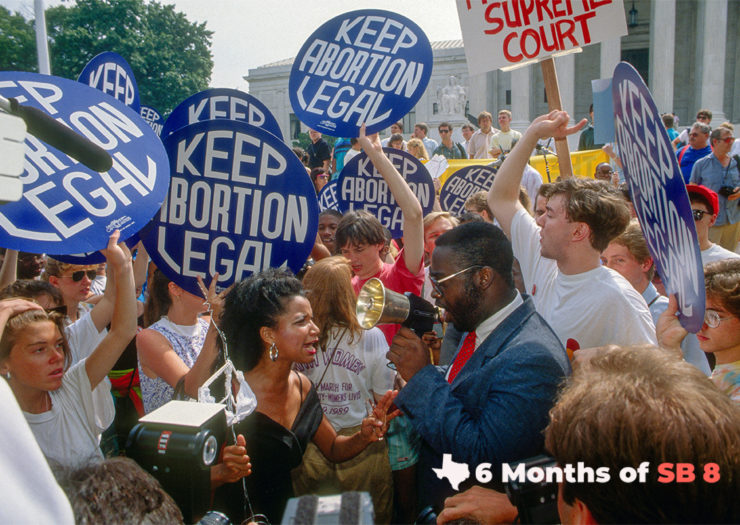
Abortion rallies held outside the Supreme Court on the day of opening arguments in Webster v. Reproductive Health Services in 1989. The ruling opened the door to state-level abortion restrictions. Mark Reinstein/Corbis via Getty Images
In the early years after the Roe v. Wade decision, anti-choice rhetoric in Texas laid the foundation for abortion restrictions to come.
“Texas could become a hub for the abortion industry.”
That was the dire pronouncement of Texas’ top anti-abortion lobbyist in 1992 as the U.S. Supreme Court issued its ruling in Planned Parenthood v. Casey. In Casey, the Court had reiterated the basic premise of Roe v. Wade—that abortion prior to fetal viability is a constitutional right—sending Bill Price, then director of Texans United for Life, into a froth. He told the Fort Worth Star-Telegram he feared the state would become an “island” of abortion access in the South thanks to pro-choice leadership from Gov. Ann Richards and Lt. Gov. Bob Bullock, Democrats who had promised to block abortion restrictions following the Casey decision.
Thirty years later, Texas is home to the nation’s most oppressive abortion restrictions, including an unprecedented six-week abortion ban, SB 8, that allows private citizens anywhere to sue abortion providers—and anyone else who “aids or abets” an abortion after six weeks’ gestation—for at least $10,000. Whatever might constitute a “hub for the abortion industry,” Texas is certainly not it. So what the hell happened? How did Texas go from being the anti-abortion lobby’s worst nightmare to its greatest success story?
After all, Texas is the home of Roe v. Wade, the landmark abortion case that legalized abortion nationwide in 1973. But as we soon mark six months since SB 8 effectively banned almost all abortions in the state, Texas is a leader not in abortion rights but in abortion repression.
How did we get here? I dug back through nearly 50 years of Texas legislative history to uncover more of the story, which I’ll recount in a three-part series.
There is a popular narrative—parts of which even I’ve subscribed to over my years spent covering abortion restrictions—that casts Texas as a hopeless case, a nerve center for anti-abortion extremism, the kind of place where a ban like SB 8 was simply an inevitability; a low-voting state where apathetic lefties let rabid right-wingers steal the show (and the vote), or, less charitably, a state where ignorant rednecks run roughshod over spineless Democrats year after year.
The truth is more complicated. Far from being universally spineless or apathetic, Democrats—even nominally “pro-choice” Democrats—have historically played significant roles in passing some of the earliest abortion restrictions in Texas, and their Republican counterparts were not always as confident or extreme as those who are currently in office. Perhaps most importantly, Texas was not always the abortion desert it is today. It was not until 30 years after Roe that Texas lawmakers began in earnest to successfully block access to abortion care.
The 2003 “Woman’s Right to Know” Act—which instituted a 24-hour waiting period, forced doctors to lie to their patients about the risks of pregnancy termination, and required providers who perform abortions after 16 weeks’ gestation to do so in licensed hospitals or ambulatory surgical centers—kicked off two decades of restrictions on providers and people seeking care.
Folks might be forgiven for thinking it has always been this way; the framework of relentless Republicans, hell-bent on outlawing abortion by any means necessary, steamrolling a handful of scrappy, pro-choice Texas Democrats certainly makes for a compelling, if revisionist, political fundraising pitch on either side, but the reality is much messier.
Texas was a “blue” state, or at least a state where Republicans had to put up a pretty good fight to secure a modicum of power, until the late 1990s. Democrats played instrumental roles in both blocking abortion restrictions in the first decades after Roe and instituting the first restrictions that did pass in the ’70s, ’80s, and ’90s. During those years, Republicans and anti-choice activists, as well as a healthy cadre of Democrats, publicly expressed fear and reservation about pushing too hard to roll back abortion rights and access.
Among all but a handful of Texas lawmakers who held strong beliefs either way, abortion in the first couple of decades after Roe mostly seemed to be an issue many felt was too hot or too messy to touch. Too hot and too messy, that is, until the Supreme Court—stacked with Reagan-appointed justices—opened the door to state-level abortion restrictions in a case out of Missouri called Webster v. Reproductive Health Services.
The first 25 years after Roe v. Wade
“When you have a ruling like [Webster v. Reproductive Health Services], what that does is bring on an onslaught of legislation on both sides. It gets folks fighting back and forth on the issue. What will happen in the next session, you’ll probably have 25 or 30 bills on both sides of the issue—people trying to impose restrictions and people trying to limit restrictions.”
That’s Texas House Speaker Gib Lewis, a Democrat who sometimes backed anti-abortion legislation, talking to the Fort Worth Star-Telegram following the Supreme Court’s 1989 ruling in Webster, the Missouri case that laid the groundwork for many of the state-level abortion restrictions in effect across the country today. (The Court held that Missouri’s bans on using public resources, facilities, and staff to provide abortion counseling and services were allowed under Roe’s right-to-privacy framework, as well as constitutional on their own.) Unlike right-to-lifer Bill Price’s assertion that Texas would become an abortion hub—which never came to pass—Lewis’ prediction was half-right. There was an increase in proposed abortion bills in Texas after Webster, but not from “both sides.” Not even a little bit.
Until Webster, Texas had passed just three abortion regulations: a “conscience”-type law protecting people who refused to provide abortion care, a law establishing reporting requirements to track the provision of abortion care in the state, and a ban on abortions after fetal viability. Of the five lawmakers who authored or sponsored those bills, just one was a Republican—the rest were anti-abortion Democrats. (All were men.) These regulations were just about all state lawmakers could do before the Webster ruling. But that’s not to say they didn’t try.
Between 1973 and 1989, Texas lawmakers proposed 91 laws relating to abortion, just three of which centered on improving abortion access. (One proposal, which looked neutral on its face but was anything but, would have put the question of legalized abortion directly to Texas voters in a statewide referendum. At the time, abortion rights leaders and abortion opponents alike told reporters the issue was too complex and nuanced, and that the referendum would be too costly—financially and politically—for either side to support.)
The first two post-Roe abortion bills in Texas came from one of the most famous faces of the abortion rights movement: Sarah Weddington, the attorney who argued and won Roe at the Supreme Court and who was serving in the Texas House of Representatives on January 22, 1973—the day Roe was decided.
The Texas Legislature happened to be in session in 1973 when Weddington filed two emergency bills: One sought to repeal sections of the Texas Penal Code that criminalized abortion, and the other affirmed the right to abortion by establishing a woman’s ability to consent to, and a doctor’s ability to provide, abortion care without punishment. Neither bill received a public hearing.
It would be 16 years before another Texas lawmaker put forth legislation in support of abortion rights or access: Houston Democrat Al Edwards, a civil rights activist who in 1989, on the heels of Webster, introduced a bill “expressing legislative sentiment against further restrictions on abortion.” That bill didn’t get a public hearing either. And even that came at a price: A decade earlier, Edwards had won support for his proposal to mark Juneteenth as a Texas state holiday by casting a vote for a political opponent’s anti-abortion bill. If the Texas Legislature has any tradition at all, it is one of pitting politically disenfranchised people against each other in their bids for rights and recognition.
From 1973 onward, every Texas legislative session has seen more proposed abortion restrictions than efforts to expand or protect abortion rights and access, often by several orders of magnitude.
Most of the more than seven dozen other abortion-related bills proposed in Texas in the ’70s, ’80s, and early-to-mid ’90s would look depressingly familiar to people who follow abortion politics today. Many had to do with restricting access to abortion for politically disenfranchised people. Some of the bills restricted young people’s access to abortion—in reaction to the Supreme Court case Bellotti v. Baird, which held that teenagers did not have to obtain parental consent to get an abortion. Others were designed to limit or ban the use of taxpayer funds for abortion, or to block public hospitals and health-care providers from providing abortion care.
Such efforts centered on putting abortion out of reach for low-income people and disproportionately blocked women and people of color from accessing care. (This isn’t by accident: Henry Hyde, the namesake of the racist, sexist, and classist 1976 Hyde Amendment, expressly said at the time that while he’d like to ban abortion entirely, he would settle for banning abortion for poor women through similar measures.)
Other proposed legislation sought to ban the sale or use of fetal tissue for research or medical purposes, and still others used as their premise many widely discredited “born-alive” myths to create criminal and civil penalties for abortion providers. Some lawmakers tried to ban particular medical procedures or introduced racist, misogynist “sex-selective” abortion bans, and others tried to regulate how abortion providers handled fetal remains and the products of conception. “Informed consent” bills came up repeatedly, including those that would institute mandatory waiting periods or require doctors to provide specific information (more accurately misinformation and outright lies) to people seeking abortion care.
In the ’70s, ’80s, and early ’90s, anti-abortion lawmakers trudged back to the Texas Capitol again and again, proposing the same anti-abortion legislation over and over—making the very same claims and demands that would become national news and perpetual cable-TV fodder in the 2000s and the 2010s, but getting almost nowhere.
While early anti-abortion lawmakers laid the rhetorical and political groundwork for future anti-abortion battles, very few of their proposals went farther than public committee hearings. This was in part due to Texas’ uniquely situated legislative apparatus, which allows the lieutenant governor to essentially stall or kill any legislation they don’t like.
Democratic lieutenant governors did just that, blocking most abortion restrictions for decades, though not necessarily because they were bold pro-choicers. In 1981, Texas Monthly noted that Lt. Gov. Bill Hobby often blocked abortion bills in the Texas Senate to “protect legislators from having to cast politically damaging votes,” holding off all but three new abortion restrictions for nearly 20 years.
The next man in the job, Bob Bullock, kicked off his tenure sticking to promises he’d made alongside Gov. Ann Richards to block new abortion restrictions. But Bullock quickly relented. In 1995, just three years after Casey, he publicly supported restricting young people’s access to abortion by requiring parental notification for care—efforts anti-abortion lawmakers had been pursuing since the early ’80s. Those restrictions failed to pass during Bullock’s tenure, though new abortion-reporting requirements and penalties for providers who violated them passed on his watch in 1997. (Those requirements were authored in part by Democrat Leticia Van de Putte, who would go on to become one of the heroes of the 2013 abortion rights filibuster and a champion for abortion access more broadly.)
With Bullock reneging on his no-new-restrictions pledge, Texans saw a marked change in abortion politics in the mid-to-late ’90s, legislatively speaking. From then on, the number of anti-abortion proposals introduced in the Texas Legislature numbered in the double digits most session years, with ever more co-sponsors and co-authors willing and excited to put their names on each bill.
In fact, from 1973 onward, every Texas legislative session has seen more proposed abortion restrictions than efforts to expand or protect abortion rights and access, often by several orders of magnitude. Partisanship didn’t meaningfully enter the conversation until the late ’90s, and even then, Democrats remained willing to support abortion restrictions, especially those they perceived as having little impact on—or even as politically beneficial to—their careers.
Laying the groundwork for restrictions
And we do have to talk about “impact,” especially on marginalized and politically disenfranchised Texans.
Throughout coverage of anti-abortion proposals in the first 25 years after Roe, abortion rights supporters continually warned that abortion restrictions would predominantly affect low-income folks, women of color, and young people. They rightly predicted—and later observed—that such restrictions were death to abortion rights by a thousand cuts, often disguised as concern for the “health and safety” of the patient. And at every turn, anti-abortion lawmakers and lobbyists mocked and pooh-poohed them as overreacting “Chicken Littles” complaining that the sky was falling.
But those abortion supporters were right, and not just because abortion is currently all but outlawed in Texas. They were right because every one of those early steps to infringe upon abortion rights and access—from bans on using public funds and resources for abortion care to singling out abortion providers for additional regulations and penalties—did lay the groundwork for abortion restrictions to come, and did serve to prevent low-income people, women of color, and young people from accessing abortion. Any limitation on abortion provision necessarily makes care harder to obtain for anyone who doesn’t have the means or resources to navigate or sidestep those restrictions, as well as for health-care professionals to provide. It’s just common sense.
But anti-choice rhetoric in Texas during those early post-Roe years took hold. From abortion-as-birth-control myths and “born-alive” propaganda to the “selling” of fetal tissue and the specter of “criminal” providers coercing and deceiving their patients, these narratives are deeply rooted in our collective political psyche—whether because many wrongly believe them or because many work tirelessly to combat them.
The real impact of these narratives, and the abortion restrictions they fueled, on the women and young folks and pregnant people they’ve harmed have routinely come second (if they were noted at all) to campaign talking points and political careers.
And so when George W. Bush and Rick Perry took office in Texas as governor and lieutenant governor in the mid- and late ’90s, respectively, the stage was set. Freed from the tyranny of even vaguely pro-choice Democrat decision-makers, the first thing the state legislature did was pass the restrictions on access to abortion for young people, which Republican lawmakers had been trying to usher through for 20 years. It then moved on to so-called informed consent laws. Soon after it would target abortion providers in an effort to shut down clinics and further squeeze abortion access.
Texas lawmakers didn’t come out of the gate passing mandatory waiting periods and ultrasounds or requiring doctors to disseminate medical misinformation, though they’d tried much of that before—instead, they kicked off the next 20-plus years of abortion regulations by restricting access for people who, quite literally, had no vote in the matter.
More than two dozen senators signed onto a letter to highlight the need for insurers to comply with the ACA contraceptive mandate. The message was clear and timely: Let’s step up enforcement. Getty Images
It’s been over a decade since the Affordable Care Act mandated contraception access—and yet many people still struggle to get the birth control they need.
With the impending demise of Roe v. Wade, making a range of contraceptive options widely accessible is more urgent than ever to help decrease the risk of unplanned pregnancy. When the Affordable Care Act was passed over a decade ago, it brought in a new era of easier access to contraception. The ACA’s provisions specifically aimed to reduce costs and other barriers to birth control options. Yet many people still struggle today to obtain the method they and their doctor have determined is best for them.
First, the good news. By requiring marketplace plans to include key reproductive health-care services, the ACA has significantly increased access to this vital care. According to the National Women’s Law Center, more than 64 million insured women are now covered for at least a dozen forms of FDA-approved contraception at little to no cost thanks to the ACA. This includes coverage for those pricey but long-acting intrauterine devices, which previously cost up to $1,000.
The ACA also mandates maternity care and breastfeeding support for new mothers, as well as preventive screenings for all people to help reduce their risk for diseases such as breast or cervical cancer and HIV/AIDS. Denial of coverage for pre-existing conditions is a thing of the past—a big step forward from the era when a prior cesarean section or incident of domestic violence could cause a person’s insurance costs to skyrocket. The ACA has even helped narrow our country’s appalling racial and ethnic disparities in insurance coverage, although serious gaps remain around maternal health care for people of color, and undocumented people are still excluded from the ACA.
However, the ACA has not reached its full potential to help expand contraceptive use. Despite the law’s requirement of contraceptive coverage without co-pays, some insurance companies and pharmacy benefit managers have gotten away with denying coverage outright, or with tacking on exorbitant co-pays for people who rely on this care. Rather than follow the law and allow individuals to select their preferred contraceptive option, some insurance providers and pharmacy benefit managers also require people to first try other methods—sometimes several—before covering the desired product. Insurers regularly deny coverage for brand-name medications even when no generic equivalent exists. Whether these practices are intentional or simply result from insurers’ failure to establish simple, transparent waiver processes for patients who request an exempt birth control method, the end result is the same: a bar to access.
Fortunately, the federal government has begun to step in. Just last month the Health Resources and Services Administration—the agency whose programs provide health care to those who are geographically isolated, economically disadvantaged, or medically vulnerable—updated its preventive care and screening guidelines for women, infants, children, and adolescents. These guidelines are key to implementing the no-cost contraception rule. This administrative action bolstered existing law and, moreover, provided a much-needed means of addressing the systematic noncompliance by insurers and health plans. It’s a great first step. However, the government must do more to hold insurance companies accountable and to ensure access to the hard-won rights in the ACA.
And last week, more than two dozen senators signed onto a letter they sent to the secretaries of the Health and Human Services (HHS), Labor, and Treasury departments to highlight the need for insurers to comply with the ACA contraceptive mandate. The message was clear and timely: Let’s step up enforcement.
As reproductive health activists have long said, and as the senators’ letter echoed, several federal actions are essential. First, the HHS should move against any insurer that continues to flout ACA requirements. Preventative measures are also needed and may be as simple as creating a transparent, accessible process for patients who are denied their choice of contraceptive method. An electronic portal could give the HHS easy recourse for people who are denied coverage, as well as directly provide the information officials needed for officials to send enforcement letters to bad-actor insurer companies and pharmacy benefit managers. New guidance from federal agencies will go a long way toward ensuring compliance.
The ACA had many holes when Congress passed the legislation over a decade ago, but overall it was cause for celebration. Yet the ACA continues to exclude undocumented people and still contains a ban on most abortion funding. Now, as the ACA enters its tween years, there is much work to be done to advance reproductive health care and prevent unplanned pregnancy. Fortunately, the Biden administration has indicated its commitment to expanding the right to health care and reproductive freedom overall. An easy first step would be to enforce existing laws regulating contraceptive coverage. As our basic rights of whether and when to start a family are on the most endangered list, access to contraception has never been more fundamental.
FILE – Lyn Toelle fills out forms before bringing roses to her legislators during the Rose Day observance, an anti-abortion event, at the state capitol in Oklahoma City on Feb. 4, 2004. Two abortion providers in Oklahoma said Tuesday they’re continuing to be inundated with women from Texas seeking to terminate their pregnancies after Texas last year passed the most restrictive anti-abortion law in the U.S. in decades. (AP Photo/Jeffrey Haderthauer, File)
OKLAHOMA CITY (AP) — Two abortion providers in Oklahoma said Tuesday that they’re still seeing a massive influx of women from Texas who want to terminate their pregnancies after Texas last year passed the most restrictive anti-abortion law in the U.S. in decades.
Officials with Trust Women and Planned Parenthood Great Plains, which both operate abortion clinics in Oklahoma City, said some women from Oklahoma are being forced to seek abortion services in other states because of two-week wait times for services in Oklahoma.
“Our phones have not stopped ringing in the last six months,” said Rebecca Tong, co-executive director of Trust Women. “We’re being forced to turn people away in desperate situations.”
Tong said the clinic has added an additional physician and the clinic is open more days per week but it still has longer wait times, which leads to longer pregnancies, more complications and an increased likelihood that a woman will have to receive a surgical procedure instead of a medication-induced abortion.
Tong said the company’s Oklahoma City clinic went from seeing 12 Texas patients in August to 130 in September after the Texas law passed. She said their clinic in Kansas saw similar increases.
Emily Wales, interim president and CEO of Planned Parenthood Great Plains Votes, said Planned Parenthood went from seeing about 50 patients from Texas at their clinics in Arkansas, Kansas, Missouri and Oklahoma in the fall of 2020 to more than 1,000 last year.
Tong, Wales and other abortion rights advocates say they’re particularly concerned the Oklahoma Legislature intends to follow Texas’ lead and pass a similar bill or even more onerous restrictions that could bring an end to abortion services in Oklahoma altogether.
Oklahoma lawmakers have introduced more than a dozen bills this year to further restrict or prohibit abortions in Oklahoma, including measures that make it a felony crime to perform or receive an abortion.
Meanwhile, hundreds of anti-abortion activists are expected to descend on the Oklahoma Capitol on Wednesday for the annual Rose Day where they present red roses meant to signify the lives of the unborn and encourage the passage of anti-abortion bills.
Tony Lauinger, chairman of Oklahomans for Life and a longtime anti-abortion activist in Oklahoma, said that while he’s “greatly concerned” at the increase in the number of abortions being performed in Oklahoma, he’s also optimistic that the U.S. Supreme Court has agreed to hear a legal challenge that could lead to the historic Roe v. Wade decision legalizing abortion to be overturned or limited.
“It’s a great concern to us if women from anywhere go to an abortion facility,” Lauinger said. “When a pregnant woman goes into an abortion facility, two human beings enter and one leaves. Whether the women are from Texas, Oklahoma or elsewhere, that’s a tragedy in our view every time it occurs.”
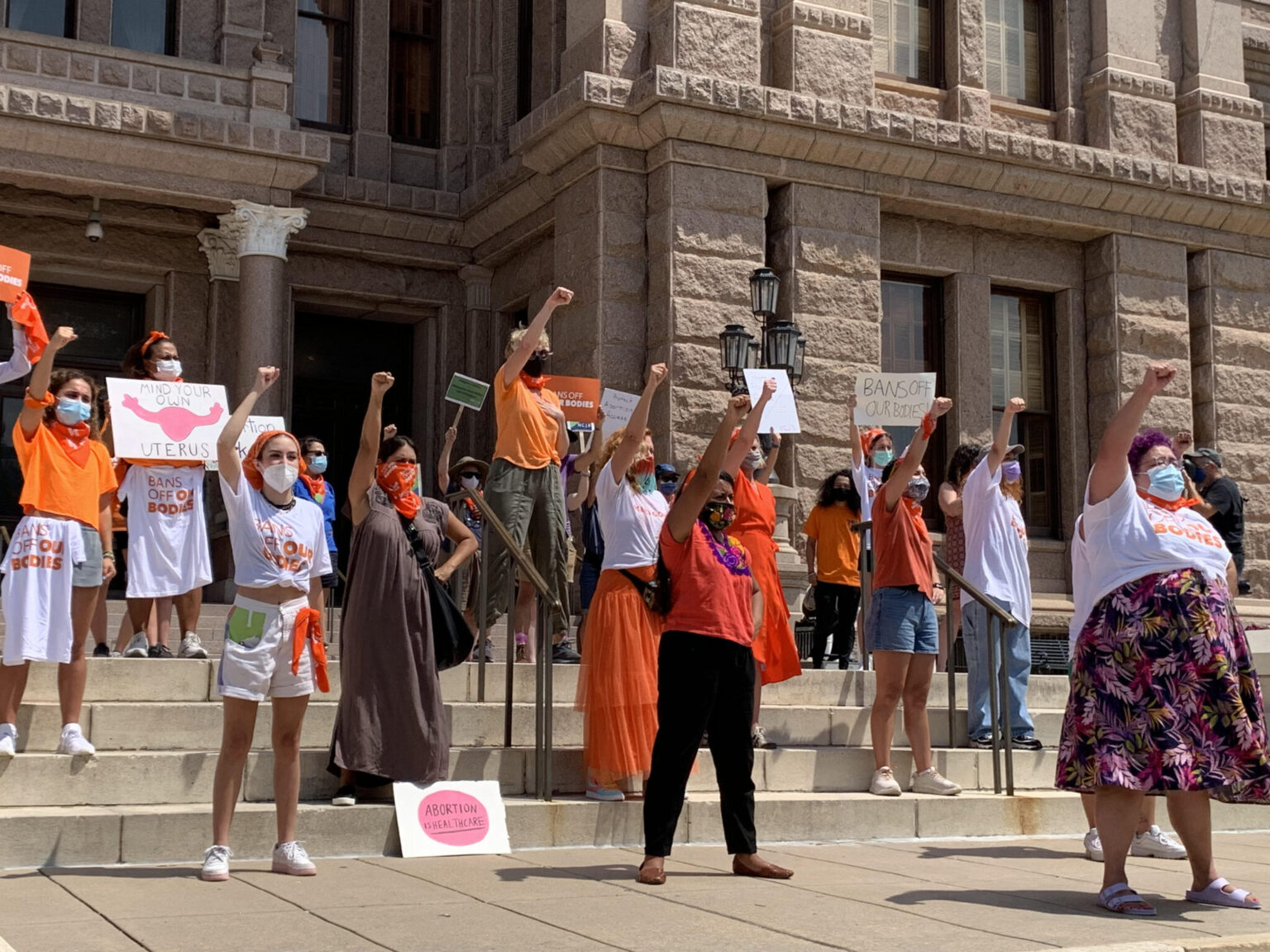
An abortion rights rally on the steps of the Texas Capitol on Wednesday, Sept. 1, 2021, the day the six-week abortion ban went into effect in the state. “Abortion is essential. Abortion is health care,” the group chanted. “Bans off our bodies!” (Roxy Szal)
I’m only 16 and I’m not backing down anytime soon. Abortion is essential healthcare and should not be denied to anyone.
I am a human. I am a daughter. I am a minor. But most importantly, I am a young woman in Texas whose reproductive rights are under attack.
You have likely heard people across America, especially in Texas, debate abortion laws—but have you heard the viewpoint of a 16-year-old facing a potential future without the protections of Roe v. Wade? A teenager who wakes up terrified of what bills Congress may or may not have passed?
Bans like S.B. 8, Texas’s near-total abortion ban, are forced onto our bodies, yet very rarely does news coverage provide the perspective of my generation.
To the adult lawmakers who legislate our bodies but refuse to hear our voices and opinions, shame on you. Shame on you for silencing the future. Shame on you for acting entitled because of your age. Shame on you for dismissing us before we can even speak.
I was raised by a single mother who worked tirelessly to provide for us. She taught me to fight for what I believe in and to always stand up to injustice. Because of her, I continue to fight for reproductive rights.
Even though I was judged and belittled when I first called myself a feminist, I didn’t listen when I was told to “stop talking” or to “wait until I grow up” to start asking questions. Instead I took their sexist ideology and made a name for myself. I became a volunteer at an early age and am now a team leader for our community outreach and mobilization program at Planned Parenthood.
I’m only 16 and I’m not backing down anytime soon.
Abortion is essential healthcare and should not be denied to anyone. Texas’s abortion ban is a complete setback and an assault on women’s health.
In 1970—three years before Roe v. Wade guaranteed our constitutional right to abortion in the U.S.—Hawaii became the first state to decriminalize abortion, followed by New York, Alaska and Washington. Fifty years later, our rights are now back on the line.
To be clear, S.B. 8 will not stop people from having abortions, it will just make it harder and potentially less safe.
As a teenager, I should not have to be afraid of what is going to happen next for my body, what laws are going to be passed or when this war on women will erupt into something even more dangerous. Our rights should not be up for debate, especially by politicians who prioritize their religious beliefs over other people’s humanity. I’ve been told by many people that “God will find me” or they will “pray for me.” I don’t want your God or your prayers—I want my rights back. Feel free to practice your religion and hold your values, but let me have the choice to do what is best for my body.
What is right for you, may not be right for me. What is right for me, may not be right for you. But what is NOT right for either of us is being stripped of the freedom to choose what is right for ourselves.
Anna Gala
Although S.B. 8 is buzzing around the media, it’s not the only law restricting access to reproductive healthcare. In 2021, state politicians introduced more than 600 abortion restrictions and more than 100 became law—the most in any year since Roe was decided. Some of these include targeted restrictions on abortion providers or TRAP laws, which are designed to cut off abortion access by imposing severe, expensive and unnecessary restrictions on health centers.
And there’s more: Since 1976 the Hyde Amendment has blocked Medicaid from covering any expenses related to abortion, even when a patient’s health is at risk. Because of Hyde many people simply cannot afford essential healthcare.
For all these reasons and more, we need the U.S. Senate to pass the Women’s Health Protection Act and protect abortion access across the country. As your right to reproductive healthcare should not change based on your zip code.
I am a 16-year-old young woman who continues to fight for justice, for liberation of our own bodies and for access to abortion. While I have never had an abortion, the ability to access this essential healthcare should not be taken away from me or any other American. The United States was built on the promise of freedom for all, so what’s different here?
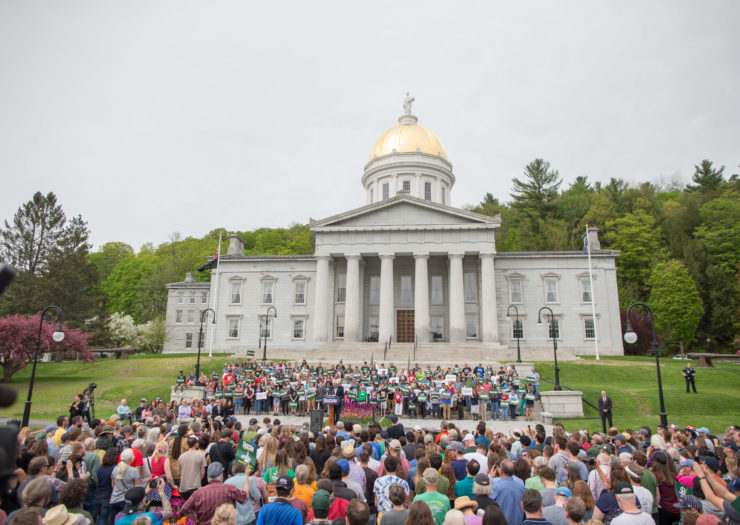
Voters in Vermont will decide in November whether to enshrine abortion rights into the state Constitution.
Vermont could soon become the first state to enshrine the right to abortion directly in the state constitution.
Last week, the Vermont House of Representatives voted to pass the Reproductive Liberty Amendment, or Prop 5.
The proposed language reads: That an individual’s right to personal reproductive autonomy is central to the liberty and dignity to determine one’s own life course and shall not be denied or infringed unless justified by a compelling State interest achieved by the least restrictive means.
According to the Washington Post, Vermont Gov. Phil Scott (R) “is required to give public notice before it appears on the ballot in November.” Scott has “signaled his support for the measure,” the Post reported.
And considering that 70 percent of Vermonters support abortion access, Prop 5 is expected to pass.
As the Guttmacher Institute notes, Vermont doesn’t have any of the major abortion restrictions seen in other states. But as we’ve seen in those states, that can change at a whim—especially once the Supreme Court dismantles Roe v. Wade later this year.
But human rights aren’t up for debate. By amending its constitution to reflect this, Vermont is doing what the United States won’t: protecting the right to personal reproductive autonomy.
Good for Vermonters, but what about everyone else? Well, as abortion access becomes increasingly restricted in other parts of the country, Vermont could become a destination for pregnant people forced to seek abortions away from their home state.
But it’s not easy to get there—and pregnant people shouldn’t have to spend hundreds of dollars and travel thousands of miles to get access to health care. So keep following us to keep up with the latest in the ongoing fight for our rights.











 Abortion - Abortion Clinics, Abortion Pill, Abortion Information