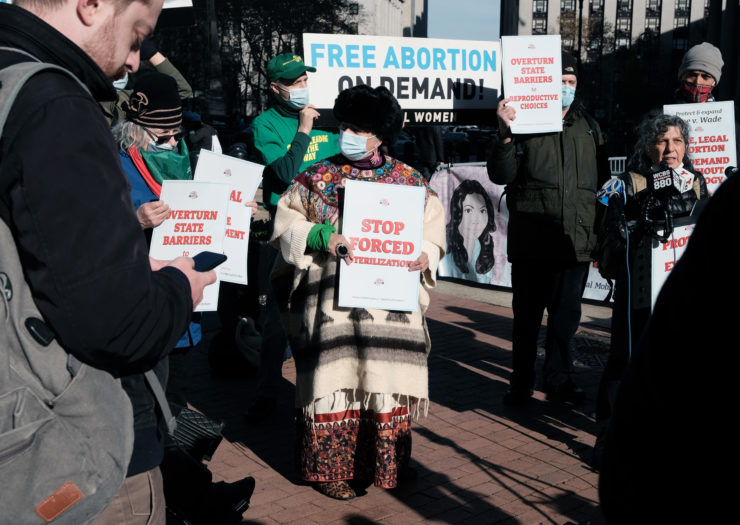
Black and Indigenous people are the communities most at risk of reproductive coercion from the state. Spencer Platt/Getty Images
Rachael Lorenzo talks to Imani Gandy about reproductive coercion, reproductive justice, and running an Indigenous-led abortion fund.
Rachael Lorenzo is a survivor of reproductive coercion. The co-founder of Indigenous Women Rising sat down with Rewire News Group‘s senior editor of law and policy, Imani Gandy, for a conversation on the intersection of race and and reproductive rights. It’s part of Rewire News Group‘s new Instagram series Repro Changemakers.
Here’s a brief transcript of the conversation.
Rachael Lorenzo: LARC coercion is where medical providers, whether in collaboration with law enforcement or a court system, or not, just on their own because of medical providers who are mostly white and their value judgements on how we live our lives as Indigenous people and can also be applied to Black folks and immigrant folks, anyone who’s not white. And so being pressured into having a LARC inserted, whether it’s an IUD or Nexplanon, the little match stick that goes in your arm, and once it’s in there, refusal to take it out. And be told like, “Oh, all of these adverse side effects that you’re experiencing are actually normal. That’s a sign that it’s working.”
Very short story: I had an IUD inserted after I had my first kid, the copper IUD. And for ten months I bled the entire time. And I went to the ER three times in the city and was told that they would not take it out because it was working. I went to Indian Health Services, they didn’t even have anyone trained to take out an IUD. When I finally got it taken out on the fifth try, the bleeding stopped almost immediately. And so that’s an example that a lot of my cousins and aunties have gone through with essentially this long-acting reversible contraception, which can stay in our bodies for years at a time, impacting our ability to make our own decisions about when we want to have children or even just trying to get relief from some of the adverse side effects that might come with having a LARC.
Imani Gandy: So, I wanted to talk about access. I wanted to talk about the ways in which Indigenous communities suffer in different ways. The different ways in which Indigenous communities suffer as a result of winnowing access or access that has been virtually eliminated, particularly in Texas. What are you hearing from providers and from patients on the ground? And I just wanted to say, if you’re just joining us, I am speaking with Rachael Lorenzo. They are the co-head and founder or head and co-founder of Indigenous Women Rising. And this is part of our new Rewire News Group series called Repro Changemakers. And they are Repro Changemakers. So we’re very excited. So please talk to us about access and how it affects Indigenous communities differently.
RL: Yeah, so we exist. First and foremost, this is Native American History Month. … Where I’m at in Albuquerque, I’m on my ancestral Pueblo land. We’ve been here. We will continue to be here. There are Indigenous folks in Texas. There are federally recognized tribes in Texas. They are going north a bit more to Oklahoma. The folks, even though we are a nationwide abortion fund, I will tell folks right now, the main states that we fund are red states, Oklahoma being one of them. We’re starting to expand to the Carolinas, Georgia, Florida, Montana. Another chunk of who we serve is in Arizona and in the Dakotas, we have excellent working relationships with independent clinics in Arizona, and the Dakotas, and in Oklahoma. And we’re seeing folks from Texas go to the few clinics that they have in Oklahoma. And these are states by the way, that are going to start implementing their own abortion bans or their own restrictions on access.
So this is incredibly concerning for us because we’re probably going to have to start expending more resources and more time to get people to another state. It’s going to push our people further into another trimester. And we’re not the only abortion fund who’s experiencing this. Southwestern Women’s Options, one of the few clinics in the country that provides abortions into the third trimester, is seeing an influx of folks coming from Texas to get care. So whether it’s abortion funds or clinics or advocacy groups that help people find abortion access, there’s a lot of moving parts that we’re trying to monitor, whether it’s upcoming abortion laws, changing restrictions or interpretations of a court decision.
One thing we’re starting to find now is … that crisis pregnancy centers, which are anti-abortion, quite frankly disgusting places, are tricking people who need abortion care into thinking that they provide abortions. So, that way they can convince a pregnant person to carry their pregnancy to term. And we have had callers who fall victim to that. So there’s a lot of things on the ground that are happening, that are impacting the callers that we hear from every day.
California Gov. Gavin Newsom has called for California to become a “sanctuary” state for reproductive health-care access. Justin Sullivan/Getty Images
California Gov. Gavin Newsom’s budget proposal asks for $20 million in loan repayments and scholarships to future reproductive health-care providers.
While calls for student loan debt relief from millions go ignored by the Biden administration, more than 400,000 people will get some relief from a $1.85 billion settlement between Navient and 38 states over claims of predatory loan practices. One of those states is California, where student loan repayment is also part of a recommendation for improving reproductive health and abortion access.
Democratic Gov. Gavin Newsom recently released his state budget proposal for the upcoming fiscal year. As part of the proposed budget, he’s asking for $20 million in student loan repayments and scholarships to future health-care workers who commit to providing reproductive health care.
It’s part of the state’s bid to be the first to achieve universal access to health care, regardless of immigration status. And that includes abortion access.
“The budget put forth today by Governor Newsom is another step toward leading the nation in prioritizing sexual and reproductive health care, including access to abortion,” Planned Parenthood Affiliates of California President and CEO Jodi Hicks said in a statement.
As conservative states across the country continue their attacks on abortion access, the Golden State is vying to become not just a safe haven but a beacon for reproductive rights in the United States.
“California is in a unique position—while our reproductive freedoms and ability to make choices about our own bodies are constitutionally protected, the same does not hold true in other areas of the country,” California Senate President Pro Tem Toni Atkins wrote last month in the introduction to a report by the California Future of Abortion Council.
The United States has a long and shameful history of using the ability to become pregnant as a way to oppress entire communities. Jim Watson/AFP via Getty Images
The anti-abortion movement is already building a post-Roe world by zeroing in on “personhood.”
Conservatives have long relied on the false promise that no matter how many abortion restrictions they enact, they’re not targeting the people who have abortion. They’ll regulate abortion into nonexistence by targeting providers and, as with Texas SB 8, anyone who helps someone obtain an abortion—from the person who drives a patient to the clinic to the person who answers phones for their local abortion fund. Despite that, they’ll say pregnant people are not in their crosshairs.
But now they’re saying the quiet part out loud.
Anti-abortion lawmakers are working to enact “personhood” laws, which codify into law the concept that life begins at conception. In the simplest of terms? Personhood laws confer all the same rights that living, breathing human beings have onto a fetus; they make abortion murder and anyone who has an abortion a murderer.
Abortion advocates have warned against such measures for years, arguing that personhood was the eventual endgame of the anti-abortion movement. Now creeping personhood seems to have escalated to a sprint.
Meanwhile, the Supreme Court is poised to decide the most consequential abortion case in decades—Dobbs v. Jackson Women’s Health Organization—which will likely bring about the end of Roe v. Wade as we know it by gutting the constitutional protections that, frayed as they may be, have been safeguarding access in this country since the 1970s. And it’s only getting worse from here.
Personhood is not a hypothetical—it’s a reality
The concept of personhood is not new. The first personhood amendment was introduced in Congress a mere week after Roe v. Wade was decided in 1973. Since then, lawmakers have tried and failed to pass such measures. In recent years, personhood legislation has cropped up in states around the country, including Alabama, Georgia, Iowa, Missouri, and Ohio.
And while such measures directly contravene both Roe and the 14th Amendment, new laws will be coming before what is arguably the most conservative judiciary in recent history—one that will no doubt be emboldened by the impending decision in Dobbs v. Jackson later this year.
In Indiana, lawmakers this session introduced two bills—HB 1217 and HB 1282—with personhood provisions; the latter legally defines life as beginning at fertilization. The law “finds that human physical life begins when a human ovum is fertilized by a human sperm [and] asserts a compelling state interest in protecting human physical life from the moment that human physical life begins.” The bill would change the criminal code to reflect the new definition; that means any pregnancy that does not end in a live birth would be vulnerable to murder or manslaughter charges. It also means that some standard in vitro fertilization procedures, like the destruction of embryos, would be illegal as well.
Similar measures are familiar to advocates in Colorado, where earlier this month a state panel blocked a proposed personhood ballot initiative from advancing.
“Colorado really has been the canary in the coal mine for this type of extremism,” said Karen Middleton, the president of Cobalt, a Colorado nonprofit dedicated to abortion rights. “We’ve had four personhood measures on the ballot since 2008, plus numerous attempts at the state legislature. We’ve seen this coming for years. Anti-abortion forces don’t just want to ban abortion. They want to ban the whole idea of bodily and reproductive autonomy.”
And in Arizona last April, the state enacted SB 1457, which broadens the criminal and civil code to include “an unborn child at every stage of development” alongside any mention of a person or child. The American Civil Liberties Union, the ACLU of Arizona, and the Center for Reproductive Rights filed a lawsuit challenging the law, which includes a provision that bans all abortions sought in the presence or presumption of a fetal anomaly. In September, a district court struck down the fetal anomaly provision, but allowed the personhood provision to stay in effect; appeals of both holdings are before the Ninth Circuit for consideration.
“This so-called ‘Personhood Provision’ provides the grounds for state actors in Arizona including prosecutors and child welfare authorities to treat the fertilized eggs, embryos, and fetuses inside of pregnant women as whole persons with independent rights,” National Advocates for Pregnant Women, which filed an amicus brief in the case, said in a press release.
Advocates at NAPW who spoke with Rewire News Group made clear that while personhood measures purport to safeguard the rights of the “unborn,” what they actually do is diminish the rights of pregnant people and make them vulnerable to prosecution. Advocates said this impact is not a hypothetical—it’s already a reality in states across the country, as criminalization of adverse pregnancy outcomes is on the rise.
“This was coming for a long time,” NAPW founder Lynn Paltrow said. “So a major long-term strategy has been to establish, in every area of law they could, the idea that fertilized eggs, embryos, and fetuses were separate people. What you see is an evolution from them sort of going along with the viability line, so viable fetuses are persons, to the point where now it’s just from the moment of fertilization.”
The non-issue of viability
The question of viability is a sticking point for conservatives and progressives alike—the constitutional framework of abortion jurisprudence has set a precedent under which viability is the primary consideration in the question of when government intervention in abortion access is appropriate. But advocates told Rewire News Group that the first failure of abortion rights in the United States was contextualizing viability in the law in the first place.
“Viability is irrelevant to the fact that there should be no role for law enforcement in pregnancy or any outcome of pregnancy period,” Paltrow said. “That’s not what law enforcement should be used for. Pregnancy and its outcomes are health issues. They should be seen as health issues that half of the human population, half of the U.S. population is likely to have to deal with in the course of their lifespans.”
A means of marginalization
If the impact of these laws stopped with abortion patients and providers, that alone would be egregious. But personhood provisions provide a grim insight into the ways in which abortion restrictions pervade every aspect of pregnancy care and have the potential to impact the lives of anyone who can become pregnant.
The broad effects of personhood laws make clear that it has never been about abortion per se for those advocating for these restrictions, just as it has never been about the “sanctity of life” or the procedure itself; it’s not about dilation and curettage or misoprostol and mifepristone. Abortion for these lawmakers is merely a means to an end—a tool to oppress and marginalize populations they deem less worthy: people of color, people living in poverty, disabled people, members of LGBTQ communities, anyone who faces marginalization.
The movement’s use of abortion restrictions and other family planning policies as a means to marginalize is nothing new. The United States has a long and shameful history of using the ability to become pregnant as a way to oppress entire communities.
“I’m old enough to remember taking a friend to an illegal abortion in Los Angeles and waiting in the car while she went in and hoping she would come out alive,” said Dianne Post, an attorney with decades of experience on cases involving sexual violence, domestic violence, and international human rights law who assisted NAPW on its amicus brief. “She did. I also tried to get my tubes tied and no doctor would do it. At the same time they were involuntarily sterilizing Black and Hispanic women in the hospitals in Los Angeles.”
The nuances of pregnancy and birth, death and life
“The consequences of putting this ideological language into law would be sweeping,” said Caroline Mello Roberson, the Southwest regional director for NARAL Pro-Choice America. “Not only would it criminalize abortion, but it could also ban stem cell research, assisted reproductive technology like in vitro fertilization (IVF), and common forms of birth control.”
Pregnancy and birth are nuanced; someone who experiences a miscarriage early in a pregnancy may feel differently about what they’ve lost than someone who has an elective abortion. Someone undergoing IVF treatments might regard their embryos with a different sentiment than someone passing fetal tissue during a medication abortion. And while conservatives will seize on these distinctions to justify legislation that relies on a viability framework or establishes the rights of a fetus, what these deeply human and widely differentiated experiences make clear is, in fact, the opposite.
“Laws are such blunt and clumsy instruments,” said Jodi Liggett, founder of Arizona Center for Women’s Advancement, which joined NAPW’s amicus brief. “They can’t possibly be used in a situation like this.”
Conservatives often underline their advocacy for abortion restrictions, and personhood by extension, with the argument that nowhere else in law or society do we “sanction” the “taking of a life.” And while a fetus at any stage of development does not qualify as a person under the 14th Amendment, Liggett points out that these kinds of questions are not specific to the abortion discussion.
“We just had a death in the family,” she said. “It reminded me that we collectively, including the government, have empowered doctors and families on end-of-life matters.” After finding out a loved one would not recover from a stroke, Liggett said her family said goodbye, the doctor administered a morphine push, and he passed away.
“The pro-life movement isn’t all over that, right? It’s a telling indicator of the misogyny [that] just undergirds all of this,” she said. “They figured out, under Reagan I think it was, that ‘Oh my God, abortion is a wedge issue. It divides the country, and the breaks favor us.’ It’s about winning.”
How personhood shows up in insidious ways
Criminalizing the choice to end a pregnancy might seem radical to those unfamiliar with the tactics and aims of the anti-abortion movement, but a look at long-standing statutes in many states makes clear how the concept of personhood has already insidiously worked its way into the law. The idea that a fetus has all the rights of a human being exists not only in explicitly anti-choice laws but in legislation on all kinds of issues.
“Personhood comes in statutes around the country in seemingly innocuous statutes, such as inheritance, divorce, tax,” said Purvaja S. Kavattur, a research and program associate at NAPW.
“But what we’re seeing in our documentation is that the more hostile states are including model language and definitions in the exact same [way] everywhere in any statute, that’s unrelated to health or pregnancy.”
And these laws are even sometimes framed through a lens of protecting pregnant people.
“A very salient example of that is feticide statutes, which are often passed with bipartisan support based on the notion that they will protect pregnant people from domestic violence and intimate partner violence, and who wouldn’t want to do that?” NAPW staff attorney Emma Roth said.
“People are able to shroud these statutes with this goal of protecting women and ensuring that pregnancy is a safer or happier time in a woman’s life; then prosecutors turn around and use those various statutes against pregnant women themselves, even though that was never the explicit intent of the legislature. It just goes to show that states don’t even need these very explicit versions of personhood statutes.”
Saying the quiet part out loud
On Friday, anti-abortion activists will descend on Washington, D.C., for the annual March for Life. This year’s theme is “Equality Begins in the Womb.”
It’s hard to imagine a more overt endorsement of the concept of personhood than the largest anti-abortion demonstration making this their rallying cry. It dispels any conceivable doubt that the movement is coming loudly and unapologetically for the rights of pregnant people in the name of protecting the “unborn.”
“People have a hard time believing the extremism of the ‘personhood’ movement, but they mean every word of it,” Middleton said. “They have repeatedly said so, and we should believe them. Personhood denies the humanity of the pregnant person and turns them into a vessel under state control. Every pregnancy outcome, from abortion to miscarriage to a complex birth, is potentially suspect.”
For conservatives, this was always the endgame. They’ve been relatively coy about it, but for abortion activists and movement leaders, this moment comes as no surprise. There is no more pandering to an ideological “middle,” no more cloaking their motives in softened language to make it palatable for moderates or to obscure the brutality of their intent.
The open embrace of personhood will have a devastating impact on abortion access nationwide, not to mention pregnancy and birth care. In short, anyone who can become pregnant will have their lives touched by these laws if conservative are able to see these plans through. There is no greater threat to reproductive autonomy and, by extension, personal liberty than personhood.
There is no clearer illustration of the far-reaching harms anti-choice laws pose and of the bad faith with which they are devised.
The question then becomes: Will it be enough for lawmakers on both sides of the aisle to see the fight for personhood as a human rights crisis? Will conservatives’ endgame be their downfall?
After a federal appeals court ruling, abortion clinics fear the case will now languish for weeks if not months.
AUSTIN, Texas (AP) — Texas’ ban on most abortions is likely to stay in effect for the foreseeable future, opponents fighting the law said Monday night, after a federal appeals court ruled against sending the case back to only judge who has ever blocked the restrictions.
The decision by the 5th U.S. Circuit Court of Appeals in New Orleans means that legal challenges to stop the nation’s most restrictive abortion law next move to the Texas Supreme Court, which is entirely controlled by Republican justices and does not have to act immediately.
Abortion clinics fear the case will now languish for weeks if not months, and maybe not until after the U.S. Supreme Court makes a ruling in a Mississippi case that could roll back abortion rights across the country.
“There is now no end in sight for this injustice that has been allowed to go on for almost five months,” said Nancy Northup, president and CEO of the Center for Reproductive Rights, which is suing over the Texas law.
The Texas law that bans abortion once cardiac activity is detected — usually around six weeks, before some women know they are pregnant — has been in effect since September. Last month, the U.S. Supreme Court kept the law in place and allowed only a narrow challenge against the restrictions to proceed.
Abortion providers wanted their lawsuit sent back to a federal court in Austin that so far has been the only one to block the restrictions — albeit for only a few days. Instead, the conservative-leaning appeals court sent the case instead to the state supreme court.
Texas Right to Life, the state’s largest anti-abortion group, celebrated the decision.
“This is great news!” the group tweeted, saying the case will now go to one with a “Pro-Life majority.”
Texas abortion providers have said they are serving roughly a third of their typical number of patients since the law went into effect. Abortion clinics in neighboring states, meanwhile, say they continue to experience longer wait times for appointments because of a backlog of patients coming from Texas.
The Supreme Court signaled last month in the separate case out of Mississippi that it would roll back abortion rights, and possibly overturn its landmark Roe v. Wade decision, in a ruling that is expected later this year.
Stephen Parlato of Boulder, Colo., holds a sign that reads “Hands Off Roe!!!” as abortion rights advocates and anti-abortion protesters demonstrate in front of the U.S. Supreme Court, on Dec. 1, 2021, in Washington, D.C. Andrew Harnik/AP File Photo
With Roe v. Wade facing its strongest threat in decades, a new poll finds Democrats increasingly view protecting abortion rights as a high priority for the government.
Thirteen percent of Democrats mentioned abortion or reproductive rights as one of the issues they want the federal government to address in 2022, according to a December poll from The Associated Press-NORC Center for Public Affairs Research. That’s up from less than 1% of Democrats who named it as a priority for 2021 and 3% who listed it in 2020.
Some other issues like the economy, COVID-19, health care and gun control ranked as higher priorities for Democrats in the poll, which allowed respondents to name up to five top issues. But the exponential rise in the percentage citing reproductive rights as a key concern suggests the issue is resonating with Democrats as the Supreme Court considers cases that could lead to dramatic restrictions on abortion access.
“The public have lots of things that they want to see government addressing,” said Jennifer Benz, deputy director of The Associated Press-NORC Center for Public Affairs Research. “You ask this kind of question in a time of economic turmoil and in the time of a pandemic and all of these other things going on, we might not expect abortion to rise to the top.”
With a 6-3 conservative majority on the Supreme Court, Republicans see this as their best chance in years to overturn Roe v. Wade, the 1973 decision legalizing abortion throughout the United States. In December, the Supreme Court left in place a Texas law that bans most abortions in the state and signaled during arguments that they would uphold a Mississippi law that bans abortions after 15 weeks of pregnancy. That decision will be made public in June.
Calling the abortion polling numbers “stark,” Benz noted that conventional wisdom holds that abortion is a motivating issue for Republicans and not for Democrats. Research from the 1980s and 1990s, Benz said, “regularly found that opponents of abortion had greater strength of attitudes and considered the issue important to them personally more than pro-choice people.”
That may be changing. Sam Lau, senior director for advocacy media at the Planned Parenthood Action Fund, believes more Americans are recognizing this moment as a crisis for abortion access.
“I think what we have seen is absolutely an increase in awareness, an increase in urgency, an increase in the need to fight back,” he said. “But I still actually think that huge swaths of this population still don’t quite believe that the access to abortion and the 50-year precedent that is Roe v. Wade is really hanging in the balance.”
The court’s 1973 decision, reaffirmed in the 1992 ruling in Planned Parenthood v. Casey, allows states to regulate but not ban abortion up to the point of fetal viability, at roughly 24 weeks. If Roe and Casey are overturned in June, abortion would soon become illegal or severely restricted in roughly half the states, according to the Guttmacher Institute, a research organization that supports abortion rights.
That’s just months ahead of midterm elections that are expected to be challenging for Democrats.
Lau thinks people are starting to recognize they “simply cannot rely on the courts to protect our rights and our access to essential health care.”
“We are currently pushing for elected officials who are champions of sexual and reproductive health care to be bold and to go on offense and to pass proactive legislation to protect access to abortion,” Lau said. “I think voters are going to go to the polls and want to vote for candidates who they can trust to protect their health care and their reproductive freedom.”
Polling shows relatively few Americans want to see Roe overturned. In 2020, AP VoteCast, a survey of the electorate, showed 69% of voters in the presidential election said the Supreme Court should leave the Roe v. Wade decision as is; just 29% said the court should overturn the decision. In general, AP-NORC polling shows a majority of the public favors abortion being legal in most or all cases.
Still, Americans have nuanced attitudes on the issue, and many don’t think that abortion should be possible after the first trimester or that women should be able to obtain a legal abortion for any reason.
For 41-year-old Rachelle Dunn, who knew girls in high school and women in college and her adult life who have needed abortions, it’s “just health care.”
“It’s something that women I have known through my life have needed for different reasons,” said Dunn, of Tarentum, Pa. “The government needs to step in because all of these laws are being written and passed, but none of them are for medical reasons.”
She’s concerned about a domino effect from these Supreme Court cases, adding that she worries about how they will affect her two daughters’ futures, as well as her son’s.
“It just seems like, if it’s been affirmed, repeatedly, why are we still doing this?” Dunn said.
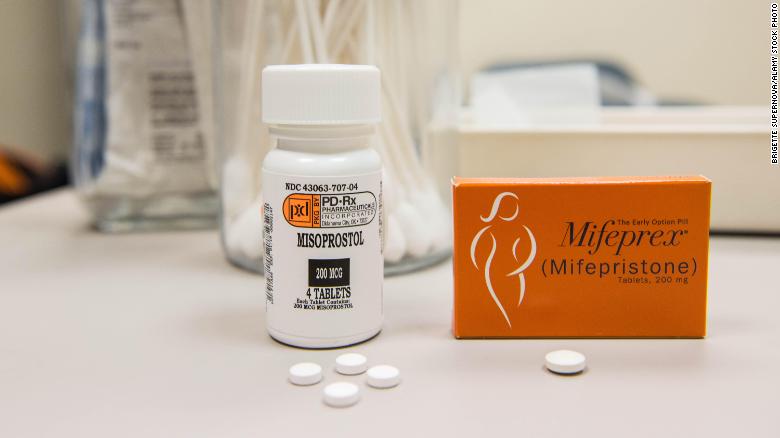
Medication abortion pills, misoprostol and mifepristone.
Women in South Dakota who are seeking a medication abortion will face additional restrictions later this month after state lawmakers approved a new rule from the state’s health department.
Current state law allows for the medical abortion process to begin 72 hours “after the physician physically and personally meets with the pregnant mother,” except in medical emergencies, and usually only required one more visit to a licensed facility to receive the necessary drugs for the process.
But on Thursday, state lawmakers on a rules review committee approved theSouth Dakota Department of Health’s rule requiring that women receive both drugs used in a medication abortion — mifepristone and misoprostol — in person at a licensed abortion facility.
The rule means South Dakota will be the first state to require a visit to obtain the misoprostol, according to Guttmacher Institute state policy analyst Elizabeth Nash.
A medication abortion, also called a medical abortion, is a nonsurgical procedure effective until about 10 weeks into a pregnancy. It involves taking mifepristone and misoprostol one or two days apart.Typically, women are given both drugs in the same visit to their doctor or a clinic. They take the mifepristone pill at the clinic and are instructed to take the misoprostol pill at home a day or two later.Enter your email to sign up for the CNN Meanwhile in America Newsletter.close dialog
Under the new regulation, women in South Dakota will now effectively be required to make four visits to a licensed abortion facility for a medication abortion.
The rule comes after the Biden administration temporarily relaxed federal regulations on medication abortion in April, removing the requirement that mifepristone be dispensed in person during the Covid-19 pandemic.
The move prompted South Dakota and other conservative states to take steps to counteract the federal government.South Dakota Gov. Kristi Noem, a Republican, signed an executive order in September directing the state’s Department of Health to draft rules to ensure the drugs distributed in the state could not be sent via mail, among other restrictions.
“In December, the FDA permanently lifted the requirement that the first drug be dispensed in person, instead allowing pills to be sent by mail. The agency also started requiring pharmacies that dispense the drug be certified.
After a public hearing last month and a committee hearing that resumed Thursday, the South Dakota legislature’s Republican-majority Interim Rules Review Committee voted to pass the rule requiring in-person distribution of both medications.
Current South Dakota law requires physicians to obtain “a voluntary and informed written consent” from a pregnant woman for an abortion, with exceptions for medical emergencies.
Under the new rule, three days after a pregnant woman gives the informed consent for a medication abortion, the woman can return to the clinic to receive the first drug, mifepristone. She is only allowed to take the medications up to nine weeks after conception.
But before dispensing the drug, according to the new regulation, a physician has to inform the woman that should she change her mind and decide to carry the baby to term, it’s possible to reverse the effects of the mifepristone.
If she does take that medication, she must wait 24 to 72 hours later and return a third time to the clinic for the second drug, misoprostol, to be dispensed in person.
Abortion facility staff then need to schedule a follow-up appointment with the woman for 14 days after taking the medication.
The abortion facility also must monitor the patient and report to the Department of Health any complications that require medical follow-ups, what the required follow-up care was, the facility where the follow-up appointment was held, and if the pregnant woman was sex-trafficked.
Ali Tornow, a staff attorney for the Department of Health, argued in Thursday’s hearing that the “purpose of this rule is to protect the health and safety of women in South Dakota by requiring in-person dispensing of both medications.
“Other proponents of the rule, including several South Dakota physicians, testified that removing in-person visits could lead to life-threatening health complications for pregnant women.
Planned Parenthood North Central States and the American Civil Liberties Union of South Dakota slammed the new regulation, saying it mandates another “unnecessary” visit to the clinic.
Dr. Sarah Traxler, the chief medical officer for Planned Parenthood North Central States, testified during Thursday’s hearing that the rule is “not medically necessary” and may instead prevent women “from taking the second medication, thereby exposing them to increased risk.”
Traxler argued that for patients who spend hours driving to reach the clinic, an extra trip is an “insurmountable barrier to care,” and for some women, “the unpredictability of everyday life may ultimately prevent patients from returning to the clinic to receive the misoprostol.
“Jett Jonelis, the ACLU of South Dakota’s advocacy manager, said in a statement provided to CNN that mandates like South Dakota’s “represent dangerous political interference and compromise patient care and safety.”
“These restrictions violate patients’ rights to liberty, privacy and equal protection as guaranteed by the U.S. Constitution by imposing significant burdens on abortion access without proof of a valid medical justification,” Jonelis said.
The American College of Obstetricians and Gynecologists (ACOG) and several other medical associations have advocated for the removal of federal restrictions on how the drugs are administered.
The restrictions “do not make the care safer, are not based on medical evidence or need, and create barriers to clinician and patient access to medication abortion,” ACOG says on its website.
But “limited available evidence suggests that use of mifepristone alone without subsequent administration of misoprostol may be associated with an increased risk of hemorrhage,” the group said.
According to data the FDA has collected since the drug’s approval in 2000, of the 4.9 million women who have taken mifepristone for a medical abortion, 26 have died — a mortality rate of less than 0.0001%.
Governor moves to make new rule permanent
Noem “plans to work with the South Dakota legislature to make these and other protocols permanent,” her office said in a press release. The upcoming session kicks off Tuesday.”I look forward to the day when the life of every unborn child is protected in South Dakota,” the governor said in a statement.
South Dakota has a number of restrictions on access to abortion, including banning abortion after 22 weeks of pregnancy with some exceptions.
It’s also one of 19 states that require a physician providing a medication abortion to be physically present during it, effectively prohibiting telemedicine to prescribe abortion medication, according to the Guttmacher Institute.
By all accounts, the Supreme Court is poised to upend 50 years of our constitutionally protected right to abortion in Dobbs v. Jackson Women’s Health Organization. This effort is not in a vacuum. With Congress gridlocked by the filibuster and a nationwide effort underway to restrict access to the ballot box, conservative leaders are opening the door, inch by inch, to strip away the rights of individuals across the country. Reproductive rights are at the top of their list.
While the debate around this issue is hyper-focused on the Supreme Court, we are collectively overlooking the most important battleground of the abortion rights fight: state legislatures. Texas’ blatantly unconstitutional abortion ban, SB8, makes it clear: anti-abortion lawmakers will introduce new, egregious bills at the state level to thwart abortion access — and SCOTUS made it clear they will allow it.
The moment we’re in is a direct result of generations of underinvestment at the state level and an overreliance on the courts. Protecting abortion access requires transforming our state legislatures.
Without building state power, and ensuring lawmakers have the tools they need to enact policies their constituents want, the consequences for abortion rights will be nothing short of disastrous. Already, 21 states have existing laws or statutes that may make abortion illegal following a hostile decision by the Supreme Court. Another five could soon follow, based on their legislative makeup and recent history — that’s half of the country poised to restrict or eliminate abortion rights altogether.
Fortunately, some states have already acted to protect the legal right to abortion. In 2019, New York enacted the Reproductive Health Act to codify the Roe v. Wade ruling into state law, and Illinois enacted a similar law to protect all individual decision-making around reproductive health, including abortion, contraception and pregnancy care. In 2021, New Mexico repealed a pre-Roe law on the books that criminalized abortion, ensuring legal abortion is protected in the state if Roe is further weakened or overturned at the federal level. Michigan has introduced a similar bill.
But protecting the legality is only step one. State legislators now have a duty to unapologetically protect the abortion access people everywhere will need in the face of a confusing and ever-changing landscape. It’s time for new, bold policies that must originate from statehouses.
First, states must put their money where their mouth is by removing any public or private insurance coverage restrictions on abortion, like Washington state has done. Even better? Look to New York, where Attorney General Letitia James has called for the creation of a state fund to support the cost of transportation, accommodations and abortion care for patients seeking care if their own state has banned abortion.
Then, states can make sure they expand their provider pool to meet the needs of thousands of patients crossing state lines to access abortion care. California and Maine have ensured health care professionals like physician assistants and advanced practice registered nurses can provide abortion care. Good policies can also look like Massachusetts’ bill to make medication abortion available on college campuses, or a plan in Georgia to ensure that communities of color are centered in any new legislation to protect abortion rights. And it goes without saying states can repeal any other existing abortion restrictions on their books, like Virginia and Illinois have done recently. New Jersey has moved to protect abortion clinic employees from possible harm, while Connecticut aims to mitigate the harm of deceptive crisis pregnancy centers.
Of course, many states cannot and will not pass laws to protect or expand abortion rights — yet. We’ve spent too many years ignoring state legislatures and pinning all our hopes on Congress or the courts. But there are structural changes we can make so state legislatures are much more responsive to the needs of women, communities of color, immigrants and poorer people who have been shut out of the democratic process for too long and are most affected by unpopular policies like abortion restrictions. Only by making state legislatures more representative of the electorate will we begin paving the way for more inclusive, progressive state policies.
This starts with increasing legislator pay, providing funding to lawmakers so they can hire staff support, and considering a move toward full-time legislative sessions. In many states, legislators work part-time although their communities need them year-round, are paid very little (if at all), and have to juggle their legislative duties with another job and their personal life for months on end. This results in disproportionately wealthy, white people being more likely to take the financial risks associated with running for office and serving as a state lawmaker.
The best time to have invested in building power in states was a generation ago; the next best time is now. After all, this is not the time for politics as usual: The bodily autonomy and reproductive dignity of millions are about to be dismantled. After a decision from the Supreme Court, it will be up to state legislators to determine the future of abortion access. We look to them to take up that mantle.
In a tense hearing Friday, the 5th US Circuit Court of Appeals signaled that — for now — it was likely to keep the Texas abortion case out of the hands of a federal judge who in the past had blocked the state’s six-week ban on abortion.The 5th Circuit panel is deciding what should come next in abortion clinics’ federal lawsuit challenging the ban after the Supreme Court kept the case alive in a decision handed down last month.”Maybe we should just sit on this until the end of June,” Judge Edith Jones said Friday, citing a separate challenge to Roe v. Wade already at the high court.
“By that time, it is very possible the hot potato will be in the seat of the Supreme Court,” she added.
The clinics say the case should be sent to US District Court Judge Robert Pitman, who blocked the law lastOctober in a separate case brought by the Justice Department, only for that order to be frozen by the 5th Circuit.
The providers’ request got no apparent traction with two of the three judges on the appellate panel. The third judge — the panel’s sole Democratic appointee — had already said he would grant the request in a dissent that decried the “impermissible delay to the vindication of the constitutional rights of Texas women in federal court.”
Instead, the appellate panel’s Republican-appointed majority seems poised to grant a request from Texas and the ban’s other legal defenders to send the case to the Texas Supreme Court. The defenders say that, before the federal lawsuit moves any further, the Texas Supreme Court needs to weigh in on state law questions that they say were left unresolved by the US Supreme Court’s decision last month.
Jones, an appointee of President Ronald Reagan, appeared to agree. She warned that the federal courts are “all going to have egg on our faces” if the Texas State Supreme Court interpreted the state law in a way that was at odds with how the federal judges were approaching the case.
She also floated the idea that the 5th Circuit could just sit on the case until the US Supreme Court handed down its decision in a separate abortion case it heard last month, where the conservative justices may make significant changes to the court precedent that protects abortion rights.
Circuit Judge Kyle Duncan, an appointee of President Donald Trump, meanwhile questioned whether there was really any urgency in moving the federal lawsuit along, given the ways the US Supreme Court had already scaled back the clinics’ case.
Four months and counting that most abortions have been illegal in Texas
The legal issues before the 5th Circuit are extremely technical. But at stake is whether abortion providers will have any shot in the coming months to get an order that would at least partially block enforcement of the law.
The clinics have already asked the Supreme Court to intervene yet again in the 5th Circuit’s handling of the case. So far, the justices have not taken any action on that request, which was filed Monday night.
For more than four months, a law that bans a majority of abortions in the country’s second most populous state has been in effect. Given the legal risks that come with violating the ban, which outlaws abortions when fetal cardiac activity is detected, clinics have been unwilling to offer the procedure in those instances — a point around six weeks into the pregnancy, before many women even realize they’re pregnant.
So far, the Texas ban’s unique enforcement mechanism has allowed it to stand in the face of Supreme Court precedent that protects abortion rights before a fetus is viable — a point around 23 weeks into the pregnancy when the fetus can survive outside the womb.
Rather than impose criminal or administrative penalties for clinics that conduct abortions after six weeks, the Texas law allows private citizens to sue those providers — or anyone else who assists the person obtaining the abortion — in state court, with the threat of damages of at least $10,000.
When the US Supreme Court reviewed the case last year, it said the clinics could not get federal court orders preemptively blocking state court officials from accepting those lawsuits. But eight of the justices said their lawsuit could proceed against a select group of state licensing who could in theory revoke providers’ medical licenses for violating the six-week ban.On Friday, comments from Duncan illuminated why the Supreme Court decision had left clinics with little hope for effective relief in federal court from the law, known as SB8.”The principal injury that you’re seeking to redress here is the threat of SB8 lawsuits puts a chill on your clients’ provision of abortion services, right?” Duncan told Marc Hearron, a senior counsel for the Center for Reproductive Rights who is representing the providers.”So how would an injunction against these licensing officials redress that at all?” Duncan asked, later adding that, given that reality, he was struggling to see the urgency of moving the federal lawsuit along quickly.
A clock ticking on a separate Supreme Court case that could bolster Texas’ ban
In the background of these procedural maneuverings is an even bigger threat to abortion rights not just in Texas — but nationwide.
The Supreme Court last month heard a separate abortion case out of Mississippi that gives the conservative majority the opportunity to gut — and perhaps, outright reverse — current precedent protecting pre-viability abortions.
The idea of waiting until a summer ruling on the Mississippi case and Roe v. Wade drew vehement pushback from the clinics’ attorney, who called it “completely inconsistent” with how quickly the Supreme Court handled had the Texas case so far.
Even the attorney for Texas, Assistant Solicitor General Natalie Thompson acknowledged that Texas is not asking for that delay, under persistent grilling from Judge Stephen Higginson, who was appointed by President Barack Obama.
Nerves were frayed among the judges as the 45-minute hearing wore on. Not only did the Republican-appointed judges express repeated dissatisfaction with how Hearron, the clinics’ attorney, was handling their questions, they exchanged shots with Higginson.
Jones interjected in one line of tough questions Higginson had for Texas’ attorney: “Normally this court isn’t litigating on behalf of on one side or the other,” Jones said.
Higginson asked Thompson, the Texas attorney, if there had be any unfair question to her. She said no and he continued with his questions.
THE WHITE NATIONALIST GROUP PATRIOT FRONT ATTENDS THE MARCH FOR LIFE ON JANUARY 8, 2022 IN CHICAGO. (PHOTO BY KAMIL KRZACZYNSKI / GETTY IMAGES
This isn’t the first time that Patriot Front has appeared at an anti-abortion event.
Members of the white supremacist group Patriot Front tried to join an anti-abortion march in Chicago this weekend—only to get heckled by some of the demonstrators.
In videos posted to social media, more than a dozen Patriot Front members can be seen marching alongside people demonstrating in support of Chicago’s March for Life. The Patriot Front members wore matching, country club-esque uniforms of blue jackets and pale khakis, as well as hats and face coverings to obscure their identities. Many carried American flags and red-and-blue shields. The group’s banner read “Strong Families Make Strong Nations.
In one video, a man demonstrating with March for Life can be seen asking, “What are you carrying shields for?”
“You guys are an embarrassment,” he added. “Put the shields down!”
“Who do you guys think you are?” another man demanded. One voice can be heard saying, “Bunch of fucking clowns who never grew up.
The Chicago Sun-Times reported that the cowboy hat-wearing Patriot Front founder Thomas Rousseau was also among the Patriot Front members present at the march. Rousseau formed the group, a splinter faction of the neo-Nazi group Vanguard America, in the wake of the violent Unite the Right rally in Charlottesville, Virginia, in 2017. Rousseau, who used to head the Texas chapter of Vanguard America, led Vanguard America members who showed up in Charlottesville.
Patriot Front took the explicitly neo-Nazi agenda of Vanguard America and repackaged it in Americana, with the goal of broadening their appeal and drawing in more recruits.
After leaving the March for Life, Patriot Front members unloaded their gear and took off in cars with taped-over license plates. Although the group is obsessed with optics and typically uses public appearances as marketing opportunities for slick propaganda videos, its members also place a high premium on secrecy.
The Proud Boys, another neo-fascist group, has also recently sought to align itself with abortion opponents: VICE News found that, in the last year, the group provided security to the anti-abortion “Stolen Voices Foundation.”
This isn’t the first time that Patriot Front has appeared at an anti-abortion event in Chicago, according to the Anti-Defamation League. The organization reported that people associated with Patriot Front have appeared at at least three anti-abortion demonstrations dating back to 2018.
The belief that Donald Trump and his ilk are entitled to power and control in this country is not distinguishable from the eugenicist foundations of the anti-abortion movement. Philip Cohen/Flickr
From fire bombings, shootings, and ceaseless harassment, anti-abortion violence has wreaked havoc on clinics for decades.
Trump supporters laid siege to our nation’s capital on Wednesday, storming past a flaccid and enabling law enforcement presence in an attempt to stage a coup. As they were filling the halls of Congress—stealing lecterns and paintings, and taking selfies at Nancy Pelosi’s desk—pundits lamented: This is not America; this is not who we are. Some even marveled at the cooperation from law enforcement, wondering how security could have been so lax.
Unfortunately, abortion providers are all too familiar with the sort of violence that played out at the Capitol.
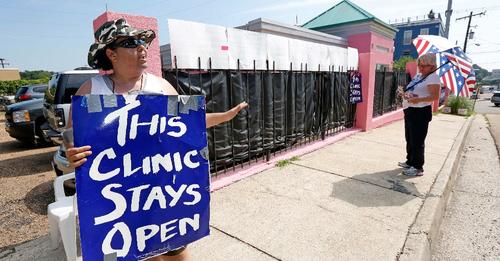
Anti-abortion violence has wreaked havoc on clinics for decades: fire bombings, shootings, and ceaseless harassment, have forced clinic directors to barricade their medical facilities and stock them with bulletproof vests and staff trained to respond to mass violence at any given moment. All for providing necessary and critical medicine.
“Those of us who provide abortion care have seen this rage before,” Dr. Jamila Perritt, president and CEO of Physicians for Reproductive Health, said in a statement. “We have seen it in the eyes and hear it in the shouts of the protesters outside of our offices and clinics. We know that the individuals that breached the Capitol [on Wednesday] are the same ones standing outside our health centers in the morning.”
In the 40 years that the National Abortion Federation has been documenting violence against abortion providers, there have been 11 murders, 26 attempted murders, 42 bombings, 189 arsons, and thousands of incidents of criminal activity directed at abortion providers across the country.
Calla Hales, executive director of A Preferred Women’s Health Center, an abortion clinic with branches in North Carolina and Georgia, is no stranger to anti-choice terrorism. Her clinic is a hotspot for harassment and protests. The health center is regularly inundated with hundreds—even thousands—of violent anti-abortion terrorists, who occupy the lot next door to harass patients and shout about baby parts.
Hales said watching the insurrection unfold in Washington was rattling.
“As an executive director of multiple abortion clinics, in the Bible Belt no less, the potential for violence is something that’s never far from my mind,” she told Rewire News Group. “Violence is something all abortion providers and advocates are familiar with. We deal with harassment and intimidation on a daily basis.”
Wednesday “made me think about how invading and blockading clinics over the past few decades must have been the perfect training ground for this insurrection,” Hales said.
The violence on Capitol Hill also hit home for Dr. Diane Horvath, an OB-GYN and abortion provider in Baltimore.
“The terror was visceral, and I had to sit down, close my office door, and have my panic attack in private,” she said. “It wasn’t until hours later that I was able to even recognize that I reacted in that way because of the constant fear of violence that we live with every day.
Many others in abortion advocacy noted the similarity between Wednesday’s violence and the violence that clinics and providers face with regularity—and with far less visibility and protection. And these parallels extend beyond the symbolism of white nationalists overtaking a building by force and threatening those inside. There were also many familiar faces among the insurrectionists at the Capitol.
Sharp eyes spotted the anti-choice darling Abby Johnson in the crowd. And RNG has confirmed the presence and involvement of dozens of other well-known anti-abortion terrorists and protesters, including convicted clinic bomber John Brockhoeft.
In the coming weeks we will surely see calls for more security around the Capitol; we have already seen unearned gratitude paid to the police who did next to nothing in the face of a violent coup attempt. As we watch this unfold, it’s critical to hold the providers who have grown accustomed to this kind of violence in the forefront of our discussions. They have warned us of the terrors of right-wing extremism, reporting to the frontlines of a domestic terrorism battleground and fighting to keep their patients safe every day—and they have done so while being met with a thankless and merciless response.
Clinics around the country long relied on the protection of buffer zones—boundaries created outside of clinics to deter violence—that were instituted after John Salvi’s 1994 assault on two abortion clinics in Boston killed two people and injured five others. But when the constitutionality of buffer zones came before the Supreme Court, which itself enjoys the protection of a buffer zone, the Court ruled that the provision violated the First Amendment, leaving clinics at an increased risk for violence.
Remember: Many of the same political leaders who decried Wednesday’s display will vote for anti-choice laws that subject providers to the same kind of violence. Many in Congress see this as an entirely singular and unprecedented incident, while failing to realize that they confirm judges who would swiftly take away a clinic’s right to protect itself from right-wing extremism.
“The fear that someone will use violence to get inside a clinic is not theoretical,” Dr. Horvath said, emphasizing that she uses evidence-based safety measures to keep her patients safe.
“It has happened many times and will continue to happen as long as it’s tolerated by the public,” she said.
“What we need is systemic change. Laws that protect us and our patients (and enforcement of the laws we already have) would be a great place to start. Call your local and state legislators and ask them what they are doing to protect health-care facilities that provide abortion. See if your local clinics need escorts to help patients safely access care (or donate to help support others doing this work). Send postcards of support. Call us and tell us you appreciate us. Donate to an abortion fund so that patients who need care can get it.”
These are not coincidences: Fascism, white supremacy, and anti-abortion terrorism are inextricably linked. The desire to control other people’s pregnancy outcomes has a direct line to the racism that fueled Wednesday’s insurrection. The belief that Donald Trump and his ilk are entitled to power and control in this country is not distinguishable from the eugenicist foundations of the anti-abortion movement.










 Abortion - Abortion Clinics, Abortion Pill, Abortion Information