Conservatives are in the midst of a power grab, and something as minor as the will of the people—as democracy itself—is not going to stop them from imposing their rules of Christian theocracy and forcing the rest of us to live by them.
 Kevin Dietsch/Getty Images

Ending abortion won’t be enough for the anti-abortion movement. They’ll want fertilized eggs, embryos, and blastocysts to have full constitutional rights.

In 2011, voters in Mississippi were given the opportunity to amend their state constitution to provide all of the constitutional rights that you and I have—or at least are supposed to have—to a fertilized egg.

And Mississippians resoundingly said no. But it wasn’t just abortion advocates who opposed the ballot initiative. National Right to Life opposed it, as did Americans United for Life. The U.S. Conference of Catholic Bishops and the state’s Episcopal and Methodist church leadership also refused to support it.

It was a crushing blow to the so-called personhood movement, which suffered repeated humiliating losses during the 2010s. Voters in North Dakota rebuffed the personhood movement’s advances, as did voters in Colorado—twice.

The personhood advocates retreated with their tail between their legs. The will just wasn’t there.

But it’s ten years later, and the will of the people doesn’t mean much anymore. Conservatives are in the midst of a power grab, and something as minor as the will of the people—as democracy itself—is not going to stop them from imposing their rules of Christian theocracy and forcing the rest of us to live by them.

And personhood? Well, personhood is Christian evangelicals’ holy grail.

A Supreme Court ruling in Mississippi’s favor in Dobbs v. Jackson Women’s Health Organization won’t end the fight for the anti-abortion movement. It will galvanize it. Disparate wings of the anti-abortion movement that have clashed in the past over the efficacy of pushing for personhood will come together. Republican-controlled states will rush to amend their constitutions to reflect the fetus’s new status as a person, while anti-choice advocates push Congress for federal personhood legislation.

Because ending abortion is not enough.If you thought the fight to protect Roe v. Wade was bad? The fight to ensure that women and pregnant people in this country don’t have to share human and constitutional rights with a fertilized egg will be worse.

They want fertilized eggs, embryos, and blastocysts to have full constitutional rights under the 14th Amendment—the right to due process, the right to equal protection, the right to life—even at the expense of the person whose body is sustaining fetal life.

That means anything that interferes with a fertilized egg making its way to the uterus and implanting—along with anything that interferes with that developing pregnancy—would be classified as killing a person, and potentially as murder.

Someone suffering from infertility who, as is often the case during in vitro fertilization (IVF), does not implant every fertilized egg could be brought up on charges. A pregnant person who suffers a miscarriage could expect a visit from the cops to determine whether the miscarriage was accidental.

Any contraceptives that prevent, or even potentially prevent, a fertilized egg—pardon me, a person—from implanting into the uterus would be banned.

That this has grave consequences for abortion rights is a gross understatement. If you thought the fight to protect Roe v. Wade was bad? The fight to ensure that women and pregnant people in this country don’t have to share human and constitutional rights with a fertilized egg will be worse. Because the end result isn’t just forced pregnancy and unsafe abortion care. It’s total control over women and other people capable of reproducing.

That’s always been the anti-choice movement’s goal, which is why they won’t stop if the Supreme Court upholds the Mississippi Gestational Age Act, the 15-week abortion ban at issue in Dobbs v. Jackson Women’s Health.

The fight for personhood begins

Exactly one week after the Supreme Court’s decision in Roe v. Wade, the first federal personhood amendment—the Human Life Amendment—was introduced by Rep. Larry Hogan Sr. For the next 40 years, personhood amendments would be introduced and would fail. Anti-choice politicians would try to slip personhood language in unrelated legislation. (In 2012, Rand Paul threatened to block a bill to reauthorize funding to the National Flood Insurance Program unless a personhood amendment was attached to it.) Ultimately, those efforts would fail as well.

Meanwhile at the state level, personhood activists within the anti-abortion movement found themselves fighting an uphill battle alone. While they were in sync when it came to ending legal abortion, the movement was split on what tactic to deploy.

Personhood activists insisted that ending legal abortion required declaring that life begins at conception and that fertilized eggs deserved full constitutional protection. The rest of the anti-choice movement preferred a less controversial approach—attack abortion around the edges and reduce abortion by restricting access. It would be death by a thousand cuts.

This incremental approach became the dominant strategy. After decades of brutal and violent attacks on abortion providers, accompanied by a pervasive narrative that women who get abortions are baby killers, a dramatic shift occurred in the way that the anti-abortion activists talked about abortion.

The cries about baby killers and murderers abated for a while as anti-choice advocates turned their attention toward crafting an image of caring abolitionists concerned about the harm that abortion caused women. Women weren’t baby killers. Rather, they were being coerced into abortion by providers who were falsely painted as motivated by profit. (One thing that remained from the tactics of the 1980s: attacking abortion providers and making them unsafe with wild claims about justifiable homicide.)

‘Abortion is bad for women’

“The real challenge for pro-lifers in 2009 is to effectively address the assumption that abortion is good for women.”

That’s what Clarke Forsythe, senior counsel for Americans United for Life, said in an article published by CBS News in 2009. AUL’s model anti-choice legislation would go on to be a big force in the avalanche of abortion restrictions that came pouring out of statehouses across the country during the rise of the Tea Party in the Obama administration.

Screaming at women that they were baby killers wasn’t working, so anti-abortion activists began to couch anti-abortion activism in “woman-protective” terms and promoted legislation that would purportedly protect women.

The flood of state abortion restrictions in the early 2010s marked this rhetorical shift and reflected the anti-abortion movement’s decision to focus on “women’s health and safety.” Anti-abortion advocates keened about women being coerced into abortion, and invented medical conditions they claimed “post-abortive women” had suffered, including the ludicrous claim that women were being traumatized by the sound of vacuum cleaners after their abortions.

In addition, biased informed consent laws forced doctors to lie to patients about, among other things, an increased risk of breast cancer or an inability to bond with subsequent children, and to read scripts impressing upon the patient that they’re “terminating the life of a whole separate unique living human being” (as one law in South Dakota required), just to impress upon the hapless pregnant person that abortion is an abrogation of their maternal duties. Unwanted ultrasounds and “heartbeat” listening sessions were forced upon patients because hapless pregnant women simply needed to see and hear the little dot on the sonogram in order to tap into the well of maternal instinct that evangelicals believe resides inside every woman.

And then there were the regulations aimed at providers. Those were ostensibly about health and safety too. Requirements that clinics spend millions of dollars to retrofit their facilities to act as outpatient hospitals—even clinics that only provide medication abortion. States forced doctors to get admitting privileges at local hospitals—even though abortion is safer than childbirth and, on the rare occasion that a complication does occur, an ambulance will take the patient to a hospital nearest to their home, which, thanks to the legislators who enact these restrictions, may be hundreds of miles away from the clinic.

Women’s health and safety. That’s what politicians repeatedly claimed their goal was when it counted—in the legislation, in hearings, and in court. But in the media, they crowed about how successful these restrictions were at closing clinics.

The Supreme Court ended the “women’s health and safety” charade in Whole Woman’s Health v. Hellerstedt, the case challenging Texas HB 2, sweeping legislation that Texas Republicans admitted was intended to close clinics.

In Whole Woman’s Health, the Court said states could no longer pass laws willy-nilly and claim that they protect the health and safety of pregnant people. The burdens of any restriction would have to be weighed against benefits the restriction conferred. The Court rejected Texas’ claim that its admitting privileges law was in place to protect women, finding that, in practice, the law hadn’t done anything of the kind.

In one of her shorter concurrences—clocking in at two pages—Ruth Bader Ginsburg said, “When a State severely limits access to safe and legal procedures, women in desperate circumstances may resort to unlicensed rogue practitioners, faute de mieux, at great risk to their health and safety. … Targeted Regulation of Abortion Providers laws like H. B. 2 that do little or nothing for health, but rather strew impediments to abortion, cannot survive judicial inspection.”

Whole Woman’s Health effectively put a nail in the “we have to protect women from abortion” strategy, which means the anti-choice movement is coalescing around the “we have to protect the fetus” strategy. That strategy could take many forms. Anti-choice activists may push for federal personhood legislation. They may push for an amendment to the Constitution establishing personhood. They may take a stab at both simultaneously.

It’s certainly on their radar.

The fight for personhood resumes

During a Newsweek podcast appearance with Rewire News Group’s Executive Editor Jessica Mason Pieklo, anti-abortion leader Lila Rose laid the anti-choice movement’s cards on the table:

There’s no reason that we should treat children at the moment of birth different than children before birth. They are still human beings. Human life starts—the science is clear when human life begins—it begins at the moment of fertilization: sperm, egg fusion. You have a unique, individual human being and they deserve legal protection, just like anybody else. That’s not just a general argument for human rights; it’s based on our own Constitution. The 14th Amendment says that all people should have equal protection under the law and that no state should deprive anyone of their right to life without due process.

They’ve got momentum, they’ve got power, and they’ve got a Supreme Court stacked with justices just waiting to back them up.

And this time, they’re not particularly concerned about protecting women. They can’t possibly be. Conferring legal rights to eggs turns every miscarriage into a potential criminal investigation. It also raises awkward questions about whose rights matter more when pitted against each other—the fertilized egg or the person carrying it.

Enshrining fetal personhood into law will prevent millions of people suffering from infertility from being able to have children. And it will prevent millions of people who rely on certain forms of contraception from using them.

And while this may not be the most critical issue, it does raise the question: Can a pregnant person drive in the HOV lane?

The point is, fetal personhood will lead to chaos. And it’s that chaos that led to the myriad defeats the personhood movement suffered in the early 2010s. But it’s a new decade with a new cultural zeitgeist. The “protect women” drumbeat is silent, and increasingly the claim to care about women’s well-being has given way to the rhetoric of the early days of the anti-choice movement: Abortion is murder and anyone participating in it deserves to be punished. They don’t care anymore if a pregnancy is a result of rape or incest. Gone are the concerns about the safety and well-being of women. Some Republican lawmakers have outright called for people who get abortions to be put to death.

Now it’s fetus über alles. It’s the fetus that deserves a chance at life. The pregnant person? They already screwed up by getting pregnant. Better luck next time.

The fight to keep personhood at bay will be tough, but it’s not unwinnable. Advocates will be fighting a united anti-choice movement with one goal in mind, to be sure. But fetal personhood has severe consequences outside of the abortion context; the anti-choice movement may not be able to convince enough people that fetal personhood even makes sense.

But that doesn’t mean they’re not going to try.

The anti-choice movement may have been splintered in its approach to gutting Roe v. Wade in the lead-up to Dobbs v. Jackson Women’s Health, but after that decision comes down, the movement’s approach to ending abortion entirely—or trying to anyway—will be unified. And that should make every abortion rights advocate nervous.

Source: https://rewirenewsgroup.com/ablc/2021/10/14/whats-next-after-the-supreme-court-reverses-roe-attack-of-the-egg-people/

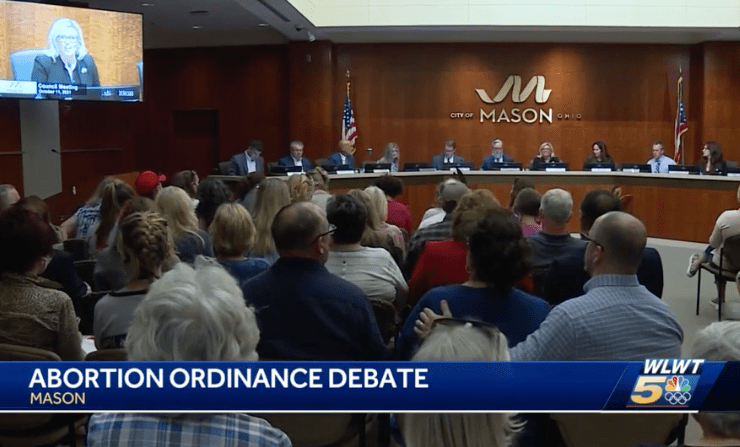
The anti-abortion ordinance will have a second reading at the Mason City Council’s next meeting.
 WLWT/YouTube

In Mason, Ohio, the city council is considering an ordinance outlawing abortion—with the help of a Texas anti-abortion group.

With “sanctuary city for the unborn” ordinances in over two dozen cities in Texas, the city of Mason, Ohio, is on its way to becoming the next municipality to enact an abortion ban.

The ordinance was introduced last week at a Mason City Council meeting, where four council members voted in favor of an abortion ban for the Ohio city. That was one short of the five members required to pass the ordinance as an emergency and skip a public referendum.

Mayor Kathy Grossmann supports the abortion ban but said she hoped it did not go to a referendum. Instead, the anti-abortion ordinance will have a second reading at the city council’s October 25 meeting, as Erin Glynn of the Cincinnati Enquirer reported.

This is far from the first time Ohio Republicans have taken aim abortion access. On top of restrictions on abortion providers, low-income people, and minors, the state bans abortions “based on” a fetal diagnosis of Down syndrome and abortions after 22 weeks’ gestation. (Ohio lawmakers have always struggled with science.)

In this case, however, Mason is skipping directly to the end goal: banning abortion within city limits entirely—even though there aren’t any abortion clinics in the city anyway.

And Mason wouldn’t be the first Ohio city to do so—Lebanon’s city council voted unanimously to ban abortion in May. The Lebanon ordinance, like the proposal in Mason, declares it illegal to provide, aid, or provide money, transportation or instructions for an abortion within city limits.

If you’re thinking “so what?” then we’ve got one word for you: Texas.

In fact, the Mason City Council got a draft ordinance from Sanctuary Cities for the Unborn, an initiative by Right to Life of East Texas, the Enquirer reported.

So even as other states dominate the headlines (and for good reason), we just wanted to let Ohio anti-abortion activists know that we’re watching them too.

Source: https://rewirenewsgroup.com/article/2021/10/18/ohio-might-get-a-second-sanctuary-city-for-the-unborn/

The Murphy administration on Wednesday approved lifting regulations on abortions that barred them from happening in a doctor’s office beyond 14 weeks of pregnancy and allowing as many as 15,000 nurses, physician assistants and midwives to perform the procedure. 

The new rules contain elements of a bill Gov. Phil Murphy supports to enshrine a woman’s right to abortion into law should the landmark Roe v. Wade ruling, which says a woman has the constitutional right to an abortion, be overturned by the U.S. Supreme Court.

But that bill Murphy supports, the Reproductive Freedom Act, includes many more protections and would expand access to birth control and pregnancy care, which he says are under threat.

“At a time when other states are creating roadblocks to reproductive health and abortion care, New Jersey is working to expand access to these vital services, especially for communities facing systemic, economic, and logistical barriers to care,” Murphy said in a statement.

The new rules were unanimously approved by the state Board of Medical Examiners and will take effect in the “coming months,” the Attorney General’s Office said.

The “outdated” restrictions had been under scrutiny after a state panel formed in 2018 examined state regulations concerning abortion.

The Attorney General’s Office said the board considered nationally recognized studies, which showed “certain” early abortions can be safely performed by non-physician clinicians and that over-regulation of abortion creates public health “harms” by disrupting access to care.

Once the rules take effect, nearly 12,000 advanced practice nurses, 4,500 physician assistants and 420 midwives could become authorized to perform abortions. The Reproductive Freedom Act would allow those workers to perform the procedure as well.

Sean P. Neafsey, the acting director of the Division of Consumer Affairs, said the change will “play a role in expanding abortion access and residents will have enhanced choices and more timely access to essential reproductive health care.”

New Jersey does not have any restrictions on when a woman can have an abortion, but the board approved lifting a regulation that barred office-based abortions beyond 14 weeks.

In 2018, the majority of abortions nationally happened in the first 13 weeks of pregnancy, while about 7% were done between weeks 14 and 20 and 1% were done after 21 weeks, according to the Centers for Disease Control and Prevention.

With a challenge to Roe v. Wade at the Supreme Court, abortion rights have increasingly been a focus nationally, but also in New Jersey.

Murphy has said he wants the Legislature to send him the Reproductive Freedom Act to codify Roe v. Wade into state law, but the Republican nominee for governor, Jack Ciattarelli, said he opposes the types of expansion the medical examiners approved Wednesday.

“No one supports an abortion in months seven, eight and nine, let alone it having it performed by somebody other than an M.D.,” or medical doctor, he said at Tuesday night’s debate.

Ciattarelli did, however, say he supports codifying the right to abortion into state law.

Planned Parenthood praised the board’s action and said the “unnecessary barriers” will expand access to abortion at a time it faces legal threats. 

“It is more important now than ever before for New Jersey policymakers to ensure that everyone seeking abortion in our state continue to have access to the highest quality reproductive health care,” Planned Parenthood Action Fund of New Jersey spokeswoman Kaitlyn Wojtowicz said in a statement. 

“New Jerseyans deserve and demand access to the care they need so they can plan their families without barriers, fear, or interference from others. Today’s action brings us closer to achieving that goal.”

Source: https://eu.northjersey.com/story/news/new-jersey/2021/10/13/nj-expands-abortion-access-roe-v-wade/8440203002/

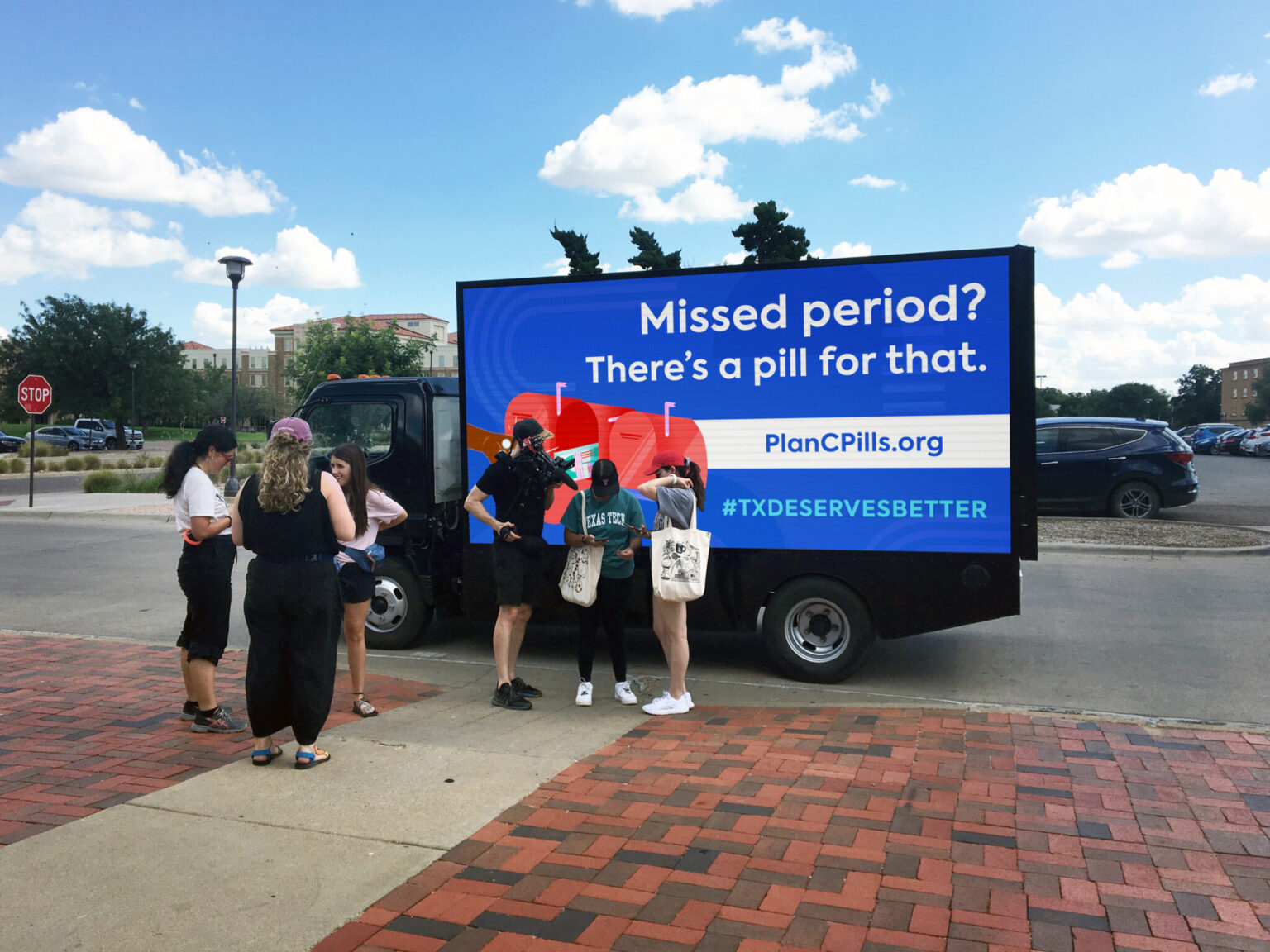
College students learning about abortion pills from Plan C advocates. (Plan C)

With the Supreme Court poised to overturn Roe v. Wade, the fight for access to the abortion pill has become a matter of life and death.

Twenty-one years ago, the U.S. Food and Drug Administration (FDA) approved the abortion pill mifepristone for distribution in the United States. As states are now passing laws to ban abortion and the U.S. Supreme Court is poised to overturn Roe v. Wade, the abortion pill is what will make a post-Roe world very different from the pre-Roe world, when thousands of women died each year from illegal abortions, and many more were left permanently harmed by unsafe and illegal abortions.  

Abortion pills are safe and effectivewidely accessible online and easy to use. A grassroots movement led by the organization Plan C is now working to ensure that women across the country know how to get abortion pills and how to use them.

On the 21st anniversary of FDA approval of the abortion pill, now is a good time to remember the courageous and tenacious people who fought for decades to make this life-saving medication possible.

How Did We Get the Abortion Pill?

The abortion pill mifepristone used in combination with another medication—misoprostol—can safely and effectively end a pregnancy. Mifepristone interrupts the flow of the hormone progesterone that sustains a pregnancy and misoprostol causes contractions to expel the contents of the uterus.

The French company Roussel-Uclaf developed mifepristone, known as RU-486, in 1980. Chemist Georges Teutsch first synthesized mifepristone and endocrinologist Étienne-Émile Baulieu arranged tests of its use for medical abortion. After extensive testing, the company applied for and obtained the French government’s approval in 1988 for the drug to be used for abortion. 

The same year, anti-abortion protests in France caused Rousel-Uclaf’s owner Hoechst AG of Germany to stop distributing mifepristone. The French government responded by ordering Roussel-Uclaf to resume selling the medication in the interest of public health.

French Health Minister Claude Évin famously explained at the time, “I could not permit the abortion debate to deprive women of a product that represents medical progress. From the moment government approval for the drug was granted, RU-486 became the moral property of women, not just the property of a drug company.”

Great Britain approved mifepristone for abortion 1991 and Sweden in 1992. But due to pressure from anti-abortion groups, including the U.S. National Right to Life Committee, Roussel-Uclaf and Hoechst AG declined to bring the drug to the U.S. market for fear of boycotts and lost profits. Instead, the company donated all rights for medical uses of mifepristone in the U.S. to the Population Council—a nonprofit that conducts international research on reproductive health.

The Population Council then tried to find a large drug company willing to develop the drug for the U.S. market. After threatened boycotts from anti-abortion groups, large drug companies refused, so in 1995, the Population Council gave the rights to distribute mifepristone to a small company named Danco Laboratories, formed specifically for this purpose. Danco then sought FDA approval of the drug for distribution in the U.S.

fda-approval-abortion-pill-anniversary-medication-abortion-biden-texas-ban
While widely known as an abortion pill, mifepristone is very effective for treating fibroids and may also be effective for treating endometriosis and depression. But politically motivated FDA restrictions limit access. (Robin Marty / Flickr)

After a long fight by anti-abortion activists to block the drug from the U.S. market, the FDA approved mifepristone for use within the U.S. in 2000, but placed the drug under a regulatory restriction called Subpart H, later called the Risk Evaluation and Mitigation Strategy (REMS) drug safety program.

Under this restriction, the FDA prohibited retail pharmacies from stocking and distributing mifepristone, instead requiring mifepristone to be dispensed in a doctor’s office, clinic or hospital registered with the drug manufacturer. The FDA allowed use of mifepristone only in the first seven weeks (or 49 days) of pregnancy and required patients to take the medication in the doctor’s presence. This meant patients had to make three visits to their healthcare providers to obtain the medication.

At the time they approved the drug in 2000, the FDA refused to reveal the names of the manufacturer or the FDA employees involved in approving the drug, citing fear of anti-abortion violence. The threats were so serious the agency had to increase security at its offices.

Evidence accumulated about the safety and efficacy of the abortion pill, but the medication remained heavily restricted, although advocates and medical professionals called for the FDA to remove its restrictions on the drug.

In 2016, during the final days of the Obama administration, the FDA finally loosened restrictions on mifepristone by extending the time period during which the drug could be used to 10 weeks (or 77 days), allowing a lower dose of the drug (from 600 mg to 200 mg)—meaning fewer side effects—and allowing fewer visits to the doctor. 

Also in 2016, the FDA approved a research study on telemedicine abortion a research exception to the REMS restriction called TelAbortion, run by Gynuity Health Projects. Under the study, clinicians are able to provide medication abortion care by videoconference and mail the pills to patients.

Despite the ongoing FDA restrictions on mifepristone, the use of medication abortion has increased significantly over time. In 2017, mifepristone accounted for approximately 40 percent of all recorded abortions and 60 percent of abortions performed up to 10 weeks gestation—although the rate is likely higher because of self-managed abortion, which is not recorded.

While widely known as an abortion pill, mifepristone is very effective for treating fibroids and may also be effective for treating endometriosis and depression. Yet the drug is not available to use for these serious conditions because of the politically motivated REMS restrictions, which have made research on its usefulness in treating these conditions difficult to conduct.

Advocates Demand More Access to Abortion Pill

Reproductive health advocates argue that the REMS restriction is based on politics, not medical evidence. Whereas REMS is meant to restrict dangerous drugs, mifepristone is an extremely safe drug. In fact, mifepristone is six times safer than Viagra—which the FDA does not restrict under the REMS program. 

Advocates are pursuing multiple strategies to challenge the REMS restriction, including challenging the FDA restrictions in court, lobbying the FDA to remove the restrictions, reinterpreting the REMS restrictions to be less restrictive, expanding the TelAbortion research exemption to the REMS restriction, and supporting self-managed abortion.

When COVID hit, the Trump administration lifted FDA restrictions on most drugs so patients could access them without in-person visits to doctors, but not the abortion pill. So advocates and health care providers sued. In July of 2020, a Maryland federal court ruling suspended the FDA requirement that patients make in-person visits to medical providers to get the abortion pill. U.S. District Court Judge Theodore Chuang ruled the FDA requirement of in-person visits during the pandemic imposed a “substantial obstacle” to abortion health care that is likely unconstitutional. Judge Chuang’s order allowed doctors to mail mifepristone to their patients. 

But the Trump administration appealed the ruling all the way to the Supreme Court, twice. The second time, on January 13, 2021, six members of the Supreme Court granted a Trump administration request to reinstate an FDA rule requiring patients seeking medication abortion to make an unnecessary in-person visit to their health care provider just to pick up the medication and sign a form. Justices Sotomayor, Kagan and Breyer dissented.

With President Joe Biden in office, the FDA issued new guidance on April 12 lifting a restriction on mifepristone for the duration of the COVID-19 public health emergency. Then on May 7, the Biden administration announced that the FDA would undertake a review of the REMS restrictions on mifepristone. The announcement came as part of a joint legal filing in the ACLU lawsuit Cheslius v. Becerra, challenging the restrictions.

But while the FDA now allows qualified providers to mail the abortion pill to patients—at least for now—19 states prohibit medication abortion via telemedicine and mailing pills.

The Difference Between Pre-Roe and Post-Roe: The Abortion Pill

As states are adopting a record-breaking number of abortion restrictions, the Supreme Court has allowed a six-week abortion ban to go into effect in Texas, and the court has agreed to hear a case involving 15-week abortion ban in Mississippi, the abortion pill is more important today than ever before. Thanks to the abortion pill and innovative organizations committed to reproductive health and bodily self-determination, a reversal of Roe v. Wade would not send us back to the pre-Roe world of coat hangers and hospital wards full of deathly ill women.

fda-approval-abortion-pill-anniversary-medication-abortion-biden-texas-ban
A rally for reproductive rights in Ambler, Pa., in May 2019. (Governor Tom Wolf / Flickr)

Advocates are educating women about how to buy abortion pills online, receive them by mail, and use them at home, and evidence suggests that women are doing just that. Recently-published research reveals that Aid Access received 57,506 requests from people in the U.S. seeking abortion pills between 2018 and 2020, before the pandemic began. Online demand for abortion pills surged when the pandemic hit in early 2020, especially in states that closed abortion clinics such as Texas, where requests for abortion pills made to Aid Access increased by 94 percent.

The week after the Texas ban went into effect, traffic to the website of the abortion pill advocacy group Plan C spiked 2,357 percent — with 30 percent of those new visits coming from Texas. Online abortion clinic Aid Access, which prescribes abortion pills mailed from India for $150, also saw vastly increased traffic on their website—from less than 2,000 hits per day before the ban to about 10,000 on September 1 and then 30,000 on the September 2.

While the FDA still considers it “illegal” for overseas pharmacies to ship medications into the US, this is done all the time and the FDA has a policy of non-enforcement about importation of medicines for limited use (up to a 90 day supply). 

According to Elisa Wells, Plan C co-director:

“Aid Access is set up to comply with all the requirements in the places that they operate: Dr. Gomperts is licensed as a physician, so providing care legally. She writes a prescription for the patient, who then submits it to the pharmacy. The pharmacy is licensed to fill the prescription. And, because the doctor and pharmacy are both offshore, they feel protected from prosecution in the states that don’t allow telemedicine abortion.”

Self-managed abortion—when someone ends a pregnancy outside of a clinical setting, such as by buying abortion pills online—is not illegal in most states.  Only five states have explicit criminal prohibitions against individuals self-managing abortion: Arizona, Oklahoma, South Carolina, Delaware and Nevada. New York repealed their criminal prohibition on self-managed abortion in 2019. And while thirty-eight states have feticide laws that equate pregnancy termination with murder, most explicitly exclude pregnant women from criminal penalties. Last February the American Bar Association adopted a resolution against the criminalization of self-managed abortion and pregnancy loss.

But some overzealous prosecutors across the country have tried to criminally prosecute women for self-managing abortion. In response, the reproductive justice lawyers network  If/When/How has launched a nationwide Repro Legal Defense Fund (RLDF)—a first-of-its-kind resource to support women and others investigated, arrested or prosecuted for self-managed abortion. RLDF provides money for bail and legal representation. If/When/How also has a Repro Legal Helpline—a free, confidential helpline for callers to get legal information or advice about self-managed abortion. 

On September 17, Texas Governor Greg Abbott signed a bill banning the abortion pill after seven weeks of pregnancy and prohibiting mailing abortion pills in the state. But Abbott is spitting in the wind. No one will be able to stop women from obtaining abortion pills if they are determined to find them and use them. And strong evidence suggests they are.

Source: https://msmagazine.com/2021/09/27/fda-approval-abortion-pill-anniversary-medication-abortion-biden-texas-ban/?fbclid=IwAR0PkgefDnFICvXYKoL1jwzPHSq0uxo4_zRoqOFQz8nKgMgZZ-ivflTs4Rs

After the passage of Senate Bill 8, getting an abortion in Texas, which was already extremely difficult, became almost impossible.Photograph by Jordan Vonderhaar / Getty

In addition to helping people get to abortion appointments out of state, volunteer groups have been inundated with requests to deliver Plan B pills and pregnancy tests.

Amanda Bennett was in the Texas legislature this past May, on the day that Senate Bill 8, a near-total ban on abortions, was passed by the state’s House of Representatives. Bennett, a twenty-nine-year-old pro-choice activist, had gone to the capitol to protest the legislation. She recalled the eerie calm that day—there wasn’t much debate over the law, which prohibits abortions upon detection of fetal cardiac activity (starting as early as six weeks into a pregnancy) and does not make exceptions for survivors of rape or incest. Many observers assumed that the law would soon be struck down in court. “It wasn’t anything like Wendy Davis’s filibuster,” Bennett said, referring to the Texas state senator’s thirteen-hour attempt to block S.B. 5, an earlier antiabortion bill, in 2013. “It just passed quietly. I honestly think even some of the Republicans thought it was purely symbolic.” But, nearly four months later, the Supreme Court refused to strike down the ban, and getting an abortion in Texas, which was already extremely difficult, became almost impossible.

Bennett is a member of the Bridge Collective, a small group of volunteers in Austin who drive people to their abortion appointments. She joined the organization in 2016, a couple of years after moving to the city, from Chicago, to study public policy at the University of Texas. Back then, she wanted to be a diplomat. But she developed an interest in abortion rights after talking to a college friend who had volunteered as an abortion-clinic escort—someone who helps patients enter and exit the facilities, which are often mobbed by protesters. “From talking to her, I realized that it was just luck that I’d always had access to birth control, and that my birth control had never failed,” Bennett recalled. At first, she worked part time for Fund Texas Choice, a group that helps people pay for travel costs, such as bus or plane fare, to get to abortion clinics both inside and outside the state. She quickly realized, however, that she wanted to do something more hands-on, so she signed up to be a driver with the Bridge Collective.

The number of abortion clinics in Texas has been on the decline for a long time, owing to targeted restrictions on abortion providers, or so-called trap laws, which impose hard-to-meet standards that often result in clinics having to shut down. (These range from building specifications—hallway widths or operating-room dimensions—to requirements regarding locations and relationships with nearby hospitals, which can be especially difficult for rural providers to fulfill.) In the past several years, Texas went from having more than forty surgical abortion clinics to a total of nineteen. The Bridge Collective serves people within a hundred-mile radius of Austin, where some of the remaining clinics are clustered. But even Austin locals need help getting to their appointments. “If you’re getting sedation, you can’t drive yourself,” Bennett explained, adding that “all the appointments are during the workday, and Austin has terrible public transportation.”

Bennett’s driver training was on a weekend, and the volunteers included men, women, and nonbinary people. In their regular lives, they were social workers, small-business owners, food-service workers, students, and retirees. (Bennett works at a digital-security company and has flexible hours, leaving her time to volunteer.) The trainees learned about the different types of appointments that they might be taking their passengers to: the ultrasound and consultation, which is required by Texas law before a patient is able to get an abortion; the medication abortion, which usually means going to the clinic, where a doctor will administer the first pill, and then stopping at a pharmacy afterward to pick up an additional prescription; and the in-clinic procedure, a surgical abortion that can sometimes take two days. They were also coached on matters of empathy. “Everyone having an abortion is thinking about the experience differently,” Bennett said. “Some people might talk about their ‘baby.’ Others talk about their ‘pregnancy.’ ” Drivers are taught to mirror their passengers’ language.

After the training, Bennett started driving. Once a month, she would get into her Ford hatchback and ferry someone to an abortion appointment. The passengers were surprisingly diverse: middle-aged moms from the Austin area; young people from Central Texas; soldiers from a military base in nearby Killeen, who are unable to get the procedure on the base owing to restrictions in the Hyde Amendment, which bans federal funding for most abortions. “Sometimes people, when they do this, imagine, I’m going to be helping young women,” Bennett said. “But, really, people of all reproductive ages have abortions.”

The conversations in the car vary. “With some people, it’s like an Uber drive,” Bennett said—there’s a brief exchange, and then they ride in silence. For others, it’s the opposite. “I might be the first nonjudgmental person they get to talk to outside the clinic,” she explained. Bennett has heard tales from her passengers of rape, medical troubles, failed relationships, and child rearing. (Two-thirds of patients who seek an abortion already have children.) She also hears about her passengers’ dreams and goals. “Some people talk about finally making a decision for themselves,” she said, “or prioritizing themselves for a change.”

Money is almost always an issue. Abortions cost a minimum of five hundred dollars, and, in Texas, insurance doesn’t cover the procedure. Many people fail to get abortions because they can’t come up with the money. “The response to that is, ‘Well, a kid is way more expensive than an abortion,’ ” Bennett said. “But that doesn’t make five hundred dollars materialize when you need it.” Her passengers sometimes ask her to stop at an A.T.M., and often seem anxious because they’re short on cash.

In 2019, Bennett became one of the Bridge Collective’s core members, meaning that she started training and coördinating other drivers. This past August, there was a flurry of activity, as patients scrambled to get to clinics before S.B. 8 went into effect, on September 1st. Since then, the Bridge Collective’s core members have been scrambling to figure out their next chapter. Bennett said that calls for rides haven’t entirely stopped, but being an abortion driver now is much more complicated: it used to mean taking a short trip around the Austin area, but now it can entail taking someone to and from the airport, or driving six hours to Oklahoma, and then staying at a hotel overnight. In addition, the Bridge Collective has received hundreds of requests for Plan B pills and pregnancy tests. Its members have begun delivering these items and other safe-sex supplies to people in the Austin area, and the group plans to expand the service to college campuses and other cities throughout Texas. “We’re just exhausted,” Bennett said. “But we’re going to keep helping people. Because people need help.”

Bennett has also been fielding calls from well-meaning blue-state residents who are looking to provide aid in Texas. She suggests that they look closer to home. “They’ll say things like, ‘I wish I could do the kind of work that you do, but I live in New York.’ It’s, like, people in New York still need help getting abortions! Can you walk into a pharmacy and get abortion pills?” Even in New York, the answer is no, which means that abortion drivers are in demand.

Source: https://www.newyorker.com/news/annals-of-activism/how-texas-abortion-volunteers-are-adapting-after-sb-8?fbclid=IwAR38qETaeehxGeUnhJ408fv5_w5FKDNwwKlsQcliW9YxM8IHynMOGxMqXiU

The Supreme Court will hear oral arguments in Cameron v. EMW Women’s Surgical Center today.
 Alex Wong/Getty Images

The legal fights in Texas and Mississippi aren’t the only major abortion cases in the pipeline right now. We’re tracking them all.

For court watchers and abortion rights enthusiasts, it has been a long couple of weeks. First, the Supreme Court allowed a six-week abortion ban with bounty hunter-style enforcement to take effect in Texas. Then the Supreme Court announced a hearing date for the much anticipated Dobbs v. Jackson Women’s Health Organization, which will decide the fate of Mississippi’s 15-week ban and Roe v. Wade itself. To say it has been a whirlwind is an understatement.

But the legal fights in Texas and Mississippi aren’t the only major abortion cases in the pipeline right now. There are a number of potentially critical lawsuits making their way through the lower courts—and one at the Supreme Court—and we’re here to track them all.

Here are five cases we’ve got our eye on right now.

Cameron v. EMW Women’s Surgical Center

You may know Daniel Cameron as the man who declined to recommend homicide charges for the police officers who killed Breonna Taylor. But, as Susan Rinkunas reported for Rewire News Group, Kentucky’s Republican attorney general is also the reason why the Supreme Court will hear an abortion-related case this month—the first abortion-related case in this new term under its 6-3 conservative supermajority. The Sixth Circuit initially blocked the law; Democratic Gov. Andy Beshear, who is pro-choice, then decided to drop the case altogether. But that didn’t stop Cameron from intervening, hoping to bring the case all the way up to the Supreme Court.

The case is about a law banning the most common abortion procedure used after 15 weeks of pregnancy, known as dilation and evacuation (D&E). “If the Supreme Court sides with Attorney General Cameron, then he will get to pursue his goal, which is to overturn the underlying decision striking down the abortion ban,” the ACLU’s Alexa Kolbi-Molinas told Rewire News Group.

If Cameron is able to intervene and the law gets upheld, it could effectively ban abortion after 15 weeks in a state that has just two clinics and multiple restrictions, including a 24-hour waiting period and bans on insurance coverage of the procedure. Both clinics are in downtown Louisville, which means access is limited for people in other areas of the state.The plaintiff in the case is EMW Women’s Surgical Center, the state’s only independent abortion clinic and the only one that provides care after 14 weeks of pregnancy.

Current status: Oral arguments will be heard today

Reproductive Health Services v. Parsons

In 2019, Missouri Gov. Mike Parson signed one of the country’s most restrictive abortion bills into law. It is structured like a Russian nesting doll: It includes bans within bans, so that as soon as one is struck down, another is ready to go.

HB 126 includes gestational bans at eight, 14, 18, and 20 weeks, as well as “reason bans,” which prohibit performing an abortion if the reason given for the abortion is based on sex, race, or fetal diagnosis. The law also makes it harder for patients to obtain abortion care out of state because it requires them to comply with Missouri’s informed consent standard, and it forces young people to notify their parents of their abortion decision. And it includes a trigger provision that would immediately ban abortion if Roe v. Wade were overturned.

The gestational and reason bans were struck down as unconstitutional in the district court and the Eighth Circuit, but the other provisions remain in effect, further limiting access in the state.

Current status: The Eighth Circuit, which already struck down the reason and gestational bans, decided to rehear the case on its own, without an appeal from the parties—which is incredibly unusual. Why? Because they felt like it? Who even knows anymore. For more on how that September 21 hearing went, Rewire News Group’s senior editor for law and policy, Imani Gandy, live-tweeted the whole thing.

SisterSong v. Kemp

This case is about Georgia’s six-week ban, which, like Texas’ six-week ban and every other six-week ban, is a pre-viability abortion ban and is therefore—say it with us—unconstitutional. In 2019, the Center for Reproductive Rights sued Georgia on behalf of SisterSong Women of Color Reproductive Justice Collective as well as a number of other providers and advocates in the state.

In July 2020, the district court granted a permanent injunction striking down the law. The state then appealed that decision up to the 11th Circuit. If you had asked us two months ago what was going to happen, we’d have said a six-week ban will never survive. But with Texas’ six-week ban getting the stamp of approval from the Supreme Court, (then getting blocked by the district court then getting reinstated by the Fifth Circuit—it’s been a long few weeks) the floodgates have opened for lower courts to let similar laws go into effect. And last month the 11th Circuit issued a stay on SisterSong v. Kemp until after the Supreme Court rules in the Mississippi case, by which point those floodgates will likely be wide open.

Current status: After the 11th Circuit heard the case on September 24, it decided to wait to make a decision until after the Supreme Court issues its Jackson Women’s Health decision next year.

Planned Parenthood South Atlantic and Greenville Women’s Clinic v. Wilson

In February, South Carolina lawmakers passed one of the most restrictive abortion bans in the country: a six-week ban that, like Texas SB 8, doesn’t allow for an exception in the case of rape or incest. In March, a federal district court granted a preliminary injunction against the law just as an emergency order blocking the law was set to expire.

Current status: The case is on the docket at the Fourth Circuit Court of Appeals which, we’d feel a lot less itchy about if the Supreme Court hadn’t given abortion access the kiss of death by approving Texas’ six-week ban in September.

Isaacson v. Brnovich

In April, Gov. Doug Ducey of Arizona signed SB 1457, a law that includes a reason ban prohibiting abortions in cases of fetal diagnosis or anomaly, and a “personhood amendment” that classifies fetuses, embyos, and fertilized eggs as people under Arizona law.

In August, the ACLU of Arizona announced it would join the Center for Reproductive Rights to represent two Arizona physicians, the Arizona Medical Association, National Council of Jewish Women Arizona, and the Arizona National Organization of Women in challenging the law.

Current status: The district court held a hearing on September 22. On September 28 a federal judge issued a preliminary injunction against the reason ban but allowed the personhood amendment to go into effect. The Arizona attorney general has filed an appeal to the Ninth Circuit.

Source: https://rewirenewsgroup.com/article/2021/10/12/these-5-cases-could-finish-off-abortion-rights-for-good-after-dobbs-v-jackson-womens-health/

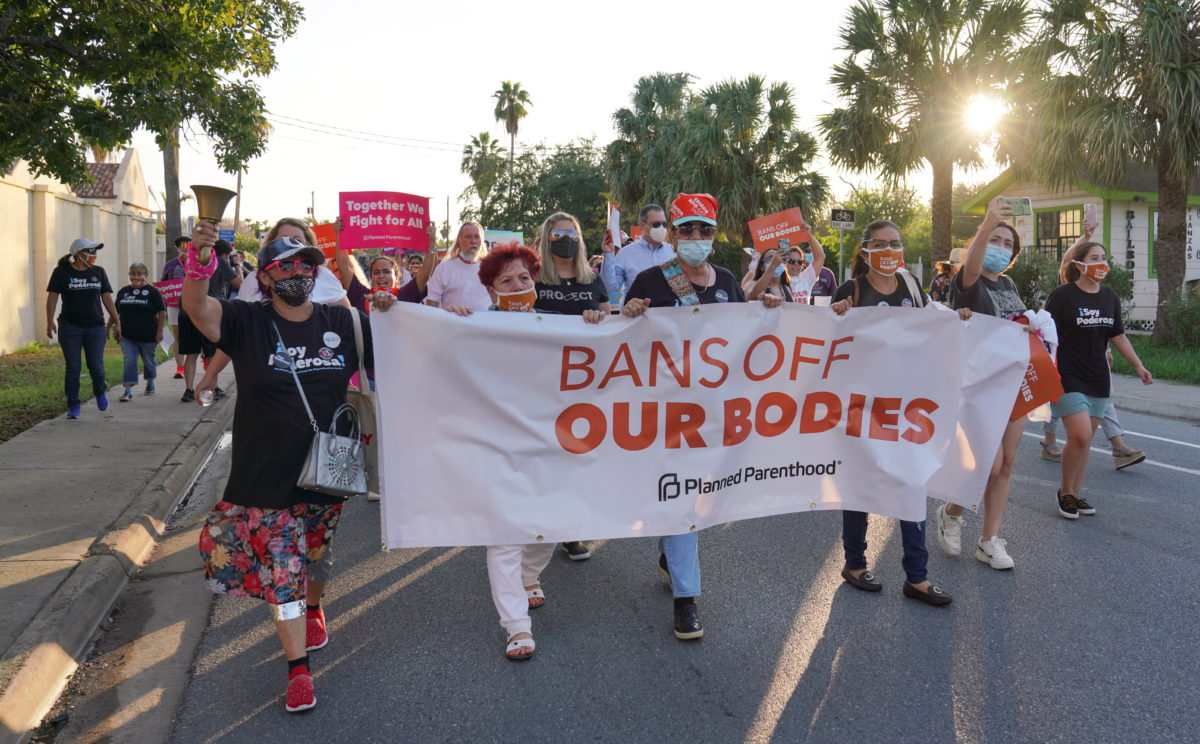
Supporters of reproductive choice take part in the nationwide Women’s March, held after Texas rolled out a near-total ban on abortion procedures and access to abortion-inducing medications, in Brownsville, Texas, U.S. October 2, 2021. REUTERS/Veronica Cardenas

The type of anti-abortion law enacted by the state of Texas last month is deeply unpopular with Americans, according to a new poll from the PBS NewsHour, NPR and Marist. The novel legal strategy empowers private citizens to file civil suits against anyone who aids a person getting an abortion, rather than rely on a state agency to bar the medical procedure.

It’s one of several restrictive abortion laws that are making their way through the courts. Two of them, from Kentucky and Mississippi, will be considered by the Supreme Court this term, which begins Monday.

Breaking down the numbers

abortion lawsuits horiz

Graphic by Megan McGrew

  • 74 percent of Americans said they oppose a law that allows private citizens to sue abortion providers or others who provide any assistance. This majority holds across party lines: 90 percent of Democrats, 57 percent of Republicans and 74 percent of independents don’t support such a law.
  • 18 percent of Americans support the rule, including 33 percent of Republicans, 18 percent of independents and 7 percent of Democrats.
  • Women are more likely than men to oppose the law (79 percent vs. 68 percent), and the same is true of people younger than 45 compared to those 45 and older (77 percent versus 71 percent).

lawsuits bar horiz

Graphic by Megan McGrew

Barbara Carvalho, director of the Marist Poll, said that attitudes toward abortion have stayed relatively consistent. “There is a very significant consensus among Americans. Our debate generally tends to be at the extremes, so it tends to get framed as an all or nothing. And I think that there’s a consensus among Americans that abortion should be legal, but with significant restrictions,” she said.

This consistency holds when it comes to enforcing abortion restrictions, she added. While this particular question has not been asked before, previous polling had similar results when it came to enforcing or criminalizing abortion, she said.

Poll respondent Joan Garnand, a Tennessee Republican, said she is completely opposed to abortion, and does not like this type of law because it could encourage opportunists to file lawsuits (those who sue and win can collect $10,000, and their legal fees can be reimbursed). She said she would support a law where the biological father or family could sue because they are directly connected to the terminated pregnancy.

Eric Johnson, a Republican who lives in New York, said he generally supports all anti-abortion laws, but he found the citizen enforcement component of Texas’ law too extreme. He added that abortions can’t simply be illegal, but that there need to be better options for people, like financial incentives, birth control access and a better foster care system.

Where Americans stand on abortion

Texas is far from the first state to attempt to make abortion illegal after six weeks, the earliest point at which cardiac activity may be detected and before some people even know they are pregnant.

  • In this poll, about one in three Americans support a law that outlaws abortions once there is cardiac activity — sometime after six to eight weeks — while 58 percent are opposed.
  • Those numbers are virtually unchanged since June of 2019, the last time a PBS NewsHour/NPR/Marist poll asked the same question.
  • Gallup, which has been tracking views on abortion since 1975, published a poll in May that found 32 percent of Americans think abortion should be legal under any circumstance, 48 percent think it should be legal under certain circumstances and 19 percent think it should be illegal in all circumstances. According to a Pew Research Center poll from the same month, 59 percent of U.S. adults think abortion should be legal in all or most cases, and 39 percent think it should be illegal in all or most cases.

Carvalho said that it is important to note that while the majority of Americans are against banning abortion between six to eight weeks, a portion of them may be against it because they do not think abortion should be legal at all.

What’s next

The Supreme Court begins a new term on Monday with a more conservative bench, and the future of abortion rights on the line.

The justices will hear arguments later this month in Cameron v. EMW Women’s Surgical Center, regarding a Kentucky law requiring that a fetus die in utero before a procedure known as “dilation and evacuation” can be performed during the second trimester. The court is not ruling on the law’s constitutionality, but examining a specific question: Whether the Kentucky attorney general can bring the case to the Supreme Court when no other state actors will defend the law. Law experts and abortion rights advocates say that decision could set the tone for future cases.

“It will give some indication about whether and to what extent the court is willing to basically overlook normal rules of procedure and ordinary processes in its eagerness to rule against abortion rights,” said Leah Litman, a constitutional law professor at the University of Michigan and podcast host of the Supreme Court-themed podcast Strict Scrutiny.“[The court’s] authority comes from the public’s willingness to accept its decisions and the public’s belief that the court is legitimate.”

On Dec. 1, the court plans to hear arguments in its biggest abortion case of the term, over a Mississippi law than bans nearly all abortions after 15 weeks — a direct challenge to Roe v. Wade and Planned Parenthood v. Casey, which prevents states from imposing an “undue burden” on someone seeking an abortion.

Litman said Roe v. Wade could be overturned, but the high court could also allow states to ban abortions before viability without saying it overruled the landmark decision. “That would be extremely destabilizing to the law and open the floodgates for a bunch of abortion restrictions that are definitely not allowed now.”

If Roe v. Wade is overturned, abortion would be instantly illegal in a dozen states and greatly restricted in several others. The Texas law has already effectively ended abortions in that state and so far the Supreme Court has refused to block the law, due to its unique enforcement mechanism.

In the meantime, a federal judge will decide whether to halt the Texas abortion ban after the Biden administration argued in court on Friday that it violates women’s constitutional rights. Abortion providers in the state say damage has already been done — people have been forced to go to other states for find medical care, and even if the law is knocked down, physicians may be hesitant to resume their services. Legislators in other states, like Florida and Missouri, have said they plan to introduce similar abortion bans with civil enforcement.

“The practical effect of these laws will be to prohibit abortions, even though the Supreme Court hasn’t said and won’t necessarily say Roe was overruled,” Litman previously told the PBS NewsHour.

Around the nation, thousands of people, many of whom were motivated by the Texas law, joined a Women’s March on Saturday to protest abortion restrictions and urge the Supreme Court to uphold Roe v. Wade.

“No matter where you live, no matter where you are, this moment is dark,” Planned Parenthood President Alexis McGill Johnson told a crowd at the “Rally for Abortion Justice” event in Washington, D.C.

Litman said it’s hard to know if support for legal abortion will influence justices on the current bench, given its more conservative makeup. But how the court rules on such cases could affect public confidence.

“[The court’s] authority comes from the public’s willingness to accept its decisions and the public’s belief that the court is legitimate. And if that’s no longer the case, the court’s institutional authority is at risk,” she said.

Source: https://www.pbs.org/newshour/health/most-americans-oppose-abortion-laws-that-let-private-citizens-sue-new-poll-says

Abortion is now incredibly difficult to access in Texas, and that’s especially true for young people, who already faced significant hurdles even before SB 8 went into effect.
 Leigh Vogel/Getty Images for Women’s March

If you’re under 18, it’s possible to access abortion in Texas, but thanks to the harmful laws and legal chaos, it’s extremely difficult.

UPDATE, October 8: SB 8 was temporarily blocked Wednesday night as part of the Department of Justice lawsuit. Attorneys for Texas have filed an appeal with the Fifth Circuit, asking for an emergency stay of the district judge’s order.

It’s been about a month since the Supreme Court more or less put its stamp of approval on Texas SB 8, which bans all abortions after six weeks with no exception for rape or incest, and only allows abortions to be performed after the six-week mark in the case of medical emergency.

To make matters worse, anyone who helps someone get an abortion—from the abortion provider, to the person who drives them to their appointment—can be sued for a minimum of $10,000 by absolutely anyone in the country.

By allowing SB 8 to go into effect, the Supreme Court has set a precedent that any state in the country can pass a similar ban, and while their decision didn’t technically overturn Roe v. Wade, a six-week ban is about as close to an outright abortion ban as you can get.

What does this all mean? Especially for young people? We’re here to break that down.

First of all, abortion is still legal in the state of Texas, and in neighboring states like Oklahoma. In fact, it’s still legal in the whole country. That’s the good news.

The bad news is abortion is now incredibly difficult to access in Texas, and that’s especially true for young people, who already faced significant hurdles even before SB 8 went into effect. Statistics show that in Texas, there are 24 births for every 1,000 women between age 15 and 19, and the state has the highest average of repeat teen births. Teen pregnancy and birth present many challenges and are often associated with poor educational and health outcomes.

To be clear, teen pregnancy is not the problem; the problem is barriers to education and care. Language around teen pregnancy and parenting too often is stigmatizing and centered on prevention, but young people, like pregnant people of any age, can be great parents if that’s what they choose and if given the support they need. They should be given resources to make the parenting decisions that are best for them. Texas is doing the opposite.

For starters, in order to have an abortion right now in Texas you have to catch your pregnancy really early; six weeks pregnant is typically two weeks after your missed period. That gives you, at the absolute maximum, a two-week window to get an abortion. But statistically speaking, young people detect their pregnancies later, and this makes sense. It takes a while to understand your cycle, and no matter what age you are, there are so many things that can make your period late–changes in diet, sleep, stress, or environment can all delay a period or make it start early.

Texas is one of 37 states that require young people to either involve a parent or obtain a judicial bypass to access abortion, which means that young people who can’t get a parent to approve their abortion have to go to court. That delays the abortion even more. Now let’s make one thing clear: Young people are entirely capable of making their abortion decisions however they are most comfortable, whether that involves a parent or not. And statistics show that in states without parental involvement laws, the majority of young people involve a parent regardless, and almost all young people involve a trusted adult in their abortion decision.

But for young people who can’t involve a parent, parental involvement laws only present further challenges; these are often young people in foster care, or whose parents have been deported or incarcerated, or who live in abusive households. And for these minors, the delays caused by the judicial bypass process will make it nearly impossible to get an abortion in Texas before that two-week window has passed.

As if that’s not bad enough, Texas also enforces a 24-hour mandatory waiting period for all abortions, adding another day’s delay.

The TLDR: If you’re under 18, it’s possible to access abortion in Texas, but thanks to a bunch of harmful laws it’s really really hard.

What to do if you need an abortion in Texas

Put in a call to Jane’s Due Process, a Texas-based nonprofit that works with young people to help them access abortion and other reproductive health care, including by providing support for minors going through the judicial bypass process. They have a 24/7 hotline that you can call or text: 866-999-5263. Jane’s Due Process can also help you find contraceptive services, so if that’s something you want to consider to help protect you against unplanned or unwanted pregnancy, they’ve got you covered.

“SB 8 is so devastating for minors because, on top of the complicated and time-consuming process of getting a judicial bypass, SB 8 would make it nearly impossible to get a bypass and get an abortion in a six-week time frame. I found out I was pregnant as early as I possibly could and I still had the abortion past six weeks,” said Veronika Granado, a youth advocacy fellow with Jane’s Due Process.

You might be eligible to access a medication abortion, which you can find more information about here. If you have questions about the risks of self-managed abortion, you can contact the Repro Legal Helpline online or at 844-868-2812, or the Miscarriage + Abortion Hotline, which is a free service.

Consider your traveling options. Traveling out of state is challenging for many reasons. For young people, the possibility of missing school, finding and paying for transportation, and finding somewhere to stay all complicate the option of traveling to a neighboring state with fewer abortion restrictions. Not to mention the complications added by a global pandemic. But if you can consider traveling, here’s what you need to know:

  • New Mexico has almost no abortion restrictions, including no parental consent law.
  • Oklahoma has a whole host of abortion restictions, including parental consent, a ban on telemedicine for medication abortion, and a mandatory ultrasound and waiting period. And while they don’t have an abortion ban now, lawmakers recently passed a six-week ban that will go into effect in November unless it is blocked by the courts.
  • Arkansas also has a number of abortion restrictions including a ban at 22 weeks’ gestation, a mandatory waiting period and mandated counseling, as well as a parental consent law.
  • Louisiana has a ban at 22 weeks’ gestation, mandatory counseling, a waiting period and ultrasound law, and a ban on telemedicine among other harmful restrictions.
  • If traveling further is an option, there are many states you can fly to where abortion is more accessible. New York Gov. Kathy Hochul recently announced that pregnant people from Texas would be welcomed in her state with open arms; states like Maine and California allow young people to have access to abortion without parental consent.

How to pay for your abortion. Check out the National Network of Abortion Funds; they have funds in every state that can help cover the costs of your abortion, including travel and lodging. You can also call your local clinic and ask them about any funding sources they might be able to connect you with, and the National Abortion Federation has a hotline that can help with abortion referrals and financial assistance.

More questions? AbortionIsLegal.org has got you. Find resources for paying for abortion, medication abortion options, and locating a clinic at their website.

Finally: Take a deep breath. Things are really scary right now, but there are a lot of people on your side: advocates working tireless to fight these laws and to help pregnant people access abortion care, and abortion providers in neighboring states ready to welcome patients to their clinics.

Source: https://rewirenewsgroup.com/article/2021/10/05/what-teens-need-to-know-about-texas-sb-8-and-accessing-abortion/

(Reuters) – A day after a federal judge blocked Texas’ near-total abortion ban, at least one provider in the state said it had resumed services on Thursday for patients seeking to terminate pregnancies beyond the law’s limit of about six weeks.weeks of pregnancy.

Amy Hagstrom Miller, chief executive of Whole Woman’s Health, told reporters that since the law went into effect on Sept. 1, the provider with four clinics in Texas had put patients on a waiting list if their pregnancies had advanced beyond the legal limit.

“So those folks were able to come in and we did provide them with abortion care today,” Hagstrom Miller said during a call on with reporters.

She did not say which clinics had resumed services or how many abortions they had provided.

U.S. District Judge Robert Pitman in Austin on Wednesday blocked here the state from enforcing the law while litigation over its legality continues. The Republican-backed measure empowers private citizens to enforce the ban, and Texas immediately appealed the ruling to the conservative-leaning Fifth Circuit Appeals Court.

The law has become a flashpoint in a national battle over abortion rights as Republican lawmakers in other states try to pass similar legislation here. In December, the U.S. Supreme Court will hear a Mississippi case testing Roe v. Wade, its landmark 1973 decision that established the nationwide right to abortion access.

Drexel University law professor David Cohen said Texas clinics that resume their previous abortion services while the law is blocked will be in a “very precarious position.” A clause in the law says providers can still be sued if the law goes back into effect after being struck down by a court.

Cohen said that even if Pitman’s injunction against the law were upheld by the Supreme Court on appeal, it could still be dissolved by a subsequent decision overturning Roe v. Wade, because that decision was the basis for Pitman’s ruling.

Hagstrom Miller said the retroactive clause was concerning for many medical professionals.

“Any abortion you provide, even with an injunction, could be seen as criminal a year from now, six months from now – and you could be held accountable for every one of those. It’s pretty daunting to think about that,” she said.

Anti-abortion advocates said that if Pitman’s ruling is reversed on appeal, they will sue providers who have resumed abortion services.

“As this case develops, if there’s an opportunity for lawsuits or for enforcement in the future, that’s something that the pro-life movement is very interested in,” said John Seago, legislative director for anti-abortion group Texas Right to Life.

Other Texas abortion providers acknowledged they were worried about the state’s vow to appeal the injunction to a conservative-leaning appeals court.

“Given the state’s appeal, our health centers may not have the days or even weeks it could take to navigate new patients through Texas’s onerous abortion restrictions,” the leaders of Planned Parenthood South Texas, Planned Parenthood Gulf Coast and Planned Parenthood Greater Texas said in a joint statement.

Molly Duane, an attorney with the Center for Reproductive Rights, which represents several Texas clinics fighting the law, said abortion providers were in a difficult situation.

“There are independent providers across the state that are working to reopen full services and are doing so wary of the fact that the Fifth Circuit may take away this injunction at any moment,” she said.

Source: https://www.reuters.com/article/us-usa-abortion-texas/texas-abortion-provider-resumes-services-after-judge-blocks-near-total-ban-idUSKBN2GX2AB?fbclid=IwAR15PxvTK0TVkuNfntCeT_DL5AbAVI-yUHDJSakB3njPJDu16LZ8IYRDXzY

Demonstrators rally against anti-abortion and voter suppression laws at the Texas State Capitol on October 2 in Austin. Montinique Monroe / Getty Images

“This Court will not sanction one more day of this offensive deprivation of such an important right,” Judge Robert Pitman wrote.

WASHINGTON — The status of abortion access in Texas was once again thrown into uncertainty Wednesday night after a federal judge issued an order halting enforcement of what he described as the state’s “flagrantly unconstitutional” 6-week abortion ban.

The immediate effect of US District Judge Robert Pitman’s 113-page ruling — and whether it will mean that providers can, or will, resume performing abortions — is uncertain. Just over an hour after Pitman issued his order, Texas filed notice that it would petition the US Court of Appeals for the 5th Circuit to intervene; the state is expected to ask the appeals court to put Pitman’s order on hold as quickly as possible, which would leave the law, SB 8, in place.

Pitman’s ruling came less than a week after he heard arguments on the Justice Department request for an injunction blocking the law. He refused to grant Texas’s request to pause his decision to allow state officials time to appeal, writing that Texas had “forfeited the right to any such accommodation by pursuing an unprecedented and aggressive scheme to deprive its citizens of a significant and well-established constitutional right.”

“From the moment S.B. 8 went into effect, women have been unlawfully prevented from exercising control over their lives in ways that are protected by the Constitution,” Pitman wrote. “That other courts may find a way to avoid this conclusion is theirs to decide; this Court will not sanction one more day of this offensive deprivation of such an important right.”

Abortion providers released statements praising Pitman’s ruling but suggesting they were not sure yet if they could begin scheduling abortions that SB 8 had made illegal. The law includes a section that says doctors who perform abortions or other people who assist a pregnant person based on a court decision that is reversed later on cannot rely on that original order as a defense if they’re sued. Planned Parenthood affiliates in Texas released a joint statement saying that, “While the Department of Justice’s swift action and the court’s order seek to restore Texans’ options to access abortion in their own state, we understand Texas will immediately appeal[.] Our patients and providers need the courts to allow care to resume.”

SB 8 has been in effect since Sept. 1. It bans nearly all abortions after fetal cardiac activity can be detected, which typically occurs around the sixth week of a pregnancy. Pitman’s order bars any state actor from taking steps that would permit enforcement of the law, which deputizes private citizens to sue doctors suspected of performing abortions or other individuals suspected of helping a pregnant person obtain the procedure.

The judge made clear that his order prohibits any state court judge or clerk from accepting, processing, or taking any other action on the civil lawsuits that private individuals could bring under SB 8. He wrote that the court would have the power to issue a direct injunction that bars private individuals from bringing these types of suits, since they would be acting on behalf of the state, but he would not do so at this stage; he noted that his order blocking state courts from accepting such a case would restrict their ability to act.

“A person’s right under the Constitution to choose to obtain an abortion prior to fetal viability is well established. With full knowledge that depriving its citizens of this right by direct state action would be flagrantly unconstitutional, the State contrived an unprecedented and transparent statutory scheme,” Pitman wrote.

Pitman ordered Texas to notify all state judges and state court employees affected by his decision and to publish his ruling on all public state court websites “with a visible, easy-to-understand instruction to the public that S.B. 8 lawsuits will not be accepted.”

Addressing Texas’s argument that siding with the Justice Department would open the floodgates to federal challenges to state laws, Pitman wrote that this case represented an “exceptional” situation where the constitutional rights of individuals were being violated and Texas had designed SB 8 to bar them from taking the state to court to protect those rights on their own.

Pitman rejected Texas’s contention that a court couldn’t issue an injunction against the state since the law was enforced via lawsuits filed by private individuals. He criticized the state for trying to use the unusual enforcement structure as both a “sword” — to carry out an early-term abortion ban that courts would almost certainly strike down if the state tried to enforce it on its own — and a “shield” against legal challenges.

The judge wrote that his order would send a message to other states that they could not attempt something similar to what Texas had tried to do, whether it was intended to serve a conservative or liberal political agenda — he alluded to commentary by pundits about whether SB 8 could serve as a model for Democrat-led states to find a way to restrict gun rights.

“The American legal system cannot abide a situation where constitutional rights are only as good as the states allow,” the judge wrote.

SB 8 took effect at midnight on Sept. 1 after abortion providers failed to convince the US Supreme Court and a federal appeals court to stop that from happening while they pursued a constitutional challenge. Healthcare providers across the state immediately announced that they would comply with the law and stop performing abortions in cases where fetal cardiac activity could be detected, usually at the sixth week of pregnancy; providers have said 85 to 90% of abortions in the state take place after week 6.

Pregnancy terms are counted from the first day of a person’s most recent period, so six weeks is typically two weeks after a missed period, which is when many people first realize they’re pregnant. Early-term state abortion bans are often referred to as “heartbeat” laws but that term is misleading, since a fetus’s heart valves haven’t formed at that point; an ultrasound at that stage is detecting electrical activity. Pitman wrote in a footnote that the term “heartbeat” was “medically inaccurate.”

With the abortion providers’ case held up in the 5th Circuit, the Justice Department filed its own constitutional challenge to the law on Sept. 9.

Unlike other early-term state abortion bans swiftly struck down by federal courts, the Texas law is unique in that it delegates enforcement to private citizens. Instead of authorizing a prosecutor to press charges or interfering with a clinic’s ability to get a license and operate, the law empowers individuals to file a civil lawsuit against a doctor they suspect of performing an abortion that’s now illegal in the state, or anyone who “aids or abets” that abortion — a category so broad that it could apply to a person or group that helped pay for the procedure, provided transportation to a clinic, or accompanied a patient.

The law created financial incentives for people to sue and placed few limits on who could bring a case; one of the only bright-line rules is that a pregnant person who receives an abortion cannot be sued. A plaintiff who wins can collect $10,000 or more in damages per abortion, as well as their legal costs. If a judge dismisses a case, the defendant cannot recoup their legal costs, so there’s no penalty for bringing a meritless case and pulling abortion providers and anyone else into court. The law doesn’t require a plaintiff to have any connection to the patient.

That unusual structure opened the door for Texas to argue that Pitman didn’t have jurisdiction to consider a sweeping constitutional challenge to the law brought by the Justice Department, or anyone else for that matter — that is, until someone actually brought a lawsuit, any case was based on speculation about what might happen, and there was no one the court could enter a judgment against in the meantime.

During arguments last week, Pitman offered signs that he was skeptical of Texas’s position that there was no way for a court to review the constitutionality of the law, and called out the state for attempting to find a work-around when so many other states had been knocked out of court for trying to adopt early-term abortion bans that ran afoul of Supreme Court precedent. If Texas was “confident” a six-week ban was constitutional, he asked at the time, why did the state “go to such great lengths” to avoid directly enforcing it?

For decades, Supreme Court precedent has held that state abortion bans before a fetus is viable — typically at around week 24 of a pregnancy — are unconstitutional. The justices are poised to revisit that issue in another case already on the court’s docket for the term that started this week, involving a challenge to Mississippi’s 15-week abortion ban.

As the Justice Department’s case presses on, the abortion providers are waiting to find out if the Supreme Court will consider their latest petition for the justices to intervene. On the eve of SB 8 taking effect, the 5th Circuit had put that case — also before Pitman — on hold after Pitman rebuffed an early effort by the defendants named in that case to have the case dismissed. The law took effect after a majority of the justices declined to disturb the 5th Circuit’s handling of the case.

A 5th Circuit panel later explained that there was a good chance the abortion providers would lose on the question of whether they could sue at all, and the case is now waiting for the appeals court to make a definite ruling on that. The abortion providers on Sept. 23 asked the justices to skip that next step before the 5th Circuit and take up the question as soon as possible of whether anyone could sue. The justices have yet to take any action on the question.

Source: https://www.buzzfeednews.com/article/zoetillman/judge-block-texas-abortion-law?fbclid=IwAR1Tixkx2CQuz72q3jXP5sv3VLQemjF7EIexWB4Djm9jybJ_N4hr2KNMTng