WASHINGTON – The steps President Joe Biden took early in his administration to reverse his predecessor’s policies on reproductive health issues drew howls from abortion opponents.

Biden, whose positions on abortion issues have evolved over the years, still faced some skepticism from abortion rights advocates about his commitment to their cause. One sign had been the administration’s avoidance of the word “abortion” in favor of more generic phrases such as “reproductive health” and “women’s health access.”

Biden faces his biggest test of that commitment in his response to a new Texas law that bans the procedure after about six weeks of pregnancy – and is likely to be copied by other GOP-led states.

Biden did, for the first time since his inauguration, use the word “abortion” in his statements condemning the law, which the Supreme Court allowed to go into effect last week. He called the law “almost un-American” for its reliance on private citizens to sue abortion providers and anyone involved in “aiding and abetting” abortions.

His team met Friday with women’s rights and reproductive health leaders to discuss how to fight the statute.

Marcela Howell, president and CEO of In Our Own Voice: National Black Women’s Reproductive Justice Agenda, said that although she believes Biden supports reproductive rights, he needs to do more – especially from the bully pulpit.

“Extraordinary circumstances call for extraordinary action,” she said, “and it’s time for him to demonstrate that in a much bigger way.”

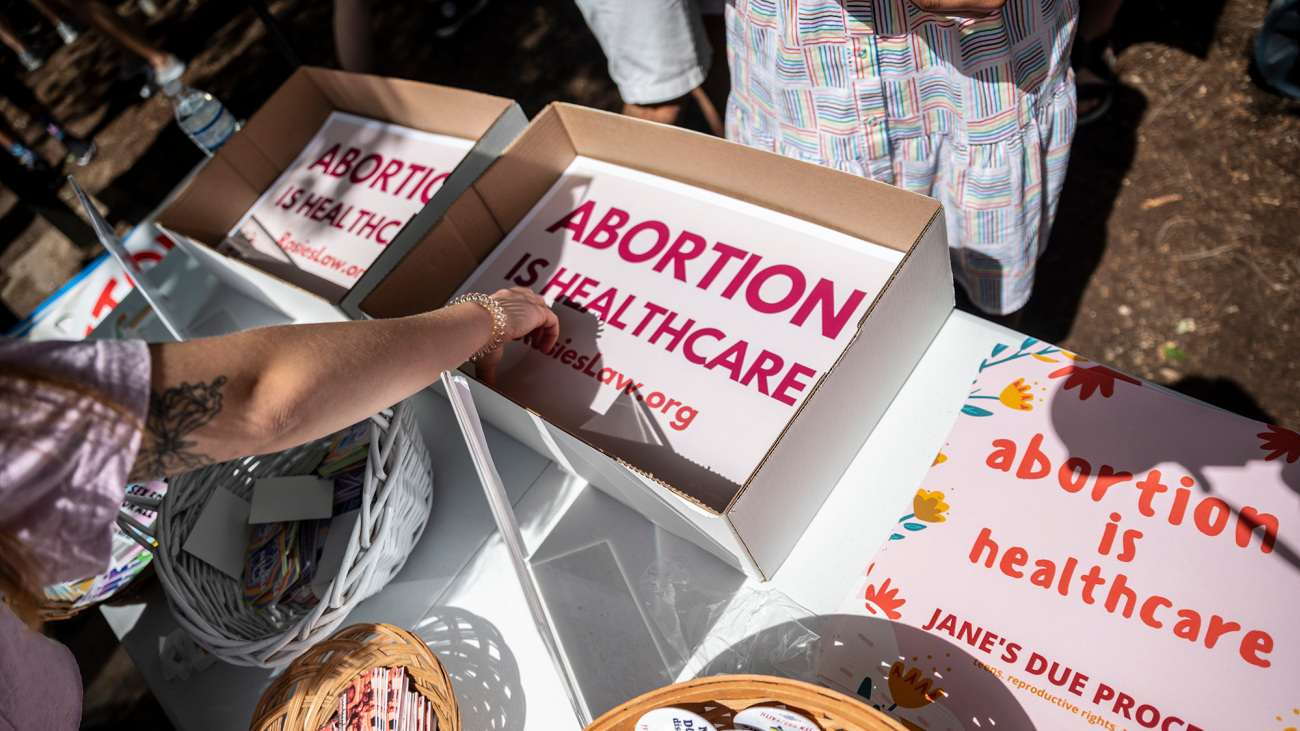
Sept 1, 2021; Austin, TX, USA; Jillian Dworin participates in a protest against the six-week abortion ban at the Capitol on Wednesday September 1, 2021.  Dozens of people protested the abortion restriction law that went into effect Wednesday. Mandatory Credit: Jay Janner-USA TODAY NETWORK ORIG FILE ID:  20210901_ajw_usa_024.JPG

Jillian Dworin participates in a protest against Texas’ six-week abortion ban at the state Capitol on September 1, 2021.  JAY JANNER, JAY JANNER / AMERICAN-STATESMAN

Activists want the administration to embrace actions such as suing Texas, meeting with Texas women affected by the law, easing restrictions on medication abortion and endorsing legislation in the House that would codify the Supreme Court’s Roe v. Wade decision establishing abortion rights in 1973.

The Texas law increases pressure on Biden to back changes to the filibuster and to the makeup of the Supreme Court. 

“I think they were getting the full picture of the urgency and responding appropriately,” said Nancy Northup, president and CEO of the Center for Reproductive Rights, who attended the meeting with White House officials.

Biden, an observant Catholic, has long wrestled with the issue as the Democratic Party’s unanimity on abortion rights increased.

Last year, Biden reversed his decades-long support for the Hyde Amendment, which prohibits federal funding for most abortions.

President Joe Biden speaks with a priest at St. Joseph on the Brandywine Catholic Church in Wilmington, Del., on June 19.

President Joe Biden speaks with a priest at St. Joseph on the Brandywine Catholic Church in Wilmington, Del., on June 19.  OLIVIER DOULIERY, AFP VIA GETTY IMAGES

Soon after taking office, Biden allowed federal funds to flow again to international groups that provide or refer patients for abortion services and moved to undo restrictions on U.S. clinics that provide abortion counseling or services. His first budget request did not include the Hyde Amendment.

Biden, who said he personally opposes abortion, frames his views in the context of one of his top priorities: creating a more equitable society for people of color and other marginalized groups.

The U.S. Conference of Catholic Bishops is working on a document that could rebuke Catholic politicians for receiving Communion if they support abortion rights.

White House press secretary Jen Psaki sparred last week with a reporter from EWTN Global Catholic Network. The reporter asked how Biden can support abortion when “his own Catholic faith teaches that abortion is morally wrong.”

“Well, he believes that it’s a woman’s right, it’s a woman’s body, and it’s her choice,” Psaki told the male reporter. ”I know you’ve never faced those choices, nor have you ever been pregnant. But for women out there who have faced those choices, this is an incredibly difficult thing.”

White House press secretary Jen Psaki affirms the president's support for abortion rights.

White House press secretary Jen Psaki affirms the president’s support for abortion rights.  GETTY IMAGES PHOTO; USA TODAY GRAPHIC

The next day, White House officials met virtually with 11 leaders of women’s rights and reproductive health organizations.

Advocates hopeful, but details remain unclear

Fatima Goss Graves, president and CEO of the National Women’s Law Center, said she was pleased that the administration committed to using every tool at its disposal to respond to the Texas law.

“And that was the thrust of the meeting,” Goss Graves said. “What does that mean in practice, in this time of both constitutional crisis and a literal public health emergency on the ground where people who need care are at risk of not getting it?”

The answer is unclear.

Attorney General Merrick Garland said in a statement Monday that the Justice Department will enforce a 1994 law prohibiting threats, physical obstruction or property damage to try to prevent someone from seeking or providing reproductive health services at a clinic.

He didn’t detail how that would work. Psaki said Wednesday the Justice Department and Department of Health and Human Services are still evaluating their options.

Goss Graves said she expects “ongoing updates.”

“We will be watching closely to ensure that becomes a reality,” she said. “This is one of those moments where people will be asking, ‘What side of history were we on? Where were our leaders when there was this effort to totally undermine our access to care and our fundamentally protected rights?’”

Northup, of the Center for Reproductive Rights, urged the Justice Department to take every possible action, including suing Texas, enjoining the law and considering criminal prosecutions for the deprivation of civil rights.

“I have full confidence that they will move as soon as they can,” she said.

Alexis McGill Johnson, president and CEO of the Planned Parenthood Federation of America, hopes Biden and Vice President Kamala Harris will go to Texas to talk with patients “to understand what is actually happening on the impact of the law.”

Planned Parenthood is pushing the administration to get behind the Women’s Health Protection Act, legislation that would block restrictions on reproductive health services that House Democrats plan to bring to the floor this month.

“We shared our thoughts with the administration on Friday,” McGill Johnson said. “All of these things are in conversation.”

Planned Parenthood and others called for the administration to lift the FDA’s restrictions on Mifepristone, a drug used to end early pregnancies. Psaki said Wednesday that’s “a decision that the FDA has to make on their own, based on science.”

Abolish the filibuster? Expand the court? 

Though Biden supports codifying Roe v. Wade, Psaki demurred when asked if he backs the Women’s Health Protection Act as the way to do it.

“We’re still looking at whether that’s a vehicle we’re going to support,” she said Wednesday.

The bigger hurdle for legislative actions is the Senate, where Democrats don’t have enough votes to block a filibuster. That intensifies the pressure Biden already faced – over voting rights and other issues – to support changes to the filibuster.

The Texas law adds significance to the commission Biden tasked with reviewing the structure and operation of the Supreme Court by early October.

“In the long term, the best way to protect women’s rights is to add at least two justices to the Supreme Court,” Dan Pfeiffer, a top aide in the Obama administration, wrote in The Message Box newsletter.

(FILES) In this file photo taken on March 04, 2020 pro-choice activists supporting legal access to abortion protest during a demonstration outside the US Supreme Court in Washington, DC, as the Court hears oral arguments regarding a Louisiana law about abortion access in the first major abortion case in years. - A US federal appeals court on March 31, 2020 ruled that Texas could temporarily suspend abortions as part of its response to the coronavirus crisis, overturning a ruling by a lower court the day before.

The governor of the conservative-leaning Lone Star State, Greg Abbott, had decreed that elective procedures should be delayed to ensure readiness to treat virus patients -- and to conserve protective gear for frontline workers. (Photo by SAUL LOEB / AFP) (Photo by SAUL LOEB/AFP via Getty Images) ORIG FILE ID: AFP_1QB28H

Abortion rights activists protest during a demonstration outside the U.S. Supreme Court on March 4, 2020.  SAUL LOEB, AFP VIA GETTY IMAGES

Expanding the court and abolishing the filibuster are among the priorities for Tamika Middleton, deputy director of the Women’s March who was not a participant in Friday’s White House meeting.

The group has worked with dozens of organizations to mobilize a show of support for abortion rights before the Supreme Court returns in the fall. The court signaled its readiness to take another look at abortion rulings by agreeing to consider Mississippi’s attempt to ban most abortions after 15 weeks of pregnancy.

The Texas law added urgency.

“We knew that we needed to mobilize more quickly,” Middleton said of marches planned for Oct. 2 in every state.

The response from the administration, she said, has not been strong enough to deter other states from passing similar laws.

“This is an emergency moment,” she said. “We have to take clear and immediate and strong action.”

Renee Bracey Sherman, founder and executive director of We Testify who was not at the White House meeting, said the administration’s actions should start with Biden talking openly about abortions.

Bracey Sherman, whose group helps people who’ve had abortions share their stories, created a website tracking how long it took Biden to use the word. She found it “absolutely wild” that even the presidential statement recognizing the 48th anniversary of the Roe v. Wade decision did not use it.

“If he truly believes that abortion access is a human right and that it’s a constitutionally protected service, then he should be able to come out and address the country and talk about that, talk about his values, why, as a Catholic man, he believes that people should have access to abortions,” Bracey Sherman said. “How can you advocate for something without talking about it?”

Asked last week about Biden’s seeming reluctance to use the word until the Texas law went into effect, Psaki declined to say whether that was deliberate.

Her response was an acknowledgment that abortion rights activists are paying close attention to the president’s response.

“I think the most important value people should look at is what the president does in his actions and what he fights for,” she said. “And I don’t think I’m going to have any other assessment beyond that.”

Source: https://eu.usatoday.com/story/news/politics/2021/09/08/abortion-rights-groups-want-bigger-response-biden-texas-law/5761181001/

The city of Portland, Oregon, announced it intends to ban trade and travel to the state of Texas in response to the Lone Star State’s new abortion law.

Mayor Ted Wheeler announced Friday that the city council intends to vote on an emergency resolution Wednesday to stop “the City’s future procurement of goods and services from, and City employee business travel to, the state of Texas.”

The resolution will be in effect until Texas ends the law or it is overturned. It’s not exactly clear what such a ban would look like.

“City legal counsel is currently evaluating the legal aspects of this proposed resolution,” a release from the city council said.

“The Portland City Council stands unified in its belief that all people should have the right to choose if and when they carry a pregnancy and that the decisions they make are complex, difficult, and unique to their circumstances.”

Portland Mayor Ted Wheeler
Portland Mayor Ted Wheeler announced the city of Portland intends to ban trade and travel to the state of Texas.AP Photo/Craig Mitchelldyer, File

The new Texas law, S.B.8, was signed by Gov. Greg Abbott in May and went into effect last week after the US Supreme Court declined to hear the case.

It bans all abortions once a fetal heartbeat can be detected, which is typically about six weeks after conception and before many women are aware they are pregnant.

Additionally and uniquely, the law allows for private residents bring legal action against anyone who assisted in terminating the pregnancy, including those who drive a woman to the abortion appointment. Citizens who win such lawsuits may be entitled to at least $10,000.

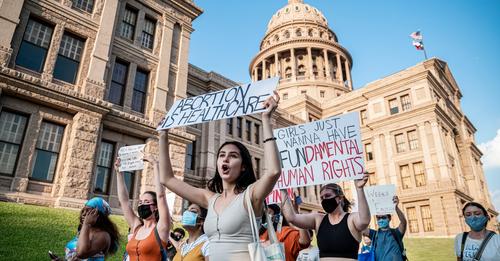
Pro-choice protesters march outside the Texas State Capitol on Wednesday, Sept. 1, 2021 in Austin, TX.
Pro-choice protesters march outside the Texas Capitol on Wednesday, Sept. 1, 2021, in Austin.

“This law rewards private individuals for exercising surveillance and control over others’ bodies. It violates the separation of church and state. And, it will force people to carry pregnancies against their will,” the council’s statement said.

“Portland City Council stands with the people who may one day face difficult decisions about pregnancy, and we respect their right to make the best decision for themselves.”

The law sparked immediate outcry nationwide, and legal battles have already begun.

On Friday, a Texas district judge issued a temporary restraining order against the anti-abortion group Texas Right to Life, which launched a “whistleblower” website asking for tips about abortions.

anti-abortion rights demonstrators gather in the rotunda at the Capitol while the Senate debated anti-abortion bills in Austin, Texas.
The nation’s highest court has allowed a Texas law banning most abortions to remain in effect.

On Monday, US Attorney General Merrick Garland said the Justice Department would “protect those seeking to obtain or provide reproductive health services” under a federal law known as the Freedom of Access to Clinic Entrances Act.

Garland said in a statement that federal prosecutors are still urgently exploring options to challenge the Texas law.

President Biden called the law “almost un-American” on Friday, and pledged to work with the Justice Department to fight against it.

“The most pernicious thing about the Texas law: It sort of creates a vigilante system where people get rewards … And it just seems — I know this sounds ridiculous — almost un-American, what we’re talking about.”

Florida may be considering a similar abortion ban.

Source: https://nypost.com/2021/09/06/portland-to-cut-trade-travel-with-texas-amid-abortion-law/?fbclid=IwAR1U_ILmSLowxeOwsPPoqFK0GoFjswx6oaEBbsOuIegV-vWA2e6_2eJS9xc

BY SERGIO FLORES/WASHINGTON POST/GETTY IMAGES

All ideas are in the air, from backing groups that support abortion access to taking a page from Lysistrata. 

aced with a draconian new restriction on abortion rights in Texas (home to nearly 30 million people, four million more than Australia), most reasonable people are wondering, “what the hell do we do now?” That includes Hollywood, and judging by the voices so far, women’s bodily autonomy is an issue that could prompt action. 

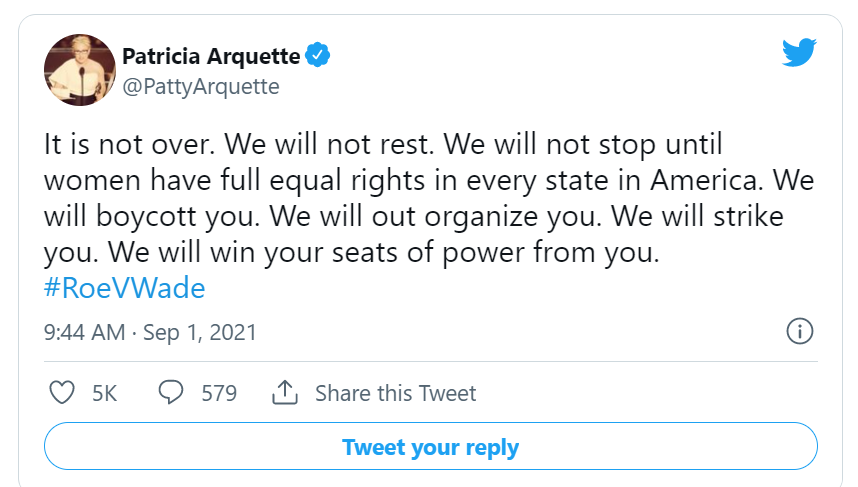
Actress and advocate Patricia Arquette was one of the first out of the gate to suggest a Hollywood boycott. “We will not stop until women have full equal rights in every state in America. We will boycott you. We will out organize you. We will strike you,” she wrote.

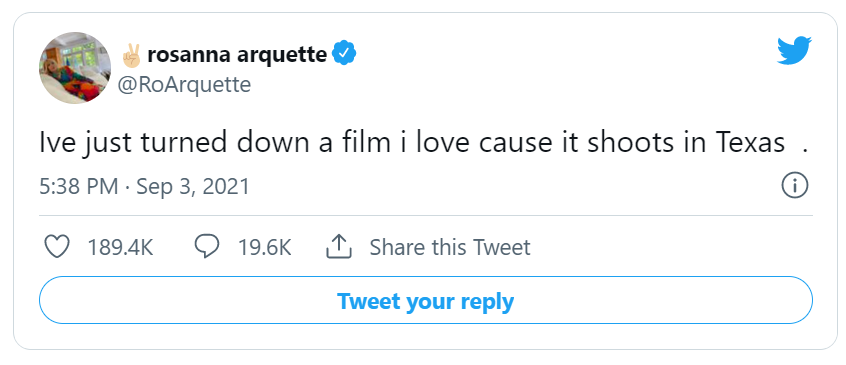
Soon after, her sister Rosanna Arquette put her money where her mouth was.

Author Megan Kelly Hall suggested that all entertainers should cancel their Texas dates.

Such a move is not entirely out of the question. For the time being, abortion access is severely curbed in Texas, barring action like a new congressional bill. But nationwide, the future of the landmark Supreme Court decision Roe v. Wade remains under threat. And Republicans in other states, including Florida, are looking to make similar moves to the Lone Star State, emboldened by the Supreme Court’s failure to protect the rights of people who need abortions there. 

In 2019, when abortion rights were threatened in Georgia, forces in Hollywood put up a fight. Netflix said they would “rethink its investment.” Kristen Wiig didn’t only make threats; she changed locations on Barb and Star Go To Vista Del MarBob Iger, who was CEO of the Walt Disney Company at the time, said that “many people who work for us will not want to work there, and we will have to heed their wishes in that regard. Right now we are watching it very carefully.” (Thanks to tax credits initiated in 2008, Atlanta has become a major hub for film and television production, even dubbed “The Hollywood of the South!”). But Texas presents an even more formidable challenge, given that the Supreme Court failed to block the law, possibly foreshadowing what’s to come for people in red states who don’t have the means to travel to exercise their reproductive rights. 

As of Saturday, social media had no shortage of celebrities piping mad about what happened in Texas (see the Twitter feeds of Bradley WhitfordBarbra StreisandGeorge Takei, among many others). But the idea of a Texas-wide boycott does not yet appear to be reaching anything close to a consensus.

Jack Antonoff announced he’d still bring his act to Texas, but proceeds from those shows will go to groups that support abortion rights until the laws are repealed.

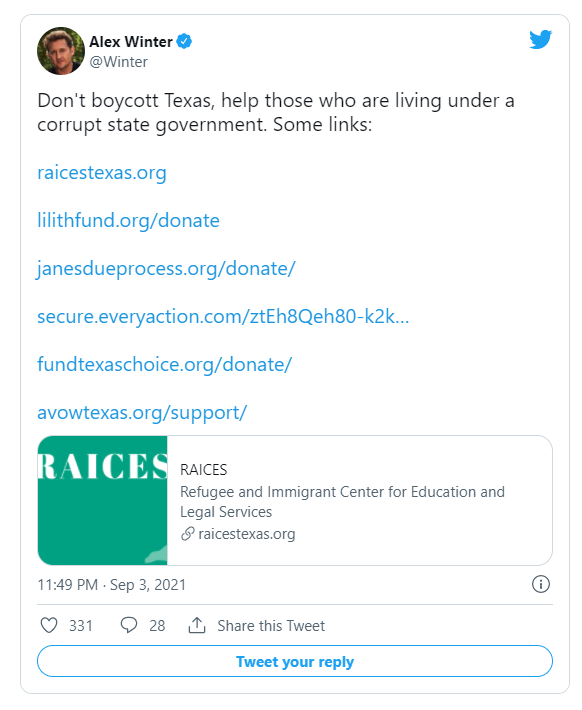
Actor and documentary filmmaker Alex Winter also seemed less keen on a boycott but suggested ways to help people living in Texas.

Similarly, actress and advocate Alyssa Milano, in an interview with the Los Angeles Times said, “I don’t know if a Hollywood boycott would do much directly. But a Hollywood-driven boycott of companies which fund the campaigns of [Gov.] 

Greg Abbott and others like him might hurt more.” She added that a boycott could “hurt the people who are most affected by these new laws” and instead hoped to get “the entertainment industry united and loud in pushing for immediate federal reform and relief [which] will protect women everywhere in America.” 

Harking back to classical antiquity, Bette Midler fired off a tweet that gained a lot of traction, offering a spin on Lysistrata. At this point, it can’t hurt.

Source: https://www.vanityfair.com/hollywood/2021/09/we-will-boycott-you-how-hollywood-is-responding-so-far-to-texass-abortion-law?fbclid=IwAR1NR7l07sOTYbYP5XTIEUOTKTfS65bKhHyr7XWAkS1eUaV_yBEY0nOxj4g

“We will not tolerate violence against those seeking to obtain or provide reproductive health services, physical obstruction or property damage in violation of the FACE Act,” Attorney General Merrick Garland said in the Department of Justice statement.
 Kevin Dietsch/Getty Images

By announcing the Justice Department was looking at the FACE Act to fix Texas SB 8, the administration announced it was effectively doing nothing at all.

The Department of Justice on Monday announced it was “urgently” exploring all options to challenge Texas SB 8, the blatantly unconstitutional pre-viability abortion ban the Supreme Court allowed to take effect last week.

The announcement, made via press release on Labor Day, said the Justice Department would “not tolerate violence against those seeking to obtain or provide reproductive health services, physical obstruction or property damage in violation of the FACE Act.”

Monday’s announcement is, to borrow a Texas euphemism, all hat and no cattle. Here’s why.

The Freedom of Access to Clinic Entrances (FACE) Act is a federal law prohibiting the use of force, threats, and/or physical obstruction to injure, intimidate, or interfere with a person seeking to obtain or provide abortion services. It also prohibits intentional property damage of a facility providing abortion services. Congress passed it in 1994 following a wave of anti-choice terrorism that resulted in the murder of Dr. David Gunn in Pensacola, Florida.

In many ways the FACE Act is a natural tool for the Biden administration to use in fighting back against SB 8 because the origins—or the most pernicious parts of the Texas ban—are found in the roots of anti-choice terrorism. But those origins also show the limitations of enforcing the FACE Act.

SB 8 not only bans abortion as soon as a provider detects cardiac activity in the embryo, which can occur as early as six weeks into a pregnancy, it also outsources enforcement of the ban to private citizens, effectively deputizing third parties to act as agents of the state as an attempt to insulate the law from successful legal challenge. It’s a mess of a provision that has caught many legal observers off guard, but it’s not a new tactic for the anti-choice movement.

Secret criminal investigation

In 2003, shortly after taking office, Kansas Attorney General Phil Kline, a staunch anti-abortion advocate, opened a secret criminal investigation to search for evidence of wrongdoing by area Planned Parenthood affiliates and Dr. George Tiller, a Kansas-area abortion provider. As part of that investigation, Kline asked a state judge to issue more than 90 subpoenas for complete original patient medical records. A big court fight ensued around the records that resulted in partially redacted medical records being disclosed to Kline’s office.

What happened next is the stuff of nightmares. While Kline was fighting to publicize abortion clinic records, he was also in a big re-election fight. He lost, and in 2007 on the last day in office as attorney general, Kline directed his staff to make photocopies of the redacted medical records. For the next two months, Kline and his goons moved these records unsecured and unprotected all around a state known as a hotbed of anti-abortion terrorism and violence.

Meanwhile, Kline’s electoral loss wasn’t the end of his political career in Kansas. After his loss but before Kline left office, the Johnson County Kansas Republican Central Committee named Kline to a two-year term as district attorney.

As district attorney, Kline filed more than 100 baseless claims against abortion providers in the state. The amplification had deadly consequences. In 2009, Scott Roeder murdered Dr. George Tiller while Tiller was serving as an usher at his local church.

Kline’s law license was suspended indefinitely for these actions. He is currently an associate law professor at Liberty University.

Tiller’s murder sent shockwaves through the abortion rights and access community, but it didn’t come as a surprise thanks to the environment Kline cultivated. Just one year after Dr. Tiller’s death, threats to other providers began.

Some, like the letter and bomb threats to Dr. Mila Means, were specific and targeted. Others were more diffuse. In 2012 Troy Newman, then the president of Wichita-based Operation Rescue, announced his organization was in possession of dozens of patient records from a local abortion clinic. At the time, Newman claimed a confidential informant delivered him the patient records. Cheryl Pilate, an attorney for the clinic in 2012, told local press that someone had broken into a locked dumpster on clinic property. Newman used the records as an opportunity to call for more investigations of abortion providers in the area and, perhaps more chillingly, to just let the public know a group with ties to acts of domestic violence was in possession of patient records.

The terroristic tactics would spread. All while the FACE Act was on the books.

Surveilling patients and providers

Jonathan Bloedow is a name familiar to those who track anti-choice violence. Back in the early days of the Obama administration, Bloedow began filing a series of records request under Washington’s state’s Public Records Act, looking for details on abortions provided at clinics around the state. Bloedow’s requests sought information like the patient’s race and age, last known address, and at what point in the pregnancy the abortion occurred.

Bloedow had at least one purpose in mind with each of those records requests—using the information gathered from the state to launch lawsuits accusing Planned Parenthood affiliates of fraud. Along with attorneys from the Alliance Defending Freedom, the anti-civil rights advocacy organization that Justice Amy Coney Barrett has ties to, Bloedow sued Planned Parenthood in 2011, accusing the reproductive health-care provider of attempting to defraud Congress. Bloedow’s lawsuit was just one of several brought by ADF attorneys that relied on early surveillance techniques by anti-choice activists.

At the time, Operation Rescue activist and Troy Newman associate Cheryl Sullinger applauded the tactics, telling the Washington Post that the surveillance was necessary because this is “about saving the lives of women.”

Bloedow’s lawsuits were eventually dismissed, but those dismissals were hardly the end of the anti-choice community using private parties to surveil patients and providers. In 2015 anti-abortion activist David Daleiden released a series of heavily edited videos through a front organization called the Center for Medical Progress that claimed Planned Parenthood affiliates were selling fetal tissue for profit. Daleiden and other private citizens infiltrated provider conferences, surreptitiously recorded conversations, and then released the videos in a smear campaign designed to curtail abortion access. In the course of the litigation around the CMP videos it was revealed that other major anti-choice advocacy organizations were involved as informal advisers, including Americans United for Life and Troy Newman.

Not enough

Which brings us back to Monday’s announcement that the Biden administration is looking at using the FACE Act as a response to Texas SB 8: The FACE Act is quite simply not enough to deal with the threat facing abortion access in this country—and it really never was enough. The statute provides for both criminal and civil penalties, which is a good thing, but the penalties alone are not enough to disincentivize anti-choice violence. And the FACE Act is only as effective as the will of the attorneys and federal judges tasked with enforcing it, which means the Justice Department will be relying on a host of Trump judges to enforce it.

Furthermore, the FACE Act almost by definition is reactive because an attorney bringing a FACE Act claim will need to establish evidence of a threat or interruption of access—and at the point that evidence exists, the chilling effect on abortion rights and access has already taken hold.

That’s not to say Attorney General Merrick Garland shouldn’t try here. Quite frankly the Biden administration needs to try everything it can to respond to the threat facing abortion providers and patients, including FACE Act enforcement.

But that enforcement is not enough, and we need to be clear-eyed in assessing promised Democratic responses to the crisis of abortion access in this country. Monday’s statement and promised action land flat because they once again depend on the courts and assume that conservative judicial appointees will faithfully apply the law to protect abortion access in Texas. That is the kind of magical thinking that helped get us into this mess.

Source: https://rewirenewsgroup.com/article/2021/09/07/biden-administration-responds-to-texas-abortion-vigilantes-and-somehow-makes-it-worse/

In May 2021, thousands of protesters came out in response to a new Texas bill outlawing abortions after six weeks.Sergio Flores/Getty

“If I say abortion exists as a concept, can I get sued?”

Last night, when I was up too late doomscrolling through Twitter while mourning the demise of women’s constitutional rights, I couldn’t stop thinking of my friend, who I’ll call Laura. Laura is an OB-GYN in Fort Worth, Texas. Since she moved there almost five years ago from the East Coast, our communication has shifted from our favorite trash TV shows to lamenting the bleak outlook for women and women’s health care in her new home state.

Even for someone who follows the news, the human consequences of Texas’ relentless assault on reproductive rights came as a bit of a shock to Laura—like when, shortly after she’d moved there, a pregnant woman in her early 40s and in a hostile relationship sought advice. “She was devastated and scared to get an abortion, personally and culturally, but knew she needed to do it,” Laura tells me. “So I counseled her, supported her, and went to my desk to call and schedule it.” The hospital representative asked how many weeks the patient was, and “just because it’s a new place [for me], I’m like, ‘It’s good to do an elective [abortion] here?’ The woman on the other side of the phone loses it and says, ‘Oh my gosh, absolutely not. We don’t do that.’”

Laura called three other places—hospitals and ambulatory surgical centers where she has surgical privileges. They all told her no. Laura had to go back to the patient and tell her she could not do it, and that she’d need to go to a clinic, but the woman balked. “She says she can’t do that—knows about the protesters. She says she could only do it after forming a bond with the doctor who counseled her: me.” Now, at least until the Supreme Court intervenes, the options are drastically worse for women like Laura’s patient.

Texas was never an easy place to be an OB-GYN, but when SB 8 took effect at midnight last night, banning abortions at six weeks and deputizing citizens to inform on people who “aid and abet” abortions, it became damn near impossible. (This is why Laura and I agreed not to use her real name or identify exactly where she practices.) Sure, Laura, who has privileges at a big private hospital in Fort Worth, rarely provides any abortions herself, but she can’t help but worry that giving her best medical advice will land her in court. She takes some solace in knowing that most of the brave people providing abortions “are together,” overwhelmingly working in clinics like Planned Parenthood and Whole Woman’s Health, where they will figure out the next steps. But, she says, that still “leaves behind counseling. When a young patient shows up, what can I say or do?”

We caught up on Wednesday morning to talk about what it’s like on the ground right now after this momentous change. She called from her car, parked at a church next to the “eerily empty” Whole Woman’s Health clinic in Fort Worth, which was one of the biggest abortion providers in the state. Our conversation has been edited for length and clarity. 

Well, well, well. Sad to talk to you today.

Well, hello—just another day in the new but old America that is Texas.

It’s chaos!

Well—it’s not chaos. It’s just government functioning as usual. It’s mental and emotional chaos.

This morning I was walking around the hospital and am like, Is anyone else thinking about this like I am? It feels normal here. Oh, are we all good? There are definitely people who I know for sure are anti-abortion, so I wouldn’t bring it up at work. But we got an email this morning saying something like: Reminder this went into effect today. It was mostly screenshots highlighting the language of the actual law. 

Source: https://www.motherjones.com/politics/2021/09/sb8-texas-what-its-like-obgyn-abortion-reproductive-rights/

Justices Brett Kavanaugh and Amy Coney Barrett did what they’ve set out to do since they were nominated—dismantle abortion rights.
 Jonathan Ernst-Pool/Getty Images

In a 5-4 ruling, Justices Barrett, Kavanaugh, Alito, Gorsuch, and Thomas let the Texas abortion ban stand.

The Supreme Court let the most restrictive abortion ban in the country—Texas SB 8, which bans abortion at about six weeks’ gestation—take effect without a single court hearing arguments on its constitutionality.

This is bad. I cannot stress just how bad this is.

Let’s just get this out of the way: We can stop debating about whether the Court overturned Roe v. Wade. They did. So what if it’s on a technicality? It’s not a technicality to the people forced to carry pregnancies to term against their will.

The Court did this in the least transparent fashion possible, which should tell all of us they don’t care that we’re mad. They don’t care that we know they’re stealing away rights and democracy. They don’t care because there is no check on their power with no political will.

Chief Justice John Roberts joined the liberals to say that the courts should pump the breaks on SB 8 taking effect because the enforcement mechanism—abortion vigilante—is unprecedented, and the courts need to take a look.

This is a status quo position. By saying this, Roberts is staying true to his reputation as an institutionalist.

But it doesn’t matter if Roberts is an institutionalist if the other conservatives on the bench are not. And these other conservatives are most definitely not institutionalists. Justices Samuel Alito, Clarence Thomas, and the three Trump justices—Brett KavanaughAmy Coney Barrett, and Neil Gorsuch—run the show now.

In the immediate, it means that Roe is dead letter law in Texas. And probably Mississippi and Louisiana—the other states in the Fifth Circuit Court of Appeals.

And it means more bad news is coming.

But it doesn’t mean people stop needing access to abortion. Nor does it mean that providers will stop providing that care. After this week though, it is undeniable that the abortion landscape is radically changed—for generations.

Source: https://rewirenewsgroup.com/article/2021/09/02/amy-coney-barrett-and-brett-kavanaugh-did-it-they-gutted-roe-v-wade/

Kathy Kleinfeld, left, and nurse Catalina Leano.Photo by May-Ying Lam for The Washington Post

HOUSTON – Kathy Kleinfeld’s cellphone lit up for the first time on Monday at 3 a.m. By 7 a.m., she had 13 missed calls. When she couldn’t be reached by phone, she said, patients emailed, desperate to schedule their abortion with Houston Women’s Reproductive Services before Wednesday, Sept. 1, when Texas is on track to ban abortions after six weeks gestation, before most people know they’re pregnant.

Calls soared once Kleinfeld got to work. The ringing of the office phones reverberated as Kleinfeld, the clinic director, and three other staff members juggled up to seven calls at once, jumping up every few minutes to buzz in a patient at the door. While S.B. 8 could still be stopped before Wednesday, clinic staff counseled patients as if the law was a certainty.

First, they asked for the date of the patient’s last period. If they were further than six weeks along, they clinic staff said, they’d have to leave the state. They were fully booked before Sept. 1.

When Texas Republican Gov. Greg Abbott signed S.B. 8 into law in early June, many abortion rights advocates assumed it would be overruled before it ever took effect. Similar six-week bans, passed in 11 other states since 2013, have all been blocked in court. But unlike all the other bans, this one could be enforced by almost anyone. Any individual in the country could sue any person or organization that helps a Texan access abortion after the six-week limit. That would make it very difficult for abortion rights organizations to figure out who to sue, said John Seago, legislative director for Texas Right to Life, the antiabortion organization that helped draft the law.

Abortion rights advocates, including Planned Parenthood and the Center for Reproductive Rights, filed an unconventional lawsuit to challenge the law in July. A district court judge was supposed to hear arguments at a hearing on Monday, after which he could have issued a preliminary injunction to stop the law. But the 5th Circuit Court canceled that hearing, a move Seago called a “phenomenal victory” for antiabortion advocates.

Now abortion rights advocates are asking the U.S. Supreme Court to step in.

Abortion providers like those at Houston Women’s Reproductive Services are preparing for the law to take effect this week, working overtime to squeeze in as many appointments as possible before the deadline. Wary of lawsuits from antiabortion advocates, newly empowered to sue them, many clinics have been extremely intentional in their messaging to patients: Come Wednesday, they will fully comply with S.B. 8. While providers and patients hope that something might change before then, they’re not counting on it.

At 9:28 a.m., Kleinfeld announced it was time to “set the phones.” For the rest of the day, the calls would go to voice mail; Kleinfeld and others would return them when they could. By lunchtime on Monday, Houston Women’s Reproductive Services had received more than 400 calls. On a typical Monday morning, Kleinfeld said, they might get 100.

The clinic’s Monday and Tuesday appointments had filled up the previous Wednesday. At this point, all they could do was refer callers to a clinic in Tulsa, where pre-visit consultations can be done over the phone.

It’s a seven-and-a-half-hour drive from Houston.

After the law passed, Marjorie Eisen spent several weeks “in denial,” she said. A patient advocate at Houston Women’s Reproductive Services, Eisen has been working in abortion care for 30 years. Over the years, she’s had to inform patients seeking abortion care of various waiting periods and timing restrictions instituted by the Texas state legislature. During the coronavirus pandemic, she had to explain that services had been temporarily suspended when abortion was left off a list of “medically necessary” procedures in Texas.

These phone calls have been the hardest, Eisen said.

Kleinfeld has also been doing this work since the 1980s. When she opened Houston Women’s Reproductive Services in 2019, her goal was to provide an abortion experience that didn’t feel cold and clinical. She keeps a vase of lilies in the waiting room and a eucalyptus-scented diffuser in the bathroom. Sometimes clients tell her that the clinic feels more like a spa, she said.

With purple and blue bangs and chunky silver earrings, Kleinfeld greets every patient with a warm smile, quick to strike up a conversation about the band on their T-shirt.

In between difficult calls, she chooses a new song from a Spotify playlist called “Peaceful Piano.”

On Monday, Aug. 23, Kleinfeld decided that her staff would start telling patients about S.B. 8. When patients called to make their appointments, staff members urged them to come in as soon as possible. By the end of the week, they’d filled most of their remaining slots. Staff members started pointing patients to clinics out of state, just in case.

“Here’s the difficult news I have for you,” said Eisen, when she answered the phone on Monday. The woman was over the six-week limit, Eisen said.

“Have you tried the other clinics in Houston?”

The woman went quiet.

Eisen apologized that she couldn’t do more to help and wished her luck.

“She sounded young,” Eisen said as she hung up the phone.

Last week, callers asked more questions about the bill, said Jeana Nam, a student who works part-time at the clinic. They hadn’t heard about it – or they weren’t quite sure when it was due to take effect. Now, Nam says, they seem to know what she is going to tell them. They know there are no more appointments, because they’ve already called every clinic in Houston.

Hope Hanzlik, a 21-year-old in the Army, arrived at the clinic around 11 a.m. on Monday. She called to schedule her abortion on Aug. 23, knowing that S.B. 8 could take effect soon. To take the day off for a medical procedure, she said, she had to get approval from her commanding officers. Then she drove three hours to the clinic with a friend.

“It was a race against time for me,” she said.

Hanzlik felt “relieved” once she finally arrived for her appointment, she said. “I’m not ready to have a child.”

The older women working at the clinic say they’re not particularly surprised by S.B. 8 – or the 5th Circuit’s decision to upend Monday’s preliminary hearing. After years of working on abortion issues in the state, they have learned to expect the worst, Kleinfeld said.

“We’re no longer shocked by anything. You can’t be,” Kleinfeld said. “Because it happens again and again.”

Texas has been a testing ground for antiabortion laws largely because of the 5th Circuit, said Seago, the legislative director with Texas Right to Life.

“Texas is about to be more bold because we know the 5th Circuit will actually take its role as the judiciary seriously,” Seago said. “That is what we don’t see in abortion cases all over the country.”

When Kitty Kahn counsels women like Hanzlik, in the face of legislation like S.B. 8, she sometimes remembers what things were like before Roe v. Wade. In 1971, she volunteered at a Planned Parenthood clinic based out of a three-bedroom house in Austin. The bedrooms were examination rooms, she said. The kitchen was the lab.

“We had nothing to offer women,” said Kahn, a part-time patient advocate and educator at Houston Women’s Reproductive Services. “We had condoms and diaphragms.”

A few years later, she said, she organized travel to New York and Los Angeles, where abortion was legal.

It’s not hard for Kahn to imagine the United States returning to a pre-Roe world, she said.

When she sees what’s happening today, she says, “I feel like I’m on a conveyor belt going backward.”

Just before Kleinfeld stops taking calls Monday morning, she receives good news. Someone has canceled. She spins around in her rolling chair to face Nam and the other staff members answering phones.

“We have an opening tomorrow at 3:30.”

They’ve turned away dozens of women at this point: How will they choose who gets the spot?

The next caller will be the “lucky person,” Kleinfeld tells them.

They look at their phones, and wait.

Source: https://www.sfgate.com/news/article/400-calls-no-more-appointments-Texas-abortion-16425842.php

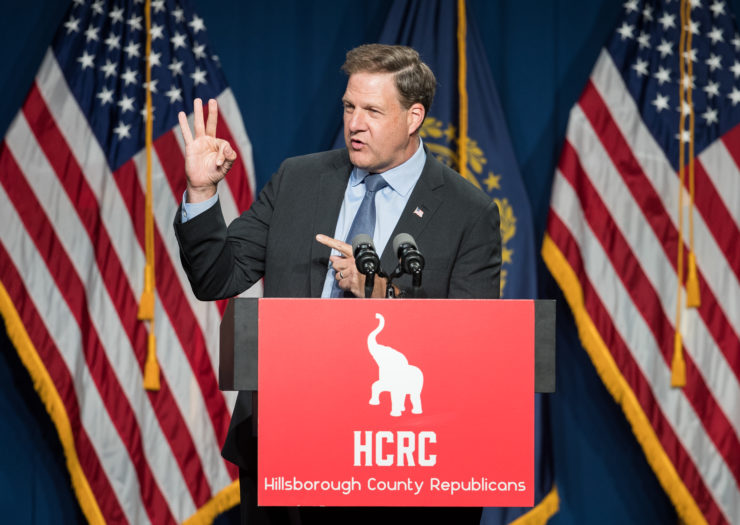
Republican Gov. Chris Sununu considers himself “pro-choice,” but calls some later abortions “not appropriate.”
 Scott Eisen/Getty Images

Republican Gov. Chris Sununu calls himself pro-choice, but he wasn’t pro-choice enough to veto New Hampshire’s first gestational abortion ban.

New Hampshire’s motto might be “live free or die,” but thanks to some sneaky abortion restrictions the Republican-majority legislature included in the state’s most recent budget, that … kind of no longer applies to abortion providers or patients.

Republican lawmakers added the “Fetal Life Protection Act”—which includes a ban on abortion after 24 weeks with no exception for rape, incest, or fetal viability—onto New Hampshire’s $13.5 billion annual budget before passing it in June.

Once the 24-week ban goes into effect on January 1, the number of states without gestational limits on abortion will be down to a mere six.

As if that weren’t bad enough, the budget includes civil and criminal penalties for providers who do perform an abortion after 24 weeks. Abortion providers could be charged with a felony that carries up to seven years in prison and up to a $100,000 fine.

Oh, and did we mention the budget also allows the “father of the fetus” (if married to the pregnant person) to sue for monetary damages if an abortion is provided after 24 weeks?

The law also includes a requirement that all abortion patients undergo an ultrasound.

In an op-ed for the New Hampshire Journal that reads like a chaotic love letter to abortion restrictions, Republican state Rep. Beth Folsom, the prime sponsor of the act, said she was “humbled and proud to watch as our state finally passed long overdue, basic protections for the preborn.”

While restrictions and gestational limits like this are far from uncommon, what makes New Hampshire’s “Fetal Life Protection Act” unique is how it managed to fly under the radar.

New Hampshire has long been regarded as a safe haven for abortion. Until this year, the state’s only abortion restrictions were a forced parental notification law and a prohibition on public funding of abortion care. Republican Gov. Chris Sununu even considers himself “pro-choice.” But when asked about the 24-week abortion ban, the governor had this to say:

Like most citizens of the state of New Hampshire, I do not think that we should be doing late-term or, you know, these at-the-very-last-minute type abortions … I think most people agree that, that’s not appropriate.

Just a reminder: Gestational limits on abortion have absolutely nothing to do with fetal safety, and they definitely don’t have anything to do with what’s “appropriate.”

Statistics show that the vast majority of abortions in the United States happen in the first trimester. Abortion after 24 weeks is rare, and typically involves complications like a risk to the health of the pregnant person or fetus.

New Hampshire’s 24-week ban doesn’t protect fetuses—it merely chips away at the rights of pregnant people and abortion providers.

Politicians who claim to be pro-choice like Sununu should know this, but that didn’t stop him from signing the anti-abortion budget in June.

New Hampshire’s new abortion ban is part of a sweeping tide of new abortion restrictions in both conservative and liberal states. States enacted 90 abortion restrictions in the first six months of 2021, already making it the worst year for abortion rights on record.

Source: https://rewirenewsgroup.com/article/2021/08/30/new-hampshire-snuck-an-abortion-ban-into-the-state-budget/?fbclid=IwAR0_C3mhTKZXPTh5K_EsXY8S-Z4-3_ov8gQCnbqK8FnffgQBsyitviKO6Uc

Angie Kells created the SASN because people in Saskatchewan were reporting a struggle in accessing the service. At the same time, States south of the border had started tightening access to abortions and limiting reproductive rights. (Submitted by Angie Kells)

Saskatoon Abortion Support Network wants to help people before, during and after

Angie Kells wants to make sure anyone who needs abortion supports or services in the Saskatoon area can get them. But she said gaps in services across the province make that hard to guarantee. 

She’s calling for change.

“Reproductive freedom is critical. People should not be forced to continue a pregnancy that they do not want to continue,” said Kells, the founder of Saskatoon Abortion Support Network (SASN) and an abortion doula. 

Kells said the province doesn’t offer enough options north of Regina, so organizations like the SASN need to fill in the gap.  She’s not the first advocate to point out unequal access.  

Regina offers surgical abortions in the second trimester (up to 18 weeks).  The surgical procedure is only available up to 12 weeks in Saskatoon and is not available in Prince Albert. 

“If it becomes difficult accessing abortion care, then all of a sudden your reproductive rights are at risk, your bodily autonomy is at risk,” Kells said. 

She wants surgical options expanded in Saskatoon and Prince Albert. While the SASN is Saskatoon-based, she said there are people from the entire north of the province who need help. They might have to travel more than five hours for the procedure in Regina. The SASN offers free transportation and support for people who need help getting to Regina 

“While we will continue to do it as long as we need to, the government has an obligation to ensure access to abortion to every resident in Saskatchewan.” 

A spokesperson for the Ministry of Health said Regina provides the procedure up to 18 weeks because the health-care workers there have “additional training and skills required to perform this more complex procedure.”

They said abortions could be performed up to 14 weeks in Saskatoon under certain circumstances, but did not answer why Prince Albert has no surgical option. The spokesperson said that the free medical abortion option can help people who can’t travel to Regina or Saskatoon.

The government started providing universal coverage for the medical abortion option in 2019, lessening financial barriers. However, Kells said the option doesn’t solve all access problems because it’s only an option up to nine weeks of pregnancy.

She said some don’t even know they’re pregnant by then, while others have trouble accessing a prescription for the option.

The government spokesperson said “the SHA is continuing to look at options to improve access to services in rural communities, including access to abortion services.”

Abortion doulas provide free support 

Abortion doulas like Kells work with the SASN to provide free support beyond transportation. 

They provide information and support to people considering or proceeding with an abortion. Kells said they have learned how to help others through conversations with affected people, lived experience and formal training. 

Kells and several others attended a trauma-informed abortion support training led by abortion doula Shannon Hardy, who visited Saskatchewan from Abortion Support Services Atlantic in 2019. The SASN now also offers abortion doula training for others who want to help. 

Kells said SASN’s volunteer abortion doulas can help people in-person, over the phone or text.  They can accompany people to appointments, help find a pharmacy or the right clinic or pick up prescriptions. They also help people navigate the experience once it’s over. 

“The vast majority of people who choose abortion feel really good about their decision, not in a happy, joyful sense, but they feel a sense of relief and a sense of confidence,” she said. “But they may not have supportive family, friends or partners, so we’re there to listen to them if they need to talk.” 

Source: https://www.cbc.ca/news/canada/saskatchewan/saskatoon-abortion-doulas-access-support-1.6146720?fbclid=IwAR3G3VVb-Y9DQhiK6MT4shZvUZJlllwu4MdIoYjODeNVCewj6PueoQlbvaw

Protesters against abortion restrictions gathered at the Texas State Capitol on May 21, 2019. 
Eric Gay/AP
  • People are submitting phony claims to a Texas website that aims to penalize abortion providers. 
  • The website encourages citizens to report people who’ve helped someone get an abortion after 6 weeks.
  • Texas’s so-called “heartbeat ban,” which is uniquely restrictive, is set to go into effect September 1. 

Pro-choice advocates are spamming a Texas website that encourages people report abortions performed after six weeks of pregnancy — which, come September 1, will be illegal in the state. 

The website calls on “citizens to hold abortionists accountable to following the law” by anonymously reporting providers or others who’ve “aided and abetted” an abortion after six weeks.

That includes parents who drive their child to the clinic or friends who lend money for the procedure.

Those found to have violated the law will be fined at least $10,000, the website says. 

Planned Parenthood and other pro-choice organizations have fought against the law going into effect, but Twitter users are opposing it in another way: by aiming to overwhelm the website with an influx of bogus claims. 

“Gosh, I wonder if they factored in people abusing the integrity of this system. Hmmm I hope ppl don’t abuse this! That would be terrible,” Nancy Cárdenas Peña, a Texas director for the National Latina Institute for Reproductive Justice, Tweeted Friday. 

She’s since been banned by the website, she told the Daily Dot, but her idea has taken off, with other Twitter users saying they’re flooding the site with “furry porn” and outrageous claims like trying to abort their 30-year-old children who’ve gotten “too big.” 

No other states have such a clause 

Texas’s so-called “heartbeat ban,” which passed in May, is uniquely restrictive because it limits abortions before most women even know they’re pregnant and makes no exceptions for rape or incest. Its lawsuit clause, which doesn’t require the reporter to have any connection to the person violating the law, is the first of its kind. 

That’s “very, very scary and could open the door to a lot of frivolous lawsuits,” Dr. Bhavik Kumar, an abortion provider in Houston, previously told Insider when the law passed in May

Indeed, experts say it could lead to “hundreds, even thousands” of lawsuits that could threaten abortion clinics, the Texas Tribune Reported.

Source: https://www.insider.com/people-are-spamming-a-pro-life-tip-line-in-texas-2021-8?fbclid=IwAR1bDx4qOQXd7Vl9qCPPxijSEycT58SRmr2Ws34C4GBKsZbIU98gqM4WHzo