The Supreme Court’s decision to take up a case challenging a Mississippi abortion ban has profound implications for corporate America—whether or not the C-suite realizes it.

This is a story about the dangerous reality for women denied access to necessary health care. But this is also a story about economic impact, both for women and for their employers. 

Companies that already compete for top talent will find that the majority of employees will not be willing to relocate based on what lack of abortion access signals about the culture and politics of the state. Six in 10 women would be discouraged from taking a job in a state that has tried to restrict access to abortion. And 54% of men ages 18 to 44 say they also would be discouraged from taking a job in a state that has recently tried to restrict abortion access. A majority of women (56%) say they would not even apply to a job in a state that has recently banned abortion.

This abortion ban violates nearly 50 years of Supreme Court precedent and is a test case to overturn Roe v. Wade. That’s why this law, and others like it across the country, were passed—to give a newly constituted Supreme Court the chance to either fully overrule or more subtly dismantle Roe. Bans like the one in Mississippi have been unconstitutional since the court’s ruling in 1973, and this will be the first such ban to go before the court since that landmark ruling.  

The consequences of a Roe reversal would be devastating for the communities where corporate America operates. If Roe falls or is further diminished, more than 20 states would prohibit abortion outright. And 11 states—including Mississippi—currently have trigger bans on the books, which would instantaneously ban abortion if Roe is overturned.

Imagine even more women crossing state borders to get the care they need. Health care providers in states that would continue to have legal and safe abortion have planned for decades to be able to provide uninterrupted health care to out-of-state patients through mobile clinics, telemedicine, and other new technologically enabled services. But it will be difficult regardless.

Because women have been historically less valued as employees, as demonstrated by gender-based pay inequities across race, it is all the more important to highlight the economic impact of banning abortion. Recent research by the Institute for Women’s Policy Research estimates that state-level abortion restrictions cost the U.S. economy $105 billion annually. Depending on the state, the existing abortion restrictions cost states from hundreds of millions to even billions annually by reducing labor force participation and earnings levels and increasing turnover and time off from work among women 15 to 44 years old.

If Roe is ended, employers need to be ready to respond to the needs of their employees who suddenly won’t be able to access the comprehensive reproductive health care, including abortion, they need in the state where they live or work. Notably, many employees already experience 24- to 72-hour waiting periods to access abortion care, drive hundreds of miles or get on flights for appointments, and need to arrange for childcare and time off work. 

Companies need to act now by reviewing and revising benefits to better support employees based on laws in their state. Business leaders should call and meet with elected officials at all levels to let them know that abortion restrictions, including bans and trigger laws, have a negative impact on the current and prospective workforce in their state. Companies need to take public stances that connect abortion access with efforts to improve equity in the workplace.

Since diminished access to abortion has been among the collateral damage of corporate support for Republicans, companies must increase their due diligence when it comes to political giving. Companies can limit political giving to candidates who uphold shared values and norms in line with revised investor and employee expectations.

If nothing else, employers should highlight for their workforce how existing policies like paid time off and other benefits can be tapped to help employees access the health care they need. And given the existing barriers that vary by state in accessing abortion, employers can bolster financial assistance, caregiving benefits, and employee assistance programs for workers who face extraordinary burdens in obtaining essential health care. Some employees who are able to do so may choose to relocate because of looming restrictions—their employers should allow them to.

The future of full gender equality for generations hangs in the balance. Because of the Supreme Court’s willingness to revisit precedent, workers and communities are at risk. 

Source: https://fortune.com/2021/06/10/roe-v-wade-supreme-court-mississippi-abortion-ban-companies/

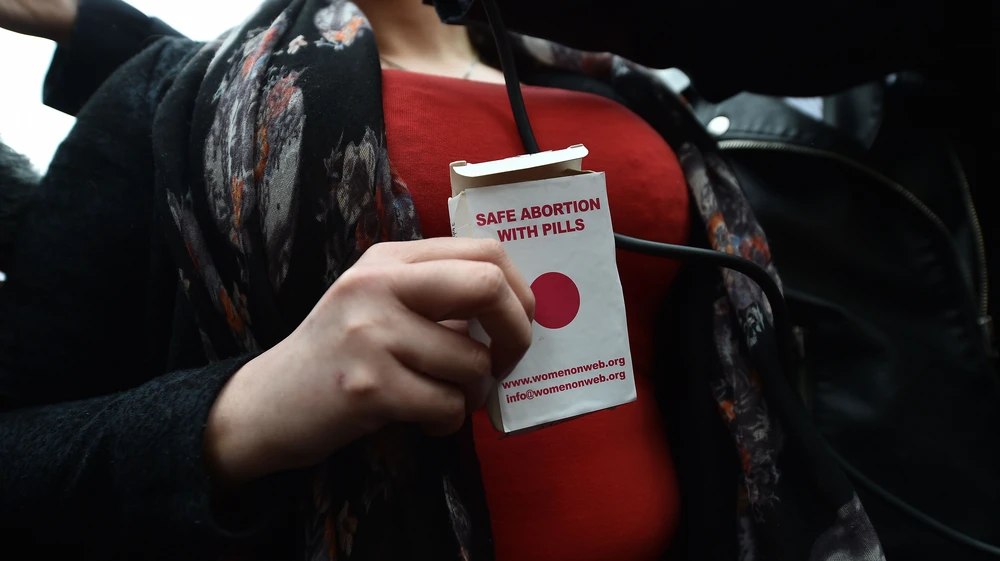
AN UNIDENTIFIED WOMAN DISPLAYS AN ABORTION PILL PACKET AFTER TAKING ONE OF THE PILLS AS ABORTION RIGHTS CAMPAIGN GROUP ROSA, REPRODUCTIVE RIGHTS AGAINST OPPRESSION, SEXISM AND AUSTERITY DISTRIBUTE ABORTION PILLS FROM A TOURING BUS ON MAY 31, 2018 IN BELFAST, NORTHERN IRELAND (CHARLES MCQUILLAN/GETTY IMAGES)

As clinics close and self-managed abortion becomes more common, a first-of-its-kind fund will step in where people are facing prosecution for inducing their own abortions.

A reproductive justice group is taking a radical step to protect abortion access: a first-of-its-kind legal defense fund to help people who are facing criminal probes for inducing their own abortions.

If/When/How announced Wednesday that it’s launching the Repro Legal Defense Fund, an initiative that will pay for the legal costs of people who need to defend themselves for having, or helping others have, what’s known as a “self-managed abortion.” Although only five states explicitly ban self-managed abortions, experts told VICE News that if law enforcement wants to find a way to go after people for the practice, they can usually find a statute that’s pliable enough to do it. 

Abortion rights advocates also expect self-managed abortion to only become more ubiquitous in the coming years, especially if Roe v. Wade, the 1973 Supreme Court decision that legalized abortion nationwide, falls apart. Last month, the majority-conservative Supreme Court agreed to hear an abortion case out of Mississippi—a move that threatens to reduce the landmark ruling to ruins.

“There have been criminal investigations of people in more than 20 states. That includes California and New York and other ‘blue’ states,” said If/When/How Executive Director Jill Adams.

“It happens in big cities. It happens in rural towns. Unfortunately, because there’s so much misinformation about the laws regarding abortion and people’s rights, and there’s so much antipathy—that gets manipulated by overzealous prosecutors and by police who try to create crimes where none exists.”

“Abortion is not a crime,” Adams added. “We have a constitutionally protected right to abortion that encompasses self-managed care. These laws, in the five states—those are arguably unconstitutional.”

With $2 million in funds, the Repro Legal Defense Fund intends to defray the costs of expenses like bail, expert witnesses, court fees, and attorney fees for people who are being criminalized for self-managing their abortion. “Not letting access to a robust defense be marred by a lack of financial ability is really the goal,” said Rafa Kidvai, If/When/How’s legal defense fund director.

No one knows just how many people have been prosecuted for self-managing their own abortions or helping others do so. A 2017 If/When/How report found that, since 1973, there had been at least 21 arrests for suspected self-induced abortions. These arrests can have life-shattering consequences: In 2013, an Indiana woman named Purvi Patel was accused of inducing her own abortion and later convicted of felony child neglect and feticide. She was sentenced to decades behind bars. Although an appeals court ultimately found that Indiana’s feticide law wasn’t intended to be wielded against women seeking their own abortions, the entire ordeal took up more than three years of Patel’s life.

If/When/How is now embarking on a more comprehensive study that seeks to find out just how many people have been criminalized for self-managed abortion. A pilot study in three states—Arizona, New York, and Nevada—has so far uncovered dozens of such cases. 

Although people like to rage about the specter of the “coat-hanger abortion,” the risks for people who want to self-manage their abortion are primarily legal, rather than medical, thanks to the advent of abortion-inducing pills. These pills are widely regarded as safe to use at home; the World Health Organization even recommends a regimen for self-inducing an abortion using a drug called misoprostol. (The Repro Legal Defense Fund is open to providing aid to anyone who self-manages, regardless of the method they use.)

The pills are also increasingly easy to obtain, thanks to groups like Aid Access, an organization that ships abortion-inducing pills across the United States. At the same time, states are passing a record-breaking number of restrictions on abortion clinics. Multiple studies have indicated that lack of access to in-clinic abortion is a key reason motivating people who want to self-manage instead.

Between March 2018 and March 2020, more than 57,000 people in all 50 states asked Aid Access for help obtaining abortion-inducing pills, according to a study led by a researcher at the University of Texas at Austin and published last month. More than 70 percent of people said that they couldn’t afford an in-clinic abortion, while 40 percent said that “clinic distance” made them lean towards self-managing their own abortion.

“That shows us that those folks are already in that place where abortion is a legal right, but it’s a right on paper only,” the lead researcher, University of Texas at Austin associate professor Abigail Aiken, told VICE News last month. “If Roe v. Wade is overturned or diminished, I think that we will find more people in that situation. So I think we could expect self-managed abortions to increase.”

Source: https://www.vice.com/en/article/5dbd3a/people-arrested-for-giving-themselves-abortions-now-have-a-legal-defense-fund?utm_source=email&utm_medium=editorial&utm_content=news&utm_campaign=210609

New research shows a majority of voters support the Women’s Health Protection Act. The bill arrives just weeks after the Supreme Court announces it will hear an abortion ban case challenging Roe v. Wade

Today, the Women’s Health Protection Act (WHPA)—a bill that would protect the right to access abortion throughout the country—was introduced in the House by U.S. Representatives Judy Chu (D-CA), Lois Frankel (D-FL), Ayanna Pressley (D-MA), and Veronica Escobar (D-TX) and in the Senate by Senators Richard Blumenthal (D-CT) and Tammy Baldwin (D-WI). WHPA would create a federal statutory right for health care providers to provide abortion care, and a corresponding right for their patients to receive that care, free from medically unnecessary restrictions that single out abortion care and impede access.

The introduction of WHPA comes on the heels of the Supreme Court’s decision to hear a case next term that directly challenges Roe v. Wade. The case—filed by the Center for Reproductive Rights and appealed to the Court by the state of Mississippi—challenges the state’s ban on abortion after 15 weeks of pregnancy. In response to the Supreme Court’s decision to hear the case, the above members of Congress immediately announced their intention to reintroduce WHPA. This bill would protect the right to abortion under federal law, even if Roe were overturned.

WHPA is being introduced in the 117th Congress with 176 original co-sponsors in the House and at least 45 in the Senate – the highest number of original co-sponsors ever for this bill. During the 116th Congress, WHPA earned 260 co-sponsors, more than in any previous Congress. The Center has been supporting the bill since its first introduction in 2013, when it had 132 co-sponsors in the House and 35 in the Senate. Since then, it has garnered more support each term.

Also today, a poll conducted earlier this year by Hart Research Associates was released, showing that a majority (61%) of voters believe abortion rights across the country should be protected with a new federal law like WHPA. Support is especially strong among Black voters (79%) and other voters of color.

This poll sends a clear message to Congress: the majority of voters want abortion protected under federal law,” said Nancy Northup (she/her), President and CEO of the Center for Reproductive Rights. “We cannot wait any longer. If Roe falls, many states will immediately take action to make abortion a crime. Even now, with constitutional protections in place, state legislators have made it impossible to access abortion in the South and Midwest. Especially for Black people and other people of color who already face barriers to health care. This bill—WHPA—would protect against the hundreds of state restrictions and bans that have pushed abortion out of reach. This is an issue of equal access, everywhere.”

“This new polling reconfirms what young people and people of color have been saying for years: We want abortion care that is free from medically unnecessary restrictions that shame, stigmatize and deny us timely, confidential abortion care,” said Danielle Hurd-Wilson (they/them), Interim Deputy Director of Field and Programs at URGE: Unite for Reproductive & Gender Equity. “Each of us should be able to make our own decisions about whether and when to become a parent. Period. It’s time to listen to the people most affected by reproductive oppression about what we need for our communities to thrive. The Women’s Health Protection Act will bring us a step closer to that that goal.”

Key Poll Takeaways:

  • 61% of voters nationally support passage of a national law that would protect the constitutional right to access abortion by creating a nationwide safeguard against bans and medically unnecessary restrictions on abortion. That law is WHPA. This includes:
    • 82% of Democrats
    • 60% of independents
    • 39% of Republicans
    • 62% of swing voters
    • 63% of suburban women
  • Support for WHPA is especially strong among voters of color and voters under age 30, with large majorities expressing support for creating a national law:
    • 79% of Black voters
    • 67% of Hispanic voters
    • 67% of Asian-American and Pacific-Islander voters
    • 66% of voters under age 30
  • 7 in 10 voters (68%) believe that the constitutional right to abortion should be protected. This is the majority point of view across most of the electorate, including:
    • 91% of Democrats
    • 71% of independents
    • 43% of Republicans, including 72% of moderate and liberal Republicans
    • 72% of swing voters
    • 68% of suburban women
  • 58% of voters nationwide say it is a big concern that 24 states are likely to ban abortion completely if Roe v. Wade is overturned.

The full poll results are available here.

Already this year, more than 70 state-level abortion restrictions have been passed into law, putting 2021 on track to be the worst year for abortion access in decades. Nearly 90% of counties in the U.S. have no abortion provider and five states are down to their last abortion clinic. If Roe were to be overturned, 24 states and 3 territories would likely prohibit abortion entirely, according to an analysis by the Center for Reproductive Rights. Already, 12 states have so-called “trigger bans” in place that would ban abortion immediately if Roe falls.

POLL METHODOLOGY: Hart Research conducted the nationally representative online survey from January 15, 2021 to January 20, 2021 among 1,629 registered voters. The sample is demographically and geographically and politically representative of the 2020 electorate nationally.

###

Source: https://reproductiverights.org/members-of-congress-introduce-bill-to-protect-abortion-access/?fbclid=IwAR3nT5e4ZHYCruejbX7S7mWZh49gR_g9sVFa9UtDRou5nyeWe7sU6_TRHh4

From left, Asia Brown, Ellie Rome and Derenda Hancock wait outside the Jackson Women’s Health Organization clinic parking lot in Jackson, Miss., on May 20, to escort patients. The clinic is Mississippi’s only state-licensed abortion facility. (Rogelio V. Solis/AP)

A simple majority vote in the Senate would nullify the threat to reproductive health posed by the Mississippi case.

The Supreme Court’s recent decision to accept a major abortion case out of Mississippi has led to fear among many Americans that Roe v. Wade will be overruled next year. There is some chance of this — but that’s why it is crucial to understand that reproductive rights do not depend only on the justices.

Here’s the thing: Congress can, right now, by simple majority vote, protect those rights and nullify any threat posed by the Mississippi case or any other.

A year ago, when the last abortion case reached the high court, Chief Justice John G. Roberts Jr. cast the deciding vote to invalidate Louisiana’s abortion restrictions. Roberts surprised many by joining the four justices appointed to the court by Democratic presidents, one of whom was Ruth Bader Ginsburg. Today, however, Justice Amy Coney Barrett occupies the seat Ginsburg once did, leading some who support abortion rights to predict doom from the Mississippi case. Predictions are always tough in this business, but the far more important point is that this focus on the Supreme Court is misplaced. Reproductive rights need not depend at all on what the court does with Roe.Advertisement

In Roe, the Supreme Court in 1973, by a 7-2 vote, reviewed a Texas law that criminalized abortion, declaring it unconstitutional. The court’s opinion meant that states could generally not restrict abortions in the first trimester and for much of the second, until the point of fetal viability. Thus, women had a right to choose what to do until approximately the 24th week of their pregnancies. Mississippi, however, recently passed a law in defiance of that framework, restricting abortion after the 15th week. This law so flagrantly defies the Supreme Court that nothing like it has had a chance of success in any court since 1973. (Texas, not to be outdone by Mississippi, last month outlawed abortions after the sixth week if a fetal heartbeat has been detected.)An upcoming Supreme Court review of a Mississippi abortion law could pave the way for many other state laws that restrict or ban the procedure. (Joshua Carroll/The Washington Post)

This is subtle but important: When the Supreme Court hears a case about abortion, whether it was Roe in 1973 or the Mississippi case in the coming fall, it is not being asked to outlaw the practice of abortion. The court has only one power — the power of judicial review — which means all it can do is say whether a particular abortion restriction passed by a legislature is constitutional. The court cannot outlaw abortion itself. So if the court sides with Mississippi and says “you can have this law,” that simply means those states whose legislatures want such laws restricting abortion can have them. Other states that don’t want to restrict abortion do not have to. The court can’t compel abortion restrictions; it can simply permit them.

What this simple insight means is that there are two ways, not one, to safeguard reproductive rights: one by legislatures and the other by courts. And because the Constitution says that federal law reigns supreme over state laws, this insight also means that Congress can sweep away state laws that conflict with federal protections. Congress uses this power of “preemption” all the time — blocking states from having their own food and drug laws, employment rules, banking regulations and the like. Congress also frequently passes legislation to guarantee rights. Indeed, almost all of the major civil rights protections you have at your job or at restaurants or in hotels are guaranteed by Congress, not the courts or the Constitution. That is because the Constitution restricts only governments, not private individuals or corporations.Advertisement

Right now, Congress has a bill before it that would capitalize on this insight and statutorily guarantee the reproductive rights recognized by the Supreme Court since 1973. Called the Women’s Health Protection Act and sponsored by senators including Kyrsten Sinema (D-Ariz.), Charles E. Schumer (D-N.Y.), Tim Kaine (D-Va.) and Amy Klobuchar (D-Minn.), it would codify the rights two generations have taken as part of American life.

This legislation can be passed by simple majority vote, and if enacted, it would remove cases like the Mississippi one from the Supreme Court’s consideration. The rights would now be guaranteed by Congress, making it impossible for the court to trim them back. The only way states could try is to file separate lawsuits seeking judicial review of such legislation, arguing that Congress’ law is unconstitutional because Congress lacks the power to enact it.

Such an argument has about zero chance of success. Since the New Deal, the Supreme Court has given Congress broad powers over interstate commerce, and the case here would be ironclad, on par with the rationales that undergird civil rights laws and their prohibitions on discrimination in employment, restaurants and the like. There is no way the Supreme Court could void such a law without collapsing the scholarly and judicial consensus about the reach of government power, present at least since the New Deal but with its roots going all the way back to the Bank of the United States case McCulloch from 1819.

Some in the Senate would try to filibuster the legislation, claiming 60 votes, not 50, is needed to pass it. But if there is ever a piece of legislation that merits a departure from the filibuster, this is pretty much it. Recall that it was the Republicans in the Senate who bypassed the filibuster when they confirmed President Donald Trump’s three nominees to the Supreme Court, including Barrett.Advertisement

And Trump campaigned on the claim that Roe would “automatically” be overturned once his Supreme Court nominees were confirmed. It can’t be that one side gets to play by a “no filibuster” rule and the other side doesn’t. That is particularly so since one of the seats at the court was filled as a result of Republican senators’ gamesmanship over President Barack Obama’s nomination of Merrick Garland — gamesmanship that itself had the goal of trying to overturn Roe.

In this sense, Roe is unique — it occupies a role in Senate confirmations unlike any other case. If 50 is good enough to confirm a justice for life and against Roe, it should be good enough to democratically enshrine Roe into law, too. All it takes is 50 senators to sidestep the filibuster (or return it to its original roots, like a speaking filibuster) for this particular piece of legislation. And especially when such legislation is designed to preserve the status quo over reproductive rights and codify five decades of understandings, it is hard to see how senators representing a small fraction of the United States should be able to block the popular will.

With Republican senators such as Susan Collins (Maine) and Lisa Murkowski (Alaska) having gone on the record to support Roe, a Senate majority for the Women’s Health Protection Act is exceptionally likely. And although Democratic senators such as Joe Manchin III (W.Va.) have expressed general support for keeping current filibuster rules, the act is best understood as falling within an existing exception to the filibuster: lifetime appointments to the Supreme Court. Indeed, it is a far more modest reform than the 2017 decision by then-Senate Majority Leader Mitch McConnell (R-Ky.) to end the filibuster for Supreme Court nominees.Advertisement

Citizens can easily feel disempowered when issues they care about are reduced to analyzing the proclivities of nine people in Washington sitting in black robes. Since 1973, the questions about reproductive rights have been dominated by the court, not Congress. But now we have an opportunity to recalibrate the balance and guarantee reproductive justice for Americans in every state. We don’t need the court to protect these rights. We just need a majority vote in Congress.

Source: https://www.washingtonpost.com/outlook/2021/06/07/roe-abortion-congress-mississippi/

Malta is the only country in the European Union that bans abortion in all circumstances. But a bill recently introduced in Parliament would change that.

The draft legislation, if adopted, would remove Malta’s strict criminal penalties for abortion—penalties that currently call for up to three years imprisonment for those procuring an abortion or helping someone to do so; and four years imprisonment for doctors who perform illegal abortions.

“This draft bill is a historic first step towards reforming one of the few remaining abortion bans in Europe. If adopted, the bill would remove harmful criminal penalties and could pave the way to allow women in Malta access to abortion care in their own country,” said Katrine Thomasen, Senior Legal Adviser for Europe at the Center for Reproductive Rights.

Marlene Farrugia, member of Malta’s Parliament, presented the bill, which aims to ensure that no person or medical professional in Malta is criminalized “for the choice pertaining to their medical health and/or the provision of medical assistance. Such criminalisation is discriminatory.”

Malta is one of only three countries in Europe that outlaw abortion in all circumstances. The others are Andorra and San Marino, which are not members of the European Union. For an overview of Europe’s abortion laws, see the Center’s comparative legal analysis.

Source: https://reproductiverights.org/bill-would-decriminalize-abortion-in-malta-the-only-eu-country-with-a-total-abortion-ban/?fbclid=IwAR0tCgZctcL4_th-BSnfTtqlWAjvDC_jLqHy0JDNkEk7AV48VFhMyODsqf0

Paxton Smith, the 2021 valedictorian of Lake Highlands High School in Dallas, gave an impassioned graduation speech about abortion rights that’s going viral. 

For those unfamiliar with what’s happening in Texas: The state’s governor, Greg Abbott, just signed into law the “heartbeat bill,” which, per The Texas Tribune, bans abortions as early as six weeks into a pregnancy, when most women don’t even realize they’re expecting. 

Smith had originally planned to talk about television and media during her speech but instead used the platform to shed light on the “heartbeat bill.” 

“In light of recent events, it feels wrong to talk about anything but what is currently affecting me and millions of other women in this state,” Smith said, per Vox. “Starting in September, there will be a ban on abortion after six weeks of pregnancy, regardless of whether the pregnancy was the result of rape or incest. Six weeks. That’s all women get.”

According to Vox, the “heartbeat bill” not only bans abortion after six weeks of pregnancy but allows people to sue anyone who “aids and abets” one of these illegal procedures. 

Smith’s speech has exploded on TikTok, racking up more than 210,000 views. It was reposted to Twitter, where it’s been viewed more than 2 million times. “In Texas, Lake Highlands High School valedictorian, Paxton Smith, switched out her approved speech to talk about abortion rights,”

According to Advocate magazine, a local Highlands publication, Smith’s decision to change her speech on the fly was not supported by her school district. “The content of each student speaker’s message is the private, voluntary expression of the individual student and does not reflect the endorsement, sponsorship, position, or expression of the District or its employees,” RISD school board president Karen Clardy said. “What the student did was unexpected and not supported by LHHS or RISD. We are going to review student speech protocols in advance of next year’s graduations to prevent something like this from happening again.”

That being said, Smith’s father, Russell, fully supported her actions. “It was something that she felt was important, and she had the nerve, determination, and boldness to put herself out there and say her piece,” he said, according to Advocate. “So few people demonstrate this level of maturity and poise, regardless of age.”

Read her full speech, according to Advocate magazine, below: 

As we leave high school we need to make our voices heard. I was going to get up here and talk to you about TV and content and media because those are things that are very important to me. However, in light of recent events, it feels wrong to talk about anything but what is currently affecting me and millions of other women in this state.

Recently the heartbeat bill was passed in Texas. Starting in September, there will be a ban on abortions that take place after six weeks of pregnancy, regardless of whether the pregnancy was a result of rape or incest. Six weeks. Most women don’t even realize they’re pregnant by then. And so, before they have the time to decide if they are emotionally, physically, and financially stable enough to carry out a full-term pregnancy, before they have the chance to decide if they can take on the responsibility of bringing another human into the world, the decision has been made for them by a stranger. A decision that will affect the rest of their lives.

I have dreams, hopes, and ambitions. Every girl here does. We have spent our whole lives working towards our futures, and without our consent or input, our control over our futures has been stripped away from us. I am terrified that if my contraceptives fail me, that if I’m raped, then my hopes and efforts and dreams for myself will no longer be relevant. I hope you can feel how gut-wrenching it is, how dehumanizing it is, to have the autonomy over your own body taken from you.

And I’m talking about this today, on a day as important as this, on a day honoring the students’ efforts in 12 years of schooling, on a day where we’re all brought together, on a day where you will be the most inclined to hear a voice like mine, a woman’s voice, to tell you that this is a problem. A problem that can’t wait. I refuse to give up this platform to promote complacency and peace, when there is a war on my body and a war on my rights. A war on the rights of your sisters, a war on the rights of your mothers, a war on the rights of your daughters.

We cannot stay silent.

Source: https://www.glamour.com/story/a-high-school-teens-powerful-graduation-speech-about-abortion-rights-is-going-viral?fbclid=IwAR1NE9um0vf1PSscZ3jBmKK6Dc7vd80FJ1_J–cL_i4LnO7YNJB4cG7c25o

The Associated Press
In this photo from Thursday, April 8, 2021, Jeanne Gawdun, right, a lobbyist for Kansans for Life, the most influential anti-abortion group in Kansas politics, watches a state Senate debate from one of its galleries at the Statehouse in Topeka, Kan. She sees an increase in abortions in Kansas in 2020 resulting from Democratic Gov. Laura Kelly’s refusal to ban elective abortions temporarily during the early weeks of the coronavirus pandemic when Republican governors in Oklahoma and Texas did. (AP Photo/John Hanna)

The number of abortions performed in Kansas increased by 9.1% last year

TOPEKA, Kan. — The number of abortions performed in Kansas increased by 9.1% last year as far more women traveled from Oklahoma and Texas to terminate pregnancies than in 2019 and the state reported that out-of-state patients outnumbered Kansas patients for the first time in almost 50 years.

The state Department of Health and Environment says 7,542 abortions were performed in 2020, an increase of 626 from 6,916 in 2019.

Women and girls from Oklahoma and Texas had 566 abortions in Kansas in 2020, up from 110 in 2019. The additional 456 abortions were the bulk of the total increase in abortions in Kansas.

The Kansas health department said 3,901 abortions, or nearly 52%, were for patients from outside the state. The last time the department had reported that more abortions were performed on patients from outside Kansas than on patients from Kansas was 1973, the same year that the U.S. Supreme Court legalized abortion nationwide.

“Gov. Kelly owns this increase,” said Jeanne Gawdun, senior lobbyist for Kansans for Life, the state’s most politically influential anti-abortion group. “We can now consider her the abortion-industry governor.”

The report on abortions, release late last week, came as both sides prepared for an August 2022 statewide vote on a proposed anti-abortion amendment. The measure would overturn a 2019 decision by the Kansas Supreme Court declaring access to abortion a “fundamental right” under the Kansas Constitution.

The 9.1% jump in abortions was the largest annual increase since at least 1995, when the state began requiring all health care providers to report any abortions they performed. Since then, abortions in Kansas peaked at 12,445 in 1999, then declined in 16 of the following 20 years.

A significant percentage of Kansas abortions historically have been performed for Missouri patients, particularly in the Kansas City area. In 2020, the number was 3,201 or 42% of the total.

Source: https://abcnews.go.com/Health/wireStory/patient-influx-states-increases-kansas-abortions-78027418?fbclid=IwAR0ckM4cBc0q3_JR6dJ9BwSbNP2X-OFpsBv5E0IGNMe2bHKdmyxOG8mtTTM

President Joe Biden kept a campaign promise and excluded the Hyde Amendment from the federal budget.
 Anna Moneymaker/Getty Images

Abortion rights advocates pushed Biden to exclude the discriminatory Hyde Amendment from his proposed budget.

On Friday, President Joe Biden released his $6 trillion budget proposal, and it doesn’t include the Hyde Amendment.

For decades, the Hyde Amendment has permitted the government to discriminate by excluding abortion care from the health-care services covered for low-income people through the federal Medicaid program.

The amendment is named after Rep. Henry Hyde (R-IL), and it was first passed in 1976—just three years after the Supreme Court’s decision in Roe v. Wade.

Does it seem fair to you that people with low incomes should be offered a limited set of health-care services just because they’re poor?

Because that’s what the Hyde Amendment does—it cuts off access to health care based on how much money you have.

It’s not just poor people. If you’re in the military or employed by the government or in federal prison or if you receive health care through the federal Indian Health Service, you’re cut off from abortion coverage too (except in cases of rape or life endangerment).

Advocates and organizers secured a promise from Biden during his campaign that he would not submit budgets containing the Hyde Amendment.

He kept his promise. And that illustrates that it is possible to move Biden left. Abortion rights advocates did it.

But keep in mind: The president’s budget isn’t binding on Congress, and a spending bill without Hyde still needs to pass a divided Senate.

And there’s still other anti-abortion garbage left in Biden’s budget. As the National Women’s Law Center points out, the Weldon Amendment is still in the budget. The NWLC tweeted that the amendment “prioritizes personal beliefs over patient care and threatens states’ funding for expanding abortion coverage. It’s time for Weldon to go too.

Then there’s the Helms Amendment, which is still in the budget as well. Rep. Jan Schakowsky (D-IL) tweeted Friday that the Helms Amendment, which affects foreign aid, needs to go: “To ensure #ReproRights and #ReproJustice, both the #HydeAmendment AND #HelmsAmendment MUST be repealed!

Last summer, Schakowsky introduced the “Abortion Is Health Care Everywhere Act” to repeal the Helms Amendment, which forbids foreign aid money from going toward abortion services. In her op-ed last year for Rewire News Group, Schakowsky wrote:

The Helms Amendment effectively allows the United States to control the health care and bodily autonomy of Black and brown people around the world. It imposes our arbitrary and medically unnecessary abortion restrictions on international communities, hinders billions of individuals from being able to exercise their reproductive rights, and deprives them of the care they want and need. Just like the Hyde Amendment, the Helms Amendment puts reproductive and economic freedom out of reach for women of color in order to advance a conservative political agenda. Both amendments must fall in order for us to realize any vision of health equity and reproductive justice.

And finally? Say the word abortion, Joe. You know you want to. Just say it.

Source: https://rewirenewsgroup.com/article/2021/06/01/biden-kept-his-promise-on-the-hyde-amendment/

A Planned Parenthood Reproductive Health Services Center in St. Louis, Missouri. 
Photo by SAUL LOEB/AFP via Getty Images
  • Texas last week banned abortions after six weeks of pregnancy, with no exceptions for rape or incest.
  • It would have prevented a 13-year-old who was raped by her grandfather from getting an abortion.
  • “What would her life be like? How different would it be?” said her provider, Dr. Bhavik Kumar.

When Gov. Greg Abbott of Texas signed an unusually restrictive abortion ban into law last week, Dr. Bhavik Kumar was pained to think about the people it would hurt the most — patients like those he’s served as an abortion provider at the Planned Parenthood Center for Choice in Houston.

The law, which is expected to be challenged and is not yet in effect, forbids abortions after six weeks of pregnancy and makes no exceptions for rape or incest.

“While politicians pass these laws in faraway buildings, we actually see these people, we take care of them,” Kumar told Insider. “There are people depending on us. They have names. They have families. And their ability to access care will make the world of difference to them.”

The story of a 13-year-old girl remains salient. She’d been raped by her grandfather and told her mom when she stopped getting her periods. A doctor confirmed she was pregnant, but the girl couldn’t get an abortion close to home in Texas, where abortion access is already limited, so she was driven hours to Kumar’s clinic.

“She shouldn’t have to be dealing with any of what she’s dealt with, but when I think about if a law like this were to go into effect and she wasn’t able to access abortion, if that’s what she had chosen, then what would her life be like? How different would it be?” Kumar said. “It’s difficult for me to think about that, to have that choice robbed from somebody.”

More recently, Kumar saw a 17-year-old who’d been roofied and raped at their first party. They didn’t know who the perpetrator was. “They decided not to be pregnant. They didn’t even make the decision to have sex. So this [law] would not give them any options; it would force them to carry that pregnancy,” Kumar said.

Theoretically, patients like the two teens could travel to neighboring states with less restrictive abortion bans, but that takes time, money, and other resources.

A poll found that more than three-quarters of Americans support exceptions for rape and incest

The bill justifies not allowing exceptions for rape and incest by saying that “public and private agencies” provide “emergency contraception for victims of rape or incest.”

State Sen. Bryan Hughes, a sponsor of the bill, told CNN that law enforcement should hold perpetrators accountable but not hurt the fetus. “Let’s harshly punish the rapist, but we don’t, we don’t punish the unborn child,” he said.

Abortions due to rape and incest are rare. A 2005 report from the Guttmacher Institute found that 1% of women who’d gotten abortions said they did so because they conceived through rape, and less than 0.5% said they did so because of incest.

2018 Gallup poll found that 77% of Americans said they supported abortions in the first trimester in cases of rape and incest, and 52% said they still supported it in the third trimester.

Source: https://www.insider.com/texas-abortion-ban-would-block-teen-raped-by-grandfather-2021-5?fbclid=IwAR2RSUPkq0X5nN3WZqbpniKeIZoo1wACBBHBLA4f3pbNGPJoc1UTFwmSuQ4

Justice Brett Kavanaugh was handpicked by Trump to create a conservative majority that would overturn Roe v. Wade. And after him came Amy Coney Barrett, who was also handpicked to be part of that majority.
 Drew Angerer/Getty Images

Dobbs v. Jackson Women’s Health is based on a plan set in motion years ago by a Christian legal advocacy group that has ties to Justice Amy Coney Barrett.

“We have a plan to make Roe irrelevant or completely reverse it.”

That was the message that Kevin Theriot, an attorney with the conservative Christian law firm Alliance Defending Freedom, delivered to the attendees of the 2018 Evangelicals for Life conference, according to a Right Wing Watch report at the time.

It was January 20, 2018, two days before the 45th anniversary of the Roe v. Wade decision, and as they had done for years, anti-choice protesters gathered for the March for Life rally to protest the legal ruling that gave pregnant people some modicum of control—and, in some cases, the illusion of control—over their own bodies.

Theriot, vice president of ADF’s Center for Life, and Denise Burke, ADF senior counsel, spoke to attendees of the Evangelicals for Life conference about the organization’s strategy for overturning Roe v. Wade and passing state-level laws banning abortion, according to Right Wing Watch’s Peter Montgomery. (The Southern Poverty Law Center labeled ADF an anti-LGBTQ hate group in 2016 because the group has supported criminalizing and imprisoning LGBTQ people in the United States and has supported European laws that required forced sterilization of transgender people.)

“We have a strategic plan, that is a comprehensive, start-to-finish, from when we’re considering legislation all the way up to the Supreme Court, to challenge Roe,” Burke reportedly told a group of conference attendees. “And we are focusing right now on two specific types of abortion bans. … So we’re not looking at regulation, we’re actually looking to enact abortion bans.”

One of those abortion ban? A 15-week ban, just like the one at issue in Dobbs v. Jackson Women’s Health Organization.

In fact, Mississippi was the first state that ADF trained its sights on.

Burke went on to lay out ADF’s strategy: Pass laws banning abortion at 15 weeks, which would essentially limit abortion to a week after the first trimester.

“Once we get these first-trimester limitations in place, we’re going to go for a complete ban on abortion, except to save the lives of the mother,” Burke told the conference attendees.

Essentially, Burke said, ADF planned to use the 15-week bans as bait, according to Right Wing Watch. Burke also reportedly said 20-week bans hadn’t been challenged in court because abortion rights advocates fear a bad decision. In reality, Jackson Women’s Health Organization is Mississippi’s sole abortion clinic, and no abortions are performed there past 16 weeks. As such, there would be no reason to challenge a 20-week ban in Mississippi. The same is the case in multiple states that have passed 20-week bans. Moreover, abortion providers have won every case challenging a pre-viability abortion ban, whether it’s a six-week ban, a 12-week ban, or a 20-week ban.

According to the Jackson Free Press, Burke then said:

“I can guarantee you that they will not be able to ignore a 15-week limitation, which is in essence limiting abortion to the first trimester. We’re kind of basically baiting them, ‘come on, fight us on turf that we have already set up and established.’”

And, after that, chillingly:

“I am happy to say the first 15-week limitation based on our model language was just introduced in the state of Mississippi this week.”

Mississippi Gov. Phil Bryant would go on to sign that 15-week ban into law two months later. And the lawsuit that the Supreme Court just agreed to hear would be filed immediately after that.

That was three-and-a-half years ago. And in a little over a year from now, ADF’s professed strategy to make Roe irrelevant will probably have succeeded.

The basic rule laid down in Roe and reiterated in Planned Parenthood v. Casey is simple: Pre-viability abortion bans are unconstitutional.

A fetus doesn’t become viable until approximately the 24th week, and even then it’s an individual determination specific to each pregnancy. The point at which one pregnancy is viable isn’t the same for another pregnancy.

Everyone agrees that no fetus is viable at 15 weeks. Even Mississippi’s attorneys conceded that no fetus is viable at 15 weeks. Mississippi’s law is, under 48 years of precedent, unconstitutional. Period. That’s why the district court struck it down. And that’s why even the extremely conservative Fifth Circuit Court of Appeals struck it down. That’s also why not a single federal court has ever upheld a pre-viability gestational abortion ban in any state.

In March 2018, when Bryant signed Mississippi’s 15-week ban into law, I wrote that it was unconstitutional just like other gestational bans that states had tried and failed to enact. I pointed out that these pre-viability abortion bans are unconstitutional and would remain that way “unless President Trump is able to stack the Court with conservative judges.”

At the time, Neil Gorsuch had barely been on the bench for a year, Brett Kavanaugh had not yet begun to regale us with tales of doing keg stands with his buddies PJ and Squi, and I had not yet begun internally screaming about the fact that Amy Coney Barrett—who, in March 2018, had been a Seventh Circuit judge for less than six months—would be replacing Ruth Bader Ginsburg on the bench less than two-and-a-half years later.

Gorsuch had simply replaced Scalia as a conservative; meanwhile, Anthony Kennedy was still on the bench, and Ruth Bader Ginsburg was alive. I was feeling pretty good about Roe.

But then came Brett Kavanaugh, who was handpicked by Trump to create a conservative majority that would overturn Roe. And after him, Amy Coney Barrett, who was not only picked to be part of that conservative majority, but also received speaking fees from ADF after she gave lectures for the Blackstone Legal Fellowship. (The Blackstone Fellowship is a summer intern program ADF runs; Barrett began speaking to fellows in 2011, right around the time that an avalance of abortion restrictions came rushing out of Republican-controlled state legislatures around the country.)

And it turns out that while ADF was developing model legislation—like Mississippi’s 15-week ban—and working with state attorneys general to defend anti-abortion legislation in places like Oklahoma, shadowy organizations like the Federalist Society were working to make sure there were justices in place who would be primed to take a case like Jackson Women’s Health and find a justification for upending abortion rights. Even though there’s absolutely no reason for the high court to take up a case challenging a pre-viability abortion ban because there’s no disagreement among the federal courts about the constitutionality of pre-viability abortion bans.

Over the next year, you’re going to hear a lot about Jackson Women’s Health, and it might be tempting to think that the fight over abortion at the Supreme Court is going to come down to constitutional analysis and good faith.

It’s not.

Jackson Women’s Health is the result of a plan set in motion by a powerful Christian legal advocacy group that Amy Coney Barrett has ties to. Anti-choice lawmakers and advocates will try to convince the nation—which overwhelmingly does not want Roe v. Wade to be overturned, by the way—that Roe v. Wade is bad law and that the Supreme Court must course-correct and send the abortion question back to the states, where anti-choice advocates are already working to disenfranchise Black voters in order to ensure that Republicans can capture the legislature and the governorships in as many states as possible so that they can begin systematically banning abortion.

The very fact that the Supreme Court decided to hear Jackson Women’s Health is unjust and based on a plan that ADF put into motion years ago—a plan that depends upon every actor in this conservative theater playing their part.

ADF has played its part. And if I were a betting woman, I’d bet that Kavanaugh and Barrett will play theirs.

Source: https://rewirenewsgroup.com/ablc/2021/05/28/how-the-plan-to-end-roe-v-wade-was-hatched-in-mississippi/