U.S. President Joe Biden’s proposed 2022 budget omits a ban on federal funding for most abortions that has been part of government spending bills for decades.
The budget, released Friday, makes no mention of the “Hyde Amendment,” first passed in 1976, which has been included in federal spending bills since.
The amendment, which restricts abortion coverage for recipients of Medicare, Medicaid, federal employees, servicewomen and Washington, D.C., residents, could still be added to any final 2022 spending bill as it moves through Congress.
Women’s and civil rights groups, who say the amendment disproportionately impacts low-income women, hailed its omission in Biden’s proposal Friday nonetheless.
“Exciting to see the admin’s historic step! For too long, the Hyde amendment has put the gov’t in control of personal health care decisions for people with low incomes,” women’s health provider Planned Parenthood said on Twitter.
Biden, a life-long Catholic, supported the Hyde Amendment for most of his political career, but changed his position in 2019 while campaigning for president, saying the right to abortion was under assault in many states and increasingly inaccessible to poorer women.
Republican lawmakers criticized the omission on Friday.
“It breaks with decades of settled precedent by calling for direct taxpayer-funded abortion,” said Republican House minority leader Kevin McCarthy.
Though abortion is legal in the United States, regulations can vary dramatically from one state to the next. California, New York and several other states use public money to cover abortion, according to the Guttmacher Institute, while many others states prohibit that practice.
The U.S. Supreme Court has agreed to hear a case that could gut Roe vs. Wade, the 1973 ruling that legalized abortion nationwide.
If the Supreme Court is going to rob pregnant people of their reproductive freedom, then that freedom must be secured at the ballot box. Hill Street Studios/Getty Images
From school boards to statehouses, it’s time for progressives to become single issue voters for abortion rights.
Last Monday, people across the United States woke up to the news that the Supreme Court will hear a case to ban abortion at 15 weeks, clearly violating the constitutional right to privacy and abortion established by Roe v. Wade in 1973.
Every single person in this country should feel shivers run down their spines, because this is terrifying.
The newly established block of six conservative Supreme Court justices do not reflect the values of this country. The United States is an overwhelmingly pro-choice nation—over 70 percent of people in this country do not want Roe v. Wade overturned. A vast majority support reproductive freedom and know that people deserve access to the reproductive health care they need.
Yet our reproductive freedom hangs in the balance because of an overly funded, extreme anti-choice minority that is committed to controlling pregnant people’s decisions.
This minority movement’s sinister strategy has been successful. They have focused on taking over the judicial system (currently more than a quarter of federal judges were appointed by Trump), maintaining control in state houses by any means necessary (particularly using gerrymandering and voter suppression), and achieving the ultimate victory of establishing a radical, extreme anti-choice Supreme Court.
By activating their small base to win elections and maintain patriarchy and control, they have achieved their goal of blocking reproductive freedom as a tactic to gain political power and to reinforce white supremacy, wealth inequality, and misogyny. The goal has never, ever been to “protect life.”
The Supreme Court will likely use the Mississippi case to undo the constitutional protection to abortion, and allow states free rein to control reproductive freedom. Today, ten states sit ready in the wings with “trigger ban laws,” which will automatically outlaw abortion if Roe v. Wade is overturned.
Already, 58 percent of the country lives in a state hostile to reproductive freedom, according to the Guttmacher Institute. Over the last 30 years, states have enacted hundreds of medically unnecessary hurdles to access reproductive health care—increasing cost, requiring extensive travel, and confusing patients with inaccurate information. In 2021 alone, 549 abortion restrictions, including 165 abortion bans, have been introduced across 47 states. Of those, 70 restrictions have been enacted across 13 states, including ten bans.
Indeed, abortion may still be legal in the United States, but it is extremely inaccessible now, particularly for low income people. This Supreme Court case will make it even more difficult, and even more dependent on where you live and how much money or access you have. This is by design.
Those of us who believe in reproductive freedom are up against elected officials who believe there should be criminal penalties for people seeking an abortion and for doctors performing an abortion. Just last month in Oklahoma, an abortion ban passed that would charge medical providers with homicide if they perform an abortion in the presence of a “fetal heartbeat.”
We must ask ourselves: Do we want the government standing in the doctor’s office with us when we’re making personal decisions about our future and our families? Do we really want sheriffs’ deputies investigating every miscarriage in this country?
This moment is exactly why #VOTEPROCHOICE exists. If the Supreme Court is going to rob pregnant people of their reproductive freedom, then that freedom must be secured at the ballot box.
State legislatures are where these horrible anti-choice laws are passed. Pro-choice state legislatures must be protected, and anti-choice state legislatures must be transformed. Advocates must identify the anti-choice extremists and replace them all with candidates who support bodily autonomy, like the majority of this country does.
Organizers must work obsessively in every single city, state, and county to elect sheriffs, district attorneys, public defenders, judges, and coroners who are champions for reproductive freedom and will not enforce these horrific, controlling anti-choice laws.
There is no time to waste. The Supreme Court will hear the Mississippi case in the fall and hand down a decision by the end of next June, leaving the full control of our reproductive freedom in the hands of local and state elected officials.
There is so much at stake in this battle. This moment requires reproductive rights and justice advocates to unite, focus, and improve our strategy to shift power to the pro-choice majority.
And that can be done by winning elections.
Success in state and local elections mean the difference between body autonomy or oppressive, state-controlled reproductive health. One of our most foundational freedoms—the right to decide whether, when, or how to build a family—is at stake.
The combination of mifepristone and misoprostol is more than 95 percent effective and is a safe way to end an early pregnancy, according to a study from the National Library of Medicine. (Robin Marty / Flickr)
“The evidence is crystal clear: Mifepristone is safe and effective, and the FDA’s unique restrictions provide no safety benefit while severely burdening patient’s ability to access care. … If the FDA follows the science, we should soon see the removal of these barriers to care.”
—Julia Kaye, staff attorney at ACLU’s Reproductive Freedom Project
On Friday, May 7, the Biden administration announced that the U.S. Food and Drug Administration (FDA) will undertake a review of longstanding restrictions on the medication mifepristone used for miscarriage and abortion care. The announcement came as part of a joint legal filing in the ACLU lawsuit Cheslius v. Becerra, challenging the restrictions.
“This is promising news, and reflects the Biden administration’s commitment to follow the science,” said Kirsten Moore, director of Expanding Medication Abortion Access Project.
“The FDA decision to comprehensively reevaluate restrictions on mifepristone coming on the heels of the FDA decision to suspend the in-person requirements during the COVID-19 public health emergency feels like, finally, science and common sense have a foothold on this issue and some long overdue progress,” said Julia Kaye, staff attorney at ACLU’s Reproductive Freedom Project which represents the plaintiffs in Cheslius v. Becerra.
The FDA was facing a Friday deadline to file a brief defending their mifepristone restrictions. The parties agreed to stay the litigation until December 1, 2021.
“There is no reason why patients in abortion and miscarriage care should be singled out for unjustified and burdensome regulations,” Kaye told Ms. “We are very hopeful that the outcome of the FDA review will be a full elimination of the restrictions.”
Approved by FDA for use during the first 10 weeks of gestation, medication abortion uses two types of pills: mifepristone, which interrupts the flow of the hormone progesterone that sustains the pregnancy, and misoprostol, which causes contractions to expel the contents of the uterus. This combination of pills is more than 95 percent effective and is a safe way to end an early pregnancy. According to the Guttmacher Institute, medication abortion now accounts for over 60 percent of abortions in the first 10 weeks of pregnancy.
Despite its safety, the FDA restricts distribution of mifepristone through a drug safety program called the Risk and Evaluation Mitigation System (REMS). Under this program, the FDA prohibits retail pharmacies from stocking and distributing mifepristone and requires that the medication be dispensed only in certain health care facilities through a certified prescriber.
“The evidence is crystal clear that mifepristone is safe and effective and that the FDA’s unique restrictions provide no safety benefit while severely burdening patient’s ability to access care,” Kaye told Ms. “Leading medical authorities, including the American Medical Association and the American College of Obstetricians and Gynecologists, uniformly call for the elimination of these unjustified restrictions. Given all of that, if the FDA follows the science, we should soon see the removal of these barriers to care.”
Other advocates agree that the restrictions are outdated and not medically necessary.
“Medication abortion care has a 20-year track record as a safe and effective option for ending an early pregnancy,” said Moore. ”We believe the review will confirm why it’s important to eliminate these outdated restrictions. Women should be able to receive their prescription for medication abortion in the way that makes the most sense for them and providers shouldn’t have to jump through hoops to deliver the best care for their patients.”
They’re critical infrastructure that needs to be funded.
As with bridges and roads, access to reproductive health care is a mission-critical resource people need to get from point A to point B. Joe Raedle/Getty Images
President Biden got this much right: Recovery requires going big on infrastructure. But where are reproductive rights? That’s critical infrastructure, too.
As with bridges and roads, access to reproductive health care is a mission-critical resource people need to get from point A to point B. A person’s well-being, including their economic well-being, depends in large part upon their ability to control whether, when, and how to have children.
Let’s start with abortion. According to a review of empirical data by the Institute for Women’s Policy Research, the legalization of abortion increased Black women’s educational attainment, increasing high school graduation rates, college entrance, and college completion by 1.3 percent, 3.7 percent, and 9.6 percent, respectively. What’s more, abortion access increased women’s participation in the workforce overall.
A note: All people need reproductive rights, including transgender people who can become pregnant and cisgender people who can’t; when research refers explicitly to women, I use that term to maintain the accuracy of the data presented.
Birth control also shows related effects, with data showing that access to contraception correlates to increased attainment of postsecondary education and higher income earning levels. To be clear, people who want to avoid pregnancy in order to improve their economic outcomes should be respected.
And we must be equally clear that pushing contraceptives on people, especially people of color and people with disabilities, in the name of poverty reduction is actually population control branded as “help.” What low-income people who want to have children really need is higher wages, affordable child care, and a stronger social safety net, not coercion to use contraceptives. Children are for everyone. They are not and must never be a luxury reserved for the rich.
Social support around birth, parenting, pregnancy, and reproduction is also critical infrastructure. If people need free diapers, they should get access to them without having to depend on anti-abortion fake clinics requiring them to complete inaccurate, shaming “classes” that tell them they’re going to hell. Medically accurate sex education so that everyone understands their bodies is critical infrastructure. Access to prenatal care is critical infrastructure. And, as the COVID-19 crisis that forced parents around the world into a tailspin made abundantly clear, child care is critical infrastructure—and yet the system was broken even before the pandemic, with women of color least likely to have access to affordable child care.
In the spirit of solutions, here are a few modest proposals for how reproductive rights should be included in infrastructure packages:
Provide financial incentives to open new abortion clinics, with additional incentives to states hostile to abortion access and to states bordering them.
Provide financial incentives for existing health-care providers to integrate abortion into their medical practice.
Provide financial incentives for mobile health units that provide the full range of reproductive health care in specially fitted RVs.
Fund unbiased, medically accurate provision of comprehensive sex education in public schools.
Fund contraception and abortion, including direct funding of pills and procedures as well as nonprofit abortion funds that, in many instances, provide not just financial support for care but logistical support, such as defraying the cost of transportation to a provider.
It may seem overly optimistic to think these things are possible when, as activists have rightfully pointed out, the Biden administration seems to have problems saying the word “abortion” and has failed to take leadership as states pass an onslaught of abortion restrictions and the Supreme Court takes up a case about a Mississippi abortion ban that could, under hostile justices, be used to eliminate the core framework of Roe v. Wade. It is true that President Biden needs to take more leadership for reproductive rights. But what better way than to start within the context of the big, bold change he champions for moving society past the deep damages wrought by COVID-19?
Reproductive rights are not theory. They are urgent, basic needs and core operating infrastructure for any society. Biden is correct to focus on shoring up our infrastructure as a nation. It’s critical for the president and all policymakers to include reproductive rights in what it means to build back better.
Jessy Rosales, 25, poses for a photo in Los Angeles, California, U.S., May 17, 2021. REUTERS/Lucy Nicholson
Jessy Rosales did not realize she was pregnant for weeks. When she found out, Rosales – a 20-year-old college student at the time – hid it from her family, whose judgment she feared, and struggled to find an abortion clinic that would accept her student health insurance.
The Los Angeles resident scrambled for more than a month in 2016 to save the $700 needed for the procedure and was failing her classes due to the stress. Rosales managed to end her pregnancy at around 16 weeks.
Other women could lose that ability, depending on how the U.S. Supreme Court rules when it reviews the legality of a Republican-backed Mississippi law that would ban abortions after 15 weeks of pregnancy. The decision by the justices on Monday to take up the case worried some U.S. women, who for decades have had legal access to abortion thanks to the court’s landmark 1973 Roe v. Wade ruling.
“Access is so complex. There’s so much that goes beyond just knowing that you want to have an abortion and actually getting to that destination,” said Rosales, 25.
Abortion rights advocates fear – and abortion opponents hope – that the court, with a 6-3 conservative majority, could use the case to permit more restrictive abortion laws, which Republican-led state legislatures have been pursuing for years.
Reuters/Ipsos polling last year found that 58% percent of U.S. voters said abortion should be legal in most instances, including 76% of Democrats and 40% of Republicans.
The Roe v. Wade ruling barred states from banning abortion before the viability of the fetus outside the womb, which is generally viewed by doctors as between 24 and 28 weeks. Mississippi’s law would ban abortion much earlier than that.
Carol Tobias, president of the anti-abortion group National Right to Life, applauded the court for taking up the case.
“We know more today about the life of a child in the womb than we did 50 years ago. The medical advances made in our knowledge of unborn children and their care and treatment are astonishing,” Tobias said. “Today, viability is not a characteristic of the baby but of how advanced our technology has become.”
Abortion providers and rights advocates have said bans like Mississippi’s overlook the myriad circumstances that lead women to delay abortions and would disproportionately affect minority and low-income women.
Access varies, with 43 U.S. states prohibiting abortions at some point in pregnancy, according to the Guttmacher Institute, a group that supports abortion rights. Mississippi, a state of 3 million people, has one abortion clinic. Some other similarly sized states have several.
‘A PERFECT WORLD’
Dr. Anuj Khattar, a fellow with Physicians for Reproductive Health who performs abortions in Tennessee and Texas, said he sees patients who seek second trimester abortions for a number of reasons. Khattar, based in Tacoma, Washington, said some did not realize they were pregnant earlier, some were in a abusive relationship and could not escape their partner sooner, and some learned of serious fetal anomalies that would prevent the baby’s survival.
“In a perfect world, I think patients would be able to access abortion care earlier,” Khattar said. “However, we don’t live in a perfect world.”
Valerie Peterson, a 42-year-old education consultant in Las Vegas, said she was living in Texas and 15 weeks pregnant when she learned that her baby’s brain was detached from the spinal cord and would not survive. Her doctor gave her three options: get an abortion, wait to miscarry or possibly deliver a stillborn.
She wanted an abortion and due to restrictions in Texas at the time had to fly to Florida to obtain one, facing anti-abortion protesters at the clinic’s doors. The total costs amounted to $5,000, Peterson said.
“People need to understand that there are special circumstances,” she said. “Regardless, they shouldn’t be in our business.”
The number of abortions reported to the U.S. Centers for Disease Control and Prevention has dropped in recent decades, to roughly 620,000 in 2018, the most recent figures. About 5 percent of U.S. abortions came after 16 weeks of pregnancy, Guttmacher Institute data from 2016 showed.
COST CONCERNS
The cost of an abortion, as well as related travel and accommodations, can be prohibitive. Access to second trimester abortions is already limited. In Oklahoma, for instance, a single clinic, called Trust Women in Oklahoma City, provides abortions past 18 weeks.
Julie Burkhart, the clinic’s founder, said there is “definitely a correlation” between a woman’s financial struggles and delays in getting an abortion.
“You have to know where to go, you have to know who to call, and then you have to be able to find the means by which to travel to a facility that will see you,” Burkhart said.
Insurance coverage varies widely. Most states do not cover abortions under the Medicaid healthcare program for the poor. Around half of women who get an abortion pay out of pocket, Guttmacher Institute data from 2014 showed.
Briana M., a Dallas woman who spoke on condition that her last name be abbreviated, said she considered selling her laptop, one of her only valuable possessions, to pay for her abortion of twins as a 20-year-old college student in Georgia.
She eventually obtained funding through a clinic and had an abortion at 22 weeks. Without it, she said she would have dropped out of school and not have gone on to earn her master’s degree in social work.
“There are multiple barriers that people have to go through, and you can’t put a time stamp on that,” she said.
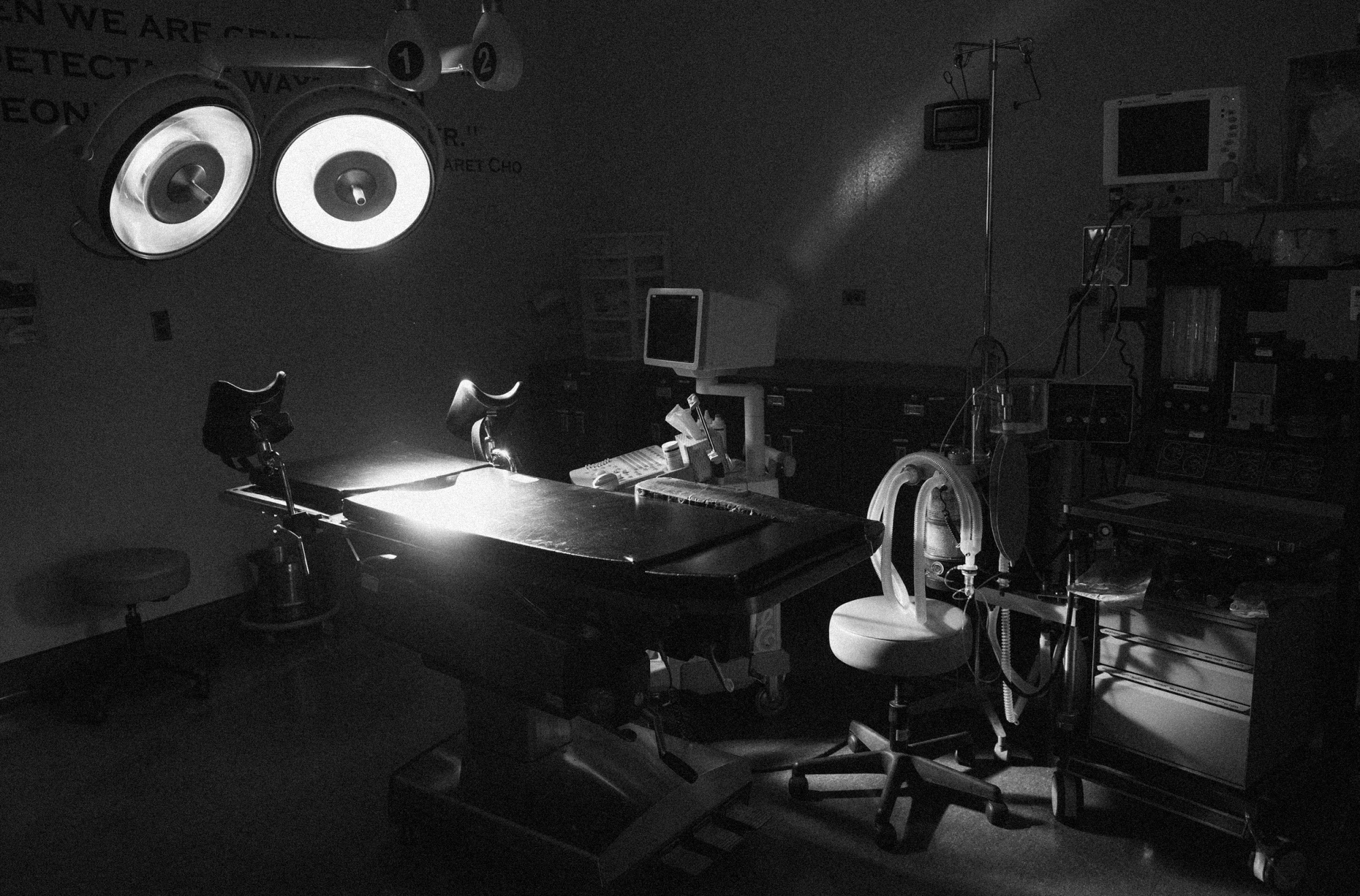
An operating room at the Whole Woman’s Health abortion clinic in San Antonio, Texas, on Feb. 16, 2016.Matthew Busch / Bloomberg via Getty Images file
Abbott can call himself “anti-woman,” or “pro-birth,” but he can’t call himself “pro-life” when he and his state are recklessly trying to kill people.
Texas Gov. Greg Abbott on Wednesday signed into law one of the most extreme abortion bans in the country, prohibiting abortions starting from six weeks after a woman’s missed period. The bill also incentivizes any Texan to sue anyone who provides an abortion or helps a woman get an abortion after that point for up to $10,000.
Texas already has one of the highest maternal mortality rates in the country, particularly high among Black women.
Texas already has one of the highest maternal mortality rates in the country, particularly among Black women, and that’s been exacerbated by the fact that Abbott won’t expand Medicaid.
The self-described “pro-life” governor scribbled his name on this legislation just one day after banning local government entities, including public schools, from enforcing Covid-19 mask mandates. So even in schools where many children have not received the vaccine yet, and which have decided for themselves that a mask requirement continues to make sense in a continuing deadly pandemic, will not be able to enforce that rule.
Ironically, after signing the executive order, Abbott tweeted: “Texans, not gov’t, should decide their best health practices.
That’s exactly what reproductive rights advocates have been saying for years. But Abbott apparently means to apply the principle to everyone except pregnant women.
Nothing about Abbott or his Republican colleagues in Texas — aside from their apparent concern for fetuses — suggests particular respect for life, but that’s been especially obvious over the past year. Texas refused Medicaid expansion in the middle of a pandemic last year, as tens of thousands of Texans died from Covid-19, effectively denying 1.5 million people in the state access to affordable health coverage. Abbott lifted the statewide mask mandate and reopened nonessential businesses at 100 percent capacity in early March, long before the Centers for Disease Control and Prevention recommended doing so.
Abbot’s “pro-life” buddy, Lt. Gov. Dan Patrick, declared that senior citizens would be happily willing to die of Covid-19 for the sake of Texas’ economy. And Republican state Rep. Bryan Slaton introduced a bill that criminalizes abortion and threatens women and doctors with the death penalty, even in cases of rape and incest — effectively admitting that he would prioritize a fetus’ life over that of a living person.
Now Texas is banning abortion as soon as the fetal heartbeat is detected, which is before many women even realize they’re pregnant. Such laws, as we know from a time in this country before abortion was legal, only push abortion underground and result in desperate women seeking dangerous, unregulated methods of ending their unwanted pregnancies. Wealthy women may be able travel to another state where abortion is legal; but low-income women who may have jobs and/or other children cannot so easily make the trip to Chicago to find a provider there.
To be clear, banning safe, legal abortions will cause women to die.
I reported in 2014 that deadly back-alley abortions were already returning in Texas, where lawmakers have been on a crusade to limit women’s reproductive freedom for over a decade. Now the stakes are higher, as former President Donald Trump has appointed three new anti-abortion justices to the Supreme Court and tipped it solidly conservative for a generation to come.
The Supreme Court just took up a case this week that could ultimately overturn Roe v. Wade, the landmark 1973 decision that legalized abortion until the fetus is viable. And if it does, laws like the one Abbott just signed in Texas could be allowed to stand.
To be clear, banning safe, legal abortions will cause women to die. Unsafe abortion is one of the leading causes of maternal mortality in the world. Before Roe, hundreds of American women died from illegal abortions each year — which necessitated the high court decision in the first place.
The governor can call himself “anti-woman,” or “pro-birth,” but he can’t call himself “pro-life” when he and his state are recklessly trying to kill people.
Surprise bill tabled by Marlene Farrugia in Catholic Malta seeks to remove criminal sanctions for women who seek abortions
LONDON, May 12 (Thomson Reuters Foundation) – A Maltese lawmaker made history on Wednesday by calling for the decriminalisation of abortion in the Mediterranean island, which has one of the world’s strictest bans.
In the first such move to amend the country’s tough abortion laws, independent MP Marlene Farrugia presented a bill which would remove criminal sanctions for women who seek terminations.
“It’s a historic moment,” said Lara Dimitrijevic, a lawyer and director of the Women’s Rights Foundation which campaigns on abortion rights in Malta.
“It is not legalising abortion, but it is a very important first step.”
Malta is one of five countries in the world that outlaw abortion in all circumstances, even when a woman’s life is at risk. The others are El Salvador, Nicaragua, Dominican Republic and Vatican City.
Procuring an abortion, or helping someone to do so, is punishable by up to three years in jail under Malta’s criminal code.
A doctor carrying out a termination faces up to four years in prison and a permanent ban on practising medicine.
Abortion opponents in the Catholic country say life begins at conception. But campaigners say the law does not stop women having terminations and Malta must stop criminalising them.
The online newspaper MaltaToday described the bill as “a bolt from the blue”, adding Farrugia was not known as a pro-choice politician.
Dimitrijevic said the surprise bill had immediately sparked a huge outpouring of support on social media and many people had started gathering outside parliament.
There is no date for when the bill will be debated in parliament.
Although prosecutions are rare, campaigners say the law impacts women’s health and creates a climate of fear and silence.
Abortion has long been a taboo issue in Malta, but attitudes are becoming more liberal in the country, which has legalised same-sex marriage and banned gay conversion therapy.
“Social attitudes are changing, particularly among the young, and the Catholic Church does not have the influence it once had,” Dimitrijevic said.
Campaigners estimate 300 to 500 women in Malta seek abortions every year. Many buy pills online while others travel overseas for terminations, mostly to Britain and Italy.
With the COVID-19 lockdown preventing most travel, Dimitrijevic said more women had resorted to buying abortion pills online, which can be dangerous if they need medical support and leaves them open to prosecution.
Women on Web, a Canadian organisation providing abortion pills by post following online consultations, said it shipped 220 sets of pills to Malta last year.
About 60 women a year travel from Malta to Britain for an abortion, according to UK government data.
Others pay about 2,000 to 3,000 euros ($2,400 to $3,620) for an abortion in the Italian island of Sicily, to its north, via a “tour guide” who takes them to a “clinic” after meeting them off the ferry or plane, according to campaigners.
They say such abortions are probably illegal under Italian law, which states terminations can only be performed in public hospitals.
The real danger is the Supreme Court strikes down the Mississippi law and still guts abortion rights. Drew Angerer/Getty Images
With Amy Coney Barrett on the bench, the Court announced it was stepping back into the abortion rights fight. This can’t be good.
“No is a complete sentence.”
That’s a clever phrase I taught my children when I first introduced the concept of consent. No. With one word, you communicate so much. Know how to use it.
On Monday, the Supreme Court announced it was stepping right back into the abortion rights fight. Last year, Mississippi begged the Court to bless its efforts to enact a pre-viability abortion ban. But because pre-viability abortion bans are always unconstitutional, the Supreme Court should have answered Mississippi’s plea with a simple no.
No is a complete sentence, after all.
Nearly 50 years of Supreme Court precedent on abortion rights tells us clearly that a state does not have the power to ban abortion until a pregnancy reaches viability. Not before. The state’s power is what we are talking about here—to dictate how and when people reproduce.
The Court has spoken very clearly on this point. Before fetal viability—the point at which a fetus can meaningfully exist outside the womb and without medical intervention—states can do all sorts of things to make getting an abortion more difficult, more complicated, and more expensive. And after fetal viability? After fetal viability, states can ban abortion outright, if lawmakers so chose. But not before.
All of that is very likely to change, thanks to the Court’s actions on Monday.
In choosing to hear Dobbs v. Jackson Women’s Health Organization, the Court’s conservative majority sent a clear signal that the law around abortion rights as we know it is about to change. How? I’ll get into that in a second—first, some background.
At issue in the case is a gestational ban. Gestational bans outlaw abortion at a specific point in pregnancy—in this case, 15 weeks. Why 15 weeks? Who knows—anti-choice lawmakers certainly don’t. Gestational bans are arbitrary nonsense that have nothing to do with the responsible practice of medicine; they have everything to do with politicizing perceived moral discomfort around later abortion. And that’s why conservatives love them so.
Everyone agrees that no pregnancy is viable at 15 weeks. Literally everyone! This includes Mississippi attorneys defending this ban who concede that at 15 weeks, no pregnancy is viable and that makes the Mississippi law an unconstitutional pre-viability abortion ban.
In fact, everyone agrees so hard on this point that there is not a single federal appeals court decision upholding a law like Mississippi’s. Not one! And it’s not like the federal courts haven’t had a chance to think about this question, either. Alabama. Texas. North Dakota. Arkansas. Mississippi, except for a six-week ban. These are all federal cases I can recall without doing a Google search or pulling up my case list that had this question at its core—are pre-viability abortion bans always unconstitutional? In every instance—INCLUDING THIS CASE—the federal courts have looked at the law and come to a concise conclusion.
Yes, pre-viability bans are always unconstitutional.
But Monday was different. On Monday the Court’s conservative wing made it clear that the answer to that question—are pre-viability abortion bans always unconstitutional—is at least a maybe but probably really no.
It takes four justices to decide to take a case. It takes five justices to decide to change the law.
We all need to let that settle in for a minute. Because the easiest thing for the Supreme Court would have been to stay out of this case. None of the traditional markers for taking up a case exist in Jackson Women’s Health. None. There is no circuit split—a disagreement among the appeals courts regarding the constitutionality of pre-viability abortion bans—that the Supreme Court needs to resolve. There’s no brand-new question of constitutional law the Court needs to decide. The only thing that exists is the political will of the Court’s conservatives to strike on abortion rights now.
We have at least a year before we know how the Court decides this case, but I think we already know, don’t we?
In one scenario, the Court’s conservatives just go for it. They let Justice Amy Coney Barrett really open up in the opinion she’s waited for her entire career to write. I’d bet she finds a way to cite the late Justice Ginsburg here in explaining how gutting reproductive autonomy is actually amazing for gender equality and call it freedom.
In another scenario, the Court strikes down the Mississippi law and still guts abortion rights. That’s the real danger of this case as I see it.
The question as teed up for the Court doesn’t even depend on the justices endorsing the Mississippi ban. It is by its nature a thought exercise about the durability of Roe v. Wade, Planned Parenthood v. Casey, and the basic constitutional underpinning of all reproductive freedom. The issue is “whether all pre-viability prohibitions on elective abortions are unconstitutional.” That’s not my shorthand. That is the only question this Court is going to answer when it hears arguments in this case later this fall. The question becomes: What is the answer?
It very well could be no. And no is a complete sentence.
The Supreme Court could decide that Mississippi’s 15-week ban is a bad-faith effort to undercut abortion rights and still issue a decision that decimates those rights by agreeing with Mississippi that, generally, states can ban abortion before viability, even if not in this case specifically. The justices could find that the Mississippi law goes too far in banning what advocates call “elective abortions” but that because of advances in medical technology, or what the conservative justices perceive as changing public attitutes around abortion, now is the time to upend the law protecting access.
Such a ruling would give the 200-plus Trump judges on the federal courts the green light to uphold any restriction anti-choice lawmakers dream up while simultaneously giving anti-choice lawmakers the green light to continue to fundraise off the big evil of Legal Abortion. Nevermind that in over 20 states, such a ruling would eliminate abortion access altogether, leaving patients across the country to pay an unspeakable, devastating toll.
No is a complete sentence. We’ll know just how complete next year.
Abortions are legal in Guam, but women have no access to them because of a lack of local providers and rules requiring in-person consultations for the procedure
Women in Guam who want an abortion are being forced to come to Hawaii or travel elsewhere for the procedure since the island’s only abortion provider left a few years ago.
But two Hawaii physicians and the American Civil Liberties Union are trying to convince a Guam court that women in the U.S. territory should be able to get abortions using medication prescribed remotely instead of having to travel for an in-person appointment. A Guam judge denied a preliminary injunction last week and the case is now pending in District Court.
Drs. Shandhini Raidoo and Bliss Kaneshiro, who live in Hawaii and are licensed to practice in Guam, are part of an ongoing TelAbortion pilot study that allows them to prescribe abortion medication by mail.
However, two Guam abortion laws that require an “in-person” consultation prior to the procedure and stipulate that the procedure should be performed in approved clinics are essentially barring them from providing abortion medications to their Guam patients, they claim in the lawsuit. The Guam laws make no reference to telemedicine.
The issue has drawn concern because the last doctor who conducted abortions on the island retired in 2018 so there are no local providers or abortion clinics. Patients instead must fly to the closest place where abortions are available: Hawaii.
Abortions are legal in Guam, but many patients have to fly to Hawaii for the procedure since the last local provider retired in 2018. A lawsuit could facilitate abortions performed via telemedicine. Cory Lum/Civil Beat
Abortions are legal in Guam, but for almost four years none have been reported to the local Guam Department of Public Health and Social Services, according to Pacific Daily News.
The lawsuit, filed in January in Guam, seeks to update local laws that the doctors say prevent them from providing abortions to patients in Guam. The ACLU argues that these laws make access to an abortion impossible in Guam and are infringing upon patients’ constitutional right to health care.
The second, which was passed by the Guam Legislature in 2012, requires doctors to provide written materials to patients in person — an extensive list of materials that includes details such as anatomical and physiological characteristics of the fetus and that “public assistance may be available” for the child if it is born, among other requirements.
“If not for these laws, people on Guam would have access to FDA approved medications that can be used to end a pregnancy,” Alexa Kolbi-Molinas told KUAM News in a January interview. Kolbi-Molinas is the senior staff attorney for the Reproductive Freedom Project at the American Civil Liberties Union Foundation.
“But because there is no access to these medications and because of these laws, people are being forced to travel several thousand miles and incur significant costs,” she said. “People are being forced to go to Hawaii or even further just to be able to exercise their constitutional right and get the care they need.”
The problem is complicated by the fact that Hawaii, in addition to being an expensive flight away, also has few abortion providers.
The Hawaii doctors also requested a preliminary injunction in February that would permit them to consult with patients and make prescriptions online.
Last week, a Guam magistrate judge recommended a preliminary injunction be denied, but a final decision is still pending from the District Court. In her recommendation, Judge Heather Kennedy wrote that the doctors have not provided sufficient evidence that Guam’s law to require written materials and information to patients in person infringes on a woman’s constitutional right to an abortion.
Kolbi-Molinas told Civil Beat by email this week that the ACLU legal team is disappointed in the court’s recommendation that the in-person counseling requirement be enforced against telemedicine patients, but “this is not a final ruling,” and they will file objections with the District Court.
The judge’s recommendation solely addressed the counseling requirement and did not prevent the use of telemedicine to provide abortion access to patients in Guam, she said.
“An earlier settlement in the case has cleared the way for telemedicine abortion access in Guam, and that is unchanged by the recommendation,” she said.
As of May, Guam still required in-person consultations for patients a day prior to any abortion, whether in a clinic or using telemedicine.
Helping Underserved Communities
Raidoo and Kaneshiro are participating in a project called TelAbortion, sponsored by the nonprofit Gynuity Health Projects. It’s a clinical study approved by the Food and Drug Administration that explores the validity of sending abortion pills by mail to patients who are medically underserved and live in remote areas.
The Guam Attorney General’s office did not respond to a request for comment.
Raidoo and Kaneshiro declined to be interviewed for this story, citing the ongoing legal proceedings.
Kaneshiro told The Guardian last month that the number of Guam patients seeking abortion services in Hawaii has increased since the last local provider in Guam left.
But Hawaii has very few abortion providers, according to Dr. Reni Soon, chair of the Hawaii Section of the American College Of Obstetricians and Gynecologists and one of the few doctors who fly to neighbor islands to provide reproductive health care to patients.
Soon is also participating in the TelAbortion project, and said the telemedicine and abortion pill option has expanded the types of care options for patients who cannot easily come to a clinic.
Medication abortion entails taking two drugs — mifepristone and misoprostol, which were approved by the FDA in 2000 to be used up to the first 10 weeks of pregnancy.
Their use is becoming more popular, although the total number of abortions in the U.S. has declined steadily for the past two decades, the foundation said, adding that the use of the abortion pill is safe and effective and carries a 0.4% risk of major complications.
SB 8 would let any random anti-choicer sue abortion providers for damages—as if anti-choice advocates needed any more license to harass health-care workers.
UPDATE, 4:40 p.m. May 13: The Texas legislature passed SB 8 and sent the bill to the governor to sign.
Anti-abortion lawmakers are at it again in Texas. Let’s take a look at what in the cinnamon toast crunch is going on in the state because it’s … not good.
Last week, residents of Lubbock, Texas, voted to pass an ordinance to make the city the largest “sanctuary for the unborn” in the state. What does being a “sanctuary for the unborn” mean, exactly? It means Lubbock voters have tried to criminalize abortion. But the ordinance goes further.
It also criminalizes helping someone get an abortion within the city. That means anyone who drives someone to an appointment, provides information on abortion, or even donates to an abortion fund could be charged with aiding and abetting.
There’s more! If you “aided and abetted” an abortion in Lubbock, you could be sued for “emotional distress” by the pregnant person’s family—or by anyone who wants to take you to court. (And while you’d probably win the case, legal battles are expensive.)
This could be devastating for abortion funds and for the city’s Planned Parenthood clinic—which just started offering abortion care last month, in a part of West Texas with no other abortion clinic for 300 miles.
The only good news about the Lubbock ordinance is that there’s a trigger before its criminal penalties can take effect. That means something else would have to happen—like the Supreme Court overturning Roe v. Wade—before Lubbock could enforce this “sanctuary city” nonsense with criminal charges.
Before we proceed further, let’s take a scream break, shall we?
OK, moving right along. Lubbock isn’t the only abortion story in Texas. Let’s talk about SB 8. SB 8 is a six-week abortion ban—which is technically a near-total abortion ban but functionally a total abortion ban.
This one is really bad.
Six weeks is so early in a pregnancy that most people don’t realize they’re even pregnant—so by the the time they do realize, it is probably going to be too late to have an abortion.
Anti-abortion lawmakers love these six-week bans. But they never survive court challenges because a six-week ban is a pre-viability abortion ban and—we’re going to type this loudly—PRE-VIABILITY ABORTION BANS ARE UNCONSTITUTIONAL.
SB 8 is different, though. Most six-week bans give power to the state to enforce, but SB 8 gives individuals the power to sue abortion providers. Lawmakers crafted the bill this way in hopes that it will survive legal challenges that other six-week bans haven’t.
Basically, they know the state can’t enforce an unconstitutional abortion ban like this, so they want to try letting random anti-choicers sue for private damages (just like in Lubbock).
It is nothing short of a green light to legally harass abortion providers. As if anti-choice advocates needed any more license to do so. But we digress.
The law will take effect September 1 if the courts don’t block it first. Advocates have promised a legal challenge.
“What happens in Texas does not stay in Texas,” Yamani Hernandez, executive director of the National Network of Abortion Funds, said in a statement. “Texas is a testing ground for catastrophic anti-abortion bills, and anti-abortion extremists and legislators across the country are watching this fight.”
Unluckily for those lawmakers, we’ll be watching too, by keeping an eye on every maneuver these pesky anti-abortion zealots make in their quest to decimate access.








 Abortion - Abortion Clinics, Abortion Pill, Abortion Information