Jennifer Carroll Foy, a Democratic gubernatorial candidate in Virginia, has vowed to appoint an all pro-choice cabinet

Jennifer Carroll Foy was one of the first Black women to graduate from the Virginia Military Institute before she became a magistrate judge, public defender, and delegate in the Virginia General Assembly,
 Courtesy of Jennifer Carroll Foy

Jennifer Carroll Foy, a gubernatorial candidate in Virginia, isn’t ready to breathe a sigh of relief now that Donald Trump is no longer president of the United States. The mom of two, who was one of the first Black women to graduate from the Virginia Military Institute before she became a magistrate judge, public defender, and delegate in the Virginia General Assembly, knows that attacks on abortion rights persist, regardless of who’s in the Oval Office.

“I have heard this sentiment that now that we have a Democratic White House and Congress—there’s not much to worry about,” Carroll Foy told Rewire News Group. “But we cannot be complacent. With the stacking of the federal judiciary with judges hostile to our fundamental rights, Roe v. Wade and the legal right to abortion is in jeopardy. With the Supreme Court—including Amy Coney Barrett, Brett Kavanaugh, and Clarence Thomas—salivating at the opportunity to repeal Roe v. Wade, now is the time to do everything we can to shore up these rights.”

Carroll Foy, who grew up in Petersburg, Virginia, a majority-minority community of low socioeconomic status, also knows that protecting Roe simply isn’t enough. Over 1,200 anti-abortion laws have passed since the landmark 1973 Supreme Court ruling—all disproportionately impacting Black people and people of color.

“I have seen firsthand the ramifications of what happens when people take advantage of communities, especially communities of color and of low socioeconomic status,” Carroll Foy said. “Right now, there is a fake abortion clinic in my hometown spewing out falsehoods about abortion and reproductive health to people just trying to get help and information. When that happens, it says that we aren’t capable of making our own decisions: that we aren’t entitled to the right to control our own bodies or are able to make our own decisions. And those types of attacks are attacks on all of us.”

There are as many as 4,000 so-called crisis pregnancy centers across the country—fake clinics that misrepresent themselves and lie to pregnant people about the gestational age of their pregnancy, about their options, and about abortion care, including how safe abortions are and how abortions are performed. The majority of them are strategically placed in primarily Black and brown communities.

“Most of my family still lives in Petersburg,” Carroll Foy said. “I want my kids to grow up in a community where they are not on the receiving end of this misinformation—that they’re not targeted or seen as being more susceptible to those types of tactics. That they’ll be entrusted to make decisions about when and if they want to start a family, and what that looks like.”

Many of these deceptive anti-choice centers have received federal loans and other grants that keep them staffed and afloat, while actual health-care clinics that provide abortion are shut down due to TRAP laws, or targeted regulations of abortion providers. In just five years, from 2011 to 2016, 162 clinics that provided abortion services closed. Only 22 opened. In 27 major U.S. cities, people have to travel at least 100 miles to reach the nearest abortion clinic.

For a large majority of this country—especially Black, brown, and poor people—Roe v. Wade exists in name only, a protection afforded only to the white and affluent. Meanwhile, Black and brown people are offered faux science by anti-abortion activists masquerading as morally sound, informative medical professionals.

Carroll Foy is ready for that to change. And she’s starting at home.

“When there’s an attack on access to abortion and reproductive health care, it’s actually an attack on people of color more than anyone else,” she said. “As governor, I will ensure that our state is that brick wall protecting people in Virginia, as much as we can, so that they have access to abortion.”

When she represented the 2nd District in Virginia’s House of Delegates, Carroll Foy fought to expand Medicaid coverage for 400,000 Virginians, helped Virginia become the final state needed to ratify the Equal Rights Amendment, and worked to pass the Reproductive Health Protection Act, which removed politically motivated and medically unnecessary barriers between people seeking abortion care and their doctors.“The Jennifer Carroll Foy administration will make trans rights a top priority because until all of our rights are secure, none of our rights are secure.”
-Jennifer Carroll Foy, Democratic gubernatorial candidate in Virginia

But the work is not done. As governor, Carroll Foy has vowed to appoint an all pro-choice cabinet. She’s the first gubernatorial candidate in the country to make such a promise.

“Reproductive freedom and justice impacts all parts of a person’s life,” Carroll Foy said. “When we think about reproductive freedom we have to think about it holistically. To have an all pro-choice cabinet would mean that we are all on the same page as far as understanding the intersectionality of access to reproductive health care and abortion rights and how it crosses over into so many other sectors of our lives.”

“It’s not just a statement—it’s a mission,” she continued. “We see ourselves, and I see myself, as that firewall, that barrier, protecting people. I want to make sure that I have a cabinet that is in full support of that mission. We will do everything we can to ensure abortion rights and access to reproductive health care in the commonwealth.”

Carroll Foy is also dedicated to expanding abortion access and other reproductive health-care services for LGBTQ people, who are also disproportionately impacted by anti-abortion laws. She lobbied and helped pass the Virginia Values Act, a law that bans discrimination against LGBTQ people when it comes to housing, employment, public places, and credit applications.

“What goes hand-in-hand with [reproductive justice] that a lot of people don’t talk about is working to strengthen and protect trans rights,” she said. “We have to go a step further and say that trans people also need equitable access to health care, including reproductive health care. The Jennifer Carroll Foy administration will make trans rights a top priority because until all of our rights are secure, none of our rights are secure.”

Virginia and New Jersey are the only two states electing a governor this year. The Democratic gubernatorial candidates in Virginia—reported by the Associated Press as “more diverse than anytime in modern history”—also include Lt. Gov. Justin Fairfax, state Sen. Jennifer McClellan (both of whom are also Black), state Del. Lee Carter, and former Virginia Gov. Terry McAuliffe.

Carroll Foy hopes that after the nation watched Georgia turn blue, and cheered as Black women—once again—handed Democrats not only the presidency but also the Senate, that sentiments about lifting up, protecting, and listening to Black women will manifest in real, tangible action to not only protect Roe, but expand access to abortion care for everyone, especially the Black and brown people who are disproportionately impacted by anti-abortion laws.

“There are sentiments—well-deserved, well-earned sentiments—of standing with Black women and trusting Black women,” she said. “But we need people’s bills and budgets to reflect those same values. We need not just advocacy, but action. And until that happens, there’s still that lack of respect and of us being treated fairly and equally. And that’s what this is all about. It’s about elevating all voices. It’s about ensuring all people have access to abortion care, no matter how much is in their checking account, what their ZIP code is, or who they love.”

“It’s about equity. It’s about respect. It’s about social justice. It’s about racial justice. It’s about civil rights,” she continued. “I just want to make sure people understand that that’s why this is so urgent and so needed and so necessary. That’s why I’m going to fight so vehemently to ensure people are protected in every way possible, especially when it comes to abortion care and reproductive health care.”

Source: https://rewirenewsgroup.com/article/2021/01/27/virginia-could-change-the-game-for-abortion-access/

Brandon McKoy, president of New Jersey Policy Perspective, and Oren Jacobson, co-executive director of Men4Choice, say men must understand that reproductive rights isn’t just about abortion — it’s about freedom, control, dignity and respect. Every person deserves the basic dignity and freedom to control their own bodies and their own lives. We must move beyond, and fundamentally reject, the stigma around abortion.

Across the United States, the anti-abortion movement is led mostly by men, using their power as elected officials to roll back abortion rights and access. Every single state or federal law attacking abortion in this country has been passed by a male-dominated legislature. Meanwhile, pro-choice men have largely sat on the sidelines, believing this isn’t our fight. It’s time for pro-choice men to shed this antiquated view and instead step up as allies in the fight to protect and expand reproductive freedom in New Jersey.

With the latest Supreme Court confirmation of Justice Amy Coney Barrett, who described Roe v. Wade as a “barbaric” decision, the anti-abortion movement in America is on the cusp of a 40-year goal to overturn Roe, and then ban and criminalize abortion in America. They say this openly, so we must take them at their word.

Some in New Jersey believe that reproductive rights are safe here and that what is happening on the national stage, or in other states, has no effect at home. However, access to affordable birth control and abortion care is still out of reach for hundreds of thousands of people, especially in marginalized communities. And despite New Jersey’s generally supportive stance, doctors, women, and all those who can get pregnant still face medically unnecessary restrictions to abortion. These barriers end up denying New Jersey families access to health care and put the health and well-being of patients at risk.

Beyond the harm and injustice of anti-abortion policies, men must understand that this isn’t just about abortion — it’s about freedom, control, dignity and respect. Every person should be free to control their own bodies and their own lives. Every person deserves the basic dignity to be in control of their own reproductive decisions. We must move beyond, and fundamentally reject, the stigma around abortion, trust that people know what is best for them and their families, and respect whatever medical decisions they make.

This is also about the economic security of New Jersey families. There is no decision that has a greater economic impact on a family than whether or not to have a child. Without action in Trenton, the economic future of many families will be determined, in large part, by the extreme views of a radical fringe. The Legislature must protect the people of this state from that injustice.https://ed5592ec39cd9f83697b9b339aad3299.safeframe.googlesyndication.com/safeframe/1-0-37/html/container.html

Right now in New Jersey, we have the chance to declare that all people, regardless of circumstances, deserve to have access to comprehensive reproductive health care by passing the Reproductive Freedom Act. We have the opportunity to ensure every New Jerseyan has the right to make personal health care decisions without political interference.

We have the opportunity to remove medically unnecessary regulations and unenforceable laws that do not contribute to patient safety. We have the opportunity to end a system of class and race-based discrimination by removing financial barriers so that all people who want or need birth control or an abortion can afford to.

Once the Reproductive Freedom Act goes through the legislative process, one of two stories will be written. The Legislature will have listened to the voters of this state and answered the call to protect reproductive freedom. Or, a few men will have the power to decide that some people in our state don’t deserve to be free, perpetuating a fundamental problem with our society.

As supporters of reproductive freedom, we ask that the New Jersey Legislature, 70% of whom are men, choose to affirm that each person seeking medical care is deserving of dignity and respect. All people deserve the freedom to control their own bodies, lives, and health care.

We ask them to champion economic justice for all. For without reproductive freedom, there is no certain path toward economic security and prosperity for all New Jersey families. And, for those men who don’t see it that way, the people of New Jersey will find new elected officials to represent them.

Source: https://www.nj.com/opinion/2021/02/why-men-should-support-expanding-access-to-abortion-care-opinion.html

Voices from a protest march in Warsaw over Poland’s near-total abortion ban

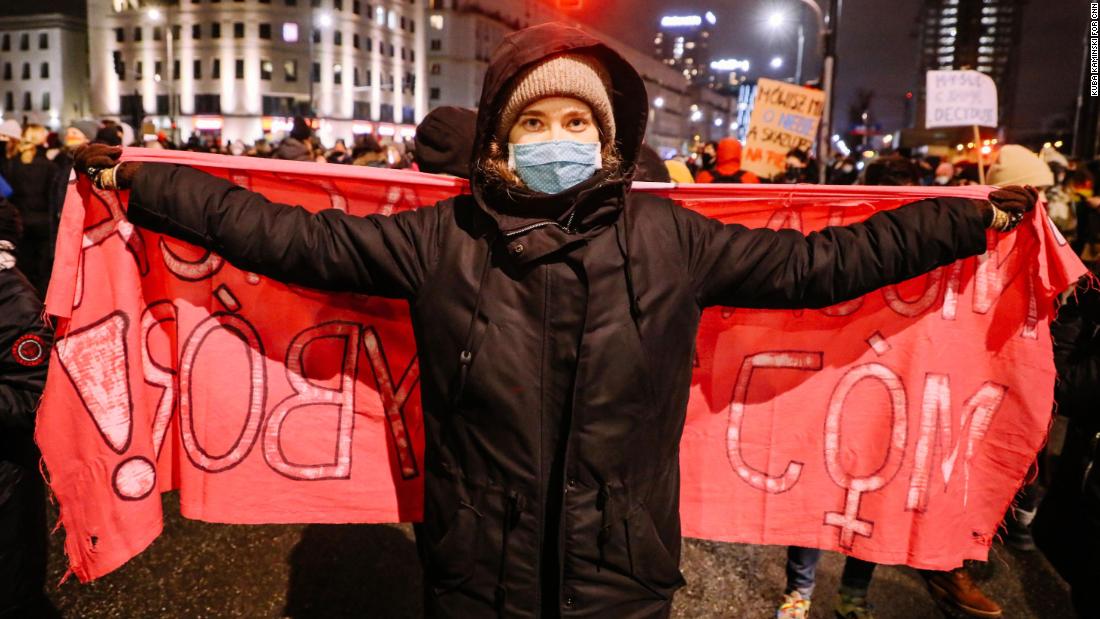
Warsaw, Poland — The protesters who marched through the Polish capital’s icy streets on Friday night had a clear message for the government over its imposition this week of a near-total ban on abortions: We will stand up for women’s rights.It was the third day of protests since the ruling came into effect — and marked 100 days of protests since Poland’s constitutional tribunal court first handed down its controversial ruling, sparking weeks of mass demonstrations.Following those protests, the government had signaled it was open to dialogue. But on Wednesday it unexpectedly published the law enforcing the court’s ruling, which states that abortions may only be permitted in cases of rape, incest or when the woman’s life is in danger and bars the termination of pregnancies with fetal defects.The Constitutional Court’s ruling marked the first change to Polish abortion law since 1993, but came after a years-long effort from the country’s right-wing government to curtail access to abortions. The ruling Law and Justice Party (PiS) has placed anti-abortion rhetoric at the heart of its socially conservative agenda, and attempted to pass a bill banning abortions due to fetal defects in the early weeks of the coronavirus pandemic.Wednesday’s move prompted demonstrators in the capital, Warsaw, and other cities — including Krakow, Bydgoszcz, Opole, Szczecin, Łódź and Wrocław — to defy a pandemic-related ban on gatherings of more than five people and take to the streets again.Corporate worker Eliza carries a placard saying "This is war" at Friday's protest.Corporate worker Eliza carries a placard saying “This is war” at Friday’s protest.A rights group known as Women’s Strike has led the opposition to the new law, as abortion has emerged as one of the most divisive issues since the PiS came to power in 2015.Those who marched in central Warsaw on Friday carried placards declaring “Abortion without borders,” “Abortion is my right” or “You will not burn these witches.” Banners bearing the lightning bolt emblem of the Women’s Strike movement fluttered overhead, along with the red and white of the Polish flag.Some spoke to CNN about why they had turned out despite the pandemic restrictions, extended Thursday until mid-February, and a heavy police presence.”It’s very important to be here, because women’s rights are being trampled,” said 17-year-old high school student Zuzia. “I’m showing support for the movement.”Corporate worker Eliza, 46, who carried a placard saying “This is war,” said: “I think all women are here for freedom for Polish women. We are protesting here. A group of women saying ‘no’ to our government and their decisions.”Protester Julia, 23, carries a banner at the protest. Protester Julia, 23, carries a banner at the protest.Psychology student Dagmara, 25, believes in respect for all.Psychology student Dagmara, 25, believes in respect for all.”We are here because the new abortion law’s verdict came into force and women became live incubators,” said Julia, 23. “The matter is simple to me: I want to have my rights and choice and I think everybody thinks similarly here and we have to support one another.”Psychology student Dagmara, 25, carried a sign saying, “It’s a right, not an ideology.”
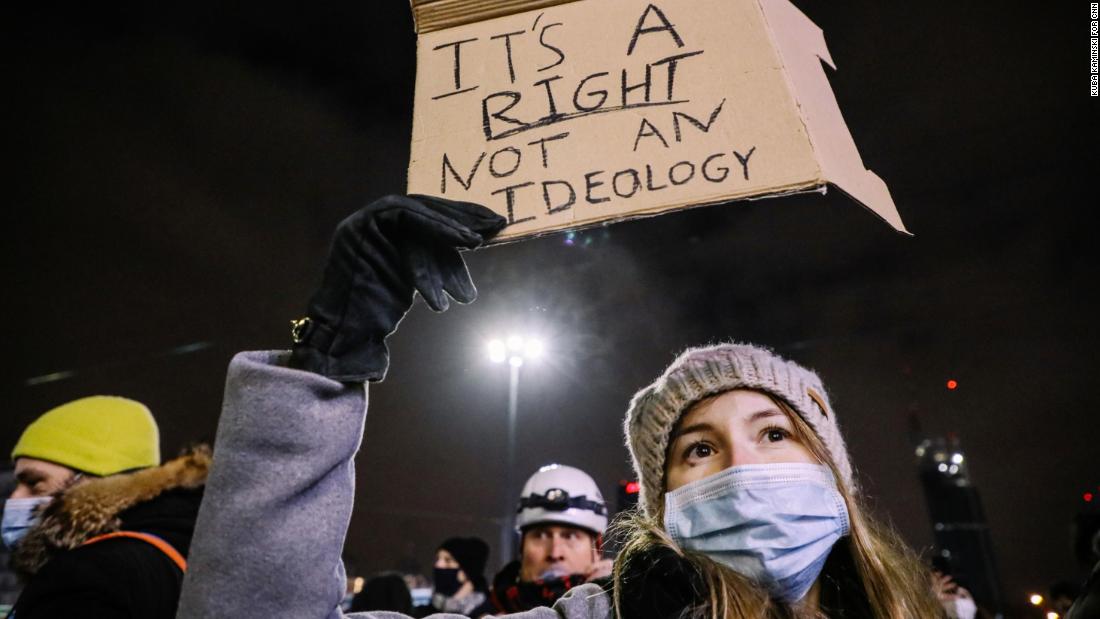

“It’s my duty as a citizen to be here and fight for freedom. It’s the 21st century and respect and tolerance for everybody is a must.”Dagmara, student, aged 25

Police were deployed in significant numbers in central Warsaw. Loudspeakers on police cars broadcast the message that the gathering was illegal and called for those gathered to disperse. Video of the protest showed what appeared to be tear gas being used.But the crowds of demonstrators remained defiant as, wrapped in thick coats and scarves and wearing face masks as a precaution against Covid-19, they walked toward the official residence of PiS chief Jarosław Kaczyński in the city’s northern Żoliborz district.Women's Strike leader Marta Lempart rallied the protesters as they marched on Friday.Women’s Strike leader Marta Lempart rallied the protesters as they marched on Friday.Police blockades prevented the demonstrators reaching the official residence of PiS leader Jarosław Kaczyński.Police blockades prevented the demonstrators reaching the official residence of PiS leader Jarosław Kaczyński.The protesters, galvanized by Women’s Strike leader Marta Lempart, took detours down back streets to avoid police blockades. But a large police presence prevented them from getting close to the residence and the protest eventually broke up after midnight.Kaczyński, the country’s deputy prime minister, is widely seen as the de facto decision maker in Poland and the driving force behind the new abortion law. Even before it came into force, the staunchly Roman Catholic country had some of the strictest abortion rules in Europe.Abortions due to fetal defects comprised approximately 98% of all legal abortions carried out in Poland in 2019, according to data from the Polish Ministry of Health.Further restricting abortion is seen by the law’s critics as the latest attack on social freedoms by a right-wing government that openly disdains Western liberal values, uses homophobic rhetoric and has eroded protections for the LGBTQ community. Pride flags have been a common sight among the crowds of protesters.Students Antek and Aneta are opposed to the government's stance on LGBTQ rights.Students Antek and Aneta are opposed to the government’s stance on LGBTQ rights.Weronika, 22, holds a banner with the Women's Strike symbol.Weronika, 22, holds a banner with the Women’s Strike symbol.”This verdict is despicable,” said 25-year-old student Antek. “We are LGBT people and the government hates us,” said fellow student Aneta, also 25. The pair carried a rainbow flag and the red lightning bolt symbol of the Women’s Strike movement as they walked.Weronika, 22, said: “I’m here in solidarity with all the women and all the men who stand with women, with all non-binary people and all the people that have had enough.”Neither the PiS nor President Andrzej Duda, who is backed by the PiS, have commented publicly on the fresh round of protests. CNN has reached out to the offices of the President and Prime Minister for comment.Kaczynski in October described people protesting over the abortion ruling as criminals and warned that their actions in the middle of a pandemic would cost lives.

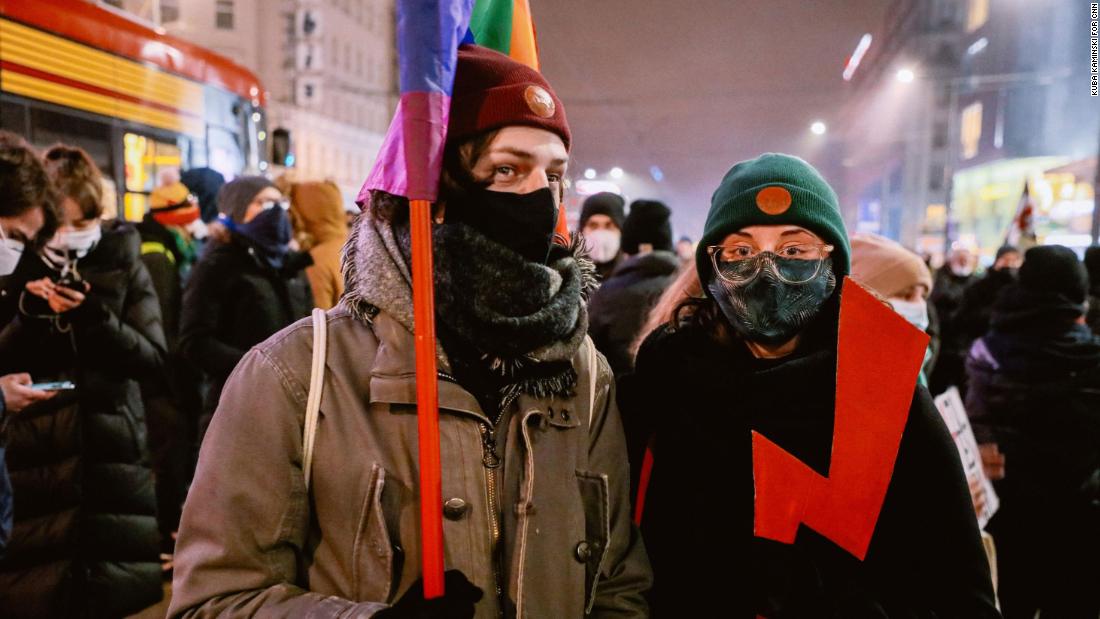
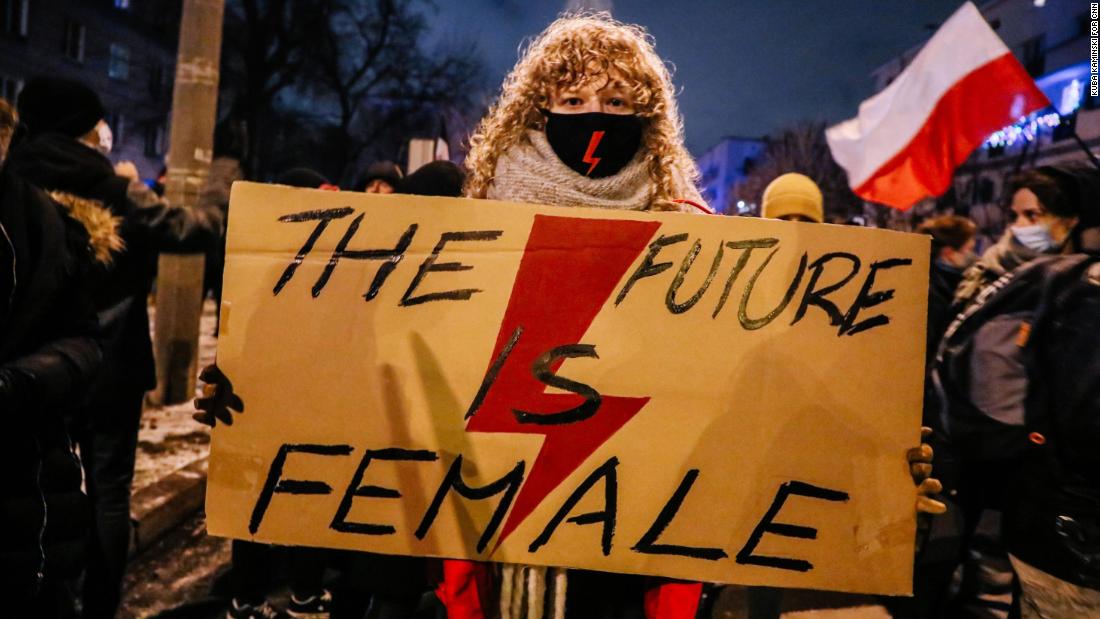
Some in Poland may leave the country because of this law 01:38Meanwhile, to those in the protest movement, the Catholic Church and the PiS form a powerful bloc determined to impose an intolerant, ultra-conservative agenda.Mayor of Warsaw Rafał Trzaskowski, of the opposition center-right Civic Platform party, joined the protest Friday, saying on a Facebook Live that he “stands in solidarity with the Women’s Strike.”Dariusz Rosati, a Civic Platform MP, said the governmental ban on assembly is illegal and accused the police of putting the protection of Kaczyński above that of other institutions such as the parliament and Council of Ministers. “They protect Kaczyński. The guest responsible for the destruction of the state, for setting Poland on fire, for unleashing hatred. Disgrace,” he tweeted late Friday.Warsaw Police tweeted Friday night that its aim was to secure the protest while minimizing inconvenience to other people. “We evaluate the situation only through the prism of ensuring safety. Also the safety of other inhabitants of our city,” the force said.Meanwhile, Urszula Sara Zielińska, an MP from the Green Party, tweeted that each of those who had turned out in protest “despite the frost, pandemic and fear of police repression” represented “hundreds of thousands of others who do not want to live in a sick country.”It’s unclear whether the latest protests will persuade the governing coalition to pursue a different course.But the dispute over women’s reproductive rights has once again laid bare the cultural, moral and political divisions that run deep through Polish society.

Source: https://edition.cnn.com/2021/01/31/europe/poland-abortion-law-protests-intl/index.html?fbclid=IwAR228thk44K__FWGu8TFZQicqwIsoBX1d0_qdCOAk0yfqgqYw-BDDWEyzWc

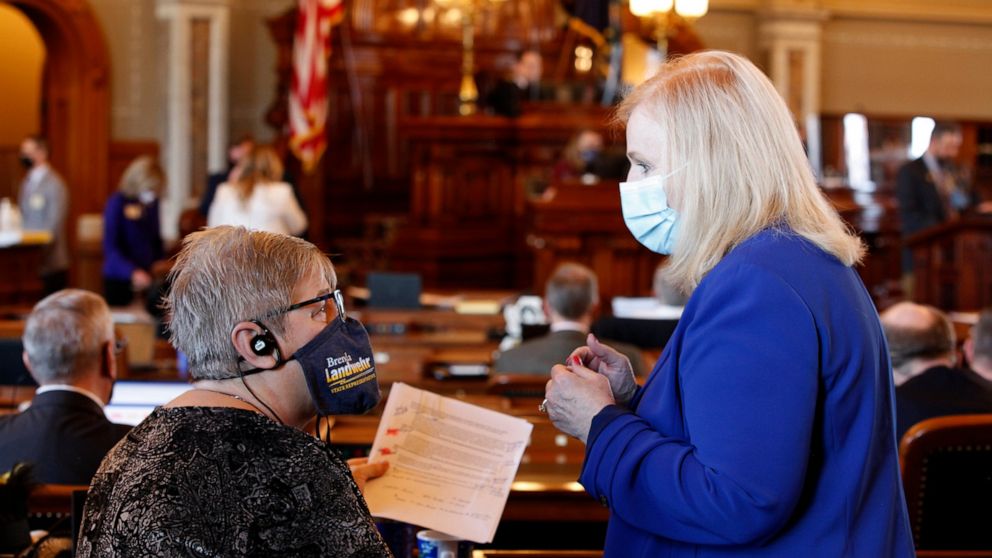
Kansas state Reps. Brenda Landwehr, left, R-Wichita, and Susan Concannon, R-Beloit, confer during a House debate on a proposed anti-abortion amendment to the Kansas Constitution, Friday, Jan. 22, 2021, at the Statehouse in Topeka, Kan. Both supported the measure, which would overturn a Kansas Supreme Court decision in 2019 that declared access to abortion a “fundamental” right under the state constitution. (AP Photo/John Hanna, Pool)

Republican legislators in Kansas have put a proposed anti-abortion amendment to the state constitution on the ballot for the state’s August 2022 primary election

The Senate approved, 28-11, a measure that overturns a Kansas Supreme Court decision in 2019 that declared access to abortion a “fundamental right” under the state’s bill of rights. Supporters had one vote more than the two-thirds majority necessary for approval of a proposed constitutional change.

The measure would add language to the state constitution declaring that it doesn’t grant the right to abortion and that the Legislature can regulate it in line with U.S. Supreme Court decisions. The measure would not ban abortion, but it would allow lawmakers to enact a ban if the nation’s highest court were to overturn its landmark 1973 Roe v. Wade decision protecting abortion rights.

“Kansans don’t want an unregulated abortion industry,” said state Sen. Molly Baumgardner, a Kansas City-area Republican who led fellow anti-abortion lawmakers in the debate.

If voters approve the measure, Kansas would become at least the seventh state with language in its constitution saying the charter does not grant a right to abortion, and Iowa lawmakers also are considering a similar measure. The Kansas proposal is similar to ones approved by voters in Tennessee in 2014, West Virginia in 2018 and Louisiana in 2020.

Both sides were confident enough that the Kansas Senate would approve the measure that they had already begun previewing messages for what is likely to be an intense, monthslong campaign. Those messages included one from abortion rights supporters that adding the anti-abortion language to the state constitution would hurt the state’s economy.

Ahead of the Senate’s debate, Democratic Gov. Laura Kelly warned that enacting it would lead to boycotts of Kansas and discourage companies from relocating to the state. Kelly, a strong abortion rights supporter, said last year that the proposal would return the state “to the Dark Ages.”

“There are a number of CEOs who really look to see what kind of inclusive policies we have in place that make it easier for them to recruit and retain a talented work force,” Kelly said in a recent Associated Press interview. “It will be an economic development issue for us.”

But the biggest threat to the measure’s approval in the Senate was too many GOP members being absent because of illness or personal reasons. Elections last year not only preserved GOP supermajorities in both chambers but made them more conservative.

“The people of Kansas have shown they are pro-life, and the election spoke volumes,” said Jeanne Gawdun, lobbyist for Kansans for Life.

Gawdun’s group is the most influential anti-abortion group in state politics and generally favors an incremental approach to restricting abortion as federal courts give states more leeway.

Two decades’ worth of restrictions on abortion have been enacted in Kansas with bipartisan support. Kansas imposes a 24-hour waiting period ahead of an abortion, spells out what information providers must provide patients and requires most minors to notify their parents before terminating a pregnancy.

Abortion opponents expect to argue to voters that the amendment would allow the Legislature to regulate abortion as it had before 2019 and to warn that future state court decisions otherwise would strike down most restrictions. Abortion rights supporters already are testing a message that the measure is a big step toward an abortion ban.

Kelly likens the anti-abortion measure to North Carolina’s infamous and since-repealed 2016 “bathroom” law preventing transgender residents from using facilities in line with their gender identities, which prompted an economic backlash. In Kansas in 2014, a House-passed measure to protect people from lawsuits if they refused for religious reasons to provide services to LGBTQ people died in the Senate when some business leaders objected to it.

Sen. David Haley, a Kansas City, Kansas, Democrat and one of two Black senators, said enacting the amendment would assign women in Kansas to “a certain kind of slavery.”

“I don’t want Kansas to continue to be that stigmatized,” Haley said.

In 2019, Georgia’s enactment of a ban on most abortions, some movie producers and actors said they wouldn’t film in the state, but the major studios were quieter than they were about the North Carolina bathroom law.

And businesses and business groups have been silent so far on the Kansas anti-abortion proposal.

Alan Cobb, president and CEO of the Kansas Chamber of Commerce, said high taxes and burdensome regulations make Kansas less competitive and, “no, the (abortion) amendment will not hurt the state’s economic development.”

Abortion opponents said the lack of public opposition from business leaders suggests Kansas wouldn’t face any economic fallout.

“If you’re going to say unlimited abortion is helpful to your economic future, that’s kind of a problem,” said Brittany Jones, advocacy director for the anti-abortion Family Policy Alliance of Kansas. “You’re essentially saying you want to build your economy on the back of abortion.”

Source: https://abcnews.go.com/Health/wireStory/kansas-debates-abortion-measure-stifle-economy-75547106

The Hyde Amendment, which prohibits the use of federal money to pay for abortion, is a legislative provision that has been in place for decades.
 Bettmann/Contributor/Getty Images

It’s time for President Joe Biden to make good on his campaign promise and repeal the Hyde Amendment.

In 1977, Rosie Jimenez died after having an illegal abortion. But it wasn’t just the procedure that killed her—it was the Hyde Amendment.

A year prior, Rep. Henry Hyde, a Republican from Illinois, introduced the piece of legislation that still bears his name. The Hyde Amendment, which prohibits the use of federal money to pay for abortion, is a legislative provision that has been in place for decades—one that President Joe Biden promised during his campaign to finally overturn.

When Jimenez found out she was pregnant in 1977, she knew she didn’t want to be a parent. She wanted to finish college, and so she sought an abortion. Just a few months earlier, she would have been able to use Medicaid to pay for her abortion, but thanks to the Hyde Amendment, this wasn’t an option anymore.

Unable to afford the procedure out of pocket, she turned to an illegal abortion. Soon she was hemorrhaging and vomiting; she had a fever and her friends and family rushed her to the emergency room. There, she was given a tracheotomy, and soon after, a hysterectomy. But the infection in her uterus had become too widespread. After a painful seven days in intensive care, she died at the age of 27.

According to the Texas Observer, in just the short two months after the Hyde Amendment went into effect, complications from unsafe abortions were already on the rise in Jimenez’s Texas hometown.

“Between August and October of 1977, five women, including Jimenez, turned up at the emergency room with infections and related complications, probably from cheap illegal abortions, according to a report from the Centers for Disease Control and Prevention,” the Observer reported.

It has been over 40 years since the Hyde Amendment was first enacted, and the concept of federal funding for abortion remains contentious, despite overwhelming evidence that the ban endangers the lives of the most marginalized and vulnerable pregnant people, particularly those in rural areas and in communities of color.

In 2016, at the urging of abortion advocates, Hillary Clinton became the first presidential candidate to include repealing the Hyde Amendment in her campaign platform, making it the most progessive abortion platform in history. And while the final iteration of Biden’s campaign platform included a repeal, that move only came after pressure from abortion advocates in response to Biden’s initial support for the Hyde Amendment.Repealing the Hyde Amendment is the least we can expect of liberal lawmakers. It’s a draconian and harmful law that puts the lives of pregnant people at risk.

Some states, like Massachusetts, get around Hyde by using state money to cover abortion care for residents on Medicaid. Other states, like Texas, have additional bans that prohibit even private insurers from covering abortion care.

Abortion-related funding has already made headlines since Biden was inaugurated. This week he announced he would be rescinding the Mexico City policy, otherwise known as the global “gag rule.” The global gag rule prohibits government money from going to nongovernmental organizations that promote—or even talk about—abortion as a method of family planning. The global gag rule works in concert with a legislative provision that also restricts abortion access overseas: the Helms Amendment. Think of Helms as the international counterpart to Hyde; it bars U.S. foreign aid money from paying for any kind of abortion care in other countries. And, to be clear, Biden should throw this one into the incinerator too.

Biden’s decision to rescind the Mexico City policy came after criticism—mine, to be exact—that the Biden administration seems just a tad uncomfortable with actually saying the word abortion. First there was White House press secretary Jen Psaki dancing around it at a briefing; then there were President Biden and Vice President Kamala Harris’ statements commemorating the anniversary of Roe v. Wade, with the word “abortion” nowhere to be found. Even on Thursday as Biden signed the executive order, he evaded the term, opting instead for vaguer language like “reproductive rights” and “women’s health.”

But good news is good news, and the repeal of the global gag rule is pretty damn good news. What’s more, at least two states—Virginia and New Jersey—are looking to expand coverage for abortion care. If passed, the Reproductive Freedom Act in New Jersey would require private insurers to cover birth control and abortion care with no out-of-pocket costs. And on January 26, the Virginia House of Representatives voted to repeal a ban on abortion coverage for insurance plans in the state’s health-care exchange.

Repealing the Hyde Amendment is the least we can expect of liberal lawmakers. It’s a draconian and harmful law that puts the lives of pregnant people at risk. And it’s a grim reminder of how stigmatized and backwards United States abortion policy is. Insurance should cover abortion just like it covers any other procedure. That this is up for debate shows how far we still have to go to win this fight. Put simply, federal funding for abortion should be the floor—not the ceiling.

Repealing the Hyde Amendment is long overdue in the fight to ensure that comprehensive abortion access is a reality for all. It would be a recognition that abortion—like any other procedure, from an appendectomy to knee surgery—is just good medicine.

Source: https://rewirenewsgroup.com/article/2021/01/30/paying-for-other-peoples-abortions-saves-lives/

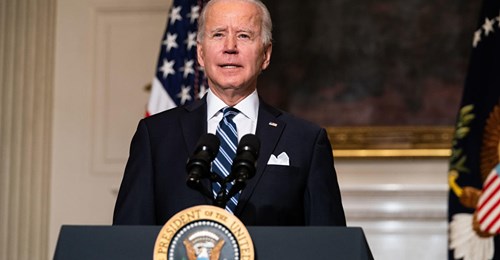
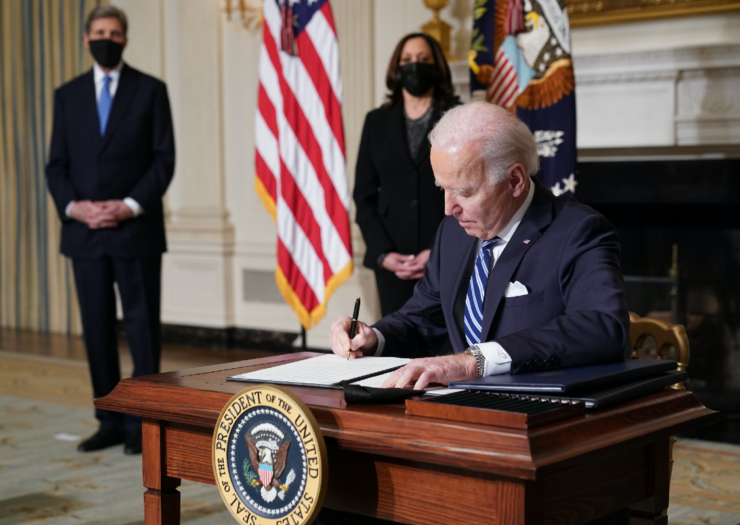
Washington — President Biden is expected to use his executive authority to rescind the Mexico City Policy, also known as the global gag rule, as part of a slew of executive actions on Thursday, according to three people familiar with the White House’s plans. The Mexico City policy prohibits federal dollars from going to non-governmental organizations (NGO) that provide abortions, advocate to legalize and expand abortion access, or who provide abortion counseling.

This policy, first announced by President Ronald Reagan in 1984, has been regularly enacted by Republican administrations and rescinded by Democratic administrations.

But the Mexico City Policy was expanded under the Trump administration, prohibiting funding for NGOs who, in turn, fund other programs that provide abortions or abortion counseling.

A 2020 report by the Government Accountability Office found in 2017 at least 54 instances when NGOs did not accept U.S. federal aid dollars because they did not want to cease their abortion access advocacy or limit abortion counseling. This resulted in the NGOs foregoing $153 million, according to the report.

Mr. Biden is also expected to ask the Department of Health and Human Services to review a similar policy in the United States that prevents money from Title X, a federal program meant to help low-income patients afford reproductive health care, from going to health care centers that provide abortion counseling.

Finally, Mr. Biden is expected to disavow or remove the United States’ 2020 endorsement of the Geneva Consensus, which is a nonbinding international declaration signed by countries opposed to abortion. Led by former Secretary of State Mike Pompeo, the U.S. was among more than 30 countries, namely Uganda, Hungary, Indonesia, Brazil and Egypt, to join the consensus. The text of the pact is also viewed by critics as being anti-LGBTQ and anti-same sex marriage, as most of the nations involved have not legalized same-sex marriage and several others criminalize and prosecute their LGBTQ citizens.

These executive actions are expected to be part of additional health care related actions on Thursday, the people familiar with the plans said.

While these actions were expected, Mr. Biden has not always supported expanding access to abortion. For decades, then-Senator Biden supported the Hyde Amendment, which bans using federal money for abortion services in most cases. But under pressure from progressive groups and fellow Democratic presidential candidates, Mr. Biden in June 2019 reversed his stance and said he was now in favor of repealing the Hyde Amendment.

“I can’t justify leaving millions of women without access to the care they need and the ability … to exercise their constitutional protected right,” Mr. Biden said at the time.

The White House did not immediately respond to a request for comment.

Source: https://www.cbsnews.com/news/biden-reverse-anti-abortion-rights-policies-executive-order/?fbclid=IwAR2ohfwmoFnm5MmtTXLIxJQmQlEHwRcczEmfCxJqYOspQZ6yCwsvq6t6u-E

Rescinding the global “gag rule,” also known as the Mexico City policy, is a start. Here’s what the administration can do next to advance abortion rights.

Mandel Ngan/AFP via Getty Images

Today, President Biden signed a presidential memorandum to rescind the global “gag rule,” also called the Mexico City policy. The gag rule prevents U.S. aid to nongovernmental organizations overseas if they conduct abortion-related counseling, referrals, or advocacy.

From its first implementation in 1984, the global gag rule has slashed NGO’s ability to provide informed health care without risking the loss of much-needed U.S. aid. Now more than ever, having both popular support and political power, the Biden administration must go above and beyond repealing the global gag rule to protect, ensure, and expand abortion access and reproductive health care.

The global gag rule has been enforced by all Republican administrations since Reagan and rescinded by all Democratic administrations, but the version Trump signed in 2017 came with a particularly draconian set of restrictions. Trump expanded the gag rule’s scope to all U.S. global health assistance, not just family-planning organizations. This meant that initiatives addressing HIV and AIDS, child and maternal health care, water sanitation, nutrition, or infectious diseases would lose funding if they couldn’t certify that they did not participate in any abortion-related activity. Furthermore, if an NGO receiving any global health funding from the United States were to award a grant to another organization, that organization had to also prove to the U.S. government that it doesn’t support abortion-related activities—even if no U.S. dollars trickled down to them at all.

The repercussions of the gag rule reached far and wide, creating lasting effects on the lives of people who were unable to access the full spectrum of care during its enforcement. In 2017, $8.8 billion of global health aid flowing to more than 70 countries was subject to the gag rule. With the United States being the largest funder of international health initiatives, organizations working on the ground within their communities were vulnerable to losing their biggest pot of resources at the expense of providing accurate medical services and care.

For example, providers whose work was funded under U.S. global health programs would need to violate the patient-provider relationship due to the gag on discussing abortion as a possible avenue of reproductive health care. Advocates working with organizations to legalize or decriminalize abortion in their countries are censored from enacting change, and in places where abortion is already legal, people are unable to make use of their legal right to pursue the termination of a pregnancy.

Most frighteningly, the most recent iteration of the global gag rule has shown that the presidency is able to wield its power to affect other critical areas of care, like HIV and malaria, if doing so can act as an added deterrent to abortion-related activities.

The United States’ barriers to abortion care are not only reserved for its international partners.

Even with the repeal of the global gag rule, the narrower Helms Amendment of the Foreign Assistance Act will continue to restrict U.S. foreign aid funding from being used directly for abortion procedures. You can look at the Helms Amendment as the international counterpart to the domestic Hyde Amendment, a 1976 rider to the annual congressional budget crafted in response to the Roe v. Wade decision, which legalized abortion. Just like the global gag rule and the Helms Amendment, the Hyde Amendment blocks federal funding from going toward abortions, which means anyone insured under a federal program—like Medicaid, Medicare, Indian Health Services, or the military’s TRICARE—is unable to use their health insurance to cover their abortion.

There is simply no other medical procedure that experiences such restrictions, and while rescinding the global gag rule reaffirms the care and autonomy that communities and people considering and seeking abortions internationally deserve, President Joe Biden’s campaign promise to ensure informed and supportive access to abortion will not be fulfilled by a single presidential memo.

President Biden must prove his dedication to supporting all pregnant people choosing between all pregnancy outcomes, including abortion, by urging Congress to repeal the Helms and Hyde amendments and signing new, clean foreign aid and federal budget bills into law.

Access to reproductive health care should have never been subject to the political pendulum, but as decadeslong advocacy from domestic and international partners alike comes to a boil, the unignorable reality is that expanding access to abortion on the federal level is now undeniably within reach, full stop. In addition to rescinding the global gag rule, President Biden can do what no other president has done and establish himself and his administration as true bringers of progress and change by working to end the Helms and Hyde amendments.

Source: https://rewirenewsgroup.com/article/2021/01/28/biden-administration-starts-to-unwind-abortion-policy-exported-abroad/?fbclid=IwAR1c5jijVON0YJhq71PtTvYsPUq2HCyRV7xpgWfFuRHtMDvasbcD8V24hLQ

The U.S. Supreme Court on Monday voided rulings from lower courts that upheld a ban on most abortions in Texas early in the coronavirus pandemic. Credit: Stephen Spillman for The Texas Tribune

The high court vacated two rulings from the lower U.S. 5th Circuit Court of Appeals that sided with Texas GOP officials arguing that Gov. Greg Abbott’s March 2020 executive order prohibited abortion under all but a few narrow circumstances in an attempt to preserve medical resources for COVID-19 patients.

The U.S. Supreme Court on Monday voided rulings from lower courts that upheld a ban on most abortions in Texas early in the coronavirus pandemic.

The high court vacated two rulings from the lower U.S. 5th Circuit Court of Appeals that sided with Texas GOP officials arguing that Gov. Greg Abbott’s March 2020 executive order prohibited abortion under all but a few narrow circumstances in an attempt to preserve medical resources for COVID-19 patients. Abortion providers have said that the procedure rarely requires hospital time and typically does not involve extensive personal protective equipment.

The executive order ended over the summer, allowing abortions in the state to resume, but Planned Parenthood has said leaving the lower court rulings on the books would set harmful legal precedent for abortion rights advocates.

In a statement, Planned Parenthood, the Center for Reproductive Rights and the Lawyering Project called Abbott’s order “a transparent attempt to chip away at access to reproductive health care by exploiting a public health crisis,” and said it was “important we took this procedural step to make sure bad case law was wiped from the books,” according to a NBC News report.

After Abbott paused all non-urgent medical procedures and surgeries to slow the spread of COVID-19 and conserve medical equipment, Texas Attorney General Ken Paxton said the order should include a ban on most abortions, setting off a barrage of conflicting court rulings that created confusion for clinics and women seeking to end their pregnancies.

Many Texans left the state to receive abortions during that time, a new study found earlier this year.

Source: https://www.texastribune.org/2021/01/25/supreme-court-texas-abortion-ban/

As Texas goes, so does the rest of the country. At Avow, we’re committed to unapologetic advocacy for abortion rights.

We have to be bold, to not compromise on our values for political convenience to win the longterm fight for abortion rights.
 Shutterstock

Since I joined NARAL Pro-Choice Texas as executive director nearly three years ago, I’ve thought every day about how we can boldly show up for the people in our state who need abortions.

I’ve thought often of the young woman who testified at the People’s Filibuster that her abortion enabled her to address her mental illness. Despite being raised by an abortion provider, despite being one of the 1 in 4 women who will have an abortion in her lifetime, despite being an advocate in the abortion rights movement, I had succumbed to the stigma that has been perpetuated since abortion became legal. That abortion was not health care, but something to be ashamed of. I used euphemisms like pro-choice, or reproductive health care, when I meant abortion care. I never told my story, but told the story of my dad’s work as an abortion provider and his heroism.

That woman’s story was my story and hearing her bravely tell her truth, despite the stigma, despite anti-abortion zealots, despite anti-abortion legislators trying to take that right away from Texans, changed my life and led me on a different trajectory.

The reality is that the majority of Texans and Americans believe that abortion should be safe and legal, and we need to start doing the work like we truly believe this sentiment. As abortion care becomes more restricted, and we face an anti-abortion majority on the Supreme Court, our current political reality demands that we be bold and abortion-forward in our fight to protect access.

To avow means to declare openly, bluntly, and without shame. Now more than ever, our state needs bold and unapologetic advocacy for abortion rights, and with that we are excited to announce that NARAL Pro-Choice Texas is now Avow.

At Avow, we’re working for a better Texas, where every person is trusted, thriving, and free to pursue the life they want. That’s why it’s our mission to secure unrestricted abortion care and reproductive rights for all Texans. We are changing the culture in Texas so that we can start developing and passing policies from a place of freedom and compassion, instead of fear and stigma. The existing restrictions on abortion care rely on and reinforce white supremacy, oppression, and misogyny. Anti-abortion extremism is about telling people how they can and can’t live their lives, and limiting Texans’ futures. When we fight for unrestricted abortion access, we are fighting for our families, our communities, our futures, and our freedom.

We are proud to avow that everybody has a place in this movement, especially those who’ve been historically marginalized: transgender and nonbinary folks, people of color, young people, and people who have abortions.

We believe that in order to win the longterm fight for abortion rights, we have to be bold, to not compromise on our values for political convenience, and to center the voices of Texans impacted by abortion restrictions, who are more likely to be people of color and people working to make ends meet. We believe that “culture change” work is just as important as political and electoral work and that we can’t successfully win a fight for abortion rights in the long term without pushing the boundaries of both. In Austin we, along with our allies, helped pass a city budget initiative that funds practical support for abortion care, and recently we increased that initiative to $250,000. This was possible because when it was suggested that we substitute the word “abortion” with “reproductive health care,” we stood our ground.

At Avow, we’ve made a commitment to educating legislators and having bold, unapologetic conversations about abortion. We do this so that candidates and elected officials can use medically accurate and bold abortion rights language and policy, instead of the vague and stigmatizing language that is far too common in our current political movements. We’ve made clear that this is what we need from the folks vying for our votes and representing us in the legislature. By building on this work and building our collective power, we’re working toward a future of bold, unapologetic abortion access in the halls of the Capitol and beyond.

For years, we’ve been on the ground fighting to make abortion accessible because we know that legality alone is not enough. Southern and red states like Texas have been the most resilient and creative in fighting back against restrictions, and we will tap into that resiliency as we embark on this new journey as Avow. Georgia showed us what’s possible when we lead with our values and our faith—I know we can do the same in Texas.

Source: https://rewirenewsgroup.com/article/2021/01/25/envisioning-a-bold-future-for-abortion-access/

Joe Biden and his wife Jill Biden attend a church service before his presidential inauguration, at St. Matthews Catholic Church in Washington on Jan. 20, 2021.Tom Brenner / Reuters

One his first acts will be to end the “global gag rule.” Many of our faith have seen the harm that reproductive rights restrictions cause in the world.

President Joe Biden, like his Democratic predecessors, will reportedly mark the early days of his tenure by overturning the “global gag rule,” a policy dating to the presidency of Ronald Reagan that prevents all international organizations that receive U.S. foreign aid from advocating for abortion access in their own countries or providing clients with abortion services, referrals to other organizations that provide abortions or even information about the existence of legal abortion programs.

But while it could be seen as the typical action of a Democratic president — the rule is lifted every time a Democrat replaces a Republican in the White House, only to be reinstated when a Republican wins the presidency — it’s particularly notable to some commentators this time because Biden is a practicing Roman Catholic, and only the second to win the presidency after John F. Kennedy.

Commentators from both within and outside the Catholic faith typically express (often feigned) surprise that a practicing Catholic might advance pro-choice policies, but Biden’s positions — like those of House Speaker Nancy Pelosi, D-Calif., and the Senate president pro tempore, Patrick Leahy, D-Vt., for instance — point to a simple truth that’s often overlooked: Most American Catholics support reproductive choice.

survey of U.S. Catholics during the 2020 election demonstrated what so many of us in the faith already knew: Abortion is simply not the top-line concern for Catholics that the church hierarchy and the media believe it to be, and a broad majority of us do not want to see Roe v. Wade overturned. Furthermore, Catholics are almost twice as likely to vote for candidates who support policies providing safe and legal abortion than for those who fail to do so.

Catholics increasingly express their support for reproductive rights, and the bishops who claim to speak for us have little understanding of the people in their pews.

And, in fact, many practicing Catholics who support reproductive rights often do so not despite their faith, but because of it.

The obligation to not just care for the vulnerable but to actively privilege them over everyone else lies at the heart of the Catholic faith; it’s the guiding principle of the church’s work with the poor and the marginalized. Policies like the global gag rule inflict disproportionate suffering on the poorest of the poor, those afflicted by illness related to reproductive health, those in rural areas with limited resources and those who find themselves in states of profound powerlessness.

Many Catholics are increasingly aware that the absolute prohibition on abortion in various countries in Latin America, as well as previous prohibitions in countries like Ireland and increasing restrictions in red states in the U.S. are not only hurting vulnerable women and girls but, in repeated and shocking cases, killing them. May we never forget that abortion is legal in the Republic of Ireland today because of the agonizing death of Savita Halappanavar, who was denied an abortion at a Galway hospital while she was having a miscarriage in 2012.

What’s shocking is not that Catholics are increasingly expressing their support for reproductive rights, but that the bishops who claim to speak for us have so little understanding of the people in their pews.

Most American Catholics support reproductive choice.

That is why Biden must go further than an executive order to roll back the global gag rule. He must commit to ending it permanently, and then work with the new congressional majority to push back on and reverse the many additional steps taken by the Trump administration to further entrench policies that restrict reproductive rights around the world.

To do this, the U.S. government can draw on examples from across the international Catholic community —and, in particular, the women who have been leading the charge. Biden can look to last year’s legislative efforts in Malawi to loosen abortion restrictions; Polish women marching regularly in the streets for abortion access; or the recent victory in Argentina to legalize abortion. These all point to the fact that, when the struggle for fully realized human rights protections for all people — regardless of gender or reproductive status — has been taken up around the globe, Catholics play a vital role in making progress happen.

Advocates for increased access to the full range of reproductive health care, in the United States and around the world, must see these cases of Catholics for reproductive choice for what they are: the building blocks of global change, not just a curiosity to appreciate.

Listening only (or even mostly) to the church hierarchy on issues of abortion or reproductive choice is simply no way to know what Catholics think, and no way to guide health care policy, either domestic or international. All over the world, people of all faith traditions are championing with increased urgency the sexual and reproductive health of all people. The Biden administration must listen to their voices, and commit to securing these most basic human rights.

When our government refuses to support these efforts — or worse, uses the language of religion to undermine them — we are not honoring the supposed faith of millions (let alone the millions of that faith who disagree), but rather condemning millions to unsafe abortions, increased maternal death and the poverty and squandered opportunities that come from insisting that more than half the population does not have the right to make their own health care decisions.

As Catholics, we find this morally indefensible; as Americans, we know our country can do better.

Source: https://www.nbcnews.com/think/opinion/biden-s-catholic-supports-abortion-rights-it-puts-him-majority-ncna1255215