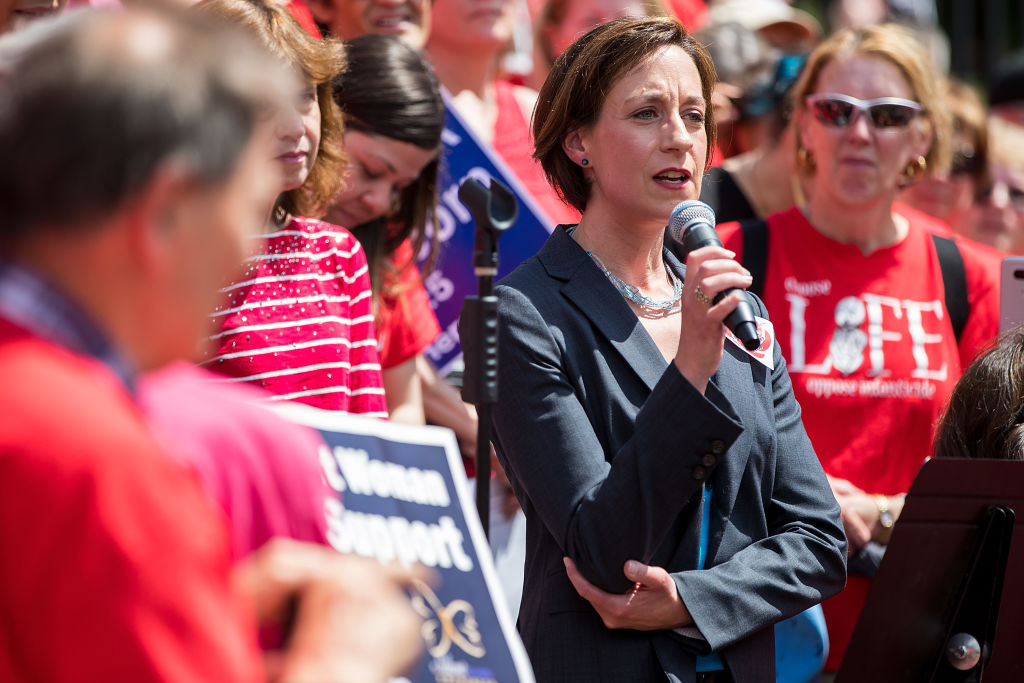
Anti-abortion demonstrators protest in front of the Supreme Court as they wait on a decision on the Louisiana case, Russo v. June Medical Services LLC in Washington on Monday, June 29, 2020. [Photo by Caroline Brehman/CQ-Roll Call, Inc via Getty Images]

Louisiana just passed Amendment 1, which ensures its constitution will explicitly not protect abortion rights—just the latest in a string of antichoice measures introduced by the state.

For some voters, the election wasn’t just a referendum on Trump. Abortion access was on the ballot again, this time on the heels of Amy Coney Barrett’s appointment to the Supreme Court. In Colorado, a proposal to ban abortions after 22 weeks failed to pass. Voters in Louisiana, on the other hand, pushed through an amendment that effectively enshrines the state’s endemic lack of abortion access in its constitution.

Many abortion advocates see Barrett’s confirmation as a credible threat to Roe v. Wade. But in states such as Louisiana—where the new amendment is only the most recent maneuver in a sustained attack on abortion rights—the law of the land hardly matters.

Since the passage of Roe v. Wade in 1973, Louisiana has adopted 89 abortion restrictions, including a 24-hour waiting period between required counseling and the actual abortion procedure. The state now has just three abortion clinics, down from seven a decade ago; Planned Parenthood operates two health centers in Louisiana but has been unable to obtain a license to provide abortions. Last year, the Louisiana governor signed into law a heartbeat bill that could prohibit abortions as early as six weeks into a pregnancy, though a court order blocked it from taking effect. But in the event that Roe v. Wade does get overturned, the state’s trigger ban would immediately outlaw abortion in the state.

Amendment 1 introduces language that ensures the Louisiana constitution will not protect the right to abortion or provide funding for abortion. After Louisiana voters passed the amendment, I spoke to Kathaleen Pittman, who runs Hope Medical Group for Women, one of the few abortion clinics that are still standing. Pittman, who has worked at the clinic in various capacities for 28 years, weighed in on how the pandemic has impacted access to abortion care and the immediate effects of the new amendment. Her account has been edited and condensed.

“MOST OF THE PATIENTS WE SEE HERE ALREADY HAVE ONE OR MORE CHILDREN”

My primary responsibility is keeping our clinic doors open, overseeing staffing and the physical clinic itself to make sure it meets all the standards and regulations as required by Louisiana. We are actually licensed by the state and have been since 2004, which is a requirement. In Louisiana, in order for a physician to perform more than five abortions per year—and that includes medical abortion—that physician would have to be licensed as an abortion clinic.

Since Hope is located in the northwest corner of Louisiana, we pretty much pull in from a 200-mile radius. We do see a lot of patients coming from rural areas. Even though there are clinics in South Louisiana, we do have some that come up from there. We see quite a few [from] East Texas because we are just a few minutes from the Texas border. We have patients coming to us from Arkansas, Oklahoma, and also Mississippi. Most of the patients we see here already have one or more children; most of them live at or below the federal poverty line. The most common reason given for terminating a pregnancy is the lack of financial resources.

“OUR CHALLENGE SINCE THE PANDEMIC BEGAN HAS PRIMARILY BEEN KEEPING OUR DOORS OPEN”

Our challenge since the pandemic began has primarily been keeping our doors open. We did have a bit of a battle with state officials early on, when we initially received the closure orders for a lot of non-critical facilities. There was a lot of pushback from state legislators; the attorney general did everything he could think of, even [sending] a team of investigators in on us to try to get us to defer patients until later on. But time is of the essence when you have an unplanned pregnancy. We’ve had to rethink a lot of the way we handle patient care, as far as trying to do social distancing within the clinic. We have a 24-hour waiting period and have had since the mid-90s—so in order to not have too many people in the clinic at one time, we’ve had to separate days that we do the consults from the days we do our procedures.

One of the biggest complaints we’ve had from patients is the fact that because everybody is masked, and we’re having to be extra cautious, we’re no longer able to serve cookies and tea as we traditionally have. I know it sounds funny, but for years now, that’s kind of been our thing. Patients call us years after the fact wanting to know what we put in our tea.

Another very difficult thing for us during this pandemic has been having to limit support persons coming into the clinic with our patients. On day one, unless it’s a minor, we only allow the patient inside, and on day two, when they return for the procedure, the driver has to check in and then leave. And that’s heartbreaking to me. Because there’s something about having your best friend, your partner, or your sister or mom sitting next to you, waiting until you’re called. We ran into a problem with Texas clinics having to be closed temporarily, so we were seeing more patients come to us from Texas. It made it more difficult for us to see patients as quickly—we were literally scheduling almost a month out, just to get them in for that first visit. That’s difficult because most of these [patients] can’t wait that long.

“WHEN YOU PROVIDE ABORTION CARE IN LOUISIANA, THERE’S ALWAYS SOME BATTLE”

I can tell you four years ago, the morning after the election, I literally said, ‘I just don’t know that I can even get out of bed.’ Truly. It was that devastating, and then all our worst fears came true. [I have] said for years that my biggest fear isn’t that Roe will be overturned. It was that these trap laws that are passed by Louisiana legislature every year will make abortion inaccessible, in which case it doesn’t matter that we have Roe.

We can hardly catch our breath before we have something else that we’re having to deal with. Amendment 1 did become a big issue for us. It threw a lot of people into panic mode. The day after the amendment passed, we were fielding phone calls from people who were very concerned. Some were crying. I mean, we literally had people calling saying, ‘Are you going to be able to stay open? Are you closing? Are you already closed?’ That’s not happening—not now, anyway. But so many people were so frightened and concerned. I mean, I literally had my assistant administrator crying on the phone with one caller. When you provide abortion care in Louisiana, there’s always some battle.

The amendment itself was written specifically, I think, to create some confusion. Your average voter might say, ‘It’s not that I’m against abortion, but I don’t need to pay for it.’ When the truth of the matter is, state law prohibits state or federal funds from paying for abortion care; that’s already on the books. Also already on the books is a trigger ban passed in 2006. So if Roe v. Wade is overturned, abortion immediately becomes illegal in Louisiana. If that ever occurs, [the amendment] will make it more difficult to challenge not being able to have an abortion in Louisiana. And the fact that there were no exceptions allowed for rape or incest? I mean, the amendment itself I find appalling, but not having any exceptions—that’s stepping over the line into cruelty, as far as I’m concerned.

We need to focus on the reality that more and more in Louisiana, access to abortion is being denied. And it’s because it has become so difficult to keep clinics up and running. Women are having to travel further for care—and these are women that do not have transportation necessarily. They do not have childcare or can’t afford it. They cannot afford to take off time from work or school. They’re faced with so many things. And it’s not just one day, but two that they have to come in. So I think instead of making it more difficult to obtain an abortion, we need to focus more on [making] it less necessary to even need one.

“JUST WHEN YOU’RE HAVING A REALLY, REALLY, REALLY BAD DAY, SOMETHING SWEET HAPPENS”

This is going to sound rather corny. But my office is located off the main hall in the clinic. Patients who are leaving at the end of the day [are] walking by my office. I see them leaving, and the absolute difference in the way they carry themselves. It’s like, head up, shoulders back. [They’re] no longer defeated—let me put it that way. I see them, and they pop their head in to say thank you and compliment me on the staff. We get some really sweet notes from our patients. So just when you’re having a really, really, really bad day, something sweet happens, and that makes all the difference in the world. I’m surrounded by an absolutely outstanding staff. Some of my staff have been here almost as long as I have, and they’re here with meaning and for a purpose.

Source: https://www.fastcompany.com/90575678/we-can-hardly-catch-our-breath-an-abortion-clinic-on-the-new-louisiana-amendment?partner=rss&utm_source=rss&utm_medium=feed&utm_campaign=rss+fastcompany&utm_content=rss&fbclid=IwAR1KOfEg3oXzP2T_0yIfuYLutW4dToJYx7cWrFsECjemStICkfiSb-38BKQ

What Joe Biden's Election Means For Abortion Rights

Like many abortion rights opponents, Tom McClusky is feeling good about battles won under President Trump during his four years in office.

“He has probably done more pro-life things than many Republicans who have had two terms,” McClusky said.

McClusky, vice president of government affairs at the March for Life, points to Trump’s reinstatement and expansion of the Mexico City policy, which forbids foreign aid groups who provide or refer patients for abortion from receiving U.S. funds, and similar rules for domestic family planning providers who receive funds through the federal Title X program.

A push to reverse Trump’s executive actions

Those same Trump administration policies are a top target for abortion rights supporters, who want President-elect Joe Biden to immediately reverse what they call “gag rules.”

“The harm that has been done by the Trump administration — the harm that has impacted a lot of low-income and rural communities around access to basic family planning services — has been horrific,” said Alexis McGill Johnson, the president of Planned Parenthood.

Trump’s policies have prompted many providers to leave the federal Title X program, reducing the availability of services provided almost by half, according to an analysis by the Guttmacher Institute, which supports abortion rights.

A history that long predates Trump

Gretchen Borchelt, of the National Women’s Law Center, said Biden will take office at a “crisis moment” for abortion access. Borchelt said that’s not solely attributable to Trump; it’s the culmination of decades of effort by groups who’ve worked to restrict the procedure at the state level.

“And so we need this [Biden] administration to recognize that crisis and take steps not only to undo what the Trump administration did, which was add more and more restrictions, but actually to move us forward and get us to a better place than we have been,” Borchelt said.Article continues after sponsor message

Borchelt said she also hopes to see Biden support robust funding for reproductive health and agencies that support those services. She’d also like Biden to work to reverse the Hyde Amendment, which prohibits federal funding for most abortions — a goal that would require help from Congress.

Meanwhile, Carol Tobias of the National Right to Life Committee said anti-abortion rights groups are fearful of what Biden’s inauguration will mean.

“I think it will be a dark day in history for unborn children,” Tobias said.

Battles in the courts, legislatures

Tobias said activists will continue working at all levels of government to pass abortion restrictions, including laws aimed directly at challenging Roe v. Wade, the 1973 Supreme Court decision that legalized abortion nationwide.

“We’ve had it for almost 50 years. There are legislators who want to be the sponsor of the bill that goes before the Supreme Court that overturns Roe v. Wade,” Tobias said.

McClusky, with the March for Life, said abortion rights opponents are feeling optimistic, with three of Trump’s conservative nominees now sitting on the high court — most recently, Justice Amy Coney Barrett, whose nomination was quickly pushed through by Senate Majority Leader Mitch McConnell just before the election.

“It’s not just the Supreme Court justices,” McClusky said. “They’ve put in some fantastic — a couple of hundred circuit court judges as well all.”

Polls indicate a majority of Americans support the Roe decision, which guaranteed the right to an abortion but allowed states to increasingly limit the procedure as a pregnancy progresses. Later rulings, like Planned Parenthood v. Casey in 1992, gave states more room to regulate abortion under certain conditions.

Codify Roe?

Given the uncertainty around abortion rights in the courts, Biden campaigned on a proposal to codify Roe in federal law.

Mary Ziegler, a law professor at Florida State University, said it’s unclear what exactly such legislation would do.

“We don’t really know what he means by that, other than the common denominator that there’s a right to abortion and you can’t ban abortion. But beyond that, who knows what he’s talking about,” Ziegler said.

Biden also would need cooperation from Congress — unlikely if Republicans maintain control of the Senate. And with an increasingly conservative judiciary, there may be little Biden can do as president to stave off a wave of abortion restrictions in red states.

Source: https://www.npr.org/2020/12/01/935947603/what-joe-bidens-election-means-for-abortion-rights

From the record-turnout presidential election to referendums on state ballots, the results of Election 2020 will affect the reproductive rights landscape in both federal and state policy going forward.

The election of Joseph R. Biden, Jr., as President and Kamala Harris as Vice President brings the promise of a U.S. domestic and foreign policy agenda that once again advances reproductive rights as fundamental human rights. After four years of the Trump-Pence administration’s attempts to undermine reproductive rights through harmful policies and appointments, the Center for Reproductive Rights celebrates the outcome of the presidential election and looks forward to working with the Biden-Harris administration to secure reproductive health, rights and justice; promote maternal health; protect civil rights and women’s rights; and renew American leadership in international institutions. (Read the Center’s statement on the presidential election here.)

Here’s a wrap-up of other election results and initiatives that will impact reproductive rights and health policies:

Congress and Federal Legislation

While control of the Senate will not be determined until the outcome of two Georgia runoff elections in January, two new champions of reproductive rights will be joining the Senate: Mark Kelly of Arizona and John Hickenlooper of Colorado. In the House of Representatives, the majority of members will continue to support reproductive rights. 

The Center will continue to advocate for federal legislation to protect and advance reproductive rights and health. Along with our Act for Women campaign partners, we’ll be working to make progress to pass the Women’s Health Protection Act (WHPA), which would protect the right to access abortion care throughout the country by safeguarding against bans and medically unnecessary restrictions. The Center will also continue supporting the Equal Access to Abortion Coverage in Health Insurance (EACH Woman) Act, which aims to ensure insurance coverage for abortion care, no matter what a person’s income or how they’re insured. Vice President-Elect Harris supported both these bills in the Senate.

Improving access to quality maternal health care and addressing the ongoing maternal health crisis—specifically the unconscionable disparities in maternal health outcomes for Black and Indigenous people in the U.S.—also remains a priority of the Center’s. We are optimistic about the prospect of enacting legislation such as the Black Maternal Health Momnibus Act to help alleviate these disparities. Vice President-Elect Harris was the lead sponsor of the Senate version of this bill.

State Ballot Initiatives

In Colorado and Washington, voters confirmed their support for reproductive health, rights and justice. For the fourth time in 12 years, voters in Colorado rejected a ballot measure designed to ban abortion later in pregnancy. The Center joined a coalition of over 125 organizations in opposing this ballot initiative—and its defeat is a victory for Coloradans and for people in surrounding states who rely on Colorado to access this care. In the state of Washington, voters resoundingly supported state legislation requiring inclusive, comprehensive, and medically accurate sex education for every student in the state. The measure will ensure that young people in every community will receive health lessons based on science, which will enable them to make their own decisions about sex. 

Unfortunately, in Louisiana, voters approved an anti-abortion constitutional amendment that added language specifying that the right to abortion is not protected. Louisiana is already hostile to abortion rights, with numerous restrictions that already make it difficult to access abortion care. Such restrictions are most harmful to those already facing barriers to accessing care: Black, Indigenous, and people of color, women, the LGBTQI community, people with low incomes, and young people. Together with our local partners, the Center is committed to fighting to make sure Louisianans can access the care they want and need. Just this past June, in the Center’s case, June Medical Services v. Russothe Supreme Court struck down a Louisiana law that could have closed all but one abortion clinic in the state.  

Despite Louisiana’s amendment and numerous restrictions, abortion remains legal in Louisiana and in every U.S. state.

State Legislation

Multiple governors who support abortion rights were reelected in November, including North Carolina’s Governor Roy Cooper and Washington’s Governor Jay Inslee. New state legislators were elected on platforms that include support for reproductive health, rights, and justice and many of these legislators hold identities that are currently underrepresented in their state chambers.

The Center will continue to work with state advocates and legislators to promote state legislation to protect and advance reproductive rights and health, including efforts to protect abortion in state law, increase access to abortion care and reproductive health care, and respond to the maternal health crisis. In addition, we will work with our partners to oppose restrictive state legislation that would limit reproductive autonomy.

The Federal Courts

Although the new administration will have the opportunity to appoint demographically diverse judges committed to equal justice under law and to reproductive rights, daunting challenges nonetheless lie ahead. Across President Trump’s term in office, the U.S. Senate confirmed more than 220 judges, including three Supreme Court justices, to lifetime appointments on the federal bench. These judges and justices will be hearing cases for generations to come.  

The Center for Reproductive Rights, however, has won cases before a wide range of federal judges who have been appointed by both Republican and Democratic presidents. And the stakes are simply too high to back down: Dozens of abortion-rights cases are working their way through the federal courts, and one has already arrived at the Supreme Court’s doorstep. Also in the pipeline are other cases we are litigating on abortion access, contraception, and the ability to make one’s own health care decisions. We will continue to fight in the courts to protect our rights.

Moving Forward

The Center is prepared to work closely with our national and state partners to push forward proactive legislation and block hostile bills in Congress and in the states—and to work with the new administration to undo the damage of the last four years and make progress on rebuilding laws and policies that respect reproductive autonomy and human rights for all. As we’ve done for nearly 30 years, we will continue to advance reproductive rights as fundamental human rights in the U.S. and around the world, no matter the obstacles. 

Source: https://reproductiverights.org/story/election-2020-wrapup-reproductive-rights?fbclid=IwAR3tHnAmaIVnKEJ5u2UZETGXRFzTKI5BstMLML8VLHGYeMwo4d4QXsVgdm4

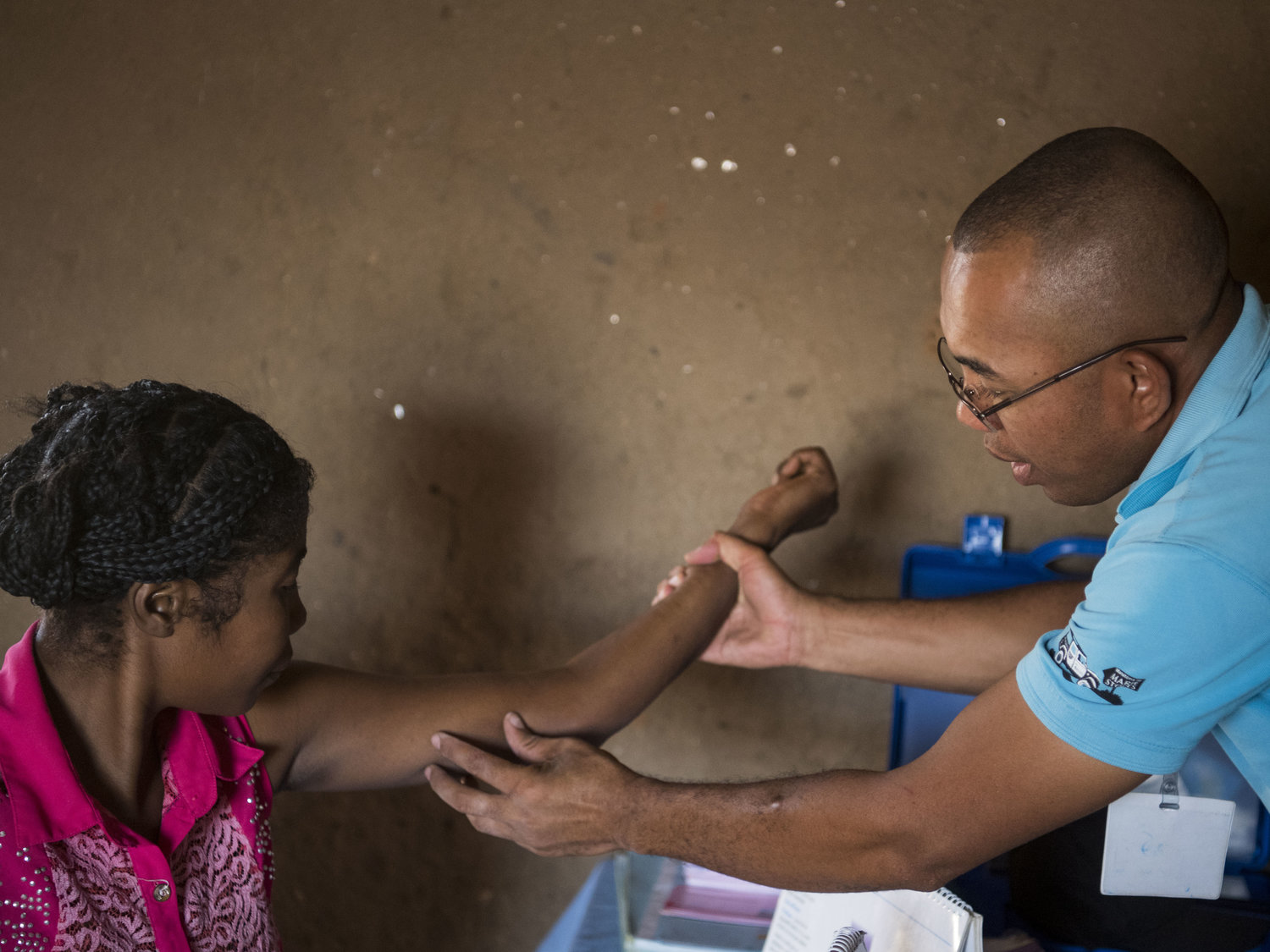
Nana (left) gets her birth control implant checked by Dr. Jean Rangomana during the Marie Stopes International mobile clinic in Besakoa, Madagascar, on April 9, 2018. Abortion is illegal under all circumstances in Madagascar, and Trump administration policies led to shortages of birth control there, health workers say.
Carolyn Van Houten/The Washington Post via Getty Images

In Ethiopia, health clinics for teenagers once supported by U.S. foreign aid closed down. In Kenya, a decades-long effort to integrate HIV testing and family planning unraveled. And in Nepal, intrepid government workers who once traversed the Himalayas to spread information about reproductive health were halted.

Around the world, countries that depend on U.S. foreign aid have scrapped or scaled back ambitious public health projects, refashioning their health systems over the past four years to comport with President Donald Trump’s sweeping anti-abortion restrictions that went further than any Republican president before him.

The effects have been profound: As groups scrambled to meet the administration’s strict ideologically driven rules, they severed ties with health care providers that discuss abortion in any way, deleted references to abortion on websites and in sexual education curricula, and stopped discussing modern contraception for fear of forfeiting vital American aid.

President-elect Joe Biden has pledged to reverse the policy when he takes office, and he campaigned on a promise to enshrine abortion rights in federal law. But for many foreign aid groups, the changes may be permanent.Article continues after sponsor message

“The U.S. has lost its position as a leader and lost its credibility,” says Terry McGovern, of Columbia University’s Mailman School of Public Health who has overseen research of the Trump policy in multiple countries.

Since Ronald Reagan, Republican presidents have barred foreign aid organizations from using U.S. global health funds to counsel women about abortion or refer them to a safe abortion provider. But the Trump administration vastly expanded those anti-abortion restrictions, known as “the global gag rule” by opponents.

Under Trump, the rule applies to some $9 billion of aid touching nearly every facet of global health funding, including groups working on HIV, malaria, tuberculosis and water sanitation. Under President George W. Bush, the policy applied to a fraction of that, $600 million in foreign aid.

The Trump administration proudly touted these efforts to protect “the unborn abroad,” but the rules have left international aid groups deeply skeptical of U.S. promises and deepened the nation’s rift with European countries that have long viewed abortion access as vital to women’s health and safety.

Some major organizations opted out of any U.S. funding rather than comply with the new strictures, including Marie Stopes International and International Planned Parenthood Federation, among the largest providers of reproductive health care in the developing world. Untold numbers of front-line health care workers — in large cities and remote villages alike — have been confused by what seem like sudden swings in American policy.

And that trepidation may not be quick to dissipate even with a Democrat in the White House.

“Biden and Trump may seem radically different to Americans,” says Jennifer Sherwood, a policy manager at Amfar, the Foundation for AIDS Research. “But if you’re a small organization in sub-Saharan Africa, you may not understand what this new [Biden] administration means and if you can trust the United States.”

The restrictions intentionally constrict the activities of foreign aid groups, many of which have worked in close coordination with American counterparts for decades. The rules also have a ripple effect on their funding: U.S. funding to foreign groups is contingent on their not accepting money from other countries, or even private foundations, to underwrite abortion-related services. They are not allowed to subcontract with other organizations that run separate abortion-related projects.

Trump telegraphed the worldwide anti-abortion gains in appeals to evangelical Christians. In early October, Secretary of State Mike Pompeo touted the policy during a speech to the Florida Family Policy Council, a conservative anti-abortion group, calling it an “unprecedented defense of the unborn abroad.”

“Our administration has drawn on our first principles to defend life in our foreign policy like no administration in all of history,” says Pompeo, who is an evangelical Christian.

The hard-right policies of the Trump administration stand in stark contrast to the steady liberalization of abortion laws in countries around the world over the past two decades. Since 2000, more than two dozen countries have eased abortion laws, including Ireland, South Korea, the Democratic Republic of Congo and Ethiopia.

Even in countries where abortion is forbidden, the rules are having an impact on reproductive health care. In Madagascar, where abortion is illegal with no exceptions, the largest provider of contraception, Marie Stopes, turned down U.S. money, endangering its ability to offer unfettered medical care to women, ending support for nearly 200 public and private facilities.

Mamy Jean Jacques Razafimahatratra, a researcher at the Institut National de Santé Publique et Communautaire in Antananarivo, found that led to shortages of contraception, in a poor country where travel to nearby towns is difficult.

“The women asked us, ‘What is the cause of this rupture?'” says Razafimahatratra. “We tried to explain to them the reason, and [they say], ‘But that regulation is for abortion, so we don’t understand why we are also penalized?'”

Researchers at Amfar and Johns Hopkins, in a study published in Health Affairs, found the anti-abortion policies could have deadly consequences, specifically in preventing the spread of HIV/AIDS. Sherwood says young African women face the highest risk of HIV and many clinics had combined HIV testing and treatment with family planning services.

But, fearing they would run afoul of the Trump policy and thus forfeit funding, clinics have curtailed family planning for patients, reducing the number of women seeking care in African countries.

“A lot of the times, they want contraception,” says Sherwood. “That is what’s on their mind, and HIV is the secondary thing, something we can tack on to meet their needs all at once.”

Jennifer Kates, director of global health and HIV policy at KFF says, “I have no doubt some groups are going to say, ‘We are not going to play there anymore.'” (KHN is an editorially independent program of KFF.)

The practical challenges of restarting these programs are steep: rehiring staff, reopening clinics, retraining employees, rewriting curricula.

“You can imagine being a health care worker that was under threat of losing their funding for counseling a patient on abortion,” Sherwood says. “To us, it’s like a light switch that can turn off and on, but to them, this is a very opaque and confusing process. It’s not how health systems work. You can’t just change the way they work overnight.”

This story comes from NPR’s partnership with Kaiser Health News.

Source: https://www.npr.org/2020/11/24/938519690/under-trump-new-anti-abortion-rules-shook-fragile-health-systems-around-the-worl?fbclid=IwAR2qlokV_K1OGDIoJRtS-q-1UiOpvGt8OI23zYTwNXwncm9fQMN_9MMXR9E

“I don’t know if I would have chosen an IUD.”

A birth control pill pack. Some people are changing their birth control because of the pandemic.
TEK IMAGE/Science Photo Library/Getty ImagesBy Jennifer Gerson

Anna, 24, lost both her jobs — substitute teaching and waitressing at a comedy club — on the same day in March, as COVID-19 lockdowns hit. Almost immediately, her thoughts turned to her birth control.

“Obviously, I am not financially ready to have a child,” she tells Bustle. Though she’s still on her parents’ insurance for two more years, losing her jobs made her realize that actually, maybe an IUD made more sense than the pill she’d been taking for nearly a decade. “I don’t know if I would have chosen an IUD” if it weren’t for the pandemic, she says, but she ultimately made the switch “out of fear that I was going into the world with no job, and wanted to get my birth control all lined up.” Now, as she applies for full-time teaching jobs during a very uncertain back-to-school season, she’s secure knowing she’s covered, contraception-wise, for the next five years.

With over 5 million Americans losing their health insurance thanks to coronavirus-linked layoffs, some people with periods feel they’re losing choice over their birth control decisions. According to a survey conducted by the Guttmacher Institute, one in three women have had trouble accessing birth control since March. The pandemic has made birth control users switch methods or skip coverage altogether because of lack of consistent availability, they say, or a fear of losing what access they do have.

How The COVID-19 Pandemic Is Affecting Birth Control Choices

“Losing access to birth control is a big concern during the pandemic … as more people are losing jobs and employer-sponsored health insurance,” Robin Watkins, CNM, WHNP-BC, the director of health care at Power to Decide, the national campaign to prevent unplanned pregnancy, says. She adds that people’s inability or unwillingness to see a doctor in person is an additional worry.

Chrissy, 25, dealt with these issues firsthand when she moved back to her home state of West Virginia to ride out lockdown. She’d been on the Pill on and off since she was 17 when her yearly prescription ran out in March. She assumed that getting her birth control at home wouldn’t be that hard. But her rural community’s health center said she’d have to see a doctor in-person in order to get her refill. These kinds of policies, which the American College of Obstetricians and Gynecologists (ACOG) cites as barriers to birth control access, are common to ensure patients come in for their annual well-woman visit.

“I wasn’t comfortable going to a doctor’s office at that point,” Chrissy says. So she simply went off her birth control until July. She had “really serious cramps for the first time in years,” and her periods doubled in length. After several weeks on a waitlist, she finally saw a doctor 45 minutes away, who renewed her prescription without an issue.

Her body is reacclimating to being back on hormonal birth control after a months-long break. Despite the nausea and mood swings, her main feeling is relief. “Luckily, I have a job where I could take time during the day to manage going to my appointment. I live in a rural area where public transportation is non-existent, and I’m privileged to have a car and be able to afford gas.” She adds, “But not everyone is as lucky as me.”

I don’t think it should have to be as overwhelming as it is.

Jacqueline, 25, also had to skip the Pill after being told she had to see her doctor to get her prescription renewed. The first in-person appointment available was in December, and the office’s telehealth service didn’t have a date open until after she needed her new pill pack. Like Anna, she’s thinking about when she’ll no longer be on her parents’ insurance in a year, and considering getting an IUD when she can get in to see the doctor.

Contraception isn’t just about preventing unintended pregnancy; for many people, it’s critical medicine needed to manage conditions like endometriosispremenstrual dysphoric disorder (PMDD), or polycystic ovarian syndrome (PCOS). Makena, 23, didn’t take birth control to manage illnesses like those, but she had wanted to switch from the Pill to a non-hormonal method.After a failed copper IUD insertion in December 2018, she decided to take some time off birth control to research new methods.She’d just gone to see a hormone specialist when shutdowns happened; then, she moved from California to Colorado.

Going off birth control resulted in acne, digestion issues, and weight fluctuation, she says. Feeling unsafe about in-person birth control counseling, it took her months to connect with a doctor who could help her navigate her needs. As of a week ago, she’s now using NuvaRing. “I would have wanted to start on a method sooner, but it ended up being now.”

Makena is happy with the NuvaRing so far, but wishes she could have had a more informed conversation about her methods, without the pressure of the pandemic. “I wish I had had more time to find the right doctor, to have a longer discussion about what’s the right plan for me,” she says. “I don’t think it should have to be as overwhelming as it is.”

Are There Health Risks If You Take Birth Control & Get COVID-19?

For the most part, pandemic-related contraceptive switches appear to be situational. But aside from concerns about access, some birth control users may worry about the link between COVID-19 and blood clots, given estrogen’s association with blood clots.In April, the Society of Family Planning (SFP) released recommendations that patients hospitalized with COVID-19 should stop using combined hormonal contraceptives, saying the potential risks of thromboembolism outweigh the benefits of being on the Pill. Still, the recommendations note that they’re based on extremely limited data about blood clots and COVID-19, and that more research is needed.

“We also know that there is a slight increase in clot risk among users of estrogen-containing contraceptives, although the absolute risk is very low and lower than the risk during pregnancy and the post-partum period,” says Dr. Ashley Turner, MD, an OB-GYN and fellow in family planning at Northwestern University. It’s still unknown if combined hormonal contraceptives can increase clot risks in COVID-19 patients. Dr. Turner suggests that people who do contract coronavirus talk to their doctor about their risk of blood clots.

Watkins says patients should be comfortable picking a method that works best for them, without worrying about any potential risks should they potentially contract COVID.

Source: https://www.bustle.com/wellness/how-the-covid-19-pandemic-is-affecting-birth-control-choices

The new study surveyed a national sample of 1,014 women aged 17-45 and revealed that over half of Irish women use contraception methods most linked to failure

Over a third of Irish women between the ages of 17 and 45 have had an unplanned pregnancy due to contraception failing, a new study has revealed.

The study surveyed a national sample of 1,014 women aged 17-45 and revealed that over half of Irish women use contraception methods most linked to failure.

One in two women in this age bracket said they have had sex where no contraception was used, while the study also revealed an over-reliance on emergency contraception.

The study dubbed as the most comprehensive research on female contraception in Ireland was commissioned by the Dublin Well Woman Centre and carried out by Empathy Research.

Researchers say the results are worrying, as 87pc of those surveyed cited pregnancy prevention as the most important factor when choosing a form of contraception. However, the majority of women surveyed use forms of contraception which are the least effective in preventing pregnancy.

Some 28pc of respondents use the contraceptive pill while 27pc rely on condoms to prevent pregnancy, however, these methods are cited most often in contraceptive failure.

Some 73pc of respondents who experienced contraception failure said they were using a condom while 21pc were using the contraceptive pill.

Overall, 35pc of the women surveyed said they had sex where the contraception failed, and claimed it resulted in a pregnancy.

Some 53pc of this cohort surveyed were not aware that condoms have a 17pc failure rate in typical use, and 49pc were not aware that the failure rate for the pill is 9pc.

When it comes to the ‘withdrawal’ method, 10pc of respondents incorrectly believe it offers 100pc protection from getting pregnant, while 34pc said they have used this method in the past.

One in five women surveyed said they must travel outside their town, city, or village to access the contraception they are currently using.

Speaking about the findings, Shirley McQuade, Medical Director of the Dublin Well Woman Centre said, “The research has shown us that women face many barriers to accessing the most appropriate forms of contraception.

“All women should be able to access contraception that is most appropriate for them, and free of charge. There is no one right form of contraception for each woman and many will change what contraception they use over time.

“Certain forms of contraception are more suitable for certain women and a comprehensive programme would give a woman the choice of which she wanted to use, in consultation with her GP or medical professional.”

She added that Long-Acting Reversible Contraceptives (LARCs) like implants or coils are more effective for preventing pregnancy in comparison to condoms and the contraceptive pill.

“Implants and coils are more than 99pc effective. LARCs have an extremely high rate of success, and thus are our best chance of reducing the incidence of unintended pregnancy,” Dr McQuade said.

Alison Begas, Chief Executive Dublin Well Woman Centre, is calling on the government to provide free contraception for women aged 17-25.

“This is the most comprehensive research carried out on contraception in Ireland in the last ten years,” she said.

“The findings show there are still significant mistruths around contraception and fertility amongst women in Ireland. It also points to significant barriers on the part of women who are trying to access their preferred forms of contraception.

“Access to free contraception was a recommendation made by the Oireachtas Committee on the Eighth Amendment and was included in the Programme for Government earlier this year for women aged 17 – 25 years.

“We are calling on Government to prioritise its Programme for Government commitment as a first step in rolling out a fully State-funded contraception scheme to all women in their reproductive years.”

Source: https://www.independent.ie/irish-news/one-third-of-irish-women-aged-17-45-had-an-unplanned-pregnancy-due-to-contraception-failure-39784101.html?fbclid=IwAR2pAIokHFaiBajM3mRrPlvxclGl5z2sTGKT2989cRW8uTG9gjKh4ch76L0

Mississippi’s capital city has repealed a local law that sought to restrict noise levels outside the state’s only abortion clinic

JACKSON, Miss. — Mississippi’s capital city has repealed a year-old local law that sought to restrict noise levels outside the state’s only abortion clinic by limiting amplified sound and banning protesters from approaching patients without their permission.

A group that sued the city of Jackson said the repeal is a victory for free speech, while the clinic’s owner sharply criticized the city for not protecting patients and clinic employees from harassment.

The Jackson City Council voted unanimously Tuesday to take the ordinance off the books. It was responding to a lawsuit filed by Mississippi Justice Institute, a group that pushes for limiting government regulations.

“We are pleased that the city of Jackson has decided to do the right thing and end this unconstitutional restriction on free expression,” the institute’s director, Aaron Rice, said in a news release Wednesday. “This is a major victory for free speech for Jackson and the state of Mississippi.”

Jackson City Council members adopted the ordinance in October 2019, and the institute quickly sued the city on behalf of Sidewalk Advocates for Life, whose members pray outside the abortion clinic.

The lawsuit said the ordinance unconstitutionally limited speech rights as people tried to persuade women not to end pregnancies.

Mississippi’s only abortion clinic, Jackson Women’s Health Organization, is in Jackson’s eclectic Fondren neighborhood. Owners of nearby shops and restaurants have complained about commotion outside the bright pink clinic. Some protesters have used bullhorns and the clinic has played loud music to cover the sound. The street and sidewalk outside the clinic were quiet Wednesday — likely a sign that no patients were being seen for procedures or for the counseling that the state requires at least 24 hours before an abortion is done.

Clinic owner Diane Derzis told The Associated Press on Wednesday that protesters have harassed women for years.

“The Jackson police pretty much ignored the ordinance,” Derzis said.

She said the City Council backed down under pressure because of the lawsuit. Referring to city officials, Derzis said: “We’re not willing to do the right thing. We’re not willing to do it for the women who walk in that door or the women who work in the clinic or the people who walk on the street or the businesses that are nearby.”

Like many places in the Deep South, Mississippi is a conservative state with a Republican-led Legislature that has been enacting laws to restrict access to abortion. Southern cities where abortion clinics are located tend to be more socially and politically liberal. That’s the case in Jackson, where most City Council members are Democrats.

During debate about the ordinance last year, Jackson council members said limiting noise and creating a buffer zone was an attempt to help patients and local businesses rather than to help the clinic.

Violation of the Jackson ordinance carried a $1,000 fine, 90 days in jail or both.

A federal appeals court in February 2019 upheld the constitutionality of a 2009 Chicago ordinance that created an 8-foot (2-meter) bubble zone outside medical facilities. But, in 2014, the Supreme Court struck down a 2007 Massachusetts law that banned people from standing within 35 feet (11 meters) of an abortion clinic.

Source: https://abcnews.go.com/Health/wireStory/city-repeals-noise-rule-mississippi-abortion-clinic-74278772?fbclid=IwAR3Ag915D9JsFHfjqMPPAw-rxRqn6ng58MGxJqgfKXX7RRvRHtH2oCFT7e0

FILE – In this Nov. 10, 2020, file photo, Tennessee Gov. Bill Lee speaks with reporters in Nashville, Tenn. A federal appeals court ruled Friday, Nov. 20, 2020, that Tennessee can begin outlawing abortions because of a prenatal diagnosis of Down syndrome, as well prohibit the procedure if it is based on the race or gender of the fetus. Earlier this year, Lee enacted the so-called “reason bans” as part of a sweeping anti-abortion measure that he signed earlier this year. (AP Photo/Mark Humphrey, File)

NASHVILLE, Tenn. (AP) — A federal appeals court ruled Friday that Tennessee can begin outlawing abortions because of a prenatal diagnosis of Down syndrome, as well as prohibit the procedure if it’s based on the race or gender of the fetus.

Tennessee Republican Gov. Bill Lee enacted the so-called “reason bans” earlier this year as part of a sweeping anti-abortion measure. The law gained national attention because it banned abortion as early as six weeks — making it one of the strictest in the country — but it included several other anti-abortion components.ADVERTISEMENT

The law was immediately blocked by a lower federal court just hours after Lee signed it into law.

However, the 6th Circuit Court of Appeals’ decision will allow the state to enforce the reason bans while abortion rights groups continue their court battle against that law.

The plaintiffs, which include Tennessee abortion providers being represented by reproductive rights groups, had argued the ban was improperly vague, but the court disagreed.

Currently, more than a dozen states have similar reason bans in place.

“These bans are just another way anti-abortion politicians are attempting to limit the constitutional right to abortion care and to create stigma,” said Nancy Northup, president and CEO of the Center for Reproductive Rights, in a statement. “Decisions about whether and when to continue or to end a pregnancy are best made by the individual and their family.”

The Attorney General’s office said in a statement that they “appreciate the Sixth Circuit lifting the lower court’s injunction” and looked forward to continuing defending the statute.

“Our law prohibits abortion based on the race, gender, or diagnosis of Down syndrome of the child and the court’s decision will save lives,” Lee said in a statement. “Protecting our most vulnerable Tennesseans is worth the fight.”

Immediately following the appeals court ruling, the plaintiffs’ attorneys filed a request in lower federal court for a temporary restraining order to block the reason bans once again, but this time argued the law illegally prohibits a patient from “obtaining constitutionally protected pre-viability abortion care.”

“(The) Sixth Circuit only addressed plaintiffs’ vagueness claims and explicitly declined to issue any ruling with respect to plaintiffs’ claims that the Reason Bans violate patients’ constitutional right to pre-viability abortion,” the attorneys wrote.

The court had not issued a ruling on that as of Friday evening.

Down syndrome is a genetic abnormality that causes developmental delays and medical conditions such as heart defects and respiratory and hearing problems.

According to the National Down Syndrome Society, about one in every 700 babies in the United States — or about 6,000 a year — is born with the condition, which results from a chromosomal irregularity.

The rarity of the condition has prompted abortion rights groups to paint the Down syndrome bans as part of yet another thinly veiled effort by lawmakers to continue chipping away at a patient’s right to an abortion.

Source: https://apnews.com/article/tennessee-down-syndrome-courts-6c95681e7c7dfc8d2d94a0ee4a7723c2?fbclid=IwAR2NpW-oQHm8kR_ohrylUDTIynoAFZVfT-UArDQNbQ11GbWQUmhBDKSKH6w

Seeking solace as she sat in the airport parking lot of a strange city, Tara Mendola tried to reach her rabbi before her procedure, to no avail. 

Though Mendola lives in Massachusetts, home to some of the best hospitals in the world, she was forced to travel to Denver, Colorado, for abortion care after receiving a fatal fetal diagnosis.

“I think that for women — especially women of faith — you know, we often seek out guidance for how to handle these situations,” she said, recalling that day nearly three years ago. “That’s a great deal easier if you’re not trying to negotiate reaching your spiritual leader from several thousand miles away.”

5:56RBG’s Death Sparks Urgency in Massachusetts’ Abortion DebateIn the days since the death of Justice Ruth Bader Ginsburg and Supreme Court Judge Amy Coney Barrett’s confirmation to replace her — which consolidated a conservative majority on the bench — the push to…Read more

Mendola is not alone in facing such a predicament: Women in Massachusetts are forced to get abortion care elsewhere because it’s illegal in the state after 24 weeks, even in cases of fatal fetal anomalies. There is an exception if continuing the pregnancy is a threat to the life or health of the mother.

In the days since the death of Justice Ruth Bader Ginsburg and Supreme Court Judge Amy Coney Barrett’s confirmation to replace her — which consolidated a conservative majority on the bench — the push to expand abortion access in Massachusetts has gained traction on Beacon Hill.

“So much hangs in the balance with this new Supreme Court,” Attorney General Maura Healey told NBC10 Boston. “From my perspective, we need to do everything that we can in our state legislatures to make sure that we have laws on the books in Massachusetts and elsewhere across this country that ensure a woman has a right to access an abortion when she needs it.”

If Roe v. Wade were to fall, Massachusetts has precedence from the Supreme Judicial Court that would preserve the right to choose. Opponents argue the legislation is unnecessary, but advocates warn that the make-up of state courts is subject to change and, therefore, the right should be written in law.

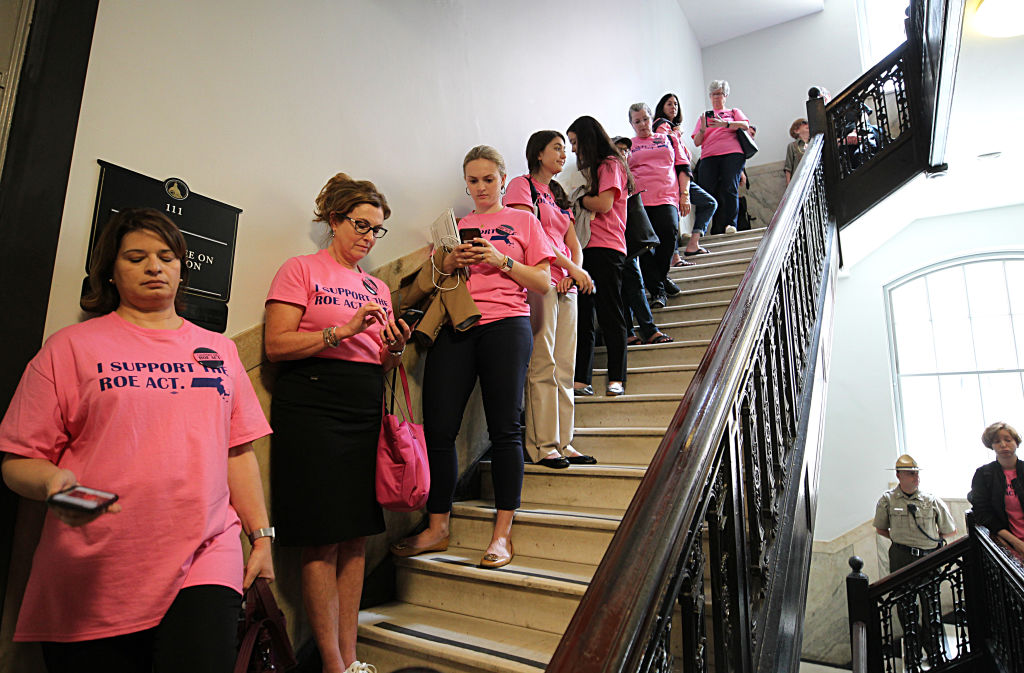
Pro-choice supporters of the the Roe Act line a staircase waiting to attend a hearing at the Massachusetts State House in Boston on a bill to expand abortion access in Massachusetts on June 17, 2019. (Photo by Suzanne Kreiter/The Boston Globe via Getty Images)

“Obviously to just lose such a lion, such a force for all kinds of rights — but especially for women’s rights — is a devastating blow for all of us who held Ruth Bader Ginsburg up as a hero,” said Rebecca Hart Holder, executive director of NARAL Pro-Choice Massachusetts. “But it’s a really scary blow for our rights going forward.”

“We have a record in Massachusetts of responding when there is a change on the court that looks like it could threaten our rights,” Hart Holder said, pointing to the Legislature’s decision to repeal a criminal abortion ban when Supreme Court Chief Justice Anthony Kennedy retired in 2018. “It’s a really important opportunity for Massachusetts to lead nationally.”

The legislation is written too broadly, so as to include pretty much any circumstance that a woman feels is challenging for her up to the moment of birth… It would encompass too many viable babies’ lives.

Myrna Maloney Flynn, Massachusetts Citizens for Life

A coalition of organizations including NARAL Pro-Choice Massachusetts, Planned Parenthood League of Massachusetts and the ACLU have been pushing to pass the ROE Act, a bill pending on Beacon Hill that would expand access to abortion beyond 24 weeks in cases of fatal fetal anomalies and lower the age that women are required to get permission from a parent or judge from 18 to 16.

“We like to think of Massachusetts as being super progressive and in a lot of ways, we are. In a lot of ways access to abortion has been protected,” said  Dr. Jennifer Childs-Roshak, president of PPLM. “But there are a couple of remaining areas that really create barriers.”


Mendola learned of those barriers firsthand after she became pregnant in April 2017, when a routine growth scan with her high-risk pregnancy doctor in October turned into a diagnosis of severe and potentially lethal brain deformities. Her doctor at Beth Israel Deaconess referred her to Boston Children’s Hospital, where a team of specialists ran tests to confirm the physician’s suspicion.

Courtesy: Tara Mendola

“They sat us down and they told us that the doctor had been right,” Mendola said, “and that should we wish to end the pregnancy, they couldn’t help us because it was illegal in the state of Massachusetts.”

That’s how Mendola found herself at the airport parking lot in Denver, far from the comfort of her home, family and spiritual leader.

“Obviously, being able to have the abortion in Massachusetts would not have taken away the grief that we felt or the pain of the situation,” she said. “But, you know, I’m not going to lie — I’m still very angry and frustrated that I was not able to get care with my doctors in my state. And that I had to leave my older children behind at a very difficult time for a family to travel for care.”

Mendola was “very lucky,” she added, that she could afford the associated travel expenses such as last-minute plane tickets, a car rental and hotel that was reasonably comfortable considering the circumstances.

We need to do everything that we can in our state legislatures to make sure that we have laws on the books in Massachusetts and elsewhere across this country that ensure a woman has a right to access an abortion when she needs it.

Attorney General Maura Healey

The issue disproportionately impacts people of color and those with low incomes, Hart Holder said, adding such people may not have the means to pay “tens of thousands of dollars out of pocket” to travel to Chicago or New Mexico for abortion care, or to navigate the court system for judicial bypass.

“It is a ridiculous amount of money to expect people to have on hand,” Mendola said.

The ROE Act has been stuck in the Judiciary Committee for the majority of the 2019-2020 session despite widespread support. Amid concerns over an ideological shift on the Supreme Court, abortion amendments that closely mirror the bill were recently passed in the state House and Senate versions of the FY2021 budget. 


The decision now lands on Gov. Charlie Baker’s desk.

Baker has said he doesn’t necessarily see a need to change the current abortion laws, but has not explicitly said whether he would veto the measure. When asked again about the subject during a press conference last week, Baker echoed complaints from his Republican counterparts over including the proposal in a spending plan.

Governor Charlie Baker (Craig F. Walker/The Boston Globe via Getty Images)

“I do share some of the unhappiness that was raised by a number of members of the Republican Party, that putting policy in the budget was something that both leaders in the House and Senate said they would not do,” Baker said last week. “And it’s pretty hard to argue that this isn’t a major policy initiative that is now in the budget.”

Opponents of the bill, like the pro-life organization Massachusetts Citizens for Life, argue the legislation is unnecessary because the abortion laws currently on the books are sufficient. 

“We agree with the governor when he states that the abortion law, as it is currently written in Massachusetts, serves our population just fine,” MCFL President Myrna Maloney Flynn said, noting that Baker is “more pro-choice” than the organization.

“We don’t believe that it’s in the best interest of the women, the girls or the infants in the Commonwealth,” Flynn said. “The legislation is written too broadly, so as to include pretty much any circumstance that a woman feels is challenging for her up to the moment of birth… it would encompass too many viable babies’ lives.”

Massachusetts Citizens for Life Vice President Myrna Maloney Flynn speaks during a rally outside the Massachusetts Statehouse on June 17, 2019 in Boston, Massachusetts. Opposing activists were rallying in advance of consideration by lawmakers of measures aimed at loosening restrictions on abortion, including removing criminal penalties for those performed after 24 weeks as well as removing the requirement for parental-consent for pregnant girls under 18.

Senate President Emerita Harriette Chandler, co-sponsor of the legislation, argues that the bill protects a woman’s right to choose without interference from the state.

“Basically, it gives women the right to make their own decisions about their bodies with the help of a doctor,” Chandler said. “That’s the most important issue that we have to deal with.”

I think that for women — especially women of faith — you know, we often seek out guidance for how to handle these situations. That’s a great deal easier if you’re not trying to negotiate reaching your spiritual leader from several thousand miles away.

Tara Mendola

Health care providers like obstetrician-gynecologist Dr. Tara Kumaraswami, who has worked in central Massachusetts for more than a decade, argue the state restrictions prevent them from being able to provide complete care.

“I’ve been able to see what women have gone through and what the barriers they encounter (are) that really make it difficult for them to seek abortion care,” Kumaraswami said. “It is important that women are able to make this very personal decision between themselves, whomever they feel comfortable sharing this decision with and their health care provider.”

Mendola, who describes herself as a private person and a woman of conservative Jewish observance, said she is sharing her story in the hopes of changing the state law and, subsequently, the lives of women who need access to care like she did.

“I carry a sense of obligation to the people that helped me and to the women that will come after me,” she said. “I have a terrible stage fright. I hate talking in front of people. I really don’t enjoy having my personal obstetric history on the internet, but it feels worth it to me.”

State House News Service contributed to this report.

Source: https://www.nbcboston.com/news/local/after-rbgs-death-urgency-mounts-in-massachusetts-abortion-debate/2237092/

And there’s nothing feminist about that.

Stephanie Bice and Marjorie Taylor Greene are two of the anti-choice women elected to the House of Representatives.
 Washington Post/YouTube, Dustin Chambers/Getty Images

Coming soon to Congress: women who oppose abortion rights.

The number of anti-abortion women in the House of Representatives is set to double, going from 13 seats to as many as 30, pending election results in three districts. All of the women are Republican.

There is no reason to think they were merely checking a box in hopes of getting elected as Republicans.

Michelle Fischbach, one of the new representatives, spent more than a decade as a state senator sponsoring laws that doled out state funds to anti-abortion fake clinics (commonly known as crisis pregnancy centers) and forced biased information on Minnesotans seeking abortion care. Married to the head of Minnesota Citizens Concerned for Life and the daughter of National Right to Life Committee co-executive director Darla St. Martin, Fischbach is practically anti-abortion royalty. She defeated anti-choice Democrat Rep. Collin Peterson, long known for doing all the wrong things for reproductive health, rights, and justice, including voting for “personhood”—an effort to grant legal rights to fertilized eggs and fetuses, criminalizing abortion and even birth control in the process.

Then there’s Georgia’s Marjorie Taylor Greene, the “pro-life” QAnon supporter and incoming member of Congress who can be found tweeting “WE WILL NOT COMPLY!” in response to hypothetical mask mandates—even though masks are proven effective at reducing the spread of COVID-19 and would actually save lives.

Not all of the incoming anti-abortion women are white. There’s Stephanie Bice of Oklahoma, who will be the first Iranian American in Congress. Yvette Herrell of New Mexico is a member of the Cherokee nation, and Florida’s Maria Elvira Salazar is Cuban American.

Does any of this represent progress for women? No.

Feminism is not simply womanhood. Feminism is a movement for gender equality that puts women and girls at the center of analysis.

There are feminisms, many of them great—Black feminism, ecofeminism, sex-positive feminism, young feminism, and faith-based feminism, to name just a few—and a smaller handful of the repulsive and oppressive, such as white feminism, Islamophobic feminism, and trans-exclusionary radical feminism, all of which seek to slap pro-woman branding on plain old discrimination against marginalized people, women included.

Enacting laws against women’s equality is not progress, even when done with the collaboration, collusion, and leadership of women. Abortion is not merely a “women’s issue.” There are people of all genders who have the capacity for pregnancy, and delightfully, our understanding of feminism and gender itself are at inflection points, especially among younger people who seem to understand transgender equality and inclusion far better than older generations of feminists who have discriminated against, misgendered, and deeply wounded trans and nonbinary people.

That said, abortion and reproductive rights and justice will always remain core, urgent issues for women’s equality in this country and around the world.

At any moment, an enormous proportion of women could become pregnant, and this issue is inextricably entwined with every other issue affecting women’s lives, from police violence to pay equity and gender-based violence. There is no hope for women’s equality without readily available, adequately funded, shame-free access to abortion. Not contraception. Not comprehensive sex education. Not public assistance and support to raise families with dignity. These are all critical, but they are not substitutes for abortion access. Abortion is not a bad behavior to minimize. That thing telling us it is? That’s sexism and internalized misogyny talking.

As I have written for Rewire News Group and other publications throughout a lifetime of advocacy for women and girls, there is no such thing as “pro-life feminism.” So-called pro-life feminism is literally impossible. There is no purer expression of sexism in the United States today than the anti-abortion movement, which exists to advance and cement white male supremacy under the law by subjugating women, criminalizing all but a narrow band of accepted sexual and reproductive behaviors, and increasing white birth rates while leaving Black babies to die.

I know some people will say, “Can’t we just focus on women’s equality and set the controversial issue of reproductive rights to the side?” Well, if you argue that women can be equal so long as they do not transgress laws that might throw them in jail for abortion, miscarriage, and pregnancy, then what you are arguing for is not equality, but submission. Remember this as the inevitable, bad-faith think pieces emerge about the new anti-abortion women in Congress, as women opposed to the Equal Rights Amendment suddenly claim the mantle of feminism in order to further cement sex and gender discrimination into law.

The modern anti-abortion movement exists because a handful of conservative men got in a room (maybe even a smoke-filled one) 50 years ago and decided that overturning Roe v. Wade could become their primary wedge issue and voter mobilization tool as explicitly embracing segregationism became more unfashionable. Ever desperate to prove they are not just racist white men with cigars, they are increasingly eager to put forward women to close their disgusting deal.

Remember this when Marjorie Dannenfelser, head of the cynically named Susan B. Anthony List, goes on a press junket about the new anti-abortion women coming to Washington, crowing about how women want laws that would throw even more people in jail for abortion, miscarriage, and pregnancy. Remember this when Justice Amy Coney Barrett hears her first abortion case at the Supreme Court. Remember this when the newly elected women in the House of Representatives are strategically chosen to sponsor anti-abortion legislation.

Central casting has always called on women, especially white women, to enforce the patriarchy. Don’t let them fool you.

Source: https://rewirenewsgroup.com/article/2020/11/17/more-anti-choice-women-were-elected-to-congress-than-ever-before/