Dr. Julie Amaon explains what a “perfect world” for reproductive health care looks like to her.

Dr. Julie Amaon, M.D., 43, is the medical director of Just the Pill, a mobile reproductive health clinic out of Minneapolis, Minnesota, which began mailing medication for abortion, birth control, and STI treatment this month. She graduated from her residency in family medicine during the COVID-19 pandemic and realized that, with clinics limiting their services and patients afraid to see a doctor over exposure concerns, no-touch, no-test medication abortion was critical health care that she could safely provide.

Amaon tells Bustle about how she became an abortion provider, and what reproductive health care would look like in a perfect world.

I started in the abortion care world not as a physician, but working in my local Planned Parenthood in Austin, Texas. This was right around the time when our state government took away most of our family planning money and gave it to crisis pregnancy centers. Over the next four years that I managed the clinic, things just kept getting worse for abortion access. I decided to go to medical school in 2012 to become a physician, so we could have more abortion providers in Texas.

My family medicine residency program at the University of Minnesota Medical Center trained everyone studying family medicine in abortion, and if someone wasn’t comfortable with that, they could opt out. It shouldn’t be something super unique, but there are only 38 Reproductive Health Education in Family Medicine (RHEDI)-funded opt-out programs in family medicine nationwide. [Even in OB-GYN residencies, many programs are either opt-in or don’t offer abortion training at all.]

In a perfect world, you could see a family medicine doctor for a sinus infection, for birth control, and for a medication abortion. That doctor could call the medicine in to your pharmacy or have it mailed to your home — whatever is best for you.

People drove 18 hours, from Texas to Minnesota, to get abortion care.

That’s not what’s happening now. Because of the FDA’s Risk Evaluation & Management Strategy (REMS) program, in order to provide medication abortion,you have to be registered as a provider, which means being on a publicly available list maintained by the drug manufacturer. This creates a lot of stigma among those who would want to offer medication abortion in a small town, as a family medicine doctor. In Minnesota, specifically, 97% of counties don’t have an abortion provider. The struggle here is very real. Most people will have to travel a long way to get an abortion.

That’s how the idea was born to have a mobile clinic. What if we could drive through the state with our clinic and then people could access medication abortion because we’ve come to them? We’ve been up and running for a week, and the response from our community has already been amazing. The reproductive health advocacy organizations we partner with are so excited that people in rural areas can now have access to abortion, regardless of whether or not they have a car or live in a county with a provider. I just sent our first medication abortion pill order from our mail-in pharmacy partner.

In July, an injunction lifted some REMS restrictions in light of the pandemic, so you can now mail mifepristone, the medication abortion pill, where before that was largely illegal. That means we can advertise in rural communities more than 100 miles away from our brick-and-mortar medical office, where we house medication abortion pills in case our ability to use mail-in pharmacies is revoked so that we can mail it out ourselves. It also means people can take their pills at home, which is wonderful.

Our plan is to target rural communities in the state because right now, people have to drive for hours to get their health care. I was in Minnesota when abortion clinics shut down in Texas because of COVID — people drove 18 hours, from Texas to Minnesota, to get abortion care. Even after the pandemic ends, we hope to have a mobile clinic so we can insert IUDs or the birth control implant Nexplanon and provide other forms of primary care.

As a family medicine physician, I love being able to take care of patients cradle to grave. If someone has an unwanted pregnancy, my hope for the future is that they can come to me, their trusted family medicine provider, and I can offer her all the options in my clinic or over video.

I shouldn’t have to say, ‘Well I don’t stock mifepristone here, so I have to send you somewhere else and to a doctor you don’t already know and trust.’ I envision healthcare differently than that.

This interview has been edited and condensed.

Source: https://www.bustle.com/wellness/just-the-pill-julie-amaon-medication-abortion-pandemic?fbclid=IwAR03jIyGPi4smsiEsrRiou8Nq9eQJSsjzm3wCPanyqIrytxsryIRC5O5Wxc

The court’s attacks on reproductive rights won’t make abortion go away, but they could make them much less safe.

With Justice Amy Coney Barrett joining the Supreme Court, the court now has a solid 6-3 anti-abortion majorityRoe v. Wade will likely be seriously compromised over time, if not outright overruled. However, restricting access to abortion, a recent study shows, doesn’t mean fewer abortions. In fact, it’s quite the opposite. 

A recent report authored in part by researchers at the Guttmacher Institute tracked the rates of unintended pregnancies and abortions and how those relate to the legal status of abortion in various countries. 

Worldwide, around 60% of unintended pregnancies end in abortion, whether it’s legal or not. But over the last two decades, the percentage of unintended pregnancies which end in abortion increased in those countries where there were more abortion restrictions.

The researchers learned that in high-income countries where abortion is “broadly legal,” rates of abortion are lower than in high-income countries where abortion is restricted only to save the life or the health of the mother or is banned. 

In the broadly legal high-income countries, 11 per 1000 women of reproductive age have abortions. In the high-income countries where abortion is highly restricted or banned, 32 per 1000 women of reproductive age have abortions. 

The United States currently falls into the “broadly legal” category. However, many conservative legislators have agitated for that to change.

Guttmacher reported that almost half of the 58 new abortion restrictions enacted in 2019 were designed to ban some or all abortions. Ten states already have “trigger laws,” which would make abortion illegal or almost completely illegal automatically if the Supreme Court overturns Roe. If that happens, abortions may actually increase.

In part, that increase may be because restrictions on abortion are often combined with highly restrictive views on birth control as well. Better access to birth control decreases abortions. One study at Washington University found that providing free birth control cut abortion rates by at least 62% compared to the national rate. But many conservative legislators and anti-abortion activists have pressed to make birth control illegal as well. 

And Barrett, the newest member of the Court, has already said she believes that life begins at conception and has aligned herself with groups that say allowing doctors to discuss birth control with patients is tantamount to bullying them not to reproduce. It’s a worldview that comprehensively undermines reproductive health. 

In a post-Roe world, the need for abortions in the United States won’t decrease, but the safety of them likely will. 

Across the world, millions of people have abortions every year, and almost half of those are unsafe, with complications that can lead to death. As much as anti-abortion activists and legislators like to say that a concern for maternal health underpins their desire to restrict abortion, it’s simply untrue that maternal health is bolstered by abortion restrictions.

Barrett may get her wish to eliminate access to legal abortions in America, but it won’t stop them from happening — they’ll just go underground and get more dangerous. 

Source: https://americanindependent.com/supreme-court-amy-coney-barrett-attacks-on-abortion/

Even the Alabama Supreme Court says so. For now.

While the Alabama Supreme Court rejected an abortion lawsuit, it might be inevitable that one of these cases will make its way up to the U.S. Supreme Court.
 Shutterstock

The Alabama Supreme Court recently refused to hear the appeal of a man who was so mad his ex-girlfriend got an abortion that he  sued the abortion clinic for providing her the pills to end her pregnancy, and the manufacturer of those pills for making them in the first place. It was a frivolous, hateful, and downright bananas lawsuit—but it could have grave implications for abortion rights nationwide.

The lawsuit is Ryan Magers individually and on behalf of Baby Roe, a deceased unborn child v. Alabama Women’s Center Reproductive Alternatives, and if your antenna is already up at the name of the case—that’s for good reason. (Typically nothing good comes from a petitioner filing on behalf of a deceased unborn child, a term that’s a triple oxymoron.)

This case is a stark illustration of how conservative Alabama is, and how tenuous abortion access remains in the state. It also underscores that in Alabama, the ultimate goal is personhood.

Personhood is the notion that life begins at conception. In 2018, Alabama voters approved a personhood amendment to the Alabama Constitution that gives constitutional rights to fertilized eggs, embryos, and fetuses. The measure is cloaked in language about protecting the unborn; in reality, these laws threaten not only access to abortion but also access to birth control and IVF care. Because Roe v. Wade is still the law of the land, Alabama’s personhood amendment is a trigger law, meaning it will only take effect if Roe is overturned. Until then, it’s just symbolic.

Magers cited the the Alabama constitutional amendment as the basis for his claim that his ex-girlfriend’s abortion was a wrongful death. The clinic argued there were no grounds for the lawsuit because the abortion was legal. And because abortion is still legal in Alabama, it should come as no surprise that the clinic is right on the law.

A lower court judge dismissed Mager’s case, ruling that he had no personal claim against the clinic, that there was no allegation anything illegal happened at the clinic, and that clinics were protected from lawsuits like this, according to WAFF-TV. Magers appealed the decision, and the case worked its way up the state supreme court where it was thrown out—but not for the reason you’d hope.

Let’s back up a little and take a look at how we got here: Angry that his ex-girlfriend got an abortion six weeks into her pregnancy, Magers filed a petition in probate court to be appointed as a representative for the embryo’s estate. (Alabama law does not permit family members of a deceased person to bring a wrongful death claim. Only the personal representative of the deceased person’s estate can bring wrongful death claims.)

So that Magers could pursue this claim, the probate court judge granted Magers’ request to represent the estate of a six-week embryo dubbed “Baby Roe.”Magers then filed a wrongful death claim against Alabama Women’s Center for Reproductive Alternatives, which had provided the woman with a medication abortion, on behalf of “Baby Roe.” Magers’ attorney Brent Helms gloated that it was the first time a court had created an estate for an aborted fetus. The probate judge’s ruling, he said, would lend legitimacy to their wrongful death suit because it would help establish that the termination of a six-week embryo is the same as the death of a real person, with the ability to have an estate established and presumably drive and do TikTok dances.

“It gives more legs to the lawsuit and it’s also pretty monumental because it’s the first time a probate court has opened an estate for an aborted baby,” Magers told a local newspaper.When one of these cases inevitably works its way up to the new conservative Supreme Court, it could spell disaster for abortion rights.

Even after a local court judge dismissed the case, Magers’ attorney had good reason to gloat: The Alabama Supreme Court judges have been injecting personhood language into their opinions for years. They are perfectly fine with giving constitutional rights to embryos and fetuses. But the court dinged Magers on a procedural issue: Magers filed a one-sentence brief with a string of citations to Alabama cases and statutes. Appellate briefs are required to have actual arguments in them. Magers’ had none.

The court dismissed the case, but that didn’t stop it from taking the opportunity to opine on why Roe v. Wade should be overturned, since if Roe is overturned, the state’s personhood amendment would be triggered into law. Justice Jay Mitchell penned the concurrence, filling it with quotes from conservative giants like Scalia and Thomas. He cites Thomas’ dissent in June Medical Services v. Russo calling abortion “grievously wrong for many reasons,” and arguing that the right to an abortion finds no support in the U.S. Constitution. And he quotes from Scalia’s dissent in Ohio v. Akron, which makes a similar argument: “The Constitution contains no right to abortion. It is not to be found in the longstanding traditions of our society, nor can it be logically deduced from the text of the Constitution—not, that is, without volunteering a judicial answer to the nonjusticiable question of when human life begins.”

Drawing on these opinions, Mitchell calls for overturning Roe v. Wade, arguing that “Roe and Casey hamstring states as they seek to prevent human tragedy and suffering.” In his concurrence, Mitchell also describes dilation and evacuation (D&E) procedures—the most common form of second trimester abortion—as “dismemberment” abortions, a clear attempt to make the procedure seem scary and gross. And he basically spits on stare decisis—which is just legal jargon for “we should stick to precedent”—by saying Roe should be overturned even though it’s binding precedent.

Here’s the thing: Sure, it’s might seem like an absurd, nonbinding concurrence from a state supreme court (another court can’t use it to say, “welp this court said this so we’ve gotta abide by it!”), but it’s actually incredibly serious and dangerous. We are faced with a U.S. Supreme Court saturated with Trump judges, and cases like this are like warning shots across the bow: a dark and terrifying omen of what’s to come as Trump’s influence on the courts becomes more apparent. And when one of these cases inevitably works its way up to the new conservative Supreme Court, it could spell disaster for abortion rights.

Source: https://rewirenewsgroup.com/article/2020/11/07/no-abortion-is-not-a-wrongful-death/

Abortion-rights opponents pushed a 22-week limit because they believed they could win. They were wrong.

An anti-abortion-rights protester holds a sign outside of the Colorado Springs Westside Health Center in 2017. MARC PISCOTTY / GETTY

With a newly expanded conservative majority on the Supreme Court, state-level fights over abortion have taken on even more significance: They’re a preview of what might happen if the justices grant more latitude to states to determine abortion restrictions. On Tuesday, by a margin of more than half a million votes, Colorado voters firmly rejected a proposition that would have limited abortion more than 22 weeks into a pregnancy.

Watch White Noise, the inside story of the alt-right

The Atlantic’s first feature documentary ventures into the underbelly of the far-right movement to explore the seductive power of extremism.Stream Now

This decision has significant practical consequences: Colorado is one of only seven states that permits abortion at any point in pregnancy, and women in their second or third trimester consistently travel there for the procedure when they can’t find a provider in their home state.

The political implications are also important. In a blue state with a strong history of conservative activism, voters were not willing to embrace an abortion limit that’s on the books in almost every other state, and is largely in line with public opinion on appropriate abortion restrictions. Colorado’s decision on Proposition 115 is the first vote in America’s new era of abortion politics, in which it is more likely than ever that the Supreme Court will reimagine the constitutional right to abortion. As terminating a pregnancy legally becomes more difficult in America, abortion-rights supporters in blue states may be unwilling to tolerate any efforts to restrict the procedure, knowing that women’s options are shrinking.https://14e2986b1a54ac68b5aec1c37f2f1f85.safeframe.googlesyndication.com/safeframe/1-0-37/html/container.html

Limits on abortion after 22 weeks are in a legal gray zone. The Supreme Court has said that states have the right to restrict abortion after a fetus reaches the point of viability, or possible survival, outside of the womb, and some studies now suggest that 22 weeks is the earliest this could happen. About 1 percent of abortions occur this late in pregnancy, many of those because of late diagnoses of fetal conditions or logistical barriers to obtaining an abortion.

Recently, Democratic legislatures in New York and Virginia have pushed to expand access to abortion at later stages in pregnancy, leading to intense national debates. In the weeks since Justice Ruth Bader Ginsburg died, several Democratic officials have proposed new measures to expand abortion access and protection in their states, including New Jersey and Massachusetts. Meanwhile, southern states including Georgia and Alabama have passed intensive new restrictions on abortion in the past year and a half, including bans after a fetal heartbeat can be detected, as early as six weeks after conception.

Abortion-rights opponents in Colorado pushed a 22-week limit for a simple reason: They believed they could win. One of the campaigns behind the proposed ban, Due Date Too Late, stated on its website that Colorado voters have indicated in the past that they would not support a full abortion ban; this ballot measure was an attempt to create a “reasonable restriction.” This proposal “really was an attempt to take advantage of the past couple of years of extreme demonizing of abortion later in pregnancy,” Kelly Baden, the vice president of reproductive rights at the State Innovation Exchange, a progressive policy organization, told me. The ban’s organizers “were proven completely wrong, in such huge numbers.”

Colorado has recently undergone a massive political transformation. For many years, conservative activists strongly influenced the state’s elections: Colorado is home to the evangelical organization Focus on the Family and some of the most notable megachurches in the country. But rapid growth in the state’s urban areas has tilted its politics to the left. On Tuesday, the state went for former Vice President Joe Biden by a comfortable margin, and voters replaced its Republican senator, Cory Gardner, with former Governor John Hickenlooper, a Democrat. Although far-right conservatives still have political sway—Lauren Boebert, who has praised the conspiracy theory QAnon, just won a congressional seat to represent the state’s rural western region—Colorado is now definitively blue. “The shift feels permanent,” Baden said.

Polling has long suggested that abortion-rights opponents are more likely to be explicitly motivated by their views on the procedure compared with abortion-rights supporters. But with abortion back at the center of the American political debate following the Senate confirmation of Supreme Court Justice Amy Coney Barrett, a former Notre Dame professor who has expressed skepticism of Roe v. Wade, that may no longer be true. Activists on both sides of this issue closely watched Colorado to see what its Democratic voters would do, and what future debates over 22-week bans might look like. On all counts, “Coloradans have sent a clear mandate in favor of sexual and reproductive health-care access,” Alexis McGill Johnson, the head of Planned Parenthood, said in a statement.

Anti-abortion-rights activists have not given up. Lynn Grandon, who leads Respect Life Denver, an organization of the city’s Catholic archdiocese, told me she was heartened by the number of Coloradans who voted to end abortions that happen late in pregnancy. Even though the ballot measure failed, the support it received was a sign that her group’s education campaign is working. “Every day that passes means more lives are lost,” she added in a statement. “The mobilization to help moms and save babies will continue to be our top priority.”

Source: https://www.theatlantic.com/politics/archive/2020/11/colorado-voters-defeated-abortion-ban/616997/?fbclid=IwAR3u717t1_LIPDRfzJzP7XvQIgZZdenv6l-8O749f2GsoR2TaYvvzfJrjpI

“I hate to say that it had to get this bad for people to feel engaged, but maybe it did.”

An american flag waves in the background of a Biden/Harris lawn sign. Abortion rights advocates say this issue could turn Georgia blue.
Jessica McGowan/Getty Images News/Getty Images

President Donald Trump and former Vice President Joe Biden aren’t the only options on the ballot this year. Election-watchers will also be anxiously waiting to find out if Georgia can really be a swing state. The Peach State has consistently voted for Republican presidents since the ‘70s, with exceptions for Southern Dems Jimmy Carter and Bill Clinton. But experts believe Georgia has a real shot at flipping in 2020, thanks to younger and more diverse voters.

One organization leading the battle to turn Georgia blue is Planned Parenthood Southeast Advocates (PPSEA), which has led get-out-the-vote efforts for Democratic candidates up and down the ballot. They are out to prove that Georgia voters care deeply about progressive issues, including abortion rights, indisputably at risk following the death of Supreme Court Justice Ruth Bader Ginsberg.

“I cannot emphasize enough how much reproductive rights and abortion rights specifically have played into […] turning Georgia blue,” says Barbara Ann Luttrell, a spokesperson for Planned Parenthood Votes in Georgia.

Luttrell has been out in the field, talking to voters about how a second Trump term could impact Georgians’ daily lives. Meanwhile,Staci Fox, president and CEO of PPSE, has been crisscrossing Georgia, Alabama, and Mississippi with the Biden/Harris campaignand local candidates to help communicate what’s at stake for Americans this year.

Bustle spoke separately with Fox and Luttrell about what fighting for Georgians’ reproductive rights means for the future of American politics, no matter which way the state swings.

Interviews have been edited and condensed for clarity.

Bustle: What has trying to flip Georgia blue looked like?

BAL: The campaigning to turn Georgia blue began years ago. Georgia made incredible strides in 2018. Then in 2019, Georgia passed its six-week abortion ban by only one vote. This led to a cascade of more than 25 bans passed across the country. There had been momentum building, but that ban in 2019 became a major milestone for energizing voters.

We knew Georgia would be in play this year, but we didn’t know it would be in a pandemic. Going virtual allowed us to get creative — we can reach so many more people digitally than on the ground. We’ve been calling people, ensuring they’re registered to vote, and explaining that their vote is for more than just the president. We made sure people understood that the incumbent lawmakers on their ballots were the people who voted to ban abortion in Georgia.

SF: The momentum in Georgia started down-ballot up. Since 2016, there have been a number of times when leaders didn’t listen to their constituents, on the federal and state levels. Senators David Perdueand Kelly Loeffler are prime examples — both profited off the pandemic instead of helping Georgians. The first thing Loeffler did was co-sponsor three different anti-abortion bills. When we say elections have consequences, it means there are consequences for officials’ actions — and accountability for the officials themselves.

Because we were embroiled in the abortion ban battle last year, we all locked arms long before the pandemic. We saw that we could flip the statehouse here — instead of people like Perdue and Loeffler, who President Obama called “the dynamic duo of doing nothing,” we can send someone to Washington who grew up in affordable housing in Savannah, went to an HBCU, and has led one of the most important churches in our country or someone who’s fought corruption his entire career. This is coming full circle on Election Day.

How have abortion rights played into this work?

SF: Candidates used to talk about “women’s health” and “women’s rights,” but now we’re hearing our candidates say the word “abortion.” The people who can get pregnant, and those who care about people who can get pregnant, care about hearing this word.

BAL: 2019 significantly shifted the conversation. Previously, the anti-abortion movement’s strategy was to chip away at abortion access with TRAP laws, without saying they wanted to ban it outright. But in 2019, people saw how they really needed to hold lawmakers accountable to prevent bans. Even though folks have always supported reproductive rights here, it wasn’t the issue that defined their vote. That has changed.

What kinds of voters have you met on the ground? What have been some of the most memorable moments from 2020?

SF: There are two segments of voters I have encountered the most this cycle. First is the young voter. I hate to say that it had to get this bad for people to feel engaged, but maybe it did. Between the pandemic, this intense period of racial unrest, the climate crisis, and the systems of oppression we’re facing, young voters are leading the movement. You have to see yourself in the movement around you — that’s what representation is. And young voters are turning out in unprecedented numbers.

The other group of voters I’m seeing are Republicans who feel that the GOP has become a cult of racist, sexist, xenophobic people whose preferred method of leadership is intimidation. Georgia Gov. Brian Kemp ran campaign ads where he pointed a gun at another human being. We’ve gotten to a place where people have had enough with the deception and obstruction. In my day-to-day campaigning, I have met more young voters, because those are the bulk of [Planned Parenthood] supporters, but suburban white women have really turned. They think it’s not OK to lead by hate and oppression.

BAL: At the end of early voting, a couple of young women walked over to one of our organizer’s tables that was set up with Planned Parenthood-branded materials. They sort of sighed and said, “What have they done now? What do we need to protest?” It just really conveyed the sense of fatigue Georgians are feeling.

What’s missing in the national conversation about Georgia?

SF: That this isn’t a new movement. People so readily discount the South, but if they’d been paying attention to when thousands of people hit the streets for the Women’s March, then after Jon Ossoff ran his first race or Stacey Abrams ran for governor, they would have seen this coming.

BAL: I am keenly aware that we are tagged as a red, anti-abortion state. But that’s not what the people of Georgia believe. The voter suppression in the state has only served to mobilize a voting population that’s more in line with the overall population — one that’s skewing younger, with more people of color voting than ever. The attacks on people of color, on immigrants, on our voting rights, on our reproductive rights have mobilized people like never before. They’re tired.

What has this election cycle taught you about how voters feel about the future of reproductive rights?

SF: Even if people don’t share my beliefs, I kept hearing people on the campaign trail say, “I want politicians out of my healthcare.” People know that politicians aren’t medical experts. Georgians want our politicians to focus on the economy and the state of healthcare. We have rural hospitals closingpregnant women dying at higher rates.

BAL: Folks now understand that the alarm bells we were ringing about abortion were not hyperbolic. If we don’t speak up to protect reproductive rights, they won’t be safe. We were one of the first states to pass an abortion ban, then we saw that cascade across the country. And now we can look to Georgia to see to what extent that has mobilized people. I’ve never had more confidence in the voting bloc or in folks’ enthusiasm and energy around this issue.

Source: https://www.bustle.com/wellness/georgia-flip-blue-abortion-rights-advocates

State’s voters have previously rejected personhood efforts

People hold up signs in favor of legal abortion during a protest against abortion bans, Tuesday, May 21, 2019, outside the Supreme Court in Washington. A coalition of dozens of groups held a National Day of Action to Stop the Bans, with other events planned throughout the week.

A ban on most abortions at 22 weeks or later in pregnancy was defeated Tuesday night as voters rejected the fourth attempt since 2008 to more stringently regulate abortions in Colorado.

About 1.6 million voters, or 59.2%, rejected Proposition 115 with 83% of the vote counted, while 1.1 million, or 40.8%, supported it.

Proponents, who said they had strong grassroots support, were vastly outspent by opponents. Proponents spent $505,488, compared to opponents’ nearly $9 million, according to the Colorado News Collaborative’s FollowtheMoneyCO project.

The ballot measure would have subjected doctors even attempting to perform a later-term abortion to misdemeanor charges and at least a three-year suspension of their license. The only exception would have been for an abortion that is immediately required to save the woman’s life.

“This measure bears no relation to previous attempts to pass personhood amendments in Colorado, which would have banned all abortions,” said Giuliana Day with Due Date Too Late, an organization that campaigned for the initiative.

Day said opponents used scare tactics to sway voters even though the proposal was a reasonable restriction and amounted to a human rights issue.

However, those campaigning against Proposition 115 said it would have undermined women’s rights to reproductive health.

“For the fourth time in 12 years, Coloradans have rejected attempts to ban abortion at the ballot, trusting patients and families to make the personal medical decisions that are right for them, without interference from politicians,” Lucy Olena, campaign manager for the No on 115 campaign, said in a statement.

Colorado was the first state in the country to decriminalize abortion, passing a law in 1967 to allow the procedure in cases of rape, incest, if the woman’s health was threatened or if the unborn child might have birth defects.

The vote on abortion restrictions came as the confirmation of Amy Coney Barrett to the U.S. Supreme Court has raised the stakes for the fate of Roe vs. Wade, the 1973 ruling that legalized abortion. Barrett has been involved in organizations opposed to abortion.

Abortions later in pregnancy make up only about 1.3% of abortions overall, said Karen Middleton, president of Cobalt, a Colorado organization that advocates for access to abortion and reproductive rights. She said the abortions are performed when a woman’s health is endangered or when something is wrong with the unborn child.

“The proposition is designed to sound reasonable, but it is not,” Middleton said. “What you’re doing is inserting an arbitrary line and essentially putting politics into the doctor’s office and into a family’s decision.”

Source: https://www.denverpost.com/2020/11/03/colorado-prop-115-results-abortion-ban/

The campaigns for and against Proposition 115 are focusing on “misinformation” and undecided voters in the final days before the election

Opponents of a ballot measure that would ban abortion in Colorado after 22 weeks of pregnancy, except in cases where the mother’s life is at risk, have raised $8.7 million — about 14 times as much as the groups pushing the initiative. 

And leading up to Election Day, the limited polling data available suggests Proposition 115 is too close to call. 

In the final days, supporters of Proposition 115 are focusing on unaffiliated voters who haven’t yet cast a ballot, while opponents said they were fighting against misinformation and what they consider confusing ballot language. 

The campaigns point to two polls conducted in recent weeks that showed the race at a statistical dead-heat, and neither side is surprised by the tight margin.

While national polling for decades has found that the majority of voters support abortion rights, that gap narrows when it comes to abortion later in pregnancy, with Americans pretty evenly split on that question. Coloradans have soundly rejected three previous ballot measures since 2008 that asked them to define “personhood” as the “beginning of biological development of a human being,” or define fetuses as people under the Colorado criminal code. 

But Proposition 115 asks voters to ban abortion after 22 weeks of gestation, the point at which proponents of the measure say a fetus could survive outside the womb. Some doctors, though, say viability is 24 weeks. The measure allows only one exception: when the life of the mother is in imminent danger. 

There are no exceptions for cases where the baby would not survive because of fetal abnormalities or when the mother’s health is endangered. The measure would make it a misdemeanor for doctors to perform abortions after 22 weeks. 

They’re not interested in Colorado being a travel destination for late-term abortions.

Nicole Hunt, Coalition to Help Moms and Save Babies

The fact that polling is this close “demonstrates that Coloradans support reasonable and moderate abortion policy,” said Nicole Hunt, co-founder of the Coalition to Help Moms and Save Babies. “They’re not interested in Colorado being a travel destination for late-term abortions.” 

Colorado is one of seven states with no time limit on when a woman can get an abortion, and women travel from several states and countries to get abortions in Colorado each year. There were between 200 and 300 abortions in Colorado that occured after 22 weeks of pregnancy in most of the last few years, according to state health department statistics.

Opponents of the proposed abortion proposal said they’ve spent the campaign battling myths and misinformation, including claims that women are traveling to Colorado to get so-called “birthday abortions” to end pregnancies just before their due dates. 

“People don’t walk into a hospital at 38 weeks and ask for an abortion,” said Dr. Rebecca Cohen, a Denver-area doctor who provides abortion care. “It does not happen. And no one is forced to have an abortion or provide abortion care. A physician is never obligated to do what someone is demanding and it is not something that they would do.”

Instead, Cohen said, women seek abortions after 22 weeks most often because they find out at a 20-week scan that their fetus has life-threatening problems or because their own health problems grow more severe as their pregnancy continues. 

Women could develop preeclampsia, high blood pressure or maternal seizure disorder, or their pre-existing conditions such as heart or lung diseases could worsen, she said. Abortions in later pregnancy happen after deliberate discussion and counseling with doctors to explore all the options, she said. 

“Late-term” abortion is not a medical term but a political one, Cohen said. “An abortion at term for a healthy pregnancy is not the right option and not something that is done,” she said. 

Volunteers with the Due Date Too Late campaign brought boxes of signatures to the Secretary of State’s Office in March. (Photo provided by Sage Naumann, Colorado Senate Republicans)

The measure, she said, would put doctors in the difficult position of deciding whether a woman needed an abortion because her life was in danger — which would be allowed — or whether her health was at risk — which would not be allowed. 

The ballot measure bans abortions after 22 weeks “except when the abortion is immediately required to save the life of the pregnant woman or when her life is physically threatened, but not solely by psychological or emotional condition.” That last part means that women could not seek an abortion after 22 weeks because they did not feel mentally stable enough to have a baby.

Hunt, a supporter whose daughter was born at 27 weeks, said that in cases of a lethal fetal diagnosis, there are better options than abortion. Alternatives, such as prenatal hospice programs, help women “celebrate and mourn the passing of a loved and wanted child.” 

“They can provide comfort to a family during pregnancy,” said Hunt, who volunteers for a crisis pregnancy center. “There is closure.”

Abortion measure is 2nd-most costly in Colorado 

Proposition 115 is the second-most costly campaign initiative on the ballot this year, nearly tied with a paid family leave measure. Colorado Families First raised $8.9 million through Wednesday to support Proposition 118, the paid leave proposal. 

Abortion Access for All has raised $8.7 million to try to defeat the abortion ban proposal, including many large and small donations from across the country. Meanwhile, four groups supporting the abortion ban have raised a combined $609,000, according to campaign finance records. Those are the Coalition to Help Moms and Save Babies, the Coalition for Women and Children, Alliance for Life and National Right to Life. 

“While we might not have as much money to spend, the amount of hours, the amount of engagement … There is a lot of momentum that is quiet,” Hunt said. “It’s grassroots level.”

She said it feels different this time around, compared to prior abortion ballot measures in Colorado. “This is not a personhood bill,” Hunt said. “The proponents are afraid that they are going to lose. If they lose Colorado on this ballot measure, that is something that they will find as a big setback to their agenda.” 

Nobody is at 20-plus weeks whimsically saying, ‘I just don’t want this baby.’ These are serious, agonizing, complicated issues. 

Stefanie Clarke, Vote No on 115

The opponents received a boost in funding after the death of U.S. Supreme Court Justice Ruth Bader Ginsburg, an abortion rights proponent, and again this week when her replacement, Amy Coney Barrett, was confirmed, said Stefanie Clarke, a spokeswoman for the “Vote No on 115” campaign.

“The amount of money just underscores how important this is and the ramifications that this measure, if passed, would have on a national level,” she said. 

The “Vote No on 115” volunteers have been working phone and text banks every day to combat the “intentionally confusing” measure, Clarke said. 

“Nobody is at 20-plus weeks whimsically saying, ‘I just don’t want this baby,’” she said. “These are serious, agonizing, complicated issues.” 

A University of Colorado Boulder poll found only slight gender differences in polling on Proposition 115, with men and women pretty evenly split on the measure. This is despite other races that showed big gender gaps, including the presidential race where Colorado women were more likely to favor former Vice President Joe Biden, said Anand Sokhey, an associate professor of political science who worked on the survey.

On the abortion-ban proposal, partisianship was a much larger factor than gender with a majority of Democrats surveyed against the ban and a majority of Republicans in favor, he said. 

Source: https://coloradosun.com/2020/10/29/abortion-ban-measure-2nd-most-expensive/

A new report from the top leaders of the anti-abortion movement provides a snapshot of their recent victories.

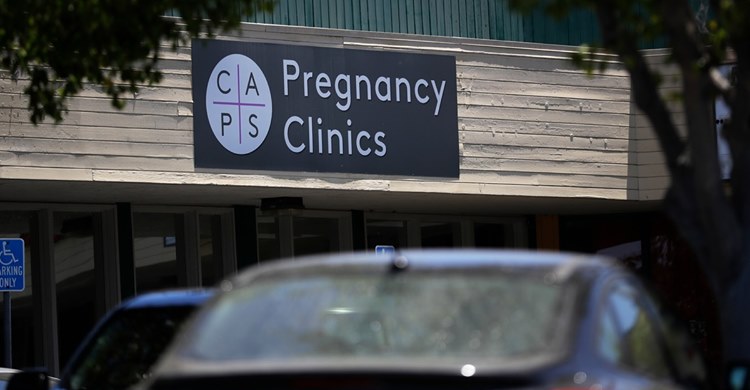
A COLLEGE AREA PREGNANCY SERVICES (CAPS) CLINIC IS SEEN TUESDAY, JUNE 26, 2018, IN SAN DIEGO. (AP PHOTO/GREGORY BULL)

Top leaders of the U.S. anti-abortion movement are congratulating their foot soliders for gaining ground in the war over abortion—just as the Senate prepares to confirm a Supreme Court justice that could help topple Roe v. Wade, the landmark ruling that legalized abortion nationwide.

The United States now has more than 2,700 pregnancy centers, according to a report released Tuesday by some of the nation’s leading anti-abortion organizations. These facilities, which are sometimes called “crisis pregnancy centers,” offer anti-abortion activists a physical presence in communities across the country. They do not offer or refer abortions and instead try to steer people into continuing their pregnancies. 

“When I consider the triumphs of the pro-life movement, I think there can be no more ultimate measure of it, this side of paradise, than every resounding ‘yes’ to new life,” Marjorie Dannenfelser, president of the powerful anti-abortion group Susan B. Anthony List, wrote in the introduction to the report. “As a mother, as well as a convert to and leader in the pro-life cause, I am incredibly heartened by the ongoing work of pregnancy centers across our country to support women and their families in saying ‘yes’ to Life.”

(“Life” is deliberately capitalized. Dannenfelser also signed off her introduction with, “For Life.”)

A 2018 version of the report found that, in 2017, there were around 2,600 pregnancy centers in the United States. By comparison, the U.S. had just 808 abortion clinics in 2017, according to the most recent data from the Guttmacher Institute, which studies abortion restrictions.

The thousands of centers served around 1.85 million people in 2019, according to the new report, compiled by the anti-abortion think tank Charlotte Lozier Institute and the three top pregnancy center networks, Care Net, Heartbeat International, and National Institute of Family and Life Advocates (NIFLA). And all of the 2,700 centers adhere to a set of standards that includes the commitment to never “offer, recommend, or refer for abortions, abortifacients, or contraceptives.” 

Eleven percent of the centers—or 305 centers—also offer the “abortion pill reversal,” a controversial treatment that purports to help people stop their medication abortions. 

In 2019, the number of providers that offer “abortion pill reversal” increased by 30%, thanks to a mix of “clinics, private practice, hospital systems, and pregnancy centers,” the report found. More than 200 consulting pregnancy centers also “support” the practice by referring people to a hotline that counsels them about it, offering free ultrasounds, and providing what the report calls “long-term support to reversal clients.”

No conclusive medical evidence exists to prove that “abortion pill reversals” work. In 2019, a study meant to evaluate the “abortion reversal” protocol instead ended early, after three study participants started hemorrhaging so much blood they went to the ER.

The pregnancy center report shares the story of “Sarah,” a woman who underwent the abortion pill reversal protocol and ended up giving birth. However, the report says that, after Sarah took the first of the two drugs used in a medication abortion, a doctor found a heartbeat and then started her on the protocol, which typically involves giving patients several doses of the hormone progerstone. 

That account suggests that the pregnancy continued despite the first drug (which, one doctor told VICE News in 2018, isn’t a “very good abortion-causing drug” when taken on its own). It does not confirm that it was the progesterone that successfully saved the pregnancy.

Abortion rights groups say that these pregnancy centers are often less than forthcoming about the fact that they don’t offer abortions, a tactic that’s designed to lure in unsuspecting pregnant people. 

“Behind the doors of what are designed to look like full-service health clinics, ideologically motivated staff members deceive and manipulate women with dangerous misinformation,” alleged a 2015 report from NARAL Pro-Choice America, which conducted undercover investigations into pregnancy centers in more than 10 states.

2019 VICE News investigation found that, when searching for places to get an abortion in states where abortion rights are under threat, Google Maps will often return results for anti-abortion pregnancy centers. These centers had labels like “pregnancy care centers” or “women’s health clinics,” which made it difficult to tell which services were actually offered by the facilities. VICE News also found that these facilities’ websites frequently don’t clarify that they don’t support abortion.

The report released Tuesday speaks highly of the “medical, education, and support services” offered by the pregnancy centers. Most performed ultrasounds, gave out goods like diapers and baby wipes, and gave what the report calls “parenting/prenatal education program[s].” Many centers, the report noted, have stayed open throughout the coronavirus pandemic as “essential services.” (In the spring, public officials in multiple states cited the pandemic as a reason to stop abortion clinics from offering the procedure.)

Just 30% of the pregnancy centers offered STI testing in 2019. About 20% offered STI treatment. And 2% offered pap smears and “well-woman exams,” where providers typically offer a kind of physical centered around reproductive health.

“In 2019, a total of 5%, or 147 pregnancy center locations, offered some level of prenatal care beyond the provision of prenatal vitamins on-site,” the report found.

Nearly 1,000 centers offered “group sexual risk avoidance education presentations.” “Sexual risk avoidance” is a rebranding of abstinence-only sex ed. 

The vast majority of people working at pregnancy centers are also not licensed medical professionals, according to the report. Out of around 53,000 volunteers—who make up the bulk of the U.S. pregnancy center workforce—around 6,400 were licensed to practice medicine. Just under 3,800 paid staffers, out of almost 15,000, had similar licenses.

Another common service is “after-abortion recovery and support,” which 1,931 centers offered to nearly 22,000 people. While some people do have mixed or negative feelings after getting an abortion, a landmark study of abortion’s aftereffects found in 2019 that, five years after an abortion, 84% of women reported either feeling primarily positive about their abortions or having no feelings about it at all.

The vast majority of the funding for pregnancy centers comes from private donations, the report found. But 340 “pregnancy center organizations,” in the words of the report, “received government monies at some level through federal or state funding.” That’s a 2% spike from 2017.

By contrast, the Trump administration banned clinics funded by the only federal program dedicated to family planning from referring patients for abortions in 2019.

Source: https://www.vice.com/en/article/epd4n7/hundreds-of-us-pregnancy-centers-are-now-offering-unproven-abortion-reversals?fbclid=IwAR3BEnPL6IDpQRmMQN2Tm8UzxVEXB2v1ZPRvG1AIIo8_HxUicdMcdP7URyE

Sen. Lindsey Graham, R-S.C., speaks during Senate Judiciary Committee hearing on Capitol Hill in Washington, Wednesday, June 3, 2020. (Greg Nash/Pool via AP) 
Associated Press
  • Republican Sen. Lindsey Graham of South Carolina said Saturday that women are welcome anywhere in the country if they’re against abortion.
  • “I want every young woman to know there’s a place for you in America if you are pro-life, if you embrace your religion, and you follow a traditional family structure — that you can go anywhere, young lady,” he said at a campaign event.
  • Graham was urging women to be more like newly appointed Supreme Court Justice Amy Coney Barrett, who in the past has signaled her anti-abortion stances.
  • Early in October, Graham made a similar suggestion, saying Black people are free to go and live in any part of South Carolina so long as they’re not liberal.

On the campaign trail Saturday night, Sen. Lindsey Graham said women are welcome anywhere in the country — provided that they’re anti-abortion.

The Republican senator took the stage at a campaign event in Conway, South Carolina, his home state, and praised Amy Coney Barrett, the newly appointed Supreme Court justice. 

“You know what I like about Judge Barrett? She’s got everything,” Graham said. “She’s not just wicked smart, she’s incredibly good. She embraces her faith.”

“I want every young woman to know there’s a place for you in America if you are pro-life, if you embrace your religion, and you follow a traditional family structure — that you can go anywhere, young lady,” he continued.

Throughout the confirmation process, Barrett has chosen to withhold details about her stance on abortion and reproductive rights. But in the past, Barrett’s actions have signaled she is against Roe v. Wade, the landmark Supreme Court decision granting abortion. 

Barrett, for example, publicly backed an anti-abortion ad appearing in a South Bend, Indiana, newspaper in 2006. Additionally, more than 1,500 alums from Barrett’s alma mater, Rhodes College, signed a letter in October that argued Barrett would “seriously curtail” Roe v. Wade if nominated. 

Women and LGBT activists are slamming his remarks, characterizing the parameters he listed as sexist and anti-LGBT.  

Graham’s remarks come weeks after the senator made limiting characterizations about Black people. 

On October 9, Graham said Black people are free to go and live in any part of the state, as long as they’re not liberal.

“I care about everybody,” Graham said, speaking at a forum for South Carolina Senate candidates. “If you’re a young African American, an immigrant, you can go anywhere in this state. You just need to be conservative, not liberal.”

Graham is fighting to keep his Senate seat against Jaime Harrison, a Black former state legislator who spoke at the forum just before him. For weeks, polls have shown either the two tied or one just slightly ahead of the other.

Graham has a marginal lead of 3 percentage points over Harrison, according to a poll conducted last week and posted on Real Clear Politics. Harrison, with 46% of support, trails Graham’s 49%.

The South Carolina senator did not immediately respond to Business Insider’s request for comment on his Saturday remarks about women.

Source: https://www.businessinsider.com/graham-women-have-place-in-america-if-against-abortion-2020-11?fbclid=IwAR3sRVr2OiP8iOr9buYO-AKKPC6cDmQ2EPR4EjltLoeedK1OIblbuUxwf0Q

PORTLAND, Ore — With the confirmation of Justice Amy Coney Barrett, and major cases on the high court’s list dealing with abortion, same-sex marriage, and healthcare, many Oregonians are wondering what this could mean locally.

Many speculate because of Barrett’s seemingly conservative side, that she might rule to overturn the landmark Roe v. Wade case. However, law experts say judges are often hard to read.Volume 90% Oregon law protects reproductive rights if Roe v. Wade overturned. (KATU)

Law experts like Tung Yin, who is a law professor at Lewis and Clark College says even if some of these rulings are overturned. like Roe v Wade or Obergfell vs. Hodges, which deals directly with same-sex marriage, it would likely have little effect in Oregon because Oregon already has laws in place.

“If [Roe v. Wade] were overturned, all it would mean is that the constitution does not guarantee the right to an abortion, but a state could provide that, and in Oregon it does,” Yin said.

Oregon was one of the first states to legalize abortion. In fact, the right to an abortion is protected in the state constitution.

And at that point, any state could make its own laws about abortion.

“State legislatures have generally far more power, the only limits are imposed by their state constitution or the U.S. Constitution Bill of Rights,” Yin said.

Yin says the only way a state would be prevented from legalizing abortions is if there were a crime attached to it.

When it comes to the Affordable Care Act, there are a few more possibilities.

“Oregon could certainly implement its own version within the state. That would not help people outside the state, but within the state. Nothing in the Affordable Care Act rulings would prevent the states from doing so,” Yin said.

In fact, so could Congress.

In DC, lawmakers could go back to the drawing board on the Affordable Care Act, so to speak, and pass a new version.

As for what will happen, time will tell, but on Monday, Governor Brown’s office released this statement on the possibility:

The Governor recognizes that many Oregonians are worried about the impacts the decisions and rulings of the U.S. Supreme Court in the months to come will have on their family, their health care, their right to marry, or their immigration status. For example, striking down the Affordable Care Act would have dangerous consequences for Oregonians with pre-existing conditions and families who rely on it for necessary preventive and non-preventive health care coverage. If that law is invalidated, more than 546,000 Oregonians could lose coverage.

Here in Oregon, Governor Brown has been a champion for access to health care, reproductive rights, LGBTQIA rights, and for our immigrant and refugee communities. She’s fought to improve the quality of health care all Oregonians receive, as well as eliminating health disparities and improving access to care; signed Oregon’s Reproductive Health Equity Act into law in 2017; championed driver’s licenses for all and protections for our dreamers; and championed Adi’s Act to help prevent youth suicide, ban conversion therapy, and make Oregon the first state to pass a stand-alone transgender justice bill.

The Governor is committed to fighting to protect the rights of each and every Oregonian and ensuring our state will be a welcoming, inclusive state for all who call Oregon home.

Source: https://katu.com/news/local/oregon-law-protects-reproductive-rights-in-event-of-roe-v-wade-overturn?fbclid=IwAR11kTgKrXB-TpUtQWfma3uyxWf8IqdXKdSZhNI9DCFk0TPPOSR74y40cls