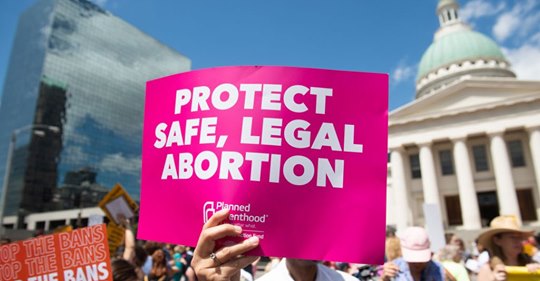
The bifurcation of abortion access in the United States means more clinics should be built on the border of states with onerous anti-choice restrictions, advocates say.

The location of the new Planned Parenthood clinic in Fairview Heights, Illinois, was strategically chosen to reach as many patients in the region as possible.
Michael Thomas / Getty Images

After 18 months of secret construction, Planned Parenthood will open one of the nation’s largest abortion clinics in southern Illinois this month, expanding access not just in the state but across the midwest.

The new health center in Fairview Heights, Illinois, will replace the city’s smaller Planned Parenthood clinic, which provided family planning and medication abortion services to more than 5,000 patients in 2018. The location of the new facility, just 13 miles from Missouri’s last remaining abortion clinic in St. Louis, was strategically chosen to reach as many patients in the region as possible, said Yamelsie Rodriguez, president and CEO of Planned Parenthood of the St. Louis Region and Southwest Missouri.

The 18,000-square-foot facility, equipped to serve 11,000 patients a year, is the latest abortion clinic to be built near the border of a state where lawmakers have restricted access to abortion care at every turn. Reproductive rights advocates say it will be critically important to construct abortion-providing facilities near states where people are burdened by medically unnecessary anti-choice laws.

“We specifically chose Illinois because we know the policies in that state have made Illinois an oasis for access to the entire spectrum of reproductive health-care services,” Rodriguez told Rewire.News.

Missouri is one of six states with only one abortion provider, and that provider’s state license has been in jeopardy this year as anti-choice politicians continue to adjust licensing requirements. Conversely, Democrats in Illinois have passed legislation to protect and expand abortion access, making it one of the least restrictive states in the country. An increasing number of patients from surrounding states are traveling to Illinois to receive abortion care.

“Planned Parenthood of the St. Louis Region and Southwest Missouri has been looking to expand and protect access to comprehensive reproductive health care not just in Missouri, where we know abortion access hangs on by a thread, but in the Midwest region, where we have states like Arkansas and Kentucky increasing restrictions to limit women’s access to these services,” Rodriguez said.

The divide between Illinois and Missouri illustrates an emerging trend across the country, as states with Republican-held legislatures, primarily in the South and Midwest, continue to make abortion care inaccessible, while states with Democratic-majority legislatures in the West and Northeast protect and expand access. In the first six months of 2019, state legislatures enacted 58 abortion restrictions, 26 of which would ban the procedure in all, most, or some cases, according to the Guttmacher Institute.

In Colorado, another state many people travel to for abortion care, the location of abortion clinics is strategically chosen to reach those needing services, said Laura Chapin, spokesperson for NARAL Pro-Choice Colorado. Colorado is one of seven states that doesn’t restrict abortion at any stage of pregnancy. Colorado clinics served women from 34 states in 2018, the Denver Post reported.

“There’s a Planned Parenthood facility on the eastern side of Denver off I-70. That’s not an accident,” Chapin told Rewire.News. “There should be a national standard of care across the country. That’s why you have constitutional rights that aren’t dependent on your geography.”

While 2019 has brought a surge of GOP-backed abortion bans, spurred by hopes that conservatives on the U.S. Supreme Court will overturn Roe v. Wade, Democratic-led state legislatures have passed a record number of bills meant to secure and expand abortion access, said Elizabeth Nash, senior state issues manager for the Guttmacher Institute. In the first six months of 2019, states have enacted 93 proactive provisions, including 29 that protect abortion rights, 11 that increase access to contraception, and 15 that seek to improve comprehensive sex education.

“The immediate catalyst is a more conservative Supreme Court, but these proactive bills are also a reaction to a longer trend of abortion restrictions,” Nash told Rewire.News. “And there isn’t a lot of overlap. States are either looking to ban abortion or protect it.”

Planned Parenthood built the new Fairview Heights facility using a shell company to avoid interference from protestors, CBS News reported. Other Planned Parenthood projects have been halted by protestors harassing contractors and putting pressure on other vendors The new clinic will begin serving patients in mid-October and will provide a broad spectrum of reproductive health-care services including medication and surgical abortions, cancer screenings, annual exams, family planning, HIV prevention, and STI testing.

Though the new Planned Parenthood facility in Illinois will be equipped to serve thousands of patients, many across the Midwest will still have to travel long distances to receive care. People in the middle or southern regions of Missouri will need to drive at least a couple hours to reach an abortion provider in either St. Louis or Illinois. People in western Missouri could seek care in eastern Kansas, but will still need to travel to get there.

“We know that increasing one access point doesn’t necessarily mean all people will be able to seek the care they need, but Planned Parenthood is committed to reducing as many barriers as we can,” Rodriguez said.

While the new Planned Parenthood facility will expand access in Missouri and Illinois, the same strategy may not be as effective in other parts of the country where neighboring states have onerous restrictions, Nash said.

“If we are looking at the current political environment, particularly in the South, you aren’t going to find many states where building a facility on a border will really increase access,” Nash said. “Certainly for Illinois, building capacity there is part of a solution, but if you’re in Alabama or Mississippi, where potentially could the next clinic be?”

As state legislatures continue to pass laws aimed at either restricting or expanding access to abortion care, more patients will be forced to travel or go without the care they need.

“I do think the existing divide in access will continue and be exacerbated, and that isn’t where we need to be,” Nash said. “We need to be looking at what patients need, and making sure they get the services they desire and deserve with respect and dignity.”

Source: https://rewire.news/article/2019/10/11/the-strategy-behind-where-to-build-abortion-clinics/

Mary Kay Culp, executive director of the anti-abortion group Kansans for Life, speaks to a legislative study committee, Tuesday, Oct. 1, 2019, at the Statehouse in Topeka, Kansas. The committee is considering whether lawmakers should propose an amendment to the Kansas Constitution to overturn a state Supreme Court decision declaring access to abortion a fundamental right. (AP Photo/John Hanna)

Kansas conservatives are trying to overturn a state Supreme Court decision that protects abortion rights and threatens years’ worth of Republican-enacted restrictions, guaranteeing an election-year fight over amending the state constitution.

A legislative study committee opened two days of hearings Tuesday on a ruling in April by the state’s highest court that access to abortion is a fundamental right under the Kansas Constitution. The Republican-led committee is expected to urge the full, GOP-controlled Legislature to put a proposed constitutional change on the ballot next year for voters to consider.

Anti-abortion groups and legislators said Tuesday that they’re still drafting their proposal. Mary Kay Culp, executive director of Kansans for Life, said the measure wouldn’t seek to ban abortion outright but would declare that the Legislature determines how it is regulated.

If the effort succeeds, Kansas would be among a handful of states in which voters have added provisions to their state constitutions to declare that they don’t grant a right to an abortion. Alabama and West Virginia approved theirs last year, and Louisiana voters are considering a ballot question next year.

“We’re really stuck here,” Culp told the committee. “There is no other way to do it.”

Abortion rights opponents didn’t push for action before lawmakers adjourned their annual session in May, saying they wanted to confer with lawyers throughout the country and build political support.

The Legislature has long had anti-abortion majorities, but abortion opponents were a bit spooked in early May, when anti-abortion lawmakers narrowly failed to override Democratic Gov. Laura Kelly’s veto of a bill that would have required providers to tell patients about a disputed treatment to stop a medication-induced abortion after it has been started.

Overriding a veto requires the same two-thirds majorities in both chambers that are required to put a proposed constitutional amendment on the ballot for a statewide vote.

And in Iowa, another Republican-leaning state where the highest court issued an abortion-rights ruling in 2018, lawmakers have failed to move forward with a constitutional change, and one couldn’t go before voters there until 2022.

“Those politicians who are very opposed to abortion, for whom this is their No. 1 issue, realize that this isn’t an easy task anymore,” said Rachel Sweet, a lobbyist for Planned Parenthood Great Plains. “It’s going to be tricky for them to get the votes that they need.”

The Kansas court decision came as other states moved to ban most abortions in direct challenges to the U.S. Supreme Court’s historic 1973 Roe v. Wade decision. In Kansas, the April decision means that even if Roe were overturned, state courts could reject new restrictions or invalidate those enacted under Kelly’s conservative Republican predecessors.

The Kansas Supreme Court declared that the state constitution’s Bill of Rights grants a “natural right of personal autonomy” protecting a woman’s right to end her pregnancy. Critics see that as an overreach because most abortions were illegal in Kansas Territory when the state constitution was adopted in 1859.

Two justices in the 6-1 majority have announced their retirements, and Kelly, an abortion rights supporter, will name their replacements in the coming months, with no oversight from lawmakers. Abortion foes also are pushing a proposed constitutional change to require state Senate confirmation of Supreme Court justices, hoping that the court eventually would move to the right.

“Then, we are inserting politics into the judicial decision-making process, and that’s a very bad idea,” said state Rep. John Carmichael, a Wichita Democrat who supports abortion rights.

The Kansas court’s abortion decision blocked enforcement of a first-in-the-nation ban on a common second-trimester procedure. Special health and safety regulators for abortion providers have been tied up in state court since 2011.

Abortion opponents worry that even long-standing laws, such as one requiring a parent’s consent for a minor’s abortion, could be in jeopardy if the decision isn’t overturned.

“Personally, it’s my top priority,” Kansas Senate President Susan Wagle, a conservative Wichita Republican, said in an interview. “And I have a lot of colleagues who agree that this is most important.”

Source: https://abcnews.go.com/Health/wireStory/kansas-conservatives-push-undo-abortion-rights-ruling-65990551?fbclid=IwAR1wqPgDw_ZeU7zGbIrP2M2NqoFlTQEs2KQXZgS3j-BS7Bzj4kjrYSqUdJc

Michigan Gov. Gretchen Whitmer (D) threw a wrench into Republicans’ plans to funnel state funding to clinics that lie to pregnant people and don’t provide a full range of reproductive health services.

Whitmer, who won the governorship in 2018, last week used her line-item veto power to prevent Pennsylvania-based Real Alternatives from using more state dollars to line Real Alternatives executives’ pockets while failing to meet the promised metrics for success and promoting an anti-abortion agenda.
Bill Pugliano / Getty Images

Michigan’s reproductive rights powerhouse Gov. Gretchen Whitmer (D) recently smacked down $700,000 in state funding for a group with a long history of misspending taxpayer dollars and deceiving pregnant people.

Whitmer, who won the governorship in 2018, last week used her line-item veto power to prevent Pennsylvania-based Real Alternatives from receiving more state dollars while failing to meet the promised metrics for success and promoting an anti-choice agenda.

Funding for Real Alternatives should have never made it into the Michigan budget, much less to our governor’s desk. The idea of increasing what the state was giving the anti-choice group is an insult to me as a woman, a taxpayer, and a person capable of reading a simple balance sheet. But given the absurdist theater of state politics of the past few years, I’m not the least bit surprised.

Months after Whitmer proposed her budget, Republican lawmakers tried to corner her by taking a summer vacation and giving her mere days to prevent a government shutdown. It wasn’t fair, and it wasn’t right. But what do you expect from GOP officials with a history of taking money away from needy families and children?

Real Alternatives has been proven to misuse money intended to serve vulnerable households with newborn children. They grew their own executives’ paychecks, missed yearly goals they promised to fulfill for the Michigan Pregnancy and Parenting Support Program, and funded anti-choice crisis pregnancy centers that lie to and manipulate people who seek abortion care.

We’ve known Whitmer is a powerful ally for reproductive rights. As a state senator and a representative, she was no stranger to the uphill battle against nonsense anti-abortion legislation. She fought back against attacks on later abortion care in 2008, and tried to fend off so-called rape insurance in 2014, although—unfortunately—both eventually passed with Republican support.

But it shouldn’t take an effective ally to see through Real Alternatives’ charade. Real Alternatives is just one piece of the growing anti-abortion movement in Michigan and across the country.

Since the spring, anti-choice groups Michigan Values Life (backed by Right to Life Michigan) and the Michigan Heartbeat Coalition have launched two ballot initiatives to make second-trimester abortions inaccessible and criminalize abortion at six weeks’ gestation, respectively.

But even without those ballot initiatives, abortion care is barely accessible for Michiganders. From Detroit to Kalamazoo, people have to wait for available appointments at clinics, pay for abortion out of pocket unless they purchase an additional insurance rider, and plan around a 24-hour forced waiting period to obtain an abortion.

And while legislators are trying to pay Real Alternatives to fund fake programs, our Planned Parenthood affiliates are under financial stress after a Trump administration policy forced the organization to reject federal family planning funding in order to keep providing abortion services.

When we find the small victories in the long list of battles pro-choice advocates face here in Michigan, we’ll take them.

If not for Whitmer’s strong pro-choice leadership, Republicans would’ve handed over the money to Real Alternatives. This would have been one more win for the right’s nationally coordinated attack on reproductive freedom in the United States.

Everyone knows abortion restrictions are not about protection or medical necessity—bad-faith arguments put forth by anti-choice Republicans. Making abortion illegal or inaccessible is a way for conservatives to oppress and punish people who seek necessary health care.

Funding groups like Real Alternatives is about taking money away from those who need it. Even without mentioning the word, “abortion,” funneling taxpayer money into Real Alternatives was a direct attack on abortion rights.

Source: https://rewire.news/article/2019/10/09/michigan-governor-says-no-to-more-taxpayer-funds-for-anti-choice-clinics/

Banning abortions isn’t particularly effective. When governments restrict access to abortion, abortions actually continue to take place at roughly the same rate, according to the World Health Organization. But they get less safe. When abortion services are denied or limited, coat hangers, toxic herbal medicines and unqualified practitioners step into the breach, while medical professionals who provide proper care are criminalized.

Total bans or restrictive abortion laws in countries like El SalvadorPoland and more recently several U.S. states (including Louisiana, Ohio, Kentucky, Mississippi, Georgia, Alabama and Missouri) are designed to control and confine women and girls to stereotypical gender roles. They are an affront to their human rights and dignity and constitute gender discrimination. For transgender and queer people who need abortions, such restrictive laws are the latest in a long line of attacks on their rights and freedoms.

Organizations defending human rights have documented the agony and despair stemming from restrictive abortion laws around the world. One of the most harrowing stories is that of “Ms Y”, a woman who was granted asylum in Ireland after being beaten and raped by paramilitaries in her own country. Ms Y tried to kill herself several times when she was told she could not end her pregnancy, which was the result of rape. She was eventually forced to give birth by C-section. At every step of the way, the Irish authorities’ concern for the protection of the fetus trumped any consideration of Ms Y’s mental and physical health.

Last year Ireland joined the list of nearly 50 countries that have expanded access to lawful abortion over the last few decades. It was a historic move which came too late for Ms Y, but which will protect others from suffering the same trauma.

More recently, we have seen the horrific impact of criminal abortion laws being used to punish people for suffering pregnancy-related complications. In El Salvador, women who suffer miscarriages or stillbirths are routinely “suspected of having abortions” and charged with homicide.

In April 2016, Evelyn Hernández, a 21-year-old El Salvadorian woman, suffered an obstetric emergency at home, resulting in the loss of her pregnancy. She was arrested, tried and sentenced to 30 years in jail for aggravated homicide. In February this year, a higher court overturned this ruling and ordered a re-trial — which found Evelyn innocent. However, on Sept. 6, the Salvadoran Public Prosecutor’s Office announced that it would appeal that judgement – showing the authorities’ obsession with charging her under the country’s draconian laws.

We must continue to stand up to governments’ efforts to control women’s and girls’ bodies. According to the US-based reproductive health non-profit the Guttmacher Institute’s latest report, as of 2017, 42% of women of reproductive age live in the 125 countries where abortion is highly restricted (prohibited altogether, or allowed only to save a woman’s life or protect her health). Jurisdictions around the world are going to extreme lengths to restrict abortion access — stripping those who can get pregnant of their human rights and bodily autonomy.

Any person who does not control what happens to their body cannot be free. The debate around abortion should go beyond whether a person’s life is endangered by pregnancy. At the core of the issue is a person’s right to make decisions about what happens to their body. This right is critical to enabling all people who can get pregnant to fully exercise their human rights and to live their lives with dignity. Governments must not only decriminalize abortion and ensure access to safe abortion in practice, but also create social conditions in which people can make pregnancy-related decisions free of oppression, discrimination, stigma, coercion, violence, lack of opportunities or punishment.

More and more countries have woken up to this fact, despite the alarming rollback of reproductive rights in some countries, like the United States or Poland, driven by anti-choice groups and supported by populist politicians. Over the last 25 years, around 50 countries have changed their laws to allow for greater access to abortion. Although national contexts vary, one thing has united all successful campaigns to reform abortion laws: women speaking out. From Ireland to South Korea, activists have helped dispel the stigma and secrecy surrounding abortion by sharing their stories. In Argentina and Poland, over a million women have marched to demand that their voices be heard.

People who need, or have had, abortions deserve our support and solidarity. Whether by donating time and resources to national abortion networks, taking to the streets in protest or educating people in our lives about the need for safe abortion, we all have a role to play in reclaiming our rights.

At the same time, governments must expand access to safe, lawful and affordable abortion and contraception for all people. Not only is it the humane thing to do, it is a state obligation under international law. It will prevent countless deaths, life-long trauma and life-changing injuries.

Source: https://time.com/5684858/international-safe-abortion-day/?fbclid=IwAR3us_9q_kYCdrHa2SXTwF2cB-XnXxbJ1et5vTug6nTDXk3i2EMv3ILiOGM

In 1962, a woman named Sherri Chessen Finkbine, who was the host of a children’s TV show, learned that a tranquilizer she had been taking for chest pains contained a drug known to cause birth defects. This was definitely troubling enough, but Finkbine was pregnant too. Knowing that the fetus was in danger, the mother of four, accompanied by her husband, sought an abortion at a hospital in Phoenix, Arizona.

A doctor agreed to do the procedure, which at the time was illegal except in atypical health circumstances. But after Finkbine’s story made it into the press, the hospital reversed the decision, and the family of six was at the center of a fiery national moral debate. Eventually Finkbine went to Sweden and obtained an abortion. She was able to exercise her reproductive freedom, but she also lost her job as a result.

That August, the nonpartisan polling group Gallup conducted its first-ever poll concerning abortion, specifically about Finkbine (called “an Arizona woman” in the poll) and her decision to have the procedure. The poll asked: “As you may have heard or read, an Arizona woman recently had a LEGAL abortion in Sweden after having taken the drug thalidomide, which has been linked to birth defects. Do you think this woman did the right thing or the wrong thing in having this abortion operation?” When the poll was released in September 1962, 52% of the nation said the Arizona woman did the right thing; 32% said the abortion was the wrong thing; and 16% had no opinion.

Among those surveyed, 54% of men said it was the right thing, as did 50% of women.

The Gallup press release announcing that poll was headlined “Public Agrees With Abortion Action Taken by Mrs. Finkbine.” Nearly 60 years after the American public was asked to judge a working mother from Arizona, the subject of abortion, in one form or another, continues to have support from a majority of Americans. It just may not feel that way.

Abortion is almost always presented as a divisive and contentious issue. How can it not be when clinic workers know their protesters by name? When clinicians have reported more than 3,000 incidents of protester obstruction and more than 1,000 cases of trespassing at facilities? Since at least the first major wave of murders of abortion providers and their staffers in the 1990s, abortion has been largely presented as a ride-or-(literally)-die issue.

The truth is, though, abortion is largely condoned. One could even say abortion is popular. And while abortion may become more divisive when you dive into party identification, many other societal markers show that the medical procedure and the freedom it allows remain popular issues. Gallup has been tracking abortion as a social issue since 1975, two years after Roe v. Wade was decided by the Supreme Court, with one consistent question used to gauge public opinion: “Do you think abortions should be legal under any circumstances, legal only under certain circumstances or illegal in all circumstances?”(The analytics company has tracked abortion through other questions starting earlier, but the 1975 question lets us measure (un)favorability over decades.)

When that question was asked in 1975, 55% of Republican voters said abortion should be legal under certain circumstances, with another 18% believing abortion should be legal under any circumstances. Only 25% of Republican voters in 1975 said abortion should be illegal no matter what. When looking at independent voters, these numbers were similar: 58% said abortion should be legal in certain conditions; 24% said legal under any conditions; and only 16% said abortion should be illegal.

These numbers were relatively similar when polling Democratic voters in 1975. Fifty-one percent said abortion should be legal under certain circumstances and 19% thought abortion should be legal under any circumstances. The Democratic voting pie was rounded out with 26% saying abortion should be illegal. This means that among the self-identified Republicans and Democrats polled, abortion had roughly the same amount of broad support, 18% and 19% respectively.

In 44 years the numbers haven’t moved that much. In 2019, 55% of Republican voters still said that abortion should be legal under certain circumstances. The number of Republicans who said abortion should be legal under any circumstances dropped 6 points to 12%. The number of Republicans who said abortion should be illegal increased by seven points from 25% to 32%. For independents, the numbers have changed even less: The only movement in 44 years was for those who believe abortion should be legal only under certain circumstances, which decreased from 58% to 56%.

Numbers among Democrats have seen real shake-ups, despite the trend lines staying at roughly the same level. Fewer people believe abortion should be legal in only certain circumstances (51% to 45%), but the number who believe abortion should be legal in all cases increased from 19% all the way to 39%. Additionally, the percentage of people who believe abortion should be illegal in all circumstances decreased from 26% in 1975 to 14% in 2019.

“The overall trend hasn’t moved very much, but that’s masking the fact that Democrats have become more supportive of abortion rights and Republicans have become more entrenched in the pro-life position,” Gallup senior editor Lydia Saad told Teen Vogue.

To Saad’s point, Republicans who identify as “pro-life,” as opposed to “pro-choice,” increased from 51% in 1995, when Gallup first started asking the question, to 75% in 2019. Those who identify as pro-choice dropped by 21 points during those 24 years. Democrats who identify as pro-choice increased by 10 points to 68% and those who identify as pro-life dropped by 4 points to 29%.

Polling shows that support for abortion is up on both sides of the aisle. A poll by NBC News and the Wall Street Journal found that the number of Democrats agreeing that “abortion should be legal all or most of the time” grew by 13 points between 2008 and early June 2019, when the poll was conducted. Republicans increased their broad support for abortion by four points during that same period.

That support was cited by National Abortion Federation interim president and CEO, the Very Rev. Dr. Katherine Hancock Ragsdale: “The majority of people in this country want [people] to have safe, compassionate, quality health care,” Hancock Ragsdale told Teen Vogue. “Even if that were not true, [if] the majority didn’t agree, that doesn’t mean it’s okay to deny women safe, compassionate, quality health care. This is a basic human right that cannot be denied because of numbers, and a majority of people know that.”

Oddly, party identification is one of the only societal identifications where this split in opinions on abortion is so clear. Saad said that while the partisan entrenchment is real, it overlooks the crossover Americans have in their views on the procedure: “People are so nuanced on abortion that it oversimplifies public opinion. It makes it sound like this intransigent two different camps when there’s, in fact, a lot of overlap [in] views among both groups about when abortion should be legal.” Saad continued, “I always like to tell people there’s a lot more opportunity for compromise than you would think from the politics of it, or even these labels.”

Interestingly, views on abortion are not divided along gender lines. In May 2018, 26% of men and 31% of women favored legal abortion under all circumstances. This number has only grown since Gallup started tracking the opinion in the late 1970s; it was then 21% of men and 22% of women.

“Gender is one of the least differentiating demographics on abortion,” Saad told Teen Vogue. “Year to year, it goes back and forth whether men or women are more pro-choice or more pro-life. If you average it out over our history, it comes out pretty even-steven.”

Saad’s assessment remains true for the participants who favor abortion legalization but only in certain circumstances. In 1979, 54% of men and women said they favor legal abortion in certain circumstances. By 2018, the numbers had barely moved: 53% of men and 48% of women.

These numbers track with what Linda Greenhouse, coauthor of Before Roe v. Wade: Voices That Shaped the Abortion Debate Before the Supreme Court’s Ruling, witnessed for decades while covering the Supreme Court for The New York Times. “All that’s changed is our politics. And the politics have been driven by particular, very engaged interest groups and politicians, not by anything that the public wants changed,” she said.

There have always been conflicts about abortion despite its popularity, Greenhouse added. “Public support for the right to abortion has basically not changed. It’s a little up, a little down. It’s been the case since Roe v. Wade; there’s a solid majority of the public that support women’s access to abortion,” she said. “One part of our efforts of the Before Roe v. Wade book was to show that it wasn’t the court in Roe v. Wade that created the conflicts over abortion. There were conflicts over abortion before then.”

Abortion may have incredibly vocal opponents, but polling that’s been conducted since before abortion was legal shows that reproductive choice was and remains popular. Maybe it’s time for the national media to treat abortion supporters as the loudest voices in the room.

Source: https://www.teenvogue.com/story/public-opinion-abortion-us-favorable

A fund in Georgia is responding to restrictive legislation with a familial kind of care.

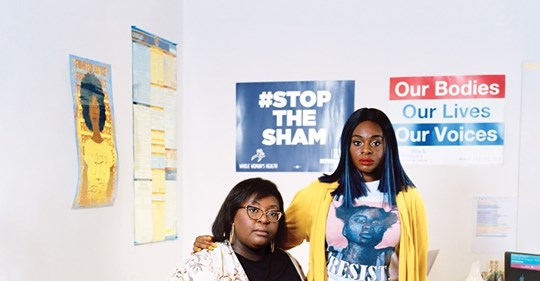
Oriaku and Dirichi Njoku, of the abortion fund arc-Southeast.Photograph by Andrew Lyman for The New Yorker

n June, 1994, at a pro-choice conference in Chicago, twelve black women gathered together to talk. One, Loretta Ross, was the executive director of the first rape crisis center in this country. Another, Toni Bond, was the executive director of the Chicago Abortion Fund. A third, Cynthia Newbille, was the leader of the National Black Women’s Health Project, which was among the first national organizations to be devoted to the wellness of black women and girls. After the first day of the event, which was hosted by the Illinois Pro-Choice Alliance and the Ms. Foundation, the group met in a hotel room. “We did what black women do when we’re in spaces where there are just a handful of us,” Bond, who is now a religious scholar, recalled. “We pulled the sistas together and talked about what was missing.”

Abortion had been decriminalized in 1973, with the Supreme Court’s Roe v. Wade decision, but, with the passage, in 1977, of the Hyde Amendment, which banned federal funding for almost all abortions, the procedure had become too expensive for many women. In 1993, Bill and Hillary Clinton had proposed an overhaul of the health-care system, but reproductive-health coverage was sacrificed to make the reforms more palatable to Republican lawmakers. To the women in the hotel room, the conversation at the conference about reproductive health focussed too narrowly on “choice.” There had been no discussion of the services that black women needed most, such as fibroid-tumor screenings, mammograms, and pre- and postnatal care. (Black women have a higher risk of fibroids than white women, higher percentages of late-detected breast cancer, and a maternal-mortality rate that is more than three times higher.) Nor was there an acknowledgment that the reproductive and parenting decisions of black women were limited by poverty, unequal pay, lack of access to adequate housing and schools, and the abuses of the policing and criminal-justice systems.“No one was talking about black women’s health as a whole,” Ross told me, not long ago. “Too many people were examining policies through the lens of white supremacy.”

The women created the term “reproductive justice” to describe the scope of their activism. They were inspired by the work of the black legal scholar Dorothy Roberts, whose research traced the history of efforts in this country to control black women’s reproductive freedom, beginning with the forced procreation of enslaved women. Abuses had continued into the nineteen-seventies, when thousands of women—including some who were receiving public assistance in North Carolina and others who were incarcerated in California—were involuntarily sterilized. In Arizona, South Carolina, Tennessee, and Washington, state-court judges often offered black female defendants reduced prison sentences if they agreed to get birth-control shots or implants. (This practice was happening as recently as two years ago.) As Roberts observed, black people had turned to their families, friends, and neighbors for the family-planning services and child care that the government had denied them. Bond said, “Reproductive justice offers us an opportunity to talk about the ways in which black women have exercised agency and been resilient even in the midst of reproductive and sexual oppression.”

The twelve women called themselves Women of African Descent for Reproductive Justice. After the meeting in the hotel room, they bought full-page ads in the Washington Post and Roll Call, publishing a letter to Congress that argued for “unimpeded access to abortion as part of the full range of reproductive health services offered under health care reform,” which should be available “regardless of ability to pay, with no interference from the government.” The letter stressed that reform should be comprehensive, and “must include strong anti-discriminatory provisions.”

During the following months, Ross and some of the other women led a reproductive-justice discussion in Cairo, Egypt, and wrote a public letter in support of Joycelyn Elders, the former Surgeon General, whom Bill Clinton had asked to resign after she said that she approved of educating children about masturbation to avoid the spread of aids. In 1997, with funding from the Ford Foundation, sixteen groups representing African-American, Asian-American, Pacific Islander, Latina, and indigenous women came together to form SisterSong, a national collective advocating for the reproductive and sexual health of women of color. SisterSong was based in Atlanta, the birthplace of the civil-rights student protests and the home of several historically black colleges; the city also had the largest black gay population in the South. Activists there had already created a parallel system of care, encompassing the Feminist Women’s Health Center, an abortion and gynecological clinic in the North Druid Hills, which grew out of a women’s self-help health group, in 1976; the National Black Women’s Health Project (now the Black Women’s Health Imperative); and SisterLove, founded, in 1989, to tackle H.I.V./aids.

In the next few years, the leaders of SisterSong and of newer reproductive-justice organizations—such as Spark Reproductive Justice Now, founded, in 2007, to include queer perspectives in the movement—held round-table discussions and met up for dinners and happy hours, as well as get-togethers at Charis Books, a feminist bookstore downtown. In 2004, after the passage of the Partial-Birth Abortion Ban Act, SisterSong, Planned Parenthood, and the National Organization for Women, among other groups, put together the March for Women’s Lives on the National Mall in Washington, D.C. In 2010, after the passage of the Affordable Care Act, several Atlanta-based reproductive-justice groups sent their members to D.C., to protest the Stupak-Pitts Amendment, which aimed to prevent federal funds from being used to pay for insurance plans that covered abortions. The current Democratic Presidential candidate Julián Castro, one of several politicians who have recently spoken about the importance of reproductive justice, told me that he was thankful to the Atlanta community who had launched the movement. “Their voices are crucial, especially now, to get us out of our comfort zone,” he said.

Oriaku Njoku was twenty-five when she visited Atlanta, in October, 2010, to attend the Atlanta Pride Festival. The daughter of middle-class Nigerian immigrants, Njoku had grown up in a mostly white neighborhood in Bowling Green, Kentucky. While attending the University of Kentucky, she came out to her siblings, then to her parents, and participated in L.G.B.T.Q. activism. After graduating, she worked in retail in Kentucky and Indiana. At the Pride celebrations, she was drawn to Atlanta, with its ambitious black residents and its queer scene, and moved there a few months later. In January, 2013, she attended an event held by Spark that was an introduction to reproductive-justice organizing, and later volunteered on a Spark initiative to stop the practice in Georgia prisons of shackling pregnant women during childbirth. “Doing reproductive-justice work has been the one place where I feel like I can bring my full self to the table,” she told me recently. “Being a first-generation queer black Southern fat femme, I can bring all those identities to work and do it unapologetically.” Njoku, who is now thirty-four, calls herself “a giver.” She has the Southern female tendency to go out of her way to put others at ease, filling in an awkward silence with a caring question, a compliment, or a wavering “um.” When she is frustrated, she is just as accommodating, but her voice takes on a slight edge. She likes to wear Igbo dresses and head wraps in vivid colors, and has a sprawling tattoo on her forearm that reads “Love is lifeforce”—a quote from the queer Jamaican-American poet and activist June Jordan.

After the 2013 Spark event, Njoku started travelling to other reproductive-justice gatherings, including the annual summit held by the National Network of Abortion Funds, where people talked about intersectionality and abortion access. She briefly dated a trans man, a human-rights defender from Uganda, who was seeking asylum and trying to bring his children to the United States; she realized that trans men also had trouble exercising their reproductive rights. She began to ask people for their gender pronouns.

In February, 2014, Njoku got a job taking patients’ information and making appointments at the Atlanta Women’s Center, an abortion clinic near the wealthy enclave of North Buckhead. As of that year, legislatures in Georgia and twenty-five other states had enacted laws restricting the coverage of abortion in the Affordable Care Act health-insurance marketplaces. Women who contacted the clinic were often struggling to come up with the money for their abortions, which became more expensive as their pregnancies progressed.

Njoku regularly directed such women to call the National Abortion Federation, which, in 2014, donated to more than a hundred thousand women based on their needs, with the expectation that the women would raise as much as they could themselves. Its hotline was often busy for hours on end. When Njoku looked for regional sources of assistance, she discovered only one in Georgia: the Magnolia Fund, which helped women pay for abortions performed at the Feminist Women’s Health Center. (Magnolia closed last year.)

In May, 2014, Njoku and two colleagues decided to set up their own abortion fund to help women in Georgia, Alabama, Florida, Mississippi, South Carolina, and Tennessee. “I was, like, We gotta do right by our people,” she recalled. “There’s no reason that our folks should be calling multiple numbers and waiting on hold forever to try and get in touch with someone for basic health care.” Kwajelyn Jackson, of the Feminist Women’s Health Center, called abortion funds “the conduit through which people are going to be able to get connected with care in the long run.” That November, Njoku took a job at Summit Medical Associates, assisting in the operating room and caring for women in post-abortion recovery. Meanwhile, she approached the National Network of Abortion Funds for advice. Njoku and her colleagues worked from coffee shops and buffet restaurants, applying for grants and organizing fund-raisers, including a fish fry. Their fund, Access Reproductive Care-Southeast, began operating in May, 2015. Its first grant paid for a headquarters, in an airy arts center in downtown Atlanta. By January, 2016, Njoku was working there full time.

The following spring, Njoku went on a tour of the Deep South, hoping to form relationships with employees at independent clinics, which, in that part of the country, are more numerous than Planned Parenthood centers. At each one, she made note of the affordable hotels nearby, the schedules for intakes and procedures, waiting lists and patient backlogs, and whether there were translators on hand. The fund set up a hotline in July, 2016. As it received more calls, she needed more volunteers to take women to and from appointments. (Clinics require that women receiving sedation have someone with them to take them home.)

That year, arc-Southeast gave funding and assistance to about fifty women each month; it now serves more than three hundred a month. The average cost of an abortion is around five hundred dollars, with later-term abortions sometimes in the thousands of dollars. arc-Southeast gives most women between seventy-five and a hundred dollars. The fund now employs a staff of seven, who are mostly black and queer, and has more than a hundred volunteers. They provide a kind of care that might be considered familial, booking travel and hotel rooms, taking women out for meals, and even putting them up for a night or two in their own homes. “We try to lead with love,” Njoku said. In 2017, Njoku’s sister Dirichi, who goes by Chi Chi, joined the organization to run the hotline. A former nurse, Chi Chi had little knowledge of reproductive justice, but she felt a connection to the fund’s mission. When she was nineteen, she got pregnant after being raped by a friend and had an abortion, an experience she often shares with callers.

arc-Southeast has found rooms for homeless women who would otherwise have spent the night outside the clinic, and counselled mothers and daughters who needed abortions at the same time. Not long ago, the fund referred an undocumented Honduran woman living in Atlanta with her two children, whose husband had been detained by Immigration and Customs Enforcement, to the National Abortion Federation, which agreed to pay for her procedure. The woman was twenty-six weeks pregnant, six weeks past the limit for abortions in Georgia. She could have taken a bus to a state where the gestational limit was higher, but she’d heard that immigration raids on buses were common. Njoku decided that the fund’s hotline operator, Crystal Zaragoza, who had previously run a clinic for queer migrants in Phoenix, should drive the woman in a rental car to a clinic in Bethesda, Maryland. Zaragoza and the woman stayed in an Airbnb for four days. The fund paid more than a thousand dollars for the car, the accommodation, the woman’s medication, and care for her children while she was away.

Abortion in Georgia is legal up to the twentieth week of pregnancy, and fourteen of the state’s seventeen clinics are in the Atlanta area. Calls come in to the fund from all over the Deep South; for some women, the clinics near them have closed, or offer only limited services. In South Carolina, there are just three abortion clinics. In 1995, the state put into place regulations requiring that all clinics terminating second-trimester pregnancies meet the same design and construction standards as “ambulatory surgical facilities.” Ostensibly meant to insure women’s safety, the regulations dictated, in overwhelming detail, specifications including the width of the corridors, the number and size of procedure rooms, and the size of the janitor’s closet. Pro-choice organizations and physicians agreed that the regulations were politically motivated; the necessary changes would be too costly for most clinics to make, and, ultimately, they would do little to improve patients’ care. More than half of the South Carolina women who had abortions in 2017 travelled outside the state for their procedures.

Spring is the fund’s busiest season. (As Chi Chi put it, “People get it on in the winter.”) In April, 2018, arc-Southeast assisted a hundred and eighty-two women. This past April, it helped three hundred and ninety-seven callers, and Njoku spent much of her time in her car. One morning, she woke up early to pick up a woman from her home in south Atlanta and took her to the Atlanta Women’s Center, in the northeast of the city. There, she met up with another woman, who was accompanied by her partner and their child, and gave her cash for food and a hotel. Then she took the first woman home and headed back to the office. In the parking lot, she received a call from Chi Chi about Naomi (a pseudonym), a woman who was waiting at Summit Medical Associates, four miles away, in need of an escort. Naomi had driven more than two hundred miles that morning, from Columbia, South Carolina, for her appointment. She believed that she was fourteen weeks pregnant. Twenty minutes after the call, Njoku arrived at the clinic and signed Naomi in. The process for second-trimester abortions, known as “dilation and evacuation,” usually takes place over two days. After the first appointment, Njoku gave Naomi a ride to her motel and learned that she and her partner were not speaking, that her best friend had wanted her to have the baby, and that she hadn’t told her parents she was pregnant, because she was too ashamed. Naomi knew that she needed an escort, but another friend, who had agreed to accompany her, had cancelled at the last minute. She had hoped to persuade the clinic to make an exception.

When I recently talked to Naomi, she still hadn’t told her family about her abortion, and she said she would take the secret of it to the grave with her. On her first night in Atlanta, she recalled, she had been in pain and lonely, and had slept badly. In the morning, when Njoku picked her up for her second appointment, Naomi was amused to see Njoku’s Pomeranian-Shiba Inu mix, Marley, in the passenger seat. She felt comforted by Njoku’s presence. “I didn’t have nobody there with me, and just in the moment of time being in that car with her—that really meant a lot,” Naomi said.

This past spring, after the confirmation of Brett Kavanaugh to the Supreme Court, in October, 2018, legislatures in Alabama, Arkansas, Georgia, Kentucky, Louisiana, Mississippi, Missouri, Ohio, and Utah all passed bills that placed restrictions on abortion, which were intended to undermine Roe v. Wade. In May, Alabama passed a bill that, if it goes into effect, would outlaw abortion, even when pregnancies are the result of rape or incest, except in cases where the mother’s life is at risk; doctors who performed the procedure could go to jail for up to ninety-nine years. The new law is being challenged in federal court by the American Civil Liberties Union and Planned Parenthood on behalf of Alabama abortion providers.

Despite a backlash against decriminalisation, Sarah Ewart’s high court victory shows pro-choice advocates are winning

‘Sarah Ewart had to take a case to the high court – twice.’ Ewart speaking to the media outside Belfast’s high court in January 2019. Photograph: Brian Lawless/PA

In 2013, Sarah Ewart received a heartbreaking fatal foetal abnormality diagnosis for her much-wanted pregnancy. Faced with the prospect of a baby who might die during gestation or shortly after birth, she felt she couldn’t continue with the pregnancy. But in Northern Ireland abortion is illegal unless the mother’s health or life is at risk, so Sarah travelled to England for a termination.

It was a journey she should never have had to make.

Finally, the court has agreed. The high court in Belfast today found that Northern Ireland’s strict abortion laws contravene human rights in the case of fatal foetal abnormality. The judgment is nothing short of a stunning victory for reproductive rights campaigners.

For Sarah Ewart and thousands like her who have travelled away from their homes and loved ones to access basic healthcare, encountering stigma where there should have been empathy, it is finally a semblance of justice. A victory, she said outside the courthouse this morning, not just for her, but for all women.

That she had to take a case to the high court – twice – to demand her basic human rights in a drawn-out and traumatising legal process is a damning indictment of the state of reproductive rights in Northern Ireland.

The judgment comes as the tide is changing for abortion in the country. Through the determination of abortion activists, decriminalisation is now on the horizon. It is not yet guaranteed, something that the court acknowledged, saying it would review today’s decision not to issue a formal declaration of incompatibility until after 21 October, when the legislation decriminalising abortion is set to take effect in the absence of a functioning Stormont executive.

But the backlash against decriminalisation has already begun. The DUP and Sinn Féin are facing pressure from anti-abortion factions to reconvene negotiations that could lead to the restoration of Stormont before 21 October: if the Northern Ireland assembly returns by then, it would effectively scupper the decriminalisation legislation coming from Westminster. Abortion rights and equal marriage would then go back to the starting block in Stormont, their progress dependent on a new and unpredictable political process. This is what abortion opponents want. They are willing to sacrifice all other principles solely to defeat abortion (equal marriage is rarely mentioned in public, though surely discussed in the DUP backrooms).

Some healthcare workers in the north have also declared their alarm at potentially being required to carry out abortions. In Belfast city council, Sinn Féin councillors voted with the DUP against a Green party motion welcoming the forthcoming decriminalisation and equal marriage – something Sinn Féin ostensibly supports – apparently bowing to anti-choice pressure. In London, meanwhile, MP Stella Creasy, instrumental in the passage of decriminalisation legislation, has been the victim of vile abuse, arguably levelled at her not only for her role but because she is also pregnant.

It is worth remembering, in this fraught atmosphere, that backlash against abortion isn’t really about abortion at all – whether it’s in Northern Ireland, Argentina, Poland or the United States , it’s about control over women’s bodies and lives, and who gets to exercise that control.

The value they place on life starts and ends in utero – confining women to traditional gender roles and controlling their ability to participate in society. If it was only about abortion and not control, church leaders and other groups now coming out of the woodwork with their distress and concern would logically have taken a stand for “life” during the introduction of universal credit and the rape clause. If it was about abortion and not control, they would have been calling for free universal childcare and affordable housing for all – things that would make a marked positive impact on women and marginalised communities’ lives – among other progressive causes that feminists have long campaigned for in tandem with abortion rights. That these groups have chosen this moment to pressure the DUP to return to Stormont negotiations “without red lines” reveals what their “concern” is really about: they have seen Northern Ireland go without a government for two and a half years – and all the problems that has entailed – but only now, with abortion legislation on the horizon, do they push for the assembly’s restoration.

Reproductive justice cedes to women territory that has always belonged to men: that of bodily autonomy. Were women truly free to exercise control over their own bodies and therefore their own lives, they would be unstoppable. It is the definition of liberation. Without reproductive justice, without access to abortion, women and other oppressed communities are pushed into poverty, farther into the margins of society, until it is acceptable for “concerned” citizens to ignore the cruelty of austerity politics and its horrific consequences – while demanding deference to their beliefs on “life” when it comes to abortion.

Focusing on abortion also allows anti-choice politicians and activists to pass judgment on pregnant people. Their intention is to isolate abortion-seekers by stigmatising them, driving a wedge between them and their communities, and between abortion and other progressive causes. In Northern Ireland’s current political situation, this means pitting reproductive rights activists against Irish-language activists – the status of the latter being part of what brought down the Stormont government in 2017. It is a losing strategy. Progressive activists in Northern Ireland have long known that their liberation comes together or not at all. Efforts by the DUP to force Sinn Féin back into negotiations to save face with their grassroots over abortion, or by anti-choice elements within Sinn Féin to force the party to return to power-sharing if it means stopping abortion and thereby winning an Irish Language Act, will be watched closely by progressive activists of all stripes.

For now, bolstered by the power and strength of women such as Sarah Ewart, we will celebrate this judgment as a victory for reproductive justice. Women, trans and non-binary people are staking a claim to our autonomy. The backlash by some people is because we are winning.

 Elizabeth Nelson is a writer and activist with the Belfast Feminist Network

Source: https://www.theguardian.com/commentisfree/2019/oct/03/northern-ireland-abortion-ban-sarah-ewart-high-court?fbclid=IwAR3oQuLeh0RwK5bebgmPiPpgexdSfUtI2HV-6d5-b4TKJBoir029DJxlJxk

As Missouri teeters on the brink of becoming the first state with no abortion clinics, a new Planned Parenthood center just across the Illinois border could help take patients who can’t get abortions back home.

Planned Parenthood said it is opening a new 18,000-square-foot health center in Fairview Heights, Illinois — just 15 miles from Missouri.
Planned Parenthood's Anita Murphy works in the new Illinois facility ahead of its mid-October opening.

“We are thrilled to be able to better serve our patients through this new center, both in Southern Illinois and around the region,” said Yamelsie Rodriguez, president and CEO of Planned Parenthood of the St. Louis Region and Southwest Missouri.
The new facility is scheduled to open in mid-October. It will also provide annual exams, cancer screenings, birth control, testing for sexually transmitted diseases, and HIV prevention services.
It could see an influx of patients from Missouri, which this year passed a law that bans most abortions after eight weeks. US District Judge Howard Sachs in August blocked the law from going into effect.
The law “conflicts with the Supreme Court ruling that neither legislative nor judicial limits on abortion can be measured by specified weeks of development of a fetus; instead, ‘viability’ is the sole test for a State’s authority to prohibit abortions where there is no maternal health issue,” Sachs wrote.
Missouri is one of several states that recently passed laws limiting abortions to eight weeks or fewer. Illinois, on the other hand, allows abortions until the point of the fetus’ viability.
Courts have typically blocked early-term abortion laws from going into effect, saying they’re unconstitutional.
But anti-abortion activists say they hope legal challenges will go all the way to the US Supreme Court, which now has a conservative majority, so justices can reconsider Roe v. Wade, the 1973 ruling that legalized abortion nationwide.

A federal court on Tuesday rejected arguments that a Georgia law didn’t “ban” abortions before viability, but merely “restricted” them.

Georgia was one of seven states with Republican legislative majorities this year to pass some version of an extreme abortion ban designed to challenge the durability of Roe v. Wade and abortion rights.
Elijah Nouvelage / Getty Images

Georgia Republicans’ effort to outlaw abortion around six weeks into pregnancy was temporarily blocked by a federal judge Tuesday.

Georgia’s GOP-held legislature in the spring enacted one of the most extreme abortion bans in the United States. The draconian law would both ban abortion as soon as fetal cardiac activity can be detected in a pregnancy, which can be before many know they are pregnant, and establish fetal personhood.

District Judge Steven C. Jones rejected every one of the state’s arguments in defending HB 481, the Living Infants Fairness and Equality Act (LIFE). Signed into law in May by Gov. Brian Kemp (R), HB 481 bans abortion after a “fetal heartbeat” is detected and attempts to establish fetal “personhood” by asserting that it is the “policy of the State of Georgia to recognize unborn children as natural persons.” Advocates challenged the law in court in June, arguing it is a patently unconstitutional pre-viability ban, one that has the potential to cause particular harm to Black women and other women of color.

Attorneys for the State of Georgia defended the measure, claiming the law around whether states can ban viability before abortion is “unsettled.” They argued that the law was not a ban on abortion but merely a “regulation” since patients would still be able to have an abortion “up to the point” that a “heartbeat” is detected and HB 481 contains a narrow exception for “medical emergency, rape, or incest.”

“This is a victory for people in Georgia and a reminder that these attacks on abortion access are illegal,” Talcott Camp, deputy director of the American Civil Liberties Union’s Reproductive Freedom Project, said in a statement. “Abortion is still legal in all 50 states.”

Judge Jones’ 47-page decision rejecting the State of Georgia’s arguments is, frankly, unremarkable. It is a straightforward application of over 40 years of precedent that clearly establishes states cannot ban abortion before viability. It’s a sober rejection of attempts to create disagreement in the law around issues of fetal viability and state power where none exist. And for that reason, the opinion is a breath of fresh air. 

“[T]he Supreme Court has repeatedly and unequivocally held that a State may not ban abortion prior to viability,” the opinion states. “By prohibiting abortions once a fetal heartbeat is detected, months before the point of viability, Section 4 of H.B. 481 does exactly that.”

Judge Jones rejected Georgia’s claims that HB 481 is anything other than an extreme and unconstitutional abortion ban. 

“In the face of this clear Supreme Court precedent, established nearly a half-century ago in Roe and reaffirmed decades later in Casey and subsequent cases, the State Defendants insist that the law on this matter is ‘unsettled,’” Jones writes. “The Court, however, disagrees.” 

That’s as much as Judge Jones says in response to Georgia’s claim that the law around when states can ban abortion is unsettled. It’s a powerful rebuke to basically disregard an argument, and that’s exactly what Jones’ opinion does.

“The State Defendants further insist that the Supreme Court has recognized the State’s interest in protecting the life of the unborn and that the ‘precise contours’ of that interest remain undefined. What is clearly defined, however, is that under no circumstances whatsoever may a State prohibit or ban abortions at any point prior to viability, no matter what interests the State asserts to support it.”

Georgia was one of seven states with Republican legislative majorities this year to pass some version of an extreme abortion ban designed to challenge the durability of Roe v. Wade and abortion rights. Not a single measure has yet to take effect, and that itself is a testament to the power of court precedent in protecting abortion rights. But the fact that anti-choice advocates continue to advance these measures with the hopes that one of them will be upheld is a testament to their belief that precedent can’t hold for much longer. 

Attorneys for the State of Georgia are expected to appeal Tuesday’s decision to the conservative U.S. Circuit Court of Appeals for the 11th Circuit.

Source: https://rewire.news/article/2019/10/02/judge-blocks-georgia-gops-six-week-ban-abortion-law-is-not-unsettled/


The Supreme Court could dismantle the constitutional right to an abortion, and all it has to do is sit on its hands.

Supreme Court Justices Neil Gorsuch and Brett Kavanaugh attend the State of the Union address in the chamber of the US House of Representatives at the US Capitol Building on February 5, 2019, in Washington, DC. Doug Mills-Pool/Getty Images

The constitutional right to an abortion is almost certainly coming to an end — the only question is how long the Supreme Court’s new majority will take to kill it off. It’s not likely to be very long. On October 1, the Supreme Court will meet to decide whether to hear a case that could leave little, if any, of this right standing.

For years, Justice Anthony Kennedy held the balance on a Supreme Court divided between four staunch opponents of this right and four supporters.

His replacement, Justice Brett Kavanaugh, looks ready to change that. Just months after joining the Court, Kavanaugh wrote an opinion seeking to shrink abortion rights.

Nor is Chief Justice John Roberts, the closest thing this Court has to a swing vote, likely to vote in favor of abortion rights out of respect for precedent. In 2007’s Gonzales v. Carhart, decided less than two years after Roberts joined the Supreme Court, Roberts voted to uphold a ban on so-called “partial birth abortions” that was very similar to a law the Supreme Court struck down just seven years earlier. The salient difference between Gonzales and the earlier case, Stenberg v. Carhart, wasn’t any difference between the two laws. It was the fact that the Court’s personnel had changed, and the new majority with Roberts as chief justice was far less protective of the right to an abortion.

Litigators on both sides of the abortion debate, in other words, are now experiencing deja vu — except that the Court’s current majority is even more hostile to abortion rights than the one that decided Gonzales. The salient question today is not if the Supreme Court will gut what remains of its pro-abortion decision in Roe v. Wade. It is almost definitely when.

The decision undercutting abortion rights could come as soon as next week, though it is more likely that the Court will wait until next June, when they typically hand down their highest-profile decisions, to come for Roe. But make no mistake, when the justices meet on October 1 for their first conference of the next term, the continued vitality of the abortion right is very much on the line.

Why Roe is on the line

Throughout the year, the justices meet periodically to decide if they want to add more cases to the short list of lawsuits that are argued before the Court. October 1st is the Court’s “long conference,” the annual meeting where the justices consider the backlog of petitions that were filed while the Court was on its summer break, each of which ask the Court to hear a particular case.

One of those petitions concerns June Medical Services v. Gee, a case involving a Louisiana abortion restriction that will be very familiar to anyone who’s followed the last several years of abortion litigation.

To recap: Three years ago, in Whole Woman’s Health v. Hellerstedt, the Supreme Court considered a Texas law that imposed burdensome restrictions on abortion clinics that, at least on the surface, appeared to be ordinary health regulations. One provision required any physician performing an abortion in Texas to have admitting privileges at a nearby hospital (a credential that is especially difficult for abortion providers to obtain). Another required abortion clinics to maintain expensive facilities, such as “a full surgical suite with an operating room.”

Whole Woman’s Health was a challenge to what abortion-rights advocates often refer to as “targeted restrictions on abortion providers” or “TRAP” laws — laws that masquerade as efforts to make abortions safer but whose real purpose is to drive up the cost of operating abortion clinics until they shut down.

Many abortion clinics, for example, only offer medication abortions — a non-surgical abortion induced by pills. As Whole Woman’s Health explained, “the surgical-center requirement provides no benefit when complications arise in the context of an abortion produced through medication” because “complications would almost always arise only after the patient has left the facility.” Simply put, it makes no sense to require facilities that perform no surgeries to have a full surgical suite.

In theory, an admitting-privileges requirement might make abortions safer by allowing women to be admitted to a hospital more quickly if they experience complications. But numerous studies cited in Whole Woman’s Health found that such complications are so rare — occurring in “less than one-quarter of 1%” of first-trimester abortions — that it was far from clear why a state should impose such a burdensome requirement on abortion providers when that requirement could only be relevant to a tiny fraction of patients.

Indeed, a major reason why abortion providers struggle to obtain admitting privileges is because complications are so rare. “Hospitals often condition admitting privileges on reaching a certain number of admissions per year,” according to a brief filed by an organization representing hospital physicians, but abortion complications are so unusual that the doctors who provide such abortions are unlikely to meet their quota.

As Whole Woman’s Health explains, “doctors would be unable to maintain admitting privileges or obtain those privileges for the future, because the fact that abortions are so safe meant that providers were unlikely to have any patients to admit.”

Which brings us back to Gee, the case the Court will discuss next week. The Louisiana law at issue in that case is nearly identical to the admitting privileges law struck down in Whole Woman’s Health. Nevertheless, a panel of the conservative United States Court of Appeals for the Fifth Circuit upheld this extraordinarily similar law, largely resting its decision on a contested factual claim that it may be easier for doctors to obtain admitting privileges in Louisiana than it is in Texas.

That prompted a strongly worded dissent from Judge Patrick Higginbotham, a Reagan appointee. The Fifth Circuit majority, Higginbotham wrote, ignored the Supreme Court’s command that “‘unnecessary health regulations that have the purpose or effect of presenting a substantial obstacle to a woman seeking an abortion impose an undue burden’ on the exercise of that right.”

Moreover, the majority’s factual claims were not just highly contested, they were at odds with the factual conclusions of the trial judge who heard this case. As a general rule, appellate judges are supposed to defer to trial judge’s findings of fact unless they are “clearly erroneous.” But the majority, according to Higginbotham, did not do so. “I had not thought that abortion cases were an exception to the coda that appellate judges are not the triers of fact,” he wrote, warning that “it is apparent that when abortion comes on stage it shadows the role of settled judicial rules.”

Should the Supreme Court allow the Fifth Circuit’s decision in Gee to stand, in other words, it would send a clear message to anti-abortion judges throughout the country. It would tell those judges that they are free to ignore the Supreme Court’s abortion decisions or to violate the ordinary rules that govern nearly all litigation in order to protect laws restricting abortion.

Indeed, the Fifth Circuit’s defiance of the Supreme Court appeared to be too much even for the conservative Chief Justice John Roberts. Last February, Roberts surprised many court-watchers by crossing over to vote with his liberal colleagues and temporarily stay the Fifth Circuit’s decision.

It’s unlikely that Roberts, who joined the dissent in Whole Woman’s Health, suddenly had a change of heart about abortion rights. Rather, the most likely message Roberts intended to send to the Fifth Circuit was more territorial — ”You don’t get to overrule Roe v. Wade. Only I get to overrule Roe v. Wade.”

Three ways the Supreme Court could resolve this case

The stay expires automatically upon the Supreme Court’s final disposition of Gee. That is why so much is at stake at the October 1 conference.

In theory, the Court could decide that it is so troubled by the Fifth Circuit’s defiance of Whole Woman’s Health that it reverses the appeals court without additional briefing or oral argument — a process known as “summary reversal.” Anyone who bets on this outcome should expect to walk away empty-handed.

A somewhat more likely outcome is that the Court could decide not to hear the case at all. If it did that and let the Fifth Circuit’s opinion stand, the stay lifts and Louisiana’s anti-abortion law will take effect.

Should that happen, other judges will believe that they are free to follow the Fifth Circuit’s lead — that is, to uphold anti-abortion laws even if those laws are nearly identical to laws the Supreme Court already struck down. Cases like Roe and Whole Woman’s Health will remain on the books in some zombie form, but they will be treated as optional.

Such a decision, moreover, would come at a time when Republican dominance of the federal bench is increasing. The Fifth Circuit, which oversees Mississippi, Louisiana, and Texas, already showed that it is eager to uphold anti-abortion laws. Republicans have solid majorities on the SixthSeventh, and Eighth Circuits, which combined oversee a vast swath of the country that includes the Midwest and much of the South and the Great Plains states. And once Trump fills two vacancies on the Eleventh Circuit, which oversees Alabama, Florida, and Georgia, Republicans will gain a majority there as well.

Most of the states that are likely to enact anti-abortion laws, in other words, are overseen by conservative appeals courts. So if the Supreme Court gives those courts a permission slip to ignore cases like Whole Woman’s Health, the right to an abortion could effectively cease to exist in those states.

All of that said, it is much more likely that the Supreme Court will agree to hear the Gee case. The four most conservative justices may want to take the case so they can cut back on abortion rights in a formal legal opinion. And the four most liberal justices may want to take it just so they can extend Roe’s viability for a few more months before its seemingly inevitable demise. And it only takes four votes in total to place a case on the Court’s argument calendar.

So the Court will probably hear the Gee case, and the decision will likely come down next June, the month when the Court ordinarily hands down its most contentious opinions.

Assuming that there are five votes to uphold the Louisiana law — and there almost certainly will be — there is some doubt about what the opinion will say. It may overrule Roe outright, thus ending the era of constitutional abortion rights in one fell swoop.

Alternatively, the Court could leave some shell of Roe in place while also making it clear that at least some so-called TRAP laws are now permissible. Louisiana won’t be able to ban abortions outright but they will be able to require abortion providers to obtain pointless credentials. They might also be able to require clinics to build expensive facilities that serve no medical purpose.

If this last scenario plays out, the future of abortion rights is not likely to look very different from what it would if the Court overrules Roe outright. As a practical matter, there isn’t much difference between a clinic that shuts down because abortion is illegal and a clinic that shuts down because there are no longer any doctors who can gain the credential they need to perform an abortion.

In states led by anti-abortion lawmakers, in other words, some of the better-funded clinics will likely try to remain open, building more and more expensive facilities and running their doctors through more and more elaborate obstacle courses just to obtain the credential that doctor needs to perform abortions. But once the Supreme Court opens the floodgates to laws whose real purpose is to drive up the cost of operating an abortion clinic, even the wealthiest clinics will be caught in a vice.

Eventually, the costs will be so high that no one can afford to operate a clinic. And that will be the end of the constitutional right to an abortion. When it all sorts out, abortion will likely remain available in blue states. But the rule that every pregnant person has the right to terminate their pregnancy will fade into memory.

Correction: A previous version of this article stated that the Supreme Court would meet in conference on Monday, Sept. 30. The opening conference is in fact on October 1.

Source: https://www.vox.com/2019/9/26/20873873/supreme-court-gut-roe-v-wade-next-week-abortion