Almost one year ago, Doctor George Tiller was murdered in Wichita, Kansas.  This event garnered national headlines and this week pro-choice groups are honoring his memory.   I knew George Tiller well and have already expressed my thoughts about him (see above).    But a few months after he was killed, another pro-choice leader died and her death did not attract as much attention as Doctor Tiller’s murder.   Her name was Susan Hill.

The first time I saw Susan Hill was at a meeting of the Board of Directors of the National Abortion Rights Action League.  When she walked into a room, she literally lit up the place.  A vivacious blond with a warm southern accent, she could charm the heck out of you.  But if you crossed her, she could cut your lungs out.

Susan was the owner of several abortion clinics scattered throughout the country.  For the most part, she placed her clinics in areas where women needed access to abortion services, places like Fargo, North Dakota, Fort Wayne, Indiana and Jackson, Mississippi.  Ultimately, because they were so isolated, these clinics became the target of very intense anti-abortion activity.  I still have a picture in my mind of Susan,  in high heels and short skirt, standing defiantly in front of the doorway of her Fort Wayne clinic facing hundreds of protestors who were blocking access to her clinic.  Meanwhile, her clinic in Fargo was regularly covered in the national press because of the constant protests, death threats, bombings and other forms of harassment.

Years after I met her at NARAL, she asked me if I would help form the National Coalition of Abortion Providers.  Her reasoning was that, while there were other pro-choice groups in Washington, D.C., the abortion providers needed their own person on Capitol Hill representing their particular interests.  As she often said to me, “the groups are great at defending ‘choice,’ but when it comes to abortion they disappear pretty quickly.”

Working through NCAP, Susan and several other key abortion providers helped pass the first federal law protecting doctors, staff and women seeking access to abortion.  Indeed, when President Clinton signed the Freedom of Access to Clinic Entrances Act into law, she was there.   When the bullets started flying,  Susan bravely became a face of the providers, never shying away from going on a television show to talk (proudly) about what she did for a living.   She testified before the Congress, she met with the Attorney General to demand protection for her and her colleagues, and she put her money where her mouth was, always ready to make a contribution to a pro-choice cause.

She had one of the finest political minds of anyone I’ve ever met.  But we wouldn’t just talk about politics.  We talked about baseball (she was once married to a professional player), movies, books and even our love lives.  She was a brilliant strategist and an above average golfer.  And she could demonstrate a heart of gold.  When my father died a few days before Easter, I drove down to Myrtle Beach for the ceremony and stopped at her house on the way back home.  Knowing I had been preoccupied over the last few days, she presented me with two Easter baskets for my young boys.

About twenty years ago, her twin sister, Nancy, died of breast cancer.  It was a terrible experience for Susan and she literally disappeared for two years helping Nancy through the ordeal.  Then, about two years ago, I got the horrible news that Susan had contracted the same deadly disease.  Unfortunately, she cut off all communication with her friends for fear that the anti-abortion movement would find out that she was dying and try to exploit the situation.  As far as I know, they never found out.   Unfortunately, that meant that I never got the chance to say goodbye to my dear old friend.

Goodbye, my friend.

A few days ago, a judge in Omaha, Nebraska gave permission to a 17 year old girl to have an abortion.  Not sure why it was a story, but…

For many years, the United States Supreme Court has said that states can require minors to get the permission of their parents or at least notify them before getting an abortion.    I have argued in previous blogs against these laws.  However, the Supreme Court also said that, if the state enacts these laws, then they also have to give the minor the option of getting permission from a judge.  And that’s what happened in this case.

The Supreme Court made it sound so very simple.  Well, little girl, if you really cannot talk to your parents, then all you have to do is go to a judge.

Let’s think about this for a second.

Take your average 14 year old girl.  She – unfortunately – gets pregnant.  I’m not going to get into chastising her, feeling sorry for her or whatever.  The fact is that she is pregnant and she does not want to have the child.  Sounds pretty responsible to me (yes, I know she was “irresponsible” to begin with, but…).    The problem is that her parents are pretty strict.  No, let’s say they are extremely religious and the girl knows that if she tells them she is pregnant, they’ll practically kill her.  She would ruin everything for her parents.  Now, if you are anti-abortion person please don’t give me that crap that the girl should go to her parents anyway and they’ll work it out.  In real life, unfortunately, every family is not perfect.

So, the girl has determined that she wants an abortion but cannot go to her parents.  But, wait, there’s an easy alternative!   You just have to go to a judge!

So, the young girl decides to pursue that option.  Well, how does a 14 year old girl find a judge?  In fact, as I think about that scenario, I frankly haven’t the foggiest idea how you would get that process started.  And I’m not a 14 year old girl or one of her friends.  Where do you find a judge?  Are there special judges for abortion cases?  What would be your Google search terms?

Ultimately, you might get lucky and discover that several pro-choice groups have lawyers that help women through this difficult process.  So, you talk to someone and they say they’ll help.

The girl then has to sit down with the pro-choice attorney and probably some other staff to discuss her situation.  She has to be prepared to talk about why she cannot go to her parents.  Think of how embarrassing this process is for her, even when she is in friendly territory.

Then, she finally has to go to court.  Have you ever been in court?  Did you not feel intimidated by the whole process?   Now, think about the 14 year old girl, going downtown to the big, marbled courthouse with hundreds of people running around in suits.  Think about walking into the cavernous courtroom, sitting there with the bailiff, the court reporter and possibly others waiting silently for the judge to come in.  The judge sits down and calls your case.  Think about the young girl walking up to the bench and having to talk about how she is mature enough to get the abortion.   That requirement always killed me:   the girl has to prove that she is mature enough to have the abortion but if the judge determines she is not mature enough, then the assumption is that she is “mature” enough to have the baby.

It’s always easy for some legislator in some state to get up and pontificate on what the law should be.  In this case, it’s easy to argue about this “judicial bypass” requirement as if it is such an easy thing for a young woman to do.

Get real, will ya?

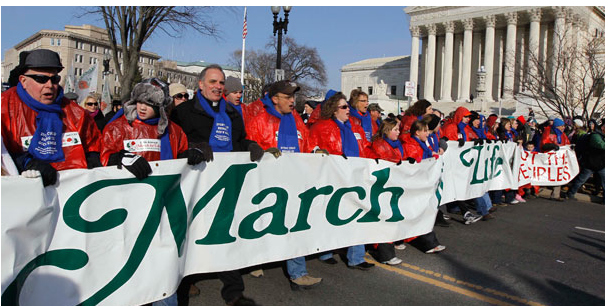
March for Life

During the annual “March for Life” on Friday, I happened upon a “pro-choice” rally.  Listening to the speeches of various leaders of the movement, I suddenly realized why we may be losing the battle.

Throughout the hour that I was there, no one with a microphone in their hands said “abortion.”  It was all about “choice” this and “choice” that.   Protect our “freedom to choose.”  The A word was conspicuous by its absence.

I understand that we want to preserve the right of women to have a choice in their reproductive decisions, but let’s face it, folks, everyone with half a brain understands that one of those “choices” is, dare I say it, ABORTION.    When we say we want to give women that option it implies that we approve of that option, just like we all approve of adoption or childbirth.

When we do not talk about the abortion option, we contribute to the stigma of abortion.  Why can’t we just say we support legal abortion, that legal abortion has saved hundreds and thousands of lives over the years, that it can be a good decision?   Even when the word is mentioned, it is in the context of an apology.    “Abortion is the most difficult, emotional decision a woman will ever make.”    Perhaps true for some people, but can we actually make such a broad, sweeping declaration?     Poppycock.   For many women, it was not a difficult decision.  Indeed, it was a relief when they decided and when they had the procedure.

Let’s start talking about the benefits of legal abortion.   Over one million women a year get one.  Why the heck are we hiding behind the mantle of “choice?”   Why not face the issue head on?

By not talking about abortion, we cede that very important part of the debate to the anti-abortion movement.  They get to define what abortion is, they get to stigmatize those courageous doctors and their staff who help women every day.   They get to prohibit the so-called “partial birth abortion” which was just another option for women and their doctors.

I don’t know when that public relations consultant came out with the word “choice.”   It was certainly decades ago.   And now we are one vote away from having “choice” eliminated by the Supreme Court.   What does that tell you about that strategy?

We need to be honest with the public.  We need to stand up for LEGAL ABORTION and toss out the buzz words that mean nothing to a younger generation.   Abortion is a benefit to the health of women.   Abortion is okay.   Just say it.

Abortion

The Liberty we recognize today, stands so immensely tall, proud, and strong, it’s message of glowing hope and freedom travels through the minds of the world, and resonates, drawing individuals who suffer under tyranny to our shores in our third century still.  We are the flagship of freedom in a sea of that tyranny.

An example for the world.  Women shall not be subjugated in this country.  They will not tolerate it.  Neither will men, as we all are determined that no one regardless of their attributes be denied the inalienable rights so well articulated.

Our Republic evolves and continue to create the most optimal society. We prove over time, people can govern themselves. There is no other option.

Liberty in her Statuesque form stands literally in concrete and steel, on the impervious massive pedestal of righteousness. She stands as a metaphor, and as an image, enduring, and indelible, unknown to few, celebrated worldwide.

Roe v Wade is in the company of the most important decisions that the Supreme Court has accurately ruled upon.  The decision reaches back through the historical events that were the maturation of our Republic. Now, again, a precedent etched in the Granite of Freedom, IT WILL ENDURE.  It is in our self governance, our own implicit contract with society, the binding of freedom, that we are in comfort that the flaw has been fixed, and shall stand. We will continue this effort on all fronts, tearing down any barriers as we find them.

The sentinels of freedom shall never be unaware of attack. The guard never let down.  There is still work to be done, and it shall. We are a Union of self governance that proves to the world that it can be done. There is no other choice, except the choice to abide by the laws we construct for ourselves.   And we take comfort in that knowledge.

Rejoice on this blessed day the Anniversary of Roe v Wade.  As few in this world have what we do, as we routinely do not even notice as we journey though our lives in freedom.  Freedom to control our own bodies, and make our own decisions.

The old notions will die off as they have over the generations, and freedom will endure and the people of our nation will cradle in that joyous comfort.

One would assume this to be a positive turn in events for all those of the Catholic faith who have wondered about their belief system in regards to abortion.

The nation’s Roman Catholic bishops approved principles this week to guide Catholics in choosing whom to vote for, and parting from some past perspectives, leaving the door open for them to back candidates who support abortion rights.

Nearly all the bishops approved this document, “Forming Consciences for Faithful Citizenship.” This broad consensus may help the Catholic church avoid the schism that occurred in 2004, church experts said, when some conservative Catholic groups declared voting guidelines identifying abortion as “non-negotiable.” A group of bishops touched off a debate about whether Catholic candidates who support abortion rights should be denied holy Communion.

Past documents did allow Catholics to vote for candidates who support abortion rights.

The issue has received renewed interest this year with the Republican candidacy of Rudolph W. Giuliani, the former mayor of New York and a Catholic. He has supported abortion rights.

The set of principles discusses “intrinsic evils” and defends them as actions that “must always be rejected and opposed.”

Abortion is among a few evils greater than others, the document asserts. But it also concedes that Catholics face difficult decisions when voting and in some cases might be able to vote for those who support abortion rights or stem cell research. “There may be times when a Catholic who rejects a candidate’s unacceptable position may decide to vote for that candidate for other morally grave reasons,” the document says.

It is difficult for this author to understand how one could vote for a candidate with a belief system which in their minds contains an act that is as horrific as any abhorrent act can be.

The United States Conference of Catholic Bishops has been issuing reflections on how the church’s moral teachings could shape Catholics’ political decisions since the 1970’s. This was the first time that an open discussion was held. The approximately 300 bishops had a chance to vote for it.

Bishop Nicholas DiMarzio, chairman of the bishops’ domestic policy committee, that pulled together this document, said it was not aimed at the candidates.

Rather, it is “a summary of Catholic teaching,” Bishop DiMarzio said. “It offers a basic moral framework on what it means to be a Catholic and American, a believer and a voter in this coming election year.”

The set of principles will be issued as an insert that priests can put into a Sunday bulletin, but its dissemination is not mandatory, Bishop DiMarzio said.

The document seemed to offer flexability for a variety of belief systems which is unusual since the Pope’s position is fairly precise on the point. The Rev. Frank Pavone of the anti-abortion group Priests for Life said he was pleased with it. Catholics, whom abortion is not the sole issue when voting, have also been given freedom to maneuver around the issue.

“Can a Catholic in good conscience vote for a candidate who is pro-choice?” said the Rev. Thomas J. Reese, a fellow at the Woodstock Theological Center at Georgetown University. “What they are saying is, ‘Yes.’”

Cardinal George has close ties to the Vatican and will be host to Pope Benedict XVI on his trip to the United States in April. But the cardinal has recently come under fire because of two cases of sexual abuse of minors by priests that occurred during his tenure. Yet another blemish for the beleaguered church and it’s rank of pedophilic patriarchs. An ironic twist. Victims’ rights groups have asserted that Cardinal George failed to act quickly enough to remove the priests once accusations surfaced. This was mentioned as a side note to the issue of conscience and morality, which lay at the core of the proposition.