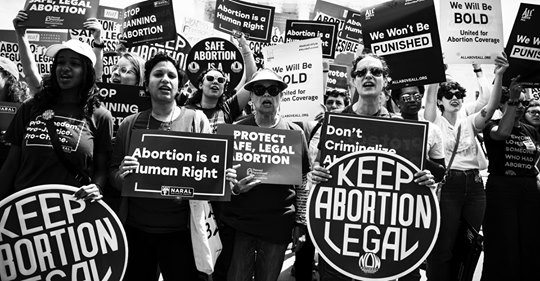
Only one in three women would tell their family if they were considering an abortion, according to a new poll. Nine-in-ten women identify as pro-choice but experts say there is still a stigma in discussing a termination.

A survey of 2,684 women for Marie Stopes International, which provides abortions, found most would hide the issue from their family.

Just over a third (34%) would speak to their friends and only 62% would tell their partner.

A new campaign has been backed by outgoing MP Heidi Allen (Picture: PA)

Some 6% of women would not talk to anyone apart from a medical professional about their decision, the survey found.

Of the women polled, 92% said they were pro-choice and 79% said abortion should be talked about more openly.

The charity has launched a new campaign – #SmashAbortionStigma – in a bid to help women feel ‘informed, educated and supported’ about their choices.

It is backed by Liberal Democrat MP Heidi Allen, novelist Marian Keyes and Derry Girls actress Siobhan McSweeney.

Amy says she does not regret having an abortion when she was at college (Picture: Marie Stopes International)

Amy, 28, had an abortion when she was 17 after her contraception failed. She said: ‘Even though I was completely confident in my choice, I only told a few people at the time. In hindsight, I felt silenced because it wasn’t something people spoke about.

‘The day after my abortion, I went back to college. My teacher asked me if I was feeling better and I remember nodding, trying not to cry.

‘It wasn’t the abortion that upset me, I was upset that I couldn’t tell the truth – I felt as though I had a dirty little secret that I couldn’t share with anyone.

‘As I grew older, I started to realise that I wasn’t ashamed of my abortion. It was the responsible thing to do for my own happiness.’

Healthcare worker Amity already had two older children and did not want to start all over again (Picture: Marie Stopes International)

Amity, 40, is a registered midwife and works in abortion care. She became pregnant while her husband was on the waiting list for a vasectomy and her children were nine and 11 at the time.

She said: ‘When I found out I was pregnant, I knew I didn’t want to start all over again. I told my husband and a few close friends who were very supportive, and it gave me the chance to talk through my options before I came to the decision.

‘Although I am generally quite open about my abortion, even I don’t always feel comfortable talking about it.

‘When I went back to work, I didn’t tell people why I had been off in case they were taken aback.’

Katriana was reluctant to tell her parents but eventually confided in her mother and realised she had been in a similar situation years earlier (Picture: Marie Stopes International)

Katriana, 24, from London felt she could not tell her Catholic parents about her decision.

She added: ‘I thought about telling my friends but I didn’t want to burden anyone with what I was going through. I lost so much sleep in the two-and-a-half week wait between the phone call and the procedure and it was such a stressful, dark time.

‘It was really sad because I needed support from someone close to me and I was on my own.’ Katriana burst into tears at work and her boss persuaded her to tell her mother.

She added: ‘I couldn’t look her in the eye as I told her, but my mum held my hand and told me that she understood and that she had also had an abortion at a similar age to me – telling her was one of the best things I’ve ever done.

‘If I had been able to find stories of other women, it would have helped me to recover from my experience so much quicker. It was the stigma that made me feel guilty and made me feel like I was doing something wrong.’

Holly said her parents were supportive but her then-partner made her feel guilty for wanting to discuss it (Picture: Marie Stopes International)

Holly, 26, was in a controlling and emotionally volatile relationship and said while her parents were supportive, her partner made her feel guilty for discussing it.

She added: ‘I think it’s really important that we are able to talk about abortion more openly. Abortion is not shameful, an embarrassment, or wrong. It should be every woman’s right.’

Dr Caroline Gazet, clinical director for Marie Stopes UK, said: ‘In the UK, one in three women will have an abortion in her lifetime, yet we know that abortion stigma can make women feel judged, shamed and silenced.

‘Women want to talk, and our research shows that open and honest conversations about abortion help women and girls feel informed, educated and supported when it comes to making their own choices about their own bodies.

‘The UK is a pro-choice nation, but with a small minority of anti-choice voices threatening abortion rights worldwide, it is more important than ever that we smash abortion stigma and champion the right of women to access abortion care.’


Source: https://metro.co.uk/2019/11/06/most-women-would-not-tell-their-family-about-an-abortion-11047467/?fbclid=IwAR0ROcwlROePkxS4_QH-F4HL3w9EFaAHW5pQnwuCl6dfB_b32hux6amLAWY?ito=cbshare

Pro-choice advocates described this week’s wins in Virginia and Kentucky elections as monumental victories for reproductive rights.

Pro-choice Democrat Andy Beshear is the apparent winner in the Kentucky race for governor, and his campaign has declared victory. But Bevin, who trailed Beshear by roughly 5,000 votes, has refused to concede and formally requested a recanvass.
John Sommers II / Getty Images

Abortion Rights Groups Declare Victory After Tuesday’s Elections

Democrats scored major victories across the country in this week’s elections, flipping control of the Virginia General Assembly and scoring an apparent victory in Kentucky’s gubernatorial race. Pro-choice advocates lauded the wins as monumental for reproductive rights.

“Reproductive freedom has won the day,” said Kelley Robinson, executive director of Planned Parenthood Votes, of the election results. “Voters made their voices heard loud and clear that when politicians fail to stand up for our rights—including abortion access—we will take that fight straight to the ballot box.”

“In a southern, traditionally red state, Andy Beshear ran a campaign that addressed abortion access head-on, vowing to protect Kentucky residents’ constitutional rights in the face of the Trump administration’s assault on Roe v. Wade,” Andrea Miller, president of the National Institute for Reproductive Health (NIRH) Action Fund, said in a statement. “ In defeating [Matt] Bevin, Kentuckians have made clear that they are ready to fight for every person’s right to make their own decisions about their bodies, lives, and futures. As we head into the 2020 campaign season, I urge candidates to look toward Kentucky as a reminder of the passionate support for abortion access in all corners of the United States.”

Kentucky’s race for governor was considered crucial for abortion access. The state is home to a single abortion clinic, and its current governor, Republican Matt Bevin, has sought to make sure that number drops to zero. Pro-choice Democrat Andy Beshear is the apparent winner in the race, and his campaign has declared victory. But Bevin, who trails Beshear by roughly 5,000 votes, refused to concede and formally requested a recanvass. Given that some leaders in the state’s GOP-held state legislature have signaled they may get involved, this race is still worth keeping an eye on. The recanvass is set for November 14, according to Secretary of State Alison Grimes (D).

Virginia Democrats’ decisive victory in Tuesday’s elections hands the party a trifecta capable of passing liberal priorities previously held back by GOP legislators. That could include codifying Roe v. Wade (Democratic Gov. Ralph Northam said on the campaign trail in 2017 that he supported an amendment to the state’s constitution to safeguard abortion rights), undoing the state’s forced 24-hour waiting period for abortion, and other efforts to safeguard and expand access to reproductive health care.

Reproductive rights aren’t the only big issue that may see a shift after Tuesday’s elections—Medicaid expansion eligibilitygun control, and the ratification of the Equal Rights Amendment may all now see movement.

Beto O’Rourke Dropped His Criminal Justice Platform—Then He Dropped Out of the Race

Former U.S. Rep. Beto O’Rourke dropped out of the race for the Democratic presidential nomination last week. “Though it is difficult to accept, it is clear to me now that this campaign does not have the means to move forward successfully,” he said in a post on Medium. O’Rourke listed some of what he considered the highlights of his campaign, including his plan to address climate change and taking what he called “the boldest approach to gun safety in American history.”

O’Rourke’s departure from the race came a few days after he released his criminal justice platform in a post to Medium. His “Comprehensive Plan to End Mass Incarceration and Reform Our Criminal Justice System to Prioritize Rehabilitation” didn’t contain a section devoted specifically to reproductive rights, but it did include a vow to end “the deprivation of health care in prison.” He also promised he would enforce the First Step Act’s ban on shackling pregnant people and its requirement that the Bureau of Prisons provide menstrual products to incarcerated people.

As Vaidya Gullapalli explained in a piece for the Appeal, an independent news outlet focused on criminal justice issues, O’Rourke’s plan “reflects a public consensus among the field of Democratic presidential candidates that the scourge of mass incarceration must end and the pressure to announce ambitious plans in response.”

“What remains to be seen is how much of a priority criminal justice will be for the candidates beyond the primary,” wrote Gullapalli.

The release of O’Rourke’s criminal justice platform followed plans from other 2020 Democratic presidential candidates, including former U.S. Housing and Urban Development Secretary Julián Castro. Castro’s plan promised to address reproductive justice for the incarcerated including “requiring free access to reproductive health care.”

What Else We’re Reading

“Abortion Is Not a Losing Issue. Yesterday’s Election Proved It,” writes Bridget Read for the Cut.

Castro’s presidential campaign “will fire its staff in New Hampshire and South Carolina,” Politico reported on Monday.

Sen. Elizabeth Warren (D-MA) said she would undo a Trump administration policy banning transgender people from serving in the military “on the first day of [her] presidency.”

Sen. Kamala Harris (D-CA) has a new bill addressing the gap between when schools close and when parents get out of work.

2020 Democratic presidential candidate Andrew Yang spoke with LGBTQ Nation about how he would get the Equality Act through a Republican filibuster, and it is …. something.

“Single-Payer Advocates Are Being Drawn Into the Wrong Debate,” argues Libby Watson for the New Republic.

Sen. Jeanne Shaheen (D-NH) will face “an anti-abortion foe in 2020” the New Hampshire Union Leader reported.

Jed Duggar, a reality TV show star from 19 Kids and Counting, is running for a seat in the Arkansas State House of Representatives—and he’s already highlighting his anti-choice platform.

Source: https://rewire.news/article/2019/11/08/campaign-week-in-review-reproductive-freedom-has-won-in-tuesdays-elections/

Anti-choice advocates were confident going into yesterday’s state elections. The Susan B. Anthony List, a group that has seized on Donald Trump’s presidency to try and finally overturn Roe v. Wade, had spent $750,000 on ads, mailers, and door-knocking on behalf of incumbent Governor Matt Bevin, who is incredibly unpopular except for one issue (or so they thought): abortion. Since he’s known for trying to throw poor people off of Obamacare and blaming striking Kentucky teachers for the death of a 7-year-old girl who was home from school, Bevin’s best chance of beating Democratic opponent Andy Beshear was supposed to be his bombastic anti-abortion stance.

Except that it wasn’t. The race is still too close to officially call, but as of now, Beshear is ahead by 5,300 ballots, poised to become a governor of Kentucky who ran on protecting abortion rights. Kentucky voters rebuked the narrative that GOP operatives have been trying to sell us us with state ban after state ban: that America’s protection of reproductive choice, enshrined in a constitutional amendment since 1973, is no longer popular nationwide.

And Kentucky wasn’t the only loss for the anti-choice lobby. In Virginia last night, Democrats flipped both houses in the state legislature, finally wresting narrowly held control from Republicans. This is particularly notable because the state was recently the epicenter of a bitter fight over access to late abortion care: After Democratic lawmaker Kathy Tran introduced legislation that would have reduced onerous state requirements around terminating a pregnancy in the third trimester, she was accused of “supporting infanticide” and faced a torrent of death threats. Conservatives gleefully used the controversy to argue that such unapologetic pro-choice positions would alienate voters and ensure Trump’s re-election. But they misjudged. “Today’s Election Will Determine The Future Of Late-Term Abortions In Virginia,” the Federalist wrote. It did — just not in the way they hoped. Tran ultimately kept her seat.

“SBA List used the Kentucky governor’s race and the Virginia state elections the same way they used the 2016 presidential race,” Robin Marty, author of Handbook for a Post-Roe America, told the Cut, “by investing all of their money and resources into motivating voters who were wavering on GOP politicians to believe that opposing abortion is the only issue that should matter. And they failed. Spectacularly.”

The results are a blow to the coordinated, decades-long effort by far-right groups to overturn Roe through state laws and an anti-choice judiciary, which has been terrifyingly successful so far; the Supreme Court announced on October 4 that the court would consider a Louisiana abortion law, the first major test of Roe since Justice Brett Kavanaugh was confirmed last year. SBA List helped hammer through the confirmation of both anti-choice justices Kavanaugh and Neil Gorsuch.

“For 2020 they will no doubt try again, focusing on small populations in swing states to give them just the right margin to win the electoral college for Trump, despite his massive unpopularity. They could still pull it off, because their pockets are deep, but clearly it will be a much harder battle than they were expecting,” Marty says.

Last night’s results should be a bellwether for not just abortion rights, but for many progressive policies Democrats will be running on in future state elections, and in 2020. Supposedly controversial issues like abortion, Medicare for All, the Green New Deal, and free college tuition are, in fact, widely popular, and the GOP’s attempts to consolidate power by turning them into poison pills should embolden Democrats, not push them to appeal to some ostensibly “moderate” base — despite what some people have been trying to tell us.

Speaking of a so-called moderate base, Joe Biden’s hometown of Scranton just elected its first woman mayor: a 39-year-old insurgent candidate who ran on finally defeating “the same old boys club.” Its members far and wide should be worried.

Roger Severino, director of the Office for Civil Rights at the Department of Health and Human Services, was a major driver of the rule struck down Wednesday. A federal judge found the rule issued earlier this year — making it easier for health care workers to refuse care for religious reasons — to be an overreach by the department.
Aaron P. Bernstein/Getty Images

In a blow to the Trump administration, a federal court in Manhattan has knocked down a rule that would make it easier for doctors and other health care workers to refuse care for religious reasons.

U.S. District Judge Paul Engelmayer ruled Wednesday that the Department of Health and Human Services, which issued the regulation earlier this year, exceeded its authority and “acted arbitrarily and capriciously” in promoting it.

The department’s violations of federal law, according to the judge’s opinion, were “numerous, fundamental, and far-reaching” — and he vacated the rule entirely, just over two weeks before it was set to take effect on Nov. 22.

The Trump administration had asserted that the rule would give health care providers the freedom to opt out of providing care or services — such as abortions — that violate their conscience. Employers that did not comply with the rule could have had their federal funding withdrawn.

“This rule ensures that healthcare entities and professionals won’t be bullied out of the health care field because they decline to participate in actions that violate their conscience, including the taking of human life,” Roger Severino, director of HHS’s Office for Civil Rights, argued in a written statement when the regulation was issued in early May.

The rule’s critics, however, saw it as a means of allowing health care workers to circumvent rules against discrimination. And they quickly took the Trump administration to court — with more than two dozen states, cities and organizations such as Planned Parenthood filing lawsuits against Severino and Health and Human Services Secretary Alex Azar. Those suits were later consolidated into one case, which Engelmayer oversaw.

There’s also another lawsuit against this rule, filed in the U.S. District Court for the Northern District of California. The plaintiffs in that consolidated case include the state of California, Santa Clara County and organizations such as Lambda Legal. It wasn’t immediately clear what Wednesday’s ruling means for the case in California.

As NPR has reported, this rule was part of a big push from the Office for Civil Rights to bolster “religious freedom” in health care. Severino, who is Catholic and formerly of the conservative Heritage Foundation, has argued that previous administrations did not fully enforce existing law that protected what supporters call health care workers’ “conscience rights.”

To remedy that, Severino created a Conscience and Religious Freedom Division in January 2018, and in May of this year, his office issued this rule.

The rule was designed to bolster the rights of providers to opt out of care, even without prior notice of their objections to their employer. It also expanded the type of workers who are able to file complaints about rights violations to include billing staff, receptionists and anyone else who in any way “assist[s] in the performance” of a procedure.

Complaints of such violations are relatively rare — for a decade, the office would receive an average of one complaint like this each year. Severino frequently pointed to a jump in those complaints to 343 last year as proving the need for this rule. He attributed that increase to a strong message from his office that they were “open for business” when it came to issues of religious freedom.

However, that increase in the number of complaints is “demonstrably false,” according to Engelmayer’s ruling. Nearly 80% of all the complaints given to the court were about vaccinations — unrelated to health care workers and their religious beliefs in providing care.

The judge writes that only 21 — or 6% — of the complaints that the government provided the court are even potentially related to providers’ moral or religious objections. During oral arguments, the government’s attorney conceded that the real number of complaints was “in that ballpark.”

“This conceded fact is fatal to HHS’s stated justification for the Rule,” Engelmayer writes. “Even assuming that all 20 or 21 complaints implicated the Conscience Provisions, those 20 or 21 are a far cry from the 343 that the Rule declared represented a ‘significant increase’ in complaints.”

In a statement to NPR, the government said, “HHS, together with DOJ, is reviewing the court’s opinion and so will not comment on the pending litigation at this time.”

Closing the last abortion clinic in the Dayton, Ohio, area would have a major effect on people of color and those with low incomes, groups that make up a large portion of Dayton’s population.

Gov. Mike DeWine (R) has pledged to continue Kasich’s assault on abortion access.
Justin Merriman / Getty Images

Abortion clinics in Ohio and Missouri are fighting to stay open in the face of burdensome and medically unnecessary state regulations that threaten access to reproductive health care, testing the limits of the constitutional right to an abortion.
The last abortion provider in the Dayton, Ohio, area, Women’s Med Center, is trying to avoid closure after the Ohio Department of Health revoked its license in April for failing to meet strict regulations designed to shut down abortion clinics. The clinic has postponed surgical abortions while providing medication abortion care amid its legal challenge to the health department’s regulatory enforcement, the Associated Press (AP) reported.
Local activists and pro-choice advocates told Rewire.News that the closure of Women’s Med Center, which in 2018 served more than 2,000 patients, would have an outsized effect on vulnerable populations that make up much of the region.
Dayton has a large population of people of color and those with low incomes. There are around 35,000 women of reproductive age living in Dayton, Ohio’s sixth-largest city, according to the U.S. Census Bureau. Nearly 43 percent of Dayton’s population is Black. The median household income in Dayton is $30,128, less than half that of the national median household income.
“Restrictions to access of safe and legal health-care options by attempting to close the Dayton clinic are unconstitutional, undue burdens on patients,” District 10 Indivisible for All, an anti-racist activist group in the Dayton area, said in a statement to Rewire.News. “People of color, people in poverty, and other marginalized communities are most impacted when this happens. Women will be forced to travel to other cities or states to receive care. This can be a barrier for low income and some people of color.”
The Ohio Supreme Court in late October declined to hear an appeal from Women’s Med Center, placing its fate in the hands of a federal judge after the clinic sought a restraining order to temporarily block the state from enforcing those regulations, which it argues unconstitutionally infringes on the right to an abortion. An attorney for the clinic told the AP last week that the federal judge would rule quickly on the temporary restraining order.
The Ohio Health Department is denying the clinic a license based on its inability to comply with a state law requiring abortion clinics to have a written patient transfer agreement with a local hospital in the case of an emergency. Advocates say the law is medically unnecessary and doesn’t do anything to ensure patient safety, but rather is designed to make it too difficult for abortion providers to operate and force them to close down.
The law requires that patient transfer agreements be obtained from private hospitals within 30 miles of the facility.
“The fact that Ohio places the decision of whether a clinic can stay open in the hands of a private corporation is completely bonkers,” said Gabriel Mann, a spokesperson for NARAL Pro-Choice Ohio. “You have to find a privately owned non-religious facility, and in some cases they practically don’t exist.”
In the Dayton area, the only private hospitals that could sign the medically unnecessary transfer agreement are Kettering Health Network, which was founded by the Seventh-Day Adventist Church, and Premier Health, which is partially owned by a Catholic organization. Many Catholic-run hospitals have proven hostile to reproductive health care. NARAL Pro-Choice Ohio has launched a campaign to put pressure on Kettering Health Network and Premier Health to sign the agreement.
“There’s no reason why the hospital can’t just sign this piece of paper, which costs the hospital nothing, and requires them to take no action other than just to continue serving patients as they do,” Mann said.
Over the summer, more than 3,300 people signed a petition asking Premier Health to sign the transfer agreement and help protect abortion access in Dayton, the Dayton Daily News reported. Premier Health in a statement to WOSU Radio said that because of the organization’s governing documents, “We have long been—and continue to be—prohibited from entering into certain arrangements, which include transfer agreements with this type of provider.”
Without Women’s Med Center, there would be just six clinics in the state that provide surgical abortions. Mann said since former Ohio Gov. John Kasich (R) took office in 2011, the number of abortion clinics in the state has been cut in half due largely to the regulatory scheme designed and passed into law by Republican majorities. Gov. Mike DeWine (R) has pledged to continue Kasich’s assault on abortion access.
“All together, the actions of the legislature, the extremist groups, and the governor, and the way that Governor Kasich and now Governor DeWine have ordered around the health department to increase the number of annual inspections on clinics, all of these factors combine to make it very difficult for providers,” Mann said.
The Ohio law is one example of how anti-choice legislators have placed targeted regulations on abortion providers, referred to as TRAP laws. According to the Guttmacher Institute, a reproductive and sexual health research organization, Ohio is one of 24 states with laws that regulate abortion providers beyond what is necessary to ensure the safety of patients.
Women’s Med Center’s battle to remain open comes as the fate of last operating abortion clinic in Missouri hangs in the balance due to that state’s similarly strict regulatory process for abortion providers.
An administrative hearing to determine whether the Missouri Health Department can revoke the license for Reproductive Health Services of Planned Parenthood in St. Louis concluded last week after state regulators claimed this year that an audit revealed “deficient practices” at the clinic, but didn’t provide many specifics. Reproductive rights activists have accused Missouri officials of moving “the goalposts” in their regulatory push to end legal abortion in the state.
Missouri could become the first state with no abortion provider since Roe v. Wade established the constitutional right to abortion in 1973.
The question of whether strict regulations on abortion clinics like those in Ohio and Missouri violate the constitutional right to an abortion is one that will be considered by the U.S. Supreme Court when it hears the June Medical Services v. Gee case, which challenges a Louisiana law requiring abortion doctors to have admitting privileges at a local hospital.
The case will likely revisit the precedent set in Whole Woman’s Health vs. Hellerstedt, in which the Supreme Court ruled in 2016 that parts of a Texas law that caused widespread clinic closures constituted an “undue burden” on the right to an abortion.

Unrestricted abortion would be available in Northern Ireland up to 12 or 14 weeks under UK Government proposals.

Ministers are bound to introduce a system governing terminations by next spring.

MPs at Westminster forced the Northern Ireland Office (NIO) to act after legislation passed earlier this year reformed the most restrictive laws surrounding child birth in the UK.

An official consultation said: “Twelve weeks gestation has been considered because it is the end of the first trimester of pregnancy and in England and Wales 90% of abortions are performed within this timeframe.

“However, an alternative approach would be allowing for a termination up to 14 weeks gestation without conditionality, as some women and girls may have been delayed in finding out that they are pregnant and others may need more time to reach a decision.”

Abortion is a deeply divisive issue in Northern Ireland.

Abortion is a deeply divisive issue in Northern Ireland (Niall Carson/PA)

The DUP failed in a last-ditch bid at Stormont to thwart legalisation last month.

The British Government said it was concerned that it may not be appropriate for a new process to be applied that requires a woman or girl to give evidence that the pregnancy is a result of sexual crime and to obtain certification from a medical professional on that basis.

Its consultation added: “No certificate of opinion may be required from a doctor for the early termination (up to 12/14 weeks gestation), because it is proposed that termination will be available up to this gestational limit without any medical grounds being required to be met.”

Mental well-being grounds may allow an abortion after 14 weeks under the proposals.

Abortion without time limit may be available in cases of fatal foetal abnormality or where a woman’s life was at risk or she was in danger of suffering permanent injury.

Any medical practitioner may perform the procedure and flexibility would be shown about where, recognising the use of pills at a woman’s home.

Later stage abortions would take place in hospital.

A provision allowing medics to opt out on conscientious objection grounds would cover the course of treatment.

An exclusion or safe zone would be in place allowing women to obtain the procedure without facing protest.

Source: https://www.irishexaminer.com/breakingnews/ireland/unrestricted-abortion-proposed-for-ni-up-to-14-weeks-961796.html?fbclid=IwAR0c6SGMXWnraEQ0nkvvt683YC3anpwJEv8YUfiLP5TDUG1viLrEAFNs4pA

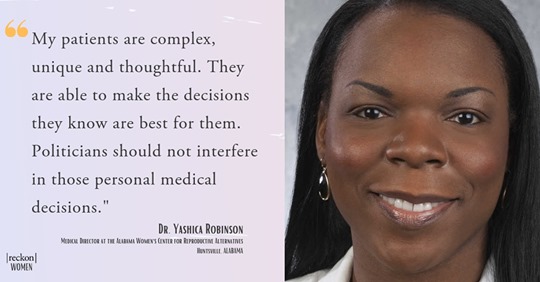
Dr. Yashica Robinson, one of the last remaining abortion providers in Alabama, is taking on the state’s abortion ban law alongside Planned Parenthood and the American Civil Liberties Union of Alabama.

A Notasulga, Alabama native, Robinson decided she wanted to go into obstetrics when she became a teen mother. She attended medical school at Morehouse School of Medicine and completed her residency in obstetrics and gynecology at the University of Alabama at Birmingham School of Medicine.

Today Robinson works at her OBGYN office in Huntsville and provides abortion care at that city’s Alabama Women’s Center, one of Alabama’s last three remaining abortion clinics. Both offices are under a constant barrage of protesters, some who film patients entering and exiting and broadcasting them onto Facebook live.

Alabama is one of nine states who passed abortion ban laws this year. In May, Gov. Kay Ivey passed a law banning nearly all abortion, including pregnancies conceived by rape or incest. Robinson is the lone person – along with Planned Parenthood and the ACLU of Alabama – who filed a lawsuit challenging the law. A federal judge issued a preliminary injunction on Oct. 29, temporarily prohibiting the law from going into effect until the law makes its way through higher courts.

Abortion is still legal in all 50 states. Alabama’s two other abortion clinics are West Alabama Women’s Center in Tuscaloosa and Reproductive Health Services in Montgomery.

Why did you decide to be one of the plaintiffs in the state’s abortion ban case?

As a physician, I care deeply for my patients. I know how critical abortion care is. I understand how bans like the one Alabama passed hurt patients who are already marginalized the most. The majority of my patients do not have the resources to challenge these unconstitutional laws themselves. Therefore, I feel it is my responsibility to stand and fight on their behalf.

Why did you decide to go into gynecology and then decide to perform the entire spectrum of women’s healthcare?

My passion for helping people led to a career in medicine. Becoming pregnant as a teenager influenced my decision to choose Obstetrics and Gynecology as a specialty. I understand that women need different types of care over the course of their reproductive life span – comprehensive contraceptive education, prenatal care, abortion care without judgment and compassionate management of miscarriages. I did not decide to go into gynecology, and then perform the entire spectrum of women’s healthcare. Abortion care is simply part of the work that defines a specialist who is an Obstetrician-Gynecologist. I chose to care for women, and refused to be bullied into negating part of my duties by leaving abortion care out of my practice.

What needs did you see in the state for more doctors who perform abortions?

There is a critical need to provide more protections for abortion providers and their families against harassment and violence in their communities and at work. The hostility and stigma leads to a shortage of physicians who are trained and willing to provide this needed medical service for patients. It also leads to a dearth of medical professionals willing to provide proper referrals. This hurts patients. There is also a need for local law enforcement agents to be educated and willing to be responsive when abortion providers and their patients are violated.

Why did you decide to be one of the plaintiffs in the state’s abortion ban case?

As a physician, I care deeply for my patients. I know how critical abortion care is. I understand how bans like the one Alabama passed hurt patients who are already marginalized the most. The majority of my patients do not have the resources to challenge these unconstitutional laws themselves. Therefore, I feel it is my responsibility to stand and fight on their behalf.

How does your community/family respond to the work you do?

There are many people in my community who are supportive and appreciate the need for the care that I provide. Of course, there are many who staunchly oppose the work I do, and they work hard to drive me out of the community. It is unfortunate that those against comprehensive health care for women, are the ones who are most vocal and active. My family members are supportive. Any concern they have comes from their concern for my safety.

The new U.S. Ambassador to the United Nation (UN), Kelly Craft, takes up the United State’s seat at the Security Council at UN headquarters on September 12, 2019 in New York City.SPENCER PLATT/GETTY

Shortly after a unanimous vote in the UN Security Council to pass a resolution on women, peace and security, the U.S. Mission to the UN, headed by Ambassador Kelly Craft, released a press statement criticizing references to “sexual and reproductive health.”

The resolution referenced previously passed resolutions including the term, which Craft deemed unacceptable. “I must note that we cannot accept references to ‘sexual and reproductive health,’ nor any references to ‘safe termination of pregnancy’ or language that would promote abortion or suggest a right to abortion.”

The statement continues, “The U.N should not put itself in a position of promoting or suggesting a right to abortion, whether it is humanitarian or development work.”

Other countries in the open debate spoke strongly of including references to sexual and reproductive health, including the United Kingdom and Belgium.

This is not the first time that that the U.S. has pushed back against including these rights in Security Council resolutions.

In April 2019, a draft resolution circulated prior to the Security Council vote included the term. The U.S. Mission responded by threatening to veto, thereby killing the resolution, if the term was not taken out.

The resolution, which centered on sexual and gender-based violence in conflict, was passed without the inclusion of any reference to sexual and reproductive health.

In an article on International Peace Institute’s Global Observatory, Siri May from Center for Reproductive Rights wrote, “It is arcane to suggest that providing sexual and reproductive health (SRH) services to survivors of conflict-related sexual violence is even up for debate.”

May also noted that quality sexual and reproductive health can address issues such as, “unsafe abortion, maternal and low birthweight, miscarriage, premature labor and sexually transmitted infections for women and girls.” These quality health services are particularly difficult to access in conflict situations, May said.

Representatives of the Trump administration at the UN have been consistent with the position, pushing back on the inclusion of sexual and reproductive health not just in the Security Council, but across the UN.

In September, US Health and Human Services Secretary Alex Azar spoke at the General Assembly, saying, “We do not support references to ambiguous terms and expressions such as ‘sexual and reproductive health and rights’ in U.N. documents, because they can undermine the critical role of the family and promote practices like abortion in circumstances that do not enjoy international consensus and which can be misinterpreted by U.N. agencies.”

Source: https://www.newsweek.com/-1468541

Buried inside a new Supreme Court case is a “wrecking ball” that could devastate abortion access.

What if it were virtually impossible to fight an abortion ban in court?

On Tuesday, the American Civil Liberties Union got a judge to block one of the most extreme pieces of anti-abortion legislation the country has ever seen: a near-total abortion ban that Alabama’s governor signed in May and was set to go into effect in November. It’s the seventh abortion ban the ACLU has gotten struck down in court in recent months, meaning the organization has now blocked nearly every early abortion ban passed in 2019. The plaintiffs in these cases are clinics, like Planned Parenthood, or abortion providers, like Yashica Robinson, whom the ACLU is representing in the Alabama suit.

For decades, this is what it has looked like to challenge abortion restrictions in court. Rather than pregnant patients challenging the laws that prevent them from accessing their abortion rights, organizations like the ACLU, Planned Parenthood, and the Center for Reproductive Rights argue against the laws with providers and clinics as their clients.

That’s because those abortion providers and clinics have what’s known as “third-party standing,” the legal standing to advocate on behalf of their patients. Without it, lawyers would instead have to find a pregnant person willing to go through years of court proceedings and litigation, a demand that experts say would prevent cases from getting to trial in time to stop anti-abortion laws from taking effect—even blatantly unconstitutional ones like Alabama’s.

A measure hidden within June Medical Services v. Geethe abortion case the Supreme Court will rule on in the next year, would target third-party standing. When Supreme Court justices agreed to hear Louisiana’s law requiring abortion providers to have hospital-admitting privileges—which is identical to a Texas law the court struck down in a landmark 2016 ruling—they also agreed to rule on a cross-petition from the state that argues doctors and clinics can’t speak for their patients.

The court’s ruling on the admitting privileges law could severely undermine Roe v. Wade, and lead to clinics shutting down across the country. But a ruling that overturned third-party standing would be equally, if not more, catastrophic for the future of abortion rights, said T.J. Tu, one of the lead attorneys for the Center for Reproductive Rights who’s arguing the Louisiana case before the Supreme Court.

“If providers don’t have standing, it’s a looming question of whether blatantly unconstitutional criminal statutes would even get into court, and certainly whether we’d get into court in time to prevent such a flagrantly unconstitutional law [like Alabama’s] from going into effect,” Tu told VICE. “These sorts of cases for all practical purposes will go away because there will be no one left to bring them.”

Crucially, a ruling to overturn third-party standing would also work retroactively, which means all of the court challenges to abortion bans currently winding their way through the appeals process that don’t have a pregnant person as the plaintiff would be wiped out. And it could go even further than that: Getting rid of the federal court procedure would also call into question every past abortion case that did not have a patient plaintiff—that is, nearly every major case since Roe v. Wade was decided in 1973. (“Roe” was a pseudonym for the pregnant woman in the landmark case.)

“It would take a wrecking ball to 40 years of abortion jurisprudence,” Tu said.

One of the vital precedents these cases helped establish was the “undue burden” test, which says that states can’t pass restrictions on abortion that create an unnecessary barrier to the procedure.

Third-party standing was established in 1976 in Singleton v. Wulff, a case that had to do with whether Missouri’s Medicaid program could exclude covering abortion; it was brought against the state by two Missouri physicians. As part of the ruling, then-Justice Harry Blackmun asserted that those physicians—and physicians in general—had the ability to speak for their patients. “Aside from the woman herself, the physician is uniquely qualified…to litigate the constitutionality of the State’s interference with, or discrimination against” her abortion rights, he wrote.

Blackmun also pointed out that there are significant obstacles that would make it difficult for someone seeking an abortion to take up the additional task of fighting for their rights in court. Legal experts emphasize that pregnant people who want abortions have more pressing interests—like accessing the procedure they may have been denied because of unconstitutional restrictions. Low-income women, who made up half of all women who got an abortion in 2014, would have an especially hard time entering into a lengthy legal battle, experts say.

“Abortion providers have more resources than individual pregnant women,” said Mary Ziegler, a professor at Florida State University College of Law. “Pregnant women are pregnant, which makes it harder to launch lawsuits when they may have other concerns—like their own health.”

Anti-choice advocates say eliminating third-party standing would protect women, because they believe abortion providers’ interests are diametrically opposed to their patients’.

“It would take a wrecking ball to 40 years of abortion jurisprudence.”

Steven Aden, the chief legal officer and general counsel at Americans United for Life, the country’s largest anti-abortion legal organization, argues that restrictions on abortion are designed to protect women from the doctors who provide them, because those doctors are performing a “medical procedure for non-medical reasons.” AUL is the architect of the Louisiana abortion law at the center of the Supreme Court case; state legislators hoping to replicate it were once able to find a fill-in-the-blanks form on the AUL’s site called “The Abortion Providers’ Privileging Act.” (The legislation template has been taken down, though Aden said there is “no particular reason” for its removal.)

AUL also filed an amicus brief in support of the Louisiana cross-petition in June, arguing that abortion providers “do not have a close relationship with their patients and should not have third-party standing.”

“We think it’s time for the court to re-examine the cases that have given a path—a carte blanche—to abortionists to go into court and claim they stand for women when in many cases they don’t,” Aden said. “Health and safety laws are designed to protect women from their dirty and dangerous operations.”

Tu says Aden’s argument would require the justices to ignore overwhelming evidence that shows abortion is safe and effective, and disregard findings that show anti-abortion restrictions—like requiring clinics to have hospital admitting privileges, for example—are medically unnecessary and can even make the procedure less safe by forcing people to have abortions later in pregnancy. In addition to the decades of precedent that supports third-party standing, Tu believes this medical consensus strengthens arguments in favor of the federal court procedure.

“If you acknowledge the facts, it’s obvious that patients’ and providers’ interests are aligned,” Tu said. “They’re both walking in lockstep to prevent the state from imposing dangerous and unnecessary regulations on their relationship.”

Still, anti-choice officials across the country are rallying together to insist otherwise. A dozen states have signed onto an amicus brief arguing in favor of eliminating third-party standing. (Senator Josh Hawley of Missouri filed his own brief as well.) Tu said it’s no coincidence that these states—Alabama, Idaho, Indiana, Kansas, Mississippi, Nebraska, Ohio, Oklahoma, South Carolina, Texas, Utah, and West Virginia—are also known for their hostile abortion policies. They see a new path to advancing their anti-abortion agenda, one that would leave little room for recourse from their pro-choice opposition, experts say.

So, why isn’t the third-party standing element of this case getting more attention?

Ziegler said the highly legalistic nature of the concept can make it difficult for the public to understand, especially since it doesn’t seem to apply to Roe v. Wade directly. People have also been hyper-focused on “headline-grabbing” abortion bans like Alabama’s, Tu added, because they’re so boldfaced in their attempts to criminalize abortion.

“We should be deeply troubled by the bans,” Tu said. “But many of the things anti-choice advocates are doing have the practical effect of banning abortion even if they’re not banning it outright, whether it’s TRAP laws that put abortion out of reach for most or all women or whether it’s changes to the law that prohibit … advocates from bringing these cases to court.

“This is all part of a strategy,” he said. “This all has the same goal.”

Source: https://www.vice.com/en_us/article/yw8zqj/new-york-reproductive-health-act-passed?fbclid=IwAR1HPZfNWoRJOb6fvz-HdarZ065ziac7OutXbz_9ZpzT4e2U4C-bQO1uknQ

I am a family doctor who provides abortion care in the Philadelphia suburbs. While that may sound like a bit of an oxymoron, the reality is that abortion is just like any other health care decision. Prenatal care and abortion care comprise the full spectrum of reproductive health care. Sometimes the decision to have an abortion is complex and full of emotions, sometimes it’s straightforward, and sometimes it’s heartbreaking and full of grief. No matter how easy or difficult, the only person who knows what the right decision is for the woman sitting in front of me is that woman herself.

What do my patients want when they decide to have an abortion? They want the same type of information and support as any other patient. They want honesty from their physician. They want clear and accurate information. They want support to make decisions that are right for them and assistance to navigate a complex health care system.

Last week, Pennsylvania became the latest state to introduce a ban on abortions when a baby’s heartbeat is detectable. While Gov. Tom Wolf has promised to veto such a ban, House Bill 1977 will create a climate of uncertainty and fear for the people I care for. If passed, the bill will ban abortions as early as six weeks into pregnancy, when most women don’t even know they’re pregnant.

HB 1977 would prevent me from offering essential medical advice to my patients. When it comes to abortion, women are likely to receive misinformation bordering on deception and outright lies. I’ve had women ask me if they were going to be cut up with metal instruments, making them infertile. I had to reassure them that abortion is a safe, medical procedure.

Apart from HB 1977, Pennsylvania already restricts abortion access through laws that have nothing to do with safety. If you want an abortion, the state mandates that you receive counseling designed to discourage you, and wait a full 24 hours before the procedure. What’s worse, about 85 percent of our counties lack a health care clinic that provides abortion care. From 2014 to 2017, our state saw a 10 percent decline in the number of abortion clinics.

The numbers are troubling, and my experiences concern me. I once saw a 30-year old woman who struggled with many years of opioid use. She was finally recovering in a program and taking suboxone, medication that has proven to be successful at helping people stay sober. We had a conversation about the benefits and risks of suboxone during pregnancy, and how pregnancy could impact her recovery. After much discussion, after learning about all of her health care options, she decided that an abortion was the best decision for her. But due to Pennsylvania’s laws, I could not provide her with an abortion right in my office. I had to refer her to another clinic.

Another woman, a 26-year-old mother of two young children, came to see me about her miscarriage. We were able to discuss all of her treatment options: she could wait and let her body naturally take care of the miscarriage; she could take medication to help her uterus pass the pregnancy; or she could have a suction procedure and shorten the entire process. She didn’t want to worry about bleeding, working, and caring for her children, so she decided on the suction procedure, which I was able to do in my office. But due to Pennsylvania’s laws, I would not have been able to provide the same exact procedure had it been her abortion.

I have the skills, the knowledge, and the trust of my patients. As a physician, I want to be in a position to help people when they need it most. Pennsylvania’s laws, however, make it difficult for family doctors like me to provide all forms of care, including abortion care. HB 1977 would be yet another nail on the coffin for women’s health in our state.

Lin-Fan Wang is a family physician who practices in the Greater Philadelphia Area. She is a member of Eastern PA’s Reproductive Health Access Project Cluster and fellow with Physicians for Reproductive Health.

Source: https://www.inquirer.com/opinion/commentary/pennsylvnia-heartbeat-bill-abortion-laws-access-20191031.html