I’m a doctor at the only abortion clinic in Kentucky. Providing safe, compassionate medical care has been my life’s calling, and my patients’ well-being is always my first priority. But Kentucky politicians — determined as usual to interfere with access to reproductive healthcare — are trying to force me to harm and humiliate the patients who entrust me with their welfare. That’s why I’m joining with the ACLU today to ask the Supreme Court to keep Kentucky lawmakers’ insulting, anti-abortion political agenda out of the exam room.

H.B. 2, the law we’re asking the Supreme Court to review, is cruel and offensive. It mandates that I display an ultrasound to every abortion patient, describe it in detail, and play the sound of the fetal heartbeat — even if the patient does not want it, even if in my medical judgment I believe that forcing it on them will cause them harm. The law forces me to do this to a patient who is half-naked on the exam table, usually with their feet in stirrups and an ultrasound probe inside their vagina. With my patient in this exposed and vulnerable position, the law forces me to keep displaying and describing the image, even when the patient shuts her eyes and covers her ears.

Take a moment to imagine what this must be like. To tell your doctor, “thank you, but I don’t want to hear you describe the ultrasound,” and to have your doctor tell you that you have no say in the matter — that you must lie there, undressed, with an ultrasound probe inside of you, and have the images described to you in government-mandated detail over your objection. Even if the patient has already had one or more ultrasounds performed. Even if the fetus has been diagnosed with a condition incompatible with survival. Or even if the patient is pregnant as a result of sexual assault, and having to watch and listen to the ultrasound over their objection forces them to relive that trauma.

We have had patients burst into tears when we tell them that they must undergo an unwanted narrated ultrasound and that they must close their eyes and cover their ears if they want to avoid the speech Kentucky politicians insist we force upon them. I’ve had patients sob through the experience, and others pull their shirts up over their faces to cover their eyes.

As physicians who have dedicated our professional lives to providing compassionate medical care, being ordered by politicians to force this unwanted and harmful experience on patients who have sought our help is appalling. It goes against the very fundamentals of our role as healers and violates the trust at the heart of the physician-patient relationship.

My patients’ health and well-being come first, and if there is anything I can do to protect them from politicians trying to barge into the exam room, I will do it. Today, that includes asking the Supreme Court to put an end to this insulting political intrusion.

Enough is enough.

Source: https://www.aclu.org/blog/reproductive-freedom/abortion/kentuckys-abortion-law-forces-me-humiliate-my-patients?fbclid=IwAR3HSvjTVioMcrrHFdvY2dB_g1dnm61h0hPHN9Gy5Ieb4Pmn5HENUTnwI5Q

Washington lawmakers have enacted some of the country’s most progressive policies to protect reproductive health care. But these measures have run up against the state’s high concentration of religious facilities.

As a Catholic hospital, St. Joseph Medical Center restricts many types of reproductive care. But it’s the only hospital in Bellingham—and for at least 30 miles beyond.
Shutterstock

There’s a single hospital in Bellingham, a picturesque coastal city 20 miles from the Canadian border in Washington. So when a Bellingham mental health counselor named Alison started bleeding three months into her pregnancy in 2013, PeaceHealth St. Joseph Medical Center was her only option.

Alison had first gone to her OB-GYN’s private practice, where her doctor, C. Shayne Mora, diagnosed her with a possible case of placenta previa, a serious condition where the placenta blocks the cervix. He told her to go to the hospital if she started bleeding again. When that happened the next day, Alison went to the St. Joseph emergency room. After an ultrasound showed the fetus was viable, the hospital discharged her. Providers recorded a clinical impression of “threatened abortion,” meaning Alison was at risk of miscarrying. They told her to return if she bled more heavily or ran a fever.

Alison, who asked us to withhold her last name for professional reasons, had never thought much about the fact that St. Joseph is part of PeaceHealth, a Catholic system that runs ten hospitals across Washington, Oregon, and Alaska. Catholic facilities, which make up a growing swath of the health-care landscape, follow rules written by the U.S. Conference of Catholic Bishops that ban sterilization, abortion, most contraception, and in vitro fertilization. Washington is one of five states where more than 40 percent of acute-care hospital beds are Catholic. That leaves many patients like Alison with one option: a hospital where care may be restricted by religion without their knowledge.

The next day, Alison started soaking through a menstrual pad an hour and returned to the ER. Her medical records show she was again discharged with plans to see Dr. Mora in his office. Three days later, she woke up in the middle of the night bleeding. Around noon, she passed a blood clot the size of a jawbreaker. In the ER for a third time, she described her pain as a seven out of ten. She was running a fever of 100.4 with an elevated white blood cell count, a classic sign of infection. “Appears anxious,” staff noted in her medical records. But the hospital discharged Alison again, this time telling her that her pain might be the result of appendicitis.

Alison and her husband, Richard Bennett, clung to that idea, because it meant the pregnancy might be safe. At no point, they said, did anyone at the hospital mention that Alison had the option of ending her pregnancy with surgery to address the brewing infection that would end up putting her life at risk. Alison’s records at the time of her third discharge still show a working diagnosis of threatened abortion.

By the next morning, Alison was in significant pain and her fever wasn’t responding to medication. She and Bennett returned to the ER. There, records show, a doctor ordered an abdominal MRI to rule out appendicitis and a chest X-ray to rule out pneumonia.

Then Mora arrived. He did a vaginal exam, and Alison arched off the bed in agony.

“It felt like something from the Exorcist, just like flailing from the pain,” she said. Bennett remembers Alison screaming when the doctor pressed on her abdomen. Alison, who recalls having refused pain medication out of fear it might harm the pregnancy, told Rewire.News that the agony radiating from her infected uterus was worse than non-medicated childbirth. Medical records show her fever had spiked to 101.1. One of Alison’s mothers, Lin Skavdahl, clung to Alison’s hand. Overcome, watching her daughter writhe, Skavdahl stepped away and fainted, sliding toward the floor and putting her hands over her head.

Mora moved quickly. He explained to Alison that she had an infection and needed surgery to end the pregnancy. Bennett asked whether there was any way to save the baby. Mora was firm: No. In fact, Alison’s life might be in danger.

Records show Alison had sepsis, a potentially deadly condition caused by the body’s response to infection. But Mora explained that he couldn’t proceed until the hospital’s ethics committee approved the surgery. Citing Catholic policy, PeaceHealth bans abortion unless its “direct purpose” is the “cure of a proportionately serious pathological condition of a pregnant woman” and it “cannot be safely postponed until the unborn child is viable.” In other words, the hospital would permit the life-saving surgery only if the committee considered Alison sick enough.

Skavdahl remembers Mora saying that if he couldn’t secure the approval, he planned to send Alison in an ambulance 90 miles south to Seattle, a drive that can take well over two hours on the congested highway. “And I’m just thinking, ‘What? You have to get a bunch of people together?’” Skavdahl recalled. “And he goes, ‘Well, it’s not quite as bad as it sounds. I can get them on the phone, it’s not like they all have to get here, but I don’t know how long it will take.’”

It’s unclear from the records how long the committee deliberated, but Alison said it felt like around an hour. “I remember being scared about that,” Alison said. “You’re telling me this is really serious and that my life is in danger, and we have to wait, and these people have to say it’s OK for you to have this procedure you absolutely need.”

Mora’s notes show that the ethics committee approved the surgery because of the risk to Alison’s health. At some point, records indicate she was given misoprostol to soften her cervix. But before she made it to the operating room, Alison miscarried into the toilet. She felt so sick that she thought she might be hallucinating when she saw the white form in the water. She sobs recalling it, six years later.

“I didn’t have to suffer like that,” Alison said through tears during an interview in June. “Everyone deserves adequate medical attention, and information, and choices.”

Alison and her husband said that besides Mora, no one at St. Joseph mentioned the possibility of surgery to end Alison’s pregnancy. She said providers “ignored that whole area,” and neglected to do a vaginal exam, even as they ran tests on her abdomen and chest. During her final visit to the ER, Alison, having searched online for possible causes of her pain, said she asked a doctor if it might be a uterine infection; she said the doctor wouldn’t make eye contact and told her to talk with her OB-GYN. Mora and PeaceHealth declined to comment on Alison’s case. The Catholic health system directed Rewire.News to its statement of common values, which says it “strives to promote the sanctity of all human life.”

“Our care embraces women and their children both during and after pregnancy,” the statement reads. “Because we believe in the sacredness of life’s journey from conception until natural death, direct abortion is not performed in any PeaceHealth-owned, operated or leased facilities.”

But Alison believes her life was put at risk.

“If I had been in an ambulance in traffic for hours, I really could have died,” Alison said. “I feel lucky that I didn’t die.”

Washington lawmakers have enacted some of the country’s most progressive policies to protect reproductive health care. But these measures have run up against the state’s high concentration of religious facilities like PeaceHealth, which are unwilling to carry out the legislature’s mandates. Washington state has the third-highest concentration of Catholic hospital beds in the country, according to the most recent MergerWatch report from 2016. Doctors and advocates told Rewire.News that it’s not uncommon for miscarrying patients to have their care dangerously delayed or be forced to travel, sometimes dozens of miles, because of the ban on abortion in Catholic facilities.

Washington law has long declared birth control and abortion to be a fundamental right and required public hospital districts that provide maternity care to provide abortions. Last year, legislators passed a law requiring insurance plans to cover abortion if they cover maternity services. But Washington, like nearly all states, also has policies that allow institutions and providers to refuse to perform abortions. A decade ago, Washington voters legalized death with dignity—but as with abortion, many hospitals, including Catholic ones, refuse to offer it. Meanwhile, the Trump administration has moved to empower hospitals to deny care on religious grounds and has sided with providers who refuse to participate in abortion care.

Some Catholic hospitals in the state also have imposed blanket bans on insurance coverage for gender-affirming services; Pax Enstad, a transgender teenager, sued PeaceHealth after the company denied him coverage for top surgery in 2016. This year, Washington lawmakers passed a ban on these blanket denials that takes effect in January. The Reproductive Health Access for All Act also required all hospitals to fill out a checklist designed by the state health department to publicly disclose on the department’s website which specific reproductive health services they offer. As of September 24, 72 of the state’s 95 hospitals had submitted their forms in compliance with a September 1 deadline, a department spokesperson told Rewire.News. “We will begin citing hospitals during our routine on-site compliance surveys if the new reproductive health services form has not been submitted,” the spokesperson said.

But these progressive laws have so far not stopped Catholic hospitals from denying care to patients like Alison. And mergers and affiliations have expanded the influence of Catholic health systems in a state known for its relatively progressive politics.

“When I first moved here, I didn’t even fully understand or essentially believe—because it’s such, in some ways, a progressive and liberal state—that there could be such restrictions on care when it came to things like miscarriage management,” Leah Rutman, health care and liberty counsel at the ACLU of Washington, told Rewire.News. “As I started to hear story after story after story I was horrified by the fact that all these great laws can exist on the books and there can be such a feeling of access to care … but people and women can still be in emergency situations and not get the care they need.”

 “This Is Not a Rare Event”

A few years ago, Dr. Brigit Brock, a maternal fetal medicine specialist, was working at her outpatient consultation clinic in Everett, about 30 miles north of Seattle, when a patient arrived in preterm labor. At 20 or 21 weeks pregnant, before the fetus is viable, the patient’s cervix was open; her amniotic sac and parts of the umbilical cord were in the vagina, Brock told state lawmakers last year. She was testifying in favor of a bill—which failed to pass amid opposition from hospitals—that would have prohibited health-care entities from limiting the ability of a provider to give patients comprehensive information and to provide services when the failure to do so would put the patient at risk. (A weakened version of the bill failed to pass again this year.)

The patient needed to be hospitalized immediately, Brock said. So she and her colleagues sent her to Providence Regional Medical Center Everett, a Catholic hospital attached to Brock’s outpatient clinic.

But the labor and delivery nurse told the patient and her husband that the Catholic hospital didn’t participate in abortions, Brock told lawmakers. “She’s in pain and this is a devastating thing for them to go through, and they were not allowed even to step onto the labor and delivery floor,” Brock said. When the patient returned to the outpatient clinic, Brock knew that if she called an ambulance, it might take some time to arrive and would likely take the woman back to Providence. So she told the patient’s husband to drive her to Swedish Medical Center in Seattle, which would take up to an hour in traffic.

Dr. Nari Heshmati, the former chief of obstetrics at Providence Everett, said in an interview that he didn’t remember the specific case Brock described, although Brock recalled that he was involved. He said that hypothetically, in a case where a patient showed up with those symptoms, the protocol would be to transfer the patient to Swedish for more advanced care than Providence Everett can offer. In a written statement, the hospital declined to comment on specific cases, saying, “Each patient’s unique needs are evaluated on a case-by-case basis, and all treatment decisions are made privately between our patients and their care teams.”

But Brock said it’s not the only time she’s seen this kind of case. “People think this is a rare event. This is not a rare event. This happens frequently,” she told lawmakers. Brock often works at Swedish Medical Center in Seattle, where she told Rewire.News she sometimes “rescues” patients from Catholic hospitals in surrounding communities by pulling them into the Swedish system.

Like many non-Catholic hospitals, however, Swedish is partly subject to the Catholic rules. That’s because it affiliated with Providence in 2012 and agreed to stop performing abortions unless there is a threat to the patient’s life. Brock said that in her experience, Swedish typically trusts doctors to make this call. “If we say, ‘Hey, this is life-threatening,’ we don’t get a lot of pushback,” she told Rewire.News.

The Unexpected Consequences of a Delay in Care

It’s not always easy for staff in Catholic hospitals to decide when a pregnancy is life-threatening enough to merit action—as Meghan Eagen-Torkko’s story shows.

In 2004, Eagen-Torkko was about seven weeks pregnant when she had an incomplete miscarriage. She worked as a labor and delivery nurse at Providence in Everett, and her insurance covered her only at that hospital. Her debacle shows how the laws promoting abortion and contraception access in Washington can be blunted by religious facilities; if insurance plans only cover Catholic options, comprehensive coverage of reproductive health services won’t help. (Her former employer, Providence, recently announced it planned to enter the health insurance exchange in Washington state and invoke its religious principles to limit coverage of abortion.) There was no other high-risk obstetrics facility in the area, Eagen-Torkko says. Like Alison, Eagen-Torkko’s only option when she was bleeding and needed urgent care was a Catholic facility.

As a nurse, Eagen-Torkko knew she needed a procedure called an aspiration to remove the remaining tissue from her uterus and stop her bleeding. But care providers at Providence were worried that her fetus might still have a heartbeat. For hours, they performed ultrasound after ultrasound, searching for a heartbeat that wasn’t there, afraid to get in trouble if they missed it. After about six hours, they finally performed an aspiration. During this ordeal, Eagen-Torkko lost enough blood to require a transfusion.

The consequences of this transfusion would become apparent later, when Eagen-Torkko was pregnant again. She had been transfused with blood containing an antigen called Kell. While Eagen-Torkko, like most people, was Kell negative, her ex-husband was Kell positive—as were her pregnancies. Because she was sensitized to Kell by the transfusion, her body produced antibodies that put her next pregnancy at risk of sudden fetal demise. Doctors told her that her fetus could die with no warning and no way to predict it. “It’s a very hard position to be put in knowing that your body could essentially kill your baby, which is what happens with Kell,” Eagen-Torkko told Rewire.News. 

Eagen-Torkko dissociated from the pregnancy, declining to buy anything for her daughter until she was about 30 weeks pregnant. While she had planned for a vaginal birth, when her daughter started showing signs of stress once she was far enough along to deliver, her Kell status made Eagen-Torkko more inclined to accept her doctor’s recommendation for a C-section, she said.

Years later, Eagen-Torkko, who is now a midwife, said she doesn’t blame her providers, who might have been afraid to get in trouble or lose their admitting privileges. But she said her case shows how hard it is to apply religious doctrine to real-life crises.

“I don’t think people understand how gray this is and how everybody is cobbling things together sort of on the fly,” Eagen-Torkko said. “I think we’re setting up this idea that there is some sort of a clear, bright line between life-threatening and non-life-threatening and it just doesn’t exist.”

“A Very Narrow Definition of Protecting Life”

There are 39 hospitals in Washington that are federally designated critical access facilities, which typically means the nearest alternative is more than 35 miles away. At least six of those hospitals are Catholic, a Rewire.News analysis found. On San Juan Island, off the coast of Bellingham, PeaceHealth runs the island’s only hospital, meaning patients have to travel by boat or air to get to another option. In Centralia, a city of 16,000 south of Olympia, the sole community hospital—another, similar federal designation—is Catholic. For patients in these communities, there is no accessible option not restricted by religion. In fact, Alison had to return to St. Joseph to deliver her son two years after her ordeal, because it remains Bellingham’s only hospital.

Even more of the state would likely be under Catholic health-system control if not for grassroots efforts over the years to fend off mergers. In Skagit County, between Alison’s hometown of Bellingham and Seattle, activists formed People for Health Care Freedom and helped defeat a series of affiliations that threatened to leave Washington with only Catholic hospitals from Seattle to the Canadian border.

Their concern was well founded: The Church sees mergers with secular systems as a way to spread its religious message. “New partnerships can be viewed as opportunities for Catholic health care institutions and services to witness to their religious and ethical commitments and so influence the healing profession,” the Catholic Bishops wrote in the 2009 edition of the Catholic Ethical and Religious Directives. “For example, new partnerships can help to implement the Church’s social teaching.”

Buckling down on their enforcement of this teaching in their latest version of the directives, the Bishops tightened the rules for mergers and partnerships, emphasizing that a Catholic institution must “ensure that neither its administrators nor its employees will manage, carry out, assist in carrying out, make its facilities available for, make referrals for, or benefit from the revenue generated by immoral procedures.” That means even institutions that are secular, like Swedish in Seattle, may be required to adopt Catholic restrictions.

But Washington’s policies intended to address this wave of Catholic mergers have inadvertently revealed concerns about secular facilities too. In 2014, Gov. Jay Inslee (D) mandated that all Washington hospitals disclose their reproductive health-care policies on their websites and the health department website. When Hilary Schwandt, an associate professor at Western Washington University, reviewed these policies in 2016, she found very little concrete information. “Most hospital reproductive health policies, regardless of Catholic affiliation, provided more confusion than clarity in terms of abortion and contraception service provision,” Schwandt and her colleagues wrote in a report.

Even among non-Catholic hospitals, only 13 percent said they provided both medically and non-medically indicated abortions. One non-Catholic hospital had an approval process for abortion that required “at least six individuals from the hospital, paperwork on behalf of the patient and the provider, a minimum waiting period of 48 h[ours], and a social service referral,” researchers found. Another required 11 hospital personnel and 13 hospital procedures before it would allow a medically indicated abortion. In an interview with Rewire.News, Schwandt attributed these restrictions to the pervasive stigma against abortion and reproductive health-care across all medical facilities.

Like Alison, Schwandt lives in Bellingham. After concluding her research, she said she’s unsure where she would tell a friend to go if she were miscarrying. “To be honest, I would be really afraid to go anywhere,” she said. In March, Schwandt testified in favor of legislation—later incorporated into the Reproductive Health Access for All Act, signed by Inslee in May—that requires hospitals to disclose their reproductive health-care services on a form developed by the state. In line with Schwandt’s recommendation, the state designed a checklist of services like abortion and emergency contraception that should make it harder for hospitals to release only vaguely worded policies. The law doesn’t outline specific penalties, leaving enforcement up to the health department.

For Alison’s mother, Steffany Raynes, this transparency is only a first step toward preventing what happened to Alison from happening again.

“I want PeaceHealth and other Catholic hospitals to have to disclose what their policies are, and limitations, and make available appropriate care for women who might want to make different choices,” Raynes told Rewire.News. “I don’t want anybody to have to die because of a very narrow definition protecting life.”

Source: https://rewire.news/article/2019/09/25/miscarriage-catholic-hospital/

At a routine ultrasound when she was five months pregnant, Hevan Lunsford began to panic when the technician took longer than normal, then told her she would need to see a specialist.

Lunsford, a nurse in Alabama, knew it was serious and begged for an appointment the next day.

That’s when the doctor gave her and her husband the heart-wrenching news: The baby boy they decided to name Sebastian was severely underdeveloped and had only half a heart. If he survived, he would need care to ease his pain and several surgeries. He may not live long.

Lunsford, devastated, asked the doctor about ending the pregnancy.

“I felt the only way to guarantee that he would not have any suffering was to go through with the abortion,” she said of that painful decision nearly three years ago.

But the doctor said Alabama law prohibits abortions after five months. He handed Lunsford a piece of paper with information for a clinic in Atlanta, a roughly 180-mile (290-kilometer) drive east.

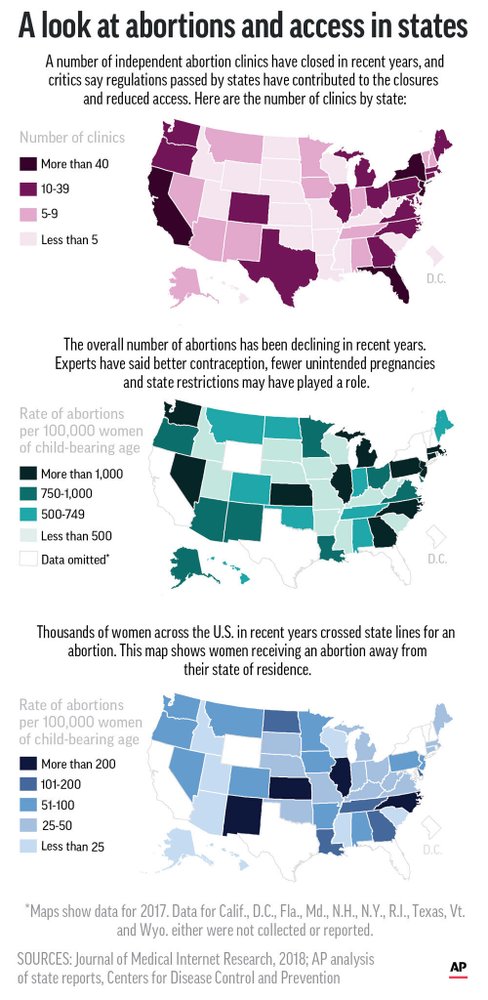
Lunsford is one of thousands of women in the U.S. who have crossed state lines for an abortion in recent years as states have passed ever stricter laws and as the number of clinics has declined.

Although abortion opponents say the laws are intended to reduce abortions and not send people to other states, at least 276,000 women terminated their pregnancies outside their home state between 2012 and 2017, according to an Associated Press analysis of data collected from state reports and the U.S. Centers for Disease Control and Prevention.

In New Mexico, the number of women from out of state who had abortions more than doubled in that period, while Missouri women represented nearly half the abortions performed in neighboring Kansas.

“The procedure itself was probably the least traumatic part of it,” Lunsford said. “If it would have been at my hospital, there would have been a feeling like what I was doing was OK and a reasonable choice.”

While abortions across the U.S. are down, the share of women who had abortions out of state rose slightly, by half a percentage point, and certain states had notable increases over the six-year period, according to AP’s analysis.

In pockets of the Midwest, South and Mountain West, the number of women terminating a pregnancy in another state rose considerably, particularly where a lack of clinics means the closest provider is in another state or where less restrictive policies in a neighboring state make it easier and quicker to terminate a pregnancy there.

“In many places, the right to abortion exists on paper, but the ability to access it is almost impossible,” said Amy Hagstrom Miller, CEO of Whole Women’s Health, which operates seven abortion clinics in Maryland, Indiana, Texas, Virginia and Minnesota. “We see people’s access to care depend on their ZIP code.”

___

Nationwide, women who traveled from another state received at least 44,860 abortions in 2017, the most recent year available, according to the AP analysis of data from 41 states.

That’s about 10% of all reported procedures that year, but counts from nine states, including highly populated California and Florida, and the District of Columbia were not included either because they were not collected or reported across the full six years.

Thirteen states saw a rise in the number of out-of-state women having abortions between 2012 and 2017.

New Mexico’s share of abortions performed on women from out of state more than doubled from 11% to roughly 25%. One likely reason is that a clinic in Albuquerque is one of only a few independent facilities in the country that perform abortions close to the third trimester without conditions.

Georgia’s share of abortions involving out-of-state women rose from 11.5% to 15%, while North Carolina saw its share increase from 16.6% to 18.5%. North Carolina had one of the highest shares of out-of-state abortions in 2017. While both states have passed restrictive laws, experts and advocates say they are slightly more accessible than some of their surrounding states.

In Illinois, the percentage of abortions performed on non-residents more than doubled to 16.5% of all reported state abortions in 2017. That is being driven in large part by women from Missouri, one of six states with only a single abortion provider.

Even that provider, in St. Louis, has been under threat of closing after the state health department refused to renew its license.

Missouri lawmakers also passed a law this year that would ban almost all abortions past eight weeks of a pregnancy, but it faces a legal challenge.

About 10 miles (16 kilometers) from St. Louis, across the Mississippi River, is the Hope Clinic in Granite City, Illinois, which has seen a 30% increase in patients this year and has added two doctors, deputy director Alison Dreith said.

About 55 percent of its patients come from Missouri, and it also sees women from Indiana, Kentucky and Ohio. All those states have mandatory waiting periods to receive an abortion, a requirement Illinois does not have.

Dreith called it a scary time for women in states with highly restrictive laws and few clinics.

“The landscape that we’re seeing today did not happen overnight, and it was not by accident,” she said.

And Illinois isn’t the only place Missouri women are heading for abortions.

In 2017, Missouri women received 47% of all abortions performed in Kansas. That is in large part because the only access to the procedure throughout western Missouri, particularly the greater Kansas City area, is across the state line in Overland Park, Kansas.

Beth Vial, who didn’t learn she was pregnant until 26 weeks after chronic medical conditions masked her symptoms. (AP Photo/Moriah Ratner)

___

Between 2011 and May 31 of this year, 33 states passed 480 laws restricting abortion, according to the Guttmacher Institute, a research organization that supports abortion rights.

In 2019 alone, lawmakers approved 58 restrictions primarily in the Midwest, Plains and South — almost half of which would ban all, most or some abortions, the group said.

The most high-profile laws, which face legal challenges that could eventually test the U.S. Supreme Court’s Roe v. Wade decision, would ban abortion after a fetal heartbeat can be detected — as early as six weeks.

Advocates say that if the Supreme Court upholds the latest restrictions, it will become more common for women to seek an abortion in another state.

“The intent of these lawmakers is to completely outlaw abortion and force people not to have abortions. But in reality, it pushes people farther and wider to access the care they want and need,” said Quita Tinsley, deputy director of Access Reproductive Care Southeast.

ARC Southeast is part of the National Network of Abortion Funds, a collective of 70 abortion support groups for women in six Southeast states. Some provide money to women to pay for abortions, while others also help with transportation, lodging and child care.

A third of women calling the group’s hotline for help end up traveling out of state for abortions, Tinsley said. Many choose Georgia because it’s convenient to get to and considered slightly less restrictive than some other states in the South.

In Georgia, which has a mandatory waiting period, a woman is not required to come to a clinic twice, like they are in Tennessee. But if Georgia’s new fetal heartbeat law survives a court challenge, it would have one of the earliest state-imposed abortion bans.

That would force many women to go even farther from where they live to terminate their pregnancies.

___

Of all states, New Mexico has seen the biggest increase in the number of women coming from elsewhere for an abortion — a 158% jump between 2012 and 2017, according to AP’s analysis.

The New Mexico Religious Coalition for Reproductive Choice helps an average of 100 women a year but is on track to assist 200 this year. Some of its 55 volunteers open their homes to women coming from out of state.

Executive director Joan Lamunyon Sanford said her group is doing what faith communities have always done: “Care for the stranger and welcome the traveler.”

Joan Lamunyon Sanford, executive director of the New Mexico Religious Coalition for Reproductive Choice. (AP Photo/Susan Montoya Bryan)

Lamunyon Sanford said the need is growing as barriers increase and women are unable to access care where they live.

“They have to figure out so many details and figuring out how they are going to get the funding for everything,” she said. “Sometimes it’s just too much. And then they become parents.”

The coalition helped Beth Vial, who didn’t learn she was pregnant until she was six months along after chronic medical conditions masked her symptoms.

As a 22-year-old college student living in Portland, Oregon, Vial was beyond the point when nearly every abortion clinic in the country would perform the procedure.

Vial’s only option for an abortion was New Mexico, where a volunteer with the New Mexico Religious Coalition for Reproductive Choice drove her to and from the clinic in Albuquerque and brought her meals.

The support she received inspired her to join the board of Northwest Access Abortion Fund, which helps women in Oregon, Washington, Idaho and Alaska.

“To have people I didn’t even know support me in ways that I didn’t even really know I needed at the time was unlike anything I have ever experienced,” said Vial, now 24. “It has encouraged me to give back to my community so other people don’t have to experience that alone.”

___

Abortion opponents say the intent of laws limiting the procedure is not to push women to another state but to build more time for them to consider their options and reduce the overall number of abortions.

“I have been insistent in telling my pro-life colleagues that’s all well and good if the last abortion clinic shuts down, but it’s no victory if women end up driving 10 minutes across the river to Granite City, Illinois, or to Fairview Heights,” said Sam Lee, director of Campaign Life Missouri and a longtime anti-abortion lobbyist.

Anti-abortion activists also hope a broader cultural shift eventually makes these issues disappear.

“We are seeing this trend toward life and a realization of what science tells us about when life begins,” said Cole Muzio, executive director of the Family Policy Alliance of Georgia who advocated successfully for new abortion limits there. “Just because something is legal does not mean that it is good.”

Before the recent wave of legislation focused on limiting when an abortion can be performed, opponents largely worked to regulate clinics. Critics say those regulations contributed to more clinics closing in recent years, reducing access to abortion in parts of the country and pushing women farther for care.

Texas lost more than half its clinics after lawmakers in 2013 required them to have facilities equal to a surgical center and mandated doctors performing abortions have admitting privileges at a nearby hospital.

Even though the U.S. Supreme Court struck down key provisions of the law in 2016, most clinics have not reopened.

Candice Russell was among those who felt the impact. When she sought an abortion in Dallas in 2014, she was told she would have to wait more than two weeks because of an influx of patients from other parts of Texas where clinics had closed.

She feared she would not be able to miss work for back-to-back appointments, required under Texas’ mandatory waiting period, so she told the bar where she worked that a relative died and took out a payday loan to buy an airplane ticket to California. She had the procedure the next day.

“Even though I had to take on that horrendous loan and entered a debt spiral that lasted until about two years ago, I am really, really lucky,” said Russell, now 36 and working as deputy director of the Yellowhammer Fund, which helps women in Alabama seeking abortions. “There are a lot of people who just can’t do that. They can’t get on a plane and fly 1,500 miles for an abortion.”

Nationwide, 168 independent abortion clinics have closed since 2012, and just a handful opened over that time, according to the Abortion Care Network, a clinic advocacy group.

Some resulted from providers retiring and an overall decline in unplanned pregnancies, but advocates say many shut down because of restrictive laws.

“It’s not about safety of patients,” said Nikki Madsen, executive director of the Abortion Care Network. “It’s about closing clinics.”

For Lunsford, it took two years before she could begin managing the grief of losing her son, compounded by the hurdles she faced to carry out that painful decision — the drive to Atlanta, staying in a hotel and going to a clinic with doctors she didn’t know.

Lunsford, now 31, said she thinks about how she couldn’t hold her baby, an intimate goodbye that might have been possible if she had the abortion at a hospital. Before she left Atlanta, she asked the clinic’s staff to use the inkpad and paper she brought so she could keep her son’s footprints and handprints.

“Most of the laws I navigated, there was no reason for them,” she said. “None of them prevented my abortion. It just made it where I had to travel out of state.”

Source: https://apnews.com/4ced42150e3348328296e28559c2143b?fbclid=IwAR2T0VxNmxMjmkkHaZQIm7C4sphBHdxhBRhLDrfjxqbbobUsIt1CJ47FpwY

In a year when we’ve seen states throughout the South and Midwest move to ban abortion and restrict access to reproductive health, California could soon cement its reputation as a leader in reproductive freedom. This past week, the state legislature passed SB 24 to ensure that medication abortion is available to college students in public universities.

Jessy Rosales, a UC student, struggled with paying for care and dealing with the complexities of insurance plans when she needed an abortion. She had to go off campus to three different providers, which took time away from class, work, and other responsibilities. Jessy’s grades slipped as she tried to navigate the obstacles to getting an abortion. Such financial, logistical, and emotional tolls are completely unnecessary.

Every month, approximately 500 students at the UC and CSU campuses seek the abortion pill at off-site health care facilities. On average, a student seeking abortion in California will have to wait one week for the next available appointment at the facility closest to their campus — and that’s assuming they can make it to the appointment. More than half of all students in UC and CSU universities are low-income and over two-thirds of UC students and one-third of CSU students do not have a car, so cost and transportation are critical barriers for many. Students of color, low-income students, first-generation college students, and students who are already parents or supporting their families are particularly harmed by barriers to accessing comprehensive reproductive care.

State Sen. Connie M. Leyva (D-Chino) authored the groundbreaking bill to require every University of California (UC) and California State University (CSU) campus to provide the abortion pill — a safe and effective method to end a pregnancy — at student health centers. The law would eliminate barriers currently faced by students who struggle to travel off campus to obtain an abortion, which results in unnecessary hardship and delay. California’s effort to improve access to abortion care is a bright point in a national landscape that has seen access to abortion decrease significantly. In the first nine months of 2019 alone, seven states banned all or most abortions. And the Supreme Court is likely to further gut abortion rights, even if it doesn’t immediately overturn Roe v. Wade.

Student health centers already provide a range of reproductive health services including testing and treatment for sexually transmitted infections, pregnancy tests, pregnancy options counseling, and contraception. It just makes sense that the abortion pill — safe, effective, and simple to provide — should be among the services offered.

Research shows that student health centers are well equipped to offer the abortion pill, and private funders have come forward to pay the costs of implementation and training.

In addition, students and allies from across the state have built a groundswell of support for SB 24. Six in 10 Californians support providing the full range of reproductive health care including the abortion pill, including majorities of every age bracket. The ACLU of California is proud to be one of seven organizational sponsors of SB 24, which has received support from over 130 organizations, including the American College of Obstetricians and Gynecologists, the American Academy of Pediatrics, and other medical groups; reproductive health, rights, and justice organizations; and community groups from every part of the state. The Los Angeles Times editorial board came out in support of the measure, calling it a “sensible and smart addition to the healthcare services.”

Last year, California narrowly missed a chance to make history and support its students when a similar bill (SB 320) was vetoed by Governor Jerry Brown. At that time, now-Governor Gavin Newsom said he supported the bill. Today, SB 24 sits on his desk awaiting his signature.

The future of abortion rights in the U.S. may be uncertain, but California is poised to lead the nation in expanding access. SB 24 is a testament to California’s spirit of innovation, the drive of our young people, and our commitment to a better future. It sets a new standard for campus care that we can all be proud of.

Source: https://www.aclu.org/blog/reproductive-freedom/abortion/california-ready-ensure-every-public-college-student-has-access

Abortion costs tend to rise after the first trimester, partly due to the amount of time and level of skill required to perform the procedure

Nine in 10 abortions are performed within the first 13 weeks of pregnancy, according to the CDC.

Laws that require abortion seekers to wait a period of time between counseling and the procedure can drive up the share of women of having riskier second-trimester abortions, suggests a new study distributed by the National Bureau of Economic Research. What’s more, their abortion costs are likely to go up.

Researchers from Texas A&M University analyzed the impacts of Tennessee’s mandatory waiting period (MWP), which was enacted in 2015 and requires that a minimum of 48 hours elapse between in-person counseling and a woman’s abortion.

Laws requiring two visits to a clinic are associated with a $107 increase in the price of an abortion, according to one 2015 analysis.

The policy increased the share of Tennessee women getting second-trimester abortions in 2016 by 4.1 percentage points, they found — a 62% increase from 2014. The number of abortions fell overall by 6%, though the authors cautioned that estimate had “limited statistical power.”

The waiting period also carried an added financial cost of up to $929, the study authors estimated. “In total, the mandatory waiting period could increase the monetary cost of obtaining an abortion by a total of over $900 when accounting for fees, transportation costs, lost wages, and child-care,” they wrote.

The Guttmacher Institute, a reproductive-health think tank that supports abortion rights, points out that “first-trimester abortions are much less expensive than second-trimester procedures, often by several hundred dollars.”

Study co-author Jason Lindo, an economics professor at Texas A&M and research associate at NBER, has served as “an expert witness in litigation regarding abortion regulations, including litigation regarding the regulation examined in this study,” the paper discloses.

Anti-abortion groups say the unborn have a right to life, believe life begins at fertilization and object to abortion on moral grounds.

The anti-abortion advocacy group National Right to Life says that many single mothers “find free help and support from local pregnancy care centers.” The group also suggests giving the baby up for adoption as an alternative for people who can’t afford to care for a baby.

Republicans say they oppose “taxpayer-funded abortion.” Anti-abortion groups say the unborn have a right to life, believe life begins at fertilization and object to abortion on moral grounds. They comprise a range of views from those who believe abortion is wrong under any circumstance to others who believe it’s acceptable in cases of rape, incest or when a woman’s life is at risk.

That said, some 71% of voters oppose overturning Roe v. Wade, a July poll from The Wall Street Journal and NBC News found.

Nine in 10 abortions are performed within the first 13 weeks of pregnancy, according to the Centers for Disease Control and Prevention. And, as the American College of Obstetricians and Gynecologists notes, “abortion-related mortality increases with each week of gestation” — though the risk of childbirth-related death remains far higher.

Women are required to get counseling before they can have an abortion in 34 states, 14 of which require the counseling be delivered in person, according to the Guttmacher Institute. Twenty-seven of those states mandate a typically 24-hour waiting period from counseling to procedure, and waiting periods can stretch as long as 72 hours in states like Arkansas, Missouri and North Carolina.

Women who obtained second-trimester abortions paid an average of $854, compared to the average of $397 paid by first-trimester patients.

“In states in which the counseling must be obtained in person (rather than via mail, fax, Internet or phone) and the woman must then wait a specified time period … between the counseling and the procedure, the woman is effectively required to make two trips to the health care provider in order to obtain an abortion, a requirement that could constitute a hardship for some women,” Guttmacher says.

Indeed, laws requiring two visits to a clinic are associated with a $107 increase in the price of an abortion, according to one 2015 analysis of two-visit and Targeted Regulation of Abortion Providers laws.

Advocates for mandatory waiting periods, meanwhile, “argue that they ensure women will receive information about pregnancy and abortion and will have ample time to weigh their options before deciding to terminate a pregnancy,” the present study’s authors note.

Abortion costs tend to rise after the first trimester, partly due to the amount of time and level of skill required to perform the procedure, Guttmacher Institute principal research scientist Rachel Jones previously told MarketWatch; 2013 research co-authored by Jones found that women who obtained second-trimester abortions paid an average of $854, compared to the average of $397 paid by first-trimester patients.

Six months after being denied an abortion, women were less likely to be employed full-time and more likely to be dependent on public assistance.

Three in four women who obtain abortions are low-income, and almost half live below the federal poverty level, research shows. Meanwhile, women who are denied abortions are more likely to endure long-term “economic hardship and insecurity” than women who receive abortions, according to a 2018 study published in the American Journal of Public Health.

Six months after being denied an abortion, women were less likely to be employed full-time and more likely to be dependent on public assistance, it added. The findings indicated that women who were denied a wanted abortion had four times greater odds of having a household income below the federal poverty level and three times greater odds of being unemployed after six months.

“The additional financial costs for a woman to obtain an abortion caused by Tennessee’s mandatory waiting period over and above prior costs can amount to a very large share of women’s monthly income,” the Texas A&M researchers wrote.

Source: https://www.marketwatch.com/story/mandatory-waiting-periods-can-make-abortions-nearly-1000-more-expensive-2019-09-10?fbclid=IwAR2LpvZ9srkuDxHmmqIODsv9D-FBvDZWRLIY0w1RIrkCeyZ1I9yIAEWmGXo

A California judge on Tuesday said David Daleiden “was engaged in criminal activity irrespective of his journalistic status.”

Daleiden, who coordinated his smear campaign against abortion care providers with Republican lawmakers and operatives, could face prison time if his case goes to jury trial.
Eric Kayne / Getty Images

A California judge on Tuesday ruled that anti-choice activist David Daleiden broke the law when he surreptitiously taped private conversations with abortion providers as part of a campaign to smear Planned Parenthood.

The ruling all but clears the way for a jury trial over the controversial recordings.

Daleiden, who coordinated the smear campaign against abortion care providers with Republican lawmakers and operatives, could face prison time if his case goes to a jury trial.

Tuesday’s ruling comes as a criminal preliminary hearing against Daleiden and co-defendant Sandra Merritt wraps up in San Francisco Superior Court, where abortion providers have testified anonymously against the pair. Raw footage of their discussions about fetal tissue donation has been played in court over the past two weeks.

Daleiden and Merritt insist they are “citizen journalists” who went undercover to investigate alleged fetal tissue trafficking by Planned Parenthood, therefore exempting them from liability under California’s eavesdropping law.

Daleiden had also sought to get overturned the 2016 search warrant for his Long Beach, California, apartment that would’ve led to the dismissal of the bulk of felony charges pending against him, claiming that as a “citizen journalist,” he was entitled to the protections of the California Shield Law. On Tuesday, Judge Christopher Hite declined to immediately resolve the dispute over Daleiden’s reporting credentials. He denied Daleiden’s motion because Daleiden “was engaged in criminal activity irrespective of his journalistic status.”

Daleiden has never worked as a journalist, and state prosecutors insist he doesn’t qualify for Shield Law protections. Some of the nation’s foremost journalists and journalism scholars said in a 2016 court filing that Daleiden wasn’t acting as a journalist in secretly recording abortion care providers. The videos served as pretext for Republican lawmakers in some states to defund Planned Parenthood. The man who killed three people at a Colorado Springs Planned Parenthood facility in 2015 repeated talking points from Daleiden’s videos.

“Even assuming Daleiden was a journalist at the time of the recordings his actions would not be protected by the California Shield Law or the Federal Privacy Protection Act under the circumstances alleged in the search warrant,” Hite ruled. “While this newfound freedom of information and speech brings about different perspectives and discussions, it does not give either the media or a citizen journalist free reign to violate criminal laws applicable to the general public.”

Posing as executives of a fake fetal tissue procurement company keen on doing business with Planned Parenthood, Daleiden and Merritt filmed abortion providers at the National Abortion Federation’s (NAF) annual meeting in California in 2014 and 2015. Through an anti-choice front group called the Center for Medical Progress (CMP), Daleiden and Merritt released heavily edited videos in 2015 to falsely accuse Planned Parenthood of illegally profiting from the sale of fetal tissue. They face charges of felony invasion of privacy and conspiracy and could go to prison.

Hite’s ruling Tuesday was the clearest indication that he intends to take the case to trial. A day earlier, the defense argued that the people who were filmed had no reasonable expectation of privacy because they were filmed in public, where conversations can be easily overheard.

Daleiden testified he believed he had observed California’s eavesdropping law by filming solely in public places. He and Merritt turned down invitations to meet abortion providers in private despite the likelihood of obtaining better quality footage in the quieter surroundings, he said. “I chose to keep the recordings within the boundaries of the California law as I understood it,” Daleiden said.

But when Deputy Attorney General Johnette Jauron stated that he had stolen data from a Northern California-based fetal tissue company for his investigation, Daleiden struggled to explain himself.

“That’s not true,” he said. Later he elaborated, “I don’t believe I took data away from the company.”

A former employee of StemExpress, a company that uses fetal tissue for research, gave Daleiden the password to her StemExpress email account after she stopped working there. Daleiden accessed her email and downloaded every single message to his laptop’s hard drive.

Matthew Strugar, a First Amendment attorney in Los Angeles who is not affiliated with the case, said Hite had correctly held that the First Amendment doesn’t permit journalists to break the law. “Journalists cannot, for instance, break into someone’s house while pursuing a lead, or run a red light to get to a breaking story,” Strugar told Rewire.News.

But Strugar said the case could have repercussions for legitimate undercover work.

“The threat of this prosecution is in the threat of finding that undercover investigations and recording in place where people could generally overhear your conversation, or in blurring the line so much that journalists or investigators won’t ever record because the threat of prosecution could wax and wane from second to second,” Strugar told Rewire.News.

Melanie Newman, a spokesperson for Planned Parenthood Federation of America, said in a statement that Daleiden and Merritt should face the legal consequences of their “multiyear illegal effort to manufacture a fake smear campaign against Planned Parenthood.”

“They broke the law to try and prevent Planned Parenthood from serving the patients who depend on us and to advance their goal of banning safe, legal abortion in this country. We’re looking forward to justice being served,” Newman said.

Hite has not indicated when he will rule.

Source: https://rewire.news/article/2019/09/18/anti-choice-activist-david-daleiden-gets-bad-news-in-court/

For one of the last abortion doctors in Missouri, harassment, stalking and death threats are a part of regular life. But this year, it’s been worse than ever.

Colleen McNicholas, the chief medical officer at Planned Parenthood of the St. Louis Region and Southwest Missouri, is one of many providers who told CBS News they’ve seen an uptick in violence this year, both against themselves and their clinics. They say the increased harassment has coincided with newly enacted state laws restricting legal abortion and polarizing rhetoric surrounding the procedure.

The National Abortion Federation has been tracking violence against abortion providers and clinics since 1977. The Very Reverend Katherine Hancock Ragsdale, an Episcopal priest and interim president & chief executive officer of the organization, said the violence that providers face today is “beyond anything we’ve ever seen before.”

“We’re seeing a dramatic increase in violence and disruption against clinics,” she said in an exclusive interview with CBS News.

In 2017, violent acts against abortion providers more than doubled from the year prior, according to data compiled by NAF. The group recorded 1,081 violent acts, the most since the group began tracking these incidents.

Last year, the group recorded another new record high: 1,369 reported violent acts, including 15 instances of assault and battery, 13 burglaries, 14 counts of stalking and over a thousand episodes of illegal trespassing.

In interviews with nearly one dozen clinics, including McNicholas’s St. Louis Planned Parenthood, providers say the situation is getting worse. In August alone, three young men were arrested for threatening mass shootings against Planned Parenthood facilities. At the home of one of the suspects, authorities seized 15 rifles, 10 semi-automatic pistols, and 10,000 rounds of ammunition during a raid.

As Missouri has emerged on the front lines of the nation’s debate over abortion access, McNicholas has become the face of that battle. She’s been a staple at nearly every protest, courtroom hearing and press conference.

But becoming a vocal defender of abortion access in Missouri has made her a target. Protestors have followed her coming to and from work. In the midst of fighting a very public battle to keep the clinic in operation, McNicholas told CBS News that she was advised to increase the security protocols at her home. She declined to give specifics for safety reasons. Security protocols at the clinic are constantly under review, said a spokesperson for Planned Parenthood.

Ragsdale and the providers interviewed by CBS News said they’ve seen a direct correlation between the rise in violence and the wave of anti-abortion legislation passed this year. So far in 2019, lawmakers in the South and Midwest have passed 58 restrictions, nearly half of which would ban the vast majority of abortions in their respective states, according to data compiled by the Guttmacher Institute, an abortion rights and reproductive health research organization.

Julie Burkhart, the founder and chief executive officer of Trust Women, a network of abortion clinics, knows firsthand the potential danger that abortion providers face. Ten years ago, her mentor, Dr. George Tiller, was assassinated at church by an anti-abortion extremist. At the time, Tiller was a high-profile abortion doctor, known nationally for providing the procedure later into women’s pregnancies. In an interview with CBS News, Burkhart said today’s anti-abortion environment feels similar to that of 2009.

“I’m just so unsettled and fearful that we’re going to see people hurt,” she said. “My boss was murdered. I fear that we’re going to have the same horrible outcome.”

Ragsdale said anti-abortion violence tends to go hand in hand with anti-abortion legislation, adding that “you can pretty much always draw a line from public rhetoric to violence.” Inflammatory language — like referring to abortion as “infanticide” and doctors as “baby killlers” — can be a “dog whistle” to anti-abortion extremists and can push them into action, Ragsdale said.

At Whole Women’s Health, a network of seven abortion clinics across Indiana, Maryland, Minnesota, Texas and Virginia, anti-abortion protestors are a constant, said Amy Hagstrom Miller, the group’s chief executive officer and president. But earlier this year, as states were passing abortion bans and federal lawmakers considered the “Born-Alive” bill, the situation worsened, Miller said in an interview with CBS News.

“These aggressive bills that keep getting introduced have a tone to them that’s incredibly fringe and introduces violent language,” Miller said, noting that in Alabama’s legislation for a near total ban on abortion, lawmakers compared the procedure to the Holocaust, the Khmer Rouge “killing fields,” and other modern genocides.

This spring, protestors scaled her clinic’s fences, blocked clients from entering the parking lots and even stopped patients from closing their cars’ doors as they tried to leave, Miller said. In April, her clinic in McAllen, Texas, was the target of an arson attack, something Miller believed to be directly related to President Trump’s comments on the Senate’s failed “Born-Alive” bill, legislation that would require doctors to resuscitate infants born after a “botched abortion.”

However, as many abortion rights advocates pointed out at the time, the instance described in the bill “virtually doesn’t happen.” Even if it did, it’s already covered: a bill passed in 2002 already requires physicians to provide that care.

At the time of the vote, in a pair of tweets, Mr. Trump said, “the Democrat position on abortion is now so extreme that they don’t mind executing babies AFTER birth.”

“When you put something like that out there, it can motivate anti-choice people to act,” Senator Mazie Hirono, a Democrat from Hawaii, said in an interview with CBS News. “That’s what happens when you call a whole bunch of people ‘baby killers.’ The rhetoric is very, very harmful.”

Hirono spoke out strongly against the legislation and her position — and subsequent vote against the bill — earned her “hundreds” of threatening voicemails and emails, some of which were death threats that required her to increase her office’s security, Hirono told CBS News.

“I’m really afraid that this kind of language will motivate people to do something harmful and violent,” Hirono said.

Source: https://www.cbsnews.com/news/violence-against-abortion-clinics-like-planned-parenthood-hit-a-record-high-last-year-doctors-say-its-getting-worse/?ftag=CNM-00-10aab7e&linkId=73798416&fbclid=IwAR2kzixriZuiADOf0ZMfJSjZNK9cGmz7KVFWIblc9wSRc1AT_8BwLcZmBmM

Abortion bans throughout Mexico include exceptions for rape. Activists say despite some recent improvements, survivors still confront obstacles to accessing abortion care.

Alma (R) sees her daughter’s ordeal as a form of punishment for their decision to pursue a legal abortion in a conservative region of Mexico.
Meghan Dhaliwal

When Patricia discovered she was pregnant, she tried inducing an abortion with remedies she read about on the Internet: rue tea, aloe, and unsalted bean soup. None of them worked.

Weeks earlier, the 16-year-old was raped by a taxi driver rumored to control the marijuana trade in her neighborhood on the outskirts of Guadalajara, a bustling city in the state of Jalisco, in Mexico’s conservative heartland. Finally Patricia, who asked us not to use her real name, told her mother, Alma. Years earlier, Alma’s mother ignored her daughter’s reports of sexual abuse, and Alma resolved not to make the same mistake. Alma sat her daughter down, and as they talked, Alma took notes. She stressed that whatever happened next was Patricia’s choice, writing “your decision” in a loopy scrawl and circling it. When Patricia said she wanted an abortion, Alma jotted down how they wanted the procedure performed: “Safe—with trained providers. Under the law.” It was January 2016, and Jalisco’s penal code has permitted abortion in cases of rape since 1933. But health department records show that before 2016, no one in the state had obtained a legal abortion under the rape exception.

Patricia and her family live in Tlajomulco de Zúñiga, a poor neighborhood racked by drug-related violence. She was an outgoing teenager who volunteered with the local Green Party, taking classes in urban gardening and helping campaign for the party’s candidates. She loved cooking, and she marveled at how the food reflected her emotions, how her chile de molcajete grew mouthwateringly spicy when she was happy. But after the rape, Patricia withdrew. She was furious one moment, sobbing the next. The smallest sounds startled her. Her rice burned. “I was in shock,” she recalled when we spoke in the fall of 2018, in the studio where her mother works as a beautician. “It was as if my life had been paused and someone had told me, ‘Stay quiet and don’t move.’” She was terrified that if she reported the rape to authorities, her attacker would come after her. But at the time, Jalisco required rape survivors to report the assault in order to obtain authorization from a public prosecutor’s office or a judge for an abortion.

Patricia could have made the 13-hour round-trip journey from their home to Mexico City, where abortion is legal in the first trimester and with no time limit in cases of rape. But that journey can be expensive and logistically complicated, and Alma was a single working mother with other children. Plus, she knew her daughter had the right to abortion in her state. “And if we don’t make those rights worth something, then what are we here for?” she thought.

On January 28, 2016, Patricia and Alma reported the rape to prosecutors, initiating a series of medical and psychological exams, during which they expressed their intention to obtain an abortion for Patricia. None of the officials they encountered gave them a clear answer about how to access an abortion. Finally, on February 10, a psychologist from the attorney general’s office accompanied Alma and Patricia to the state health department. In hand, they had a letter from the prosecutor’s office directing the department to carry out Patricia’s abortion. The following day, they met with the department’s legal director, and on February 12, he called them back to his office. He gave them misoprostol, an ulcer medication that is also used to induce abortions, along with typewritten instructions that read, “one each 8 hours orally; one each 8 hours vaginally” and a phone number for an OB-GYN at the public Hospital General de Occidente. The lawyer gave them the 14-pill foil packet without the box and told them not to tell anyone, not even the prosecutor, according to Patricia and her mother. (In testimony to the Jalisco Human Rights Commission, the legal director denied Alma’s account of these events.)

By the time they returned home, it was dark. The two sat in the living room. “How are we going to do this?” Patricia recalled thinking. “I was very scared, because we didn’t know what would happen.” Around 9 p.m., she took one pill orally and inserted the second into her vagina. By the following morning, she was so weak that she couldn’t walk to the bathroom. It pained her mother to have to continue inserting the pills even as her daughter’s vagina grew inflamed. “I told her, ‘Be patient, mi hija. Be patient,’” Alma recalled. “She was crying, and it was maddening to see her because, apart from her despair, you know that you don’t really know what you’re doing.”

On Sunday morning, nearly 36 hours after Patricia began taking misoprostol, Alma texted the OB-GYN photos of Patricia’s bleeding and concerns about her pain. The OB-GYN agreed to meet them at the hospital, where, according to both women, he abruptly performed a vaginal exam as Patricia wept from the pain. An ultrasound confirmed that she was still pregnant. The instructions the lawyer provided did not match the World Health Organization’s protocol for abortion beyond 12 weeks of pregnancy, which recommends administering the pills every three hours instead of eight. According to Alma and Patricia, the doctor then told Patricia to go home and take more misoprostol, removing the label from the bottle and telling Alma to be careful because, if the police caught them with it, they could be arrested—even though Patricia was seeking a legal abortion from a public hospital. On average from 2007 through 2016 across Mexico, one person was reported to the authorities every day on suspicion of abortion. (The doctor denied this account of the day, testifying to the Jalisco Human Rights Commission that Patricia’s medical care was administered “with quality and warmth and with due information.”)

Patricia began to doubt her decision. “I looked at my mom, and I thought, ‘What am I doing? What is happening?’” she said. “I was resigned to the fact that I was going to have a child.”

Still, the two persisted. Rather than begin a new round of misoprostol, as the OB-GYN suggested, Patricia and her mother met with a lawyer, Angela García Reyes, who told them she would file a legal stay alleging that the state was subjecting Patricia to cruel, degrading, and inhumane treatment by denying her an abortion. The day before that stay was filed, the doctor wrote to Alma saying a judge had authorized the abortion. (According to García, the letter from the public prosecutor’s office should have been sufficient authorization. She speculated that the secretary of health may have been waiting for a judge’s authorization for extra cover in case there was public controversy over the case.) He instructed them to return to the hospital the next morning. But when they arrived, he warned them that the hospital didn’t have “molidas de bebés”—Spanish for “baby grinders,” his term for the equipment necessary to carry out a surgical abortion. Instead, Patricia would be administered more medication to end the pregnancy.

The following morning, Patricia was admitted for what staff members described as their first abortion case. (State records show there was one abortion in the month before hers in the same hospital, but local lawyers and activists said they have no memory of such a case.) The medical staff placed her in a bed in a corner of the maternity ward echoing with the sound of women in labor, and they barred her mother from entering the room. At one point, Patricia recalled a gaggle of about 15 medical students clustering around her. She was told to open her legs, and someone painfully inserted a speculum. According to medical records, the medical staff administered mifepristone and misoprostol with the aim of inducing labor. She said the doctors subjected her to more than a dozen vaginal exams. Nurses drifted by her bed, chiding her, “You do know that the babies aren’t to blame?” Hours later, she was injected with oxytocin, a hormone used to induce labor, and her contractions grew so painful that she cried out for help. A medical worker moved to inject her with a pain medication, but a doctor intervened. “We’re not going to give you anything for the pain,” Patricia remembered her saying. (According to the medical records, during this phase of the abortion, Patricia was given an anti-inflammatory medicine known as keterolac, which has some analgesic properties, and another medicine used to treat cramping. The hospital did not respond to requests for comment.) Finally, more than 12 hours after she was admitted, Patricia felt a sensation similar to defecating, and the room grew blurry. She was wheeled into the surgical ward. Doctors performed a curettage to remove the remains of the pregnancy.

It had been 22 days since Patricia first reported the rape. Alma sees her daughter’s ordeal as a form of punishment for their decision to pursue a legal abortion in a conservative region of Mexico. “It was like they were telling her, ‘You chose this, right? Well, then this is what’s going to happen.’”

* * *

In Mexico’s groundbreaking national elections in 2000, the right-wing Partido Acción Nacional (PAN) ousted the Partido Revolucionario Institucional (PRI), at the time the longest-ruling party in the world. Abortion rights activists feared that members of the conservative government would seek to further restrict abortion in Mexico, which at the time was legal only for rape survivors and, in some states, in other instances, such as if the pregnant person’s life was in danger or for serious fetal anomalies. Indeed, the month after the elections, lawmakers in the president-elect’s home state of Guanajuato moved to ban abortion in cases of rape in that state. The effort sparked such massive street protests that the state’s interim governor was forced to veto the measure. Although the law failed, abortion was nearly impossible for rape survivors to obtain. According to a 2006 Human Rights Watch report, “actual access to safe abortion procedures is made virtually impossible by a maze of administrative hurdles as well as—most pointedly—by official negligence and obstruction.” In Jalisco, one social worker boasted to Human Rights Watch about having persuaded a child who had been raped by her brother not to end the pregnancy, saying, “She came here wanting to have an abortion, but we worked with her psychologically, and in the end she kept her baby. Her little child-sibling.”

Mexican feminists scored an extraordinary victory in 2007, when Mexico City legalized all abortions in the first trimester. But in the ensuing years, more than half of Mexico’s states passed constitutional amendments to define life as beginning at conception, joining Chihuahua, which reformed its Constitution in 1994. While not enforceable, these measures contributed to a sense of uncertainty around access to legal abortion. Meanwhile, the U.S.-backed drug war, which began in 2006, fueled soaring levels of violence across the country, including rape and femicide. Women activists and victims’ families mobilized to bring attention to this crisis and demand protections, including abortion access for rape survivors. In 2012, with more than 100,000 people killed and 25,000 more disappeared in the previous six years, lawmakers passed a General Law of Victims. Among other things, it affirmed the right of rape survivors to access legal abortions in public hospitals. Advocates then successfully pushed federal authorities to reform a rule, known as Norm 046, to say that rape survivors could obtain an abortion without authorization from a judge or other authority and that those age 12 or older could do so without a parent’s permission. The reform took effect in 2016—a month after Patricia had her abortion—and the Supreme Court upheld it this August. The same year, activists pressured Jalisco to declare an alert over gender violence, activating a legal mechanism that feminists have used to push authorities to improve access to abortion in cases of rape.

Despite these reforms, in prosecutors’ offices and public hospitals across the country, procedural barriers remain deeply entrenched. In a report tracking cases from 2012, the year before the General Law of Victims took effect, to 2018, two years after the reform of Norm 046, the reproductive rights organization Grupo de Información en Reproducción Elegida (GIRE) said it supported 38 rape survivors, the majority of whom were under 18, who were denied abortions or faced serious hurdles. In 2015 in Tabasco, the public prosecutor’s office attempted to reclassify a 10-year-old’s rape as pedophilia in order to disqualify her from accessing an abortion. (She ultimately obtained the procedure.) In 2016 an 18-year-old farmworker was denied an abortion in Baja California Sur because, according to local authorities, “abortion is a crime because it is an attack against a child.” In 2018 a 15-year-old reported to authorities in Puebla that she had been raped by her uncle and needed an abortion, but local authorities told her that abortion there was illegal, making her fear that she would be arrested for obtaining one. She and the farmworker had their abortions in Mexico City.

Before the General Law of Victims took effect, one woman was even imprisoned. In 2012 a 26-year-old in Durango obtained an abortion after being kidnapped, raped, and impregnated by her ex-boyfriend, who later threatened to kill her unless she dropped the charges against him. When she complied with his demands, local authorities charged her with making false statements and the crime of having an abortion. She went to prison.

Data collected by GIRE suggests that, despite the prevalence of sexual violence in Mexico, few abortions have been provided in cases of rape, even in the years since the reforms. GIRE found that from December 2012 to October 2017, public health-care institutions reported performing 137 abortions in cases of rape, an average of 27 each year nationwide, even though thousands of rapes are reported each year.

* * *

Mexican activists credit survivors like Patricia, who have asserted their legal rights within a hostile system, with spurring limited improvements in recent years. “It was these women, these girls, who came forward and said, ‘Yes, I’m going to do it,’” said Verónica Marín, an activist who helps rape survivors in Jalisco. “We accompanied them, but it was their bodies that endured that torment.”

For more than a decade, Marín and other activists have supported women and girls in Jalisco who traveled to Mexico City to end their pregnancies. From 2009 to 2016, when there were 111,413 rapes reported to federal and local attorneys general, public health authorities reported performing only 63 abortions in cases of rape. About two-thirds of these were reported by Mexico City. According to government statistics, just over 600 people from Jalisco have traveled to Mexico City for legal abortions over the last 12 years. Countless more have chosen to self-induce using misoprostol pills, which are available in street markets and over the counter in pharmacies. Grassroots feminist groups have sprung up across Mexico to help people safely take this medication. Self-managed abortion is legal in cases of rape, but rape victims who pursue that option and experience complications that require follow-up care risk being reported to authorities if providers don’t believe they were raped. Government records show that nationwide, authorities prosecuted 157 women for having an abortion from 2014 to 2017. In Jalisco illegal abortion carries a sentence of up to two years in prison, and other states impose sentences of up to six years for patients and 10 years for providers. Women who self-induce abortion, or suffer miscarriages or stillbirths, have faced murder and infanticide charges. People in rural areas, including indigenous women, may lack access to safe methods of abortion and are more likely to resort to dangerous methods. Unsafe abortion is a leading cause of maternal death in Mexico.

Activists Verónica Marín (L) and Patricia Ortega (R)
(Amy Littlefield and Laura Gottesdiener)

Several years before Patricia’s case, Marín and other activists began helping rape survivors demand that public hospitals provide abortions. They wanted to force the hospitals and the Mexican state to make good on their legal rights, but they also wanted to pave the way for decriminalizing abortion by compelling doctors, who are authority figures in Mexican society, to perform the procedure. Marín said that having doctors provide abortion in public hospitals, as opposed to women secretly taking pills at home, would help destigmatize the procedure. “It has to be in the health centers. It has to be done via the state,” said Marín, a vibrant woman with blue-streaked hair, “because if the state is doing it, then how can the state criminalize it?”

When Marín and others started trying to help rape victims access abortions in Jalisco, there was no clear protocol, and the authorities simply refused. Time after time, the activists helped victims travel to Mexico City. Even after some public hospitals began to perform the procedure around the time of Patricia’s case, Marín said, hospital authorities continued to treat both patients and activists with hostility. Sometimes staffers called security to oust the activists. When providers failed to give victims pain medications, the advocates would smuggle pills to them hidden inside their clothing. “When we began,” Marín said, “it seemed impossible that one day a hospital would practice abortions and that the whole world would know it was happening there.”

* * *

Today, though the national law says rape survivors in any Mexican state can go to a public hospital and get an abortion without reporting the crime to authorities first, 11 states still have laws on the books that require victims to file a report. The national law nullifies such requirements, but “the lack of compliance of some penal codes with the national legislation concerning care of victims disadvantages women in certain states, who face higher barriers to access abortion services depending on their geographic location,” GIRE concluded last year. Twelve states impose some form of time limit on abortion for rape survivors, mostly confining it to the first trimester of pregnancy. The patchwork of state-level abortion laws in Mexico parallels that of the United States, where access also depends largely on a person’s location and ability to afford to travel to the nearest clinic. Interest in self-induced abortion has spiked in the United States after the confirmation of two U.S. Supreme Court justices nominated by President Donald Trump, which has raised the prospect that the Court will overturn Roe v. Wade and allow some states to ban abortion outright. Some emboldened Republicans have dropped rape exceptions from their increasingly extreme efforts to ban the procedure. But many, including Trump, still support these exceptions as a way to temper opposition among an American public that overwhelmingly supports abortion access for rape survivors. In Mexico, such exceptions have yet to fulfill their promise of protecting these victims.

Since Patricia’s case in 2016, public hospitals in Jalisco have performed at least 20 abortions for rape survivors, according to records provided by officials in October 2018. Otilia Bibiana Domínguez Barbosa, the coordinator of the gender-based-violence program at the Jalisco Health Department, said in an interview that since Patricia’s case, the state has implemented a protocol for rape survivors and is conducting trainings for providers.

García, the attorney who represented Patricia, said she has seen improvements in the legal system in Jalisco but not as much among health-care providers. “I think that the laws, the judges are slowly understanding that this is a right that we have as women. But the health sector is still behind. The health sector is the barrier we are pushing up against,” she observed. Across the country, activists said that one of the biggest remaining hurdles is not the law itself but rather the doctors, nurses, hospital administrators, and other public officials who fail to understand it or refuse to carry it out.

Many of these providers claim a religious opposition to abortion. In an interview last October, Domínguez said she knew of only 28 doctors in the entire state who were not registered as conscientious objectors to abortion—up from nine the year before. This year, a young rape victim was forced to file a lawsuit after authorities in the state of Aguascalientes denied her a legal abortion, claiming that there were no people who were not conscientious objectors available to carry out the procedure. (A federal judge then ordered Aguascalientes to provide her an abortion within ten days.) “We have a beautiful legal framework in Mexico,” said Esmeralda Lecxiur Ferreira, a legal adviser with the reproductive health services group Mexfam. “The problem is that the authorities are not interested in implementing it.”

Indeed, in two cases in 2017 and 2018, rape survivors continued to confront obstacles to accessing legal abortion in Jalisco—including at the same hospital where Patricia went. In September 2017 a 16-year-old named Juana (who asked to use a pseudonym) sought a legal abortion after being raped by two men while she was walking to school in her rural town in the interior of Jalisco. She and her father traveled hours to Guadalajara to obtain the procedure. But from the moment they arrived at the hospital, Juana said, she felt that the doctors didn’t want to take care of her. According to Yazmín Cano, an activist who accompanied Juana, the doctor in charge of the legal abortion program initially refused to treat her because she didn’t have documents showing she reported the crime to authorities, even though the reform of Norm 046 made it clear that rape survivors could obtain an abortion without authorization. Cano said the doctor then tried to intimidate Juana, warning that the abortion could perforate her uterus, leaving her infertile or even killing her. (The hospital did not respond to requests for comment.) After insisting that she wanted an abortion, Juana was given medication and, like Patricia, found herself sequestered in the labor and delivery room. “They left me pretty much alone, dying of pain,” she recalled. “To this day, I close my eyes, and I still see the women who were giving birth. It was very traumatic.”

The activists got observers from the state’s human rights commission to go and witness Juana’s treatment. Finally, Cano said, the doctors ended her pregnancy surgically. “I think that the doctors didn’t want to participate in the curettage because for them and for many people, this is a crime—abortion is a crime,” Juana said. The next morning, as she was recovering from the surgery, a police officer arrived and interrogated her and her father separately about the rape, even though she had not reported it. She said she felt her rights were violated in the hospital but, despite the trauma, she doesn’t regret seeking an abortion. She’s now attending nursing school and is passionate about her studies. “Even though the whole world criticizes you, you have to keep living, for yourself most of all,” she said.

A year after Juana’s case, García accompanied a rape victim to another public hospital in Guadalajara, where the staff had undergone training by an abortion rights organization. The victim didn’t face any legal barriers, but according to García, the hospital prevented the patient from meeting with her and called the patient’s family to disclose the rape and the abortion, even though García had expressly told the hospital that the patient didn’t want her family to know and the law allows victims age 12 or older to get an abortion without a parent’s permission. “It’s a daily, daily, daily fight with the health-care institutions,” García said.

Recent Supreme Court rulings in favor of rape survivors’ accessing abortion have given legal advocates more ammunition. The rulings granted damages to victims and ordered improvements by health-care authorities. “We as civil-society organizations are disseminating the information and saying to the hospital authorities, ‘Look, you can be held responsible for denying services,’” said Fernanda Díaz de León, a senior policy adviser at Ipas, an international reproductive health organization. Still, the rulings don’t subject individual providers to penalties.

Another issue is the lack of education among not just officials but also the public, including rape survivors themselves. Patricia Ortega, a Jalisco activist who works with Marín, said that before 2016, though the rape exception was in the penal code, no one—including the most sympathetic public officials—knew how to make it a reality. “Now there is a clear procedure, and when victims have that information, they can arrive [at the hospital] and argue this is in the official norm,” Ortega said. “What is lacking now is public awareness.”

Many people still think that abortion is a crime in all cases, she added—leading GIRE to conclude that “while abortion is considered a crime instead of a health-care service, women will keep confronting violations of their reproductive rights, including when they seek abortions under circumstances allowed by law.”

* * *

Activists on International Safe Abortion Day in 2018
(Amy Littlefield and Laura Gottesdiener)

Many advocates say that justice for rape survivors will not be fully realized in Mexico until abortion is both decriminalized and more widely accepted within the country’s conservative culture. Two years after Patricia fought to obtain her legal abortion, a “green tide” of pro-choice activism began to sweep across Latin America, with hundreds of thousands of people pouring into the streets to demand the legalization of abortion across the region. Countries in Latin America and the Caribbean have some of the world’s most restrictive abortion laws, with several banning abortion outright. A few allow it without a specific reason in the first trimester, and the rest ban it with various exceptions, including to save the pregnant person’s life or in cases of rape. In 2014 at least 10 percent of maternal deaths in the region resulted from unsafe abortion, according to the Guttmacher Institute, a reproductive health research organization. The green tide began in Argentina, where a grassroots feminist movement brought a million people to the streets to support a historic vote to legalize abortion. Although the bill they supported ultimately failed, the effort galvanized the abortion rights movement across the region.

Mexican activists have been emboldened. “When we saw everything that happened in Argentina, that gave us a breath of fresh air and renewed our energies here in Mexico,” said Daniela Zaizar, a 24-year-old activist. Pressured by the green tide, members of the left-wing Morena party of Mexican President Andrés Manuel López Obrador have sent some hopeful signals. Interior Minister Olga Sánchez Cordero has said she supports decriminalizing abortion up to 12 weeks and releasing all women currently incarcerated for abortion-related crimes.

On September 28, thousands of people are expected to fill the streets of cities across Mexico for the annual International Safe Abortion Day. Last year, hundreds of women wearing green handkerchiefs and T-shirts poured into the streets of Guadalajara to demand the decriminalization and acceptance of a procedure undergone by countless women in Mexico. Some of the protesters said they were inspired to march after their experiences with extralegal abortions. Patricia said she hoped to attend the march, but it was too far from home for her to travel alone, and her mother was at work. Instead, she shared information about the event on social media. Posting publicly about the march made her nervous, given how critical she knew people could be about abortion. But she decided to do it anyway. Much to her surprise, some of her friends liked her post. One male friend who worked in a public hospital replied simply, “I support you.”

Source: https://rewire.news/article/2019/09/17/mexico-abortion-exception-rape-survivors/

Ectopic pregnancies can be deadly if left untreated. But abortion opponents are telling another story.

Ectopic pregnancies can be deadly.

The condition happens in about 2 percent of all pregnancies, when a fertilized egg implants somewhere outside the uterus — usually in the fallopian tube, a tiny structure connecting the uterus to the ovary. If the pregnancy continues to grow and develop, the tube can rupture, and the pregnant person can hemorrhage and die.

In most cases, the only way to treat an ectopic pregnancy is to terminate it with medication or surgery. But now, some abortion opponents are arguing that patients with ectopic pregnancies can simply be monitored until they miscarry — or even that such pregnancies can be carried to term.

“Knowing that a medical condition carries a very small chance of death is scary,” Georgi Boorman wrote at the Federalist on Monday. But, she asked, “is that very small chance enough to prompt you to suffer through purposely destroying your own child?”

The argument is starting to make its way into legislation, with a recent Ohio law including a special provision for the surgical reimplantation of ectopic pregnancies into the uterus, something doctors say is not possible.

Experts say failing to treat an ectopic pregnancy can put patients at serious risk. “It is really malpractice to watch a patient who is at risk for a tubal rupture from an ectopic pregnancy” without offering termination, Dr. Daniel Grossman, a professor of obstetrics, gynecology, and reproductive services at the University of California, San Francisco, told Vox. “There’s a real risk of death.”

Claims that abortion isn’t necessary in the case of ectopic pregnancies may be part of a larger movement toward abortion bans with fewer and fewer exceptions, like a law in Alabama that bans abortion even in cases of rape or incest (the law does have an exception to save the pregnant person’s life). And even if such laws never go into effect — most have been challenged in the courts — false claims about ectopic pregnancy in the media could lead patients to delay treatment, Grossman said, potentially harming their future fertility or risking their lives.

Some abortion opponents say ectopic pregnancies can be left to “resolve on their own.” Doctors disagree.

At first, the symptoms of an ectopic pregnancy are similar to those of a normal pregnancy, like sore breasts and a missed period, according to the American College of Obstetricians and Gynecologists. But patients may also experience abnormal bleeding or abdominal or pelvic pain. Once a doctor has diagnosed an ectopic pregnancy, time is of the essence — fallopian tubes cannot stretch very much, Grossman explained, and if the pregnancy grows beyond a certain point, they will rupture.

As long as the tube has not yet ruptured, doctors typically give patients an injection of methotrexate, a chemotherapy drug that can also be used to stop a pregnancy from growing. Then, according to ACOG, the body typically reabsorbs the pregnancy on its own. If the tube has already ruptured, and in some other cases, surgery is necessary to remove the pregnancy and sometimes a portion of the tube.

Historically, anti-abortion groups have supported allowing abortion in the case of ectopic pregnancy, arguing that it is morally distinct from abortion in other cases. For example, the American Association of Pro-Life Obstetricians and Gynecologists (AAPLOG) said in a 2010 statement that the group “recognizes the unavoidable loss of human life that occurs in an ectopic pregnancy, but does not consider treatment of ectopic pregnancy by standard surgical or medical procedures to be the moral equivalent of elective abortion, or to be the wrongful taking of human life.”

Others have argued that ending an ectopic pregnancy should not be considered an abortion at all. Anti-abortion activist Lila Rose, for instance, said in a recent video that removing an ectopic pregnancy “is not to intentionally kill that child; that’s not an abortion procedure.”

And yet some abortion opponents have started making the argument that terminating an ectopic pregnancy by medication or surgery is not medically necessary. At the Federalist, Boorman argues that instead of abortion, patients with ectopic pregnancy should be closely monitored by their doctors (a process called “expectant management” or “watchful waiting”). Sometimes, she writes, the patient will miscarry with no need for intervention. If the tube ruptures, the patient can be treated with a blood transfusion procedure — though, she acknowledges, there is a small risk of death. She also argues that sometimes, an ectopic pregnancy can move on its own, reimplanting in a safer location and even resulting in a healthy birth.

Doctors, however, say it is not possible to carry an ectopic pregnancy to term and have a child. “Once a diagnosis of ectopic is made, that pregnancy cannot continue,” Grossman said.

Ingrid Skop, the chairman-elect of AAPLOG, agrees. She told Vox she would call what happens in an ectopic pregnancy “an inevitable spontaneous abortion.” But, she says, her course as a doctor is clear: “regardless of when I intervene, that pregnancy’s going to die, but if I intervene earlier, then I’m going to leave that mom a much better chance of doing well than if I leave it alone and wait for it to rupture.”

In the case of an ectopic pregnancy, waiting can be very dangerous. In some cases, when doctors can tell that pregnancy hormones are dropping, it may be safe to let a miscarriage happen on its own, Grossman said. But those patients need careful monitoring, and they are in the minority. In general, “it’s critical that when the ectopic pregnancy is identified that treatment be given because this is a very serious condition,” he said.

Overall, ectopic pregnancy is the top cause of maternal mortality in the first trimester, Grossman added.

Boorman also argues that more research is needed to determine if embryos can be surgically removed from the fallopian tube and reimplanted in the uterus. But because the option of abortion exists, she writes, such research isn’t being pursued.

“As long as abortion is legal, it is the go-to ‘preventative’ solution for ectopic pregnancies,” Boorman writes. “As long as the tiny life is expendable, why not just kill it to be on the ‘safe side’ and move on?”

However, according to Grossman, “there is no evidence” that transplanting an ectopic pregnancy into the uterus is safe or effective. Meanwhile, Skop says that, “to my knowledge we are nowhere near having the technology to do that.”

The idea of transplanting an ectopic pregnancy from the fallopian tube into the uterus has made its way into public policy debates. An Ohio bill introduced earlier this year to ban most private insurance coverage for abortion included a provision allowing insurance companies to cover “a procedure for an ectopic pregnancy that is intended to reimplant the fertilized ovum into the pregnant woman’s uterus.” The bill, which has not yet passed, may be an attempt to ensure coverage for the procedure in case it becomes possible at a later date, or to incentivize researchers to develop such a procedure.

In general, though, doctors, including those who identify as pro-life, say the science is clear: ectopic pregnancies are not viable, there’s currently no way to transplant them, and if left alone, they can and do result in a pregnant person’s death.

False claims about ectopic pregnancy could hurt patients

Misinformation about ectopic pregnancy could have real-world effects, doctors and reproductive-health advocates say. It’s connected to a larger anti-abortion argument “that abortion is never medically necessarily,” Grossman said.

Indeed, Boorman writes that the “conventional wisdom” that ectopic pregnancies are dangerous and non-viable needs to be challenged in order to “wake up the whole world to the fact that abortion is never the answer and galvanize citizens to demand an end to the abominable practice — with no exceptions.”

But doctors — and patients — say that abortion in the case of ectopic pregnancy is very necessary indeed.

“If you have never treated a woman with a belly full of blood from an ectopic you should shut the fuck up and sit down and learn before you get someone killed,” Dr. Jen Gunter, an ob-gyn and author of the recent book, The Vagina Biblewrote on Twitter on Monday. She also retweeted doctor and patient stories of ectopic pregnancies, including stories of “shredded” fallopian tubes, massive blood loss, and friends and family lost to ectopic pregnancies caught too late.

Meanwhile, false claims about ectopic pregnancies could put patients in danger, Grossman said. “Often these are desired pregnancies,” he explained, and claims that they can be viable “could lead some patients to really question the advice of their doctor and maybe wait longer before getting the necessary treatment and put their lives at risk.”

Source: https://www.vox.com/2019/9/11/20859034/ectopic-pregnancy-abortion-federalist-intrauterine-ohio-surgery?fbclid=IwAR1GDwjVTuaDkbaHd692MbcR10l6jJuF6Eq_h0Htc8amdzGJKOUXo95RV04

The California bill would require public universities to provide medication abortion at student health centers on campus.

The College Student Right to Access Act was inspired by student activists at the University of California, Berkeley, who banded together in 2015 to advocate for medication abortions on campus. According to Phoebe Abramowitz, who joined the campaign as a freshman, students seeking abortions face unreasonable hardships.
David Litman / Shutterstock.com

After a four-year-long student-led campaign to expand access to abortion care, California may soon become the first state to require publicly funded universities to offer medication abortion on campus.

The California state legislature has until Friday to vote on the College Student Right to Access Act, sponsored by state Sen. Connie Leyva (D-Chino). If it does not move forward this week, the bill will be “carried over” to 2020 and the process will pick up when the legislature reconvenes in January, according to Elizabeth Nash, senior state issues manager at the Guttmacher Institute.

A previous version of the bill was vetoed by Gov. Jerry Brown (D) last year, but California’s new governor, Democrat Gavin Newsom, has signaled he would sign the bill into law.

The bill was inspired by student activists at the University of California, Berkeley who banded together in 2015 to advocate for medication abortions on campus. According to Phoebe Abramowitz, who joined the campaign as a freshman, students seeking abortions face unreasonable hardships.

“We talked to people who had to miss class and work to access abortion care,” she told Rewire.News. “At the time, there was a $300 co-pay [and] a confusing referral process.” For some students, navigating this bureaucracy meant they missed the 10-week window for medication abortion and instead had to seek a surgical abortion off-campus.

“I really do believe this [bill] is a major step for gender equity—and being able to access our studies along with other students,” Abramowitz said.

Medication abortion, also known as the abortion pill, is a non-surgical procedure that blocks the hormones needed for pregnancy and induces contractions through the use of two drugs. Because medication abortion is relatively straightforward and safe, more primary care physicians are beginning to offer it, according to Ushma Upadhyay, PhD, MPH, a researcher at Advancing New Standards in Reproductive Health (ANSIRH) at the University of California, San Francisco and an associate professor.

The California bill would require public universities to provide medication abortion on campus; its requirements wouldn’t apply to private or community colleges.

According to Nash, the only other state considering a similar policy is Massachusetts, although California is likely to be the first place it passes.

“California is a leader on reproductive health issues,” she said. “Other states look to California as a place to find policy ideas on a lot of different progressive issues. It stands to reason that this could be an issue that other states adopt.”

Today, abortion services are seldom available at university health clinics, Upadhyay said.

That’s despite research from the University of Illinois at Chicago that found medication abortion is “safe and feasible” to offer at student health clinics.

As part of her research at ANSIRH, Upadhyay has documented the many hurdles students face when seeking abortion care. In one study, she and her colleagues found that the average student at a California state school had to wait about a week for an off-campus appointment and pay an average of $600 for medication abortion services.

According to Upadhyay, if the California bill becomes law, it would benefit as many as 500 students per month. Each campus of California State University and the University of California would receive $200,000 to cover the startup costs of offering medication abortion services and would be required to begin providing the care by 2023.

Dr. Daniel Grossman, director of ANSIRH, said the funding should be “more than enough” to train staff and get student health centers ready to provide abortion care. After that, the campus health centers should be able to bill insurance for services.

“I am optimistic about this proposal because it makes sense from both a medical and educational perspective,” Grossman said in an email. “If it can work here, I think other states will follow our lead.”

Source: https://rewire.news/article/2019/09/11/california-students-get-a-second-chance-for-expanded-abortion-access-bill/