A year after Justice Brett Kavanaugh’s confirmation, “women are organizing like our lives depend on it, because they do,” Women’s March COO Rachel Carmona said.

Advocates see the placement of Justice Kavanaugh, following on the heels of the confirmation of Justice Neil Gorsuch, on the Court as a direct threat to the constitutional right to abortion given their conservative records.
CHRIS KLEPONIS/AFP/Getty Images

Exactly one year after Brett Kavanaugh was sworn in on the U.S. Supreme Court, the Women’s March, Demand Justice, and the Center for Popular Democracy Action plan to mobilize women, survivors, and their members to hold the nation’s highest court accountable amid a slew of attacks on reproductive health and rights.

The action, to be held on October 6 in Washington, D.C., will seek to put pressure on congressional lawmakers as the Court’s landmark abortion rights case, Roe v. Wade, is in jeopardy. Advocates see the placement of Justice Kavanaugh, following on the heels of the confirmation of Justice Neil Gorsuch, on the Court as a direct threat to the constitutional right to abortion given their conservative records.

“We protested Kavanaugh’s appointment to the Supreme Court last year because we knew that right-wing extremists would respond by pushing reckless anti-abortion laws. President Trump repeatedly promised on the campaign trail that Roe v. Wade would be overturned ‘automatically’ once he had his choice of justices on the Supreme Court,” Women’s March Chief Operating Officer Rachel Carmona said. “We won’t be silent while the GOP subverts the will of the people by cheating our democratic processes. Women are organizing like our lives depend on it, because they do.”

Katie O’Connor, senior counsel at Demand Justice, told Rewire.News that the organizations hoped to “tap into [the] energy” of the women who mobilized for the Women’s March in 2017 and protested Kavanaugh’s confirmation the following year. Now, the groups are inviting activists to take action and demand “that the Congress do better,” such as by more closely reviewing Kavanaugh’s record.

Marking the anniversary of Kavanaugh’s confirmation is important because “we really think of it as unfinished business,” O’Connor said.

The announcement of the action comes after House Judiciary Committee Chair Jerrold Nadler (D-NY) sent a letter to the National Archive in early August requesting the records from Kavanaugh’s work in the George W. Bush administration.

“There’s a lot that the Senate never investigated last year and that the American public deserves to have investigated,” O’Connor said.

During Kavanaugh’s confirmation process, only a small fraction of the estimated 3.85 million total pages of documents pertaining to his time working in the White House were reviewed.

“While [Kavanaugh] was staff secretary to the George W. Bush administration, the so-called partial-birth abortion ban was passed,” O’Connor said. “Partial-birth abortion” is a term created by anti-choice activists referring to an uncommon method of abortion. “We have no idea what he worked on while he was there. We have no idea whether he was part of the administration’s decision to sign that bill.”

Answering those questions could make a difference at a critical time for abortion rights in the United States. “Depending on what we find in these documents, we can at least question his impartiality about abortion cases and potentially asked him to recuse himself,” O’Connor said.

“Kavanaugh was almost certainly put on this court to overturn Roe, as was Gorsuch,” she said. “That was President Trump’s campaign promise.” And both Kavanaugh and Gorsuch received support from anti-choice groups during the confirmation process.

“We have no reason to believe that he’s not going to do what everyone knows he was put there to do,” she said.

Source: https://rewire.news/article/2019/08/28/exclusive-advocates-will-mobilize-to-reclaimthecourt-on-kavanaughs-confirmation-anniversary/

Imagine living in a place where legislators banned abortion after eight weeks, with no exceptions for rape, human trafficking, incest, or fatal abnormalities. Then, if someone manages to confirm a pregnancy within this period — often, it takes people up to 12 weeks to verify that they are pregnant — they might have to travel more than 200 miles to the state’s lone, persecuted abortion clinic. Along the way, they can expect to see car license plates emblazoned with “Choose Life,” a campaign that funnels money from these plate sales into anti-abortion organizations. They might also stumble upon one of the state’s estimated 69 tax-funded crisis pregnancy centers, which masquerade as real health clinics but peddle religious sentiments and misinformation.

When they finally arrive at an abortion provider and undergo a 72-hour waiting period, it’s legally mandated that they’re given medically inaccurate information, including a pamphlet that states, “The life of each human being begins at conception. Abortion will terminate the life of a separate, unique, living human being.”

This might sound like a scenario ripped straight from a dystopian hellscape created by Margaret Atwood, but these real-life policies play out every day in Missouri, where I live and where public defenders are warning that, beginning Aug. 28, people who need abortion services after eight weeks of pregnancy could potentially face prison time if they attempt to perform or induce their own abortion.

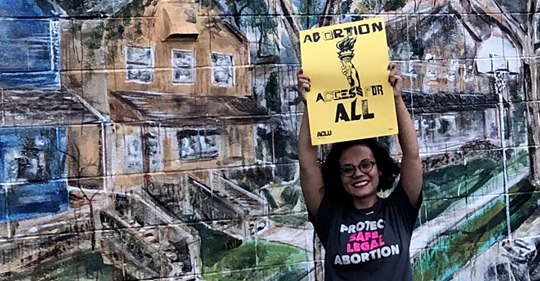
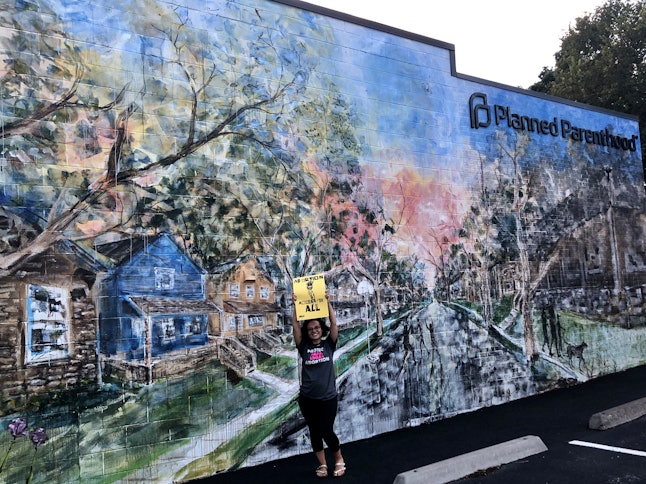
It’s against this dehumanizing backdrop that I began volunteering at Planned Parenthood six months ago, as a wave of restrictive abortion laws swept the Midwest. Suddenly, the news alerts that bombarded my phone and my Twitter feed forced me to reexamine my values.

Throughout college, I’d taken gender studies courses that encouraged me to present my womanhood in any way I wanted, to embrace sex positivity and to demand diversity in pop culture. I saw myself as sort of a fourth-wave feminist, committed to a women-heavy reading list and to keeping my last name, but not having to fight for basic equality like the suffragettes. I chanted the c-word on stage in front of my grandma as part of a performance of The Vagina Monologues and wore T-shirts that proclaimed, “The future is female.”

But none of that well-intended girl power sufficed when extremist laws encroached on my and others’ bodily autonomy. With a newfound sense of fury and fear fueling me, I signed up to volunteer for the only reproductive rights organization that I knew had a century-long history of defending and advancing women’s rights.

I talked to people who, like myself, supported abortion rights but had rarely taken action.

Just stepping into the back room of the clinic in Kansas City, Missouri, shifted my perspective. I heard a chorus of determined voices transform the day’s headlines into calls for action. Ten phone bank volunteers were calling strangers on both sides of the Missouri-Kansas state line, urging them to contact their senators and express support for abortion rights. I realized that, in 2019, my feminism needed to be something that it had never been before: urgent, inconvenient, and even impolite. Once I began making these calls myself, I noticed that it marked the most times I’d ever uttered the word “abortion.” That alone awakened me to the fact that I needed to do better.

Courtesy of Kara Lewis

While working the phone bank, I received support from some people on the other end of the line, but also heard curse words, rants, and mansplaining. One woman screamed that I was going to hell and was “personally responsible for murder.” Before, remarks like these would’ve made me hang up the phone or scared me out of making the next call altogether. In college, I once walked across an entire soccer field to avoid protesters holding gory pictures of fetuses, convinced that engaging with them would prove pointless and even traumatic.

However, volunteering showed me that emotionally charged, divisive conversations are instrumental to creating change. I talked to a woman who had an undecided opinion on abortion, and encouraged her to contemplate the level of choice she’d want for her daughter. I talked to people who, like myself, supported abortion rights but had rarely taken action, convincing them to participate in town halls, rallies, and even visits to the state capitol.

This shift from passive to active feminism has rippled into other areas of my life, too. My increased advocacy pushed me to leave my job at a daily newspaper, because when I was asked if I could cover my right to my own body and men who made laws without knowing anything about female anatomy “objectively,” I knew the answer was no. I ended a friendship when a close friend compared abortion to the Holocaust in a Facebook post. I’m now reevaluating whether to shop at retailers like Hobby Lobby, which refuses to cover certain birth control for employees, and CVS, which donated to Trump through its political action committee.

As with all revolutions — both personal ones and on a wider scale — many people have labeled my actions as dramatic. Fortunately, Planned Parenthood’s long history serves as the perfect guide for how to react. Just nine days after it first opened in 1916, police raided the clinic and arrested its founders for sharing information related to birth control. They didn’t back down — while in jail, Margaret Sanger provided the same reproductive education to her fellow inmates. More than a century later, Planned Parenthood now operates without critical Title X funding from the federal government, so they can continue to offer abortion.

Led by these examples, I now refuse to be shut down, even when being vocally pro-choice seems socially unacceptable. When I ask friends, partners, and family members about their views on abortion, I no longer care if it makes them blush. Despite societal conditioning, I’d rather be rude than a human incubator who cannot decide if and when to carry a child. Volunteering for my and others’ reproductive rights has helped me embrace one of the most important, radical feminist tenants of all: The personal truly is political.

Source: https://www.bustle.com/p/i-volunteered-for-abortion-rights-in-missouri-it-made-me-rethink-my-entire-life-18687253

FILE PHOTO: An exam room at the Planned Parenthood South Austin Health Center is shown following the U.S. Supreme Court decision striking down a Texas law imposing strict regulations on abortion doctors and facilities in Austin, Texas, U.S. June 27, 2016. REUTERS/Ilana Panich-Linsman

CHICAGO (Reuters) – Illinois will defy enforcement of the Trump administration’s rule barring federally subsidized family planning clinics from making abortion referrals, the governor said on Thursday, vowing the state would step in to fund most of those clinics itself.

Illinois’ action comes a week after a federal appeals court cleared the way for the administration to cut off Title X grants for reproductive healthcare and family planning for low-income women at clinics that refer patients to abortion providers.

Governor J.B. Pritzker, a Democrat, said the state would forgo all federal Title X funding while the Trump administration continues to impose its restriction – branded by critics as a “gag rule” designed to silence doctor-patient communications about abortion options.

Instead, the Illinois Department of Public Health will provide state funding to the 28 local clinics that normally receive Title X money through the agency, making up for an estimated $2.4 million in federal dollars they otherwise stand to lose for the rest of the fiscal year, Pritzker said.

“President Trump’s gag rule undermines women’s health care and threatens the providers that millions of women and girls rely on, and we will not let that stand in the state of Illinois,” the governor said in a statement.

Officials for the U.S. Health and Human Services Department, which administers Title X, did not immediately respond to requests from Reuters seeking comment on Illinois’ action.

The Illinois Republican Party denounced Pritzker’s willingness to turn away federal funding of “non-abortion-related medical care for women and girls because of his unrivaled zeal for forced taxpayer funding of abortions.”

At least two other states, Maryland and Massachusetts, took similar pre-emptive countermeasures months ago, enacting legislation to temporarily opt out of Title X if the new rule takes effect, and to provide state funding in its place.

Maine Family Planning, a nonprofit, sole recipient of Title X funds in that state, has also said it would withdraw from the program rather than abide by the new rules. The Democratic governors of four other states – New York, Hawaii, Oregon and Washington state – threatened to end participation in Title X.

Planned Parenthood, an organization that provides abortions and other health services for women under Title X, has already said it would likewise reject Title X money under the new rules, relying instead on private donations and emergency funds to make up the difference.

Planned Parenthood operates 17 clinics in Illinois, said Julie Lynn, a spokeswoman for the state organization.

AIMED AT PLANNED PARENTHOOD

The administration’s policy is aimed at fulfilling President Donald Trump’s campaign pledge to end federal support for Planned Parenthood, the largest single provider of abortions in the United States.

The administration’s new policy also requires financial and physical separation between facilities funded by Title X and those actually providing abortions.

Federal judges in Washington state, California and Oregon, among nearly two dozen states challenging the administration’s rule in court, issued preliminary injunctions against enforcement of the rule earlier this year. It had been slated to take effect in May.

The 9th U.S. Circuit Court of Appeals on June 20 lifted those injunctions, and the same court rejected emergency bids to overturn that decision last week. That allowed the restrictions to go back into effect while court challenges proceed.

Congress appropriated $286 million in Title X grants in 2017 to Planned Parenthood and other health centers to provide birth control, screening for diseases and other reproductive health and counseling to low-income women.

That funding already was prohibited from being used to pay for abortions, but abortion opponents have long complained that the money in effect subsidizes Planned Parenthood as a whole, including its abortion services.

Planned Parenthood provides healthcare services to about 40% of the 4 million people who rely on Title X funding annually.

Source: https://www.reuters.com/article/us-usa-abortion/illinois-to-defy-trump-administrations-abortion-referral-gag-rule-idUSKCN1UD32V?fbclid=IwAR0QfVcBfwy5DNtFBglAroSE-bXIH1lUHXWRhN5IkvZzHjXaH3TNQcnaHsg

While debate around abortion in recent years has been centred on America, a parliamentary vote here has now turned the spotlight on the issue in Northern Ireland. 
Marisa Bate speaks to three women campaigning for change

In recent months, there has been international outcry over the draconian abortion bills being passed in some American states, with Alabama, Ohio and Georgia (among others) recently signing bills to severely restrict women’s abortion rights. But what about the abortion crisis in our own backyard? In Northern Ireland, abortion is illegal. Even in cases of rape and incest, it is a crime punishable by life imprisonment, which also extends to the doctors who administer the procedure. But banned abortions don’t result in fewer abortions. According to the Department of Health and Social Care, 1,053 women from Northern Ireland travelled to the UK for an abortion in 2018 – which marks 
a 22 per cent increase on the year before. Clearly, free, safe and legal abortions are desperately needed.

However, on 9 July, a historic window of opportunity opened as an overwhelming majority voted in Westminster for an amendment tabled by MP Stella Creasy, which would see abortion become decimalised in Northern Ireland, falling under the 1967 Abortion Act that currently exists in England and Wales. But, this will only come to pass if Stormont – the currently collapsed Irish Assembly caught in a stalemate – does not restore by 21 October 2019.

In other words, there’s still some way to go. If Stormont restores, the issue will fall back to a government that has fiercely opposed abortion. Even if the abortion laws are relaxed, Stormont would have the right to amend them.

Despite the long road ahead, campaigners are celebratory. Grainne Teggart, Amnesty International’s Northern Ireland campaign manager, told Marie Claire, ‘This is a significant defining moment for women’s rights in Northern Ireland. The grave harm and suffering under Northern Ireland’s abortion regime is finally coming to an end. At a time when prosecutions are still a grim reality, this cannot happen quickly enough.’

For now, though, that grim reality is still something women are facing. Here, we explore the complexities of the debate through stories of women personally affected by this issue.

‘I had to fly alone to England to have a safe, legal abortion’

Karen*, 37, from Northern Ireland, is a mother of two and a pro-choice campaigner

‘When I found out I was pregnant for the third time, my kids were six and eight months. I was still on maternity leave and had been suffering with postnatal anxiety. I couldn’t sleep, 
I found it hard to leave the house and had panic attacks. Then, just as I was starting to feel better, I got pregnant. I was terrified of getting pulled back into a black hole that I had barely started to climb out of.

‘As a pro-choice campaigner, I always thought I was fighting for this so other women have freedom, but I would never personally have an abortion. And then I was in that position myself. You never know what situation you’re going to find yourself in. Straight away I started making calls.

‘I spoke to the Abortion Support Network first. I didn’t need to ask them for money, but I got really good logistical advice. There’s no one else to give you that – you can’t get information from GPs, they’re too scared to tell you. Next I called the British Pregnancy Advisory Service and booked a clinic in Liverpool. I had to wait a week and, in that time, 
I went to the Family Planning Association, which has sadly now closed. They were a lifeline.

‘My husband couldn’t come with me as he had to look after the kids, and I didn’t feel I could ask a friend because she would have to take the day off work or get childcare and then pay £180 for the flights. But I really regretted going alone. I left super early and I was back by 6.30pm, in time to give the kids a kiss goodnight, which really struck me. If it was in your own city, it would be such a small thing, yet it felt like such a massive journey because of the impact of having to get up and go somewhere totally unfamiliar. I was scared throughout the entire experience.

‘I had to have a surgical abortion because I was flying home that day – pills induce heavy bleeding and pain too severe for travel – but the general anaesthetic freaked me out a bit, so I phoned my husband, then had a bit of a cry. That’s when I wished he or a friend had been there. I was in the theatre waiting room with three other women from the UK, and I’ll remember that for the rest of my life. In that moment, we all shared our stories. I heard all kinds, from domestic violence to drug addiction. There’s such complexity in people’s circumstances.

‘When I came round, the sense of relief was unbelievable. I felt so grateful. It was amazing to me that all these people work in this place that gives you this incredible gift of being able to walk out of there and get on with your life.

‘Between 30 and 35, I was pregnant five times. It was the most intense period of my life. I had two kids, two miscarriages and one abortion. I think people need to understand that is what women’s lives are like when we make that decision to have children. That it brings with it all the stuff – the bad with the good.’

‘Our clients range from 12 to 53 years old’

Mara Clark is founder of The Abortion Support Network, which is based in England to help women access safe and legal abortions

‘In 2002, I was living in New York and I read an article about the women travelling to the city to have abortions because it had a 24-week time limit. They had to pay $2,000 [about £1,600] for the procedure and stay overnight, and some were having to sleep in their cars. The article featured the Haven Coalition, a group of volunteers who let people stay in their homes. Even though I lived in a teeny studio, I began inviting women and girls coming to the city for an abortion to stay. And that’s where it all started for me.

‘When I moved to the UK, I looked for something similar to support women in Ireland and Northern Ireland, but people were telling me there was just no need for it now there were credit cards and RyanAir, but I knew that couldn’t be right.

‘So, in 2009, I started The Abortion Support Network with five friends for women in Northern Ireland, Ireland and the Isle of Man. As a charity, we give information on the process, provide travel and accommodation arrangements, pay for abortions and find the cheapest way to make the trip. When someone contacts us, we never ask them how they got pregnant or why they want an abortion, because that is none of our business. After all, rich women don’t need to justify themselves.

‘Last year, our clients ranged from 12 to 53 years old. Our largest group is women in or escaping from abusive relationships. Reproductive coercion is a big problem: abusers won’t use birth control or they sabotage it to keep women pregnant because it’s harder for them to leave.

‘Every bit of research shows that banning abortion doesn’t stop it; it just stops safe abortion for poor women. Because women with money have the ability to travel, and women without money don’t. And that’s just not fair.

‘What makes it an ordeal is you have to get on a plane. The law in Northern Ireland takes what should be a five-minute outpatient procedure and turns it into 
a 16-hour ordeal. And let’s talk about the other obstacles: say they’re in an abusive relationship – what happens if they’ve got children to look after? What if they have insecure work status or have to care for a parent? Abortion highlights the other issues people who are already marginalised face. And that’s the difficult part of our work; we can only solve one problem.

‘Over the years, we’ve been told we’re hysterical, too politically correct, that 
we should lighten up. But when Donald Trump was elected, people started saying: “How can I help?” That’s what is great about Alabama, and the light it has shone on Northern Ireland. People are saying, “How can I help?”’

‘
The state hates women’

Emma Gallen is a stall coordinator at Alliance4Choice, a campaign group for abortion rights in Northern Ireland

‘I coordinate an information stall in Belfast city centre on Saturday afternoons encouraging people to sign up to our mailing lists and running different campaigns, writing to politicians. When you’re on the stall, reactions vary. If some of the pro-life groups are out on the street, people tell us how upsetting they find them. They have images of foetuses and signs that say: “Abortion won’t unrape you”. Yet, in some ways, they are our biggest recruiter.

‘A lot of people approach us to talk about how wrong they think it is that women have to travel, but don’t necessarily support abortion. For years, you had to pay for abortions in England. It’s only been since 2017 that there’s been any funding, and that comes from 
the government’s equalities budget. Scotland, where there are free abortions, is an option but it’s not practical: you have to be there for a week, see a GP, then go to a hospital as there’s no private clinics. Also, if you’re in England, the state pays for some childcare. We don’t have that here, which makes things even harder. The state hates women.

‘Alongside the stalls, Alliance4Choice also delivers workshops to change the way people talk about abortion. There’s also political lobbying of Westminster to keep Northern Ireland’s abortion laws on the agenda. For years, we have petitioned them to act; to decriminalise abortion here. The UN has said that Westminster has to act because what women are enduring is torture, not tantamount to torture, but torture. Forcing someone to continue with a pregnancy for 12 weeks when they know the child is going to die or not offering support for rape victims is torture. Awful things are happening. A story came out in the Women’s and Equalities Committee inquiry of a 12-year-old rape victim who had to go to England with a police escort so they could collect the foetus for evidence.

‘If you’re a feminist in England, you can lobby your MP, and they can actually make life better for women in Northern Ireland. But, instead, people protest about Trump or the abortion laws in Alabama and Georgia – and they are not as restrictive as the ones in Northern Ireland. It is frustrating. When people ask me, “Why didn’t your government act?” I often reply, “Why didn’t yours sooner?”’

Source: https://www.marieclaire.co.uk/reports/abortion-northern-ireland-663242?fbclid=IwAR3N1jDCidxpT3LG8B2shDzYCYJK6qFyopBaXArGiT0A7skKyeWUejlDTBI

Discussion of the Helms Amendment hasn’t bubbled up much so far this election cycle, but it was a topic of discussion in the 2016 race

At least ten Democrats vying for the Democratic nomination for 2020 have come out in opposition to the Helms Amendment, an anti-choice ban on using foreign assistance funds for abortion.
Scott Olson / Getty Images

At least ten Democrats vying for the 2020 Democratic nomination have come out in opposition to the Helms Amendment, a ban on using foreign assistance funds for abortion.

The U.S. Congress passed the Helms Amendment in 1973 as part of the Foreign Assistance Act in the wake of the U.S. Supreme Court’s landmark decision in Roe v. Wade legalizing abortion in the United States. It states, “No foreign assistance funds may be used to pay for the performance of abortion as a method of family planning or to motivate or coerce any person to practice abortions.” Though no language in the amendment specifies doing so, the ban has long been enforced without exceptions for rape, incest, and life endangerment—leaving those facing sexual violence in conflict zones especially vulnerable.

Discussion of the Helms Amendment hasn’t bubbled up much this election cycle, but it was a topic of discussion in the 2016 race. In that election cycle, eventual nominee Hillary Clinton and Sen. Bernie Sanders (I-VT) voiced their opposition to Helms during the primary, while the Democratic Party’s official platform for the first time included ending the Helms Amendment.

This time around, the issue of foreign aid funding bans on abortion hasn’t gone entirely undiscussed. Rebecca Traister reported in The Cut in March that in 1981, Joe Biden introduced a measure “prohibiting foreign aid to be used in any biomedical research related to abortion.” Biden’s campaign didn’t respond to Rewire.News about his stance on the Helms Amendment—but the 2020 campaigns of ten other Democrats running for president did.

Spokespeople for the campaigns of Sens. Elizabeth Warren (D-MA), Kirsten Gillibrand (D-NY), and Cory Booker (D-NJ), as well as entrepreneur Andrew Yang, confirmed to Rewire.News that the candidates opposed the Helms Amendment. Other campaigns specified their stances and how they factored into their platform on reproductive rights.

The campaign for Sen. Bernie Sanders (I-VT) in a statement doubled down on Sanders’ promise to work with Congress to end Helms permanently and stated that he would sign an executive order allowing for U.S. foreign aid to fund abortion services.

“Sen. Sanders believes health care is a human right, and reproductive care, including the right to abortion, is a fundamental part of health care,” a campaign spokesperson said. “As president, he will repeal the Trump administration’s global gag rule, which is a disgraceful assault on women’s rights, and sign an executive order to allow for U.S. foreign aid to pay for abortions services. He will also work with Congress to permanently repeal both the Hyde and Helms amendments.”

Washington Gov. Jay Inslee’s presidential campaign also noted that Inslee would take executive action on Helms. “Governor Inslee believes that all women should have access to abortion and reproductive health care. As such, he opposes the Helms Amendment and its ban on the provision of abortion and reproductive care in foreign assistance funding,” a spokesperson said. “Governor Inslee would exercise executive authority to relieve the burden created by the Helms Amendment, and would aim to repeal it along with the Hyde Amendment.”

Marianne Williamson also vowed to take prompt action to address Helms. “I would immediately give an interpretation of the Helms Amendment to include exceptions for situations outside of family planning—namely for rape, incest, and a threat to the woman’s life. I would work to completely overturn the ban in Congress,” she said in a statement.”

A spokesperson for former Rep. Beto O’Rourke’s presidential campaign said, “Beto supports the repeal of the Helms Amendment to ensure the United States government does not stand between women and the access to the health care they need. As president, Beto would allow organizations that receive federal U.S. financial aid to both offer information on, and provide comprehensive, reproductive health care, including abortion.”

A spokesperson for Julián Castro’s campaign said that the former U.S. Housing and Urban Development secretary supported repealing Helms but didn’t specify how he would address the issue. “Secretary Castro supports both repealing the Helms Amendment that restricts foreign assistance funding for a full range of family planning services, including abortion, and rescinding the global gag rule/Mexico City policy, which makes organizations that conduct such activities ineligible for U.S. foreign assistance funding for family planning,” the spokesperson said.

The campaign of billionaire Tom Steyer, who launched his presidential bid last month, noted his opposition to Helms as well. “Tom opposes all attempts to deny women health care services, including the Helms Amendment,” a campaign spokesperson said. “Tom’s Five Rights Plan includes the Right to Health, and reproductive health services are absolutely key health care services for women around the world…We must support women around the globe not make their health care choices for them.”

Source: https://rewire.news/article/2019/08/21/these-2020-democrats-support-repealing-the-helms-amendments-ban-on-foreign-assistance-funding-for-abortion/?fbclid=IwAR1lthBNHvwxLboOBwnf8b0SbF5EYFzicxnUNGHejf9dRJvPoSQ-CCip8iY

‘Crisis pregnancy centers’ give counseling, pregnancy tests – and outnumber abortion providers three to one in Georgia

In her office at the Crossroads Pregnancy Center in Milledgeville, Georgia, Pam Alford hung a picture of a grave-filled cemetery in memory of the thousands of the abortions taking place every day in America. Or so says the caption.

Other indications of the center staff’s attitude to abortion fill public areas of the building. Someone has stenciled “life is beautiful” in a hallway. Figurines of Jesus and the cross line the lunch area walls.

But from the outside one might not know it. The Crossroads facility is one of thousands of “crisis pregnancy centers” that have appeared all over the US as a controversial part of the ongoing fight over women’s reproductive rights.

Known as “fake clinics” by pro-choice activists, and coined pregnancy resource centers by anti-abortion supporters, they are accused of posing as medical centers aimed at helping pregnant women, or even looking like abortion clinics. They are part of the anti-abortion movement, newly galvanized in the US in the wake of a raft of anti-abortion legislation passed across the country, but especially in conservative, southern states such as Georgia.

Crisis pregnancy centers are not places for impartial advice for women weighing their options: they are places where women are lobbied – sometimes subtly, sometimes not – to carry pregnancies to term. Critics say they are “disingenuous and predatory”.

The Crossroads building is an inconspicuous single-story structure, sitting next to a CVS pharmacy near downtown. It is quiet before the center opens. A handful of volunteers, the volunteer nurse, Hannah Coyle, the executive director, and Alford, the client services manager, are gathered in the conference room to pray.

Before the front door is unlocked, Coyle, 27, leads the end of the prayer meeting and begins: “Father, I just know that you’ve got something planned today, working with our clients and we just pray that you use them and guide them all.”

There are more than 90 centers spread out across Georgia, training and functioning under multiple religious organizations. Many offer counseling sessions, pregnancy tests and alternatives to abortions such as adoption. They outnumber abortion providers in Georgia nearly three to one in a state that just passed one of the toughest anti-abortion laws in the country, which, if it comes into effect, will virtually outlaw abortion after six weeks.

Crossroads associates with the National Institute of Family and Life Advocates (NIFLA), which says it “exists to protect life-affirming pregnancy centers that empower abortion-vulnerable women and families to choose life for their unborn children”.

Milledgeville’s pregnancy center has been around for 27 years, renting various spaces in town. A decade ago, the center rebranded itself as a medical clinic, and found a permanent spot to ensure it could offer ultrasounds and pregnancy tests from the registered nurse, Joy Lori Lyle. No one else, including the volunteers who intake patient information and offer counseling to the women who come in, is a medical professional.

The Georgia department of public health did not answer questions via multiple emails or phone calls asking for clarification on the requirements for a pregnancy center to identify as a medical clinic. Multiple calls to the department went unanswered.

Now, because the center has Lyle, they have a brand new ultrasound machine in a room where eight figures of a fetus in utero at various stages of the pregnancy line two shelves. “They get all their options [here] instead of like, you know, instead of just one,” Lyle said, referring to abortion.

Though the center doesn’t offer abortion as an option, she clarified.

“Well, let’s share one thing that you might not see on an ultrasound until six weeks. The heartbeat,” Lyle said, referring to the new law Georgia’s governor, Brian Kemp, signed.

“The heartbeat is at its earliest detection at 18 days, so, just letting you know,” she added, but was unable to provide the science or research behind that assertion.

“They just want to squash us like bugs!” she shouted, her southern twang becoming shrill, referring to pro-choice activists.

That’s when Alford changed the subject. We’re an information station, not a pregnancy center, she interrupted, ushering the conversation away from abortion.

The Crisis Pregnancy Center offers free baby clothes and supplies in exchange for in-house paper money earned while watching anti-abortion videos and pregnancy tutorials.
 The Crisis Pregnancy Center offers free baby clothes and supplies in exchange for in-house paper money earned while watching anti-abortion videos and pregnancy tutorials. Photograph: Khushbu Shah/The Guardian

As Alford provided a tour of the facility, she pointed out the five appointments scheduled for visitors; one pregnancy test and four “earn while you learn” video sessions. For purple “mommy money” and green “daddy dollars” people in various stages of a pregnancy watch videos with titles such as Safe from the Start, Parenting with Respect and others on how to interact with your child or breastfeeding. The “money” can be spent on diapers, formula, blankets or onesies in a pistachio green room called the Stork’s Nest. Initially, Coyle had offered the Guardian the chance to sit in on some of the sessions but rescinded the offer.

Crossroads serves three neighboring counties, much of the area rural, some of them poor. Lyle acknowledged later, over her salad, that the clients, as they are called by staff, tend to live below the poverty line and the center’s offerings incentivize their return.

“Everything is free here. Everything,” Lyle added.

If and when the anti-abortion law in Georgia goes into effect, no one on staff at the center believes it will close even as abortion would become exponentially more difficult. Everyone in the office that day sees a need for its continuance because the center is not strictly anti-abortion but also about pregnancy more broadly, Lyle insisted.

Coyle, the director, who had been listening, agreed. “Yeah, we get a lot of people that just need a hug and encouraging word.”

A few minutes later, the center’s chairwoman entered the conference room turned lunch room that day, asking, as many others had that day, if the Guardian was anti-abortion. Without an answer, the visit was suddenly cut short.

Source: https://www.theguardian.com/us-news/2019/aug/16/georgia-abortion-crisis-pregnancy-centers?fbclid=IwAR0RXXHzyU0H2ua1kVQ_WFXdqC8-ykqd0SxqmWbqlWsJ7f1SdD1o_gMhiHk

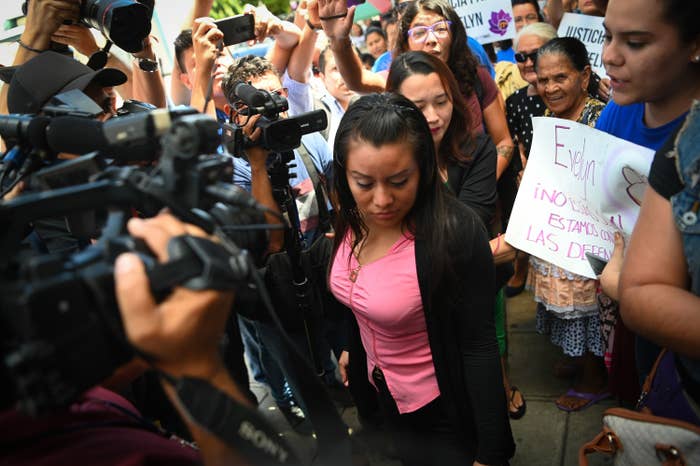
Evelyn Hernández was put on trial — again — last week for aggravated murder after she delivered a stillborn in 2016. After weeks of uncertainty, a judge ruled on Monday that she was innocent.

MEXICO CITY — Marking a new victory for women’s rights in Latin America, Evelyn Hernández, who was convicted three years ago of aggravated murder after delivering a stillborn in El Salvador, was acquitted in a retrial on Monday.

She has become the latest standard-bearer for the dozens of women accused of homicide after having miscarriages in the deeply conservative and machista Central American nation where abortion is banned in all cases, including when the woman’s life is in danger.

Her defense attorneys said that prosecutors ignored scientific evidence during the first trial. For the retrial, they centered their strategy on the presence of meconium in the baby’s lungs as evidence that it died of asphyxiation.

The final hearing of the retrial began on Thursday but the verdict, expected to be delivered that day, was postponed twice. This time around, the prosecution had asked for a harsher sentence: 40 years, a decade longer than the original sentence.

Hernández’s acquittal comes at the heels of the Supreme Court’s decision to commute the 30-year sentences of three women jailed for abortion convictions. Still, legal reform is unlikely to pass the right-wing-majority legislature in the foreseeable future. El Salvador has bucked the regional trend toward liberalization of abortion laws, even as reports of sexual violence have increased in recent years.

“We celebrate today, but we keep fighting tomorrow,” Paula Ávila-Guillén, director of Latin America Initiatives at the Women’s Equality Center, told BuzzFeed News in a phone call after the verdict was announced.

Raped by a member of a local gang while she was still a teenager, Hernández became pregnant but said she didn’t become aware of it until 32 weeks later, when she delivered a baby in a latrine in her home in rural El Salvador. Bleeding profusely, Hernández passed out. She woke up in the emergency room, where she was detained by police.

Hernández served 33 months in jail before her sentence was annulled in February following an appeal from her lawyers. Prosecutors called for a retrial, underscoring the aggressive persecution of women suspected of inducing abortions.

Oscar Rivera / AFP / Getty Images

Evelyn Hernandez arrives at Ciudad Delgado’s court in San Salvador, Aug. 19.

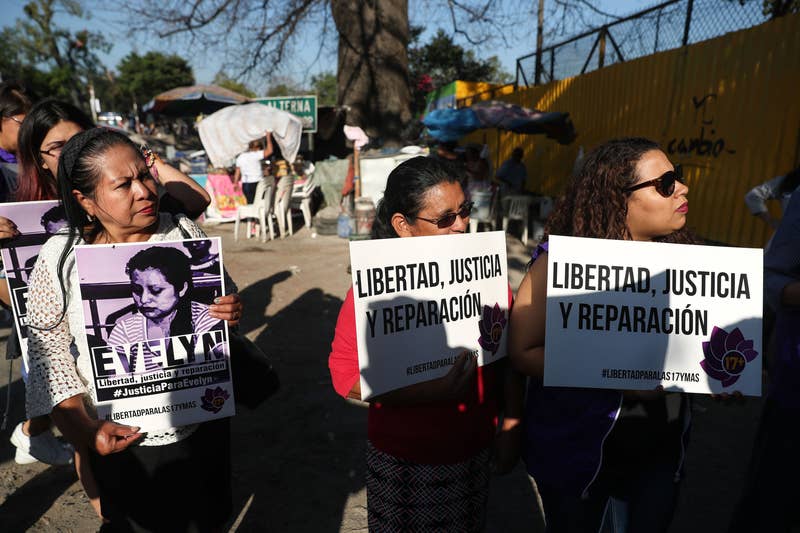
Now 21, Hernández has begun rebuilding her life, going back to school and getting a part-time job. But the threat of a return to prison loomed over her during the last six months. During that time, a collective of 17 women who were imprisoned for similar charges and since released advocated for Hernández’s freedom.

“We will not stop until all of them are free, because none of them deserve to be in prison,” Teodora Vásquez, a member of the collective, told BuzzFeed News.

El Salvador’s recently inaugurated president, Nayib Bukele, who has publicly opposed punishing low-income women who have had obstetric emergencies, has not commented publicly on Hernández’s retrial, which has captured the country’s attention. Instead, he celebrated the birth of his first daughter on Thursday, updating his Twitter bio to “Father of Layla.”

Hernández’s case was the first of its kind tried under Bukele. About 147 women were sentenced to prison for abortion or homicide between 2000 and 2014, according to the El Salvador–based Citizens’ Group for the Decriminalization of Abortion. At least 16 women remain incarcerated for pregnancy-related complications; some are serving 30-year sentences, and two others are in the middle of legal proceedings.

Johnny Wright Sol, a former lawmaker who introduced a petition in 2017 to legalize abortion in cases where the woman’s life is in danger or when a minor has been raped, applauded the verdict but said that there is still work to be done.

“The next step is to sit down and have a long conversation about what happened,” said Wright Sol. “This is not a moment to let up on the pressure.”

Source: https://www.buzzfeednews.com/article/karlazabludovsky/evelyn-hernandez-stillbirth-murder-retrial-acquitted?utm_source=dynamic&utm_campaign=bfsharefacebook&ref=mobile_share&fbclid=IwAR0VrmoaFZ94WiTu-2mKllXOlZIIUVx_JIkj_xaCrZdTVsIIOEP4Ef9sTb4

Evelyn Hernández was convicted of aggravated murder after a stillbirth, but was released after serving 33 months. This week, she is going back to court for the same alleged crime.

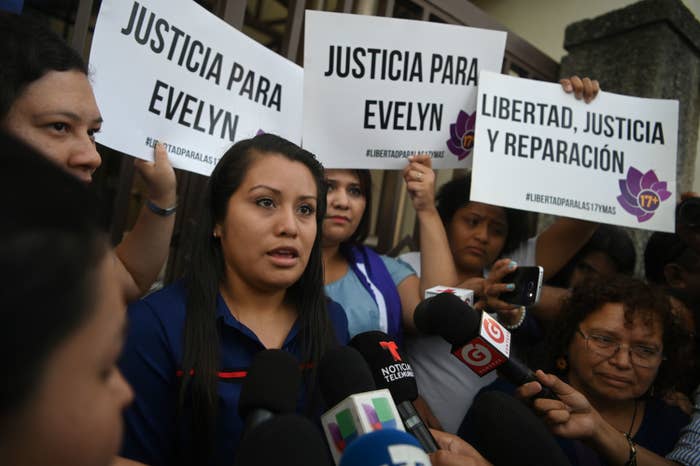
MEXICO CITY — On the morning of Feb. 15, Evelyn Hernández walked out of Ilopango, a women’s jail in El Salvador, where she had been for nearly three years. Looking slightly dazed, she stepped through a crowd of cheering women carrying “Justice for Evelyn” banners outside the gates and into a waiting car.

Hernández, who had been serving a 30-year sentence for aggravated homicide after she had a stillbirth, had become malnourished in prison. But she finally had reason to believe her luck was turning: Her sentence had been annulled following an appeal from her legal team. Since then, the 21-year-old has gotten treatment for her physical ailments, gone back to school, and started a part-time job.

This week, she is heading back to a courtroom to be tried again for the same alleged crime. It’s a date that has been looming over her since she first regained her freedom, as the courts have been preparing to relitigate her case. Thursday’s proceedings come after the retrial began and was swiftly suspended in July.

Hernández is one of dozens of women in the Central American country, which bans abortion entirely, who have been accused of murder by the state after having miscarriages or stillbirths. Her case will be the first of its kind tried under recently inaugurated President Nayib Bukele, who has spoken out against the punishment of impoverished women who have suffered “spontaneous abortions,” putting the new administration’s stance on women’s rights to the test.

In El Salvador, “there is an intentional, systematic persecution of women, of poor women,” Paula Ávila-Guillén, director of Latin America Initiatives at the Women’s Equality Center, a New York City–based reproductive health advocacy organization, told BuzzFeed News.

Over the last decade, activists, lawyers, and international women’s groups have rallied behind Salvadoran women imprisoned for “obstetric emergencies.” Since 2009, more than 38 women have been released from jail, 16 remain incarcerated, and at least three — including Hernández — are in the middle of legal proceedings.

Before her release, Hernández had served 33 months in prison. According to Angélica Rivas, one of her lawyers, Hernández’s first trial ignored scientific evidence and was determined largely by statements from witnesses called forth by the prosecution. This time, the defense is focused on highlighting the presence of meconium in the baby’s lungs, which can cause asphyxiation — and shows that the baby died of natural causes, said Rivas.

Raped by a member of a local criminal gang, Hernández kept quiet, aware that her case would have likely slipped through the cracks of a justice system virtually synonymous with impunity. Machismo is rampant in the country, which has one of the highest homicide rates in the world. More importantly, going to the police would have put Hernández’s and her family’s lives in danger.

Hernández said she didn’t know she was pregnant until 32 weeks later, when she went to the latrine in her small home and delivered a stillborn baby. She started bleeding profusely and passed out.

Marvin Recinos / AFP / Getty Images

Hernández speaks before her trial at the Ciudad Delgados court in July.

A total ban on abortion was put in place in El Salvador in 1998, after an onslaught of pressure by the Catholic Church. The country of 6.3 million people has eluded a growing regional trend toward liberalization of abortion laws: In 2012, Uruguay legalized abortion during the first trimester, while Colombia, Brazil, and Argentina have incorporated exceptions, such as in cases of rape or when the fetus is expected to die — though eligible women and girls have at times been forced to fight the state to access this right.

Efforts to dent El Salvador’s ironclad legislation have been growing. In 2017, then-legislator Johnny Wright Sol submitted a petition to legalize abortion in cases where the woman’s life is in danger or when a minor has been raped. It didn’t garner enough votes to be discussed in the National Congress.

“As is the norm with this issue, it was put back in a drawer and stripped of its importance,” Wright Sol told BuzzFeed News during a telephone interview. He worries that the current administration is so focused on fighting gangs — a push factor for Salvadorans to head to the US, creating a diplomatic challenge for the country — that abortion legislation will take a backseat.

Bukele, who took office this summer, said during a conference at the Universidad Centroamericana José Simeón Cañas last year that abortion should only be available for women when their life is at risk. He also argued that impoverished women should not be presumed guilty after having an unintended abortion.

There are no signs that the law will be modified anytime soon — and any attempt to do so will likely be met with fierce opposition, both from the church and conservative political circles.

Ricardo Velásquez Parker, a lawmaker who has spoken out against abortion, told the BBCearlier this year that the maximum sentence for murder — 50 years — “should be changed to be harsher” for abortion. Parker, whose Twitter profile description has #NoAlAborto and #AltoAlBullying side by side, did not respond to an interview request.

Marvin Recinos / AFP / Getty Images

Activists demanding freedom, justice, and redress for Hernández await her release, Feb. 9.

Teodora Vásquez stood outside the gates of Ilopango in San Salvador, the capital city, the morning Hernández was to be freed. While she waited, Vásquez, 35, thought about how serendipitous timing could be: That day, Vásquez was celebrating the one-year anniversary of her own release from prison after serving 10 years for stillbirth.

“Welcoming Evelyn to her freedom was one of the greatest gifts I’ve ever received,” Vásquez told BuzzFeed News.

In 2007, Vásquez was pregnant and eager for her baby’s arrival. She was at work when she felt a sharp pain in her abdomen. She started bleeding and called 911 seven times; the ambulance never arrived, Vásquez lost consciousness, and her baby was born dead. When she regained consciousness, she was handcuffed, taken to a clinic, and shortly afterward, to prison. Vásquez was sentenced to 30 years.

Vásquez, whose sentence was commuted by the country’s supreme court last year, has become an outspoken defender of women who have gone through similar situations. Since her release, eight other women have been freed, including Imelda Cortez, 20, who spent more than 18 months in jail awaiting trial, suspected of having attempted an abortion. “My freedom was a door that opened for the rest of them,” said Vásquez, “things are beginning to speed up.”

Now, Vásquez leads a collective of 17 freed women who call themselves “Free to Bring Down the Patriarchy,” though she said the group is looking for a new name. Four of them, including Vásquez, live in the same house in San Salvador, where a psychologist visits every weekend to speak to the women. They are all part of a WhatsApp group where they check in regularly, offering each other support through the inevitable bouts of depression. The women, some of whom left prison with a criminal record, have faced stigma from their families and have struggled to get jobs.

Vásquez said she will be at the courthouse Thursday, when Hernández goes back before the judge, cheering her on. Anxious about the verdict, Hernández declined an interview request, but her legal team said she is eager to move on.

“She’s counting down the hours, the minutes, to put this behind her,” said Rivas, “as if it had been a bad dream.”

Source: https://www.buzzfeednews.com/article/karlazabludovsky/evelyn-hernandez-el-salvador-rape-stillborn-trial?fbclid=IwAR1qQzqI-B5RWWLiAjLavhNHjweL7ANrCPxGNNct5iKq_WLUxiZCD6yX7qQ

In a state that’s done the utmost to protect against Trump’s attacks on abortion, clinics are still on the verge of closing.

Two reproductive health clinics in New York City are preparing for the possibility that they will have to close after withdrawing from Title X, the country’s family planning program.

The clinics, both located in Brooklyn, are two of six operated by Public Health Solutions, a nonprofit organization that is no longer eligible to receive Title X funds because of a recent Trump administration policy. The change prohibits federal dollars from going to abortion providers or to health centers that provide abortion referrals to their patients. PHS provides referral services—not abortions—as well as gynecological exams, prenatal care, birth control, STI testing, and other reproductive health care.

The policy, which was handed down in July, has given the roughly 4,000 clinics that currently receive Title X funds an ultimatum: Stop providing abortions—or referring people to clinics where they can obtain abortions—or give up millions of dollars in funding. Clinics have until September to make their choice, but, like many others, PHS has already announced that it will forego the Title X money in order to continue providing the same standard of care it did before.

“We are unwilling to compromise those beliefs by replacing our services with inadequate and incomplete health care,” PHS President and CEO Lisa David said in a statement earlier this month. The network of clinics, she continued, would reject a total of $4.6 million in funding.

Turning down the funds has put PHS’s clinics—which primarily serve low-income New Yorkers—in a precarious position. With funds rapidly dwindling, the Brooklyn Eaglereports that the two clinics, located in the Brooklyn neighborhoods Fort Greene and Crown Heights, may be forced to close in a matter of weeks, unless PHS receives an infusion of cash. If the clinics close, they could be the first to do so as a result of the Trump administration changes.

New York state has prepared for this exact scenario by establishing a $16 million emergency fund for abortion clinics to dip into as a substitute for Title X. But as of this writing, neither PHS nor any other New York clinics have been able to access those funds as they have not been released by the governor’s office. On Tuesday, a spokesperson for PHS told VICE that the organization was still in conversation with the state about securing the funding and directed VICE to the governor’s office for comment. A spokesperson for Gov. Andrew Cuomo’s office declined to comment on the record.

Some advocates say the fact that two New York clinics have already been brought this close to shutting down highlights that even providers in progressive states are feeling the impact of the Trump administration’s mounting attacks on abortion.

Roe v. Wade stands for the principle that abortion is a fundamental right, but that’s far from people’s reality across this country, even in blue states,” said Katharine Bodde, the senior policy council at the New York Civil Liberties Union. “Federal policy can impact abortion access even in states with supportive laws and policies, as we’re seeing here.”

PHS’s struggles to secure funding in the absence of Title X is mainly logistical: Since the network of health centers was a direct grantee of Title X—that is, its funds were paid directly by the federal government—the bureaucracy involved in connecting the organization to the state pipeline for funding has caused a lapse in cash flow.

But the logistical issues involved in getting former Title X beneficiaries access to state funds aren’t the only obstacle to New York clinics staying open. In July, David told AMNY she had concerns that the $16 million set aside by the state could run out. “$16 million in the state budget…is not a lot of money,” she said at the time. ” …What I worry about is disruption in services, not that it won’t ultimately be funded.” A PHS spokesperson told VICE that David was unavailable for comment.

History shows that even a temporary disruption in services can be dire for both patients and providers. Amy Hagstrom Miller, president and CEO of the clinic network Whole Women’s Health, remembers well what it was like to cease operations at multiple Texas clinics as the result of the 2013 state law requiring abortion clinics to obtain hospital admitting privileges.

“Laying off a fabulous nurse, telling them they no longer have a job because of political interference is one of the hardest things we’ve ever done,” Hagstrom Miller said in a June interview about the looming closure of Missouri’s last abortion clinic. If staff members get laid off, “they’ll have to get other jobs, making it very difficult to reopen and rebuild [later on],” she continued. “It might not be something you can afford to do.”

Layoffs are also a concern at PHS—the two clinics in question employ 30 people, according to NY1—though a statement from senior adviser Rich Azzopardi on behalf of New York Governor Andrew Cuomo reassures that the “threats of layoffs are 100 percent avoidable.” Azzopardi also said the administration has been in “constant contact” with PHS to help them access the state funds.

Blue states have ramped up their efforts to fund and protect abortion providers over the last year, in the face of both federal attacks on abortion rights and the increasingly extreme state laws threatening to ban abortion for millions. Multiple states, including New York, have passed legislation enshrining abortion protections into state law. Others have signed laws requiring public and private insurance to cover abortion, and pledged to fund abortion providers through their state’s public health departments instead of through Title X.

But even if providers may be in a slightly better position to continue services in progressive states, Robin Chapelle Golston, the president of Planned Parenthood Empire State Acts, said Wednesday it’s important to remember that nothing about the current environment of abortion access is ideal.

Replacing Title X funds is a “burden on the state,” she said, that forces state officials to “come up with this money that would normally come from the federal government.”

“Title X covers basic health care that most people support,” Golston continued. “These services are not controversial. There’s nothing about this [new Title X policy] that is about keeping women healthy and safe.”

Source: https://www.vice.com/en_us/article/43jk8d/title-x-family-planning-policy-destroy-birth-control?utm_campaign=sharebutton&fbclid=IwAR3CiilBn9KB7r8ouOJLnf9yE4V2qN-JXz_Xj1VmEHb6WdFL5N8K1o3awzc

Illinois, Maryland, and Washington state are replacing the millions clinics will lose when they exit Title X after the Trump administration imposes its domestic “gag rule.”

Washington Gov. Jay Inslee (D) announced in late July that the state would ensure Title X clinics receive state funds, shielding the health-care facilities from complying with the Trump administration’s “gag rule.”
Scott Olson / Getty Images

A handful of states are withdrawing from Title X and replacing the funding so reproductive health clinics won’t have to comply with the Trump administration’s restrictions on the family planning program that serves 4 million low-income patients across the United States.

Meanwhile, Planned Parenthood Federation of America will withdraw its clinics nationwide from Title X if the U.S. Court of Appeals for the Ninth Circuit doesn’t intervene before August 19. The national nonprofit will lose around $60 million by withdrawing from the program, according to the Washington Post.

The restrictions, which went partly into effect in mid-July, ban federal family planning money from going to health-care clinics that refer patients for abortion care. Just a few days later, the administration created confusion by announcing that it “does not intend to bring enforcement actions” against health-care clinics making “good-faith efforts” to comply with the restrictions.

The National Family Planning and Reproductive Health Association called the notice “wholly insufficient.” It said in a statement, “It’s just absurd to think that a few bullet points amount to guidance.” Michelle Kuppersmith, director of Equity Forward, in a statement said the administration’s mixed signals on Title X are “meant to hinder clinics’ ability to operate and encourage health care providers to drop out of the grant program.”

Another domestic “gag rule” restriction that requires clinics maintain physical separation between abortion services and all other health-care services will go into effect next year.

Three states have already stepped in to compensate clinics for the lost federal funding. Officials in other states have said they would assist clinics but haven’t yet clarified their plans. Hawaii Gov. David Ige (D) said in 2018 that the state would reject Title X funding if the administration’s “gag rule” went into effect, and on Friday a spokesperson for the Hawaii State Department of Health said the department is “discussing options and evaluating alternatives for funding services affected by the changes to Title X requirements.” New York Gov. Andrew Cuomo (D) also pledged last year to withdraw from the family planning program if the rule survived court challenges. A spokesperson for the New York State Department of Health told Rewire.News, “We are thoughtfully weighing options that will allow organizations to provide access to critical services without interruption.”

Illinois

Illinois Gov. J.B. Pritzker (D) said July 18 that the state would reject the federal government’s family planning funding, allowing the state’s Title X clinics to continue providing the full spectrum of reproductive health care.

The Illinois Department of Public Health will step in and fund the Title X clinics, which will lose around $2.4 million when the state leaves the program, according to NPR. That money does not include Planned Parenthood of Illinois, which had already announced its plans to reject the Title X dollars. Planned Parenthood served more than 50,000 “female contraceptive patients” in 2015 at its Title X-funded health centers in the state, according to a statement from the organization.

“We will not let that stand in the state of Illinois,” Pritzker said, NPR reported last month. “Under my administration, Illinois will always stand with women and protect their fundamental right to choose. While I’m committed to bringing as many federal dollars to the state as possible, I refuse to sacrifice our values and allow vital care to lapse. In this state, we trust women to make their own health care decisions and will guarantee access to reproductive health care for all of our residents.”

Maryland 

After the administration indicated through its early staffing decisions that it would go after Title X funding, Maryland’s Democratic-held legislature passed a 2017 law to create a state-funded family planning program to help fill any potential gap. Since then, the legislature has continued to support the state’s Title X clinics.

Maryland Democrats passed legislation this year that would fund family planning clinics at the same level as last year despite the state’s loss of federal funding. The move will cost around $4.2 million starting in fiscal year 2021.

The state’s Title X clinics serve more than 67,000 female contraceptive clients, according to 2015 data from the Guttmacher Institute.

“Maryland is very fortunate that our legislators safeguard a woman’s right to access family planning services,” Karen Nelson, CEO of Planned Parenthood of Maryland, told the Associated Press in April. “Our state has to step in far too often to fulfill the responsibility of the federal government.”

Washington

Washington Gov. Jay Inslee (D) announced in late July that the state would ensure Title X clinics receive state funds, shielding the health-care facilities from complying with the Trump administration’s “gag rule.”

Officials said the state began reimbursing Title X clinics July 15, shortly after the administration started enforcing the restriction. More than half of the people who benefit from Title X funding in Washington state live at or below the poverty line, an Inslee spokesperson told Rewire.News.

Title X funds allowed 18,000 people in Washington state to avoid unintended pregnancies in 2017, according to the state’s lawsuit against the “gag rule.” The lawsuit calls the rule “arbitrary and capricious.”

“It reverses longstanding policies and agency interpretations of Title X with no rational explanation or evidentiary support, backtracks from evidence-backed standards of care included in HHS’s own Program Requirements and guidance, and adds unsupported, illogical, and counterproductive new requirements, while ignoring contrary record evidence and failing to consider the grave public health harms the new requirements will cause,” the lawsuit says.

State officials have been among the most vocal opponents of the restrictions.

“The Trump Administration’s effort to muzzle doctors and keep patients from receiving medically sound care and advice is simply not something we will tolerate in Washington state,” Inslee said in a statementshortly after the Ninth Circuit gave the green light to the rule.

State Attorney General Bob Ferguson called the family planning restrictions “outrageous and unlawful.”

This piece will be updated as more states announce plans to circumvent Trump’s domestic “gag rule.”

Source: https://rewire.news/article/2019/08/16/these-states-are-protecting-family-planning-clinics-under-trumps-domestic-gag-rule/