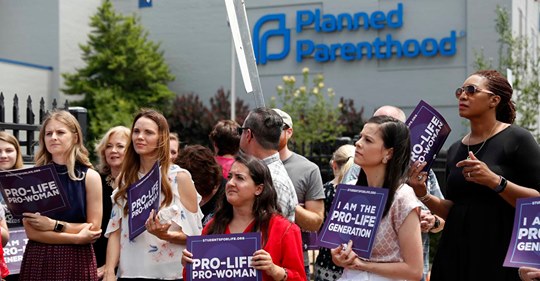
“I just can’t believe that they are so arrogant as to impose this rule on trusted medical providers in our state while the litigation is happening,” said George Hill, president and CEO of Maine Family Planning, shown at a rally in July 2018. Joe Phelan/Kennebec Journal

Maine Family Planning will forgo hundreds of thousands of federal dollars rather than move its abortion services or close its clinics.

The decision was a response to a Trump administration rule that puts new restrictions on abortion providers that receive federal family planning grants. Despite pending legal challenges across the country, the federal government announced Monday it would begin to enforce the rule. Critics including the American Medical Association say the restrictions will limit access to abortion and other medical care for low-income patients, while supporters say taxpayer dollars should not go to abortion providers even though the money is used for other services.

So Maine Family Planning announced Tuesday that it will not accept any more federal money and instead dip into its reserves to maintain its existing services across the state. The nonprofit has been part of the federal Title X program for 50 years and is one of the first to leave it over the new restrictions. Planned Parenthood, which is the largest grant recipient, also has told news outlets that it will not comply with the rule. Others have made similar statements since the rule was proposed earlier this year.

“I just can’t believe that they are so arrogant as to impose this rule on trusted medical providers in our state while the litigation is happening,” said George Hill, president and CEO of Maine Family Planning.

He said he did not want to prevent medical providers at Maine Family Planning clinics from discussing abortion with patients.

“It came down to a mind’s-eye picture of a young person, 15 or 16 years old, getting a pregnancy test result that she doesn’t want and asking one of our providers what her options were and might she be able to get an abortion,” he said. “I don’t want to put our providers in the position of having to respond with simply a referral for prenatal care or the statement that they cannot talk about abortion.”

An official from the U.S. Department of Health and Human Services said the government is working with grantees to help them come into compliance with the rule. She said she has not heard from other grantees about withdrawing from the program.

“While the final rule prohibits referral for abortion as a method of family planning, nondirective counseling on abortion is permitted,” Mia Heck, director of external affairs in the Office of Assistant Secretary for Health, wrote in an email. “The final rule protects Title X healthcare providers so that they are not required to choose between participating in the program and violating their own consciences by providing abortion counseling and referral.”

Federal money cannot pay for abortions except in the case of rape, incest or to save the life of the woman. The Title X program pays for birth control, STD tests and cancer screening for low-income people.

Maine Family Planning is the only Title X grantee in the state and receives nearly $2 million from the program each year. It runs 18 clinics and shares the federal funds with Planned Parenthood clinics and other health centers in Maine. The money represents more than a quarter of the agency’s annual revenue, and more than 23,000 patients in Maine access services through the program ever year.

The new rule bans family planning clinics that receive Title X funds from making abortion referrals – what critics are calling a “gag rule.” The clinics also will be barred from providing abortion services in the same buildings where they provide health services paid for by Title X funds, a requirement that would increase costs for many providers.

Maine Family Planning has said that expense would force it to stop offering abortion services at all but one of its clinics. Under that scenario, Mainers would have only three publicly accessible locations for abortion care across the state – the flagship Maine Family Planning Clinic in Augusta, the Mabel Wadsworth Center in Bangor and the Planned Parenthood location in Portland.

Maine Family Planning and the national Center for Reproductive Rights sued the federal government in U.S. District Court in Maine, and that lawsuit is one of several filed across the country. Federal judges in different courts have alternately blocked the rule and allowed it to take effect, but Hill said no order currently blocks it.

So the federal government announced Tuesday that it would begin to enforce the rule. Hill said he was about to board a plane to Washington, D.C., for a national meeting of Title X grantees when he got the news. Instead, he canceled his flight and spent three hours at the airport organizing the organization’s response. The board agreed to dip into reserves to maintain operations as usual, he said.

“This is the rainy day,” Hill said. “There’s no better use for it than now.”

Hill was unsure whether Maine Family Planning would be required to return any money to the federal government. The nonprofit has received nearly $880,000 so far this year, and it will forgo $825,000 through the end of 2019.

Tax documents show the nonprofit has relied on those reserves to cover operating losses in recent years. It had net assets of $4.7 million at the end of 2016, the most recent year available. Its expenses that year were more than $8.2 million. Hill said the board would need to look for new funding sources if the rule does hold up to pending legal challenges.

“It’s unsustainable in the long term, that’s for sure,” Hill said. “The situation is urgent.”

Some Maine elected officials released public statements Tuesday in support of Maine Family Planning. They included Maine House Speaker Sara Gideon, a Democrat, and U.S. Sen. Angus King, an independent.

“The Trump Administration’s gag rule is a misguided, backward effort to deny Maine people critical health care like cancer screenings and reproductive health services,” said Gov. Janet Mills, a Democrat. “Further, it is an attack rooted in ideology – not in concern for public health – and it will only result in reduced access to health care and less healthy people. …

“I applaud Maine Family Planning for their commitment to keep their health centers open for as long as possible, and my administration will work with them to evaluate if there is any way state government can be helpful.”

Teresa McCann-Tumidajski, the executive director of the Maine Right to Life Committee, said that low-income families can still access free contraceptive services at federally qualified heath centers that provide an array of health care services, but do not perform abortions.

“We are pleased that the 9th Circuit has upheld this ruling which protects our hard-earned tax dollars being used by organizations that promote and provide for the wholesale destruction of innocent human life,” she said.

Source: https://www.pressherald.com/2019/07/16/maine-family-planning-will-forgo-federal-funds-over-abortion-gag-rule/

“It’s vulnerable women who are criminalized. It’s exactly the same thing that will happen in the United States.”

In El Salvador, where abortion has been banned in all circumstances since 1998, activists drew similarities between the two countries’ situations—and told Rewire.News that those concerned about reproductive rights should look to unite with allies beyond their own borders.
Courtesy of Kathy Bougher

Legislatures around the United States have passed increasingly tight restrictions on abortion in the past few years. As the overturning of Roe v. Wade becomes a more realistic possibility, some activists have looked to those in other countries with abortion bans for guidance.

In El Salvador, where abortion has been banned in all circumstances since 1998, activists drew similarities between the two countries’ situations—and told Rewire.News that those concerned about reproductive rights should look to unite with allies beyond their own borders.

“What happens in the United States is not unimportant in our countries,” said Morena Herrera, founder and president of the El Salvador-based Agrupación Ciudadana por la Despenalización del Aborto. “The 1973 Supreme Court decision [legalizing abortion in the United States] has been a reason for hope, a point of reference for women in the world.”

Overturning Roe v. Wade, based on Herrera’s experience, will likely lead to the return of clandestine, illegal measures to have abortions—sometimes risking people’s safety in the process.

In both the United States and El Salvador, Herrera said, “The most vulnerable are the most affected by restrictive legislation. Obviously, this includes women who live in poverty, but also younger women, and those who have less information and less power to make decisions about their own reproductive processes.”

“Let’s be real,” said Paula Avila-Guillen, director of Latin America Initiatives for the Women’s Equality Center. “This is not about protecting a fetus or a possible life. This is about controlling women’s bodies, but it’s also very connected with white supremacy and controlling certain women’s bodies.”

“Women who are privileged will be able to find an abortion. That is nothing different than what we see in El Salvador. It’s vulnerable women who are criminalized,” she said. “It’s exactly the same thing that will happen in the United States.”

The Consequences in El Salvador

In El Salvador, anyone suspected of having an abortion can end up arrested—sometimes while they’re still in the hospital. That includes people who have had obstetric emergencies or miscarriages, who often didn’t know they were pregnant in the first place.

In addition to outlawing all abortion, the Salvadoran government has manipulated the law to convict some women who have obstetric emergencies of aggravated homicide, with a prison term of 30 to 50 years. To date, the Agrupación Ciudadana has worked to free 37 such women from prison. At least 17 remain incarcerated—and as long as the law is in effect, more can be charged and jailed.

Maria Teresa Rivera, for example, served more than four years of a 40-year prison sentence after having an unattended precipitous birth in the latrine of her home. She almost bled to death before arriving at the hospital, where she was charged with abortion and then aggravated homicide. Although she had sought medical attention for various infections during the previous months, neither she nor the medical personnel who treated her had realized she was pregnant. After the Agrupación supported her in a new trial and she was freed from prison in 2016, the government made clear it intended to retry her andimprison her again. She requested and was granted political asylum in Sweden; she is believed to be the only person in the world granted asylum for abortion-related reasons.

Sonia Tábora, meanwhile, spent 12 years in legal limbo after she had a stillbirth in the coffee fields behind her family’s modest rural home in 2005. She was convicted of aggravated homicide and spent more than seven years in prison before she was found innocent in 2012 and again in 2017 after a higher court insisted on another trial; the last court determined that the government owed her reparations.

The fear of being prosecuted like these women has had ripple effects around the country—including, activists say, a number of suicides among adolescents.

The study “¿Sin opciones? muertes maternas por suicidio (Without options? Maternal deaths by suicide)” released by the United Nations Population Fund (UNFPA) in May, analyzed 14 cases of suicide among young pregnant women in El Salvador.

In covering the study for La Prensa Gráfica, Evelyn Machuca noted 18 additional cases that El Salvador’s Institute of Forensic Medicine defined as “suicides where the precipitating factor was an unwanted pregnancy.”

Hugo González, UNFPA representative in El Salvador, told La Prensa Gráfica that “the common denominator in all the cases were the expressions of violence, the absence of information, the lack of comprehensive sexual education, and gaps in the public health system.”

“One of the keys to reducing these numbers and to preventing these situations is, without a doubt, comprehensive sexual education,” according to González, who also raised the need for an “obligatory discussion that the country must have around the decriminalization of abortion.”

“Pregnancy in girls and adolescents must be considered as one of the most impactful forms of violence on the personal aspirations and health of this population,” the UNFPA report emphasized.

“These situations of suicide [in El Salvador] derive from situations adolescents face that have no exit, [which] derive from situations of violence,” Herrera told Rewire.News.

Although there is little existing data for adolescents in the United States, Herrera said, “I’m almost certain that if the U.S. advances this restrictive legislation, they’re going to have to incorporate the variable of suicide among pregnant adolescents.”

Pregnant people, especially adolescents, in El Salvador also face the risk of maternal death. The country’s maternal mortality rate is significantly higher than the United States’ rate, which is itself rising.

“One of the risks of maternal mortality in adolescents—adolescence is a risk factor in general—is premature birth,” said Hererra. “Girls and adolescents face an increased risk of premature birth.”

She pointed out that the Ministry of Health has said “that if you want to reduce infant mortality and diseases in newborns, you have to reduce premature births. And to do that, we must reduce pregnancies in girls and adolescents.”

Activists also fear what may happen when people who need abortions turn to self-managed practices, some of which are riskier than others.

“I see this going to where you do your own abortion,” said Avila-Guillen. “I see how a spike in unsafe abortion will correlate with girls and adolescents trying to Google how to do your own abortion and probably dying. That might be more likely than an increase in suicides.”

“When you have this combination of policies—restrictions on abortion, lack of sexual education, and lack of access to contraception—what you are creating is all the circumstances to actually have a spike on the number of abortions because women will be desperate and do whatever they need to do,” she continued. “That is what ends up sending women either to prison or to hospital beds or to the cemetery.”

“We still don’t know what the reality would be in the U.S. for women and girls and trans people if Roe v. Wade is overturned,” she said.

Medication abortions—which use misoprostol and mifepristone—fall under El Salvador’s ban, but misoprostol is somewhat available through clandestine networks and in some pharmacies for on-label use, such as for ulcers. Some activists say that this has led to a decrease in deaths from “knitting-needle type” abortions. And indeed, there has been rising interest in the United States in self-managed abortion because of restrictions, safety concerns, or personal preference.

Still, Herrera warns that the ban on medication abortion means that someone can’t seek help if they encounter fake pills or unsafe practices from suppliers.

“Yes, [medication] abortion has changed the effect of the consequences of abortion in general,” she said. “However, the clandestine conditions of illegality and lack of safety continue with [medication] abortions because a woman does not have any safety if she confronts bad practices. She cannot make a legal claim.”

Dr. Guillermo Ortiz Avendaño, now with the reproductive rights organization IPAS, was formerly the head of the perinatology department at the National Women’s Hospital of El Salvador. There, he oversaw the case of Beatriz, a woman with lupus and other health concerns who was pregnant with a fetus with anencephaly in 2013. Her quest for a life-saving abortion became a public turning point in the fight to decriminalize abortion in El Salvador.

Abortion bans are “a huge step backward not only in terms of human rights, but also in terms of women’s health,” Ortiz Avendaño told Rewire.News in a phone interview.

Because health providers “have an ethical commitment to women, they will do their best to prevent situations where women are [at] risk,” Ortiz Avendaño said. “However, this can put providers in the position of facing legal uncertainty. They must walk the line between what is permitted and what isn’t while a woman’s health deteriorates.”

“It will become more complicated for women who are searching for services while their pregnancies advance. This puts the women and their doctors at greater risk,” he said. “I’ve already seen this with women in the U.S. who are undocumented and have difficulty finding a provider while their pregnancies are advancing.”

Another significant issue in El Salvador that could arise in the United States, too, is the lack of data on abortions, medical or surgical, legal or clandestine. There is no way to know how many abortions actually occur, the age of those involved, and other important public health data points.

“There is a lack of any kind of registry on abortion in the country,” Herrera pointed out. There are no data points about the results of medication abortion’s availability “because there are no statistics in the country. With the change of the law [in 1998 which ended all legal abortions] that changed what was recorded. We just don’t know.”

What U.S. Activists Can Learn

As in the United States, there are groups on the ground in El Salvador who have fought for the right to access abortion.

The Agrupacion, which has been publicly working to decriminalize abortion since 2009, has been able to “show some of the consequences this legislation has created—the criminalization of women, the judicial brutalization in those processes of criminalization, the confusion between spontaneous abortion or loss of pregnancy spontaneously in advanced stages,” Herrera said.

The Agrupacion works to decriminalize abortion under specific circumstances, to gain the release of women who have been unjustly imprisoned on abortion-related charges, and to change public perceptions around abortion. Its strategies include legal defense, legislative action, media and communications work, direct action, and national, regional, and international alliances.

“I believe that in the political spectrum we still need to work more, to move the will and to make a decision [to change the anti-abortion law]. I think that it will be important to highlight the political consequences for politicians of not widening their perspectives. In that I think that is a pending task, because today they have very few or no consequences,” she said.

“In our part of the world, the little we have we’ve had to fight tooth and nail for every little bit,” said Monserrat Arévalo, director of the Salvadoran feminist organization Mujeres Transformando. “Maybe this is a message for our compañeras in the United States that in fighting for rights, the time is coming to turn the gaze to the south … and see the great cumulation of political struggle that we have in these regions in order to work together as sisters. See these struggles that are so visionary and creative, because I’m convinced that this is not isolated. This is a global struggle that is linked to capitalism too.”

“We must find ways to work together right now and share experiences,” she continued. “How can we share strategies and adapt them to our own realities?”

Source: https://rewire.news/article/2019/07/16/abortion-has-been-illegal-in-el-salvador-for-two-decades-heres-what-activists-say-u-s-feminists-should-know/

In a ruling that pro-abortion rights advocates called “rogue,” an Oklahoma judge upheld a state law on Friday that banned the most common abortion method for women at least 14 weeks into a pregnancy.

Oklahoma County District Judge Cindy Truong declined to strike down the 2015 ban on dilation and evacuation abortions, a method considered to be the “standard of care” for women seeking an abortion in the second trimester, according to Julie Rikelman, Litigation Director at the Center for Reproductive Rights, the group that challenged the state law.

Once a final order is issued by the courts, the law will take effect immediately, though Rikelman said her group plans to immediately appeal the decision to the state’s Supreme Court.

“There really is no other standard method of care for women at that point in their pregnancy,” Rikelman said in a telephone interview with CBS News on Friday. “It really puts doctors and women in an impossible situation.”

Prior to Friday’s ruling, Oklahoma already had substantial regulations and restrictions in place impacting a woman’s ability to receive an abortion, according to data provided by the Guttmacher Institute, a pro-abortion access research organization. Women are required to undergo a 72-hour waiting period before receiving an abortion and private insurances are generally only allowed to cover the procedure in cases of life endangerment, according to the group.

A handful of other states — including Arkansas, Kansas, Kentucky and Texas — have passed similar bans on the specific procedure method, but all have been struck down by judges, according to the Center for Reproductive Rights. In June, the Supreme Court decided not to reviewa lower court’s ruling that struck down an identical ban in Alabama that prohibited dilation and evacuation abortions.

“It is unconscionable to think that we would allow this practice to continue. Judge Truong is to be commended for declaring this legislation constitutional,” Oklahoma Attorney General Mike Hunter said in a statement Friday. “Today is a major victory for basic human decency in Oklahoma.”

Hunter’s office did not immediately return a call requesting further comment.

At Trust Women, a network of women’s healthcare clinics and one of Oklahoma’s three abortion providers, the dilation and evacuation abortion method is “absolutely the most common” protocol for women seeking the procedure in their second trimester, said Julie Burkhart, the co-founder and chief executive officer of the clinic network.

The method is the default choice for doctors at Trust Women because it’s the least invasive, safest, most efficient choice, Burkhart told CBS News on Friday.

“This ruling substantially interferes with our doctors’ relationship with their patients and allowing our physicians to determine what’s the best, safest form of treatment,” Burkhart said. “It’s so frustrating to have that decision making power taken away from these physicians who have gone through medical school and become highly trained in their fields.”

Once the final decision is signed, Burkhart said her clinic will be forced to stop providing the procedure.

“It’s frustrating because I know, and all of us who work in abortion care know, that is not some sort of abstract exercise,” Burkhart said. “This is reproductive healthcare, service delivery, and medicine that everyday people need, request and come to our clinic in hopes of receiving.”

Source: https://www.cbsnews.com/news/oklahoma-county-district-judge-cindy-truong-upholds-state-ban-on-dilation-and-evacuation-abortions-today-2019-07-12/?fbclid=IwAR1u-_5WN_fGP49044QnF3K9yqdZPXYb8_Np2MepAiTbXitPVplHAV4scbQ

Support for legal abortion stands at its highest level in more than two decades according to a Washington Post-ABC News poll, even as numerous states adopt restrictions that challenge the breadth of rights established by the Supreme Court’s 1973 Roe v. Wade decision.

The Post-ABC poll finds a 60 percent majority who say abortion should be legal in most or all cases, up from 55 percent in a 2013 Post-ABC poll, and tying the record high level of support from 1995. The latest survey finds 36 percent say abortion should be illegal in all or most cases, also tying a record low.

In 2013, a Post-ABC poll found 55 percent of Americans said abortion should be legal in all or most cases. The increase in support for legal abortion has increased in part due to large growth in support among independent women voters (up 16 points to 71 percent) and Democrats (up 12 points to 77 percent).

A 41 percent plurality of Americans want their own states to avoid making it either harder or easier for women to have access to abortion. Fewer (32 percent) say their states should make it easier and fewer still (24 percent) say their states should make it harder for women to have access to abortion.

Many states have recently passed laws to limit abortion, and some, such as Georgia, have tried to effectively ban it. Many of these restrictions are being challenged and could eventually wind up before the Supreme Court.

Most Americans have circumstantial views of abortion laws – a majority say that abortion should be either legal in most cases (33 percent) or illegal in most cases (22 percent). About 4 in 10 say it should always be legal or illegal, with roughly twice as many who say abortion should be legal in all cases (27 percent) as say it should be illegal (14 percent).

Even within party ranks, allowing or banning abortion in all cases is a minority position. Among Democrats, 77 percent say abortion should be at least mostly legal, but just over 4 in 10 (42 percent) say it should be legal in all cases. Among Republicans, 52 percent say it should be at least mostly illegal, but fewer than a quarter, 22 percent, want it to be illegal in all cases.

Examining annual averages in opinions toward abortion across Post-ABC and Pew Research Center polling since the mid-1990s, support for legal abortion was last this high in Post-ABC polling in 1995, right before the country saw a decrease in the abortion rate. In 2015, the most recent data available from the Centers for Disease Control and Prevention, the abortion rate reached a historic low.

Opposition to abortion was highest in 2010, when 45 percent of Americans said it should be illegal in most or all cases and 52 percent said it should be legal.

Looking ahead to 2020, just over 6 in 10 Americans say abortion is either “one of the single most important issues” in their vote or a “very important issue.” Democrats are more likely than Republicans to say that abortion is an important issue in their vote for president, 71 percent versus 57 percent.

Asked about Trump’s handling of the abortion issue, disapproval outpaces approval by 54 percent to 32 percent margin. A majority of Republicans (65 percent) approve of Trump’s efforts on the issue, but that lags his 87 percent overall job rating among fellow partisans. Meanwhile, 85 percent of Democrats disapprove, as do 53 percent of independents.

Opinions on abortion do not differ greatly among people living in states with more or less restrictive laws. In the 30 states where abortion is prohibited at 24 weeks or earlier (except in cases of life or health endangerment), a 57 percent majority say abortion should be legal in all or most cases. And residents of the remaining states with fewer restrictions on abortion are slightly more likely to say abortion should be legal (64 percent).

The partisan divide on abortion has increased sharply since the 1990s. An October 1995 Post-ABC poll, which found the same 60 percent of Americans saying abortion should be legal as this month’s poll, found Democrats only 15 points more likely than Republicans to say abortion should be mostly or always legal, 64 percent to 49 percent. That gap now is 36 percentage points, 77 percent to 41 percent.

Men and women offer similar opinions on abortion in the latest survey, with 59 percent of men and 62 percent of women saying it should be legal in all or most cases. Women are slightly more likely to say abortion should be legal in all cases, 31 percent compared with 23 percent of men.

Age is another factor, with a larger share of adults under 30 – 72 percent – who say abortion should be legal than those who are older (58 percent of those 30 to 64 and 56 percent of those 65 and older).

There are sharp differences in support for abortion by religious affiliation. White evangelical Protestants remain the most united against legal abortion, with 62 percent saying it should be illegal in all or most cases, virtually unchanged from 66 percent in 2013. White Catholics are largely split, with 51 percent saying abortion should be legal, and 46 percent saying it should be illegal, also little changed from 2013. Fully 85 percent of those with no religion say abortion should be legal.

This Washington Post-ABC News poll was conducted by telephone from June 28 through July 1 among a random national sample of 1,008 adults, with 65 percent reached on cellphones and 35 percent on landlines. Results from the full sample have a margin of error of plus or minus 3.5 percentage points; the error margin is plus or minus 5.5 percentage points for questions on approval of how President Trump is handling abortion and how important the issue is to Americans’ presidential votes.

Source: https://www.stamfordadvocate.com/news/article/Abortion-support-is-the-highest-it-s-been-in-two-14084550.php

We need to teach young people of all genders about abortion. Here are three ways teachers, parents, and health-care providers can do that.

We need to position abortion as part of the larger reproductive health-care conversation, then equip young people of all genders with accurate information, and give them the skills to talk about this and other aspects of sexuality with a partner.
Shutterstock

As a health educator who works with teens and college students, I regularly find myself addressing a range of complicated issues in the classroom. Probably the most difficult, however, is abortion, something that can feel so political and emotional to so many people. It is also something adults—like teachers, parents, and health-care providers—often present to young people through a gendered lens that positions this procedure as a “women’s health” issue.

The result of this lens is concerning. For one thing, it can silo information. For another, it can reinforce the idea that abortion isn’t a concern for boys. Conversely, it can legitimize the belief that allowing pregnant people to make personal decisions about abortion is unfair to men. Plus, it can alienate trans, non-binary, and intersex youth whose unique experiences are regularly overlooked in these discussions.

To avoid those outcomes, we need to teach about abortion early, and we need to equip young people of all genders with accurate information about abortion, pregnancy prevention, and sexual decision-making.

Here are three ways teachers, parents, and health-care providers can help do that.

When it comes to sex, no one—not sex educators, medical doctors, psychologists, religious leaders, or parents—can agree on what is, or is not, age-appropriate. As a result, the default often omits a range of topics from the conversation. We know this approach can be particularly harmful for LGBTQ youth and for young survivors of sexual violence. It is also becoming increasingly clear that the failure to discuss abortion can allow confusion and misinformation to proliferate. For example, polls have found that people tend to underestimate how common abortion is and to overestimate risks related to the procedure, when in fact abortion is incredibly common and very safe.

We all want to reach young people in developmentally appropriate ways, but as abstinence-only education has shown us, avoiding a comprehensive discussion of sexuality is dangerous. In my experience—and according to numerous experts as well—what tends to be most effective is to provide a broad picture of sexuality to younger kids, and then to add information and detail as they get older. With abortion, this ideally means starting the conversation at the same time you start to talk about pregnancy.

Of course, this is something that may be easier for parents to do than for educators, who may have rules about what they can discuss in the classroom. (Just consider a recently introduced Ohio bill that would require a public school curriculum about the “humanity of the unborn child,” with the stated goal of reaching an “abortion-free society,” and which would prevent teachers from discussing most aspects of abortion.)

For those who have permission to have these conversations, one strategy can be to help younger children learn that many pregnancies end in a baby—but that some end before that, either through a miscarriage or via an induced abortion, and that others are prevented from occurring in the first place by the use of contraception. In their teen years, we can teach in more detail about different types of birth control and about abortion procedures, abortion access, and differing views on the matter. Having a nuanced conversation destigmatizes abortion, helps children avoid black-and-white thinking, and prepares them for a world that doesn’t always follow one script.

2. Teach teens to talk about abortion with a partner before they have sex.

Teens and young people often wonder how they will know when they are ready to have sex. I always say that a good way to figure this out is to start by asking questions. For example, do you want to be in a serious relationship before having sex? Are you comfortable telling your partner your likes and dislikes, and setting and respecting limits? Do you know how to reduce the risk of sexually transmitted infections, and do you have access to condoms? If you have sex with someone where pregnancy is possible, do you know how to prevent this from happening? If you were faced with an unplanned pregnancy, do you know what you would want to do? And, do you know what your partner would want to do in that situation?

People of all ages are often unsure about the answer to that last question. But discussing one’s personal views on unplanned pregnancy and abortion before having sex, as opposed to only doing so after experiencing an unplanned pregnancy, is an important part of demonstrating sexual responsibility.

There are lots of reasons that someone might choose not to have sex with another person, and teens should know that having a different view than a partner about how to address an unplanned pregnancy is a perfectly good one.

Of course, there are plenty of ways to express sexuality without having penile/vaginal sex at all, and that can help avoid the possibility of pregnancy altogether. But a lot of young people don’t get that message, since when they do learn about sex, it is often in a heteronormative context that positions vaginal sex as the “gold standard,” or it is during a formal discussion of reproduction. Such narratives may inadvertently be sending the message that the natural progression of intimacy is a culminating act of vaginal intercourse. That can actually propel young people of all sexual orientations and gender identities into vaginal sex rather than a potentially safer and preferred alternative.

3. Teach young people about their birth control options and help them access it when needed.

Young people of all genders need to have accurate information about birth control. Teens who don’t get comprehensive sexuality education at school may not even know about their contraceptive options or that pregnancy does not have to be the inevitable outcome of sex. So parents and health-care providers should fill in the gaps by ensuring teens are aware of prescription methods of birth control like hormonal contraception or intrauterine devices, as well as condoms, which are available over the counter. Teens should also know about emergency contraception, which can be used up to five days after sex to help prevent pregnancy; since it does not end a pregnancy, it is not the same as the abortion pill. It is available over the counter to anyone regardless of age or gender.

Parents may also need to help teens access birth control by setting up health-care appointments, filling prescriptions, or even just driving them to the drug store.

***

When I first started teaching sex education 15 years ago, it was still common to separate boys and girls for topics like puberty and reproduction. For people who teach comprehensive sex education, this practice has become increasingly less common. But outside of such classrooms, the messages young people hear about a range of sexual and reproductive health issues can remain incredibly gendered and divided.

What we need to do is position abortion as part of the larger reproductive health-care conversation, then equip young people of all genders with accurate information, and give them the skills to talk about this and other aspects of sexuality with a partner. Doing this will help young people avoid a lot of the potential problems and confusion that so often arise when adults aren’t proactive about having these conversations.

Source: https://rewire.news/article/2019/07/12/how-to-talk-to-young-people-about-abortion/

Representative Jay Livingstone spoke during the 2019 Elected for Choice ceremony in June. (NATHAN KLIMA FOR THE BOSTON GLOBE)

“We need you guys” might not be a top-selling T-shirt at the next Women’s March, but it’s a message that women’s rights advocates are increasingly comfortable sending in a national climate growing hostile to reproductive rights. And it’s one that men in leadership positions — like 2020 Democratic presidential hopefuls Cory Booker and Pete Buttigieg — have been amplifying.

After Alabama took steps to ban abortion recently, Booker, a US senator from New Jersey, wrote an open letter in GQ to all men, urging them to action. “Women should not have to face this fight alone,” he wrote, adding that “all people deserve to control their own bodies.”


In Massachusetts, abortion rights advocates who are countering the national trend by trying to expand abortion access actively sought a male ally to sponsor legislation on Beacon Hill.

“We felt strongly that as one of our co-leads, we needed a man,” NARAL Pro-Choice Massachusetts’ executive director, Rebecca Hart Holder, recently told supporters.

Not in a white-knight way, but because women’s issues can be relegated to second-class status unless they are framed as a matter of economic equality and racial justice, she noted.

“Men have to have skin in the game just as much as women do on reproductive freedom issues,” she said. “And honestly, there are quite a few men in the Legislature who really understood.”

On Beacon Hill, men are lead sponsors of numerous issues once regarded as female concerns. Representative Jack Patrick Lewis, a Framingham Democrat, teamed up with Representative Natalie Higgins, a Leominster Democrat, to sponsor a bill that aims to end sexual violence by teaching students about sexual consent, starting in kindergarten.

A few weeks ago, Lewis testified about the bill in the State House with his own kindergartner, Rafael, on his lap. “I’m doing what many of us who are parents do,” he told those assembled at the hearing. “We try to juggle. We try to balance.”


“As the parent of three boys, our family puts a great focus on the need to respect other people’s bodies,” Lewis said. “What our families need though is a Commonwealth that has that same respect codified into law. Which is why I am so committed to passing legislation that requires that sex education be scientifically accurate and inclusive of units on consent . . . along with state laws that truly respect a woman’s right to her own health care decisions.”

Lewis is also one of many cosponsors of the abortion access bill, known as the Roe Act. A lead sponsor — the guy who took up NARAL’s charge — is state Representative Jay Livingstone, a Back Bay Democrat honored by NARAL last month with an “Elected for Choice” award.

His bill would codify abortion rights into state law, eliminate a parental consent requirement for minors, and allow a woman carrying a fetus diagnosed with a fatal anomaly to have an abortion after 24 weeks.

Currently in Massachusetts, later abortions are allowed only to save a woman’s life or safeguard her health. A woman carrying a fetus with a fatal anomaly must either continue the pregnancy — anticipating that the baby will die soon after birth, if not before — or travel to another state where the late procedure is legal, often Colorado.

State Representative Tommy Vitolo, a Brookline Democrat who had a constituent in just such a situation, sees it as a matter of economic justice to accommodate families like hers facing agonizing medical decisions.


“It shouldn’t only be the people with the resources to fly to Colorado who have access,” Vitolo said.

But opponents fear that if later abortions are permitted in those circumstances, they will ultimately be permitted in any circumstances. And like President Trump, they continue to claim falsely that later abortions will lead to fetuses somehow surviving abortion attempts and being left to die in clinics.

So, on the day he received accolades from NARAL, Livingstone was pilloried by the Massachusetts Republican Party, which blasted him in Facebook ads as the sponsor of “the infanticide act.”

Livingstone — just in case this must be said — is not an advocate of infanticide. (He brought his wife, toddler, and baby to accept the NARAL award.) He wants women who get horrible news about their pregnancies to be able to get treatment from their own doctors here in Massachusetts.

“We have the best health care in the United States,” Livingstone told the NARAL crowd.

Livingstone urged abortion rights activists to thank other legislators who are standing up for women’s rights and are being “personally attacked with the worst, most outrageous rhetoric.”

Vitolo, for one, said it’s a matter of principle.

“For me, it’s a values vote. I believe that all women should have autonomy over their bodies,” Vitolo said.

Then, he added thoughtfully: “Men, too.”

Source: https://www.bostonglobe.com/metro/2019/07/10/beacon-hill-and-beyond-women-seeking-male-allies/MprDbDv6Pv27ZcNUiEshcJ/story.html

Alabama Gov. Kay Ivey signed the nation’s strictest abortion ban into law in May, 2019

A UN official blasted the policy of outlawing abortionin some US states as “torture” and said there was a coordinated effort to attack women’s rights.

“We have not called it out in the same way we have other forms of extremist hate, but this is gender-based violence against women, no question,” United Nations deputy high commissioner for human rights, Kate Gilmore, told The Gaurdian.

“It’s clear it’s torture – it’s a deprivation of a right to health.”

Gilmore said that a UN committee has declared that absolute prohibition of abortion is against human right.

“This is a crisis. It’s a crisis directed at women,” she said, adding that the recent laws in Missouri and Alabama that seek to outlaw or curtail most abortions are “deeply distressing.”

The World Health Organization found that 30 women die for every 100,000 unsafe abortions in wealthy countries. But in poorer countries the number rose to 220 while it soars to 520 in sub-Saharan Africa.

“We have to stand with the evidence and facts and in solidarity with women, and in particular young women and minority women who are really under the gun,” Gilmore told the paper.

“This doesn’t affect well-off women in the same way as women with no resources, or able-bodied women the way it affects disabled women, and urban women the way it affects rural women,”

The American Medical Association is suing North Dakota to block two abortion-related laws, the latest signal the doctors’ group is shifting to a more aggressive stance as the Donald Trump administration and state conservatives ratchet up efforts to eliminate legal abortion.

The group, which represents all types of physicians in the U.S., has tended to stay on the sidelines of many controversial social issues, which, until recently, included abortion and contraception. Instead, it has focused on legislation affecting the practice and finances of large swaths of its membership.

But, says AMA President Patrice Harris, the organization feels that, in light of new state laws in the U.S. that would force doctors who perform abortions to lie to patients—put “physicians in a place where we are required by law to commit an ethical violation”—it has no choice but to take a stand. One of these laws, set to take effect Aug. 1, requires physicians in North Dakota to tell patients that medication abortions—a procedure involving two drugs taken at different times—can be reversed. The AMA said that is “a patently false and unproven claim unsupported by scientific evidence.” North Dakota is one of several states to pass such a measure.

The AMA, along with the last remaining abortion clinic in North Dakota, is also challenging an existing state law requiring doctors to tell pregnant women that an abortion terminates “the life of a whole, separate, unique, living human being.” The AMA argues in a statement on the lawsuit that law “unconstitutionally forces physicians to act as the mouthpiece of the state.”

It’s the second time this year the AMA has taken legal action on an abortion-related issue. In March, the group filed a lawsuit in Oregon in response to the Trump administration’s new rules for the federal family planning program. Those rules would, among other things, ban doctors and other health professionals from referring pregnant patients for abortions.

“The Administration is putting physicians in an untenable situation, prohibiting us from having open, frank conversations with our patients about all their health care options—a violation of patients’ rights under the [AMA’s] Code of Medical Ethics,” wrote then-AMA President Barbara McAneny.

It’s an unusually assertive stance for a group that has taken multiple positions on abortion-related issues over the years.

Mary Ziegler, a law professor at Florida State University who has written several books about abortion, says the AMA’s history on abortion is complicated. In general, she says, the AMA “didn’t want to get into the issue because of the political fallout and because historically there have been doctors in the AMA on both sides of the issue.”

In its earliest days, the AMA led the fight to outlaw abortion in the late 1800s, as doctors wanted to assert their professionalism and clear the field of “untrained” practitioners like midwives.

Abortion was not an issue for the group in the first half of the 20th century. The AMA became best known for successful fights to fend off national health insurance. Leading up to Roe v. Wade, the 1973 Supreme Court decision that legalized abortion nationwide, the AMA reentered the fray, and appeared to soften its opposition. In 1970, the AMA board called for abortion decisions to be between “a woman and her doctor.”

But the organization declined to submit a friend-of-the-court brief to the high court during its consideration of Roe. Then, in 1997, in a surprise move, the AMA endorsed a GOP-backed measure to ban what opponents called “partial-birth abortions,” a little-used procedure that anti-abortion forces likened to infanticide.

In recent years, the AMA has taken mostly a back seat on abortion issues, even ones that directly addressed physician autonomy, leaving the policy lead to specialty groups like the American College of Obstetricians and Gynecologists, which has consistently defended doctors’ rights to practice medicine as they see fit when it comes to abortion issues.

Ziegler said it is not entirely clear why the AMA has suddenly become more outspoken on women’s reproductive issues. One reason could be that the organization’s membership is skewing younger and less conservative. This year, for the first time, the AMA’s top elected officials are all women.

One reason the organization may be moving on the issue now could be shifting public opinion on abortion. In 1997, the abortion procedure ban that the AMA endorsed “polled well and allowed abortion opponents to paint the other side as extremist,” Ziegler says.

Exactly the opposite is true today, she says: most public opinion polls show a majority of Americans want abortion to remain legal in many or most cases.

“As abortion opponents take more extreme positions”—as states pass abortion bans more sweeping than those seen at any time since Roe v. Wade— “the AMA is probably a little more comfortable intervening,” Ziegler says.

Molly Duane, a lawyer from the abortion-rights legal advocacy group Center for Reproductive Rights, who is arguing the case for the AMA and North Dakota’s sole remaining abortion clinic, says the laws they’re challenging are “something all doctors should be alarmed by.… This is an unprecedented act of invading the physician-patient relationship and forcing words into the mouths of physicians.”

Leana S. Wen is an emergency physician and the president and chief executive of Planned Parenthood Federation of America.

The turkey sandwich I always had for lunch tasted different. My colleague’s perfume was suddenly overpowering. I could hardly keep awake; when I slept, I had leg cramps and vivid dreams.

I knew before I took the test: I was pregnant.

I was thrilled. My husband and I had been trying for months. We wanted another child, a sibling for our son, Eli, now almost 2. I’m 36; my husband is 44; we didn’t want to wait much longer. Though I worried about how I would do my demanding job with two small children, I also believed that fulfilling my deep desire to expand our family would send a strong message for the organization I represent: We support all people in their decisions when and whether to become parents.

We got more and more excited as we planned for Baby No. 2. If it was a girl, we had a name picked out; if it was a boy, we’d have to go through the baby-name books again. We measured the spare room to turn it into a nursery. We started teaching Eli to be more gentle. I began to plan my maternity leave.

Then, just as suddenly as they’d come on, my nausea, exhaustion and other symptoms went away. I knew even before I went to my doctor that I’d had a pregnancy loss.

When the test results confirmed it, I felt numb. Then I felt the guilt. I knew this was not rational — as many as 1 in 5 pregnancies result in miscarriage, with unsurvivable genetic issues as a major cause of early pregnancy loss. In the emergency room, I’ve counseled many patients who suffered miscarriages. I told myself what I’ve told dozens of women and families, that no one knows what caused the miscarriage, and there’s nothing that could have been done differently. Yet, I couldn’t stop the self-blame: Was it all the travel? Was it the late nights? What if I’d had less stress?

A few days later, I was on a work trip when I started having heavy bleeding and cramping. At the same time I was going through my miscarriage, I was being asked to respond to the breaking story of 27-year-old Marshae Jones facing manslaughter charges (later dropped) for undergoing the same bodily process. Someone shot her in the belly, resulting in her miscarriage, and — incredibly — she was the one accused of a crime. As I spoke, it was hard for me to hold back my tears. How would I have felt if I were Jones — suffering severe bodily harm and mourning the loss of a potential life, while at the same time facing the prospect of imprisonment?

Over the past several months, I’d been on the front lines of the fight against dozens of extreme legislative efforts to ban abortion care. Now, I pictured myself as a woman having a miscarriage in Alabama, Missouri and Georgia. Not only have these states passed bans on abortion early in pregnancy, before many women even know that they’re pregnant, but their new laws also would allow the investigation of women who have had miscarriages to determine whether they, in fact, had an abortion. To be enforceable, any laws that criminalize doctors in this way would require that women be investigated. What cruelty would that be, to compound the trauma of my miscarriage with the indignity of a government investigation into my personal medical records?

Already, in recent years in Tennessee, Wisconsin, Alabama and numerous other states, women have been arrested for endangering their pregnancies by using addictive substances, or falling down the stairs, or taking medications legally prescribed by their doctors. In 2012 in Pennsylvania, Jennifer Whalen brought her 16-year-old daughter to the ER because she was having bleeding and cramping. In the hospital, Whalen admitted that she helped her daughter obtain an abortion by purchasing pills on the Internet. Eventually, she was arrested, convicted and received a jail sentence of nine to 18 months.

If pregnant people are too terrified to seek medical care, they will be forced to make impossible trade-offs, at the cost of their health and lives. I once treated a woman in her late 20s who had a miscarriage complication. If she’d received care early, she could have had a simple outpatient procedure. But by the time she came to the ER, she had such a severe infection that she had to have a hysterectomy and was in the ICU for weeks. My patient suffered serious injury and almost died because she didn’t have health insurance — a situation no one should face — just as no one should have to decide how close to death she needs to be to risk imprisonment for health care.

I was able to return home and visit my regular doctor to receive follow-up care. As I recover over the Fourth of July weekend with my family, I decided to write about my experience because I want to break the silence and shame that often come with pregnancy loss. I also write because my miscarriage has made my commitment to women’s health even stronger. If we truly care about the health of women, children and families, we must commit to policies that provide pregnant women with the care, humanity and dignity that all people deserve.

Source: https://www.washingtonpost.com/opinions/leana-wen-my-miscarriage-has-made-my-commitment-to-womens-health-even-stronger/2019/07/05/43962668-9f3f-11e9-b27f-ed2942f73d70_story.html?fbclid=IwAR2GndwWOJWT4q5i4E5C4YzPbhOSdLnIfD3BJ2iOoPNc_RWOZnHlV45Bl-g&utm_term=.a96c0ec14fce

We’ve marched, we’ve tweeted, we’ve asked nicely but now we want to take the government to court over abortion rights in Northern Ireland, writes Cara Sanquest

Living in London for the past few years, I’ve found that two facts often surprise people here. First, that Northern Ireland is part of the UK; second, that abortion is illegal in Northern Ireland.

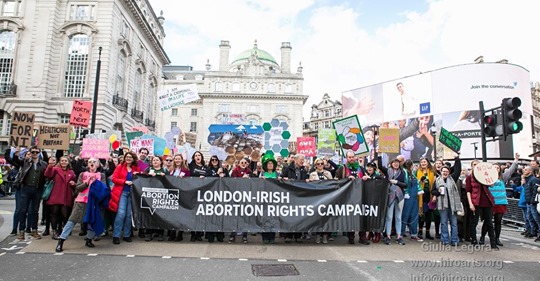
Three years ago, I co-founded a campaign group, the London-Irish Abortion Rights Campaign. We have marched, we have protested. We have written to our MPs, we have tweeted, we have chanted. Women have spoken out about their personal stories, women’s homes in Northern Ireland have been raided by police looking for abortion pills. And nothing has changed. We’ve been ignored by the UK government. We’ve been told that it’s a devolved matter. We’ve been told now is not the right time. We’ve been told to wait.

But we know that ‘waiting’ really means continuing the denial of basic healthcare, risking our lives and our health, sacrificing our autonomy, and keeping quiet while politicians wring their hands. I’m from the Republic of Ireland, and was part of an army of women who fought to repeal the total ban on abortion. We know what happens when change comes too late. I will never forget waking up to the news, in 2012 , that Savita Halappanavar had died in an Irish hospital because doctors would not give her a potentially life saving abortion after being told ‘This is a Catholic country’. In that moment something inside me changed – we were all culpable.

In 2010, Enda Kenny, our then Taoiseach said abortion was ‘not of priority’ when the European Court of Human Rights ruled against Ireland because the total ban forced a woman to travel to England for an abortion while having chemotherapy. In 2014, even after Savita Halappanavar died, the horrors of the Eighth Amendment came thick and fast. Miss Y, an asylum-seeker who had been raped, was turned back from an English port while travelling for an abortion. She went on hunger strike, became suicidal, and underwent a forced C-section. In the same year, a pregnant woman who was clinically dead was kept alive against her family’s wishes.It was called ‘experimental medicine’ and deemed unlawful.

It’s hard to fathom now how the Irish political establishment could claim that calling a referendum was not a priority sooner. Over 35 years, approximately 200,000 women and girls travelled from Ireland to England for abortion. Now, we are seeing the same intransigence in Westminster. How long will this government put its deal with the DUP ahead of providing healthcare to women and girls in Northern Ireland? How long will the government pledge to protect the ‘precious union’ of the UK, but treat women and girls in Northern Ireland as second class citizens? A prominent DUP MP, Sammy Wilson, was ‘not embarrassed’ about Northern Ireland’s abortion laws and said that without them children would be ‘discarded and put in a bin before they were ever born’. How long will the government hide behind devolution to defend its inaction on one of the harshest abortion laws in the world?

On November 18th, the mother of a 15-year-old girl (pregnant as a result of statutory rape) will stand trial in Northern Ireland for getting abortion pills for her daughter who was in an abusive relationship. The police were supplied with the daughter’s confidential GP records without her knowledge.These are the same pills that are available in England. On the NHS. And have been for the past 50 years.

Abortion in Northern Ireland is punishable by up to life in prison. There are no exceptions for rape or incest, or where the foetus will not survive after birth. The United Nations has called the abortion law in Northern Ireland “tantamount to torture”, the UK Supreme Court has “radical reconsideration’  is required and that the law ‘treats women like vehicles’. The UN is clear that devolution is no excuse, but the government continues to use this to justify inaction.

In 2017, an amendment by the Labour MP Stella Creasy, with wide cross-party support, forced the government agreed to waive the fees for women from Northern Ireland to England for abortion. In October last year, a further amendment tabled by Creasy and Conor McGinn passed by a huge majority. This time, it sought to hold Karen Bradley, the secretary of state for Northern Ireland accountable for the human rights violations associated with denial of abortion care and equal marriage rights. But Bradley and the government have continued to pass the buck to Stormont.

But Stormont has not sat for over two and a half years, and next week the government will kick the can farther down the road by postponing elections for another five months. Next week, Creasy will again table a series of amendments to compel the government to take responsibility for its human rights obligations on abortion in Northern Ireland.

Human rights rest on the accountability of governments, but this government seems content with using women and girls human rights as a bargaining chip to stay in power. On Friday, we began legal proceedings against the government, and launched a crowdfund to fund our case. We are a volunteer, grassroots campaign and we are worried about the costs of taking the government to court, but this is happening on our watch, and we are ready to push for change through every route. We might not win our case, but we will keep going. The North doesn’t need to be next. It needs to be now.

Source: https://www.huffingtonpost.co.uk/entry/northern-ireland-abortion_uk_5d23047ae4b0f3125686a6d2?fbclid=IwAR3XVuuyZ8DhykhqdMrNBook3krp4UPnUJqlBj2f6fWTA_Xl7OSMUjTg2T0&guccounter=1&guce_referrer=aHR0cHM6Ly93d3cuZmFjZWJvb2suY29tLw&guce_referrer_sig=AQAAAIHtUKG4w8bBx-ugF7zfXdkj20GF0kEdOXLRpncXcuxOwnIaYBlm-vXeETR73G1K2NO9_Ln8O-7BNdLEyGefDUFlsJsnS5Aj-IOuzGG7z8c6IfckbNp9nLCSdktMklHEWhpzcAxeelctGUw9regAD8wdTx2dw2BG_Hp1YN6hJAXM