Anti-abortion advocates have been misleading the public. Beth Vial sets the record straight.

In this op-ed, Beth Vial tells her abortion story.

In recent weeks, New York and Virginia have made headlines for their efforts to cut the medically unnecessary regulations on later abortion. The bills sought to ensure that people seeking abortions would no longer have to travel out of state for care and, in Virginia’s case, ask one — not three — doctors for approval. The policies even made it into the president’s State of the Union address. Anti-abortion advocates have been intentionally misleading the public about the policies and misrepresenting what later abortion is and why people have them. I know because I had an abortion at 28 weeks.

I’m 23, and I have polycystic ovary syndrome (PCOS) and irritable bowel syndrome, which means I’m in a constant state of pain; I have absent and irregular — if present at all — periods, nausea and vomiting, weight fluctuation from the PCOS, as well as cramping and more from the IBS-C/D, all of which are symptoms of an early pregnancy. I’d recently heard about a friend of a friend who didn’t know she was pregnant and went into premature labor. The idea of being pregnant for that long and not knowing scared me, and taking a pregnancy test is pretty standard anytime I go to the doctor to address PCOS-related issues. So I took a pregnancy test just in case, but the test came back negative and a doctor told me I was infertile due to my PCOS. When the symptoms persisted, though, I sought further care.

It was then that I found out I was pregnant, and then that I started experiencing challenges to accessing an abortion.

Unsure of what to do after I learned I was pregnant, an aide at my doctor’s office told me to go to a clinic, which turned out to be an anti-abortion crisis pregnancy center, for a free ultrasound I thought I needed. There I filled out the paperwork, took a pregnancy test, and went into a small room with a counselor, who gave me a ton of literature and talked to me about my options. Because the crisis pregnancy center didn’t have nurses on staff, she said I would need to go to a different location for an ultrasound. I started to feel weird about the way they were trying to convince me not to have an abortion. But I was panicking, so I was willing to accept any free help I could get.

At the second clinic, they gave me a “diagnostic ultrasound” and broadcasted the image on a huge television screen. They pointed at the fetal parts and said macabre things like “Let’s check to make sure the head is attached.”

I was sobbing and couldn’t bear to look at the screen. They handed me six ultrasound images and said I was 16 weeks pregnant. I explained I wanted an abortion, but they said it was dangerous. I now know it’s a very safeprocedure. I realized they were never going to help me, so I left.

The next day I went to a hospital near my home to get a real ultrasound. That’s when I couldn’t believe what they told me: I was actually 26 weeks pregnant.

All the while, the anti-abortion advocates from the centers I had visited kept calling me day and night, harassing me about my decision. I finally yelled at them on the phone and blocked their number. They made an already stressful situation worse — something crisis pregnancy centers frequently do. They use deceptive practices, like telling someone they are much earlier or later in their pregnancy than they really are, or frightening people with myths about abortion, seemingly in an attempt to sway people away from the procedure.

When I finally saw a doctor who could provide me with an abortion, she said she had to get approval from the hospital board because of hospital policy, which was denied. I cried. I didn’t know what I would do. I didn’t want to continue the pregnancy because I was too sick, not ready, and I simply couldn’t afford it.

Despite living in Oregon, a state with one of the most progressive abortion laws in the nation, I encountered so many obstacles to accessing abortion just because of my situation. Eventually, my doctor referred me to a clinic in New Mexico, but that meant I had to fly across the country just to get an abortion — and it would be expensive. Because I was later in my pregnancy, the abortion would cost $10,500, another $1,500 for blood work and ultrasounds, and about $1,000 to fly there. My insurance would only cover $200.

The clinic told me about the Northwest Abortion Access Fund, an organization that helps people cover the cost of their abortions when they can’t afford it. They helped me cover $1,000, and the National Abortion Federation helped me out with another $1,000. It seemed insurmountable. But thanks to some loved ones, I was able to raise the money.

Two weeks later I flew to New Mexico and stayed with a family friend for six days. It was a long process, but I was able to get the abortion I needed.

Afterward, I searched the Internet to look for later-abortion stories like mine. Most focus on fetal anomalies and health issues, and not the barriers that keep us from being able to access care by design. In fact, research shows that the anti-abortion restrictions on early abortion have created an increased need for later abortion in Texas. I know I’m lucky — I live in a state with no restrictions on when in pregnancy an abortion is allowed and Medicaid coverage of abortion care, yet it can still be inaccessible if we’re misled or just can’t afford it. This is especially true for young people.

People are also impacted by financial constraints in getting access to abortion services. Young people are less likely to be able to afford travel for multiple clinic visits. Even with access to reliable transportation, if we live in an abortion desert or in one of the eight states with only one abortion clinic, we may miss school or work to make it to our appointments. It also means risking disciplinary action by our schools, teachers, or bosses.

A nation that acknowledges our constitutional right to abortion is not the same as a nation that makes abortion accessible to us when we need it. There are no rights without access.

Beth Vial is a leader with Youth Testify, a collaborative program for people who’ve had abortions that is associated with Advocates for Youth‘s 1 in 3 Campaign and National Network of Abortion Funds‘ We Testify. Vial also serves on the board of directors at the Northwest Abortion Access Fund.

Source: https://www.teenvogue.com/story/what-it-was-like-to-get-a-later-abortion?fbclid=IwAR3Tw0YtlOFMIOF1olo9QKTP7e-EhrycFJgVtjM5Nn_5LwAN0tIj6Nz9WxQ#intcid=recommendations_default-similar2_49554511-8a40-4b0d-81b6-2ae483e62935_text2vec1_text2VecSimilarity


“In 2019 we shouldn’t be fighting for the presumption of innocence when a woman loses a pregnancy.”

Evelyn Hernández Cruz, inside the gates of the Ilopango Women’s Prison in El Salvador on Friday, hugging her mother while her father looks on.
Jorge Menjivar

Evelyn Hernández Cruz, 21, was released from the Ilopango Women’s Prison in El Salvador on Friday after 33 months of incarceration for charges of aggravated homicide after she experienced an obstetric emergency in April 2016 during which her baby died. She still faces a re-trial on April 4 of this year on the same charges, but she was granted release under alternative measures to imprisonment as she awaits retrial.

The Agrupacion Ciudadana por la Despenalización del Aborto, or Citizen Group for the Decriminalization of Abortion, in El Salvador has supported her throughout her ordeal and has maintained that she was unjustly accused and convicted. Twenty-two other women remain incarcerated on similar charges related to the country’s absolute ban on abortion.

Hernández’ legal team appealed the original conviction from July 5, 2017, as reported by Rewire.News, but it was upheld in August 2017. Upon appeal to the Criminal Court of the Supreme Court of Justice, that court annulled the original conviction on September 26, 2018, on the grounds that there was not sufficient evidence to justify the conviction. The evidence submitted in the original trial demonstrated that her baby died from meconium aspiration, which occurs when a newborn or fetus aspirates its first feces produced before birth. This can take place before, during, or after birth, and is not a process that the pregnant person can control.

After annulling the decision, the Supreme Court remanded the case to the trial court, which ruled in December 2018 that a new trial must be held, but specified that a different judge must hear the case. But Hernández remained incarcerated, which violated Salvadoran law that prohibits holding an accused person more than 24 months in prison without a final resolution to a case.

In the Court’s decision, which Rewire.News has reviewed, attorney Bertha De Leon argued that Hernández’ right to the presumption of innocence and her right to liberty were violated by her continuing incarceration. De Leon requested that Hernández be released on alternative measures while awaiting her new trial. De Leon’s request was granted on February 14, and Hernández was released on February 15.

Under the alternative measures, she is required to maintain the same residence, stay in the country, and be present for her new trial scheduled for April 4.

The Agrupacion contends that Hernández’ case is part of a pattern in which young women, living in marginalized conditions and lacking access to adequate health care and sexual education, are criminalized by state institutions when they arrive seeking emergency medical care at public hospitals after experiencing obstetric emergencies. The organization continues to fight to free the other 22 women currently imprisoned with similar cases.

Mariana Moisa, communications coordinator of the Agrupacion, spoke with Rewire.News about the effects of the court’s decision to annul Hernández’ original conviction. Moisa said:

There are huge benefits from this decision from the High Court that can help other women in similar cases. They are listening to the legal argument that women are being accused of serious crimes under circumstances that are very unclear. They acknowledge that for Evelyn, and indirectly other women, too, it is extremely difficult to show that there was an intention to do harm on the part of the woman.

This decision also shows that there are some changes in the judicial system. Until recently it was just a given that all these women were bad people. Now there is a window of doubt on that view. It’s a sign that Salvadoran society is changing. Even a year ago one of the major newspapers was publishing terrible stories about Evelyn, pages of horrendous accusations. Now, stories leave open the possibility that women like Evelyn could be innocent.

The downside to the decision was that the court could have absolved her at that point, and they didn’t. Now she still has the uncertainty of the April 4 trial.

On this day of celebration for Hernández’ freedom, Moisa also pointed out the dangers of normalizing this struggle. She warned, “What we have to watch out for as we celebrate, rightfully, each time a woman is freed from prison, is that this struggle does not become normalized. We don’t want to naturalize this fight because it exhausts us, it wastes resources that we shouldn’t have to use. This is not a normal situation.”

Moisa explained how the law hasn’t always been this way. “Only when the law changed in 1997,” when the legislature reformed the law to prohibit all abortions, “did we start to see normal occurrences as crimes,” she said.

“In 2019 we shouldn’t be fighting for the presumption of innocence when a woman loses a pregnancy. We shouldn’t have to be proving that motherhood is not related to crime. We should have full human rights as Salvadoran women,” said Moisa.

Source: https://rewire.news/article/2019/02/15/woman-detained-after-obstetric-complications-released-from-prison-in-el-salvador/

When Ohio legislators in December passed the heartbeat bill, which would make abortions illegal once a fetal heartbeat can be detected, former Gov. John Kasich’s refused to sign it into law.

But state legislators — who came one vote short of overriding Kasich’s veto — are giving new life to the bill, which is expected to pass in March. Ohio Gov. Mike DeWine, a pro-life Republican, has already vowed he will “absolutely” sign the controversial legislation. The bill is being introduced in both houses by Republicans, in the state Senate by Kristina Roegner and in the House of Representatives by Ron Hood and Candice Keller.

Both sides of the abortion debate are preparing for the possibility of Roe v. Wade being overturned. Roegner said the heartbeat should be the new standard, not the viability of the fetus.

“The presence of a heartbeat is a universally recognized sign of life,” Roegner argued Wednesday. “If government exists to protect the weak and vulnerable, then the point when that begins should be clear.”

The law, formally known as the Human Heartbeat Protection Act, could ban abortions as early as six weeks — or before most women know they are pregnant — as supporters point to how medical technology can now detect the preborn child’s heartbeat that early.

“Ultimately, this will work its way up to the United States Supreme Court,” DeWine told conservative radio host Hugh Hewitt last month. “And they’ll make that decision.”

The Ohio Planned Parenthood chapter slammed the bill as soon as it was announced.

“The early introduction of the SB 23, the unconstitutional six-week abortion ban, highlights the misguided and dangerous priorities of our state legislators. This bill seeks to ban abortion before most people know they’re pregnant,” the group wrote. “It’s shameful.”

Ohio Right to Life, which was previously neutral on the legislation, has pegged the bill as their top legislative priority.

“A detectable heartbeat is the clearest indicator that life is present,” Mike Gonidakis, president of Ohio Right to Life, said in a statement. “Ohio law should recognize this reality and protect unborn babies with a heartbeat. Ohio continues to lead the nation in advancing pro-life policy…we believe that the Human Heartbeat Protection Act is the next step in our incremental approach to end abortion-on-demand.”

A similar bill that passed in Iowa was struck down by a judge because it violated the state’s constitution.

Source: https://www.foxnews.com/politics/ohio-reintroduces-heartbeat-bill-with-new-pro-life-governor?fbclid=IwAR0cJXYuJYjPjt0qXauIsmu7phC_OzBxkmGVfZxeeltWjX0Xo1zmu31BkSY

“It’s high time we address the needs of Native women.”

A panel of experts gave a briefing to a packed room of U.S. House of Representatives staffers Tuesday in hopes of bringing attention to the reproductive and maternal health concerns of Native people in the United States.

In a session organized by Rep. Deb Haaland (D-NM) along with the Center for Reproductive Rights and the U.S. Human Rights Network, Native leaders called on Congress to provide more federal money to community organizations that are already doing critical maternal and reproductive health care, and to honor treaty promises that include providing quality health care to tribal members.

Native reproductive health is a priority for Haaland, one of the first two Native women ever elected to Congress. “When mothers are healthy and thriving, their children can also grow and thrive, but there is a lack of services that promote maternal health in Indian Country,” she said in a statement emailed to Rewire.News. “That’s why I didn’t hesitate to bring the voices of expert Native women to Congress to talk about maternal health in the indigenous community. Bringing attention to this incredibly important issue will help us develop policy solutions that empower women and support healthier mothers and families.”

One policy change suggested by the panel’s experts was repealing the Hyde Amendment, a budget rider that bans federal funding from going toward abortion care except in instances of rape, incest, or life endangerment. “The Hyde Amendment disproportionately impacts those who predominantly rely on federal funding for their health care, such as Native” women, said Lauren van Schilfgaarde, one of Tuesday’s panelists and an attorney at the Tribal Law and Policy Institute, in an interview with Rewire.News after the briefing.

Van Schilfgaarde pointed out that Indian Health Services (IHS), the agency responsible for Native health care, is 100 percent federally funded. “The Hyde Amendment has really acted as a full prohibition in effect for IHS. Very few if any IHS facilities offer any abortion services whatsoever. So if a woman were to come in who was a victim of sexual assault, even though she’s entitled to abortion services to be paid for, she’s not going to be able to get them,” van Schilfgaarde said.

Using an example of a pregnant Native woman from South Dakota, van Schilfgaarde explained how Hyde acts as an abortion ban people in poverty. In her scenario, a pregnant Native person in South Dakota may be forced to wait up to eight weeks for their first prenatal appointment with IHS, which doesn’t offer abortion care. From there, they’d have to figure out if Medicaid would cover the abortion (it doesn’t), and then travel at least three-and-a-half hours to the state’s only abortion clinic in Sioux Falls. They’d have to pay to stay overnight in a hotel room to satisfy the state’s mandatory 72-hour waiting period, which doesn’t include weekends or holidays. Additionally, they would have to undergo state-required “counseling” designed to dissuade patients from having an abortion.

“She’s going to have to pay to drive, pay to stay overnight, as well as take time off work, [and] pay for any child care,” said van Schilfgaarde. “All of these expenses come out of pocket, and she’s the least likely to be able to afford [it]. That’s not even accounting for the trauma that she’s just endured, the trauma of navigating all of these issues, and the trauma of enduring the abortion itself. All of that serve as a huge barrier that most other women don’t encounter …. The Hyde Amendment is just not acceptable.”

The Hyde Amendment wasn’t the only issue discussed by the panelists. Melissa Rose, a Native midwife with the Changing Woman Initiative, a nonprofit health-care collective centering Native American women, discussed the barriers this population faces in accessing midwifery care and midwifery training. “Around the world, the midwifery model of care is the gold standard,” she said in an interview with Rewire.Newsshortly after the briefing. “Most women who are healthy receive care from midwives, [but] in the U.S. it’s marginalized within the health-care system. So that means that it’s not integrated into the health-care system in a way that makes it accessible for people, especially Native people, because we do receive our health care through the federal delivery system of Indian Health Services.”

There’s been significant congressional interest in addressing the country’s abysmal maternal mortality rate. Maternal death rates are higher in the United States than most industrialized nations even though we spend more money on health care than countries with comparable levels of economic development. According to a 2016 report from the American College of Obstetricians and Gynecologists, the rate of maternal death in the United States in 2014 was about 24 deaths per 100,000 live births. But a deeper look at the numbers reveals that the main driver in the country’s high rate is wide racial disparities in pregnancy-related deaths, specifically the extremely high mortality rate for people of color and Native people compared to other races.

Native people in the United States experience maternal mortality at a rate 4.5 times higher than their non-Hispanic white peers. Rose said increasing access to midwifery care, which is not always reimbursed by Medicaid, should be an integral part of solving that issue.

Though certified nurse midwives are utilized within IHS, Rose said they follow a federally required medicalized birthing model, rather than a traditional midwifery model. “[The medical model] treats pregnancy as a pathology, as a disease,” she said. “Whereas, on the other hand, the midwifery model assumes health and normalcy. We also rely heavily on evidence-based practices as midwives, and oftentimes within the medical model, practices are dictated by insurance companies’ protocols or institution-based protocols, like a hospital, clinic or state.”

Organizers of the congressional briefing hope that the staffers who attended will take Tuesday’s information and translate it into legislation that will make a real impact for the Native population. “The need to address the needs of Native women became apparent to us in the course of our work,” said Jennifer Jacoby Altscher, who delivered the briefing’s opening remarks and is the federal policy counsel for the Center for Reproductive Rights, in an interview with Rewire.News. “With [Haaland’s election] we can start to bring the real experts into Congress, and start to legislate around this issue given the immense interest in maternal health [in Congress]. It’s high time we address the needs of Native women.”

Source: https://rewire.news/article/2019/02/13/native-leaders-brief-congress-on-reproductive-health-priorities/

South Carolina lawmakers have introduced legislation that seeks to criminalize abortion and make women and their doctors subject to felony charges if they receive or perform the procedure. Their efforts mark the latest state-level push to restrict access to abortion as politicians across the country prepare for a potential overturn of Roe v. Wade by the U.S. Supreme Court.

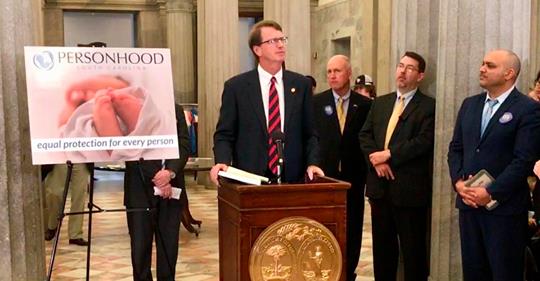
State Senator Richard Cash and state Representative Josiah Magnuson separately introduced “personhood” legislation to South Carolina’s legislature this session. The House bill specifically seeks to “establish that the right to life for each born and preborn human being vests at fertilization.” By defining the beginning of life at fertilization, the proposals would effectively prohibit abortion, granting that the unborn can’t be “deprived of life without due process of law nor denied the equal protection of the laws.” The Senate bill matches that language.

Magnuson’s law makes exceptions for when the mother’s life is at risk, and specifically clarifies that the bill would not impact access to birth control methods. Cash’s legislation has similar exceptions, but it also proposes that having or performing an abortion be deemed a felony, referring to abortion as “the shedding of innocent blood.”

However, the bills would not take effect — even if they become state law — unless the Supreme Court moves to overturn its 1973 Roe v. Wade decision, which prohibited states from banning abortion prior to fetus viability. The landmark ruling secured a woman’s right to access the procedure across the U.S., regardless of state.

Cash, in a telephone interview with CBS News, said that the purpose of his bill was twofold. First, if passed, the legislation could be used to challenge the high court’s ruling on abortion access, potentially prompting an overturn of the original decision. Second, if Roe v. Wade is overturned, South Carolina would already have anti-abortion laws in its books, making the procedure immediately illegal, Cash said.

“We’re always hopeful in moving the needle and challenging the way people think about the killing of unborn children,” said Cash, who has spent his entire professional career fighting against abortion. “There’s a need and urgency to do something at the state level and not just wait for someone else.”

Elizabeth Nash, a senior states-issue manager at Guttmacher, called it “very concerning.”

“This bill could have some momentum given the political climate,” she told CBS News.

Cash’s bill was introduced and referred to committee Wednesday, according to the state legislator’s website. Magnuson’s was introduced and referred to committee in January.

South Carolina lawmakers, including Cash, have introduced several “personhood” measures in the statehouse in previous sessions, but all have failed to pass.

Magnuson did not immediately respond to calls and voicemails requesting comment.

South Carolina Republican Sen. Richard Cash reintroduces personhood legislation at pro-life event Wednesday, Feb. 6, 2019, inside the lobby of the Statehouse.CHRISTINA MYERS/AP

With a Republican White House and increasingly conservative Supreme Court, some believe that the days of Roe v. Wade may be numbered. During a 2016 presidential debate, then-candidate Donald Trump said he foresaw the ruling being overturned if he were elected because he planned to appoint pro-life judges. He stressed the issue again in a speech before the 2018 midterm elections.

The Supreme Court has not agreed to hear a direct challenge to Roe. But if it eventually does, and if a majority of the justices vote to overturn that precedent, it would be up to individual states to determine whether to restrict or outlaw abortion within its borders.

The proposals in South Carolina are similar to laws passed in other states. Voters in Alabama approved a state ballot measure in November that amended the state constitution to include that its policy was to protect “the sanctity of unborn life and the rights of unborn children, including the right to life.” The legislation also clarified that the state’s official stance on abortion was to “ensure the protection of the rights of the unborn child in all manners and measures lawful and appropriate.”

In the event that justices overturn Roe v. Wade, the law would immediately take effect and outlaw pregnancy-ending procedures. Two other states — Kansas and Missouri — have similar “personhood” laws in place that would go into effect if Roe is overturned.

In blue-leaning states, politicians have gone the other direction, successfully passing laws that dramatically expand a woman’s access to abortion. In New York, lawmakers passed the “Reproductive Health Act” last month which allows for abortions after 24 week if the fetus is not viable or if there is a risk to the mother’s health.

Last week, Virginia’s embattled Governor Ralph Northam expressed his approval of a sweeping Virginia abortion bill that would expand abortion access in the state by eliminating a 24-hour waiting period. It would also allow the procedure to take place in non-hospital settings if it is performed during the second trimester, and widen availability to third-trimester abortions in the event that the mother’s health is at risk.

During his State of the Union address on Tuesday night, President Trump took aim at the hot-button issue, vowing to end late-term abortions while asking Congress to “work together to build a culture that cherishes innocent life.”

Source: https://www.cbsnews.com/news/south-carolina-abortion-law-criminalizing-abortion-roe-v-wade-overturn-2019-02-07/?fbclid=IwAR3dEfeDUP4UT4bHiH_fLqrIGPjlwkKrx-Kyp15rwwVh47PliDT2__vuV4U

Massachusetts Democrats are primed to pass a series of pro-choice bills, including one that would provide medication abortion at colleges across the state

Massachusetts state Rep. Lindsay Sabadosa (D-Northampton) has seen how hard it is for low-income families and students on remote college campuses to access or pay for abortion care.

A new lawmaker and the first woman to hold her district seat, Sabadosa has volunteered with the Planned Parenthood Advocacy Fund of Massachusetts and been on the board and intake team of the Abortion Rights Fund of Western Massachusetts. A founding board member of DARLA, the Doula Association for Reproductive Loss and Abortion, Sabadosa told Rewire.News she drew from her experience to introduce bills this session to expand reproductive access in the Bay State and set a high standard for health care.

HD 3658 would require public universities to provide medication abortion, a nonsurgical regime of two drugs. The “Act to Establish Health Equity for Pregnant Persons,” HD 3274/SD 1450, would get rid of co-pays for abortion care.

“Even though we have some fairly good laws in Massachusetts around abortion, financial abilities really impact access, so it felt like it was important to address a problem I’m seeing regularly,” Sabadosa said.

MassHealth, the state’s Medicaid and Children’s Health Insurance Program, covers abortion care, but most private insurances don’t. People have called the Abortion Rights Fund to complain about the high cost of their deductible and how they have to basically pay for the procedure out of pocket, Sabadosa said.

“Unfortunately we live in a world where $730 for an abortion makes it completely inaccessible for most people. That’s only the cost of a medical abortion during the first ten weeks; it gets exponentially more expensive after that,” she said. “So it struck us that really this is an economic disparity. We are charging people with uteruses more money for health care. Pregnancy is another area where the costs are exponential, so women or people with uteruses are being penalized simply because these are health services they may require at some time in their lives.”

The bill would require health insurance plans cover all pregnancy-related care, including abortion care, prenatal care, childbirth, and postpartum care, without cost sharing.

“Pregnancy care—prenatal, labor and delivery, and postpartum care are fundamental to ensuring healthy pregnancies and babies. To see Massachusetts make pregnancy coverage a priority along with abortion and other reproductive health care shows that they are putting patients first,” Elizabeth Nash, senior state issues manager at the Guttmacher Institute, said in an email.

California’s Democratic-majority legislature last year passed a first-of-its-kind bill to provide medication abortion on college campuses, but Gov. Jerry Brown (D) vetoed the measure after some university officials pushed back against the pro-choice bill. The bill would have affected more than 400,000 students on campuses across California.

Sabadosa is finalizing a bill requiring medication abortion options be available at public college campuses in the state. “We have a lot of students at UMass Amherst who have a hard time getting to a clinic to get abortion care because the nearest clinic is in Springfield, which is not close, and there is no public transportation to get there,” she said.

After repealing antiquated anti-choice laws last year, Massachusetts legislators are looking to further bolster abortion access with the newly filed Remove Obstacles and Expand (ROE) Abortion Access Act (HD 2548/SD 109), which aims to remove anti-choice restrictions.

“The ROE Act breaks down barriers to ensure that women are able to receive appropriate medical care, according to a physician’s best judgement, in tragic circumstances when there are lethal abnormalities or a risk to the woman’s life during the course of a pregnancy. The law should reflect that these are very difficult decisions that should be made between a woman and her doctor,” sponsor Sen. Harriette L. Chandler (D-Worcester) said in a statement.

This is a top priority for advocates because it “removes the onerous, shaming, and medically unnecessary restrictions that deny people care in Massachusetts,” Tricia Wajda, vice president of external affairs at the Planned Parenthood Advocacy Fund of Massachusetts, said in a statement. “This important legislation reflects the values of the vast majority of people in Massachusetts who believe women should make their own personal health care decisions, and who support the right to access abortion safely and legally, without interference from politicians.”

The ROE Act would go above and beyond the protections of Roe v. Wade, advocates say, by not only codifying the right to abortion but also removing obstacles like parental consent and forced waiting periods; allowing for abortions after 24 weeks in cases of lethal fetal anomalies; ensuring medical decisions remain between a patient and doctor; and removing medically inaccurate terms like “unborn child” from state law.

Sabadosa’s two bills, which would reduce the expense of abortion care and expand medication abortion access to public universities, could surpass both the Roe protections passed by Democrats in New Yorklast month and Oregon’s reproductive rights laws, often considered the gold standard in abortion protections, activists said. In addition to making private health insurance providers cover the cost of abortion care, Oregon pays for undocumented residents to receive abortion care.

“Massachusetts has a long history of leading the nation on health care access. In this uncertain environment, we must be visionary and articulate a clear vision of reproductive freedom for all Bay Staters,” Rebecca Hart Holder, executive director of NARAL Pro-Choice Massachusetts, said in a statement. “Passage of the ROE Act will ensure the people of Massachusetts are able to access the care they need without political interference.”

Massachusetts lawmakers expect Gov. Charlie Baker (R) to sign off on all three bills. Baker has opposedthe Trump administration’s anti-choice policies and has supported the right to abortion care.

Baker’s office did not respond to a query from Rewire.News.

“Individual rights and freedoms, including the right to access safe and legal abortion, are at the heart of who we are as a Commonwealth, but that commitment to reproductive freedom and equitable access to health care is blatantly missing from our current laws around abortion,” Wajda said. “As a state known as a health care pioneer, Massachusetts’ laws must trust medical professionals, end government intrusion into personal medical decisions, and declare that abortion is health care.”

Source: https://rewire.news/article/2019/02/12/uteruses-are-being-penalized-massachusetts-sees-pro-choice-legislative-blitz/

The Supreme Court Thursday evening announced it will keep in place a stay that blocks a restrictive Louisiana abortion law. Chief Justice John Roberts joined the Court’s four liberals in preventing the law from going into effect.

The brief order gives the Center for Reproductive Rights, which is challenging the law, time to file a petition for certiorari. The Court, if it chose to hear that petition, would then rule on the merits of the case. The order is not a ruling on the merits of the case—only a ruling on whether an emergency stay is appropriate.

Justice Brett Kavanaugh wrote a dissent arguing that the law should go into effect so that the Court can see how it affects state abortion clinics. He argues that the law might not have a dramatic effect on abortion availability. The dissent does not speak to the merits of the case, and cites only procedural issues.

Both opponents and supporters of the law agree that it would likely force all but one Louisiana abortion clinic to close.

Understanding Louisiana’s Abortion Law

In 2014, Louisiana enacted a restrictive abortion law that would require all abortion doctors to have privileges at hospitals within 30 miles of their clinics. The law would close all but one Louisiana abortion clinic.

The Supreme Court previously struck down a substantially similar Texas law in Whole Woman’s Health v. Hellerstedt.

Citing that ruling, the Center for Reproductive Rights challenged the law. A district judge in Louisiana initially blocked the law, but the state appealed to the 5th Circuit Court of Appeals. A three-judge panel held that the law differed substantially from the Texas law, and reversed the ruling of the lower court. The 5th Circuit is the same federal court that ruled in favor of Texas in Whole Woman’s Health, only to be later reversed by the Supreme Court.

The Center for Reproductive Rights appealed to the Supreme Court. The Court last Friday issued a temporary stay to block the law from going into effect February 4th. Now the stay is extended, and the law will not go into effect Friday, as it otherwise would have.

Chipping Away at Roe

Record numbers of Americans—70% or more—believe that Roe v. Wade should not be overturned. One recent survey even found that half of Republicans do not think the ruling should be reversed.  Republicans know that an outright reversal of Roe will be difficult, so they’ve instead opted to slowly chip away at it. The goal is to make abortion technically legal, while still inaccessible. Over time, they can slowly erode the law with new precedent, and perhaps eventually reverse it.

Central to this strategy is lying. We’ve seen this already with the response to New York’s recent move to protect abortion rights. The far right now insists that mothers routinely abort babies at 40 weeks, just for the fun of it. They hope that judges will believe them, and act to protect babies from their apparently homicidal mothers. The media is an enabler here. A 2016 study found that media coverage of abortion prominently features men lying about abortion.

Right now, there are at least 13 cases that could eventually make their way to the Supreme Court. The Louisiana law is just the beginning of the right’s long-game strategy. They remain mobilized and energized. Meanwhile, many on the left are unaware of the immediate threat to Roe.

Though 85% of voters say they do not want new state-level abortion restrictions, less than half have heard of these laws. Only about half say they are aware of the immediate threat to abortion rights.

Anti-Life, Anti-Choice

As the right attempts to destroy choice, they also continue to enact every conceivable strategy to harm families who opt to keep surprise pregnancies. They’ve done nothing to halt the epidemic of maternal deaths. The U.S. is now the most dangerous developed nation in which to give birth. They steadfastly oppose all strategies that are proven to reduce abortion rates. And they do not want to offer any support—food stamps, welfare, health insurance—to babies born to impoverished mothers.

Anti-choicers don’t care about life. They care about punishing women, including through the suffering of children.

Source: https://www.dailykos.com/stories/2019/2/7/1832991/-Supreme-Court-Upholds-Stay-to-Block-Louisiana-Abortion-Restriction?utm_campaign=recent

Democratic gains in the 2018 midterms have produced a range of pro-choice bills across the United States that would repeal abortion restrictions and open up abortion access.

As pro-choice legislators in states like New York fight to protect Roe v. Wade, lawmakers across the United States are joining the fray by filing pro-choice bills as reproductive health advocates are suing to remove discriminatory laws.

From bills to decriminalize abortion access in Nevada to states fighting back against the Trump administration’s rollback of the birth control benefit, legislators are pushing to protect access to reproductive health in 2019 while an anti-choice administration and Supreme Court threaten to curtail it.

It seems as if the pro-choice laws passed in California and New York are saying to legislators in more conservative states that change is possible after years of Republican-backed laws eroding access to abortion and contraception, Elizabeth Nash, senior state issues manager at Guttmacher Institute, told Rewire.News.

“We have really started to see legislators in hostile states trying to change the conversation and push back, eventually saying enough is enough,” she said. “These bills mean that people are looking at all the ways to expand reproductive access.”

Nearly half the country, 21 states, is considered “hostile” or “very hostile” to abortion policy, a marked change from 2010, when ten states were hostile and none were deemed as very hostile, according to Guttmacher’s latest analysis. A lot of this activity is in response to the composition of the U.S. Supreme Court, Nash said.

However, there is a pro-choice majority in the U.S. House of Representatives for the first time in nearly a decade, and a record number of women and pro-choice legislators nationwide after the midterms, signaling a new era.

Safeguarding Roe protections in the states 

States celebrated the anniversary of the landmark 1973 Roe v. Wade decision last month, and New York, where Democrats control both chambers of the legislature for the first time in a decade, passed the Reproductive Health Act after a lengthy fight to enshrine those protections statewide.

New Mexico and Nevada could be next to ax pre-Roe abortion bans with pro-choice bills. Lawmakers in Rhode Island, which has a new pro-choice majority, held hearings last week in the continued effort to pass similar Roe protections that anti-choice Democrats there have repeatedly blocked.

The “Trust Nevada Women Act” seeks to repeal criminal penalties for abortions performed outside the scope of Nevada’s abortion statute, including self-induced abortions, which are punishable by a minimum one-year and maximum 10-year prison sentence and a fine of up to $10,000 under state law. It seeks to change the state’s abortion informed consent law, and repeal the state’s forced parental notification statute, which was ruled unconstitutional in 1991, according to the Nevada Independent.

New Mexico Democrats are trying to remove its criminal penalties for abortion. The bill passed the house on Wednesday and will be considered in the state Senate. Democratic Gov. Michelle Lujan Grisham intends to sign it.

Massachusetts repealed antiquated abortion laws last year but is looking to further bolster reproductive rights with two pro-choice bills this session: the Roe Act to remove restrictions on abortion, and a health equity act to require health insurance plans to cover all pregnancy-related care, including abortion.

Even in progressive Maine, where the right to abortion has long been protected, Gov. Janet Mills (D), who replaced the anti-choice Gov. Paul LePage, has vowed to fight national efforts to erode that right.

The U.S. Supreme Court on Thursday blocked an effort in Louisiana that advocates say would burden access to clinics that provide abortions. The measure, requiring doctors at abortion clinics to have admitting privileges at nearby hospitals, passed in 2014, but never took effect.

Lawsuits challenge ‘physicians only’ anti-choice laws 

State-level lawmakers are working to expand access by trying to repeal physician-only laws that restrict physician assistants and advanced registered nurses from providing abortion care. Ten out of 33 states are facing lawsuits to eliminate these types of laws: Idaho, Indiana, Kansas, Louisiana, Maine, Mississippi, Montana, Texas, Virginia, and Wisconsin, ThinkProgress reported.

Physician-only laws, supported primarily by GOP legislators, prevent people from getting the care they need and block qualified advanced practice clinicians from providing care, especially in low-income areas and medically underserved areas.

People in the largely rural Idaho, for example, already face significant barriers to accessing sexual and reproductive health care services. In 2014, about 95 percent of Idaho counties had no abortion care provider. Requiring physician-only abortion serves to further reduce access without medical justification, advocates say.

Pro-choice advocates hit back against attacks on birth control access

Contraception is another area lawmakers are looking to expand. While the Affordable Care Act (ACA) required employers to provide contraceptive coverage without a co-pay, the Trump administration continues to fight it, stacking the Department of Health and Human Services with anti-choice activists who oppose contraception. A federal judge recently blocked Trump’s attack on the ACA’s birth control mandate.

According to Guttmacher, 29 states require insurers to cover FDA-approved prescription contraceptive drugs and devices; 14 states prohibit the cost coverage.

In Arkansas, lawmakers will weigh in on a bill that would allow women 18 and older to get birth control without a prescription from their doctor. In Michigan, the attorney general has filed a lawsuit to prevent employers from refusing contraceptive insurance coverage to workers on religious or moral grounds. In Texas, lawmakers have once again introduced “Rosie’s Law,” a bill that would expand Medicaid insurance coverage for abortion care, prevented in many states due to the discriminatory Hyde Amendment. The 1976 federal law banned the use of Medicaid insurance for abortion in all but a few narrow circumstances.

Others are fighting against logistical barriers like forced waiting periods, parental consent, targeted regulation of abortion providers (TRAP) laws, and so-called heartbeat bans—all creations of conservative think tanks and anti-choice legislation mills.

“Conservative state legislatures are the last group anyone should want determining whether they have access to abortion care, and our increasingly conservative courts come in a close second,” said Pamela Merritt, co-director of Reproaction, a direct action group working toward reproductive justice. “Regardless of the political climate, reproductive oppression impacts everyone and every community, so supporting and organizing to expand access must be a top priority. It’s exciting to see activists and organizations embrace the reality that when we take bold unapologetic action, we create a more favorable climate for abortion rights and reproductive justice.”

Despite a conservative U.S. Supreme Court threatening to overturn Roe, more lawmakers seem eager to expand reproductive rights in their home states in 2019.

The midterms have made it clear that voters “want more access to health care, not less, including access to safe, legal abortion,” Dr. Leana Wen, president of Planned Parenthood Federation of America, told Rewire.News. Yet, more than 400 restrictions have been placed on abortion over the past seven years and 16 cases are aiming to overturn Roe v. Wade.

“States will be a critical backstop, which is why reproductive health care champions in state legislatures—red and blue—are stepping up to pass legislation that expands access,” Wen said. “The success of the Reproductive Health Act in New York shows what states can do when we work together to protect women’s health and rights. From Maine to Idaho to Missouri, we’re fighting for policies that expand access to reproductive health care could change people’s lives for the better.”

Source: https://rewire.news/article/2019/02/08/these-pro-choice-bills-could-change-the-abortion-landscape/

A new law and a governor’s comments prompted the mention.

President Donald Trump brought up “late-term abortions” during the 2019 State of the Union, and it’s left doctors scratching their heads.

“As a board-certified Ob-Gyn, I wish people understood that the term ‘late-term abortion’ is not remotely a medical term. In fact, even Ob-Gyns don’t know what people are referring to when we hear this term,” said ABC News chief medical correspondent Dr. Jen Ashton.

The phrase has come up recently as a result of the passage of a law in New York concerning reproductive rights in the state, as well as comments made by the now-embattled governor of Virginia describing a hypothetical situation.

During his speech Tuesday night, Trump described how the New York law would “allow a baby to be ripped from the mother’s womb moments before birth” and said that “these are living, feeling, beautiful, babies who will never get the chance to share their love and dreams with the world.”

That description made no mention about the rare circumstances that would lead to an abortion happening later in a pregnancy — which includes spinal and genetic anomalies that would prevent a viable life, rather than just a decision by the mother that she does not want the child — and the misconception has caused outrage and misunderstanding that doctors have tried to clear up.

The American College of Obstetricians and Gynecologists (ACOG) released a fact sheet in early February about abortions that take place later in a pregnancy. It begins by noting that “politicians should never interfere in the patient-physician relationship.”

Dr. Sarah Horvath, an OB-GYN who is in a family planning fellowship at ACOG, told ABC News that the phrase “late-term abortion” is “inaccurate and purposefully confusing language that’s used for political reasons.”

 Anti-abortion rights activists pass the Capitol building during the 2018 March for Life, Jan. 19, 2018 in Washington, D.C.

(Alex Wong/Getty Images. FILE)  Anti-abortion rights activists pass the Capitol building during the 2018 March for Life, Jan. 19, 2018 in Washington, D.C.

Why abortions take place later in pregnancies

Horvath said that there is no set time limit for what is considered “late” in a pregnancy. The average pregnancy spans 40 weeks.

States differ as to whether or not they set a time limit — typically either 20 or 24 weeks — as to when an abortion can be obtained, with exceptions, or if their limit is set to fetus “viability” which allows for individual case considerations to be taken into account.

Ashton explained that “there is a difference between first trimester terminations (up to 12 to 13 weeks) and second trimester terminations (generally up to 24 weeks).”

“In general, we use 24 weeks as the threshold for viability: the age at which a fetus can survive outside the uterus. But there are cases in which fetuses at 23 weeks can survive, and those in which fetuses of 25 weeks do not,” Ashton said.

More conservative states have been pushing for so-called “heartbeat” bills, where an abortion is banned, with exceptions, once a fetal heartbeat can be detected, which can occur as early as six weeks into a pregnancy when some women may not even know that they are pregnant.

The CDC reported in 2015 that 1.3 percent of abortions took place at or after the 21st week of a pregnancy, and Horvath said that fewer than 1 percent of abortions happen after 24 weeks of a pregnancy.

“In terms of second trimester terminations, there are often cases where serious anomalies are not detected in the fetus until the second trimester. There are also cases in which the life or medical condition of the woman is at serious risk if the pregnancy were to continue,” Ashton said.

Horvath said that she has had patients who face the “devastating” situation of having an abortion later in their pregnancy, including one patient who lived in New York.

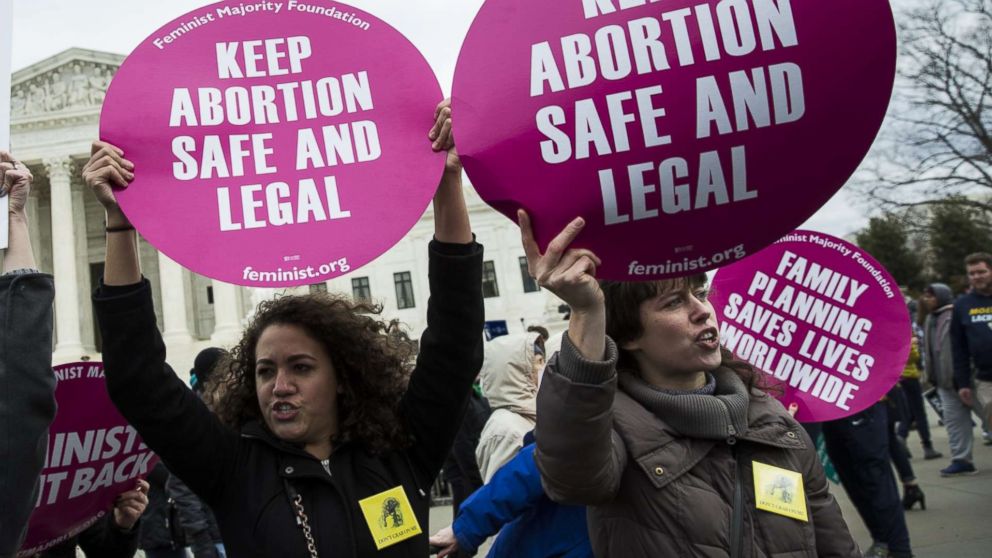
 Pro-abortion rights activists try to block anti-abortion rights activists in front of the Supreme Court during the annual March for Life on the anniversary of the historic Roe v. Wade Supreme Court ruling, Jan. 27, 2017.

(Samuel Corum/Anadolu Agency/Getty Images)  Pro-abortion rights activists try to block anti-abortion rights activists in front of the Supreme Court during the annual March for Life on the anniversary of the historic Roe v. Wade Supreme Court ruling, Jan. 27, 2017.

Horvath described how the patient, whose name she did not share, had a “very wanted pregnancy” and everything “looked like it was going to be a normal pregnancy” until the 26th week. It was at that point that the woman was diagnosed with a “lethal fetal skeletal anomaly.”

“It develops later in pregnancy. She had an ultrasound at 20 weeks that had shown a healthy pregnancy and it was only after 24 weeks that this was actually diagnosed,” Horvath said of the situation. “This is completely incompatible with life outside the uterus.”

The new law in New York

The situation with this patient occurred before New York Gov. Andrew Cuomo signed the Reproductive Health Act into law on Jan. 22 of this year. The law adjusted the legal framework for abortions in the state, setting it to a fetus viability standard as opposed to a set gestational age, and changing laws that criminalized certain later abortions.

Horvath said that the viability standard “is a much more accurate way of determining whether a fetus can live outside of the uterus.”

The ACOG, which is a nonprofit association with more than 58,000 members, uses viability as their standard as well.

“Viability is the capacity of the fetus for sustained survival outside the woman’s uterus. Whether or not this capacity exists is a medical determination, may vary with each pregnancy and is a matter of judgement of the responsible health care provider,” the ACOG wrote in a statement about their position on abortion.

In the case of the patient Horvath treated, because the new law was not yet in place in New York, and because when she was diagnosed with the lethal fetal skeletal anomaly her own life was not in danger, she “had no ability to obtain abortion care in her home state.”

“She was forced to continue to carry a pregnancy that she knew was never going to be able to survive and become a healthy baby,” Horvath said. “Several weeks later it demised in utero and she was then able to have the procedure to remove it from her uterus.”

The difference that the new law would have made in that patient’s case, Horvath said, was that she would have been able to be treated in her home state and not have to “wait with the knowledge that she was carrying a doomed pregnancy.”

“It’s really important to remember that every one of these situations is complicated and difficult for the woman and that’s why it’s much better that its left for her to discuss with her physician and the people in her life who can love her and support her and help her make the right decision for her,” Horvath said.

Political posturing

While the passage of the law in New York has prompted some discussion about abortion laws, Virginia Gov. Ralph Northam, who previously worked as a pediatric neurologist before entering politics, also waded into the fray by talking about the issue during an appearance on a radio show.

 President Donald Trump delivers the State of the Union address, with Vice President Mike Pence and Speaker of the House Nancy Pelosi, at the Capitol in Washington, Feb. 5, 2019.

(Doug Mills/Pool via Reuters)  President Donald Trump delivers the State of the Union address, with Vice President Mike Pence and Speaker of the House Nancy Pelosi, at the Capitol in Washington, Feb. 5, 2019.

Speaking to radio station WTOP about aborting a fetus later on in a pregnancy on Jan. 30, Northam said “it’s done in cases where there may be severe deformities, there may be a fetus that’s non-viable. So in this particular example, if a mother is in labor, I can tell you exactly what would happen. The infant would be delivered. The infant would be kept comfortable. The infant would be resuscitated if that’s what the mother and the family desired, and then a discussion would ensue between the physicians and the mother.”

During the State of the Union, Trump said “the governor of Virginia … stated he would execute a baby after birth.” Trump also said that the law in New York would “allow a baby to be ripped from the mother’s womb moments before birth.”

Horvath said that Trump’s characterizations are inaccurate.

Source: https://abcnews.go.com/Health/explaining-trumps-talk-late-term-abortions-state-union/story?id=60883835

© Greg Nash

President Trump called on lawmakers during his State of the Union address Tuesday night to ban “late-term” abortions, a policy that won’t pass a divided Congress.

“To defend the dignity of every person, I am asking the Congress to pass legislation to prohibit the late-term abortion of children who can feel pain in the mother’s womb,” Trump said during his speech.

The White House has said Trump backs legislation that would ban abortions after 20 weeks. Senate Democrats blocked such a measure in January 2018.

Trump in his speech referenced bills in Virginia and New York that would ease abortion restrictions, measures that have faced backlash from anti-abortion groups in recent weeks.

“Let us work together to build a culture that cherishes innocent life,” Trump said.

“And let us reaffirm a fundamental truth: all children — born and unborn — are made in the holy image of God.”

Planned Parenthood President Leana Wen, a guest of Speaker Nancy Pelosi (D-Calif.), knocked the president’s comments on Twitter.

“Restrictions on abortion later in pregnancy prevent health care providers from giving their patients the best care possible. It’s my job to provide my patients with the information they need to make the best decision for themselves. I trust my patients; I trust women,” she tweeted.

The New York bill signed into law last month by Gov. Andrew Cuomo (D) allows abortions after 24 weeks if a doctor determines the woman’s life or health is at stake, or if the fetus is not viable.

A bill in Virginia would have made it easier for women to get abortions in the third trimester of pregnancy by requiring the approval of only one doctor instead of the three mandated under current law.

Source: https://thehill.com/policy/healthcare/428647-trump-calls-on-congress-to-ban-late-term-abortions