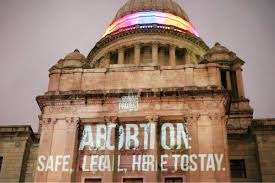
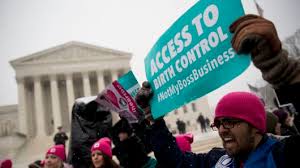
On the anniversary of Roe v. Wade, we are proud of our members who provided abortion care before Roe and helped fight for the landmark decision to protect women’s right to make their own private reproductive decisions. We are also proud of our members who provide abortion care today and keep reproductive choice a reality for so many. Unfortunately, the fight isn’t over.

Whether it’s the violence and disruption anti-abortion extremists use to harass and intimidate patients and abortion providers or the constant stream of medically-unnecessary anti-abortion laws politicians propose, the rights recognized by Roe v. Wade are constantly under attack.

Anti-choice lawmakers are determined to undermine women’s access to abortion care-here are 46 regulations in the U.S. that are designed to chip away at the right to reproductive choice by reducing access, shaming patients, and more. You can follow along with us on Twitteron Facebook, or see all 46 here. This is just a small sample of what abortion providers and women are forced to navigate in order to make Roe a reality for the 1-in-4 women who will access abortion care by the time they’re 45 years old.

There is good news, though! We are working with our members and partners to fight back against these attacks! Pro-active, pro-choice laws are being introduced throughout the country this week. The Reproductive Health Act (RHA) has passed the New York State Senate and New York’s Governor Andrew Cuomo has already promised to sign it if it reaches his desk. The RHA removes abortion from New York’s criminal code and puts it where it belongs, in the public health law. If Roe v. Wade is overturned, the RHA can help ensure qualified health care providers will be able to provide the abortion care their patients need.

Thank you for all you do to support our members, their patients, and our work at NAF.

We are in this together.

Donate: https://prochoice.org/about-naf/support-naf/

This year’s March for Life claims that “being pro-life is not in opposition to science,” though many of its positions fly in the face of evidence.

The pseudoscience promoted at March for Life will drive another year of policymaking.
EVA HAMBACH/AFP/Getty Images

The 46th annual March for Life in Washington, D.C., has adopted “Unique from Day One” as its theme, an apparent declaration of the extreme anti-choice position that life begins at conception. The event not only asserts this view as a moral position but also claims that “being pro-life is not in opposition to science.”

This co-opting of science is in line with a strategy and infrastructure that the anti-choice movement has been building for some time.

In 2011, the Susan B. Anthony List (SBA List), which supports policies and lawmakers who seek to end legal abortion, created what it called a “research” organization called the Charlotte Lozier Institute (CLI). CLI has since been a prominent voice in promulgating myths about abortion under the pretense that it conducts research and values “science.”

Take the American College of Pediatricians (ACPeds) as another example. In 2002, a few conservative members of the established American Academy of Pediatrics (AAP) were angry when the AAP took the public health position that pediatricians should support the adoption of children by people in same-sex relationships; they broke away to form their own organization. This group, ACPeds, has since been designated a hate group by the Southern Poverty Law Center and has advocated for positions with no scientific basis, including “conversion therapy.” It has equated parental support of transgender children to “child abuse,” and it joined a court brief against the dilation and evacuation abortion—the safest and most common second-trimester abortion. And yet March for Life includes an ACPeds link in its “pro-life is pro-science” list of online resources.

These are just two institutions created recently to provide the anti-choice movement and groups like March for Life with an arsenal to validate its myths.

Knowing that the myths promoted at March for Life may drive another year of policymaking, correcting this narrative before Friday’s event is important. In the list below, the evidence about abortion appears first. Because leading with the real science—the science backed by evidence, and supported by leading experts all over the country—is the best way to drown out the misinformation.

Abortion Is Extremely Safe

Each year the U.S. Centers for Disease Control and Prevention (CDC) releases statistics about abortion in almost all 50 states, and the data clearly shows that complications from abortion are minimal. Of the 652,639 abortions reported to the CDC for 2014, the last year for which data is currently available, only six women were reported to have died from medical complications related to abortion. This government data paints the same picture as reputable studies and reports from the country’s leading medical and health organizations.

A 2014 analysis from University of California, San Francisco’s Advancing New Standards in Reproductive Health (ANSIRH) center confirmed that abortion is extremely safe. Research ANSIRH conducted using 2009-2010 data in California found that 0.23 percent of abortions done through the state’s Medicaid program resulted in a major complication. That is less than a quarter of one percent. A 2014 ACOG committee opinion also promoted the safety of abortion.

The myth that abortion is unsafe has been perpetuated by the anti-choice movement and by sympathetic media. In addition to supporting the creation of groups like CLI and ACPeds, the movement has built a network of people who use their academic accreditation to publish flawed studies and testify as “experts.” Many of these people are profiled in Rewire.News’ False Witnesses database. For example, Dr. Byron C. Calhoun, a proponent of the myth that complications from abortion are common, has had his research disputed and discredited, but he has still had the ear of lawmakers on abortion policy issues and has testified in the U.S. Congress in favor of abortion bans.

D and E Abortions Are Safe—and the Language Used to Describe Them Was Invented by Anti-Choice Activists

Dilation and evacuation (D and E) abortions are the most common second-trimester abortions, and are supported in their safety by leading medical groups such as the American College of Obstetricians and Gynecologists (ACOG).

Despite this, the anti-choice movement has deployed political and linguistic attacks to try and ban all second-trimester abortions. The movement has invented non-medical terms like “partial birth abortions” and “dismemberment abortions,” and has been successful in getting these terms used in legislation and the media. Through the 2007 U.S. Supreme Court ruling in Gonzales v. Carhart, the anti-choice movement successfully advocated for some second-trimester abortions procedures to be bannedStates have since used this legal decision to start banning D and E abortions. Now the fight around the method is on the horizon for the Supreme Court as state bans on the procedure are being challenged.

Abortion Does Not Cause Mental or Physical Health Problems

This reality continues to be confirmed by evidence, including research from ANSIRH. Its groundbreaking ‘Turnaway Study” looked at the impact that having an abortion and being denied a wanted abortion had on the lives of women, including their mental and physical health. After five years, ANSIRH researchers confirmed that “a wanted abortion was not associated with mental health harms.” ANSIRH’s findings are in line with the views of leading medical organizations, including the American Psychological Associationand ACOG.

ANSIRH found that “policies based on the notion that abortion harms women’s mental health are not supported by rigorous evidence.” Yet eight states still require that a person receiving an abortion must first be counseled on the myth that it can cause long-term mental health problems.

Abortion’s lack of long-term health effects is not just limited to mental health. People can and do remain physically healthy after having abortions. This belies one prominent anti-choice falsehood: that abortion is linked to breast cancer. ACOG, the National Cancer Institute, and the American Cancer Society are among the leading medical groups that have released statements confirming this is a myth. But in five states, people who seek an abortion are still required to receive counseling to the contrary. The basis of this myth originated in methodologically flawed studies from prominent anti-choice advocates who now are asked to testify on the issue in state legislatures and courts.

A Fetus Cannot Feel Pain 20 Weeks After Fertilization

Leading medical groups, such as ACOG and the Royal College of Obstetricians and Gynecologists, agree that a fetus cannot begin to feel pain until after viability, which occurs around 24 weeks’ gestation. Nevertheless, 21 states have enacted 20-week abortion bans. The U.S. Congress has even considered a federal ban. But the bill—which was backed by President Donald Trump—was unconstitutional (Roe v. Wade made clear that states cannot completely ban abortion before viability) and based on junk scienceACOG pointed this out in a press release opposing the policy: “This bill ignores scientific evidence regarding fetal inability to experience pain at that gestational age. In addition, the phrase ‘probable post-fertilization age’ is not medically or clinically meaningful .… It is an unconstitutional attempt to intimidate health care providers and prevent them from providing the safe care their patients want and need.”

So-Called Heartbeat Bans Are Arbitrary and Unconstitutional

At around six weeks, when a pregnancy is still an embryo, doctors can detect cardiac activity with an ultrasound. This is far before the point of fetal viability and before a heart has fully formed. As Dr. Rebecca Cohen, assistant professor of obstetrics and gynecology at the University of Colorado, told HuffPost in early 2017, “It’s not a fully formed heart like you would understand from looking at an adult or even a young child …. It’s a very early structure. We can see it on the ultrasound, but it’s not a heart, a fully developed organ, by any means.’”

So-called heartbeat bans, which would ban abortion at six weeks—before most people know they are pregnant—are sweeping the nation, and are being supported by groups like March for Life. These bills have picked up momentum since first proposed in 2011 in Ohio. And as Rewire.News’ Imani Gandy and Brie Shea predicted, many states (so far four and counting) will propose similar bills in 2019. These bills are unconstitutional, but the motivation behind them is clear, as Gandy and Shea explained: “To provide the Supreme Court as many opportunities as possible to reverse course on abortion rights.”

In addition to the obvious legal issues, medical groups, including ACOG, oppose these policies. In opposition to a federal version of a ban, ACOG wrote: “This bill bans abortion long before the point of viability. Whether a fetus is viable is a medical determination and occurs much later in pregnancy. This bill violates the Constitution, will serve as [an] outright ban on abortion for most women, and will prohibit health care providers from providing ethical, necessary care to their patients.”

Fetal Tissue Research Has Led to Important Medical Advances

Research using fetal tissue has been conducted since at least the 1930s and has been funded by the federal government through the National Institutes of Health (NIH) since the 1950s. This research has been regulated for decades, presently falling under the purview of the NIH Revitalization Act of 1993, which was passed with bipartisan support. Because of the significant potential contributions of this research, NIH provided $98 million for fetal tissue research in 2017 alone. This funding went to support a variety of research projects on issues such as HIV, Zika virus, and various cancers. Already, research using fetal tissue has led to monumental medical advancements, including developing vaccines for polio, rubella, measles, chicken pox, hepatitis A, tetanus, and rabies. These advancements have saved lives and pushed health care forward.

But since Roe v. Wade was decided in 1973, fetal tissue research has been targeted by the anti-choice movement. The most recent attacks under the Trump administration gained steam in September 2018 when a company that provides fetal tissue for research had its contract canceled by the Department of Health and Human Services (HHS). March for Life was among many anti-abortion groups that celebrated this contract termination. Since then, Congressional hearings on fetal tissue research tenability and alternatives have been underway. The hearings included testimony from people tied to the Charlotte Lozier Institute, and the effort to block fetal tissue research is likely to continue given HHS is heavily stacked with anti-choice advocates who are receptive to the movement’s lobbying activities.

Source: https://rewire.news/article/2019/01/16/six-facts-about-abortion-to-counter-march-for-lifes-junk-science/

The administration acknowledges the rule could increase the out-of-pocket cost of abortion care.

“This proposed rule would require insurers who offer plans in the marketplaces that include abortion coverage, of course beyond the limited exceptions of the life endangerment, rape. and incest, to offer a … ‘mirror plan’ in the same area that includes all the same benefits without the abortion coverage,” Megan Donovan said.
BRENDAN SMIALOWSKI/AFP/Getty Images

The Trump administration proposed a rule Thursday that includes a provision restricting insurance coverage for abortion care. Health-care experts said the rule is meant to steer insurers away from covering abortion services.

The abortion restriction was included in a proposed “2020 Payment Notice” from the Centers for Medicare & Medicaid Services (CMS), a division of the U.S. Department of Health and Human Services (HHS). If finalized, it would “require that insurance companies that offer [Affordable Care Act] plans covering abortions of pregnancies that do not threaten the life of the mother or result from rape or incest must also offer at least one identical plan in the same geographic area that does not cover these abortions,” according to a press release Friday touting the administration’s recent anti-choice policies.

“The rule would not apply in states with abortion coverage mandates,” the press release noted.

Megan Donovan, senior policy manager at the Guttmacher Institute, told Rewire.News Friday that the administration’s proposed rule was “another attempt to disincentivize insurers from offering abortion coverage—to restrict abortion coverage to the full extent that they can and just make it that much harder for insurers to include coverage in their plans by putting on another requirement.”

“Under the ACA, insurers can choose whether to cover abortion in the plans that they offer in the marketplaces subject to state law—and of course, there are 26 states that restrict abortion coverage in the exchanges and four states that require plans to cover abortion,” she said. “But in the absence of a state law with a requirement or a ban … insurers can choose whether or not to include abortion in the coverage that they provide in the plans offered on the exchanges.”

“This proposed rule would require insurers who offer plans in the marketplaces that include abortion coverage—of course beyond the limited exceptions of the life endangerment, rape, and incest—to offer a …  ‘mirror plan’ in the same area that includes all the same benefits without the abortion coverage,” Donovan said.

The proposal acknowledges that the change could “potentially reduce the availability of non-Hyde abortion coverage in insurance, thereby increasing out-of-pocket costs for some women seeking those services.” Donovan pointed to that language and said this could “possibly make it difficult for people to obtain the care entirely because if they can’t meet that out-of-pocket cost there is significant financial barriers to getting the care that they need.”

The new Trump administration proposal “piles on top of the proposed rule from [November] that would create an onerous requirement that insurers offering insurance coverage in the marketplaces try to collect separate payment for that coverage,” Donovan said.

That rule, proposed by the Trump administration in November, would require insurers to bill customers and collect payments separately “for the portion of the consumer’s premium attributable to certain abortion services.” The comment period on that rule closed last week.

“This is part of what is clearly an ongoing effort to restrict private insurance coverage of abortion in the marketplaces,” Donovan continued.

“It is really telling that in the midst of a government shutdown the administration is pushing out new proposed restrictions on abortion coverage and the Senate was taking a vote on extreme anti-abortion coverage language yesterday while federal employees and contractors and the service-industry workers who rely on their business are … turning to nonprofits and community members to meet basic needs for food, housing, and diapers,” she said.

Source: https://rewire.news/article/2019/01/18/trump-administration-wants-new-restriction-on-abortion-coverage/

The 5th U.S. Circuit Court of Appeals lifted an injunction forbidding Texas from stripping Planned Parenthood of Medicaid funds Thursday, while stridently criticizing the abortion provider for its rhetoric and medical practices.

“Planned Parenthood’s reprehensible conduct, captured in undercover videos, proves that it is not a ‘qualified’ provider under the Medicaid Act, so we are confident we will ultimately prevail,” Texas Attorney General Ken Paxton said in a statement after Thursday’s ruling.

The case arose after a pro-life group called the Center for Medical Progress released videos purporting to show Planned Parenthood violating medical and ethical standards codified in federal law and state regulations. Texas terminated its Medicaid provider agreement with Planned Parenthood shortly thereafter, citing infractions documented in the videos.

In turn, Planned Parenthood asked a federal court to restore its Medicaid funding. Thursday’s ruling—which related to a jurisdictional issue in that case—is especially striking for its numerous rebukes of Planned Parenthood. Judge Edith Jones, a Ronald Reagan appointee, delivered the opinion.

Perhaps the most noteworthy of the decision’s reprimands is a graphic depiction of post-abortion fetal remains taken from a Center for Medical Progress video on the fourth page of the opinion. A small arm is visible in the picture. Texas cited the manner in which Planned Parenthood disposes of fetal remains as one reason for terminating its Medicaid eligibility.

In another instance, the decision all but accuses Planned Parenthood of breaking federal law banning partial-birth abortions. The ruling highlights a Center for Medical Progress video in which an administrator called Dr. Tram Nguyen said doctors at one facility could evacuate an intact fetus—thereby breaking federal law—provided they sign a form that they did not “intend” to do so. Such procedures allow researchers to recover organs like the thymus or the liver.

Later in the opinion, the panel chides Planned Parenthood for failing to address Nguyen’s comments in court filings.

“The plaintiffs’ briefing with regard to the substance of the discussions contained in the videos is curiously silent,” the decision reads.

Planned Parenthood has denied it intentionally alters abortion procedures for impermissible reasons.

The panel also dismissed Planned Parenthood’s claim that the Center for Medical Progress videos were “deceptively edited,” a soundbite that redounded across the press after the tapes first appeared.

“The record reflects that [the Texas Office of Inspector General] had submitted a report from a forensic firm concluding that the video was authentic and not deceptively edited,” a footnote in the decision reads. “And [Planned Parenthood] did not identify any particular omission or addition in the video footage.”

Finally the panel accused the judiciary of politicking on abortion cases. Ordinarily, providers like Planned Parenthood must challenge Medicaid termination decisions in an administrative forum and state court before seeking a federal court’s intervention. By allowing Planned Parenthood to skip directly to federal court—as the trial court did here—the 5th Circuit said judges are engaging in ideological favoritism.

“Had [Texas] terminated the Medicaid provider agreements of any other type of health care provider, the incongruity of allowing that provider to use patient litigation proxies to avoid administrative review and [reach] federal court would be obvious and unacceptable,” the ruling reads.

The decision comes as pro-life activists gather in Washington in advance of Friday’s March for Life.

The question before the 5th Circuit did not relate to abortion directly: After Texas disqualified Planned Parenthood from Medicaid eligibility, the abortion provider sued, claiming the federal Medicaid statute allowed it to do so. A federal district judge agreed, allowing the lawsuit to proceed. The 5th Circuit had to decide whether that decision was correct.

The federal appeals courts are divided over the answer to that question. Though the Supreme Court generally intervenes when the circuits disagree over the same question of law, the justices denied review in a related controversy from Kansas in December, drawing a vigorous dissent from Justices Clarence Thomas, Samuel Alito, and Neil Gorsuch that accused the court of playing politics.

In that instance, Chief Justice John Roberts and Justice Brett Kavanaugh joined with the court’s liberal bloc, effectively preserving a pro-Planned Parenthood decision in the lower court.

The 5th Circuit’s Thursday decision concluded that it is bound by precedent to find Planned Parenthood can proceed with its lawsuit in federal court under the Medicaid statute, though Jones wrote a concurrence to her own majority opinion urging the full 5th Circuit to revisit that question.

However, the 5th Circuit gave Texas a partial victory, finding the trial court assessed Planned Parenthood’s request for an injunction under the wrong standard. The panel lifted the injunction, and ordered the lower court judge to reconsider Planned Parenthood’s request under a different standard that is more accommodating of Texas.

As such, the state has a much better chance of prevailing when the matter returns to the trial court for further proceedings.

Texas awards approximately $3.4 million to Planned Parenthood affiliates through Medicaid annually. The decision notes this is a “smidgen” of the revenue Planned Parenthood’s Texas affiliates generate each year, which runs over $57 million.

Source: https://www.dailysignal.com/2019/01/18/a-federal-appeals-court-just-took-a-big-swing-at-planned-parenthood/

Pro-choice campaigners said the change in the law was “long overdue”

Women on the Isle of Man will soon be able to request an abortion within the first 14 weeks of pregnancy.

Tynwald President Steve Rodan said the Abortion Reform Act had received Royal Assent, meaning that the UK’s Ministry of Justice has given its approval.

The Manx government is yet to announce when the new law, proposed by Ramsey MHK Alex Allinson, will be introduced.

Currently abortions can only be carried out after a rape or because of concerns about the mother’s mental health.

Under the changes, Manx women will also be able to seek an abortion up to 24 weeks in cases of foetal anomalies of if there are serious social reasons.

Health Minister David Ashford MHK said: “We will now be working with clinicians to develop the service so that we can bring forward an appointed day order at the earliest practical opportunity and open a new chapter in our island’s healthcare provision.”

‘Long overdue’

The Campaign for Abortion Law Modernisation (CALM) said the group was “delighted” by the “long overdue” change in the law.

“It’s taken 24 years to update this cruel, discriminative law and decriminalise abortion and make abortion care part of reproductive healthcare,” a spokeswoman added.

The changes were brought forward by Dr Allison in a private member’s bill last year.

He said decriminalisation “changes abortion from being a criminal justice issue to a health matter, as it should be”.

“This is the culmination of years of campaigning by numerous people across the island to improve our law and stop women having to cross the Irish Sea to access essential healthcare,” he added.

‘Dark and sad day’

Sue Richardson, of pro-life campaign group Humanity and Equality in Abortion Reform (HEAR), said it was a “dark and sad day for the Isle of Man”.

“We will never stop fighting for the recognition of the humanity, dignity, and rights of every member of the Manx and human family,” she added.

In Scotland, England and Wales abortion is legal up to 24 weeks, provided certain conditions are met, but not decriminalised entirely.

Northern Ireland only allows abortions in cases where the woman’s life is at risk.

In a referendum last year, people in the Republic of Ireland overwhelmingly voted to overturn its ban on abortion.

https://www.bbc.com/news/world-europe-isle-of-man-46879046?fbclid=IwAR1LN1DV4qYFCSvUziCITUUG82AJVnTa4imtDZ0pEa2cgDwmyMKeW8sWxNE

Rhode Island Democrats might finally have the votes to get the Reproductive Health Care Act to the governor’s desk in 2019.

Rhode Island has a powerful anti-choice lobby, and anti-choice Democrats who have routinely blocked the bill in recent years.
The Womxn Project

A new pro-choice legislative majority and a governor committed to signing abortion protections into state law has many in Rhode Island hopeful about finally passing the Reproductive Health Care Act (RHCA) this year.

Longtime state Rep. Edith Ajello (D-Providence) said 38 of 75 state house members have committed to voting for the RHCA, which would enshrine abortion rights in state law. She said “a number of other representatives tell me they will vote for the bill when it comes to the floor.”

“I’ve never been more optimistic,” Ajello told Rewire.News.

Rallying legislative support for the pro-choice measure in the most Catholic state in the United States has been difficult. Rhode Island has a powerful anti-choice lobby, and anti-choice Democrats have blocked the bill in recent years. Rhode Island scored an “F” grade from NARAL Pro-Choice America in 2016 for its “severely restricted access” to reproductive rights.

The 2018 midterms changed the balance, adding more women and pro-choice legislators in the Rhode Island General Assembly than ever before. This includes newly elected state Reps. Karen Alzate (D-Pawtucket), Terri Cortvriend (D-Portsmouth), Justine Caldwell (D-East Greenwich), and Mario Mendez (D-Johnston, Providence) who replaced incumbents opposed to the RHCA and are not co-sponsoring the bill, Ajello said. There are four new Rhode Island state senators who back the RHCA who replaced opponents of the bill.

In the state senate, the bill has 17 sponsors—five more than 2018—so there is “huge momentum,” said sponsor state Sen. Gayle Goldin (D-Providence) who expects to secure more support. The bill would need 19 votes to pass the state senate.

Gov. Gina Raimondo (D), who will deliver her State of the State address Tuesday night, is advocating for the RHCA and is “fully committed to enshrining the protections of Roe v. Wade into state law,” spokesperson Josh Block confirmed Monday.

Raimondo has not been as vocal a pro-choice ally in past years.

“This is a great indicator of the governor really serving as a voice for the 71 percent of Rhode Islanders who want to see this bill pass,” Goldin said.

Legislators expect to introduce the new bills next Tuesday, on the 46th anniversary of the landmark Roe decision. Advocates have ramped up efforts pushing for the RHCA.

“The Reproductive Health Care Act is not about politics: it’s about our health and our ability to control our own futures. The governor has been a leader in working to close gaps in access to reproductive healthcare. The passage of this bill would continue that important and powerful legacy by making sure that we are a state where we protect the right to access safe, legal abortion care,” Jordan Hevenor, co-director of The Womxn Project, said in a statement.

“The sheer number of people active on the issue this session can’t be denied,” Hilary Levey Friedman, president of the Rhode Island chapter of the National Organization for Women (RI NOW), told Rewire.News. “In a state where the legislature has refused to act to maintain the law of the land, it’s imperative that we have a governor who is willing to do so. Governor Raimondo understands that it’s not up to a lawmaker to tell a woman when she must become a parent.”

Advocates said the governor’s backing should be a clear signal to anti-choice Democratic leaders like the Speaker of the House Nicholas Mattiello (D-Cranston) and the Senate President Dominick Ruggerio, who have held up the RHCA. Neither responded to Rewire.News emails for comment.

But Ajello is hopeful Mattiello may bring the bill to a floor vote for the first time given his recent comments about the public support for abortion rights protections. “I think that’s in recognition of poll results showing such a strong support and a strong feeling of the need to do this,” she said.

As the anti-choice Trump administration and a more conservative U.S. Supreme Court continue to threaten reproductive rights, there are many voices advocating for the RHCA this session.

“The reason this can happen in 2019 is legislators have finally seen with the Kavanaugh appointment that reproductive rights truly are at risk and there is a significant potential for our rights to be diminished if not eliminated and they have heard very strongly from their constituents that that’s not acceptable,” Goldin said. “I’m really happy to see that we are finally at a time where reproductive rights are being taken seriously in the … legislature and we are joined with enough colleagues to make this a reality for women in our state.”

Source: https://rewire.news/article/2019/01/15/elections-matter-rhode-island-legislators-primed-to-safeguard-abortion-rights/

A federal judge on Sunday blocked Trump administration rules that would allow most businesses to opt out of covering contraception for their employees if they have moral or religious objections.

Judge Haywood Gilliam blocked the rules, which were set to go into effect on Monday, in California, Washington, D.C., and 12 other states. Gilliam granted a request for a preliminary injunction from those states, but limited the ban’s scope to only the case’s plaintiffs.

California Attorney General Xavier Becerra (D) at the end of December asked Gilliam to block the rules, which would allow more exemptions to ObamaCare’s contraception mandate.

Attorneys general in Connecticut, Delaware, Hawaii, Illinois, Maryland, Minnesota, New York, North Carolina, Rhode Island, Vermont, Virginia, Washington state and the District of Columbia joined Becerra’s request for an injunction.

“The law couldn’t be more clear — employers have no business interfering in women’s healthcare decisions,” Becerra said in a statement on Sunday. “Today’s court ruling stops another attempt by the Trump Administration to trample on women’s access to basic reproductive care.”

“It’s 2019, yet the Trump Administration is still trying to roll back women’s rights,” Becerra added. “Our coalition will continue to fight to ensure women have access to the reproductive healthcare they are guaranteed under the law.”

The administration issued draft rules that took effect immediately last year, but they have been blocked by several courts.

Gilliam on Friday said a “substantial number” of women would lose birth control coverage under the Trump administration rules.

“It is a good day when a court stops this administration from sanctioning discrimination under the guise of religion or morality,” Louise Melling, deputy legal director of the American Civil Liberties Union, said in a statement. “The Trump administration’s rules authorized employers and universities to strip women of birth control coverage — a benefit guaranteed to them by law, and meant to advance their health and equality. We applaud the order to enjoin the enforcement of these discriminatory rules.”

Source: https://thehill.com/policy/healthcare/425136-judge-blocks-trump-contraception-rule-in-13-states

A fake website has been set up to mimic the H.S.E website that provides information for people seeking abortion services. 

Repeal campaigner Tanya Cody called the helpline number on the fake website to find out what information was being given to callers.

“I told him I was looking for info on where I could get an abortion in my area and he said that looking for information on abortion is still illegal as Simon Harris has not abolished the family planning act 1979. He then said I need to get a solicitor immediately as I’m breaking the law by calling him. He was extremely rude through out the call.”

The man she spoke to repeatedly asked her for her name and queried how far along her pregnancy was.

Tanya explained:

“I asked him was I through to the right number and he kept avoiding the question.”

View image on Twitter

On the third day of limited abortion services being available, anti-choice campaigners stood outside a health clinic in Galway protesting abortion services. The same thing happened in Louth a few days later.

Senior Law Lecturer at the University of Birmingham, Máiréad Enright, said that these efforts to hinder abortion access could have been avoided.

“The Minister recognises the need for exclusion zones, and must know that other jurisdictions have successfully legislated on this issue.”

Máiréad and her colleagues at Lawyers For Choice published a position paper in July 2018 noting the key flaws in the draft legislation that Minister Simon Harris put forward.

View image on Twitter
Day 3, January 2019 and the ‘pro-life’ groups are already outside clinics intimidating & harassing women.

Máiréad says they were concerned about the legislation when it was first published,

“We assumed that it was draft legislation only, and the Minister would be open to changes once the legislation was actually debated in the Oireachtas.

“Although we did not expect that the basic grounds (twelve weeks, risk to life, risk of serious harm to health and FFA) would be open to change, we did think that some of the secondary provisions which do not comply with international human rights law or medical best practice e.g. the three day mandatory waiting period would be open to re-negotiation.”

Lawyers For Choice members researched best practice legislation elsewhere in the world and the group drafted model legislation, “which complies with best medical practice and reflects the highest standards imposed by international human rights law.”

“We hoped that the overwhelming mandate provided by the Yes vote would strengthen arguments for more accessible legislation. Simon Harris, however, argued that the Yes vote in May was effectively a vote for the draft legislation published in March and so no significant pro-choice amendments to the legislation could be accepted.”

Lawyers For Choice proposed legislation that included fines or imprisonment for anyone publishing, distributing, displaying or broadcasting material, “likely to mislead or deceive a person who is accessing or attempting to access an abortion.”

Their proposed legislation also included 100-metre safe zones, with fines or imprisonment for anyone engaging in intimidation, threatening or recording of people attempting to access premises where abortions are provided.

There are other key areas where Lawyers For Choice say they believe the legislation could cause future problems,

“The mandatory waiting period should be scrapped or, it should be possible to waive it in cases where observing the waiting period would block the woman from accessing abortion care.”

“Abortion should be completely decriminalised, or failing that, any offences should be very narrow and targeted at practices which harm women. Although doctors have a clear defence where they are acting in good faith, criminalisation leaves them vulnerable to ‘stings’ and threats.”

Máiréad says that this “chilling effect” is already inhibiting access to abortion, with the Rotunda recently announcing that they will only provide abortions between nine and eleven weeks, rather than between nine and twelve weeks as permitted by law.

“Criminalisation is also likely having an effect on the number of GPs willing to offer terminations so that some counties have very limited or no abortion services at the current time.”

During the campaign to repeal the 8th amendment women with wanted pregnancies spoke to the media about how the 8th impacted on their capacity to refuse consent while pregnant.

Now that the 8th has been removed, Máiréad says attention needs to be paid to the wider impact of removing the 8th Amendment from the Constitution.

The law lecturer cites the National Consent Policy, “which restricts pregnant people’s right to refuse medical treatment where doing so is perceived to place the foetus’ life at risk”, saying it, “has not yet been altered to clarify the scope of a woman’s right to bodily autonomy in pregnancy.”

According to Máiréad, the current law leaves too many people behind.

“It makes no provision for women who receive a diagnosis of severe foetal anomaly, or who need to terminate a pregnancy after 12 weeks for serious socio-economic reasons.”

“The combination of a strict 12-week deadline, a mandatory three-day waiting period and scarcity of service providers outside the major cities will inevitably mean that some women are refused care and will need to travel or terminate pregnancies illegally.”

Source: https://www.her.ie/news/law-lecturer-says-that-new-abortion-legislation-leaves-too-many-women-behind-444015?fbclid=IwAR1IsVSjyCQAtBm245ISt2HFGbrGS1lvi7eXh7y-PStl6ZgSgOlKA-kgJak

”This is certainly the most blatant attempt to take aim at Roe vs. Wade,” a lawyer for the American Civil Liberties Union said Wednesday.

FRANKFORT, Ky.— Already mired in three lawsuits over abortion restrictions, Kentucky lawmakers are ratcheting up the stakes with a new bill to ban most abortions once a fetal heartbeat is detected.

As a new legislative session opens, the measure appeared to be on a fast track in the Republican-dominated state Senate. The American Civil Liberties Union, the state’s adversary in the ongoing courthouse fights, warns the heartbeat bill would prohibit most abortions in Kentucky and would immediately trigger a legal challenge.

“It’s blatantly unconstitutional,” ACLU attorney Brigitte Amiri said Wednesday, a day after the measure was introduced by lawmakers. “This is certainly the most blatant attempt to take aim at Roe vs. Wade. It’s extreme. It’s yet again anti-abortion politicians trying to push abortion out of reach for women in this state.”

Kentucky’s bill is at odds with the legal standard set by the Supreme Court in its 1973 Roe v. Wade ruling, which prohibits states from banning abortions before viability. But the Kentucky proposal is among a series of measures introduced by abortion opponents who hope the Supreme Court will be more receptive to limiting abortion rights now that Justice Anthony Kennedy, a key vote to preserve abortion rights, has retired.

Kennedy was replaced by Justice Brett Kavanaugh. Though Kavanaugh’s record on abortion is limited, he did vote as a federal appeals court judge in 2017 in favor of delaying an abortion for a pregnant immigrant teenager in federal custody.

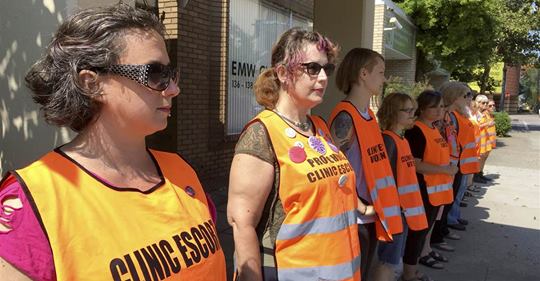
Meg Stern, left, and other escort volunteers line up outside the EMW Women’s Surgical Center in Louisville, Kentucky, July 17, 2017.Dylan Lovan / AP file

In Iowa, a heartbeat law was temporarily blocked while a judge weighs whether it is unconstitutional. North Dakota’s fetal heartbeat law was struck down as unconstitutional and the U.S. Supreme Court refused to review the lower court rulings.

The effort to prohibit abortions in Kentucky once a fetal heartbeat is detected — which is around six weeks of pregnancy — would further cement Kentucky’s reputation as “one of the most hostile states” to abortion rights in the country, Amiri said by phone.

The ACLU attorney added that the “vast majority” of abortions occur after six weeks of pregnancy and called a six-week ban unconstitutional under more than 40 years of precedent.

“Most women don’t even know they’re pregnant at six weeks,” she said. “So this is a virtual ban on abortion.”

The heartbeat bill was introduced Tuesday, opening day of Kentucky’s new session, and one of the many sponsors expected it to be heard in committee on Thursday. Senate Majority Floor Leader Damon Thayer said he hopes the bill would get a Senate vote this week. It would still have to pass the GOP-led House before it would go to the state’s anti-abortion governor, Republican Matt Bevin.

After Friday, lawmakers head home for a break before reconvening in early February for the rest of the year’s session.

If it reaches the governor’s desk, the heartbeat bill would give Bevin an opportunity to attach his name to a measure imposing stricter limits on abortions — a popular stance with his socially conservative base. Bevin, who has said he’ll seek re-election this year, saw his approval ratings drop after he criticized public workers who opposed his efforts to change the state’s struggling public pension plans. Kentucky and two other states — Louisiana and Mississippi — will elect governors in 2019.

Embry said the state’s legal setbacks in the other abortion cases would not deter Kentucky lawmakers from pushing ahead with an even more restrictive measure.

“We’re still going right ahead with what we think is the right thing to do,” he said.

Thayer said the threat of another ACLU lawsuit also wouldn’t hold up the bill in the Senate: “It’s our job to make laws, to make policy, and that’s what we’re going to do.”

Republican lawmakers in Kentucky have aggressively pushed bills to restrict the procedure since consolidating their hold on the legislature starting in 2017, even though two abortion-related laws have been struck down in the courts. Bevin’s administration has appealed in both cases.

One of those laws, enacted in early 2017, had required doctors to perform ultrasounds and show and describe the ultrasound images to pregnant women, who could avert their eyes.

Another legal challenge arose over Bevin’s interpretation of another law — passed about two decades ago — that required a Kentucky abortion clinic to have written agreements with a hospital and ambulance service in case of medical emergencies. Bevin’s administration actions had threatened the state’s last abortion clinic, EMW Women’s Surgical Center in Louisville.

In a third case, lawyers for Bevin’s administration and the ACLU argued over a lawsuit challenging a state law aimed at a common second-trimester procedure to end pregnancies. The law remains suspended pending a ruling by a federal judge.

Associated Press writers Adam Beam in Frankfort and Mark Sherman in Washington, D.C., contributed to this report.

Source: https://www.nbcnews.com/news/us-news/new-abortion-related-fight-kentucky-heats-over-fetal-heartbeats-n956966?fbclid=IwAR0ct28M8XUlap29Tdj7S6mzs56eDt20vrLYamG3a19bGhHih06UXjuMuV8

Ireland voted to liberalize abortion laws. The far-right government in Warsaw is moving in the opposite direction.

People attend the anti-government, pro-abortion demonstration in front of parliament, on April 9, 2016 in Warsaw. / AFP / AFP PHOTO / WOJTEK RADWANSKI (Photo credit should read WOJTEK RADWANSKI/AFP/Getty Images)

Everyone knows someone who has had an abortion in Poland. But most of it happens underground.

Under Poland’s draconian abortion law—one of the strictest in the European Union—terminations are permitted only if there is a threat to the mother’s life, if there is a fetal abnormality, or when pregnancy has resulted from rape or incest. 

Under Poland’s draconian abortion law—one of the strictest in the European Union—terminations are permitted only if there is a threat to the mother’s life, if there is a fetal abnormality, or when pregnancy has resulted from rape or incest.

Even when it is permitted, few doctors are willing to perform the procedure, forcing women to seek abortion on the black market, where they risk their health and sometimes their lives.

In Europe, only Northern Ireland and Malta have stricter laws, where abortion is banned in most circumstances. Until recently, the Republic of Ireland was part of this group. However, in a momentous referendum last May, the republic voted to lift the ban, joining the list of more than 30 countries that have liberalized abortion laws since 1994. Poland seems to be moving in the opposite direction.

The trend is extremely disturbing given the crucial role that access to abortion plays in protecting women’s lives and health. More than 30,000 women still die from botched abortions each year worldwide. And restrictions on abortion only increase the number of women who seek illegal and unsafe methods. According to the Guttmacher Institute, a research group that supports abortion rights, abortion rates in countries where it is broadly legal and where it is highly restrictive are similar—34 abortions take place for every 1,000 women in countries where it is not restricted, and 37 per 1,000 where it is illegal.

Officially, just 1,055 women obtained a legal abortion in Poland in 2016, while illegal abortions numbered up to 150,000, according to Krystyna Kacpura, the executive director of the Federation for Women and Family Planning (FEDERA). It’s not known how many women are injured or die as a result of unsafe, illegal abortions. In Ireland, just 25 legal abortions were carried out in 2016, while 3,265 women traveled from Ireland to the U.K. for a termination that year. And in March 2018, the Guttmacher Institute found that countries in Latin America and the Caribbean—where there is a total ban or severe restrictions on abortion—have the highest annual rate of abortion in the world: for every 1,000 women in the region of reproductive age, 44 have had abortions.

In 1989, after the collapse of communism, the new government sought to impose an outright ban on abortion, which had been legal in Poland since 1956—a move widely seen as a payoff to the Roman Catholic Church for its integral role in nurturing the rise of the opposition. Widespread protests against the ban led to the creation of the restrictive 1993 “compromise bill” that is in place today. However, surveys showed about 60 percent of Poles opposed the bill. “Women had no say in the decision. The church and politicians decided for us, and they are still deciding for us today,” said Kacpura.

The church has long held enormous influence in Poland, where about 86 percentof the population identifies as Roman Catholic. Once repressed under the old regime, the church was by its very existence a constant, powerful rebel against communism as bishops regularly criticized government policies. By the late 1980s, it was considered the primary vehicle for anti-communist activism under the Solidarity movement—the hugely popular trade union movement that succeeded in overthrowing the communist leadership in 1989.

Since the end of communism, the church and government have been inseparable. “Politicians know that to be successful they need the support of the church,” Kacpura said. In 2015, the conservative Law and Justice (PiS) party, strongly aligned with the church, won an outright majority in Parliament, giving rise to an increasingly nationalistic atmosphere that embraced anti-abortion rhetoric.

In 2015, the conservative Law and Justice (PiS) party, strongly aligned with the church, won an outright majority in Parliament, giving rise to an increasingly nationalistic atmosphere that embraced anti-abortion rhetoric.

In March 2016, lawmakers tried to impose a full ban on abortion, which threatened to imprison women seeking abortions and doctors who performed the procedure for up to five years. Even “suspicious” miscarriages could be investigated.

People were furious. Thousands of men and women took to the streets across Poland in the “Black Protests”—one of the largest demonstrations in the history of the country—forcing the government to abandon its plans. Now, it is trying again. The current Polish Parliament is working on the “stop abortion” bill, authored by staunch conservative groups, that would outlaw abortion for the most common reason: fetal malformation. Yet, as many 75 percent of Poles oppose further restrictions on the existing law, according to a March 2018 survey by Kantar Millward Brown. Another survey found that 69 percent of Poles support the right to terminate a pregnancy before 12 weeks.

Although protests halted the legislative process last spring, Marta Kotwas, a Polish doctoral researcher at University College London and a women’s rights activist, argues that with a PiS victory in this year’s parliamentary elections, it’s likely this law will be passed.

What’s more, under the PiS-led government, access to the morning-after pill—or as it has been rebranded, “the early abortion pill”—has also been restricted with the introduction in July 2017 requirement for a prescription for emergency contraception. A great concern among women’s rights activists is that the strong anti-abortion propaganda and the fact that women have now grown up without access to abortion are conditioning the younger generation not to talk.

“When I’m out on the street collecting signatures for liberalized abortion laws, I get more support from women in their 50s who remember when they had this right. But women in their 20s and 30s say nothing,” said Iza Desperak, a sociology teacher at the University of Lodz.

The church, anti-abortion groups, and government have transformed abortion into a deeply moral issue that has polarized the population.

The church, anti-abortion groups, and government have transformed abortion into a deeply moral issue that has polarized the population.

In the western city of Poznan, for example, anti-abortion campaigners have displayed graphic posters of fetuses alongside images of Adolf Hitler, with text comparing abortion to genocide.

Anti-abortion ideas are amplified by PiS Chairman Jaroslaw Kaczynski, who has called the latest abortion bill the new “pro-life law” that will stop abortions of those with Down syndrome, which, he claims, are the majority of abortion cases. Academics and rights activists say there is no evidence to support this.

These messages are shocking for women who grew up under communism. Kacpura remembers when abortion was just a procedure and noncontroversial. “You could have it done on a Friday and be back in church on a Sunday,” she said. Stigmatization of abortion and sex has been compounded by the church’s hijacking of sex education, reinforced by PiS politicians who claim it would lead to “unnecessary sex promotion” and “sexual degeneration.” Instead, children are given “Preparation for Family Life” classes, delivered by the school’s religious teacher, who is approved by the local church.

Growing up in 1990s Lodz, one women’s rights activist said, “The general message was the family is of supreme value. There was no talk about the permissibility of abortion, contraceptives, and consent. The point was to make girls believe that sex can only happen only within a Catholic marriage.”

Under PiS the message has only intensified. Last year new textbooks were introduced that present embryos as “unborn children” and contraception as “dangerous” for a person’s health.

Last year new textbooks were introduced that present embryos as “unborn children” and contraception as “dangerous” for a person’s health.

Teachers have complained to the government about the lack of practical information on access to contraception and abortion. “It’s not an education, it’s misinformation,” Desperak said.

Abortion is already banned in some regions thanks to the “clause of conscience,” which gives doctors the right to refuse an abortion on faith grounds. Although they are obligated to refer a woman to another doctor, it rarely happens, according to Kacpura.

In the eastern region of Podkarpackie, more than 3,000 doctors signed the clause in a PiS-led initiative to make the area anti-abortion, inspired by the Italian region of Verona. A local PiS politician, Jacek Kotula, said the party aimed to send a signal that “homosexuality, gender ideology, abortion, and in vitro fertilization are all unwelcome here.” The same policy “exists unofficially in most Polish hospitals,” Kotwas said. Only 10 percent of hospitals agree to carry out abortions, according to FEDERA.

A Warsaw doctor, Bogdan Chazan, caused an uproar in June 2014 after he refused to perform an abortion of a severely deformed fetus on faith grounds. He failed to tell the mother the abortion would be illegal after 12 weeks, nor where else she could get the procedure. The baby, carried to term, was born with no skull and died nine days later.

A Warsaw doctor, Bogdan Chazan, caused an uproar in June 2014 after he refused to perform an abortion of a severely deformed fetus on faith grounds. He failed to tell the mother the abortion would be illegal after 12 weeks, nor where else she could get the procedure. The baby, carried to term, was born with no skull and died nine days later.

Kacpura said there are many such stories, but these seldom reach the media, as women are often too traumatized to speak out. Patricia Mitro, a Polish lawyer specializing in family affairs, told the Dzien Dobry TVNprogram she has seen a huge increase in the number of women in Podkarpackie reporting that doctors failed to tell them their baby would be deformed.

The situation is just what the PiS chairman, Kaczynski, could have hoped for when, in October 2016, he said: “We will strive to ensure that even pregnancies which are very difficult, when a child is sure to die, is severely deformed, end with the mother giving birth so the child can be baptized, buried, and have a name.”

No one in government has discussed severe conditions where the maximum survival time is a few days or weeks at a cost of enormous suffering to the child and the mother. It’s no wonder that women—particularly those from smaller villages—travel to different regions to see a gynecologist, afraid local doctors will conceal information.

Many women have found a way to safely abort at home, such as Mary from Gdansk, now 28, who ordered pills online using the website of Women on Waves—a Dutch nongovernmental organization that gives advice on accessing abortion in countries where it is forbidden.

Mary was 19 and about to start university when she found out she was pregnant. “I knew immediately I didn’t want a baby. It wasn’t the right time.” The site explains how to get hold of medicines like Arthrotec from pharmacies without needing a doctor’s prescription. Arthrotec, prescribed to reduce arthritic pain, can be used to induce an abortion safely up to nine weeks of pregnancy. “Say it’s for your grandmother’s arthritis,” the site writes. That’s exactly what she did.

Mary took the pills in a relative’s empty house with her boyfriend. Feeling more pain than expected, she called a Women on Waves representative. “I remember being relieved when I heard she had kids around her. It made me realize I wasn’t a monster who hated children,” said Mary, now the mother of two children.

Women who have passed the cutoff for taking the pill can turn to a Polish doctor willing to carry out the abortion illegally, typically paying around 4,000 zloty, or just over $1,000, but it can be as much a 9,000 zloty (about $2,400). The cost is steep considering Poland’s average monthly wage is about $1,250. The University of Warsaw researcher Agata Chelstowska estimated in 2011 that the illegal abortion industry generates $95 million a year.

More and more women are choosing to go to clinics abroad in Slovakia or Germany.

More and more women are choosing to go to clinics abroad in Slovakia or Germany.

This way, women can also spare themselves the shame they are likely to face in a Polish hospital. “You cannot imagine the humiliation,” Desperak said. One such foreign organization is Ciocia Basia, a Berlin-based Polish-speaking volunteer group created four years ago in response to the growing numbers of women traveling to Germany for safe abortions. The group translates documents, organizes travel and accommodation, and subsidizes costs if women cannot afford the procedure, which costs approximately 400 euros (about $450) in Berlin. “We never turn people down for lack of money. We let them stay on our couches for free,” a group member said.

Mary has never told her friends and family about her abortion. “I’m scared of the discussion. If you have an abortion, you’re a bad person. Everyone has an opinion on it. It’s really black and white.” The scale of the Black Protests signified a turning point in uniting women on the issue, and there’s no doubt that opposition to further restricting abortion is strong. So far, protesters have managed to stop a bad situation from getting worse. But much greater work is needed to challenge the abortion laws that were never democratically implemented and to counter the government’s latest efforts.

The United Nations and the Council of Europe have denounced Poland’s “retrogressive” restrictions on reproductive rights. But without consensus among their member states, these bodies have no enforcement powers. In reality, the Polish government has the ability to roll back women’s rights, and it’s down to civil society to push back. That will require more women demanding the same rights that Irish women and their European counterparts have claimed.

Source: https://foreignpolicy.com/2019/01/08/poland-is-trying-to-make-abortion-dangerous-illegal-and-impossible/?fbclid=IwAR3uwRAQEor5AT638NSAE0KH_hSxlJsF_q9APL8p8TIddYiFiYfBsP_UOPw