I wanted to provide abortions for my patients. My med school wouldn’t teach me how.

Illustration by Marina Muun for The Washington Post

Outlook Perspective – Stephanie Ho is the director of primary care for Planned Parenthood Great Plains.

Last year brought one of the toughest moments I’d ever faced as a family doctor. A woman had shown up for her appointment after a three-hour drive to one of our clinics in Arkansas, and we had to turn her away. A state restriction had gone into effect, requiring that abortion providers contract with a physician who has hospital-admitting privileges. It works by weaponizing antiabortion attitudes within the medical community.

My staff and I had been attempting to comply with the law since it was passed in 2015. We reached out to every OB/GYN we could find. Receptionists would hang up on us or refuse to take a message. The doctors who did answer said that while they might personally support a woman’s right to choose, their colleagues did not. One told me that for him to sign on as a backup, he’d need permission not only from his hospital administrator but also from the Diocese of Little Rock — “and after that,” he added, “the pope.” We finally found a willing obstetrician in November.

This fear doesn’t surprise me. Medication abortion is one of the safest procedures out there; it’s less risky than wisdom-tooth extraction (which requires anesthesia). But doctors and nurses in Arkansas are so afraid of abortions — and the attendant politics — that it’s almost impossible to learn about them as a medical student, let alone administer them. Where I grew up, in the River Valley of western Arkansas, nobody said the word “abortion” out loud. When I went to medical school at the University of Arkansas for Medical Sciences (UAMS) in Little Rock, that censorious silence didn’t relent. Over four years, the most exposure we got to the topic was a half-hour guest lecture. (At that time, 17 percent
of medical schools offered no formal abortion education, according to a national survey published by the American Journal of Obstetrics and Gynecology.)

That implicit disapproval carried over to my residency in family medicine, which I began in 2008 at UAMS West in Fort Smith. Second-year residents gave presentations on a topic of their choice — and mine, on abortion, was the most highly attended and contentious that year. A senior faculty member vocally disagreed with my description of abortion as a common medical service, interrupting every few sentences and quoting the Bible at me. Someone dubbed me the “abortion chick,” and the nickname stuck. Whenever a patient at the clinic wanted to learn more about terminating a pregnancy, the staff would call me in to talk her through her options, even when I wasn’t scheduled on a shift. My fellow physicians didn’t feel comfortable sharing information about abortions.

Third-year residents could pursue an elective rotation, and I was determined to learn how to perform an abortion. Because I was not aware of any local providers, I enrolled in a program at Planned Parenthood of the Rocky Mountains, in Denver. The residency director said it was not an appropriate elective for a family medicine resident, and that he would have to talk about it with the other faculty physicians at Fort Smith. Then he said that the program didn’t permit residents to rotate out of state. I responded by citing the portion of the resident handbook that said we could travel for hard-to-find specialties — and pointed out that another trainee had done so the previous year in a different subspecialty. (Reached by an editor at the Post, a UAMS spokesman declined to comment, saying that the residency program has since changed directors. The medical center did not return phone requests for comment.)

Then came the end of my residency. It was commonly known among residents that if you applied to work at our training medical center and had done a decent job, you were essentially a shoo-in. In my first interview, I was forthcoming about intending to provide abortions at some point in my career. I was not offered a second interview. I decided not to attend our graduation ceremony.

The only other hospital in the area was a Catholic institution, and I doubted that it would even consider hiring me. But I didn’t want to leave: My house, family and patients were all in Fort Smith. My only option was to open my own practice, a highly unusual path for a newly minted doctor. So I took out loans and, in 2011, bought equipment from an out-of-state doctor closing her practice. Unlike most other providers, I did not cap how many Medicaid patients I saw. I lived paycheck to paycheck, paying my bills late and pouring every extra minute and dollar I had into keeping the practice afloat. When I told my malpractice insurance company, SVMIC, that I wanted to provide the occasional medication abortion, it tripled my monthly premium from about $600 to $1,800, claiming that it didn’t normally insure doctors who offer that service. (SVMIC also declined to comment for this piece, telling a Post editor, “We do not discuss our confidential insurance relationships.”)

Although I could provide medication abortions, I didn’t want to advertise the service and subject my staff to the scrutiny and harassment that would follow. So none of my patients asked me for an abortion. I started providing medication abortions only after Planned Parenthood’s Fayetteville clinic asked me to fill in for a doctor there who’d fallen ill — first twice a month, then every week, then twice weekly.

At some point during my residency, a faculty member pulled me aside to ask, “Why do you even want to do this?” Then and now, my answer is: If I can, and I’m willing, then why wouldn’t I? I was more hesitant about going public as an abortion provider. But as politicians continued to pile on restrictions, I saw how that affected my patients — and other doctors — and I realized that I couldn’t do my work and keep quiet. It didn’t feel right that my silence might hinder access to care by perpetuating the sense of shame around the procedure. Today, I am one of four physicians regularly providing abortions in Arkansas, which is home to 1.5 million women. Who else is going to speak up for them?

In January 2016, the organizers of a reproductive-justice rally in Little Rock asked if I would speak, and I accepted. Before I did, I let my father know: He’s an immigrant from Taiwan, always aware of how his children’s actions reflect on him. To my surprise, he was completely fine with it. Some people need abortions, he said simply. It made sense to him that, as a doctor, I would help meet that need.

Not everyone was so supportive. After finding out about the rally, one local family wrote to me saying that, although I had provided them with excellent care, as Catholics (and as donors to a local crisis pregnancy center), they could no longer come to my practice in good conscience.

Yet the exodus of patients that I feared never came. After that, I was no longer afraid to say I provided abortions. I eventually closed my practice — ultimately, I couldn’t make the finances work — and took a full-time position at Planned Parenthood Great Plains, where medication abortion was just one of many primary-care offerings, along with family planning, HIV care and transgender services.

Even so, the abortion work is hampered by a raft of medically unnecessary and insulting restrictions. Planned Parenthood clinics here currently can’t provide surgical abortions, because Arkansas requires that our facilities be outfitted comparably to a hospital surgical center. I’m legally required to hand out pamphlets filled with falsehoods about how the mifepristone pill, which ends a pregnancy, can be “reversed.” My patients sit through 48-hour waiting periods and mandatory follow-up visits, which impose costs — gas money, time off from work, overnight stays, child care — that many can barely afford. The contracted-physician requirement was only the latest imposition; the state legislature will consider passing two more bills restricting abortions when it reconvenes this month.

Reproductive rights depend, in part, on the medical community dispelling taboos. Abortion should be a topic of normal conversation, especially among medical professionals. It is, after all, a part of ordinary life — a routine medical procedure. When I first hosted a lunch for Arkansas medical students called “Meet the Provider” in 2017, I expected only a handful to attend. Instead, some 30 people came, and next time, we expect more.

The path to becoming an abortion provider can be extraordinarily frustrating in states like Arkansas, but younger doctors seem to be much more aware of inequity, stigma and other barriers to medical services. I’m hopeful that their sense of openness will ultimately mean better access for patients.

Source: https://www.washingtonpost.com/news/posteverything/wp/2019/01/04/feature/i-wanted-to-provide-abortions-for-my-patients-my-med-school-wouldnt-teach-me-how/?noredirect=on&utm_term=.640073ee65f7


Photo: Tony Gutierrez, STF / Associated Press

Abortion restrictions in Texas faced a renewed challenge on Monday in federal court, as abortion rights groups argued in court that more than two dozen of the state’s laws and restrictions are unconstitutional.

The hearing came on the eve of the Texas Legislative session, where lawmakers have proposed still more of the sort of restrictions that have led to a series of lawsuits pitting the abortion rights activists against the Texas attorney general’s office.

Monday, the abortion rights groups in federal court were targeting laws that require a mandatory 24-hour waiting period for women seeking abortions, that require women to get sonograms of the fetus before getting an abortion, and a ban on abortions after the 20th week of pregnancy, among others.

“Abortion patients and providers now face a dizzying array of medically unnecessary requirements that are difficult, time-consuming, and costly to navigate — sometimes prohibitively so,” the lawsuit states. “Plaintiffs ask the Court to strike down Texas’ unduly burdensome abortion laws, returning the State to a regime of reasonable and medically appropriate abortion regulation.”

Attorneys for the state called the lawsuit “meritless and bordering on frivolous.”

In the past, U.S. District Judge Lee Yeakel has called his Austin courtroom a “whistlestop” for the “constant, never-ending stream” of abortion-related cases on the way to the U.S. Supreme Court. And the stream is showing no sign of slowing down.

A bill for the legislative session has already been filed by Rep. Valoree Swanson, R-Spring, that would make it illegal for a Texas doctor to perform an abortion except to save a woman’s life, and there are several other proposed bills that would create various restrictions. If any of the bills are signed into law, they’re sure to face a legal challenge, sending the two sides back to to Yeakel’s courtroom.

“We know we’ll be fighting this again,” said Marsha Jones, the executive director for The Afiya Center, one of the plaintiffs in the case. “This case will still be going on a year from now, and there will probably be a new one too, just a different law with a different name affecting women’s reproductive healthcare. But we’ll still be here.”

The legal landscape for these cases has shifted following President Donald Trump’s appointment of conservative Judges Brett Kavanaugh and Neil Gorsuch. Kavanaugh replaced longtime swing vote Justice Anthony Kennedy, throwing Roe v. Wade, the 1973 ruling legalizing abortion, into question.

Despite the now conservative makeup of the Supreme Court, former state Sen. Wendy Davis said she didn’t anticipate a change in strategy on the part of abortion rights groups in the state. Davis drew national attention in 2013 for her 13-hour filibuster to block an anti-abortion bill in the Texas Legislature.

“I don’t think you can abandon one strategy for another,” Davis said. “That’s why we have three branches of government, and we have to rely on exercising tools and resources at our disposal in each of those realms. It would be foolish for us to look at the current makeup of the court and decide that we’re going to give up on that route because I believe that the law is on our side, and I’m reliant on a judiciary that’s going to uphold that.”

On the other side of the debate, Joe Pojman, executive director of Texas Alliance for Life, also said he doesn’t expect any Supreme Court reversals in the near future.

“Unfortunately, the case law is currently very bad and the precedent is very bad against the Texas Legislature for doing what we think is just a matter of justice,” Pojman said. “I’m very cautious, and I’m not foreseeing any earthquakes any time soon.”

If Roe v. Wade is ever overturned by the Supreme Court, conservative Texas Legislators heading into the session are going to be ready. Rep. Bob Hall, R-Edgewood, filed a resolution that would amend the Texas Constitution to automatically ban abortion if Roe v. Wade is overturned.

Source: https://www.chron.com/news/politics/texas/article/Abortion-rights-groups-make-their-case-against-13515595.php

Campaigners vow to join with MPs to force UK government to support end to abortion ban

People take part in the Rally for Choice demonstration outside Belfast’s city hall last July. Photograph: Charles McQuillan/Getty Images

Women’s rights campaigners in Northern Ireland have vowed to join forces with pro-choice activists in the Irish Republic and MPs at Westminster to force the UK government to address the “denial of human rights” in 2019 by supporting moves to end the region’s abortion ban.

Activists urged Theresa May’s government not to sacrifice the rights and health of women at the altar of Brexit, and back potential legislation to decriminalise abortion in Northern Ireland.

The region has one of the strictest bans in the world, with women in almost every circumstance facing up to life in prison for a termination. The 1967 Abortion Act does not extend to Northern Ireland and an abortion cannot be performed legally even in cases of rape, incest and fatal foetal abnormalities.

But after the success of the repeal the eighth amendment campaign in helping to overturn the Republic of Ireland’s near-total ban on abortionsin a landslide referendum victory, as well as polls showing strong support for a change north of the border, activists are motivated and energised in a manner not seen in decades, said Emma Campbell, who co-chairs the Alliance for Choice.

“The referendum in the south was really helpful, because you can basically no longer argue that the public don’t support a change in the law,” she said. “This has been a long fight with a lot of setbacks so we are cautiously optimistic, but I would say more optimistic than we’ve ever been.”

In the Irish Republic, the repeal campaign’s use of online platforms such as In Her Shoes to tell the stories of women forced to travel to other countries for an abortion also had a huge impact, said Campbell. “The public heard stories of travel that were no different to the stories here. It gave people courage … it has been such a huge open secret, but once you have broken the silence there is no putting the genie back in the bottle.”

In Northern Ireland, the Democratic Unionist party, which props up May’s government in Westminster, has refused to budge from its hardline support for the region’s Victorian-era abortion law. Sinn Féin, however, dramatically changed its stance after the referendum in the Irish Republic and backs liberalisation of the law.

Campaigners have the support of their counterparts in the Irish Republic who were ready to continue the struggle north of the border, said Ailbhe Smyth, a spokeswoman for the Coalition to Repeal the Eighth Amendment. “I think what’s maybe most important is we’ve actually managed it in the south,” she said. “If we had lost that referendum it would have set back that process, but winning it has given them great fire and determination.”

A number of elements have come together over the past couple of months to add fuel to that fire. In October polling by Amnesty International suggested 65% of adults in Northern Ireland thought abortion should not be a crime.

A supreme court ruling in June said that the region’s abortion laws were incompatible with human rights legislation. The decision has put further pressure on politicians to act even though the justices declined to issue a final ruling because the case brought before them did not involve an individual victim.

And with the Northern Ireland assembly not sitting since the collapse of the power-sharing government almost two years ago, campaigning MPs in Westminster sense they have an unprecedented opportunity. Last July more than 170 politicians from the UK and the Irish Republic signed a letter urging the UK government to reform Northern Ireland’s abortion laws.

The women and equalities select committee is carrying out an inquiry into those laws, and the minister for women and equalities, Penny Mordaunt, has told Northern Ireland’s politicians that if they did not liberalise the abortion law, Westminster would.

Since the referendum, the Northern Ireland secretary, Karen Bradley, has also received letters from anti-abortion campaigners, including people born with serious conditions to maintain restrictions on abortion. One asked Bradley to confirm whether she was a Christian, writing: “It would seem that the most vulnerable in our society, the unborn child, is not permitted human rights.”

But a growing number of MPs support a change in the law, with a number taking direct action. A free vote on a 10-minute rule bill, put forward by Labour’s Diana Johnson, passed 208 votes to 123 with cross-party support, bolstering confidence among campaigners and supportive MPs even if the backbencher bill will not become law because the government has signalled that it will not give it parliamentary time.

“We can no longer stand by as women in Northern Ireland have their human rights breached,” Johnson told the Guardian. “It is quite clear that the Westminster parliament stands ready to deal with this.”

Many campaigners are now pinning their hopes on moves by her colleague Stella Creasy who, with Labour’s Conor McGinn, successfully tabled an amendment in October forcing Bradley “to issue guidance” on how officials can continue to enforce the region’s abortion law.

Stella Creasy
Pinterest
 Stella Creasy: ‘Whatever deals the PM does with the DUP to stay in power we will not rest until abortion is free, safe, legal and local for every UK citizen.’ Photograph: Jack Taylor/Getty Images

Creasy plans to table an amendment to the government’s long-awaited domestic abuse bill.

“The lack of assembly cannot be used as an excuse not to act on this basic human rights issue,” said Creasy. “In 2019, we will be redoubling our fight against this injustice and seeking to amend legislation to decriminalise abortion across the UK including in Northern Ireland. Whatever deals the PM does with the DUP to stay in power we will not rest until abortion is free, safe, legal and local for every UK citizen.”

The situation for the women seeking an abortion was an ongoing tragedy, said Ruairi Rowan, an advocacy manager at the Family Planning Association in Northern Ireland. “People are still shocked when they find out that you can go to jail for buying abortion pills, that you can’t get an abortion if you are raped,.”

A woman faces prison after been embroiled in a legal battle for years after obtaining abortion pills for her underage daughter, who was in an abusive relationship.

A mural to Savita Halappanavar
Pinterest
 A mural to Savita Halappanavar, who died of sepsis in 2012 after being denied an abortion in the Irish Republic during a protracted miscarriage. Photograph: Charles McQuillan/Getty Images

Women in Northern Ireland will be able to access services in the Irish Republic from this month. However, a three-day waiting period means women in desperate situations are likely to continue to travel to the rest of the UK where they now have access to free abortion services, said Rowan.

But campaigners are more determined than ever that 2019 will bring the change they argue Northern Ireland desperately needs, sai Goretti Horgan, an activist. Horgan said it took the death of Savita Halappanavar in 2012 after being denied an abortion during a protracted miscarriage to spark a mass movement for change south of the border, she said.

“Maybe the only way we can break the stalemate is to get tens of thousands on to the streets either here [in Northern Ireland] or london,” she said. “I just hope it won’t take another tragic death to make that happen.”

Source: https://www.theguardian.com/uk-news/2019/jan/02/pro-choice-activists-ireland-success-replicated-north-end-abortion-ban

Image copyrightGETTY IMAGES
Image captionThe Republic of Ireland voted to overturn its abortion ban in a referendum in May

Seven months and nine days ago, 1.4 million people in Ireland voted to remove its anti-abortion laws.

What (Taoiseach) Irish PM Leo Varadkar called a “quiet revolution”, had culminated with a day when the Eighth Amendment was repealed.

Irish Health Minister Simon Harris hailed the passing of the legislation as a “new era for Irish women”.

This new era began on Tuesday, when abortion services in Ireland were opened for the first time.

But this new era is not without its challenges, as many Irish medical groups have warned.

When did abortion services start?

As of 1 January 2019, Irish abortion services are being provided by Ireland’s health service through GPs, family planning services, maternity units and hospitals across the country.

What abortion services are being provided?

Since last year’s referendum, the law in Ireland now allows for abortion in the following cases:

  • Up to 12 weeks of pregnancy
  • Where there is a risk to the life or of serious harm to the health of the pregnant person
  • Where there is a condition likely to lead to the death of the foetus before or shortly after birth

Abortion care is being provided free of charge for people normally living in Ireland.

Has anyone accessed these services since they began?

There are no official details on how many abortions have taken place since the introduction of the new services on Tuesday.

Repeal campaigners celebrate at Dublin Castle
Image copyrightGETTY IMAGES
Image captionRepeal campaigners celebrate at Dublin Castle. where the result was announced

A spokesperson for Ireland’s Health Service Executive (HSE) said that its new unplanned pregnancy support service My Options had received “a steady stream of calls” since opening at 09:00 local time on 1 January.

Can you access abortion services in all of Ireland’s maternity units?

Not yet. Ireland has 19 maternity units, but only nine are currently providing abortion services. These are:

  • National Maternity Hospital in Dublin
  • Midland Regional Hospital in Westmeath
  • Rotunda Hospital in Dublin
  • Our Lady of Lourdes Hospital in Meath
  • University Hospital, Galway
  • Mayo University Hospital
  • University Maternity Hospital in Limerick
  • Cork University Maternity Hospital
  • University Hospital Waterford

It is expected that other hospitals will begin to provide abortion care in the near future. The HSE will provide information to women and to healthcare professionals about where and how services are available as they start providing the service.

How have GPs reacted?

Some medical groups in Ireland have voiced concerns over the January deadline.

Dr Maitiu O’Tuathail, president of the National Association of General Practitioners (NAGP), told BBC News NI about 3 to 5% of GPs had signed up to deliver abortion services.

“There remains a lot of uncertainty for GPs around the provision of abortion services in Ireland,” he said. “GPs are being asked to operate without updated Medical Council guidelines, which is problematic.

“The access to ultrasonography is patchy across the country and will remain so for the foreseeable future.

“Finally, the services and medical back-up that maternity hospitals will be able to provide on a site-by-site basis remains unclear.

LEO VARADKAR
Image caption“We voted for the 200,000 women who travelled to England since 1983,” said Leo Varadkar, referring to Irish women who had sought abortions in the UK

“It would have been preferable, if these uncertainties had been resolved prior to, and not during the roll out of abortion services.

“We should strive for the best and safest service possible, anything less simply isn’t good enough.”

A spokesperson for the HSE said it had agreed an approach with GPs whereby details of GPs taking part in providing abortion care will not be published. Details are provided directly to people who need them, through the executive’s new My Options helpline.

“We are satisfied that there is already a good geographic spread of GPs taking part, enough to meet the needs of people who may need to access the service,” said the spokesperson.

“Currently 179 GPs have signed the contract and each day more GPs are signing up.”

Any other objections?

The Institute of Obstetricians and Gynaecologists is to hold an emergency general meeting on the implementation of the new abortion services, particularly on the safety and readiness of these services.

A date for this meeting is yet to be set.

In October, the masters of the three Dublin maternity hospitals wrote to Mr Harris expressing concerns about the suggested commencement date, which has now passed.

The masters of the Rotunda Hospital, Coombe Women and Infants University Hospital and the National Maternity Hospital said the date was “unrealistic” for the full range of abortion services.

Both the Rotunda and National Maternity Hospital are now listed as abortion service providers.

Source: https://www.bbc.com/news/world-europe-46737593

A memorial in Dublin for Savita Halappanavar, who died of complications from a miscarriage. She became a symbol for abortion-rights campaigners.CreditCreditPaulo Nunes dos Santos for The New York Times

Ireland this week began offering legalized abortion services, a historic shift in a country that for decades had some of the most restrictive abortion laws in Europe.

In a referendum last year, voters repealed a clause in Ireland’s Constitution that effectively outlawed abortion, and legislation passed at the end of 2018 allowed for unrestricted terminations of pregnancies up to 12 weeks.

The legalization was immediately met by small-scale protests, with a demonstration at a clinic in Galway gaining national attention on Thursday after a handful of anti-abortion activists gathered outside the entrance with signs that read, “Real doctors don’t terminate their patients,” and “Say no to abortion in Galway.”

The protests set off calls for additional legislation to protect those seeking abortions and for the physicians providing them, including establishing exclusion zones that would restrict how close protesters could be to places providing abortions.

Mairead Enright, a senior lecturer in law at Birmingham University in Britain and a member of the advocacy group Lawyers for Choice, said legislation was needed to ensure that women and doctors did not feel intimidated.

“It’s about generally sending a message about access, sending a message that it’s no longer permissible to stigmatize and intimidate and mislead and obstruct women who are accessing a legal service,” she said.

Simon Harris, Ireland’s health minister, pledged this week to work to designate exclusion zones around clinics providing abortion services, with a plan to introduce a bill in the coming weeks, according to the Irish Independent.

Anti-abortion activists denounced his call for exclusion zones, saying they could limit free speech.

“Abortion providers are going to be protested & picketed in Ireland, it happens in other democracies it will happen here & it will intensify. It is a democratic right,” Declan Ganley, an Irish businessman and prominent anti-abortion campaigner, wrote on Twitter.

Some Irish men and women have begun to organize on social media in solidarity with those seeking abortions, vowing to accompany anyone in need of support to a clinic.

Using the hashtag #SiulLiom, “walk with me” in the Irish language, dozens have pledged their support.

Mr. Harris, the health minister, said that 200 physicians have signed up to provide abortion services and more would be added next week. However, only some are willing to be publicly listed on the national health service’s “My Options” website, the main referral pathway for women seeking an abortion.

Four counties in Ireland have no physicians listed on the official government website, raising concerns about access, abortion rights activists say.

“Many women, particularly in rural Ireland will have to travel significant distances,” Ms. Enright said. “We hope that we are going to be able to build on this initial provision.”

Source: https://www.nytimes.com/2019/01/05/world/europe/ireland-abortion-clinic-protest.html

Abortion might as well be illegal in this country given the intensely restrictive laws and regulations placed on the procedure depending on the state. From ridiculous waiting periods enforced for women, to mandatory counseling, and laws that dictate the exact size of clinic hallways, anti-abortion advocates can make it a living hell for women who just want to obtain one. And sometimes, those advocates can make it a living hell for women who just want to learn how to perform one.

Stephanie Ho, the director of primary care for Planned Parenthood Great Plains, wrote an op-ed for The Washington Post which tracks how difficult it was for her to even seek out becoming an abortion provider as a medical student. She writes about how growing up in Arkansas, people barely even said the word abortion, which was an attitude that didn’t change much even as she entered medical studies.

That implicit disapproval carried over to my residency in family medicine, which I began in 2008 at UAMS West in Fort Smith. Second-year residents gave presentations on a topic of their choice — and mine, on abortion, was the most highly attended and contentious that year. A senior faculty member vocally disagreed with my description of abortion as a common medical service, interrupting every few sentences and quoting the Bible at me. Someone dubbed me the “abortion chick,” and the nickname stuck.

When it was time for Ho to choose a rotation, she had to enroll in a Planned Parenthood program in Denver because of a lack of local providers just so she could learn how to perform an abortion. The director of her residency program tried to tell her it couldn’t happen, but eventually relented when she pointed out program rules for “hard-to-find specialties.” But the disapproval from her supervisors didn’t end there.

It was commonly known among residents that if you applied to work at our training medical center and had done a decent job, you were essentially a shoo-in. In my first interview, I was forthcoming about intending to provide abortions at some point in my career. I was not offered a second interview. I decided not to attend our graduation ceremony.

Ho eventually opened and closed her own practice before moving onto Planned Parenthood, but she writes that she’s only one of four physicians in Arkansas regularly providing abortions there. And that’s not surprising given the mountain of restrictions the state piles onto abortion clinics.

Planned Parenthood clinics currently can’t provide surgical abortions, because Arkansas requires that our facilities be outfitted comparably to a hospital surgical center. I’m legally required to hand out pamphlets filled with falsehoods about how the mifepristone pill, which ends a pregnancy, can be “reversed.” My patients sit through 48-hour waiting periods and mandatory follow-up visits, which impose costs — gas money, time off from work, overnight stays, child care — that many can barely afford.

Reading Ho’s op-ed, where she is confronted with anti-abortion bias at every step of her training and schooling, and then subjected to harsh and expensive TRAP laws as a provider, it’s easy to see why so many doctors would, or are perhaps forced to, pursue different specialties. The list of states in America which only have one abortion clinic is growing and as of 2014, 90 percent of U.S. counties had no clinics providing abortions. But TRAP laws are just one part of the growing provider shortage; in a study of 190 residencies done in 2018, 64 percent of directors reported that that abortion training was routine, 31 percent reported it optional, and 5 percent reported that it wasn’t even available.

Source: https://abortion.ws/2019/01/04/gop-womens-senate-judiciary-assignments-are-about-abortion-not-optics/

Republicans assigned Sens. Marsha Blackburn and Joni Ernst to the Judiciary Committee because of their hostility to abortion rights, not because of the Kavanaugh nomination.

Anti-choice advocates were hopeful these assignments would help usher in even more anti-choice federal judges.
Alex Wong/Getty Images

Republicans made history this week by assigning one-third of their women senators to serve on the Judiciary Committee.

U.S. Sens. Marsha Blackburn (R-TN) and Joni Ernst (R-IA) are set to become the first Republican women to serve on the Senate Judiciary Committee, but their assignments are about more than just addressing the horrible optics of Republicans never having had a woman on a committee that deals with fundamental constitutional privacy rights like abortion. They just added two more committed anti-choice activists and Trump loyalists to the committee charged with jurisdiction over federal civil rights law, at precisely the time the administration’s attacks on civil rights—and especially reproductive rights—are reaching a fevered pitch. 

And that is a serious concern.

“What we really need right now, especially when you think about what this administration is doing in terms of an all-out assault on our civil rights laws, what we really need are committees looking under the hood,” said National Women’s Law Center President and CEO Fatima Goss Graves in an interview with Rewire.News.

“One of the things that should be a top priority is the reauthorization of the Violence Against Women Act (VAWA),” Graves said. “It’s just really outrageous that it was allowed to expire, and that especially in this era where there is a new, important level of attention to the many ways in which violence undermines all of us, we need our policymakers to reflect that,” said Graves. VAWA is a federal law designed to improve criminal justice and community-based responses to sexual assault and domestic violence; the Senate Judiciary Committee has jurisdiction to review pending federal legislation, including VAWA.

Not surprisingly, anti-choice advocates praised the assignments of Blackburn and Ernst and were hopeful they would help usher in even more anti-choice federal judges. 

“It’s great to have two women on the Senate Judiciary Committee, especially two heroes like Sens. Blackburn and Ernst,” said anti-choice activist and Live Action Founder and President Lila Rose in a statement to Rewire.News. “They are both staunch advocates for the protection of women and their preborn children from the predation of the abortion industry. Having these two on the Judiciary Committee could help ensure that judicial appointments to the federal courts are committed to strict interpretation of the law rather than devoted to twisting the meaning of words to make laws conform to their individual policy preferences,” said Rose. 

Rose added that it was “especially important to rid the courts of activist judges who interpret our laws to mean just about anything that expands abortion in this country.”

Father Frank Pavone, national director of Priests for Life, echoed Rose’s praise of the assignments and what they could mean for the anti-choice movement. “I know both Senators Blackburn and Ernst, and am very happy they are on the Senate Judiciary Committee. They believe, as do we, that the role of the committee is to conduct fair hearings based on a nominee’s qualifications to serve on the federal bench,” Pavone said in a statement to Rewire.News. 

“Simply having that focus, and commitment to objectivity, automatically helps the pro-life cause,” he continued. “And the reason is simple: President Trump’s nominees have everything to do with the Constitution; abortion has nothing to do with the Constitution.” 

To be clear, Ernst and Blackburn are being praised for advancing the view that the U.S. Constitution does not protect a right to privacy and that federal law should follow suit. Father Pavone and Lila Rose may be talking about abortion, but their views that the Constitution does not protect a right to privacy extend far beyond whether or not abortion is protected: It extends to the right to use contraception and to any of our sexual privacy rights.   

The reaction to the Blackburn and Ernst assignments from the anti-choice movement is not surprising, though. Both Blackburn and Ernst have a long track record of attacking reproductive autonomy. When Blackburn was a member of the U.S. House of Representatives, she “collaborated with anti-choice extremists in an inflammatory, taxpayer-funded crusade against Planned Parenthood,” as Rewire.Newsreported. Her select committee was born from the anti-abortion propaganda campaign spawned by David Daleiden and the Center For Medical Progress, which falsely accused Planned Parenthood of illegally profiting from legal donations of fetal tissue. As reported by Rewire.News‘ Christine Grimaldi, over the course of the year-long investigation, Blackburn’s so-called Select Investigative Panel on Infant Lives “undermined life-saving fetal tissue research, while endangering the privacy and safety of researchers and reproductive health-care providers alike,” all while costing taxpayers $1.59 million and finding bupkis. 

Ernst is also no stranger to anti-choice shenanigans. While a state legislator in Iowa, she supported a constitutional amendment that would have created “fetal personhood” and effectively re-criminalized abortion. In the U.S. Senate she’s come to the defense of Iowa’s absurdly unconstitutional “heartbeat ban,” a law that would ban abortion around six weeks of pregnancy.

And with Republicans almost singularly focused on finding judicial nominees committed to upending legal abortion and rolling back civil rights protections for LGBTQ people, Blackburn and Ernst are perfect foot soldiers to help continue that mission in the Judiciary Committee. The question is not if a direct legal challenge to abortion rights happens; it is when. In the first two years of Trump’s presidency, Republicans have almost remade the federal judiciary in a conservative model advocated for and approved by the Federalist Society. Trump’s judges are not just hostile to abortion rights; they are openly antagonistic and actively searching for a means to overturn Roe v. Wade.

Yet public support for abortion rights is more popular than ever. That means for conservatives, ending legal abortion is a political imperative for their base. Evangelicals set their sights on overturning Roe while the ink on the decision was still drying. But a campaign to specifically target abortion rights contains electoral risks for Republicans because of the public’s overwhelming support for abortion rights. Republicans know that with a thin margin of control in the Senate and a very unpopular president they have a window of time—right now—to push their attacks on abortion rights to the apex: first by pushing the most extreme forms of abortion restrictions ever in the states, like the Iowa “heartbeat ban” celebrated by Ernst, and then by installing ultra-conservative federal judges vetted by anti-choice advocacy groups who will uphold those restrictions. 

I’m less convinced the Blackburn and Ernst assignments were in direct response to the Kavanaugh confirmation hearings, as Politico suggested, in part because I don’t believe conservatives see the Kavanaugh confirmation hearings as anything they need to recover from. For progressives, the reality of a Supreme Court nominee credibly accused of rape being shielded from any real committee investigation of those allegations by conservative white men is an abomination. For conservatives, it’s a display of force. 

I also wonder what if anything would have changed during the Kavanaugh hearings had someone like Ernst or even Blackburn been on the Judiciary Committee at the time. I don’t believe for a second they would have done anything but provide a different kind of cover for Kavanaugh, one that the men in the Republican Party would have been more than happy to exploit.

Maybe optics is a motivating factor in the Blackburn and Ernst assignments. But I think we should just take conservatives at their word when they say that these two members are the ones best poised to advance in the Senate Judiciary Committee the top Republican policy priority: confirming federal judges who will end legal abortion and erase nearly a century’s worth of civil rights advances. 

Evidence-based journalism is the foundation of democracy. Rewire.News, is devoted to evidence-based reporting on reproductive and sexual health, rights and justice and the intersections of race, environmental, immigration, and economic justice.

As a non-profit that doesn’t accept advertising or corporate support, we rely on our readers for funding. Please support our fact-based journalism today.

Source: https://rewire.news/article/2019/01/04/gop-senate-judiciary-assignments-about-abortion/

A judge ruled Monday that Kansas cannot stop telemedicine abortions, thwarting the latest attempt by state lawmakers to prevent doctors from providing pregnancy-ending pills to women they see by remote video conferences.

District Judge Franklin Theis ruled that a law barring telemedicine abortions and set to take effect in January has no legal force. During an earlier hearing, Theis derided the law as an “air ball” because of how lawmakers wrote it.

That law was challenged in a lawsuit filed by the Center for Reproductive Rights on behalf of Trust Women Wichita, which operates a clinic that performs abortions and provides other health care services.

Theis also ruled that other, older parts of the state’s abortion laws that could ban telemedicine abortions are on hold indefinitely because of a separate lawsuit challenging them that’s still pending.

The Wichita clinic began offering telemedicine abortions in October because its doctors live outside Kansas and could be on site only two days a week. It also hopes to provide the pills to women in rural areas and have them confer by teleconference with doctors.

The center argues that banning telemedicine abortions violates the state constitution by placing an undue burden on women seeking abortions and singling out abortion for special treatment when state policies intend to encourage telemedicine. Kansas has no clinics that provide abortions outside Wichita and the Kansas City area.

“That procedure by telemedicine is going to be legal after midnight (Monday), and the clinic will continue to offer it,” said Bob Eye, one of the attorneys for Trust Women. “This is a good outcome.”

The anti-abortion group Kansans for Life, influential with the Republican-controlled Legislature, contends telemedicine abortions are dangerous. But a study of abortions in California, published in the American College of Obstetricians and Gynecologists’ journal in 2015, said less than one-third of 1 percent of medication abortions resulted in major complications.

Mary Kay Culp, executive director of Kansans for Life, called Theis’ ruling “infuriating.”

“This judge has a long history of taking laws designed by the Legislature to protect unborn babies and women and turning them into laws that instead protect the abortion industry,” Culp said.

Seventeen other states have telemedicine abortion bans, according to the Guttmacher Institute, a group that advocates for abortion rights.

The 2018 law represents the third time Kansas legislators passed a measure meant to outlaw telemedicine abortions.

In 2011, a ban was part of legislation imposing special regulations on abortion clinics that critics argued were meant to shut them down. Providers sued, and Theis blocked all of the regulations. The case is still pending.

Legislators passed another version of the telemedicine abortion ban in 2015, but Theis ruled Monday that it also is covered by his order blocking the 2011 clinic regulations. He called that 2011 injunction a “safe harbor” for the clinic.

The 2018 law says that in policies promoting telemedicine, “nothing” authorizes “any abortion procedure via telemedicine.” Theis concluded that it’s toothless because it does not give prosecutors a way to bring a criminal case over a violation. He said in his order Monday that it “has no anchor for operation” — essentially rendering the clinic’s lawsuit moot.

The Kansas health department has reported that in 2017, the latest data available, nearly 4,000 medication abortions were reported, or 58 percent of the state’s total, all in the first trimester. It’s not clear how many of them were telemedicine abortions.

While abortion opponents have a long list of legislative victories over the past decade, they’ve fared less well in the courts. The U.S. Supreme Court recently refused to hear an appeal of lower federal court orders barring Kansas from stripping Medicaid funds for non-abortion services provided by Planned Parenthood.

The state’s first-in-the-nation ban on a common second trimester procedure anti-abortion lawmakers called “dismemberment abortion” has been on hold since 2015. In that case, the Kansas Supreme Court has yet to decide whether the state constitution protects abortion rights independently of the federal constitution — so that state courts could chart their own, more liberal course.

Source: https://apnews.com/f1a3ad21b3aa408fb89a6b023b5b03fe

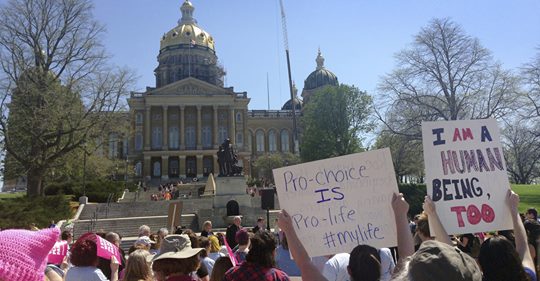
Abortion-rights advocates rally outside the Iowa capitol building in May. A law there banning abortion after a fetal heartbeat is detected is one of several state laws on its way through the courts.
Barbara Rodriguez/AP

With a newly configured U.S. Supreme Court, the stakes are high for abortion-rights battles at the state level. Abortion-rights advocates and opponents are preparing for a busy year — from a tug-of-war over Roe v. Wade to smaller efforts that could expand or restrict access to abortion.

Supreme Court Justice Brett Kavanaugh is known for his conservative record on issues including reproductive rights. And with his confirmation, many abortion-rights opponents see new opportunities to restrict the procedure at the state level.

“The pro-life movement has been talking about more pro-life-friendly courts for years, and we see Kavanaugh really tilting that balance,” says Jamieson Gordon with Ohio Right to Life.

Activists in Ohio just pushed through a law banning a common second-trimester abortion procedure called dilation and extraction. Gordon says her group is feeling optimistic and is working to pass more restrictions in the new year.

“It really has been encouraging for us knowing that if our bill … got picked up to go to the court, that we would have a more favorable court,” she says. “So I do think that we’ve seen the tide turn.”

A “watershed moment”

Abortion-rights advocates also are preparing for a wave of bills to be introduced in statehouses across the country, says Elisabeth Smith, chief counsel for state policy and advocacy at the Center for Reproductive Rights.

“We think this will be a watershed moment in terms of the number [of bills] that are filed, and then potentially the number that will actually be enacted in various states,” Smith says.

She says advocates are working to protect abortion rights, repeal existing restrictions and fight new efforts to limit access to the procedure.

“I think the specter of the Supreme Court will be behind both the proactive bills — in terms of shoring up the right and access [to abortion] at the state level — and on the other side, I think states that are hostile to reproductive rights are going to be jockeying to be the state that sends a law to the Supreme Court,” Smith says.

Tug-of-war over Roe v. Wade

Many abortion-rights opponents say they’re hoping to overturn Roe v. Wade, the 1973 decision that legalized abortion nationwide.

“States want their bill to be the one to go to the Supreme Court. They want to be the one,” says Sue Liebel, state director for the anti-abortion-rights group Susan B. Anthony List.

Possible test cases for Roe already are working their way through the courts — including an Iowa law banning abortion after a fetal heartbeat is detected, and one in Mississippi prohibiting the procedure after 15 weeks.

Liebel says anti-abortion-rights activists want to pass similar bills in as many states as possible.

“So I think they’re hopeful; they’re energized and rarin’ to go,” Liebel says.

If Roe were weakened or overturned, more power for regulating abortion would fall to the states. Several anti-abortion-rights groups are pushing to increase the number of states banning abortion after 20 weeks or earlier.

Meanwhile, lawmakers supportive of abortion rights in several states are sponsoring bills to guarantee the right to abortion in state law, in places including Massachusetts, Virginia and even Texas, according to Smith, with the Center for Reproductive Rights.

“It’s unlikely that [Texas] bill will pass,” Smith says. “But I think more and more state advocates are bringing up this bill — either as a messaging vehicle, or to actually get it enacted.”

Big steps, and small ones

NARAL Pro-Choice America is promoting those bills. But Deputy Policy Director Leslie McGorman says it is also working on incremental efforts to improve abortion access, including legislation allowing a broader range of medical providers — such as nurse practitioners and physician assistants — to provide abortions in more states.

“We know that as long as abortion is sort of a one-off procedure, or care that’s delivered in a standalone clinic and people sort of don’t know what it is, that it’s gonna be this part of health care that’s sort of viewed that way, that’s viewed as sort of marginal,” McGorman says.

Abortion-rights opponents also are continuing to pursue their own incremental strategy.

Americans United for Life has close to 60 model bills aimed at restricting abortion. Among them is the Abortion Reporting Act, which requires medical providers to submit detailed reports to health officials about abortion-related complications.

“This is really designed to make sure that women are informed about those abortion providers that are especially dangerous,” says the group’s president, Catherine Glenn Foster.

Abortion-rights advocates say the requirements are intrusive and vaguely defined. Planned Parenthood sued last summer to block a similar law in Idaho.

“There’s also a big push to defund abortion facilities, to stop them from getting Title X funding,” says Ingrid Duran, of the National Right to Life Committee.

It’s already illegal for federal funds to pay for abortions in most cases, but anti-abortion activists want to ban organizations such as Planned Parenthood, which offer abortions, from receiving any public money for reproductive health services. The Trump administration has proposed blocking such groups from getting funds through Title X, the federal family planning program for low-income people; Duran says similar efforts are underway in many states.

Source: https://www.npr.org/2019/01/02/679887749/activists-brace-for-2019-abortion-rights-battles-in-the-states?utm_source=facebook.com&utm_medium=social&utm_campaign=npr&utm_term=nprnews&utm_content=20190102&fbclid=IwAR2fq8KhBIeLFjxXUaANnJAMjkefGKdGmMZg5G64jcFzFyLqJBCmoToU1sA

Women who have been given a diagnosis of fatal foetal abnormalities will be able to legally avail of early termination of pregnancy.

ABORTION SERVICES WILL be available across the country from today.

Following last year’s referendum to repeal the eighth amendment from Ireland’s constitution and subsequent legislative changes, services will be provided by the HSE, through GPs or family planning services and in maternity units and hospitals throughout Ireland.

The recent enactment of the Health (Regulation of Termination of Pregnancy) Act means that abortion services can now be accessed in specific circumstances.

The Act allows for terminations of pregnancy up to 12 weeks. It also provides for terminations where there is a risk to the life or a serious risk to the health of the pregnant woman.

Women who have been given a diagnosis of fatal foetal abnormalities will be able to legally avail of early termination of pregnancy in the hospital they are being treated in.

Consultant Obstetrician and Gynaecologist Dr Peter Boylan has said that clinical guidance and training has been provided to assist practitioners in the clinical decision making of providing abortion services.

“A lot of work has been done by people across our health service to prepare for this new service, with a sufficient number of GPs signed up and others continuing to do so.”

Services will be provided in GP practices and family planning services, and maternity units and hospitals across the country.

While abortion services are available from today, some doctors and hospitals have said that they are unlikely to be ready to provide terminations in January.

The HSE has said that abortion care will be provided free-of-charge to people who need it.

In December, it launched a new website to provide information to women who are considering terminating their pregnancies.
MyOptions.ie provides people with details on information and counselling for abortions.

Those who experience an unplanned pregnancy are being encouraged to contact the My Options counselling service, where counsellors will provide information on where women can access termination of pregnancy services should they want to avail of them.

Helen Deely, Programme Lead of the HSE’s Sexual Health and Crisis Pregnancy Programme, has said “we’re here to help you, with professional counsellors, if you want to talk to someone, have a question about continued pregnancy supports, or want information about abortion services.”

Source: https://www.thejournal.ie/abortion-services-will-be-available-in-ireland-from-today-4418726-Jan2019/?fbclid=IwAR0cmouRheSk6b0hl0syiGE61a_QLG07zb9HnpAtOjtnX2HAhYci5Vwu1Co