When Donald Trump was asked about abortion access in a November 13 interview with 60 Minutes, he said that if the Supreme Court overturns Roe v. Wade, women seeking abortions will simply “have to go to another state.” His vice-president-elect, Mike Pence, was even more blunt. Speaking at a campaign event in July, he told supporters, “We’ll see Roe v. Wade consigned to the ash heap of history where it belongs.”

Whether or not Trump and Pence will take away a woman’s legal right to get an abortion remains to be seen, but it’s clear that neither appreciates the implications of banning the procedure. In fact, outlawing abortion doesn’t actually reduce the abortion rate — in countries were abortion is illegal, the number of abortions per woman is slightly higher. Instead, it forces women to seek out secretive, unsafe, unregulated abortions and in some cases to pay hundreds of dollars to get them. If Roe v. Wade is overturned, only women of means — women who can afford to “go to another state” — will be able to get an abortion. In many states, women’s health care will look much as it did before 1973.

Which means that the stories told in Back Rooms: Voices From the Illegal Abortion Era will be depressingly apt. Joanne Michaels, a New York–based journalist and publisher, decided to release an updated, revised edition of the book — which was written by Ellen Messer and Kathryn May and originally published in 1988 — months before the election. But under the Trump administration, the stories it contains will serve to remind readers what it was like to get an abortion in “the bad old days.” Below are four excerpts from Back Rooms, which is available upon mail-in request.*

***
Caroline, 44, on her abortion in 1963:

When it happened, I knew right away that I was pregnant. It was the summer between my junior and senior year of college. I didn’t really know what to do. I knew, though, that having a baby would ruin my whole life.

I don’t know when I really started to think about an abortion. I had earlier helped a friend get an abortion. It had seemed to be a fairly easy thing to do. [But] things at that time in Cleveland were very tight. It was 1963, and when I followed up on the few leads there were, it seemed that it was absolutely the worst possible time in about five years to have an abortion in Cleveland. I finally located an abortionist in Youngstown, Ohio. It was going to cost $100.

This so-called doctor — this man who called himself a doctor — had two businesses. He was a bookie and he was an abortionist. He was an elderly man in a ramshackle little house in a disreputable, shabby section of Youngstown. It in no way fit my image of a doctor’s house and office. But that was my only option, and I was very desperate to go through with it. He had a room with a chair and stirrups set up. I went in and it was all very, very secretive. I do know that when I finally aborted I was alone in my room at the dormitory at school. I went through at least twelve hours of labor alone in my room. It was more terrible than I ever imagined. I was timing the contractions and I just didn’t think I could bear any more. I didn’t feel I could cry out for help, and I just remember thinking, I’m going to get through this.

I know it went on for at least twelve hours. I remember noticing that the contractions were getting more frequent, and then there was a lot of blood and there was a fetus. I was really beside myself, and terrified. I didn’t know what to do. There was more blood than I ever imagined. I was terrified of someone discovering me, of being arrested.

I managed to get through that night and morning. Somehow I thought then it would be over, but it wasn’t over. I kept hemorrhaging and it just wouldn’t stop. It went on for days and days and I didn’t know what to do. I had become pregnant in August, and it was close to Thanksgiving, and I continued to bleed. When I finally saw [a] doctor, I got really frightened. He was so appalled at my condition that he said, “Do you realize you could’ve killed yourself?”

Emily, 50, on her abortion in 1955:

It was the end of 1955. I was living in Philadelphia, alone in a basement apartment. I was working part-time in Horn & Hardart to support myself. I was going to high school at night to get a diploma to qualify for college. I was, I guess, 20. I was having a relationship with a young man — my first actual experience with a man — and I found myself pregnant. I knew that I could not take care of a child. I knew that I was frightened and alone and impoverished. I had dreams about my life, so there was absolutely no way that I would give up what I was going to become. I didn’t feel I could take care of a child — I was a baby myself.

At that time it was impossible to get an abortion in Philadelphia because there had been a recent tragedy. The daughter of an upper-middle-class family had just died on the abortionist’s table. Everyone was terrified. There was absolutely nothing to be done. [So] I went to New York looking for an abortionist. I happened to bump into someone on the street that I had gone to high school with, so I asked her if she knew of an abortionist, not for me, of course, but for my friend. She had a friend who was going to Cuba to have an abortion, and maybe my friend wanted to go with her friend. So I did.

I went to the abortionist with her. She had hers first, and I heard her screaming and I was absolutely terrified. I said I simply did not want to go through that without some medication, and they did give it to me. I was sure that I was never going to wake up again.

I cannot believe that a 16- or 17-year-old knows how to raise a child — I think babies deserve better. I don’t have feelings of admiration for these young kids who decide to keep their babies, I really don’t. They can only raise miserable children, and I feel bad about that. They can have an abortion now without the pain and fear that I had. They don’t know what it was like before, and what it might be like if it’s taken away. They just don’t know what it was like.

Ann, 60, on her abortions in the late 1950s:

I had two illegal abortions. The first was in 1956 when I was 25. I had lived with my husband for about two years before we went to Europe, and we got married because we wanted to go to Europe. In those days, it was not common for unmarried people to travel together. I had gotten pregnant after we were married just a few months. My husband wasn’t opposed to keeping the child, but you know who the burden would have fallen on. It would have changed my life more than his.

I don’t know how, but we found out about a place in Germany. It was a maternity hospital. We had to give the doctor $300 in cash, which in those days was a lot of money. He pretended I was bleeding and told a nurse it was an emergency and performed a D&C. I was in the hospital for five days and was treated quite well. It was just that: $300 not to have a child.

Then, when we got back to New York, about two or three years later I got pregnant again. I found out through a friend about a doctor in West New York, New Jersey. It was hard at the time to find someone who would perform an abortion. It was all very secretive, like they had a code name “Charlie” and you had to call at a certain time on a certain day. It was really bizarre that in New York it was more difficult to find somebody than it was in Europe.

I remember going to this doctor’s office on a Saturday, and the office was empty and he didn’t use any anesthesia. It was very painful, but in a way I was lucky because the woman who told me about him had to have an abortion a few months later, and she had all kinds of terrible complications from it. So even though I had two abortions, I think I was really lucky not having any side effects. It sounds really simple now, but it was not simple. It was like I wasn’t being allowed to decide my own future, and that seemed really important to me — that I could decide when I wanted to have a child.

Lila, on her illegal abortion:

I had been dating Joseph almost a year — I met him in the spring of my freshman year, and I was still dating him in the fall. He was a Catholic also, and black Catholics were really hard to find. Joseph and I had gone to dinner. We started fooling around and fell into bed. We fell into his bed and had sex, and my period did not come the next time.

I was determined not to have the baby. Joseph told me that it was my choice because he was ready to get married. I liked the guy, but I wasn’t ready. I wanted to finish my education. I didn’t want to be a married student with a baby trying to finish up college for two years. I really couldn’t imagine having a baby by this guy. I decided to ask my stepmother in Des Moines if she could help me. I told my stepmother I was pregnant and that I didn’t want to have the baby, and she says, “Fine, I’ll call you back.” In two hours she called me back. She said, “Come to Des Moines this weekend.” I said, “How much will it be?” and I think she said $100. I felt nothing.

It was a kitchen table, coat-hanger abortion. It took maybe six minutes. I got on the kitchen table. I think my stepmother gave me a drink of brandy or something, and she said, “Now this may hurt a little bit.” She held my hand and this woman stuck a piece of coat hanger into my vagina. And then my stepmother said, “Okay, now get dressed.” And what you were supposed to do was leave that in there until you started to abort. I remember walking out with this coat hanger between my legs.

That evening I started bleeding and I think I was feeling cramps. I got up very early in the morning and went to the bathroom, and there was just this passage of blood and a clot that was slightly bigger than the clots I usually passed during my menstrual period. I realized that that was the fetus. The next month my period came on time.

I think it was rarer for black women to have chosen to have an abortion back in the bad old days. One reason people cite is that having a child enhanced a black woman’s self-esteem. I would suggest that another reason is because many black women didn’t know where to find one. If it was difficult for a white woman to find one, it was impossible for a black woman to find one, especially a poor black woman.

Source: https://www.thecut.com/2016/11/4-women-on-getting-an-abortion-before-roe-v-wade.html?utm_medium=s1&utm_source=fb&utm_campaign=thecut&fbclid=IwAR2sm3HX1vd3VAkCmvoFx2EO3v-5FgfSXwWpjz4bYf1TFUOnqohSRM8di7Q


Oregon’s Measure 106 is on the wrong side of history, and must not be allowed to pass. Not in Oregon. Not now. Not ever.

Oregon voters on November 6 will decide if new abortion care restrictions will be put into place in the pro-choice state.
Shutterstock

Constitutional amendments should protect our rights and liberties, not restrict them. But restricting rights—namely those of people with the capacity to become pregnant—is exactly what Oregon’s Measure 106 purports to do.

This ballot measure would amend the state constitution to require Oregon, in its publicfunding of health care, to discriminate against only one medical procedure: abortion.

Oregon is one of only 17 states to have expanded its Medicaid program to cover abortion care; it’s also one of the 28 statesthat allow abortion coverage in insurance plans for public employees. Last year, state lawmakers passed the Reproductive Health Equity Act, which ensures access to abortion care for all people in Oregon—with no out-of-pocket costs—regardless of their insurance provider, gender identity, or immigration status. At a time when liberty is under attack by our own federal government, it is up to states like Oregon to continue charting the path forward, not to retreat.

Those for Measure 106 argue that the measure is justified because it only prohibits funding for abortions that are “elective” rather than “medically necessary,” as though the decision to have an abortion is just like the decision to undergo teeth whitening, or Botox, or a facelift. Their argument goes something like this: If abortion is a “choice,” shouldn’t taxpayers be able to “choose” whether to fund it?

Even looking beyond the co-optation of the term “choice,” this argument falls flat. Because abortion isn’t merely a choice.

Consider those who lack access to basic reproductive health care, such as contraception and medically accurate sex education. Or those who do not have adequate housing or a job that pays a living wage (much less one that offers paid parental leave). Or—considering that nearly 60 percent of women who have abortions are parents—think about those who are struggling to care for the children they already have. Or victims of domestic violence, for whom unintended pregnancies could lead to further violence and forever tether them to their abusers. For these women and so many others, an abortion may not be medically necessary, but it surely isn’t “elective” either. For these women, access to abortion is a matter of survival.

In fact, abortion is never really “elective,” even for those who simply don’t want a child or have things they want to accomplish before becoming a parent. Truly elective procedures are those for which the consequences of forgoing them would be relatively inconsequential. Carrying a pregnancy to term has significant physical, emotional, social, and economic consequences.

To characterize abortion as an “elective” procedure is to deny the lived experiences of all women, and particularly young women, low-income women, and women of color. The truth is that one in four womenin the United States will have an abortion by the age of 45—and this includes women who have a religious or moral objection to abortion.

Seeing abortion care as “elective” makes it easier to ignore those who would be harmed by Measure 106. This includes the estimated 250,000 women of reproductive age who receive health care through Oregon’s Medicaid program; or the thousands of teachers, nurses, firefighters, city workers, and other public service members who receive health care through state insurance plans; or the countless others who would be affected by abortion being further stigmatized and made inaccessible.

It also makes it easier for state lawmakers to assert power over pregnant people’s bodies more generally. Doing so diminishes people’s experiences, and minimizes what is at stake when we push abortion care out of reach. And if we cannot talk about the reality in which abortion happens, we can’t begin to address the many forms of oppression that lead to one in four women needing abortion care in the first place.

Abortion is not like plastic surgery. Abortion is essential health care. It is a fundamental right under the United States Constitution; international law recognizes abortion, including the means by which to access it, as a basic human right. Yet this right means nothing if it is only available to the privileged.

People who seek abortion care, and those who have had abortions, are unique, multifaceted individuals; they share only a singular decision for their bodies, their futures, and their reproductive health.

Measure 106 is on the wrong side of history, and must not be allowed to pass. Not in Oregon. Not now. Not ever.

Source: https://rewire.news/article/2018/11/02/oregons-anti-choice-ballot-measure-is-dangerous-and-discriminatory/

In less than two weeks, voters in three states will weigh in on measures that are designed to restrict access to abortion and take away a woman’s right to make her own decisions about her reproductive health care.

In West Virginia and Oregon, voters will consider ballot proposals that could immediately ban state Medicaid insurance coverage for abortion, making this essential reproductive health care inaccessible for low-income women. In Alabama, politicians are attempting to enshrine, via ballot, anti-abortion rhetoric in the state constitution and assign legal rights to fetuses.

What’s worse, the measures in West Virginia and Alabama would exclude the right to abortion from those states’ constitutions. This step, in combination with the fact that both states still have pre-Roebans criminalizing abortion on their books, could lead to abortion being completely outlawed should the Supreme Court overturn Roe v. Wade and return the matter of the legality of abortion to the states. Not only would the Alabama measure lead to the criminalization of abortion, but it could also potentially outlaw certain forms of birth control as well once Roe’s protections are gone.

In other words, the proponents of these measures are trying to hoodwink voters into giving away their rights now and avoid the messy legislative battles sure to come in the wake of a Roe reversal.

Indeed all three proposals are part of a broader strategy by the anti-abortion movement to test just how far it can go in restricting reproductive health care, and they come at a time when the future of legal abortion in the United States is at unprecedented risk. By some estimates, nearly half the states would either outlaw abortion entirely or severely restrict it should the Supreme Court overturn or gut Roe.

Four states have so-called “trigger laws” on the books that would immediately outlaw abortion if the courts allow it. Another nine states, including West Virginia and Alabama, have pre-Roe laws still in place that would criminalize women, doctors, or both for abortion. And this doesn’t include other state legislatures controlled by anti-abortion politicians, who since 2011, have passed more than 400 restrictions designed to put abortion care out of reach.

The consequences of abortion restrictions fall hardest on women of color, poor communities, rural women, LGBTQ individuals, and young people. A woman’s ability to decide when and whether to become a parent should never be tied to how much money she makes, how she is insured, or where she lives. Anti-abortion politicians’ relentless attempts to restrict abortion care will only result in more women being forced to carry unwanted pregnancies to term, either because they can’t afford to pay for their procedure out of pocket or because clinics in their communities have closed.

For years, the ACLU and our state affiliates have been fighting these restrictions in the courts and in state legislatures. But this election season, we’re working hard to defeat these initiatives at the ballot box. In West Virginia, the ACLU is working with a strong coalition on the ground to ensure people Vote Against Amendment 1; the ACLU of Oregon is a founding member of the No Cuts to Carecampaign in Oregon to tell people to vote No on Measure 106; and the ACLU of Alabama is a member of the Alabama for Healthy Families campaign, which urges people to “Vote No on Amendment 2.”

While we continue to push back against these unjust laws, it’s up to all of us to make our voices heard at the polls this year, not just in Alabama, West Virginia, and Oregon, but across the country. That’s why we’re asking you to vote like your rights depend on it — because they do.

https://www.aclu.org/blog/reproductive-freedom/abortion/abortion-restrictions-are-ballot-3-states-election?fbclid=IwAR1Fr5mD9yoRyUvV87mGOcTZoTqKhQil18j0XqinaFE81EDuSixN_fIrtAA

Newly released review sets out way to make abortion a health rather than criminal matter

Andrew Little, New Zealand’s justice minister, is overseeing changes to abortion laws. Photograph: Pool/Getty Images

Pro-choice advocates in New Zealand have welcomed a law review exploring ways to decriminalise abortion and treat it as a health issue instead.

Advocates called the report “amazing” and said its recommendations were long overdue.

The review recommends three alternative approaches to abortion law. The first – called model A and favoured by pro-choice campaigners – would remove all specific regulation of abortion and see it treated like any other health service. A further two options include a “statutory test” that would require a health professional to be convinced an abortion “is appropriate”.

Terry Bellamak, director of ALRANZ Abortion Rights Aotearoa, said model A was the only option that would make accessing abortion a more streamlined and dignified experience for women, many of whom found the existing system “degrading”.

“Model A is clearly superior because it treats abortion as a health issue like any other, and does not place unnecessary barriers between pregnant people and abortion care,” Bellamak said.

The review found health practitioners and professional bodies were “almost unanimous” in their support for model A.

Under New Zealand law, abortion is a crime and legal only in cases of incest, “mental subnormality” or foetal abnormality, or where the physical or mental health of the mother is at serious risk. Other factors that may be taken into consideration but are not grounds in themselves include “sexual violation” and “extremes of age”.

The justice minister, Andrew Little, said on Friday the legislation governing abortion was “outdated” and New Zealand needed to follow reforms elsewhere such as Ireland and the Australian state of Queensland in making abortion easier to access.

Compared with other countries New Zealand women face long delays in obtaining abortions. Little said it was “disturbing” to read of women being forced to go through with unwanted pregnancies.

In England and Wales in 2017, 77% of abortions were carried out before 10 weeks, the safest period in which to terminate, while in New Zealand in the same year only 59% of abortions met that criterion.

A 2009 study found New Zealand women were waiting an average of 25 days for an abortion.

Opposition to the government’s reform plans was “a certainty”, said Little, but starting the debate was also necessary for women’s wellbeing. “It is a very sensitive issue and it does tend to generate a fairly polarising debate, and it’s a conscious issue for MPs and even within parties there are very different views,” Little said.

“But I think it is very timely to look at the law and ask ourselves whether it is fit for the 21st century. Other countries have been doing it [reform] and are doing it, and I think it’s right for New Zealand to be doing it now.”

Other reforms suggested by the review include allowing women to access abortion services directly rather than being referred by a doctor, removing restrictions on who can perform abortions and where, and removing the requirement for two “certifying consultants” to approve it.

Despite the restrictions, abortion is common in New Zealand but rates have been steadily declining for more than 10 years, which is thought to be due to wider use of long-term contraceptives and significantly fewer teenage pregnancies.

International evidence suggests restrictive abortion laws do not reduce the number of abortions taking place but increase the proportion that are unsafe, the report states.

In countries with highly restrictive abortion laws the risks associated with illegal abortions are high. The World Health Organization estimates 47,000 woman die each year from unsafe abortions, with a further five million suffering permanent disability.

Source: https://www.theguardian.com/world/2018/oct/26/new-zealand-pro-choice-campaigners-hail-move-towards-abortion-law-reform?fbclid=IwAR3ppmJj4Gq-Oq-Yq5IQD80-WveJjG1Z0FNgB7SjI1i1UQPFsl7LCVr-tAw

These six states show how the Supreme Court could end abortion access without overruling Roe v. Wade

Following Brett Kavanaugh’s nomination to the Supreme Court, there was much discussion about the future of reproductive rights in the United States and whether his appointment could result in the overturning of Roe v. Wade. While that prospect remains a real threat, abortion could be made as good as illegal for millions of people long before that happens.

In 2016, the Supreme Court struck down abortion restrictions that would have closed most abortion clinics in Texas. Justice Anthony Kennedy was the swing vote in that case. With Kavanaugh confirmed as his replacement, the court could use the next abortion-rights case to eviscerate abortion access without explicitly overruling Roe.

Ever since Roe was decided in 1973, state legislatures have been chipping away at abortion access, passing more than 1,100 restrictions. They include waiting periods, anti-abortion counseling mandates, bans on the types of procedure used, and forced ultrasounds. And then there are the TRAP laws — Targeted Regulations of Abortion Providers — that require abortion providers to have admitting privileges at local hospitals or require clinics that provide safe, outpatient care to meet the standards of ambulatory surgical centers.

The TRAP requirements are difficult — in some cases impossible — to meet. Many hospitals simply won’t provide admitting privileges to doctors who perform abortions due to anti-abortion bias and stigma. Others require doctors to admit a certain number of patients at the hospital each year, but because abortion is such a safe procedure, abortion providers can’t meet that threshold.

Ambulatory surgical centers are far more complex and expensive than what is necessary to provide a safe abortion, and no other comparable medical procedure is subject to such requirements.

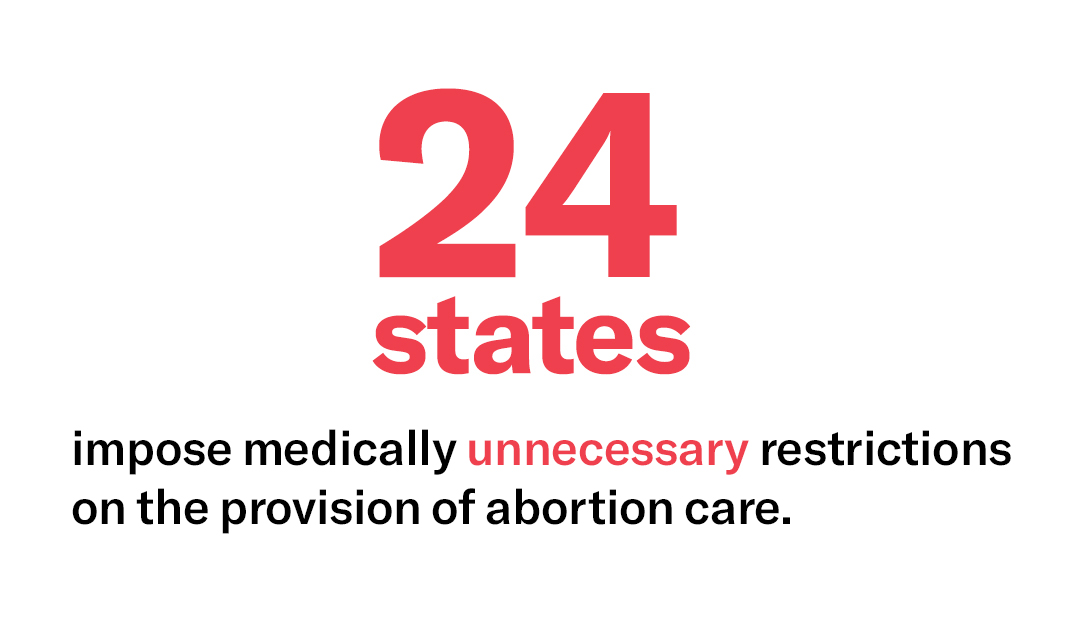
24 states impose medically unnecessary restrictions to accessing abortion care

Proponents of TRAP laws claim that they are intended to protect women’s health, but major medical associations oppose the requirements, saying they actually jeopardize women’s health by delaying and obstructing access to abortion care.

In 2016, the Supreme Court agreed that the laws do not benefit women but rather impose unnecessary obstacles. In a decision called Whole Woman’s Health v. Hellerstedt, the Supreme Court struck down a TRAP law in Texas that would have required abortion providers to have admitting privileges and meet the requirements of ambulatory surgical centers.

The court found that there was no evidence that that the measures protected women’s health. There was, however, overwhelming evidence of the burden they imposed on women by forcing three-quarters of clinics around the state to close, leaving millions of women without access to abortion.

In a dangerous preview of what may lie ahead, judges on lower courts who disagree with Roe v. Wade, are already starting to ignore the Whole Woman’s Health ruling and uphold laws nearly identical to the one in Texas, forcing more clinics to close. It happened in Arkansas, where the state went down to a single clinic for a period this summer when a federal appeals court lifted an injunction against a TRAP law that was very similar to Texas’s. And it’s what happened just last month in Missouri and Louisiana, both of which are going down to one clinic each because appeals courts for those states have flouted the Supreme Court’s decision and allowed TRAP laws there to stand.

Before those decisions, as of May 2017, there were already six states that had only one abortion clinic remaining. Soon, that number could increase to at least eight. And, if the Supreme Court gives the green light, some states may have no abortion clinics left in the not-so-distant future.

Below, we look at just some of the states that are down to a single clinic or have seen a precipitous reduction in the number of clinics over the past 25 years because of abortion restrictions. Sadly, this is likely what more and more of the country may start to look like.

Decline in Arkansas Abortion Clinics - 8 in 1992, 3 in 2018

In 1992, Arkansas had eight abortion clinics. Today it has three. And, depending on how a federal appeals court rules in a pending case, it could soon have only one.

That is what happened over the summer, when a federal appeals court allowed a law virtually identical to the one struck down by the Supreme Court in 2016 to take effect. The Arkansas decision made medication abortion (aka abortion with pills) unavailable in the entire state by requiring clinics that provide the service to have an agreement with OB-GYNs who have admitting privileges at a nearby hospital. (Recall this is the same type of law that the Supreme Court found unconstitutional just two years ago.) And that could happen again — this time on a permanent basis — if the appeals court rules in favor of the state once more.

In addition, we have challenged four other restrictions passed by the Arkansas Legislature, all of which have been blocked by a federal trial court. But the state has appealed. If the state prevails, these laws would act as an effective bar to having an abortion anywhere in the state. Arkansas also requires anti-abortion counseling, parental consent, and a 48-hour waiting period. It also bans abortions at 20 weeks. Counseling must be provided in person and take place before the waiting period begins, necessitating two separate trips to one of the few clinics in the state.

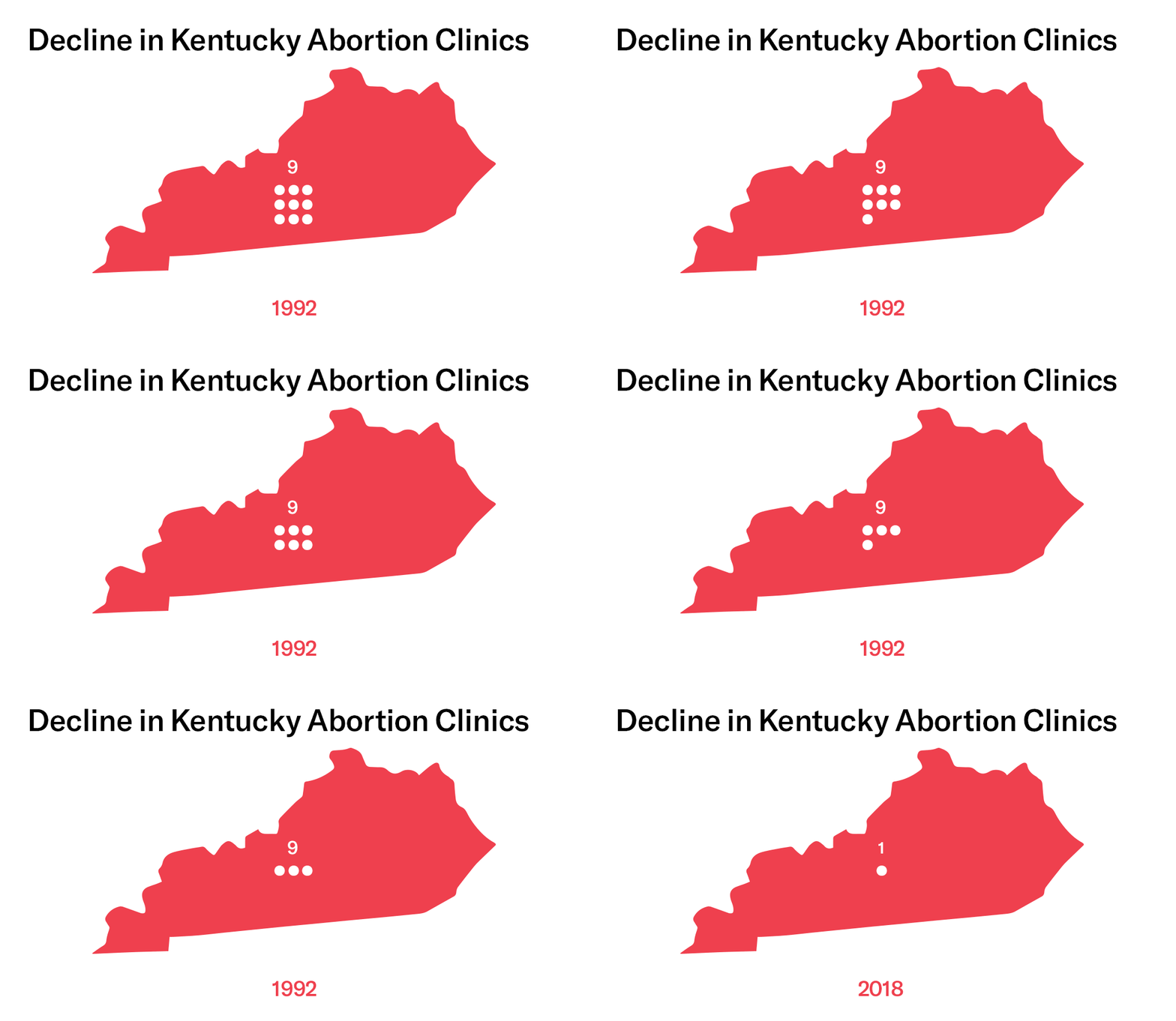
Decline in Kentucky Abortion Clinics - 9 in 1992, 1 in 2018

In 1992, Kentucky had nine abortion clinics. Today it has one. The state has tried to use TRAP laws to shut down the single remaining clinic, but litigation has thus far blocked it from doing so. In September, a federal court held that the TRAP laws’ “scant medical benefits” were “far outweighed by the burden imposed on Kentucky women seeking abortions” and struck the laws down. However, the state has vowed to appeal. If the ruling stands, a second clinic is likely to begin offering abortion services.

But there’s more. Kentucky already bans abortion after 20 weeks, but this year the state passed a law effectively banning abortions after 15 weeks as well. We sued and the law is on hold. Women in Kentucky are also required to have a face-to-face consultation with a doctor at least 24 hours before an abortion. Women under 18 must get permission from a parent or a judge in order to have an abortion. And doctors must provide an ultrasound, narrate fetal development, and make the heartbeat audible regardless of whether the patient wants to hear it. We are challenging the ultrasound law in the courts, too.

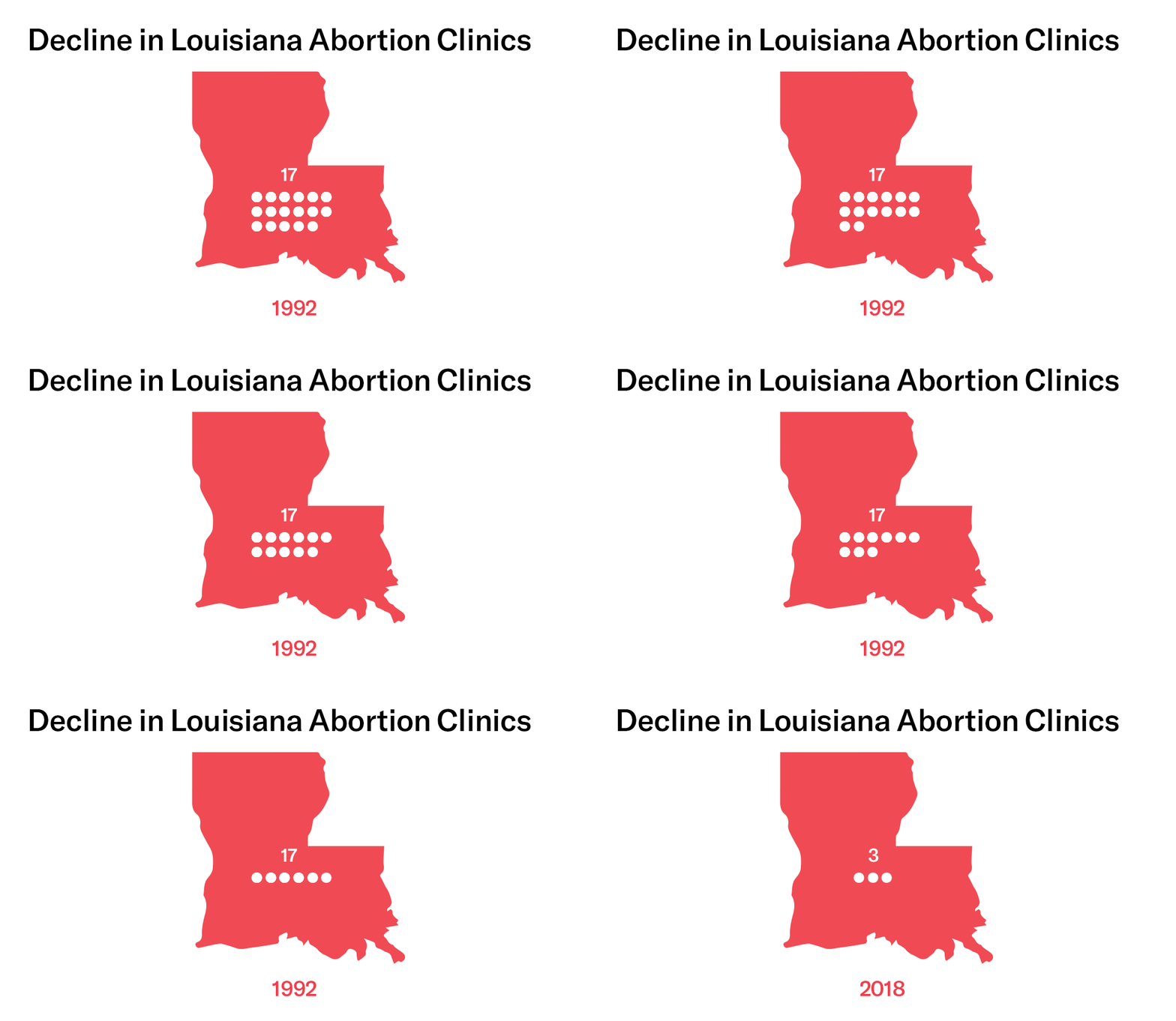
Decline in Louisiana Abortion Clinics - 17 in 1992, 3 in 2018

Louisiana had 17 abortion clinics in 1992. Today it has three. And, due to a recent court ruling, it may soon only have one. That is because its clinic licensing law contains more than 1,000 medically unnecessary requirements, including an admitting privileges measure that is indistinguishable from the one struck down in Whole Woman’s Health. Yet the Fifth Circuit Court of Appeals ignored the clear and controlling precedent and allowed the law to go into effect.

In addition to establishing licensing hurdles that are almost impossible to overcome, the law forces women to undergo invasive examinations, makes doctors give their patients misleading or false information, and allows the government to collect and review the medical records of every woman who has an abortion in the state. Moreover, the state passed a bundle of abortion restrictions in 2016 that, among other things, tripled the time a woman had to wait to get an abortion — pushing women later into pregnancy — and banned the most common method of abortion in the second trimester.

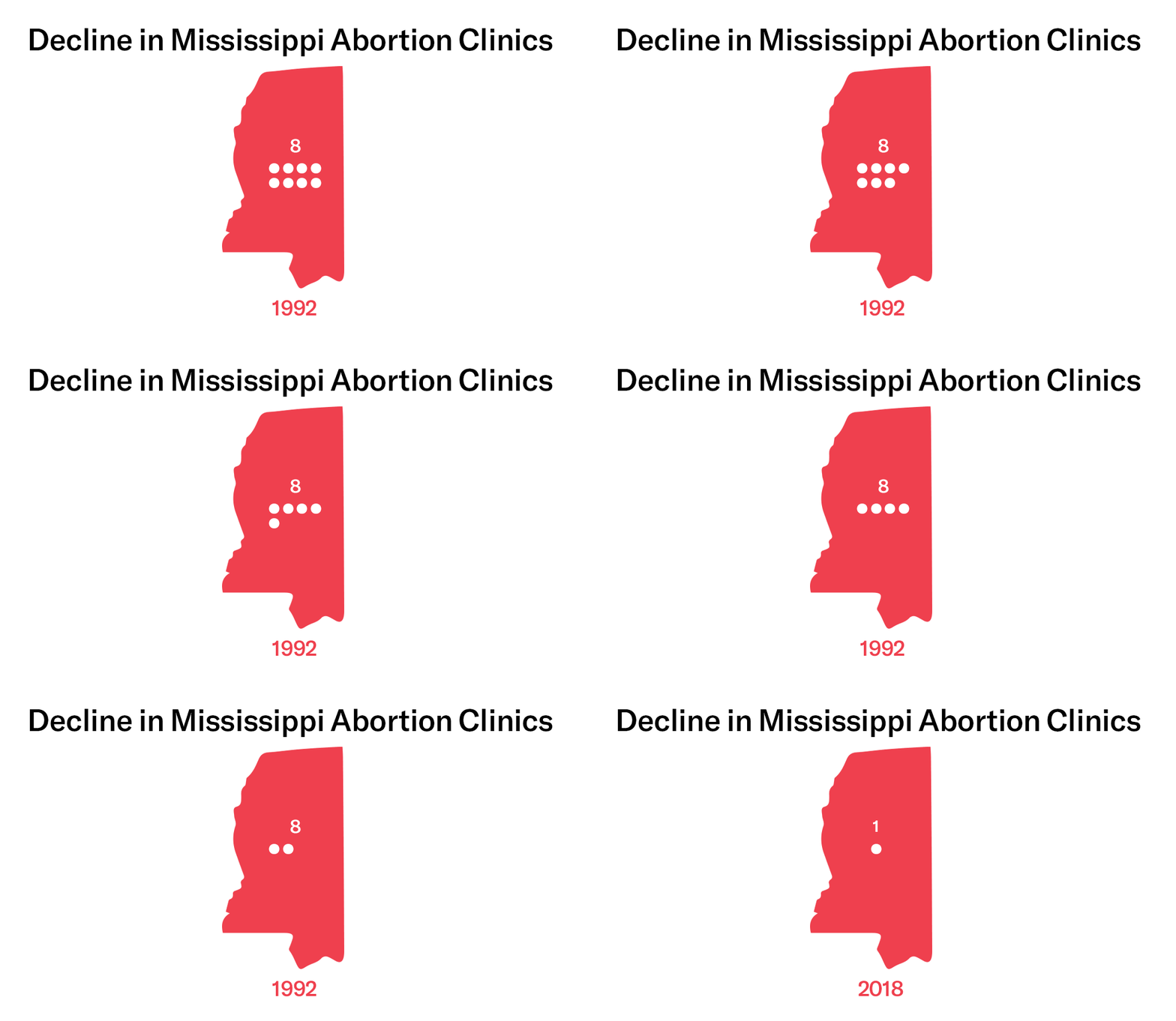
Decline in Mississippi Abortion Clinics - 8 in 1992, 1 in 2018

In 1992, Mississippi had eight abortion clinics. Today it has one. From 1991 to 2014, the annual number of abortions in Mississippi declined by nearly two-thirds. The abortion rate in Mississippi is almost four times lower than the national rate, despite the state’s unintended and teen pregnancy rates being substantially higher than the national average.

Mississippi has some of the most stringent abortion laws in the country, and Mississippi Gov. Phil Bryant has said, “Please rest assured that I also have not abandoned my hope of making Mississippi abortion-free.”

Until the measure was blocked in court, Mississippi required any physician associated with an abortion facility to have admitting privileges at a local hospital. It took eight months for the state to finally admit that there was no meaningful distinction between the Texas law that had been struck down by the U.S. Supreme Court in Whole Woman’s Health v. Hellerstedt and its own admitting privileges measure.

While several states have laws limiting the provision of abortion care to physicians, thereby preventing other qualified, licensed clinicians from offering this service, Mississippi takes it one step further by requiring abortion providers to be OB-GYNs. It is the only state to impose such a requirement.

In addition to its clinic shutdown laws, a woman must receive in-person, state-mandated counseling intended to discourage her from choosing an abortion, wait 24 hours before she can return to the clinic, and undergo an ultrasound before she can have the procedure. A woman under 18 must obtain written consent for her abortion from both parents or permission from a judge.

Mississippi was the first state in the nation to enact a ban on abortion after 15 weeks of pregnancy, which was the earliest abortion ban in the country at the time it took effect. The state also has a “trigger law,” which is designed to ban abortion immediately should the U.S. Supreme Court overturn Roe v. Wade.

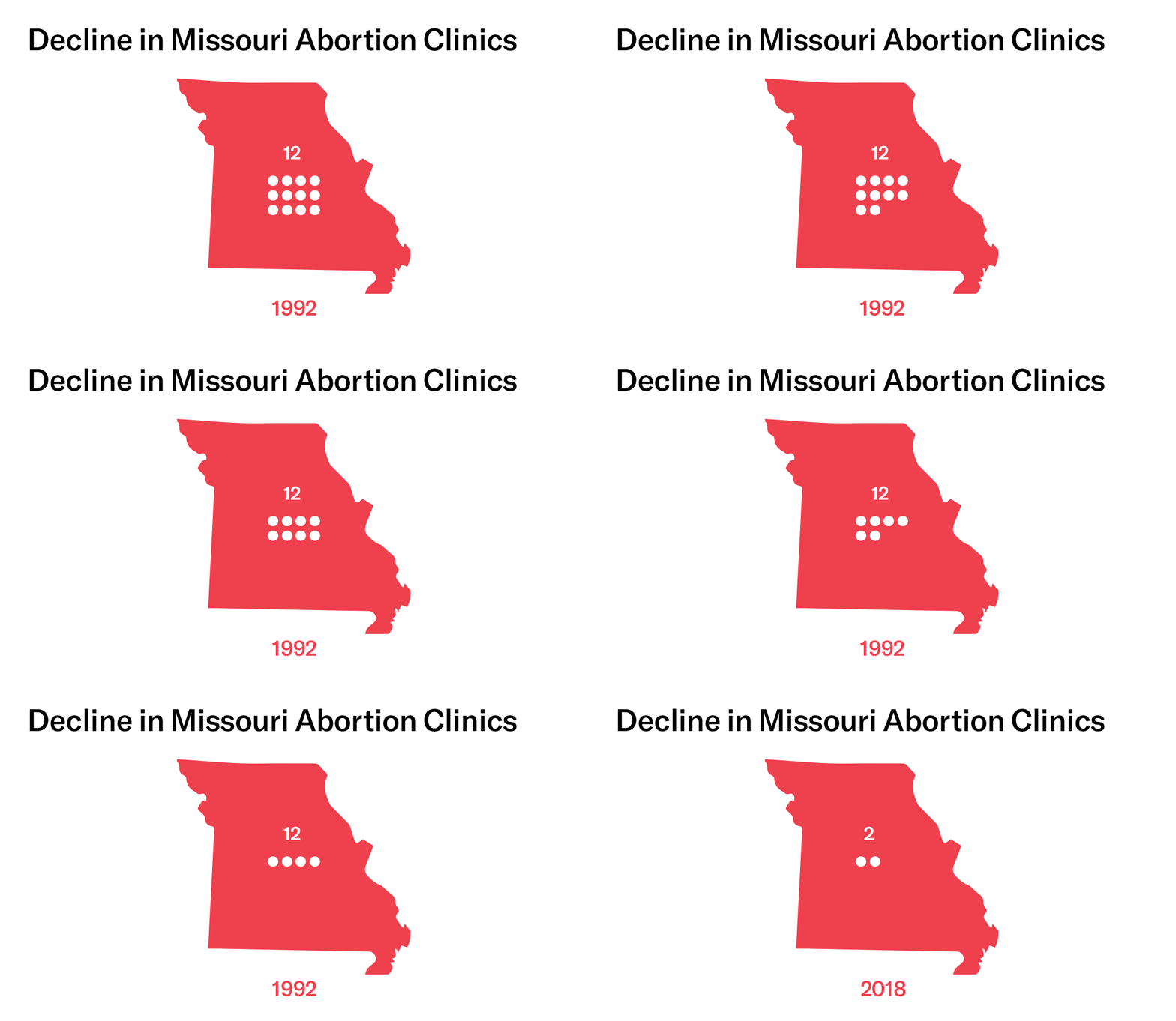
Decline in Missouri Abortion Clinics - 12 in 1992, 1 in 2018

In 1992, Missouri had 12 abortion clinics. Last year it had one — until a federal district court enjoined its TRAP law, which allowed a second clinic to offer abortion services again. But now it has gone back down to one after a federal appeals court let two measures, virtually identical to the ones struck down in Texas, take effect in September.

Beyond its TRAP laws, Missouri requires state-directed counseling designed to discourage abortion that must be provided by the same doctor who will perform the abortion. Following the counseling, a woman needs to wait 72 hours before she can obtain the procedure. Because the counseling must be provided in person, she must make two separate trips to the clinic. And with so few clinics in Missouri, a trip to the clinic could be 300 miles away. That, in turn, requires additional time off of work and possibly extra childcare costs, given that the majority of women who have abortions are already mothers.

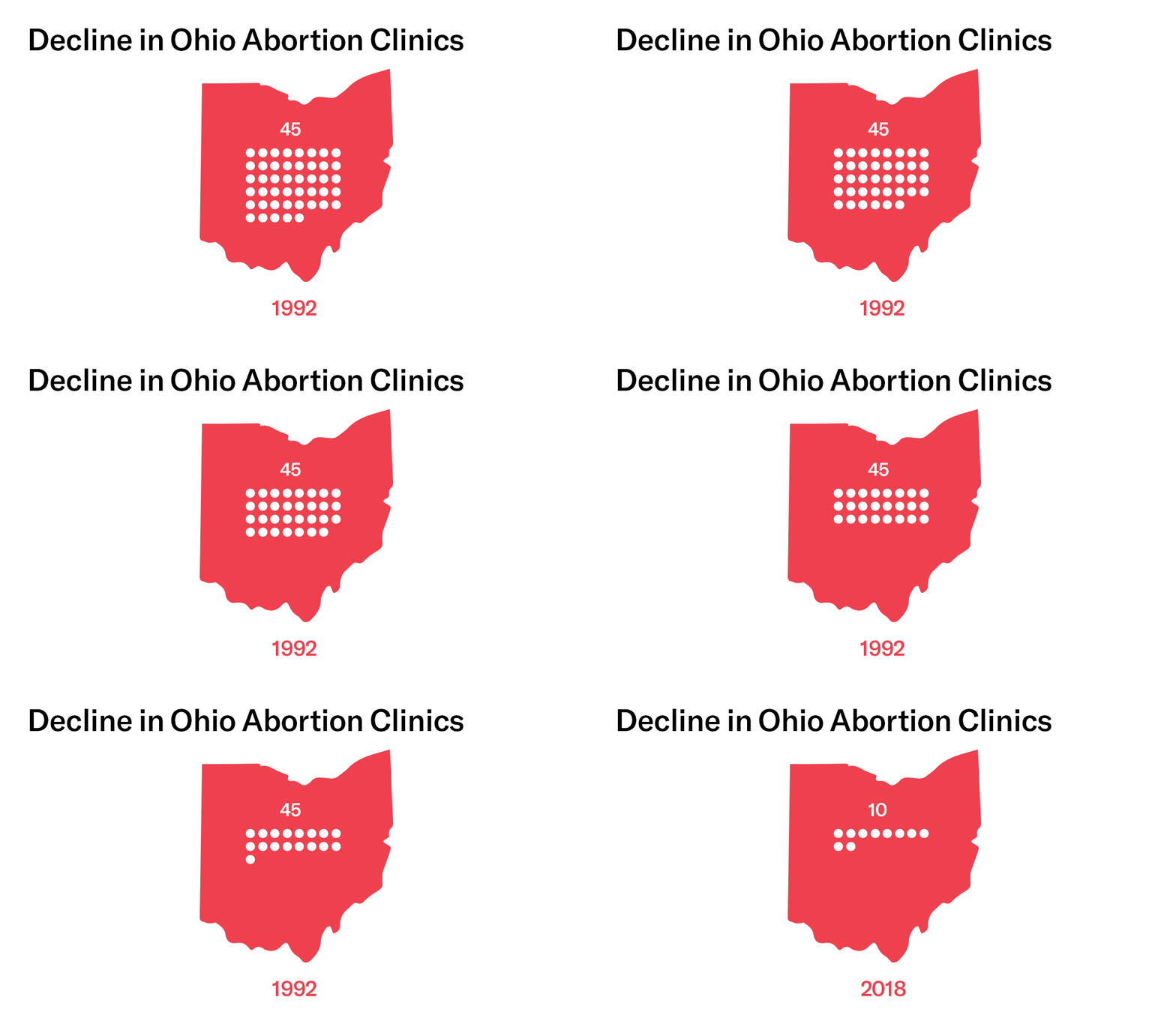
Decline in Ohio Abortion Clinics - 45 in 1992, 10 in 2018

In 1992, Ohio had 45 abortion clinics. Today it has 10.

First, the state required abortion providers to obtain a written transfer agreement with a local hospital. Then, it banned public hospitals from entering into such agreements with abortion clinics. Not satisfied with that Catch-22, the state also created an onerous process for abortion clinics to seek an exemption from the transfer agreement requirement and made the denial of a clinic’s application automatic if the Department of Health failed to act within 60 days. And while the statute only requires a clinic to have one backup physician in order to be exempted, the Department of Health demanded a showing of two, then three, and ultimately four backup physicians.

It is only due to court intervention that the sole remaining clinic in Dayton is open today, and several other clinics are also in jeopardy of shutting down because of these laws. Even the retirement of one backup doctor could force a clinic to close.

On top of these onerous measures, women must wait at least 24 hours after receiving in-person, biased counseling before having an abortion, requiring two trips to the clinic. Women under 18 must have a parent’s consent. Finally, women must undergo an ultrasound so that the provider can test for a fetal heartbeat.

* * *

Rather than improving women’s health and safety, abortion restrictions have been designed to harass, guilt, and shame women and push abortion care out of reach. Already, too many women live in places where Roe has been rendered meaningless. Whole Woman’s Health, if dutifully applied by the courts, would stem the tide of laws that have shuttered so many abortion clinics. But a newly constituted Supreme Court, and lower federal courts that have been stacked with judges who are hostile to abortion rights, portend a future in which broad swaths of the country will have little to no access to abortion – all while Roe remains “settled law” but exists in name only.

Source: https://www.aclu.org/issues/reproductive-freedom/abortion/last-clinics-standing?fbclid=IwAR3IWa0o72OSix7y1ZHxyuGcEEt5enOU-X6GvjXfTjGQAim4gwdGK63u3hc

Anti-choice advocates, vowing to fight Aid Access, and are now considering advocating for Congress to intervene.

According to USDA guidelines, doctors must dispense mifepristone at clinics, medical offices, or hospitals.
Jarretera / Shutterstock.com

The U.S. Food and Drug Administration (FDA) is investigating a website that recently began providing women in the United States with low-cost medication to cause early abortion at a relatively low cost.  The federal agency says that selling the pills online is illegal and breaks federal protocol, and anti-choice advocates are considering asking the U.S. Congress to step in as well.

The website Aid Access began selling drugs online this year, allowing people up to 10 weeks’ gestation to terminate their pregnancies for less than $100—one-fifth of the average cost of the same medication at a clinic.

Women in the United States are able to end first-trimester pregnancies at home with Mifeprex; also known as mifepristone, the drug prevents a pregnancy from continuing by blocking the hormone progesterone, dislodging an egg from the lining of the uterus. Another drug, misoprostol, “enhances contractions and helps to expel the products of conception from the uterus,” according to Aid Access.

The FDA has determined that Mifeprex, should only be “dispensed in certain health care settings, specifically, clinics, medical offices and hospitals, by or under the supervision of a certified prescriber. Mifepristone, including Mifeprex, for termination of pregnancy, is not legally available over the Internet,” the FDA said in an emailed statement to Rewire.News.

“The agency takes the allegations related to the sale of mifepristone in the U.S. through online distribution channels very seriously and is evaluating the allegations to assess potential violations of U.S. law,” the FDA said.

According to FDA guidelines, doctors must dispense mifepristone at clinics, medical offices, or hospitals. Aid Access uses a doctor to write prescriptions for the drug online, and distributes the drugs through the mail.

The FDA also posted a notice online warning consumers not to by Mifeprex over the internet “because you will bypass important safeguards designed to protect your health (and the health of others).” Drugs that are “purchased from foreign Internet sources are not the FDA-approved versions of the drugs, and they are not subject to FDA-regulated manufacturing controls or FDA inspection of manufacturing facilities,” the agency warned.

But not everyone agrees. Major medical organizations and physicians have argued that the drugs should be more widely available and are perfectly safe for home use. Experts have argued in the Journal of the American Pharmacists Association that the limitation is not warranted, and medication abortion up to 10 weeks’ gestation is the safe, effective, and preferred method for terminating a pregnancy. Pharmacists can dispense the medications upon a doctor’s prescription in Australia and some provinces of Canada, the commentary said.

“This restriction might have made sense when mifepristone was first approved in 2000, given the limited safety data from the US at that time, But after 18 years of evidence of the drug’s safety, this is no longer needed. Canada recently approved mifepristone, and the drug is already available at pharmacies by prescription,” said Dr. Daniel Grossman, director of Advancing New Standards in Reproductive Health (ANSIRH), a research center at the University of California, San Francisco.

Aid Access responded to questions about the investigation by referring Rewire.News to a recent publication by the Guttmacher Institute, an abortion research and policy institution, arguing that the FDA restrictions on mifepristone “are not justified.” It cites support for lifting restrictions from the American Medical Association and the American College of Obstetricians and Gynecologists. The “limits imposed on mifepristone are both burdensome on those seeking to access medication abortion and ineffective in addressing any risks associated with the medication,” the Guttmacher Institute said.

The founder of Aid Access, Dr. Rebecca Gomperts, has offered similar services in countries where abortion is illegal through her site Women on the Web. Aid Access reportedly launched in April and has since received thousands of requests. Gomperts was not made available for an interview with Rewire.News.

While medication abortion is generally available in the United States, access to abortion providers varies widely. Women in 27 large U.S. cities would have to travel more than 100 miles each way to access abortion services, according to ANSIRH research. Six states have just one abortion-providing facility.

Medication abortions have risen in recent years—from 6 percent of non-hospital abortions in 2001 to 31 percent in 2014. That is despite a decline in the overall rate of abortion: The abortion rate in 2014 was lower than it was when abortion became legal in 1973, according to the Guttmacher Institute.

Anti-choice advocates have vowed to fight Aid Access’ work and are now considering advocating for Congress to intervene. Americans United for Life (AUL) President Catherine Glenn Foster said in a statement that the service is “reckless and irresponsible” because no ultrasound is performed, and thus it is not possible to know if the pregnancy is ectopic.  “Because Gomperts’ plan is dangerous to women’s health and safety, the act of sending unregulated prescription abortion pills through the mail should be the subject of federal regulation,” Foster said.

“Research has shown that women who know when their last period started are generally accurate at determining how far along they are in the pregnancy,” Grossman argued in response. “These medications are not thought to be effective to treat an ectopic pregnancy, but they won’t make the complications from an ectopic worse. Ectopic pregnancy is very rare—and apparently rarer among women seeking abortion compared to the general population. Most women with an ectopic will have unusual symptoms like pain or bleeding, and they should be advised to seek care.”

A spokesman for the Republican-led House Energy and Commerce Committee did not respond to questions about whether the committee is considering an investigation.

AUL may already have an inside track at the FDA and its parent agency, the U.S. Department of Health and Human Services. The department’s assistant secretary for public affairs is Charmaine Yoest, the former president of AUL.

Source: https://rewire.news/article/2018/10/26/the-fda-is-investigating-self-managed-abortion-care-website/

A one-month supply of birth-control plils. (Rich Pedroncelli/AP)

Kathleen Sebelius served as secretary of health and human services from 2009 to 2014.

Congressional candidates have deluged voters in recent weeks with debates about the Trump administration’s efforts to peel away protections for Americans with pre existing health conditions. Yet there is another, equally insidious effort from the administration that could undermine access to health care, and Americans have no idea it is happening: a proposal to drastically reduce information on and access to contraception.

Decades of health data make it clear that helping young women avoid unwanted pregnancies can be a critical factor in their success in life. With freedom from an unexpected pregnancy, they can finish school, pursue a career and better prepare for parenting. Even people who believe that abortion services should be legally available also believe that abortion is not the preferred method of family planning. We are making considerable progress in the United States in reducing teen pregnancies and abortion rates, thanks in large part to the availability of birth control.

But pending rules from the Department of Health and Human Services would dramatically limit access to contraception for low-income women, “gag” health providers from discussing or referring women to abortion services and divert taxpayer resources now used to provide access to contraception to largely ineffective abstinence-only programs.

The proposal targets Title X, the federal grant program enacted in 1970 that supports family planning services and contraceptive care to about 4 million low-income women at little or no cost — though federal law bars any federal funds from being used to provide abortion services. The $260 million program helps to fund services in about 4,000 health clinics throughout the country.

The draft rules, issued in June, not only would block any federal funding for family planning clinics that also offer abortion services, such as Planned Parenthood, but also would eliminate the current requirements that all health clinics receiving federal family planning funds offer a broad range of approved family planning methods, including prescription contraception. It excludes all reference to contraception or the federal government’s clinical guidelines for quality family planning, stressing instead “natural family planning.”

Under these rules, women — particularly low-income and younger women — will likely never learn what affordable options, depending on their insurance, are available to them. And for the first time, women’s health providers could exclude any discussion of contraception choices other than less-reliable “natural methods.”

With this rule change to Title X, the government would impose significant barriers for contraception and could rapidly undermine the significant progress made on teen pregnancies and reduced abortion rates. According to the Guttmacher Institute, U.S. teen pregnancy rates have fallen to historic lows. Compared with 1990, only a third as many young women ages 15 to 19 became pregnant in 2013. Abortion rates also declined by 74 percent over the same period. Health experts say this correlates with improvements in contraception use in the United States, particularly among younger and lower-income women.

Millions of women now have private health plans that cover, with no out-of-pocket costs, all forms of contraception approved by the Food and Drug Administration. And with expanded Medicaid plans across the country, low-income women also have access to family planning choices, including long-lasting contraception.

But for women without that coverage, the pending Title X rules could have a devastating impact for generations. Either HHS must abandon this ill-advised move or Congress needs to act to curtail this destructive new proposal. The United States still lags behind other developed countries in terms of teen pregnancies, but real progress has been made. This is the wrong time to undermine those proven successes.

Source: https://www.washingtonpost.com/opinions/low-income-womens-access-to-contraception-is-under-attack/2018/10/23/f9e696f4-d2e0-11e8-a275-81c671a50422_story.html?fbclid=IwAR25nd1UoUnkZLKvIsqNXodzjULe2H6OedpTfbqN2xk18NEbZlV4VvBt05E&noredirect=on&utm_term=.f5221f949451

Mary Mayhew could block women from using their Medicaid insurance at reproductive health clinics for birth control and STD testing if the clinic also provides abortion.

Erin Hooley/Chicago Tribune/TNS via Getty Images

The Trump administration announced last Monday that it had appointed former Maine health commissioner Mary Mayhew to run Medicaid, the government-run health insurance program for people with low incomes, people with disabilities, some pregnant women, and more.

Mayhew is known for her “aggressive” conservative reforms to the program that lead to enrollment dropping by almost 25 percent under her watch. As other outlets have pointed out, she’s a Medicaid critic in charge of Medicaid, which is the single largest source of health insurance in the US—a program whose budget the GOP has already said they plan on cutting.

Mayhew’s appointment has received considerable press for its potential to affect health coverage, but less discussed is the impact her hiring could have on access to reproductive healthcare. In addition to supporting conservative policies like work requirements for Medicaid, Mayhew has also been vocal about her anti-choice views and her disdain for Planned Parenthood in particular.

When she was running for governor in Maine earlier this year, Mayhew said “I will support legislation that protects the lives of the unborn…and I am also proud to say I implemented a policy that stopped the use of tax dollars for abortions by Planned Parenthood.”

Reproductive health advocates find these views concerning given that Medicaid is critical for access to family planning: According to the Guttmacher institute, the program covered nearly 13 million women of reproductive age in 2015 and accounts for 75 percent of all publicly funded family planning services.

Mayhew’s appointment has renewed long-held concerns that the Trump administration may let states exclude clinics that provide abortions from their Medicaid programs (even though such a move doesn’t appear to be legal—more on that below). What that would mean, in effect, is blocking women from using their Medicaid insurance at highly-qualified reproductive health clinics that provide services like birth control and STD testing if the clinic also provides abortion services. Recent news reports show that similar provider exclusions in Texas and Iowa led to fewer people getting family planning care than before changes were implemented.

“The administration seems open to and, in fact, encouraging states to try to exclude abortion providers from their Medicaid programs,” says Kinsey Hasstedt, a senior policy manager with the Guttmacher Institute. “There are real concerns for people’s access to the family planning services that they need, particularly for marginalized communities, low-income individuals, uninsured folks and real concerns for the quality of care patients would ultimately receive by excluding these highly qualified providers.”

What does Planned Parenthood have to do with Medicaid?
Republican legislators have long tried to “defund” Planned Parenthood by proposing amendments to exclude it from federal programs like Medicaid and Title X, though these amendments have ultimately failed or been vetoed.

“Defunding” is a misnomer anyway: There is no line item in the budget for abortion providers like Planned Parenthood. Clinics only receive federal funds in exchange for providing services like birth control, STD testing, and cancer screenings to people with Medicaid (just like it works with any other kind of insurance), or by winning grants earmarked for family planning. Medicaid funds can’t be used to pay for abortions except in the cases of rape, incest, or danger to the mother’s life; and family planning grants from the program known as Title X can’t be used for abortion under any circumstances.

Since federal lawmakers have been unsuccessful in “defunding” women’s health clinics that also provide abortion, some states are trying to get approval from the government to exclude these clinics from Medicaid at the state level—it’s a backdoor way to accomplish what Congress has been unable to do.

Texas, for example, has submitted a special waiver to exclude abortion providers from its Medicaid program, and that application been pending since July 2017. In January, Governor Greg Abbott personally wrote to President Trump asking him to approve the request. (The Obama administration had rejected Texas’ request to do exactly this in 2011, so the state turned around and set up its own state-funded program that excluded abortion providers as of 2013. It’s hoping a different administration will reinstate its federal Medicaid funding.)

Is it legal to exclude abortion providers from Medicaid?
In a word, no. Medicaid has special rules for family planning services which state that people with this insurance have their choice of family planning provider, so long as the provider takes Medicaid. It’s literally called the “free choice of provider” provision. Back in 2016, the Obama administration reminded states that they can’t block providers from Medicaid for any reason other than their ability to provide care. But in January 2018, the Trump administration rescinded that Obama-era guidance, signaling to some the administration’s possible willingness to approve requests like those from Texas.

“Ultimately, we have been concerned about the administration’s efforts to try to promote this [kind of exclusion] and just because they say they can doesn’t mean they can legally,” Hasstedt says. “Regardless of what the Trump administration is saying or may say in the future, states still do not have the authority to oust otherwise qualified family planning providers from their Medicaid programs just because those providers are in some way associated with abortion.”

Even if Mayhew did approve these requests, the Trump administration would very likely get sued, Hasstedt says—but then it’s up to the courts to decide the outcome. “What would happen from there is harder to predict. But we have seen so far is that courts have overwhelmingly found in favor of the providers,” she says.

But the Trump administration is quickly leaving its imprint on courts nationwide. According to the Pew Research Center, Trump has appointed more federal appeals court judges so far in his presidency than Obama and George W. Bush had appointed at the same point in their first terms combined.

Not only does the Medicaid statute make very clear that people have their free choice of provider, but the type of waiver Texas submitted (known as an 1115) is specifically meant for programs that will promote the objectives of Medicaid. “Waivers are intended to be experiments in order to help make health coverage better for people in this country,” Hasstedt says. “The idea of using the waiver process to exclude providers just doesn’t jive—that’s not what it’s intended for.”

What would these possible changes mean for people with Medicaid?
Whether the administration and courts allow these Medicaid requests or states simply choose to reject federal funds to set up their own programs, evidence shows that people’s access to care will be impacted. A Guttmacher analysis of Texas’ state-run program found that it actually provided less access to family planning services in 2015 than it did in 2011, before it had excluded abortion providers like Planned Parenthood. Hasstedt says there have been big drops in the number of clinics in Texas that can serve high volumes of patients (read: thousands per year), and these clinics tend to be providers that focus on reproductive health. Excluding these providers from the program has a huge impact on patients, she says.

“Those types of sites that are really focused on that service are able to see a lot more patients than, say, private providers that the state ends up trying to fill the gap with,” she says, adding, “Just because a provider who has not previously done family planning services now gets money to do that that doesn’t mean that overnight that provider’s going to be able to go from zero to offering a full range of [birth control] methods to 3,000 women every year. It takes time.”

A recent report in the Texas Observer bears this point out: Of the approximately 5,400 providers in Texas’ program, almost half didn’t see a single patient in 2017, and more than 700 providers saw just one patient each. Twenty-seven providers served more than 1,000 people, but 11 of those were labs, which don’t actually see patients.

Separately, the Center for Public Policy Priorities found that after Texas excluded Planned Parenthood from its health program for low-income women, the number of women getting health services in the program fell by 39 percent (from 115,226 women in 2011 to 70,336 in 2016). And the state recently announced that it was canceling its contract with The Heidi Group, an anti-choice reproductive clinic chain, after it failed to serve the number of patients it claimed it could.

“One of our big concerns over and over with this funding restrictions is it doesn’t take very long to exclude providers and damage a state safety net, it takes a long time to build it back up,” Hasstedt says.

Programs like this aren’t just in Texas. The Des Moines Register reports that after Iowa banned abortion providers from Medicaid via state legislation, its state-funded program provided 73 percent fewer services. Here’s what that looks like: In the last three months before the altered program launched (April to July 2017), the state covered 3,637 family planning services, and over that same period one year later, it only covered 970 services. The health department says providers have up to a year to submit claims for reimbursement so the numbers could rise, but the fact is that the program now includes providers, like a Catholic health system, that don’t offer contraception.

In a statement, Dawn Laguens, executive vice president of the Planned Parenthood Federation of America, compared Mayhew’s hiring to a fox guarding the hen house, adding “We have no doubt that Mary Mayhew will advance the Trump-Pence agenda of attacking women’s health and rights. When Texans were blocked from accessing care at Planned Parenthood health centers, people went without the care they needed. This is a dangerous policy that we must not take nationwide, yet that is what Mayhew is poised to do. Women make up the majority of people who rely on Medicaid—and it is women and families who will suffer the most from Mary Mayhew’s policies.”

Hasstedt stresses that the importance of Medicaid for people’s access to family planning services cannot be underestimated. “People deserve to be able to make their own family planning decisions and in order to do that, they need affordable access to high-quality care. Medicaid is a program that helps many people get there,” she says. “We should be helping people have access to that program and expanding that access rather than jeopardizing it.”

Source: https://tonic.vice.com/en_us/article/qv99qq/mary-mayhew-medicaid-abortion-planned-parenthood

Without government support bill unlikely to become law

The first reading of the Abortion Bill was passed by 208 to 123, majority 85 in the Commons on Tuesday.

Six of the DUP MPs voted against the bill. They were Gregory Campbell, Jeffrey Donaldson, Gavin Robinson, Jim Shannon, David Simpson and Sammy Wilson. MP Emma Little Pengelly was a teller meaning she counted the votes but could not take part.

It was listed for a second reading on November 23 but is unlikely to become law in its current form without Government support or sufficient parliamentary time.

The private member’s bill  was tabled by Labour MP Diana Johnson aiming to remove sections of the 1861 Offences Against the Person Act that make abortion a criminal offence in England, Wales and Northern Ireland.

The 1967 Abortion Act in England and Wales provided for exemptions to the 1861 Act, enabling legal abortions.

On Wednesday, fellow Labour MPs will attempt to amend a bill the Government is tabling in response to the ongoing power-sharing crisis.

The amendments proposed by MPs Stella Creasy and Conor McGinn aim to use the bill to compel the Government to push through changes to abortion and same sex marriage laws in Northern Ireland.

Abortions in Northern Ireland are currently illegal in all but exceptional medical and mental health circumstances.

The Government has so far resisted pressure to step in to legislate for reform in the wake of a recent Supreme Court judgment that found the current legal framework incompatible with human rights laws.

In June, a majority of Supreme Court judges said the ban on terminations in cases of rape, incest or fatal foetal abnormality needed “radical reconsideration”.

Given there are no ministers at Stormont due to the power-sharing impasse, pro-choice campaigners have demanded the laws are changed at Westminster.

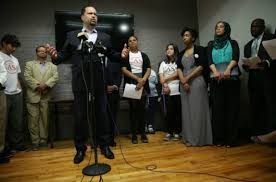
Maryland Democrat Ben Jealous wants to cover abortion as part of his Medicare for All plan and protect the reproductive rights of incarcerated women.

Ben Jealous already scored an upset when he won the Democratic primary over establishment candidate Rushern Baker by ten points this summer. Alex Wong/Getty Images

You won’t find reproductive health explicitly discussed in Maryland Democrat Ben Jealous’ Medicare for All plan, but that doesn’t mean it won’t be covered if he wins November’s gubernatorial contest against Republican Gov. Larry Hogan and implements the policy.

“Reproductive health care would be treated like any other health care under the plan,” Jealous told Rewire.News in an interview, confirming that these services would include abortion. “Because there are no specific limitations contemplated, there’s no mention of it. Just like there’s no mention of many other types of health care under the plan that would be covered.”

Jealous’ Medicare for All plan is a key element of the progressive Democrat’s platform. It would, according to an outline released by the campaign, help provide health insurance for the more than 350,000 people in the state who lack coverage and eliminate out-of-pocket health costs for Maryland residents.

Both health insurance access and abortion care have become increasingly fraught issues as the 2018 midterm elections near. Though the Maryland General Assembly is dominated by Democrats who defeated all anti-choice bills introduced in its last legislative session, the Republican governor isn’t an advocate for abortion. It was a key issue during Hogan’s 2014 race, when Democratic U.S. Rep. Anthony Brown sought to frame Hogan as a threat to reproductive rights, citing the Republican’s record.

As the Baltimore Sun reported at the time, Brown released ads “based on Hogan comments from 1980 and 1981 in which he supported a ban on abortions at a Prince George’s County hospital except to save the life of the mother, as well as a ‘human life amendment’ that would have barred abortions while possibly outlawing some forms of birth control. By 1992, Hogan had modified those positions and said abortion should remain legal.” After Brown highlighted Hogan’s record on the topic, the Republican vowed that he would not act to restrict women’s reproductive health if elected.

Now, as Hogan faces a nationally watched battle for re-election, abortion has once again been an issue on which the Republican governor faces criticism. When Trump nominated Justice Brett Kavanaugh to the U.S. Supreme Court this summer in what many advocates fear could be a death blow to Roe v. Wade, Jealous criticized Hogan for not affirming that he would move to protect abortion in Maryland by enshrining the right into the state constitution.

In response, Hogan’s office pointed to the governor’s earlier promise not to enact restrictions on reproductive rights. “The governor’s record is clear, four years ago he pledged that he would never alter Maryland’s reproductive health laws and he hasn’t,” Hogan spokesperson Scott Sloofman told the Baltimore Sun in July. “Maryland state law protects a woman’s right to choose, and that will never change under Larry Hogan regardless of any Supreme Court decision.” A Hogan spokesperson later said that the Republican governor would support a ballot initiative to let voters decide on whether to codify abortion rights in the state.

Diana Philip, executive director of NARAL Pro-Choice Maryland—whose PAC has endorsed Jealous—suggested to Rewire.News that Hogan’s position on reproductive rights has dual connotations. “I think that Gov. Hogan is in a position with his party that he can say he is not going to restrict abortion rights, but it also means that he is not going to make any moves or support efforts to advance abortion rights,” she said.

Philip pointed to two laws Hogan declined to sign during his tenure as governor. In 2017, he declined to sign a measure to reimburse Planned Parenthood for Medicaid funding should congressional GOP’s attacks on the provider prove successful. But Maryland law allows bills neither signed nor vetoed by the governor to go into effect, so it was enacted without his action.

Then earlier this year, after the state’s General Assembly passed a series of bills addressing the reproductive health care of incarcerated women, Hogan signed a measure mandating that a sufficient supply of free menstrual hygiene products be provided in prison, but did not act on a separate measure that would, as Rewire.News reported at the time, require “every correctional facility in the state to have a robust policy in place for the medical care of pregnant inmates, including prenatal testing, labor and delivery, abortion care, postpartum care, access to child placement services, and counseling.”

That measure went into effect without Hogan’s signature on October 1. Hogan’s campaign did not respond by publication time to a question from Rewire.News about why he did not approve the measure.

Philip said Hogan’s decision not to sign those bills “indicates to us that he is in a political position in which … the administration is not able to address the real needs that patients have in access to abortion care and eliminating the barriers that do exist in our state.”

Hogan has, however, approved legislation requiring state health insurance plans to cover more expansive contraceptive options.

Jealous, meanwhile, has pledged to take a more proactive approach to reproductive health and rights. Reproductive health services are explicitly mentioned in Jealous’ criminal justice reform plan, which vows to provide people in prison or jail with “full access to adequate and humane reproductive health services.”

“[Incarcerated] women should have convenient, adequate, and free or low-cost access to the full range of needed reproductive health services, including menstrual hygiene products, contraceptive care, and access to abortion, and community-based or other postpartum services that eliminate the trauma of postpartum separation,” the plan explains.

“We have to create a criminal justice system that returns people to society more whole, more healed, better able to reintegrate and be a productive member of society,” Jealous told Rewire.News. “And [there are] a number of indignities that happen to women behind bars related to their reproductive health that have profound effects on their emotional well-being both in prison and when they get home.”

Jealous noted that he had “heard reports from women inmates over the years that included them being denied sanitary napkins” and that “the ways in which women inmates are abused are manifold and some of them are specific to them being women.”

Addressing these concerns came naturally, Jealous suggested, noting his professional background having “worked in the criminal justice reform community since I was 18 years old.” Jealous previously served as the president of the NAACP and as a visiting professor at Princeton. “I knew that no criminal justice plan would be complete if we didn’t speak to specific issues experienced by women behind bars, including their need for reproductive health care,” he said.

Jealous also plans to safeguard abortion rights in the state constitution, as he urged Hogan to do.

Jealous says his views on reproductive rights have been influenced by his family’s experience, including his grandmother’s time at Planned Parenthood in Baltimore during the 1940s. “When you grow up with a grandmother who worked for Planned Parenthood when she was young, and parents who are both feminist activists, it has a real impact on how you see the world,” he said.

“My grandmother’s story is where my life-long support for a woman’s right to choose and total access to reproductive healthcare originates,” Jealous further explained in a post on his campaign site. “But it doesn’t stop there. I grew up knowing my mother had had an illegal abortion in the 1960s. I grew up knowing that it was luck that kept her alive, luck that her doctor knew what he was doing and that she didn’t develop any life-threatening complications. Luck that I was even alive to have her tell me this story.”

“Women who need abortions, get abortions. If we make them affordable, safe, and legal, we protect women,” Jealous continued.

But to implement his progressive platform, Jealous first needs to win. It could be a tall order given Hogan’s high approval ratings, but Jealous already scored an upset when he won the Democratic primary over establishment candidate Rushern Baker by ten points this summer. Speaking to voters in the state earlier this year, Jealous said that he was “not going to win [this election] by tacking towards the middle,” according to the Atlantic.

“Republicans win when Democrats don’t show up,” in Maryland, Jealous told Rewire.News. “The only way to win this election is to run right towards the people of the state, to give voice to their pain and put real solutions on the table that are capable of solving the problems all of our families face. Whether that’s surging health-care costs … public universities [becoming] too expensive, or an economy that’s stuck.”

Source: https://rewire.news/article/2018/10/22/as-concerns-around-roe-v-wade-grow-ben-jealous-says-hell-safeguard-abortion-rights-in-maryland/