I’m going to admit something to you that I’ve never told anyone outside my closest friends and family. When I was a pre-pubescent adolescent, I wrote in my diary that I thought abortion was wrong. I did not understand why or how women would choose it as an option. At the time, I was steeped in the teachings of the evangelical movement due to the influence of a maternal uncle who had been taking me to attend church services at Christ for the Nations Institute in Dallas where he was enrolled.

To this day, I have always respected people whose perspectives on abortion differ from the strongly pro-choice one that I have since come to adopt. Maybe because I once held those same beliefs, I understand how the “moral” teachings of one’s church can instill a sincere belief that abortion is wrong.

But, while I have respect for a point of view that differs from mine, I draw the line when someone’s perspective on what is “moral” is imposed on those of us who see things differently, particularly where the imposition of that perspective demands that I give up my right to make decisions about my own body, my own future, and my own understanding of what is best for me and my family. I particularly take issue with that imposition when, instead of representing an honest difference of ideals and values, it is used as a wedge to gain political advantage. And, really, that’s what the conversation about abortion rights and the proposed appointment of Brett Kavanaugh to the Supreme Court is pretty much all about right now—politics.

How did my own thinking on abortion evolve? It’s simple really. I opened my heart to the understanding of other women’s stories. I saw the role that reproductive autonomy through contraceptive care played in my own ability to rise from struggling single mom to Harvard Law School grad. In short, I began living a life of empathy and understanding. I came to see that no outsider should ever be allowed to impose his or her judgment on what women know to be best for ourselves. And then, many years after becoming pro-choice, I made an abortion decision myself, terminating a much-wanted pregnancy after the discovery of a fatal fetal abnormality. I cannot imagine someone making such a deeply personal decision for me.

WOMEN CHOOSE ABORTION FOR A MYRIAD OF REASONS. NO SINGLE ONE OF THEM IS EXACTLY ALIKE.

Women choose abortion for a myriad of reasons. No single one of them is exactly alike. Each story is as unique as the woman who can tell it, should she choose to do so. Some, like me, make wrenching decisions when faced with devastating news. Some are survivors of sexual abuse. Some are already mothers, both single ones and married ones, living the challenge of providing for children that they already have. Some are in high school or college and have dreams of making something of their lives before they become mothers, if ever.

What we know about reproductive rights, including abortion, is that when the Supreme Court enshrined those rights with the protection of law, women’s ability to decide when and whether to have children changed our trajectory. We no longer had the threat of losing our lives if we chose not to carry an unplanned pregnancy to term. We became the authors of our destiny. We made a bold step toward what it means to live as equal citizens of this country and of this world.

“EVEN IF YOU BELIEVE ABORTION IS A DECISION YOU WOULD NOT MAKE FOR YOURSELF, I HOPE YOU’LL FIGHT ALONGSIDE YOUR SISTERS WHO HAVE MADE OR WHO MIGHT MAKE SUCH A DECISION IN THE FUTURE.”

I cannot state this more strongly: we cannot afford to go back. And even if you believe abortion is a decision you would not make for yourself, I hope you’ll fight alongside your sisters who have made or who might make such a decision in the future.

Make no mistake about it, we WILL go back if Brett Kavanaugh is appointed to the Supreme Court. How do I know this? It’s simple—because it’s what Trump has said he would do with his next Supreme Court appointment. And it’s what Kavanaugh himself has made clear he will do, having previously praised the dissentin Roe v. Wade and having opined in a recent appellate decision that he thought the government had a right to deny a young immigrant woman access to abortion care.

Let’s be clear what this is all about. The political forces supporting Kavanaugh’s appointment aren’t just trying to end abortion. They’re trying to stop women from controlling our own lives, families, and futures. They are dead-set on making sure that women will remain unequal in the eyes of the law, society, and the economy. Their success will devastate any hope that we have of living to our fullest potential. So, yes, the stakes are high and our voices are needed as much, if not more, than they’ve ever been.

I realize that the battle over Kavanaugh’s confirmation may look like it’s a lost cause because I know what it’s like to believe that the deck is stacked so high against you that you are tempted to give up before you even start. I live in Texas after all, and I’ve faced many overwhelmingly high “decks” in the past. But, just as I tell the young #Changemakers that we work with at my non-profit, Deeds Not Words, we cannot let long odds keep us from engaging in a fight worth waging.

For the doubters, you need only to recall our battle here in Texas in June of 2013 against an anti-abortion bill making its way through the Texas legislature. In a state where we’ve become conditioned to give up in the face of overwhelming political and social challenges, where many of us don’t even bother to vote because we don’t think it will make a difference—even in this state—we’ve learned that we can make a difference when we decide not to cede our power. We, through the “People’s Filibuster,” armed with the personal stories of the thousands of women who sent them to us to be read on the Senate floor that day, demonstrated that we truly do possess the power to change things when we show up, stand up and fight with everything we have for what we believe to be right.
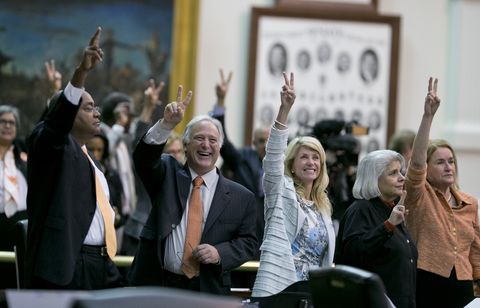
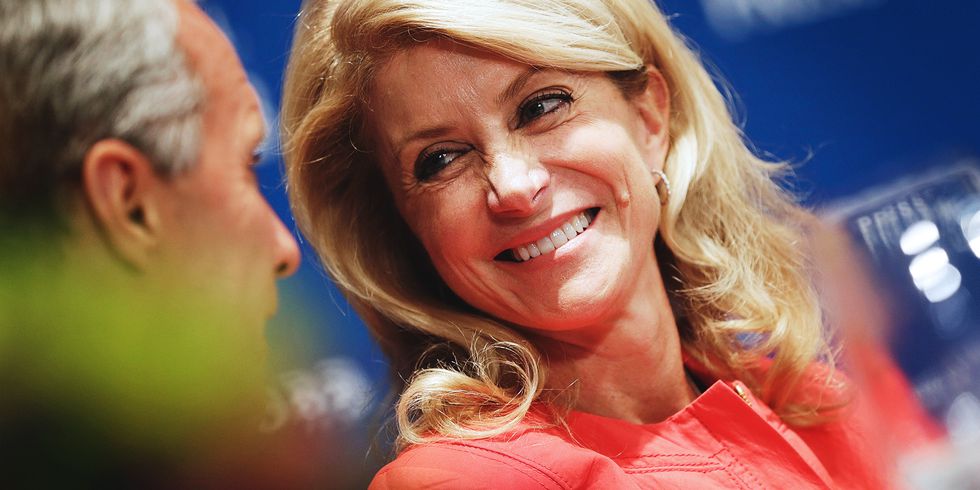
Texas - Sen. Wendy Davis filibuster
Wendy Davis and Senate Democrats cheer during her filibuster of abortion bills at the Texas Capitol.

GETTY IMAGESROBERT DAEMMRICH PHOTOGRAPHY INC

What made the difference in Texas that day—the reason we were able to kill that anti-abortion bill by talking it past the midnight deadline for a vote—is the same thing that will make a difference in whether Kavanaugh is successfully appointed to the Supreme Court. That difference is YOU. That difference is making a decision to fight, even if you think we might lose. Our sisters, our daughters, and the daughters of our daughters are relying on us to give this all we’ve got. Are you in? Because I most certainly am.

Wendy Davis is the Founder of Deeds Not Words and was a member of the Texas Senate from 2009 to 2015. She will be on the road this year with the Rise Up for Roe tour.

Source: https://www.elle.com/culture/career-politics/a22717606/wendy-davis-abortion-supreme-court-justice-nominee-brett-kavanaugh-rise-up-for-roe/

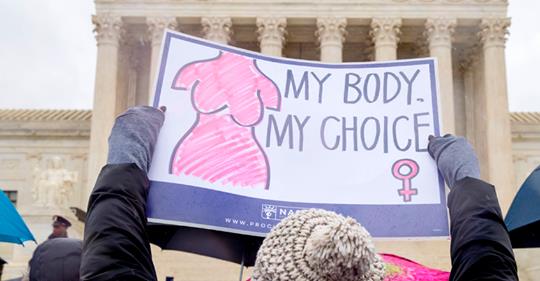
The majority of women who have abortions are already mothers. Being a parent makes me support choice

The voices of the anti-choice movement have a specific vision of their enemy. It’s a selfish, reckless young woman who believes in abortion out of “convenience.” It certainly couldn’t be a man, because men don’t care about these things. It couldn’t be a woman who understands the experience of motherhood, because once you hold a little baby in your arms, you could never condone abortion. This of course it patently untrue. And it drives the enemies of reproductive rights crazy.

Earlier this week, my friend Deborah Copaken wrote an honest, fearless account of her reproductive history — three children and two abortions. She explained the personal and health reasons she terminated two pregnancies at different stages in her life, and also why she chose to go forward with an unplanned pregnancy in her late 30s. Here’s a simple inconvenient truth opponents of choice don’t want to acknowledge — for a lot of women, abortion makes their future families possible. My friend’s entire adult life, a life that includes three great kids, would be unimaginable without the abortions that have also been a part of it.

Deborah is not unique; plenty of the mothers I’m friends with have had abortions. Plenty of yours have too, whether you want to admit it or not. Here’s your evidence. According to the Guttmacher Institute, “Fifty-nine percent of abortions in 2014 were obtained by patients who had had at least one birth.” And sorry, the women having abortions aren’t godless heathens: “Seventeen percent of abortion patients in 2014 identified as mainline Protestant, 13% as evangelical Protestant and 24% as Catholic.” Yup, a full quarter of the women seeking abortions are Catholic, just like I am. Put that in your conclave and smoke it.

I know mothers who’ve had abortions when they were young and their circumstances would have made raising a child impossible. I know mothers who had them when they were older and they had serious health considerations. They had them for all kinds of reasons. They were all deeply personal and all made thoughtfully, because no one has any better sense of their private needs and those of their families than they do. End of story.

I have never had an abortion. I’ve had two children and I’ve had one miscarriage from an unplanned pregnancy. I still grieve that loss, and would have gone forward if my body had not had other ideas, despite the far less than ideal circumstances in my life at the time. I also spent two years in a clinical trial for late stage cancer, and I would not have hesitated for a moment to choose to terminate if I’d become pregnant during that time. Not when the choice would have been between continuing treatment and living or miscarrying and dying. Any religious or political leader who would take that option from a woman, from a mother trying not to die so she can raise her children, honestly has no sense of how valuing life actually works. Or, for that matter, the blessing of choice.

Few things I can say in public provoke more logic-defying fury than when I mention that because I was conceived out of wedlock before Roe v. Wade, my mother didn’t have the options I have been blessed with and that I fight for my daughters to keep. I, unlike pundits like Kevin Williamson, do not rejoice in my mother’s forced parenthood — a situation that my father, who walked away before I was even born, never had to endure.

“But you wouldn’t be alive now!” the eager anti-choice voices cry. Well, yeah, I wouldn’t be alive now if my mother hadn’t sat next to my father at the cafeteria either. I wouldn’t be alive now if I died that time I almost drowned when I was 17. And I definitely wouldn’t be alive if I’d died of cancer. Meanwhile, my daughters know that they were planned and wholeheartedly wanted.

About a year ago I got an email from a young woman whose mother had experienced a high risk pregnancy but decided to continue it, resulting in her beloved sibling. She truly couldn’t understand why a mother might make a different choice. I told her the key word there was “choice.” Her mother got to make a decision about her pregnancy. What sadist would deprive any other woman of the same right? Why demand that women die — and women keep dying, all across the world, every day — so they can carry nonviable fetuses? Why demand they give birth to babies they aren’t financially, physically, or mentally competent to care for? Could it be about something other than fetuses? Like a fury over women controlling their own lives? I don’t expect to change anybody’s mind, by the way, I’m just spitballing here.

“Close your legs” and its corollary, “Tell you daughters to close their legs” is a thing that people actually write to me all the time. And if that doesn’t tell you a whole lot about the fear and contempt surrounding women’s sexuality that’s at the slimy bottom of the anti-choice rhetoric, I don’t know what is. Believe me, I am all for women refusing to have sex with men who don’t support their bodily autonomy, and the fewer d-bags getting laid out there the happier I am. That said, this specious argument ignores reality. For starters, it puts the entire burden of pregnancy prevention on women, despite the necessary male component of impregnation. Second, the Guttmacher Institute reveals that “Fifty-one percent of abortion patients in 2014 were using a contraceptive method in the month they became pregnant.” Shocker! Contraception doesn’t always work. Third, there’s something called sexual assault. Rapists don’t really pay attention to your evangelical insistence on clenching your knees.

There are people who would truly rather women and their doctors be murdered than see them have access to a safe and (so far) constitutionally protected right. I hear from these men all the time. (It’s mostly men.) They don’t care about our country’s shameful maternal mortality rate. They don’t care about healthcare or education. I get truly scary vitriol sent my way regularly, but it really ramps up whenever I express the fact that I’m a mother who supports choice and who wants my teenage daughters to have the freedom to choose when and if they have children. This means access to birth control, morning after pills and abortion. Because I love them more than anything in the universe and I want them to be educated, independent, and healthy. People who want to protect their daughters are called mothers. And people who are frightened of that prospect are called misogynists.

Source: https://www.salon.com/2018/08/01/why-mothers-defend-roe-v-wade-abortion-is-a-fact-of-life-for-parents-too/

So-called crisis pregnancy centers sometimes masquerade as abortion providers and attract patients with offers of free pregnancy tests, but most operate with the over-arching mission of preventing abortions.

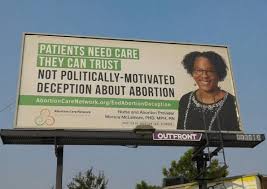
A new billboard campaign in Northern California aims to educate the public about the deceptive tactics of “crisis pregnancy centers,” according to the campaign sponsors.

The five billboards went up in Sacramento and Fresno funded by the national Abortion Care Network. More are planned for Chico. Organizers said these locales are where anti-choice pregnancy centers have deliberately set up near independent abortion providers.

The timing of the billboards follows a recent decision, NIFLA v. Becerra, in which the U.S. Supreme Court sided with California anti-choice pregnancy centers that challenged the state’s 2015 reproductive disclosure law. The Reproductive Fact Act required pregnancy centers to post a brief notice that described how to access all reproductive health options, including abortion, through state programs. Unlicensed facilities also had to disclose that fact.

Pro-choice advocates call the deceptive anti-choice centers “fake clinics.”

“Now that the fake clinics are not going to be held accountable because of NIFLA v. Becerra, the real question is … how can we get patients to the services they need in a very transparent and easy way,” said Monica McLemore, a San Francisco nurse and abortion provider whose face appears on the billboards.

With close proximity to abortion clinics and with names that mimic abortion facilities, anti-choice pregnancy centers have been known to confuse and mislead patients—when what patients need is “care they can trust,” McLemore told Rewire.News.

These anti-choice pregnancy centers outnumber abortion clinics in this country, although by how much isn’t clear. The facilities sometimes masquerade as abortion providers and attract patients with offers of free pregnancy tests, but most operate with the over-arching mission of preventing abortions. Federal and independent investigations have caught staff at such facilities misleading patients, exaggerating the risks of abortion, and delaying care.

“That’s really what this campaign is about: Trying to get patients the care they need that is ethical, accurate, and without delay, shame, or deception,” McLemore said.

The new billboards follow an outreach effort in the Bay Area earlier this year. That campaign sought to debunk claims that abortion pill “reversal” is sound health care, and it pushed back against a controversial decision last year by the state nursing board to allow training on abortion “reversal.” Meanwhile, advocacy groups have targeted Google’s Bay Area workers over the search giant’s maps, ads, and results that direct people who Google “abortion clinic” to anti-choice pregnancy centers.

McLemore said the new campaign targets the cities of Fresno and Sacramento in part because of the area’s prominent anti-choice billboards. With messages such as: “Pregnant? Scared? Call Us,” the billboards funnel callers to deceptive anti-choice centers in the area.

“It’s really problematic when those billboards are directing people to places that don’t offer health services,” she said.

The campaign’s landing page includes resources to report an anti-abortion center and to find a legitimate abortion provider.

The billboards are expected to remain up for 30 days.

CORRECTION: This story has been updated to correctly identify the locations of the planned billboards.

Source: https://rewire.news/article/2018/08/10/anti-choice-centers-targeted-in-california-billboard-campaign/

What a woman chooses to do with her body should not be up for debate in 2018.

At this point in my 52 years, filling out the forms at the doctor’s office feels like writing a memoir. Any past surgeries? Why, yes. So many! Here we go, in alphabetical order, to the tune of “Twelve Days of Christmas”: one adenoidectomy, one appendectomy, two D-and-C’s, one frenectomy, one hysterectomy, one inguinal-hernia repair, one meniscectomy, one Morton’s-neuroma repair, one trachelectomy, one vaginal-cuff-dehiscence repair … and a partridge in a pear tree. That’s 11 surgeries, eight of which were related either to my children’s births or to disease of my postpartum reproductive organs. We’ll get back to that.

Then comes the inevitable question: Number of pregnancies? Followed by: Number of live births?

Five and three, I write. Five pregnancies, three live births. But these numbers do not tell the whole story, either about my health or about the gap between births Nos. 2 and 3. And it is in the delta between all these numbers (along with the answer to the question left out—namely, how many of those pregnancies were planned?) wherein everything I hold dear about Roe v. Wade resides: a woman’s right to choose what’s right for her, her family, her body, and her life at the time she finds herself pregnant, whether intentionally or not.

The day when you find yourself six weeks pregnant at the age of 17, as I did, is not a joyous day, particularly after doing all the right things, birth-control-wise, including getting yourself fitted for a diaphragm at Planned Parenthood. For one, you can’t have a baby. You’re still a baby yourself. You would (you know, even then) cause permanent emotional damage to a child, in not wanting to have one, never mind that you have neither the skills nor the means to raise one properly. For another, you’ve just been admitted to college, and though you love your high-school boyfriend dearly, you have no idea who you are or what you want out of love or life. Plus, raising a baby in a freshman dorm was never part of your plan. Nor your college’s. And adoption—for you, personally—is out of the question. The pain of handing over your child to another person would, you know, become a lifetime of “Little Green” sorrow.Your parents drive you to the abortion clinic in Maryland. No one in that car is happy, but everyone is nevertheless grateful for one another’s love and for your right to legally choose this option. The clinic makes you answer a bunch of invasive questions to prove you know what you’re about to do, as if you hadn’t been thinking only about this moment for the past week. You’re awake for the entire procedure, which is painful. You cry a bucket of tears into your saltines in the crowded recovery room after, because it hurts and because you’re still 17, the age of emotional roller coasters under the best of circumstances, which this is not. But not one of those tears can be traced back to shame or to regret over the decision to abort the minuscule embryo of cells inside you. In fact, it was not a “difficult decision.” It was easy: the only rational one, to your mind, to make.

Fast-forward from 1983 to 2000. You are now 34, married, and the mother of two planned children, ages 5 and 3. You love your children! They say funny things and bring you untold joy. You’re about to publish your first book and have started working on a second. Life’s chaotic, as it always is with young kids, plus you are doing all the domestic chores and child-schlepping solo while also bringing home a substantial chunk of the bacon. Even so, you don’t make enough to afford full-time child care in America.

America: a country where pro-life actually means pro-blastula, pro-embryo, and pro-fetus, not pro-baby. You know what pro-life policies actually look like?  Universal health care, so all women could afford prenatal doctor visits and the birth itself; paid maternity and paternity leaves, to allow parents to actually care for a living baby without emptying their bank accounts; subsidized daycare, so parents could go to work without paying all or most of their income to private babysitters; and a school day that hews closer to the workday, not to some outmoded agrarian schedule designed to get kids home in time to harvest crops.

You start to wonder why you ever left Paris, where your kids could have had high-quality, affordable, government-subsidized crèches, after your ample months of paid maternity leave, as well as longer school days. You argue with your spouse about the gross inequity in domestic responsibilities as well as about more pressing relational issues. You are worried that your discord is affecting the children. Put simply, you’re not sure this marriage will last, but you are seeing a couple’s therapist to try to save it. Meanwhile, you had an IUD inserted after your second child was born to make sure you’ll have no more babies. Two kids: That’s enough. But then, one day, you wake up and realize your period is late.

Apparently, seeing an embryo next to an IUD in a sonogram is a rare enough occurrence that the entire ultrasound office is called into your examining room to bear witness. Though you’ve agreed to serve as a teaching moment, you feel a bit like a zoo monkey. While the ultrasound technicians and medical students ooh and aah over the image on the screen, your mind races over this unplanned turn of events. Should you have this baby or not? The next day, you are on the phone, crying to your ob-gyn, “What should I do?” You tell her that you don’t think you, your bank account, your marriage, or your kids can survive a third child right now. She lays out the facts clinically, without emotion: The IUD has to come out, a procedure that often dislodges an embryo. Moreover, the oral Lamisil you’ve been taking to combat a toenail fungus for the past week is contraindicated for pregnancy.That seals it for you. You would never knowingly bring a baby into the world who had possible deformations and disabilities from the start, never mind everything else going on at home. Your hideous, embarrassing toenail fungus has, in a sense, saved you from having to make a more difficult choice this time, but even if it hadn’t, you realize, you would still not choose to gestate this embryo. The marriage is teetering, imbalanced. A new baby, with or without disabilities, would be the final thumb on the scale. On the day of your D&C, a procedure that has improved in the intervening 17 years—you are put under twilight anesthesia this time, so the pain is minimal—both you and your husband are clear in your choice. The only tears this day are those of relief.

From 2000 to 2005, the marriage improves, somewhat, and you’re back to using a diaphragm for birth control: Your breast tissue has abnormalities that will later lead to more serious problems, and the estrogen in the pill exacerbates this. Plus the IUD was clearly a bust. Moreover, at 39, the chances of you getting accidentally pregnant again while on birth control are low. And yet, once again, your body shatters the odds. When your period is late, you assume you’re entering menopause, but you decide to pee on a stick to confirm this. The little plus sign appears. You curse. Loudly.

In that instant, you feel a sudden jolt of shame for having cursed so loudly, and acceptance of this new and shocking reality. At 8 and 10, the kids are not yet old enough to fully respect your privacy in the bathroom, but they are old enough to require much less care. Hurtling toward 40, you feel comfortable in your own middle-aged skin. You love babies, you have loved being a mother, you even love breastfeeding, and your husband has said he’s always wanted a third child. In fact, he’s been begging you for one, promising to take paternity leave this time. Should you do this?You consider the cons. The money issue is still there, but it will always be there. Your country still has no paid parental leave, and pregnancy discrimination at work, while illegal, is nevertheless real, pervasive, and financially punitive. You’re worried about your own health as well. Pregnancy has not been kind to your body. Each prior live birth has led to two surgeries: the Morton’s neuroma, formed during your first pregnancy, when your shoes got too tight; and the inguinal hernia, popped giving birth to the daughter now standing in front of you. And yet despite all these downsides, the pull of that tiny blastula growing inside you is strong. “Nothing’s wrong, sweetie,” you say. “We’re having a baby!”

But as glad as you were to have chosen to gestate him to term, it was hardly an easy pregnancy. He tried to come out dangerously early, at 30 weeks, turning the end of the pregnancy into six weeks of strict bedrest and constant contractions. This eventually led to the discovery, after his birth, that you had severe anemia and advanced adenomyosis, requiring a partial hysterectomy, followed by a trachelectomy of your diseased cervix five years later, which lead to a near-fatal bleed-out due to vaginal cuff dehiscence three weeks after that. A few months after his birth, you’d keeled over, on a city sidewalk, with the kind of pain that became an emergency appendectomy, not knowing, until sitting down to write this essay, that the risk of acute appendicitis in postpartum women over 35 is 84 percent greater than the risk to the general public. We often forget, in the abortion debate, the real toll pregnancy can take on a mother’s body, never mind the fact that the U.S. has the highest rate of maternal deaths in the developed world by a landslide: 26.4 per 100,000 live births, compared with the next on the list, the U.K., with 9.2. (The lowest, Finland, has only 3.8.)
I’ve had five pregnancies and three live births, I write on the medical forms, but what I leave out is now crucial, as Roe v. Wade once again comes under attack. My youngest was not planned. But he was chosen—I want him to know—with love, optimism, and hope, just as the terminations of the two other unplanned pregnancies were also chosen. My body is now a canvas of pregnancy-related scars. I knew, going into that third birth, the physical toll pregnancy had already taken on me. And yet I chose to go into it anyway.My third pregnancy/second live birth, my only daughter, is now 21. She is extremely responsible and trustworthy, yet she calls me at least three times a year when some glitch in her birth-control-prescription delivery service sends her scrambling to fill in the gaps with her friends’ pills. (Her friends’ pills!) Though I pay a backbreaking $2,298.30 a month for our insurance, my daughter, like all Americans on the pill, must visit her doctor in person for a new prescription every year. This is not easy when your prescribing physician is in New York, you’re a full-time premed student in Illinois, and you work 10 to 20 hours a week on top of that as a condition for your financial aid. What she chooses to do with her body if she finds herself accidentally pregnant—and, given her genes and prescription hurdles, this seems as likely as not—should not be up for debate in 2018.

Only two of my five pregnancies were planned. Three were not. If those were the odds in blackjack, no one would ever play. In other words, what’s at stake in this ridiculous debate over bodily autonomy is choice. It’s always been about choice. To be alive and human is to be in favor of life, but to bring an unwanted child into this world—or to force any woman to do so against her will, her health, her future, her finances, or her well-being, because that is your moral stance, not hers or her doctor’s—is not pro-life. It is control wearing the mask of virtue. It is government regulation at its most invasive. It is being willfully blind to the inevitable bloodshed from illegal abortions and high-risk pregnancies. It is choosing an embryo over the life of a woman. It is, to put it succinctly, anti-woman.

Source: https://www.theatlantic.com/family/archive/2018/07/three-children-two-abortions/566270/

Liberal groups are working to stop Brett Kavanaugh’s confirmation – which could threaten to unravel abortion rights

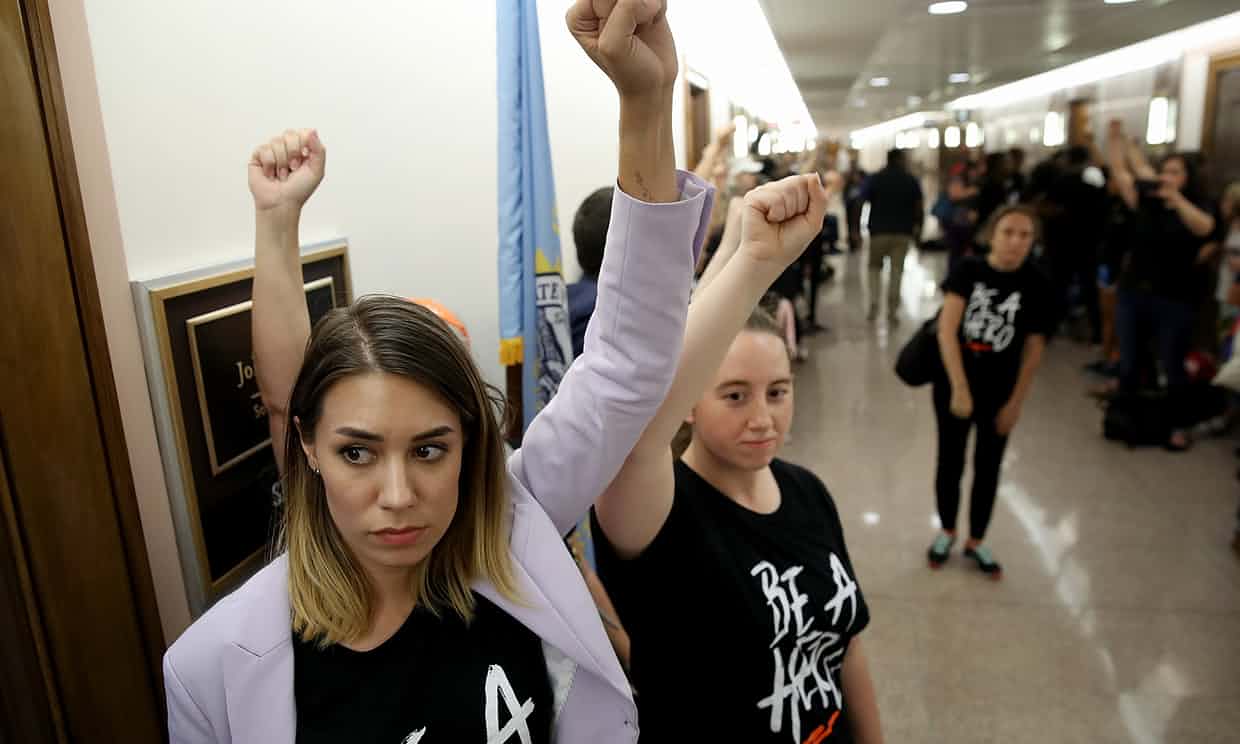
Protesters opposed to the nomination of supreme court pick Brett Kavanaugh on Capitol Hill on 1 August. Photograph: Win McNamee/Getty Images

Two thousand Planned Parenthood organizers and volunteers, mostly female and young, gathered recently in Detroit to imagine what they see as a kinder, more peaceful America.

But eighteen months and counting into the presidency of Donald Trump and with the threat of a conservative supreme court that could unravel abortion rights in the US, their mission was nothing short of political trench warfare.

“Are women going to be equal members of this society or not? Are they going to have equal rights or not?” said Deirdre Schifeling, the executive director of Planned Parenthood Action Fund said. “That is what is on the line.”

As part of that fight, the 100-year-old women’s health organization convened Power of Pink, the “biggest, baddest, raddest grassroots training ever”. Planned Parenthood, along with a coalition of other liberal groups, are working to mobilize opposition to Brett Kavanaugh, whose supreme court nomination was been cheered by social conservatives as a chance to finally overturn Roe v Wade, the 1973 landmark supreme court decision that established a constitutional right to abortion.

The stakes are particularly high as Kavanaugh would replace moderate Justice Anthony Kennedy, a sometime-swing vote who embraced more liberal views on abortion.

The volunteers at the Power of Pink training are the ground troops in an uphill, multi-million dollar battle to stop Kavanaugh from being confirmed to the supreme court.

“I have my kevlar on. I have my boots on, my pink camouflage. I’m ready to fight,” said Peshka Calloway, an Army veteran from Parkersburg, West Virginia.

Calloway has relied on Planned Parenthood for care and support after being sexually assaulted by a fellow soldier. Now she’s doing everything she can to protect the organization and the reproductive health services it provides.

“I may even run for office,” she exclaimed, having just left a candidate training run by Emily’s List, which helps to elect pro-choice women. “A lot of people tell me I should.”

The three-day training was held at the Cobo Center, a sprawling structure in downtown Detroit with a glass atrium boasting views of Ontario, Canada. That just across the Detroit River, healthcare is free and the prime minister is an unapologetic feminist was not lost on attenders.

Brett Kavanaugh would replace moderate Justice Anthony Kennedy, a key sometime-swing vote who embraced more liberal views on abortion.
Pinterest
 Brett Kavanaugh would replace moderate Justice Anthony Kennedy, a key sometime-swing vote who embraced more liberal views on abortion. Photograph: Joshua Roberts/Reuters

Throughout the weekend, participants heard from Cecile Richards, who recently stepped down after serving more than a decade as president of Planned Parenthood, Debbie Stabenow, a US senator from Michigan, and Barack Obama, who applauded their activism in a pre-taped video. Then, in break-out sessions and panels, they strategized how to stop Kavanaugh’s confirmation.

In the Senate, Democrats alone do not have the votes to derail a supreme court confirmation. But if they hold their party together and persuade two Republican senators to their side it would be a death knell for Kavanaugh’s nomination.

The plan is to pressure red-state Democrats like senator Joe Manchin of West Virginia who are still undecided on Kavanaugh and moderate Republicans like Lisa Murkowski of Alaska and Susan Collins of Maine, who have said they support abortion access. It is widely seen as a long shot, but that is not deterring them.

“We know from the fight over the Affordable Care Act that hearing from thousands of Alaskans across the state really impacted her decision,” Jessica Cler, an organizer with Planned Parenthood in Anchorage, said of Murkowski, who helped block a Republican bill that would have repealed the healthcare law. “We know it will be the same with Scotus, so folks are doing anything and everything they can to make sure that she’s hearing from us.”

Yet in interviews with the Washington Post, Murkowski and Collins said they felt the emotional pleas from constituents over the supreme court nominee have “less intensity” than the stories they heard during the healthcare debate. But the senators acknowledged that the personal appeals had affected them.

Already Planned Parenthood volunteers have made hundreds of calls to the senators’ offices and sent postcards and letters from women sharing their personal stories. They also published op-eds in the hometown newspapers of key senators.

Planned Parenthood and a coalition of advocacy groups have launched an offensive against Kavanaugh that will give volunteers the chance to put their training into practice. Supporters will participate in more than 100 actions across the country this week “to sound the alarm on how Kavanaugh’s nomination to the Supreme Court would threaten people’s health and rights”.

The ‘Kavanaugh Singers’ perform in front of the supreme court promoting the confirmation of nominee Judge Brett Kavanaugh on 8 August.
Pinterest
 The ‘Kavanaugh Singers’ perform in front of the supreme court promoting the confirmation of nominee Judge Brett Kavanaugh on 8 August. Photograph: Brian Snyder/Reuters

Meanwhile, Susan B Anthony List, an anti-abortion political organization, launched a seven-state campaign to pressure vulnerable Democrats to confirm Kavanaugh as part of a broader effort to help galvanize opponents of abortion ahead of the 2018 midterms.

Behind the sharp political debateare deeply personal, and often painful, experiences, said Síona Cahill, an Irish pro-choice activist who helped mobilize voters to repeal Ireland’s near-total ban on abortion.

In one of the most warmly received speeches for volunteers in Detroit, shesaid the Irish campaign was successful because thousands of women broke their silence and shared their stories.

“We didn’t make it about those who disagreed with us,” she said. “We made it about the people that a ban on full reproductive rights affects: everyone.”

A majority of Americans have long believed that abortion should be legal and that share has only climbed since Kavanaugh was nominated. That gives abortion rights advocates hope that a public pressure campaign could sway votes in the Senate.

“It has been the singular goal of the anti-abortion right to get the courts packed with conservative justices who will overturn Roe,” said Dawn Laguens, executive vice president of Planned Parenthood Action Fund. “They were gleeful until they realized that their glee collided with what the American people want.”

Planned Parenthood and coalition of pro-choice groups have demanded that lawmakers oppose Kavanaugh unless he commits to affirm the “right of all people to make personal decisions about their bodies,” including the right to use contraception and access abortion. He will almost certainly decline to answer questions about how he would rule from the bench during his confirmation hearing.

While Kavanaugh has not ruled directly on abortion, Laguens said his writings and speeches are evidence enough to justify their worst fears.

“It may not be the Handmaid’s Tale,” Laguens said. “But it won’t be pretty.”

Source: https://www.theguardian.com/world/2018/aug/09/pro-choice-groups-fight-against-trump-supreme-court-pick

Argentina’s Senate voted against legalizing elective abortion in the early hours of Thursday morning, dashing the hopes of pro-abortion rights advocates in the predominantly Catholic country, homeland of Pope Francis.

The Senate rejected the proposed bill 38 to 31, with two abstentions and one absentee.
The bill, which fueled contentious debate, would have expanded abortion rights to allow women to end a pregnancy in the first 14 weeks. Current laws allow the procedure only in cases of rape, or when the mother’s health is at risk.
A heavy police presence around the National Congress in Buenos Aires quickly quelled scattered confrontations after the vote’s outcome was announced.
Opposition mounted ahead of the vote in Argentina’s more conservative Senate after the legislation only narrowly passed through the lower house of Congress in June. And the bill lost momentum over the weekend when an opposition senator withdrew her support.
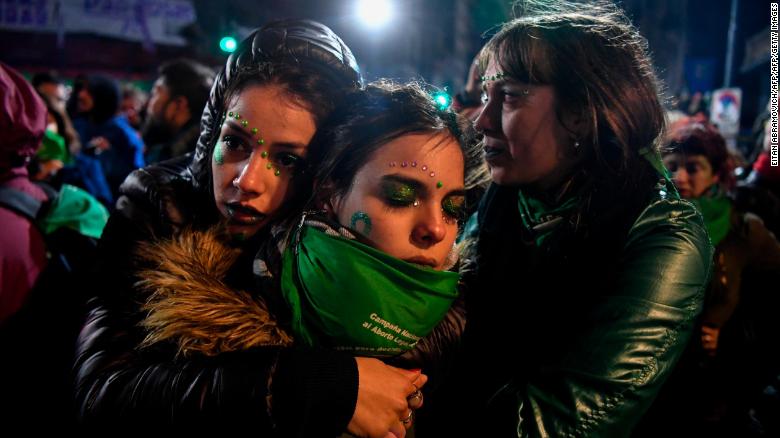
Activists in favour of the legalization of abortion comfort each other outside the National Congress in Buenos Aires.

Celia Szusterman, trustee of the UK board of Pro-Mujer and director of the Latin America program at the Institute for Statecraft, told CNN that is was “a step backward for women’s rights and women’s health.”
She says it’s a “sad day… not only because of the way the vote went but the way the campaign for and against went. It was so divisive.”
Protesters demonstrate in support of loosening the abortion law, left, and against abortion, right, in this photo taken from Congress where lawmakers were debating the issue.

But even with its defeat, the groundswell of support for the legislation is not expected to go away, with those who supported the bill saying it was a victory that it was even debated.
Activists say they’ll keep pushing the bill, in the hope that it passes one day soon.
“It will happen because that’s the world — to increase rights and this is one of the fundamental rights that is still not available to women in Latin America,” Szusterman said.
The bill has ignited passions and sparked widespread protests in Argentina, with anti-abortion campaigners protesting in the streets under blue “save both lives” banners and members of the opposing side in the debate donning green bandanas.
As senators debated the bill into the early hours of Thursday morning, pro-abortion rights activists rallied outside Congress chanting “legal abortion at the hospital” while the Catholic Church held a “Mass for Life” in the capital Buenos Aires.
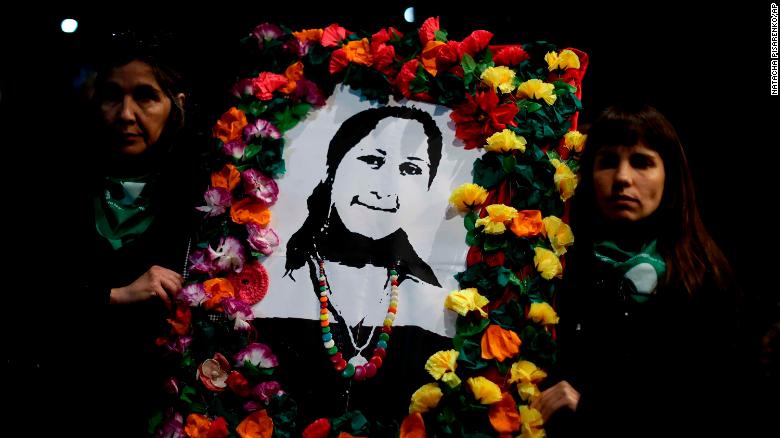
Pro-choice activists hold a poster of a woman who died as a result of a clandestine abortion.

In recent weeks the so-called “green wave” demonstrations have spread outside of Argentina too. Green bandanas — now a symbol of the abortion rights movement — have been spotted in Brazil, where the country’s supreme court is considering loosening abortion restrictions. And momentum is growing in Chile, where lawmakers voted last year to ease the country’s strict ban.
Supporters of the bill rallied across the region Wednesday, in Chile, Uruguay, Mexico and Peru, as well as across the Atlantic, in Spain.
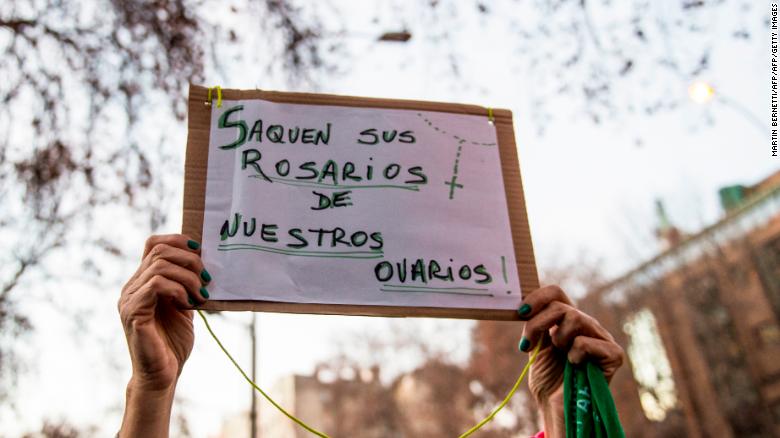
An activist in favour of the legalization of abortion holds a sign reading "Take out your Rosaries from our ovaries" during a demonstration outside of Argentina's embassy in Santiago de Chile.

Bolstered by Ireland’s referendum in May, which removed one of Europe’s last abortion bans, pro-abortion rights activists were hoping they could turn the tide on abortion law in Latin America, where more than 97% of women of reproductive age live in countries with restrictive abortion laws. On Tuesday, 60 Irish parliamentarians, across political parties and groups, signed a letter to the Argentinian senators urging a vote in favor of the bill.
While Pope Francis hasn’t addressed the legislation directly, he did speak out strongly against abortion just days after the bill was approved by the lower house — comparing abortion to avoid birth defects to Nazi eugenics.
The pontiff also issued a letter in March, as the abortion debate began, urging Argentines to “make a contribution in defense of life and justice.”
Source: https://edition.cnn.com/2018/08/09/americas/argentina-abortion-vote-intl/index.html

Abortion-rights advocates are intensifying efforts to make it easier for women to get abortions amid a new wave of state-level bans and restrictions expected to occur under a reconfigured U.S. Supreme Court. The efforts include boosting financial aid for women needing to travel long distances to get an abortion, and raising awareness about the option of do-it-yourself abortions.

The sense of urgency stems from the retirement of Supreme Court Justice Anthony Kennedy, who sometimes provided the decisive vote in support of abortion rights, and the possibility that Brett Kavanaugh, nominated by President Donald Trump to replace him, would give the court an anti-abortion majority.

Advocates anticipate new limits on abortion access in red states that are emboldened by the prospect of a more solidly conservative court. The Republican-led states want more latitude in the courts to impose far-reaching abortion restrictions while hoping that a lawsuit on the issue makes its way to the Supreme Court and is the case that ultimately overturns Roe v. Wade — the 1973 establishing a nationwide right to abortion.

Yamani Hernandez, executive director of the National Network of Abortion Funds, said that since Kennedy’s retirement announcement on June 27, there has been a surge of donations to help the network assist low-income women in paying for their abortions. There are 70 funds in 38 states, currently assisting about one-fifth of the 150,000 women who inquire about assistance each year.

“Without a doubt we’re moving into a bleaker time,” Hernandez said. “People who haven’t been paying attention are realizing what is at stake, and wanting to get involved.”

If Roe were overturned, abortion-rights advocates anticipate that 20 or more states would ban most abortions. Women in those states might face long and costly interstate journeys to reach an abortion provider, or they could avail themselves of information about how to self-induce an abortion.

The two main abortion-inducing drugs, mifepristone and misoprostol, are legally available only through authorized medical professionals in the U.S., and numerous states have placed restrictions on medical abortions. In many places abroad, misoprostol is widely available, even over the counter in pharmacies in some countries, and has been used extensively for self-induced abortions in countries such as Brazil that have restrictive laws.

For American women, the most likely means of obtaining misoprostol is via an online purchase from a foreign provider. That method is considered difficult to prevent, even in states with laws explicitly banning self-induced abortion.

A 2-year-old California-based organization, the Self-Inducted Abortion Legal Team, is expanding its operations this summer, convinced that the ongoing push for tougher abortion restrictions will prompt more women to consider the self-induced option.

Jill Adams, the team’s founder and chief strategist, said a top priority is to provide legal advice and support for any women who face possible prosecution for do-it-yourself abortions. Her group plans to launch a help line this fall that will provide callers with basic advice and, if warranted, connect them with an attorney in their area.

Her team and its allies are advocating that states avoid such prosecutions, a goal recently backed by two major medical associations.

Dr. Jamila Perritt, a Washington, D.C.-based obstetrician-gynecologist who provides abortions, says she has counseled some women who opted for self-induced abortions, and is grateful that they now have relatively safe and effective means of doing that, thanks to the abortion pill.

“Whatever happens with the Supreme Court, there are safer options now that we didn’t have 40 years ago,” she said.

Anti-abortion leaders are troubled by the positive talk about self-induced abortion.

“This kind of effort is dangerous and highly irresponsible,” said Carol Tobias, president of the National Right to Life Committee. She evoked the potential difficulties of women who used that method and then suffered serious side effects.

Tobias said her organization does not favor criminal action against women who self-abort, and instead would prefer targeting those who make the medicine available.

Many of the abortion-related topics now being discussed in the context of the Supreme Court vacancy will be summarized in a book being written by journalist and activist Robin Marty, titled “Handbook for a Post-Roe America.” It is scheduled for publication on Jan. 22, the 46th anniversary of the Roe v. Wade decision.

Marty describes the book as “a step-by-step guide explaining what any person can do once abortion becomes illegal or inaccessible in the U.S.” It covers possible legislative action, ways of supporting women who need to cross state lines for abortions, and the key factors involved in considering a self-induced abortion.

“The internet will be a great way to find information, but it’s a double-edged sword because it leaves a trail,” Marty said. “How do you access these things online without being able to be tracked?”

Source: https://www.cbsnews.com/news/abortion-rights-activists-brace-for-new-wave-of-restrictions/

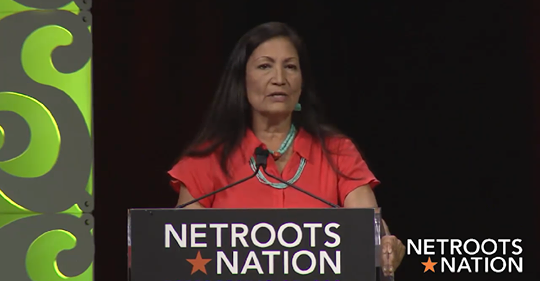
“Voters rely on you to stay true to your word, and everything that I’m campaigning on, that’s what I’ll do when I get to Congress,” said Deb Haaland, who would be the first Native American woman elected to Congress if she wins in November. “You have to be courageous.”

When asked generally about whether the Democratic Party should compromise on reproductive rights, Deb Haaland, a Democratic candidate running to represent New Mexico’s 1st Congressional District in the U.S. Congress, told Rewire.News, “absolutely not.”
Netroots Nation / Facebook

Progressives can win office and policy goals when they stick to their values—including protecting reproductive rights. That was the message shared by many activists, organizers, and candidates who convened for the annual progressive summit Netroots Nation in New Orleans last week.

New York gubernatorial candidate Cynthia Nixon touched on the theme in her keynote speech on Friday. “I’m tired of a Democratic establishment that warns candidates not to run on single-payer health care, and tells us to stop talking about abolishing ICE because it doesn’t poll well. The same Democratic establishment that once told us not to talk about civil rights, or same-sex marriage, or abortion, or a $15 minimum wage,” she continued, going on to suggest that her campaign had pushed incumbent Democratic Gov. Andrew Cuomo further to the left on issues like marijuana policy and teacher evaluations.

A panel the day prior moderated by #VoteProChoice co-founder and CEO Heidi Sieck went even further, specifically addressing abortion as a Democratic litmus test and the panelists’ belief that “for too long the Democratic Party has been compromising on reproductive freedom.”

The topic has caused visible conflict among Democrats coming to a head last year when Omaha mayoral candidate Heath Mello, who had cast anti-choice votes as a state legislator, was slated to speak alongside high-ranking party members at a rally. Rep. Ben Ray Luján (D-NM), chair of the Democratic Congressional Campaign Committee, has maintained there should be no litmus test on abortion for candidates.

When asked generally about whether the Democratic Party should compromise on reproductive rights, Deb Haaland, a Democratic candidate running to represent New Mexico’s 1st Congressional District in the U.S. Congress, told Rewire.News, “absolutely not.”

“Abortion is legal in this country. It’s legal, and that is the baseline,” said Haaland, who would be the first Native American woman elected to Congress if she wins in November. “We can’t go backward on that. I’ll always fight for that. Women have died, and that can happen again.”

“I’ll never sacrifice any of my values,” Haaland said when asked about whether Democrats should moderate their stances to appeal to more voters. “Voters rely on you to stay true to your word, and everything that I’m campaigning on, that’s what I’ll do when I get to Congress …. You have to be courageous.”

Reproductive rights as an issue is “solidly progressive,” according to Marvin Randolph, president of the Southern Elections Fund and Onyx Communications.

When it comes to whether the party should work to appeal to anti-choice voters, Randolph told Rewire.News doing so would be “a big mistake.”

“That’s one issue that is an absolute deal-breaker,” he said. “When you try to expand your tent where you include just everybody, at some point you lose your voice with who you are.”

While he later noted that he thought there would always be “candidates in some districts, in some place, that may take a different position on the issue” to oppose abortion, and that it was something that “voters and the party have to sort … out,” speaking more generally about the party’s beliefs Randolph said that the issue was a core Democratic value.

“As a platform, as a fundamental, ‘This is what being a progressive and a Democrat is about,’ that is territory we should not cede,” Randolph continued. “I would challenge anyone that says that to say, ‘Well does the Republican Party see their position the opposite [way]? Never. When their candidates get into office, they hold their feet to the fire on that. They don’t wait a second, they don’t wait a minute. They don’t want to wait zero seconds and they are unflinching—and we need to be too.”

Democrat’s 2016 national platform did include an explicit commitment to protecting abortion rights and, for the first time, to repealing restrictions on federal funding for abortion care.

Erica Sackin, director of political communications at Planned Parenthood, told Rewire.News that while the reproductive health organization is nonpartisan, “what you can say is that right now we’re seeing a movement across the country of women and of people galvanized around women’s health and women’s rights.”

When it comes to whether Democrats need to change their stances to appeal to more moderate voters, she noted that “people are really hungry for people who will be champions for them.”

“Alabama is a great example,” Sackin continued. “Roy Moore was absolutely a terrifying candidate, and he thought that he could win by saying that he was anti-abortion and by trying to leverage the fact that Doug Jones is unabashedly pro-choice against him. And what you saw is that it didn’t work. You saw Doug Jones’ base galvanized by him being supportive of access to abortion and access to reproductive health.”

“I think that right now we’re seeing this moment where people are really hungry for people who will stand up and fight for them, and that’s being reflected in the activism that you’re seeing but also the new candidates who are running for office,” she said.

Sackin said that she was seeing some of that energy at Netroots this year, and it had been a theme at the summit. “People who are not just organizing their communities, but running for office as first-time candidates and really not shying away from talking about the rights that affect people, including reproductive rights,” she said.

Source: https://rewire.news/article/2018/08/06/dispatch-from-netroots-you-dont-need-to-compromise-on-abortion-to-win-progressives-say/

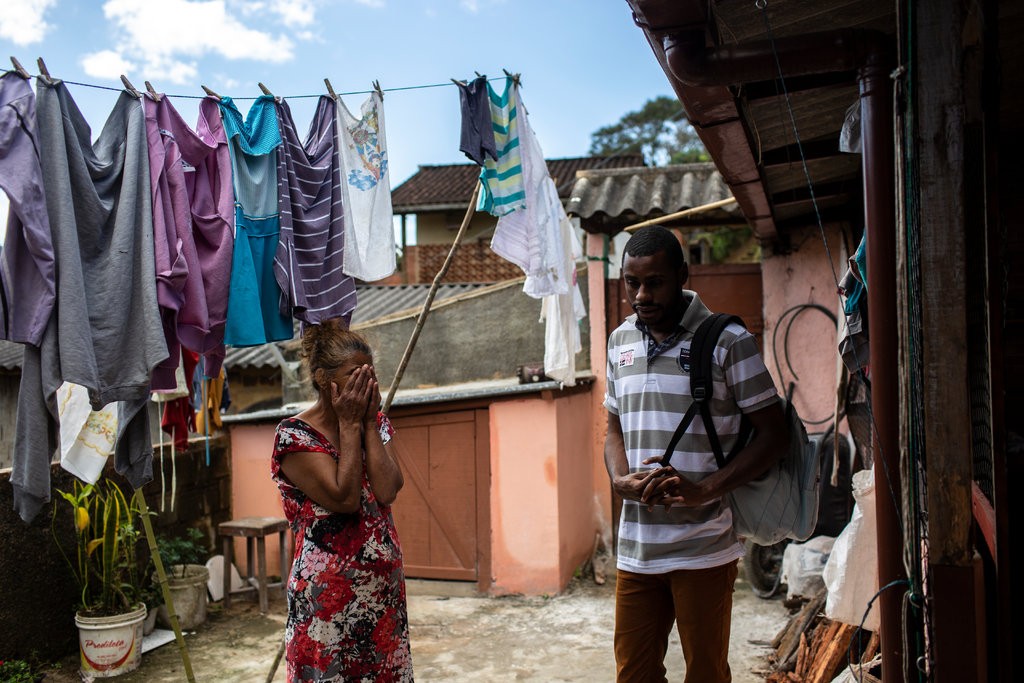
Natanael Barbosa and his aunt, Maria Aparecida Barbosa, talking about Natanael’s sister Ingriane Barbosa Carvalho, who died from a clandestine abortion.CreditLianne Milton for The New York Times

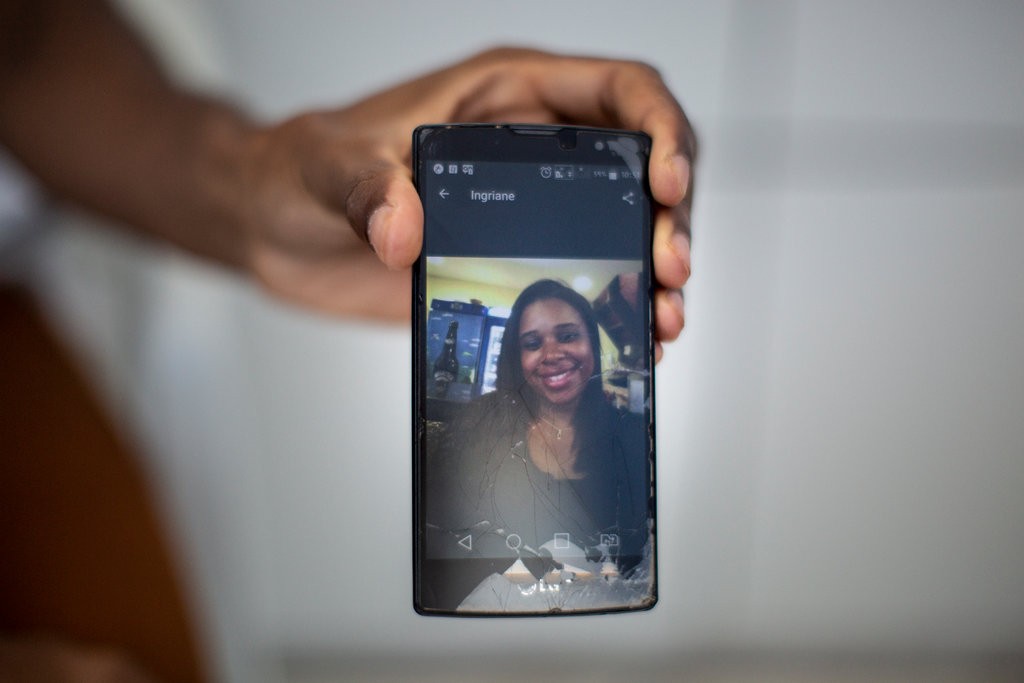
PETRÓPOLIS, Brazil — For three days after she had an illegal abortion, Ingriane Barbosa Carvalho hemorrhaged in silence. Even as she writhed in pain, and an infection caused by the botched procedure spread, Ms. Carvalho insisted to relatives she was just nursing a stomach bug.

By the time she sought medical help, it was too late. Ms. Carvalho, a 31-year-old mother of three, died seven days later.

Her death on May 16 illustrates the high stakes of the fight over reproductive rights that is playing out before Brazil’s Supreme Court during a rare two-day public hearing that started Friday.

The court will consider whether Brazil’s abortion laws — which forbid terminating pregnancies with few exceptions, including cases of rape and instances in which the mother’s life is in peril — are at odds with constitutional protections.

The hearing, which will continue Monday, is unlikely to lead to the imminent legalization of abortion. But women’s rights activists hope the public hearing will set off a high-profile debate on the issue, draw attention to the risks hundreds of thousands of women take each year as they resort to clandestine abortions and ultimately pave the way to overhauling the existing law.

During the first day of arguments, a majority of the 26 speakers argued for decriminalizing abortion.

Though the Ministry of Health did not take an official position on the issue, Maria de Fátima Marinho, who represented the ministry before the court, made clear that unsafe abortions created public health challenges, leading to overcrowding of facilities as well as preventable illness and death.

Image
The death of Ms. Carvalho, a 31-year-old mother of three, illustrates the high stakes of the abortion debate playing out before Brazil’s Supreme Court.CreditLianne Milton for The New York Times

Ms. Marinho said that she hoped the hearing would “give a voice to those who hide the act, who are ashamed, and, because of that, take too long to ask for help, face complications, and die.”

The hearing is being held as Brazilian lawmakers take steps to adopt even more restrictive laws and abortion rights groups across the region face a strong backlash after attaining victories.

“This hearing comes at a historic moment in Brazil and in Latin America, where we have seen a rise in recent years in the opposition to sexual and reproductive health and rights,” said Beatriz Galli, a Brazilian human rights lawyer. “Brazil exemplifies the regional paradox: There has been massive mobilization in civil society for expanded rights, contrasting with a very conservative Congress.”

Brazil’s top court has ruled narrowly on abortion cases in recent years, signaling an inclination to expand access, but it has refrained from making sweeping legal changes related to the politically fraught issue.

In March 2017, the leftist Socialism and Liberty Party and Anis, a women’s rights group, filed a petition asking the court to rule that terminating a pregnancy within the first 12 weeks of gestation should not subject the pregnant woman or the abortion provider to prosecution.

They argue that abortion laws written in 1940 violate protections conferred by the 1988 Constitution, including the right to dignity, equal protection and access to health care.

Taking up their petition, Justice Rosa Weber, one of two women on the 11-member court, took the relatively rare step of seeking input from legal analysts in Brazil and abroad and convened a hearing.

Image

Doctors found a piece of mamona, a plant used to induce abortions, inside Ingraine Barbosa Carvalho’s uterus.CreditLianne Milton for The New York Times

In a March statement she called abortion rights one of the “most sensitive and delicate” legal issues, “since it involves matters of ethics, morality, religion, public health and fundamental rights.” Since then the court has received legal briefs from 38 groups, a record number.ADVERTISEMENT

While Ms. Carvalho’s case is not before the court, abortion rights activists say her death, which received extensive press coverage, starkly shows how the current abortion laws disproportionately affect poor women.

After a long struggle to make ends meet, Ms. Carvalho landed a good job as a nanny early this year. It paid twice the minimum wage and put her dream of buying a home within reach. The unexpected pregnancy threatened to derail that progress, according to an account of her final weeks drawn from police reports and interviews with relatives.

The man who got her pregnant made clear he had no interest in being a father. When Ms. Carvalho told him in a text message that she intended to have an abortion, he didn’t respond.

Ms. Carvalho seemed to know her relatives would try to talk her out of her decision. Her brother, Natanael Barbosa, an evangelical preacher, said he would have been adamantly opposed to an abortion.

“I wish she had told me,” Mr. Barbosa said during a recent interview at his small church in a hillside neighborhood. “I would have said, Give me one of your kids, I’ll raise it.”

A protest demanding the legalization of abortion in Rio de Janeiro in June.CreditSilvia Izquierdo/Associated Press

Ms. Carvalho first attempted to terminate the pregnancy by swallowing an entire pack of hypertension pills. When that didn’t work, she stuck a knitting needle in her uterus. By early May, when she was nearly four months pregnant, she sought the services of an underground abortion provider, who inserted a stalk of castor-oil plant into Ms. Carvalho’s uterus, according to the police report, which included an affidavit from the woman who administered the procedure.

Ms. Carvalho was instructed to remove the plant by pulling on a thread attached to it. But the thread came undone and the stalk remained inside her. As an infection took hold, she lay in a tiny bedroom in an aunt’s home. By the third night, when the aunt, Maria Aparecida Barbosa, went into the room to give her niece a blanket, the young woman’s lips were purple.

“I think I’m dying,” she told her aunt.

By the time Ms. Carvalho arrived at the hospital, the infection had entered her bloodstream.

Estimates of the number of abortions performed in Brazil each year range from 500,000 to 1.2 million. Each year, more than 250,000 women are hospitalized as a result of complications from abortions, according to the Brazilian Health Ministry. In 2016, the last year for which official figures were available, 203 women died as a result of botched abortions. Providing medical care for them has cost the government more than $130 million over the past decade.

Wealthy and middle-class women can have safer abortions by traveling abroad or resorting to medical professionals willing to perform them. Poor women, many of whom are black, make up a disproportionate number of those who die, become ill or get prosecuted as a result of the procedure, according to researchers, activists and public defenders.

Lívia Casseres, a public defender in Rio de Janeiro who is among those who will argue before the court, said that Brazil’s overwhelmingly male, and increasingly conservative, politicians had shown little interest in women’s reproductive rights.

“It makes our democracy weak,” Ms. Casseres said, noting that 11 percent of Brazil’s lawmakers are women, one of the lowest rates in the world.

Image

Natanael Barbosa visits the grave of his sister.CreditLianne Milton for The New York Times

Since 2000, 28 countries and regions have expanded abortion rights. Last year, lawmakers in Chile lifted the country’s total prohibition on abortion, and next week the Senate in Argentina will vote on a bill that could legalize abortion there.

In Brazil, where Congress has become more conservative in recent years as the political power of evangelicals has grown, lawmakers have introduced bills that would ban abortion under any circumstances. Few women in politics publicly champion legalizing abortion. The activists who do are often threatened and ostracized.

Debora Diniz, an anthropologist at the University of Brasília who helped write the petition before the court, recently decided to leave the capital after receiving death threats. In an interview, she said she was hopeful the hearing would lead to a vigorous debate on the issue ahead of Brazil’s presidential election in October.

“This hearing has the potential to shape the political debate,” she said.

Even as the political establishment has become more conservative, a growing number of Brazilian women have spoken out about their decision to have abortions. Last year, Rebeca Mendes, a mother of two, unsuccessfully sought to get permission from the Supreme Court to have an abortion. She ultimately traveled to Colombia, where the rules are less strict, to undergo the procedure.

The Supreme Court hearing prompted Ladyane Souza, a lawyer in Brasília, to publicly disclose that she had an abortion two years ago, even though doing so means she could be prosecuted.

“It’s very cruel to submit women to dealing with this all alone, underground,” Ms. Souza, 22, said. “During that time, I wanted very much to talk to my mother, because I felt it would have been easier if my mother knew, if my friends knew, but I was afraid of being prosecuted.”

Prosecutors and religious organizations intend to rebut the arguments of advocates by telling the court that legalizing abortion would put an unreasonable burden on the public health care system.

José Paulo Leão Veloso, a lawyer who will represent the northeastern state of Sergipe before the court and argue against decriminalizing abortion, said that the penal code was the prerogative of the legislature and that the current law should stand.

“Of all the obligations of the state, the most important is to protect life,” he said.

Ms. Carvalho’s relatives opted to bury her in a cemetery several miles from her hometown after local residents reacted with outrage and scorn to details of her death. They held a low-key ceremony as her remains were deposited in an unmarked grave in a small hillside cemetery.

“I wish she had survived, so she could have been arrested and learned to be responsible,” Ms. Barbosa, her aunt, said.

Source: https://www.nytimes.com/2018/08/03/world/americas/brazil-abortion-supreme-court.html

Several months ago, I appeared on a morning TV show alongside Cecile Richards, then the president of Planned Parenthood. Our topic had been women’s activism, and we’d both spoken in equal amounts. But when I checked Twitter later, the violent insults were flying only at Ms. Richards, with commenters calling her a “baby butcher” and “this puke bitch” for her support of abortion rights. None took aim at me — and as I read the stream, I felt more cowardly than I can ever remember, as if I were crouched in a foxhole while Ms. Richards took fire for the rest of us.

Why was I letting her take the heat? After all, I’d had an abortion myself.

No woman has an obligation to talk about her most personal decisions. The right to privacy, in fact, is the legal underpinning of Roe v. Wade, the Supreme Court ruling that secures a woman’s right to choose. Still, that day I felt ashamed — not of my choice, which I have never regretted, but of my silence. The decision I made 30 years ago was perfectly legal. I’m a grown woman, with a family and a career I love. Why keep quiet?

Last week, that question has taken on new urgency. As Justice Anthony Kennedy, whose vote has helped protect abortion rights over his 30 years on the Supreme Court, prepares to retire, we are faced with the very real prospect of a court that would overturn Roe, at a time when states across the country are already restricting abortion rights. Against this alarming backdrop, my silence started to feel like a holdover from a safer time. Which this most certainly is not.

The story of my abortion is nothing out of the ordinary, though it determined the course of the rest of my life. I was a college freshman, completely infatuated with a boy I had chased most of the semester. Back home in Virginia, my mother was in the slow process of dying of cancer; she’d hung on for my high-school graduation and sat with fierce pride and tears running down her cheeks as I got my diploma. I loved her profoundly, but when she dropped me off at college, I felt free from the crushing nearness of grief, and then immediately guilty at feeling free. I immersed myself in late-night discussions and new friends. I drank too much. And one night, when the object of my affection and I ended up at the same party and walked each other home giddily singing little-known Bruce Springsteen lyrics, I forgot everything I’d ever known about birth control. (As did he.)

Seven difficult weeks later, I ended my pregnancy at a nearby clinic. My main emotions were intense regret that I’d gotten myself into this mess and equally intense relief that I could get myself out.

Before my mother died the next year, she told me she’d confided my experience to a friend so that I’d have someone to talk to about it if I ever felt alone. But the truth was, I found plenty of people to talk to about it those first years: friends, roommates, boyfriends, including the one I’d eventually marry. And my female friends and colleagues told me about their abortions — stories of broken condoms, carelessness, missed pills and sometimes rape. Some found their decisions agonizing, others not at all, but most had the same feeling that I did: not the situation I wanted to be in, but thank God it’s a choice I have.

Around us, it felt as if other women were talking too. Two decades earlier, in 1971, 343 well-known Frenchwomen like Catherine Deneuve and Simone de Beauvoir had signed the “Manifesto of the 343” testifying that they’d had abortions. They got called the “343 salopes,” or sluts, for it, but still, the next year 53 Americans, including Gloria Steinem, Judy Collins and Billie Jean King, followed suit, publishing an open letter in Ms. magazine titled “We Have Had Abortions.”

By the time I came of age, in the 1980s and early 1990s, such stories were not unusual: In 1985, the Hollywood sweetheart Ali MacGraw had appeared, with a soft smile, on the cover of People under the headline “Abortion: No Easy Answers”; inside, she detailed her own harrowing procedure when it was illegal — and her later discovery that her own mother had had one as well. In 1991, Whoopi Goldberg and Rita Moreno opened up about their abortions (in Ms. Goldberg’s heartbreaking case, at age 14 with a coat hanger) in the book “The Choices We Made.” If I was sharing my story, I had company.

Then, at some point, I stopped sharing. In part because of the passage of time — after a few decades, and the birth of my children, the experience became a memory I thought of mostly when filling out the “number of pregnancies” line on doctors’ charts. But it wasn’t just that: Around me, other women seemed quieter too. Many of the earlier generation of activists had been survivors of the coat-hanger era and they spoke out as a warning: never again. As the years passed, so did that urgency; my generation began to feel more secure — and perhaps less inclined to air our private business.Losing Earth: The Decade We Almost Stopped Climate Change

Over the past few years, the attacks on reproductive rights have come fast and furious — 51 clinics closed nationally just between 2011 and 2014; in about 90 percent of American counties there are no abortion clinics; and the reduced access has hit poor communities and women of color especially hard. As a result, activism around abortion rights has risen, and I’ve watched in admiration as well-known women (from the entertainers Chelsea Handler and Vanessa Williams to Representative Jackie Speier) have spoken about their own experiences, while groups like We Testifyand Shout Your Abortion, co-founded by the writer Lindy West, have collected stories online. But silence is still the rule, and I observed it: When I spoke at pro-choice events, I told only the story of an older female relative of mine who’d risked her life seeking an illegal abortion decades ago. It was true — but it wasn’t the whole truth.

And that day on Twitter, I began to feel like a coward.

This silence, after all, has a price: First, it renders the women who make this choice anonymous and lets those who would deny us our freedom do so without looking us in the eye. There are so many would-be deniers today: Iowa has passed a law that outlaws most abortions after a fetal heartbeat is detected, usually about six weeks into a pregnancy, making it virtually impossible for most women to have one; politicians and pundits — from President Trump on the campaign trail to the columnist Kevin Williamson — now like to bat around the idea of punishment for those of us who have made this choice. (“I’ve got a soft spot for hanging,” Mr. Williamson said, chillingly.)

But would it be quite so easy to demonize this common experience if it were clear that the women who have gone through it include kindergarten teachers, clergywomen, Republicans, C.E.O.s, the woman who served your coffee this morning, who cleans your house, who signs your paycheck, who patrols your neighborhood? As the activist Renee Bracey Sherman, who runs the We Testify site, put it: “Everyone loves someone who has had an abortion. And if you think you don’t, they just haven’t shared their story with you yet.”

Silence also allows menacing myths about abortion to thrive. Most Americans believe the procedure to be less common than it is, and more dangerous. No wonder: According to one study, on television 5 percent of all female characters who choose abortion die — a figure that is 7,000 times the actual, very low real-life mortality rate. As for the popular perception that women regret their abortions, 95 percent of women who end their pregnancies say they believe they made the right decision. Oh, and the stereotype that women who get abortions are selfish or unmaternal? Well, the majority already have one child, studies show. But for a young woman faced with an unplanned pregnancy, those are terrifying misperceptions to contend with.

It’s time for those of us who know and have lived the truth to raise our hands and say no, this is the real story: Many of us have been here before you, and we are here for you, and we will not let your rights be rolled back. With that in mind, I recently told my own 15-year-old daughter about the choice I’d made. To my surprise, I cried as I described my life that year — the confusion, my mother’s illness — and though she was just a kid, not much younger than I had been then, she wiped my tears. I told her that I felt immense gratitude for the life I have been able to build, for the two children I’ve been able to care and provide for, for the marriage I could choose freely, for the dreams I was able to pursue. And all of it, I told her, was made possible by my right to decide when I was ready to be a mother.

Today, that right is under greater threat than it has been in my adult lifetime, for her and for all women. And just as women decades ago shared their stories en masse in an effort to change inhumane laws, it’s time for those of us who feel we can share to do so once again. Already on social media, women have responded to the Supreme Court news by coming forward to say “I made this choice,” and their forthrightness encourages my own.

No woman owes anyone an answer about whether she has or hasn’t. But roughly one in four of us have, and we are your sisters and mothers and friends. We have lives. We have moral compasses. If you are going to call us immoral, ignore our basic human dignity, propose sending us (but not our partners) to jail, or enact bans that, make no mistake, will kill women — well, these are not anonymous characters you’re dealing with, represented by a few brave spokespeople on TV. You’re dealing with real women. You’re dealing with me. You’re dealing with us.

Cindi Leive is a media and publishing executive, and a former editor in chief of Glamour and Self.

Source: https://www.nytimes.com/2018/06/30/opinion/sunday/abortion-kennedy-supreme-court.html?utm_source=nytimes&utm_medium=fb&utm_campaign=actionfb&utm_content=scotus0702