A recent study published by the University of California San Francisco’s Advancing New Standards in Reproductive Health (ANSIRH) research group highlighted America’s “abortion deserts” and how they affect people seeking to terminate unwanted pregnancies. The study, which was published in theJournal of Medical Internet Research on Monday, reported that there are 27 “abortion deserts” in the country — a term used to refer to cities where the lack of abortion facilities may force people to travel over 100 miles to get abortion services.

Although there were 780 abortion centers in the United States, these facilities were not evenly spread throughout the country, the study found. ANSIRH’s project director and one of the main authors behind the study, Alice Cartwright, tells Bustle that the purpose of conducting the study was to understand how Americans navigate the “intersection of digital health and reproductive health.”

“More and more these days, it’s [about] going on Google and searching for ‘abortion clinic’ or something like that,” she says. “We wanted to model what it would look like for the average person searching online.”

The study’s conclusions paint a deeply troubling picture of reproductive health care and access in the United States. For instance, ANSIRH’s research says that Texas has the highest number of abortion deserts than any other American state. With 10 cities that lack abortion facilities, the Lone Star State seems to be particularly challenging for people who may be seeking abortion care.

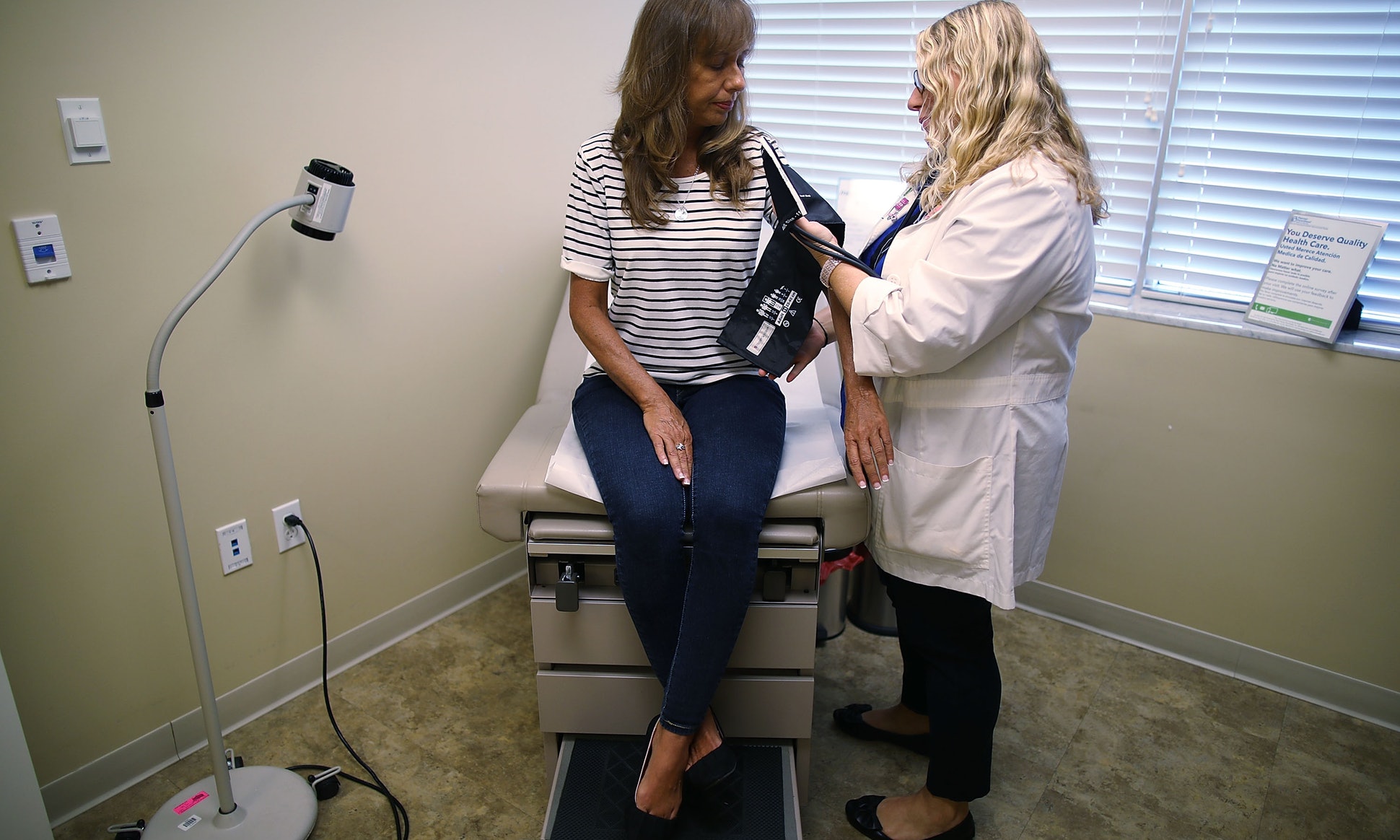
Scott Olson/Getty Images News/Getty Images

“It really demonstrated to us that there are huge swaths of the country where people have to travel so far that they may just decide that the barriers of getting to an abortion clinic are [high] — they can’t overcome them,” Cartwright says. “So, they may choose to carry the pregnancy to term and parent that pregnancy when they may have preferred to have an abortion.”

Texas’ case of abortion deserts has been studied over the past few years. In 2015, the University of Texas’ Texas Policy Evaluation Project reported that the waiting time for people seeking abortion services in Texas had shot up to 20 days in places like Dallas, Fort Worth, and Austin due to state-level restrictions on abortion care.

The study also dug into regional abortion facilities and reported that the American Northeast region had the highest number of options, with 233 abortion centers spread over nine states. In contrast to the Northeast, America’s Midwest has the lowest number of abortion centers with only 92 facilities dotting a total of 10 states.

The ANSIRH paper also noted that North Dakota, South Dakota, Missouri, Kentucky, West Virginia, and Mississippi were the six states with only one abortion center in each.

Alice Cartwright@cartwrightalice

So excited to share my first first-authored paper. We used a systematic online search to describe the abortion facility landscape in the U.S. and document the 27 cities that are 100 miles or farther from an abortion facility: http://www.jmir.org/2018/5/e186/ 

Identifying National Availability of Abortion Care and Distance From Major US Cities: Systematic…

Background: Abortion is a common medical procedure, yet its availability has become more limited across the United States over the past decade. Women who do not know where to go for abortion…

jmir.org

Abortion deserts affect the day-to-day lives of the people seeking abortion services, including having to arrange for day care if they already have children, taking time off from their jobs, preparing for more than one appointment, and paying for travel expenses. Cartwright highlights the intricate detail that goes into such travel and how it impacts people, especially those who are working-class. “What does it actually for someone to travel even five miles? Or 10 miles? They might have to get on three buses or take a train to a bus,” she says.

ANSIRH’s research was published shortly after the reproductive health research organization Guttmacher Institute released research in January that reported there had been 400 state laws targeting abortion services between 2011 and 2017, contributing to abortion centers shutting down across the country.

Perhaps with ANSIRH’s study, the hold that abortion deserts have on people can be understood — and mitigated. “This is the first time that we have done [this research] in such a systematic way,” Cartwright says. “I definitely hope that we continue this methodology annually.”

Source: https://www.bustle.com/p/what-is-abortion-desert-one-researcher-explains-the-lengths-people-must-go-to-for-care-9078143

© Francis Rivera

Abortion and access to it, is a protected constitutional right. Throughout the country people recognize that fact and a clear majority of Americans want to keep it that way. This week, health care providers, state advocates, faith leaders and other concerned Americans from dozens of states will gather in Washington to make clear they want lawmakers to protect abortion access by supporting legislative solutions like the Women’s Health Protection Act.

The renewed effort comes as states are passing harmful abortionrestrictions at historically high rates, while a hostile White House is hastily finding ways to chip away at our fundamental reproductive rights. The courts have offered some protection, overturning or blocking egregiously unconstitutional state laws.

But President Trump has been vocal about his commitment to undermining the rule of law by appointing Supreme Court justices who would ignore the settled precedent of Roe v. Wade and erase Americans’ fundamental right to access abortion.At a time when abortion access is under attack on multiple fronts, reproductive rights advocates must fight back using all options available — from strategic legal challenges to proactive federal legislation. It’s not only the right thing for women, it’s also an idea the American people firmly support.

Politicians on both sides of the aisle tend to treat abortion rights like a deeply controversial issue. That does not in fact reflect the national climate. A poll released by the Center for Reproductive Rights confirmed what other polls have consistently shown: that seven in 10 Americans favor upholding Roe v. Wade, which first recognized access to legal abortion as a woman’s constitutional right.

The poll — conducted as a nationwide online survey from 1,877 voting-age American adults (18+) — also revealed that six in 10 Americans see efforts by lawmakers to restrict a woman’s access to abortion as “a step in the wrong direction.”

A strong majority (81 percent) want elected officials to be proactive in prioritizing women’s health; more than half support the kind of safeguards built into the Women’s Health Protection Act.

First introduced in Congress in 2013, the Women’s Health Protection Act is critical to securing abortion access. As federal legislation, it would protect the legal right to abortion in every zip code and prohibit restrictions that make access to safe and legal abortion care expensive and difficult.

These findings are the just the latest in a growing body of research that shows Americans overwhelmingly support keeping abortion legal and accessible no matter their personal beliefs. Yet lawmakers appear committed to defying both the constitution and this public consensus.

And it’s not just public opinion that demonstrates broad support for abortion access. It’s what women actually decide to do when their health and lives are at stake. One in four women in the United States will make the decision to end a pregnancy. These are women from across the political and religious spectrum, from all parts of the country.

Yet attempts to take their power to decide away continue. States are working overtime to cut off abortion access, quietly passing more than 400 abortion restrictions since 2011.

Many of these laws have been drafted by anti-choice organizations representing a small but determined minority. Around one-third of all such restrictions passed since the 1973 decision in Roe v. Wade have come during this six-year span and the deluge shows no sign of slowing.

These laws are invasive, fact-averse and medically unnecessary — and specifically designed to work in concert with one another to create a de facto ban on abortion. Some force doctors to lie to their patients; others impose unnecessary and burdensome compliance costs designed to shutter abortion clinics, or add arbitrary delays and expenses on women seeking care to which they are legally entitled.

Lawmakers have been able to get away with such an unpopular agenda because the public remains largely unaware of the extent of the crisis. Sixty percent of the Center’s poll respondents did not know that the number of abortion restrictions has increased in the last six years — let alone at an unprecedented rate. This is by design, reflecting a pivot away from direct, national attacks on Roe to an under-the-radar strategy of quietly passing laws that gradually undermine our rights.

The consequences are grave. Most immediately, restricting abortion access prevents people – often the most poor and vulnerable among us — from receiving the medical care that they need and are entitled to by law.

Of course, there are also long-term consequences to allowing the gradual erosion of our reproductive rights, because those rights don’t exist in isolation. As the Supreme Court has noted, reproductive freedom lies at the heart of the promise of human dignity, self-determination and equality.

And while organizations like the Center for Reproductive Rights and its allies have succeeded in suing to block the most egregious abortion restrictions, litigation is a long and expensive process and the pace of these restrictions is accelerating.

It’s now up to elected officials to listen — to the advocates coming to Washington this week calling for passage of the Women’s Health Protection Act and to the rest of their constituents at home. Public support for abortion and women’s health issues is clear and the need for federal protections has never been more urgent. It’s time for politicians to stop the anti-abortion onslaught in its tracks and provide the sort of nationwide safeguards that Americans want and deserve.

The public support is there. Now it’s time for lawmakers to act.

Susan Inman is the chief counsel for federal policy & advocacy at the Center for Reproductive Rights.

Source: http://thehill.com/opinion/healthcare/386976-more-than-400-abortion-restrictions-passed-since-2011-states-working

New abortion restrictions mock Roe v. Wade with an oddly ironic effect

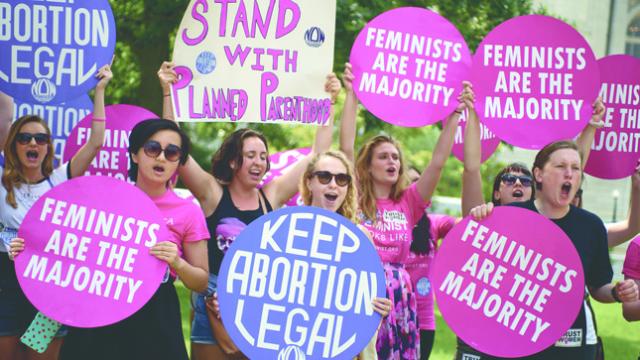
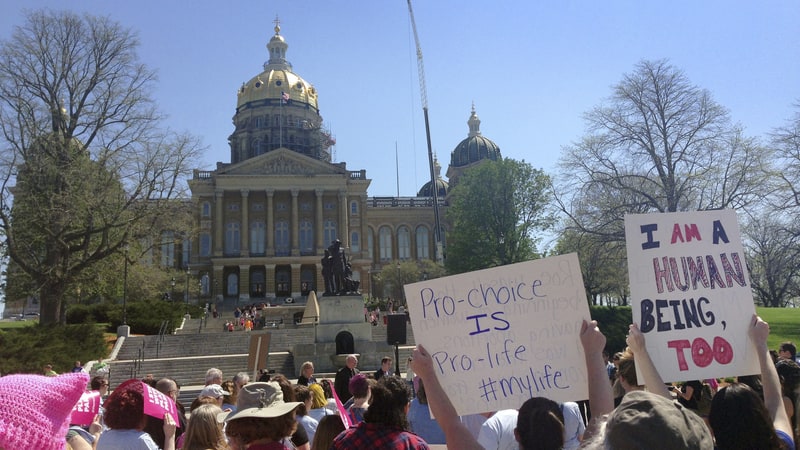
Planned Parenthood supporters rally outside the Iowa State Capitol. Barbara Rodriguez/AP

If you’ve been following the news surrounding reproductive rights recently, you’d be forgiven for asking yourself whether we’re living in a world where Roe v. Wade was never decided. In 1973, the Supreme Court ruled that states cannot make abortion illegal before viability – back then this meant about 28 weeks into pregnancy, now it’s about 24 weeks. And yet, in March, Mississippi passed a law banning abortion after 15 weeks. Last week, Iowa one-upped the Magnolia State, passing a law banning abortion after just six weeks. And South Carolina nearly topped both of them, coming close to passing a law banning all abortions except in the case of life threat, rape or incest. The only thing that stopped that law was a rarely successful Democratic filibuster that pushed the legislature too close to the end of its calendar. In other words, if the law had been considered earlier in the year, the state could have banned almost all abortions.

It doesn’t take a law professor to comprehend the legal problem here.

So what’s going on? Why are these states spending valuable time and resources passing clearly unconstitutional laws?

There are two main reasons these states are willfully violating the Constitution. First, there’s the simple messaging aspect. By passing these laws, the legislators who vote for them and the governors who sign them are signaling to their constituents that they are not merely a little against abortion, but are in fact extremely against abortion. They are making the naked political calculation that being extremist on this issue is a winning strategy in future elections.

That may sound crass, because, after all, couldn’t they be doing this simply because they want to stop abortion? Well, that’s certainly how they talk about their actions, but in reality, not a single person is under any illusion that these laws are going to prevent future abortions. These measures will be immediately challenged in court, and they will be found unconstitutional. And with such extreme laws, the personal politics of the judges hearing these challenges are irrelevant. They will be bound by the clear precedent of Roe, no matter how much they disagree with the decision. In other words, there shouldn’t be a single person voting for or signing these laws who believes they will stop any abortions.

That is, until these laws get to the Supreme Court. The thinking here is that by passing these measures, states like Mississippi and Iowa are forcing the issue to continue to bubble up to the courts – up to and including the Supreme Court. The logic is that, maybe the next time a given abortion case reaches the Supreme Court, new justices will have joined the bench, specifically ones who are willing to overturn Roe.

There’s nothing at all new going on here. This has been part of theanti-abortion strategy ever since Roe was decided. Again, the game is simple: Pass anti-abortion laws to keep cases in the courts while electing conservative presidents who will appoint anti-abortion justices. So far, this strategy hasn’t resulted in overturning Roe, but it has come close, and it has successfully chipped away at the abortion right, even if not getting rid of it altogether.

But what’s different with the recent state-level abortion laws is that there’s absolutely no wiggle room for lower court judges – or even Supreme Court justices who might not like Roe but do not wish to see it overturned. Requirements that women must wait 24 hours before getting an abortion, or that minors tell their parents about their decision, or that doctors tell patients about risks that aren’t supported by medical evidence – those types of restrictions are extremely burdensome for women but have been generally upheld by the courts because the justices have said they still allow a woman to eventually obtain an abortion.

But these new extreme bans in Mississippi and Iowa don’t do that. These measures are wholly unconstitutional if Roe is still nationwide law, which it is. So the end result is this: politicians express their anti-abortion bona fides and hope for lightning to strike in all of the political forces coming together at the right time to overturn Roewhile sending hundreds of thousands – even millions – of taxpayer dollars to abortion rights groups.

Yes, this is the real practical effect of these laws – conservative anti-abortion states funneling gobs of money to nonprofits whose sole mission is to keep abortion legal. How does that happen? Because the lawyers that work for these groups will immediately sue to block these laws in federal court. And under long-standing precedent that applies to all civil rights cases – not just abortion cases – when lawyers sue to block an unconstitutional law and win, the state has to pay the fees of the attorneys who brought the lawsuit, and when the lawyers work for abortion rights groups, those groups get the money.

Thus, as a result of this law, Texas faced a $4.5M bill after it shut down three-quarters of the state’s abortion clinics, North Dakota had to pay $245,000 after passing a six week abortion ban, Missouri was ordered to pay $156K after blocking a clinic’s license, and so on. These are not small sums of money that taxpayers in these states are being forced to cough up to places like the Center for Reproductive Rights, ACLU Reproductive Freedom Project and Planned Parenthood.

The irony is inescapable. For the political party that likes to claim the mantle of fiscal responsibility, these almost-certainly empty efforts show that symbolically limiting women’s rights is more important than protecting taxpayer money, even when that money is being sent to organizations committed to keeping abortion safe and legal.

Source: https://www.rollingstone.com/politics/features/abortion-laws-by-state-w520139

Trump is reportedly weighing a rule that would ban some doctors from even talking about abortion.


Anti-abortion protesters outside a Planned Parenthood health center in February 2017. Marc Piscotty/Getty Images

The Trump administration last year reinstated — and expanded — a rule banning family planning clinics that get aid money from the United States from performing abortions or even discussing abortion with their patients. Often called the “global gag rule,” it’s led to clinic closures and reductions in crucial services around the world. And now it might be coming to the United States.

The White House is reportedly considering a domestic gag rule that would essentially apply the restrictions of the global rule to providers that receive federal Title X funds, which help low-income patients get services like contraceptive counseling and testing for sexually transmitted infections. Such a rule would force Planned Parenthood and other reproductive health providers to either stop discussing abortions with their patients or stop receiving Title X money.

The global gag rule, also called the Mexico City policy, has been reinstated by every Republican president since Ronald Reagan established it in 1984, but a domestic gag rule was only in effect for one month, in 1992. But anti-abortion groups and members of Congress have been pushing the White House to issue its own version, which some believe could come this month.

It’s not yet clear exactly what form a domestic gag rule from the Trump administration would take. The previous attempt at one was immediately challenged in court. But reproductive health advocates say the consequences of such a move could be dire — forcing doctors to lie to patients, undermining medical ethics, and leaving low-income Americans without necessary health care.

It would also be part of a larger pattern in the Trump administration, which has moved repeatedly over the past year and a half to restrict Americans’ access to contraceptionabortion, and accurate information about their health.

Abortion opponents have been advocating for a domestic gag rule for a while. Trump is reportedly listening.

The Reagan administration issued a domestic gag rule in 1988, but it was immediately challenged in court by reproductive health groups. The case ultimately made it to the Supreme Court, which decided in 1991 that the rule could go into effect. It took effect briefly but was again blocked by a court challenge, and when President Clinton took office in 1993, he suspended the rule. That was the end of it. until now.

Anti-abortion advocates have long been pushing the Trump administration to implement a domestic version of the global gag rule. In April, Republican Reps. Ron Estes (KS), Vicky Hartzler (MO), and Chris Smith (NJ) circulated a letter in the House asking the Department of Health and Human Services to implement such a rule, according to the Hill. “The Title X Family Planning Program is in dire need of review and updated regulations that ensure program integrity with respect to elective abortion,” the letter said.

On May 1, leaders of a variety of anti-abortion groups, including the Susan B. Anthony List and the Family Research Council, sent a similar letter to HHS. “For far too long the Title X Family Planning Program has been integrated with abortion centers,” that letter stated. “It is time to act swiftly to disentangle abortion centers from the Title X network.”

The Trump administration appears to be listening. In April, a White House aide told Modern Healthcare that a new rule on Title X would be coming in early May. And according to Axios, Kellyanne Conway met with Trump in late April to urge him to cut off Title X funding to Planned Parenthood.

The White House has not responded to Vox’s requests for comment on Title X plans. But a conservative leader told Axios that if Trump failed to take action on Title X, it would be “political suicide,” given Trump’s campaign promise to strip federal funding from Planned Parenthood.

The effects of the rule would go way beyond abortion

Signed into law by Republican President Richard Nixon in 1970, Title X is the only federal funding stream dedicated solely to family planning services, said Kinsey Hasstedt, a senior policy manager at the Guttmacher Institute. Funds from the program go to health centers around the country — Planned Parenthood affiliates, Health Department centers, clinics operated by hospitals, and more — to help them offer services like contraceptive care, STI screenings, and Pap tests.

Today, about 4,000 clinics get Title X funds, and they serve about 4 million patients. Title X funding is mandated to focus on patients who are low-income or uninsured, or otherwise have difficulty getting health care, Hasstedt said, and two-thirds of patients who get care through the program live at or below the federal poverty line.

Providers are already barred from using Title X funds to pay for abortions, though they can still offer the procedure if they use other funding to pay for it.

While it’s not clear what the specific details of a Trump domestic gag rule would be, reproductive health groups think it would probably bar health centers that get Title X funds from performing abortions, referring patients elsewhere for abortions, or discussing abortion as a possible option when a patient has an unplanned pregnancy.

This would put the health of low-income patients at risk in several ways, Hasstedt said. First, it would exclude from the Title X program any providers that offer abortions. These providers, which include but aren’t limited to Planned Parenthood, are more likely than others to specialize in reproductive health, Hasstedt said. They are also more likely than others “to offer really high-quality family planning services and to serve a really high volume of Title X clients,” she explained.

Planned Parenthood, for instance, operates about 500 clinics that receive Title X money, according to Axios, but these clinics serve a disproportionate share of Title X patients — around 41 percent, the group says. According to a Guttmacher analysis, if Planned Parenthood were excluded from Title X, other Title X providers would have to increase their caseloads by an average of 70 percent in order to pick up the slack. In practice, excluding Planned Parenthood and other providers could mean some patients simply go without contraceptive care, STI screenings, and other crucial health services.

Meanwhile, providers who don’t perform abortions would be barred from talking about the procedure with their patients. This would put doctors and other health care workers in a difficult position: If a patient with an unplanned pregnancy asks about her options, they’d have to omit abortion from the list. And if she asks specifically whether she can get an abortion, they’d have to say no or refuse to discuss the issue.

“This kind of attack,” Hasstedt said, “goes after people’s ability to make informed decisions about their own reproductive health care and directly undermines medical ethics.” A gag rule “would force doctors and nurses to lie to their patients across the country,” said Dawn Laguens, executive vice president of Planned Parenthood Federation of America, in a statement to Vox.

The rule would essentially create a tiered system of reproductive health care, in which people with private insurance would be able to get a full range of information and services, and Americans relying on Title X would not, Hasstedt said. That system “would disproportionately harm folks who are low-income, people who are uninsured, people of color,” she added.

The American College of Obstetricians and Gynecologists and the American College of Physicians have also voiced opposition to a domestic gag rule. “We are deeply concerned about anticipated changes to Title X, which move away from science-based principles and erode standard of care by interfering in the patient/provider relationship,” said Hal Lawrence, the executive vice president and CEO of ACOG, on a press call last week. “We don’t need the government interfering in the exam room.”

While the contexts are different, research on the past effects of the global gag rule could offer a preview of what’s in store. The rule has forced health organizations to reduce services and close clinics around the world, according to a 2017 op-ed in the Lancet by Ann M. Starrs, the president of Guttmacher. The policy also reduced contraceptive availabilityin some areas, and may even have contributed to higher abortion rates.

A domestic gag rule, if it is released, would be part of a larger drive by the Trump administration to restrict access to comprehensive reproductive health care. That drive includes the administration’s weakening of the contraceptive coverage mandate in the Affordable Care Act, efforts by the Office of Refugee Resettlement to bar unaccompanied minors from getting abortions, new rules privileging teen pregnancy prevention programs that promote abstinence, and more.

“This isn’t just about the domestic gag rule,” Hasstedt said. “This is about social conservatives’ broader, and at this point relentless, assaults on reproductive health and rights.”

Source: https://www.vox.com/2018/5/11/17319614/trump-abortion-planned-parenthood-domestic-gag-rule-title-x

Opposition parties believed to be broadly in favour of removing abortion from penal code

 Bruges in Belgium. It remains a criminal and imprisonable offence to have an abortion outside the restrictions imposed by the state Photograph: Darrell Gulin/Getty Images

Belgian MPs are taking a major step towards the decriminalisation of abortion after a parliamentary majority emerged in favour of following France and Luxembourg in treating the procedure as a woman’s right.

The federal parliament decided on Wednesday to start debating the removal of abortion from the penal code after a large survey of the public indicated its approval, and the minister of public health for the francophone Walloon region of Belgium offered her support.

As in England and Wales, it remains a criminal and imprisonable offence in Belgium to have an abortion outside the restrictions imposed by the state. Abortion within 12 weeks of conception was legalised in 1990, and there is a mandatory six-day period of counselling and “reflection”.

At the time, the Belgian king, Baudouin, told the prime minister he could not sign the law without violating his conscience as a Catholic, and abdicated for a 24-hour period so the government could act in his absence.

There is believed to be a majority in the parliament among the opposition parties in favour of decriminalisation, but it will be up to the coalition government to provide time for vote on legislation. Olivier Maingain, the leader of the liberal Défi party, called on Wednesday for a vote before the summer recess in July.

Due to the current tight restrictions, about 500 women travel from Belgium to the Netherlands every year to have the procedure carried out.

Belgium has otherwise been one of the most forward-thinking of European states on reproductive health and anyone aged under 20 has access to free contraception.

In recent years, a series of proposals have been made by opposition parties in parliament to take abortion out of the penal code, so as to avoid stigmatising women who undergo the procedure. It has been repeatedly blocked from being put on the parliamentary agenda, until this week.

Wim Van de Voorde, from Sensoa, a sexual education charity, said: “Belgium has one of the lowest abortion rates but still one in five women will have an abortion at some point in their life. It is a part of life and a medical procedure. It is not something that belongs in a penal code.

“In Ireland, where there is a referendum this month, there have been hearings and debates about abortion. But that hasn’t happened in Belgium, until now.”

Abortion has been liberalised across Europe in recent years. Ireland will vote on 25 May on repealing the eighth amendment of the republic’s constitution, which gives the unborn an equal right to life as the mother and therefore prohibits abortion in almost all cases.

Abortion was taken out of Luxembourg’s penal code in 2014. François Hollande’s government changed the law in France in 2015 to explicitly permit abortion for “any woman who does not wish to continue a pregnancy”, rather than simply those in “distress”.

In 2017, the Labour MP Diana Johnson failed in her attempt to reform the 1967 Abortion Act to decriminalise abortion in England and Wales.

Source: https://www.theguardian.com/world/2018/may/02/belgium-to-debate-removal-of-abortion-from-penal-code

“What happens in Ohio may not stay in Ohio. It may have implications in the 45-year battle over Roe v. Wade.”

UPDATE, May 9, 10:00 a.m.:Mike DeWine won Ohio’s May 8 Republican primary and will advance to the November general election.


Ohio Attorney General Mike DeWine and Secretary of State Jon Husted announced last week that the GOP gubernatorial candidates would merge tickets as they look to further erode access to abortion care across the state.

DeWine will top the ticket as a candidate for governor with Husted as his running mate in the state’s May 8 primary. “He shares my vision of where the state needs to go,” DeWine said of Husted during the announcement of the pair’s plans for the 2018 race.

DeWine and Husted are vocal opponents of reproductive rights. As the state’s attorney general, DeWine signed on to amicus briefs in support of anti-choice policies, including Texas officials’ fight to deny abortion care to an undocumented unaccompanied minor and in support of efforts to restrict access to contraception through the birth control benefit in Hobby Lobby v. Burwell.

Advocates say the state of reproductive health access in Ohio is at a critical juncture. “It’s very close, I think, to the breaking point,” Kellie Copeland, executive director of NARAL Pro-Choice Ohio told Rewire. “We have seen Governor Kasich enact 19 different attacks on access to reproductive health care,” she said, pointing to the governor’s anti-choice record. “And as a result, we went from 16 abortion clinics to just eight, and some of those clinics are involved in litigation to remain open.”

Under Kasich, Ohio has undergone massive rollbacks in access to reproductive health care. The Republican governor has signed a measure to defund Planned Parenthood and a 20-week abortion ban. Moreover, his aides played a key role in drafting language requiring medically unnecessary licensing regulations for abortion clinics into the 2013 state budget bill. That provision ultimately led to the closureof clinics across the state.

Kasich vetoed Republican “heartbeat” bill last year that would have banned abortion care as soon as a heartbeat was detectable, which could be as early as six weeks into a pregnancy. Many people don’t know they’re pregnant at the six-week mark, meaning a “heartbeat” bill amounts to a total abortion ban. Though Kasich said the law would have been unconstitutional, DeWine said he would have defended the restriction if it had been signed into law.

Copeland said DeWine’s position on that total abortion ban was “absolutely” a concern. Though Kasich vetoed the measure, “I don’t think that we could count on that from a Governor DeWine,” she said. “He has used his office as attorney general in every way to interfere with access to reproductive health care, not just here in Ohio, but in other states,” Copeland continued, pointing to the anti-choice legal briefs he signed.

Kasich appointed Ohio Right to Life President Mike Gonidakis to the state’s medical board in 2012, and Gonidakis recently was given another 5-year term. Both DeWine and Husted have ties to Ohio Right to Life, which announced in July that it would no longer back candidates that didn’t support banning abortion without exceptions for rape and incest—though it claimed this was “not really a new strategy in any way.”

A public records request filed by the Associated Press in 2016 revealed DeWine was in contact through text message and email with Gonidakis.

Gonidakis, whose organization also has a PAC, told Rewire he still speaks with DeWine “on the phone or in person whenever the need arises” and does so in his “capacity as president of Ohio Right to Life or as a citizen of the state of Ohio.”

“Everyone in the state of Ohio regardless of political stripes has the ability to communicate with elected officials,” Gonidakis said. “And so do I.”

When asked whether he communicated similarly with Husted, Gonidakis said, “If the need arises for me to talk to him, I’ll pick up the phone and I’ll call him. Or I’ll schedule a meeting through his office,” though neither of them “have time for small talk.”

In 2016 Husted hired the former executive director of Ohio Right to Life, Stephanie Ranade Krider, to be his director of policy and legislative affairs. Husted’s gubernatorial campaign site, which now redirects to DeWine’s site, had boasted that the candidate “consistently backed the work of Ohio Right to Life and earned their endorsement during every race.” He has spoken at events sponsored by the group.

DeWine and Husted both appeared in recent “candidate spotlight” videos created by Ohio Right to Life. In early November, DeWine met with anti-choice activists at an Ohio Right to Life forum to “court their vote for Governor in 2018,” according to a post on the organization’s website. Husted met with the organization’s board of trustees earlier in the year and made “similar commitments to Ohio’s pro-life voting block [sic],” the post said.

Gonidakis told Rewire that the organization plans to endorse a candidate in the Republican gubernatorial primary, but he noted that Ohio Right to Life had yet to distribute a candidate survey. Such a questionnaire could definitively answer whether DeWine and Husted will officially support banning abortion care, a prerequisite for earning the group’s endorsement. Gonidakis said he didn’t know where the two stood on exceptions for abortion bans.

While Gonidakis said his organization was “excited to have a great group of candidates to choose from on the Republican side,” he said he hoped a “pro-life Democrat” would run. “Nothing would make us more excited [than] to be able to endorse a pro-life Democrat and a pro-life Republican for governor of Ohio because then we’d win no matter what,” he said.

“I don’t care what the Democrat’s position is on taxes, health care, anything else,” Gonidakis said. “If you’re a pro-life Democrat and you’re an elected official and you want to run for the governor’s office, call me. I’ll help you.”

Copeland suggested to Rewire that Ohio’s gubernatorial race has national implications for reproductive rights. “This is getting to the end of the chess match, if you will, on the battle over abortion access,” Copeland said. “Ohio anti-choice politicians have enjoyed gerrymandered districts that have allowed them to pass restriction after restriction without having to face the ire of voters. And these restrictions have all been designed to set up a buffet in front of the U.S. Supreme Court to say that these are a number of different ways that you could undercut or eliminate Roe v. Wade, and therefore access to abortion care.”

“All they need on the federal level is one more justice, one more vote,” Copeland said. “And so what happens in Ohio may not stay in Ohio. It may have implications in the 45-year battle over Roe v. Wade.”

Source: https://rewire.news/article/2017/12/07/anti-choice-crusaders-team-ohio-gubernatorial-race-abortion-access-nears-breaking-point/

Danielle Campoamor is an editor at Romper and a columnist for Bustle. She received an award from Planned Parenthood for media excellence. The views expressed here are solely hers.

The Legislature in Iowa has passed the most restrictive abortion law in the country. Senate File 359, or the “heartbeat bill,” will bar physicians from performing the procedure after a fetal heartbeat is detected, which can be as early as six weeks, when it is common for women not to know they are pregnant yet.

Danielle Campoamor

If you looked at my life on paper, you might very well wonder why this news is a big deal to me. I have a life in New York City, a 3-year-old son, a current, wanted, planned pregnancy, a rewarding relationship and my mental health. But I have these things because of the abortion I was legally, safely and affordably able to procure at age 23. To advocate for restricted access, to ban abortion services before women even know they are pregnant or to destroy access entirely is to endorse the unnecessary deaths of women across a country that claims to value all life. And I cannot enjoy my life while women are losing the right to live theirs.
In 2010, I walked into a Planned Parenthood in Washington state and had a safe, affordable and relatively easy abortion. I wasn’t subjected to mandatory waiting periods, forced counseling or an abortion provider required to regurgitate state-mandated, inaccurate information. I didn’t have to travel long distances, worry I was getting there too late in the pregnancy, find money to pay for child care or walk past angry or intrusive protesters. Instead, I went in pregnant and, a few hours later, came out with my future back in my control.
I was unaware at the time, but that future would eventually include life as a writer of a column dedicated entirely to abortion, lobbying elected officials on Capitol Hill and sharing my abortion story in front of thousands of people.
I had no idea that it would include another pregnancy, a difficult labor and delivery, and a healthy, beautiful baby boy. But it also brought me death threats, promises of eternal damnation, severed relationships with conservative or evangelical childhood friends and daily online attacks from anti-abortion zealots; all “consequences” of my choice to procure and advocate for abortion care. And since that day in 2010 I have watched in anger as the constitutionally protected right to an abortion has been attacked and trampled across the country. I have heard our vice president promise I would see the demolition of Roe v. Wade in my lifetime and interviewed women who’ve been lied to by so-called crisis pregnancy centers, to the point they were tricked into carrying their unplanned pregnancies to term.
State Sen. Rick Bertrand, an Iowa Republican, said during a debate on Senate File 359 that it would be a “vehicle that will ultimately provide change and the opportunity to overturn Roe v. Wade,” because the measure is likely to be challenged in court and potentially appealed by either side to the US Supreme Court. Proponents of the bill are proudly proclaiming that there is no hidden agenda: The bill is not meant to protect life but to engineer public policy that could lead to a national ban on abortion.
For those who believe in abortion rights, it’s a scary time. When Kevin Williamson, conservative writer for The Atlantic for all of two weeks, was let go after a firestorm over comments he made calling for women who’ve had abortions to be hanged, I wasn’t surprised. I was, however, surprised that so many people considered Williamson’s remarks to be “fringe.” Williamson later wrote in The Washington Post to clarify, “That isn’t my view at all.”
Abby Johnson, a former Planned Parenthood clinic director turned anti-abortion activist, told LifeSiteNews, a so-called “news” website, in response to Williamson’s comments, “As pro-lifers, we must preach mercy, not condemnation. We believe that abortion is the ultimate violence against women and their unborn children. We must not, in turn, respond with violence against those who are misled and living in spiritual blindness.” A fine sentiment, to be sure, but one dripping with hypocrisy.
It is inherently violent to call for the demolition of Roe v. Wade, and wish to return to a time when abortion was listed as the official cause of death for almost 2,700 women in the United States. By 1965, according to the Guttmacher Institute, 17% of all deaths attributed to pregnancy and childbirth were the result of illegal abortions, and those were the deaths officials reported; the actual number of lives lost is undeniably much higher.
It’s violent to continue to introduce anti-abortion restrictions when a 2017 study conducted by Ibis Reproductive Health and the Center for Reproductive Rights found that states with the highest abortion restrictions also have the highest maternal mortality and infant mortality rates. According to UN experts, repealing anti-abortion laws would save the lives of nearly 50,000 women a year.
It’s violent for states to pass Targeted Regulation of Abortion Providers laws that close clinics and limit access to a legal medical procedure. Before the US Supreme Court struck down House Bill 2 in Texas, in 2016 — arguably responsible for the state’s most rigorous abortion restrictions — 21 clinics reportedly were shut down and only 19 remained to serve the second-most populous state. There are 5.4 million women of reproductive age living in Texas, and a 2016 report from the Texas Policy Evaluation Project, based at the University of Texas at Austin, revealed that more than 100,000 of them attempted self-induced abortions. Meanwhile, Texas has the highest maternal mortality rate in the developed world.
In 2014, poor women accounted for 49% of abortion patients, according to the American Journal of Public Health, and numerous studies have shown that when women are denied access to abortion they’re more likely to live in poverty, inhibiting their ability to seek out and pay for additional health care. According to Axios, the Trump administration is currently debating whether to cut off Title X family-planning funding to abortion providers such as Planned Parenthood, a move that would potentially force the organization to choose between losing the funding or ending abortion referrals. In 2015, according to the Guttmacher Institute, clinics funded by Title X provided contraceptive services to a reported 3.8 million women, helping to prevent 1.9 million pregnancies.
In the United States, between 700 and 1,200 women die from pregnancy or childbirth complications, the World Health Organization reports, and black women are three to four times more likely to die from such complications than white women. In other words, women of color and poor women are disproportionately affected by abortion restrictions. The lovers of rich white men, however, are still able to access the reproductive care they need.
Worldwide, an estimated 68,000 women die of unsafe abortions each year, according to an obstetrics and gynecology study, and 5 million will suffer long-term health complications if they survive. Yet if successfully implemented, the beliefs of people such as Williamson and Johnson and many other anti-abortion advocates would result in a nation of back alleys and contorted clothes hangers.


In El Salvador, a total ban on abortion has resulted in the automatic suspicion of any woman who doesn’t carry a pregnancy to term. Some women who endure miscarriages or stillbirths are sent to prison, such as Carmen Vásquez, who was sentenced to 30 years for aggravated murder after giving birth to a stillborn baby. Thankfully, her sentence was commuted in February, but there are many others like her still in jail.
Instead of being a beacon of freedom that celebrates complete bodily autonomy, anti-abortion advocates would see the United States go the way of El Salvador: a total ban on abortion, and the demonization — even imprisonment — of any woman whose pregnancy doesn’t result in the birth of a healthy newborn.
Rick Bertrand isn’t pro-life. Kevin Williamson isn’t pro-life. Abby Johnson isn’t pro-life. Our vice president isn’t pro-life. The anti-abortion movement isn’t pro-life.
Abortion is.
Source: https://edition.cnn.com/2018/05/05/opinions/supporting-abortion-is-pro-life-opinion-campoamor/index.html

America’s abortion clinics experienced a major upsurge in trespassing, obstruction and blockades by anti-abortion activists in 2017, according to an annual survey by an industry group.

The National Abortion Federation report chronicled a litany of actions that ranged from coordinated trespassing efforts by abortion opponents, repeated brick-throwing at windows of a Cleveland clinic and an attempted bombing in Illinois.

The report found that there was an overall decrease in acts of vandalism against clinics but a significant increase in activities aimed at disrupting services and intimidating patients and providers. Acts of trespassing increased from 247 in 2016 to 823 in 2017, instances of obstruction tripled to 1,704 and threats of death or other harm nearly doubled to 62.

“The protesters are feeling emboldened by the political environment and seeing what they could get away with,” said the federation’s president, Vicki Saporta. “They want to make it more difficult to provide care, without going to very extreme forms of violence.”

The federation based its findings on monthly reports filed by its members who make up the vast majority of abortion clinics nationally.

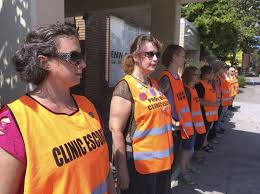
Many clinics across the U.S. routinely are targeted by legal picketing near their premises. But in some cases, the protests escalated and led to intervention by federal and law enforcement agencies.

At least 10 people were arrested last May when anti-abortion activists blocked the entrance to the EMW Women’s Surgical Center in Louisville, Kentucky — the last abortion clinic still operating in the state. Saporta said the protesters, organized by the militant anti-abortion group Operation Save America, were emboldened by Kentucky Gov. Matt Bevin’s high-profile efforts to shut down the clinic.

As a result of the blockade, a federal judge established a buffer zone outside the clinic to keep protesters from assembling in front of the entrance.

Among those arrested in Louisville was Operation Save America’s national director, Rev. Rusty Lee Thomas. While awaiting trial, he said abortion should be outlawed, declaring “Our justice system is committing another grave injustice by arresting the wrong people.”

Elsewhere, several trespassing arrests occurred during coordinated actions by anti-abortion protesters in Virginia, Michigan and other states. Activists entered clinics, conveyed their anti-abortion views to patients, and refused to leave when told to do so by law enforcement.

Citizens for a Pro-Life Society, a group headed by Roman Catholic theology professor Monica Migliorino Miller, described the incursions as “an act of nonviolent defense of unborn children about to be aborted.” Miller was among those arrested in Michigan, and in February was convicted of trespassing.

The one attempted bombing in 2017 involved a pipe bomb that did not explode after being placed in an abortion clinic in Champaign, Illinois, in November. The three men charged by federal authorities are allegedly part of a militia group called the “White Rabbits” who also have been charged in the bombing of a Minnesota mosque last year.

A clinic in Cleveland incurred more than $32,000 in damages because of repeated brick-throwing attacks on its windows.

The report does not include a violent case in February when — according to prosecutors — a Massachusetts man deliberately crashed a stolen truck into a Planned Parenthood clinic in New Jersey, injuring three people, including a pregnant woman. That was the first major violent attack on a U.S. abortion clinic since 2015, when a man killed three people at a Planned Parenthood clinic during a shooting attack in Colorado.

The picketing in 2017 often was more aggressive than in recent years, according to the Feminist Majority Foundation, which operates a national clinic access program.

“They’re telling us they’ve never seen this level of intensity,” said the foundation’s executive director, Kathy Spillar.

The threat of attacks and vandalism can significantly boost clinics’ costs, notably to provide security for facilities and staff. Some clinics have faced extra legal costs challenging state laws aimed at restricting abortions.

In part, because of the legal and financial challenges, the number of abortion clinics in the U.S. has been declining. As of 2014, when the last comprehensive tally was made, there were 788 clinics.

Source: https://abcnews.go.com/Health/wireStory/us-abortion-clinics-face-surge-trespassing-blockades-54982471

Group embarks on 12-day trip to push for repeal of ‘unforgiving’ Eighth Amendment

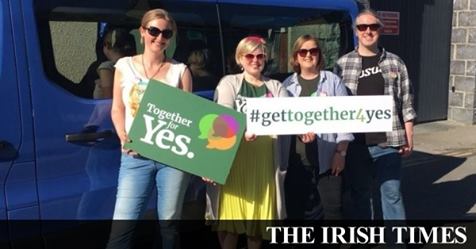
Together for Yes campaigners as the group begins its 12-day tour. Photograph: Together for Yes

The Together for Yes group has embarked on a 12-day tour of 22 locations across the State in an effort to convince more voters to back repeal of the Eighth Amendment in the forthcoming referendum on the issue.

Co-director Orla O’Connor told the campaign group’s first “Get Together For Yes” gathering, held in Athlone on Sunday, that the May 25th ballot was not a vote on abortion as “we already have abortion in Ireland”, but a vote “to decide if we will regulate it, make it safe, and care for the women of Ireland”.

She said the Amendment was “broad and unforgiving” and failed to reflect the reality for “women and families in every community, every village, every town and every county in Ireland”.

She pointed to figures from the department of health and social care in the UK which state that, between 2012 and 2016, more than 18,000 women gave Irish addresses at British abortion clinics.

“This doesn’t count those who didn’t give addresses, or who went to other European countries for the care they needed,” she said.

The May 25th referendum will ask voters whether they want to repeal the Eighth Amendment, which prohibits abortion, and allow for legislation that would permit terminations without restriction up to 12 weeks into a pregnancy.

‘Failed experiment’

At the Athlone event, the chair of the Institute of Obstetricians and Gynaecologists, Dr Peter Boylan, described the Eighth Amendment as “a failed experiment”, adding that “abortion is here already”.

He said that, over the last year, 2,000 women in Ireland imported illegal abortion pills from online providers.

“These pills are very safe when used under medical supervision. However, if taken in the wrong dosage or at the wrong time they can cause serious, potentially fatal problems such as uterine rupture and haemorrhage,” he said.

He suggested that the Amendment created the “risk [of] waking up one morning to the news that a woman has bled to death, alone in her bathroom”, a risk that could not be ignored.

He said the “fact is that as long as we have the Eighth Amendment, we can do nothing about fatal foetal anomalies, pregnant rape victims, or some cancer patients”.

Ms O’Connor said she accepted abortion can be “a difficult topic to discuss”, but added that sometimes a private matter needed public support.

“Our ‘Get Together For Yes’ conversations tour recognises this, and it is why we are visiting 22 locations across Ireland over the next 12 days, so that we can help people start that conversation and open up that discussion,” she said.

https://www.irishtimes.com/news/social-affairs/together-for-yes-begins-tour-of-ireland-ahead-of-abortion-vote-1.3486142

(Photo: Mandel Ngan, AFP/Getty Images)

COLUMBIA, S.C. — A bill that would have outlawed most abortions in South Carolina was killed early Friday after Democratic state senators, who hold only two-fifths of the seats, waged a lengthy filibuster.

The 24-21 vote at about 1 a.m. ET, where five Republicans joined the minority party, sent a bill back to committee that had been amended Wednesday night to outlaw all abortion in the state except in instances that would save a mother’s life or in cases of incest or rape.

“The abortion ban in South Carolina is no longer,” Sen. Marlon Kimpson, a Democrat from Charleston, wrote on Twitter. “Women will continue to have the right to choose and make their own personal decisions about their bodies in consultation with their families and doctors.”

He and other Democrats had swapped places at the Senate podium to keep talking and block consideration of the bill. Republicans tried repeatedly to give the bill a final approval, but in the end came up one vote short of ending the Democrats’ speeches.

The Democrats had talked about food, coffee, swimming, lack of money for what they believe are the state’s most pressing issues and why the legislation was a  “bad bill” that even South Carolina House leaders opposed.

“Why are we wasting our time?” Kimpson asked in the middle of his hours at the podium Thursday.

Sen. Marlon Kimpson@KimpsonForSC

The abortion ban in SC is no longer. After hours of filibuster, the bill has now been recommitted to committee. Women will continue to have the right to choose and make their own personal decisions about their bodies in consultation with their faimilies and doctors.

The bill initially banned only a procedure called dismemberment abortion, which was performed 22 times out of 5,736 abortions in 2016 in South Carolina.

But a Democrat who has spent years fighting restrictions against abortions took a risk. State Sen. Brad Hutto of Orangeburg suggested changing the bill to ban all abortions with few exceptions; Republicans agreed on a 24-1 vote with most Democrats sitting out.

The change galvanized the debate, and Democrats started a filibuster.

The bill would have violated the U.S. Supreme Court’s 1973 landmark ruling Roe v. Wade and invited a lawsuit the state would lose, opponents argued. Democrats also pointed out the broad proposal could be read as banning many forms of birth control including intrauterine devices and birth control pills.

“We were right there on pins and needles until the very end,” said Sen. Gerald Malloy, a Democrat from Hartsville.

The bill initially passed the state Senate 28-10 Wednesday and needed only a final vote to return to the House. If the bill had made it to Gov. Henry McMaster’s desk, he previously has vowed to sign any bill reducing abortions in the state.

“It is over!” tweeted Vicki Ringer, a spokeswoman for Planned Parenthood Votes! South Atlantic who called the bill extreme earlier Thursday. “With just three days left in the session, it should be dead for the year.”

Source: https://www.usatoday.com/story/news/politics/2018/05/04/south-carolina-abortion-ban-bill-killed/582611002/