Governor Kim Reynolds’ of Iowa signed legislation Friday barring nearly all abortions in the state after a fetal heartbeat is detected. For more on the story here is Zachary Devita. Buzz60
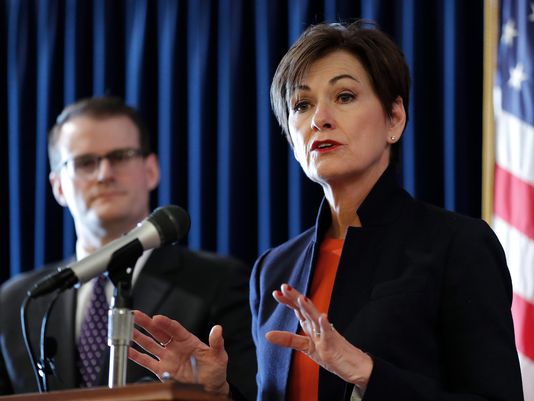
DES MOINES — Iowa’s governor signed legislation Friday prohibiting nearly all abortions in the stateafter a fetal heartbeat is detected, making it the most restrictive abortion ban in the nation.
Security was tightened at the Iowa Capitol in advance of the signing and several state troopers were seen Friday afternoon outside Gov. Kim Reynolds’ formal office.
“I believe that all innocent life is precious and sacred, and as governor, I pledged to do everything in my power to protect it. That is what I am doing today,” Reynolds said.
The bill received final approval early Wednesday from the Iowa Senate on a divided vote. The House passed the legislation Tuesday night.
The law, which goes into effect July 1 if the courts don’t stop it, will require physicians to conduct an abdominal ultrasound to test for a fetal heartbeat on any woman seeking an abortion. If a heartbeat is detected, a physician cannot perform an abortion.
A fetal heartbeat can be detected about six weeks into a pregnancy and often before a woman realizes she’s pregnant, experts said.
Planned Parenthood for the Heartland, which is Iowa’s largest provider of abortions, announced earlier Friday it would file a lawsuit if Reynolds signed the legislation.
“It’s shameful that when Planned Parenthood heard lawmakers were introducing legislation to ban abortion, we were outraged — but we weren’t surprised,” said Suzanna de Baca, president and chief executive officer of Planned Parenthood of the Heartland. “But I think many of us still never expected that Governor Reynolds would so swiftly jump to sign a bill that is so clearly unconstitutional.”
Reynolds, a Republican who has been outspoken in her opposition to abortion, had declined to say Wednesday whether she would sign the legislation. She had said she would work with her staff before making any final decisions although faith-based lobbyists told The Des Moines Register they fully expected Reynolds would sign the bill.
Iowa law has barred most abortions after 20 weeks under legislation enacted last year. Those provisions already were among the most strict abortion bans in the country.
But many Iowa Republican lawmakers said they believe the time is right to pass legislation that could advance to the U.S. Supreme Court and pose a challenge to Roe v. Wade, the 1973 landmark case that found women have a constitutionally protected right to abortion.
The Supreme Court has declined to hear similar cases in recent years. But as states continue to pass legislation restricting abortions and President Trump appoints more conservative federal judges, abortion opponents are increasingly optimistic.
Texas legislators shovel millions into fake clinics that promote an anti-choice agenda. Only a small portion of the funding pays for assistance, such as maternity clothing, baby clothing, and diapers.
Anti-choice clinics will be eligible to receive an unprecedented $40.5 million in taxpayer dollars from 14 states this fiscal year. Texas accounts for more than half of funding for fake clinics. Mandel Ngan/AFP/Getty Images
Texas has seen some of the nation’s most regressive abortion restrictions in recent years. This series chronicles the fall-out of those laws, and the litigation that has followed.
The Texas Alternatives to Abortion (A2A) program since September 2014 has distributed more than $21.6 million in funding to organizations that oppose abortion rights and supposedly provide support services to pregnant people and adoptive parents.
Subcontractors over the past three years were reimbursed more than $13.9 million dollars for “counseling” services and more than $4.3 million for pregnancy, childbirth, and parenting classes. Only $3.4 million was distributed to organizations to pay for assistance, such as maternity clothing, baby clothing, and diapers.
Anti-choice clinics will be eligible to receive an unprecedented $40.5 million in taxpayer dollars from 14 states this fiscal year, and Texas accounts for more than half of funding for fake clinics.
“Political leaders in Texas should be ashamed. When over 14 percent of households in the state experience food insecurity because the Texans living in them lack consistent access to regular meals, it is a dereliction of duty to give hard earned tax dollars to shady, anti-abortion fake clinics that exist to talk women out of having abortions,” Pamela Merritt, co-director of ReproAction, told Rewire.News.
Texas Gov. Greg Abbott (R) in June 2017 signed an appropriations bill that allocated $38.3 million over two years for the A2A program, after the state’s GOP-held legislature approved an amendment to more than double the program’s funding.
The A2A program is administered by the state’s Health and Human Services Commission, which contracts with an outside organization to distribute the funds. The Texas Pregnancy Care Network (TPCN), an Austin-based nonprofit, was awarded a contract to distribute funds to the subcontractors that the network selects and oversees. Organizations that provide abortion care or refer clients to abortion providers are not eligible to receive funding through the A2A program.
TPCN this fiscal year has distributed more than $4 million to 55 subcontractors that operate more than 121 facilities. Nearly $2 million has been directed to 51 fake clinics.
A Rewire.News investigation found TPCN funneled $2 million in state funds to fake clinics in 2015, and the majority of the funding was not used for concrete assistance or services.
Houston Pregnancy Help Centers is subcontractor provider for TPCN, which claims to provide “life-affirming alternatives to the tragedy of abortion” to pregnant people who are experiencing an unplanned pregnancy. The organization offers limited medical services at two locations in Houston, along with a mobile clinic.
Houston Pregnancy Help Centers, which states that it seeks to “equip and encourage Christian volunteers” and “share the Gospel of Jesus Christ,” has received more TPCN taxpayer funding since September 2014 than any other state-funded fake clinic: $1.2 million.
“Just think about the impact on food insecurity or infant mortality over $10 million dollars, including the $1.2 million awarded to Houston Pregnancy Help Center alone, would have had,” Merritt said.
South Carolina’s state Senate voted Wednesday to ban virtually all abortions, The State reported.
The measure, approved 28-10, blocks abortions except in cases of rape, incest or medical emergencies that could seriously harm the pregnant woman.
This would reportedly ban approximately 97 percent of the roughly 5,700 abortions performed in South Carolina each year.
If signed into law, it would almost certainly face a court challenge — exactly what Senate Republicans are hoping for.
“It’s designed to give the court an opportunity to revisit Roe v. Wade,” Senate Majority Leader Shane Massey (R) said, referencing the 1973 Supreme Court decision legalizing abortion nationwide.
State Sen. Brad Hutto (D) said the bill is “clearly unconstitutional,” but said the state Senate should hold a vote on the measure so it didn’t clog up the legislative calendar.
“It’s an attempt to get it to the courts so we don’t have to keep debating it over and over and over,” Hutto said.
Hutto said he’s confident the courts will eventually strike down the abortion ban.
The bill now heads back to the GOP-controlled House for approval. Republican Gov. Henry McMaster and Lt. Gov. Kevin Bryant (R) have both endorsed anti-abortion bills.
“This bill is one more example of state politicians, emboldened by the Trump-Pence administration, carrying out policy after policy that strip away people’s freedoms and access to care.”
There were 3,719 abortions performed in Iowa in 2016, and all but 230 abortions—6.2 percent—were performed prior to 14 weeks of pregnancy, according to state data. Shutterstock
The Iowa legislature on Wednesday passed a total abortion ban as part of a crusade by Republican lawmakers and anti-choice activists to challenge the U.S. Supreme Court’s landmark ruling in Roe v. Wade.
State Sen. Rick Bertrand (R-Sioux City) said Iowa will be “ground zero” in an effort to reverse the Supreme Court’s decision legalizing abortion care. “I believe this bill will be the vehicle that will ultimately provide change and provide the opportunity to overturn Roe v. Wade,” Bertrand said, according to Iowa Public Radio.
Ohio GOP legislators in March mounted a challenge to Roe by passing a law that would criminalize abortion care. Republicans in the U.S. House of Representatives introduced Congress’s first-ever total abortion ban in January 2017.
So-called heartbeat bans have been deemed unconstitutional because they seek to ban abortion months before the point at which a fetus is viable. The “heartbeat bans,” which outlaw abortion care as early as six weeks’ gestation—before many people even know they’re pregnant—have been blocked by courts in both Arkansas and North Dakota. The Supreme Court declined to review either case.
Dawn Laguens, executive vice president of Planned Parenthood Federation of America, said in a statement that the GOP legislation is an “extreme and draconian policy” intended to restrict the right to access reproductive health care.
“This bill is one more example of state politicians, emboldened by the Trump-Pence administration, carrying out policy after policy that strip away people’s freedoms and access to care,” Laguens said. “The right to control your body includes the right to access safe, legal abortion. Your body is your own, if it is not, we cannot be truly free or equal.”
SF 359 would prohibit abortion from the time a fetus has a detectable heartbeat. A fetal heartbeat can be detected as early as six weeks into pregnancy, two weeks after a first missed period, and well before a person may realize that they are pregnant.
The bill includes an exception for rape, if it is reported within 45 days to a law enforcement agency or a private health agency, along with an exception for incest, if the incident is reported within 140 days. There are exceptions for fetal abnormalities that a physician determines are “incompatible with life,” and for a medical emergency, in which a physician determines the pregnancy must be terminated to “preserve the life” of the pregnant person.
Rep. Beth Wessel-Kroeschell (D-Ames) said during the floor debate that the courts have ruled that similar laws were unconstitutional, and that the Iowa GOP’s total abortion ban would disproportionately affect marginalized communities, reported the Cedar Rapids Gazette.
“Middle-class and upper-class women always have access,” Wessel-Kroeschell said. “If Iowa manages to pass this extreme, ideological proposal, middle- and upper-class will travel to another state. These women can afford the plane ticket or auto fuel and possible hotel stays they need to accommodate an out-of-state abortion.”
After several hours of debate, the Republican-controlled house Tuesday evening passed the bill with a narrow 51-46 vote, with six GOP lawmakers joining Democrats to vote against the bill. The bill was then sent to the state senate, where lawmakers in the early morning hours on Wednesday voted 29 to 17 to approve the changes made by the house.
The bill now heads to Gov. Kim Reynolds (R), who has not stated whether she intends to sign the bill.
Brenna Smith, the governor’s spokesperson, said the governor is “100 percent prolife,” but the governor’s office has not received legislation and the “governor does not comment on any bill until she sees it in its final form,” reported the Des Moines Register.
In a Facebook post, Perez Williams said she had attended the anti-choice March for Life. She did not dispute the authenticity of the posts to the Intercept.
YouTube/ Juanita For Mayor
Evidence provided to Congress by state attorneys general and health departments proves that abortion is both extremely safe and highly regulated. Searchable by state.
In February, Democratic leaders in New York’s 24th Congressional District chose Dana Balter—a visiting professor and a PhD candidate at the Maxwell School of Citizenship and Public Affairs at Syracuse University—as their candidate for U.S. Congress. The Democratic Congressional Campaign Committee (DCCC) apparently had other ideas: The DCCC recently stepped in to support another candidate who entered the race at the last minute, whose campaign website includes no formal positions on critical issues, and who has promoted erroneous anti-choice propaganda.
As the Intercept reported Saturday, Juanita Perez Williams, a former prosecutor and candidate running for the U.S. House of Representatives, described her personal anti-choice views in a series of private posts to Facebook. “My heart has also been changed for life from the many women I know, both young and old like me, who have suffered greatly from abortion,” she wrote two years ago in a post, according to the publication.
“It is a choice that leaves many with years of suffering,” she claimed. “It is a choice that leaves one with depression, and sadness, and often hurts relationships. I mention this because there is nothing in my pro-life advocacy that even suggests judging or condemnation. I hate that crap! Women suffer with pregnancy and often feel hopeless. This I know! Be good!”
Perez Williams’ claims about abortion perpetuate widely debunked anti-choice falsehoods.
In another post, Perez Williams said she had attended the anti-choice March for Life. She did not dispute the authenticity of the posts to the Intercept.
In a statement also provided to Rewire.News, Perez Williams vowed that if elected she would protect reproductive rights and claimed her “personal opinions are far more nuanced.”
“I believe 100 percent in a women’s [sic] right to choose and will always defend and protect that right. I further believe that women should have access, funding, and education with regard to their reproductive health and therefore I will advocate for and defend organizations like Planned Parenthood,” she said. “Like many women, my personal beliefs on the issue of choice have been shaped by my life experiences, both as a Hispanic and a Catholic and as a mother and a grandmother. My own personal opinions are far more nuanced then [sic] some people would like you to believe. I will always vote to support the choice of all women.”
Balter is the favorite of voters in the district and won the Democratic designation for Oswego, Cayuga and Wayne counties earlier this year. She was the presumptive nominee until Perez Williams jumped into the race.
Balter’s campaign site highlights health care as “a fundamental human right,” and promotes Medicare-for-All. Her platform includes calls to “guarantee coverage for essential health services that protect our families like maternity care, hospital services, and mental health care” and to “safeguard women’s access to reproductive health care.” She has the support of the Indivisible Project and Zephyr Teachout, who launched a progressive challenge to Gov. Andrew Cuomo (D) in 2014.
In a statement to Rewire.News, Balter said that Perez Williams’ statements were “disturbing.”
“How can we consider electing a Democrat who describes herself as a pro-life advocate? How can we trust that she will stand firmly with choice when she attends Pro-Life rallies, rallies designed to persuade Congress to ban abortion,” said Balter. “Women’s access to abortion is under attack across the country, we need candidates who will unequivocally stand with choice,” she continued. “I am absolutely pro-choice and believe that abortion is a personal decision between a woman, her family, her faith, and her doctor.”
Perez Williams’ campaign site does not include her platform or her positions on various issues. Despite anti-choice claims on her private Facebook page, EMILY’s List, which ostensibly works to elect pro-choice women, endorsed her during her 2017 Syracuse mayoral race. She also attended the EMILY’s List annual gala in Washington, D.C. this week. EMILY’s List did not respond to a request from Rewire.News for comment on Perez Williams’ position by the time of publication.
But an EMILY’s List spokesperson told the Intercept it was “taking a close look at this race.” “Although we do not discuss our internal endorsement process, we do reexamine every candidate with fresh eyes when she pursues a new office and evaluate every race on a case-by-case basis.”
Mark English, chair of the Onondaga County Democratic Committee—the same county from which Perez Williams had run for mayor—told Rewire.News he had “not heard anything about her position” on reproductive rights.
English, speaking before Perez Williams’ social media posts came to light, said reproductive rights “will always be an issue that matters” to voters in his district.
The Democratic National Committee (DNC) supported Perez Williams in her 2017 mayoral bid. DNC Chair Tom Perez called Perez Williams the “embodiment of the American dream.” She lost that election by a landslide. Despite this and the fact that Balter is favored by voters in the district, the DCCC is backing Perez Williams.
Local party officials were dismayed when the DCCC—the arm of the Democratic Party that looks to elect members to the U.S. House of Representatives— jumped into the race in her support.
“The recent DCCC actions in NY24 are unfortunately just the latest example (see PA-7, TX-7, PA-16 & a half dozen others) of not taking into account the work happening at the grassroots this year,” the chairs of the Onondaga, Cayuga, Oswego and Wayne County democratic committees said this month in a joint statement. “From people engaged for the very first time this year, to party and elected officials we stand united behind our designated nominee Dana Balter and against the DC meddling that has hampered far too many races thus far.”
The race made headlines this week when a complaint was filed with the state’s Board of Elections alleging that some signatures collected to get Perez Williams on the ballot were invalid. After she launched her last-minute campaign, she gathered more than 3,200 signatures with help from the DCCC, as the Auburn Citizen reported. Only 1,250 valid signatures are needed to qualify for the ballot. The Board of Elections is reportedly set to decide on the matter on May 3.
The DCCC doubled down on its support of Perez Williams last week, officially adding the candidate to their “Red to Blue” program, which “arms top-tier candidates with organizational and fundraising support.”
The Democratic Party has been embroiled in a visible debate over its values since last spring when high-ranking party members were slated to appear at a rally alongside Heath Mello, a Democratic mayoral candidate with an anti-choice voting record. But Rep. Ben Ray Luján (D-NM), who chairs the DCCC, has said support for abortion rights will not be used as a litmus test for its support.
The Democratic primary will be held on June 26. The winner will face Republican U.S. Rep. John Katko in the general election.
More than 3,600 individuals and groups responded to the Abortion Reform Bill consultation
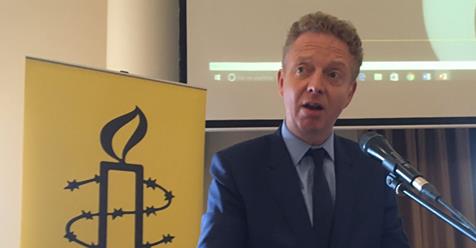
Dr Alex Allinson called the reforms a ‘major step forward’ Amnesty International in Northern Ireland/Twitter
Abortion is set to be decriminalised on the Isle of Man as part of a radical reform.
The changes are set to turn the self-governing crown dependency, where abortion is currently only allowed in very limited circumstances, into one of the world’s most progressive places for reproductive rights.
The legislation, which will make the laws even more relaxed than in England and Wales, will allow abortion up to 14 weeks on request, up to 24 weeks in cases of foetal anomaly or serious social reasons, and after 24 weeks in rare circumstances where the life of the mother or baby is at risk.
Counselling must be offered before and after the procedure, and a clause allows medical professionals to not deliver treatment if it clashes with their personal views.
The move follows a consultation on The Abortion Reform Bill which received more responses than any other on the island, with more than 3,600 respondents giving feedback.
Alex Allinson, the politician elected after placing the issue at the centre of his manifesto, said the aim of the reforms is to take abortion “out of the realm of the criminal justice system” and make it available “on request” to women in a broad range of circumstances.
The former GP said decriminalising abortion would free up midwives from “not constantly having to look over their shoulder”, allowing them to “look forward and provide decent services”.
He called the reforms a “major step forward”.
“What we’re doing is making it legal and firmly putting it in terms of women’s healthcare,” he said.
“And I think that’s very, very important, that women are actually empowered to be part of the system that supplies their healthcare.
“This is the first move to break down some of the stigma about abortion, to try to get rid of the shame some women feel, either making the decision or afterwards, which can affect their mental health, so it’s more than symbolism, this is a really positive step forward.”
In England and Wales, abortion is legal on a wide range of grounds but not decriminalised entirely.
Dr Allinson said the move on the Isle of Man and “will hopefully lead the way” with regard to the Irish referendum and other countries considering reform.
Last Friday’s release of the U.S. Department of State’s annual Country Reports on Human Rights Practices has a gaping hole: the “Reproductive Rights” section has disappeared. This section was previously included for each one of the 195 countries covered by this comprehensive assessment of the state of human rights around the world With his confirmation now settled, Secretary of State Pompeo should understand — and reverse — his predecessor’s dramatic about-face in U.S. efforts to protect the rights of women.
The country reports form a critical body of evidence for capturing human rights conditions. They provide narrative evidence of compliance with human rights norms — an established part of international law — incorporating rights to free press, association, religion, fair trials and conditions of confinement, as well freedom from racial, ethnic and gender-based discrimination.
The reports shed light on abuses and help human rights bodies, lawmakers and civil society address violations with direct intervention, sanctions, or other corrective means. For example, their documentation of forced military conscription of children as young as eight years old contributed to the 2007 passage of the Child Soldiers Prevention Act, which denies U.S. support to countries who continue this brutal practice.
Included in past reports was documentation of violations of women’s reproductive rights such as high rates of maternal mortality and limited availability of contraception. Moreover, last year’s country reports covered the harsh penal consequences of criminal abortion laws for women in El Salvador and Uganda and the denial of medical care to Filipino womensuffering complications from unsafe abortion. In the just-released reports, the “Reproductive Rights” section has been eliminated altogether. Instead, the only reporting on women’s human rights with respect to reproduction is a section labelled “Coercion in Population Control.”
Without question, coerced abortion and sterilization are human rights abuses that must be denounced. So too should other affronts to women’s human dignity and ability to control their bodies and their lives. Gone from this year’s reports are government restrictions on contraceptive methods and instances of women criminalized for ending a pregnancy. Rates of largely preventable maternal mortality are absent as well, though the reports do link to an outdated World Health Organization white paper. Taken in total, these changes materially overhaul what the United States monitors on women’s rights and sends an unmistakable signal that some lives are not entitled to equal treatment and respect.
These much-diminished reports will undermine efforts by international actors to hold nations accountable and intervene on behalf of vulnerable populations. They reveal that the U.S. no longer stands among the nations of the world which recognize women’s rights as human rights, giving tacit support to countries with deplorable human rights records.
Under this administration, the U.S. record of protecting women’s human rights within its borders merits little more than a C-minus. Now, the failure to monitor these violations overseas erases the realities of women’s lives and marks the next step in a systematic retreat by the U.S. on gender equality at home and abroad.
Reproductive rights are internationally recognized human rights. It is imperative that the State Department monitors all human rights, including those most deeply affecting women. Human rights in general — and reproductive rights in particular — are not spoils in a political contest. They are established legal obligations under international law which protect individuals all over the world from discrimination, violence, injury and death.
Failure to collect evidence of violations to reproductive rights aligns with the administration’s scornful treatment of women, survivors of sexual violence and abuse and, increasingly, the very large world beyond U.S. borders.
Sen. Maggie Hassan questioned a Trump administration official about a decision to force unaccompanied immigrant minors to seek permission from Office of Refugee Resettlement Director Scott Lloyd before they can have an abortion.
Hassan repeatedly questioned Wagner about whether ORR was following the recent court order that prevents the government from blocking young people in ORR custody from accessing abortion. Chip Somodevilla/Getty Images
The failings of the Office of Refugee Resettlement (ORR) were highlighted Thursday during a congressional hearing, including an outright lie concerning the agency’s policy on abortion care for immigrants.
U.S. Sen. Margaret Hassan (D-NH) addressed Steven Wagner, acting assistant secretary of the Administration for Children and Families, which like ORR, is overseen by the Department of Health and Human Services (HHS). Hassan said she was concerned about Scott Lloyd, the ORR director who has blocked “young women from their constitutionally protected health care and privacy.”
Many of Lloyd’s colleagues have defended him in light of disturbing revelations, including receiving a weekly spreadsheet containing information on every pregnant teen in ORR’s custody. The spreadsheet tracks gestational age and whether the young person has asked for abortion care. Lloyd has traveled to meet with pregnant people in ORR detention centers to coerce them out of accessing abortion care; he’s denied seven young, undocumented women’s requests for abortion—even when the pregnancy resulted from rape, which is a violation of federal law; he has disobeyed court orders to not tell a young woman’s parents about her decision to obtain an abortion, which put her safety at risk; he has ordered that all pregnant people in ORR custody be given anti-abortion counseling; and asked officials to look into “reversing” a medication abortion.
When Hassan asked Wagner if he was aware of Lloyd’s use of spreadsheets to track the pregnancies of young people in ORR custody, Wagner sidestepped the question and cited a 2008 HHS Policy outlining how “serious medical services” that “may threaten the life of” an unaccompanied immigrant child require “heightened ORR involvement.” Despite being safer than giving birth, abortion care is listed in the policy as a serious medical service. Wagner was implying that the policy requiring approval from the ORR director to access abortion care has nothing to do with Lloyd and goes back a decade.
That is a lie, as Hassan told Wagner. Prior to the March 2017 HHS policy under Lloyd, the approval of the ORR director was not required to access abortion care while in ORR custody. It should be noted that nothing in Lloyd’s background indicates he is qualified or equipped to lead ORR or to “counsel” pregnant people in ORR custody against seeking abortion care, which he admitted to doing when speaking to the Christian Broadcasting Network.
Dawn Laguens, executive vice president of the Planned Parenthood Federation of America, said in a statement that HHS officials are pretending they didn’t create a new policy regarding access to abortion care. “Blocking undocumented women from accessing safe, legal abortion is the new policy of HHS under the Trump-Pence administration,” Laguens said. HHS “Sec. [Alex] Azar needs to immediately fire Scott Lloyd as Director of the ORR and reverse HHS’ unconstitutional policy.”
Hassan repeatedly questioned Wagner about whether ORR was following the recent court order that prevents the government from blocking young people in ORR custody from accessing abortion. While Wagner clarified they are appealing the order, he assured Hassan the court order was being followed. However, a conservative publication reported this week that a faith-based shelter in Texas that contracts with ORR is refusing to tell unaccompanied immigrant minors in its care that they have the right to access abortion care, a violation of the court order.
Lloyd is said by advocates to be ushering in a wave of “anti-choice fanaticism” into the U.S. immigration system, first illustrated by the case of Jane Doe, a pregnant unaccompanied immigrant teen in ORR custody who was essentially “held hostage” for wanting to access abortion care.
ORR’s revised policy “allows [shelters] to wield an unconstitutional veto power over unaccompanied immigrant minors’ access to abortion,” according to court documents. This directive explicitly prevented unaccompanied immigrant minors in their care from obtaining abortions by prohibiting federally funded shelters from taking “‘any action that facilitates’ abortion access to unaccompanied minors in their care without ‘direction and approval’” from Lloyd.
After a lengthy legal battle, Doe, the Salvadoran minor, was able to receive abortion care, but similar cases emerged in the following months.
The intent of the U.S. Senate Permanent Subcommittee on Investigations’ hearing was to shed light on ORR and the Department of Homeland Security’s (DHS) efforts to protect unaccompanied immigrant minors from abuse, efforts that have made little progress.
ORR has some serious problems to contend with, including the agency’s failure to keep track of children it releases to sponsors, with nearly 1,500 children going missing in a three-month period last year.
Sen. Rob Portman (R-OH), chairman of the subcommittee, began the hearing with the story of eight unaccompanied immigrant minors who, in 2015, migrated to the US with the help of human traffickers. These young people were picked up by DHS, transferred to ORR custody, and promptly released back into the custody of the human traffickers, whom ORR failed to vet and allowed to be sponsors of the children.
“The traffickers took them to an egg farm in Marion, Ohio, where the children lived in squalid conditions and were forced to work 12 hours a day, six days a week, for more than a year. The traffickers threatened the children and their families with physical harm—and even death—if the children didn’t work,” Portman said.
The situation lead to an investigation by the subcommittee and at a January 2016 congressional hearing, HHS committed to clarifying DHS and HHS responsibilities for protecting children in their care. The agencies said they would enter into a detailed “Joint Concept of Operations” (JCO) that would outline the agencies’ plan for addressing issues of safety for unaccompanied immigrant minors. The deadline for the JCO was February 2017. As of April 2018, no JCO exists.
The New York Timesrecently reported that the Trump administration has moved forward with its policy of separating children from their parents at the border, meaning ORR has taken custody from parents of approximately 700 children, including more than 100 who were younger than 4, despite the children having migrated with their parent.
These centers, aimed at convincing “abortion-minded” women to continue their pregnancies, purchase videos from the “Earn While You Learn” program with federal funds intended to address maternal health and infant mortality.
Woven throughout the “Earn While You Learn” content is evidence of another purpose: to push people to carry their pregnancies to term. EWYL
Texas has seen some of the nation’s most regressive abortion restrictions in recent years. This series chronicles the fall-out of those laws, and the litigation that has followed.
This is not your typical parenting video.
A glowing, pink fetus hurtles through a tunnel of purple and blue dots, as dubstep pulses in the background. White font spells out the title: “Bonding With Your Unborn Baby.”
A young woman appears against a backdrop of stars. She offers to take us on a journey, to reveal how “even before birth, we are uniquely connected to our tiny, unborn babies.”
“She’s not just a mass of tissues growing into what will eventually become a baby, she IS a baby,” the narrator says. “And as she’s knit so intricately together, so is her personhood.”
Then the video’s agenda comes into even sharper focus.
“Around 18 weeks, your baby begins producing the same hormones found in adults, including cortisol, which is released when she feels pain or stress,” the narrator says.
That’s long before a fetus can actually feel pain.
This video is part of a curriculum designed for fake clinics, or crisis pregnancy centers, whose primary purpose is to convince “abortion-minded” clients to carry their pregnancies to term. In North Carolina, a Rewire.News investigation found, these centers purchase videos like it with federal funds intended to address maternal health and infant mortality. In exchange for watching them and completing worksheets, women earn points they can redeem for necessities like diapers and car seats.
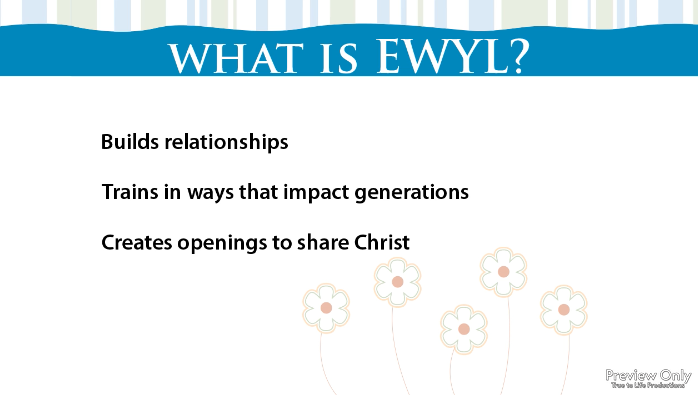
The program, called “Earn While You Learn,” is used by as many as 2,000 centers nationwide, its founder, Dinah Monahan, told Rewire.News. In an introductory video on the program’s website, Monahan says her model is aimed at combating the “entitlement mentality”—while helping anti-choice centers expand their ministry and create openings to “share Christ.”
For the past several years, the North Carolina state legislature has directed a portion of its federal Maternal and Child Health block grant to the Carolina Pregnancy Care Fellowship (CPCF), an umbrella group of anti-choice centers; that allotment is $400,000 annually for the current fiscal year and next.
Records show anti-choice centers subcontracted by CPCF have, since at least the 2015 budget year, used a portion of these funds to buy Earn While You Learn (EWYL) materials and incentives for those who complete them, with plans to buy more next year. The documents also reveal that centers, with approval from state regulators, purchased religious materials with federal funds, including DVDs intended to help men “discover authentic manhood as modeled by Jesus Christ.”
“These expenses should not have been approved and this spending is not consistent with federal law,” the North Carolina Department of Health and Human Services (DHHS) said in a statement, after Rewire.News brought these purchases to the agency’s attention. “We are strengthening oversight of this program and exploring repayment options.”
CPCF is made up of “faith-based” centers that are expected to abide by “biblical principles,” according to its bylaws.
DHHS said it has approved the use of federal funds for the EWYL program’s main and Spanish curricula, because the material focuses on prenatal education and the first year of life. Indeed, the main curriculum, with a price tag around $3,000, includes lessons on vaccines, infant hygiene, DIY maternity wear, the impact of pregnancy hormones on emotions, and the dangers of smoking while pregnant. But woven throughout the content is evidence of another purpose: to push people to carry their pregnancies to term. The goal is made plain in the program’s Best Practices booklet.
“When counselors are working to convince clients that the baby is alive, the fears of the future also need to be addressed,” the booklet reads. “EWYL gives answers to those fears. The ‘I can’t be a mother’ [fear] can be answered with, ‘We can help you learn how.’”
In an interview with Rewire.News, Monahan said the curriculum is based on science.
“It’s not from a pro-life perspective, other than the fact that we believe that the unborn baby is a human being from conception, and in believing that, we address it as such,” Monahan said.
Some of the content, however, appears distorted in service of that belief.
Take the video on “The Emotions of Pregnancy,” where the narrator explains that our “pesky fluctuating hormones” may intensify stress about finances, job changes, or relationships. Both this video and “Bonding With Your Unborn Baby” were added to the main curriculum in 2017, according to the EWYL website; the budget records don’t make clear if centers purchased these specific titles.
In an online sample of the video, the narrator acknowledges that up to 23 percent of women experience depression during pregnancy. But she glosses over the circumstances that may cause people to consider abortion—as well as the realities of postpartum mood disorders.
“While circumstances may not change, the life developing within you brings hope,” she says. “Even though some women face difficult circumstances in unplanned pregnancies, and may feel negative about their pregnancies, it is very rare that these negative feelings continue after the birth of their babies.”
“Many of the Women … Are Very Effective at Manipulating”
The Earn While You Learn program is intended for people who have already chosen to continue their pregnancies, and is meant to avoid a “handout system” for clients, most of whom are low-income, Bobbie Meyer, state director of CPCF, told Rewire.News in an interview.
“Many of the women have been brought up in a home, in a culture, where you just try and get everything you can and they are very effective at manipulating and being users,” Meyer said. “In earning points, she is learning how to work for things, and they feel good because they’re the ones that are doing something to get things for their baby.”
The information can “replace unhealthy generational family patterns” on topics like healthy eating and the importance of prenatal care, CPCF says in reports to the state.
Reproductive justice advocates say this language is rooted in stereotypes about poor parenting.
“That all comes out of racist and racially biased theories around poverty,” Laurie Bertram Roberts, co-founder and executive director of the Mississippi Reproductive Freedom Fund, told Rewire.News.
Meyer rebuffed these claims about the language.
“‘Generational family patterns’ exist in many demographics,” she wrote to Rewire.News.
Bertram Roberts says her group gives out diapers, but does not make people sit through videos first.
“I’m not going to withhold things you need until you meet some arbitrary goal because I don’t feel like you’re a worthy poor person until you do,” Bertram Roberts said. “I mean, the whole concept of Earn While You Learn is offensive to me.”
North Carolina experts say the model may also be ineffective—as efforts to place conditions on welfareshow.
“There just isn’t a lot of data to show that [adding requirements] helps people in the long term,” Whitney Tucker, research director of NC Child, told Rewire.News. “The more we try to put these strings on people’s basic needs, the more we’re just creating additional toxic stress in the lives of families that are already struggling to make ends meet in the state.”
North Carolina is ranked 39th in the nation in infant mortality. Black infants in the state are nearly three times more likely than white infants to die before their first birthday. Reproductive health advocates say every dollar of federal funds to address this crisis should go to evidence-based programs, not those with an anti-choice agenda.
“This is a diversion of funds for programs that we don’t know are actually providing any kind of benefit,” Tara Romano, executive director of NARAL Pro-Choice North Carolina, told Rewire.News.
North Carolina Democratic state Rep. Deb Butler echoed these concerns.
“It is unconscionable to try and manipulate someone in their most vulnerable moment and to give them information that is so biased and clearly one-sided and in many cases probably wholly inaccurate,” said Butler, who, last year, unsuccessfully tried to redirect North Carolina’s funding of crisis pregnancy centers to addiction treatment. Instead, the Republican-dominated legislature gave CPCF $2.6 million in state funds over a two-year period, much of it for ultrasound equipment.
When Rewire.News outlined our findings about Earn While You Learn, Butler was outraged.
“It’s also unkind,” Butler continued, “in the sense that a person comes to an organization looking for help, and in order to get the help they have to jump through hoops … [that] may violate their own religious beliefs.”
“Mommy Money” and “Daddy Dollars”
Dinah Monahan cites the “ingratitude” of women as a catalyst for Earn While You Learn. When she launched the program about two decades ago at a crisis pregnancy center in Arizona, the “girls” would complain they didn’t like or need the things the counselors gave them for free, she says, in the introductory video.
“The girls were doing exactly what they knew how to do in this entitlement society that we have,” Monahan continues. “Earn While You Learn was designed from the beginning to shift the paradigm for a generation that has grown up on handouts.”
And it has shifted the paradigm, Monahan told Rewire.News.
“You almost don’t find centers who give away stuff [for free] anymore,” Monahan said. “It’s rare.”
Most centers don’t use public money for the programs, either—at least according to Monahan.
“There’s an old saying, ‘with shekels come shackles,’” she told Rewire.News. “Most centers use the private sector, churches … businessmen, corporations, lots of charitable giving to fund this program, and of course businessmen love it, because of the earning aspect of it.”
In the video, Monahan recounts how she started writing lessons and sitting down with women one-on-one. The women earned pink “Mommy Money.” When men unexpectedly showed up, they got blue “Daddy Dollars” (the program’s website suggests keeping a closet for dads stashed with tools and sporting goods).
Earn While You Learn is distributed by the anti-choice business Heritage House ‘76, founded by Monahan’s parents and now run by her son, Brandon. While sections of the curriculum have been upgraded, some still appear to be based on Monahan’s personal opinions.
“What young women want from a guy is not sex,” she writes, in a lesson intended to teach teenagers about the “emotional damage” of sexual activity. “Consistently, when I asked girls what they wanted in a relationship with a guy, it was someone to talk to, someone whom they could be honest with, someone who would value their ideas, someone who would accept them just the way they were. Never, not one time in 20 years, has a girl answered that she wanted sex.”
“I didn’t know they still used that,” Monahan said, when Rewire.News asked her about that lesson, which is highlighted on the EWYL website as a sample from the Life Skills supplement. “It’s still true,” she added.
DHHS confirmed the Life Skills supplement has been approved for purchase with federal funds.
A Violation of Federal Law
Monahan’s vision for the program is to help centers forge bonds with “abortion-minded” clients, who then act as “missionaries” by bringing in other members of the “abortion-vulnerable population.”
It is also meant to create openings to “share Christ.”
This was the case for Jasmine Edwards, a client of the Pregnancy Resource Center of Statesville, which receives federal funds. Edwards said her counselor there helped bring her back into contact with religion, encouraging her to pray about her challenges with food insecurity.
“She prayed with me every single day,” Edwards told Rewire.News. “And I prayed about it, and I’m telling you, it was beautiful.”
Edwards and another Statesville client, Danielle Redfield, said they could earn points not just for parenting lessons, but for going to doctor’s visits, writing Facebook reviews for the center, or attending Bible study or church.
Bobbie Meyer said counselors ask for permission before praying with clients.
“We are Christian organizations,” Meyer said. “For us, that is an important piece of who we are, as individuals … but we’re not into forcing anybody else in that direction. We might encourage, but not force.”
There’s no question that crisis pregnancy centers in North Carolina fulfill a need for some clients.
When Redfield’s food stamps were cut off and her fiancé lost his job, she called her counselor.
“She’d let us come up there and get whatever we needed,” she said. “They’re very nice about [it], even if you don’t have extra points to get the stuff.”
Recent budget records show the centers have planned to spend tens of thousands of dollars in federal funds annually on incentives, including diapers, car seats, formula, cribs, baby bouncers, and $5 Walmart gift cards.
But the fact that clients could earn these materials by attending church appears to violate the constitutional separation of church and state, because the government is effectively rewarding people for worship, Robert Tuttle, a professor of law and religion at George Washington University, told Rewire.News.
Meyer called such objections “stretching the separation of church and state to an extreme.”
The current contract between the Carolina Pregnancy Care Fellowship and DHHS includes language noting that faith-based organizations cannot use “direct Federal financial assistance” to support “explicitly religious activities,” including religious instruction and proselytizing. Meyer said religious materials were not purchased this year.
A document from last year’s contract period shows CPCF reallocated $900 of federal funding to purchase three copies of “The Quest for Authentic Manhood,” a program intended to help men “discover authentic manhood as modeled by Jesus Christ and as directed by the Word of God.”
It’s part of a series called Men’s Fraternity, created in a church.
Meyer initially told Rewire.News the fellowship did not buy those DVDs, but after we sent her the document, she confirmed the materials were purchased. She said the decision to buy them had been based on a promotional blurb from Heritage House ’76 about how the program helps men “embrace authentic manhood on a journey to become who God intends them to be.”
“Yes, the word God appears at the very end,” Meyer wrote in an email to Rewire.News. “I did not notice it at the time.”
Meyer also said that in the same budget year, the Tri-County Pregnancy Center in Burnsville had purchased materials from another Men’s Fraternity program called “33 the Series.” DHHS confirmed these materials were approved and should not have been.
In a trailer for the series, described as “a journey to authentic manhood as modeled by Jesus in his 33 years on earth,” the words “Authentic Manhood” flash against a background of exposed brick. An apocalyptic score races to a pulse-pounding crescendo. Sparks fly. Surrounded by stacks of logs, pastors in button-up shirts deliver rapid-fire wisdom about fatherhood and Jesus.
This was paid for with federal funds intended for maternal health.
A second federal court has ordered the Trump administration continue funding comprehensive sex-education programming.
HHS neither provided an explanation for the decision to end the grants early nor did it give the plaintiffs or the other grantees any ability to challenge that decision, according to the lawsuits. Laura Segall/AFP/Getty Images
Evidence provided to Congress by state attorneys general and health departments proves that abortion is both extremely safe and highly regulated. Searchable by state.
A federal judge in Washington state has issued a permanent injunctionpreventing the Trump administration from cutting grants to Planned Parenthood that help fund a teen pregnancy prevention program. Tuesday’s decision is the second from a federal court ordering the administration to continue funding the program.
The U.S. Congress in 2010 created the Teen Pregnancy Prevention Program (TPPP) under President Obama to provide funding for organizations working to cut teen pregnancy rates, primarily through comprehensive sex education. The program provides federal grants for evidence-based initiatives targeting underserved communities with high rates of teen pregnancy, including youth of color, youth in foster care, and youth in rural communities, according to the lawsuits.
President Trump’s proposed budget for 2018 called for eliminating TPPP and sought $277 million to extend abstinence education in its place.The administration announced cuts to the program shortly after appointing Valerie Huber to the Office of Assistant Secretary of Health at the Department of Health and Human Services (HHS), the federal agency tasked with administering the grants. Huber is an anti-birth control advocate who was “instrumental” in attempts to push the agency away from evidence-based comprehensive sex education programs and toward abstinence-only-until-marriage programs. Research, however, has found such education to be ineffective and unethical.
The grants for the program were supposed to run through 2020, but in July 2017, HHS notified the recipients of 81 TPPP grants that their funding would be terminated as of June 30, 2018—two years before their projects were set to end—alleging the program was ineffective at reducing teen pregnancy rates.
HHS neither provided an explanation for the decision to end the grants early nor did it give the plaintiffs or the other grantees any ability to challenge that decision, according to the lawsuits.
Advocates sued the administration in February, arguing the cuts were unlawful. On Tuesday the court agreed and ruled that HHS had acted “arbitrarily and capriciously” when it decided to terminate the program two years early.
It noted that “the public interest weighs in favor of Plaintiffs, as [the order] would prevent harm to the community … and prevent loss of data regarding the effectiveness of teen pregnancy prevention.”
The decision means the administration must continue with the grant agreements for the next year.
“The courts confirmed that the Trump-Pence administration’s attempt to impose its ideological agenda on young people is unlawful,” said Dawn Laguens, executive vice president of Planned Parenthood Federation of America, in a statement. “Planned Parenthood applauds the court’s decision and is proud to continue to serve Americans in the TPPP, along with our partners.”
Tuesday’s ruling follows last week’s announcement by the administration that it would radically remake the science-based TPPP to push ineffective abstinence-only-until-marriage sex education programming.
”The Trump-Pence administration can’t turn back progress, ignore science and the needs of young people, to push its ideological agenda,” said Rachel Todd, director of education for Planned Parenthood of Greater Washington and North Idaho, in a statement following the ruling. “Shifting funds from a wide range of evidence-based programs to focus exclusively on programs that emphasize abstinence-only programs will disproportionately harm young people —including survivors of sexual violence, LGBTQ teens, youth of color, families in rural communities, and youth who already face significant barriers to accessing information or health care.”
Attorneys representing the administration argued HHS had the authority to end the grants at any time.





![[Photo: Juanita Perez Williams against a white background]](https://rewire.news/wp-content/uploads/2018/04/Untitled-1-740x525.png)



![[Photo: Sen. Maggie Hassan speaking during a hearing]](https://rewire.news/wp-content/uploads/2018/04/GettyImages-631929882-740x525.jpg)



 Abortion - Abortion Clinics, Abortion Pill, Abortion Information