In the past week, Dr. Jennifer Conti has seen two patients who would be perfectly screwed if House Republicans had their way.

One, Conti told Vogue, was lied to at a crisis pregnancy center posing as an abortion clinic: told that her pregnancy was 12 weeks along when in fact she was 21 weeks in, and conveniently enough, just three weeks shy of California’s 24-week deadline on legal abortion. Probably, CPC staffers sought to run out the clock and obligate the patient to carry the pregnancy to term, Conti—a clinical assistant professor at Stanford University in obstetrics and gynecology and a fellow with Physicians for Reproductive Health—explained.

The second woman, meanwhile, was in the 23rd week of a pregnancy she wanted very much when doctors diagnosed her with a serious heart condition that will require a transplant. Birthing a child would mean risking her life; she landed in Conti’s office just in the nick of time.

Later abortions are rare but not unheard of. “Whether it’s the life of the mother that’s in danger or the life of the fetus, whether [the patients] just didn’t realize they were pregnant until [they were] further along, or whether it’s other laws that are in place that affect their ability to access care sooner, there are so many reasons why women might be in a scenario wherein they need to access medically necessary and safe abortion care after 20 weeks,” Conti said, adding: “It’s really not for the politician to decide when that is.”

And yet politicians keep on trying. The latest effort comes Tuesday, when the House of Representatives votes on a bill that would not only ban abortion nationwide, 20 weeks after fertilization, but also criminalize procedures performed thereafter, with exceptions for instances where the life of the mother is at risk and in cases involving rape or incest. A direct challenge to the terms established by Roe v. Wade—abortion is legal until the fetus is viable outside the womb, a phenomenon medical professionals generally agree occurs around the 24th week of pregnancy—the so-called Pain-Capable Unborn Child Protection Act, or H.R. 36, isn’t likely to pass a Senate vote even if it does advance. (Similar bills failed in both 2013 and 2015.)

But these are different times—a whirlwind nine months that have seen the Global Gag Rule reinstated, Congress attempt to codify the abortion-restrictive Hyde Amendment, and President Trump take aim at Planned Parenthood, among many other calamities—and regardless of its outcome, H.R. 36 should set a field full of red flags waving for any woman concerned about her uterine autonomy. The constant attacks lobbed at reproductive rights speak volumes about the way Republican legislators view women.

Emboldened as antichoice lobbyists are by the rabidly antichoice “A-Team”occupying the White House, it probably shouldn’t surprise anyone to see this particular brand of abortion legislation creep from statehouses to Capitol Hill. In the first quarter of 2017 alone, state legislatures introduced 431 abortion restrictions nationwide. Currently, 17 states bar abortion 20 weeks after fertilization, a legislative maneuver without scientific basis. While medical advancements occasionally mean that a fetus as young as 22 weeks can potentially survive outside the womb—provided doctors intervene immediately and maintain intensive, extended care, and then only with odds so slim that many doctors wouldn’t try—a fetus any younger than that cannot. There’s no gray area.

When Vogue asked what purpose a medically arbitrary 20-week limit on women’s gestation serves, Susan B. Anthony List—an antiabortion group backing H.R. 36—replied that “the Pain-Capable Unborn Child Protection Act protects babies starting at 20 weeks post-fertilization, or 22 weeks gestation,” and insisting that “this legislation is meant specifically to address the humanity of the unborn child in the womb on the scientific truth point that they can feel pain, not whether they are viable.”

Speaking to Rewire, however, SBA president Marjorie Dannenfelser said that while securing the president’s signature was one end, a more immediate aim “is to make sure there is a very high-level public conversation” and to capitalize on the Democratic Party’s demonstrated unwillingness to treat support for abortion rights as a litmus test.

Dannenfelser, it seems, hopes to exploit her opponent’s weakness before the midterm elections, while also lending some legitimacy to misinformation beloved of the antiabortion right: that fetuses can feel pain as early as 20 weeks, when in reality, the neural pathways that allow them to do so don’t develop until around the 28th week of gestation. That’s one aspect of H.R. 36 that worries Conti.

“The really divisive and sneaky thing about this is that, on the surface, it looks like something that’s designed to protect women, and that’s not an accident,” she said. “You’ll see a lot of these bills framed in a way where, if you haven’t done research into this topic, or you haven’t sat down with a family going through this scenario, you might think, Well, that’s actually a good thing—is there a gestational age at which we need to stop [performing abortions]?”

Seeing 20 weeks touted, again and again, as that gestational age could change people’s opinions, with brutal consequences for women.

According to the Guttmacher Institute, the vast majority of abortions occur in the first trimester (weeks one to 13): Just 9 percent are performed after 14 weeks, and 1 percent at or after 21 weeks. The women who make up that 10 percent typically face some kind of hardship. Some, like Conti’s patient with a heart condition, are people for whom pregnancy poses a grave health threat; others are the same groups continually disenfranchised by our nation’s health-care system.

“It’s going to be young people, it’s going to be women of color, low-income women, and immigrant women,” Dr. Jamila Perritt—vice chair for Advocates for Youth’s Board of Directors, a fellowship-trained obstetrician and gynecologist, and a fellow with Physicians for Reproductive Health—told Vogue, ticking off H.R. 36’s prospective casualties. As Perritt noted, these women don’t necessarily get to have abortions precisely when they want them, thanks to an accumulation of hurdles (mostly) white, male legislators place in their way.

Consider the timeline: A woman might not realize she’s pregnant until she’s missed a period or two. Best-case scenario, she’ll make the discovery while she’s still in her first trimester and manage to book an appointment before the cost of the procedure—typically around $500— slides up to second-trimester rates, which can run into the thousands. And best-case scenario, she’ll have saved up enough money to be able to afford that emergency expense—although in a country where 69 percent of adults have less than $1,000 in savings, that’s an unlikely proposition.

The scramble to raise funds for an abortion often forces low-income women into second-trimester procedures, their difficulty compounded by a slew of hidden costs: dwindling clinic numbers mean traveling longer distances to get abortions, and enduring longer wait times for appointments. They mean securing and paying for child care (in 2014, 59 percent of abortion patients were already parents); locking in transportation or finding someone to drive, quite possibly across state lines; forgoing pay to take time off work not just for the procedure, but also for the counseling many states deem mandatory a day, or two days, or three days in advance. This logistical nightmare takes time to resolve, potentially more than 20 weeks. Legislators know this—they designed the bureaucratic puzzle that way. And according to Perritt, that willful ignorance betrays a more sinister motivation.

“Politicians who claim to truly care about women’s health and their well-being really should focus on policies that advance healthy pregnancies,” Perritt said. They should focus on policies that expand access to things like contraception, especially for low-income communities. But that’s the opposite of what congressional Republicans have done under Trump.

The most obvious piece of evidence here is the GOP’s Affordable Care Act repeal, every iteration of which—from Paul Ryan’s failed American Health Care Act to Mitch McConnell’s thwarted carbon copy to the Graham-Cassidy iteration that Planned Parenthood blasted as going “even further to devastate women and families” than its predecessors did—has portended particular doom for uterus-havers and children alike. Consistent themes were gutting Medicaid; making abortion harder to finance; shuttering Planned Parenthood and blocking access to preventative health services for its low-income patients; and imposing roundabout financial penalties on women who’d given birth or had C-sections, all while eliminating the guarantee of insurance coverage for maternal and newborn care.

H.R. 36, Republicans’ most recent effort to torpedo women’s health, follows closely on the heels of the Graham-Cassidy bill’s collapse last week. The timing strikes both Conti and Perritt as suspicious, suggesting that when legislators couldn’t accomplish a task one way, they found another. “Was the impact of all of these previous attempts to undo the ACA really aimed at women’s health?” Conti wondered. The sequence of events heavily suggests a hierarchy of priority.

“I think you’d have to be blind not to see that it’s part of a larger agenda,” Perritt agreed. “This is not about health care, it’s not about science; it really is about removing access overall.” We already know what happens when women can’t get the abortions they want; it’s not usually advancement, and indeed that seems to be the point.

https://www.vogue.com/article/house-votes-on-20-week-abortion-ban

It’s certainly not the low-income, people of color, and those who discover serious health problems later in pregnancy.

Just hours after Senate Republicans’ latest effort to gut the Affordable Care Act (ACA) died before a vote, House Majority Leader Kevin McCarthy (R-CA) announced a Tuesday vote on House Resolution 36(HR 36), a bill criminalizing abortion care at the arbitrary 20-week cutoff point.

Research and epidemiological data don’t support the bill. And we would know: We are reproductive health researchers, certified nurse midwives, family and women’s health providers, nurse practitioners, physicians, mental health nurses, and public health advocates.

We also know the toll HR 36 will take. If this bill passes, there will be dramatic effects on individuals who need to access abortion care, especially people of color; the low-income; and those who learn that their pregnancies come with serious, even fatal, health problems for them or their fetuses.

But the “Pain-Capable Unborn Child Protection Act” shows Republicans’ dedication to this kind of abortion ban and also their increasing desperation for a win after devastating failures to repeal Obamacare and before the 2018 elections. Quite simply, they hope to score political points by robbing pregnant people of the ability to make the best medical decisions for themselves.

And all for a bill that’s misleading at best and egregious at worst.

The bill’s very name is misinformation: At its foundation is the claim that a fetus can feel pain at this point in gestation. This is not supported by reliable evidence or respected medical research. A recent systematic review of more than 150 studies about fetal pain found that a fetus’ neurological system is too undeveloped to perceive pain at this random moment chosen by anti-abortion politicians who have pushed similar 20-week bans in many states and previously tried, unsuccessfully, to pass it in the U.S. Congress.

So why do the bill’s sponsors and supporters continue making this claim? Clearly, ideology trumps science here. But also, because they are politicians and not clinical experts, they choose to exploit extremely rare instances when severely premature infants have survived (often at great cost in terms of money and quality of life for them and their families). The authors of this bill incorrectly portray 20-week fetuses as viable, arguing that most could potentially live without significant disability or health complications. Health-care decisions should be based on reality and evidence-based research.

The bill’s sponsors and supporters say it will protect, not harm, families. But that could not be farther from the truth. In fact, HR 36 is antithetical to reproductive justice—a human rights framework developed by Black women and which says individuals have a right to choose when to give birth, terminate pregnancies, and parent—for several important reasons.

People in the United States already face many barriers to accessing safe, legal abortion care. Delays in pregnancy confirmation, insurance coverage bans on abortion care like the Hyde Amendment, and state-required waiting periods and parental-consent laws—along with finding money to cover child care, lost wages, travel, and lodging costs—make obtaining abortion care an increasingly more difficult task. Barriers can take weeks or months to overcome, creating more delays. People of color, those with lower education levels, and those who experience multiple life stressors in the preceding year are more vulnerable to these delays and therefore more likely to suffer the effects of HR 36.

Furthermore, pregnant people in rural and low-income communities are doubly constrained by challenges if they decide to—or are forced to by measures like HR 36—to continue their pregnancy. In addition to the few abortion care providers in this country, the shortage of pregnancy care is a well-documented problem, affecting more than half of the counties in the United States. It is unconscionable to force people to continue pregnancies in a country with one of the highest maternal mortality rates in the developed world, without ensuring the pregnant person has a safe passage.

HR 36 creates a system where some pregnant people won’t be able to access the abortion care they need and will be forced to carry their pregnancy to term. While the bill does include two exceptions (if the pregnant person’s life is in danger and in the case of rape), they are not enough.

These exceptions fail at protecting health of the pregnant person. At what point is death or injury considered “imminent enough” for an abortion to be allowed under this bill? How certain does a provider need to be without risking arrest?

State-level abortion bans with these limited exceptions like HR 36 disproportionately affect families receiving a fetal diagnosis via anatomy ultrasound (traditionally done between 18 and 22 weeks) or amniocentesis, which cannot be done before the second trimester and is the “gold standard” for chromosomal disorder diagnosis. Although often touted as “protecting” people with disabilities, these bans do nothing to address very real challenges an ableist society creates for these same people. Indeed, many of the bill’s sponsors, including Rep. Trent Franks (R-AZ), voted in favor of repealing the Affordable Care Act (ACA), which gave vital coverage to people with pre-existing conditions, including disabilities.

Finally, bans like HR 36 are unconstitutional. The U.S. Supreme Court made its stance clear in 2014 when it declined to hear Arizona’s appeal of a Ninth U.S. Circuit Court of Appeals decision that struck down a state ban similar to HR 36. Unfortunately, anti-choice politicians continue to ignore the U.S. Constitution.

If HR 36 becomes law, it signifies the same irresponsible disregard for improving and protecting access to health care that these same politicians have shown when pushing their multiple versions of Trumpcare. The brunt of these restricted choices will fall most heavily on marginalized women of color, the poor, and people struggling with difficult health news or conditions.

If the bill’s sponsors and supporters are really worried about what causes pain, they need to look no further than their own proposed bill.

https://rewire.news/article/2017/10/02/pain-capable-unborn-child-protection-act-protecting/

The decision in Florida is one of several wins for reproductive rights activists in recent weeks.

The law, which was signed by Gov. Rick Scott last year, would have required abortion “advisers” to pay a $200 fee and offer a “full and complete” definition of abortion and its benefits and drawbacks. What that definition needed to include was not made clear under the law.

“This case presents a challenge to a state law that (1) imposes a content- and viewpoint-based requirement to register and pay a fee to engage in speech protected by the First Amendment and (2) makes it a crime not to simultaneously engage in compelled speech that the law describes so vaguely that even the state’s Attorney General does not know what is required,” Judge Robert L. Hinkle explained upon granting the preliminary injunction Friday.

The decision is a win for the group that challenged the law, which included the American Civil Liberties Union, a minister, two rabbis, and the Palm Beach chapter of the National Organization for Women. Hinkle said he issued the injunction because the group challenging the law would likely succeed at trial.

The state argued that the group had not been harmed by the law, that the law wasn’t being enforced, and that there was no penalty for not registering.

Hinkle, when issuing the injunction, called provision “hopelessly vague.”

“A woman’s trusted advisors, whom she turns to for personal and private conversations when considering abortion, should be free to provide compassionate support without the threat of criminal charges,” Talcott Camp, deputy director of the ACLU’s Reproductive Freedom Project, said in a statement. “We are very pleased that the court has blocked these dangerous requirements from causing further harm.”

Hinkle’s injunction is the latest in a line of recent victories for reproductive rights and abortion activists at the state level.

Two weeks ago, a federal judge in Indiana blocked an anti-abortion law signed by Vice President Mike Pence, then governor of Indiana, that would have prohibited anyone from seeking an abortion specifically because the fetus may be disabled. Additionally, the law would have required aborted fetuses be buried or cremated and that abortion providers notify patients seeking abortions that doing do because the fetus may be disabled was illegal in the state.

Last week, Illinois Gov. Bruce Rauner, a Republican, also reversed course and announced he would sign into law a bill that will expand taxpayer subsidized abortions for those covered by Medicaid and state employee insurance.

Additionally, on the national level, Senate Republicans conceded last week that their latest attempt to repeal and replace Obamacare, which would have defunded Planned Parenthood, did not have the votes and would not come to the floor.

https://thinkprogress.org/florida-abortion-law-5a64f956ff72/

Of the 55.7 million abortions that take place worldwide every year, 25.5 million are unsafe.

Image: Kishivan via Shutterstock

NEARLY HALF OF all abortions that happen around the world every year are unsafe, a new study estimates.

Every year, of the 55.7 million abortions that take place worldwide, 25.5 million are unsafe, according to the study published in The Lancet.

The vast majority of these (97%) are taking place in Africa, Asia and Latin America.

In the study, the authors classified abortion safety as safe, less safe and least safe.

Globally, around 55% of all abortions (30.6 million each year between 2010 and 2014) were safe, meaning they were done through a medical abortion, vacuum aspiration, or dilatation and evacuation, and were provided or supported by a trained individual. All of these methods have been recommended by the World Health Organisation (WHO).

Meanwhile, 30.7% of all abortions (12.1 million) were put into the less safe category. These were abortions that were done by a trained provider but with an outdated method, or it was done with a safe method without the support of a trained person.

A stark 14.4% (8 million) were classified as least safe. These were provided by untrained individuals using dangerous or invasive methods.

Around the world

About 87% of all abortions in developed countries were safe.

The exception was Eastern Europe, where the proportion of unsafe abortions was slightly higher at 14.2%, compared to 6.5% in Western Europe.

Eastern Asia had similar safety statistics to Europe and North America.

Less than 25% of abortions in most regions of Africa and Latin America were considered safe.

The vast majority of unsafe abortions in Africa were considered least safe and were associated with higher death rates. The study suggests this is likely linked to serious complications and poor health infrastructure.

Restrictive laws

Differing laws around the world had an impact on abortion safety in different jurisdictions, according to the study.

It suggested that countries with high proportions of safe abortions were more likely to have less restrictive laws, which might provide a more accommodating environment for trained professionals and access to safe methods.

In the 57 countries where abortion was available on request, 87.4% of all abortions were safe, compared with 25.2% in the 62 countries where abortion was banned or allowed only to save a woman’s life or to preserve her physical health.

In countries with restrictive laws, 31.3% of abortions were considered least safe.

“Our findings call for the need to ensure access to safe abortions to the full extent of the law, particularly in low-income regions of the world, and efforts are needed to replace the use of unsafe methods with safe methods,” Bela Ganatra, lead author of the study said.

Increasing the availability, accessibility and affordability of contraception can reduce the incidence of unintended pregnancies, and therefore, abortions, but it is essential to combine this strategy with interventions to ensure access to safe abortions.

Ireland’s current stance

In April of this year, the Citizens’ Assembly voted to recommend radical changes to Ireland’s abortion regime.

Crucially, its members voted to replace or amend the Eighth Amendment to the Constitution which, except in very limited cases, effectively bans abortion in Ireland.

In its place, the assembly’s members recommended that the Constitution makes it clear that Ireland’s abortion regime should be decided by legislation – worked out by Ireland’s elected public representatives.

The committee has until Christmas to complete its work and deliver a report to the Oireachtas, with a June/July date for a referendum flagged by Taoiseach Leo Varadkar.

In June, the UN Human Rights Committee found that Ireland’s abortion legislation violated the human rights of a woman.

The finding was made in relation to the case of Siobhán Whelan, who was denied an abortion in 2010 after the diagnosis of a fatal foetal abnormality. It echoes the same committee’s June 2016 decision in the case of Amanda Mellet, who traveled to the UK to have a termination. In November, the State offered to pay her €30,000 in compensation.

The sixth annual March for Choice is set to take in Dublin this Saturday, organised by the Abortion Rights Campaign (ARC).

Yesterday, the campaign said that it will support nothing less than a full repeal.

“We will reserve judgement on the announcement of a stand-alone referendum on the Eighth Amendment until we know the question that will be put to the people of Ireland,” ARC spokesperson Linda Kavanagh said.

http://www.dailyedge.ie/unsafe-abortions-worldwide-3618232-Sep2017/?r_dir_d=1

On Monday, the Global Day of Action for Access to Safe and Legal Abortion, we at Planned Parenthood of the Great Northwest and the Hawaiian Islands (PPGNHI) are reminded that legal abortion is critical to improving maternal health and reducing maternal mortality around the world.

Unsafe abortion is a maternal health crisis in countries where abortion is illegal or difficult to access, leading to 47,000 preventable deaths each year, according to the World Health Organization. Women and adolescents with unplanned pregnancies are risking their lives and health to access what should be a routine procedure. On Monday, the Global Day of Action for Access to Safe and Legal Abortion, we at Planned Parenthood of the Great Northwest and the Hawaiian Islands (PPGNHI) are reminded that legal abortion is critical to improving maternal health and reducing maternal mortality around the world.

Women who lack access to legal abortion are often forced to continue with unwanted pregnancies. Recently in Ireland, a survivor of sexual assault and attempted suicide who was denied the right to a legal abortion was hospitalized in psychiatric care until her baby could be delivered by cesarean section at 26 weeks’ gestation. Last year in Senegal, an 11-year-old rape survivor gave birth to twins and is now unable to continue her education. Her mother, according to reports, asked the Senegalese women lawyers’ association for financial support so the girl could continue her education, but also stressed that the girl would need to switch schools to avoid being bullied.

Without access to legal abortion, women seeking to terminate a pregnancy face dire options, particularly women with limited resources.

Each year there are 85 million unintended pregnancies globally, with 3.4 million in the United States alone, according to the Guttmacher Institute. In most countries, women with financial resources can obtain a safe procedure; however, where abortion is illegal, women without resources risk unsafe methods, such as seeking care from an unqualified provider; self-medicating; drinking toxic fluids; and self-injury. Such abortion procedures lead to 13 percent of global maternal deaths annually, or eight maternal deaths every hour. Millions of women who survive these unsafe procedures suffer serious—if not permanent—injuries.

In addition to the immediate health impacts, unsafe abortion makes a negative impact on society. The Guttmacher Institute reports that unsafe abortion reduces women’s productivity, increasing economic burdens for poor families; causes maternal deaths that leave 220,000 children motherless annually; and creates long-term health problems.

Recent changes in abortion laws in several countries have irrefutably demonstrated that access to legal abortion improves health outcomes. Since legalizing abortion in 2002, Nepal has nearly halved its maternal mortality ratio. In South Africa, the annual number of abortion-related deaths fell by 91 percentafter abortion laws were liberalized in 1997. And a 2005 decriminalization of abortion in Ethiopia has “had a huge impact on saving lives of girls and mothers,” according to Addis Tamire Woldemariam, general director for the Ministry of Health.

In recent months in El Salvador, two local organizations, La Colectiva Feminista para el Desarrollo Local and La Agrupación Ciudadana para la Despenalización del Aborto Terapéutico, Ético y Eugenésico have called for the Salvadoran media and government to cease their public defamation. These actions, including hate speeches by public officials, as well as by non-state actors, such as religious and community leaders, or fundamentalist groups and news outlets, intend to impede their work to advance sexual and reproductive rights as human rights, the organizations say. Abortion is criminalized in all cases in El Salvador, including when the woman’s life or health is at risk, or in cases of rape or incest.

The World Health Organization states that “ending the silent pandemic of unsafe abortion is an urgent public-health and human-rights imperative” and calls safe, legal abortion a “fundamental right of women, irrespective of where they live.”

We know that some of the lowest abortion rates in the world are in countries where safe abortion is legal and available, along with quality family planning services that enable women to prevent unintended pregnancies. Providing contraception to the estimated 222 million women who want to avoid pregnancy in the developing world would decrease the need for abortion services; however, even when quality contraceptive services are widely available, there will always be a need for abortion. Through our global programs, PPGNHI is working to increase access to contraception, provide sexual and reproductive health education, and advocate for sexual and reproductive health and rights.

Next month, PPGNHI is a proud co-sponsor of the Human Right to Family Planning Conference, held October 9-11 at the University of Washington campus in Seattle. This conference is the first of its kind to be sponsored by a U.S. university in collaboration with community organizations and it will explore the relationship between the right to health and family planning, including abortion, and improving universal access—globally and locally.

The numbers and stories are horrifying indeed, and at the same time make a strong argument for legalized abortion. Surveys suggest people can agree on abortions in cases of rape, but why should we stop there? We as a society, from Seattle to Dubai, must eliminate restrictions on a woman’s ability to decide when and if she has children, because no woman should die from an unsafe abortion.

https://rewire.news/article/2015/09/28/illegal-abortion-maternal-health-crisis/

Republican Gov. Bruce Rauner today signed into law a bill that expands Medicaid and state employee insurance to cover abortion and enshrines a woman’s constitutional right to abortion in the state of Illinois. His decision marks the first time in over two decades that a state has voluntarily provided Medicaid-funded abortion care for low-income and disabled women.

HB 40—championed by state Representative Sara Feigenholtz (D) and Senator Heather A. Steans (D) in the legislature—lifts restrictions in state law on Medicaid coverage for abortion, repeals a current “trigger law” put into place in 1975 in the state that would have made abortion illegal if Roe v. Wade was overturned and allows state employees to negotiate for abortion coverage in their health insurance plans. The legislation passed the House in April and the Senate in May, but wasn’t sent to Rauner’s desk until Monday.

“The Governor’s decision is a game-changer in the fight for reproductive justice,” Eleanor Smeal, President of the Feminist Majority, said in a statement today. “It is all the more monumental that this legislation was passed essentially along party lines by a Democratic majority state senate and house, but will now be signed into law by a Republican governor.”

Rauner campaigned on expanding Medicaid coverage to abortion leading up to his 2014 election, declaring that laws restricting Medicaid funds from covering abortion were unfair because they constrained access based on income. His wife, Diana, helped fund a full-page ad during his campaign against Democrat Pat Quinn touting that “both candidates for Illinois Governor… are pro-choice.”

557,000 women of reproductive age are enrolled in Medicaid in Illinois, and so are one-in-five women of reproductive age nationwide. But under the Hyde Amendment—a discriminatory ban on federal funding for abortions in place since 1976—the low-income women, Native American women, disabled women and government employees who rely on Medicaid and other government-funded healthcare programs have been unable to access comprehensive reproductive healthcare. At the federal level, lawmakers are trying to pass the EACH Woman Act to repeal the ban.

Although the Hyde Amendment makes some room for abortion care in cases of life endangerment, rape or incest, women with cancer or other serious illnesses can still be denied funding for the procedure under the law. As it stands, only 14 states—excluding Illinois—provide Medicaid funding for abortion beyond Hyde restrictions. Until today, state employees could be and had been denied coverage for reproductive health care, including for medically necessary abortions, with no exceptions for rape and incest—and a court mandate ruling that Illinois use government funds to cover medically necessary abortions went largely unenforced.

“Governor Rauner demonstrated through his announcement that Medicaid-funded abortions should not be a partisan issue, but rather a matter of economic justice,” Smeal said. “Abortion is not a constitutionally protected right for only wealthy women. Making decisions about what happens to one’s own body is a constitutionally protected right for everyone. Poor women, just like women of greater means, deserve access to comprehensive, constitutionally-protected reproductive healthcare, which includes abortion. Medicaid isn’t supposed to be wielded as a weapon to punish poor women. But that is exactly what it becomes when we use women’s bodies as a battleground for a draconian agenda that the majority of Americans do not support.”

Today marks International Safe Abortion Day, a global day of action for access to safe and legal abortion. In two days, the Hyde Amendment will turn 41. Next week, lawmakers in the House plan to vote on a nationwide 20-week abortion ban. (A 20-week ban is also one of two laws restricting abortion proposed in Illinois this year.) In the midst of a political climate where lawmakers at all levels have been seeking to erode abortion access and attack women’s healthcare, Rauner’s signature on HB 40 sends a firm message—in Illinois and to the entire country—that abortion access shouldn’t be defined by income or location.

“This is a great victory for all women, for reproductive freedom as a human right and for the return of the Republican party to its original tradition of individual rights,” Ms. co-founder Gloria Steinem said in a statement. “I applaud Governor Rauner for his leadership and for putting the state of Illinois into the forefront of human rights.”

http://msmagazine.com/blog/2017/09/28/newsflash-illinois-governor-decide-whether-state-will-fund-abortions/?utm_source=facebook&utm_medium=Social&utm_campaign=SocialWarfare

DUBLIN (Reuters) – Tens of thousands of people marched in Dublin on Saturday to demand the loosening of some of the strictest abortion laws in the world ahead of a 2018 referendum on the issue.

Abortion remains a divisive issue in once stridently Catholic Ireland, where a complete ban on the procedure was only lifted in 2013 to allow terminations in cases where the mother’s life was in danger.

In 2016 over 3,000 Irish women traveled to England for abortions, according to the British Department of Health, but activists say the real number is far higher.

The government has promised to hold a referendum next May or June, but it has yet to decide exactly what question to put to the Irish people.

The human rights arms of the United Nations and Council of Europe have pressed the government to decriminalize abortion and widen the law to allow for the procedure in cases of fatal fetal abnormality, rape or incest.

But pro-choice activists want a more liberal regime, closer to that of England, which allows terminations to be carried out up to 24 weeks after conception. Opinion polls show a large majority of voters want some change.

“Government ministers have suggested only the most restrictive terms will pass, but I think the people want more than that,” said Sarah Murphy, a 26-year-old recruitment professional.

“Ireland is changing. I don’t think you would have seen a march like this a few years ago,” she said.

Like many at the march she was wearing a black jumper with the word Repeal in white, a reference to a campaign to repeal the eighth amendment of the Irish constitution, which gives the unborn child equal rights to those of the mother.

A panel of citizens called together to advise government on the issue voted overwhelmingly that the eighth amendment should be changed.

An all-party committee in parliament is now considering those recommendations and is due to report to parliament by the end of the year.

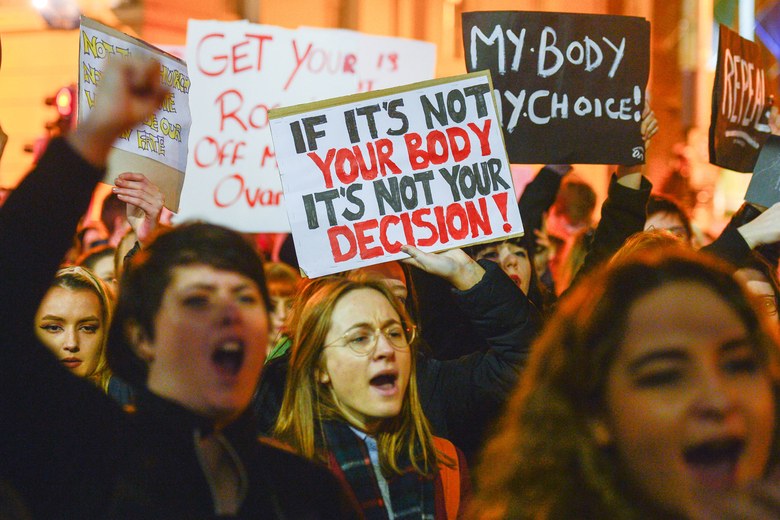
Some of the crowd, which marched across the city before assembling outside the office of Prime Minister Leo Varadkar, chanted “Get your rosaries off our ovaries” in reference to the influence the Catholic Church has long had on social policy in Ireland, while others held posters demanding “Repeal now.”

The growing pro-choice movement is seen as a sign that the Catholic church, which has dominated Irish life for centuries, is continuing to lose influence.

Ireland was the first country to adopt gay marriage by popular vote in 2015, approving it by 62 percent to 38 percent despite the opposition of the church.

https://www.reuters.com/article/us-ireland-abortion/tens-of-thousands-march-for-abortion-rights-in-ireland-idUSKCN1C50LZ

The candidates for the top spot at the Department of Health and Human Services presumably would pick up where Price left off in his quest to blow up the Affordable Care Act’s birth control benefit.

Tom Price, the public health chief who believes “there’s not one” woman who can’t afford birth control, is out at the U.S. Department of Health and Human Services (HHS), as other virulently anti-choice candidates are reportedly in the running to take over the job.

The Trump administration is considering Centers for Medicare and Medicaid Services Administrator (CMS) Seema Verma, U.S. Food and Drug Administration Commissioner Scott Gottlieb, and former Louisiana GOP Gov. Bobby Jindal, according to a Friday morning Axiosreport.

The candidates would presumably pick up where Price left off in his quest to blow up the Affordable Care Act’s popular birth control benefit guaranteeing contraception without co-pay to some 62.4 million cisgender women and an untold number of transgender and gender nonconforming people.

Verma stood by Trump’s side as he signed off on congressional Republicans’ plan to undermine Obama-era Title X safeguards intended to stop state-level interference in the federal funding stream for family planning clinics. A leaked draft obtained by Vox listed CMS as one of the government arms involved in the unraveling of the benefit.

Gottlieb has attempted to stoke fears about the birth control benefit, falsely claiming that under President Obama’s signature health-care law, women “risk losing far more than they’ll gain.” And Jindal falsely claimed the Obama administration limited, rather than expanded, access to birth control, according to a 2012 report by journalist Irin Carmon for Salon. Two years later, Jindal signed an omnibus anti-abortion bill in Louisiana.

By late Friday afternoon, Price tendered his resignation to the White House as the reported price tag for his taxpayer-funded travels exceeded $1 million. Politico first uncovered that Price had taken more than $400,000 worth of charter flights, rather than readily available commercial flights, then found that the outgoing secretary traveled abroad, with the White House’s approval and with his wife by his side, on military jets that cost taxpayers another $500,000–plus. Price offered to reimburse the federal government for a mere fraction of the charter flights only.

Price was a budget hawk during his time in the U.S. Congress. He gave up a plum House Budget Committee chairmanship for the HHS top spot. Charmaine Yoest, the former Americans United for Life president charged with overseeing the agency’s messaging, had the job of defending Price in the news as the scandal unfolded.

With Price’s ouster, Yoest remains one of the most high-profile anti-choice extremists in an agency stacked with officials who tout failed abstinence-only education and distort or deny the scientifically proven efficacy of birth control. Teresa Manning, the notorious birth control foe nevertheless charged with administering Title X funds to ensure people with low incomes can access family planning services, claims that “family planning is something that occurs between a husband and a wife and God” and isn’t a matter for the federal government.

https://rewire.news/article/2017/09/29/price-ouster-isnt-end-anti-choice-hhs-leadership/

On International Safe Abortion Day pro-choice campaigner Tara Flynn explores what it means to be pro choice

Pro-choice campaigner Tara Flynn at the March for Choice, which was organised by the Abortion Rights Campaign, in Dublin city centre. Photograph: Eric Luke/ The Irish Times

Pro-choice campaigner Tara Flynn at the March for Choice, which was organised by the Abortion Rights Campaign, in Dublin city centre. Photograph: Eric Luke/ The Irish Times

I once cried when our old washing machine was taken away. Obviously, I quickly cheered up when I realised the replacement didn’t need a crowbar to unlock it or a bucket at the door when you did prise it open. But we’d always had that old machine and it had somehow managed to do more or less what it was supposed to. Until it didn’t. It was broken, not even good for the clothes. Still, its presence gave me something, I’m not sure what. Stability. Continuity. Change is often frightening, challenging, but there comes a moment when you realise it’s the only way.

Even conversationally broaching the repeal of the Eighth Amendment can cause consternation here in Ireland. I understand: talking openly and frankly about reproductive rights is brand new to us. Personally, I’ve had a lot of reading to do; I realised I didn’t have the facts, even the words. We’re not taught them.

You can be strongly morally opposed to abortion and still be pro choice

Until now, the narrative has been weighted towards only one set of beliefs. It doesn’t help when such a nuanced issue is crudely framed as binary debate, yet the media love of a bunfight (not solely an Irish concern) and multitude of commentators seemingly bent on obfuscation shape it as such. So often, this leads to the wrong question being asked:

“Are you for or against abortion?” It’s a fine question if you’re faced with making the decision. It’s something you should know. But it has no place when talking about other people’s bodies and their right to determine their own lives and futures. That’s none of our business. No two pro-choice people will have the same response to that question. Attitude to abortion is not what makes a person pro choice.

Pro-choice people come from wildly varying backgrounds and positions on when life begins, or whether we’d ever have an abortion ourselves. What unifies us is the firm belief that the pregnant person knows what’s best for them. We trust them. We believe them.

In the two years since I came out about having an abortion, I’ve found most people to be supportive. Even those who find the topic unpleasant will say “That’s your business.” They might not realise it, but they’re pro choice. You can be strongly morally opposed to abortion and still be pro choice. It’s the “that’s your business” part that’s key.

I, for one, wouldn’t want to put grieving families through legal hoops at such a time

That we all need rounded, balanced education on this issue is an understatement. We need to assess what’s already happening in our country and ask more useful questions. Like, why would people ask for later gestational limits, if the mantra is “as early as possible”? (The majority of abortions take place prior to 12 weeks.) Well, the vast majority of later cases are wanted pregnancies gone tragically wrong. I, for one, wouldn’t want to put grieving families through legal hoops at such a time. I’d prefer them to be able to access the appropriate medical care for them. I believe most people would.

Tara Flynn. “Why do we say that the stance that abortion is acceptable only on grounds of rape or incest is not a moderate one?” Photograph: Cyril Byrne/ The Irish Times

Why do we say that the stance that abortion is acceptable only on grounds of rape or incest is not a moderate one? Because the procedure in those cases is the same as for an abortion for any other reason. So it’s not the procedure people oppose; it’s the circumstances under which the person got pregnant, and whether they’re deemed to have suffered enough. That’s quite extreme, when you think about it. Not to mention legally and practically unworkable.

However, asking for broad access, I’m sometimes told, is “scaring people”. That’s what’s scary? What about people being forced to continue pregnancies with which they can’t cope? Or harming themselves? Or risking a 14-year sentence? Or for those lucky enough to have means, being forced to travel for the medical care they need?

It seems, for some, there’s comfort in denial. They may like the idea of Ireland being abortion-free, but it’s not. Nowhere is. Our rates are comparable with countries where it is legal, the only difference is the hardship we inflict on pregnant people trying to access it.

Change can be frightening, but it’s not as frightening as the status quo

And on that point, good news: should the Eighth Amendment be repealed and our laws made more compassionate, the landscape would not change. Rain would still fall. Buses would still arrive two at a time. Washing machines would still break down. If we get safe abortion access here, those who don’t want to think about it can go back to pretending it’s not happening.

There are plenty of questions to be asked about this issue, but only one truly pertinent one: “would you force someone to remain pregnant against their will?” And, if “yes”, “what would you do to enforce that?” I believe most people’s answer is, “that’s your business”. I thank them for their compassion. Change can be frightening, but it’s not as frightening as the status quo.

https://www.irishtimes.com/life-and-style/people/would-you-force-someone-to-stay-pregnant-against-their-will-1.3236840

Flanked by supporters, Gov. Bruce Rauner announces he will sign abortion legislation HB40. | Ashlee Rezin/Sun-Times

Gov. Bruce Rauner on Thursday signed into law a controversial abortion bill — expanding insurance coverage for the procedure and seeking to ensure abortion remains legal in Illinois even if the U.S. Supreme Court overturns Roe v. Wade.

The governor signed the bill minutes after announcing his long-awaited decision on the deeply divisive issue.  His action drew praise from abortion rights supporters and damning indictments from abortion opponents — with one leading GOP legislator saying he no longer supports the governor.

The governor acknowledged  the divide but said he sought to make a decision “consistent with my views”

“I personally am pro-choice. I always have been,” Rauner told reporters. “A woman should have the right to decide.”

Flanked by supporters, including Former Lt. Gov. Corinnne Wood (right), Gov. Bruce Rauner announces he will sign abortion legislation HB40. | Ashlee Rezin/Sun-Times

The governor said he spoke to people on both sides of the issue and sought to find “common ground” between abortion rights supporters and those who want the procedure outlawed.

“We were unable to do that,” Rauner said. “The passions run too deep. As a result, today I am announcing that I am signing House Bill 40.”

Rauner made the announcement at a Thompson Center news conference, flanked by women, including former Lt. Gov. Corinne Wood, an abortion rights supporter who has battled breast cancer.

“I’m here as someone who has been fighting for women’s health issues for decades, and not just women’s health issue across the board but also women’s reproductive health issues,” Wood said. “And I can tell you it is a challenging issue, and that is why today is so important. Because we have a governor who is standing up for the right thing for all the women of Illinois.”

Former Lt. Gov. Corinnne Wood speaks at Thursday’s news conference. Sun-Times Media.

“He’s standing up for women’s health. He’s standing up to putting an end to this partisan bickering.”

The governor has given mixed signals on what he plans to do on the bill, and that was reflected in the reaction to his final decision.

Cardinal Blase Cupich tweeted that “Gov. Rauner has signed into law a very disturbing bill he once promised to veto.”

Rauner’s own lieutenant governor issued a statement saying “as a pro-life Republican” she disagrees with the governor’s decision.

“I wouldn’t be here today if it weren’t for a 15-year-old refugee who chose to have me and keep me,” Lt. Gov. Evelyn Sanguinetti said. “I realize this bill is a political ploy to divide the people of Illinois. While I disagree with the Governor on this, we must focus on our areas of agreement – enacting real reforms we need to turn Illinois around.”

The bill’s chief House sponsor, state Rep. Sara Feigenholtz issued a statement that was far from congratulatory.

“I am grateful that Governor Rauner has finally realized how important this legislation is to women in the current political climate,” the North Side Democrat said. “Governor Rauner has decided to stick to his original promise, and his decision will help ensure women continue to have access to all reproductive care.”

First lady Diana Rauner smiles and applauds from the back of the room as Gov. Bruce Rauner announces he will sign abortion legislation HB40. | Ashlee Rezin/Sun-Times

Republican abortion opponents were even harsher.

House Republican Floor Leader Peter issued a scathing statement, saying he can no longer support the governor because of his failure to stand up to Democratic Speaker Mike Madigan, “badly botch negotiations with the General Assembly on a variety of subjects” and now ‘flat out lies.”

“I’ve heard Rauner promise the people of Illinois that he had ‘no social agenda’ and as such firmly commit to legislators, the public, and even to Chicago’s Cardinal, Blaise Cupich, that he would veto taxpayer funding of abortions,” Breen said.

“But he has now broken that commitment, signing a bill that puts taxpayers on the hook to pay for an expected 20,000-30,000 aborted lives per year. … Now, I’ve come to expect politicians to shade the truth, but what’s clear today is that Rauner’s promises were just flat out lies.”

State Rep. David McSweeney echoed that sentiment.

“Bruce Rauner is a failed Governor who lied to the people of Illinois,” the Barrington Hills Republican said. “On April 14th, he announced that he would veto HB 40. Rauner looked the other way on the 32% increase in the income tax rate, made Illinois a sanctuary state and is primarily responsible for Illinois’ $16 billion backlog of unpaid bills.”

A source who has close knowledge of the legislation said the governor made his final decision Thursday to sign the bill.

The governor participated in meetings with prominent Republicans on Wednesday, but told them they he had not yet made a decision. First lady Diana Rauner was involved in those meetings, the source said.

The governor was sent HB40 on Monday. In April he said he didn’t support one of two parts of the measure and would issue an amendatory veto. But last week Rauner said he was “assessing” the measure and speaking with both proponents and opponents.

Rauner has put himself between a rock and hard place over House Bill 40, which would ensure abortion remains legal in Illinois even if the U.S. Supreme Court overturns Roe v. Wade. It would remove a “trigger provision” in Illinois law that would outlaw abortion if the landmark court decision is overturned.

But The bill would also expand insurance coverage of abortion, allowing women with Medicaid and state-employee health insurance to use their coverage for abortions. And Rauner has said that provision is the deal killer for him.

In April, Rauner said he didn’t support the bill because of “sharp divisions of opinion of taxpayer funding of abortion. ” That prompted the abortion rights organization Personal PAC to release a candidate questionnaire from the 2014 governor’s raceshowing Rauner’s support for abortion rights — including Medicaid funding.

In the questionnaire, Rauner wrote: “I dislike the Illinois law that restricts abortion coverage under the state Medicaid plan and state employees’ health insurance because I believe it unfairly restricts access based on income. I would support a legislative effort to reverse that law.”

But last week, Rauner told reporters he’s “assessing” the bill: “I am meeting with advocates and legislators on both sides, both who support the bill and who are against the bill. And we’re assessing,” Rauner said.

And the governor refused to say which way he is leaning until he sees the bill.

https://chicago.suntimes.com/chicago-politics/rauner-to-announce-decision-thursday-on-abortion-trigger-bill/