Jamie Beers is an administrator for Hartford GYN Center, a health center that provides abortions in Connecticut. In May, a crisis pregnancy center (CPC) — an anti-abortion center that tries to persuade women away from getting abortions — moved into the same complex as Hartford GYN, going by the name Hartford Women’s Center. That CPC is run by St. Gerard’s Center for Life, and as Beers says, “they’ve made it very clear that their intention is to, in their own words, lure abortion-minded women into their center.”
I spoke with Beers about the CPC next door on a phone call in June for Elite Daily. St. Gerard’s Women’s Center had a grand opening in late May, complete with a priest’s blessing. The Hartford GYN Center worries about patients accidentally going to the St. Gerard’s center when they have appointments with Hartford GYN. They are concerned that women will not get the health care services that they need.
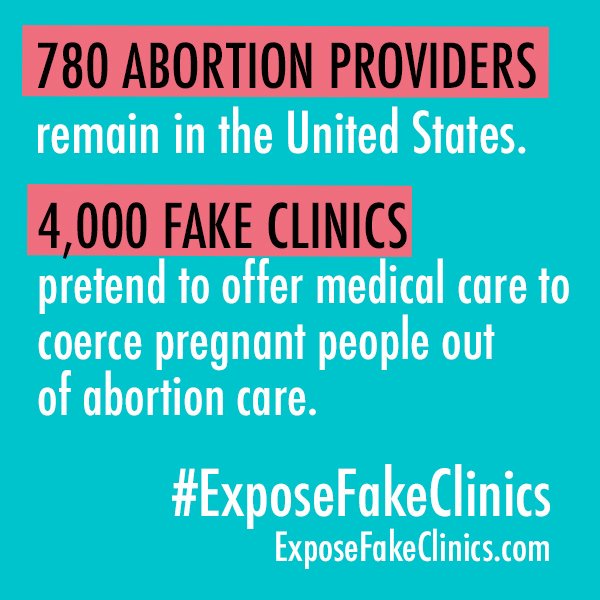
Hartford is just one story; there are thousands of others. Expose Fake Clinics, a national campaign that launched in July, is collecting testimonials about women’s experiences with CPCs and the harm they can cause.
CPCs exist across the country, often near health clinics that offer abortions. They are often run by religious people and work to convince vulnerable pregnant women not to get abortions by offering monetary, emotional, and medical support — which they may not actually be able to provide. A 2006 congressional report noted that 87 percent of CPCs “provided false or misleading information about the health effects of abortion.”
CPCs have been known to use names and signs similar to those of abortion clinics, assumedly to confuse patients into entering. Many CPCs receive funding from local governments, a practice which has been protested, and otherwise get funding from donations. St. Gerard’s gets funding from donations, including church collections.
St. Gerard’s Center for Life has been protesting outside of Hartford GYN for years in attempts to stop women from getting abortions.

Hartford GYN
“They come up holding signs and they talk to patients as they are entering the walkway, coming in for services. They will shame and harass them and they’ll say anything they can to get them to change their mind about seeking services,” Beers explains.
For their part, St. Gerard’s believes they are simply providing options for women who may feel forced to get an abortion by financial or personal circumstance, executive director Leticia Velasquez told me in an interview with Elite Daily in May.
“We know that many of the women walking to Hartford GYN… are feeling under pressure,” Velasquez says. “They feel that they have no choice and, ‘if this situation were lined up, I wouldn’t be doing this.’ We’ve heard this from several women who went there for abortions … We feel very strongly that women deserve true choice, and we need to offer it to them right where they are.”
When patients make it to Hartford GYN after facing the protesters outside, Beers says, “they’re confused.”
“They just want to come in, get their care, and instead they’re handed pamphlets or they’re encountered by people that they just don’t want to have to deal with,” Beers says. “And they’re being given false information and being told lies about abortion.”
When patients enter the offices after hearing this false information, Hartford GYN’s providers “use this as an opportunity to talk with people and we provide our care in a non-judgmental environment,” Beers says.
Meanwhile, CPCs may claim to offer medical services that they’re not actually able to provide.
“They provide unlicensed and unreliable medical services like ultrasounds that are performed by untrained staff that fail to recognize legitimate issues and inaccurately date pregnancies,” Beers says. “They delay abortion care, which can mean an increase in barriers, cost, and travel. These fake clinics manipulate women by promising support that never materializes, and is not enough.”
And on the other side of the Hartford complex, Hartford GYN has real doctors.
“All of our doctors are licensed medical providers. They’re all board-certified doctors and nurses and providers,” Beers says. “We give all accurate medical information to our patients. We provide answers to the questions that they’re seeking – the care that they’re seeking.”
St. Gerard’s providers, on the other hand, are not quite at the same level.
Hartford GYN is worried for its patients’ health with the center next door.
The St. Gerard’s center has registered nurses volunteering with them, their executive director told me in May. In terms of medical help, the St. Gerard’s center will offer sonograms — and otherwise referrals to a nearby hospital.
“We know they don’t give the health care services that women are looking for, and the fact that they shame and stigmatize women and help to limit their options – that bothers me more than anything,” Beers says. “What we care about at Hartford GYN is that people can plan the pregnancies that they want. … We’re dedicating ourselves to caring for the patients once they walk through our doors, and it’s really unfortunate that we have to spend our time worrying about whether people will walk through the right doors in the first place.”
In an attempt to keep patients from St. Gerard’s, Hartford GYN has trained escorts helping patients get from the sidewalk to the building.
“At this point, we try really hard to tell them on the phone clear markers and how to enter the building,” Beers adds.
Beers wants patients to know that despite St. Gerard’s presence, “we are absolutely dedicated to caring for our patients once they walk through our doors.”

Hartford GYN
“We are dedicated to providing compassionate, expert abortion care and other reproductive healthcare services to anybody that walks through our doors,” Beers says. “All of our physicians and all of our medical staff are licensed and completely qualified to provide medical care to all of our patients. We are compassionate, and everybody is dedicated to providing the best health care services they can possibly receive.”
While she’s comforting patients, Beers also has a message for St. Gerard’s.
“Truly supporting women to create the safe, healthy families they dream of means being honest with them and making sure they have all the information and health care they need to make decisions about what is best for them and their families — even if you don’t always agree with their decision,” Beers says she would tell the center’s staff. “We don’t always know a woman’s circumstances, we’re not in her shoes.”
http://elitedaily.com/news/politics/happens-crisis-pregnancy-center-moves-next-door-abortion-clinic/2034122/











.jpg)


 Abortion - Abortion Clinics, Abortion Pill, Abortion Information
It’s a fairly large number, 100,000, but nice and round. Easy to compute. Most of us could even divide it by 10, at a push. Apparently it is this convenient roundedness that led the Advertising Standards Authority (ASA) this week to dismiss complaints about recent claims on a billboard that Northern Ireland’s abortion laws have saved “100,000” lives. In its statement, the ASA said: “We considered that 100,000 was a large, round number that readers would typically associate with estimates” – and was therefore unproblematic.
Funded by a campaign called Both Lives Matter, the billboard prompted 14 complaints, but the ASA decided that its assertion was not misleading – despite the campaign admitting that it is not possible to calculate an exact figure, although its estimate is both “credible” and “conservative”.
It is not just the advertisement that is misleading and offensive, but also the very name of the campaign behind the billboard.
Describing itself as “pro-women and pro-life”, Both Lives Matter is a recent addition to the Northern Ireland anti-choice landscape, where abortion is permitted only if a woman’s life is at risk or there is a very serious risk to her mental or physical health. Fatal foetal abnormalities and pregnancies resulting from sexual crime such as rape or incest are not included.
And yet, somehow, in all its talk of “both” lives mattering during a crisis pregnancy, the campaign fails ever to mention the pregnant woman. What is happening to that person’s life – their body, their dreams, their finances, their mental health – is, for a campaign seemingly more intent on oppressing women than liberating them, nothing more than a word association game meant to draw a provocative parallel with a real struggle for civil rights.
Playing on Black Lives Matter is not just cynical, it’s offensive. A campaign started by three black women – Patrisse Cullors, Alicia Garza and Opal Tometi – to highlight the gross injustice and racial dimensions of police brutality in the US, it owes much of its strength not only to the mothers of the men and women killed by police, but to women of colour writ large, who bear the brunt of America’s institutionalised racism and sexism. The concept of reproductive rights and reproductive justice, which goes far beyond the simple right to choose whether or not to continue with a pregnancy, is integral to Black Lives Matter, because it also means the right to parent your child in a safe environment without fear – something consistently denied to black families by police and institutional injustice.
Defined by the Sister Song Women of Color Reproductive Justice Collective as “the human right to maintain personal bodily autonomy, have children, not have children, and parent the children we have in safe and sustainable communities,” reproductive justice as a concept was developed by women of colour who saw many of their communities challenged not just by an absence of accessible abortion, but by poverty, racism and discrimination.
It is often poor women of colour whose access to reproductive healthcare is most affected by anti-abortion laws in states such as Texas, where the recent HB2 law increased the distance to the nearest abortion clinic by more than 100 miles in some places. This can be an insurmountable burden for women with low incomes, often women of colour, and is a pattern being repeated across America.
Concepts such as reproductive justice and campaigns such as Black Lives Matter are a response to oppression and domination. There are parallels to be drawn with abortion access in Northern Ireland, but it is not the one that anti-abortion protesters attempt to make. Rather, it is an understanding of how human rights might be used to liberate communities, rather than excuse and justify their oppression.
The hijacking of such a powerful concept by the Both Lives Matter campaign is a cynical attempt to spin the language of human rights into froth to hide their true agenda – the subjugation of women. An appropriation of intersecting oppressions, Both Lives Matter neither cares about women’s lives, nor shares an affinity with Black Lives Matter – beyond using a powerful rallying cry for human rights as a cover to maintain the marginalisation of women in Northern Ireland.
It is perhaps beyond the remit of the ASA to name this for what it is. But it is not beyond ours.
https://www.theguardian.com/commentisfree/2017/aug/04/anti-abortion-hijack-black-lives-matter-both-lives-matter-advert-northern-ireland?utm_source=esp&utm_medium=Email&utm_campaign=GU+Today+USA+-+Collections+2017&utm_term=238146&subid=15007573&CMP=GT_US_collection