Image captionSenators debated into the early hours of the morning
Senators in Chile have voted in favour of a proposal which would end the country’s total ban on abortions.
The measure would allow abortion in cases of rape, if the mother’s life was at risk or if the foetus would not survive the pregnancy.
Currently, women can be prosecuted if they have an abortion.
The bill, which has the backing of President Michelle Bachelet, will now go back to the Chamber of Deputies for approval.
Close vote
The proposal was first introduced two and a half years ago and has faced by stiff opposition from the Catholic Church and socially conservative groups.
Senators voted separately on each of the three cases in which women would be allowed to have an abortion:
The vote in favour of allowing abortion in cases in which the mother’s life is at risk was 20 in favour and 14 opposed
That of allowing a termination in cases where the foetus is unviable was 18 to 14
The closest result was for the vote on whether to allow abortions in cases of rape. Eighteen senators voted in favour and 16 against
The voting went late into the night and was further delayed when police had to remove abortion opponents who had interrupted proceedings with their chanting and shouts.
Image copyrightREUTERSImage captionPolice had to forcibly remove disruptive protesters from the Senate
But on Twitter, a hashtag backing the bill was trending.
Supporters of the bill hope the Chamber of Deputies will now swiftly approve the document without further changes so it can be sent to President Bachelet for signing.
Changing Chile’s strict abortion laws has been one of the president’s main goals.
“I believe that women should have legally the possibility of making their own choices,” she told the BBC in an interview last year.
“In this country until now this is criminalised – if you interrupt your pregnancy, you will go to jail. And I believe this is not fair.”
But opposition to the move has been considerable and the debate surrounding it at times bitter.
Abortion in limited cases was legal in Chile until 1989, when it was completely banned under the rule of Gen Augusto Pinochet.
A Republican bill that would block University of Wisconsin-Madison faculty from training resident physicians in abortions would worsen a shortage of obstetrics/gynecological providers in the state, school officials say.
UW-Madison must provide abortion training to maintain its national accreditation for OB-GYN training, Robert Golden, dean of the university’s medical school, said. Without that accreditation, would-be OB-GYNs would find residencies in other states, he said. Twenty of Wisconsin’s 72 counties already lack an OB-GYN, according to the American Medical Society.
“This simple act will clearly lead to the loss of accreditation but the damage will go far beyond the residency program,” Golden said.
The measure’s author, Rep. Andre Jacque of De Pere, says UW’s fears are overblown. He said he doubts they would lose accreditation.
“I’m trying to get UW out of the abortion business,” he said. “I’m on pretty firm ground here.”
The national Accreditation Council for Graduate Medical Education requires medical schools to offer to train residents in performing abortions to obtain and maintain accreditation. Residents with moral or religious objections can opt out.
Susan White, a spokeswoman for the accreditation council, declined to comment when asked whether the council has ever revoked an accreditation for failing to provide abortion training. She said the council doesn’t comment on programs and institutions’ accreditation status.
The UW School of Medicine and Public Health, Aurora Health Care and the Medical College of Wisconsin all train OB-GYN residents in how to perform abortions.
Wisconsin law blocks spending public dollars on elective abortions, so the UW medical school has an agreement with Planned Parenthood of Wisconsin in which that organization pays UW physicians to perform abortions and train OB-GYN residents in how to perform abortions at its Madison clinic.
Jacque’s bill, introduced in April, would prohibit UW employees from performing abortions as well as training others or receiving training in performing abortions anywhere other than a hospital. Since the training requires participating in abortions and government dollars can’t be used to facilitate abortions, the training can’t take place at the university hospital. That would leave nowhere for UW residents to obtain it. They would have to join another residency program if they wanted to become a certified OB-GYN.
Not only would OB-GYN residents look elsewhere, faculty instructors also would likely leave the state to join accredited programs, Golden said.
“Nobody would choose to come here,” Golden said.
Nicole Safar, executive director of Planned Parenthood Advocates of Wisconsin, Planned Parenthood’s lobbying arm, said Planned Parenthood’s Madison clinic would continue to offer abortions using other physicians if the bill passed. But she warned the measure would mean even fewer OB-GYNs for Wisconsin.
“(Jacque) is trying to sever that relationship between UW and Planned Parenthood,” Safar said. “(But) the impact will be overall access to OB-GYNs. The intent Andre Jacque has for this bill is not at all the impact it will have in the real world.”
In a memo seeking co-sponsors for the bill, Jacque, one of the staunchest social conservatives in the Assembly, wrote that the legislation would end the “appalling arrangement” in which Planned Parenthood purchases UW faculty’s time to perform abortions.
He said in a telephone interview that UW’s OB-GYN residents could still get abortion training on their own time and UW doctors could work for Planned Parenthood as a second job if they want to perform abortions.
UW’s complaints about losing accreditation are exaggerated, he said. He pointed out that Arizona passed a law in 2011 that prevents public and tuition dollars from being spent on abortion training and the University of Arizona’s medical schools haven’t lost their OB-GYN residency accreditations.
A spokeswoman for the University of Arizona College of Medicine in Phoenix referred a request for comment to a colleague who wasn’t immediately available. A spokesman for UA Health Services in Tucson didn’t immediately return a message.
The bill is scheduled for a public hearing in front of the Assembly’s Science and Technology Committee on Tuesday, but its fate looks uncertain.
Eleven groups have registered in opposition to the bill, including Planned Parenthood of Wisconsin, the Wisconsin Alliance for Women’s Health and the Wisconsin Coalition Against Sexual Assault. Pro-Life Wisconsin and Wisconsin Right to Life have registered in support.
Aides for Assembly Speaker Robin Vos and Senate Majority Leader Scott Fitzgerald didn’t reply to emails seeking comment on the measure’s prospects.
In a trial that begins Monday, Planned Parenthood of the Heartland is taking on a reproductive justice issue that could have national implications. The health care giant is partnering with the American Civil Liberties Union to sue the state of Iowa — alleging the three-day waiting period it imposes on abortion constitutes an undue burden on women seeking to end their pregnancies.
While 27 states enforce some mandatory wait time between abortion counseling and procedure, Iowa is one of six states — others include Missouri, North Carolina, Oklahoma, South Dakota and Utah — with a three-day waiting period. Iowa’s law would require a person seeking an abortion to make two appointments: One where the patient submits to an ultrasound and receives informational materials, and another three days later, when she undergoes the actual procedure.
In states with waiting periods like Iowa’s, the extra days don’t seem to sway women away from abortion — they only drive up its cost.
“This abortion restriction takes us back decades,” Suzanna de Baca, Planned Parenthood of the Heartland President and CEO, said in a statement. “It is among the harshest in the nation and will strip access away from the most vulnerable women who need abortion care.”
“This proposed law puts women’s health at risk by forcing a woman to have an abortion later in pregnancy and risk her health solely for political — not medical — reasons.”
In early May, then-Gov. Terry Branstad signed a bill introducing the 72-hour waiting period and limiting the legal window for abortion to 20 weeks, pregnancies resulting from rape or incest and pregnancies showing life-threatening fetal anomalies excepted.
Planned Parenthood and the ACLU moved to block the law’s enforcement in early May, and if it goes into effect, it won’t do so until the case is decided. But Branstad, who recently resigned his post to accept a U.S. ambassadorship to China, had another parting gift for Iowans: He declined federal Medicaid funds for the state’s family planning program, striking another blow against Planned Parenthood of the Heartlands. The organization shuttered four of its 12 clinics June 30.
Protesting cutting Planned Parenthood’s federal funding
Despite the closures, Planned Parenthood remains the foremost reproductive health care provider in Iowa, particularly for low-income women and women living in remote areas. For them, having to make two trips is no small thing: Traveling longer distances to a clinic may mean taking time off work, and scraping together money for gas, meals and accommodations on top of the cost of the procedure. Many abortion patients already have children, which means they may need to find child care, as well.
“Especially in a rural state like Iowa, requiring a three-day waiting period and medically unjustified second visit makes it difficult for women who may have to drive hours to a health center,” ACLU-Iowa legal director Rita Bettis told the Des Moines Register in May, when her organization and Planned Parenthood filed their lawsuit.
The undue burden argument recalls the U.S. Supreme Court’s Whole Woman’s Health v. Hellerstedt decision from June 2016. That case struck down two provisions in Texas abortion law — the requirement that physicians maintain admitting privileges with a local hospital and the requirement that clinics meet the same standards as ambulatory surgical centers — on the basis that they posed no medical advantage, making the legal procedure unnecessarily difficult to access.
As Iowa Public Radio pointed out, a ruling issued in a district court is likely to face appeal in the Iowa Supreme Court. It’s impossible to know what the case’s trajectory could be from there, but if it were to make its way all the way to the U.S. Supreme Court, a decision in Planned Parenthood’s favor could have implications comparable to the Whole Woman’s Health decision, reinforcing abortion’s status as a safe and legal procedure that cannot be regulated without medically valid reason.
Bringing abortion in front of the Supreme Court is not without its risks, however: With the addition of Justice Neil Gorsuch to the bench, President Donald Trump restored the court’s conservative bias. A ruling in Iowa’s favor would undercut Roe v. Wade’s provision that states cannot restrict abortion in the first and second trimesters unless the mother’s health is at risk.
But that’s all hypothetical for now. At the moment, Planned Parenthood is focused solely on advocating for Iowans’ health and choice. According to de Baca, though, Planned Parenthood “will continue to exhaust every avenue to fight back against these extreme legislative attacks on Iowa women.”
Laurie Field of Planned Parenthood Votes Northwest and Hawaii said pregnant people who visit fake clinics are “walking into a trap.”
Hawaii’s law is alone in addressing one reported issue with fake clinics: inaccurate ultrasounds performed by unqualified staff. Shutterstock
Evidence provided to Congress by state attorneys general and health departments proves that abortion is both extremely safe and highly regulated. Searchable by state.
A Hawaii crisis pregnancy center (CPC) and a prominent anti-choice group are suing in federal court to block a new state lawrequiring anti-abortion clinics inform pregnant people of the availability of comprehensive family planning services.
A Place for Women in Waipio, a crisis pregnancy center, or fake clinic, and National Institute of Family and Life Advocates (NIFLA) claim the law violates the facilities’ First Amendment rights to free speech and free exercise of religion, according to a complaint filed last week.
Three years ago, a young pregnant woman was forced to send A Place for Women in Waipio a cease-and-desist letter to stop a clinic staff member from disclosing her personal information, as Rewire reported. After Morgen Trube visited A Place for Women for a free pregnancy test, a staff member at the facility offered Trube’s patient forms to Hawaii lawmakers. Trube testified in favor of the Hawaii legislation, and staff at A Place for Women argued that Trube hadn’t complained about the clinic at the time of her visit.
The Hawaii law requires “limited service pregnancy centers,” a category that includes fake clinics, to abide by state and federal patient privacy laws and provide information about state programs offering free and low-cost family planning services. Violators face fines of $500 for a first offense and $1,000 thereafter.
The Hawaii law is similar to a 2015 California crisis pregnancy center regulation that was found constitutional by a federal appellate panel. But the Hawaii measure goes a step further by giving pregnant people the right to sue fake clinics for up to $1,000 in damages. The law is also unique in addressing a reported issue with fake clinics: inaccurate ultrasounds performed by unqualified staff. In one case in California, a fake clinic staffer mistook an IUD for a fetus. The Hawaii law requires fake clinics to disclose to patients that “only ultrasounds performed by qualified healthcare professionals and read by licensed clinicians should be considered medical accurate.”
Hawaii’s Gov. David Ige (D) signed the measure last week after it cleared the state’s Democratic-majority legislature.
Laurie Field, Hawaii public affairs manager at Planned Parenthood Votes Northwest and Hawaii, said pregnant people who visit fake clinics are “walking into a trap.”
“Thankfully, our elected officials recognized this and, in passing this law, ensured that everyone has access to accurate and private information about their bodies and their health care,” Field said in a statement.
State Sen. Laura Thielen (D), part of the Hawaii Women’s Legislative Caucus, which submitted the legislation, said it was prompted by local reports of CPC staff sharing pregnant people’s personal information with outside parties.
“We think we need some more investigation into what’s going on at the centers,” Thielen toldRewire earlier this year.
The measure was controversial, pitting health-care providers, who contend that fake clinics peddle anti-choice misinformation, against religious groups that argue the facilities are an exercise of their faith.
Fake clinics are typically religiously run nonprofits. Their staff are known to peddle mistruths and engage in moral arm-twisting to discourage people from ending their pregnancies. Peer-reviewed research and both federal and independent investigations have caught CPC staff dispensing unscientific information on the risks of abortion care.
In Hawaii, three “medical” and two non-medical fake clinics are members of NIFLA, according to the complaint. NIFLA was involved in at least one lawsuit brought to quash the California law, and in a suit to stop a similar measure in Illinois.
NIFLA’s president called the Hawaii measure a “bully bill” and said in a statement they expect to prevail before the U.S. Supreme Court.
The young woman in a gray hoodie and backpack boarded a bus alone just after midnight, departing for an interstate trip to make the most pivotal choice of her 24 years.
A lightning storm raged outside her window, illuminating in flashes the gently rolling landscape of the Ozarks in southwest Missouri. Her family and most of her friends didn’t know the sweatshirt covered a 12-week pregnancy she was planning to terminate, the reason for her travels some 260 miles north to Illinois that winter weeknight.
“I’ve seen what unplanned pregnancies do to people,” said the woman, who requested anonymity to keep her recent abortion a secret from those closest to her. “I don’t want to be put through that. I don’t want to be forced into a marriage. I don’t want to raise a child alone.”
Illinois health data show that each year around 3,000 women come from out of state to have an abortion in Illinois, which has some of the least restrictive laws in the Midwest.
While the landmark U.S. Supreme Court case Roe v. Wade has guaranteed the right to an abortion since 1973, lawmakers and courts across the country continue to tussle over the boundaries of that reproductive freedom. That has created pockets of access in places like Illinois amid what has been termed the U.S. abortion desert of the South and Midwest.
Shrouded by privacy laws, data from the Illinois Department of Public Health reveal little about those who cross state lines to terminate pregnancies except the annual number. Four of these women, though, have shared the stories of their abortions with the Tribune, chronicling the legal obstacles that led them to Illinois as well as their fears and frustrations.
A young woman from Missouri, just starting to meet her own needs, felt it would be unfair to bring a child into the world.
An Indiana mother longed for a baby but terminated for medical reasons.
A Wisconsin mom, regretful and grieving for years after her abortion, recently began leading a recovery group at her church for others experiencing a similar loss.
A teen from Ohio came to Illinois seeking a judicial bypass so she could have an abortion without her parents learning of her pregnancy.
One Chicago clinic — citing an uptick in patients from other Midwest states — offers on its website a discounted rate at a hotel about a block away. Volunteers with a burgeoning nonprofit, Midwest Access Coalition, share their spare bedrooms, prepare meals and give rides to help women traveling to Chicago for abortion care.
Reproductive rights have risen to the forefront of national debate since the contentious fall presidential election. During the campaign, President Donald Trump once commented that Roe v. Wade could be reversed “automatically, in my opinion, because I am putting pro-life justices on the court,” sending the matter back to the state level.
Many states, particularly those in the Midwest, fluctuate when it comes to abortion laws.
Locally, Gov. Bruce Rauner has threatened to veto a bill that would expand the availability of taxpayer-funded abortions, indicating Illinois isn’t immune from challenges even as it remains a haven for access.
The governor of Missouri last month called a special legislative session to focus on abortion, and a bill moving through the legislature includes various new regulations. Iowa’s governor in May signed legislation enacting a 72-hour waiting period prior to an abortion as well as a ban on the procedure after 20 weeks of gestation, except when a woman’s physical health is at risk. Hours later, the Iowa state Supreme Court issued a temporary halt to the waiting period portion of the law.
Nationwide, recent moves to restrict reproductive rights have sparked a series of protests inspired by “The Handmaid’s Tale,” with activists in Missouri, Ohio, Texas and other states donning red cloaks and white bonnets in the image of characters from the 1985 dystopian novel and recent Hulu series.
To those who oppose abortion, these constraints are considered the last defense of the unborn.
“I don’t think having few protections is something Illinois should celebrate,” said Emily Troscinski, executive director of the nonprofit Illinois Right to Life. “It is embarrassing, because we are so out of line with the rest of the Midwest when it comes to protecting women and the unborn.”
To those who support abortion rights, these measures are unnecessary burdens wielded inequitably by geography.
“It’s unfortunate that in some states politicians have felt they can restrict access, and that means women need to go out of state,” said Brigid Leahy, director of public policy for Planned Parenthood of Illinois. “Your rights shouldn’t depend on your ZIP code or the state you live in.”
Relieved
The Missouri woman in the hoodie recalled feeling vulnerable and a little exposed a few months ago as she stood in front of the Hope Clinic for Women in Granite City, Ill., just across the Mississippi River from St. Louis.
The air was chilly, the skies partly cloudy just before the clinic opened that morning. Protesters holding anti-abortion signs called her and other patients who walked past “murderers,” she recalled.
Growing up, she moved to and from various rural towns, and it was hard to form lasting childhood friendships. She describes her education as very poor.
“I wasn’t prepared for life,” she said.
Her conservative Christian family was against abortion. When her parents learned they had conceived a fetus with a severe and typically fatal birth defect, they chose to deliver rather than terminate.
She remembers holding the newborn, who died shortly after birth.
Yet when she learned of her unplanned pregnancy, the young woman decisively chose to abort. No longer with her ex-boyfriend, finally independent but just starting to save her retail job paycheck, she said she couldn’t provide a good life for a baby.
“I’d want them to have a better life than I did,” she said. “I don’t think I could make a child feel valued because I don’t know how to value myself. I’m learning right now, I’m taking care of myself. I’m finally getting there.”
She said she didn’t feel an emotional connection to the pregnancy.
“I knew this was the right choice for me,” she said. “I just didn’t know if I would be able to get it done.”
She did pick out names in case she couldn’t have the procedure: Garrett for a boy, Caroline for a girl.
The only clinic in Missouri offering abortion services was hours from her home — a Planned Parenthood in St. Louis — largely due to state laws requiring abortion providers have hospital admitting privileges and clinics meet the same standards as surgical centers. A federal judge struck down those measures in April, and Planned Parenthood announced plans to expand or restore abortion services at four clinics throughout the state.
Missouri also requires in-person counseling followed by a 72-hour waiting period, essentially requiring two trips to a clinic. Nationally, 27 states have some kind of waiting period after mandated counseling, and 14 states require that counseling be provided in person, said Elizabeth Nash, a policy analyst with the Guttmacher Institute, a research group supporting abortion rights.
The young Missouri woman didn’t know how she could travel twice, and she also didn’t want to miss any days of work. Online, she found the nonprofit NARAL Pro-Choice Missouri and was advised to go to Illinois, which has no waiting period.
Alison Dreith, the organization’s executive director and a St. Louis resident, said she often refers women to Illinois, where she had her own abortion in May 2016.
“Because I know what our laws are,” Dreith said. “It’s devastating, especially for low-income women or women who don’t live in the area. That’s extra time off work where they’re not getting paid. … It’s an undue burden.”
While filling out paperwork at the clinic, the woman in the hooded sweatshirt recalled saying, “I’m very confident in my decision.”
It was a weird sensation to have a vacuum inside her body, she remembers thinking during the procedure, as her stomach dropped and clinched similar to the way it would on a roller coaster. Because she was by herself and had to catch a bus back home that night, she declined anesthetic but tends to have a high pain tolerance.
She held the hand of a nurse but didn’t feel the need to squeeze.
“It just took a few minutes,” she said. “It’s not a long procedure.”
Before leaving the clinic, she got a three-month hormonal birth control shot.
A little before midnight, back at the bus station, she looped the straps of her backpack around her shoulders and pulled her hoodie over her head. Curled up on the floor, she fell asleep for a little while.
She would arrive home early the next morning. The entire trip took about 30 hours.
“I felt relieved,” she said.
Her only regret was that she couldn’t talk about her abortion with her loved ones, particularly her sister.
“It’s a taboo thing, but it shouldn’t be,” she said. “I wish I didn’t have to be anonymous. I wish my family wouldn’t shut me out because of this. It should be something that is accepted and not hated upon. I really don’t think this is the wrong choice for me.”
August brings pain, healing
Their family was to be complete.
Cyndi Portteus, of the Indianapolis area, recalls her belly was already quite swollen by the ultrasound at 22 weeks, when she and her husband learned they were having a boy in August 2013. They both loved the name William.
This pregnancy felt no different from her first, when she carried her daughter about two years earlier. It was her husband who noticed the technician seemed to linger around the heart more than the rest of the image on the screen, the first subtle sign something wasn’t right.
A fetal echocardiogram shortly after revealed the defect: hypoplastic left heart syndrome, which afflicts some 960 babies born in the United States each year, according to the U.S. Centers for Disease Control and Prevention. The left side of the heart, the side responsible for pumping oxygenated blood throughout the body, was too small and underdeveloped.
Portteus briefly wished there was a way to keep the son she longed for in her womb forever. It was safe in utero, nourished by her oxygen-rich blood.
“But once they’ve been birthed and they’re not in their mom, that’s when they’re really in danger,” she said.
There was very little time to determine the fate of the pregnancy because it was so far along.
Specialists went over the options. One was a series of three open-heart surgeries, the initial one shortly after birth, likely followed by lifelong medical care. While statistics online varied, Portteus said her baby was given a 50 percent chance of survival to age 5. Another alternative was delivery followed by hospice care, keeping the baby comfortable until his natural death.
The third choice was termination for medical reasons.
Indiana law prohibits abortion past 20 weeks post-fertilization — or 22 weeks into pregnancy as calculated by physicians — unless the woman’s life or physical health is endangered.
Nationwide, about two dozen states prohibit the procedure after a certain number of weeks and 18 have laws in effect that ban abortion at about 20 weeks, according to the Guttmacher Institute. The governor of Kentucky signed a 20-week ban in January. Ohio’s 20-week ban took effect in March. Proponents argue these laws are critical because a fetus can feel pain at this point in pregnancy; the American Congress of Obstetricians and Gynecologists, however, has refuted that premise.
Portteus, now 37, recalled that a physician suggested she could try appealing to an in-state hospital’s medical ethics board, but a ruling might not be favorable with surgery still an option. This process would also take time, potentially threatening the back-up plan: traveling to neighboring Illinois, which permits the procedure until approximately 24 weeks, what is considered viability.
“What these 20-week bans force people into is making faster decisions than they want to,” she said.
While growing up in a conservative Catholic family in rural Indiana, Portteus’ views on abortion were ambivalent. In her early 20s, while getting a master’s degree in Indianapolis, she shifted to staunchly “pro choice.” While it was not a right she would ever need, she reasoned at the time, it was not a choice she could make for anyone else.
She now considers her younger self to be a bit naive.
When weighing options, the rounds of surgery seemed so intense and the prognosis so poor; the prospect of delivery into a certain death also didn’t feel right, she said. One week after that first troubling ultrasound, she was at a Chicago hospital getting a final physician opinion before terminating.
The night before the procedure was agonizing.
“We’d made our decision at that point but he’s still kicking, he’s still getting good oxygenated blood,” she said. “We had seen my son’s heart in 3-D. They can turn on colors that show you the blood flow through the heart. We had seen my son’s heart through 9 million angles.”
Afterward, empty and numb, she went through the motions of life as if in a fog for the rest of that painful August.
The hospital was able to get prints of the tiny feet on the kind of card often given to the parents of newborns. Lines reserved for a baby’s name, birth date and size remained conspicuously blank. She fingered that ink-stained paper while sitting at her kitchen table on a recent weekday afternoon.
It was the right choice, she said, but one made with no good alternatives.
“Suddenly you’re not pregnant, and you don’t have a baby,” she said. “It’s awful.”
In March 2016, when Vice President Mike Pence was governor of Indiana, he had signed a bill that prohibited abortions based on race, sex or disability, though the legislation was later blocked by a federal judge.
“I believe that a society can be judged by how it deals with its most vulnerable — the aged, the infirm, the disabled and the unborn,” Pence had said in a statement.
To Portteus, this kind of legislation seemed “horribly inhuman,” particularly for prospective parents who might have undergone years of fertility treatments before learning of a potentially life-threatening defect.
Portteus had expected to give birth Dec. 13, 2013.
On that night, she conceived once again.
After another pregnancy laced with fear and anxiety and many nerve-racking ultrasounds, she gave birth to a son with a healthy heart.
“It was healing,” she said.
His name is August William, a now impish 2-year-old who follows his big sister everywhere, completing their family.
‘Will he know who I am?’
As the teen gazed at the positive pregnancy test, her choice was never in doubt.
Still in high school and a rocky relationship, Hannah Malliett, of Racine, Wis., recalled the fear and disappointment of that winter of 1999. The 17-year-old was partying a lot, smoking blunts and drinking in the homes of friends. She wasn’t ready to become a mother.
Later, while lying in a hospital bed, Malliett was so grateful for her decision: The 6-pound baby girl with a little patch of fine hair was beautiful even as she cried. Malliett named her Alexis. Malliett remembers her parents were supportive though they hoped her lifestyle would change with motherhood.
“A baby is always a blessing,” her mom would say.
It was the next positive pregnancy test, roughly a year after the birth of her daughter, that flooded the teen mom with shame.
“Having to say again, here I am pregnant. Again,” said Malliett, now 35, in her home less than 20 miles from the Illinois state line. “I know I shouldn’t be having sex outside of marriage. I know that I’m young. I can’t take care of another baby.”
After hiding that little plastic test from her family, she went to a local clinic and announced what had once been unthinkable: She was having an abortion.
“I was so high all the time that, by the time I figured out I was pregnant, I think I was 20 weeks,” she said.
Wisconsin implemented a 20-week ban in 2015, except when necessary for the woman’s life or physical health. Even before, Planned Parenthood of Wisconsin officials say their clinics didn’t perform the procedure that far along in pregnancy; women were often referred to hospitals or another provider out of state.
The 90-minute drive to the Chicago-area clinic was convenient, Malliett recalled.
“And it was far enough from everybody that I knew,” she said. “That was a big thing … I wasn’t going to run into someone there that I knew.”
The night between the two-day procedure in spring 2001, she slept on and off in the hotel bed.
“Soon it will be all over, and I can just put it behind me,” she had thought.
At the age of about 9, Malliett once held a “pro-life” sign on Respect Life Sunday along high-traffic Green Bay Road in Racine. She had accompanied her mother, Rose Erickson, who has worked at a pregnancy resource center inside a local hospital for the past 37 years; one of the services she provides there is abortion recovery for women struggling after the procedure.
Years after her own abortion, Malliett wished Illinois had not been so convenient. She regretted her decision. The guilt began to consume her.
“Depression. Anxiety. Self-hate,” she said. “And the emotional part, knowing that I had ended the life of my baby, was so much I almost couldn’t bear it.”
Thumbing through her mother’s Bible-based recovery books about 10 years ago, she tried to find healing on her own. Until the day her mother found those texts under Malliett’s mattress.
“That’s how I knew she had an abortion,” Erickson said. “And it was very devastating for me.”
When both women were ready, the mother began leading the daughter through the most intimate recovery of her experience, the two letting go of their grief together.
As one of the later steps, Malliett wrote a letter to God about her terminated pregnancy. Although she never learned the gender, she said she sensed that it was a boy.
“I never got to hold my baby or sing to him, to brush his hair or push him on the swing,” she wrote in careful handwriting on a piece of light green stationery. “When I get to heaven, will I know him? Will I see his face and feel in my heart that he is my son? Will he know who I am? I am afraid he will ask me why I didn’t want him. What will I say?”
Atop a shelf in the foyer of Malliett’s home are two identical figurines of hands holding cherubs. One is in memory of the terminated pregnancy, the other in remembrance of a later miscarriage.
Erickson and Malliett say they favor many of the current abortion restrictions in Wisconsin such as in-person counseling, a 24-hour waiting period and ultrasound requirements. Nationwide, 26 states in some way regulate abortion ultrasound services, and in a few of them, including Wisconsin, the provider must show and describe the image on the screen.
“There’s a difference between a woman who has her mind totally set on having an abortion and a woman who is not so certain,” Erickson said. “Those things might make a difference for the woman who is not so sure … You can’t go back once it’s over with.”
Now Malliett, a single mom of four, directs local Christian youth groups, helping mentor young women.
She also recently began leading a local abortion recovery group at her nondenominational Christian church, taking another woman through steps similar to the ones she had shared with her mother years ago. She plans to begin a new session in a few months.
“It is because I have walked that path,” Malliett said. “I know what it’s like to have to carry that burden that I ended the life of my child. But that’s part of why I use my testimony to help other women with their healing.”
Last resort
She was known only as Jane Doe, as far as the courts were concerned.
The young woman, just two months from her 18th birthday, spoke a little shakily as she told her story to the judge at the Daley Center in winter 2015, each word punctuated by the click of the stenographer’s keys. The transcript and any other records from the proceeding would be sealed.
“It was a highly potentially dangerous situation for me, for my parents to know about this, especially my father,” the teen from Ohio recalled telling the judge. “I was afraid that I would be hurt physically by my mother and then disowned completely by my father.”
The petite teen with long blond hair was embarrassed to be in a new, big city telling a stranger she was a little over eight weeks pregnant and decided to terminate. The high school student had bought her bus ticket to Chicago with a gift card, leaving no paper trail of her five-hour trip.
Her parents thought she was sleeping over at the home of a friend.
“It can be anyone,” said the teen, who asked to tell her story anonymously because her parents don’t know about her abortion. “It’s the girl who has straight A’s. It’s the girl who has a conservative family. It very well could be your daughter, your niece, your granddaughter.”
Illinois requires that minors notify a parent, grandparent, stepparent who lives in the home, or legal guardian before having an abortion, though the law does not mandate parental permission as is the case in some states. If a young woman doesn’t want a parent or other family member to find out, she has the legal right to request a waiver of parental notice. This process is known as judicial bypass, granted in Illinois if a judge either deems the minor mature and well-informed or finds that notification would not be in her best interest.
While the number of young women who seek judicial bypass statewide is unknown due to strict confidentiality, “the vast, vast majority of petitions in Illinois are approved,” said Emily Werth, Judicial Bypass Coordination Project staff attorney at the American Civil Liberties Union of Illinois, which offers free legal representation to these minors.
She estimates that 5 to 10 percent of clients come from out of state. “It is not surprising, given the restrictions in their home states,” Werth said.
The 17-year-old from Ohio remembers the judge’s voice was soothing and compassionate. The waiver was granted.
The teen’s nausea had grown so intense she was surreptitiously ducking in and out of her Advanced Placement classes to be sick. Although terrified, she was not entirely surprised when the second line appeared on the pregnancy test.
“What are we going to do?” she asked her boyfriend as she cried. “We’re going to figure something out,” she recalls him saying as he hugged her.
They had met six months earlier, when the young man with bright blue eyes approached her in the school library, complimenting her performance in the recent school play. He was an athlete and clean-cut, not a big partyer, traits she liked. She said they were always careful to use condoms.
“I thought I’d done everything to prevent this,” she said, adding that she has since been fitted with a copper intrauterine device.
She never tried to get a judicial bypass in Ohio; she said she had consulted an attorney back home and was told the process was very difficult. In 2011, Ohio tightened its standards, including that the courts “specifically inquire about the minor’s understanding of the possible physical and emotional complications of abortion” and determine whether the minor has been coached on her answers.
Regardless of the age of the woman, Ohio law also mandates in-person counseling followed by a 24-hour waiting period.
“Illinois was the closest place to me that had really any hope of a judicial bypass,” she said. “So that was my last resort.”
Home of a stranger
The teen from Ohio had a second dilemma: Her appointment at the clinic wasn’t until the day after she met with the judge. In Chicago by herself — she and her boyfriend thought it would be too suspicious if both of them were missing at the same time — she had no money for a hotel because her savings was going to pay for the abortion.
A little snow seeped in her Converse sneakers as she contemplated sleeping outside the clinic.
Instead she found a warm bed and hot meals in the Bridgeport home of a woman she met for the first time that day, a volunteer with the nonprofit Midwest Access Coalition, which provides hospitality and transportation to folks traveling to the Chicago area to have abortions.
She recalls sharing her fears the morning of the procedure with her host over bowls of oatmeal with brown sugar.
The organization was founded in 2014, when executive director Leah Greenblum felt Chicago needed what is known as a practical abortion fund. While nonprofits here and in other states raise money to help women pay for the procedure, Greenblum realized there were all sorts of other costs — bus tickets, gas money, lodging, meals — associated with traveling to have an abortion.
“We are also here to be cheerleaders in a system that is so systematically disenfranchising poor women,” she said. “If they’re trying to make a choice and hitting barrier after barrier, we recognize that. We recognize that is so challenging and we want to help ease some of that burden.”
Greenblum, who began hosting women from out of town in her own apartment more than two years ago, now has a network of around 90 Chicago-area volunteers who open their homes or give rides to and from clinics. The organization has served 194 clients as of late June, with 70 percent coming from out of state. The majority of out-of-town women are from Indiana and Wisconsin, though some have also traveled from Ohio, Iowa, Michigan, Minnesota and other states, Greenblum said.
Volunteer Kate Barutha hosted a Wisconsin woman over the winter in the extra bedroom of her Pilsen loft overlooking the Kennedy Expressway. Barutha left her guest a bottle of lotion and a chocolate bar on the nightstand as homey touches.
“I feel that’s the least I can do, is make someone feel like, even if there are things happening that are hard and emotional and difficult, that you can still have those comforts around you and feel safe in that way,” she said.
Volunteer Amanda Franck drew some historical parallels to the Jane Collective — formally known as the Abortion Counseling Service of Women’s Liberation — an underground network that provided abortion access, founded in the Hyde Park neighborhood during the final years when the procedure was illegal.
“I wasn’t expecting to keep fighting that fight again as I got older,” she said. “But I will, because I have to.”
She recently hosted a woman from Indiana.
Before the guest left, Franck packed a care package with a few clementine oranges along with a handwritten note listing her guest’s train number and directions. There were so many other things Franck wanted to say. I respect your decision. I think you’re a really strong person for doing that. I really wish you didn’t have to go through all this just to have a medical procedure. Things will be better once you get home. But she didn’t want to assume how her guest was feeling or put any of her own emotions on a woman she had just met.
So she settled with a simple “have a safe trip home.”
As for the Ohio teen with the long blond hair, she now attends college near the ocean, with mountain peaks looming in the distance. She and the young man with blue eyes are still together.
“More than anything, I wanted to go to college and get a degree, do something I’m passionate about and have a job,” she said. “I feel like the people who helped me get through that, even though they were complete strangers, they gave me a rebirth. A second life.”
Daleiden has been charged with 14 felony counts of unlawfully recording people without permission and one count of conspiracy to invade privacy stemming from his covert recordings of Planned Parenthood staffers and officials.
Daleiden, head of the anti-choice front group known as the Center for Medical Progress, has fought legal battles related to his “Human Capital Project,” a series of misleadingly edited videos claiming to expose Planned Parenthood as black market traffickers of fetal tissue. Eric Kayne/Getty Images
Evidence provided to Congress by state attorneys general and health departments proves that abortion is both extremely safe and highly regulated. Searchable by state.
A federal judge on Tuesday held two attorneys for David Daleiden in contempt of court after video footage surreptitiously recorded at a National Abortion Federation (NAF) private event appeared on their website in violation of an injunction.
Daleiden, head of the anti-choice front group known as the Center for Medical Progress, has fought legal battles related to his “Human Capital Project,” a series of misleadingly edited videos claiming to expose Planned Parenthood as black market traffickers of fetal tissue.
Daleiden and an associate, Sandra Merritt, infiltrated private NAF meetings, recorded video footage despite signing contracts promising not to, and released the footage after deceptively editing it to suggest Planned Parenthood was performing illegal “partial birth” abortions and profiting from the sale of what Daleiden and his supporters ominously call “fetal body parts.”
NAF filed a lawsuit in federal court asking that any further publication of illicitly recorded footage be blocked. United States District Judge William Orrick issued a temporary restraining order in July 2015, and in a blistering opinion in which he said the defendants had “engaged in repeated instances of fraud,” converted the temporary restraining order into a preliminary injunction in February 2016.
The injunction blocks CMP and Daleiden from publishing or disclosing “any video, audio, photographic, or other recordings taken, or any confidential information learned at any NAF annual meetings.”
By publishing video footage on their website, Daleiden’s attorneys, Steve Cooley and Brentford Ferreira, violated that injunction, the judge ruled at Tuesday’s hearing.
Cooley and Ferreira justified publishing the material as necessary to Daleiden’s defense against criminal charges he faces in California, according to Courthouse News. State prosecutors from California State Attorney General Xavier Becerra’s office have charged Daleiden with 14 felony counts of unlawfully recording people without their permission and one count of conspiracy to invade privacy, stemming from his covert recordings of Planned Parenthood staffers and officials. Those charges were dropped but have since been refiled.
Matthew Geragos, the lawyer representing Cooley and Ferreira at Tuesday’s contempt hearing, claimed the two attorneys were “legally entitled” to publish the videos to find witnesses and other information that could help defend Daleiden against the felony charges in California state court, according to the Washington Post.
“We take criminal defense seriously,” Geragos said at the hearing.
But Orrick rejected Geragos’s argument.
“With respect to the criminal defense counsel, they do not get to decide whether they can violate the preliminary injunction,” Orrick said, according to the Post.
There was “no possible excuse” for the video footage to appear on the attorneys’ website, the judge added.
Orrick did not say whether he would hold Daleiden and CMP in contempt, though he ordered the anti-abortion activist and his attorneys to pay damages to NAF. NAF is seeking to recover legal costs related to the contempt proceedings and expenses for increased security measures used to protect providers exposed by the leak.
Orrick said he would issue a written ruling shortly. That ruling is expected to include the amount of damages Daleiden and his attorneys have to pay.
A new report from Save the Children revealed that nearly 30,000 teenage girls die every year due to complications from pregnancy or childbirth.
A new report reveals that nearly 30,000 teenage girls die every year due to complications from pregnancy or childbirth. These alarmingly high figures were published by Save the Children, an international NGO promoting children’s rights and providing relief and support for children in developing countries. Their analysis concluded that “teenage pregnancy kills one girl every 20 minutes,” making it the number one killer of girls ages 15 to 19.
The Independentreports that pregnancy-related problems such as “bleeding, blood poisoning, obstructed labour and complications resulting from unsafe abortions” are the leading causes of deaths in teenage girls around the world. The World Health Organization reports that around 3 million unsafe abortions are performed on girls aged 15 to 19 every year.
But it’s not just the teenage mothers that are at risk; the Save the Children report found that babies with teenage mothers have a 30 percent greater risk of infant mortality than those born to slightly older mothers in their twenties. The report warned that unless young girls are given greater access to contraceptives and family planning methods, the situation could worsen. In order to lower and eliminate pregnancy-related deaths worldwide, the NGO hopes to increase and improve access to contraception for young girls.
“It’s unacceptable that so many young girls are dying simply because they don’t have access to contraceptives like condoms or the pill, or because of myths and cultural barriers,” said Kirsty McNeill, Director of Policy, Advocacy, and Campaigns of Save the Children UK. “Girls need to be given greater access to contraceptives, and contraceptives should be made free. We also need to ensure that myths about family planning are dispelled so that every girl feels empowered to decide what happens to her own body.”
The report also found that nearly 95 percent of these deaths occur in the world’s poorest countries and girls from poorer families and rural areas are at the most risk. The World Health Organization also reports that 99 percent of maternal deaths occur in developing countries. But if you think that means teen moms would fare better in the United States, think again. WHO found that the US is the only developed country in the world where maternal deaths increased between 1993 and 2013.
A recent study from the University of Maryland found that the number of women in Texas who died from complications related to pregnancy doubled from 2010 to 2014—the same period when lawmakers restricted abortion access and closed down family planning practices in the state. A new study from Texas A&M University published this month found that after Texas state legislature slashed the family planning budget and closed over 80 women’s health clinics, the state’s teen birth rate rose 3.4 percent—and its abortion rate rose by 4.9 percent over one to two years after the funding cuts.
While advocates hoped that these figures would help shift legislators’ focus towards women’s health, Texas continues to pass draconian abortion laws that hurt women.
Just last month, Texas effectively banned abortion in the state after 13 weeks, even in cases of rape. Nikki Madsen, the executive director of Abortion Care Network, told Broadly, that the women who are going to be most affected by the new law are those with the fewest resources. “We’re likely to see enormous financial and logistical hardships for women with low incomes, women of color, young people,” Madsen said. The report from Save the Children supports her claim. “It’s clear more needs to be done,” McNeill said.
I’d go so far as to say Ruth’s decision to have an abortion is what makes her likable.
Forget ‘The Handmaid’s Tale,’ Netflix’s ‘Glow’ Is Your New Summer Watch
NETFLIX
If you’re looking to GLOW to fill the OITNB-shaped void in your heart, you might be slightly disappointed. Though produced by Jenji Kohan and starring a diverse cast with a similarly quirky aplomb–thanks, in part, to sharing brilliant casting director Jen Euston–GLOWsimply does not have the same dramatic narrative impact as OITNB, because… well, it can’t. The new Netflix comedy starring wide-eyed, secret comedic weapon Alison Brie is centered around a ragtag group of aimless women trying to learn the “art” of wrestling under the hapless tutelage of a washed up, mustachioed cult-filmmaker (Marc Maron). It’s not exactly ripe for the subtle horrific undertones you might find in, say, a women’s federal prison.
And, of course, it’s not looking to fill those shoes. GLOW‘s lighthearted and fun, while keeping with Kohan’s constant push for diverse faces and bodies on our screens. However, eight episodes into my Saturday binge, I found myself witnessing a feminist moment like I’ve never seen on screen before…in just roughly nine minutes of screen-time.
*Spoilers beyond this point. Read at your own risk*
The premise of GLOW, which you won’t find in any IMDB or Netflix description, is not actually ’80s Women’s Wrestling (shocker). It’s not even really about a struggling actress who is forced to work with a group of whimsical amateurs on a project that may never leave the ground. No, GLOW centers around a frustrated, non-working actress Ruth (Brie), who’s slept with her best friend’s husband. When her hotter, blonder, former soap opera star BFF Debbie (Betty Gilpin) discovers the affair, she confronts Ruth mid-wrestling audition and unintentionally steals the spotlight. Plot plot plot, the two are now forced to work together as co-stars with an ensemble of kooky characters. Hijinks ensue.
But then, four fifths of the way through the series, in an episode called “Maybe It’s All the Disco,” Ruth discovers she’s pregnant.
Alison Brie as Ruth Wilder in ‘GLOW’
The B storyline begins in the locker room. The ladies are passing around tampons, while making crude jokes about sanitary pads, bonding over the fact that they’re “syncing up.” A few scenes later, we find Ruth in a drugstore, looking at the pregnancy tests like a teenager might awkwardly eye condoms to pocket behind their parents’ backs. I audibly groan.
Though it’s somewhat entertaining to watch Ruth struggle with the vintage pregnancy test that looks like the chemistry set I assume students use in high school to split atoms (that’s what they do, right? I’ve blacked out AP chem), I was disappointed by a tropey plot device that would only serve to hurt and humiliate my favorite character further. (Hint: NOT Ruth).
After beginning to work intensively on their match choreography in the last episode and rebuild somewhat of a tenuous rapport, I expected the reveal of her pregnancy plummet them back into the divided, toxic work relationship.
But then, after just one furtive glance at a mother teaching her son to roller-skate at Sheila the She Wolf’s roller rink birthday party (it was the ’80s), Ruth surprised me. With a ride from director mustache, she goes to a clinic and has an abortion.
With little exposition, some off-color jokes about pulling out, and just one “Is this what you want?” in the waiting room, Ruth responds with, “Yeah. It’s not the right time. Not the right baby.” The brief appointment has an air of melancholy, but ultimately feels real and, quite honestly, right.
Again, she’s asked, this time by a female doctor, if she’s considered all her options. She has. The doctor explains that she’ll feel a slight pinch when the injection at her cervix numbs her uterus. Ruth stares at the cloud-painted ceiling and the episode ends.
Abortion is apparently a very tough subject to tackle on screen. In the first season of Girls, Jessa schedules her appointment only to get her period (or maybe miscarry, it’s unclear) before she can even go. Girls eventually chose to tackle the subject again during their final season, by…not going through with one. Instead Hannah weighs her options and lives her feminist truth by choosing to have her baby. This is a totally valid storyline, of course, but still does not tell the story of the 12.5 women for every 1,000 who do choose to terminate.
Scandal received praise from Planned Parenthood for their portrayal during season five, but the ultimate sadness of it left me, and some other viewers, cold. Olivia Pope sits completely alone in the waiting room and through the procedure, “Silent Night” playing softly in the background.
There’s an empathy in five minutes of GLOW that I haven’t seen before on screen, and hadn’t even seen on the show up until that point. I’d go so far as to say her abortion is one of Ruth’s only likable moments on screen.
Ruth did not sleep with her friend’s husband once, but twice. She did not have sex with him out of love. In fact, it seems like she’s disgusted by his presence. When it comes with dealing with higher-ups at work she’s at best an insufferable suck-up, at worst, a creepy stalker who hides in the bathroom to accost a casting director. Hell, she’s honestly not even a good actress (Alison Brie, on the other hand, is a delight in the role).
Her only selfless moment at that point was the decision not to bring a child into the mess Ruth’s made of her life, and not to further destroy her friend who’s grappling with raising her baby while trying to decide the fate of her marriage. Also, I’m not sure she could continue to be thrown around in the ring while pregnant, so there’s that.
Oftentimes, even in liberal discussion, women have three possible reasons for attaining a safe abortion:
1. She was raped.
2. She, herself, is at risk during a pregnancy.
3. She is not in a financial position to support a child.
That third reason, and even the first and second, are often argued away by those (mostly old, white men) who’d say that adoption and “God’s will” are obvious solutions. But these three narratives cannot possibly be the truth of every woman who’s ever had to make this choice.
It’s refreshing to see a show unflinchingly escape this destructive cycle. Yes, you could interpret that Ruth, who still calls her parents for help to make rent (same), was not in a position to raise a child in her run down studio apartment, but it’s clear Debbie’s gross husband is.
GLOW is by no means the perfect feminist show. The show did its most compelling character, Cherry, a massive disservice by repeatedly using her miscarriage as the butt of a joke, while never returning to how disgusted and ashamed she felt from her treatment by her director/friend and her cast-mates. But, a series with such a diverse cast that also gives even its most annoying character the autonomy to make an important decision about her body without dramatics and guilt? That’s a show I’m invested in.
Abortion rights groups and lawyers who support them are gearing up for a court challenge against new Arkansas regulations that they say would, in part, ban a common abortion procedure and would require women to notify and get consent from their sexual partners or relatives before getting abortions.
“With this package of laws, we’re definitely seeing a new, creative and especially cruel attempt by Arkansas to make abortion more difficult, if not impossible for women to access — and to stigmatize and demean them in the meantime,” Hillary Schneller, a staff attorney for the Center for Reproductive Rights, told NBC News.
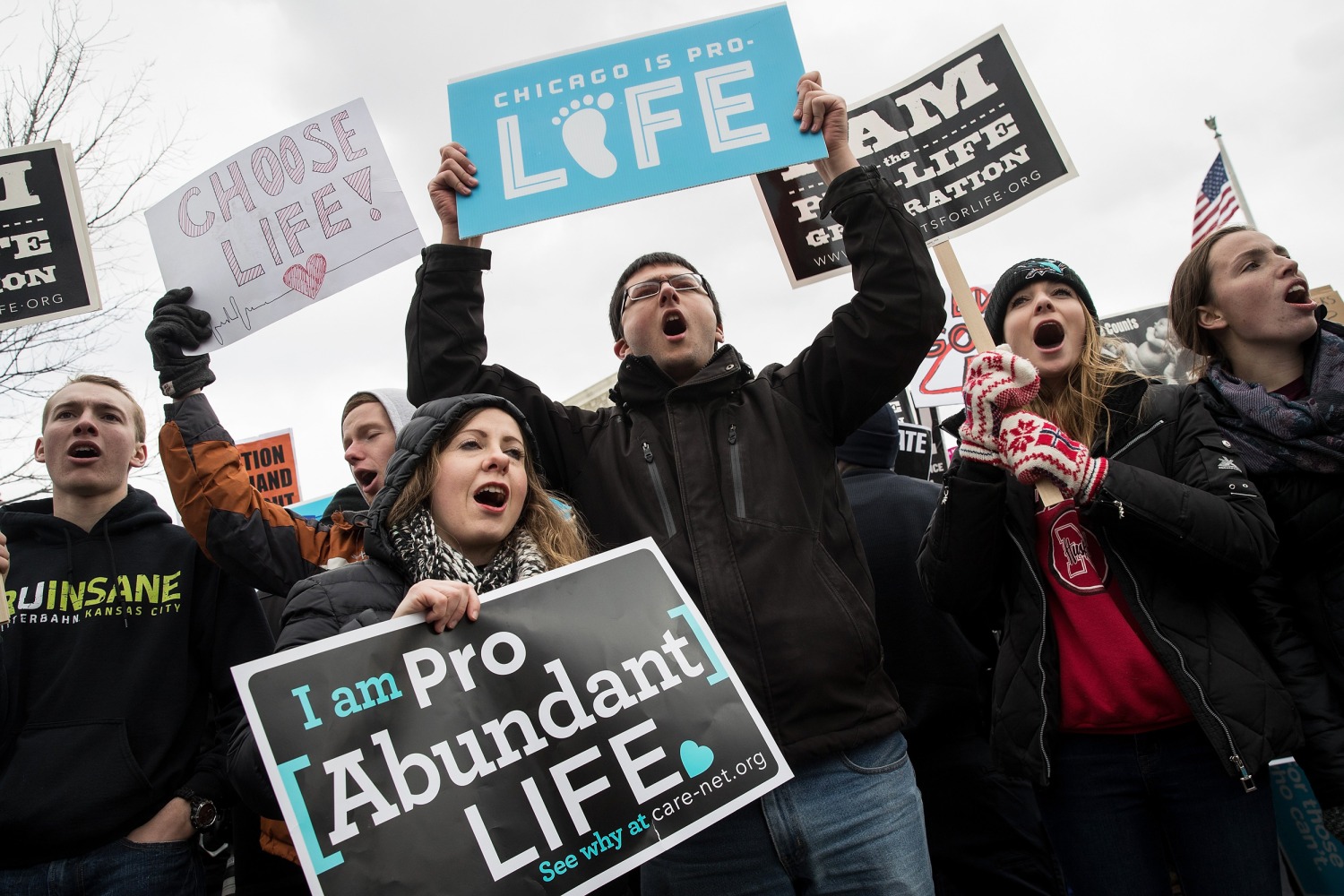
Anti-abortion advocates rally outside of the Supreme Court during the March for Life on Jan. 27 in Washington. Drew Angerer / Getty Images file
The challenge will play out in court on Thursday as the ACLU, the ACLU of Arkansas and the Center for Reproductive Rights will have a hearing for the federal lawsuit, which they filed last month.
Brigitte Amiri, a senior staff attorney for the ACLU, told NBC News that the groups are seeking an emergency order preventing the state from enforcing the laws during the case.
One of the new laws would essentially bar a “safe and medically proven” common abortion method used during the second trimester of pregnancy, known as dilation and evacuation, Amiri said.
Schneller added that this “would essentially end access to second-trimester abortions in Arkansas,” because the method accounts for nearly all second-semester abortions reported in the state.
State Rep. Andy Mayberry, who sponsored the bill, told NBC News that it wasn’t aimed “at preventing abortions” or stopping abortions during the second trimester.
“What we’re trying to do here is prevent one particularly gruesome, barbaric procedure from taking place,” he said.
Mayberry added that he believed the bill was “written in such a fashion that I believe will withstand judicial scrutiny.” He pointed to similar measures in other states, such as West Virginia and Mississippi, and a U.S. Supreme Court decision in 2007 to uphold a ban on a controversial abortion procedure known medically as intact dilation and evacuation.
Another of the laws being challenged in Arkansas would require women to notify and get consent from their sexual partners or family members on how to dispose of fetal tissue before they can have abortions, according to the lawsuit.
The recently passed H.B. 1566 adds “a dead fetus” to the Arkansas Final Disposition Rights Act of 2009, which states that family members have to agree on what happens to a body after a person’s death.
Schneller said that, in essence, would “require that a physician performing an abortion notify a woman’s sexual partner, or parent if she’s a minor, of their right to participate in the disposition of tissue from an abortion.”
“As a practical matter, the health provider can’t begin performing an abortion without knowing the tissue can be disposed of lawfully,” she added. “That shows this notification really has to happen before any care can be provided, and that can create incredible delays — and abortion is a time-sensitive procedure.”
The bill’s main sponsor, Republican Rep. Kim Hammer, defended the measure to the online publication Bustle last week, saying, “He was there at conception so he ought to be there through the whole process.”
“I think that all life, from conception through birth and right up through death by natural causes, needs to be treated with dignity, respect, and also a unified approach to deal with the remains,” he added.
The two other laws require doctors who perform abortions on minors to preserve fetal tissue in case local law enforcement should need it as evidence, according to the lawsuit, and to amass a number of additional medical records before performing the procedure.
Planned Parenthood Great Plains and Little Rock Family Planning Services have filed a separate challenge against a law in the state that would allow the closing of abortion clinics found in violation of any state law, regardless of how minor.
The Republican-controlled Legislature has put forth a series of abortion restrictions every year for the last few years, said Elizabeth Nash, senior state issues manager at the Guttmacher Institute, a reproductive heath and rights organization.
“This Legislature has become extremely hostile to abortion rights,” she said.
Nash added that according to the institute’s data, Arkansas ranked as a “middle-ground” state in 2000 in terms of its abortion restrictions, with only three of 10 major restrictions in place. But as of 2016, the state ranked in the highest category of “extremely hostile,” with eight of 10 major types of restrictions in place.
“Arkansas right now is one of the top 10 most restrictive states when it comes to abortion rights,” she said.
As of 2016, 22 states had six or more abortion restrictions, prompting the Guttmacher Institute to characterize them as “extremely hostile to abortion rights,” she said.
And while organizations tracking abortion restrictions, such as the Guttmacher Institute, have seen states try to enact legislation like the ban on dilation and evacuation, some of Arkansas’ latest restrictions “are pretty unusual,” Nash said.
H.B. 1566, the law that advocates say would require notification of woman’s sexual partners before an abortion, is new and potentially highly problematic, she said.
“When a woman is seeking an abortion, it may not be in her best interest for the partner to know about that, and it could be very detrimental to her in some cases,” she said. “This is a completely different way [of] addressing the issue of fetal disposal than we’ve seen in any other state.”
Amiri said Arkansas was not the only state to “add restriction upon restriction” in the last few years.
“Since 2010, lawmakers have passed over 300 abortion restrictions throughout the country,” she said.
Abortion rights advocates were victorious at the federal level in June 2016, when the the Supreme Court struck down one of the nation’s toughest restrictions on abortion, a Texas law passed in 2013 that would have caused more than 75 percent of the state’s clinics to shut down.
But Nash said that with much of the nation’s focus on issues at the federal level following the presidential election, some more recent abortion restrictions at the state level were getting lost in the noise.
“We are still seeing a very large number of restrictions moving through state legislatures in 2017, and I think some of that gets lost with all of the focus at the federal level,” she said.
Change is likely to see charities and NGOs have to choose between US and Swedish funding
Donald Trump reintroduced the ‘Mexico City Policy’ within days of taking office in January Getty
Sweden has pledged to stop giving aid to any organisations that agree to abide by the anti-abortion rule which was reinstated by Donald Trump.
Known as the Mexico City Policy or the global gag rule, it forces non-government organisations to “neither perform nor actively promote abortion as a method of family planning in other nations” if they want to apply for US government funds.
The US funding ban was first created in 1984 by President Ronald Reagan. The policy was rescinded by the Clinton administration, before being reinstated under President George W Bush.
In 2009, Barack Obama again ended it, only for Mr Trump to reintroduce the policy within days of taking office in January.
As a result he received widespread criticism from the international community.
Now, Sweden’s development aid agency, Sida, has announced it will freeze aid to organisations that agree to Mr Trump’s demands and withhold abortion services, news website The Local, reported.
“This is about women’s own right to decide when, and if, they want to have children and how many children they want”, said Sida’s director general, Carin Jämtin. “Sexual and reproductive health and rights (SRHR) are a prerequisite for being able to attend school and being active on the labour market.”
“We have to defend SRHR and the right to abortion for girls and women in poor countries and when the United States implements a policy that will hit the poorest countries and the most vulnerable groups – women and girls in need of care, Sida has to make sure that Swedish aid continues to go to those activities we have agreed on.”
A Sida spokesperson said it was unclear at this stage how many organisations would be affected by the change.
“We are now starting a review of which of our organisations receive support and where they stand in relation to the Mexico City Policy”, they added. “Only then will we know. The only ones we know of today that have such support and have agreed to the MCP is Save the Children.”
The measure is likely to force charities and non-governmental organisations to choose between US and Swedish funding.
“We are doing our best in a very difficult situation”, Ms Jamtin said. “The alternative for us would have been to do nothing and let the Trump administration’s decision sail through.”
Sweden is also increasing its funding of organisations involved in promoting sexual heath, contraception, abortion and maternity care by a further 170 million kronor (£15.6m).
Representatives from the Scandinavian country are also understood to have spoken to other countries, including the UK, Netherlands and Canada, in an attempt to persuade them to adopt a similar approach.
The Netherlands has already an international fund to support abortion services hit by President Donald Trump’s order to cut US foreign aid.
Announcing the “well-financed fund” to allow other governments, businesses and charities to donate in January, Dutch minister Lilianne Ploumen, said the country would do everything in its power to help women “remain in control of their own bodies”.
 Image copyrightREUTERS
 Image copyrightREUTERS



 Donald Trump reintroduced the ‘Mexico City Policy’ within days of taking office in January


 Abortion - Abortion Clinics, Abortion Pill, Abortion Information