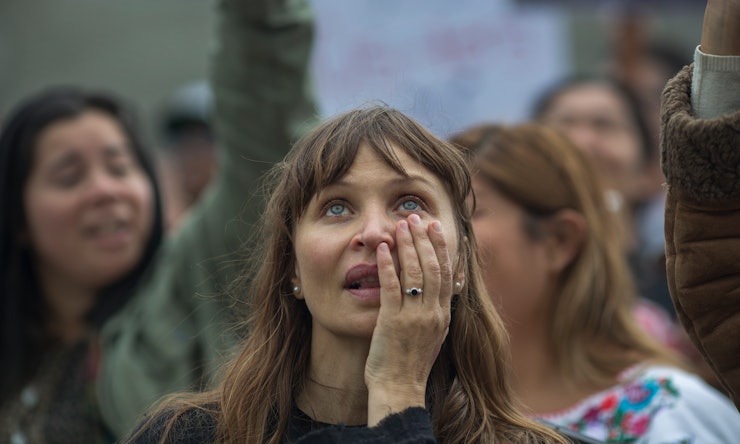
Salvadoran women rally to demand the decriminalization of abortion in front of the Legislative Assembly in San Salvador on September 28, 2016.

El Salvador’s ban on abortion is one of the toughest in the world, but for the first time in 20 years, there are signs the law could be weakened. These are some of the men and women spearheading the country’s movement for women’s rights.

San Salvador, El Salvador (CNN) — María Teresa Rivera was 28 when her mother-in-law found her bleeding heavily on the bathroom floor. She rushed Rivera to the hospital, desperate to save her life, but when they arrived, medics took one look at the young woman and called the police.
As Rivera lay in her bloodied clothes, police officers questioned her about what had happened to her baby. She says she had not known she was pregnant until that moment.
Despite evidence showing the fetus had died of natural causes, Rivera was later found guilty of “aggravated homicide.” She was sentenced to 40 years in prison.
“Life in jail was hell,” says Rivera. She and others in similar situations had “lost children, families, and everything. And the saddest part of it all was that we’re paying a conviction for a ‘crime’ that never existed.”
“I do not want another woman to go to prison,” she says. “Instead of protecting our health and freedom, the Salvadoran state and the law criminalizes and tortures poor girls and women like me.”

Lengthy prison sentences

In El Salvador, a small Central American country with a population of more than six million, El Salvadoran women who have an abortion, or simply miscarry, can face up to 50 years in prison.
At an abortion rights demonstration, this campaigner has a message for the Catholic Church: "Keep your rosaries away from our ovaries."

At least 129 women were prosecuted under El Salvador’s stringent anti-abortion laws between 2000 and 2011, according to the pressure group Citizens for the Decriminalization of Abortion.
The Center for Reproductive Rights says at least 13 women remain in prison, convicted of aggravated homicide over the death of their babies.
Last week another woman, Evelyn Beatriz, who activists say had been raped, was sentenced to 30 years in prison over the death of her newborn. The baby was found in a septic tank, where prosecutors say Beatriz had thrown him. Beatriz’s mother told CNN her daughter did not know she was pregnant when she gave birth in a bathroom in April 2016.
Campaign groups say Beatriz’s case is emblematic of the harm that harsh anti-abortion laws can cause.
In El Salvador, abortion is illegal under all circumstances, with no exceptions, even in the case of rape, or where the woman’s life is at risk.
Over the years, the country’s abortion law has sparked witch hunts within communities — if a neighbor, relative or doctor suspects a woman may have had an abortion, they can call the police and have her arrested.
Fears surrounding the punitive law mean self-induced abortions are common. According to Amnesty International, Salvadoran women and girls have gone to extreme measures, thrusting knitting needles, pieces of wood and other sharp objects into the cervix, ingesting rat poison and taking ulcer treatment drugs, to cause abortions.
A man reads a paper headlined: "Court protects life of Beatriz and child." Beatriz, a chronically ill Salvadoran woman was denied an abortion in 2013, despite the fact her fetus was unviable.

Now, almost 20 years after the law was introduced, there is a growing chorus of calls to overturn the total ban.
Amid increased pressure from its own citizens, campaigners, doctors, ethicists and lawyers, as well as international bodies such as the United Nations — which urged the country to allow abortion in some cases earlier this year — legislators and politicians are considering loosening the restrictions.
A new bill — first introduced in late 2016 by the left-wing party Farabundo Martí National Liberation Front — would allow abortion in cases of rape when the victim is a minor or a victim of human trafficking, when the fetus is unviable, or to protect a woman’s health or life.
A change in the law would mark a significant turning point for women’s rights in the country, but the bill faces serious opposition from El Salvador’s Catholic Church, anti-abortion groups and politicians, including the right-wing opposition party the Nationalist Republican Alliance (Arena).
These are the people demanding reforms to El Salvador’s abortion law.

The millennial campaigner

Sara Garcia is a campaigner with the Citizens’ Group for the Decriminalization of Abortion, which has played a key role in leading the younger generation’s abortion rights efforts. Her campaign is professional as well as personal — over the years, she has struck up friendships with many women incarcerated for having abortions, and regularly meets with them and their families.
Activists take part in a protest calling for the decriminalization of abortion in San Salvador in October 2016.

“This is a historic time for us,” says Garcia, smiling as she takes a sip of coffee. “Everything happening now has never happened before.”
Garcia has grown up alongside the law, which came into effect when she was 10, but says conversation around the issue was “non-existent” for many years.
Today, Garcia says that for the first time in the movement’s history, there is opposition support in the assembly to change the law.
“For reproductive rights, all the world’s eyes are looking at El Salvador,” she says.
“What happens to our reproductive rights will mark a sign for women everywhere. We have an opportunity to stop our country sliding backwards. Salvadorans can no longer deny the cruel consequences of this law.”
Salvadoran women campaign for the decriminalization of abortion in the capital, San Salvador on February 23, 2017.

Abortion and women’s reproductive rights are heavily politicized issues in El Salvador — and the divide between the two sides is deeply entrenched.
Politicians are “always thinking of the election,” says Garcia — they know the issue of abortion will have a big impact on how people vote.
Garcia says the international community has helped abortion advocates’ campaign efforts. Recently, her organization joined forces with Planned Parenthood and Women Human Rights Defenders, an international coalition of 35 human rights groups, to take a stand against criticism from politicians — and death threats from anti-abortion campaigners.
“Everything that happened with Planned Parenthood and women’s rights in the US also happened here,” Garcia says. “Violence is everywhere in the politicians’ arguments against abortion — in the way they talk, in their messages, in their actions.”
“These are the same people who say women can’t have access to contraception, and to many other rights,” she added.

The champion of the abortion rights movement

If Garcia is the leader of the younger generation campaigning for abortion in El Salvador, then Morena Herrera, head of the Citizens’ Group for the Decriminalization of Abortion, is the voice of the old guard.
Morena Herrera, a former Marxist guerrilla commander, is now the Director of the San Salvador Feminist Collective.

Huddled in a small office in the center of San Salvador, Herrera and Garcia work at desks facing each other, surrounded by feminist posters.
Herrera says she is driven by the ordinary women behind bars in prison who she says are “just like her,” but face an unknown future.
A former Marxist guerrilla, Herrera has channeled her decades of experience fighting for social change into the women’s rights cause.
“I try to make it all work,” she said with a laugh as phones ring and people bustle in and out, asking for guidance. “I work night and day, I have many to-do lists, I collaborate with a lot of people, and I have a lot of meetings. I always say that I live with urgency!”
El Salvador has the highest rate of teenage pregnancy in Latin America — something Herrera says is fueled by the lack of sex education in schools.
She says sexual abuse and rape are leading factors in underage pregnancy; she has worked with many women whose children have been subjected to sexual abuse and rape, and wants to help the mothers fight the issue.
A woman participates in a march on the International Day of Action for the Decriminalization of Abortion in 2012.

In 2016, El Salvador’s National Civil Police recorded 3,947 sexual offense complaints, of which 1,049 were cases of rape; 1,873 of the victims were minors, or classified as “incapacitated,” according to the Organization of Salvadoran Women (ORMUSA).
“Many of the girls here who need an abortion have been raped,” Herrera explains. “It is not just adult women, it’s abuse of minors. Children cannot consent — it is sexual violence.”
If a teenage girl is raped and tries to terminate her pregnancy, she could face decades in jail. But her rapist, if convicted, would only face six to ten years’ imprisonment. According to a study by the UN Population Fund (UNFPA), girls under 12 are most at risk of getting pregnant by rape, most commonly targeted by stepfathers and relatives.
Herrera says many uncertainties lie ahead: She is unsure whether the proposed reform will be sent to the legislative assembly, or if it will be shelved, meaning the issue will be taken off the agenda for six months. Months after the legalization campaign began, the new bill remains mired in political arguments, and has yet to come to a vote.
But she says the fact there is a proposal at all is hugely significant — and that the fight isn’t just for feminists.
“Yes, this is a huge injustice to women, but it’s an injustice that can be repaired,” she says. “It’s a problem for society, democracy, not just a problem for feminists. It’s essential the women’s movement are involved – but this isn’t just our fight, it’s a fight for everyone.”

The lawyer

Dennis Munoz, a lawyer in San Salvador, first took notice of El Salvador’s abortion laws when 17-year-old Christina Quintanilla was found guilty of aggravated homicide after suffering a miscarriage, and sentenced to 30 years.
Munoz took up her case, leading to her release four years later.
Dennis Muñoz, a lawyer working with rights groups to free women in prison on abortion charges, talks during a radio program.

“I took the first case because of my daughter,” he says, smiling at Marcela, an 18-year-old student. “I asked myself: if this was my daughter in the prison, who would help to release her?”
Munoz says his work defending women is a “privilege.”
Visiting Herrera and Garcia’s office with Marcela, the group discusses the latest court cases and ask the teenager how her studies are going, as the office buzzes with phone calls.
“Justice is important to me,” Munoz says, sitting in the courtyard outside. “I want girls in my daughter’s generation to have their rights.”
“My dad’s work is very inspiring,” says Marcela. “When you see a group of people who want to do something to make a difference, it makes me want to be better. You can change the world in many ways, and this is one of them.”
A bill calling for the relaxation of El Salvador's abortion law is under consideration, but has yet to come to a vote.

The majority of women imprisoned under El Salvador’s abortion law are poor and lack education, and Munoz has seen how the law significantly punishes women living in poverty.
He says some rich women are able to get around the law by going to private clinics and having abortions in secret, but poor women simply don’t have that option.
“They call me many things,” Munoz said. “They say I’m a bad father. But for me, the justice and truth is important. I know this is best for the country — one day I dream for that change to happen.”

The fight goes on

El Salvador is considered the most dangerous country in the world outside of a war zone. Gang violence and murder plagues the nation, which, according to police, recorded its first homicide-free day in two years earlier this year.
Abortion rights campaigners have vowed to continue their efforts regardless of the outcome of the bill — as will the anti-abortion lobby.
The Catholic Church, which holds huge influence in a country that remains socially conservative, remains staunchly anti-abortion, despite Pope Francis’s 2016 ruling that priests may “absolve those who have committed the sin of procured abortion.”
The Vatican’s view, clarified in 2009, is that “abortion willed either as an end or a means, is gravely contrary to the moral law … Life must be protected with the utmost care from the moment of conception: abortion and infanticide are abominable crimes.” Pope Francis restated in 2016 that “abortion is a grave sin, since it puts an end to innocent life.”
Unlike many other women in similar situations, María Teresa Rivera’s story has something of a happy ending: After years of failed legal appeals, the criminal chamber of El Salvador’s Supreme Court agreed to review her case. In May 2016, Rivera’s conviction was overturned after a judge ruled there was insufficient evidence against her.
This year, Rivera and her 12-year-old son were granted asylum in Sweden; Rivera is the first woman in the world to receive such protection because of her country’s abortion laws, according to the Center for Reproductive Rights.
“It’s not easy to arrive in a country where you cannot speak the language, but I have the opportunity to start a new life,” Rivera tells CNN. “I’m very happy to be safe and away from a society where I only received discrimination and persecution from the state.”

The policy had the opposite of its intended effect.

NEW YORK ― Republicans are trying to find a way to defund Planned Parenthood as part of an overall effort to limit abortion in America. But doing so had the opposite effect in Texas, according to a new study based on research from Texas A&M University.

The study, conducted by economics professor Analisa Packham (now at Miami University), shows that in the first three years after Texas Republicans slashed the family planning budget in 2011 and shut down more than 80 women’s health clinics, the abortion rate among teenagers in the state rose 3 percent over what it would have been had the clinics remained open. After cutting Planned Parenthood out of the state’s subsidized women’s health program, then-Gov. Rick Perry (R) said his “goal” was to “ensure abortions are as rare as possible under existing law.” But the move actually interfered with an overall downward trend in abortions in Texas.

“This certainly isn’t the way to have fewer abortions,” said Dr. Diane Horvath-Cosper, an OB-GYN in Maryland and an advocate with Physicians for Reproductive Health. “The abortion rates nationally have decreased and are at a historic low. So for Texans to see an increase in adolescent abortions is really telling ― it seemed to have followed the national trend until these clinics were defunded.”

The greatest rises in abortion rates occurred in rural areas, where access to affordable family planning care was already scarce. In Gregg County, where the local health center lost 60 percent of its family planning funding, the abortion rate increased by 191 percentbetween 2012 and 2014. The Austin American-Statesman reported that at least five counties in East Texas also saw “considerable increases” in abortions over that two-year period.

The overall abortion rate in the state dropped 14 percent between 2013 and 2016 ― but this was largely because in some low-income rural areas, like the Rio Grande Valley, women would have had to drive over 100 miles to find the nearest safe and legal abortion provider. Those women either had to seek out unsafe, do-it-yourself procedures or simply have babies they didn’t want or couldn’t afford.

President Donald Trump and the Republicans in control of Congress now want to “defund” Planned Parenthood nationwide by preventing Medicaid recipients ― who account for more than half of Planned Parenthood’s patients ― from going there for birth control and cancer screenings.

The Congressional Budget Office estimates this would cause 15 percent of women in rural areas to lose access to family planning care entirely, which in turn would lead to more unplanned pregnancies and likely more abortions.

Studies show that 40 percent of unintended pregnancies end in abortion, so cutting access to birth control is not the way to reduce the overall abortion rate.

Only a few moderate Republicans, like Sen. Susan Collins (R-Maine), seem to understand the flaw in this plan.

“If you’re serious about trying to reduce the number of abortions,” Collins told reporters in March, “the best way to do that is to make family planning more widely available.”

http://www.huffingtonpost.com/entry/texas-planned-parenthood-teen-abortion_us_59653229e4b09b587d63018a?utm_campaign=hp_fb_pages&utm_source=main_fb&utm_medium=facebook&ncid=fcbklnkushpmg00000063

As an abortion doula serving rural areas in Canada where reproductive options are limited, I know it’s not easy getting people the healthcare they need.

Abortion access in the Maritimes has long been among the most restricted in Canada. Abortion services only became available on the Canadian Province Prince Edward Islands (PEI) in January 2017. Women there used to have to travel to New Brunswick or Nova Scotia to receive services. New Brunswick also had restrictive policies in place, and only recently made it easier for women to access the health care they need. With low access, some women have turned to abortion doulas for help.

Before I started abortion support, I had heard about people needing abortions from Prince Edward Island and making their way to Halifax, the capital of Nova Scotia. I just didn’t believe it. This can’t actually be a thing, right? We have universal healthcare: We can’t have a province that doesn’t offer it. Yet it was true. Really, that’s what started it.

I have been a birth doula since 2006, and I started abortion doula support in 2012. Abortion doulas don’t do anything medical, and don’t give medical advice or medical intervention. But what they do provide is emotional and physical support. That means going with you to doctor’s appointments, having water available, having information, or at least knowing where to get information… meeting at the park for an hour and having a chat, or just a ten-minute phone call. We are often just there as somebody who is not bringing any emotional attachment to the experience. We’re just there for you.

Shannon Hardy

We hear from many people: “I could never tell my family what is going on. Thank you so much for being there. I just didn’t want to tell anybody.” This one person contacted us and said, “I don’t want to tell anybody. I don’t want anybody to find out, but I need a ride and somebody to pick me up. We got a volunteer who picked them up and drove them to the hospital. When it was time to pick them up, they had felt comfortable enough—because the volunteer had just been so lovely and understanding and didn’t make them feel they were wrong for making that choice—to call their sister and telling them. Then their sister came and picked them up afterward. It’s so lovely to think that all it took was one person to give that unconditional support. Like, oh, if that person can give it to me, maybe I can trust my sister.

When I first started Maritime Abortion Support Services back in 2012, we really worked closely with advocacy groups from Prince Edward Island, meeting people halfway at Confederation Bridge and driving them into Halifax. Then we would drive them back to the bridge and somebody from Prince Edward Island would come pick them up. You also can’t leave the hospital after an abortion if you do not have a person to take you. They will keep you until the very end of the day.

Then, it morphed into more local people using it—either they do not have support, or they are new to the area. We cover babysitters, rides, going to doctor’s appointments, and we also get money for gas because Halifax is the only major place in Nova Scotia that you can get an abortion performed. There are two of the smaller hospitals, but it is a bit of a labyrinth to get that service. The farthest we’ve traveled is two hours to Confederation Bridge, but certainly, in plain statistics, people coming on their own could be seven or eight hours away.

We talk as Canadians that we have universal healthcare—with air quotes around universal healthcare—but that’s so untrue if you’re a woman or somebody with a uterus. Somehow, if you have a uterus, your medical care can be truncated in some way. Hearts are important, appendixes are important, but oh, your uterus! Not so much. We’re not sure if that counts as universal. It’s not even like they live somewhere rural, and that’s why we can’t get them services.

I did have a mom who called me and she said, “I have older kids. I really don’t want this. I’m in a small town in Nova Scotia. How do I do this?” So we called the largest city near her and contacted the women’s wellness clinic in that city, and they told us—when I said I have a client who needs a termination—”we don’t do that here.” Click. The walk-in clinic for her blood work and ultrasound only takes 25 people, so she may not even get a spot. Are you kidding me? So she’s going to drive two hours to a clinic to maybe not see anybody? There was no reason to put these barriers in this woman’s way. So I had to email her back and say that you can do that, or you can drive into Halifax where a sexual health clinic will do your blood work and ultrasound the day before, but you’ll have to stay overnight in Halifax because it’s a six-hour drive.

So she prepared for that. Luckily she did have older children and didn’t have to worry about babysitting, but she was going to lose a day’s pay. Unfortunately, she spontaneously miscarried at home. It’s things like that that are the hardest. She didn’t need to have all these barriers; they could have been easily overcome. There was no need for her to go through that emotional distress.

For every “holy shit, this was a struggle just to get to Halifax” kind of story, there’s another one where they are like, “That was awesome. Thank you so much for being here.” It was a hard decision for them, but having somebody there for them was just the icing on the cake. I have received thank you cards in the mail. People have sent in money for other people for transportation. There’s an awful lot of good stories where people are so thankful.

Mifegymiso [the two-drug combination pills for abortion] could changeeverything for people when it comes to reproductive care. People who live in small towns here in Nova Scotia could just go to their pharmacy, or maybe make one appointment to see their doctor, and then go home and have their abortion in the privacy of their own home. But they’re doing two things with the regulations.

One is that you can only take Mifegymiso within 49 days of pregnancy. Few people even know they’re pregnant before six weeks.

Two, you have to be within 62 miles of a physician. For some people, this could be a life-changer, and for some of those people, a physician isn’t within 62 miles. And that’s supposed to be the point of the pill.

Here in Nova Scotia, I actually don’t know anyone who managed to get Mifegymiso. The regulations around it are so onerous. I don’t know any doctors right now who even have it. I know Halifax Sexual Health Centre has every intention of dispensing it, but again, we need a pharmacist who also steps up.

Our doctors and pharmacists have to go through special training. Doctors don’t often jump at the chance to take new training. If they are thinking, I’m going to take this training, but I’m only going to see three people a year, is it worth it? Is it worth it to carry this medication and I’m never going to use it? Then what if it goes bad, that’s really expensive. Pharmacists are thinking the same thing.

It’s hard being from a smaller province and not having the large population centers. In Nova Scotia, almost everybody who is not in Halifax is rural. [After taking Mifegymiso], you have to come back to the doctor for multiple visits. So again, if getting to the doctor is the hurdle, and you had to drive five hours or take a plane, now you have to come back in two weeks? How is that working for people? It’s a little mind-boggling.

One of the biggest kickers is that this has been approved in France since 1988. France and China have both been using this for many, many years, as have many other countries, including the US. That’s like 30 years of good, useful data, to show you the efficacy of these drugs. You don’t need all of these safeguards because it’s an incredibly safe procedure. For whatever reason, Health Canada has decided that it’s going to put these rules and regulations in place. I’m not sure why.

It’s hard not to see that through a gendered lens because the medications aren’t for anybody else except for people who can get pregnant.

My first two abortion doula workshops sold out. I have two more abortion workshops in August. The first one sold out, so I added another one. It’s open to anyone. I make a point that you don’t have to have doula experience to do this because you use some of those skills, but you are learning a whole new set of skills.

I have gotten some lovely feedback. One of my trainees, she told me, “I’ve never actually used it at an abortion clinic, but I use it at work all the time.” She used it in her day-to-day life. These are skills that are transferrable. I had a teacher who said, “This is going to be helpful in the classroom.” A nursing student said, “I will use these every day.” And doulas, “This is amazing, something that I can add to my repertoire.”

It means a lot to me to see the new doula trainees, to see their faces. They’re so excited. It makes your heart just burst. It’s wonderful.

The abortion support is just so fulfilling. Some people go to church—I am a radical feminist. This sustains my soul, to do reproductive justice work. I think, I made a difference in that person’s life, an immediate difference, and that’s pretty spectacular.

https://www.vice.com/en_us/article/9kwqaa/what-its-like-helping-strangers-through-abortions-in-rural-canada?utm_campaign=buffer&utm_content=bufferebefd&utm_medium=social&utm_source=facebook.com

In recent months, states across the county have ramped up efforts to create heightened restrictions on abortion access. The stakes are especially high in Kentucky, where the last remaining abortion clinic, the EMW Women’s Surgical Center in Louisville, faces the threat of closure after the state claimed that the clinic’s agreements with hospital and ambulance services contained technical deficiencies.

If the state’s efforts are successful, Kentucky would be the first surgical-abortion-free state in the United States. The impact could be detrimental for women across the state.

“Kentucky for a long time was not on the policy radar,” said Elizabeth Nash, who tracks state abortion legislation for the Guttmacher Institute, in an interview with the New York Times. “Now Kentucky is following the model of Texas and Ohio, where they are adopting restrictions or making it very difficult to keep clinic doors open.”

Kentucky is one of seven states — along with North Dakota, South Dakota, Missouri, Mississippi, Wyoming, and West Virginia — with only one abortion provider. In 1978, there were 17 abortion providers in the state.

The state’s Republican governor, Matt Bevin, has been vocal about his attempts to limit abortion access in the state, even dubbing himself an “unapologetically pro-life individual.” Earlier this year, he signed a bill banning abortion after 20 weeks and blocked a Planned Parenthood clinic from performing abortions. In January, EMW Women’s Clinic in Lexington was forced to close after facing a lengthy legal battle with the state over its licensing. As the case dragged on, the clinic couldn’t afford to stay open without seeing patients and the landlord opted not to renew the lease. The Louisville clinic is the only one that remains open in the state.

On July 11, Women to the Front, a progressive action group, will host a fundraiser for EMW. All proceeds from the event, which includes “badass rocker babes, irresistible El Diablo tacos, one-of-a-kind raffle items, a silent auction, and Brooklyn’s finest cocktails,” will go toward escalating legal fees and other urgently needed funds for the Louisville clinic.

The fundraiser will take place from 7-10 p.m. at Union Pool (484 Union Ave, Brooklyn, New York) and feature sets from Breanna Barbara and NYC-based band Roya, led by Rahill Jamalifard and Alix Brown. Tickets can be bought online for $18.

Photo published for NYC for EMW Women's Surgical Center

NYC for EMW Women’s Surgical Center

Women to the Front* is raising urgently-needed funds for the LAST remaining abortion clinic in Kentucky, EMW Women’s Surgical Center. They are involved in a legal battle with their governor, while…

gofundme.com

For those outside the New York area, there are myriad other ways to support Kentucky’s last abortion clinic.

1. Donate to Women to the Front’s GoFundMe page.

So far, the page has raised $2,245 of their total goal of $3,500.

2. Reach out to elected officials.

If you want to make a difference, let your elected officials know these are not the types of policies that you want or support.

“This fits into the national picture, making sure that that we stand up and are heard and we take away the shame and stigma related to abortion, and tell our elected officials wherever we live that these are not the policies that we want,” Brigitte Amiri, Senior Staff Attorney for the ACLU Reproductive Freedom Project, tells Bustle. “Everyone should be able to make the best decisions for themselves and their families.”

3. Assist the escorts who help women in and out of the facility.

Louisville Clinic Escort volunteers are vital in ensuring people seeking an abortion can enter the clinic, especially as anti-abortion protestors shout slurs and try to prevent women from seeking the procedure. The volunteers accompany people to the clinic’s doors while practicing deescalation and promoting normalization of abortion access. You can donate to the escorts hereor volunteer to escort if you live in Kentucky.

4. Rally together for EMW.

In April, and in response to its possible closure, hundreds rallied in support of the clinic. Throngs of people came together with signs like “Keep abortion legal in Kentucky” and “#Resist.” But, like the New York City fundraiser, these types of rallies don’t have to be local — you can organize a rally of support across the country.

“With just one clinic to care for the women in need of abortion services, the forced closure of EMW will have devastating consequences for women in Kentucky,” said attorney Don Cox in an interview with the ACLU. “The state is hiding behind sham justifications when its true intent is to shut down this clinic and prevent a woman from making a real decision about her pregnancy.”

EMW’s Women’s Surgical Center, a privately owned facility staffed by board-certified Obstetricians and Gynecologists, was established in 1980. Approximately 80 percent of abortions are performed in the first trimester, and the facility currently provides both medical and surgical abortions, according to the legal complaint.

Nationwide, less than 0.3 percent of abortion patients experience a complication requiring hospitalization on the day of the abortion — and the rates are even lower at EMW.

Photo published for Kentucky's last abortion clinic sues state to stay open

Kentucky’s last abortion clinic sues state to stay open

If the EMW Women’s Surgical Center in Louisville closes, there will be no more abortion providers in Kentucky.

The ACLU filed a lawsuit, EMW v. Glisson, to challenge the facility’s closure and block what they consider to be unnecessary and unconstitutional state laws. They argue the lawsuit mimics last June’s Supreme Court case of Whole Woman’s Health v. Hellerstedt. According to that decision, centered on a Texas law, it is unconstitutional to require business arrangements with a hospital, because it serves no medical purpose and poses major harm to women.

Amiri says that she considers the state’s grounds for closure to be TRAP laws, or laws that single out abortion providers and impose requirements that are more burdensome than those imposed on other medical practices. For instance, the state wants to revoke EMW’s license because their written agreement with a local hospital was signed by the head of the hospital’s head of the Department of Obstetrics, Gynecology and Women’s Health, and the government claims it needed to be signed by someone higher up at the hospital.

“We think such a requirement is blatantly unconstitutional in the face of the Supreme Court’s decision last June,” she says. “This is the same type of business arrangement with a hospital that serves no medical justification but instead significantly burdens patients’ access to abortion and even more so in the case of Kentucky than in Texas because in Kentucky the last clinic would we shut down, effectively banning abortion in the entire state.”

In April, a federal court issued an order to allow EMW to remain open while the state challenges the clinic’s agreements with local hospital and ambulance service. The temporary restraining order will remain in effect until a final judgment is declared for the case. The trial starts on Sept. 6.

https://www.bustle.com/p/how-to-support-kentuckys-last-remaining-abortion-clinic-right-now-69238

The philanthropist, who is personally against abortion, spoke against new restrictions on the Republican policymelinda-gates.jpg

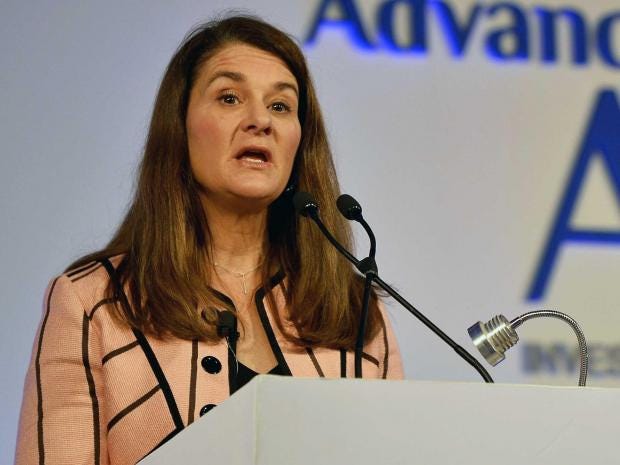
Melinda Gates has said the increased anti-abortion restrictions placed on foreign family planning clinics under Donald Trump are “very troubling”.

Despite her public personal stance against abortion and her lack of advocacy for the procedure, Ms Gates spoke against the Mexico City policy, or “gag rule” under Mr Trump, as she argued the broader application of the rule in 2017 would endanger overall reproductive health services that foreign organisations provide.

“US funding can never go to an abortion organisation, ever. That is a longstanding rule […]” Ms Gates, the co-founder of one of the world’s largest charitable foundations alongside husband Bill Gates, told the Today Programme.

Yet she said the Trump administration has expanded the Mexico City policy “very broadly”, so foreign “reproductive health organisations have to say, even if you’re not receiving government funding for […] abortions, you won’t even do these [abortions] in your clinic with funding, say, from the UK or from France.

“And that is very troubling.”

Ms Gates is co-hosting an international summit on family planning in London, where donors are anticipated to raise more than $2.5 billion to expand access to contraception.

Ms Gates said that contraception access was the “most effective anti-poverty tool we have” and that 40 developing country governments are interested in the initiative if they can get funding.

The London summit comes shortly after Mr Trump proposed to take away money from the UN Population Fund, the United Nations agency that works on reproductive and sexual health around the world.

“He [Trump] is proposing not funding family planning and that is a huge problem,” she said.

“If you believe in women, you fund family planning and so I’m counting on Congress in the US to hold up US funding on family planning.”

She added: “This [funding family planning] has been a very longstanding bipartisan issue and Bill and I have had many meetings over the last few months on the [Capitol] Hill to explain why this aid, why for just a few dollars a year, you could put a young girl and her family on the path to self-sufficiency.”

She said she had also met many times with the Catholic Church to argue that providing contraception can “transform economies” and was “one of the smartest investments countries can make”.

Experts say that around 220 million women around the world lack access to contraceptives, which would help avoid 67 million unplanned pregnancies every year and the resulting 76,000 deaths of women from pregnancy and childbirth-related complications.

The economic benefit could be as much as $430 billion per year, they claim.

The Foundation does not fund abortion rights or access.

Unsafe abortions is one of the top three causes of women’s mortality around the world, and critics say that even massive expansions to contraceptive access would still leave millions of women at risk

http://www.independent.co.uk/News/world/americas/melinda-gates-donald-trump-anti-abortion-policy-mexico-city-women-rights-contraception-charity-a7834736.html

 WHY YOU SHOULD CARE

Because when women’s rights get restricted, techies build new tools.

Going to work used to be stressful for Emily Loen. Every time the brunette stepped from her car, she braced for taunts about her appearance and her morals from protesters picketing nearby. That’s because Loen, 35, was a women’s health care worker at a North California clinic providing abortions. (Loen asked for the clinic to remain unnamed to avoid further reprisals.) But she also knows she’s lucky: Many of her peers encountered far worse, from threats of violence to being trolled and doxed online. Loen felt powerless to help them, so when a colleague proposed co-founding a hackathon to build tools for abortion seekers and providers, she was all in.

Hackathons are a recent cultural phenomenon, a gathering place for civic-minded engineers to compete by building prototypes that target specific problems. According to Hackathon.com, 3,450 such events took place last year, with 1,568 of them in the U.S. The majority, though, tackle commercial issues, and health care is considered such a thorny subject even the International Women’s Hackathon shied away from it. But with legislators from Texas to Ohio clamping down on women’s rights, there has been a growing call for help — and, considering that two-thirds of abortions are provided by independent clinics like Loen’s, their struggle has renewed urgency.

Abortion Access Hackathon

SOURCE FOX NAKAI

“I didn’t know any technology that specifically focused on delivery services,” Loen says. She was aware of We Testify, a website launched by the National Network of Abortion Funds, where users share personal stories, but she wanted something more actionable. Loen, who describes herself as “ambiguously brown,” says abortion access — a problem even in blue states like California — is particularly hard for people of color and gender-fluid folk who deal with bias, racism and, in the case of trans people, language that excludes them.

Loen traces her sense of civic responsibility to her family. “They’re all teachers, police officers, small-business owners,” she says. “They fostered the idea you should give back and advocate for your community.” She was attending art school and looking to channel her activist beliefs into helping women when she landed a job running the outreach and education division at a women’s health care clinic. Known for her wide smile, dangly earrings and a voice that accelerates when she gets fired up, Loen says, “If politicians are abusing your power, I can’t sit and watch it.”

Hackathon01

Abortion Access Hackathon

 With help from her fraternal twin, Somer, president of the San Francisco chapter of the National Organization for Women, Loen connected with startups in the same space, including Nurx, a company providing affordable access to birth control, pre-exposure prophylaxis, or PrEP, and Plan B. Nurx CEO Hans Gangeskar is enthusiastic about Loen’s venture. “It’s obviously a long road,” he says, referring to the challenge of bringing something from concept to scale. “But it’s an important cause; right now, access is under attack.”

CAN A HANDFUL OF APPS FROM WEEKEND WARRIORS REALLY MAKE A DIFFERENCE?

Now in its second year, the Abortion Access Hackathon has grown from roughly 20 people at University of California, Davis, to more than 200 in GitHub’s shiny San Francisco offices. “It’s time to disrupt the legal barriers,” says Loen’s former clinic colleague Shireen Dada Whitaker, who conceived of the hackathon after a class in media innovation and community development at UC Davis. Together, they crafted a proposal and got sponsorship from All Access, a reproductive rights group.

The second hackathon was held this March, with a focus on the challenges faced by providers, which include harassment, misinformation, anti-abortionists creating fake clinics, and the shortage of doctors. The new location was thanks to Kate Bertash, a Bay Area techie who contacted Loen and asked to help. This time, the hackathon generated significantly more buzz, a change Loen attributes to anti-Trump voters searching for grassroots ways to push back.

Loen spent a month vetting the 600-plus applications. “We wanted to make sure they were here to help, not to disrupt the process,” she says — anti-abortion activists are known to infiltrate similar events. Lila Rose, president of anti-abortion group Live Action, feels these volunteers’ time could be better used. “Abortion is never a just or loving solution to the challenges women may face,” she emailed.

Hackathoners typed furiously on laptops, fueled by LaCroix and free pizza, to build apps and websites that included a virtual doula service, Rhetorical Uterus (a debate platform) and Termina (presenting options based on a woman’s age, state of residence and pregnancy stage). The mood seemed friendly and supportive, perhaps because 80 percent of participants identified as female or gender nonconforming — a rarity in the engineering space, where men make up 92 percent of software developers.

And while no one would argue against techies using their skills for social good, can a handful of apps from weekend warriors really make a difference? Caitlin Gerdts, vice president for research at Ibis Reproductive Health, a nonprofit specializing in improving women’s health worldwide, says the hackathon spotlights the potential that technology has to expand access to care — pointing to the growing use of Samsara, an Indonesia-based abortion information hotline and app, as one tangible outcome. Gerdts also says that large-scale change will likely stem from examining state-level abortion restrictions based on evidence, and the U.S. Supreme Court’s June 2016 ruling in Whole Woman’s Health v. Hellerstedt gives her hope.

Emily Loen

Emily Loen

SOURCE MARK MADEO FOR OZY

For her part, Loen is confident enough to leave her job at the clinic to devote more time to this enterprise. She is currently waiting for confirmation that the Abortion Access Hackathon has achieved nonprofit status and will be hosting the next hackathon this summer, probably in Austin, Texas, where, she says, recent restrictions to access make it imperative that women receive support.

Loen knows the hackathons, while valuable, won’t be instantly actionable, and many women will continue to struggle while she distributes fliers and tries to raise awareness. But she’s not doing this for pats on the back; here to make incremental change, she knows she’s chosen a long and difficult road.

http://www.ozy.com/provocateurs/heres-why-they-call-her-the-abortion-hacker/77067?utm_content=buffer846f8&utm_medium=social&utm_source=facebook.com&utm_campaign=buffer

In a country where more than 65% of women don’t use contraceptives and terminating pregnancy is illegal, ‘torturous’ practices are often the only option

https://www.theguardian.com/global-development/video/2017/jul/10/at-11-years-old-theyre-getting-pregnant-the-women-smashing-catholic-taboos-in-the-philippines-video

Next to an imposing statue depicting a foetus clasped in the hands of Christ, stalls offer an array of rosary beads, amulets, mangoes and songbirds. Here, the abortion pill misoprostol is on sale for just $5 (£3.90), as well as the herb pamparegla, which can induce menstruation and end pregnancy. All this goes on in the shadows of the largest Catholic church in Manila.

The irony is not lost on women’s rights activists who want legal access to abortion.

Marevic Parcon has been called an abortion cheerleader. It’s no understatement. In a country with an outright ban on the procedure and conservative views on contraception, she is defiant in the face of criticism.

“I mean, why not? Is it shameful? At the end of the day abortion is about human rights,” she says. “No matter how much they deny the existence of abortion in the country, it’s happening under their noses.”

Parcon is programme coordinator at the Women’s Global Network for Reproductive Rights (WGNRR). “If you are for women’s rights, it is inevitable to talk about sexual and reproductive health and rights. And you cannot talk about sexual and reproductive health without talking about abortion rights.”

Her views don’t go down well in a country where more than 80% of the population are Catholic and the church holds tremendous sway.

Such conservative attitudes kept an act granting universal access to family planning at bay for 14 years.

More than 65% of women don’t use modern contraceptives, and maternal mortality rates are still high in the Philippines, standing at 114 deaths per 100,000 live births in 2015.

It was the efforts of women like Parcon that eventually helped drive the law over the line. The Responsible Parenthood and Reproductive HealthAct – also referred to as RH law – was finally passed in 2012.

“This whole culture of patriarchy controls women’s bodies. Women … should be able to exercise their own sexuality and they should be able to enjoy sex,” says Parcon, who has been on the frontline of women’s rights activism for more than 20 years.

Although it’s against the law to end a pregnancy in the Philippines, an estimated 610,000 abortions take place every year.

It’s an open secret that methods are available, albeit unsafe ones.

As well as the herbs and medicines on offer at Quiapo, women who want to end unplanned pregnancies have their stomachs massaged hard every day for a week, in the hope of inducing abortion.

“It is horrific. It is tantamount to torture,” says Parcon. “Unsafe abortion is torturous to women, especially the massage kind, because it is so painful.”

Others resort to barbaric methods such as inserting barbecue sticks or coathangers into their womb, or throwing themselves down the stairs. Three women die every day from post-abortion complications in the Philippines.

The job of campaigning for women’s reproductive health and rights there is tough. But it’s about to get tougher. Although the work of Parcon’s organisation, WGNRR, is not funded by the US, Donald Trump’s decision to reinstate the Mexico City policy, also known as the “global gag rule”, will bolster her opponents.

The gag rule bans foreign aid to international healthcare providers who discuss abortion or advocate abortion rights.

“It will definitely make it more difficult for any reproductive health NGO,” says Parcon.

“When you talk about reproductive health you will always touch on abortion. The global gag rule says that even the mere mention of abortion is not allowed. It is a challenge – a big, big challenge. But it’s not something we should be afraid of.”

On paper the Philippines looks like it’s making progress on upholding women’s rights. In 2009 the Magna Carta of Women was introduced, promising to “eliminate discrimination against women by recognising, protecting, fulfilling and promoting the rights of Filipino women”. The country has also ratified the Convention on the elimination of all forms of discrimination against women (Cedaw).

But the fight over the introduction of the reproductive health law clearly showed that the country still has a long way to go.

“Everything was reduced to the debate of whether or not contraception was [causing abortion] … [but] how can you enjoy life if you have 12 kids?” asks Parcon.

There are other hurdles ahead: the supply of contraceptives is poor, and legal challenges from religious groups are blocking distribution of the contraceptive implant.

But Parcon remains positive.

“My hope is that one day Filippino women can say ‘abortion’ and that there’s no shame in the word. Before, we couldn’t even have this conversation. But right now we are having it, so there is hope.”

https://www.theguardian.com/global-development/2017/jul/10/how-bitter-herbs-and-botched-abortions-kill-three-women-a-day-in-the-philippines?utm_content=bufferb8f6a&utm_medium=social&utm_source=facebook.com&utm_campaign=buffer

A woman waiting for an abortion in Texas in 2016. Ilana Panich-Linsman for the Washington Post/Getty

The first group in Colorado to offer training in how to help someone through the process of ending a pregnancy.

Traditionally, a doula is someone who is there to offer you emotional support during your pregnancy, as you give birth, and sometimes in the postpartum period. She (most doulas, though not all, are women) is not a medical practitioner, but a hand-holder, a confidante, and an advocate.

Pregnant people certainly need and deserve that kind of support—whether they keep the pregnancy or not. And that’s where “full-spectrum” doulas come in.

A full-spectrum doula accompanies clients through abortions the same way she would accompany them through birth. She can answer basic questions about the procedure and correct any misinformation the client might have, but her most important job is to be there for her client in the most vulnerable moment. An abortion doula might hold clients’ hands through the procedure, make conversation to distract them from discomfort, and join them in the recovery room afterward, offering heating pads for cramps and talking through whatever emotions they’re experiencing. These are intense, complicated, often physically difficult experiences. It helps to know you’re not going through them alone.

“It’s important to think of all of these experiences of reproduction—birth, postpartum, miscarriage, still birth, pregnancy, menstruation, menopause, adoption, abortion, fertility, contraception, family building, and planning, I could go on and on—as inherently linked,” says Skylar Van Steemburg, co-owner of Denver’s Luna Doulas. “A joyous or traumatic abortion experience might affect how, when, and if a person decides to be a parent.”

That’s why Van Steemburg, along with her cohort of birth workers and reproductive justice advocates in the Colorado Doula Project, decided to organize Colorado’s first formal abortion doula training.

A group of nearly 50 women and non-binary people convened at the University of Colorado Denver’s Tivoli Student Union last weekend for the training. The Colorado Doula Project has been working for close to two years to produce this event. It’s been both a long journey and a frantic sprint. The group spent more than a year trying to engage another doula project to come to Denver and run the training, but more and more logistical hurdles presented themselves.

“And then we were talking about it, and someone said, well, we have all this knowledge and training. Why don’t we do it ourselves?” recalls Gina Martinez Valentín, a birth doula and core member of the CDP.

“We hit so many dead ends,” says Piper Bonacquist, another core member, over lunch on the first day of training. “It almost hasn’t sunk in yet that this is reality.”

The group’s progress from “someone should do this” to “actually, we can do this” reflects a common narrative in reproductive justice advocacy. When law and custom impedes—or is simply indifferent to—reproductive choice, women and trans people step up and get it done. A well-known example of this kind of initiative is the Jane Collective, which started as an illegal abortion referral service before Roe v. Wade but ultimately learned to perform the procedures themselves. More recently, Women on Waves has been providing abortions in international waters for those who can’t get them legally at home. The same spirit imbues the informal global network of people exchanging detailed information online about how to procure the pills for a medication abortion. These resources have always existed, alongside or in defiance of officially sanctioned channels.

Formalized training for the role of abortion doula dates back only ten years, to the inception of the Doula Project in New York City. Founded by three birth workers and reproductive choice advocates, the Doula Project is now a permanent presence at three Planned Parenthoods and one private clinic in the city.

“Everybody deserves compassionate support,” says Sarah McCarry, a Doula Project spokesperson. “Abortion is still extremely stigmatized. We acknowledge that it can be a complicated decision and people can need emotional support and that doesn’t mean it’s the wrong choice.”

At the Colorado Doula Project’s training, the organizers and participants are discussing these issues when I arrive to observe. Van Steemburg and her Luna Doulas co-owner, Sierra Shaffer, lead the group of trained birth workers, abortion rights activists, and interested newcomers through a series of hypotheticals: Would they be able to doula for a client who has had multiple abortions? For someone who is addicted to drugs? Someone who speaks a different language? Someone who is being pressured by their partner to end their pregnancy? A minor?

The participants acknowledge that some of these scenarios would challenge them. “I don’t know if I know enough to offer the kind of support someone with a drug addiction needs,” one says. “I might not be the best person to help them.”

Shaffer, one of the Colorado Doula Project’s core members and a facilitator of the training, reminds the trainees that a doula’s job is not to know everything. “We can walk with people as a partner, not as a guide,” she says. Van Steemburg and Shaffer both repeat this phrase several times throughout the exercise: “We meet people where they are.”

Some of the trainees are longtime Colorado Doula Project members or supporters, while some are new to the concept of full-spectrum doula care. Many are drawn to this work because of personal experiences. Martinez Valentín has no regrets about keeping her unplanned pregnancy at 22, but the ostracization she faced as a young single parent made her realize that women’s reproductive choices are all too often stigmatized.

“I was young and terrified and in need of support, but in my church I was being looked down on and being embarrassed for making the choice everyone said was the right thing to do,” she says, “Now I have a daughter who’s 19, and I will take to the streets for her to be able to access birth control and abortion.”

Melissa, a trainee who preferred I not use her last name, terminated a pregnancy at 17. “It was kind of a fairy-tale abortion,” she recalls. “I had all the emotional support I needed, and I know most people don’t get that.” Melissa hopes that volunteering as an abortion doula will allow her to share her experience of being validated during a vulnerable time.

Laura Elsie realized there was a gap in her skill set when she supported a friend through an abortion in college: “I wanted to help her, but I didn’t really have the resources I needed.”

After receiving abortion doula training, these women can volunteer at clinics and Planned Parenthood—where their services are always needed—but they can also console a loved one through ending a pregnancy. “It’s a skill set that’s good for anyone who knows people who could potentially be pregnant to have,” says Martinez Valentin.

While a directory of doula projects lists around 20 organizations offering abortion support in the United States, the number of trained volunteers is obviously dwarfed by the hundreds of thousands of abortions obtained annually. Since pretty much everyone alive knows someone who has had or will someday have an abortion, a weekend spent learning to help them seems like a worthwhile investment even for someone who doesn’t plan to become a regular volunteer.

The domination of the federal government by anti-abortion Republicans has made this project seem especially urgent. Martinez Valentín says the CDP was overwhelmed by the response when it announced the training. The CDP was determined to make it more affordable than most Doula training, and offered a sliding scale so that a spot cost as little as $1. As a result, the training was filled to capacity almost immediately, and people sign up for the wait list for the next (as yet unscheduled) training every day.

“In this political climate, people really want to do something,” says Martinez Valentín. “I think we’re going to see a lot more kind of guerrilla organizations like this that are offering things without waiting for a federally funded program to do it.”

“You look around and it’s like, what the fuck can I do?” says Bonacquist. “This is something we can do. We can make one person’s life a little better.”

https://www.vice.com/en_us/article/gybqj9/inside-a-class-for-abortion-doulas?utm_campaign=Facebook&utm_medium=urlshortener&utm_source=nar.al

‘I couldn’t grieve for my little girl while I could feel her kicking inside me’


ashleigh-topley.jpgAshleigh and her husband Geoff now have a healthy one-year-old daughter, Robyn Ashleigh Topley

A Northern Irish woman has spoken about the “barbaric law” that forced her to carry her baby to full term even though it had a fatal abnormality and would not survive.

Ashleigh Topley was told at her 20-week scan that her baby daughter’s lungs and limbs would not grow properly as she had a severe case of osteogenesis imperfecta.

Ms Topley was forced to continue her pregnancy for another 15 weeks until her waters broke because abortion is illegal in Northern Ireland, even if the baby has a fatal abnormality or if the mother was raped.

“The law in Northern Ireland is barbaric,” Ms Topley, from outside Belfast, told the Mirror. 

“Women who need abortions need support, not judgement and prosecution. I couldn’t grieve for my little girl while I could feel her kicking inside me.

“The idea that these politicians and their inhumane views could be part of the UK government is a nightmare.”

When her daughter Katy was born at 35 weeks, her heart had not been beating for two days. Ms Topley decided to tell her story in an attempt to change the abortion law.

Ms Topley and her husband Geoff now have a healthy one-year-old girl, Robyn.

The UK’s 1967 Abortion Act does not apply in Northern Ireland, and women can only get a termination if they can prove that continuing the pregnancy would be an immediate threat to her physical or mental health.

Ms Topley said she suffered from depression and was taking anti-depressants when she became pregnant.

The abortion ban is supported by the DUP, the Northern Irish party that received £1 billion investment in return for propping up a minority Conservative Government in Westminster.

DUP MP Ian Paisley Jr said his party would not compromise its stance on abortion, even if it risked the deal with the Tories.

Many women travel to England for a termination but had to pay as much as £2,000 for the procedure, as well as travel and accommodation.

For those who could not afford it, women could be jailed for using abortion pills that were smuggled into the country via drones. On International Women’s Day, police carried out abortion pill raids.

Three women have been prosecuted and more women have been arrested. They face life in prison.

More than 700 women came to England from Northern Ireland for abortions in 2016.

Chancellor of the Exchequer Philip Hammond announced last week that Westminster would now pay for women to have the procedure with the NHS in England, but campaigners said they were disappointed that the money was provided from the Equalities Office and not part of a central healthcare proposition.

The Welsh Assembly and the Scottish Parliament also announced on Tuesday that they will offer free abortions to women from Northern Ireland. A timeline and the funding is yet to be clarified.

http://www.independent.co.uk/news/uk/home-news/northern-ireland-abortion-woman-forced-birth-baby-fatal-defect-15-weeks-a7823831.html

In 2011, the Texas State Legislature reduced the family planning budget by 67 percent, which resulted in more than 80 closures of family planning clinics. This policy change was motivated by a desire to defund Planned Parenthood and to reduce abortions.

But recent research shows that defunding Planned Parenthood’s family planning clinics in Texas has not had its intended effect. The evidence suggests that these anti-abortion efforts backfired and actually interfered with a positive, downward trend in abortions. The defunding also increased teen childbearing and made it more difficult for women to obtain preventative care.

A recent study focusing on teenagers, conducted at Texas A&M University by Analisa Packham, suggests that these efforts actually led to more abortions than would otherwise have been performed. Over the first three years, defunding the clinics led to 3.1 percent more abortions than if the clinics had been open. This didn’t reverse an overall downward trend in abortions, but slowed down that progress. These estimates are based on a comparison of abortion rates in Texas to abortion rates in other states that were on similar trajectories from 2005 to 2010.

Packham also finds that these funding cuts increased teen childbearing by 3.4 percent over four years.

Yao Lu from the Analysis Group and David Slusky from the University of Kansas have also investigated this episode of funding cuts in a recent study. Using an estimation strategy that compared Texas counties that were more severely affected by closures to those that were less affected, they find that an increase of 100 miles to the nearest women’s health clinic results in a 1.2 percent increase in the birth rate.

In an earlier study, Lu and Slusky found that clinic closures have significant impacts on women’s use of preventative care, reducing clinical breast exams, mammograms, and pap tests.

These findings might come as a surprise to those who supported the funding cuts and to those who support further efforts to deprive Planned Parenthood of resources by targeting their family planning clinics. But they shouldn’t.

Yes, Planned Parenthood operates abortion clinics. The group also operates family planning clinics, which are not the same as abortion clinics. Family planning clinics do not perform abortions and they are prohibited from transferring funds to affiliated abortion clinics.

Family planning clinics provide contraceptives. As such, they play a critical role in preventing unintended pregnancy, which is critical to reducing abortion. This is why defunding Planned Parenthood’s family planning clinics is at odds with the pro-life mission.

Support for family planning clinics — even those operated by Planned Parenthood —  should be bipartisan.

https://www.dallasnews.com/opinion/commentary/2017/07/06/defunding-planned-parenthood-boosted-number-abortions-texas