A high school student was convicted on the grounds that failing to seek antenatal care amounted to murder, after giving birth in a bathroom in 2016
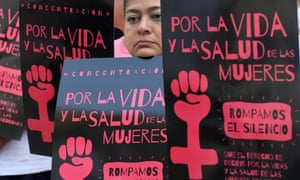
Salvadoran women take part in a demonstration to demand the decriminalisation of abortion in San Salvador on 23 February 2017. Photograph: Marvin Recinos/AFP/Getty Images
A teenage rape victim in El Salvador has been sentenced to 30 years in prison for murder after having a stillbirth, the latest in a long line of failures of justice against pregnant women in the Central American country.
Evelyn Beatriz Hernandez Cruz, 19, from a small rural community in Cuscatlán, eastern El Salvador, was convicted on the grounds that failing to seek antenatal care amounted to murder.
Hernandez, a high school student, gave birth into the toilet in April 2016 after falling ill with acute back and stomach pain.
Hernandez, who at the time was 18, was in her third trimester, but hadn’t realised that she was pregnant. She had been repeatedly raped by a gang member over several months as part of a forced sexual relationship.
Medical experts were unable to ascertain whether the foetus died in utero or in the moments after delivery.
The female judge accepted the prosecutor’s claims that Hernandez failed to seek antenatal care because she did not want the baby, and threw him into the toilet intending to kill him.
In sentencing, the judge went further and suggested that Hernandez could not have acted alone and that her mother may also be criminally responsible.
“The judgment sentencing Evelyn to 30 years in prison shows how in El Salvador justice is applied without direct proof, without sufficient evidence that clarifies what a woman has done,” Herrera said.
Abortion was criminalised in El Salvador 20 years ago, after legislators from across the political spectrum voted to strip women of their reproductive rights without any public debate or medical consultation about the consequences. The 1997 reform was passed after a shadowy campaign by a small group of powerful anti-choice groups linked to the Catholic church.
Hopes had been raised that the ban would be relaxed amid a groundswell of public and medical support for a parliamentary bill proposing to allow abortion in cases of rape or human trafficking; when the foetus is unviable; or to protect the pregnant woman’s health or life.
But four months after the parliamentary hearings ended, the bill remains in the hands of the legislative committee. The nine cross-party deputies have yet to decide whether the bill should be sent to the legislative assembly for a vote.
Hernandez insists that she only realised she had given birth after the fact, when her mother took her to hospital with severe abdominal pain.
Hernandez was arrested after police found the deceased foetus in the toilet. She spent a week handcuffed to a hospital bed while being treated for severe anaemia and a urinary tract infection, and has been detained ever since.
Her lawyer condemned Wednesday’s decision as unjust and unlawful.
“The judge’s verdict doesn’t reflect the evidence presented in court. It’s a decision based on morality, not the law or justice,” said Dennis Munoz.
Lawyers will appeal the verdict, but Hernandez faces a long road to justice.
In 2014 the Citizens’ Group launched a campaign to seek clemency for 17 women wrongly jailed for murder who had exhausted all other legal appeals. Three of the women known as Las 17 have so far been freed; another will be released next year after her sentence was reduced from 30 to 15 years. At least five other women including Hernandez have since been jailed.
Arkansas women may soon be forced to notify their sexual partner or family members if they want to have an abortion, thanks to a provision passed in the state’s 2017 legislative session. H.B. 1566, the Tissue Disposal Mandate, would make it illegal for a woman to have an abortion without communicating with the man who impregnated her — whether that be her husband, boyfriend, a casual hook-up, or a perpetrator of sexual assault.
The new provision is linked to the state’s preexisting Final Disposition Rights Act of 2009. According to that law, family members related to the deceased person have say over what happens to the body.
Under the new provision, embryonic or fetal tissue from an abortion would be considered a “deceased” family member. As such, the woman and father of the fetus have equal say over its disposal. A teenage girl seeking an abortion would have no say because, legally, she would have to be at least 18 to exercise final disposition rights over the tissue. If the girl and her sexual partner are minors, their parents would make the decision. If he is 18 and she is a minor, he has final say.
“What’s most detrimental about this is that they just tied it into an existing Arkansas law that talks about disposing of human remains of any person who is deceased. And that law gets very specific on who has the right to consent,” says Lori Williams, Clinic Director of Little Rock Family Planning Services, one of three abortion providers in the state. “Many of the patients do not wish to involve their partner in the decision to terminate a pregnancy.”
Under current Arkansas law, the physician can dispose of the embryonic or fetal tissue following a surgical abortion or miscarriage through incineration or other means, while women who opt for a medical abortion can dispose of the tissue at home. Under the new provision, physicians will face criminal penalties if they fail to notify the woman’s sexual partner about how he wants to dispose of the tissue.
“He was there at conception so he ought to be there through the whole process,” Republican Representative Kim Hammer, the bill’s primary sponsor, tells Bustle. “I think that all life, from conception through birth and right up through death by natural causes, needs to be treated with dignity, respect, and also a unified approach to deal with the remains.”
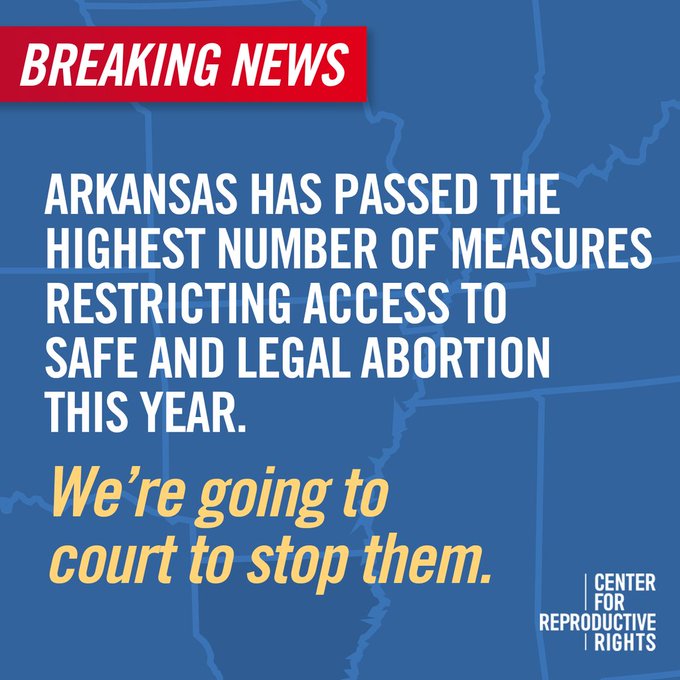
The American Civil Liberties Union, the ACLU of Arkansas, and the Center for Reproductive Rights filed a lawsuit in June, Hopkins v. Jegley, challenging the provision, along with three other measures that they say jeopardize women’s reproductive rights in the state. Talcott Camp, deputy director of the Reproductive Freedom Project at the ACLU, tells Bustle that the involved parties filed a motion requesting the judge to block enforcement of the law while the case is pending.
Currently, the provision is set to go into effect on July 30.
“In most cases, a woman has a circle of support in her decision. But, that circle should include the people she brings in — her family members, her clinicians, her faith leader, her mom. Whoever she brings in, that’s who belongs there,” Camp says. “The state has no business notifying anybody who she does not choose to bring into the circle of her decision process.”
Abortion activists worry that if the provision were to be enacted, it would essentially allow third parties to block the woman’s abortion. While the law does not allow the sexual partner or other family members to explicitly say they want the procedure cancelled, they must all agree on the method of disposal — and could go to court if their opinions clash.
Campfears that if a woman was obligated to go to court, she could be pushed past the point where she is legally allowed to have an abortion in the state. In Arkansas, abortions are banned after 22 weeks.
“This is all happening before she even gets the abortion, because the doctor has to know he or she will be able to dispose of the tissue legally and without facing criminal liability,” Campexplains. “And, meanwhile, time’s just a wasting.”
The lawsuit argues the provision is unconstitutional. In the 1992 Supreme Court case of Planned Parenthood v. Casey, the court struck down a ruling that a woman must notify her spouse to seek an abortion. Arkansas’ Tissue Disposal Mandate would go even further, by requiring notification of any man involved in the pregnancy.
Williams, of Little Rock Family Planning Services, describes the lack of protections for women impregnated through sexual assault or domestic violence as particularly alarming.
“There’s actually no protections whatsoever in place [for sexual assault or domestic violence survivors],” she says, adding, “And, it’s not just about exceptions for rape and incest or sexual assault or domestic violence, it’s a woman not having the ability to make this decision on her own.”
Hammer, the bill’s sponsor, says he doesn’t think the law is intended to be like that. “I can’t speak for judges in the state of Arkansas, but I don’t see judges who ultimately have the control to make that decision applying it that way,” he says when further pressed on the issue. “But, I will tell you, if that becomes an issue I’d be glad to bring clarity to that so somebody who is in that unfortunate situation isn’t required to do that. I don’t agree with the idea that she would have to notify who raped her.”
In 2014, around 4,590 abortions were provided in Arkansas, a 4 percent increase in abortion rates from 2011, according to the Guttmacher Institute. In addition to the provisions set to be enacted in July, the state already has a slew of restrictive abortion measures: a woman must receive state-directed counseling that includes information to dissuade her from the procedure and wait 48 hours before the procedure is provided, and abortion coverage is banned under state insurance exchange plans.
Camp says the hearing requested by the ACLU to delay enforcement of the Tissue Disposal Mandate is set for July 13. In the meantime, she encourages women to stand up against the legislation.
“They should talk to their medical providers and their family members and they should make their representatives accountable,” she says. “This law is blatantly immoral because it’s cruel, cruel, cruel to a woman at a time when what she needs is support and respect.”
Women up to 7 weeks pregnant will be able to get RU-486, province’s health minister promises
The abortion-inducing drug RU-486, marketed by the manufacturer Celopharma as Mifegymiso, has been legally available in Canada since July 2016, at a cost of around $300 for the two-step treatment. (Charlie Neibergall/Associated Press)
The abortion pill will be available to Quebec residents for free by early fall, Quebec Health Minister Gaétan Barrette announced on Thursday.
“The government of Quebec has always been in favour of the right of women to choose, particularly in regards to abortion,” said Barrette.
“The abortion pill is an additional option, among the methods for voluntarily ending a pregnancy, that has certain advantages for women.”
Women who are up to seven weeks pregnant will be able to get the drug, Mifegymiso or RU-486, which is actually a two-medication package, through the province’s health insurance plan, RAMQ.
Manitoba, Ontario, Alberta and New Brunswick have committed to offer it for free but are still working out how to make the drug available and who can prescribe it.
Health Canada approved Mifegymiso in 2015, and Canadian doctors were able to start prescribing it on July 1, 2016.
Barrette said that the Health Ministry decided to offer the drug for free after doing its own analysis to ensure the drug is efficient and safe.
Quebec Health Minister Gaétan Barrette announced the province will offer the abortion pill for free by the end of autumn 2017. (Radio-Canada)
Ultrasound needed
The Quebec College of Physicians is still finalizing how the drug will be offered, the details of which Barrette says will be ready by early fall.
An ultrasound will be mandatory, Barrette said, as well as a follow-up appointment
“The drug cannot be administered and will never be administered if there isn’t proof that the pregnancy is under 49 days of duration. It has to be dated, in all circumstances,” the minister said.
Physicians will also use the ultrasound to ensure women requesting the drug don’t have an ectopic pregnacy, which is when when an embryo implants outside the uterus, usually in the fallopian tubes.
“It is not the morning after or the day after pill, it’s something totally different that might have some complications,” said Barrette.
Women will need a prescription to access the drug, but doctors cannot be forced to prescribe the drug if abortion goes against their personal convictions, Barrette said.
The cost of RU-486 varies but usually is around $300, the price set by the manufacturer, Celopharma.
“We would have gone forward with this decision even if the price was on average a higher cost than the regular surgical procedure. We would have gone forward because we believe, again, that women in this province do have a choice and this is a choice,” said Barrette.
Quebec’s Health Ministry recently negotiated a bulk price for the drug with the manufacturer on behalf of all provinces but would not reveal the price when asked by CBC News, citing confidentiality.
Other provinces across Canada were waiting for Quebec to finish negotiations before determining if and when they’d be able to offer the pill free of charge.
Instead of glowing and nesting and all of the things expectant parents do to prepare for babies, I’ve spent half of my pregnancy worrying about the harm that could be caused by Ohio’s restrictive abortion laws.
Anti-abortion laws like SB 145 might prevent even the best doctors in the world from taking action to save my life. And that’s not pro-life.
Mallory McMaster
Abortion is among the safest medical procedures in the United States. Yet, myths about its safety abound. False Witnesses reveals the individuals behind these lies.
On June 27, 2016, I joined reproductive rights advocates around the country in celebrations after the U.S. Supreme Court released its groundbreaking Whole Woman’s Health v. Hellerstedt decision striking down anti-abortion provisions of a law designed to shut down clinics. After years of legislative setbacks in states all around the country, it seemed like abortion access supporters finally had our day.
But on June 27, 2017, exactly one year after the Whole Woman’s Health decision, I found myself standing in front of the Ohio state Senate Judiciary Committee, sharing my testimony about SB 145, a bill that seeks to ban the most common abortion procedure used for patients after 13 weeks. The bill was passed out of the committee minutes after I testified. The following day, the Ohio Senate moved to turn the bill into law, with a vote of 24 to 9. From there, the bill needs approval from the Ohio house and Republican Gov. John Kasich.
I’m currently seven months pregnant, but I made the trip (despite all the other things I could be doing) because I understand how vital the need for abortion access in Ohio is for people like me. If SB 145 takes effect, physicians would be banned from using a method of abortion that has been proven safe and effective through years of research and medical practice.
The truth is, the fight for abortion access today doesn’t feel much different from the months leading up to the Whole Woman’s Health decision. If anything, today’s battles feel even more desperate when combined with the air of uncertainty around the Supreme Court and its Roe v. Wadedecision. Conservative states have passed staggering numbers of anti-abortion restrictions since the election last November. And my state, Ohio, seems to be leading that charge.
I testified telling my senators how my current pregnancy wouldn’t be possible if I hadn’t had an abortion several years before. At that time, I was trapped in a physically violent marriage. I had absolutely no intentions of starting a family with the person to whom I was married, so I continued to use the same oral birth control method I’d used successfully since high school. Somehow, I got pregnant anyway. By that point, I knew I needed to leave the marriage but I didn’t know how. I did know, however, if I continued the pregnancy, the child and I would never really be safe from the abuse I’d experienced for years.
Making the decision to have an abortion was easy for me. In fact, I often tell people it was the best decision I’ve ever made.
My life has changed quite a bit since I had my abortion. I found the courage and the resources to leave my abusive marriage. I got a degree that allowed me to pursue a career I love; I remarried; and we bought a beautiful home with plenty of room for our growing family. My husband and I didn’t make the decision to grow our family on a whim. We’re organized, methodical people and we try to evaluate the pros, cons, and outcomes of every choice we face.
One of the biggest factors in our decision-making process was our families’ complex medical histories. The list of diseases, conditions, and premature deaths in our family trees spilled over onto two pages. Before we decided to try to get pregnant, I met with a geneticist and a high-risk pregnancy specialist to gauge the likelihood of us having a healthy child. After expensive testing to determine if I had any genetic predisposition to some of the most common hereditary conditions, they gave us a green light but did stress the importance of the 20-week anatomy scan to screen for any issues.
After a few months of planning, testing, charting, and trying, my pregnancy test turned positive. We were elated!
While we were celebrating our good news in Cleveland, abortion opponents in the Ohio legislature were pulling all-nighters and working as fast as they could to pass some devastating new restrictions before their legislative session came to an end at the end of December. They were ultimately successful, passing bills banning abortion at six weeks and 20 weeks before heading home to spend the holidays with their families.
I became pregnant knowing that I had the option to terminate my pregnancy if necessary. These new restrictions felt like a personal, physical attack on my family.
I’d done everything “right.” I was financially secure. I was married. I had great health insurance. Prenatal vitamins. Dental exams. Yoga classes. Dog training. Not cleaning the litterbox. I stopped eating sushi. Everything society tells women they have to do if they want to be a good mother, I did. Yet still, somehow, it wasn’t enough. That legislation, a measly piece of paper, suddenly stood between me and my ability to make the best decisions about my pregnancy. I panicked.
I briefly considered having an abortion.
I was desperate to do everything possible to ensure my child’s well-being, even if it meant terminating the pregnancy. Ultimately, I came to the conclusion that I wasn’t going to let legislators who have never met me prevent me from becoming a parent on my terms. Instead I mapped out the closest abortion clinics in nearby states and saved a mental list of places that could help me if doctors in my own state suddenly could not. This was far from an ideal solution, given the fact that even though I lived less than two miles from one of the best abortion clinics in the country, I would still have to miss extra work, drive hundreds of miles, and stay in a lonely hotel to get the care I needed. I told myself I was “lucky” enough to have the financial and emotional support necessary to do that, but I didn’t feel very lucky.
A few days later, we learned that the governor blocked the six-week ban, but allowed the 20-week ban to move forward. I was still devastated, but at least I knew what my timeline was. I immediately called my high-risk OB-GYN and asked how early I could schedule my genetic testing and 20-week anatomy ultrasound. My hospital and insurance company wouldn’t allow me to complete the anatomy ultrasound before 19 weeks and I knew that Ohio law meant I wouldn’t have enough time. What if I wanted a second opinion? What if I needed some time to think? What if the fetus wasn’t cooperating and they couldn’t get a clear shot of the heart, lungs, and brain that day? They were sorry, but there was nothing they could do. The test just wasn’t as reliable before 19 weeks.
My only option was noninvasive prenatal genetic testing. A seemingly simple blood test that identifies fetal chromosomes and screens—it doesn’t diagnose, it just screens—for genetic problems. I could have the testing done as early as nine weeks. The catch? My insurance policy wouldn’t cover the $10,000 fee. They preferred that women wait for their 20-week anatomy scan. I tried to explain why I needed to know if something was wrong before then, but my insurance company representatives basically told me it wasn’t their problem.
We decided to do the testing—again, something I was unbelievably lucky to be able to afford, but something I shouldn’t have had to do in the first place. The results came back three weeks later with good news. We were having a boy, and the lab didn’t detect any chromosomal abnormalities. I breathed a small sigh of relief and started counting down the days until my anatomy ultrasound.
I was nervous walking into the hospital that morning. I tried to prepare by reading about conditions that are commonly diagnosed during these scans so I could maybe feel confident about making a very quick decision to terminate the pregnancy if they found something that could hinder my child’s well-being. Ideally, I would have planned to meet with specialists and genetic counselors before making a decision that monumental, but thanks to Ohio’s 20-week abortion ban, combined with a mandatory 24-hour waiting period after signing consent paperwork, I didn’t have time to consult doctors. If I needed to schedule an abortion, I would have to do so that day. I tried not to think about how I would feel afterwards. Would I spend the rest of my life second-guessing that quick decision? Who knows.
The scan turned out fine. My baby looked perfect, with a heart, two kidneys, two lungs, a spine, and two enormous feet. As I was driving home, I felt some of the tension and stress I’d had for the last five months start to leave my body, but it was quickly replaced by anger. This should have been the happiest time of my life! Instead of glowing and nesting and all of the things expectant parents do to prepare for babies, I’d spent half of my pregnancy worrying about the harm that could be caused by Ohio’s restrictive abortion laws.
About a month later, I found myself facing yet another circumstance where my health-care options could be limited by Ohio’s abortion restrictions. I felt funny one afternoon so I checked my blood pressure. It was 180/98. I called my doctor who told me to go to the hospital immediately. It was still dangerously high 30 minutes later while I was being strapped to fetal monitors, heart rate monitors, and having a bunch of blood drawn. After a couple of hours of rest and fluids, my blood pressure was low enough to go home, but I got a stern lecture from an OB about the dangers and warning signs of preeclampsia and gestational hypertension—conditions that happen quickly and can be fatal for pregnant women. I promised to stay hydrated and check my blood pressure every day at home.
While we were pulling out of the hospital parking garage to go home, I told my husband how scary that felt. He grabbed my hand and said, “This is one of the best hospitals in the country. They aren’t going to let anything happen to you.” I just smiled and squeezed his hand, but deep down, I knew that wasn’t entirely true: Politicians can keep me from getting the care I need. Anti-abortion laws like SB 145 might prevent even the best doctors in the world from taking action to save my life. And that’s not pro-life.
The state of Oregon has long been sensitive to women’s reproductive rights. It remains the only state that doesn’t enforce any regulations on abortion access, and lawmakers in that state are aiming to keep up that reputation regardless of what the future might bring. Some lawmakers in Oregon have moved to protect abortion rights in seriously significant ways, and it’s an important move that other states should follow (though that seems unlikely) because abortion is health care.
As Senate Republicans continue to move forward with a new plan to repeal and replace the Affordable Care Act, the Obama-era health care legislation, Oregon Rep. Julie Fahey hopes to take steps to protect abortion rights in her state. With that in mind, Fahey sponsored a bill that would offer free abortions and postnatal care to all women in the state even if insurance providers are no longer required to cover these services. The coverage would also extend to an estimated 22,000 undocumented immigrants. Fahey explained to The Hill that this bill is following the lead of several other states who have taken precautionary measures if the ACA is repealed.
The Better Care Resolution Act, Senate Republicans proposed ACA replacement bill, essential health benefits could very well be in jeopardy if passed. The BCRA, if passed, would offer states the opportunity to waive essential health benefits rights.
We are here for you! Healthcare happens here at Planned Parenthood of Southwestern Oregon!
Fahey’s bill in Oregon aims to protect women in the state from losing their rights to essential health benefits. The plan would be to use $10 million to cover the potential costs of these abortions, including abortions for women who are not covered under the federal health care plan. If the bill is passed, Oregon would follow in the footsteps of California, Maryland, Connecticut, and Washington state (The Hill reported that Delaware is in the midst of implementing similar protections). Each of those four states have instituted legal protections at the state level to protect abortion access if the Supreme Court overturnsRoe v. Wade.
Since Roe v. Wade afforded women access to abortion, statistics have shown a marked increase in their earning potential. Between 1970 and 1990, there were 30 percent more women searching out skilled careers than before. According to a study performed by the Guttmacher Institute:
And the reality is that denying women access to abortion services ends up ultimately costing the government a lot more; take Texas, for example. In 2011, Texas lawmakers were looking to cut family planning funding by $73 million. When they realized this would potentially mean paying for 24,000 extra births to the tune of $273 million (based on medical expenses through Medicaid), they began to have second thoughts.
In other words, that proposed $10 million expenditure could end up saving the taxpayers of Oregon in the long run, according to Think Progress.
Scott Olson/Getty Images News/Getty Images
Oregon Gov. Kate Brown is expected to see this new bill over the next few days, but could face a considerable amount of resistance from state Republicans, despite the fact that Democrats control the state legislature. One Republican, Oregon Senate Republican Conference spokesperson Jonathan Lockwood noted, according to Mediate:
The only problem with Lockwood’s arguments is that none of them are true. 99 percent of abortions occur before 21 weeks of pregnancy, and sex-selective abortions just do not happen (and laws that seek to ban sex-selective abortion under the guise of protecting female fetuses are often steeped in racist stereotypes about Asian women).
One thing we know for certain; the lawmakers of Oregon are persisting and resisting. And it’s a good day for reproductive rights in the state, regardless of whatever rhetoric might come from detractors.
When a former reality TV star turned president of the United States is running an administration that resembles a massive dumpster fire, it’s hard to focus on much. When Trump is trying to pass religiously motivated travel bans, attacking judges, insulting our nation’s allies, and more, it can be difficult to remain aware of what else is happening around you — even in your own backyard.
Anti-choice politicians at the state level know this, and while they think we’re not looking, they’re pursuing dangerous new tactics in their assault on reproductive freedom. These days, state politicians don’t just want to defund Planned Parenthood or pass bills that would force the closure of dozens of abortion clinics in their states. Now, they’re implying that it’s okay for bosses and landlords to retaliate against people for their reproductive health care decisions.
Let me be explicit: these politicians suggest that your boss should be able to fire you, and your landlord should be able to evict you, for taking birth control. Or for being a single mom. Or for having an abortion. And no, this isn’t an exaggeration.
Just three weeks ago, anti-choice Gov. Eric Greitens (R) of Missouri called the state legislature back to the capital for a wasteful, unnecessary, taxpayer-funded “emergency” special session to try to impose new restrictions on reproductive health care, while decrying a St. Louis ordinance that protects women from discrimination for their reproductive health choices from both bosses and landlords. This session had nothing to do with the priorities of hard-working Missouri women and families and everything to do with controlling women and restricting our access to health care.
It’s easy at times like these to feel truly hopeless, when your most basic right to control if, when, and how to have kids is under siege. But when we come together to fight back against these truly backwards proposals, we can win. And the numbers are on our side.
This type of organizing works. Just last week, the California State Assembly passed a bill, with overwhelming support from elected officials on both sides of the aisle, that would protect women from discrimination and keep bosses and landlords out of their reproductive decisions. In Nevada, where our progressive activists helped flip the state house from anti-choice to pro-choice in November, the state legislature passed the first pro-choice bill related to reproductive health care access in 18 years. This law codifies the birth control coverage benefit in our nation’s health care law, which means women in Nevada won’t have to pay out-of-pocket costs for birth control, even if Trump and anti-choice Republicans in Congress succeed in ripping apart that policy. Other states have passed similar laws to protect and expand birth control access, including laws that let a woman get up to 12 months of birth control at once.
If we want to make sure anti-choice politicians don’t drag us backward on the path toward gender equality and freedom, we need to rise up and call out Republican attempts to put a single-minded agenda ahead of our best interests. Now is the time to rally behind the true values of freedom and equality and to fight back against any and every attempt the anti-choice movement makes to hold women down as less than equal.
Welsh and Scottish leaders follow UK government with committment to fund procedures despite objections from DUP
Nicola Sturgeon, the Scottish first minister. Photograph: Ken Jack/Corbis via Getty Images
The Welsh and Scottish governments will offer free abortions to Northern Irish women, their leaders have confirmed, after the UK government said last week it would fund the procedures in order to head off a Commons revolt on the Queen’s speech.
The confirmation came as the Democratic Unionist MP Ian Paisley Jr said his party would not compromise its hardline stance on abortion, even if it meant risking the supply-and-confidence agreement with the Conservatives.
Carwyn Jones, the Welsh first minister, told the Welsh assembly on Tuesday that the Labour administration would match the government’s promise to fund abortions for women travelling from Northern Ireland.
Northern Ireland has some of the most restrictive abortion laws in Europe making it near impossible to have the procedure. Women who travelled to England, Scotland or Wales faced charges of about £900 to have an abortion on the NHS, despite being UK taxpayers.
Though the Department of Health fought a supreme court challenge to defend the charges, last week the UK government dramatically changed its policy in an attempt to head off a damaging Tory rebellion on the Queen’s speech, with as many as 40 Conservative MPs indicating they supported an amendment on the issue tabled by Labour MP Stella Creasy.
As pressure mounted, Justine Greening, the education secretary and equalities minister, wrote to MPs confirming the government would fund abortions for Northern Irish women in England, and Creasy withdrew her amendment claiming victory.
The Scottish first minister, Nicola Sturgeon, said her government would set out its own policy to ensure women from Northern Ireland did not have to pay for terminations.
“The first minister has already made clear that the Scottish government would look into the provision of abortion in Scotland to women from Northern Ireland,” a Scottish government spokesman said.
“The Scottish government’s view is that abortion should be part of standard healthcare for all women, and available free from stigma. The Scottish government believes that a woman from Northern Ireland, in Scotland, should be able to access an abortion for free on the same basis as women in Scotland and we will set out shortly how that can be achieved.”
MPs from both sides of the House had expressed concern that the government may have been unwilling make the change given the deal between the Conservatives and the DUP.
Abortion rights for Northern Irish women was not a direct topic of negotiations between No 10 and the DUP, but Paisley made it clear in the Commons on Tuesday that his party would oppose any changes.
“I want to make it absolutely clear that the rights of the unborn child in my view and in the views of people from my party and on this bench trump any political agreement that has been put in place,” he said.
“I am making that abundantly clear. And if anyone takes a view that we would trade that issue of life and the sanctity of life on a political deal, they don’t understand me and they don’t understand my party and they need to be aware of that. And for it to be characterised in that way I think is grossly unfair and to members of my party.”
Paisley said the DUP believed a foetus “is a human being, it feels pain and emotion and is faithfully and wonderfully made… My party will take a stand on that issue irrespective of the political agreements that are reached.”
He went on: “I say that as a warning to others who may seek to raise it in the House in the weeks and months and hopefully years ahead.”
Greening is due to meet Creasy this week, along with charities who have campaigned on the issue, to set out the details of the funding in England.
Over the weekend, the British Pregnancy Advisory Service (Bpas) said it would remove all consultation and treatment fees for women in Northern Ireland, saying it was concerned that some may delay treatment as they waited for the commitment to be put in motion.
“While abortion is a very safe procedure, the earlier it can be performed the better for women’s mental and physical health,” the charity said in a statement.
“We hope our decision will provide clarity for women and what can be an extremely anxious time. Women who have been treated by bpas since Friday will have their fees refunded. Bpas looks forward to working with the government to put the new funding scheme in place as soon as possible.”
“There is so much that we can already do, but now the presidential administration, as well as our friends in Congress, are making it even easier for us,” said the Rev. Frank Pavone of Priests for Life.
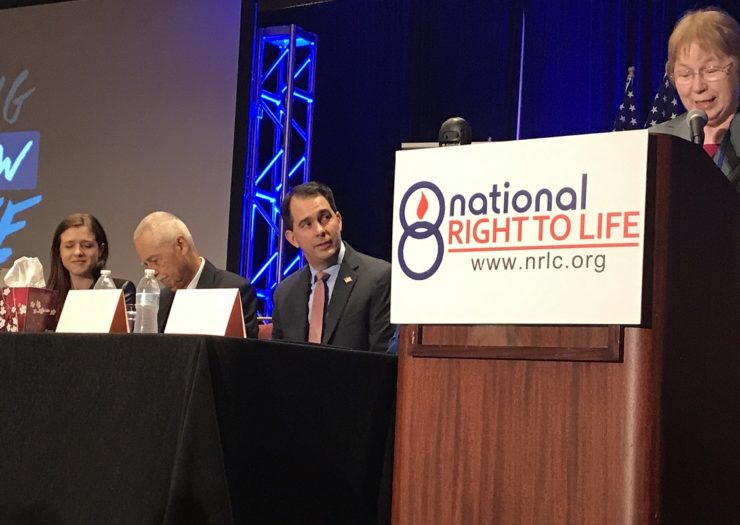
Wisconsin Gov. Scott Walker was among several state anti-choice politicians who appeared at the convention to advertise their anti-choice bona fides.
Amy Littlefield / Rewire
Evidence provided to Congress by state attorneys general and health departments proves that abortion is both extremely safe and highly regulated. Searchable by state.
On the final day of the National Right to Life Convention, the handmaids arrived.
They milled around the lobby of the hotel in downtown Milwaukee, clad in red habits and white caps; their faces veiled, they spoke only to tell passersby, “Blessed be the fruit.”
The protest on Saturday capped a three-day event featuring sessions that may not have seemed out of place in Margaret Atwood’s misogynist dystopia—from “Pro-Life Concerns About Girl Scouts” to “Defeating Planned Parenthood’s Abortion Empire.” Speakers included Wisconsin Gov. Scott Walker (R) and a host of other state politicians, as well as David Daleiden, who faces ongoing prosecution in California for his covert filming of Planned Parenthood officials.
At least year’s convention, the National Right to Life Committee (NRLC)’s political arm had yet to endorse presumptive Republican presidential nominee Donald Trump, who once declared himself “very pro-choice.”
But this year, even as Trump faced a public firestorm for what some considered among his most offensive social media posts to date, officials made it clear how firmly they have embraced him.
“He’s doing an amazing job,” NRLC President Carol Tobias told Rewire in an interview. “For the pro-life movement, of course, I think the highest priority for everyone [was] the appointment of Neil Gorsuch to the Supreme Court.”
Tobias also cited Trump’s expansion of the Global Gag Rule; his elimination of U.S. funding to the U.N. Population Fund; and his commitment to defunding Planned Parenthood, a provision contained in a Republican health-care bill sputtering its way through the Senate.
“We’re just very pleased with President Trump and what he has been doing,” Tobias said.
Pressed by Rewire on some of Trump’s other positions, including his refugee and visa order— also known as the Muslim ban—and recent Twitter attack on MSNBC anchor Mika Brzezinski, Tobias declined to comment.
“I’m not going to get into it,” Tobias said of Trump’s Thursday post claiming Brzezinski was “bleeding badly” from a facelift, even as the backlash flashed on TV screens in the hotel lobby.
Among other victories for the anti-choice movement, Trump signed an executive order in May to gut the Johnson Amendment, which prevents tax-exempt organizations like churches from making political endorsements or electioneering for candidates.
“There is so much that we can already do, but now the presidential administration, as well as our friends in Congress, are making it even easier for us,” the Rev. Frank Pavone of Priests for Life told attendees of one panel on mobilizing churches for the anti-choice cause.
Pavone, who has been among Trump’s most vocal defenders in the anti-choice movement, told Rewire he had not yet seen the most recent round of sexist tweets. But he outlined a pragmatic approach to Trump, comparing him to an auto mechanic.
“If I ask the question, do I want everybody to be virtuous? Yes, I do,” Pavone told Rewire. “But if I’m going to get my car fixed, I’m not there to clean up the guy’s language, I’m there to get the car fixed. If you can do it, I choose to pay you, I’m hiring you to fix my car. That’s what we’re doing with the president.”
“Rewire Is Part of the American Pravda”
It’s difficult to plan ahead right now, David Daleiden acknowledged.
Speaking to a conference attendee who approached him within earshot of Rewire about organizing a visit to Kentucky this year, Daleiden cited the unpredictability of his schedule. He faces civil lawsuits and an ongoing prosecution in California for secretly filming abortion providers while posing as a representative for a fake company. He and his front group, the Center for Medical Progress, edited the videos to make it seem as if Planned Parenthood was profiting off fetal tissue donations. A series of investigations have found no wrongdoing by Planned Parenthood.
Addressing the convention Friday, Daleiden was greeted with thunderous applause and standing ovations, hailed by mistress of ceremonies Pam Rucinski as “one of the heroes of our time.” He touted efforts by states to strip funding from Planned Parenthood following the videos’ release.
“And now the U.S. Congress is on the brink of sending a bill to President Trump to sign to stop forcing taxpayers to prop up Planned Parenthood’s abortion empire with hundreds of millions of dollars every year,” Daleiden said to a cascade of applause.
After his speech, Rewire asked Daleiden about the impact of his videos and whether he intentionally violated a court order by releasing more of them in May.
“Rewire is part of the American Pravda,” Daleiden said, referring to the Russian newspaper that was once the official paper of the Communist Party of the Soviet Union. “You guys are very fake news. I’m not going to talk to Rewire.”
His words reflected a general tenor of anti-journalism throughout the conference, as speaker after speaker condemned and mocked outlets from the New York Times to the Washington Post to CNN; here, again, they seemed in lockstep with Trump, who posted a video on Twitter Sunday that showed him pummeling a figure whose head was replaced by the CNN logo.
“We Attempt to Keep It Extremely Single Issue”
The convention came on the heels of projections from the Congressional Budget Office that 22 million people could lose their health insurance over the next ten years under the Senate health bill—the Better Care Reconciliation Act. The NRLC has focused its lobbying efforts on the bill’s anti-choice provisions, including defunding Planned Parenthood for a year and blocking tax credits for plans that cover abortion.
During NRLC Legislative Director Jennifer Popik’s panel on health reform, an audience member asked why Obamacare shouldn’t just be left to collapse on its own, as some Republicans claim it will.
“We don’t want people going without coverage, I think, as pro-lifers,” Popik responded. “We do want people having access to health care, life-saving health care.”
But pressed by Rewire on whether the organization has raised these concerns as part of its lobbying efforts—and whether the bill can be considered “pro-life,” given its projected effect—Popik demurred.
“We try to be careful, in terms of, we’re very single issue,” she said, while voicing skepticism about the 22 million number. “I guess the point here is that we attempt to keep it extremely single issue, but we do have that concern high in mind.”
Wisconsin Gov. Scott Walker has backed Wisconsin Sen. Ron Johnson’s opposition to the Senate health bill, calling for changes to protect the system in the state, where Walker has rejected federal Medicaid expansion money but still managed to cover everyone living at the poverty level using state funds and another Obamacare provision.
Speaking to Rewire after his address, Walker seemed confident the Senate bill will ultimately pass, following adjustments.
“I think they’re going to get it through,” Walker said.
Asked about Trump’s attack on Brzezinski, Walker said, “I’ll leave that for [Trump and the White House] to comment on.”
Walker was among several state anti-choice politicians—including House Speaker Paul Ryan, Rep. Glenn Grothman, Lt. Gov. Rebecca Kleefisch, and Wisconsin Attorney General Brad Schimel—who appeared at the convention to advertise their anti-choice bona fides. Ryan did so via video message.
Science From the Book of Genesis
While the political landscape has shifted seismically, much of the content at this year’s convention was recycled from previous years, including its reliance on junk science.
“Here we are talking about abortion and breast cancer again,” endocrinologist Joel Brind said, noting he has been speaking about the topic at this conference since 1993.
Brind continues to promote claims of a link between abortion and breast cancer, relying on a shadowy conspiracy theory about the National Cancer Institute suppressing evidence of the link. Rewire has debunked his claims in our “False Witnesses” series.
Brind also delivered a lecture titled, “We’re All Blobs of Tissue Now! How the Culture of Death Has Corrupted the Science of Life.” It featured a slide of the molecular structure of sex hormones, which he seemed to suggest made a case for the immutability of gender and the creation of Eve from Adam’s rib.
“You get this amazing sequence that is right out of the Book of Genesis,” Brind said. “You take a regular scientist, someone who does not give any credence to the scriptures, and they would never think of this, because they would dismiss it.”
Brind acknowledged he teaches this material, as well as the purported abortion-breast cancer link, to students in his classes at Baruch College, the flagship school of the City University of New York, one of the nation’s leading public universities.
Handmaids Asked to Leave
The handmaids didn’t linger for long in the lobby of the convention’s Hyatt Regency, because they were swiftly kicked out by a hotel manager. One of the handmaids, who spoke to Rewire on condition of anonymity, said the manager told them she was “pro-life” and they were offending her. The manager, who identified herself to Rewire only by her first name, Maria, denied expressing her personal opinions, saying the women were told to leave because their outfits were scaring children.
“I asked them if they could change; they’re more than welcome to stay on property and express their opinions, they just need to change, so as not to intimidate my guests,” Maria told Rewire. “They refused, and that’s why they had to leave.”
The women had rented a room at the hotel.
The imagery of the handmaids has found new resonance following the presidential election and in combination with the new TV series based on Atwood’s 30-year-old novel. Similar actions have cropped up in the Texas state legislature and at the U.S. Capitol.
“It shows a future where women’s bodies are just vessels for producing children and that they don’t have rights, that it’s controlled by the state,” the protester told Rewire. “It’s not even that dystopian anymore, this is literally happening right now.”
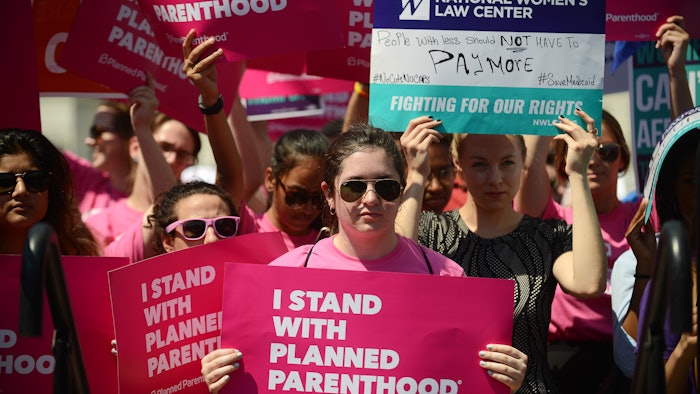
Health-care activists with Planned Parenthood and other groups protest the Republican health-care bill on Capitol Hill on June 28. (Joshua Roberts/Reuters)
By Nicole LewisJune 30
Four Planned Parenthood clinics in Iowa plan to shutter on Friday, following then-Gov. Terry Branstad’s approval of a budget in May that stripped the organization of its Medicaid funding.
Planned Parenthood officials said the closures will affect one-third of its clinics in Iowa and will cut off access to essential health-care services like cancer screenings and annual checkups for nearly 15,000 women.
The nonprofit organization — which provides birth control, breast cancer screenings and other women’s health services but has become a political lightning rod for its abortion services — says the closures foreshadow what could happen across the country should Republicans’ health-care bill become law. The Senate bill contains a provision, which closely mirrors the Iowa law, that would eliminate Planned Parenthood’s Medicaid funding for one year. Some clinics could lose as much as 40 percent of their funding.
“What’s happening in Iowa is heartbreaking,” Cecile Richards, president of Planned Parenthood Federation of America, said in an email. “If Trumpcare is passed into law, we’ll see that kind of devastation happen nationwide, with far too many women simply going without the health care they need. ”
Community members, Planned Parenthood staff and patients held vigils on Thursday over the closing of the clinics in Burlington, Quad Cities, Keokuk and Sioux City.
More than half of Planned Parenthood patients are insured through Medicaid, according to the organization.
“It’s devastating,” said Burlington resident Laura Blanchard, who has used Planned Parenthood services. She said she knows of only one other reproductive health-care option in her town targeted to low-income women and women on Medicaid.
“This community cannot afford to lose a health-care provider like Planned Parenthood,” she said.
The Planned Parenthood clinics in Burlington, Sioux City and Keokuk provided health care and contraceptives to 80 percent or more of the women in the area, said Beth Lynk, Planned Parenthood’s state policy press officer. Women in Keokuk, a small town located in rural Lee County, will be an hour away from the nearest low-cost family planning provider.
Proponents of defunding Planned Parenthood argue that other providers can absorb Planned Parenthood patients that need family planning services. The state plans to funnel about $3.3 million into a program that would fund family-planning clinics that don’t provide abortions, according to the Des Moines Register.
Branstad, a Republican who is now the U.S. ambassador to China, endorsed the plan during his Condition of the State address in January, saying the budget proposal “redirects family planning money to organizations that focus on providing health care for women and eliminates taxpayer funding for organizations that perform abortions.”
In April, Iowans for Life Executive Director Maggie DeWitte told the Registershe supported shifting funds to such community health centers.
“I would say this is fantastic news for women and families in the state of Iowa,” DeWitte said of the Planned Parenthood closures. “We have said from the very beginning that there are many, many other qualified health centers that provide comprehensive health care for women.”
The budget cuts to Planned Parenthood were unpopular among Iowans. In February, a poll conducted by the Des Moines Register found that 77 percent of adults surveyed were in favor of continued funding for the clinics. Additionally, 62 percent of Iowa Republicans surveyed were also in favor of continued funding.
Iowans sentiments are on par with attitudes nationwide, with 80 percent of Americans and 67 percent of Republicans opposed to cutting Planned Parenthood funding, according to a recent Quinnipiac University poll.
As the nation’s largest abortion provider, the 100-year-old nonprofit has sustained attacks at both the state and federal level, although the clinic does not use Medicaid funding to provide abortion services.
Planned Parenthood is planning to close six more clinics in Wyoming, Colorado and New Mexico. The closures were not a result of funding cuts, but concerns over political attacks played a role in the decision, officials said. The clinics also suffered from declining revenue under the Affordable Care Act, which expanded Medicaid to some patients who had previously paid out-of-pocket, officials said. Medicaid reimburses the clinics at a lower rate, they noted.
Once the clinic in Wyoming closes the state will become one of two in the country without a Planned Parenthood clinic, along with North Dakota.
In 2011, the Texas legislature effectively defunded Planned Parenthood by reducing the two-year budget for family-planning funding from $111 million to $38 million. As a result, one out of every four clinics in the state closed.












 Abortion - Abortion Clinics, Abortion Pill, Abortion Information