Rights groups seek commitment from UK government as Theresa May holds talks with anti-abortion DUP

Pro-choice campaigners in Belfast

Pro-choice campaigners in Belfast after a woman was convicted last year for procuring an abortion. Photograph: Charles McQuillan/Getty Images
More than 700 women travelled from Northern Ireland to England for an abortion in 2016, obliged to travel because the procedure remains illegal in most circumstances in the region.

Figures released by the Department of Health on Tuesday will attract renewed attention to Northern Ireland’s restrictive abortion legislation as Theresa May holds talks with the leader of the Democratic Unionist party, Arlene Foster, about a deal to allow the Conservatives to govern the UK.

The number of women travelling from Northern Ireland to England for an abortion fell slightly last year to 724, from 833 in 2015. It is thought the use of abortion tablets bought online and supplied by post – a cheaper option than travelling, but also illegal in Northern Ireland – may have increased.

Northern Ireland has the harshest criminal penalty for abortion of any country in Europe – up to life imprisonment for both the woman having the procedure and anyone assisting her.

A woman is being prosecuted in Northern Ireland for helping her 15-year-old daughter procure abortion pills online, after a doctor at a clinic where she had sought advice from her GP reported her to the police. Last year a woman was prosecuted for taking abortion pills after her flatmates reported her to the police.

The DUP has indicated that social issues will not be part of their demands in talks with the Tories about a Westminster pact, but on Saturday the Conservative MP and former Northern Ireland secretary Owen Paterson highlighted the possibility that there could be a parliamentary debate on further reduction of abortion time limits in the next few years. Last year, Foster said: “I would not want abortion to be as freely available here as it is in England.”

Amnesty International has called on the UK government to commit to pushing for abortion law reform in Northern Ireland. Grainne Teggart, of Amnesty’s Belfast office, said on Tuesday: “The UK government has a responsibility to deliver abortion rights for women in Northern Ireland. A failure to do so would be a cruel betrayal of women. Whilst health and justice are devolved matters, the UK government is responsible for upholding human rights.

“We are today calling on the next UK government to commit, particularly in the absence of functioning devolution, to prioritise bringing Northern Ireland’s abortion laws in line with international human rights standards. This must include the decriminalisation of abortion.”

Mara Clarke, the founder of the Abortion Support Network, a charity that gives financial assistance to women from Northern Ireland and the Republic of Ireland to travel to England for treatment, said her organisation had had a 24% increase in calls from women asking for help in the past year, as news of prosecutions created a climate of fear.

She said the DoH figures did not capture the numbers of women who did not have the money to travel to England for a termination.

“We’ve heard time and time again from women forced by the despair induced by a combination of poverty and draconian abortion laws who have taken matters into their own hands – by ingesting chemicals, by overdosing on medications, by drinking excessively, by literally throwing themselves down stairs to try and induce miscarriage,” she said.

Natika Halil, the chief executive of the sexual health charity FPA, said the decline in the number of women travelling for an abortion was “likely to mean that more women were unable to travel or afford the cost, and therefore were forced to continue with an unwanted pregnancy or risk prosecution by buying abortion pills online”.

“FPA believes that the government must legislate for abortion law reform in Northern Ireland. The UK government is responsible for human rights across the UK, and the United Nations and UK courts have ruled on multiple occasions that Northern Ireland’s restrictive law contravenes these rights,” she said.

She said the Conservative party “must use any partnership with the DUP to discuss the impact of Northern Ireland’s abortion law and bring it into the 21st century”.

The DoH figures show there were also declines in the numbers of women travelling from the Isle of Man and the Republic of Ireland to England for abortions.

On Wednesday, the supreme court will rule on whether it is unlawful for the NHS in England to deny free treatment to women from Northern Ireland. They currently have to pay for the procedure because the health secretary has a policy of not funding medical services that would be unlawful if received in Northern Ireland.

The case involves a 15-year-old, known as A, who went to Manchester with her mother, B, and paid £600 for an abortion on top of £300 in travel costs. They are arguing that the NHS treatment should have been free because A is a UK citizen.

https://www.theguardian.com/uk-news/2017/jun/13/abortion-figures-prompt-fresh-calls-for-reform-of-northern-irish-law

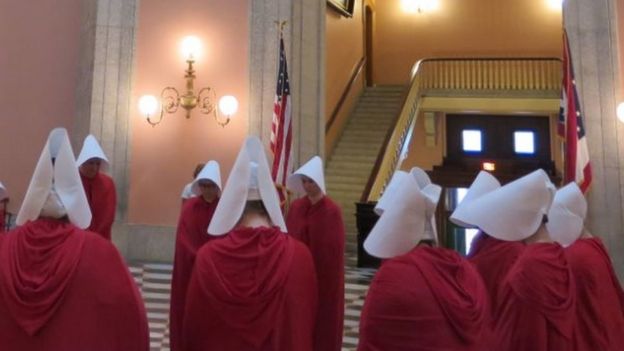
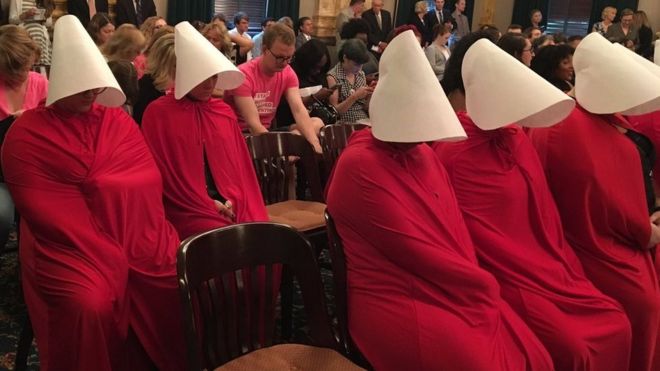
Handmaid's Tale ant-abortion protesters in Ohio (13 June 2017)
Image copyrightJO INGLES, OHIO PUBLIC RADIO/TV STATEHOUSE NEWS
Image captionThe Handmaid’s Tale has inspired several protests in the US this year

Activists in the US state of Ohio have been inspired by The Handmaid’s Tale in their protest against a bill placing more restrictions on abortion.

Several women held a silent protest in red robes and white bonnets – like the characters in the dystopian novel and TV series where fertile women are captured and forced to have children.

The proposed state legislation would ban a method of abortion commonly carried out in the second trimester.

Critics call the bill unconstitutional.

Senate Bill 145 is sponsored by members of Ohio’s Republican party who say they want to end what they describe as inhumane and brutal dismemberment abortions.

The bill makes an exception where the mother’s life is in danger.

However, opponents say the ban against dilation and evacuation is an attempt to block access to a common and safe abortion method.

They also argue it would particularly affect women who already struggle to obtain access to an abortion.

Handsmaid Tale protesters in Ohio Statehouse rotunda (13 June 2017)
Image copyrightJO INGLES, OHIO PUBLIC RADIO/TV STATEHOUSE NEWS
Image captionThe protesters gathered in the Ohio Statehouse rotunda

The Handmaid’s Tale has inspired several protests against anti-abortion bills this year, including in Texas and Missouri.

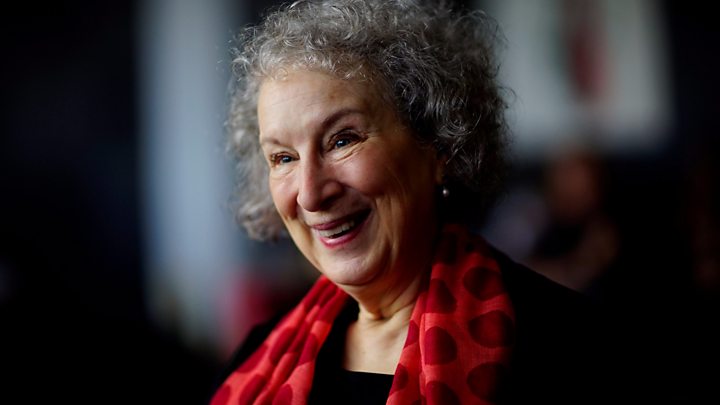
The novel, by Margaret Atwood, is set in a future, dystopian America, where a violent dictatorship has been imposed and women have been stripped of all their rights.

In the novel, much of the population has become sterile, so the few remaining fertile women are captured and given to society’s highest-ranking men as “handmaids”, to bear the children.

Speaking to the BBC in October, Atwood said the book still had resonance, and had become a meme, because “the religious right in the United States has not faded away”.

Anti-abortion activists have been energised by the Republicans gaining control over the White House and Senate in November’s election.

President Trump has in the past expressed support for a woman’s right to have an abortion, but during the campaign announced that his views on the subject “have evolved”.

He told an interviewer that he favoured “some form of punishment” for women who have abortions, but changed his position only hours later to say only the person performing the abortion should be punished.

http://www.bbc.com/news/world-us-canada-40264004?ocid=socialflow_facebook&ns_mchannel=social&ns_campaign=bbcnews&ns_source=facebook

A girl in Ireland was sent to a mental health facility against her will after telling her doctor that her pregnancy was making her suicidal.

The girl, who was a minor, traveled to Berlin with her mother in late 2016 where she thought she could get an abortion, CNN reports.

However, instead of being granted permission to terminate her unwanted pregnancy, she was told that an abortion was “not the solution for all the child’s problems at this stage.”

She was brought to a psychiatric clinic – seemingly without consent or even awareness – under the Mental Health Act, which allows for the involuntary institutionalization of people with psychological disorders.

She was detained for days, according to a new report published by the Child Care Law Reporting Project, which examines and reports on child care proceedings in Irish courts.

Under European Union law, the minor’s identity and age have been withheld.

According to the Irish Times, the psychiatrist evaluated that the girl was depressed and had suicidal thoughts, and went on record to state that terminating the pregnancy wasn’t the “solution” in this case.

“This could be managed by treatment and that termination of pregnancy was not the solution for all the child’s problems at this stage,” the psychiatrist reportedly revealed.

A second psychiatrist examined the patient a few days later and said while the girl might be depressed, “there was no evidence of a psychological disorder.”

“As the young girl did not have a mental illness she could not be detained under the Mental Heath Act. The consultant psychiatrist also reported that the young girl had very strong views as to why she wanted a termination of her pregnancy,” they added.

Ireland has the strictest anti-abortion laws in Europe. The Eighth Amendment, passed in 1983, declares the life of an unborn child equal to the life of a mother and prohibits abortion in all cases – including rape, incest, and the mother’s health – unless the mother’s life is in immediate danger (under the 2014 Protection of Life During Pregnancy Act.)

Abortion Rights Campaign spokeswoman Linda Kavanagh said, “It’s hard not to think that the psychiatrist in this case essentially used the Mental Health Act as a tool to force a child into continuing an unwanted pregnancy because of their own personal beliefs.”

More than 3,000 women with Republic of Ireland addresses visited England and Wales for abortions in 2016, according to figures from the UK Department of Health.

The UN has deemed Ireland’s abortion ban inhumane.

http://nypost.com/2017/06/13/young-woman-sent-to-psych-ward-after-asking-for-abortion/?utm_campaign=SocialFlow&utm_source=NYPFacebook&utm_medium=SocialFlow&sr_share=facebook

Nurse with woman
Image copyrightPHOTO SCIENCE LIBRARY

The UK’s highest court has rejected an appeal by a mother and daughter in their legal battle for women from Northern Ireland to receive free abortions on the NHS in England.

The Supreme Court challenge centred on the case of a Northern Ireland woman who became pregnant when she was 15.

She went to England with her mother for an abortion in a private clinic in 2012, at a cost of about £900.

Northern Ireland’s abortion law is much stricter than the rest of the UK.

Terminations are only permitted if a woman’s life is at risk, or there is a permanent or serious risk to her mental or physical health.

Rape, incest and fatal foetal abnormalities are not circumstances in which abortions can be performed legally in Northern Ireland.

Judges ‘sharply divided’

The mother and daughter took the case against UK Health Secretary Jeremy Hunt, who conceded that he had the power to make provisions for Northern Ireland residents to access free NHS abortions in England.

Positive pregnancy test
Image copyrightHIGHMAGAZIN
Image captionSupreme Court judges dismissed the mother and daughter’s appeal by a narrow majority of three to two

They claimed that it was “unlawful” that he had not done so.

However, Supreme Court judges dismissed the mother and daughter’s appeal by a narrow majority of three to two.

Delivering the ruling, Lord Wilson said it was not for the court to “address the ethical considerations which underlie the difference” in the law regarding abortion in Northern Ireland and England.

However, he said the five judges had been “sharply divided” on the case.

He expressed sympathy for women facing unwanted pregnancies in Northern Ireland and said the law put many of them in a “deeply unenviable position”.

He said they faced “embarrassment, difficulty, and uncertainty” in their “urgent need to raise the necessary funds” to travel to Great Britain for private abortions.

Supreme Court judge Lord Wilson expressed sympathy for the women but did not allow their appeal
Image copyrightUK SUPREME COURT
Image captionSupreme Court judge Lord Wilson expressed sympathy for the women but did not allow their appeal

Lord Wilson conceded that the financial burden had added to their “emotional strain”.

But he did not rule in favour of the women’s case, and dismissed their appeal, a decision with which his fellow judges Lord Reed and Lord Hughes agreed.

Their judgement acknowledged that under devolution, separate authorities in England, Scotland, Wales and Northern Ireland are responsible for providing free health services to those usually resident there.

‘Democratic decision’

It stated that the health secretary was entitled to restrict access to NHS abortions “in line with this scheme for local decision-making”.

The judgement added that Mr Hunt was “entitled to afford respect to the democratic decision of the people of Northern Ireland not to fund abortion services”.

Lord Wilson added that Lady Hale and Lord Kerr gave dissenting judgments and would have allowed the appeal.

The mother and daughter, who cannot be named for legal reasons, said they will now take their case to the European Court of Human Rights.

In a joint statement, they said they were “really encouraged that two of the judges found in our favour” and that all of the judges had been “sympathetic” to their situation.

“We have come this far and fought hard because the issues are so important for women in Northern Ireland. For this reason, we will do all that we can to take the fight further.

“We have instructed our legal team to file an application with the European Court of Human Rights in Strasbourg, to protect the human rights of the many other women who make the lonely journey to England every week because they are denied access to basic healthcare services in their own country.”

Devolutionary powers

Last year, more than 700 women from Northern Ireland travelled to England for an abortion last year, according to UK Department of Health figures.

The number was 100 fewer than the year before.

The mother and daughter initially took their case to the High Court in London in 2014, when the court heard they had struggled to part-raise the funds for a private abortion in England.

High Court judge, Mr Justice King, ruled at the time that the health secretary duty’s to promote a comprehensive health service in England “is a duty in relation to the physical and mental health of the people of England”.

He said that duty did not extend “to persons who are ordinarily resident in Northern Ireland”.

His 2014 ruling also said that devolutionary powers had to be taken into consideration.

The following year, the women took their case to the Court of Appeal but again, they lost the argument.

‘Significant strides’

The Supreme Court is the final court of appeal in the UK for civil cases.

However, the mother and daughter’s lawyer, Angela Jackman, said on Wednesday her clients had made “significant strides” since the original High Court ruling.

She added that the split decision of the Supreme Court judges provided them with a “firm basis” for taking their case forward to the European Court of Human Rights.

The British Pregnancy Advisory Service (BPAS), which was among organisations that participated in the legal challenge, said it was disappointed with the overall verdict of the Supreme Court.

BPAS’s chief executive Ann Furedi said: “NHS-funded abortion care may not have been declared a legal right for Northern Irish women today, but it is morally right to provide it.”

She added: “They deserve the same care and compassion as all other UK citizens.”

However, the Iona Institute, which is anti-abortion, said Northern Ireland “should be proud of its life-saving abortion law”.

The Christian organisation added: “At a time when scientific advances have given us an amazing ‘window’ into babies in the womb we are right to continue to reject the permissive British abortion model.”

http://www.bbc.com/news/uk-northern-ireland-40271763

Committee finds in favour of Siobhán Whelan, who was denied a termination despite fatal foetal syndrome diagnosis

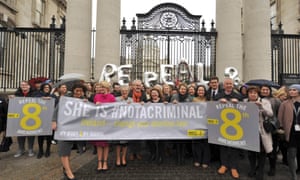
Repeal the 8th Amendment campaigners hold a banner outside government buildings in Dublin.
Repeal the 8th Amendment campaigners hold a banner outside government buildings in Dublin. Photograph: Clodagh Kilcoyne/Reuters 

The United Nations has again ruled that Ireland’s abortion laws have subjected a woman to cruel, inhumane and degrading treatment.

It is the second time in 12 months that the UN’s human rights committee has denounced the abortion rules in the Irish Republic, which denies women with fatal foetal abnormalities the right to terminate pregnancies.

The committee has found in favour of Siobhán Whelan, an Irish woman who was denied access to an abortion in 2010 despite being diagnosed with fatal foetal syndrome during her pregnancy, it was announced on Tuesday.

Fatal foetal abnormalities include where the foetus has under-developed vital organs such as the heart and brain, which would mean if the pregnancy went to full term the baby would either be stillborn or die within hours of birth.

Whelan’s case mirrors that of Amanda Mellet, who was also forced to travel to Britain to end her pregnancy.

Last year the UN ruled in Mellet’s favour, and she made history by becoming the first woman to be compensated by the Irish state over the trauma she suffered.

In the Whelan case, the UN committee held that Ireland must also provide her with reparations for the harm she suffered and reform its laws to ensure other women do not face similar human rights violations.

The committee also instructed Ireland to legalise abortion and provide effective, timely and accessible abortion services.

Three years ago, the New York-based Centre for Reproductive Rights filed a complaint on behalf of Whelan before the committee, arguing that Ireland’s restrictive abortion laws violated her basic human rights by subjecting her to cruel, inhumane and degrading treatment, interfering with her right to privacy and discriminating against her on the basis of her gender.

Responding to the latest ruling, Whelan said: “When I received the diagnosis, I was told I would have to continue with the pregnancy since Ireland’s abortion laws do not allow you to end the pregnancy even in these circumstances.

“If I wanted to end the pregnancy, I would have to travel to another jurisdiction. This, to me, was very wrong and I knew that the suffering I endured because I had to travel to access healthcare was inhuman.

“I believe that women and couples must be given the best possible care at home at such a difficult time in their lives, including if they decide to terminate the pregnancy, and that there should be equal access to good-quality information and care by hospitals countrywide.

“The human rights committee has found that what happened to me was a human rights violation. It has recognised that Ireland’s abortion laws can cause women intense suffering, violating our most basic human rights.”

Leah Hoctor, the regional director for Europe at the Centre for Reproductive Rights, said: “Siobhán Whelan bravely sought justice for the harm she and other women have endured as a result of Ireland’s abortion laws. The UN human rights committee has now upheld her claims and told Ireland, for the second time, that its abortion laws are cruel and inhumane.”

Ireland outlaws abortions except where the life of a pregnant woman is at risk. Attempts by the last Fine Gael-Labour party coalition to deal with the controversy led to the 2013 Protection of Life During Pregnancy Act, which allowed for abortion where a woman is suicidal and may be judged to be in danger of taking her own life if the pregnancy continues.

Physicians and psychiatrists in Ireland have complained that there is a “chill factor” in their professions over decision-making on abortion or even carrying out terminations in Irish hospitals under the act.

They claim this is because legal cases could be taken against them as, under the eighth amendment to Ireland’s constitution, the foetus is an Irish citizen with the same rights as everyone else in the state. Pro-choice campaigners are lobbying for a referendum that would erase the eighth amendment from the country’s constitution.

https://www.theguardian.com/world/2017/jun/13/un-denounces-ireland-abortion-laws-as-cruel-and-inhumane-again

For many women, “access” to abortion care includes enduring harassment.

JENAVIEVE HATCH FOR HUFFPOST
Volunteer clinic escort and Pro-choice Charlotte member Alixandra waits in the clinic parking lot to direct patients past throngs of protesters.

CHARLOTTE, N.C. ― On any given Saturday morning, Calla Hales is faced with hundreds of protesters outside the abortion clinic she runs. Members of various anti-abortion rights groups flock to A Preferred Women’s Health Center to preach, pray, and shame women who are trying to access their federally protected right to an abortion.

Patients are told that abortion is a violent act and that a woman’s sole purpose is to bear children. They are called selfish murderers; their husbands and boyfriends are called cowards.

The city of Charlotte has granted these groups sound permits, thus allowing them to set up their microphones and sound systems just off the property of the clinic. Through the doors of the health center, patients can hear the anti-abortion diatribes, almost all of which are given by white men.

But this weekend brought more than just the usual suspects. Hales and her patients were faced with the added presence of the “Men for Life” prayer walk, led by Love Life Charlotte, or LLC, a conglomeration of Christian churches based in the city with the shared goal of “bring[ing] an end to abortion in Charlotte in 2017.”

“The truth is, this is more a man’s issue than a woman’s issue,” he says. “Yes, one out of three women will have an abortion in their lifetime, but it’s also one out of three men. We forget about the men so often in this story.”

Reeder told HuffPost that LLC wants to foster a culture of “love and life in our city at the busiest abortion clinic in the Southeast,” and that men play a pivotal role in that.

“Men are called to be providers and protectors of women and children,” he said. “We are calling for fathers to be fathers and take responsibility. If men were taking responsibility and standing with mothers then the majority of women would not feel like abortion is their only option.”

Though the turnout didn’t quite hit the goal of 1,000, Hales estimates that close to 600 people marched ― predominantly men, but some women and young children as well. Organizers of the event agreed with that figure.

The march officially began at 9 a.m., but LLC members began setting up before 8 a.m., just up the street from the clinic. Most of the members wore blue T-shirts provided by the organization. Fathers and their young sons stood on the side of the road holding and waving signs to direct parking for other LLC members.

By 9 a.m., those 600 people began to make their way down the street toward the clinic in a “prayer march” that culminated with a protest at the end of the road, directly across from the clinic, and into the mouth of already-heated anti-abortion demonstration that had started an hour earlier.

Reeder was given a microphone to lead the hundreds of men who’d followed him. To anyone new to this scenario, it looked much more like a rally than a prayer.

A flourishing pro-choice community

On the opposite side of the anti-abortion community in Charlotte is the city’s local activist group, Pro Choice Charlotte. The group works with Hales to support patients in the clinic and keep the anti-abortion protesters at bay and away from patients.

Pro Choice Charlotte has two separate groups ― clinic escorts and clinic defenders. Clinic defenders work off of clinic property to hold signs on the clinic’s street directing patients in the right direction, serving also as “counter-protesters” who face off with the anti-abortion protesters, or “antis.”

Clinic escorts work on clinic property to escort patients safely from their cars into the clinic doors. One volunteer counter protestor, Jasmine Sherman, told HuffPost that she volunteers because “abortion isn’t just a white feminist issue.”

“In Charlotte, black women are being persecuted by white men in the name of their God and it is wrong,” she told HuffPost. “This city isn’t doing it’s part to protect black women and that means it is my job as a black woman to help my sisters in need. That support is also extended to other people of color and white women.”

Pro Choice Charlotte extends its action off of clinic grounds, too. Its members frequently hold meetings with city officials, and members have also spoken out in town hall meetings with members of the city council. In January, the group marched at the Women’s March the day after President Donald Trump’s inauguration.

But their goal, first and foremost, is defending the clinic from both regular protests and those thinly-veiled as “prayer marches.”

JENAVIEVE HATCH FOR HUFFPOST
APWHC volunteer Jasmine Sherman, left, squares off with LLC protesters on Saturday.

600 angry men ― with the city behind them

Hales, her clinic staff and volunteers say they struggle with city officials’ apparent complicity in giving anti-abortion groups a platform. LLC’s all-men prayer walk is a prime example.

Hales and Pro Choice Charlotte members keep a pretty constant eye on anti-abortion groups’ goings-on around the city ― they learned of the “thousand men march” a couple of weeks ago. Brooke Adams, a Pro Choice Charlotte member who volunteers as liaison between the group and city officials, told HuffPost that she saw the event promoted on LLC’s website and informed city officials and the Charlotte police on May 27, and asked what their plans were for protecting patients. No city officials or police leadership knew that the event was even happening before Adams notified them. LLC was planning on taking 1,000 men to march outside the abortion clinic without informing the city or the police.

Adams told HuffPost that, as of Tuesday June 6 (just four days prior to the event) LLC hadn’t even applied for a parade permit. She said she learned from the City Attorney’s office that the city had to tell LLC to apply for a parade permit, and that their application was approved on that same day. The city told HuffPost they knew about the planned march for two weeks, but wouldn’t confirm which group notified them.

What Hales and Pro Choice Charlotte found most frustrating, though, is that according to Charlotte city code, LLC needed to apply for a parade permit 30 days before its prayer march. Instead, the city expedited the permit, citing a clause that states they can do so “where other good and compelling causes are shown” in the permit application.

A city spokesperson explained to HuffPost that they were able to expedite the parade permit because the city felt it could accommodate the needs of both groups. “Because we were working in advance with both groups and had already developed a sufficient plan to protect the public and make sure there was open access to the clinic at all times, the city was able to adequately facilitate this event in less than 30 days,” she said.

To appease both anti- and pro-abortion rights groups, Charlotte police blocked half the street with orange cones on the day of the protest ― one half of the street was given to the LLC, and the other half was allotted to clinic patients and other members of the public driving in. Police officers (and, though illegally, members of LLC) directed cars at neighboring intersections to keep the flow of traffic moving and avoid any confusion on what is normally a two-way street, and Charlotte police lieutenant, Shawn Crooks, employed over a dozen officers outside the clinic to ensure safety for all involved parties.

JENAVIEVE HATCH FOR HUFFPOST
Members of Love Life Charlotte pray together outside of the abortion clinic. 

As predicted by Hales and Pro Choice Charlotte, the prayer march was anything but “peaceful.”

LLC touts itself as a nonviolent religious group, existing only to stand quietly across the street to pray. But its members take up excessive space outside the clinic, and its leaders yell into the microphone and lead prayers and chants that are audible through the clinic doors. One member of LLC even had a drone with him, even though filming any private property without written consent from the property owner is illegal in the state of North Carolina.

JENAVIEVE HATCH FOR HUFFPOST
A young member of LLC points a drone to in the direction of the clinic. The use of drones outside private property without written consent from the property owner is illegal in North Carolina.

JENAVIEVE HATCH FOR HUFPOST
Love Live Charlotte founder Justin Reeder pumps up hundreds of men as they rally outside the clinic. 

The group also becomes an audience for the already-emboldened anti-abortion speakers from the other religious groups. Hales is used to the couple hundred who regularly show up to protest, but even if LLC did remain silent and peaceful, throwing in an extra 600 men doesn’t do much to keep the tension down outside the clinic.

The microphone was handed off from Reeder to other men, all of whom used similar shaming tactics. LLC members stood in the middle of the street, potentially blocking car or foot traffic into the clinic. They played loud Christian music, held their hands up in the air, and some children even brought baby dolls to hold up. (See video footage below.)

None of this is considered harassment enough to be banned by the city, and the organizations continue to be rewarded with permits for their anti-choice platform without the same level of support being provided to the center.

In fact, a member of Pro Choice Charlotte, Henri, has made thousands of attempts at obtaining a sound permit for the clinic on Saturday mornings ― the same sound permit that the anti-abortion protesters are granted for every single Saturday. (If one public group is granted a sound permit for the clinic location, it would bar another public group from doing so ― Pro Choice Charlotte being granted a sound permit would ban the anti-abortion groups from setting up their equipment.)

Henri told HuffPost that for his thousands of sound permit requests over the last few months, he has been denied every single time.

HuffPost reached out to Charlotte’s permit coordinator, Danielle Strayer, for comment and did not hear back in time for publication. But Strayer told BVT News earlier this year that, because the pro- and anti-abortion groups are bombarding the city’s online permit system with requests, “It’s down to the millisecond…you can time stamp it to the millisecond. It’s whichever hits first.”

Members of Pro Choice Charlotte told HuffPost that, though they’ve requested it, the city has no plans to revise their permit request system.

JENAVIEVE HATCH FOR HUFFPOST
An anti-abortion protester from Cities4Life attempts to engage with a patient outside the center.

JENAVIEVE HATCH FOR HUFFPOST
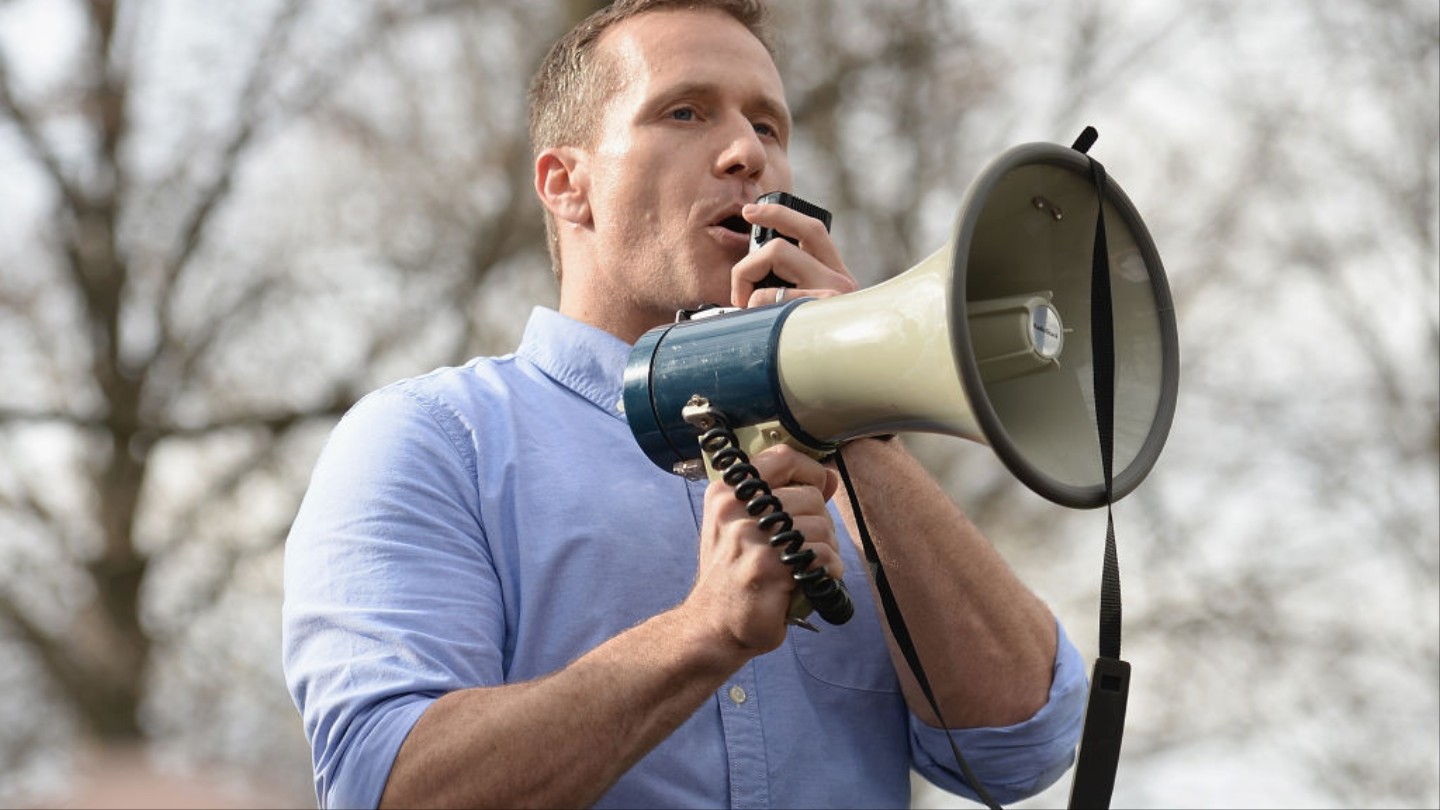
One anti-abortion protester uses a megaphone to yell outside the clinic. “You’re a coward,” he said, to the male partner of a patient.

”I’m at my wit’s end”

The city’s compliance with anti-abortion groups doesn’t just take place in the bureaucratic systems that allow them to protest outside the center.

Last month, Hales said that Charlotte Mecklenburg police ignored a death threat made against her by a member of Operation Save America, an an extreme anti-abortion rights group. OSA is the same group that blamed the Sept. 11 terrorist attack on legal abortion, and two OSA members were arrested in 1988 for the attempted bombing of a San Diego abortion clinic. In 2009, when abortion doctor George Tiller was murdered in Wichita, Kansas, the shooter, Scott Roeder, was found to have connections with OSA.

JENAVIEVE HATCH FOR HUFFPOST
APWHC clinic administrator Calla Hales sits at her desk after Saturday’s protests.

On May 21, during a particularly raucous yet lesser-attended Saturday anti-abortion protest outside A Preferred Women’s Health Center, the OSA protester, Ante, told Hales that she “wouldn’t be alive” to see her own clinic be shut down, Hales told HuffPost.

Hales filed a police report that same very day, but to no avail she says.

“They said that because the phrasing was ambiguous, it wasn’t an immediate threat,” she said.

The following week, Ante was handcuffed and driven off property by police for violating a city noise ordinance. This weekend, though, he was back, holding a poster of an aborted fetus and harassing patients and members of Pro Choice Charlotte.

Hales told HuffPost that she fears no serious action will be taken until after someone gets hurt, in which the issue of clinic violence will be about response rather than prevention.

Photo by Michael Thomas via Getty Images

Governor Eric Greitens wants to overturn a city ordinance​ that makes it illegal for employers and landlords to discriminate against women who have had an abortion or used contraception.

Heeding the call of his governor, Sen. Bob Onder, a Republican state senator, said he plans to introduce legislation that addresses Greitens’ concerns. Onder was a vocal opponent to the St. Louis ordinance, and has shown how he considers women’s access to health care a joking matter: Earlier this year during a senate debate, he and his colleague Sen. Wayne Wallingford suggested that perhaps they should send women seeking an abortion to the St. Louis Zoo because it was safer than the state’s abortion facilities.

In response to the news of the governor’s announcement calling for today’s special session, M’Evie Mead, director of policy and organizing for Planned Parenthood Advocates in Missouri, told Missourinet News: “What I think Governor Greitens appears to be doing is making up solutions in search of a problem that doesn’t exist.”

“Court after court, informed by major medical associations who are responsible for doctors and nurses and healthcare providers maximizing people’s health across this country and in this state, have repeatedly proven that these politically-motivated restrictions that interfere with access to abortion and healthcare are dangerous to women’s health,” Mead continued. “That’s what people need to know. At the center of this issue that’s being very politicized are people and their health outcome.”

https://broadly.vice.com/en_us/article/missouri-gov-finds-twisted-new-way-to-fight-against-abortion-sanctuary-cities?utm_source=broadlyfbus

Pro-choice advocates hope to to replicate the successful litigation of another anti-choice omnibus bill passed by Texas’ GOP-held legislature.

SB 8 would ban the most common type of abortion care after 13 weeks of pregnancy, ban an abortion care procedure already banned by federal law, require the burial of fetal tissue resulting from abortions, and create medically unnecessary reporting requirements for physicians who provide abortion care.

The law is set to take effect on September 1.

The GOP-backed bill was priority legislation for Texas Right to Life, the state’s most prominent anti-choice lobby. The organization praised the bill’s signingas the “most significant Pro-Life victory” of the 2017 legislative session.

The legislation is part of a national strategy aimed at “undermining” legal abortion.

Elizabeth Nash, senior state issues manager for the Guttmacher Institute, told Reuters that Texas Republicans have passed legislation replicated by GOP lawmakers in other states. “Texas legislation on abortion is typically amplified because the state can be a beacon for restrictions nationwide,” Nash said.

Reproductive rights advocates are preparing to challenge the law, hoping to replicate the successful litigation of another anti-choice omnibus bill passed by Texas’ GOP-held legislature.

The U.S. Supreme Court last year struck down portions of the omnibus anti-choice bill known as HB 2. The Center for Reproductive Rights filed the lawsuit challenging the law on behalf of Whole Woman’s Health, and the organization has promised to challenge similar anti-choice laws. Texas faces a $4.5 million legal bill after fighting for years in defense of HB2.

The state is facing a legal challenge to the implementation of regulations on fetal tissue; SB 8 includes a provision that would codify the regulations into law. A federal judge in January issued a preliminary injunction blocking the state from implementing the regulations.

Nancy Northup, president and CEO of the Center for Reproductive Rights, said in a statement that Texas lawmakers “haven’t learned their lesson” and continue to pass legislation to restrict access to abortion care.

“The Center for Reproductive Rights has long stood with Texas women to ensure their constitutional rights are respected and protected,” Northup said. “We took Texas all the way to the Supreme Court last year and won—and will continue to challenge any laws which rob women of their rights and freedoms.”

Amy Hagstrom Miller, CEO and founder of Whole Woman’s Health, said in a statement that the Supreme Court ruled that “women deserve better” than laws that erode access to abortion care.

“Whole Woman’s Health, as always, stands with and for all Texans and we will continue to do so even after this new attempt to harm our communities,” Hagstrom Miller said. “We will also continue to challenge injustice in the courts to ensure Texas women have the same rights to quality health care our constitution promises to everyone in this country.”

https://rewire.news/article/2017/06/08/advocates-ready-legal-challenge-texas-gops-latest-assault-abortion-rights/

LORENZO HODGES

Imagine an Emmy-winning showrunner inviting you into the writer’s room of a critically acclaimed TV series and asking to you to play a character based on your life story. Unheard of, right? Well, that’s exactly what happened when Jill Soloway took a shine to Ian Harvie on the set of Amazon’s Transparent in 2014.

With numerous TV guest starring roles, years spent touring at international comedy festivals and as Margaret Cho’s opening act, and now “the first trans comic special” on NBC’s digital network Seeso, interest in Harvie’s unique experience and perspective continues to grow.

Recently, Harvie was invited by yet another female entertainment visionary, Lizz Winstead, co-creator of The Daily Show and the force behind Lady Parts Justice League, to perform in the “Vagical Mystery Tour.”  LPJL’s comedy tour hits 16 cities over 8 weeks this summer, serving laughs and giving support to independent abortion providers and their local communities.

“As a trans man, with a proud female history, I believe where I intersect with women on abortion rights is that all women should have the right to do whatever they need with their bodies to have a healthy, prosperous life,” Harvie tells PEOPLE. “Body autonomy should be a right for all women and all trans people. That is our shared space, and in large part, why I’m so passionate about abortion rights. I will always stand with my sisters on this issue.”

Although he has physically transitioned, the change has not tamped down his belief in promoting and protecting women’s rights. He’s firm on his stance that he didn’t transition to become part of the patriarchy or any boys club, yet Harvie is quick to acknowledge that male privilege can sometimes apply to him.

“I transitioned to feel better in my body, [but] walking through the world now, in my current body, I am generally perceived as straight, white, and male,” he says. “I don’t have to think twice about racial, gender or homophobic violence, because of my (perceived) straight, white, male privilege, and it’s something that I have to remind myself to think about regularly. I don’t want to forget it and misuse it, although I will likely falter. I know it’s difficult to deny privilege that is being given and the only way I know how to deny it, is to whenever possible, and safely do so, out myself as transgender to the people around me.”

MIKI VARGAS

Feeling comfortable in his own skin is a subject that Harvie has clearly thought about at length, and then some.

“When you have something about your body that consumes nearly all of your headspace, every day, and leaves you in discomfort, it changes how you move through the world. You wake up thinking about it, walk through the day thinking about it, you attempt intimacy with your partner or friends thinking about it, you go to bed thinking about it — it consumes a huge amount of your life,” he explains. “I used to wake up every morning and think about how to conceal my chest, which is a tall order considering I had triple D’s!”

Harvie came out to his family as trans in his early thirties, but as he tells a young fan on his website, “I knew I was different at a very early age, I just didn’t have a language for it, no one I knew did either.” This recognition was not without anxiety.

Trans Activist Juliet Evancho Opens Up About Her Sex Reassignment Surgery

Singer Jackie Evancho’s sister Juliet explains how she knew from a very young age that she was transgender.

“Everyday events could cause a major fashion dilemma or straight-up meltdown. I would go to bed hoping to wake up flat-chested or to win the lottery so I could finally afford my chest surgery. I now know I’m not the only one that goes through this, and trans people are not the only people to go through this,” Harvie says. “It took me a minute to realize that, but when I did, it was really helpful to me to not feel isolated — that there was this intersectionality with others that I hadn’t thought of before. “

In this way, Harvie is especially successful at connecting with audiences. “Personally, I will talk about anything on stage and in public spaces,” he says. “It helps erase stigma around less familiar subjects. You can’t change things if you don’t talk about them, which is another area where I think I align with Lady Parts Justice League and abortion rights.”

But that’s not all. Harvie seems to have a natural, empathic ability to relate to people from all walks of life, no matter their specific troubles or issues. “We’d all have horribly boring stories if we didn’t have struggles,” he tells PEOPLE.

“Our common ground is that we all are struggling. Eating disorders and issues with weight and food, for a lot of people, are symptomatic of something else going on. I know lots of people that use food, alcohol, drugs, sex, etc. to cope with deeper issues,” Harvie says. “We’re all in various levels of discomfort. No one feels 100% okay about their body … and if you do, then you’re the weirdo.”

Harvie backs up this point with an all-too relatable philosophy about his own “gym body,” as well as some good advice for anyone who is body-obsessed to their own detriment.

“I spent 30-something years being consumed with thoughts of concealing my body,” he says. “[Now] I want to be fit in all aspects of body wellness, which includes hitting the gym and hiking. It also means not saying mean things to myself about my own body … As a trans person, I try to remember that we all endure a lot of comments about our bodies as if they’re not our own. There are enough people in the world who make judgments about my body, I don’t need to take part in that.”

However, Harvie does take part in educating and speaking out against those who criticize, bully or harm the trans community through both his activism and his comedy.

“Until trans women of color and trans women as a whole are not being murdered or attacked for simply being who they are, or until trans people are not being disowned by their families, or until trans people are no longer fired from their jobs for needing to transition, or until trans folks are no longer denied access to housing or healthcare, there will be no ‘post-trans’ era,” he says.

http://people.com/bodies/trans-comedian-ian-harvie-on-abortion-rights-body-autonomy-should-be-a-right-for-all-women-and-all-trans-people/

We can’t cow to the notion that abortion is a hard but necessary option for a few “unfortunates.” Saying that abortion is a devastating choice or “should be rare” implies that abortion signals a personal, moral, or physical failing—and that it’s not the best decision for many women.

On January 21, I had the joy and privilege of marching in Washington, D.C., alongside half-a-million other people crying out for equal rights for all women. Amid a sea of pointy-eared pink knit hats, I proudly carried a sign that read “MAKE ABORTION GREAT AGAIN.”

People pointed and giggled, gave me high fives, or stared in confusion. On social media, my sign received some mixed responses. Even some pro-choice friends said that the sentiment was a counterproductive joke and that abortion was never meant to be great, only necessary.

I disagree. My sign and the idea it expressed were not jokes, and I do think abortion is great when it is a safe, legal, and accessible option for all people.

As a family physician and abortion provider in the Bay Area, I see patients choose abortion for many different reasons. A woman who desperately wanted a child chose to have a later abortion when she learned that her baby would be born, and quickly die, without a fully formed brain. Another woman who had a 6-month-old child with Down syndrome chose to have an abortion when her highly effective birth control failed. There was also a woman who was trying to leave her abusive husband and was scared of what he would do if he found out she was pregnant; she chose to end her pregnancy with medication abortion. A pregnant 16-year-old didn’t want to finish high school with a child. And a mother with two kids chose to have an abortion simply because it was not the right time in her life to have another baby.

Because I work in a state that doesn’t single out abortion for unnecessary restrictions and in a practice where medical care isn’t dictated by religious affiliation, I could provide each of these women with nonjudgmental and fact-based pregnancy options counseling. They could make an appointment at a clinic close to home. My patients could get their counseling, ultrasound, and abortion all in the same day, often covered by Medicaid or private insurance.

For each of these women, abortion was indeed great. Abortion spared the first patient the emotional and physical pain of having to deliver a baby who wouldn’t live. The second patient was able to focus her limited resources on meeting the needs of the baby she already had, a child with significant physical and developmental disabilities. For women experiencing intimate partner violence, pregnancy can be an especially dangerous time. Being forced to continue this pregnancy would likely have trapped my third patient in her abusive relationship. The 16-year-old and the mother of two were both able to decide the best path for themselves and their current or future families.

For some of my patients, choosing abortion is a hard and sad decision. But for many others, it is simply a decision—and that’s okay, too.

This is not what abortion opponents tell us. They would have us believe that abortion plummets women into depression and a lifetime of negative consequences—which simply isn’t true. 

Those same anti-abortion forces have made sure that not all women are as lucky as my patients. According to the Guttmacher Institute, more than half of U.S. women of reproductive age live in states that are hostile or extremely hostile to abortion rights. Because of targeted restrictions on abortion providers, an increasing number of states, including my home state of West Virginia, are left with only one abortion clinic.

Combined with an increasing number of laws that impose waiting periods, mandate parental notification, limit the gestational age for abortion, and ban insurance coverage for abortion, the dearth of clinics means that many women are essentially left without access to abortion. For these women, Roe v. Wade is meaningless. Abortion might as well be illegal. And this is exactly what the anti-choice movement wants. They are winning.

In order for women to have full economic and social equality, we must have access to the tools needed to decide how, when, and if we parent. We must fight back against the onslaught of state-level and federal restrictions on abortion.

We can start by not being swayed or cowed by the notion that abortion is a hard but necessary option for a few “unfortunate” women. This rhetoric has been adopted even by legislators neutral to or supportive of reproductive choice. This language isn’t neutral. Saying that abortion is a devastating choice or “should be rare” ignores the oft-cited fact that one in three women in the United States will have an abortion by age 45, and it also implies that abortion signals a personal, moral, or physical failing.

This stigma affects women who consider or choose abortion. My patients may feel a lot of emotions—sadness, relief, guilt, happiness, anger—but societally imposed shame should not be one of them.

Abortion is great! And a United States where women are forced into unsafe abortions or unwelcome (or unsafe) childbirth is not great at all.

https://rewire.news/article/2017/02/02/make-abortion-great-again/