Once upon a time, a woman found a gold coin she exchanged for an abortion.

The woman was Codie Pete, a then-25-year-old living in a rural part of New Mexico, where the nearest abortion clinic was an hour and a half away from home.

At the time, Pete was making meager wages as a teacher and couldn’t afford health insurance through her employer, which put birth control out of reach, too. So when she unexpectedly became pregnant, she found herself in a tough predicament: The financial straits that left her unable to prevent the pregnancy were the same ones that would stop her from terminating it.

“When the clinic told me over the phone that, even using a sliding scale for my income, the procedure would cost $600, I was floored,” Pete recalled. “I remember being on the phone saying, ‘What do people do if they can’t come up with the $600?’ They couldn’t answer me. At that point I just got off the phone. I didn’t even tell them to schedule me.”

As Pete contemplated which of her belongings — her car? her couch? — she could sell to pay for the procedure, she thought back to, of all things, gold coins her mother had bought Pete and her sister when they were children. By some stroke of fate, her mother confirmed it: Years later, the coins were still in her dad’s office safe. A week later, Pete sold hers for almost exactly $600.

“My abortion story is about this magical coin that just sort of appeared — it was the pot-of-gold or shamrock kind of luck,” Pete said. “That’s what’s terrifying, though. Women’s choice is restricted by our ability to pay for a procedure.”

Pete’s predicament might sound far-fetched, but it’s not uncommon. The last few years have seen drastic cutbacks to reproductive health care access. With plans to defund abortion clinics and cut Medicaid coverage, President Donald Trump‘s administration is slated to drastically reduce the number of individuals who can afford safe abortions.

There’s no understating the effects of those cuts: Some 75% of Planned Parenthood‘s patients are “at or below” 150% of the federal poverty level. As the number of clinics offering abortion services dwindle, many patients have to travel farther to get to one. The money spent on transportation and hotels, as well as lost wages if patients must take days off from work to get the procedure, all add up to put abortion financially out of reach for many people.

Meanwhile, in states where it’s legal for Medicaid to cover abortion services, 89% of abortion patients with Medicaid use their insurance to pay for their care.

While the failure of the Republican health care plan was a significant victory for reproductive rights advocates, state legislators continue to propose abortion restrictions meant to chip away at Roe v. Wade.

And as they do, many more people will have to rely on luck to get the care they need.

A patient at Whole Woman’s Health, a Texas family-planning clinic, examines a state-mandated ultrasound.

Source: Jacquelyn Martin/AP

The actual cost of an abortion

There’s a lot of discussion about the legislation preventing people from effectively accessing reproductive health care, but rarely do we talk about how it can also be cost-prohibitive — a barrier that spans from states red to blue.

According to Planned Parenthood, an in-clinic, first-trimester abortion procedure can cost as much as $1,500. For patients who can’t get financial assistance through insurance or Medicaid, the median out-of-pocket cost for an abortion is $575. For more than half of those patients, the $575 amounted to roughly one-third of their monthly income, according to a 2014 study.

These costs skyrocket the longer a pregnant person waits to undergo the procedure. The cruel twist? About 60% of U.S. women live in states that require them to wait — anywhere from 24 to 72 hours — between their initial consultation and their appointment for the actual abortion.

Dr. Sarah Roberts, an associate professor at the research group Advancing New Standards in Reproductive Health and one of the 2014 study’s authors, said such laws mean pregnant people often find themselves caught in a tough situation.

“The vast majority of women who want an abortion are very determined to get one and will get one regardless of the barriers,” Roberts said. “But funding is one of those barriers that’s more difficult for women to overcome.”

A Planned Parenthood clinic in Dallas, Texas

Source: LM Otero/AP

“Divine intervention” — in the form of a perfectly timed check in the mail

For Shae Jackson, the only way out of her unintended pregnancy came in the form of her boyfriend’s tuition refund check.

Jackson found out she was pregnant during her sophomore year of college, shortly after she’d gone off birth control due to a life-threatening blood clot. She said the decision to get an abortion was a no-brainer. “No matter how much it cost, [I knew I would] figure it out because I had to get the abortion,” she said.

 But Jackson wasn’t sure how she could possibly come up with the $500 it would cost her at the nearest clinic. She and her boyfriend were both unemployed students with no income who couldn’t come up with several hundred dollars on a whim.

Just when things began to look hopeless, an unexpected check arrived in the mail for her boyfriend. “It was divine intervention,” Jackson said. “I found out I was pregnant in early March, and that was the exact same time the school issued his [tuition] refund check.”

“When I tell my story, I say I was ‘lucky’ quite often because it certainly was a gift that [the check] came when it did — otherwise, I have no idea where I would’ve gotten those resources,” she said.

Pro-abortion rights advocates rally outside the Supreme Court in March 2016.

Source: Drew Angerer/Getty Images

“The good ol’ ‘raising money for my friend’s abortion’ pregame fundraiser”

There was certainly some amount of luck involved when Cecilia Graña-Rosa counted on friends to help come up with the money to fund an abortion for her friend, Julie*.

When Julie found out she was pregnant, she almost immediately informed the father, who offered to Venmo her $50 for an abortion.

“He thought it cost the same as Plan B,” Graña-Rosa said.

The 23-year-old unemployed grad student knew she wanted an abortion the minute she found out she was pregnant. She’d collected five positive home-pregnancy tests in a plastic cup in her bathroom, Graña-Rosa said.

Despite living in a blue state, Julie had a difficult time asserting her right to an abortion. Before she was allowed to entertain the notion of going through with the procedure, she was required to endure multiple sonograms in two different family planning clinics, where staff encouraged Julie to continue with her pregnancy. She paid for these out of pocket because she feared her parents, who oppose abortion, would notice her insurance claims.

“He thought it cost the same as Plan B.”

As she watched her friend’s medical bills pile up, Graña-Rosa had an epiphany: She would turn a party she was planning to host into a fundraiser. As a former student at Vassar College, she said she saw it as both an opportunity to help a friend in need and to see whether her pro-abortion-rights friends from the liberal arts school would “put their money where their mouth is.”

So, in February 2016, Graña-Rosa made a Facebook event titled “The good ol’ ‘raising money for my friend’s abortion’ pregame fundraiser.” While the concept may seem crass or insensitive, Graña-Rosa isn’t the first to think of crowdfunding an abortion.

A GoFundMe search for “abortion” results in such campaigns as “My 15-year-old sister needs an abortion” or “Emergency abortion.” These represent people in situations so dire that they’re looking for financial assistance not from friends, but from perfect strangers. Bailey, a then-23-year-old from Illinois, was among the first to use the platform to crowdfund an abortion when she launched a campaign called “Stop Bailey From Breeding Fund” in 2014.

GoFundMe temporarily removed Bailey’s campaign page, and decided a week later to ban all abortion-related content from appearing on the site. A spokesperson told Mic the site has since changed its policies to allow users to crowdfund all kinds of legal medical procedures, including abortion.

Through Graña-Rosa’s own IRL crowdfunding, she was able to raise $350. But before she could give her friend the money, Julie — uncertain if she’d ever be able to afford the procedure — induced a miscarriage with vitamin C pills. With no abortion to fund, she ended up using the $350 to pay for the sonograms the family planning clinics had required her to have.

That Julie escaped from the situation without any major health complications is, as Graña-Rosa said, “lucky.” Self-induced or so-called “back-alley” abortions are extremely dangerous. Some 68,000 women worldwide die of unsafe abortions every year, placing it among one of the leading causes of maternal death.

Roberts, the associate professor from ANSIRH, said this sort of “luck” can easily run out for many people who become pregnant and don’t want to be.

“These are women who were able to figure it out and pull [the money] together,” Roberts said. There are other women for whom that’s not the case.”

*Name has been changed to allow source to speak freely on sensitive topics. 

Source: MIC

https://mic.com/articles/172540/women-must-rely-on-luck-to-fund-their-abortions-in-trumps-america-it-could-get-worse?utm_campaign=buffer&utm_content=buffer94883&utm_medium=social&utm_source=twitter.com#.g7ncC630a

A sweeping anti-abortion bill leaves prosecutors wide discretion over who is charged for unlawful abortions.

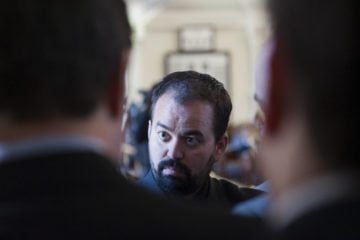
Representative Joe Moody, D-El Paso, on the House floor.  SAM DEGRAVE

Representative Joe Moody, a former prosecutor, was sure there’d been a mistake.

The sweeping anti-abortion bill that passed the Texas House May 19 could allow nearly anyone involved in the process of an unlawful abortion to be charged with a state jail felony, Moody said. That includes the doctor who performed the abortion, but also the person who drove the woman to the clinic, the receptionist who booked the appointment and even the bank teller who cashed the check that paid for the procedure.

“I’m not trying get into policy; I believe this is an unintended consequence of the law,” Moody said on the House floor Friday evening as he introduced an amendment to Senate Bill 8 that would limit who can be prosecuted. Three hours into the abortion debate, there were several calls to order as the El Paso Democrat pleaded with fellow lawmakers to pay attention.

“If the goal is to prosecute people who perform these acts, what’s written here goes way beyond that,” said Moody, one of the leading criminal justice experts in the House. He chairs the Criminal Jurisprudence Committee and worked as a prosecutor in the El Paso County District Attorney’s Office for four years.

It wasn’t a mistake. The amendment failed, 51-83 and only one Democrat, Representative Ryan Guillen of Rio Grande City, voted against.

The Observer spoke to several other attorneys who each interpreted the bill’s applications differently — indicating, at the very least, that the bill provides a subjective tool for prosecutors, who can be politically motivated. And that has Moody worried.

SB 8, which awaits final approval from the Senate, would criminalize “partial birth abortions” and “dismemberment abortions” — both nonmedical terms used by anti-abortion advocates. The first is for a procedure already prohibited under federal law, and the second describes a dilation and evacuation (D&E) procedure, one of the most common forms of second trimester abortions. Both bans would subject a doctor who performs the abortion to a state jail felony, punishable by up to two years in prison, and exempt the woman who had the procedure. But under Texas law, prosecutors could come after anyone else involved in the process, unless they’re specifically exempted in the legislation.

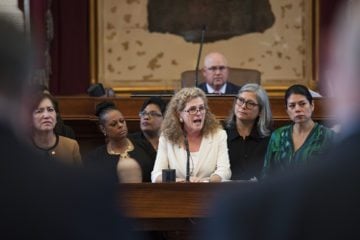
State Representative Donna Howard, D-Austin, speaks against SB 8 Friday evening.  SAM DEGRAVE

The “law of parties” in Texas allows a person connected to but not actually committing a crime to also be charged. A person is criminally responsible under Texas law if he or she, acting with intent, “solicits, encourages, directs, aids, or attempts to aid the other person to commit the offense.” The law is intended to help take down criminal networks, Moody says, but can also be wielded against, for example, individuals loosely connected to the provision of an unlawful abortion.

“I think by rejecting my amendment, [opponents showed] their intent was not only to go after physicians. I guess I misunderstood,” Moody told the Observer. “[This bill] is so poorly drafted, so poorly worded, that I think it shows they’re not really concerned about making good policy.”

The key question is whether a person was knowingly involved, said Representative Jeff Leach, R-Plano.

If a bookkeeper or receptionist has no idea what’s going on, they shouldn’t be held to the same responsibility as the doctor performing the abortion, Leach told the Observer. But if they do know, that’s a different story.

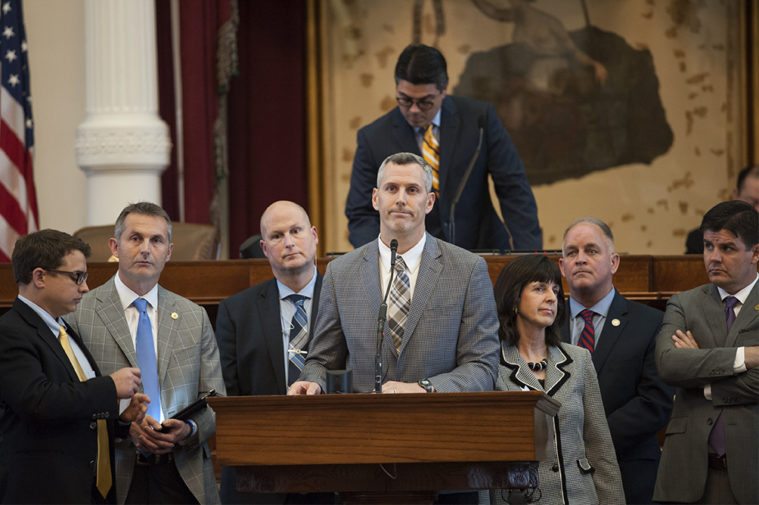
State Representative Jeff Leach, R-Plano  SAM DEGRAVE

“If there’s any individual who may not actually be performing the abortion but is knowingly assisting the criminal enterprise — that may not be a good way to put it — who is knowingly assisting in the provision of an unlawful abortion — then our laws ought to be narrowly tailored to hold those responsible,” said Leach, who was concerned Moody’s proposal might have let them off the hook and requested it be withdrawn.

As GOP lawmakers move to expand the scope of prosecution, they’ve also broadened the definition of what constitutes an illegal abortion. Following the 2016 Supreme Court ruling that struck two main provisions from Texas’ House Bill 2, members have shifted their rhetoric on abortion. Instead of claiming to protect women’s health, they’re criminalizing the procedure.

The Abolish Abortion Act, proposed by Arlington Republican Tony Tinderholt, also of the far-right House Freedom Caucus, would criminalize abortion at any stage and charge women and providers with a felony, without exemption for rape or incest. Tinderholt told the Observer the proposal would “force” women to be “more personally responsible.” Another proposal by fellow caucus member Matt Schaefer, R-Tyler, would remove the exception for fetal anomaly from the state’s 20-week abortion ban.

Leach, an attorney and Freedom Caucus member who describes himself as “pro-life and for the death penalty,” says there is a problem with how the “law of parties” is used in capital punishment, and he’s worked on bipartisan efforts this session to reform the law.

Without Moody’s failed amendment, the “partial birth abortion” ban does not exclude anyone besides the woman from criminal prosecution. The D&E ban, meanwhile, does clarify who cannot be prosecuted: “an employee or agent acting under the direction of a physician… or a person who fills a prescription or provides equipment” used in the abortion.

Joe Pojman, executive director of Texas Alliance for Life, said that he would support individuals who knowingly assist with the abortion facing prosecution, but that Moody’s inclusion of drivers and receptionists was “far-fetched.”

“It’s possible a third party could be prosecuted, but it would have to be someone close to the physician that is knowingly performing the abortion, like a nurse,” added Pojman, who said that in his 25 years lobbying against abortion in Texas, he’s never heard this kind of objection.

Leach also said he didn’t think Moody’s amendment was necessary, because the bill already protects unknowing participants from criminal prosecution.

“That’s wrong, and I told him that,” said Moody. The “knowingly perform” language in the bill is referring to the abortion provider only, but “others don’t have to know what’s going on, they can just be part of the process…The law of parties casts a wide net,” Moody said. “Prosecutors have wide discretion on the charges being brought.”

This ample freedom granted to prosecutors concerns critics of SB 8.

“We worry about rogue or malicious prosecutors,” said Blake Rocap, legal counsel for NARAL Pro-Choice Texas. “The point of this bill isn’t smart criminal justice; it’s targeted prosecution of people who want to help women access health care.”

Source: Texas Observer

https://www.texasobserver.org/texas-bill-could-send-people-to-jail-for-driving-a-woman-to-an-abortion/

“I believe that as an abortion provider, I am doing God’s work,” writes Parker in his new memoir, “Life’s Work: A Moral Argument for Choice.” “I am protecting women’s rights, their human right to decide their futures for themselves, and to live their lives as they see fit.”

That is why he’s been invited to California on this lovely Tuesday evening. Parker has come from Alabama to accept a Person of the Year award from a 26-year-old abortion rights group that is not famous, but certainly deserves to be.

The group is the Women’s Reproductive Rights Assistance Project, or WRRAP. Founded 26 years ago by Joyce Schorr, a former sales executive for Reynolds, WRRAP gives money to women who can’t afford to pay for their abortions. (Previous winners include Gloria Steinem, Dr. George Tiller, Sarah Weddington … and Kelsey Grammer, who was for abortion rights before he was against them.)

Since the early 1990s, Schorr estimates, the group has helped 40,000 women, chipping in relatively small sums, usually between $200 and $500.

“The women we help are very, very poor,” said Schorr, who owns an entertainment company with her husband, Arny Schorr, a former Rhino Records executive. “Everything is a struggle. It’s hard for them to find transportation. The last thing they need is another child to take care of.’’

Parker grew up poor and fatherless in Birmingham, Ala. At 15, under the tutelage of a coach who was a Pentecostal minister, he became a born-again Christian. The first member of his family to attend college, he carried a Bible door to door in his dorm, spreading the gospel of Jesus. After he became an OB-GYN, he refused to perform abortions for religious reasons, but would refer women to doctors who did.

Eventually, though, as he practiced at the Queen’s Medical Center in Hawaii, he started to see abortion as a critical part of his patients’ care, its restriction as a profound injustice.

One day, as he contemplated the parable of the Good Samaritan, he had an epiphany: “It was like a punch, all at once in my spiritual gut,” he writes in his memoir. “The Scripture came alive and it spoke to me. For the Samaritan, the person in need was a fallen traveler. For me, it was a pregnant woman. It became not: Is it right for me, as a Christian, to perform abortions? But rather, is it right for me, as a Christian to refuse to do them? Now I saw, without doubt, fear or ambivalence, that it was appropriate, even ethical for me to provide this care.”

In his book and in conversations — including a recent appearance on “The Daily Show” — Parker compares forcing a woman to bear a child to slavery. It’s generally unwise to compare anything that is not slavery to slavery, but Parker is unbowed.

“I know it’s a powerful analogy to draw, and people are skittish,” he told me, “but if you look at what was evil about slavery and what happens to women when they are forced to give birth, it’s apt. When we make fetuses ‘people’ and demand that women be subordinated in servitude to them… women become a means to an end. It’s no different from slavery.”

The conventional wisdom is that to be devoutly religious is to be antiabortion — but like Parker’s epiphany, Schorr’s impulse to help women obtain abortions also has spiritual roots, though perhaps in a more roundabout way.

Her moment came in 1991, as she watched an episode of the “Phil Donahue Show.’’ His guests were Quaker women who ran a kind of underground railroad for women needing abortions in the years before the Supreme Court legalized abortion. “In 1969, when I was in college, my best friend had almost died from an illegal abortion,” Schorr told me. “It just triggered me: I can’t let this happen. We need to help these women get abortions.”

She approached the National Council of Jewish Women in Los Angeles and was given permission to start WRRAP under its auspices. Four years later, WRRAP became an independent nonprofit, run by Schorr, who has never collected a salary. About 50 volunteers help out.

There is no physical location; two volunteers take calls from clinics for five hours each day. “We fund anyone who calls us,” Schorr said. In the beginning, she said, she took calls from desperate women, but discovered it was far more efficient to have clinics call on behalf of patients. (Patients — and donors — can make direct contact through the group’s website.)

Until recently, WRRAP’s annual budget had been about $35,000. “We finally caught the eye of some very big donors,’’ she said. In the last two years, these anonymous philanthropists have given a total of $550,000.

The money will enable Schorr, who at 65 is nearing retirement, to finally hire an executive director, and put a succession plan in place.

The abortion debate in this country waxes and wanes. The fundamental precept enshrined in Roe vs. Wade, that women have a fundamental right to control their own bodies, still stands.

But we appear to be in a moment when the antiabortion forces are ascendant, both in statehouses, which are defunding critically important abortion providers like Planned Parenthood, and at the federal level, where the Trump administration is systematically dismantling America’s commitment to family planning programs around the globe.

Heroes like Willie Parker and Joyce Schorr, and the people who work in the trenches with them every day, give me reason to believe that no matter how hard some folks try to turn back the clock on women’s rights, the antiabortion mission is doomed to fail.

Source: LA Times

http://www.latimes.com/local/abcarian/la-me-abcarian-abortion-doctor-201705121-story.html

Right-wing attacks on Planned Parenthood are working: Clinics close in Iowa, cutting off low-income women from services
(Credit: AP/Charlie Neibergall/Photo Montage by Salon)

Last summer the anti-choice movement was dealt a serious blow when the Supreme Court ruled that states cannot use medically unnecessary regulations as a pretext to shut down abortion clinics. But that doesn’t mean the religious right has given up on its mission to make sure that women who have sex are punished with unwanted pregnancy for it. Under President Donald Trump, anti-choicers are redoubling efforts to destroy Planned Parenthood clinics throughout the country, which not only makes abortion harder to receive but, as an added bonus for the forced-birth brigade, will also cut off many thousands of low-income women from access to contraception.

Earlier this month, Iowa’s Republican Gov. Terry Branstad signed an appropriations bill that bars women on Medicaid from receiving any non-abortion services from clinics that offer abortion. The move is forcing four of the state’s 12 Planned Parenthood clinics to close.

Texas pulled off a similar move in 2011, passing a law refusing to let Medicaid patients use Planned Parenthood for any services. In response, the Department of Health and Human Services pulled millions of dollars of Medicaid family planning funding from the state because refusing to let a willing provider offer services to Medicaid patients violates federal regulations.

But with Trump in the White House, Texas is petitioning the government to retrieve its Medicaid money back without having to let Planned Parenthood be part of the roster of providers. Branstad’s move suggests that Iowa Republicans are also hopeful that the federal government will simply let states violate long-standing norms that allow women on Medicaid to choose the best provider for them.

 “We have seen what happens in states like Texas, and now in Iowa, when politicians attack access to care at Planned Parenthood — it’s devastating, and sometimes deadly, for the women who are left with nowhere to turn for care,” said Dr. Raegan McDonald-Mosley, the chief medical officer at Planned Parenthood Federation of America, in a statement.
She isn’t exaggerating. As Joseph E. Potter and Kari White of the Texas Evaluation Project explained in a February piece for The Washington Post, “Five years ago, we learned in Texas what can happen when efforts to defund Planned Parenthood are carried out: The network of health-care providers falls apart and women lose access to essential preventive services.” In their research, they found that women had trouble receiving contraception and in many cases they were unable to prevent pregnancy.

There’s good reason to fear that many women in Iowa are going to lose access to contraception because of these clinic closures. A 2017 report by the Guttmacher Institute found that Planned Parenthood is the main provider of government-subsidized contraception in three out of the four counties that are losing their clinic. In Woodbury County 80 percent of patients receiving family planning services from publicly funded clinics went to Planned Parenthood. In Lee County, it was 92 percent; in Des Moines County, 96 percent.

Anti-choicers have an answer for this, of course: Women can just go somewhere else.

“There are many quality community health centers in Iowa that provide comprehensive health care to women and families across the state,” Maggie DeWitte, director of Iowans for Life, said in a statement.

Notice, however, the vague words about “comprehensive health care.” DeWitte does not mention gynecological health care, which Planned Parenthood specializes in, and she certainly doesn’t mention contraception.

This is not an accident. There are other places that women can go if they have a cold, break their arm or need their blood pressure checked, but receiving gynecological care, which is a medical specialty, or obtaining affordable contraception is another matter entirely. Another report from the Guttmacher Institute, released this month, shows that replacing family planning services isn’t so easy. The researchers estimate that other clinics would often have to assume double or triple the number of contraception clients that they currently serve to make up the loss of Planned Parenthood’s family planning services. Many of these clinics are already extremely busy, and simply wouldn’t be able to do it.

But there’s good reason to believe that anti-choicers are not only fine with cutting women off from receiving contraception, but that in fact that’s the ultimate goal. To be clear, the funding being cut here never went to abortion. It was always earmarked for contraception and other sexual health care. The simplest explanation for why people want to cut contraception money is that they want to cut contraception money.

Beyond that, it doesn’t take a super sleuth to realize that anti-choice activists don’t like birth control any more than they like the abortions that birth control prevents. The Iowans for Life website is stuffed full of anti-contraception propaganda, including claims that intrauterine devices are being forced on unwilling women and assertions that Planned Parenthood “heavily promotes contraceptive methods that may increase women’s risk of contracting STDs.” (This claim only makes sense if you assume that women who don’t use contraception will instead abstain from sex, an assumption for which there is no real evidence.)

 On its Facebook page, Iowans for Life has praised doctors for refusing to prescribe contraception and advertised events built around trying to scare women out of preventing pregnancy. The group has also posted articles sneering at Planned Parenthood for offering “easy contraception,” arguing that contraception and sex education have “exacerbated a promiscuous sexual culture,” and claiming that former President Barack Obama created a “forced contraceptive regime.” (In reality, no one has been forced to use contraception by the Obama administration or the Affordable Care Act.)

The agenda here is not “life.” It’s punishing women for having sex. The loss of services to prevent pregnancy and to prevent or treat sexually transmitted infections is a feature, not a bug.

If Texas is successful in restoring its Medicaid funding without reinstating the right of Medicaid patients to use Planned Parenthood services, then expect more states to follow in the path blazed by Texas and Iowa. Anti-choice activists may have lost the ability to shut down abortion services through legal shenanigans, but they will fight to make sure sexually active women are punished one way or another. Going after Planned Parenthood, which caters primarily to low-income patients, has the added bonus of punishing poor people for daring to exist at all. It’s the perfect double whammy in the age of misogynist cruelty ushered in by the Trump administration.

Source: Salon

http://www.salon.com/2017/05/22/right-wing-attacks-on-planned-parenthood-are-working-clinics-close-in-iowa-cutting-off-low-income-women/

Having largely failed to convince women that ending a pregnancy is immoral, abortion opponents have turned to economic attacks

Last week the Trump administration announced a significantly expanded global gag rule, also known as the Mexico City Policy. Saul Loeb/AFP/Getty

The global gag rule prohibits any U.S. foreign aid from going to organizations that provide, advocate for or even discuss safe abortion services. Under previous Republican administrations, the rule applied to approximately $600 million in funds for family planning. Under Trump’s expansion, the rule puts $8.8 billion for a range of programs addressing health issues like maternal and child health, HIV/AIDS, malaria and Ebola in jeopardy.

This expanded gag rule is an economic attack aimed at preventing the poorest women in the world from obtaining or even learning about safe abortion services, which will inevitably result in increased mortality from unsafe abortion as well as collateral damage to poor people in need of other life-saving health services. It is a significant escalation in the broader campaign by U.S. abortion opponents to use economic coercion to stop women from obtaining safe abortions at home and abroad – a strategy abortion opponents have embraced because, after losing the legal battle decades ago, they have utterly failed to convince women that ending a pregnancy is immoral.

Though abortion opponents like to pretend the Supreme Court made up the right to abortion out of thin air, Roe v. Wade was in fact the inevitable result of the Court’s gradual recognition that the Constitution applies to women, which means women also enjoy the fundamental rights to bodily integrity and personal autonomy that the Court had long recognized are protected by the Bill of Rights. Numerous lower and state courts had already ruled that the Constitution did not allow the government to force a person to carry a pregnancy to term against her will. Those decisions are in keeping with other rulings – and most people’s intuition – that one’s body and one’s decisions about family are sacred. The government can’t, for example, control how many children you have by forcing you to be sterilized. Nor can it invade your body by compelling you to donate an organ – or even just blood – to save a born person’s life.

The Supreme Court has repeatedly upheld its ruling in Roe that a person has a fundamental right to end a pregnancy before fetal viability. The 1992 decision in Planned Parenthood v. Casey gave states greater leeway to try to persuade women to carry to term, but dashed any realistic hopes for recriminalization. As Justice Kennedy put it in a later case, “Foreclosed from using the machinery of government to ban abortions in early term, those who oppose it are remitted to debate the issue in its moral dimensions.”

But opponents have had little success convincing women that abortion is immoral. Nearly half of all women with unintended pregnancies in the United States end them. Even after a significant drop in the abortion rate that coincided with improved access to contraception under Obamacare, close to a million women a year have abortions in the U.S. Even women who identify as anti-abortion tend to think their own abortions are justified. Studies show laws requiring women to undergo anti-abortion counseling or view embryonic ultrasounds do not cause women to change their minds.

So having failed to convince women not to have abortions, opponents have resorted to coercion. This isn’t a new strategy – in the wake of Roe, Congress enacted the Hyde Amendment, barring women on Medicaid from using their insurance to afford safe abortion care and therefore ensuring poor women continued to die from unsafe abortions, even after the procedure was legalized. As abortion opponents’ hopes of winning the legal or moral argument have dimmed in the decades since, they have focused their efforts on erecting new financial barriers to deprive low-income women of abortion care.

For example, the Trumpcare bill passed by the House bars individuals receiving federal Medicaid – who already lack abortion coverage thanks to the Hyde Amendment – from receiving non-abortion health care at Planned Parenthood. The end goal is to cause Planned Parenthood clinics to close, so that ending a pregnancy involves travel that will be cost-prohibitive for some women. The bill also aims to eliminate abortion coverage in private insurance plans by making anyone with coverage ineligible for tax credits. Similarly, targeted regulation of abortion providers, or TRAP laws, like those struck down by the Supreme Court last term, use bogus health regulations to shut down clinics and drive up costs and wait times at the clinics that remain.

Laws that put quality abortion financially out of reach are more effective at keeping women from having abortions than efforts to convince them to carry to term willingly – such laws are associated with later abortions, increased self-abortion attempts and moderately decreased abortion rates. However, a woman in the U.S. who has made up her mind to have an abortion will typically find a way to get one, come hell or high water – though doing so may jeopardize her ability to pay her rent or feed her kids. Thus, the biggest bang for one’s anti-abortion buck, so to speak, is in depriving the global poor of information and safe procedures. That’s exactly what the Trump administration’s expanded global gag rule does.

More than 21 million women have unsafe abortions each year; the deaths that result from such procedures make up 13 percent of maternal deaths worldwide. When the gag rule is in place health organizations have to stop providing accurate information about safe abortion or lose all U.S. funding for their non-abortion services. As a result, organizations that continue to offer accurate health information can’t provide as many women with contraception, so the rate of unintended pregnancies increases. Women determined to end their pregnancies who have little access to or even information about safe abortion then resort to unsafe abortion in greater numbers. The second Bush administration, during which the gag rule was last in place, amended it to allow funded organizations to treat women after they’d had unsafe abortions – but it isn’t clear that Trump’s version of the rule even allows for that.

To be clear, federal law already prohibits U.S. aid from going toward the provision of abortion services. The gag rule is about preventing groups from lobbying governments for safe, legal abortion and keeping women in the dark where legal services are available. There is no better illustration of the fact that abortion opponents have lost the moral argument than the harm they are willing to inflict just to stamp out dialogue and information. Abortion opponents can do little to stop a woman from deciding an abortion is a moral choice in the best interest of herself and her family – but they can use her poverty to prevent her from getting a safe one.

Source: Rolling Stone

http://www.rollingstone.com/politics/features/trumps-abortion-policy-isnt-about-morality-its-coercion-w483259?utm_source=newsletter&utm_medium=email&utm_content=daily&utm_campaign=052317_10

Lawmakers voted to ban the most common form of second trimester abortions and to mandate the burial of fetal remains, among other measures.

The Texas House passed a slew of anti-abortion regulations this weekend, likely setting up new legal challenges less than a year after the U.S. Supreme Court struck down the state’s sweeping anti-abortion bill.

During five hours of debate Friday afternoon, Senate Bill 8 became the 85th Legislature’s main vehicle for restricting abortion. Conservative lawmakers tacked on more extreme measures that had passed as standalone bills in the Senate but stalled in House committees.

The bill, which passed 93-45 on third reading Saturday and now awaits final approval by the Senate, would ban fetal tissue donation and require the burial or cremation of fetal remains following an abortion. The legislation also bans “partial-birth abortion,” a nonmedical term for a practice already prohibited under federal law. The measure is a response to unfounded claims that abortion clinics harvest fetal organs for a profit, resulting from discredited videos claiming Planned Parenthood sells fetal tissue.

An amendment by Representative Stephanie Klick, R-Fort Worth, bans what anti-abortion advocates call “dismemberment abortion.” That’s another nonmedical term referring to the dilation and evacuation (D&E) procedure — one of the most common types of abortion during the second trimester.

Critics and some supporters agree the measures are not intended to advance women’s health — a critical standard set by the Supreme Court — raising the likelihood for future court challenges.

“This legislature has a history of passing bills that have been struck by the courts because they’re unconstitutional,” said Representative Chris Turner, D-Grand Prairie during debate. He argued that the D&E ban would eliminate legal abortion options for many women.

Protestors inspired by “The Handmaid’s Tale” sit silently in the House gallery during debate on Senate Bill 8.  SAM DEGRAVE

Last June, the U.S. Supreme Court struck down two main provisions of House Bill 2, Texas’ major anti-abortion law passed in 2013. The court ruled that the state cannot add restrictions that would create a burden on access without evidence that the regulations are necessary for women’s health. More than half of the abortion clinics in Texas were forced to close by the time the law was deemed unconstitutional.

“Why don’t we just stop passing unconstitutional laws for a change?” Turner said.

Supporters of the bill sidestepped questions of whether the proposed measures would improve women’s health, instead focusing on emotional pleas and graphic descriptions of abortion procedures.

“Abortion is a sin, it’s wrong, it’s evil,” said Representative Briscoe Cain, R-Deer Park.

In a Senate hearing earlier this year, SB 8 author Senator Charles Schwertner, an orthopedic surgeon from Georgetown, repeatedly cited the debunked Planned Parenthood videos, not women’s health, as the reason for the bill. Representative Cindy Burkett, R-Sunnyvale, the bill’s House sponsor, said Friday she is concerned with “fetal tissue becoming a commodity.”

The fetal remains burial requirement has already been ruled unconstitutional in Texas.

The measure was originally proposed last year by the state health department, just days after the Whole Woman’s Health ruling. The regulations were blocked by U.S. District Court Judge Sam Sparks, who said they placed new undue burdens on abortion access. The state is appealing and the case will likely be at the Fifth Circuit Court of Appeals in the next few months.

Vice President Mike Pence signed a similar bill into law as governor of Indiana, but a federal judge blocked the measure last year.

Opponents of SB 8 say the requirements will further stigmatize abortion and add the kind of burdensome regulations that the Supreme Court ruled unconstitutional.

“Clinics would have to get new contractors, and the rules create new burdens they may not be able to comply with,” said Blake Rocap, legislative counsel for NARAL Pro-Choice Texas. “The other side knows that. They know if they make it hard enough to comply, clinics won’t have a license.”

The new fetal remains bill, if given final passage, will be added to the current lawsuit, said Amy Hagstrom Miller, CEO of Whole Woman’s Health and lead plaintiff in last year’s Supreme Court case, Whole Woman’s Health v. Hellerstedt. She is again at the center of the case in the fetal burial lawsuit.

“This is not based on any science or fact, [anti-abortion advocates] know that,” Hagstrom Miller said. “They’re trying to say what happened in the Supreme Court doesn’t apply to us in Texas.”

The bill’s supporters say the measure will survive legal challenges. It would not create an undue burden on clinics because added costs would be minimal, they say. The bill creates a registry of funeral homes and cemeteries willing to provide free or low-cost burials.

“This is really about ensuring babies are treated in a humane manner — that their bodies are not desecrated, their organs are not harvested and sold,” said Joe Pojman, executive director of Texas Alliance for Life, the anti-abortion group aligned with Republican House leadership.

Abortion providers could also “absorb the cost, as a good faith measure to women,” Pojman suggested, emphasizing that the cost would be “very small.”

In fact, a cremation costs between $1,500 to $4,000, according to a letter submitted to the state by the Texas Medical Association and Texas Hospital Association last year. A full funeral costs about $7,000 to $10,000.

Democrats scrambled to moderate SB 8. An amendment from Representative Rafael Anchia, D-Dallas, would have added a religious exemption to the burial requirement. Representative Jessica Farrar, D-Houston, tried to add an exemption to the D&E abortion ban in cases where doctors found it was the safest option for the mother, and another that would exempt cases in which the mother’s life was in danger. An amendment from Representative Barbara Gervin-Hawkins, D-San Antonio, would have exempted cases of rape and incest.

All these amendments failed.

State Representative Donna Howard, D-Austin, speaks against SB 8 Friday evening.  SAM DEGRAVE


“Politicians have no place in the medical exam room,” Donna Howard, D-Austin, said tearfully. “If you want to stop abortions, then help me to stop unwanted pregnancies” by supporting contraception. Abortions happened before Roe v. Wade made them legal, she said, and will continue with these new restrictions, but less safely.

Texas Alliance for Life had urged lawmakers not to support a D&E abortion ban, saying it was sure to result in a court challenge. Meanwhile, Texas Right to Life, aligned with the House Freedom Caucus, cheered the passage of its priority bill.

Conservative lawmakers drew the line at a controversial amendment by Representative Matt Schaefer, R-Tyler, that would outlaw abortions after 20 weeks, including in cases of a fetal abnormality. Burkett called the amendment “a step too far.”

“Why should a woman be forced to give birth to a baby that will die in birth?” Anchia asked. “Because it’s a person created in the image of God,” Schaefer said.

Source: Texas Observer

https://www.texasobserver.org/abandoning-womens-health-claims-texas-house-approves-wide-ranging-anti-abortion-bill/

Anti-abortion rights activists say prayers during a prayer vigil outside Planned Parenthood on Jan. 21, 2014, in Washington, D.C.

Anti-abortion rights activists say prayers during a prayer vigil outside Planned Parenthood on Jan. 21, 2014, in Washington, D.C.
IMAGE: ALEX WONG / STAFF / GETTY IMAGES
It’s hard to understand what it feels like to be confronted or bullied outside a women’s health center — until it happens to you.

I’d never had that experience until last year, while reporting on the Supreme Court case Whole Woman’s Health v. Hellerstedt. Before visiting the Whole Woman’s Health clinic in San Antonio, I expected some type of encounter.

What I couldn’t anticipate was the surge of adrenaline and mild panic I felt when, after I opened my car door, a middle-aged man wearing sunglasses thrust pamphlets at me and said, “There’s a lot of killing that goes on in there.”

I wasn’t there for an abortion or any of the routine gynecological services offered by Whole Woman’s Health, but I felt threatened and intimidated. I can only guess how the exchange might have affected me had I been a patient who lived nearby.

We don’t know how many people have this experience, but a 2013 survey of abortion clinic providers found that 92 percent were concerned about the safety of patients when they approached their facilities. And Planned Parenthood wants more of the public to understand it in a way it never has before.

That’s why the nonprofit organization — whose clinics see their share of anti-abortion rights protesters — created a virtual reality film called Across the Line last year to simulate a trip to a women’s health clinic punctuated by painful encounters with protesters. Now, new research suggests it’s having a positive impact.

A still image from 'Across the Line.'

A still image from ‘Across the Line.’

IMAGE: PLANNED PARENTHOOD / ACROSS THE LINE

Across the Line uses 360-degree video and computer-generated imaging to place the viewer in the body of someone entering a clinic to receive abortion care. The experience draws on real audio of people shouting, documentary footage, and scripted scenes.

Seeing the experience unfold in virtual reality was jarring for some.

“In the early viewings [of the film] you’d have to counsel people … to stay with it for a minute and imagine this is someone you love going through this,” says Molly Eagan, vice president of Planned Parenthood Experience and an executive producer of Across the Line.

“Who is going to walk through a group of protestors and subject themselves to that?”Planned Parenthood hoped that the film, which it showed last year to film festival participants and to dozens of people with moderate-to-conservative views on abortion, would increase empathy for people who have abortions, reduce tolerance for bullying, and even prompt people to act supportively by, for example, becoming a clinic escort or advocating for certain types of legislation.

Virtual reality is generally thought to cultivate empathy, but Planned Parenthood now has preliminary research to suggest that it can achieve that and more.

The researchers, commissioned by the nonprofit, randomly split up viewers into two groups. In one group, people were surveyed about their views on clinic harassment before they watched the film; in the other, people were surveyed after.

The results showed that the group that had seen the film before they were surveyed expressed more disapproval of clinic harassment than those who hadn’t yet watched it. They were also more inclined to dislike certain types of behavior, including individuals photographing patients, and protesters who demonstrated outside clinics.

A scene from 'Across the Line.'

A scene from ‘Across the Line.’

IMAGE: PLANNED PARENTHOOD / ACROSS THE LINE

The people who saw the film at festivals last year were predominantly highly educated white men who identified as somewhat or very liberal.

When the researchers conducted comprehensive interviews in Kansas City and Atlanta, however, they largely spoke to women between the ages of 20 and 45 who never had an abortion and held moderate political beliefs.

After watching the film, those participants were more empathetic toward women seeking an abortion and were open to talking about clinic bullying with friends. They were also willing to sign a petition against harassment on social media, though they were less interested to share it with their networks. Few said they would volunteer to escort women through crowds of protesters.

“They were very upset because they didn’t realize this was the level of harassment their loved ones may have endured.” Eagan says the encouraging results give Planned Parenthood useful information on how to shape public opinion of clinic protests. In the past year, the film has been distributed to college campuses across the country. Planned Parenthood affiliates also have discussion guides complete with a Google Cardboard VR set, which can be used to view the film.

Planned Parenthood is in the early stages of showing the film to legislatures and law enforcement groups so that policymakers and police officers, who often regulate clinic protests, better understand the effects of harassment.

The stigma surrounding abortion, Eagan says, typically keeps people from talking about their experiences at clinics, which in turn means their family and friends don’t fully grasp what it’s like to encounter protesters.

Even liberal viewers often had little knowledge of the kinds of harassment that can occur at a women’s health clinic.

“They were very upset,” Eagan says, “because they didn’t realize this was the level of harassment their loved ones may have endured.”

Source: Marshable

http://mashable.com/2017/05/19/virtual-reality-empathy-abortion-planned-parenthood/#PqKojcQu2EqA

Abortion opponents have long sought to strip public funding from Planned Parenthood and other groups that provide abortions. In Texas, they succeeded.

Lawmakers in other states who want to follow suit should first visit Texas, which offers a case study of the severe consequences of attacks on women’s health.

In 2013, organizations that provide abortions in Texas were cut off from receiving family planning funds. The number of women covered by the state family planning program dropped by 30,000. Reimbursements for long-acting reversible contraceptives like IUDs, some of the most effective forms of pregnancy prevention, fell by more than 35 percent after the exclusion of Planned Parenthood. Pregnancies among women covered by Medicaid rose 27 percent.

To carry out its cuts, Texas had to give up federal money for family planning programs, since the Obama administration would not allow states to exclude specific providers. But now Texas is asking the Trump administration to restore the money. If the application is granted, more states could take Texas’ path.

Photo

Kristy Anderson testifying as a “Texas woman” in support of Planned Parenthood during a Texas Women’s Health Advisory Committee meeting in Austin on Monday. CreditIlana Panich-Linsman for The New York Times

Experts expect legal challenges, since federal law says patients must be able to use Medicaid at any provider that meets their needs. The change could also require a budget appropriations process in Congress. But this may not keep President Trump or his health and human services secretary, Tom Price, a longtime opponent of Planned Parenthood, from saying yes.

Restoring federal money to Texas would not necessarily bring new health centers to underserved areas where Planned Parenthood and other clinics have closed. Moreover, Planned Parenthood is a trusted provider, known for offering comprehensive and nonjudgmental care. Any program that excludes it, even if fortified with federal money, would unfairly restrict women’s options.

Several states have already followed Texas in directing family planning funds away from Planned Parenthood. This year, Missouri established a program that excludes the group. The governor of Iowa recently signed a bill to do the same.

The administration first signaled its intent in January when the president directed the secretary of state to develop a plan to expand the Mexico City policy. At that time, the International Planned Parenthood Federation estimated that it would lose $100 million over four years as a result and be forced to reduce services in at least 30 countries.

Texas offers proof that limiting choices for health services harms women. Unfortunately, the Trump administration is willing to put women and their families at risk in poor countries around the world.

Source: NY Times https://www.nytimes.com/2017/05/19/opinion/the-way-texas-treats-women.html?emc=edit_tnt_20170520&nlid=15062368&tntemail0=y

Mom Planned Parenthood

COURTESY OF CBS

MAY 18, 2017 | 05:50AM PT

Producers and stars of the CBS/Warner Bros. TV sitcom “Mom” have decided to make a $250,000 donation to Planned Parenthood rather than mount an Emmy campaign this year.

“Mom” star Allison Janney and series co-creator/exec producer Chuck Lorre on Thursday launched the effort to raise awareness of the threat to Planned Parenthood funding as the Republican-backed American Health Care Act makes its way through Congress. Janney and Lorre are expected to appear on “CBS This Morning” to encourage fans to donate to the non-profit family planning and health care org through a special link established as part of the “Mom” campaign.

 “In Los Angeles County alone, we answer approximately 2,000 calls each day from people asking us for help,” said Sue Dunlap, president-CEO of Planned Parenthood Los Angeles. “Across the country, millions of women and men are relying on Planned Parenthood health centers for their basic care — like birth control, life-saving cancer-screenings, and STD testing and treatment. We are committed to being here for them, no matter what. Generous support from our community fuels this work, and we are honored that the team behind “Mom” is launching this campaign at this critical time.”

Support for Planned Parenthood has become a rallying cry for activists and others who are organizing to fight aspects of the Trump administration’s political agenda. Planned Parenthood’s role as a provider of birth control and abortions has made the org a target of anti-abortion activists and some conservative lawmakers. The health care bill designed to repeal Obamacare would also bar access to Planned Parenthood services by anyone receiving Medicaid, a crippling blow to those in need of low-cost birth control options and women’s health services.

“Mom” stars Janney and Anna Faris as a mother and daughter who are both recovering from alcohol and drug abuse and other challenges. The show is known for its bold mix of comedy and drama in tackling real-life issues faced by people from all walks of life. Janney won back-to-back supporting comedy actress Emmys for her work on the show in 2014 and 2015. “Mom” was renewed in March for a fifth season.

Janney has long been an active supporter of Planned Parenthood. Lorre, one of TV’s most successful producers, has a record of supporting public health organizations including the Venice Family Clinic, where he established the Robert Levine Family Health Center in his father’s name. Faris is a champion of the Global Alliance to Prevent Premature and Stillbirth (GAPPS), a org devoted to preventing premature births and stillbirth.

Planned Parenthood serves some 2.5 million people a year, more than half of them in rural communities and areas underserved by affordable health care facilities.

The “Mom” team’s move to forgo traditional kudos campaigning in favor of social activism recalls the decision in February by UTA to table its Oscar-night party in order to make a $250,000 donation split between the ACLU and the refugee-oriented International Rescue Committee.

Source: Variey

http://variety.com/2017/tv/news/mom-planned-parenthood-allison-janney-chuck-lorre-donation-1202431555/

Meet Trump's Terrifying, Ignorant 'A-Team' of Anti-Abortion Zealots
 The Trump administration is giving extreme anti-abortion activists the ability to make major policy decisions. As a physician, I know firsthand how disastrous this will be for women.

Earlier this month, Vice President Mike Pence spoke at a gala for Susan B. Anthony’s list, a powerful anti-abortion group. To rapturous applause, he gloated that President Trump had assembled an “A-Team” of “great pro-life leaders”: Tom Price, who twice sponsored legislation that would give full constitutional rights to zygotes; Ben Carson, who once likened abortion to slavery; Rick Perry, who signed Texas’ notorious abortion restrictions—which were eventually declared unconstitutional by the Supreme Court—into law.

Two new members have been recently welcomed to that team: Charmaine Yoest, the former head of Americans United for Life, and Teresa Manning, an outspoken anti-abortion activist. Both Yoest and Manning have been selected for leadership positions at the Department of Health and Human Services (HHS), the federal agency tasked with protecting the health of the American public; both are strongly opposed to abortion and several methods of contraception. The problem is not that Yoest and Manning have strong views on these subjects—it’s that those views are not grounded in reliable evidence, and that both women have dedicated their professional lives to advocating for policies that aren’t evidence-based, either. These appointments are a stunning example of what happens when willful ignorance gains a powerful platform.

Yoest, who will serve as the department’s assistant secretary of public affairs, has made a career out of spreading false information, insisting that there’s a link between abortion and breast cancer—despite the fact that this claim has been debunked by several leading medical organizations, including the American Cancer Society. She also claims that contraception doesn’t reduce the abortion rate, and dismisses reliable evidence that contradicts her positions by claiming the entire scientific community is controlled by an “abortion lobby.” She has clearly stated that she wants to make abortion illegal, even in cases of rape and incest.

Manning, who will oversee Title X, a family planning program that has provided contraceptive services to low-income and uninsured people for over 40 years, holds the peculiar and medically incorrect view that contraception doesn’t actually workto prevent pregnancy. As a former lobbyist for the National Right to Life Committee, she has advocated against both intrauterine devices (IUDs) and emergency contraception on the grounds that they cause early abortions (they don’t). She once remarked that family planning should be “what occurs between a husband and a wife and God.”

In reflecting what these appointments might mean for actual people, I think of my patients. I remember speaking with a woman in the early days of the Zika crisis, when so much was unknown, who had traveled to a Zika-affected area and was terrified of the possibility of becoming pregnant before she could be certain she had not contracted the virus. IUDs, which both Yoest and Manning oppose, are among the most effective methods for preventing pregnancy. Will the CDC’s new messaging withhold or minimize the evidence regarding the efficacy of IUDs because Yoest thinks they cause abortion?

Charmaine Yoest. Screenshot via Youtube

What will become of adolescents who rely on Title X clinics to obtain contraception safely and confidentially? Teresa Manning could push to change Title X guidelines and require parental involvement in teens’ health care decisions. While most young people involve a trusted adult in the decision to start birth control, the ones who choose not to often have compelling reasons to do so. I’ve cared for young people who were cut off financially, disowned, and even physically abused when their parents discovered that they had been sexually active. Mandating parental involvement can place vulnerable adolescents at risk of retaliation by unsupportive parents or guardians.

In 2016, the FDA (an agency within HHS) relaxed the guidelines for the abortion pill, extending the window in which pregnant women can take the medication and decreasing the amount of required doctor’s visits. What will happen if HHS’s new anti-choice leadership reverses these evidence-based changes? Patients could be forced to make three or more trips to the clinic just to swallow pills in the presence of a provider, or could be made to drive hundreds of miles so that they can take a pill in an ambulatory surgical center (which is essentially a mini hospital). We know that barriers to safe, legal abortion care disproportionately impact low-income women, people of color, young people, and rural women—groups of people who already experience health care disparities.

It’s challenging to overstate the potential ominous impact of these appointments on reproductive health. In this hostile climate, it can be easy to slip into despair. As we push back against the administration’s repeated assaults on access to abortion and contraception, I hold tight to a vision of what I’d like to see for my patients.

I imagine a world in which people’s reproductive decisions are respected and supported. Abortion is routine health care and should be treated as such—fully covered by insurance, including federally administered plans, and available without politically motivated barriers. Every person who wants to prevent pregnancy should be able to choose from a full range of contraceptive options and not be limited by financial constraints. Paid family leave, comprehensive maternity care, birth support, affordable child care, clean air and water, and safe neighborhoods and schools should be a reality for those who choose to parent. Health care policy must be informed by the best available medical evidence, and not ideology or theology.

Source: Broadly

https://broadly.vice.com/en_us/article/meet-trumps-terrifying-ignorant-a-team-of-anti-abortion-zealots