Olivia Pope got an abortion on Scandal during Season 5, which aired in 2015.
On Season 5 of “Scandal,” protagonist Olivia Pope has an abortion. The scene is minimal, short (about a minute long) and a revelation. Viewers saw Pope dressed in a hospital gown, laying on a doctor’s table with her feet in stirrups. It’s clear that she is having an abortion ― and yet no words are used to describe it, only images.
The scenewas widelypraised for portraying abortion as the minimally invasive medical procedure that it is; a health care decision women make for themselves. But in the Hollywood Reporter’s new oral history of the show, pegged to “Scandal’s” 100th episode, Shonda Rhimes and Bellamy Young (who plays Mellie) revealed that some people at ABC didn’t want Pope’s abortion scene to happen at all.
Rhimes made it clear to the magazine that she told ABC she wasn’t going to back down.
“I said, ‘Go ahead, alter the scene. We’ll just have a lot of articles about how you altered the scene,’” she said. “We had done an abortion on a military woman who had been raped earlier on, and we were doing nothing different than we did in that scene — they just didn’t like that it was happening to Olivia.”
“I don’t think abortion had ever been presented as an emancipated woman’s option before,” added Young. “And it’s set to ‘Silent Night.’ The balls to pick that song.”
Anyone who watches “Scandal” knows how this ended. Rhimes stood her ground, and the world got to see abortion treated as something that isn’t shameful, but a fact of life for many American women.
As NARAL President Ilyse Hogue said at the time in an interview with Variety: “The impact of popular culture on public opinion and on taking what are thought of as ‘taboo’ issues and putting them front-and-center and giving permission to talk about them, that is a very significant impact and can’t be overstated.”
President Donald Trump signed a bill Thursday that will allow states to withhold federal funds from organizations and facilities that provide abortion services, such as Planned Parenthood.
And for a president fond of spectacle, the signing was unusually private, with no media present.
The bill reverses a rule enacted by Barack Obama, days before the end of his presidency, that barred states from withholding state-managed Title X family planning funds — state grants aimed at helping low-income individuals receive family planning services at reduced or no cost — from health providers that offer abortions. The reasoning was that those providers also often offer services like contraception and screenings for sexually transmitted infections, and under the Obama-era rule, states could only deny providers the grants if they could not actually provide family planning services.
Crucially, the new measure also does not keep abortion providers from receiving federal Medicaid reimbursements, a policy option often referred to as “defunding” Planned Parenthood. (It is already illegal to use taxpayer dollars to pay for abortions, except in cases of rape, incest, or medical emergency.) But its impact could still be immense, abortion rights groups say.
“Four million people depend on the Title X family planning program, and by signing this bill, President Trump disregards their health and well-being,” Planned Parenthood Executive Vice President Dawn Laguens said in a statement condemning the signing. In the last six years, at least 13 states that use Title X grants have approved limitations that would keep abortion providers from participating in them, according to a Department of Health and Human Services report.
The bill passed only narrowly in Congress — Vice President Mike Pence, the highest-ranking government official to ever attend the anti-abortion March for Life, had to step in and cast a tie-breaking vote in favor of the measure. Groups who oppose abortion have pointed to Pence’s action as a sign that Trump is keeping his campaign promises to restrict abortion access.
“That allowed choice for the [states] on how they want to spend healthcare dollars,” Kristi Hamrick, a spokesperson for Americans United for Life, told VICE News before the signing. “That was a huge change, a huge victory.”
Trump has also already set into motion several other measures to restrict abortion access, such as slashing funding to the family planning agency the United Nations Population Fund and reenacting the global gag rule.
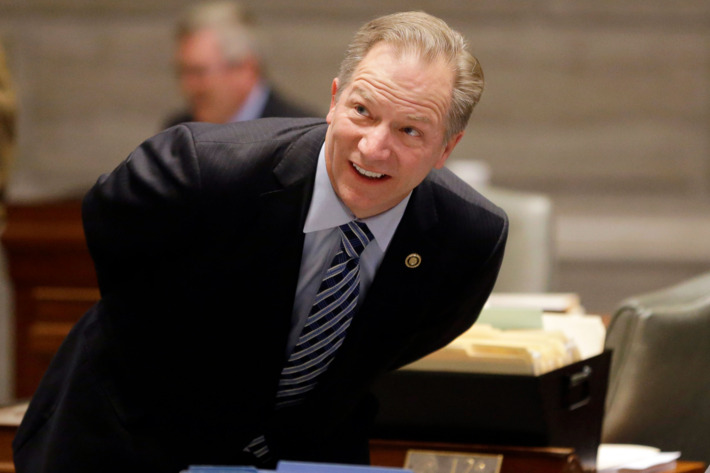
In a story noted on Broadly, Missouri State Senator Bob Onder (R), opposed a tax increase that would benefit the St. Louis Zoo. Why? Partly because the bill would ban employers from discriminating against employees who’ve had an abortion, use contraception, or are pregnant.
Onder then gave a fiery speech which drew parallels between abortion clinics and the zoo. He incorrectly noted that McDonald’s and the St. Louis Zoo offer more regulations than abortion clinics. Then, ever the Batman to his Robin, Onder’s cohort, Senator Wayne Wallingford (R) chimed in with damnatory comments. “Maybe we should send the people that want an abortion to the St. Louis Zoo, because we know it’ll be safer,” he said.
“You know, it’s funny that you say that, Senator. That’s another line of questioning I wanted to point out,” Onder responded.
He proceeded to explain that the St. Louis Zoo required a five-day waiting period before euthanizing an animal. Then — perhaps in an effort to dig himself into a deeper sexist hole — he mentioned that before having an abortion procedure, Missouri clinics require women to wait three days after meeting with their doctor.
“Let’s think about this. Babies, it’s three days, so although there are members of this body who don’t agree with that three days, babies are three days,” Onder said. “So, zoo animals, it couldn’t be more than 24 hours, right?”
So yes, he just compared a woman’s legal right to terminate a pregnancy to euthanizing animals.
The comments received a great deal of backlash, prompting Onder to defend his opinions in an interview on The Marc Cox Show, a local radio program. “When we’re debating on the Senate floor, sometimes we make serious proposals, and sometimes they’re tongue-in-cheek to make a point,” Onder said. “The humorlessness and the lack of appreciation for irony and satire on the left is on full display here.”
I am a pregnant abortion provider who is pro-life. By that, I mean that my work as an obstetrician/gynecologist in the Bay Area is conducted in service of women’s lives, not just those of their unborn children. I provide care with respect, compassion, and dignity, whether my patient needs an abortion or prenatal care, a cancer screening, or if she’s in labor. When I say I’m “pro-life,” I mean that the literal sense of the word “life,” not the way it’s been twisted by anti-choice advocates who want to shame, punish, and control women, their bodies, and their choices.
In my opinion (and in my work), there is nothing “pro-life” about policies that force clinics to close and put women’s health at risk. There is nothing “pro-life” about denying women the ability to make decisions about their own lives. There is nothing “pro-life” about taking away a woman’s health coverage for abortion, forcing her to the economic, emotional, and physical brink. On the contrary, abortion providers like me give women and families their lives back, save women’s lives, and help to ensure the health and safety of their current and future children. Though some may argue that being a pregnant mom who’s also an abortion provider somehow makes me a “hypocrite,” I’ll say this: I see no conflict of interest. I have a duty to my patients. I also have a duty to myself, and mine is very much a wanted pregnancy.
In the course of my work recently, there have been moments when I’ve been at the same stage in my pregnancy as patients I’m providing an abortion for. It gives me cause for reflection, especially when I consider the anti-abortion myths that have helped shape the way we talk about abortion, and the assumption that women aren’t “smart” or “thoughtful” enough to make their own decisions about an unwanted pregnancy. But the reality is this: Women are smart and thoughtful enough to make those choices. In fact, women who have made the decision to have abortions do so carefully, seriously, and with full awareness of what it means to end a pregnancy. After all, according to the Guttmacher Institute, 59 percent of women who have abortions are already moms.
Courtesy of Pratima Gupta
Recently, I’ve felt my fetus kick mid-procedure, and it reminds me that I am on this pregnancy journey as well as my patients — I’m just taking a different path. It can be jarring to be so physically reminded of my own pregnancy as I am ending the pregnancy of another woman, but it doesn’t make me any less committed to being an abortion provider, and it doesn’t change or alter my opinion of my patients by any means.
I WAS PARTICULARLY DRAWN TO THE FIELD OF FAMILY PLANNING BECAUSE I BECAME A DOCTOR TO HELP PEOPLE LIVE THEIR LIVES WITH HEALTH AND DIGNITY. MY WORK AS AN ABORTION PROVIDER ALLOWS ME TO DO THAT.
Patients often ask me if it is difficult for me to provide their abortions because of my own pregnancy, and my response is simple and honest: “It’s not your time now, but it is for me. If and when you decide to become a parent, I will be by your side then, too.” And I will. I am fortunate in knowing that mine is a planned and desired pregnancy. And precisely because I know how profound and personal the decision to continue a pregnancy is, I continue to support all women who seek an abortion. All too often we frame the reason for an abortion as reactionary — something hadto happen to these women for them to want to end the developing fetuses inside them. But in my opinion, the only “good” or “necessary” reason they need to give — if they even feel comfortable giving one at all — for wanting an abortion is that they no longer want to be pregnant. Some of my colleagues will give preferential treatment or priority to women seeking abortions for fetal anomalies, but this is contrary to my medical and ethical practice of beneficence.
Right now my 4-year-old son understands what I do for work as “helping ladies.” When he’s old enough to ask more detailed questions, I’ll be proud to tell him that I help women realize the decisions they’ve made about their lives, pregnancies, and futures. I’ll tell him that I’m there for women who want to end a pregnancy as well as those who want to become parents because I want to normalize abortion as part of the health career I willingly chose.
NO ONE SHOULD BE FORCED TO CONTINUE A PREGNANCY AGAINST THEIR WILL — CERTAINLY NOT BECAUSE SOME POLITICIAN WANTS TO INTERFERE, THEIR LOCAL PROVIDER HAS BEEN DEFUNDED, OR BECAUSE THEIR INSURANCE DOESN’T COVER THEIR CARE.
I’ve often been told by my patients and their partners that I don’t look like an abortion provider, and that I’m “much nicer” than my patients were expecting. I’ve been an abortion provider for nearly 12 years, and I respond to each comment in the same way: I support my patients in a non-judgmental manner, whatever their decisions, whatever their reasons. I add that I was particularly drawn to the field of family planning because I became a doctor to help people live their lives with health and dignity. My work as an abortion provider allows me to do that.
In fact, many of the patients who see me for abortion care will then request that I provide their prenatal care in a subsequent pregnancy. To me, this means I’m truly giving women quality care that respects their decisions and safeguards their health and lives. Women who give birth and women who seek abortion are not “different” women — they’re the same women, only at different points in their journeys, operating under different and unique circumstances. In my career as an obstetrician and gynecologist, I serve patients for life. Over time, I can care for (and protect) the same patient for sexually-transmitted infection screenings, pap smears, birth control, prenatal care, deliver their baby, end a pregnancy, and consult on menopause. There are often days when I’ll provide an abortion for one woman and deliver a baby for another within a few hours of each other — this is the continuum of my life.
I TRUST MY PATIENTS TO MAKE THE RIGHT CHOICE FOR THEMSELVES, JUST AS I HAVE MADE THIS ONE FOR MYSELF.
As I embark into this new world as mother of a newborn, I am readying myself for the sleepless nights, dirty diapers, stresses, worries, and toll on my mind and body. I am doing my best to plan for the logistical, financial, and social supports my family will need to thrive, all while I juggle the demands of a baby and toddler. All of this serves to remind me that no one should be forced to continue a pregnancy against their will — certainly not because some politician wants to interfere, their local provider has been defunded, or because their insurance doesn’t cover their care.
To those who might critique the decisions of my patients, or my own decision to provide abortion care, the commitment to become a parent (or have another child) is one of the most important decisions a person can make. I trust my patients to make the right choice for themselves, just as I have made this one for myself. I’m honored to support the women I care for as they choose to (or not to) create life, and I hope that we can move toward a day when each and every woman is supported, trusted, and respected for their choices. That’s the future I want for my patients, and my children too.
Activists participate in a rally to support Planned Parenthood on Capitol Hill in Washington. (Alex Wong/Getty Images)
On the political spectrum, abortion may be categorized as a women’s issue. But in U.S. newspapers and wire services, men weigh in more often than women about reproductive rights, according to a new report commissioned by the Women’s Media Center and conducted by the research firm Novetta. An analysis of 1,385 pieces, including news stories, opinion columns and editorials, that appeared in 12 publications found that men wrote 52 percent of those pieces that had a byline attached, while women wrote just 37 percent of them.
The New York Daily News was the only news organization included in the study where coverage of abortion and similar issues was evenly split between men and women: Of the stories on that subject that carried a byline, 48 percent of them were by men and 48 percent were by women. The greatest gender disparity in coverage of the subject was at the Associated Press, where 64 percent of the articles published on reproductive rights, whether opinion or news, were written by men.
One of the arguments for a more representative media corps is the idea that, for example, women will be more likely to quote women. Overall, that’s true: Across the board, in the stories by women, 42 percent of the people they quoted were women while 36 percent of their sources were men. By contrast, 48 percent of the people quoted in articles by male journalists were men; 27 percent of their quotes came from women.
Having mostly men on a beat didn’t always prevent women’s voices from being excluded from coverage. At the San Jose Mercury News, for example, just 28 percent of pieces about abortion were written by women, but 46 percent of the sources quoted by name in the paper’s coverage were women, and 28 percent were men. And though men and women wrote equal numbers of stories at the New York Daily News, 38 percent of the sources quoted by name in the paper’s coverage were women.
(At The Washington Post, 44 percent of pieces on these issues were written by men, 40 percent by women, and 17 percent appeared without a byline. Thirty-seven percent of the sources quoted by name were women.)
Novetta’s analysis of 940 news articles and opinion pieces published between 2014 and 2015 found even sharper gender disparities in coverage of high school and college campus sexual assault. Overall, women wrote 31 percent of articles on the subject, men wrote 55 percent, and 14 percent of those pieces carried no byline. Forty-eight percent of the sources quoted in those stories were men; 32 percent of the named sources were women.
There were disparities in coverage, too. Women were more likely than men to write about institutions such as fraternities and sororities and overall campus culture when they wrote about sexual assault. Men were much more likely to focus on the culture of sports teams.
The coverage of sexual assault stories in sports sections also highlights the huge gender gap in those sections. Men wrote 64 percent of the stories about campus sexual assault that appeared in publications’ sports sections, while women wrote just 7 percent of those pieces. And sports section stories about sexual assault generally ignored the way those alleged assaults affected the victims; that subject received just 2 percent of sports section coverage of these cases.
Assigning only women to cover reproductive rights and sexual assault isn’t actually a solution.
Men outnumber women at most major news organizations: Of the organizations the Women’s Media Center examined, the San Jose Mercury News got closest to byline parity with 55.7 percent of pieces written by men and 44.3 percent written by women (The Washington Post was in second place with a 57.5-42.5 split). Taking an already limited number of women and confining them to these beats would deny women the opportunity to cover other subjects and would mean that readers don’t get the benefit of the insights women bring to fields that have been traditionally dominated by men.
And shifting more women to these beats would also absolve male reporters of the responsibility of widening their base of sources. Hiring more women can only change the culture of a newsroom so much if the men who work there are allowed to stay in narrow lanes and rely on the same narrow pool of sources.
News organizations need more women. But no matter who’s covering a subject, reporters and their editors need to examine who they’re calling and what assumptions they’re bringing to their stories.
PHOTO BY CHAD GRIFFITH COURTESY OF 37 INK/ATRIA BOOKS
Dr. Willie Parker—a devout Christian and one of the last abortion providers in the deep South—explains how restrictive abortion laws discriminate against women by income and zip code.
The following passage is excerpted from LIFE’S WORK by Dr. Willie Parker, published by 37 Ink/Atria Books. Dr. Willie Parker is a board-certified OB/GYN who provides abortion care in the South. His memoir, LIFE’S WORK, can be purchased here.
A young woman—in her twenties, with a couple of kids—came to see me in the Mississippi clinic. She thought she was about nine weeks pregnant, but when we did the sonogram we discovered that she was really more like thirteen weeks. This put her in a different price category. Mississippi has a twenty-four-hour waiting period, so if she could have scraped together the additional money, she could have come back the next day. But she did not. The next time I saw her was three weeks later, when I was back in Mississippi again. This time, when we did her sonogram, we calculated that the gestational age of the fetus she was carrying was at sixteen weeks plus one day. I had to tell her that, because she was over the line, I could not perform her abortion.
The woman started to beg. Please, she said to me. Please. I wanted to do her abortion. And I was incensed at the arbitrary turn her life had taken, due to the caprice and whim of several dozen legislators. She exceeded the ban by one day because she was poor. But I wouldn’t perform her abortion. I couldn’t. I live in a world where health department inspectors check my patient files and root around in my garbage cans. I could not risk breaking the law, even a law that I find unjust, to help one woman, and in so doing jeopardize my ability to help all women.
Photo courtesy of 37 INK/Atria Books
The best I could do was to tell her about the Tuscaloosa clinic, which is a three-hour drive away. But she kept begging. She didn’t know how she was going to get the extra money (as a pregnancy progresses, the cost of an abortion procedure rises) or how she was going to get to Tuscaloosa. I didn’t tell her the thing that burned me most of all. If she lived in another place with less restrictive laws—Washington, D.C., for example—we could have seen her, done her counseling, and performed her abortion all on the very same day. She was penalized not just for being poor, but because she lived in the wrong zip code.
Delays, dead ends, and restrictions lead women to start feeling desperate. It should come as no surprise that the number of do-it- yourself abortions is on the rise. In March 2016, a New York Times op-ed writer and economist named Seth Stephens-Davidowitz used Google to demonstrate a correlation between women seeking information on DIY abortion and restrictive laws passed by states. He looked at search terms like “how to have a miscarriage” and “how to self-abort,” and found some 700,000 such Google searches in 2015. Eight of the ten states with the highest search rates were also the states with the most restrictive laws. Mississippi, with only one abortion clinic, had the highest rate of searches for DIY abortion.
Taking the Abortion Pill Without Visiting a Doctor Is Totally Safe, Study Finds
PHOTO BY JOSELITO BRIONES
In the US, women are forced to take the abortion pill in the presence of a healthcare provider. A new study of 1000 women who received the pill in the mail suggests the regulations aren’t neccessary to make sure the procedure safe and effective.
A new study has found that ordering abortion pills over the phone, without a face-to-face doctor’s consultation, is safe and effective. The results of the research, which analyzed the first 1000 women who obtained the abortion pill through the Tabbot Foundation—a telemedicine provider that launched last year in Australia—were presented at the World Congress on Public Health on Tuesday by associate professor Suzanne Belton.
Women in Australia face the some of the same problems as women in the US: Anti-abortion laws, coupled with the fact that many family doctors decline to perform abortions or prescribe the abortion pill, leave women in geographic areas without abortion clinics with very little options when they experience an unwanted pregnancy.
In theory, telemedicine would make it possible for these women to have access to the full range of family planning resources. After a woman calls a toll-free number, the Tabbot Foundation arranges an ultrasound and a blood test for them at a local clinic. A medical professional connected with the Tabbot Foundation then receives the results and, if the patient is approved, consults with the patient by phone about what they are about to experience. The service costs $250.
The patient is then mailed mifepristone and misoprostol—the drugs used in combination to induce abortion—prophylactic antibiotics, painkillers, and anti-nausea drugs. Women can expect a nurse to call one day later to check in, and are given a blood test 10 days later to confirm whether the termination has been successful. Though the abortion pill is recommended for women up to 10 weeks into their pregnancy, the Tabbot Foundation’s service is only offered to women who are less than 63 days pregnant.
The study revealed that, out of 1000 women who received the abortion pill though this method, 717 women reported they took the abortion drugs provided by the foundation, according to the Sydney Morning Herald. The study found that 82 percent of women had a confirmed normal termination; fifteen percent were not able to be contacted.
It is a low-risk procedure. Very few women needed extra support at a hospital for assistance with bleeding or additional pain relief.
“Two women (0.3 percent) still had viable pregnancies after taking the drugs,” the study reported, according to the publication. In addition, “two percent of pregnancies were terminated, but a small amount of tissue remained in the uterus” and only “0.6 percent of pregnancies were non-viable, but were not expelled from the body.”
In these cases, women had the option of taking another dose of misoprostol, undergoing a dilation and curettage procedure, or waiting for the tissue to expel on its own.
The study also found that women in rural areas who lack access to services may still face barriers to accessing the telemedicine procedure. Over 40 percent of patients in the review were from major cities. Thirteen percent were from “outer regional areas,” the Sydney Morning Herald reports, and just over eight percent were from remote or very remote areas. The cost of the procedure and lack of awareness could play a factor; Australia’s universal healthcare system does not cover the cost of telemedicine abortion.
“Essentially, the current system is discriminatory against women… and it doesn’t make sense economically,” Belton, the study’s author, told the publication.
However, for women who are able to have full access to abortion via telemedicine, the procedure is convenient and simple. “Telehealth abortions with tablets are a safe and effective way for Australian women to seek a termination of pregnancy,” Belton said in a press release. “It is a low-risk procedure. Very few women needed extra support at a hospital for assistance with bleeding or additional pain relief.”
Photo by Jovo Jovanovic via Stocksy
This study could prove instructive for the state of abortion access in the US, where it’s currently impossible to access the abortion pill by mail due to strict regulations that were enacted under the guise of keeping women safe.
When the abortion pill was approved for use in the US, the FDA mandated that it fall under a set of added regulations known as a Risk Evaluation and Mitigation Strategy (REMS), which are typically only required for drugs that cause severe adverse effects. Under those rules, the drug can only be dispensed in clinics or medical offices.
That means telemedicine for abortion looks a lot different here, if it exists at all. In 2008, Iowa pioneered a telemedicine method to circumvent the restrictions that still requires a patient to visit a designated clinic in their area. The patient’s doctor will be in a different city, appearing on a video monitor, to remotely open a drawer in the patient’s exam room that contains the medication and watch them take them ingest it.
And even then, anti-abortion politicians in the state tried to shut down the telemedicine program in 2013, claiming that “the drugs could cause complications and that dispensing them from a remote location was unsafe,” according to the New York Times.
The ban was ruled unconstitutional in 2015, but bans on telemedicine abortion have nonetheless prevented the method from gaining ground—and kept women from a revolutionary method of accessing care. The Guttmacher Institute reports that “19 states require that the clinician providing a medication abortion be physically present during the procedure, thereby prohibiting the use of telemedicine to prescribe medication for abortion remotely.” Earlier today, the state of West Virginia took the first step to explicitly ban telemedicine abortion.
However, studies have proved time and time again that the abortion pill is safe. “We now have huge amounts of clinical data [on mifepristone], and there’s nothing exceptionally dangerous about it,” Beverly Winikoff, the author of a study calling for the removal of the REMS protocols, previously told Broadly. “Many other drugs have far greater risks.”
Elisa Wells, the co-director of the Plan C campaign, which promotes information about the abortion pill, believes that one day access to the abortion pill will be broadened even beyond the Tabbot Foundation’s model.
“The Tabbot Foundation research demonstrates that a less medicalized model for providing abortion pills is safe and effective. But the model still has barriers to access that are likely not necessary,” she told Broadly in an email, citing the required doctor’s visit for an ultrasound and blood test. “It’s time to reimagine abortion pills as a method women can use themselves independently of the medical system. We believe that research to test direct access to and self-use of abortion pills will ultimately show that this is a method that women can very safely and effectively use on their own.”
In Missouri, restrictions on abortion providers are so strict that only one clinic in the state can perform abortions: a Planned Parenthood clinic in St. Louis. But on the State Senate floor Wednesday, two Republican lawmakers joked that women seeking abortions should go to the St. Louis Zoo because it’s “safer” and more regulated than abortion clinics.
“The St. Louis Zoo gets inspected once a year,” said State Senator Bob Onder to his colleague, State Senator Wayne Wallingford, who added, “Maybe we should send the people that want an abortion to the St. Louis Zoo, because we know it’ll be safer.”
Onder then pointed out that zoos have a waiting period of five days before euthanizing animals, whereas Missouri requires women to wait three days after meeting with a doctor to get an abortion.
“Let’s think about this. Babies, it’s three days,” Onder said. “So although there are members of this body who don’t agree with that three days, babies are three days. So zoo animals, it couldn’t be more than 24 hours, right?” He went on, “[It’s] five days, Senator. [And] I believe there’s some sort of requirement to notify in case some other zoo wants to adopt that animal. Isn’t that interesting?”
Onder took the floor to oppose a tax hike benefiting the zoo because he’s against a recently enacted ordinance that prevents employers and landlords from discriminating against women who’ve had an abortion, use birth control, or are pregnant (i.e. pretty much every woman ever). Conservative lawmakers are arguing the ordinance “infringes on on the free speech and religious rights of alternatives to abortion agencies or facilities that counsel pregnant women against abortion,” according to the St. Louis Post-Dispatch.
The senator explained the connection between the ordinance and the proposed tax hike benefiting the zoo in a statement posted to Twitter:
Sure, but if you’re going to go with the “senatorial banter” excuse, at least throw in a Quentin Tarantino reference.
Students United for Reproductive Justice at Berkeley co-directors Marandah Field-Elliot, Adiba Khan and Elizabeth Wells worked to remove financial, logistical, and academic barriers to accessing medication abortion on their campus. (Image: Mikaela Raphael)
For more than a year, there’s been a pioneering effort underway by students at UC Berkeley to dramatically broaden the access that women on campus have to abortion.
The effort comes from members of a campus pro-choice group called the Students United for Reproductive Justice at Berkeley. They’ve been trying to make medication abortion—colloquially termed the “abortion pill”—available on their campus. They reached out to fellow undergraduate and graduate students and faculty to drum up support through a student government referendum. They even secured funding from the school.
Still, despite petitions demonstrating campus support for providing access to medication abortion–which consists of two pills taken 24 to 48 hours apart, and which can be administered by a nurse practitioner to end a pregnancy within the first 10 weeks–the students say the university administration has yet to follow through and implement the referendum, citing security concerns.
Now, the issue has spilled over beyond Berkeley.
A California state senator recently introduced a bill which would require University of California, California State University, and community college campuses that use state funding to provide medication abortion at their health centers. If the bill passes, California could become the first state to require campuses to provide medication abortion on campus.
“Because I am from Oklahoma, I thought moving [to California] everything was relatively pretty easy in accessing abortion,” Adiba Khan, one of the co-directors of Students United for Reproductive Justice at Berkeley, told me over the phone. “But the reality is that even students here where there are clinics in the area still have to go through all these different bureaucratic hurdles in obtaining an abortion.”
This interview has been edited and condensed for clarity.
When did you become aware of the need for access to medication abortion on Berkeley’s campus?
Adiba Khan: We first went to our health center and we discovered that the student health insurance plan covers abortion, but they didn’t provide it [on campus]. [I also met] two other peers in one of my classes who have actually attempted to get an abortion through the Tang Center [the on-campus health center] but were met with academic, mental, and financial burdens.
What were those burdens?
Adiba Khan: When a student tries to get an abortion through our health center, they have to do mandatory counseling. The peers that I know that went through this didn’t like it because they didn’t really want to tell any more people that they wanted an abortion.
Then, you get a referral and have to set up an appointment with an off-campus provider.
What people would do sometimes is just skip going to the health center and just try to go to Planned Parenthood. Planned Parenthood used to be considered out of network. We’ve managed to get rid of the financial burden. Abortion is now 100% covered because of our efforts, but that doesn’t take away from the fact that it’s still not as easily accessible as it should be, like it would be if it were at our health center.
Why did you choose to focus your efforts on access to medication abortion on campus?
Adiba Khan: We were just wondering why something as simple as a medication abortion, which is just two pills, isn’t also provided when it really could easily be filled because the health insurance does cover it.
Marandah Field-Elliot: It’s only two pills and it can be administered by a nurse practitioner, so we saw that it was really logistically easy and simple for our campus health center to incorporate that into the services it provides.
This all happened last year, but medication abortion still isn’t available on your campus. Can you explain why?
Adiba Khan: In order to add this service there was going to have to be money allocated–to move things around at Tang and make the health center a little more safe–so we went ahead and applied [to an internal fund called the Wellness Initiative Fund] and we got around $120,000 a year for two years.
While the medical directors were on board with this, they needed approval and support from our administration. We ended up being denied despite all our efforts in mobilizing and finding support from the Berkeley community. The reason was that the costs of upgrading security, because of the uncertainty of what anti-choice protesters would look like, would amount to something that we definitely could not afford.
Marandah Field-Elliot: The other issue was a fear of the university losing out on research funding because now we have Donald Trump as our president, which was a valid concern. But also, at the same time, there’s many other things that this university does that would constitute revoking our research funding by Donald Trump’s criteria. The fear was that doing this on our own without any other university in California would just put Berkeley in a negative spotlight and be even more vulnerable to violence.
Now there’s a new California state senate bill proposed which would require medication abortion to be available not only at Berkeley, but at all UCs, CSUs, and community colleges. Do you have a connection to that bill?
Elizabeth Wells: I was a community college student before I came to Berkeley. It is very difficult to access and afford services when you’re juggling a family or a job. I know people who have gone to get abortions and they’re faced with huge protests and anti-choicers outside, and if people were able to access abortion on their campuses or the school system was involved, it would make that process much more easy.
Marandah Field-Elliot: We were reached out to about this bill by a couple of organizations that are helping the senator. We were able to give input onto some first drafts of the bill, which was awesome. I think this bill is fantastic politically because it won’t be concentrating all the anti-abortion activists onto one campus. It’ll be spread out throughout California and will drastically increase access to medication abortion throughout the state.
What feedback did you give on the proposed bill?
Adiba Khan: Originally, the bill just mandated medication abortion to be available at all public universities that have on-campus health centers, but we addressed the fact that doesn’t mean that much if the school doesn’t provide health insurance that actually covers the service. So they included the health insurance component after we talked to them, to make sure that the student health insurance plan also covers abortion.
In addition, there was a reference to counseling and we felt that it was appropriate to change just counseling to “scientifically accurate counseling” because counseling can be arbitrary–that can be actually counseling that tries to talk someone out of getting the service.
What happens next?
Marandah Field-Elliot: We feel that especially with legislation that was inspired by student activism, student activists need to be heard by legislators that are going to be voting on this bill, so we want to bring out as many students as possible to tell their stories.
Adiba Khan: We have started our efforts just at UC Berkeley, but now that our efforts transformed into something that will hopefully impact the entire state if this bill passes, we’re really hoping it won’t just be California. We hope that this project will succeed in changing the way we all look at abortion.
A spokesperson for the University of California Office of the President told me that the office is still reviewing the proposed state bill and has not taken a position on it. Nobody from the Tang Center would speak with me on the phone (they said “scheduling” issues prevented it), but a spokesperson provided me with the following statement:
Officials at the Tang Center fully support a woman’s right to choose and have long provided contraceptives, including the “morning after pill” (which is not to be confused with the “medication abortion” pills indicated in the proposed bill) as well as referrals to nearby facilities for abortion services. There are four facilities within four miles of the Berkeley campus that provide medication abortion pills or perform surgical abortions.We are aware of the students’ interest in this issue and have been in meetings with them to discuss their concerns. Those meetings and conversations continue. Student leaders we are working with have shifted their current efforts to SB 320. Now that the focus has shifted to legislation that would create a system-wide policy, the UC Office of the President will take the lead on responding to questions, as it does with all matters concerning legislation.
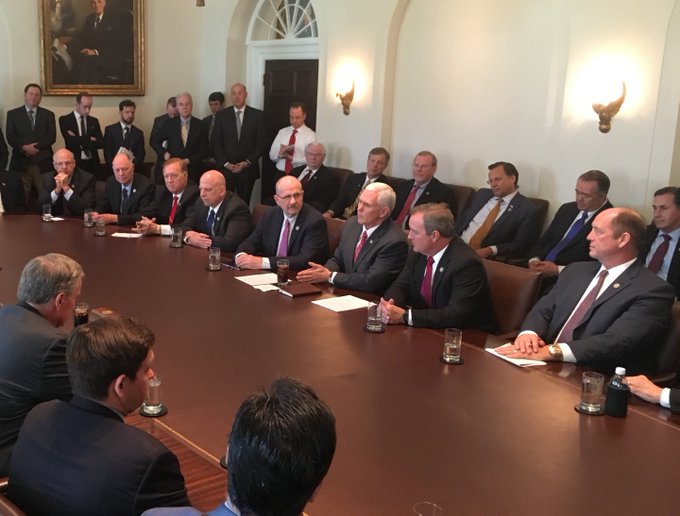
Last month, the White House released a photo of a meeting with lawmakers discussing the proposed health insurance bill — showing 25 white men and not a single woman in the room. That was so even though the bill would have cut such services as reproductive health, maternal health, and breast and cervical cancer screening.
This was not the first time that the Trump administration had shown pictures of all-male groups making policy on women. In January, for instance, the president signed an antiabortion order — reinstating what’s known as the “global gag rule” — surrounded by men.
In both cases, the Internet was atwitter with outrage. At the New York Times, Jill Filipovic even speculated that Trump’s all-male optics were an intentional appeal to his mostly male base of supporters.
Public outrage when groups of men are making decisions about women’s lives has been with us for a while. In 2012, the Internet went into spasms when Rep. Darrell Issa convened a congressional committee hearing on contraceptive coverage with only male panelists. And in 1991, famously, an all-male, all-white congressional committee interrogated Anita Hill — a black woman — about being sexually harassed. The outrage lasted into the next election, buoying more women into office.
Whether the Trump administration has purposely staged and released the all-white-male photos, our research suggests that this approach will backfire. All-male decision-making bodies erode citizens’ confidence in their political institutions. This is true for both men and women — and even for Republicans.
How we studied U.S. public perceptions of all-male decision-making bodies
In November 2016, we ran a series of survey experiments. We asked a representative sample of Americans to read a fictitious newspaper article about an eight-member state legislative committee evaluating sexual harassment policies. We varied the article so that some respondents read about a panel consisting of eight men, while others read about four men and four women. We asked how citizens felt about the panel when it made a decision that either restricted or advanced women’s rights — here, either decreasing or increasing penalties for those found to have sexually harassed others in the workplace.
We asked respondents for their personal opinions about the decision; whether the decision was right and fair; how they felt about the decision-making process; and whether they trusted the panel. Our design allows us to see whether and how citizens perceive their governing institutions differently based on whether women were involved in making decisions.
Nobody likes all-male panels
Here’s what we found: Citizens don’t like all-male panels.
As we show in the figure below, when all-male committees decrease penalties for sexual harassers, U.S. respondents are less likely to say they agree with the decision and less likely to view the outcome as right for citizens or fair to women. They are also more likely to view the procedure as unfair, more likely to think the decision should be overturned, and report less trust in the panel.
When female legislators are involved, respondents view both the decision and the decision-making process much more favorably.
Women’s and men’s responses to anti-feminist decisions
Men especially dislike women’s exclusion
How do American men feel about all-male panels? They dislike them even more than American women do. As you can see, while both men and women think more highly of decisions made by a gender-balanced panel, the effect is much larger for our male respondents. Men increase their agreement with the decision twice as much as women do when the decision is made by a gender-balanced group than when the committee is all male.
Why? Our research shows that women are more likely than men to view sexual harassment as an important issue. Because women have stronger opinions about the outcome than men (whether they’re for or against reducing penalties), the panel’s gender composition is less likely to sway their feelings about the decision itself.
Even Republicans dislike all-male panels
What about Republican respondents? Our findings suggest that if the Trump team is strategically trying to show that men are in charge of the decisions, they’ve taken the wrong approach. As with our broader sample, the figure below shows that our Republican respondents are also less likely to support rolling back women’s rights when an all-male panel makes this decision.
What’s more, leaving women out of decision-making more broadly damages Republicans’ faith in their political institutions.
Republicans might prefer outcomes that restrict women’s rights, but appear to believe that women’s presence helps legitimate these decisions.
Republicans’ responses to anti-feminist decisions
Excluding women from decisions makes U.S. citizens distrust their government — even when the decision favors women
But what if men decided to increase penalties for sexual harassers? In this case, women’s presence doesn’t affect respondents’ perceptions of the decision itself. But having women involved in the decisions significantly improves citizens’ perceptions of the decision-making process and their trust in their political institutions.
In sum, male dominance corrodes citizens’ faith in their political institutions — especially when the group rolls back women’s rights, but even when it doesn’t.











 Abortion - Abortion Clinics, Abortion Pill, Abortion Information