The White House confirmed Wednesday that President Trump will sign legislation overturning an Obama administration rule that currently prevents states from blocking federal grants to abortion providers, including Planned Parenthood.

White House legislative affairs director Marc Short said the move will be one of the final actions by President Trump to roll back Obama-era regulations by using the Congressional Review Act. By law, Mr. Trump’s ability to use the previously obscure tool expires on April 28.

Vice President Mike Pence provided the tie-breaking vote last week in the Senate to approve legislation which allows states to withhold Title X family planning funds from providers that also offer abortion services. The federal funding to states amounts to about $300 million annually.

 Late last year, Mr. Obama’s Department of Health and Human Services issued a final rule that prohibited states from withholding Title X money from providers such as Planned Parenthood.

The new legislation overturns the HHS rule by using the CRA, a 1996 law that allows Congress to repeal new regulations within 60 days of their passage.

So far, Mr. Trump has already used the CRA 11 times to repeal Obama regulations, ranging from an Interior Department regulation on stream protection near coal-fired power plants, to restricting hunting on federal lands.

“We inherited, this administration did, the biggest regulatory burden, we believe, of any president in American history,” Mr. Short said. “I think this is a huge accomplishment in the first quarter.”

Previously, only one other president, George W. Bush, had used the CRA to repeal a regulation by a prior administration. Mr. Short said the moves by Mr. Trump will save taxpayers an estimated $10 billion.

Source: The Washington Times

http://www.washingtontimes.com/news/2017/apr/5/donald-trump-sign-rule-abortion-providers/?utm_source=RSS_Feedutm_medium=RSS

INDIANAPOLIS (AP) — A federal judge has blocked an Indiana mandate forcing women to undergo an ultrasound at least 18 hours before having an abortion, ruling that the requirement is likely unconstitutional and creates “clearly undue” burdens on women, particularly low-income women.

 U.S. District Judge Tanya Walton Pratt’s ruling, issued late Friday, grants a preliminary injunction temporarily blocking the ultrasound waiting period. Planned Parenthood of Indiana and Kentucky and the American Civil Liberties Union of Indiana had sued the state last July, contending the mandate was unconstitutional and would prevent some women from getting abortions.
 Pratt’s ruling said the waiting period “creates significant financial and other burdens” on Planned Parenthood and its patients, particularly low-income women who face lengthy travel to one of only six Planned Parenthood health centers that can offer an informed-consent ultrasound appointment.
 The judge, who heard arguments in the case in November, found that Indiana had presented “no compelling evidence” to support its contention that the mandate would further its stated interest of convincing women not to have an abortion.
 “Simply put, the State has not provided any convincing evidence that requiring an ultrasound to occur eighteen hours prior to an abortion rather than on the day of an abortion makes it any more likely that a woman will choose not to have an abortion,” Pratt wrote. She added that the mandate “likely creates an undue burden on women’s constitutional rights.”
 A study of 15,000 women served by Planned Parenthood in Los Angeles is cited in Pratt’s ruling. It found that 99 percent of women proceeded with an abortion after not viewing the ultrasound, compared with 98.4 percent who did view the ultrasound.
 The requirement that women undergo ultrasounds at least 18 hours before having an abortion had replaced a previous Indiana provision that required women to get an ultrasound before having an abortion but did not specify when that had to occur.
 Planned Parenthood said in its lawsuit that under the state’s earlier measure the group performed ultrasounds on women immediately prior to their abortions.
 Betty Cockrum, the CEO and president of Planned Parenthood of Indiana and Kentucky, praised Pratt’s decision, calling it “an incredibly strong ruling” that protects Indiana women’s right to an abortion from needless burdens.
 “I would prefer that the Legislature figure out that it’s not their job to practice medicine, and that we would in fact get politicians out of our doctors’ offices,” she said.
 The ultrasound mandate is part of a wide-ranging abortion restrictions law that took effect July 1, 2016, a day after Pratt blocked the law’s provision that would have banned abortions sought because of a fetus’ genetic abnormalities, such as Down syndrome. The judge also blocked a provision requiring that aborted fetuses be buried or cremated.
 Then-Indiana Gov. Mike Pence, who is now vice president, signed the legislation into law in March 2016.
 Ken Falk, the legal director of the ACLU of Indiana, said only about 25 percent of Indiana women seeking abortions actually agree to see the fetal ultrasound, or hear the fetal heartbeat if it’s present. The remainder signed a form saying they have declined to see that information, he said.
 Falk said Indiana has 30 days to appeal the ruling.
 Indiana Attorney General Curtis Hill released a statement saying his office was considering its next steps in the case.
 Mike Fichter, the CEO and President of the anti-abortion group Indiana Right to life, urged Hill to appeal Pratt’s ruling and to continue to “fight for Indiana’s constitutional right to put a time requirement on our state’s ultrasound law.”

Source: WTop

http://wtop.com/health-fitness/2017/04/federal-judge-blocks-indiana-abortion-ultrasound-mandate/

WASHINGTON — Vice President Pence cast a tie-breaking Senate vote Thursday to pass legislation that will allow states to withhold federal funds from Planned Parenthood and other health care providers that perform abortions.

The measure, which now goes to President Trump for his signature, dismisses an Obama-era rule banning states from denying federal funds to such organizations.

Pence’s vote was needed to break a 50-50 tie. Republicans Susan Collins of Maine and Lisa Murkowski of Alaska broke with their party, voting against the measure.

Republicans have said the Obama rule should be overturned to allow states the right to steer funds away from abortion providers, if they choose.

Sen. Joni Ernst, R-Iowa, said the measure reverses a rule that “attempted to empower federal bureaucrats in Washington and silence our states.”

Democrats condemned the measure throughout the day, with Senate Minority Leader Chuck Schumer of New York calling it “another example of the Republican war on women.”

“It would let states treat women as second-class citizens who don’t deserve the same access to health care as men,” he said.

The House in February had voted 230-188 largely along party lines to reject the rule under the Congressional Review Act, which allows Congress to overturn recently enacted regulations.

The rule prohibits states from withholding family-planning funding from providers for reasons other than their ability to offer family-planning services. It took effect Jan. 18, two days before President Obama left office.

Since 2011, 13 states have restricted access to such grants, disrupting or reducing services in several instances.

Women’s marches across the country have protested cuts to reproductive health care services.

Pence, an evangelical Christian, was a leader in efforts to defund Planned Parenthood while serving in Congress and he co-sponsored “personhood” legislation calling for constitutional rights at the moment of fertilization. As governor of Indiana, he signed several anti-abortion bills, including one that banned abortions solely because of genetic abnormalities — legislation that was suspended by a federal judge.

In January, Pence became the highest-ranking official to appear in person at the annual March for Life demonstration. He told attendees then that the Trump administration would work with Congress to permanently bar taxpayer funding of abortion and abortion providers.

“Life is winning in America,” he said then, to cheers. “And today is a celebration of the progress that we have made in the cause.”

Source: USA Today

https://www.usatoday.com/story/news/2017/03/30/vice-president-pence-breaking-tie-senate-moves-against-planned-parenthood/99820022/


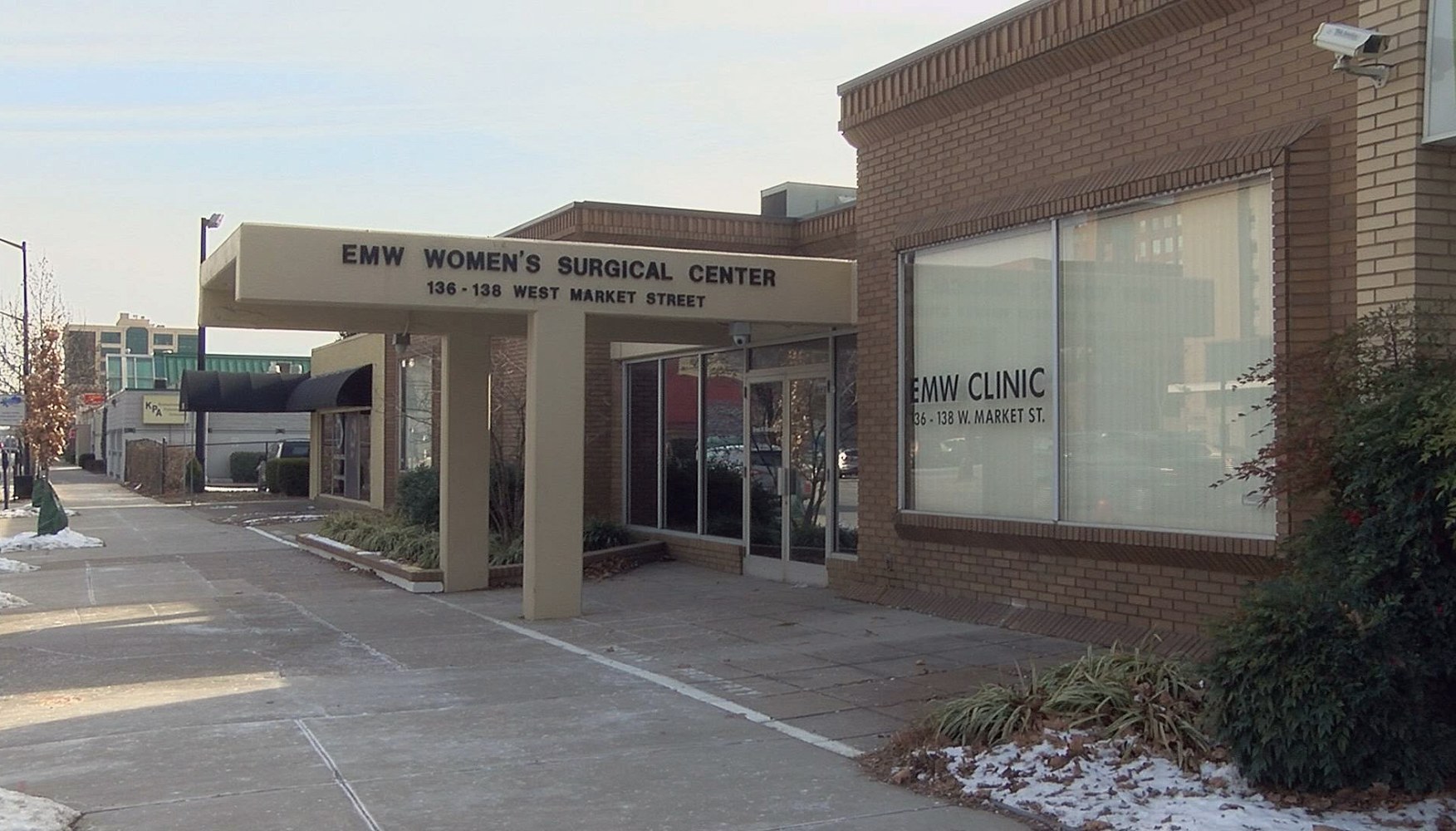
Kentucky’s last abortion provider is suing the state to stay open.

The EMW Women’s Surgical Center in Louisville claims in a federal lawsuit that Gov. Matt Bevin’s administration informed them “out of the blue” that the clinic was not in compliance with state rules and ordered them to stop performing abortions starting Monday, April 3.

“If EMW is forced to close its doors, there will be no licensed abortion facility in the Commonwealth of Kentucky,” the suit states. “Kentucky women would be left without access to a critical and constitutionally protected medical procedure.”

Image:  EMW Women's Surgical Center
The EMW Women’s Surgical Center in Louisville is Kentucky’s last abortion provider. WAVE3

The clinic is seeking an injunction against what it calls Bevin’s “blatantly unconstitutional” move.

“This is absolutely just another attempt to ban abortion in Kentucky,” said EMW attorney Donald L. Cox, adding that the clinic “has been properly licensed for decades.” “The governor’s war plan has some serious deficiencies in them. Other than that, it’s a great plan.”

There was no immediate response from Bevin’s office to the lawsuit.

At issue is the state’s requirement, outlined in the lawsuit, that “an abortion facility maintain agreements with a local hospital and ambulance company to transfer patients in the rare event of an emergency.”

Cox said EMW has had such an agreement in place with the University of Louisville Hospital and a local ambulance company since 2014. The clinic passed its most recent inspection last year and had it license renewed through May 31, he said.

“Despite these facts, out of the blue, on March 13, 2017, the Cabinet for the first time raised technical objections to the Agreements and sent a letter to EMW threatening to shut the clinic down in 10 days,” according to the lawsuit.

EMW charged in the papers the governor was retaliating against them for filing an earlier lawsuit “challenging Kentucky’s new forced ultrasound requirement.”

It’s no secret that the governor — a married father of 10 (four of them adopted) — opposes abortion and has called himself an “unapologetically pro-life individual.”

This year, Bevin signed two bills into law curbing abortion, including one that bans them after the 20th week of pregnancy. And he used tactics similar to the one he’s using on EMW to block abortions from being performed at the company’s other clinic in Lexington and at the Louisville clinic of Planned Parenthood of Indiana and Kentucky.

The Bevin administration is “taking the position that even though EMW signed an agreement with the hospital they say the actual owner of the hospital has to sign it,” said Cox.

Currently, the public hospital is managed by KentuckyOne Health, an affiliate of the Denver-based Catholic Health Initiatives.

“What they appear to be saying is we have to go to the Catholics to get permission to do abortions,” Cox said. “Not a very likely scenario.”

Source: NBC News

http://www.nbcnews.com/news/us-news/kentucky-s-last-abortion-clinic-sues-state-stay-open-n740696

A £250,000 grant to an anti-abortion group – using money raised from the tax on sanitary products – has been criticised.

MPs and campaign groups said it was wrong that Life received one of the largest amounts from the government fund that comes from the 5% VAT on tampons and towels.

Life said the money supported a project for homeless pregnant women in London.

The government said the latest £12m of funding benefitted 70 UK charities.

The Department for Culture, Media, and Sport (DCMS) released the full list of beneficiaries on its website,

‘Must be stopped’

The government has pledged to spend the proceeds from the controversial tax on sanitary products on women’s charities after hundreds of thousands of people signed a petition calling for them to be exempted from tax altogether.

The latest grants also included £200,000 for the Suzy Lamplugh Trust to support women who are stalked, £262,614 for Stepping Stones, Luton, for women facing domestic and sexual abuse, and £354,617 to support the group One Parent Families, which works across Scotland.

But it was the support to the pro-Life charity, using funds raised from a tax on women’s sanitary products that drew fierce criticism.

Stella Creasy, MP for Walthamstow, said: “This fund was supposed to help women, not encourage those organisations who want to control them – completely unacceptable and must be stopped.”

She tweeted to government minister Rob Wilson, who made the announcement: “Hey @RobWilson_RDG can you please cut funding to pro-life orgs and help ensure no young woman goes without tampons in school instead pls?”

Labour’s shadow MP for women and equalities Paula Sherriff said it was “bitterly ironic” to many women to be taxed for their biology “only for the government to hand over that money to organisations that don’t even believe we should have control over our own bodies”.

She called for the money’s allocation urgently to be reviewed.

‘Practical help’

And, Sophie Walker, leader of the Women’s Equality Party, said it was “a shock” to learn the government had used the money to support an anti-choice charity which aimed to “make abortion a thing of the past”.

She said the party appreciated the work Life did with homeless pregnant women and in caring for ill children, but: “We are very disappointed to see the allocation of such significant funds to this one charity while many others struggle, particularly those supporting BAME (Black, Asian, and minority ethnic) women and disabled women – who experience some of the highest rates of violence against them and yet are consistently at the bottom of the list for funding.”

London project

Life said it planned to use the money to develop its services, including “housing, practical help, non-directive counselling and life-skills training for pregnant and homeless women”.

It said it supported women in times of crisis with “care and compassion” and it was “grateful” to the government for the “positive gesture”.

“At Life we see women who are in genuine crisis because of pressures to end their pregnancy coming from partners, parents, employers, and society.

“We are there to empower those women with the support they need to continue with their pregnancy and to equip them with the skills to help them overcome their personal challenges,” a spokesman said.

The DCMS said the money for Life was to fund a specific west London project to help homeless and other at-risk women.

Source: BBC

http://www.bbc.com/news/uk-39472417

Arkansas governor Asa Hutchinson on Wednesday signed a law requiring doctors to investigate women seeking abortions before they can actually receive the procedure. The measure purports to block abortions that are based solely on the sex of the fetus, but actually bans women from getting the procedure until their physician has put in an unspecified amount of “time and effort” obtaining her pregnancy-related medical records.

House Bill 1434 — which creates the “Sex Discrimination by Abortion Prohibition Act” — was passed by the Arkansas House of Representatives and Senate this month, and will go into effect in January 2018. It forces doctors to ask a woman if she knows the sex of the fetus and, if she does, they must then gather all medical records pertaining to her “entire pregnancy history.” Under the law, doctors are prohibited from providing a woman with an abortion until they’ve taken a “reasonable” amount of time to get the records — which could potentially result in an indefinite waiting period, the Center for Reproductive Rights noted in a statement.

“Health-care providers should never be forced to investigate patients for the reasons behind their personal, private decisions,” Lourdes Rivera, a senior vice-president at the Center for Reproductive Rights, said. “When a woman has made the decision to end a pregnancy, she needs high-quality health care, not an interrogation.”

According to the Center for Reproductive Rights, this new law makes Arkansas the first state to require doctors to not only investigate a woman’s reasons for getting an abortion, but also to force them to look at her entire pregnancy-related history. The bill includes some language about sex-selection abortion and states that it mostly affects female fetuses, and briefly cites other countries that have taken steps to end the practice (India, Great Britain, and China). However, it doesn’t provide any data about such abortions in the United States. Under the new law, any doctor that performs an abortion based on the sex of the fetus will be found guilty of a class A misdemeanor.

Source: NY Mad

http://nymag.com/thecut/2017/03/arkansas-law-forces-abortion-doctors-to-investigate-patients.html

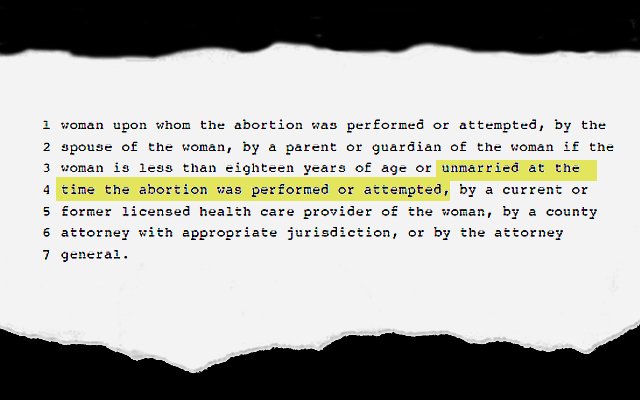
An anti-abortion bill being offered by Republicans in Iowa would effectively ban all abortions and give parents rights over the bodies of unmarried adult daughters.

A state House panel on Wednesday voted to send SF 471 — the so-called “personhood” bill — to the full committee. The bill states that life begins at conception, giving fetuses the same rights as people.

Anticipating that the “personhood” provision of the bill will likely be struck down by courts, the GOP bill also provides criminal punishment for anyone who performs an abortion more than 20 weeks after conception. The bill makes exceptions if the life of the mother is at risk. However, it does not make exceptions for rape or incest.

Iowa House Democrats noted on Wednesday that HF 53, to which SF 471 is a successor, also gives parents the legal right to prevent unmarried adult daughters from having an abortion.

View image on Twitter
The GOP’s 6 wk abortion ban dropped & it actually allows the parents of an adult unmarried women to make medical decisions for her.
The bill states “injunctive relief to prevent a physician from performing abortions” may be obtained “by a parent or guardian of the woman if the woman is less than eighteen years of age or unmarried at the time the abortion was performed or attempted to be performed.”

The Iowa House Human Resources Committee was scheduled to debate Senate File 471 on Wednesday.

Source: Raw Story

http://www.rawstory.com/2017/03/iowa-gop-abortion-bill-will-grant-parents-of-unmarried-women-rights-to-control-adult-daughters-bodies/

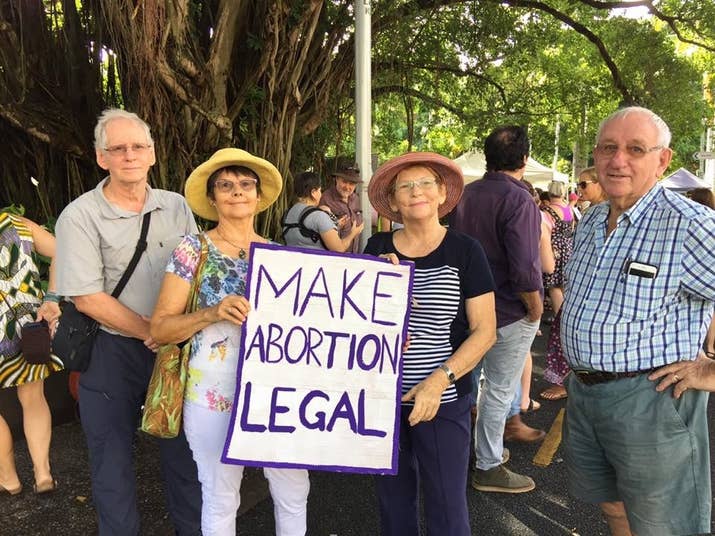
For the past 18 years Dr Michael Carrette has been one of the few doctors providing surgical abortions in Cairns.

Getty

When he retired late last year, after performing nearly 9000 abortions, women with unwanted pregnancies in Far North Queensland were left in the lurch.

The Cairns and Hinterland Hospital and Health Service (CHHHS) told BuzzFeed News: “Until recently, surgical terminations were provided in Cairns by a private doctor. Cairns Hospital patients who required this procedure were referred to this doctor who recently retired.”

Abortion remains in Queensland’s criminal code. If it is performed for reasons other than to “prevent serious danger to the woman’s physical or mental health” a woman and her doctor are technically open to being prosecuted.

Pro Choice Cairns/Facebook

The procedure is mostly performed by private clinics – Queensland Health estimates only 1% of abortions are performed in public hospitals.

Now the CHHHS is flying women as far as Sydney, 2400km away, to access abortions.

“Currently, patients who require a surgical termination are referred to providers in Townsville, Southport or Sydney,” a spokesperson for the CHHHS told BuzzFeed News.

“Medical termination options are still available locally and these are accessible for women who are considered suitable for this form of termination.”

Carrette, Cairns obstetrician and gynaecologist professor Caroline de Costa, and Cairns doctor Heather McNamee, have called on the state government to address the “immediate need” for surgical abortion services in Far North Queensland.

“It is costing taxpayers around $2000 per woman if they are going to Sydney, and that is a conservative estimate for a cheap airfare and a private surgical abortion,” de Costa said.

“That is without factoring in escorts, which you need if you’re having a general [anaesthetic].”

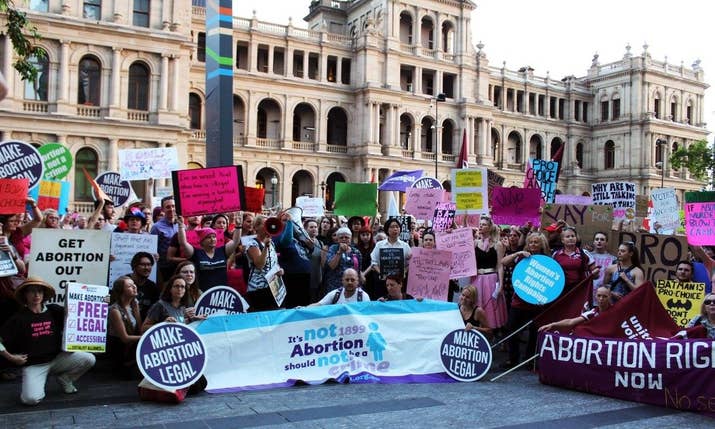
The doctors, along with 16 other Queensland obstetricians, gynaecologists, surgeons and GPs, have called on Queensland premier Annastacia Palaszczuk to speed up the push to decriminalise abortion.

De Costa said the government “tacitly, but not overtly” acknowledges the importance of access to reproductive healthcare by funding medical abortions in Cairns.

Shari Birse/Pro Choice QLD

The government also bailed out clinics in Townsville and Rockhampton when they nearly shut due to the prohibitive cost of flying doctors in and out to perform abortions for regional and rural women.

“Queensland Health itself refuses to establish effective and accessible public services and the result is a very fragile and piecemeal service everywhere north of Nambour, and no service at all west of Brisbane,” said de Costa.

Legislation to decriminalise abortion was withdrawn from the state’s parliament last month after every single member of the Queensland Liberal National opposition vowed to vote against it.

Religious-affiliated groups are testing misleading mobile tools.

Imagine you’re pregnant, and you don’t want to be. You type “abortion pittsburgh” into Google, and the first result is the Pittsburgh Women’s Clinic, offering “free abortion consultations.” “Only you know what’s best for you,” the Google ad reads. “Same-day appointments available. Call now!” You click and come face-to-face with a photo of a smiling woman with a stethoscope. “Looking for an abortion?” she asks in 65-point font. But you won’t get one from her or from the Pittsburgh Women’s Clinic. No clinic with that precise name exists.

The site is a landing page for a network of 41 pregnancy centers seeking to deter women from getting abortions. These centers, located in what they say are America’s “most abortion-dense cities,” are affiliated with or owned by Human Coalition—formerly Online for Life, sometimes going by the name Media Revolution Ministries—a Texas-based nonprofit that reaches “abortion-determined women” via ad campaigns shaped by search engine optimization (SEO) and search engine marketing (SEM). If you call the number on the landing page or initiate an online chat, you’re connected with Human Coalition’s national call center and, eventually, a nearby pregnancy center. The Google ad showed up because you were within 15 miles of one.

In Pittsburgh, 30 percent to 40 percent of women who got abortions last year first spoke to a representative “working to rescue the child and the mother,” says Human Coalition co-founder Brian Fisher, based on his own data and numbers from the Centers for Disease Control and Prevention. Operators tell callers the centers don’t provide or refer for abortion, Fisher says. Nationwide, 1 in 3 women who connect with a Human Coalition representative visit one of the group’s pregnancy centers. “The technology backbone undergirds it all,” he says.

The U.S. has more than 3,000 pregnancy centers explicitly steering women away from abortions, compared with only 1,671 facilities that perform the procedure. Pregnancy centers are typically 501(c)(3) nonprofits backed by religious donors, though nine state governments also subsidize them. Human Coalition has been funded in large part by Farris Wilks, the Texas fracking billionaire and evangelical pastor, whose $2.2 million donation in 2012 increased the organization’s revenue 30-fold, according to IRS disclosures.

 Targeting ads with SEO and SEM is becoming standard practice for pregnancy centers, overseen by umbrella groups such as Human Coalition, Heartbeat International, and Care Net. Several rally support and solicit donations through apps, pinging users to pray when a woman visits a center and, later, updating them on her decision. A chain of centers in California is testing telemedicine. Another chain has geofenced abortion clinics, meaning it has paid to show ads on the smartphones of people in waiting rooms.

“These centers are bullies,” says Amy Everitt, state director of Naral Pro-Choice America for California. “They’re sanitizing their image, but the goals and tactics are the same.” Her group has published reports documenting undercover investigators at pregnancy centers being routinely given false medical information and shamed for seeking abortions.

Pregnancy centers using SEO and SEM buy Google ads for keywords and phrases including “abortion” and “abortion clinic.” Like the Pittsburgh network, many don’t immediately make clear what they’re advertising. “The more ‘pro-life’ we are in our marketing, the more we drive away those who need us,” reads a post on Pregnancy Help News, a website for which Heartbeat International acts as the publisher. “If Jesus blurted out, ‘I am the Christ!,’ [nonbelievers] would have likely run.”

Everitt says this tactic amounts to false advertising and that her group works with Google Inc. to flag misleading search results, which violate the company’s ad policies, for removal. Pregnancy centers say their ads aren’t inherently misleading. “A lot of people search for abortion information,” says Human Coalition’s Fisher. “It doesn’t mean they want an abortion.”

Sometimes, though, pregnancy centers say they’ve gone too far. Allison Poosawtsee, digital marketing director for the 100-location nonprofit Bethany Christian Services, says her organization, which also provides adoption services, has stopped targeting ads to women inside abortion clinics, a practice that prompted public outcry. “We didn’t feel right about it,” she says, because women seeing the ads had likely made up their minds. Bethany’s geofencing campaign, which ran for three months in 2015, generated 16,652 sessions on the organization’s landing page, impregnant.org.

Baltimore, New York, and San Francisco have passed ordinances requiring centers to disclose that they don’t provide or refer for abortion, and Oakland, Calif., levies fines if ads imply they do. Naral helped draft a 2015 California law that requires centers to refer. (This compares with more than 1,000 restrictions on abortion clinics across the U.S., 30 percent passed in the past seven years.) The California rules have withstood court challenges, but lawyers for centers fighting the statewide law say they plan to appeal to the Supreme Court as early as this fall.

Pregnancy centers say they’re expanding beyond counseling and ultrasounds with an eye to supplanting Planned Parenthood. Some offer parenting classes and financial assistance. Obria Medical Clinics, the California chain testing a telemedicine app at its six centers, delivered primary-care services to about 4,000 patients last year. “We’ll provide an alternative,” says Obria founder Kathleen Eaton Bravo, who regrets getting an abortion decades ago. “I started this organization not to take away options, but to provide them.” Her centers offer testing for sexually transmitted diseases but no forms of contraception.

The stakes of confusing one kind of facility for the other can be high for pregnant women, whose options for terminating a pregnancy become fewer and costlier over time. Molly Spadt, 30, of Lincoln, Neb., once visited an Omaha pregnancy center she mistook for an abortion clinic. The billboard and radio ads she saw didn’t disclose its religious affiliation, and she only figured it out after a sonogram. “The words ‘choice’ and ‘options’ were what made me feel comfortable,” she says. “It’s incredibly deceptive.”

Source: Bloomberg

https://www.bloomberg.com/news/articles/2017-03-24/beware-google-ads-for-abortion-consultations

They’re probably not.

GEORGE FREY VIA GETTY IMAGES
Utah Gov. Gary Herbert (R) signed into law a bill that requires doctors to tell women that medication abortions can be reversed midway through the procedure. The American Congress of Obstetricians and Gynecologists does not recommend women do so.

NEW YORK― Utah Gov. Gary Herbert (R) signed a bill into law this weekend that requires doctors to tell women that medication abortions can be reversed midway through the process ― a claim that is unsupported by science.

Medication abortions involve taking two separate medications, mifepristone and misoprostol, within two days of each other. The first drug blocks progesterone and sheds the uterine lining, and the second causes a full miscarriage. The Utah law, passed by the GOP-controlled House and Senate, claims that a woman can stop her abortion after taking the first pill by ingesting the hormone progesterone. Doctors’ groups dispute that theory.

“Claims of medication abortion reversal are not supported by the body of scientific evidence,” the American Congress of Obstetricians and Gynecologists said in a statement, “and this approach is not recommended in ACOG’s clinical guidance on medication abortion.”

The author of the bill, Rep. Kevin Stratton (R), said it helps women be more “educated” about their decision. “If you’re pro-choice, I would say that it helps you be educated in making the choice,” he said in an interview with the Deseret News. “If you’re pro-life, it gives an opportunity to look at the options if a decision is made to reverse course.”

Republicans in five states have passed or tried to pass “abortion reversal” bills, and a federal judge in Arizona blocked a similar law in 2015 after ACOG called it “tantamount to quackery.” The legislation is based on a single study of six women who had taken a dose of mifepristone and then tried to reverse their abortions. Four of the women in the study were able to continue their pregnancies. But mifepristone alone only works 30 to 50 percent of the time to end a pregnancy, so researchers say there is insufficient evidence to claim that it was the dose of progesterone that halted the abortions.

The Utah bill is the latest in a trend of state legislatures encouraging doctors to give women false or incomplete information about abortion. Last week, the Texas Senate approved a bill that would permit doctors to lie to women about fetal abnormalities in order to discourage them from choosing abortion. And Republican lawmakers in Texas and Kansas have passed legislation requiring doctors to tell women that abortion is linked to breast cancer ― another medically unsupported claim.

But “abortion reversal” laws could actually put women’s health in danger by encouraging them to take a hormone that “can cause significant cardiovascular, nervous system and endocrine adverse reactions as well as other side effects,” according to ACOG. The doctors’ group recommends that instead of listening to politicians, women who change their minds halfway through a medication abortion have the same chance of success by “doing nothing and waiting to see what happens.”

Source: Huffington Post

http://www.huffingtonpost.com/entry/utah-bill-medication-abortions-reversible_us_58d96c6be4b00f68a5c96c25?ewa3cmsmscbx1or