Tennessee woman Hadleigh Tweedall shares her abortion story.

Hadleigh Tweedall and her husband had long been hoping for a second child to join their son, born in January 2014. Tweedall got pregnant just a few months after her son turned 1, but she experienced a miscarriage at the 11-week mark. “After that, it took us a while to start trying again,” Tweedall tells SELF. “It was obviously very devastating.” So when Tweedall found out she was pregnant again at the end of summer 2015, she was ecstatic. She and her husband were hopeful this pregnancy would be a successful one.

“Baby Grace,” she says. “That was the baby we ended up terminating.”

When Thanksgiving came around, Tweedall was 12 weeks pregnant. She’d just had a checkup and an ultrasound, and had been told everything looked normal with her pregnancy. She went in for some noninvasive prenatal testing, per a suggestion from her doctor. These tests could tell her the sex of the fetus, and they could alert her doctor to the presence of trisomies—chromosomal abnormalities that could lead to fetal anomalies or miscarriage. Tweedall and her husband were excited to find out the sex, so they went in and completed the tests right before Thanksgiving. The doctors said they would hear back about their results just 10 days later.

“We did Thanksgiving with our families,” she says. “We announced our pregnancy to our extended families, and it was a really exciting time.” But when they got back from Thanksgiving, Tweedall and her husband still hadn’t gotten their results. The couple called the office repeatedly over the next three weeks, until a doctor finally told them they needed to come in. “I was hysterical, because I knew something was wrong,” she says. “She would have just told us everything was fine over the phone, but she wanted to see us.” At that point, Tweedall knew her fetus likely had a trisomy—though she had no idea which one.

Tweedall and her husband soon learned their fetus was female, but the tests also found trisomy 21—more commonly known as Down syndrome. “It was a lot of information coming at us all at once,” Tweedall says. She learned there was a small chance that there was a false positive—meaning her fetus wouldn’t actually have a trisomy. Tweedall was only 30 years old, so her risk of conceiving a child with Down syndrome was 1 in 940. Her doctor recommended more tests to confirm the results, and the couple agreed.

“It was Christmas,” Tweedall says. “Everything was booked, and every sonogram place was closed for the holidays.” The couple got the earliest appointment available to them on December 28. In the meantime, Tweedall did some research. She reached out to the director of the Down Syndrome Association of Middle Tennessee, and connected with a family who had children with Down syndrome. “I wanted to get a better idea about the condition,” she says. “It could lead to multiple surgeries and a very short suffering life for the child. Or the child could be very high-functioning and prosper. You just don’t know.”

For Tweedall and her husband, the next two weeks dragged on. “I don’t think I got out of bed very much,” she says. “You just feel really lost with a diagnosis like that.” When the couple finally went in for tests on December 28, they learned the fetus had both Down syndrome and hydrops fetalis—a condition in which the body fills with fluid. “It was a terrible day,” Tweedall says. “Her legs had stopped growing due to fluid. Our doctor told us there was no way this baby would survive more than a month or two of pregnancy.” Tweedall explains that if the pregnancy had been farther along, the doctor could have induced labor and tried to save the fetus. But Tweedall was only 17 weeks in. “At that point, there’s not much you can do when there’s that much fluid in the baby’s body,” she says.

The doctor told Tweedall that the pregnancy would become increasingly high-risk if she decided to carry it to term. “‘If she passes away, your body might take a while to realize she’s no longer living,'” Tweedall was warned. This increased Tweedall’s risk of hemorrhaging or contracting an infection.

“So my doctor recommended that I terminate the pregnancy—from a safety standpoint for me,” she says. Tweedall notes that many laws restricting abortion access are written to include exceptions for cases that endanger the life of the mother. “But it’s a hard thing, because that’s based on opinion,” she says. “Nobody told me I was going to die. My risk of death and hemorrhaging and infection increased if I continued—but it’s such a fine line. I’m a wife and a mother to a little boy—I want to be around for that.”

Tweedall’s doctor said the closest place that would perform a late-term abortion was a clinic in Atlanta. “It wasn’t even a conversation to see if anyone would do it here,” she says. “But I didn’t want to be away from everyone, sleeping in a hotel, and not even knowing or trusting the medical staff.” So Tweedall didn’t really look into going to Atlanta. Instead, she decided to take a trip to her hometown—Chicago—because she felt more comfortable being in a place where her parents still lived. “It’s scary enough that you’re going through all this,” she says. “To think you’re going to be in a clinic somewhere you aren’t familiar with is a lot to take in.” And Tweedall felt disappointed by the lack of support she was receiving from her medical staff in Tennessee. “Everyone just sorted of washed their hands of it and walked away,” she says.

So Tweedall planned to travel to Chicago to receive the medically necessary procedure. Beforehand, she had to fax over her medical records and send ultrasounds showing that the fetus had severe hydrops fetalis. “But I had to follow up with my doctor three or four times just to get her to send over the paperwork,” she says. “I called her office numerous times—and never got a call back.” Tweedall grew concerned. The Chicago hospital would only perform abortions on pregnancies under 20 weeks, and Tweedall was already at 17.5. “We were leading up to the new year,” she says. “It was the holidays—everyone was out of office. No one was responding, and the longer you wait, the more your risks increase and the more difficult the procedure becomes.”

Tweedall ended up terminating her pregnancy five days into the new year—on January 5, 2016. “It was the hardest thing of my entire life,” she says.

Tweedall says that after she came home to Tennessee, people kept trying to reassure her by saying that what she did “wasn’t an abortion.” “But I kept saying, ‘No—it is,” she says. “I wanted to reclaim the word abortion, because the stigmatized image people have of abortion isn’t always what it is.”

Tweedall later learned that she could have had her abortion at a Tennessee hospital, after all. The state’s laws permit women to have abortions at clinics until they’re 15 weeks pregnant. Then, between 15 weeks and fetal viability (20 to 22 weeks), a woman can have an abortion at a hospital. These medical facilities have the right to deny patients, meaning they’re not required to perform the procedure—they’re just permitted to. If Tweedall had been more aware of Tennessee’s laws, she might have avoided traveling 491 miles just to receive a safe, legal medical procedure she needed.

“It was just interesting to find out that technically my doctor should have fought for me,” she says. “But nobody did. Nobody fought for me. And that’s disheartening. You rely on your doctors—especially in a crisis situation—to give you accurate information. On top of it, you’re grieving the loss of your daughter. And it’s just—I don’t know—the regulations and the way I was treated by the medical team here in Tennessee didn’t make the situation any easier. I even had to call and follow up about our paperwork. Thank God for my husband, because he was doing most of it while I was on the floor crying. So to find out later that I technically should have been able to go home to my bed that night is just awful.”

And though reliving these experiences brings back negative feelings, Tweedall says it’s only getting easier to talk about. When I spoke with her in early January, she was about to give birth to another child. After three years, one miscarriage, and one abortion, she and her husband are finally welcoming a second child into their family. “It’s been a long nine months,” she says. “It’s been so long, and we’ve had to go through so much crap to get to this point.”

And whether her tragic experience is effecting change, inspiring open-mindedness, or making someone feel less alone, she’s happy to share it. “At least if my story can help somebody, it’s worth telling,” she says.

Source: Self

http://www.self.com/story/tennessee-abortion

Here’s a look at 90 of them.

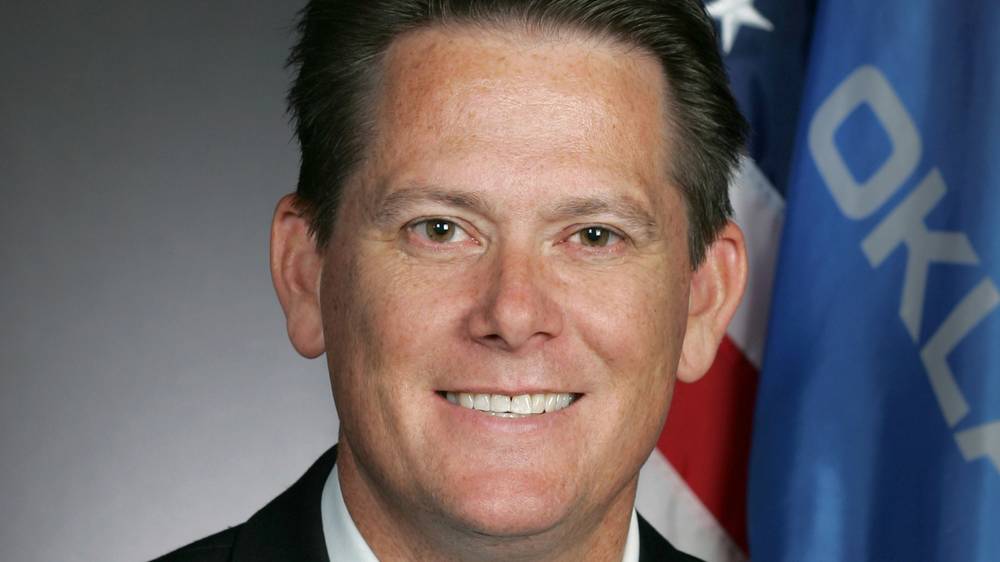
Joseph Silk, David Brumbaugh, Matthew Hill, Mark Chelgren, Justin Humphrey, and Brad Klippert—just six of the many legislators who have introduced anti-abortion bills so far in 2017.

We’re just three months into the new year, and lawmakers—a handful of whom are pictured above—have already proposed 168 anti-abortion bills at the state and federal levels.

Why does this matter? More than four decades ago, Roe v. Wade affirmed a person’s constitutional right to privacy, effectively legalizing abortion nationwide. But lawmakers have continued proposing and passing bills that make abortion—a medical procedure—harder to access.

Yet these anti-abortion legislators persist—in spite of research that shows that countries with the strictest anti-abortion laws actually have some of the highest rates of abortions in the world, and that there’s a correlation between defunding Planned Parenthood and an increase in maternal mortality rate. Overwhelming evidence indicates that smarter, more humane ways to actually lower the abortion rate involve improving healthcare and healthcare access—such as by making contraception and family planning services more available, not less. But in our country, (overwhelmingly male) politicians continue proposing and passing laws that impede access to safe and constitutionally protected medical care.

Here are 90 of the 168 anti-abortion bills that have been proposed so far in 2017.

There’s a bill that says patients have to receive permission to have an abortion from the person who impregnated them.

Oklahoma Representative Justin Humphrey introduced a bill that would prevent people from having abortions until they’ve received official permission to do so from the people who impregnated them.

“I believe one of the breakdowns in our society is that we have excluded the man out of all of these types of decisions,” Humprey said, explaining his bill. “I understand that [women] feel like that is their body. I feel like it is a separate—what I call them is, is you’re a ‘host.’ And you know when you enter into a relationship you’re going to be that host and so, you know, if you pre-know that, then take all precautions and don’t get pregnant. So that’s where I’m at. I’m like, hey, your body is your body and be responsible with it. But after you’re irresponsible then don’t claim, well, I can just go and do this with another body, when you’re the host and you invited that in.”

There’s a bill that requires medical providers to interfere with an abortion if the fetus shows any signs of life.

The Arizona Senate has passed a bill that requires medical professionals to try to resuscitate aborted embryos and fetuses if they show any signs of life—whether the embryo or fetus is viable or not. Right now, doctors only perform these measures on a case-by-case basis when the chance of survival is high. One doctor told CBS that attempting medical interventions at early stages in gestational development is “cruel” to the parents and would inflict unnecessary harm on a fetus or embryo that likely wouldn’t survive anyway.

There are eight bills that force medical providers to bury or cremate fetal remains—or otherwise specify how medical providers should dispose of fetal remains.

Doctors already have established protocols for how they sanitarily dispose of medical waste. But these eight bills would require them to treat fetal tissue differently. “Many doctors and medical organizations have said that [these laws] do nothing for any public health purpose,” David Brown, senior staff attorney at the Center for Reproductive Rights, previously told SELF. “It’s a way of putting additional pressure on clinics in the hopes that some won’t be able to withstand the pressure and close. It’s one more potential obstacle to them having to keep their doors open.”

There are five bills that allow patients to sue their abortion providers, even decades later.

These bills would allow patients to sue their abortion providers for emotional distress—even years after receiving the procedure. And while some, like Iowa Senator Mark Chelgren, see bills like these as a way to protect people seeking abortions, legal experts say the consequences could be severe. “When you look at it more carefully, it’s a threat to the woman because it creates deterrents for doctors to do this,” Mark Kende, J.D., director of the Constitutional Law Center at Drake University, told the Associated Press. In other words, the threat of being sued retroactively could scare doctors out of providing abortions at all—which ultimately hurts people who are seeking them.

There are seven bills that ban abortion entirely.

Some of these bills recognize life as beginning at conception, and view abortions at any state of gestational development as murder. Others seek to criminalize medical providers who perform abortions. All seven view abortion as unlawful in some form or fashion, and all would ban the procedure entirely (with select exceptions, depending on the bill).

There are 10 misleadingly named “Heartbeat Bills” that ban abortions after fetal cardiac activity is detectable—usually around the six-week mark.

So-called “Heartbeat Bills” ban abortions from the moment fetal cardiac activity is detectable. This typically happens around the five- or -week mark—before many people even realize they’re pregnant. (Learn more about what it means to be six weeks pregnant here.) Nine of these bills have been introduced at the state level, but Iowa congressman Steve King proposed the first federal six-week abortion ban: the “Heartbeat Protection Act of 2017.”

Other states, like North Dakota and Arkansas, have attempted to pass similar bills in the past—but their efforts were blocked in higher courts for being unconstitutional.

There are 18 bills that ban abortions after 20 weeks, based on the unsubstantiated claim that fetuses can feel pain at this point.

Twenty-week abortion bans are based on the idea that fetuses can feel pain at this stage in development—despite there being no medical evidence to support that reasoning. These bills are similar to laws already in place in 16 states and to two that were blocked for being unconstitutional.

Worth mentioning: Almost 99 percent of abortions occur before the 20-week mark, according to Planned Parenthood. Often, people who seek late-term abortions do so because they’ve discovered serious fetal anomalies that weren’t apparent earlier. “These are often desperately desired pregnancies that have gone wrong,” Lauren Streicher, M.D., an associate professor of clinical obstetrics and gynecology at Northwestern University Feinberg School of Medicine, previously told SELF.

There are 12 bills that ban abortions through dilation and evacuation, the safest and most common way for a woman in her second trimester to have an abortion.

Dilation and evacuation abortions—or D&E abortions—involve two steps. First, a woman’s cervix is dilated. Second, a doctor surgically removes the contents of the patient’s uterus. The American Medical Association recognizes this as the safest way a woman can terminate a pregnancy beyond the 14-week gestational mark. It’s also the most common way for people in their second trimesters to end pregnancies, as D&E is used in 95 percent of second-trimester abortions.

There are 12 bills that require patients to be offered ultrasounds, have ultrasounds, or listen to sonograms before they can have the abortions they’re seeking.

Ten different states have introduced bills that would require patients to jump a series of hoops before they can have the abortions they’re seeking. (Both New Jersey and New York have introduced two.) Some of these bills require people to have ultrasounds, and others require them to listen to sonogram results. Some just require medical providers to offer to perform ultrasounds on people seeking abortions. If passed, all of them would force people to take additional steps to have the abortions they want or need.

There are 16 other bills that make patients undergo counseling or wait a certain period of time before they’re allowed to have abortions.

State legislators have also introduced bills that would require patients to undergo specific kinds of counseling or wait a certain period of time before they can actually have the abortions they’re seeking. Sometimes, these bills result in people having to make more than one appointment, which can be especially difficult for people who live in rural areas and have to drive long distances to get to a medical provider in the first place.

Source: Self

http://www.self.com/story/anti-abortion-bills

GOP Politician Says Pregnancy from Rape or Incest Is Like 'Beauty from Ashes'

PHOTO VIA OKHOUSE.GOV

Invoking God, the Oklahoma House of Representatives just passed a bill outlawing abortion in cases of fetal abnormality—with no exception for rape or incest.

Republican politicians frequently have to say dumb and vile things to justify abortion bans that don’t allow exceptions under any circumstances—including pregnancies resulting from rape or incest, or if the woman’s life is in danger. The latest example comes from an Oklahoma state representative, George Faught, who introduced a bill that would ban abortions due to fetal genetic abnormalities or Down syndrome. The bill would make it illegal for doctors to perform abortions under that criteria; those who refuse to comply could have their licenses suspended or revoked and face fines of up to $100,000.

Defending the fact that the ban would have no exceptions, Faught suggested that “rape and incest could be part of God’s will,” according to the Huffington Post. And when Democratic members of the state’s House challenged him, asking him directly if rape was the will of God, he seemed to imply that, since rape was in the Bible, it’s just a natural part of life that women have to deal with.

“If you read the Bible, there’s actually a couple circumstances where that happened, and the Lord uses all circumstances,” Faught said. “I mean, you can go down that path, but it’s a reality, unfortunately.” Regarding incest, he said, “Same answer.”

When Faught added that the line of questioning from the Democrats “doesn’t deal with this bill,” they made clear to him that it does. “You won’t make any exceptions for rape, you won’t make any exceptions for incest in this, and you are proffering divine intervention as the reason why you won’t do that,” Rep. Cory Williams said. “I think it is very important. This body wants to know, myself personally, whether you believe rape and incest are actually the will of God.”

Faught responded by doubling down on his claims that rape and incest are part of God’s grand design, and victims of rape and incest can “use” the experience. “It’s a great question to ask, and, obviously if [rape and incest] happens in someone’s life, it may not be the best thing that ever happened,” he said. “But, so you’re saying that God is not sovereign with every activity that happens in someone’s life and can’t use anything and everything in someone’s life, and I disagree with that.”

 Apparently the floor was moved by this testimony, as the bill passed in the House with 67 votes. In a statement to a local NBC station after the vote, Faught spoke of the “beauty” of pregnancy that results from rape or incest. “Life, no matter how it is conceived, is valuable and something to be protected. Let me be clear, God never approves of rape or incest. However, even in the worst circumstances, God can bring beauty from ashes,” he said.

Even in the worst circumstances, God can bring beauty from ashes

Faught’s statement, and the the bill—which was authored at the request of an anti-abortion group—have been condemned by doctors and healthcare advocates. “This bill is a deeply damaging to reproductive healthcare, as well as the doctor-patient relationship,” the Oklahoma Coalition for Reproductive Justice said in a statement. “Further, we find it absolutely unacceptable and inappropriate that the bill’s author, George Faught, argued on the House floor that sexual assault is the will of God. Oklahoma women and families deserve better than a politician that uses his personal dogma to explain away violent crimes against women.”

Faught tried to pass a bill like this last year, but it failed after Senate amendments. According to the Guttmacher institute, only one other state—North Dakota—has a law that bans abortion on the basis of fetal abnormalities. Two other states have attempted to institute similar legislation, but federal courts have intervened, temporarily blocking the laws from taking effect; pro-choice advocates say Oklahoma will face similar legal challenges if the bill becomes law.

“It’s interesting that the bill is drawn so that it only impedes access for one group of people, and, frankly, folks who have fetal abnormalities are in desperate situations themselves,” Julie Burkhart, the founder and CEO of one of only three abortion clinics in the state, told a local news outlet. “So it really works to penalize women, their partners, their families for just trying to make good decisions for themselves.”

Indeed, there are many reasons women choose to terminate their pregnancies when they learn the fetus they are carrying has a genetic abnormality. In some instances, the abnormality may be so severe that it will be incompatible with life. It’s also often the case that severe conditions are detected late in pregnancy, so many late-term abortion restrictions already pose hurdles to women in these situations. But no matter the circumstance, bills like the one proposed in Oklahoma tell women that they don’t have the right to decide what’s best for their families and their own bodies—only God and old white men do.

Source: Broadly

https://broadly.vice.com/en_us/article/gop-politician-says-pregnancy-from-rape-or-incest-is-like-beauty-from-ashes

The activists were protesting several anti-abortion measures.

On Monday, the Texas Senate considered several abortion-related bills, including Senate Bill 415, a regulation that would effectively ban a safe and common procedure used for second trimester abortions, which anti-choice legislators have taken to calling a “dismemberment abortion ban.” It passed and will now head to the House.

The Senate also inched forward with SB 25 ― a bill that would effectively allow doctors to lie to pregnant women if they detect a fetal anomaly and are concerned their patients might opt for abortion. It will likely head for a final vote on the floor this week.

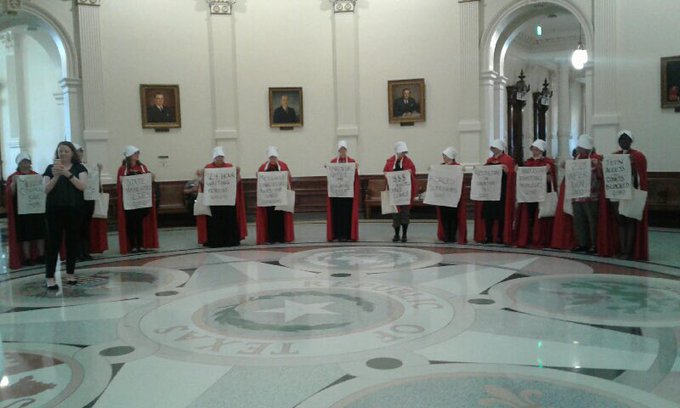
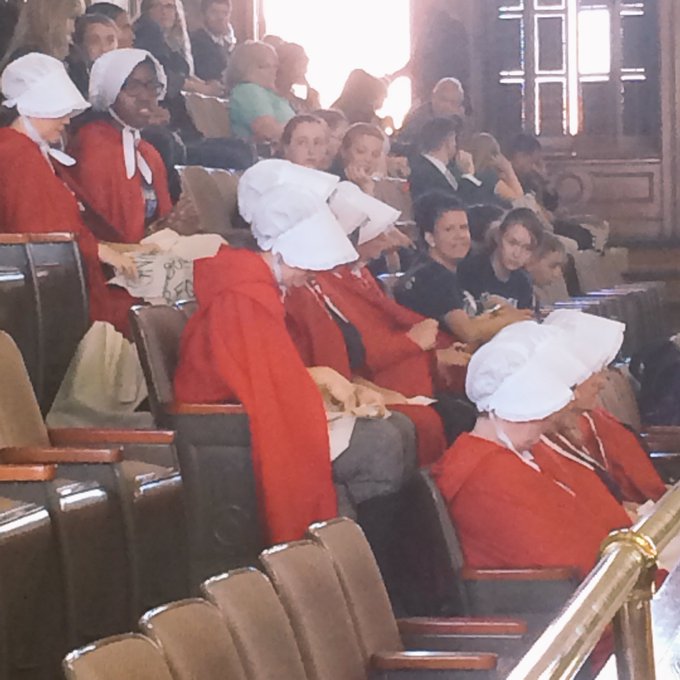
But in the Senate chambers on Monday, a group of Texas women were having none of it. The activists arrived decked out in full red robes, an homage to characters in “The Handmaid’s Tale,” Margaret Atwood’s classic (and distressingly relevant) feminist tome.

View image on Twitter
 The scene in Texas sent a quiet warning to legislators that women are ready to push back against the recent increase in anti-choice legislation in states across the country. Pictures of the sheroes quickly made the rounds on Twitter with the hashtag #FightBackTX.

It’s not the only recent example of women using clothing to broadcast a message in legislative quarters. Democratic women wore white to hear President Trump’s first address to Congress last month, a nod to the suffragists and a rebuke of misogynistic policies.

A pro-choice protest On International Women’s Day in London.
A pro-choice protest On International Women’s Day in London. ‘It is time for women to be treated as autonomous adults capable of making their own decisions,’ writes Wendy Savage. Photograph: Wiktor Szymanowicz/Barcroft

We congratulate Diana Johnston for introducing her bill (New bill to challenge UK’s Victorian-era abortion law, 14 March) and are delighted it was passed by 172 to 142 votes. As a 10-minute rule bill, it has no chance of becoming law, but it is important in starting the debate about whether, after 50 years, it is time to revisit the 1967 Abortion Act. It is time to treat abortion like any other medical procedure, and control it with regulation and the GMC. It is wrong that three women have been jailed or had a suspended sentence, and that doctors responding to women’s requests may face criminal prosecution. Many people (and even some gynaecologists) do not realise abortion is a criminal offence unless it conforms with the conditions set out in the Act. Up to 80% of people polled believe the woman should make the decision in consultation with her doctor and 90% of a random sample of gynaecologists surveyed in 2015 said that the woman should make the decision to end her pregnancy. It is time for women to be treated as autonomous adults capable of making their own decisions about continuing a pregnancy, a view that the some tabloid newspapers seem incapable of understanding.

Source: The Guardian

https://www.theguardian.com/world/2017/mar/20/women-are-capable-of-choosing-whether-to-continue-a-pregnancy

Wellington High School students protesting outside Wellington Hospital in support of women wishing to have abortions in 2014.

KEVIN STENT/FAIRFAX NZ

Wellington High School students protesting outside Wellington Hospital in support of women wishing to have abortions in 2014.

 EDITORIAL: Abortion law in New Zealand seems to be one of those areas where Government thinking is observably out of step with public opinion. Recent polling by Curia, carried out for the Abortion Law Reform Association of New Zealand, found majority public support for the legality of abortions in a range of situations. Support was as high as 77 per cent if a pregnant woman was likely to die without an abortion, down to 54 per cent if the woman cannot afford another child and 51 per cent if she simply does not want to be a mother.

These numbers reveal the existing law is archaic and farcical, and that most agree that abortion should be considered a health issue not a criminal one. Abortion is covered by laws that have not been updated for 40 years. They say that two consultants need to agree that the woman’s mental or physical health is at risk or the baby would be seriously disabled before an abortion can be approved.

In most cases, it is merely a rubber-stamping exercise. Of the 13,000 abortions that were performed in New Zealand in 2015, nearly all were approved on mental health grounds (in 2014, that covered 97 per cent of abortions). Does anyone believe that more than 12,000 New Zealand women risked severe mental health outcomes if their pregnancies went full-term?

Bill English and Paula Bennett hold different views on abortion, but his view will prevail for the time being.

CAMDERON BURNELL/FAIRFAX NZ

Bill English and Paula Bennett hold different views on abortion, but his view will prevail for the time being.

 That said, abortions are sometimes declined. It was reported that 252 “not justified abortion” certificates were issued in 2016. It is a reminder that while our system appears to operate as abortion on demand as long as doctors agree to bend the rules, they still have the authority to deny abortions without giving reasons.

The fact that one in four New Zealand women have had an abortion suggests it has become mainstream, though it is a difficult personal decision that is rarely taken lightly and often at times of considerable distress. Some noted that even the language of the law reflects earlier, less enlightened times. Doctors are routinely referred to as “he” and the abhorrent term “subnormal” is used in a mental health context. This is what Abortions Supervisory Committee chair Dame Linda Holloway meant when she told Parliament last week that parts of the law seem “offensive” to us now. It also uses outdated medical terminology.

The committee’s appearance before the Justice and Electoral Select Committee put the otherwise dormant issue of abortion law under the spotlight. It made it political. For Opposition, there is the happy coincidence of having a conservative Catholic Prime Minister, Bill English, who refuses to back liberalisation and a Deputy Prime Minister and Women’s Affairs Minister, Paula Bennett, who has said she is “pro-choice” but is toeing the party line this time.

Act leader David Seymour identified that the current law is a “charade” from his party’s liberal perspective. But it is a charade we will keep playing for the time being. Despite such pressure, there is little political will for change and it is unlikely English and Bennett will be embarrassed into reversing their public positions on what remains a private and morally subjective area.

Source: Stuff

http://www.stuff.co.nz/the-press/opinion/90539750/editorial-is-it-time-to-update-new-zealands-abortion-law

The abortion pill would be on hand at virtually every public college in California under legislation introduced Friday in the state Senate.

The bill’s inception comes amid renewed attempts to slash funding for Planned Parenthood, which would no longer receive Medicaid reimbursements under the Republican-backed American Health Care Act.

If the health care plan were passed in its current form, $174 million would be slashed from the budget of California’s Planned Parenthood clinics. Although Planned Parenthood is the largest single provider of abortions in the country, it does not use federal money to provide the procedure.

“If those cuts are made, then I do believe this bill takes on a heightened sense of urgency,” state Sen. Connie Leyva, D-Chino (San Bernardino County), who put forth the bill, told The Chronicle. “Women in 2017 shouldn’t be fighting for access to their bodies.”

The American Health Care Act, a Republican bill to repeal and replace the Affordable Care Act, is making its way through the House legislative process. As it does, a somewhat surprising group is reportedly hoping the bill fails.

Leyva’s legislation — which doesn’t cover surgical abortions — would make the pregnancy-terminating pills available at all University of California, California State University and California Community College campuses that have a student health center that gets funding from the state.

The medication, two pills ingested orally, can be taken only within 10 weeks of a woman’s last period.

Kathy Kneer, president of Planned Parenthood Affiliates of California, said the medication is safe and effective. Since the Food and Drug Administration approved the pill 16 years ago, 3 million women have taken the abortion pill, she said. Of those, 19 died from complications related to the medication — a mortality rate lower than that of giving birth.

“There’s no reason why it shouldn’t be readily available in student health centers,” Kneer said. “There’s no medical justification.”

The availability of the abortion service on campuses would be the first in the nation. Last year, the elected student leaders of UC Berkeley lobbied the administration to provide the abortion pill at the campus health center, but their demands never came to fruition. UC Berkeley spokespeople said they weren’t available to discuss the matter.

“Because our health center includes a pretty comprehensive amount of sexual and reproductive services, not providing abortions reinforces the idea that abortion is not a part of women’s health, when it absolutely is,” said Adiba Khan, 20, a student who pushed for the service to be offered on campus. “For undergrads and graduate students, abortion is part of their life. It’s normal and should be available as easily and cheaply as possible.”

Khan said friends of hers who took the abortion pills were initially met with financial and academic roadblocks. Those who got their health insurance through the campus first had to meet with a counselor before they could be referred to an outside provider — a potential obstacle for the time-sensitive medication — and often missed class or work to travel to an abortion provider off campus, she said.

Marandah Field-Elliot, a student senator who helped organize the campaign to get the abortion service on campus, said an added bonus if the bill passes the state Legislature would be that UC Berkeley wouldn’t be the sole object of antiabortion activists. Already this year, UC Berkeley’s progressivism put the campus in the crosshairs of President Trump’s tweets when violent protests forced an event featuring controversial speaker Milo Yiannopoulos to be canceled.

“This bill would be so amazing, because it would spread the impacts rather than putting a target right on Berkeley,” Field-Elliot said.

Source: SFGate

http://www.sfgate.com/politics/article/Bill-would-make-abortion-pill-available-at-state-11010665.php

The Women’s Centre used Google to target woman researching abortionsDADO RUVIC/REUTERS

Google has blocked an anti-abortion group from using advertisements on its search engine that encourage women to visit their rogue crisis pregnancy agency.

Last year The Times exposed how The Women’s Centre on Berkeley Street in Dublin was advising women that abortion caused breast cancer and could turn them into child abusers.

Despite claiming to be an objective source of information, The Women’s Centre is linked to The Good Counsel Network, an extreme Catholic group that has compared abortion to terrorism. The group paid Google so that its website, abortionadvice.ie, was the first or second result when a woman searched for information on how to access a legal abortion abroad. Women who call its “national helpline” are offered appointments at The Women’s Centre or one of the other clinics it claims to run across the country.

Google offers paid advertisements which can present a website as the first result under certain search terms. This week the company blocked The Women’s Centre from using its adverts because it had been found to be deceptive.

“We have a set of strict policies which govern what ads we do and do not allow on Google. We do not allow fraudulent or misrepresentative ads and when we discover ads that break our policies, we quickly take action,” a spokesman for Google said.

The site had specifically targeted women using Irish IP addresses who were entering search terms indicating that they were looking for information about how to access an abortion in the UK. Since the site’s removal from the top search results it has been replaced by a HSE website and the British Pregnancy Advisory service.

The Women’s Centre is facing closure after Simon Harris, the health minister, committed to pass legislation to regulate crisis pregnancy agencies that were offering misinformation. Mr Harris said that he was hoping to pass the law this summer.

Other anti-abortion groups and campaigners have also sought to use Google adverts to campaign ahead of a possible referendum on the Eighth Amendment. Over the course of the last meeting of the citizens assembly, a website alleging bias on the part of the forum paid to be the top search result.

Citizensassembly.info is a site registered through a proxy. On the site it is stated that it was set up by Josiah Burke, a business student from NUI Galway. Mr Burke is one of ten children in the Burke family in Castlebar. Members of the family are well-known as anti-abortion and anti-marriage equality campaigners. The family linked homosexuality to paedophilia during the marriage equality campaign, sparking a protest at the NUIG campus.

The website claims that the citizens’ assembly, which is considering the need to change Ireland’s abortion laws, is biased in favour of a repeal of the Eighth Amendment. At its last meeting, members of the assembly reacted angrily when Family and Life, an anti-abortion campaign group, used its presentation to claim that the assembly was biased and hearing evidence from “the abortion industry”. The 99 citizens had requested to hear from healthcare professionals who offered legal abortions to Irish women in the UK.

Family and Life has since sponsored its social media posts on sites like Facebook to claim that the assembly is biased.

Ms Justice Mary Laffoy, the assembly’s chair, has repeatedly defended the forum as being balanced and fair. At its next meeting in April the assembly members will ballot on what change, if any, should be made to Ireland’s constitutional near-ban on abortion. The assembly has considered leaving the Eighth Amendment as it is, amending it or replacing it with new legislation.

Source: The Times

http://www.thetimes.co.uk/article/google-blocks-adverts-for-anti-abortion-group-t3fgtcrgd

A Whole Woman’s Health abortion clinic in Texas is reopening four years after an unconstitutional law caused it to close. This is a great sign for the rebuilding of abortion access in Texas since a restrictive law was ruled unconstitutional by the Supreme Court last summer.

House Bill 2 said clinics had to meet the requirements of an ambulatory surgical center and that providers had to have admitting privileges at hospitals.

These terms are very difficult for clinics to fulfill, and would involve construction for many clinics. After the law was put into effect, half of Texas’s abortion clinics were forced to shut down. The number of clinics in the state dropped from 41 to 19 from 2013 to 2016.

But Whole Woman’s Health fought the law, taking it to the Supreme Court. Last June, the Supreme Court ruled Texas’s law was unconstitutional.

This was a cause for celebration for Whole Woman’s Health and pro-choice women across the country.

The Supreme Court said the burdens on women clearly outweighed the health and safety benefits of the law.

Ruth Bader Ginsburg wrote in a concurrence opinion, Given those realities, it is beyond rational belief that H. B. 2 could genuinely protect the health of women, and certain that the law ‘would simply make it more difficult for them to obtain abortions.’

Before the Supreme Court ruled, these clinic closures caused problems for women seeking abortions.

Many women had to travel further for abortions with local clinics closed — and Texas is a big state.
Meanwhile, because there were fewer clinics, the remaining ones were experiencing long wait times for procedures. Delaying an abortion by a few days is significant as the pregnancy moves along.

Even with a positive Supreme Court ruling, Whole Woman’s Health knew it would take time to rebuild their service.

Clinics can’t just reopen with a snap of the fingers. It takes time and money for space, for rehiring staff, for setting up the medications and materials.

Andrea Ferrigno, Vice President of Whole Woman’s Health, told Elite Daily last year before the decision, The damage that these laws have caused, it’s going to take years to repair. In a statement on Thursday, Amy Hagstrom Miller, President and CEO of Whole Woman’s Health, said she was committed to reopening the Austin clinic as soon as possible.

The Austin clinic was Whole Woman’s Health flagship clinic.

Abortion advocates are celebrating the reopening of the Austin Whole Woman’s Health clinic.

Greg Casar, a council member in Austin, said in a statement that “our community suffered a loss” when the clinic was forced to shut down. With the reopening of the Austin Whole Woman’s Health clinic, the residents of North Austin and beyond will have expanded access to safe, legal abortion care right here in our community. Stephanie Toti, the attorney who argued for Whole Woman’s Health in front of the Supreme Court, said, Today’s clinic reopening not only improves health care access for millions of Texas women, it shows the power of legal advocacy to move us toward a more just world.

This is great news for women in Texas, as it shows the clinics are recovering from the damage of the unconstitutional HB 2. With one more clinic open, the others will have less of a burden and more clients will be able to get responsible care.

Source: Elite Daily

http://elitedaily.com/news/politics/texas-abortion-clinic-reopening/1827206/?utm_campaign=anshare&utm_medium=referral&utm_source=applenews

Women’s Rights Are Under Attack Worldwide, Warns U.N. Chief
Guterres pointed to extremists subjugating women and governments curtailing women’s freedoms and rolling back laws against domestic violence
More

(UNITED NATIONS) — Secretary-General Antonio Guterres warned Monday that women are suffering “new assaults on their safety and dignity” around the world, pointing to extremists subjugating women and governments curtailing women’s freedoms and rolling back laws against domestic violence.

He told the opening session of the Commission on the Status of Women that educating and empowering women will unleash their potential and prevent “challenges that arise from violent extremism, human rights violations, xenophobia and other threats.”

While Guterres didn’t name any countries or groups, his message was clearly aimed at the Islamic State extremist group which sells women and girls as sex slaves. It also appeared directed at U.S. President Donald Trump’s expansion of a ban on federal aid to international organizations that provide abortions or abortion information — and to Russia for new legislation decriminalizing some forms of domestic violence.

The U.N. chief said men still dominate in every country of the world and male chauvinism blocks women from getting ahead.

“Our world needs more women leaders,” Guterres said. “And our world needs more men standing up for gender equality.”

The executive director of U.N. Women, the United Nations agency promoting women’s rights, told the commission that changing discriminatory laws in over 150 countries “could affect more than three billion women and girls in the world.” Phumzile Mlambo-Ngcuka also said that “advancing women’s equality in total could bring a potential boost of 28 trillion U.S. dollars to global annual GDP by 2025.”

But, she added in an echo of Guterres, while there has been some progress toward gender equality, gains have eroded and “the much needed positive developments are not happening fast enough.”

“With the global pay gap at an average of 23%, women are clearly earning consistently less than men,” Mlambo-Ngcuka said.

“Women regard this as daylight robbery,” she said. “Each year they work three months more than men for equivalent pay.”

She said over half of all women workers around the world — and up to 90% in some countries — are informally employed, such as low-cost farm workers, street food vendors and care workers, almost all without legal or social protection. In India alone, this sector accounts for 190 million women, she said.

“They are the under-the-radar and under-valued cogs in the bigger wheels of the formal economy,” Mlambo-Ngcuka said.

At an event Monday night on women’s economic empowerment, the theme of this year’s commission meeting, which ends March 24, UN Women and the International Labor Organization announced a group of equal pay “champions” to mobilize global action to achieve equal pay for work of equal value.

Oscar-winning actress Patricia Arquette, one of the champions, said last year that women were at “breaking point” when it comes to equal pay and this year she said it is “worse than breaking point.”

“Women have waited since the beginning of time to be treated equally,” she said. “I think the time has come now when we can’t wait any more.”

Retired American soccer star Abby Wambach, a two-time Olympic gold medalist and another equal pay champion, said there is definitely a gender pay gap in professional sports, but “it’s about every single industry in every single country.”

“It’s so near and dear to my heart,” she said, “because since retiring I’ve noticed that looking across the aisle, the Kobi Bryants, the Peyton Mannings, they’re having a much different conversation with themselves in retirement than I am.”

“I have to worry about paying my bills — and enough finally has to be enough,” Wambach said.

Iceland co-sponsored the event and Minister of Social Affairs and Equality Thorsteinn Viglundsson said he expects the country to be the first in the world to eliminate the gender pay gap by its target of 2022.

“We are really turning the table and saying to management and the institutions, you bear the responsibility, it is your task to make sure the gender pay gap is eliminated,” he said. “And the Equal Pay Standard that we are implementing is a perfect tool for it.”

Source: Yahoo

https://www.yahoo.com/news/women-rights-under-attack-worldwide-015129106.html