Clinic closures due to coronavirus in developing countries could lead to millions of unsafe abortions and thousands of maternal deaths if nothing is done, researchers said on Thursday.

The pandemic is decreasing women’s access to sexual and reproductive health care worldwide as supply chains are disrupted, transport is restricted and services deemed “non-essential” are shut down, said the Guttmacher Institute, a reproductive health think tank, in a report.

Just a 10% decline in access to care in low- and middle-income countries would result in an additional 15 million unintended pregnancies, 28,000 maternal deaths and 3 million unsafe abortions, the study showed.

That is a conservative estimate for what might happen in reality, with some experts predicting a decline of up to 80%, said Elizabeth Sully, senior research scientist at Guttmacher.

“There’s a lot to suggest that we could see this and we could see something worse,” Sully told the Thomson Reuters Foundation.

“We need to take action now in a preventative way before we start to see these types of impacts.”

Countries should make sure sexual and reproductive health services are essential and staffed, make contraceptives available without a prescription and explore innovative models of care such as telemedicine, the report recommended.

The International Planned Parenthood Federation (IPPF) reported last week that more than 5,600 of its clinics and care providers – representing 14% of the total – had closed because of the outbreak across 64 countries.

Countries particularly affected by closures included Pakistan, El Salvador, Zambia, Sudan, Colombia, Malaysia, Uganda, Ghana, Germany, Zimbabwe and Sri Lanka, said IPPF.

Charity Marie Stopes International (MSI), which provides contraception and abortion services in 37 countries, has estimated 9.5 million women and girls would lose access to its services in 2020 due to the pandemic.

In Nepal, where it performs more than 75% of all safe abortions, MSI was forced to shut down services due to the lockdown on March 24, it said.

It has since been able to reopen 12 of its 36 clinics at limited capacity but said it is far from meeting need.

“We are trying every day to open more in coordination with the government,” a spokeswoman said.

MSI was also forced to temporarily shut its clinics in India, where it is the largest provider of family planning services outside the public sector.

India’s government ruled that abortion was an essential service on April 14, several weeks into lockdown, but women said they were not sure how they would get to health centers with no transport options and movement restrictions.

Source: https://www.reuters.com/article/us-health-coronavirus-abortion-trfn/unsafe-abortions-could-skyrocket-as-coronavirus-closes-clinics-worldwide-idUSKBN21Y3D9

“Every person who makes the decision to have an abortion encounters adversity—cost, travel, childcare, insurance coverage, stigma, protestors and the list goes on. But these barriers became walls in recent weeks.” Pictured: Pro-choice demonstrators outside the Supreme Court in 1989, Washington DC (Lorie Shaull)

Last weekend, like many weekends before, we traveled from our respective home states to Kansas to provide abortion care.  A typical weekend is very busy, and we stay late to ensure everyone is seen and treated with respect, compassion and evidence-based care.

This weekend was different. Amid a pandemic, several state anti-abortion governors and attorney generals opted to use executive orders to restrict abortion to draconian levels in the name of stopping so-called “elective” procedures and preserving personal protective equipment (PPE).

This is at odds with the recommendations of the American College of Obstetricians and Gynecologists and six other national medical organizations, who unequivocally state that abortion access is essential, timely and necessary especially during this pandemic.

The state restrictions are nothing more than veiled political maneuvering at the expense of thousands of women, their partners and families. For Trust Women Wichita, Kansas, the state orders mean they are the closest clinic to receive abortion care for people in Oklahoma and Texas, which meant this weekend at Trust Women was decidedly different than any other.

Most patients we cared for had been seeking abortion care for at least two to three weeks, with multiple clinic appointments cancelled due to restrictions. Several of these patients would have been able to have a medication abortion, but due to the delays, were no longer eligible.

One patient had appointments at three clinics before making it to us, but they were all cancelled due to state government restrictions of abortion care during the coronavirus. Each time she got to a clinic, her appointment was cancelled—and as her gestational age increased, the possible places for her to go to receive care narrowed.

Many drove nine to eleven hours from Texas, or slightly less from Oklahoma.

One immigrant family was trying to get health insurance, but due to all immigration processes being halted, they opted to interrupt their pregnancy.

One patient tried to get a contraceptive implant but couldn’t because all of her local providers were not currently seeing patients. She found out she was pregnant and drove the seven hours to seek abortion care.

One woman had a contraceptive implant, but after it expired, she could not find a gynecology office who would replace it because they had cancelled all elective outpatient appointments.

Another had a scheduled sterilization procedure, which was deemed “non-essential” and was cancelled.  She tried to make an appointment to be restarted on contraception, but that, too, was not available due to closed clinics during the pandemic.

Several women were survivors of sexual assault.  Many took planes to seek abortion care. Most of the women we saw recently lost their jobs, were furloughed or are working so few hours they can’t make ends meet.  All were terrified about how the coronavirus pandemic will progress and what it means for them.

"Abortion is Not Elective": Midwest Reproductive Health Care During a Pandemic
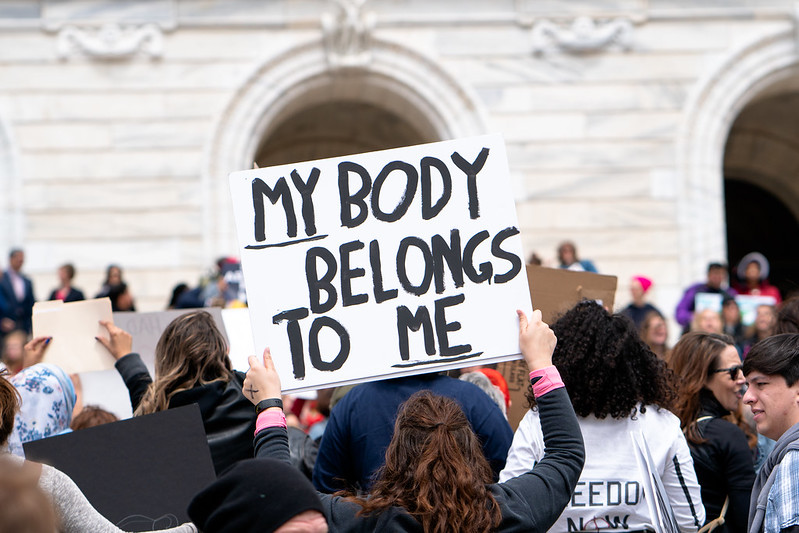
“The state restrictions on abortion are nothing more than veiled political maneuvering at the expense of thousands of women, their partners and families.” Pictured: Stop Abortion Bans Rally in St. Paul, Minnesota, May 2019. (Lorie Shaull)

What we worry most about—what keeps us up at night—are the those who are still in Texas, Oklahoma and beyond who cannot afford a plane or a long car ride and thus will stay pregnant because their need for essential abortion care will go unmet.

Everyone is scared right now, and everyone is anxious.  As a nation and planet, we are facing an invisible enemy, and each of our lives upended by it.  Using a pandemic to restrict and stigmatize abortion is counterproductive, dangerous and preys on those in need of health care.

Health care providers are the experts in deciding what is and is not essential healthcare.  We are bound by our ethical and moral oaths to serve our communities—this does not stop during pandemic.

Abortion is not elective.  Abortion is timely and cannot be delayed.

Every person who makes the decision to have an abortion encounters adversity—cost, travel, childcare, insurance coverage, stigmaprotestors and the list goes on. But these barriers became walls in recent weeks.

On our last day, we finished just in time to head to the airport.  As we left, we received quiet waves from the clinic staff who were already busy answering continuously ringing phones with people seeking reproductive health care from around the country.

The struggle for reproductive health access will continue—despite the political leadership ignoring physician and medical organization collective recommendations that abortion care is essential medicine, abortion is timely and should not be delayed or cancelled, especially not due to the COVID-19 pandemic response.

We can attest that there is a profound negative impact on a person’s life, health, family and well-being if they cannot access abortion care.  Physicians of all specialties are working tirelessly both to treat patients who contract this virus and to act as a whole to work for the best interest of our community and public health.

As we saw in Kansas, abortion care will continue to be sought despite the restrictions. We demand that state leadership put their political goals aside, listen to our stories, focus on the medicine and public health recommendations of experts, and reverse decisions that make essential health care impossible to access.

Source: https://msmagazine.com/2020/04/17/abortion-is-not-elective-midwest-reproductive-health-care-during-a-pandemic/?fbclid=IwAR1tqVjPZOOvJYhGoeap1_Nk7w-zaZJJSK00Z6zunczFG89lBJvDdOC8qrw

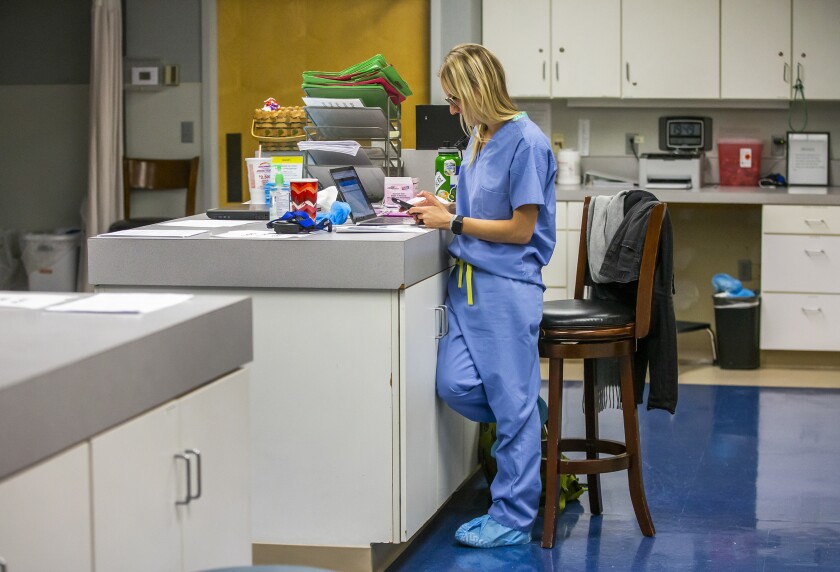
Dr. Angela Marchin checks the schedule at the Trust Women clinic in Wichita, Kan.(Fernando Salazar / For The Times )

Right after she was laid off from her medical job because of the coronavirus outbreak, a single mother of two in north Texas found out she was pregnant.

The next day, when she called to make an appointment at a local abortion clinic, staff told her it had closed — and no other clinic in the state could provide her an abortion, either.

“They told me the governor had put a halt on it,” said the woman, who asked to be identified by her first name, Kris, after driving 350 miles north to a clinic in Wichita, Kan., this week, crying and trembling with anxiety.

“I just feel like the state of Texas has taken away a fundamental right of mine,” she said.

More than half a dozen states have tried to ban abortion during the coronavirus outbreak as an elective procedure. Texas abortion providers sued to block the bansappealed to the U.S. Supreme Court, but withdrew their appeal this week after a circuit court allowed some abortions to proceed. Providers in Arkansas and Tennessee also sued to stop bans there this week, which could end up at the high court. Meanwhile, women whose appointments have been canceled have tried to self-induce miscarriages or driven hundreds of miles to out-of-state clinics, expensive and risky travel.

Texas Gov. Greg Abbott and other state officials insist abortions — even medication abortions that involve clinic staff dispensing pills — are elective procedures that require gloves and other protective medical equipment needed elsewhere during the pandemic.

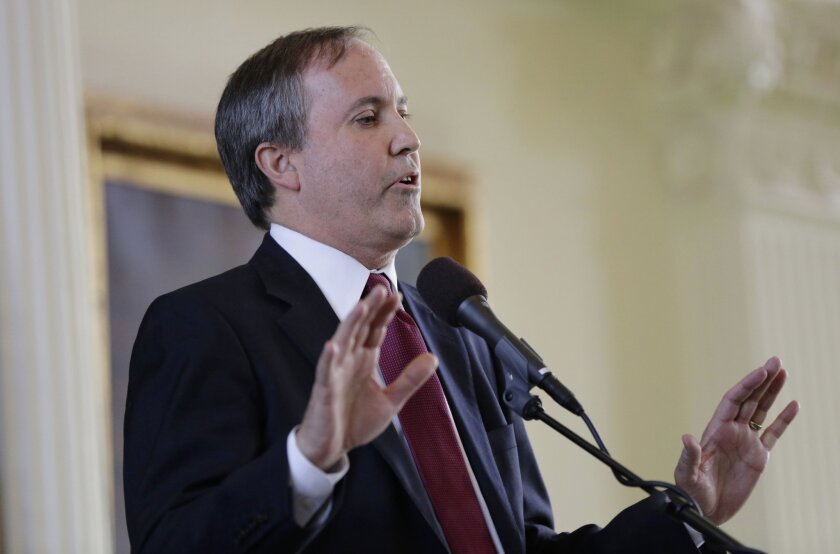
“Abortion has been touted as a ‘choice’ by the same groups now attempting to claim it is an essential procedure,” Texas Atty. Gen. Ken Paxton said in a statement last week in which he vowed “to ensure that hardworking medical professionals receive the supplies and personal protective gear they need to successfully combat this health crisis.”

Ken Paxton

Texas Atty. Gen. Ken Paxton.
(Eric Gay / Associated Press)

The bans only added to the challenges abortion clinics have faced during the pandemic.

“We do not have enough staff, we do not have enough doctors, we do not have enough days in the week,” said Julie Burkhart, founder and CEO of nonprofit Trust Women, which operates the clinic in Wichita and another in Oklahoma City. “These anti-choice governors have created a health crisis within a health crisis.”

They and other abortion clinics rely on doctors from out of state whose flights were limited or canceled after the outbreak. Some clinics limited their hours, stopped providing surgical abortions or closed. Others like Trust Women found doctors to volunteer. Staff have to wear added masks and screen potential patients for symptoms of COVID-19. Three times as many patients showed up for appointments in Wichita this week, up to 45 a day, the lowest no-show rate clinic staff can remember. Patients had to be socially distanced in the waiting room. Some had traveled from as far as Austin and Houston — about 600 miles. One woman was homeless, another arrived with just $20. Nonprofit abortion funds helped them pay for the procedure, and have expanded in recent weeks.

Some clinics discourage women from bringing companions because they can no longer enter clinics due to COVID-19, forced to wait outside in their cars where protesters often linger. The fenced Wichita clinic has drawn crowds and even closed for several years after its director, Dr. George Tiller, was fatally shot by an antiabortion extremist. Protesters show up daily and have an office next door. Last week, a group with bullhorns was dispersed by police for violating the governor’s order barring large gatherings. This week they returned, as did a priest praying the rosary and a man with a sign that said, “Children are being murdered here.”

After Abbott issued the Texas order March 22, local abortion providers filed a federal lawsuit arguing that the “pandemic and its fallout do not reduce patients’ needs for abortion; if anything, they make timely access to abortion even more urgent.”

“It just shows how when it comes to reproductive health, we live in two different Americas,” said Amy Hagstrom Miller, president of Whole Woman’s Health, a Texas abortion provider.

Whole Woman’s Health sued Texas in 2013 to block a law that closed more than half the state’s abortion clinics before it was overturned by the U.S. Supreme Court. The latest ban has forced its clinics to cancel hundreds of appointments and send patients as far as the East Coast, some by plane, Hagstrom Miller said, calling it “the biggest uncertainty we have felt in our lifetimes.”

“It’s exposing people to COVID under the guise of protecting their health,” she said. “People are desperate.”

Planned Parenthood of the Rocky Mountains saw twice as many patients from Texas at the end of March because of the state ban, said President and CEO Vicki Cowart. While they have increased telemedicine to provide medication abortions by mail, they can’t do it in Texas.

“COVID-19 is being used as a tool by people who want to see abortion banned,” Cowart said.

Joan Lamunyon Sanford, executive director of New Mexico Religious Coalition for Reproductive Choice, said the number of women seeking help paying for travel to get abortions there has doubled in recent weeks, mostly from Texas. Two weeks ago, a 19-year-old arrived on a Greyhound bus from Louisiana, more than 900 miles away.

New Mexico clinics are booked for the next month, she said, forcing women to wait and have more expensive surgical abortions during the pandemic fiscal crisis.

“People are losing their jobs or they’re worried about losing their jobs, reluctant to take time off work or if they are taking time off work, having to justify it,” she said.

In Texas, Kris, 36, followed the legal battle over the abortion bans daily, trying to predict which clinics were likely to stay open.

“It’s been flipping back and forth,” she said. “Every day has been a nightmare.”

Governors have attempted similar bans in Alabama, Iowa, Louisiana, Mississippi, Ohio and Oklahoma. As state and circuit judges ruled, the Texas ban was lifted, then reinstated in part. Surgical abortions were available this week in Texas only to women nearing the legal limit of 22 weeks. Kris said she “worried I’ll be forced to have this baby.”

She had her first child when she was 17, pressured by Christian friends in her small town not to have an abortion. A year later, she had her second, and raised them both on her own. She later had an abortion, with no delays and no regrets.

This time, she had to make an appointment at a clinic in Fort Worth, then Oklahoma City and finally Wichita, on the recommendation of clinic staff. Kansas Gov. Laura Kelly has supported abortion rights.

“They told me to keep this [appointment] because Oklahoma keeps going back and forth,” she said — most recently when a circuit court Monday allowed clinics to dispense abortion medication.

Kris became pregnant six weeks ago after her boyfriend’s condom broke. They had only dated a few months. She opted for a surgical abortion because she wanted it done as soon as possible, by a doctor, without complications. Before she left for the clinic Monday, she called Kansas and Oklahoma highway patrol to ensure she wouldn’t be stopped for traveling during the pandemic. She stayed at a cheap motel, wiping down surfaces for fear of COVID-19. There were already a handful of virus hot spots in the county surrounding Wichita.

At the clinic, she steeled herself as she took a seat in the waiting room beside a sign that said, “Politicians are not doctors.” To drive herself back to Texas, Kris would have to have the abortion with a milder sedative than is usually used.

Abortion clinic in Wichita, Kan.

Dr. Angela Marchin finishes up her day Tuesday at the Trust Women clinic, where many women from Texas have been coming because clinics in their state have been sporadically closed.
(Fernando Salazar / For The Times )

“These politicians, they have no idea what it’s like for women in this situation,” she said shortly after arriving. “My life is in other people’s hands, my choice.”

Another Texas woman came to the clinic that day because her husband had just been fired, they paid their mortgage this month with savings and were afraid they might soon become homeless. She had wanted a baby, and cried as she showed the doctor pictures of her 4-year-old son. The doctor wanted to hug her, but couldn’t because of social distancing.

“The pandemic is making these decisions even more complicated for people,” Dr. Angela Marchin said.

On Wednesday, a 22-year-old stay-at-home mother of two traveled to the clinic from the central Texas city of Killeen, where her husband is a soldier based at Ft. Hood. The woman, who asked to be identified by only her first name, Cailyn, said she decided to have an abortion because she would soon have to move: Her husband was about to be stationed in Hawaii in June. Earlier this year, they had paid $10,000 for reconstructive surgery to repair abdominal muscles damaged during her last two pregnancies. She had taken the morning-after pill, but said it didn’t work.

Cailyn unsuccessfully tried to induce a miscarriage with multiple doses of vitamin C, then called two other clinics that referred her to Wichita because of the Texas ban.

“I don’t think it’s fair. If it’s not your body, it shouldn’t be your decision,” she said as she waited to get abortion medication.

Earlier this month, Austin waitress Heather Artrip, 30, had packed her car to drive to New Mexico with her two sons, ages 6 and 9, when a local clinic called to say it had reopened because of a court decision. By the time Artrip arrived the next day, the decision had been reversed, the ban reinstated.

“Turns out now, they can’t,” she said by phone from the clinic. “This is the third appointment I’ve had that’s been canceled due to the bans.”

Artrip, who has a prolapsed uterus that would make pregnancy risky, had also taken the morning-after pill, then tried to induce a miscarriage.

She said the abortion ban was “like slavery, like forced birth.”

“This is my right given to me on a federal level but on a state level I don’t have access. But Hobby Lobby is open because it’s essential. Liquor stores are open. Taco Bell’s open. It just does not add up,” she said.

A week later, when the ban was partially lifted, Artrip was able to get abortion medication at the Austin clinic.

Abortion advocates have mobilized in response to the bans, expanding appointments and paying for women to travel to nearby states. Austin-based Lilith Fund, which operates hotlines for women seeking abortions, increased its average payment by 30% to $363 after the ban, according to executive director Amanda Beatriz Williams.

Beatriz said the average Texas woman seeking an abortion since the state ban has had to travel about 700 miles round trip; one woman traveled to Atlanta.

At the Wichita clinic, the operating room white board was filled with dozens of patient initials, the parking lot replete with Texas license plates. The two doctors who had flown in from out of state worked double time.

Trust Women clinic

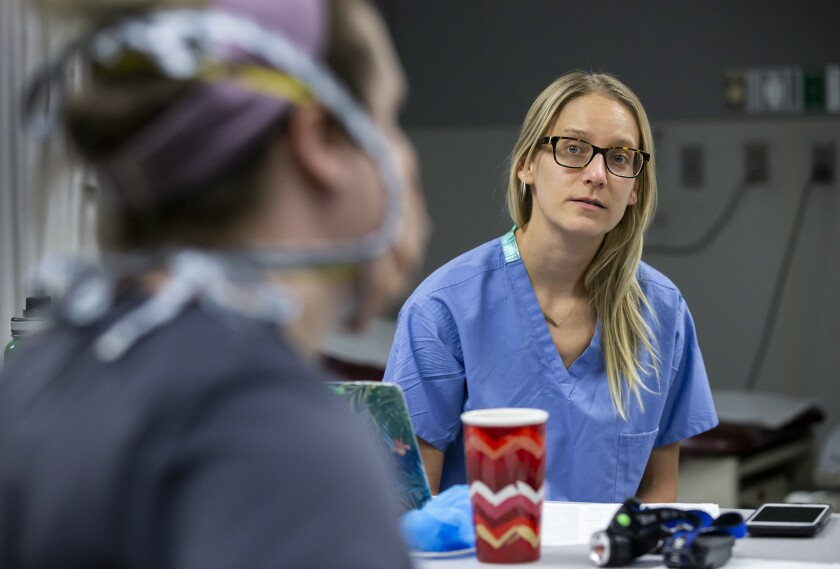
Dr. Angela Marchin listens to staff member Lindsay Mills at Trust Women on Tuesday.
(Fernando Salazar / For The Times )

“Is everyone from Texas?” said Marchin who, because of limited flights, would have to fly back to Colorado on Wednesday at noon, but seeing as many patients as she could before she had to cut her day short. “This is the most procedures I’ve done in a day.”

Source: https://www.latimes.com/world-nation/story/2020-04-16/abortion-during-coronavirus-state-bans-canceled-appointments-travel

An upcoming ruling could give state lawmakers a green light to ignore science for the sake of ideology

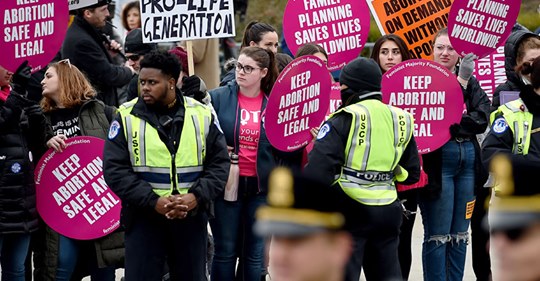
Pro-choice and pro-life activists demonstrate in front of the the US Supreme Court during the 47th annual March for Life on January 24, 2020 in Washington, DC. (OLIVIER DOULIERY/AFP via Getty Images)

In 2016, the U.S. Supreme Court ruled that it was unconstitutional for Texas to require abortion providers to have admitting privileges at a local hospital. Last week, the Court heard oral arguments in a case challenging the same requirement in Louisiana. The state in question may have changed, but the fact remains: These kinds of laws unfairly target abortion providers without improving public health.

But this case goes far beyond a single abortion restriction. If the Supreme Court upholds this law, it will give state lawmakers a green light to ignore science whenever they want for the sake of ideology.

Admitting privilege laws are among the slate of restrictions commonly known as TRAP laws, or targeted regulation of abortion providers. TRAP laws, which are in place to varying degrees in dozens of states, also include requirements that clinics conform to the physical standards of ambulatory surgical centers (ASCs). This can include installing more advanced and expensive equipment, requiring separate recovery rooms, or more advanced staffing than a typical clinic or medical office. These laws are often passed under the guise of protecting patient safety. After all, the reasoning goes, don’t more regulations mean better care?

As a doctor of public health, I care about the safety of patients seeking medical services, including abortion care. But research, including studies led by myself and my colleagues at Advancing New Standards in Reproductive Health, shows that TRAP laws do not make patients safer and are therefore unnecessary. The false arguments being made in support of such laws demonstrate the spread of anti-science sentiment among regulators, lawmakers, and the general public.

The data show that abortion is an overwhelmingly safe procedure. After analyzing 50,000 abortions provided in ASCs and clinics, we found that 96.7 percent of patients had no complications after their abortions, while 3 percent of patients had a minor complication. Ultimately, only 0.3 percent of patients had a major complication following their abortions—and there was no difference between the ASCs and office-based settings when it came to complication rates for abortions.

Furthermore, in the rare instances when patients did require hospital-based services, our research shows that providers obtaining admitting privileges did not change that process. Providers who referred patients to hospitals before performing abortions, such as for ectopic pregnancies, relied on existing protocols; these did not change once providers obtained admitting privileges. When patients sought follow-up care after the abortion in a hospital, they usually went to a facility near their home—where, again, their provider’s admitting privileges made no difference.

These kinds of laws do, however, make a difference when it comes to patients’ ability to access care. It can cost clinics hundreds of thousands of dollars to convert their facilities to match ASC standards, and physicians in conservative-leaning areas often struggle to obtain hospital admitting privileges for political reasons. After Texas implemented HB 2, which included both admitting privilege and ASC requirements, the number of clinics in the state plummeted—making abortion more difficult, and sometimes impossible, for people to get.

The safety of abortion and the consequences of making it more difficult to access means TRAP laws are similar to treating someone with steroids when they’re not even sick: an aggressive preventive measure that could, in itself, have harmful consequences.

To be clear, I believe that abortion facilities should have some level of regulation. Just like any other medical procedure, abortion should be subject to standards that ensure patient safety. It’s useful, in fact, to look at the way other comparable procedures are regulated. Usually, professional associations of clinicians who provide the procedures themselves set standards based on available research evidence and clinical expertise. In fact, multiple health care professional associations recently released such evidence-informed guidelines that apply to abortion facilities, clearly stating that admitting privileges are unnecessary for patient safety. When the government does intervene, laws that apply for other medical procedures like dental surgery ­— which is less safe than abortion — are generally based on the level of anesthesia being used.

The government’s approach to tobacco regulation is another useful comparison. When confronted with the evidence that tobacco use can lead to lung disease, heart problems, and other chronic health issues, policymakers implemented regulations around cigarette sales, manufacturing, and advertising. These regulations benefited public health and safety—and they were informed by research and clinical expertise.

Abortion restrictions, meanwhile, are rationalized with anecdotes and ideology. Unfortunately, they are just the latest example of the ways anti-science sentiment has emerged in state legislatures and the nation’s highest court. In the same way that climate change denialism and anti-vaccination rhetoric has held progress hostage, TRAP laws substitute feelings for facts. When that approach influences public policy, it puts everyone at risk.

In the past, Supreme Court justices have reasoned that abortion restrictions are unconstitutional because of the lack of data supporting them. Just four years ago, Justice Stephen Breyer wrote that the evidence Texas used to justify its admitting privileges law “does not show how the new law advanced the State’s legitimate interest in protecting women’s health.” It remains to be seen whether the 2020 incarnation of the Court, with its two new justices, requires a similar level of scientific evidence to justify regulating abortion — or if it will rule against science instead.

Source: https://www.salon.com/2020/03/21/with-the-safety-of-abortion-at-stake-the-supreme-court-could-rule-against-science/?fbclid=IwAR2ITdh5IcUqQORBWvaK2auNh38WK70ko3VC7wvZqjsdz-QjVQXwyczCMBc

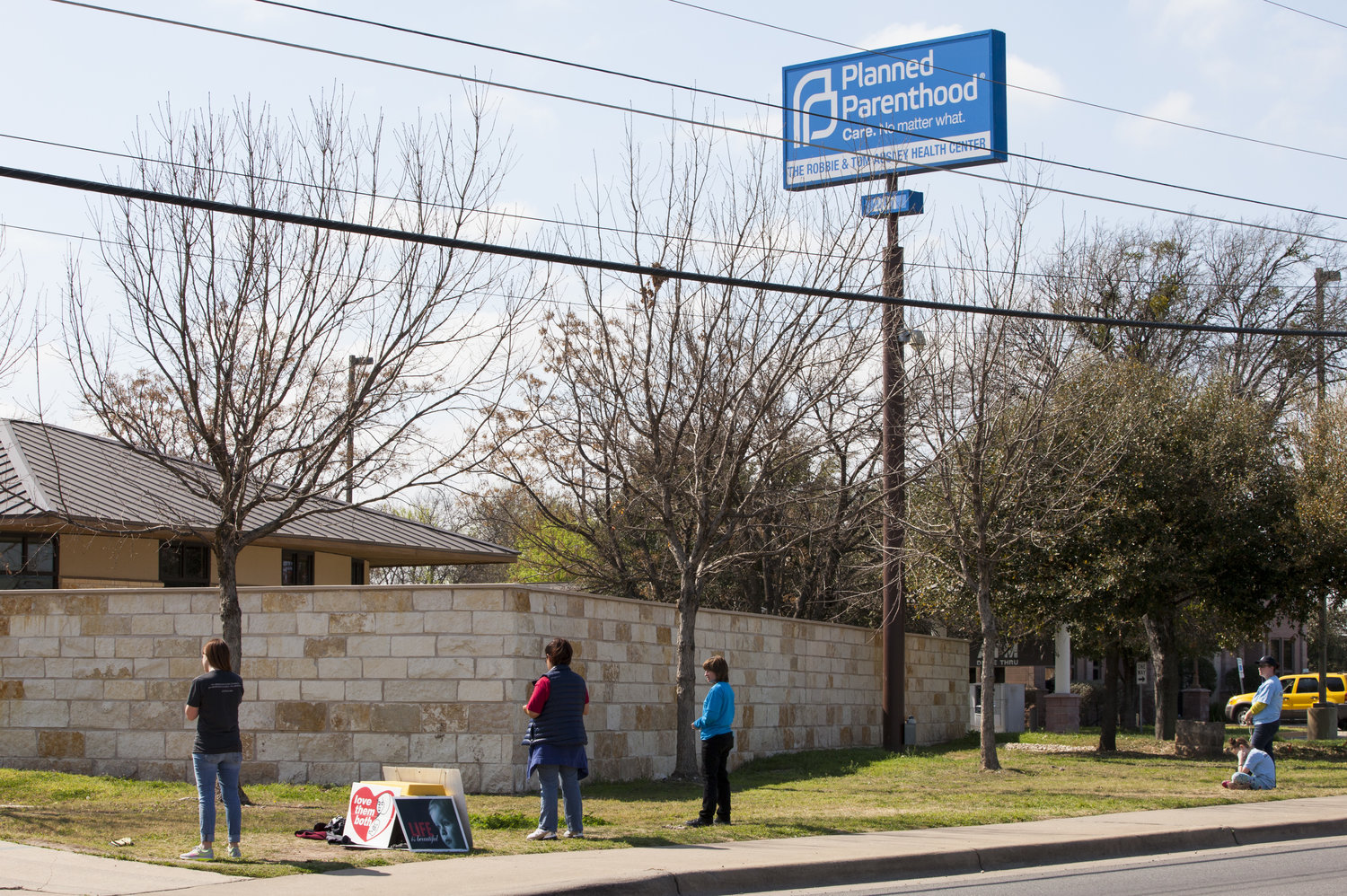
Anti-abortion-rights activists pray outside a Planned Parenthood clinic that offers abortions in 2016 in Austin. Texas has suspended most abortions during the coronavirus pandemic.
Melanie Stetson Freeman/Christian Science Monitor via Getty Images

Planned Parenthood clinics in Colorado, New Mexico and Nevada are reporting an influx of patients from Texas, after an order from Texas Gov. Greg Abbott suspending most abortions in that state during the coronavirus pandemic.

New data provided to NPR by Planned Parenthood show a more than sevenfold increase in patients traveling from Texas to clinics across the Southwest for abortions since the order took effect in late March.

“It clearly shows that when individuals aren’t able to access abortion care in their own state, they will travel — or at least the patients who have the means to travel will travel,” said Dr. Kristina Tocce, medical director at Planned Parenthood of the Rocky Mountains, in an interview with NPR.

According to Planned Parenthood, clinics in Colorado, New Mexico and Nevada saw 129 patients from Texas between March 23 and April 14, compared with 16 Texas patients during the entire month of February, a 706% increase. During the same period in 2019, a Planned Parenthood official said those clinics saw 14 patients from Texas.

Tocce said she recently saw a patient who traveled 16 hours for a procedure. She said some patients are flying or making long drives at a time when travel is being discouraged because of the pandemic.

“This really is frustrating as a provider because it seems to be putting patients at additional risk of being exposed to COVID themselves as they travel and risk them getting an infection, versus them possibly unwittingly transmitting COVID if they are an asymptomatic individual who’s positive,” Tocce said.

Republican state officials and organizations opposed to abortion rights have argued that the procedure should be treated as nonessential during the pandemic, in order to preserve medical supplies for coronavirus patients, and to reduce the risk of exposure at clinics.

Tocce said her health centers are taking steps to mitigate those risks, including screening patients for symptoms, having patients wear masks at clinics and relying on technologies like telemedicine when possible.

Major medical groups say delaying abortion can be harmful to pregnant women. Abortion-rights groups have challenged bans in several states and have succeeded in scaling them back or blocking them, but some patients seeking the procedure have been turned away.

A federal appeals court recently ruled that medication abortions could continue in Texas, along with surgical procedures for patients approaching the state’s 22-week cutoff.

Source: https://www.npr.org/sections/coronavirus-live-updates/2020/04/17/837153529/after-texas-abortion-ban-clinics-in-neighboring-states-see-influx-of-patients?fbclid=IwAR3u6oROv9K1a8TqZ-XBuVN35fUfEQrjsxf6KHycIneinNqAklkJuYIZ-Ho

You want to help health care workers? Get us more PPE.

Clinic assistant Rachel Runnells calls patients to confirm appointments during a lull in patient intake at the Planned P

Clinic assistant Rachel Runnells calls patients to confirm appointments during a lull in patient intake at the Planned Parenthood clinic in Iowa City on Friday, Sept. 13, 2019. (Liz Martin/The Gazette)

On April 9, Bob Vander Plaats, the president and CEO of The Family Leader, a conservative advocacy organization in Iowa, wrote a piece for the Des Moines Register in which he argued that all surgical abortions should be halted throughout the COVID-19 outbreak. This came after Gov. Kim Reynolds had already issued a proclamation preventing surgical abortions as part of Iowa’s pandemic response.

For both Mr. Vander Plaats and Gov. Reynolds preventing access to abortions was done in the interest of preserving vital personal protective equipment for health care workers. It’s an incredibly flimsy excuse as months of checkups and the birthing process clearly use more protective gear even if there are no complications in the pregnancy.

Mr. Vander Plaats, however, wielded words such as “heroes” to discourage disagreement in a way that will be familiar to those who have heard “the troops” invoked by people who never served. He even cynically referred to health care workers who died of COVID-19 as a justification for a ruling that he is certainly aware will not make anyone safer from the virus. As an ICU nurse who lives and works in Iowa, I resent the use of my career to justify preventing women from receiving vital health care.

Blocking women from receiving safe abortion care is wrong during the best of times, but to do so now is particularly callous: a time when many people have no escape from domestic violence at home, when mental health services are difficult to obtain, when people are living with precarious finances and could be facing eviction, when chronic conditions that could be dangerously exacerbated by COVID-19 are further complicated with pregnancy. Health care workers have unwanted pregnancies, too. Facing the physically and emotionally exhausting task of working during a pandemic while unable to receive treatment for one’s own health needs can be a frightening prospect.

If Mr. Vander Plaats were truly interested in helping health care workers, there are many ways to do so: lobby for hazard pay, for example, or encourage greater use of the Defense Production Act so that we might actually obtain more protective equipment. What he should not do is use me and my colleagues to push his own political agenda.

For now, Gov. Kim Reynolds and Planned Parenthood have reached a truce since she first tried to use the COVID outbreak as a means to block access to surgical abortions. Planned Parenthood can still provide abortions considered medically necessary. However, there are always those willing to use any method to prevent women from receiving this much-needed health care. The use of buzzwords and a faux concern for “heroes” ought not obscure these actions for what they are: attempts to capitalize on a disaster to restrict our Constitutional rights.

Rachel is an RN working in an Intensive Care Unit. She is a nearly lifelong Iowan. She lives in Des Moines with her husband and two dogs.

Source: https://www.thegazette.com/subject/opinion/guest-columnist/im-a-nurse-stop-using-my-job-to-justify-preventing-access-to-abortions-20200415?fbclid=IwAR1_rJImOz0Coon4gxLO_2FUF_Fw0As2571M3SJBXTvHb4MFg4E-z4BA78A

In the latest sweep of legal filings, Arkansas, Louisiana and Tennessee now face legal challenges over attempts to ban abortion services amid the coronavirus pandemic. Officials claim the suspension of services is an attempt to preserve medical resources, but abortion rights supporters accuse states of exploiting the public health crisis to achieve a decades-long goal: banning abortion.

In a span of fewer than 24 hours, three new lawsuits were filed by the American Civil Liberties Union, the Center for Reproductive Rights and Planned Parenthood, requesting federal courts to block states from including abortion in directives temporarily halting “non-essential” medical procedure. Eight states have now been sued over similar orders: Arkansas, Alabama, Iowa, Louisiana, Ohio, Oklahoma, Tennessee and Texas.

“This is a shameful abuse of power,” Nancy Northup, president and chief executive officer of the Center for Reproductive Rights, said in a statement to CBS News on Tuesday.

Abortion rights supporters, including Northup, don’t see the recent wave of coronavirus-related bans any differently than the many other restrictions that similar states have levied on abortion services. Indeed, every state that has attempted to restrict the procedure amid the pandemic is considered to be “hostile” toward abortion access, according to the Guttmacher Institute, an abortion-rights research organization. Many states with similar directives restricting “non-essential” medical procedures have not included abortion services in those orders.

“It’s just another version of all those other restrictions,” Northup said on a call with reporters on Tuesday.

Major medical associations side with abortion rights supporters. The American Medical Association has accused states of “exploiting” the pandemic to restrict the procedure. In response to the bans, the American College of Obstetricians and Gynecologists has called out abortion as an “essential component of comprehensive healthcare.”

A spokesperson for the Attorney General of Louisiana said the office had not yet been served and had no comment. Emails to the Attorneys General of Tennessee and Arkansas were not immediately returned.

So far, courts have mostly sided with abortion rights supporters, allowing the procedure to resume despite state bans. On Monday, federal appeals courts ruled that medication abortion services in Oklahoma and Texas could resume, as well as procedures for patients who would be outside the legal gestational limit once the bans were scheduled to lift.

Up until today, the vast majority of abortion services had been unavailable in Texas since March 23. It’s the first time that’s happened in a state in nearly 50 years — when Roe v. Wade legalized the procedure. Beginning Tuesday, most abortion services will again be available to patients. Similar rulings have allowed abortion to continue in Alabama, Iowa, and Ohio.

Louisiana is already at the center of a high-profile lawsuit that could potentially shutter all of the state’s providers. In early March, the U.S. Supreme Court heard oral arguments in June Medical Services v. Russo, a case challenging a state abortion restriction that, if upheld, could close all three of Louisiana’s clinics that provide abortion.

A decision on that case is expected this summer.

Source: https://www.cbsnews.com/news/abortion-ban-lawsuits-arkansas-louisiana-tennessee-coronavirus/?fbclid=IwAR0ucnPlrxF55MmM8uQuoC4iKtI7A9B7tCRi_HONHtl6pIDoh1CclXLJvDY

Anti-abortion rights demonstrators and Abortion rights demonstrators rally outside the Supreme Court, in Washington, Wednesday, March 4, 2020, as the court takes up the first major abortion case of the Trump era Wednesday, an election-year look at a Louisiana dispute that could reveal how willing the more conservative court is to roll back abortion rights. (AP Photo/Andrew Harnik)

Saying Louisiana politicians are trying to exploit the coronavirus pandemic to further their goals, a national reproductive rights group Tuesday asked federal court in Baton Rouge to immediately block the state’s efforts to close the state’s three abortion clinics.

“This is a shameful abuse of power,” said Nancy Northup, President & CEO of the Center for Reproductive Rights, based in New York City. “Louisiana has been trying for decades to end abortion.”

The Center represents the Hope Medical Group in Shreveport in this action as well as in another case involving nearby hospital admitting privileges for physicians who perform the pregnancy ending procedures. Depending on how the U.S. Supreme Court rules in the admitting privileges case, abortion clinics in Louisiana and other states could close.

Northup told reporters in a telephonic press conference that Louisiana Attorney General Jeff Landry and his anti-abortion allies apparently couldn’t wait for the Supreme Court decision, which was due in late May/early June before the pandemic, and targeted an abortion clinics through an interpretation of a March directive by the Louisiana Department of Health. She said Louisiana, and other states with strong anti-abortion restrictions, have long interpreted medical policies as reasons for limiting the procedure.

The health department directive limits nonemergency medical procedures during the COVID-19 crisis. But Section A of the health department order excludes patients with an emergency or whose health would be undermined by waiting.

The Center argues that delays for abortions, which have limitations based on the age of the fetus, force patients into traveling hundreds of miles to states where the legal medical procedure is more readily available or force women to give birth against their wills.

Landry issued a statement Tuesday, noting that he hasn’t been served with the lawsuit yet. He added the abortion clinics are asserting that “the rules that apply to other facilities do not apply to them.

“While the rest of Louisiana has come together to fight COVID-19, it is disappointing that (Hope Medical) is once again claiming that they are exceptional and entitled to a blanket exemption.”

Landry last week launched an investigation into whether the state’s three abortion clinics were abiding by the health department directive.

Two assistant attorney generals burst in on the Hope Clinic – they visited clinics in Baton Rouge and New Orleans as well – demanding a review of the protocols put in place and equipment being used to check compliance with the directive limiting medical procedures during crisis, said Kathleen Pittman, Hope’s administrator. They also demanded to review the personal records of individuals who have received abortions since the beginning of the pandemic.

The visits came as something of shock, Pittman said. Usually, it’s health department personnel who perform inspections, not the state’s chief law enforcement agency.

Pittman said she needed to involve lawyers to keep the Attorney General’s Office from taking the charts of patients back to Baton Rouge. The clinic is practicing social distancing by allowing only the patient into the facility as well as doing all counseling on one day and all the procedures on the next. Twenty-four hours must pass between counseling and the actual abortion under state law. She also said that the clinic doesn’t use the medicines and equipment most needed by hospitals battling COVID-19.

At least seven states have issued medical procedures orders that have been interpreted as including abortion clinics. Legal challenges to similar closure orders are pending the states that include Arkansas, Alabama, Oklahoma and Ohio. So far, enforcement of the restrictions have been temporarily blocked. Iowa settled its case.

Republican state attorneys general, whose association Landry leads, have appealed those decisions. So far, the U.S. 5th Circuit Court of Appeals is the only appellate court to consider a trial court’s restraining order barring use of emergency COVID-19 orders as a pretext for closing the abortion clinics.

The 5th Circuit on April 7 upheld Texas Gov. Greg Abbott’s March 22 directive, thereby allowing state officials to shutter the clinics. That order has since been modified to allow abortions for women whose pregnancies have gone long enough that the procedure would no longer be allowed under existing state laws and, on Monday, to allow women to end pregnancies using medication in some cases.

Louisiana used similar language as Abbott in its order.

Landry’s teams started visiting Louisiana’s abortion clinics the day after the 5th Circuit’s decision.

On March 30, U.S. District Judge Lee Yeakel, of Austin, temporarily restrained Texas officials from enforcing Abbott’s order as it applied to abortion clinics. The state went to the 5th Circuit, which lifted the temporary restraining order, thereby closing abortion clinics while the courts figured what to do next.

In a 2-1 decision written by 5th Circuit Judge Kyle Duncan, of Baton Rouge, the majority used unusually sharp language in criticizing Yeakel for ignoring federal caselaw that oversees public health emergencies. The majority contended that the COVID-19 pandemic has created such “mounting strains on health-care systems,” that Texas is within its rights to ban non-emergency medical procedures, including abortions.

Fifth Circuit Judge Jennifer Walker Elrod, of Houston, joined in Duncan’s decision.

Judge James L. Dennis, of New Orleans, disagreed, pointing out that abortions are legal medical procedures that are time sensitive. He noted that the federal caselaw on which the majority relied comes from a 1905 decision that gave the state authority to force vaccinations on Massachusetts residents during a smallpox epidemic and therefore was not really on point.

Source: https://www.theadvocate.com/baton_rouge/news/coronavirus/article_80b4612e-7e80-11ea-a33c-bb099e9072de.html?fbclid=IwAR1gJfBvaqIqfu6ie0wNXTXHoXbHI0iSbptZrIZa4Q637H0cPWKXReGzzFA

From securing financial assistance for abortion care to self-managing abortion to using telemedicine, here are ways people can obtain care amid the chaos of the COVID-19 pandemic.

Navigating abortion restrictions during the COVID-19 crisis has been a major challenge for many across the country.
Shutterstock

Four years ago, I needed an abortion in Texas while HB2, Republicans’ sweeping anti-abortion law, was still in effect. I wondered if I’d have to continue a pregnancy for which I wasn’t ready.

It took me two weeks to access care that I needed immediately. I’m struggling today knowing that as a result of the COVID-pandemic, countless others are facing similar barriers I had faced. Millions have lost their job and are without childcare, and some anti-choice government officials have used the crisis to outright ban abortion—directly violating our rights under Roe v. Wade.

We’ve known that our right to an abortion means nothing if we can’t access it. Even though it feels hard right now, you should know advocates have worked for decades to ensure people always have access to abortion care, especially in times like these.

If you’re seeking abortion care during the pandemic, I want to help you learn about the same network that helped me access an abortion when it felt impossible. Here are some tips that might help you navigate the state of abortion access during COVID-19.

How to get an abortion in a state that has deemed abortion “nonessential” 

If you’re seeking an abortion in a state that’s attempting to or have already restricted access during the pandemic, you’ve probably experienced a delay in your appointment at least once. But if you have the capacity, you should call clinics—including those in surrounding areas—frequently for updates because circumstances can change day to day.

Some clinics may be scheduling appointments for the future, and if legal action changes abortion access, scheduling an appointment allows the clinic to contact you to tell you about appointment availability. Providers are working closely with advocates to ensure access to abortion care continues, and they’re one of the first to know when services can resume.

Clinics can also connect people with resources for out-of-state abortion care. Providers are already prepared with this information for people over the legal limit to have an abortion in certain states, and who are forced to travel to one of the states that provide later abortions.

If you’re considering traveling, you’re not alone. Fund Texas Choice, a practical support organization providing Texans with travel assistance, told Rewire.News last month that pregnant people with varying gestational ages have reached out for assistance to go out of state since Texas Gov. Greg Abbott (R) banned abortion under COVID-19. The Brigid Alliance, a practical support organization that helps people traveling to clinics providing second- and third-trimester abortions, told Rewire.News that the organization has recently helped people with pregnancies of earlier gestations, as well as families who are forced to travel together as a result of a lack of childcare.

Because of shelter-in-place orders, some state officials are preventing drivers from crossing state lines and subjecting non-residents to 14-day quarantines, which could increase the logistical costs pregnant people face. Some methods of transportation have been affected too. But the Brigid Alliance says it hasn’t encountered drivers being turned away when crossing state lines, and the organization is letting folks flying to New Mexico know that in order to be exempt from the state quarantine, they can only travel between the clinic and hotel where they’re staying.

Brigid Alliance is also seeing the impacts that are surging for those providing and needing practical support.

“Bus lines have closed down, airlines have spontaneously canceled flights, hotels have closed down entirely or reduced capacity—we had to move people from hotel to hotel in the middle of a three- to four-day process [to get an abortion], and we’re hearing from partners that there are some Greyhound lines that are doing temperature checks,” Odile Schalit, executive director of the Brigid Alliance, said.

Schalit wants people to know support is available for those seeking care amid the ever-changing landscape of abortion access.

“While the obstacles to your health care may appear numerous today, please know that there is a network of good people, volunteers, and resources that exist to support you. Tap into our network and, as much as possible, your own,” Schalit said. “Take your time, break down your plan and needs, and take stock of your unique physical and emotional safety and comfort. For many, accessing abortion care now means having to travel out of your home town, city, and state. While this may seem impossible, we and many others are here to help you construct safe plans for getting to your care.”

If you’re thinking about traveling out of state for abortion access, consider going to one of the 23 states that don’t have a mandatory waiting period to limit the number of times you have to visit a clinic before the procedure.

How to get an abortion if you need help paying for an abortion, traveling to a clinic, or other logistical support 

Abortion funds and practical support organizations help alleviate the high costs associated with paying for an abortion and traveling in or out of state. Funds generally help with the cost of an abortion, while practical support organizations cover travel-related costs; some do both. Below are some organizations that may be able to help you access the care you need:

  • Northwest Abortion Access Fund provides financial and logistical assistance to people seeking abortions (and those needing to travel out of state for a later abortion) in Alaska, Idaho, Oregon, and Washington.
  • Yellowhammer Fund provides financial assistance to people seeking an abortion in Alabama, including those needing to travel out of state. The organization recently increased its budget and implemented a Visa gift card program to help alleviate some of the additional burdens people may face.
  • New Orleans Abortion Fund provides financial assistance to people who live in or are traveling to southern Louisiana for abortion care. People who need to travel outside of Louisiana for care can call the organization for more information.
  • ARC-Southeast provides financial assistance and travel support to people seeking abortions in Alabama, Florida, Georgia, Mississippi, South Carolina, and Tennessee—including people needing to travel out of state.
  • The Brigid Alliance provides logistical support through referrals from clinics and funds by providing plane, bus, and train tickets, hotel stays, rideshares, meal stipends, parking, gas, and toll costs, as well as “reimbursement for childcare and travel-related expenses, like flat tires or oil changes,” Schalit said.
  • The Lilith Fund for Reproductive Equity provides financial assistance to central and southern Texans seeking abortion care, including those needing to travel out of state. According to the organization, its hotline will remain open on an extended schedule from Monday to Friday, 7 a.m. to 10 a.m. Central time. “At Lilith Fund, we will continue to fight for our callers and ensure that folks have access to care during this pandemic,” Shae Ward, hotline coordinator for the Lilith Fund, told Rewire.News. “Every day on our hotline we hear how these [abortion] bans are hurting people. In the past two weeks, our clients have had to travel an average of 700-plus miles to get to a clinic in a neighboring state; one recently traveled as far as 1,600 miles—even though she lived only three miles away from her local clinic that was forced to stop providing care due to the ban. Our clients are forced to make appointments with clinics in surrounding states and are facing long wait times. This pushes them further into their pregnancy, which makes their procedures more expensive. The restrictions on clinic services are cruel and put people’s lives in danger.”
  • Texas Equal Access (TEA) Fund provides financial assistance for abortion costs to people in north Texas, including those needing to travel out of state.
  • Fund Texas Choice provides travel support, like plane tickets, hotel stays, and gas costs, for Texans needing to travel to abortion clinics. People can call the organization for more information, or fill out an online application every Thursday starting at 8 a.m. local time.

To find other local abortion funds and practical support organizations in your area, visit the National Network of Abortion Funds to search for groups by state.

You can also ask abortion clinics to screen you for financial assistance. Unlike assistance from abortion funds and practical support organizations, in-clinic funding can be income-based, but you aren’t required to show proof of how much money you earn.

How to get an abortion in a state that allows telemedicine 

Eighteen states prohibit the use of telemedicine for abortion care. If you live in one of the states that allow it, medical abortions can be obtained up to ten weeks into pregnancy through video conference with an abortion provider.

While U.S. Food and Drug Administration (FDA) restrictions prevent the medication from being mailed to your home, patients can avoid traveling long distances to an abortion clinic while protecting their health during the pandemic by visiting a nearby health center to receive the medication under guidance of a doctor.

TelAbortion, however, can send the medication to your home if you’re eligible. TelAbortion is a study run by reproductive and maternal health research group Gynuity, and the evaluation is offered over the internet—so you can access it on your own phone or computer. But the FDA requires people participating in the study to visit a health clinic in order to have an ultrasound or pelvic exam, according to Dr. Elizabeth Raymond, senior medical associate for Gynuity Health Projects.

You will need video conference access in one of the 13 states participating in the study, and have a mailing address in the state where the medication can be sent.

If a person encounters barriers in accessing an ultrasound or pelvic exam—especially barriers compounded by the COVID-19 pandemic—they can call a TelAbortion site, as the provider may be able to accommodate their situation.

If you’re eligible for a TelAbortion, you’ll be sent “a package containing the necessary medications and an instruction sheet by mail.” Afterward, the TelAbortion provider follows up with study participants to ensure the abortion was successful, “and to address any side effects and complications.” According to their data, the TelAbortion model is just as effective as an in-person abortion.

In the past two months, Gynuity expanded its TelAbortion study to include Maryland and Illinois, and the hope is to continue to expand during the pandemic, as telemedicine abortion care will be critical. In the past few weeks, Gynuity has had a significant increase in traffic to the TelAbortion site.

“We’ve been doing this study since 2016, [and] now it’s right there [and] ready,” Raymond said. “It’s gratifying to be able to help in this crisis.”

What you need to know about self-managed abortion 

Self-managed has proven to be extremely safe—a 0.3 percent risk of major complications, according to an analysis by Advancing New Standards in Reproductive Health. Interest in it is also rising.

Self-managed abortion can include using mifepristone and misoprostol, or misoprostol alone, to end a pregnancy. Mifepristone blocks the hormone essential to advancing pregnancy, whereas misoprostol empties the uterus.

Plan C provides a “report card” on online retailers that offer the medications, resources about how the process works, and the legal risks surrounding it. Some states have laws that could be used against people ending their own pregnancies—at least 21 people have been arrested since 2005, Jill E. Adams, executive director of If/When/How: Lawyering for Reproductive Justice, told Rewire.News.

In states without such laws, Adams said some have faced charges as a result of prosecutors “misapplying parts of the criminal codes that were never intended for people ending their own pregnancies.” In most cases, the judge determines the law doesn’t apply, but at that point, people have already been arrested, lost their job, and face public scrutiny as a result of private records being released.

“The risk is highest for populations and communities under surveillance and on the receiving end of disproportionate state violence—communities of color, especially Black and African American people, immigrants, and trans and gender nonconforming people, are all more at risk of criminalization, and [they’re] also more likely to need self-managed abortion due to barriers to clinic-based care and bans on coverage,” Adams said.

Mandatory reporters, like health-care professionals, can also feel obligated to report people should they seek follow-up care from a doctor, even though Adams said the American Congress of Obstetrics and Gynecology and the American Medical Association recommends against it.

“No state requires mandatory reporting for suspected or confirmed self-managed abortion, including when the person is a minor,” Adams said. “If people do report, they are likely violating patient privacy laws.”

When seeking follow-up care, people aren’t legally required to disclose their situation to a doctor. If/When/How: Lawyering for Reproductive Justice’s legal helpline offers information on a person’s rights when talking to law enforcement officials or doctors involving self-managed abortion. According to the website, no one has been arrested for buying abortion pills online.

“The right to abortion—self-managed or provider-directed—still exists throughout the United States,” Adams said. “But laws have been misused and power abused in unjustly criminalizing people for ending their own pregnancies.”

The helpline offers free, confidential legal information to people concerned with being “investigated or arrested” for self-managing an abortion, as well as legal advice from an attorney when necessary.

But Adams said if there were ever a time to “eliminate the sources of criminalization,” that time is now. Their legal helpline has received double the number of inquiries they usually get. “Local, state, and federal officials should make it clear that no one will be arrested, charged, or detained for ending their pregnancy, or for helping someone else end their pregnancy—and not just during the pandemic, but always,” Adams said.

If you need an abortion without parental consent 

In the 37 states that have forced parental involvement laws for young people seeking abortion care, teenagers are forced to go through the overwhelming process of obtaining a judicial bypass, or permission from a judge to have an abortion. As a result of the pandemic, shelter-in-place orders and school closures prevent teens from discreetly leaving home to go to court, or even obtaining resources that may be able to support them.

  • If you’re under 18, live in Texas, and want an abortion without telling your parents, contact the Jane’s Due Process hotline 24/7 at 866-999-5263 to be matched with a free attorney. You’ll also receive direct support from Irma Garcia, Jane’s client services manager, and the abortion costs will be covered by the National Abortion Federation. Those living outside of Texas can text the hotline from 8 a.m. to 11 p.m. Central time to learn about the process in their own state.
  • Teens in North Carolina and South Carolina can reach the Carolina Abortion Fund for help getting a judicial bypass by texting “ABBY” at 844-997-2229 from 9 a.m. to noon Eastern time every day.
  • Teens in Illinois can contact the Illinois Judicial Bypass Coordination Project, a project of the ACLU of Illinois, by calling 877-442-9727 or texting 312-560-6607 weekdays from 5 p.m. to 10 p.m. Central time and from noon to 5 p.m. on weekends.
  • Those living in Alabama, Florida, Georgia, Mississippi, South Carolina, or Tennessee can contact ARC-Southeast for assistance with the process. Some Planned Parenthoods and independent abortion clinics might be able to help you learn about the process, including which courthouse you need to go to.

Other things to know when seeking abortion care during COVID-19 

Be aware that crisis pregnancy centers (CPCs), or anti-choice clinics, are still operating, but they don’t provide abortion care. Even if they offer to talk to you about your options, they won’t refer you to an abortion clinic or provide the necessary resources to obtain one. Reach out to any of the aforementioned organizations for information about the next steps.

The Online Abortion Resource Squad, a group of volunteers who respond to abortion-related questions on Reddit with compassionate, accurate answers, developed a resource site in response to the confusion and uncertainty around abortion during this health crisis. The site offers up-to-date information on clinic operations in states that have deemed abortion as nonessential health care, as well as connecting with local resources for financial and logistical assistance, and locating clinics in your state and nearby states.

Source: https://rewire.news/article/2020/04/13/how-to-get-an-abortion-during-the-covid-19-pandemic/

Each year, nearly 1 million women choose to end a pregnancy in the United States, and about one quarter of American women will use abortion services by 45 years of age. Women’s ability to determine whether and when they have a child has profound consequences for their self-determination and for the economic, social, and political equality of women as a group. Because access to safe abortion care is time-sensitive and vitally important, the American College of Obstetricians and Gynecologists (ACOG) and other reproductive health professional organizations issued an unequivocal statement on March 18, 2020, that they “do not support Covid-19 responses that cancel or delay abortion procedures.”

Despite ACOG’s position, governors in a number of states have called for a halt to abortion care throughout the Covid-19 epidemic. Governors in Texas, Louisiana, Mississippi, Alabama, and Oklahoma have ordered or supported the cessation of both medication and surgical abortion, while governors in other states have directed that surgical abortion alone must stop. (“Medication abortion” uses pills to end pregnancy in the first trimester; “surgical abortion” includes a variety of procedures at various stages of pregnancy.) Politicians in additional states have announced their intentions to issue similar orders.

These governors, who have worked to restrict access to abortion in the past, have categorized abortion procedures as “elective” or “nonessential.” Lawsuits challenging the orders are pending. As of April 8, 2020, temporary restraining orders (TROs) have blocked state bans while litigation proceeds in Ohio, Alabama, and Oklahoma. In Texas, a TRO granted by a district court was reversed by the Fifth Circuit Court of Appeals, thereby halting abortions once more. The orders have had immediate effects on patients; thousands of women have already been turned away from abortion care. Given the potential effects on thousands more women if states suspend abortion care throughout the Covid-19 outbreak, the president of the American Medical Association (AMA) issued a statement on March 30, 2020, in support of continued access to abortion and explaining that physicians, not politicians, should decide which procedures can be delayed.

The new restrictive state policies highlight the vulnerability of abortion care in the United States. Abortion is an essential health service. The Covid-19 outbreak has illuminated several weaknesses in our health care system, and one lesson should be that our system of abortion care delivery must be strengthened in ways that prevent abortion access from being so easily rescinded in times of health system stress, whether minor or substantial.

Politicians and others advocating for the closure of abortion clinics claim that their goal is to increase the availability of personal protective equipment (PPE) for medical staff treating Covid-19. But this argument doesn’t make sense. Women who are unable to obtain an abortion will either remain pregnant and require prenatal care and support during delivery or may use dangerous methods to induce an abortion on their own, as was more common historically when abortion care was unavailable. Both these scenarios could lead to much more contact with clinicians and greater need for PPE, thereby increasing risks to both patients and staff.

Rather than being about preservation of PPE, the abortion restrictions imposed in recent weeks are the latest round in a long-running debate about whether abortion is a legitimate health care service. “Elective” abortion has been physically separated from other routine health care services; it is predominantly performed in independent clinics, even though it could be performed in most private obstetrics and gynecology practices. The national discourse has also portrayed abortion providers as “outside” health care, misrepresenting them as a distinct set of physicians with suspect professional motivations who must be regulated with special laws. The idea of “abortion exceptionalism” is propagated in part by people motivated by a desire to make abortion illegal or inaccessible, and policymakers of this mindset have enacted hundreds of new abortion restrictions over the past 10 years.

But the procedure has also been marginalized by health care professionals who support abortion care in the abstract yet seek to avoid controversy by distancing themselves from “elective” abortion. The commonness of abortion in the United States suggests that most physicians personally know someone who has chosen to end a pregnancy, and most also care every day for people who have relied on safe, legal, and accessible abortion services. However, a desire not to be associated with the politics surrounding abortion has led to a lack of solidarity in the medical profession that leaves the physicians who are providing pregnancy-termination services in the midst of a pandemic more vulnerable than ever.

The historical misclassification of most abortions as “elective” is also central to the vulnerability of abortion care. There is no debate that a minority of abortions are necessary to prevent death or serious physical harm. But this strictly medical model fails to capture the reality that the nonmedical reasons that women exercise their constitutional right to abortion are often as important to them and their families as averting a serious health consequence. The long-standing insistence on using the word “elective” to describe the vast majority of abortions frames women’s equality as a luxury and women’s autonomy as expendable. Categorizing abortions as “elective” or “therapeutic” is more of a moral judgment than a medical judgment,3 and it allows people who use these terms to determine a woman’s level of deservingness on the basis of her reason for choosing to pursue abortion.4 In the rest of medicine, classifying a surgical procedure as “elective” doesn’t determine whether or where it will be done. Instead, it denotes that a case can be planned and scheduled, as opposed to an “urgent” case that cannot be delayed without causing harm to the patient. Under the current circumstances, many hospitals are appropriately rescheduling procedures for which the outcome will not be worsened by a surgical delay. However, the surgical complexity of abortion procedures and the associated risks increase with each passing week, and since most states impose upper limits on the gestational age at which abortion can be performed, delaying procedures will mean that many women will be unable to obtain an abortion at all.

In ordinary times, access to abortion is essential because deciding whether and when to bear a child is central to women’s self-determination and equal participation in society. During the Covid-19 pandemic, such access is even more important. Millions of women under quarantine or shelter-in-place orders may have reduced access to contraception; many ambulatory clinics have restricted or halted outpatient visits, including those for placement of contraceptive devices, and women may have difficulty traveling safely to a pharmacy. It is also possible that increased time at home will increase couples’ sexual activity. The Covid-19 response has already brought about substantial financial hardship for many families, and not having the money to support a child (or an additional child) is a leading reason that women choose to have an abortion.5 Finally, quarantine and shelter-in-place orders have increased intimate partner violence, which sometimes includes sexual coercion and assault that may result in unplanned pregnancies.

The medical profession’s response to the Covid-19 pandemic must include continuing to meet other urgent health care needs, including the need for time-sensitive abortion care. The speed with which some governors have suspended abortion care during this pandemic highlights the extreme vulnerability of abortion access in the United States. We believe that the current global crisis requires the medical profession to speak with a unified voice on several topics, including access to abortion care. We call for all medical professionals to stand in solidarity with ACOG and the AMA, with the women and couples who need the option of pregnancy termination, and with their colleagues who serve these patients. If the entire profession can actively support abortion care as an essential health service during the Covid-19 pandemic, such unity could form a foundation for strengthening our abortion care infrastructure for years to come.

Source: https://www.nejm.org/doi/full/10.1056/NEJMp2008006?query=RP