This week, the U.S. Supreme Court let stand a court decision that dismissed as immaterial doctors’ ethical concerns and equated an embryo with a person.
Imagini pentru Supreme Court Confirms There Is No Fifth Vote to Protect Abortion Rights

In March, the Roberts Court will hear oral arguments in June Medical Services v. Gee, the first abortion rights challenge to be argued before the Court with Justice Brett Kavanaugh on the bench. Doug Mills-Pool / Getty Images

It only takes four votes for the U.S. Supreme Court to agree to take a case. That’s it. Not even a majority of the justices have to sign on for the Court to hear a case. Just four.

That threshold took on a new significance Monday when the Court announced it was denying a request from the American Civil Liberties Union (ACLU) to reconsider an appellate court decision that let Kentucky’s forced ultrasound law, HB2, take effect. The decision was announced without an explanation, just a one-line denial in the list of orders the Court released that day. But the justices didn’t need to offer any explanation for why they turned the case away.

The denial spoke for itself.

The Court’s refusal to take up the challenge signals that the liberal block of justices decided it was better to let a devastatingly wrong decision stand and a lingering circuit court split on the First Amendment rights of abortion providers fester than to have the full Roberts Court weigh in. It also signals that the Court’s conservative block is content to allow appeals courts to egregiously misinterpret abortion rights jurisprudence so long as those decisions advance anti-choice causes. None of those signs are good for abortion rights and access.

The Kentucky law at issue is an especially terrible version of the forced ultrasound laws enacted by Republican-held legislatures nationwide. HB 2 requires doctors to perform an ultrasound on a patient 24 hours prior to an abortion, mandates the provider to describe the images of that ultrasound, and forces the patient to listen to fetal heart tones during the procedure. Providers must perform these “speech and display” requirements even if their patient objects. If the patient tries to cover their ears or turn their head, HB 2 directs providers to carry on with the state-mandated script describing the ultrasound image over those objections. Often providers are required to use a transvaginal ultrasound to get images with sufficient detail to meet HB2’s speech and display requirements. 

Medical groups opposed the forced ultrasound law on the grounds that it violates both medical ethics and standards of care. Forcing patients to see images and hear descriptions over their objections and the judgment of their doctors is not just bad medicine, the providers claim, it’s a free speech violation. But a panel of Sixth Circuit judges disagreed, and in a 2-1 decision explained that speech and display requirements are simply part of the process for a provider obtaining a patient’s informed consent to their abortion and not part of an anti-abortion message. Therefore, the panel of judges ruled, Kentucky’s law does not violate the free speech rights of abortion providers. Sixth Circuit Court Judge John Bush, a Trump appointee, cast the deciding vote and authored the decision. 

“The information conveyed by an ultrasound image, its description, and the audible beating fetal heart gives a patient greater knowledge of the unborn life inside her,” Bush wrote for the panel. “This also inherently provides the patient with more knowledge about the effect of an abortion procedure: it shows her what, or whom, she is consenting to terminate.” 

Bush’s opinion drips with this anti-choice paternalism that forced ultrasounds are necessary because patients don’t know what they are doing when they seek an abortion. His opinion cites the myth of “abortion regret” cooked up by former Supreme Court Justice Anthony Kennedy to uphold the federal “partial-birth abortion” ban in Gonzales v. Carhart to further justify its conclusion that forcing patients to hear and see fetal images is both constitutional and sound medicine. 

As to objections the medical community had to mandate the disclosures over patient objections, Bush in his decision dismissed those objections not “material” to whether the disclosures should be considered part of informed consent. That’s right. According to Bush, the medical profession’s stated concerns that the Kentucky law actually perverts the informed consent process are not relevant and necessary for the court to deem HB 2 constitutional.

This is the decision the Supreme Court let stand on Monday, one that dismisses as immaterial doctors ethical concerns, one that equates an embryo with a person, and one that is at conflict with recent federal appeals court decisions on the topic. Letting this decision stand sends an ominous message about abortion and the Roberts Court. Quite simply, there is no fifth vote to affirm abortion rights. 

In March, the Roberts Court will hear oral arguments in June Medical Services v. Gee, the first abortion rights challenge to be argued before the Court with Justice Brett Kavanaugh on the bench. The case landed before the Court after the U.S. Court of Appeals for the Fifth Circuit went rogue and ruled a Louisiana admitting privileges law identical to a Texas anti-choice law the Roberts Court struck as unconstitutional three years ago in Whole Woman’s Health v Hellerstedt should be allowed to take effect. 

The Fifth Circuit decision allowing the law to take effect is bonkers. Like the Sixth Circuit decision to allow Kentucky’s ultrasound law to take effect, it is a willful misreading of abortion rights precedent. That Chief Justice John Roberts wasn’t willing on Monday to join his liberal colleagues and hear the Kentucky challenge in order to correct the Sixth Circuit’s decision that is out of bounds from other precedent does not bode well for an outcome in June Medical Services that unequivocally affirms Whole Woman’s Health. 

This is what the future of abortion rights looks like at the Supreme Court with Kennedy gone. It’s an exercise by the liberal justices in harm reduction, a balancing of the damage done by allowing a wrong and dangerous opinion and policy to stand rather than grant their conservative colleagues an opportunity to weigh in and endorse it nationwide.

For the conservatives on the bench, it is an exercise in tempered acceleration. Conservative appeals courts stacked with Trump appointees have the ability to undermine abortion rights and access and the conservatives on the Supreme Court have no incentive to stop them.

Source: https://rewire.news/article/2019/12/12/supreme-court-confirms-there-is-no-fifth-vote-to-protect-abortion-rights/

Clinics will offer birth control, STI testing and pregnancy counseling, but not abortion

A container of condoms at a Planned Parenthood clinic. (Ilana Panich-Linsman for The Washington Post)

A container of condoms at a Planned Parenthood clinic. (Ilana Panich-Linsman for The Washington Post)

Planned Parenthood is pioneering a new model of reproductive health services for Los Angeles County teens by opening 50 clinics at area high schools. The program — announced Wednesday and launched in partnership with the school district and county health department — is believed to be the most ambitious effort in the country to bring these types of services to at-risk students in public schools.

The program, funded by an initial investment of $10 million from Los Angeles County and $6 million from Planned Parenthood over three years, will offer a full range of birth control options, testing and treatment for sexually transmitted infections, and pregnancy counseling, but not abortion, for an estimated 75,000 teens. The program will also train hundreds of teens to be “peer advocates” to help provide information about safe sex and relationships.

“Teens listen to other teens,” said Jennifer Rivera, 23, a Planned Parenthood staffer who will oversee the training.

Students will be able to walk into the clinics or make appointments and will be allowed to leave class for them. Information about the appointments will be in protected medical files not accessible to school officials. Under California law, minors can consent to certain medical services, such as receiving birth control or mental health counseling, and health care providers are not allowed to inform a parent without the minor’s permission.

The announcement comes as high schools and colleges have become a priority battleground for abortion rights advocates and antiabortion activists.

California has taken a leading role in pushing back against efforts by the Trump administration and conservative legislators to cut government funds for Planned Parenthood and other abortion providers, impose new restrictions on abortion and shift the conversation about teens and sex toward abstinence. In October, it became the first state to require its public colleges and universities to offer abortion medication under a law signed by Gov. Gavin Newsom (D).

Five of the Planned Parenthood centers opened a few weeks into the school year. The rest are to be added before June. Officials involved in the project said the selected schools — in the Los Angeles Unified School District, the nation’s second-largest — were targeted because they are largely low-income and have no similar medical providers in the vicinity. Two public health officials, trained by Planned Parenthood, will be stationed full time at each school to provide education and counseling, and a Planned Parenthood nurse practitioner or other medical provider will come once a week.

Barbara Ferrer, director of the Los Angeles County Department of Public Health and a former high school principal, said the program grew out of conversations about strategies for combating the area’s alarming rise in sexually transmitted diseases, such as gonorrhea and chlamydia, among young people ages 15 to 24.

She said the clinics will be called “Wellbeing Centers” because they will do more than provide simple medical services: “We want to support their general well-being, the ups and downs of being a teen.”

In parent and community meetings before the launch, participants have been very supportive so far, said Sue Dunlap, president of Planned Parenthood Los Angeles. But the organization is prepared for protest from groups that do not support its mission based on its experience working with schools in other capacities and in other areas.

“I do anticipate, as this becomes public, we will have very normal and healthy debate around sexuality and schools and what it is to be engaged in family communication around a healthy adolescence,” Dunlap said.

Planned Parenthood’s involvement in sex education has long been criticized by social conservative and religious groups. In April, Pacific Grove Middle School in California canceled a visit from Planned Parenthood educators after a mother got a Christian legal group involved. In October in Minnesota, Planned Parenthood’s support of a comprehensive sex education bill drew accusations from Students for Life, an antiabortion group, which said: “All of this is really just an opportunity for Planned Parenthood to force their way into schools and sell more abortions.”

In Los Angeles, Sister Paula Vandegaer, head of Volunteers for Life, which opposes abortion rights, said she is against the Planned Parenthood initiative because it “pushes sexuality beyond where they should without reference to families.”

“I am against them being in the schools,” she said. “They all have school nurses, and there’s no need for Planned Parenthood to co-opt the normal program for health in the school.”

Source: https://www.washingtonpost.com/health/2019/12/11/planned-parenthood-open-reproductive-health-centers-los-angeles-high-schools/?fbclid=IwAR0LgAe2E3z6ho9FJdJkVecFXEp36ZuFasDcdkBvtWgDiFZAlcp_dtA-BXk

Doulas not only support people having abortions but also demystify abortion in the wider world.

APJuan-Carlos-Llorca

A clinic in Santa Teresa, New Mexico (AP / Juan Carlos Llorca)

In the clinic, it goes like this: Call the patients by their first name only, or it’s a security risk. When they come to the door, introduce yourself. Show them into the room, explain how to put the gown on, draw the curtain, and wait. When you go back inside, the procedure will begin.

The person on the table says, “I have five kids. I just can’t have another.”

The person on the table says, “My mom said this would hurt so much, but this isn’t even as bad as my tattoo.”

The person on the table says, “Can I see my baby?”

The person on the table says, “Thank God.”

Officially, an abortion doula provides nonjudgmental emotional, informational, and physical support to people receiving abortions for unintended, wanted, or miscarried pregnancies. We refer patients to help lines, wipe away tears, and chat about their kids, their commutes, and, sometimes, what constitutes a living being. I’ve been an abortion doula for two years, supporting patients at abortion clinics in Connecticut and New York.

In the past ten years, abortion doula collectives have proliferated across the country. One group that tracks abortion and full-spectrum doula groups currently active in the United States counts 35, located in every geographical region and in many major cities. They sprout out of birth doula groups, sexual violence centers, and reproductive health clinics. The collectives skew toward youth and are largely composed of volunteers; there is little or no money in being an abortion doula. Still, the doulas come.

Abortion is one of the most discussed medical procedures in the United States today but remains strangled in stigmas, silences, and outright lies. Doulas work not only to support people experiencing the medical procedure itself, but also to let some light, air, and sound into the stale conversation about abortion. We do this partially by demystifying abortion in the wider world. When people find out that I’m a doula and have been present for more abortions than the average person sees in their lifetime, I am often asked to describe what a surgical abortion looks like (probably not how you’d expect), how long it takes (five to 10 minutes), and who gets abortions (mostly people who already have children). But the real work of the doula takes place in the clinic, in the time, however brief, that we spend with patients.

Go back inside.

The doctor comes in and introduces herself. She is plump and kind, brown hair pinned up in a braid above her clean white coat. She asks if there are any unanswered questions. She asks if we are ready.

When you train to become an abortion doula, you learn first about the Procedure. You learn to call it The Procedure instead of the Abortion, because words have power, and that one can make people uncomfortable, even the ones who call themselves pro-choice, even while they are on the table.

You learn the science of it, the history, the laws. You learn the most common questions about how it will feel, about pain, about the pressure of guilt and grief or the denial of it, just as corrosive. You learn ways to relax the lower body and encourage deep breathing.

You learn about the steps of the Procedure. This is how the doctor will deliver a painkiller and dilate the cervix. This is how she will apply suction, with a handheld tool called a vacuum aspirator, to remove the products of conception from the uterus, and release those products into a metal bowl. What comes out is a spill of tissue. That’s what it looks like in the first trimester: a small, flesh colored sac smaller than my thumb, like some deep-sea jellyfish.

During the Procedure, it’s common for people to get cold. It’s a cool room, and they’re not wearing much clothing, and stress plays a factor, as does anesthesia. I offer my hand to hold; my body runs hot, always has. “It’s not just for comfort,” I say with a smile, when I think it will help. “I have warm hands. And you can squeeze as hard as you want.”

She touches my palm. “Oh, it’s hot!”

“Yep. Take as much heat as you need.”

She smiles at that, usually, and takes my hand.

Later, she might squeeze it, even if she wasn’t planning to.

Pregnant people have all kinds of reactions to working with a doula, just like they have all kinds of reactions to abortion. For some, the decision to have an abortion is a wrenching one. For many others, it’s not emotionally fraught—but when I explain to a patient that I’m a non-medical support person and that I’ll be with them throughout the procedure, I’ve never been turned away. Everyone uses our moments alone differently. I hear about the Netflix shows they’re binging and their parents’ deaths. One woman, her mascara smudged slightly, tells me she’s just left an abusive relationship. Another apologizes profusely that she hasn’t waxed.

Some compare their experiences at various clinics. “When I had my first abortion, it was totally different,” an older woman confided. “They were very professional, but it was a little bit—cold. There was nobody to talk to like this.”

Some don’t want to talk at all. Once a patient pulled a pair of Bose BlueTooth headphones out of her bag and said, “I get anxious, so I’m just going to listen to my own music, is that okay?”

I said of course it was, and once she was set up on the table, her eyes closed and her music turned up loud, I sat quietly, keeping an eye out and scrolling through my e-mail, until the doctor came. That woman didn’t ask for a hand to squeeze during the cramps; she didn’t ask any questions or list anxieties. Afterward, though, as she was leaving the recovery room, she stopped me, her headphones still looped around her neck. “Thank you,” she said. “It really helped that you were there.”

In popular imagination and media, abortions have often been represented as isolated and furtive. On TV, there are scenes where the abortion—in the rare cases one is pictured—consists entirely of patient and doctor. In real life, a surgical abortion has the following lineup: doctor, nurse, lab tech, often a resident, sometimes an anesthesiologist, and sometimes a doula, all gathered around the patient, who is in the center of the room, breathing now on my count. It takes a village.

The woman on the table says, “I want kids later, I do, but I just can’t right now, and I heard that getting this will hurt my chances.”

In 26 states, clinics are required by law to tell patients that abortion has a potential effect on future fertility. In four of these states, the information provided is medically inaccurate, by which I mean it is a lie. People are told that getting an abortion will mean their chances of getting pregnant later are significantly reduced. The truth is that scientists have found that an abortion performed by a trained medical professional is not associated with future infertility. Abortion is also a very safe procedure: The chance of major complications is only 0.23 percentlower than the chance of major complications in pregnancy and birth.

In five states, clinics are required to lie and say that abortion is linked to breast cancer.

In six states, abortion clinic counselors are mandated by law to tell women that life begins at fertilization, which is a religious idea, not a scientific one.

I’ve had the privilege of doulaing in two states that provide medically accurate information, and by the time patients get to me, they’ve already made the decision to have an abortion, but still some ask for reassurance that they won’t get breast cancer or become infertile. Lies about abortion are our accepted frame of reference.

This is how to approach the clinic: Don’t engage with the protesters outside. Some of them don’t do anything but murmur Hail Marys over and over, but others are different. Wear your street clothes through the door and then change into your scrubs, for hygiene purposes but also so that the protesters will think you’re there to receive services. If they think you’re there to receive services, they say, Don’t kill your baby. If they think you’re providing the Procedure they slam on the glass doors and say, I’ll kill you, you fucking slut.

What they don’t teach you in training: how it will smell, wet and metallic. It is nearly the dark, rubbery smell of period blood, a smell that everyone with a uterus knows. This is that smell, but more so.

The woman on the table says, “Do you think God will forgive me?”

I don’t believe in any God who wouldn’t understand the choice you’ve made. Whether it’s because you have other mouths to feed or you don’t feel ready or this pregnancy is dangerous or you were raped or you’re not financially independent or you don’t want to be a parent right now or you don’t want to be a parent ever. I don’t believe in any God who wouldn’t understand that you have done nothing that needs forgiving.

The bones of my hand grate under her grip.

She is 39, 15, 25, 32, she is my age exactly. She is white, black, Latina, Asian. She wears a fuzzy sweatshirt, she wears a hijab, she wears black ballet flats, she wears a wedding ring. She is getting a ride home from her boyfriend, her best friend, her husband, her mother, she is here alone.

No. While she’s here, she is not entirely alone.

I change out of my scrubs and walked from the clinic to the parking lot. “Miss!” a man shouts, and I turn without thinking, without remembering where I am, and there he is, holding a sign with a picture of what is supposed to be a dead baby. It doesn’t look anything like what I’ve seen today.

“Don’t kill your baby,” he says. “It’s a sin. God won’t forgive you.”

In training, they teach you never to engage with the protesters because of the threat of violence to the clinic. I turn away and hear him whisper, “Devil slut.”

I keep walking, gathering silence about me like a cloak, or armor. I get into the car, turn the engine on, and sit for a minute, watching my rearview. The man has turned back to the clinic. He hoists his sign again, higher, like he’s already forgotten me.

Source: https://www.thenation.com/article/abortion-doula-clinics/

Doctors must perform ultrasounds and have women listen to fetal heartbeats before performing abortions.

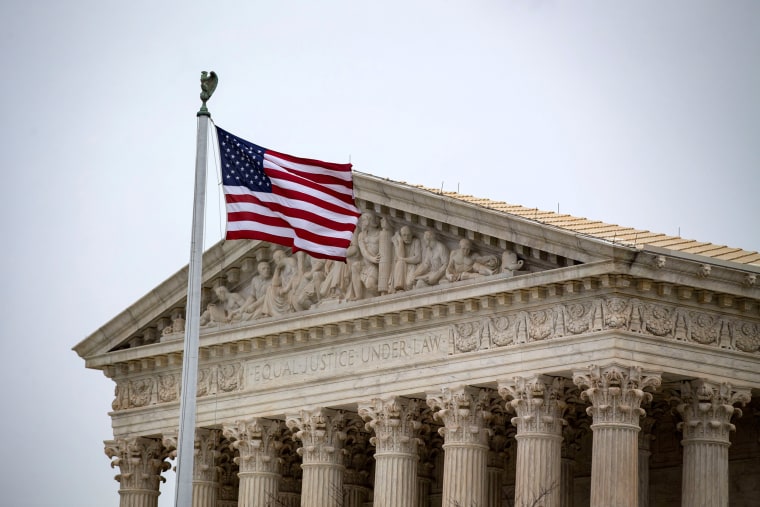
Image: The U.S. Supreme Court

The U.S. Supreme Court building in Washington on Nov. 13, 2018.Al Drago / Reuters file

The Supreme Court on Monday left in place a Kentucky law, mandating doctors perform ultrasounds and show fetal images to patients before they can perform abortions.

The high court declined, without comment, to hear an appeal brought by the American Civil Liberties Union on behalf of the state’s lone abortion clinic.

The Kentucky law, which requires a doctor to describe an ultrasound in detail while a pregnant woman hears the fetal heartbeat, was passed in 2017.

It was signed by Gov. Matt Bevin, an anti-abortion Republican who lost his bid for re-election last month.

“This is a HUGE win for the pro-life movement!” the Kentucky GOP tweeted on Monday, thanking Bevin and Republican lawmakers. “This decision by SCOTUS to allow the lower court ruling to stand is a victory for the unborn!”

The ACLU had argued that the Kentucky statute had no medical basis and was designed only to coerce a woman into opting out of having an abortion. Defenders of the law said it represented a straightforward attempt to help patients make a well-informed decision.

The high court’s action let stand the law which had been upheld by the Sixth Circuit Court of Appeals.

Alexa Kolbi-Molinas, senior staff attorney at the ACLU Reproductive Freedom Project, said in a statement Monday that the high court had “rubber-stamped” Kentucky’s interference in the “doctor-patient relationship.”

“By refusing to review the Sixth Circuit’s ruling, the Supreme Court has rubber-stamped extreme political interference in the doctor-patient relationship,” according to Kolbi-Molinas.

“This law is not only unconstitutional, but as leading medical experts and ethicists explained, deeply unethical. We are extremely disappointed that the Supreme Court will allow this blatant violation of the First Amendment and fundamental medical ethics to stand.”

Elizabeth Nash, senior state issues manager for the Guttmacher Institute, a research organization that backs abortion rights, called the Kentucky law a “shaming tactic.”

“By upholding a requirement that provides conduct an ultrasound before an abortion, what they’re really doing is establishing that the state can interfere with medical health practice and create a stigma,” Nash told NBC News on Monday. “It’s a shaming tactic.”

Source: https://www.nbcnews.com/news/us-news/supreme-court-upholds-kentucky-abortion-law-mandating-ultrasounds-n1098181?cid=sm_npd_nn_tw_ma&fbclid=IwAR1Y8CvUJOJH6t1uZfdk8epTKnhP_O1Feng4Zqq5iOaNW1tMQ8JWeKesqDY

UC Davis Health ended a study early after researchers found a risk of “serious blood loss” when patients stopped in the middle of the medication abortion protocol.

[Photo: A woman receives an IV solution as she lies on a hospital bed.]

These new findings from UC Davis Health are further evidence that abortion reversal can be dangerous—both as a fictitious narrative and as a medical practice. Shutterstock

The first-ever randomized clinical study on the medically unproven “abortion reversal” treatment being pushed by anti-choice advocates has ended early as a result of safety concerns for participants, according to UC Davis Health, the academic health center where the research was being conducted.

The study sought to enroll 40 pregnant people who were planning to have a medication abortion and test the effectiveness of progesterone as a way to “reverse” an abortion. At the time of its conclusion, only 12 participants had enrolled. Of those, one participant who had received progesterone and two who had received a placebo experienced severe bleeding that required ambulance transport.

The discovered risk of “serious blood loss” when patients stop in the middle of the medication abortion protocol led principal investigator Professor Mitchell Creinin at UC Davis Health and his colleagues to end the study early. As a result, there remains no established scientific evidence that “abortion reversal” is possible.

“Women who use mifepristone for a medical abortion should be advised that not following up with misoprostol could result in severe hemorrhage,” Dr. Creinin said in a statement for UC Davis Health.

Medication abortion relies on two drugs—mifepristone and misoprostol—to terminate a pregnancy. The pregnant person first takes a dose of mifepristone, which blocks progesterone receptors and stops the pregnancy from continuing to develop. Twenty-four to 48 hours later, they take a dose of misoprostol, which causes the uterus to contract and empty itself.

In recent years, anti-abortion activists have alleged that injecting a pregnant person with progesterone after they’ve taken mifepristone, but before they’ve taken the misoprostol, will allow the pregnancy to continue and therefore “reverse” the abortion.

This progesterone regiment is not FDA-approved, and it’s never been studied with rigorous scientific procedures such as those undertaken by Creinin’s team. The American College of Obstetricians and Gynecologists (ACOG) has fully denounced the practice. But that hasn’t stopped the anti-choice movement from launching a full-blown “abortion reversal” misinformation campaign and offering the “procedure” at crisis pregnancy centers across the country.

Those pushing “abortion reversal” rely on an unscientific report involving seven anecdotes of people who had undergone the reversal regiment. The report was published by anti-abortion doctors Dr. George Delgado and Dr. Mary Davenport in 2012. Of the seven subjects, two had complete abortions and one ended their participation without a response.

The anecdotes of four doctors who treated four people are the beginnings of this myth. In 2018, Delgado published more cases from his network of anti-abortion doctors who are apparently spending their time experimenting on pregnant people. The journal that published the report recalled the paper shortly after publication because an ethics board never fully approved Delgado’s research, which also had no control group. Both are very serious research failures.

Here’s the problem with relying entirely on anecdotes and calling it scientific research: You can’t establish any semblance of a causal relationship. That matters in this case because science has already established that taking mifepristone and failing to take misoprostol results in anywhere from 8 percent to 46 percent of pregnancies continuing normally with no abortion occurring. The pregnancy outcomes recorded by Delgado could be entirely attributed to the lack of misoprostol and wholly unrelated to the progesterone injections; there’s no way to know because there was no control group.

But four anecdotes and a recalled paper are apparently more than enough for conservative politicians across the country to codify what looks a whole lot like medical malpractice. In at least eight states, legislators have passed laws forcing abortion providers to trick their patients into believing that abortion reversal is a real medical procedure that’s available and effective. In 2019 alone, five states have passed these mandatory deception laws, and Ohio is moving another right now. Several of these laws have already failed legal tests, with a federal judge opining that North Dakota’s defense of its abortion reversal legislation was “Devoid of scientific support, misleading, and untrue.”

Medication abortion is becoming an increasingly common and accessible way to safely end a pregnancy, and abortion opponents and their allies in state legislatures are aggressively responding by pushing these restrictions. In 2017, nearly 40 percent of abortions in the United States were medication abortions. Spreading lies about abortion reversal is just the right’s latest strategy for denying bodily autonomy.

The myth of abortion reversal is particularly attractive to the anti-abortion cause because it centers itself on the false premise that people who have abortions often regret them, a stigmatizing belief that simply isn’t grounded in fact. Different people feel different emotions after having an abortion, but regret is almost never one of them. In fact, 95 percent of people who’ve had an abortion reported feeling that abortion was the right choice for them. Abortion reversal practitioners are targeting pregnant people at a time when they are often emotionally vulnerable and using their bodies to further an ideological agenda with little concern for the potential effects.

These new findings from UC Davis Health are further evidence that abortion reversal can be dangerous—both as a fictitious narrative and as a medical practice.

Source: https://rewire.news/article/2019/12/06/abortion-reversal-is-not-only-b-s-but-is-dangerous-too/

From remaking the judiciary to repealing Hyde to removing the global gag rule, Trump’s successor has their work cut out for them.

Hogue-SCOTUSprotest_ap_img

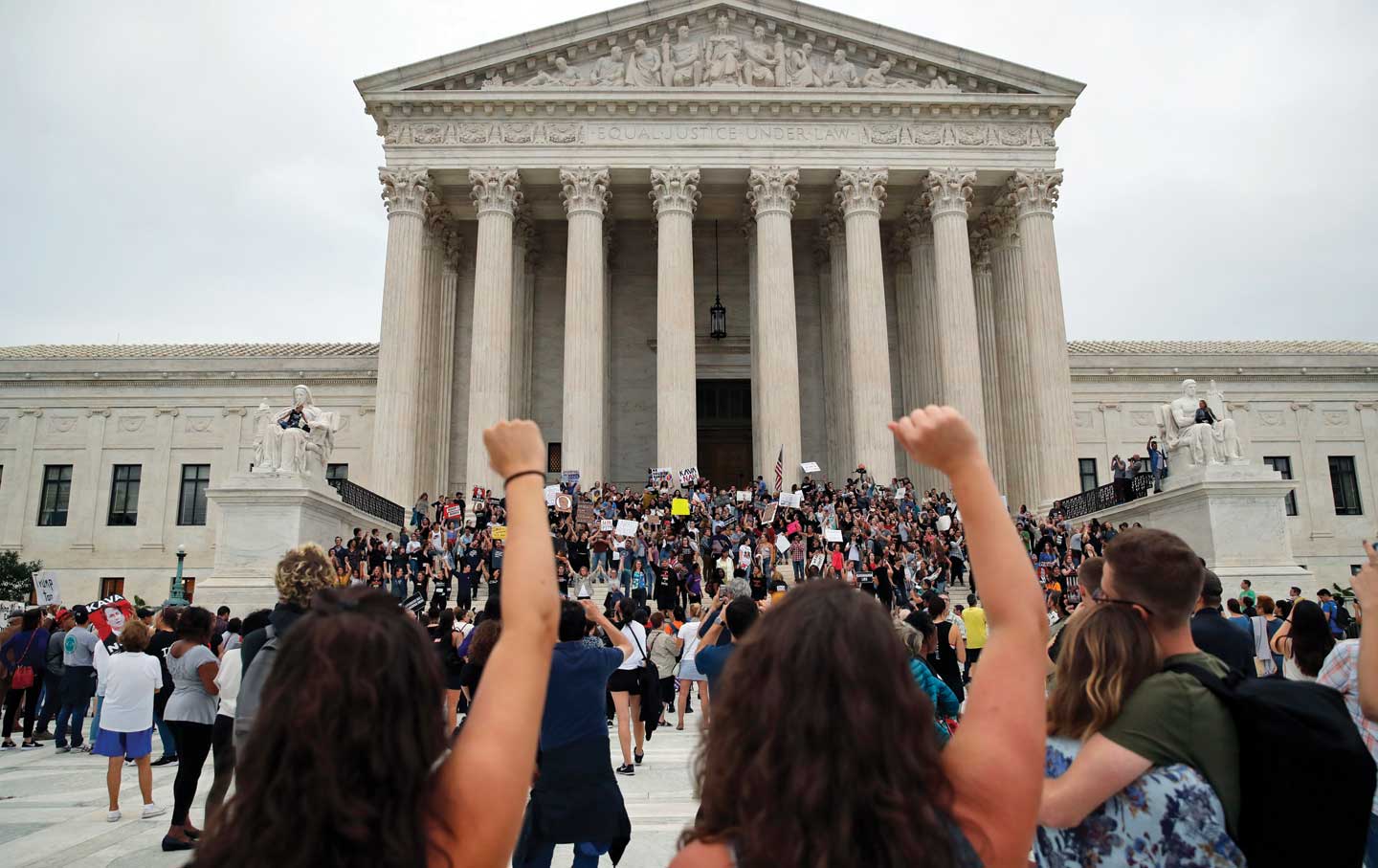
Supremely unjust: Protesters raise their fists outside the Supreme Court after the confirmation vote of Brett Kavanaugh, who was accused of sexual assault. (AP Photo / Alex Brandon)

In Los Angeles in early May, I woke up at 5:30 am to a barrage of texts and phone calls. The day before, the Alabama Legislature had passed a law banning abortion completely. This move came on the heels of the Georgia General Assembly criminalizing abortion after the sixth week of pregnancy. I was in LA with former Georgia gubernatorial candidate Stacey Abrams to talk to film industry leaders about how they could challenge that law, given their extensive investments in her state. The Alabama ban was a tipping point, and women across the country were rising in anger, frustration, and disgust over the attacks on our reproductive freedoms.

Among the calls were several from presidential contenders who wanted to put together plans to address the erosion of reproductive rights by the Trump administration and the state-level attacks that started years ago in the form of 20-week bans, mandatory waiting periods, forced ultrasounds, and much more. In all, 20 presidential candidates spoke out that day.

It hadn’t always been so. In 2016, when reproductive freedom and justice groups pushed debate moderators to ask then–presidential primary candidates Hillary Clinton and Bernie Sanders about the threats to reproductive rights as a part of the #AskAboutAbortion campaign, we were mostly dismissed by the media and the political elite. Despite the attacks on reproductive freedom that were well underway, many in the Democratic Party and the progressive movement didn’t understand the toll of these escalating assaults on the ability of women to access abortion, birth control, and prenatal care—not coincidentally, assaults that are primarily felt by poor women, rural women, immigrant women, and women of color. Given the complacency of many at the top, including in the media, only one question was asked about abortion rights during the primary debates—the very last one.

Clinton and Sanders were both pro-choice, so people scoffed, “Why should we waste our time on that?” Having our concerns minimized came as no surprise to those of us who do the work. We explained again and again that pro-choice values are great, but we expect plans.

To their credit, Clinton and Sanders didn’t shy away from the issue. When asked, they were aggressive in response, and as the nominee, Clinton led the charge to insert in the Democratic Party platform a call to repeal the Hyde Amendment, which prohibits federal funding for abortion services. Still, the conversation existed on the margins for most pundits and observers.

That brings us to today. Through fiat in the federal agencies and an unapologetic takeover of the judicial system, President Donald Trump has thrust the question of access to abortion—and all it represents about control and freedom—to the center of the 2020 presidential election.

So far, the Democratic field has risen to the occasion. Candidates have advanced explicit positions on abortion rights, and all the major ones support the repeal of the Hyde Amendment and the decades-long discrimination it embodies. That commitment was tested this year when Joe Biden reversed his stance on the issue—vowing to lift the ban on abortion funding for low-income women after quick and severe public criticism.

This progress is due to the painstaking work of those raising the alarm year after year, even when too few listened. In 2014, All Above All, a leader in the reproductive justice movement, began educating people on the evils of the Hyde Amendment and calling for its repeal. Six years ago Wendy Davis, then a state legislator, mounted her famous filibuster against Texas’s 20-week abortion ban. The backlash against that law was enormous, and it planted seeds of resistance against today’s bans. Legislators in the anti-choice movement knew their agenda was unpopular and that they were living on borrowed time. So they moved quickly and quietly to introduce bills designed to outlaw certain kinds of abortions, shame women out of choosing the procedure, and shut down clinics. These lawmakers used every trick available to jam these bills through, convening special legislative sessions and hijacking unrelated legislative efforts. In North Carolina, a bill to impose restrictions on abortion clinics was even attached to a motorcycle safety bill.

Trump’s victory heralded the end of this stealth approach. But as state-level bans sweep the nation, so does an awareness of what’s at stake. The vast majority of American adults—77 percent, according to a 2019 NPR/PBS NewsHour/Marist poll—support legal access to abortion, an increase even from last year. Support is overwhelming among Democratic voters, who have had it with the reproductive oppression enabled by misogyny. It’s undeniable that left and liberal candidates must take these issues seriously if they are to be competitive. People who understand that the freedom to access abortion is inextricably part of our fight for gender equity are marching and resisting in record numbers.

This is an inflection point, and it’s crucial to treat Roe v. Wade as the floor of what we need and not the ceiling. The next president will have massive challenges in digging our nation out of the hole we find ourselves in. Fortunately, the contenders for the Democratic nomination have some ideas. The crisis requires dedicated resources and attention, which would be part of Cory Booker’s call for a White House Office of Reproductive Freedom. The crisis requires nominating judges to all levels of the federal judiciary, including the Supreme Court, who would protect reproductive freedom, as promised by former candidates Kirsten Gillibrand and Beto O’Rourke and current contenders Pete Buttigieg and Julián Castro, among others. The crisis requires innovative thinking about the relationship between state and federal government, like the proposal put forward by Kamala Harris, whose plan models the preclearance process in the Voting Rights Act, stipulating that the most regressive states get permission from the Justice Department before a new abortion law takes effect. The crisis requires a health care plan that includes coverage of comprehensive reproductive care, like the one proposed by Bernie Sanders. And the crisis requires us to address the increased threats to and violence against abortion clinics, as proposed in Elizabeth Warren’s plan. And of course, the next president must push to codify Roe into statute; repeal the Hyde Amendment permanently; remove the global gag rule, which bars giving federal funds to any foreign health organization that provides abortion or even discusses it as an option; and reinstate Title X funding for Planned Parenthood and other full-service reproductive health care providers.

These plans—and the fact that several presidential candidates vowed during the Democratic debates to restore reproductive rights, even when they weren’t asked about them—are a good start. Still, all of that should be the minimum. To adequately confront this moment, we have to elect pro-choice champions. Congress will be instrumental in safeguarding our reproductive rights, and perhaps more than anything, we need a national leader who can convey with moral clarity and conviction what’s at stake. The Trump administration is a manifestation of a radical anti-choice movement’s deep misogyny and racism. Extremists in the White House have used this opportunity to move an anti-​science agenda and force their narrow moral code on all Americans. We need the exact opposite in our next president.

In a dystopian move, the Trump administration has tracked the periods and pregnancies of migrant women being held in Immigration and Customs Enforcement centers to prevent them from having abortions—a move that implicitly acknowledges the sexual violence experienced by these women on their travels and in detention. This White House has put people in charge of our family planning programs who do not believe in contraception and have pursued a strict abstinence-only, sex-shaming agenda. This administration moved funds away from Planned Parenthood and other comprehensive health care providers to fake clinics that lie about everything from abortion to contraception.

Of course, the crowning achievement of this administration is to install justices on the Supreme Court dedicated to gutting Roe and criminalizing abortion. The nomination of Brett Kavanaugh, who has been accused of multiple sexual assaults, to the nation’s highest court by a president who is an alleged serial sexual predator himself sent a clear message: We will have no rights to, no ability to feel safe in our own bodies. This president and the anti-choice movement that put him over the top in 2016 see our personal agency as something to gleefully extinguish.

This spring, emboldened by a president who said women should be punished for seeking abortion, Texas held a hearing on a law that would allow prosecutors to impose the death penalty on women who terminate their pregnancies. And in many states, women are fodder for test cases to establish the statutory rights of a fertilized egg over those of the person carrying it. In Alabama, Marshae Jones was charged with manslaughter after being shot in the stomach and losing her pregnancy. Although the charges were dropped, the message was clear: Our ability to reproduce can and will be wielded as a weapon to keep us in our place. Left unchecked, this is the future for all women, just as it is the present for the less powerful voices among them.

So therein lies the challenge. The mantle of leadership is not in seeking a return to a pre-Trump status quo that was already victimizing so many. It’s certainly not in treating the anti-choice movement as a benign force that we have a mild disagreement with. The leader we need will realize that he or she has a mandate to move policy that recognizes reproductive rights for what they are: the nucleus of gender equity and a fundamental guarantee without which women will never be free.

Source: https://www.thenation.com/article/abortion-trump-kavanaugh-hyde/

A gavel sits on a desk inside the Court of Appeals at the new Ralph L. Carr Colorado Judicial Center, which celebrated its official opening on Monday Jan. 14, 2013, in Denver. Photo by Brennan Linsley/AP

It’s not just the quantity of Donald Trump’s judicial nominees who’ve been confirmed by Senate Republicans; as regular readers know, it’s also the quality that’s striking.

Sarah Pitlyk, for example, received a “not qualified” rating from the American Bar Association, and the ABA’s rationale is quite persuasive: “Ms. Pitlyk has never tried a case as lead or co-counsel, whether civil or criminal. She has never examined a witness. Though Ms. Pitlyk has argued one case in a court of appeals, she has not taken a deposition. She has not argued any motion in a state or federal trial court. She has never picked a jury. She has never participated at any stage of a criminal matter.”

So why in the world did she get a judicial nomination from Donald Trump? It probably has something to do with Pitlyk being a Federalist Society member, a former Brett Kavanaugh clerk, and a fierce opponent of reproductive rights who’s argued that fertility treatments and surrogacy have “grave” adverse effects on society. Jennifer Bendery explained this week:

In private practice and as special counsel at Thomas More Society, Pitlyk established a clear record of attacking reproductive rights. She defended anti-abortion activist David Daleiden, who broke federal and state laws by secretly recording and deceptively editing videos that falsely claimed to expose Planned Parenthood’s illegal sale of fetal tissue. She defended Iowa’s six-week abortion ban that was later struck down as unconstitutional. In another case, Pitlyk argued that it is “scientific fact” that “human life begins at the moment when a human sperm fertilizes a human egg.” (It is not scientific fact.)

After losing that case, Pitlyk lamented that “the trial court’s judgment treated the embryonic children as inanimate objects, not human beings with the same interests as other unborn children.”

It’s against this backdrop that the Trump White House chose Pitlyk for a lifetime appointment to the U.S. District Court for the Eastern District of Missouri. This afternoon, the 42-year-old conservative was confirmed by the Republican-led Senate on a 49-44 vote.

Sen. Susan Collins (R-Maine) was the only Republican to oppose her nomination, and no Senate Democrats broke ranks to support her.

I’ve long believed the lasting effects of the Trump era can be boiled down to the three C’s: the climate, the nation’s credibility, and the federal courts. Health care benefits can be restored, alliances can be rebuilt, and tax breaks can be scrapped, but the lost years on dealing with the climate crisis are tragic; it’ll be a long while before the world forgets that we’re a country capable of electing someone like Trump; and with Republicans confirming young, far-right ideologues to the bench at a brutal clip, we can expect a generation’s worth of conservative court rulings.

Postscript: For those keeping score, as of this afternoon, the GOP-led Senate has confirmed 120 of Trump’s district court nominees, 48 of his circuit court nominees, and two of Trump’s Supreme Court nominees. (These figures have been corrected since original publication.)

Source: http://www.msnbc.com/rachel-maddow-show/gop-confirms-fierce-opponent-reproductive-rights-federal-bench

Just under 30 amicus briefs were filed for June Medical Services v. Gee on Monday, urging the Supreme Court to protect access to abortion and strike down a Louisiana law that could effectively eliminate abortion in the state. The “friend of the court” briefs represented about 200 organizations and more than 700 individuals.

Though many of the briefs came from pro-abortion rights advocates like Planned Parenthood and the American Civil Liberties Union, a handful came from non-partisan groups including the American Bar Association, the American Medical Association, the American College of Obstetricians and Gynecologists and the American Academy of Pediatrics. Medical groups argued that the law in question – which requires doctors providing abortions to have admitting privileges at a nearby hospital – is medically unnecessary, while legal scholars wrote that there is already precedent that covers the issue: the 2016 Supreme Court decision in Whole Woman’s Health v. Hellerstedt that struck down a similar law out of Texas.

Religious groups, representing Christian, Muslim and Jewish communities, also submitted amicus briefs Monday, arguing that “religious traditions recognize women’s moral right to decide whether to terminate a pregnancy.”

“This diverse and unprecedented array of expert voices, individual women, and advocates paints a compelling portrait of the immense stakes in this case,” said Nancy Northup, president and chief executive officer of the Center for Reproductive Rights. “It’s clear that support for abortion access and the rule of law spans all political parties, all professions, and all walks of life.”

In Whole Woman’s Health v. Hellerstedt, 45 amicus briefs were filed in opposition to Texas’s admitting privilege law. Amicus briefs supporting Louisiana’s law are due on January 2.

“It is hypocritical for abortion providers and their supporters to claim the lawsuit is helping women when its end goal is to decrease the standard of care women receive from Louisiana abortion providers who have a long documented history of medical malpractice, disciplinary actions, and violations of health and safety standards,” said Louisiana Solicitor General Liz Murrill in an email to CBS News on Tuesday.

Last week, the Supreme Court announced it would hear oral arguments for June Medical Services v. Gee on March 4, 2020, devoting an entire day to it.  At the center of the case is Act 620, Louisiana’s “Unsafe Abortion Protection Act,” a 2014 state law not currently in effect. Similar to the Texas law that was struck down by the Supreme Court in 2016, Louisiana’s law requires doctors performing abortions to have admitting privileges at a hospital no more than 30 miles away. If the law is allowed to be implemented, all of Louisiana’s abortion clinics would close, as first reported last month by CBS News.

June Medical Services v. Gee is the first abortion-related case to be heard by the Supreme Court since the appointments of conservative Justices Neil Gorsuch and Brett Kavanaugh.

Last week, the Center for Reproductive Rights (CRR), the law firm representing June Medical, filed its opening brief, the first of four to be filed ahead of oral arguments. CRR outlined its argument against Act 620, identifying two reasons why it believes the regulation should be struck down by the high court. First, CRR argued that since the Supreme Court struck down the same type of restriction in Whole Woman’s Health v. Hellerstedt in 2016, Louisiana’s restriction should also be deemed unconstitutional. Second, the law in question “is unconstitutional even assuming the burdens here are less than in Whole Woman’s Health,” according to the brief.

Previous Supreme Court precedent says abortion restrictions cannot create an “undue burden” for women seeking the procedure.

Louisiana’s opening brief is due December 26.

Source: https://www.cbsnews.com/news/abortion-supreme-court-case-amicus-briefs-filed-for-june-medical-service-v-gee-louisiana-abortion-case-2019-12-03/?fbclid=IwAR05LKn1gIIP0lOt6Vln5Rh7CE0DrrQPGYRm_YkZagr81IurcccstIIJFbg

Women often required to visit multiple clinics for routine procedures, says report

The Better for Women report calls for a reshaping of fragmented NHS systems. Photograph: Alamy Stock Photo

One-stop shops should open in the high street, where women can go to get contraception, screening services, menopause advice and help with other health needs, while the morning-after pill should be sold off the shelf without consultation, say leading UK experts.

The Royal College of Obstetricians and Gynaecologists, which has been working on a blueprint for women’s health services for more than a year in conjunction with other groups and government, says services for women need to be completely overhauled to give them far more control over their health.

Its report launched today in the House of Commons, called Better for Women, says women with busy lives struggle to get the healthcare and advice they need. It sets out a strategy for reshaping the present fragmented NHS systems that require women to see different nurses and doctors in a variety of specialised clinics, as well as their GP practice, for procedures that should be routine.

A survey of 3,000 women shows that large numbers find it hard to get advice and care near home. More than a third (37%) said they could not get contraception services locally and 60% could not easily access unplanned pregnancy services, including abortion care.

The all-time high level of abortions is connected to the unmet contraceptive needs of women, says the report. In 2018, there were 200,608 abortions across England and Wales – an increase of 4% on the previous year.

Over a third (34%) of women did not attend their last cervical cancer smear test, the survey shows. Only half had locally available sexually transmitted infection services, 56% struggled to get help for painful periods and 58% could not get menopause services locally.

It’s not just special pleading for women, said Lesley Regan, president of the college. Many are carers and mothers and they influence the healthcare behaviours of everyone else. “If you get it right for women, you get it right for lots of other people,” she said.

Many of the services women need are preventive, such as cancer screening and contraception. Many are paid for from the public health budget, through local authorities, and have been cut because of the 40% reduction in that budget, said Regan.

“Women are falling through the cracks of very basic services that should be very easy to prevent or access,” she said. “This is not rocket science. We are not suggesting an expensive new solution. We’re just saying we need to think about women across their life course because so many of the things that affect women, for which they need the NHS, are predictable.

“We’re not delivering what women need where they need it,” she said. A smear test, contraception and an STI check could all be done by the same person in 15 minutes, she said. “But at the moment, girls and women are being pushed around from pillar to post because a nurse or the health practitioner or the GP that they visit hasn’t got the commission to actually do the other things as well.”

Some 45% of pregnancies are now unplanned, she said. “What we do know is that when they’re not planned, they have much more complex outcomes often, and that means they are more expensive to deliver, and we see the abortion rate is not going up in girls – the teenage-pregnancy strategy has worked very well – it’s in the 40-year-olds who can’t access contraception.”

Women should not have to go back to the GP for a new prescription for the pill every three months when it has been heavily researched for the last 60 years. “It’s far more dangerous to get pregnant than it is to be on the pill,” she said. Girls and women should be able to get the very safe progestogen-only pill from a pharmacist or online, the report says. The morning-after pill should be sold straight off the shelf without the need to speak to a doctor or pharmacist.

The report says all young people should be educated from an early age about women’s health, and health issues such as the support during menopause should be embedded in workplace policies.

The college says the changes would save money by enabling women to stay in better health. Sexual health experts from the faculty of sexual and reproductive healthcare and the Royal College of Midwives (RCM) voiced support.

Gill Walton, chief executive of the RCM, backed its findings, including those on abortion, which she said should be regarded as just another medical procedure. “This is an important report that puts women at the centre of health improvement that needs governments and those running our health services to take notice. Our whole health service needs to focus much more on prevention of ill health, and to invest in our health and social services to support that,” she said.

Source: https://www.theguardian.com/society/2019/dec/02/one-stop-shops-needed-for-womens-health-services

If we’re only fighting to codify Roe—and not to address the racist, classist disparities that have failed to make the full spectrum of reproductive health-care services a reality for so many—then we’re leaving people behind.

Unsurprisingly, political representation for women changed the game, as moderators finally asked detailed questions about abortion and reproductive rights, such as whether candidates think there is room in the Democratic Party for anti-abortion Democrats.
Alex Wong / Getty Images

Last week, for the first time this election cycle, all of the moderators at a presidential debate and almost half of the participants on stage were women. Unsurprisingly, political representation for women changed the game, as moderators finally asked detailed questions about abortion and reproductive rights, such as whether candidates think there is room in the Democratic Party for anti-abortion Democrats. Additionally, Sen. Amy Klobuchar (MN) was asked whether she would intervene as president if Roe v. Wade were overturned by the U.S. Supreme Court, and states were allowed to outlaw abortion as a result.

Klobuchar’s promise to codify Roe into federal law was met with resounding applause from the audience in Atlanta, where Gov. Brian Kemp (R) signed a six-week abortion ban into law earlier this year. Codifying Roe has become an increasingly popular campaign promise in the Democratic field at a time when the president has put into place Supreme Court justices who are expected to overturn the precedent and many states are peddling one extreme abortion ban after another. But with so much at stake, it’s critical that Democratic presidential candidates recognize enacting a federal law to keep abortion legal must be the floor, not the ceiling.

Since 1973, the precedent of Roe has meant abortion access is dependent on socioeconomic status and ZIP code. As a result of the more than 1,200 state and federal laws that have been enacted since Roe—over a third of which were enacted in the last decade alone—abortion access has been decimated, even though abortion is still legal. One major hurdle to unfettered access to abortion is the Hyde Amendment, a federal budget rider that since 1976 has banned Medicaid insurance from covering abortion and rendered abortion a privilege based on income. Hyde, like the many state-level laws that similarly restrict insurance coverage of abortion, unjustly affects women of color. Due to a complicated “perfect storm” of racism, discrimination, and economic inequality, women of color are disproportionately enrolled in Medicaid and are therefore more likely to be harmed by Hyde than their white counterparts.

Our next president must do so much more than protect a legal precedent that simply does not function as it should to ensure each of us can access the health care we need. Democratic presidential candidates must challenge restrictions like Hyde, and promise to proactively ensure coverage for abortion and all reproductive health care. Further, more than simply promise to end Hyde, candidates should offer specific plans for how they would do so, and make it clear that they would not compromise on this in pursuit of policy gains in other areas.

Candidates must also take action on other existing state laws—from mandatory waiting periods, to parental involvement requirements, to mandated anti-choice counseling, to explicit abortion bans, to targeted regulations of abortion providers (TRAP) laws. These state laws block access to health care, stigmatize abortion, and punish and endanger anyone who may need an abortion but is marginalized by our health system. This includes people struggling financially, women of color, young people, immigrants, transgender men, and non-binary people.

And candidates must outline comprehensive plans to achieve real abortion access for all, and they should be asked about them at every debate.

We already know the toll of Democrats’ inaction and passively playing defense, all while anti-choice extremists enact barrier after barrier on reproductive rights. Georgia, where last week’s debate was held, has the highest maternal death rate in the nation, and it is especially high for Black women. When politicians block access to crucial health care like abortion and other reproductive health services, low-income people, and especially women of color, are the ones who pay the price. And if we’re only fighting to codify Roe—and not to address the racist, classist disparities that have failed to make the full spectrum of reproductive health-care services a reality for so many—then we’re leaving people behind.

The threat of losing Roe is serious. If the precedent is overturned in the coming years, both patients and abortion providers could face criminalization and many other dangerous, costly outcomes. And we know that means women of color would likely be targeted most harshly. We must fight to protect Roe—but we must also fight to expand it.

Since 1973, economic barriers, as well as other geographical and identity-based restrictions, have reduced abortion rights to the theoretical for far too many people. With the coming elections, we have the chance to fight for so much more than the status quo: We have a real opportunity to fight for reproductive justice for all. And we need to elect a president who’s going to lead the way, and seize that opportunity.

Source: https://rewire.news/article/2019/11/27/codifying-roe-isnt-a-plan-to-ensure-abortion-access/