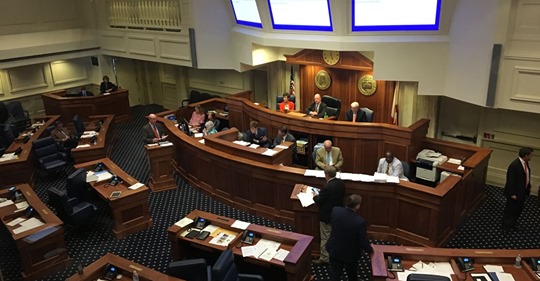
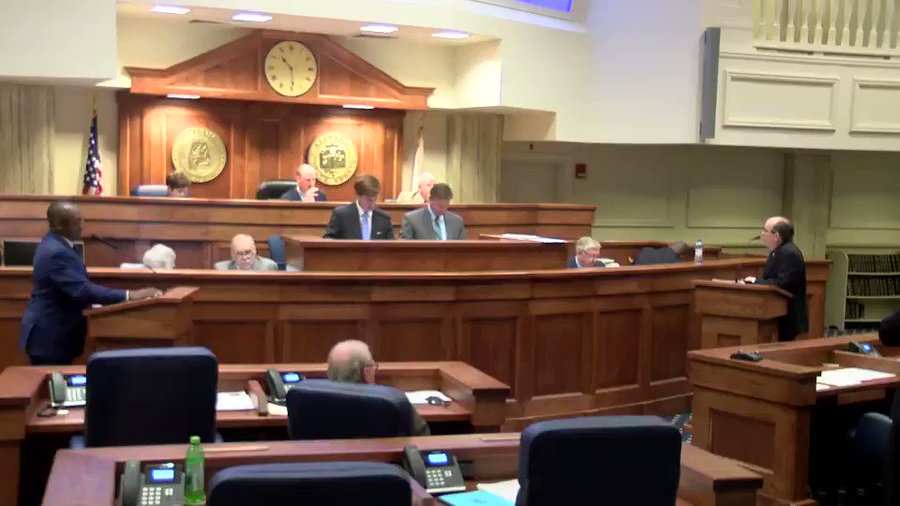
From the White House to the Senate, from courthouses to state legislatures, everywhere you look across the country, men in power are simultaneously dismissing women’s experiences of sexual assault and further restricting access to abortion care.
There’s the cruel irony of Justice Brett Kavanaugh, declaring in one of his first opinions from the bench that he would support upholding an anti-abortion law in Louisiana, only months after he was confirmed despite the protests of women bravely sharing their stories of sexual assault.
Or the irony of Senate Majority Leader Mitch McConnell rushing to confirm Neomi Rao to Justice Kavanaugh’s old seat on the D.C. Circuit despite her deeply problematic comments blaming women for being sexual assaulted. The only thing slowing down her nomination was Senator Josh Hawley’s concern that she wasn’t anti-abortion enough (he ultimately voted to confirm Rao after receiving assurances that she is, in fact, anti-abortion).
Or the fact that both Kavanaugh and Rao were nominated by a President who has been accused of sexual assault by more than a dozen women — and whose administration has been hell-bent on decimating access to abortion and reproductive health care.
And while these events might be ironic, and devastating, sadly they’re not surprising. They are part of a scary and a pervasive culture that disregards women’s right to control our own bodies.
When we think about the connection between abortion access and sexual assault, we often think of the rape survivors who need or want to end a pregnancy that resulted from the rape. But the relationship between these two issues runs much deeper.
Deciding whether and when to have a child and whether or when to consent to sexual activity are both fundamentally about asserting autonomy over our own bodies. And both restrictions on abortion and the dismissal of sexual assault are about people in power — predominantly men — trying to strip away our dignity and roll back our march toward equality. We’ve seen it across this country as state legislatures have introduced more than 250 laws restricting abortion access since January 2019.
In truth, these restrictions stem from a culture that allows survivors of sexual assault to be disregarded and where women who want a full range of choices when it comes to starting or growing our families are not seen as the key decision-maker in our own lives.
If we view sexual assault and abortion restrictions through this lens, the misogyny that underpins both becomes so much clearer. But so too does the path forward for those of us who care about women’s equality, who protest efforts to defund Planned Parenthood, who lead the Take Back the Night event at their school, who march in the streets, and who have bravely said #MeToo.
Men may try to gaslight us by telling us that we must be mistaken about what happened to us or about what we want – but we know our own minds and are reliable narrators of our own stories.
Men may try to shame and stigmatize us – but we know that we deserve respect and that our experiences matter.
Now is the time to join together across issues and movements, and to stand united in our resolve to speak out against the harmful laws, policies and culture that would erode our bodily autonomy and our humanity. Now is the time to say that, no matter who is in power, we will continue to trust and believe women.

Pro and anti-abortion rights activists on future of Alabama abortion bill

The Alabama state Senate passed the most restrictive abortion bill in the nation, sending it to the governor’s desk and setting off a wave of panic among abortion rights supporters.

The bill would make it a crime to provide an abortion at any gestational stage of pregnancy without exemptions for rape or incest.

Alabama Rep. Terri Collins, the Republican who sponsored the bill, told ABC News earlier this month she hopes it gets challenged should it be signed into law, so it could eventually make it to the Supreme Court to challenge the right to abortion nationwide.

The panic from many abortion rights supporters stems from concern that the Alabama bill could mean the end of the landmark Roe v. Wade decision that made abortion a nationally protected constitutional right.

But to legal experts at the Center for Reproductive Rights and the ACLU, the Alabama bill bringing on the overturning of Roe doesn’t seem like much of a distinct possibility, at least for the near future.

“We are very confident that the courts are going to block this law from ever taking effect,” Alexa Kolbi-Molinas, senior staff attorney at the ACLU’s Reproductive Freedom Project, told ABC News.

Should Alabama Gov. Kay Ivey, a Republican, sign the bill into law, the ACLU plans to sue, Kolbi-Molinas said.

“That litigation could end up at the Supreme Court,” Elisabeth Smith, chief counsel of state policy and advocacy for the Center for Reproductive Rights, told ABC News. “But, what we know is that for four and a half decades with different justices on the court, the Supreme Court has always confirmed and reconfirmed that women have the right to abortion,”

Without a doubt, women are terrified and watching really closely.

In three cases dealing with abortion that have come to the Supreme Court facing three different combinations of justices, the court has “consistently confirmed that women have the right to have an abortion prior to viability,” according to Smith.

This includes Roe v. Wade in 1973 that codified abortion as a constitutionally protected right, as well as 1992’s Planned Parenthood v. Casey, which struck down a spousal consent requirement and introduced the concept that a law must not impose an “undue burden” on a person seeking an abortion. The “undue burden” test was reaffirmed in 2016’s Whole Woman’s Health v. Hellerstedt, which struck down a Texas law requiring abortions be performed at ambulatory surgical centers with hospital admitting privileges.

While “viability” — the point at which a fetus can survive outside a uterus — is a murky concept, it is generally agreed to occur at 24 weeks of gestation. Laws banning abortion at less than 20 weeks have consistently been struck down by courts as unconstitutional. In 2016, the Supreme Court declined to review a lower court’s ruling that a so-called “heartbeat” abortion ban was unconstitutional, essentially upholding that decision.

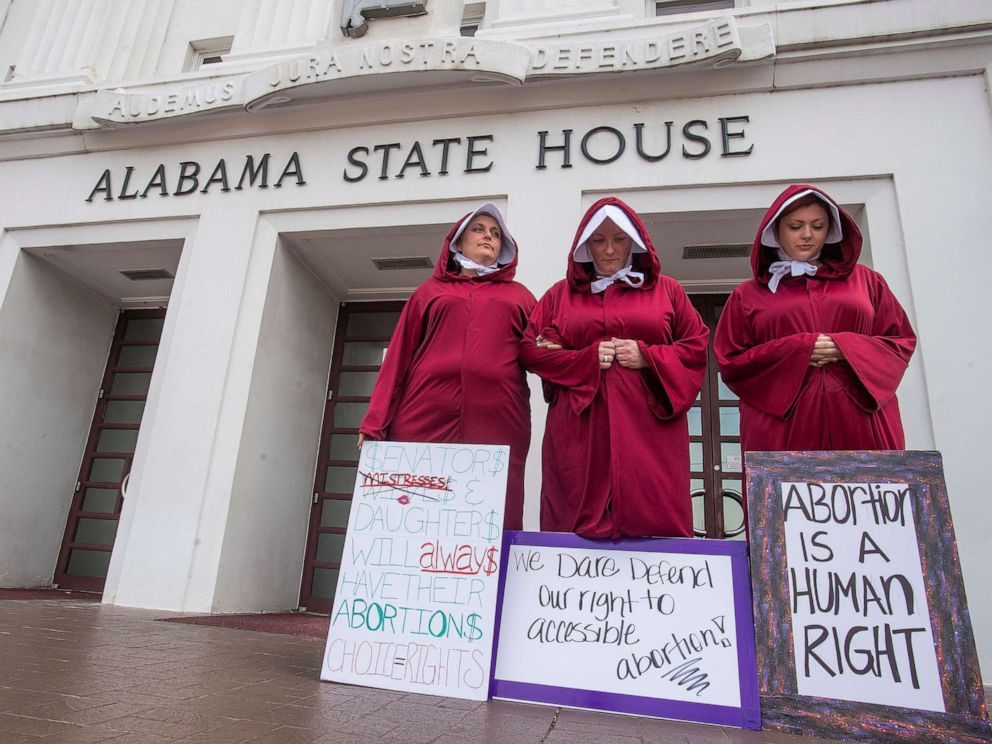
PHOTO: Abortion rights supporters dressed as handmaids take part in a protest against HB314, the abortion ban bill, at the Alabama Statehouse in Montgomery, Ala., April 17, 2019.Mickey Welsh/Advertiser via USA Today Network, FILE
Abortion rights supporters dressed as handmaids take part in a protest against HB314, the abortion ban bill, at the Alabama Statehouse in Montgomery, Ala., April 17, 2019.more +

Though some abortion rights experts may not be concerned about the Alabama bill — although they caution it is in the early stages for speculation — advocates note the context of the Alabama bill, and the recent language around abortion, is important.

“We’re definitely seeing a new wave of extreme bans on abortion,” Amanda Thayer, deputy national communications director of NARAL Pro-Choice America, told ABC News.

The Alabama bill puts that wave in the spotlight, which Thayer says is emboldened by President Donald Trump’s judicial appointments.

“The Republican Party and Trump have gone off the rails, and this is now coming into really acute focus for people across the country to see,” she said. “Without a doubt, women are terrified and watching really closely.”

For it to be sensationalized in this way, it really isn’t about abortion, it’s about equality and the status of women.

The bills restricting abortion are “getting more and more extreme,” according to Thayer, which she said is “part of the strategy of trying to move the goal post of what may seem reasonable.”

The increasing extremity of not just the bills, but the language surrounding them, concerns Amy Hagstrom Miller, founder and CEO of Whole Woman’s Health, an organization of women’s health care clinics that won the 2016 Supreme Court case.

“Our tolerance for really violent and hateful language is increasing,” Hagstrom Miller told ABC News, referencing President Donald Trump’s language around abortion, including using the term “executing,” among other issues. She worries that an increase in violent language, paired with more extreme legislation around abortion, could be linked to real-world violence for clinics and providers.

“For it to be sensationalized in this way, it really isn’t about abortion, it’s about equality and the status of women,” Hagstrom Miller said.

Many reproductive rights advocates also point out that abortion access has already been severely curtailed for many women. Though outright bans may be struck down by courts, other types of laws — such as waiting periods, hospital admitting privileges requirements and bans on specific forms of procedures — render abortion inaccessible in many parts of the country.

“While this attack we are seeing right now is unprecedented,” Kolbi-Molinas added, “it is also important to remember that for many people, abortion has already been pushed out of reach.”

And while it would take some time for the Alabama abortion ban to potentially make it to the Supreme Court, should it be signed, other restrictive laws are already in the pipeline. This includes bans on the dilation and evacuation abortion procedure, which is a de facto second trimester ban, and a law requiring abortion providers to have hospital admitting privileges.

The admitting privileges law, which was passed in Louisiana, mirrors one passed in Texas that the Supreme Court struck down in 2016. In February, the Supreme Court temporarily blocked the Fifth Circuit’s decision that would have allowed it to stand.

The Louisiana law is being litigated in June Medical Services v. Gee. In April, the Center for Reproductive Rights, which represents June Medical Services, asked the Supreme Court to hear the case, and they’ll make that decision early this summer. Should the Supreme Court take it up, it would be an opportunity to affirm or reject their own precedent.

Source: https://abcnews.go.com/US/abortion-advocates-react-alabama-ban-increasingly-hostile-atmosphere/story?id=63050393

Pro-choice men should have the guts to campaign against the rolling back of laws that benefit both sexes


No woman can be free who does not control her own body. That’s been the pro-choice mantra down the ages, no less true now than it ever was, and from it flows the equally fierce conviction that men should keep their noses out of reproductive rights. If it isn’t your womb, your life, on the line here, then what right do you have to interfere in a grown adult’s decision? No wonder that powerful image of the 25 male politicians who collectively approved Alabama’s cruel new ban on terminations beyond six weeks, struck such a chord. The sight of old men desperately clawing back their lost power over women’s lives still triggers a deep, visceral fear. Six weeks! That’s barely a missed period, a time when many women won’t even have realised they’re pregnant.

True, America’s pro-life movement has plenty of prominent women in it, and in the UK it’s a female leader of the pro-life Democratic Unionist party who (thanks to her sensitive role propping up the British government’s parliamentary majority) represents one of the biggest stumbling blocks to rolling out abortion rights in Northern Ireland. But such nuances get forgotten in the face of men doggedly arguing on Twitter that forcing victims of incest to continue their pregnancies would at least preserve the criminal evidence, or refusing to let their cluelessness about female biology get in the way of a terrible opinion.

Yet the argument that men should all shut up and leave this to women is a risky one, unless we seek a world where virulently pro-life men still feel no shame about barging in while pro-choice men hang back for fear of saying the wrong thing. I admire any woman with the courage to say publicly, as the actor Jameela Jamil did this week, that she had an abortion when contraception failed her and “I don’t feel AT ALL ashamed.”

But there’s something uncomfortable about watching women, and only women, feel driven to bare their souls in defence of reproductive and contraceptive rights that have liberated both sexes and which both should be raising hell to defend.

We rarely read or hear about them, but there must be millions of men whose lives were changed for the better by not becoming fathers when they weren’t ready. There will be men who owe their glittering careers and happy families now to the fact that 20 years ago they didn’t have to drop out of university when their student girlfriend got pregnant, or weren’t forced to marry someone they didn’t love. And there will also be men who didn’t have to raise a child in circumstances where they genuinely couldn’t have coped, and whose other children are infinitely better off for it; men who haven’t had to watch their partner struggle through the horror of a pregnancy where everyone knows the child is unlikely to survive, who know how it feels to hold their partner’s hand in the clinic but don’t feel it’s quite their place to talk about it.

If one in three women has terminated a pregnancy, then men with every reason not to take abortion rights for granted, as well as older men who shudder to remember the days before it was legal, must statistically speaking be everywhere; walking down the street, sharing your office, representing you in parliament. The next leader of the Conservative party could very well be Boris Johnson, a man once sacked for trying to hide the fact that his mistress had had an abortion. So who is to say there aren’t men in high public office across America furiously keeping their heads down as the abortion row rages, crossing their fingers that the non-disclosure agreement holds? Yet for every man frantically trying to save his marriage by pressuring his lover to get rid of a baby, there will be couples taking painful decisions together about a much-wanted pregnancy when the tests show something nobody wanted to see.

It’s a hard truth to acknowledge, given it risks creating a dangerous chink in the argument through which pro-lifers can so easily slide. But for all that abortion should first and foremost be a woman’s choice, it doesn’t only affect women’s lives, and it shouldn’t just be women who are forced to fight do the heavy lifting in fightingfor it. There are, of course, perfectly good reasons for men to stay quiet about their personal experiences. For a man to talk openly about a partner’s abortion can feel pushy and self-centred, and practically speaking risks outing a woman who might not want her reproductive history exposed to all. During the impassioned debate ahead of Ireland’s referendum last year on repealing the ban, many Irish men initially hung back for fear of intruding. Male MPs similarly often defer to female ones in trying to change the law.

But the idea that the only way of galvanising change is by making a public song and dance about yourself may be one of the great curses of modern activism.

Pro-choice men worried about stealing women’s thunder can relax, because they are absolutely welcome to donate to pro-choice charities, sign petitions, lobby their political representatives, and vote for politicians and parties committed to defending reproductive rights. They can stuff envelopes, make tea, go on marches – or look after the kids while their partners do – and cheer from the sidelines to their heart’s content, much as the wives of male activists have done for generations. And where they represent us, they can have the guts to legislate for what they know perfectly well to be the realities of life. No woman can be free who does not control her own body. But we are not the only ones liberated by acknowledging it.

Source: https://www.theguardian.com/commentisfree/2019/may/18/women-abortion-rights-pro-choice-campaign?fbclid=IwAR31uB6taDDDDDE5OVHDJA3NEUIIbWumJ4ytNjHtTd8rRvRfxYBydd5_eaE

Less than 24 hours after Alabama lawmakers voted to ban almost all abortions, Planned Parenthood’s Southeast call center was inundated with hundreds of calls from women in Alabama, Mississippi, and Georgia. Each and every one is asking a similar question: If Gov. Kay Ivey signs the bill into law today as her Republican colleagues expect, what does that mean for my reproductive health care?

In a press call Wednesday morning, Staci Fox, CEO of Planned Parenthood Southeast Advocates, stressed that abortion is currently still legal in all 50 states. Now that the Alabama bill has been signed into law, it will take six months to go into effect. Similarly, the “fetal heartbeat” bill that the governor of Georgia signed into law earlier this month won’t go into effect until 2020, reports The New York Times. And both are likely to face immediate legal challenges that would temporarily stop them from going into effect.

“It’s important that we continue this cadence of reminding patients in states, especially here in Alabama and here in Georgia, that abortion is still safe, and legal, and accessible—and we are fighting every step of the way to make sure that stays true,” says Fox.

Accessibility, however, is a relative term. As of 2014, 93 percent of counties in Alabama do not have an abortion clinic. The state already requires mandatory counseling, followed by a 48-hour waiting period, for women seeking an abortion. And worse, if the law takes effect, women living in Alabama will have to travel to neighboring states, like Florida, Georgia, Tennessee, or Mississippi to obtain an abortion. Each of these states requires a waiting period ranging from 24 to 48 hours, meaning Alabama women will need several days to travel, wait, have the procedure, and, if necessary, recover—an unrealistic option for most considering the cost of travel and amount of time off from work. Some may try to order abortion pills, but self-managed abortions have brought legal consequences. Working to close existing accessibility gaps is the Yellowhammer Fund, which provides transportation to and from Alabama’s three abortions clinics. The organization will have more ground to cover should a near-ban on abortion take effect. (A protracted court battle is likely to occur.)

You can advocate for abortion rights now without leaving your home state. (This Twitter thread provides suggestions based on your geographical location.) Start by circulating a message championing reproductive rights throughout social media, and to any acquaintances, relatives, or friends you may have in Alabama and Georgia. You can also sign a petition from Planned Parenthood Southeast urging Gov. Ivey to veto HB 314. Once you’ve made calls, sent texts, and drafted tweets, here’s what to do next.

What you can do uphold the reproductive rights of people affected by the proposed Alabama abortion ban

1. Donate, donate, donate

National Network of Abortion Funds: Apart from legislation that seeks to stand between women and abortion, financial and logistical hurdles also present a real problem. Donations to NNAF, a network of reproductive justice organizations, help provide support including childcare, transportation, translation, and more to lessen the burden on women receiving the health care they deserve.

Planned Parenthood: One in five women in America have visited Planned Parenthood for their health care needs, including obtaining legal abortions. The organization’s action fund is dedicated to promoting reproductive health throughout the U.S.

National Abortion Federation: Donations to NAF go directly towards educating people about their reproductive options, ensuring high quality care for women everywhere, and keeping abortion clinics across the nation open for business.

The Yellowhammer Fund: As previously mentioned, transportation and lodging are just a couple of barriers that keep women in Alabama from receiving abortions. The Yellowhammer Fund seeks to remedy that.

Donate locally within your state: As HuffPost points out, there may be a number of clinics within your state that could use your contribution. You can also donate directly to the Alabama Women’s Center, or other abortion providers in states like Georgia and Ohio that are particularly at risk.

2. Offer up your support to organizations that help elect pro-abortion rights candidates

Of course, the long game in ensuring women have proper access to reproductive health is all about who we elect into power. That’s why supporting places like Emerge AmericaEmily’s ListRun for Something—all of which are on a mission to elect candidates who support abortion rights—is so critical. Many of them are looking for volunteers and donations, so help in the way that best suits you.

3. Get involved in activist groups

Groups like Supermajority, the American Civil Liberties UnionNARAL, and the Guttmacher Instituteunleash the power of activism throughout the community. For example, Supermajority offers trainings to teach group leaders how to organize, as well as an online database where you can sort the stances of candidates and elected officials on hot button issues.

4. Become part of a volunteer clinic escort program

“Volunteer clinic escorts are an extremely important volunteer position,” Planned Parenthood writes on its website. “They help get patients to the door of our clinic with as little harassment from protesters and picketers as possible.” You can apply online to become a clinic escort today, or check to see if another local clinic in your area is in need of this type of assistance.

If you’d like to discuss your reproductive health care options, call Planned Parenthood at 1-800-230-7526 or text “PPNOW” to 774636. 

This story was originally published on May 15, 2019; it has been updated to reflect that the bill was signed into law by Gov. Ivey (R-AL) on May 16.

Source: https://www.wellandgood.com/good-advice/alabama-abortion-ban/

Alabama’s Senate approved legislation on Tuesday that would ban nearly all abortions in the state at every stage of pregancy, but refused to consider amendments that would take provide health care for the mothers who were denied abortions.

State Senator Linda Coleman-Madison proposed an amendment to the bill that would require the state to provide free prenatal and medical care for mothers who had been denied an abortion by the new law. Her amendment was struck down by a vote of 23-6.

“The sin to me is bringing a child into this world and not taking care of them,” Coleman-Madison said. “The sin for me is that this state does not provide adequate care. We don’t provide education. And then when the child is born and we know that mother is indigent and she cannot take care of that child, we don’t provide any support systems for that mother.”

State Senator Vivian Davis Figures proposed three amendments to the bill, one which would require a Medicaid expansion to provide funding for mothers and their young children, another that would require those who voted for the bill to pay for the legal costs of defending it in court and a third to make it illegal for a man to get a vasectomy.  All of the amendments were voted down.

The new abortion laws do not grant exceptions for cases of rape or incest and doctors who perform abortions in-state would face up to 99 years in prison. The change sets up a direct challenge to Roe v. Wade, the 1973 landmark Supreme Court case that granted women their constitutional right to terminate a pregnancy.

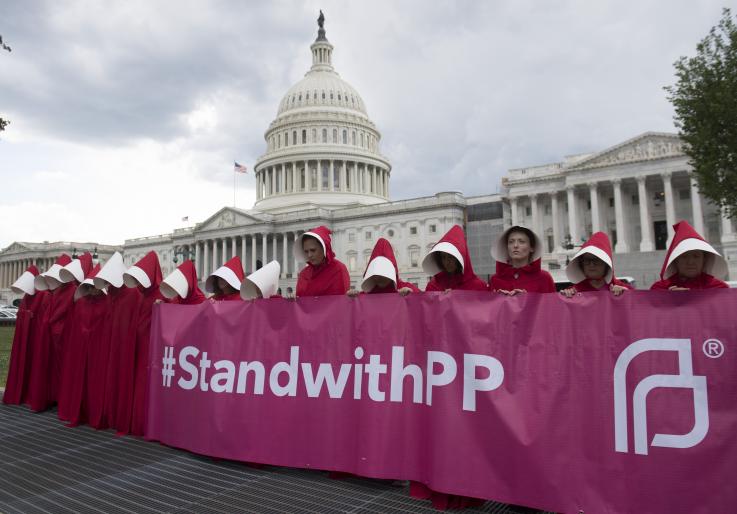
Supporters of Planned Parenthood dressed as characters from “The Handmaid’s Tale,” hold a rally as they protest the US Senate Republicans’ healthcare bill outside the US Capitol in Washington, DC.SAUL LOEB/AFP/GETTY IMAGES

The measure was approved by the Alabama House last month and now sits on the desk of Republican Governor Kay Ivey. Through a spokesperson, Ivey said she would withhold comment until she had a chance to review the entire bill, which was passed late Tuesday night by a vote of 25-6 with one abstention. In the past, Ivey has been a vocal supporter of anti-abortion bills that included banning exceptions for rape and incest, so it does appear likely that she will sign the legislation into law. Once signed, there will be a six month period before the laws are enacted.

The bill was originally introduced by Alabama Representative Terri Collins, and was intended to introduce a strong legal challenge to Roe v. Wade.

Collins said she would be open to having states go back and add exceptions for cases of incest and rape later, but needed to make this bill as strict as possible to effectively challenge the precedent.

“I’ve answered many emails from people who have poured out their hearts with real stories that were true,” Collins said in a press conference. “My goal with this bill is not to hurt them in any way. My goal with this bill, and I think all of our goal, is to have Roe vs. Wade turned over, and that decision be sent back to the states so that we can come up with our laws that address and include amendments and things that address those issues.”

There were only four women in the 35-member Senate, and two of them opposed the bill.

The vote took place just days after the Supreme Court overturned a 40-year-old precedent to rule in a 5-4 decision. The court overturned the ruling in Franchise Tax Board of California v. Hyatt, which said that states have sovereign immunity from lawsuits in other states. In his dissent, Justice Stephen Breyer said that this ruling made him worried that the court would try to roll back abortion precident next. The justice made reference to Planned Parenthood v. Casey and wrote that “today’s decision can only cause one to wonder which cases the Court will overrule next.”

Alabama Senator Doug Jones said that he refused “to believe that these Republican men represent the views of most Alabamians,” on Twitter. “Their action is both unconstitutional and shameful. The people of Alabama deserve to be on the right side of history—not the side of extremists. Women deserve better.”

Democratic Senator and 2020 presidential candidate Elizabeth Warren did not mince words. “They’re trying to overturn Roe v. Wade. It’s wrong. And we are going to fight back,” she wrote.

Other presidential candidates, including South Bend, Indiana, Mayor Pete Buttigieg also weighed in.

“Alabama just passed a cruel attack on women’s health, autonomy, and freedom, and last week, Georgia enacted a ban on abortions before most women even know they are pregnant. So far this year, twenty eight states have introduced, passed, or signed restrictive abortion bills into law,” he wrote in an email to supporters. “Abortion is a woman’s decision—one she must have the freedom to make, and lawmakers have the responsibility to protect. Our next president must stand up to protect American freedoms. And let me clear: reproductive freedom is an American freedom.”

Others made an explicit link between Alabama’s legislation and President Donald Trump. “Today, the state of Alabama became the latest example of how Donald Trump’s extremist agenda has emboldened Republican lawmakers across the country to put women’s lives at risk,” wrote Democratic National Committee Chair Tom Perez. “With Trump in the White House and Brett Kavanaugh on the Supreme Court, abortion bans in state legislatures have skyrocketed nationwide in a shameful effort to overturn Roe v. Wade.”

Earlier this month, Georgia passed a six-week abortion ban, a law that would make abortion illegal before many women even know they’re pregnant.

Only 18 percent of Americans believe abortion should be illegal in all instances, according to a Gallup poll. Nearly six in 10 Americans believe that abortion should be legal in all or most cases, according to Pew.

Source: https://www.newsweek.com/alabama-abortion-ban-mother-child-health-care-1426643

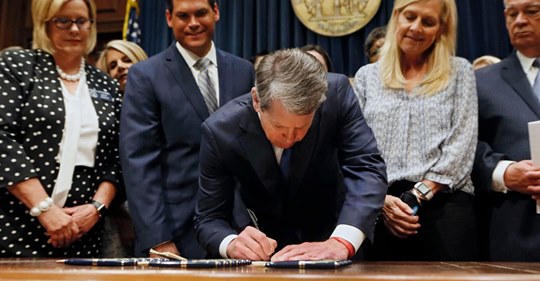
Georgia Gov. Brian Kemp signs legislation banning abortions once a fetal heartbeat can be detected, which can be as early as six weeks, before many women know they’re pregnant. (Bob Andres/Atlanta Journal-Constitution via AP)

I was trying to schedule a sonogram last year when my understanding of a basic scientific principle was totally upended. The nurse, attempting to discern how pregnant I might be, turned out to be utterly uninterested in the date of conception. She only wanted to know the date of my last period. That, she explained, is how pregnancy is calculated. Which meant that as far as the medical community was concerned, I was technically five weeks along, even though there was no way I could physically be more than three. Those two previous weeks, I guess I was . . . pre-pregnant? Pregnant-in-waiting? Truly, this was stunning news.

So last week, when John Becker, a lawmaker from Ohio, casually suggested that an ectopic pregnancy could be “removed from the fallopian tube and reinserted in the uterus” (nope: tragically, that procedure doesn’t exist), and when prominent pundit Ben Shapiro confidently conflated the concept of “six weeks of pregnancy” with “a six-week-old embryo” (two different things, actually), and when Georgia Gov. Brian Kemp signed a bill requiring that abortions may only take place in a time frame before many women even realize they’re pregnant — when all of those things occurred, my frustration approached a cosmic level. Not toward those lawmakers, but toward the squeamish cloak of secrecy and ignorance that shrouds all things ovarian.

Georgia signs ‘heartbeat bill’ into law, banning most abortions
Georgia Gov. Brian Kemp (R) signed a bill outlawing abortion if a doctor can detect a fetal heartbeat – one of the nation’s most restrictive abortion laws. (Reuters)

We are collectively terrible at talking about reproduction. Especially when it comes to pregnant bodies. We’ve got to do better.

When the Georgia abortion bill was signed into law, I heard some armchair OB/GYNs claim that a woman could easily meet this six-week deadline by simply taking a pregnancy test really, really early — like, immediately after sexual intercourse! — to find out whether she had an unwanted pregnancy to terminate.

Dispiritingly, these advice-givers did not seem to know that fertilized eggs take several days to implant in the uterus. And that pregnancy tests are not highly accurate until a period has been missed. And that, even assuming one has a textbook 28-day menstruation cycle — many are longer or far less predictable — a period won’t be missed until at least 15 or 16 days after conception.

Harry and Meghan, the Duke and Duchess of Sussex, debuted their newborn son this week, and I saw royal-watchers sharing the family photo, innocently wondering why Meghan still looked “fat.” Clearly, they’d never learned that the female body doesn’t bounce back like a rubber ball; it can take weeks or months or never for midsections to return to their previous size.

Some of the pontificators in these instances were male, but far from all of them. These aren’t the infractions of individual men. This is centuries’ worth of an attitude that, though conception might be a biological miracle, it’s also a gross one, filled with pudge and sludge that — la la la la la! — decent people are allowed to run screaming from. Plenty of folks are willing to treat fetuses as precious citizens, but seem to regard the bodies that nurture them as embarrassing slums. At a party, I once saw a new father proudly call his new kid a “princess” and his wife a “champ,” but then showily cover his ears when the wife mentioned the word “placenta.” As if the placenta wasn’t precisely what had allowed Princess to thrive.

And everyone at the party laughed! As if this willful ignorance was acceptable! Because it is, in fact, acceptable: We have accepted it.

Stories like this used to seem amusing. I have snickered over BuzzFeed listicles with titles such as “24 Ridiculous Things People Have Actually Believed About Periods.” I once snorted at my desk while skimming a complaint from a gentleman annoyed that menstruating women felt the need to waste money on sanitary products. Why didn’t they just learn to “hold it,” he suggested, the way men kept themselves from urinating?

But I’m beginning to realize that this kind of ignorance isn’t something to be laughed off. Because if we’re going to make laws around biology — about whether tampons should be taxed, or whether abortions should happen by six or eight or 14 weeks — we need to understand that biology. Because whether you’re an abortion rights advocate or antiabortion, you should be able to understand and defend the complexity of your position.

There’s another reason that has nothing to do with the law: If you don’t understand how female bodies work, you might end up believing some really harmful things about women.

If you think that menstruating women need sanitary products only because they’re unwilling to “hold in” their periods, then you might end up believing they’re just lazier than men.

If you view postpartum women as “fat,” then you might be inclined to see women as slightly less disciplined. If you don’t know what a placenta does, you might start to think your wife’s body is just gross.

If you think a woman should know she’s pregnant within days — as opposed to the weeks that biology generally dictates — then you might assume that not knowing within days is a sign that she’s scatterbrained and irresponsible. You might decide she’s unable to manage her own health.

We desperately, desperately need to do better at talking honestly and openly about reproduction. About missed periods, and heartbeats, and fetal-growth charts, and menstruation cycles, and fertilization timelines, and all of it.

Because if defending your position requires relying on falsehoods, then perhaps you should be questioning whether it’s defensible at all.

Source: https://www.washingtonpost.com/lifestyle/style/what-we-dont-know-about-how-a-uterus-works-is-going-to-hurt-us-all/2019/05/10/d210ab16-7366-11e9-8be0-ca575670e91c_story.html?fbclid=IwAR0CN9x-ViSA0B9QPvodkvJau5uEpGzlLUJVHxIB4-H37EJcG_INe38uapE&utm_term=.69420815a98d

You have surely heard by now that Georgia passed an extremely strict “heartbeat bill,” set to go into effect on the first of January, that would treat women who get abortions like criminals. It’s been suggested that this bill will also put mothers who miscarry in danger of prosecution. I have things to say about the bill, but I want to get back  to them at a later time. First I need to address something that’s happening in my own state, Ohio.

I have learned that Ohio legislators are considering a billthat is in some ways even more draconian than the one passed in Georgia. This bill would ban all insurance coverage for anything that lawmakers consider an abortion– and I use the phrase “anything that lawmakers consider an abortion” deliberately, because the bill isn’t being written by doctors but legislators, and the legislators seem to have some fanciful ideas about what constitutes an abortion.

This bill is sponsored by republican John Becker, who no doubt thinks of himself as pro-life. It includes legislation on what to do with an ectopic pregnancy, where the baby implants in the fallopian tubes instead of the womb. Ectopic pregnancies are always fatal to the embryo and, if not treated quickly, are fatal to the mother as well. She will eventually rupture and bleed out. Treatments for an ectopic pregnancy involve removing the embryo from the fallopian tube and leaving it intact, or removing the tube itself with the embryo still inside. Both result in the the death of the embryo, who is going to die no matter what, but removing the tube is 100% accepted by Catholic bioethics as necessary and not an abortion. That may not matter to non-Catholics in my audience, but I’m a Catholic who studied bioethics at Franciscan University at the graduate level, and we discussed ectopic pregnancies specifically in my classes, so it matters to me. Even by the strictest standards, treating an ectopic pregnancy is not abortion. It’s something else entirely. No one who is pro-life should hesitate to accept that treatment.

Becker doesn’t seem to realize this. He has a fanciful idea about a treatment that’s right out of science fiction: “Part of that treatment would be removing that embryo from the fallopian tube and reinserting it in the uterus so that is defined as not an abortion under this bill.”

Actually, no, Mr. Becker, that would not be part of the treatment. And I know that it’s not part of the treatment, because it’s not physically possible to save an ectopic pregnancy by just scraping the baby off the lining of the fallopian tube and stuffing it  in the womb. Unborn babies are not cuttings from a hydrangea bush. They don’t take root when transplanted. I wish they did. For the sake of my dear friends who have suffered the loss of a baby and the trauma of an ectopic pregnancy, I wish with all my heart that you could save a tiny embryo by scooping her out of the tube and sticking her in the uterus where she belongs, but you can’t.

And saying that you can is a slap in the face to any woman who’s suffered such a horror.

My dear friends who have suffered ectopic pregnancies didn’t get abortions. They got treatment for their ectopic pregnancy, they lost their babies, they went home mourning and traumatized and also recovering from a dangerous medical emergency that could have killed them. I am relieved and grateful that they’re alive. I am terrified that this law would ban insurance coverage for their condition except in the case of a fictional “procedure for an ectopic pregnancy, that is intended to reimplant the fertilized ovum into the pregnant woman’s uterus.” you can tell no doctor ever came within a mile of this legislation, not only because that procedure doesn’t exist, but because a “fertilized ovum” is an earlier stage of pregnancy; by the time you’re removing a fallopian tube to save a woman, it’s much further along. But that’s the exact wording of the bill as it stands today.

The bill also includes coverage of “a procedure, in an emergency situation, that is medically necessary to save the pregnant woman’s life.” Only in an emergency situation. In practice, in the case of an ectopic pregnancy, this could easily mean that insurance would cover you if your fallopian tube had already ruptured and you managed to make it to the hospital in extreme pain and internal bleeding before you died. But if the ectopic pregnancy was diagnosed before then– apparently Ohio legislators expect the doctor to scrape the baby out of the tube, killing him or her instantly, and then stuff the dead baby into the mother’s uterus. This would be as likely to result in a healthy baby as the doctor cutting the mother’s nose off and throwing that in the uterus too. This bill is not pro-life, it’s pro-sepsis.

It’s not even that; it’s gibberish.

It’s a man with no medical expertise crafting legislation for a body part that will never impact him personally because he doesn’t have one.

If this bill is somehow signed into law as it is, women are going to die. They are not going to bravely sacrifice their lives to save their babies, which would be bad enough; they’re going to bleed to death with a tiny dead baby rotting inside of them, because an ignorant male legislator wanted to look extra pro-life for his constituents.

He’s not being pro-life. He’s not even being rational. He’s attempting to legislate something about which he is completely ignorant.

And everyone, pro-life and pro-choice, should be outraged.

Source: https://www.patheos.com/blogs/steelmagnificat/2019/05/8903/?utm_medium=social&utm_source=share_bar&fbclid=IwAR3r4jbvseV3gROWHn4FXzHIcqHVkJ4N0AoVOcHPqLiUcb3Osual8AIRG_g#ylhrW1eoITTMHpk8.01

On Thursday the Alabama Senate adjourned after an abortion bill debate descended into chaos. Lt. Gov. Will Ainsworth gaveled a voice vote through before Democrats could ask for a roll call vote. (Mike Cason/mcason@al.com)

I’ve seen Alabama lawmakers try some stupid things, but never anything so cowardly.

On Thursday, lawmakers were set to vote to force victims of rape and incest to have their rapists’ babies — only some of them didn’t want their names attached to the bill.

Instead, Lt. Gov. Will Ainsworth tried to push the near-total abortion ban through without a roll call vote on amendments that would have created exceptions for rape and incest.

Gutless.

The bill didn’t pass. It was carried over after Democrats and some Republicans raised hell. There will likely be a do-over next week.

But you need to see this, Alabama. Because the whole country is going to see this. And you need to let these folks know whether they speak for you. And once the vote is taken, you have a right to know where your lawmakers stood.

Here’s how it went down.

Last week, the Alabama House passed what would be the strictest abortion ban in the country. The bill, sponsored by state Rep. Terri Collins, R-Decatur, would make abortions in all instances, except when the mother’s life is in danger, a felony.

That bill did not include the exceptions that have been boilerplate in these things before — for pregnancies that result from rape or incest.

Collins argued that those exceptions had to be left out because the bill is designed to challenge Roe v. Wade. It’s not an incremental chipping-away at the landmark Supreme Court decision, but a direct assault.

That bill passed the Alabama House. As cruel as the bill might be to rape victims, at least the lawmakers in the lower house put their names on it. At least they owned their votes.

But not in the Alabama Senate.

On Wednesday, the bill moved through the Alabama Senate Judiciary Committee, but not before Sen. Tom Whatley, R-Auburn, introduced amendments to it including exceptions for rape and incest. It was a small victory.

And a short-lived one.

Before Democrats could get a word in at the podium, the bill’s Senate sponsor, Sen. Clyde Chambliss, R-Prattville, motioned to table the amendments. Lt. Gov. Will Ainsworth upheld the motion before anyone could demand a roll call vote.

In short, they intended to ram this thing through without anyone else having to put their names on it.

State Sen. Bobby Singleton, D-Greensboro, erupted in anger. Chambliss muttered and sputtered while Singleton shouted over him. Ainsworth tried to gavel Singleton down. Some Republicans, including Sen. Cam Ward, R-Alabaster, and Senate Pro Tem Del Marsh, R-Anniston, stood behind the Democrats and seemed to take their side. State Senator Vivian Figures, D-Mobile, appealed to her colleagues for fairness.

“I know this bill is going to pass,” Figures said. “You are going to get your way. But at least treat us fairly and do it the right way. That’s all that I ask. That’s all that my Democratic colleagues ask. That’s all that women in this state ask, both Democratic and Republican women.”

Ultimately, Marsh moved that the Senate hold over the bill until the call of the chair and adjourn. He encouraged his colleagues to take the weekend to cool off and speak with their constituents.

That’s a lot of procedural back-and-forth, but here’s what it means.

It means that when some poor young girl, inevitably, has to have her dirty uncle’s baby, the Alabama lawmakers who vote for this thing don’t want their names attached to it.

It means all the talk about personal responsibility is just talk.

It means owning choices is something for women in Alabama (even when they never had a choice) but not for Alabama lawmakers.

It means they’re scared.

It means they are cowards.

It means they are hypocrites.

And it means the newly elected lieutenant governor was not just going to let them get away with it. He tried to help. (Ainsworth insisted to me later that the voice vote wasn’t rushed and that it was fair. I’m embedding video of it here so you can watch and decide for yourself.)

Figures argued that today’s chaos was over fairness, but it’s about more than that. This is about accountability and character — and those who’d walk away from all those things.

If you’re going to do this, lawmakers, don’t hide. Don’t cheat. And don’t lie.

Take responsibility for it.

If you’re going to bring this bill into the world, let everybody know who the father was.

[Correction: A previous version of this column said it was state Sen. Bobby Singleton who introduced amendments in committee. In fact, it was state Sen. Tom Whatley, and the column has been corrected.]

Source: https://www.al.com/news/2019/05/if-youre-going-to-pass-this-abortion-bill-alabama-senators-put-your-names-on-it.html?fbclid=IwAR0uk4ixpEEU92UfwL7Z5APQEJzEh_My1uoFRRMg-JnIJR1iPXraHf7AEIw

Anti-abortion advocates have asked the U.S. Supreme Court to step in on a restriction requiring patients to obtain an ultrasound 18 hours before getting an abortion.

The U.S. Supreme Court on Friday will consider a request by attorneys from the State of Indiana to uphold a Pence-era law that requires patient to undergo an ultrasound at least 18 hours prior to obtaining an abortion.
BRENDAN SMIALOWSKI/AFP/Getty Images

The U.S. Supreme Court on Friday will consider a request by attorneys from the State of Indiana to uphold a Pence-era law that requires patients to undergo an ultrasound at least 18 hours before obtaining an abortion.

Indiana lawmakers in 2016 passed HB 1337, an omnibus abortion bill that amended numerous provisions of existing abortion regulations, including the state’s mandatory ultrasound requirement. Before that, patients in Indiana were required to have an ultrasound before receiving abortion care, but they could schedule and have it on the same day as their abortion. As a result of HB 1337’s 18-hour delay, patients would have to make two trips to a clinic to have an abortion. Reproductive rights advocates sued, arguing the law unduly burdened abortion rights.

In April 2017, U.S. District Judge Tanya Walton Pratt blocked the measure, ruling it “creates significant financial and other burdens” on providers and patients. The Seventh Circuit Court of Appeals agreed, affirming Pratt’s decision last summer. Attorneys for the State of Indiana in February asked the Roberts Court to step in and hear the case.

The Supreme Court is already considering two other provisions of HB 1337 in a different case, which I previewed here. One requires certain procedures for the disposal of fetal remains while the other bans abortions based on the sex, race, or disability of the fetus. And just like in that case, there’s no good reason for the Court to get involved at this time in the question of Indiana’s mandatory delayed ultrasound. As attorneys for Planned Parenthood of Indiana and Kentucky note, there is no circuit-split for similar cases—one of the traditional reasons for the Supreme Court to agree to hear a case.

But attorneys for the State of Indiana insist this case is a good candidate for Supreme Court review because it will allow the Roberts Court opportunity to clarify whether the substantial burden test from Whole Woman’s Health v. Hellerstedt applies to abortion restrictions passed in the name of “protecting fetal health.”

The test states that courts must weigh the extent to which the laws in question actually serve the stated government interest—in Indiana’s case, the interest in “fetal health”—against the burden they impose. So while Indiana’s petition may not be a traditional candidate for Supreme Court review, it serves other purposes: It reminds the Court of a brewing fight the justices will eventually have to resolve, and it starts suggesting the framework for them to do so.

Whole Woman’s Health v. Hellerstedt was an important win for abortion rights advocates not just because it struck as unconstitutional restrictions that had significantly reduced clinic access, but because the decision outlines an accountability standard for lawmakers. If a law is to restrict abortion access, the decision says, there must be some data—some verifiable evidence—that the restriction furthers the state’s interest.

Anti-choice lawmakers do not like this accountability standard. It’s blocked some of their most successful anti-choice measures—ones they unsuccessfully claimed were designed to promote patient health and safety. Their goal now is to prevent the Whole Woman’s Health standard from applying to those restrictions supposedly passed in the name of advancing potential fetal life. And to further that goal, they argue that instead of creating clarity, the decision in Whole Woman’s Health v. Hellerstedt created confusion in abortion rights jurisprudence.

“The Seventh Circuit’s decision in this case illustrates why the balancing test of Hellerstedt does not make sense in the context of statutes designed to protect fetal life,” Indiana’s petition states. “The Court held that the Ultrasound Law violates the Constitution because the significant burdens imposed on women’s access to abortion, amounting to an additional cost of $219 to $247, outweigh the ‘very small’ impact of the law on persuading women to choose life.”

“Even assuming this data accurately predicts the impact of the ultrasound law on Indiana women, the panel’s conclusion necessarily raises the question: what number of fetal lives must be saved before the benefit of the statute outweighs its burdens?” the petition continues.

The question is, of course, designed to bait the Court’s conservatives into restricting Whole Woman’s Health‘s reach.

“What if … only one woman is persuaded by the ultrasound to carry her pregnancy to term? What dollar amount in burdens is her unborn child’s life worth? Surely the Constitution does not require this type of utilitarian calculus,” the petition continues.

The state’s framing of the “dollar amount in burdens” is especially telling because it ignores the additional burdens on the pregnant person the lower courts considered—including the emotional burdens an extra barrier to care creates. Those burdens, from the State of Indiana’s perspective, should not factor into the Court’s analysis.

The State of Indiana is arguing that the data to support the idea of advancing potential fetal life is impossible to quantify, unlike data regarding patient safety. It’s an attempt to create a distinction between types of restrictions as a way to try and undercut the legislative accountability the Whole Woman’s Healthstandard demands. But Whole Woman’s Health made clear that the same undue burden standard first articulated in Planned Parenthood v. Casey applies to both categories of restrictions. Anti-abortion advocates are playing loose with the language of the decision to suggest a conflict when one does not exist, and they are hoping in this petition they can get the Court’s conservatives to play along.

The Court could decide as early as Monday whether to hear the case.

Source: https://rewire.news/article/2019/05/10/how-a-pence-era-abortion-restriction-could-undermine-a-key-reproductive-rights-victory-at-the-supreme-court/

The anti-choice movement used to pretend it cared about women. Now it doesn’t have to.

Credit: Saul Loeb/Getty Images

his week, Georgia became the sixth state to ban abortions after six weeks — so early in pregnancy that many women don’t even realize they’ve missed a period, let alone that they’re pregnant. Laws like these effectively ban all abortions — and that, of course, is the whole point.

Republicans want to ensure that women are forced to carry pregnancies no matter how far along they are, and these so-called heartbeat bills do double duty: They prevent women from legally being able to obtain an abortion, and were written with the hope that they’d be challenged all the way to the Supreme Court to help overturn Roe v. Wade.

But the danger of this law is not just that it will prevent women from getting abortions, but that women who do would be subject to life in prison or the death penalty. Imagine a future where women who have miscarried are interrogated by the police over whether they took an abortion pill. Where mothers of stillborn babies are arrested because they refused to have a C-section. This is the unsaid reality of criminalizing abortion.

Up until recently, the anti-abortion movement would have taken great pains to pretend that women wouldn’t be punished under such a law. That the GOP no longer has the need for such niceties should scare every single one of us.

The truth is that the anti-abortion movement — emboldened by Donald Trump — has made a disturbing return to its extremist roots.

Up until recently, mainstream anti-choicers tried to distance themselves from their most radical proponents. They understood that videos of men screaming “murderer” at women as they walked out of clinics were not a good look, and as such, tried to soften their image. Instead of attacking women, they claimed women “deserved better” than abortion, and created organizations with feminist-sounding names.

Anti-choicers always believed women should be forced into motherhood. But before now, the country and culture necessitated that they shroud their most extreme views.

Those who once fought so hard to seem “woman-friendly” have seemingly given up on their public image problem — embracing the most radical rhetoric. It was less than two weeks ago, for example, that the president of the United States claimed that after a child is born, “they take care of the baby, they wrap the baby beautifully… and then the doctor and the mother determine whether or not they will execute the baby.” No Republicans or anti-abortion leaders stepped up to correct him. It was also just last month that, for the first time in Texas’s history, the state heard public testimony in support of a bill that would punish women who had abortions with the death penalty. And last year, conservatives rallied around a writer who said that women who end their pregnancies should be executed by hanging.

This is not to say that the anti-choice movement has changed in some fundamental way — anti-choicers always believed women should be forced into motherhood, and they always knew that the consequences of such beliefs would put women in jail or worse. But before now, the country and culture necessitated that they shroud their most extreme views.

It does not bode well for the women of America that this is no longer the case.

How long will it be before anti-choicers brag about the prison sentences women who have abortions will get? This not an imaginary future — women have already been prosecuted for ending their pregnancies, and doctors who perform abortions have already been attacked and killed. These laws are just more proof that the anti-choice movement is not afraid to double down on its most extreme and callous beliefs. Beliefs that will put women’s lives and freedom in danger.

The danger of post-Roe America is already here.

Source: https://medium.com/s/jessica-valenti/anti-abortion-extremism-is-the-new-normal-1966f99ac47f?fbclid=IwAR3JncQgCxq1SNPHJL4juQeHtqgzu3L6rR9__a2pKZnWFPitYBiImgSih0Q