Republicans assigned Sens. Marsha Blackburn and Joni Ernst to the Judiciary Committee because of their hostility to abortion rights, not because of the Kavanaugh nomination.

Anti-choice advocates were hopeful these assignments would help usher in even more anti-choice federal judges.
Alex Wong/Getty Images

Republicans made history this week by assigning one-third of their women senators to serve on the Judiciary Committee.

U.S. Sens. Marsha Blackburn (R-TN) and Joni Ernst (R-IA) are set to become the first Republican women to serve on the Senate Judiciary Committee, but their assignments are about more than just addressing the horrible optics of Republicans never having had a woman on a committee that deals with fundamental constitutional privacy rights like abortion. They just added two more committed anti-choice activists and Trump loyalists to the committee charged with jurisdiction over federal civil rights law, at precisely the time the administration’s attacks on civil rights—and especially reproductive rights—are reaching a fevered pitch. 

And that is a serious concern.

“What we really need right now, especially when you think about what this administration is doing in terms of an all-out assault on our civil rights laws, what we really need are committees looking under the hood,” said National Women’s Law Center President and CEO Fatima Goss Graves in an interview with Rewire.News.

“One of the things that should be a top priority is the reauthorization of the Violence Against Women Act (VAWA),” Graves said. “It’s just really outrageous that it was allowed to expire, and that especially in this era where there is a new, important level of attention to the many ways in which violence undermines all of us, we need our policymakers to reflect that,” said Graves. VAWA is a federal law designed to improve criminal justice and community-based responses to sexual assault and domestic violence; the Senate Judiciary Committee has jurisdiction to review pending federal legislation, including VAWA.

Not surprisingly, anti-choice advocates praised the assignments of Blackburn and Ernst and were hopeful they would help usher in even more anti-choice federal judges. 

“It’s great to have two women on the Senate Judiciary Committee, especially two heroes like Sens. Blackburn and Ernst,” said anti-choice activist and Live Action Founder and President Lila Rose in a statement to Rewire.News. “They are both staunch advocates for the protection of women and their preborn children from the predation of the abortion industry. Having these two on the Judiciary Committee could help ensure that judicial appointments to the federal courts are committed to strict interpretation of the law rather than devoted to twisting the meaning of words to make laws conform to their individual policy preferences,” said Rose. 

Rose added that it was “especially important to rid the courts of activist judges who interpret our laws to mean just about anything that expands abortion in this country.”

Father Frank Pavone, national director of Priests for Life, echoed Rose’s praise of the assignments and what they could mean for the anti-choice movement. “I know both Senators Blackburn and Ernst, and am very happy they are on the Senate Judiciary Committee. They believe, as do we, that the role of the committee is to conduct fair hearings based on a nominee’s qualifications to serve on the federal bench,” Pavone said in a statement to Rewire.News. 

“Simply having that focus, and commitment to objectivity, automatically helps the pro-life cause,” he continued. “And the reason is simple: President Trump’s nominees have everything to do with the Constitution; abortion has nothing to do with the Constitution.” 

To be clear, Ernst and Blackburn are being praised for advancing the view that the U.S. Constitution does not protect a right to privacy and that federal law should follow suit. Father Pavone and Lila Rose may be talking about abortion, but their views that the Constitution does not protect a right to privacy extend far beyond whether or not abortion is protected: It extends to the right to use contraception and to any of our sexual privacy rights.   

The reaction to the Blackburn and Ernst assignments from the anti-choice movement is not surprising, though. Both Blackburn and Ernst have a long track record of attacking reproductive autonomy. When Blackburn was a member of the U.S. House of Representatives, she “collaborated with anti-choice extremists in an inflammatory, taxpayer-funded crusade against Planned Parenthood,” as Rewire.Newsreported. Her select committee was born from the anti-abortion propaganda campaign spawned by David Daleiden and the Center For Medical Progress, which falsely accused Planned Parenthood of illegally profiting from legal donations of fetal tissue. As reported by Rewire.News‘ Christine Grimaldi, over the course of the year-long investigation, Blackburn’s so-called Select Investigative Panel on Infant Lives “undermined life-saving fetal tissue research, while endangering the privacy and safety of researchers and reproductive health-care providers alike,” all while costing taxpayers $1.59 million and finding bupkis. 

Ernst is also no stranger to anti-choice shenanigans. While a state legislator in Iowa, she supported a constitutional amendment that would have created “fetal personhood” and effectively re-criminalized abortion. In the U.S. Senate she’s come to the defense of Iowa’s absurdly unconstitutional “heartbeat ban,” a law that would ban abortion around six weeks of pregnancy.

And with Republicans almost singularly focused on finding judicial nominees committed to upending legal abortion and rolling back civil rights protections for LGBTQ people, Blackburn and Ernst are perfect foot soldiers to help continue that mission in the Judiciary Committee. The question is not if a direct legal challenge to abortion rights happens; it is when. In the first two years of Trump’s presidency, Republicans have almost remade the federal judiciary in a conservative model advocated for and approved by the Federalist Society. Trump’s judges are not just hostile to abortion rights; they are openly antagonistic and actively searching for a means to overturn Roe v. Wade.

Yet public support for abortion rights is more popular than ever. That means for conservatives, ending legal abortion is a political imperative for their base. Evangelicals set their sights on overturning Roe while the ink on the decision was still drying. But a campaign to specifically target abortion rights contains electoral risks for Republicans because of the public’s overwhelming support for abortion rights. Republicans know that with a thin margin of control in the Senate and a very unpopular president they have a window of time—right now—to push their attacks on abortion rights to the apex: first by pushing the most extreme forms of abortion restrictions ever in the states, like the Iowa “heartbeat ban” celebrated by Ernst, and then by installing ultra-conservative federal judges vetted by anti-choice advocacy groups who will uphold those restrictions. 

I’m less convinced the Blackburn and Ernst assignments were in direct response to the Kavanaugh confirmation hearings, as Politico suggested, in part because I don’t believe conservatives see the Kavanaugh confirmation hearings as anything they need to recover from. For progressives, the reality of a Supreme Court nominee credibly accused of rape being shielded from any real committee investigation of those allegations by conservative white men is an abomination. For conservatives, it’s a display of force. 

I also wonder what if anything would have changed during the Kavanaugh hearings had someone like Ernst or even Blackburn been on the Judiciary Committee at the time. I don’t believe for a second they would have done anything but provide a different kind of cover for Kavanaugh, one that the men in the Republican Party would have been more than happy to exploit.

Maybe optics is a motivating factor in the Blackburn and Ernst assignments. But I think we should just take conservatives at their word when they say that these two members are the ones best poised to advance in the Senate Judiciary Committee the top Republican policy priority: confirming federal judges who will end legal abortion and erase nearly a century’s worth of civil rights advances. 

Evidence-based journalism is the foundation of democracy. Rewire.News, is devoted to evidence-based reporting on reproductive and sexual health, rights and justice and the intersections of race, environmental, immigration, and economic justice.

As a non-profit that doesn’t accept advertising or corporate support, we rely on our readers for funding. Please support our fact-based journalism today.

Source: https://rewire.news/article/2019/01/04/gop-senate-judiciary-assignments-about-abortion/

A judge ruled Monday that Kansas cannot stop telemedicine abortions, thwarting the latest attempt by state lawmakers to prevent doctors from providing pregnancy-ending pills to women they see by remote video conferences.

District Judge Franklin Theis ruled that a law barring telemedicine abortions and set to take effect in January has no legal force. During an earlier hearing, Theis derided the law as an “air ball” because of how lawmakers wrote it.

That law was challenged in a lawsuit filed by the Center for Reproductive Rights on behalf of Trust Women Wichita, which operates a clinic that performs abortions and provides other health care services.

Theis also ruled that other, older parts of the state’s abortion laws that could ban telemedicine abortions are on hold indefinitely because of a separate lawsuit challenging them that’s still pending.

The Wichita clinic began offering telemedicine abortions in October because its doctors live outside Kansas and could be on site only two days a week. It also hopes to provide the pills to women in rural areas and have them confer by teleconference with doctors.

The center argues that banning telemedicine abortions violates the state constitution by placing an undue burden on women seeking abortions and singling out abortion for special treatment when state policies intend to encourage telemedicine. Kansas has no clinics that provide abortions outside Wichita and the Kansas City area.

“That procedure by telemedicine is going to be legal after midnight (Monday), and the clinic will continue to offer it,” said Bob Eye, one of the attorneys for Trust Women. “This is a good outcome.”

The anti-abortion group Kansans for Life, influential with the Republican-controlled Legislature, contends telemedicine abortions are dangerous. But a study of abortions in California, published in the American College of Obstetricians and Gynecologists’ journal in 2015, said less than one-third of 1 percent of medication abortions resulted in major complications.

Mary Kay Culp, executive director of Kansans for Life, called Theis’ ruling “infuriating.”

“This judge has a long history of taking laws designed by the Legislature to protect unborn babies and women and turning them into laws that instead protect the abortion industry,” Culp said.

Seventeen other states have telemedicine abortion bans, according to the Guttmacher Institute, a group that advocates for abortion rights.

The 2018 law represents the third time Kansas legislators passed a measure meant to outlaw telemedicine abortions.

In 2011, a ban was part of legislation imposing special regulations on abortion clinics that critics argued were meant to shut them down. Providers sued, and Theis blocked all of the regulations. The case is still pending.

Legislators passed another version of the telemedicine abortion ban in 2015, but Theis ruled Monday that it also is covered by his order blocking the 2011 clinic regulations. He called that 2011 injunction a “safe harbor” for the clinic.

The 2018 law says that in policies promoting telemedicine, “nothing” authorizes “any abortion procedure via telemedicine.” Theis concluded that it’s toothless because it does not give prosecutors a way to bring a criminal case over a violation. He said in his order Monday that it “has no anchor for operation” — essentially rendering the clinic’s lawsuit moot.

The Kansas health department has reported that in 2017, the latest data available, nearly 4,000 medication abortions were reported, or 58 percent of the state’s total, all in the first trimester. It’s not clear how many of them were telemedicine abortions.

While abortion opponents have a long list of legislative victories over the past decade, they’ve fared less well in the courts. The U.S. Supreme Court recently refused to hear an appeal of lower federal court orders barring Kansas from stripping Medicaid funds for non-abortion services provided by Planned Parenthood.

The state’s first-in-the-nation ban on a common second trimester procedure anti-abortion lawmakers called “dismemberment abortion” has been on hold since 2015. In that case, the Kansas Supreme Court has yet to decide whether the state constitution protects abortion rights independently of the federal constitution — so that state courts could chart their own, more liberal course.

Source: https://apnews.com/f1a3ad21b3aa408fb89a6b023b5b03fe

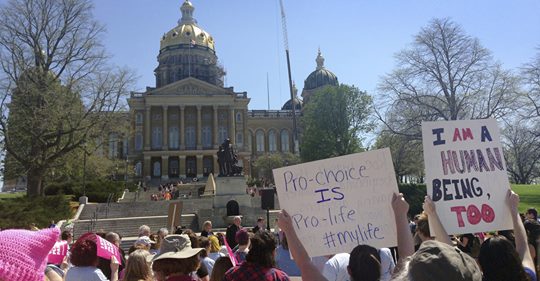
Abortion-rights advocates rally outside the Iowa capitol building in May. A law there banning abortion after a fetal heartbeat is detected is one of several state laws on its way through the courts.
Barbara Rodriguez/AP

With a newly configured U.S. Supreme Court, the stakes are high for abortion-rights battles at the state level. Abortion-rights advocates and opponents are preparing for a busy year — from a tug-of-war over Roe v. Wade to smaller efforts that could expand or restrict access to abortion.

Supreme Court Justice Brett Kavanaugh is known for his conservative record on issues including reproductive rights. And with his confirmation, many abortion-rights opponents see new opportunities to restrict the procedure at the state level.

“The pro-life movement has been talking about more pro-life-friendly courts for years, and we see Kavanaugh really tilting that balance,” says Jamieson Gordon with Ohio Right to Life.

Activists in Ohio just pushed through a law banning a common second-trimester abortion procedure called dilation and extraction. Gordon says her group is feeling optimistic and is working to pass more restrictions in the new year.

“It really has been encouraging for us knowing that if our bill … got picked up to go to the court, that we would have a more favorable court,” she says. “So I do think that we’ve seen the tide turn.”

A “watershed moment”

Abortion-rights advocates also are preparing for a wave of bills to be introduced in statehouses across the country, says Elisabeth Smith, chief counsel for state policy and advocacy at the Center for Reproductive Rights.

“We think this will be a watershed moment in terms of the number [of bills] that are filed, and then potentially the number that will actually be enacted in various states,” Smith says.

She says advocates are working to protect abortion rights, repeal existing restrictions and fight new efforts to limit access to the procedure.

“I think the specter of the Supreme Court will be behind both the proactive bills — in terms of shoring up the right and access [to abortion] at the state level — and on the other side, I think states that are hostile to reproductive rights are going to be jockeying to be the state that sends a law to the Supreme Court,” Smith says.

Tug-of-war over Roe v. Wade

Many abortion-rights opponents say they’re hoping to overturn Roe v. Wade, the 1973 decision that legalized abortion nationwide.

“States want their bill to be the one to go to the Supreme Court. They want to be the one,” says Sue Liebel, state director for the anti-abortion-rights group Susan B. Anthony List.

Possible test cases for Roe already are working their way through the courts — including an Iowa law banning abortion after a fetal heartbeat is detected, and one in Mississippi prohibiting the procedure after 15 weeks.

Liebel says anti-abortion-rights activists want to pass similar bills in as many states as possible.

“So I think they’re hopeful; they’re energized and rarin’ to go,” Liebel says.

If Roe were weakened or overturned, more power for regulating abortion would fall to the states. Several anti-abortion-rights groups are pushing to increase the number of states banning abortion after 20 weeks or earlier.

Meanwhile, lawmakers supportive of abortion rights in several states are sponsoring bills to guarantee the right to abortion in state law, in places including Massachusetts, Virginia and even Texas, according to Smith, with the Center for Reproductive Rights.

“It’s unlikely that [Texas] bill will pass,” Smith says. “But I think more and more state advocates are bringing up this bill — either as a messaging vehicle, or to actually get it enacted.”

Big steps, and small ones

NARAL Pro-Choice America is promoting those bills. But Deputy Policy Director Leslie McGorman says it is also working on incremental efforts to improve abortion access, including legislation allowing a broader range of medical providers — such as nurse practitioners and physician assistants — to provide abortions in more states.

“We know that as long as abortion is sort of a one-off procedure, or care that’s delivered in a standalone clinic and people sort of don’t know what it is, that it’s gonna be this part of health care that’s sort of viewed that way, that’s viewed as sort of marginal,” McGorman says.

Abortion-rights opponents also are continuing to pursue their own incremental strategy.

Americans United for Life has close to 60 model bills aimed at restricting abortion. Among them is the Abortion Reporting Act, which requires medical providers to submit detailed reports to health officials about abortion-related complications.

“This is really designed to make sure that women are informed about those abortion providers that are especially dangerous,” says the group’s president, Catherine Glenn Foster.

Abortion-rights advocates say the requirements are intrusive and vaguely defined. Planned Parenthood sued last summer to block a similar law in Idaho.

“There’s also a big push to defund abortion facilities, to stop them from getting Title X funding,” says Ingrid Duran, of the National Right to Life Committee.

It’s already illegal for federal funds to pay for abortions in most cases, but anti-abortion activists want to ban organizations such as Planned Parenthood, which offer abortions, from receiving any public money for reproductive health services. The Trump administration has proposed blocking such groups from getting funds through Title X, the federal family planning program for low-income people; Duran says similar efforts are underway in many states.

Source: https://www.npr.org/2019/01/02/679887749/activists-brace-for-2019-abortion-rights-battles-in-the-states?utm_source=facebook.com&utm_medium=social&utm_campaign=npr&utm_term=nprnews&utm_content=20190102&fbclid=IwAR2fq8KhBIeLFjxXUaANnJAMjkefGKdGmMZg5G64jcFzFyLqJBCmoToU1sA

Women who have been given a diagnosis of fatal foetal abnormalities will be able to legally avail of early termination of pregnancy.

ABORTION SERVICES WILL be available across the country from today.

Following last year’s referendum to repeal the eighth amendment from Ireland’s constitution and subsequent legislative changes, services will be provided by the HSE, through GPs or family planning services and in maternity units and hospitals throughout Ireland.

The recent enactment of the Health (Regulation of Termination of Pregnancy) Act means that abortion services can now be accessed in specific circumstances.

The Act allows for terminations of pregnancy up to 12 weeks. It also provides for terminations where there is a risk to the life or a serious risk to the health of the pregnant woman.

Women who have been given a diagnosis of fatal foetal abnormalities will be able to legally avail of early termination of pregnancy in the hospital they are being treated in.

Consultant Obstetrician and Gynaecologist Dr Peter Boylan has said that clinical guidance and training has been provided to assist practitioners in the clinical decision making of providing abortion services.

“A lot of work has been done by people across our health service to prepare for this new service, with a sufficient number of GPs signed up and others continuing to do so.”

Services will be provided in GP practices and family planning services, and maternity units and hospitals across the country.

While abortion services are available from today, some doctors and hospitals have said that they are unlikely to be ready to provide terminations in January.

The HSE has said that abortion care will be provided free-of-charge to people who need it.

In December, it launched a new website to provide information to women who are considering terminating their pregnancies.
MyOptions.ie provides people with details on information and counselling for abortions.

Those who experience an unplanned pregnancy are being encouraged to contact the My Options counselling service, where counsellors will provide information on where women can access termination of pregnancy services should they want to avail of them.

Helen Deely, Programme Lead of the HSE’s Sexual Health and Crisis Pregnancy Programme, has said “we’re here to help you, with professional counsellors, if you want to talk to someone, have a question about continued pregnancy supports, or want information about abortion services.”

Source: https://www.thejournal.ie/abortion-services-will-be-available-in-ireland-from-today-4418726-Jan2019/?fbclid=IwAR0cmouRheSk6b0hl0syiGE61a_QLG07zb9HnpAtOjtnX2HAhYci5Vwu1Co

If you think the attacks on reproductive rights this year were a mess, just wait until 2019.

Conservative state lawmakers passed a surge of unconstitutional pre-viability abortion bans this year in an effort to tee up a challenge to Roe v. Wade. These included everything from bans on the safest, most common form of second-trimester abortion to laws that would outright re-criminalize abortion. So far, the federal courts have proven to be the necessary firewall preventing conservatives from enshrining these restrictions into law. But Republicans spent most of 2018 vigorously packing the federal courts with judges they believe to be ready and willing to roll back abortion rights as far as possible—so that barrier might not hold in 2019.

Here’s a sample of some of the worst anti-choice restrictions passed in the states this year.

Dilation and Evacuation Bans

“Dismemberment abortion” bans target dilation and evacuation (D and E) procedures, the most commonly used method of second-trimester abortion. D and E bans have been enacted in nine states in the past four years: Alabama, Arkansas, Kansas, Kentucky, Louisiana, Mississippi, Oklahoma, Texas, and West Virginia. With the exception of Mississippi and West Virginia, courts have blocked or temporarily enjoined the laws in each.

In April, Kentucky Gov. Matt Bevin (R) signed HB 454, banning D and E procedures when the probable post-fertilization age of the fetus is 11 weeks or greater. Attorneys for the American Civil Liberties Union (ACLU) and ACLU of Kentucky filed a complaint, arguing the law violates patients’ federal constitutional due process rights to privacy and bodily integrity. The ACLU filed the lawsuit on behalf of EMW Women’s Surgical Center, the only remaining abortion clinic in the state. The law—which went to trial last month—will remain blocked while the case proceeds.

Louisiana and Mississippi this year enacted laws banning all abortion after 15 weeks’ gestation. Both bills were drafted with the help of the Alliance Defending Freedom (ADF), a conservative legal advocacy firm that targets reproductive and LGBTQ rights. Mississippi, where D and E abortions are already banned, enacted HB 1510 in March, which was quickly blocked. A federal judge last month struck down the 15-week ban in Mississippi, declaring the law “unequivocally” unconstitutional. The state of Mississippi has filed an appeal to the U.S. Court of Appeals for the Fifth Circuit.

Louisiana enacted SB 181 in May with the stipulation that the law—which would disproportionately affect D and E procedures—would only take effect upon any final decision of the U.S. Court of Appeals for the Fifth Circuit upholding Mississippi’s ban.

Ohio lawmakers took advantage of the lame-duck session to pass SB 145, a measure that would make performing a D and E abortion a felony. The bill—which passed the state senate during the summer of 2017—saw final passage this week after more than a year of inactivity. On December 21, Ohio Gov. John Kasich signed the bill into law.

Eleven other states this year considered measures that would ban the D and E procedure, effectively outlawing abortion past 14 weeks’ gestation.

Six-Week “Heartbeat” Bans

So-called heartbeat bans seek to outlaw abortion as soon as a fetal heartbeat is detected, which can occur as early as six weeks into pregnancy and well before many people even realize they are pregnant. Heartbeat bans—which amount to near-total abortion bans—are clearly unconstitutional and have been blocked in Arkansas and North Dakota.

In May, Iowa became the third state to enact a fetal heartbeat abortion ban. The measure provides a narrow exception in cases where a person’s life is in danger, and for cases of reported rape and incest. Planned Parenthood and the ACLU of Iowa filed a complaint, and the law was temporarily blocked over the summer. A district court judge earlier this month heard arguments over whether the law should be declared unconstitutional without a trial. Regardless of the ruling—which is expected in the next month or so—the case will likely end up at the Iowa Supreme Court.

Not content with effectively banning most abortions at 14 weeks, lawmakers in Ohio used the lame-duck session to push through yet another heartbeat abortion ban (they’ve been trying since 2011). Except in cases of medical emergency, HB 258 would make it a felony for providers to perform or induce an abortion when a fetal heartbeat has been detected. The bill was amended in state senate committee to clarify that the use of a transvaginal ultrasound to detect the fetal heartbeat would not be required. This would effectively ban abortion anywhere from nine to 12 weeks’ gestation—the time at which an abdominal ultrasound can be used to detect a fetal heartbeat. It’s worth noting that Ohio lawmakers in 2016 passed a heartbeat bill along with a measure ending access to abortion after 20 weeks’ gestation. Kasich was able to appear more moderate than he actually is by vetoing the six-week abortion ban while signing the 20-week ban. On December 21, he again vetoed the heartbeat ban while signing the D and E ban. The state legislature failed to override the veto.

Ten other states this year considered measures to criminalize the performance of an abortion when a fetal heartbeat is detected.

Fetal Personhood

Personhood laws seek to grant constitutional rights to fertilized eggs, zygotes, embryos, and fetuses. Most personhood laws outlaw abortion with no exception, and can also ban many forms of contraception and in vitro fertilization. These laws can come in many different forms, from constitutional amendments declaring the right to life from the moment of conception to the issuance of fetal death certificates for miscarriages and aborted fetuses.

In April, Arizona enacted SB 1393, requiring courts in a divorce proceeding to award in vitro embryos to the spouse that intends to allow the embryos to develop to birth. Critics of the law have described it as a backdoor attempt to grant embryos personhood.

In 2017, lawmakers in Alabama passed a measure proposing an amendment to the state constitution declaring the public policy of the state to recognize and support the sanctity of “unborn life” and the rights of “unborn children,” including the right to life. The amendment was on the ballot during the 2018 midterms, and Alabama voters overwhelmingly approved the measure to grant constitutional rights to fertilized eggs and fetuses. While the amendment doesn’t actually criminalize anything, it does pave the way for far more restrictions.

West Virginia lawmakers this year had a constitutional amendment of their own. The “No Constitutional Right to Abortion Amendment” passed the state legislature in March and was added to the ballot in November. The amendment—which voters approved—declares that nothing in the state constitution “secures or protects a right to abortion or requires the funding of abortion.” While the amendment doesn’t specifically grant rights to fetuses, it acknowledges “legislative authority to protect innocent life.” As with Alabama’s ballot measure, the amendment doesn’t outlaw abortion, though it all but guarantees more restrictive measures to come.

Sixteen other states this year considered measures to recognize or classify fertilized eggs and fetuses as persons.

Oh, We’re Not Done

If you think the attacks on reproductive rights this year were a mess, just wait until 2019. “Heartbeat” abortion bans have already been prefiled in KentuckyMissouri, and South Carolina. Constitutional amendments granting rights to fetuses have been prefiled in South Carolina and Texas. And a total abortion ban punishable by life imprisonment—for providers and patients—has been prefiled in Oklahoma. It’s. Not. Even. January.

Source: https://rewire.news/article/2018/12/29/here-are-the-worst-abortion-restrictions-conservative-state-lawmakers-passed-this-year/

Despite coming up a single vote shy of reversing the veto, GOP leaders warned they “will have a supermajority that is pro-life in both chambers in the next General Assembly.”

A protester holds a hanger during a demonstration against a proposed bill that bans abortion once a fetal heartbeat is detected in Columbus on Dec. 12, 2018. The bill was passed by members of the Ohio Senate, but outgoing Governor John Kasich has said he would veto the bill.Matthew Hatcher / Zuma Press

COLUMBUS, Ohio — Statehouse Republicans in Ohio came up a single vote shy Thursday of reversing a same-party governor’s veto and imposing one of the most restrictive abortion laws in the country.

The outcome marked a victory for outgoing Republican Gov. John Kasich, a prospective 2020 presidential contender who has vetoed the so-called heartbeat bill twice in as many years. Kasich argued in a veto message last week that the law would be declared unconstitutional, but only after saddling the state with a costly court battle.

Republican Senate President Larry Obhof dismissed the cheers that broke out in his chamber after senators voted 19-13 to override the so-called heartbeat bill veto, when 20 votes were needed. The bill would have prohibited the procedure at the first detectable heartbeat, as early as six weeks into pregnancy.

“I think that the celebration for some of the people in here will be short-lived,” Obhof told reporters. “We will have a supermajority that is pro-life in both chambers in the next General Assembly — we’re getting sworn in in less than two weeks, and we have a governor coming in who has said he would sign that bill.”

Still, abortion rights activists bedecked in red and pink regalia claimed the vote as a victory. The bill’s author, Janet Porter, declined a request for comment.

The failing Senate vote followed a successful override count in the Ohio House. The chamber mustered exactly the 60 votes necessary, but only after swiftly swearing in the 80-year-old father of a former state representative to take his seat and cast the deciding vote.

“What you see continuously with this bill — with the last-minute pushes, the never full sets of hearings, always last-minute hijinks — really proves that they know they don’t have the will of the people with this bill,” said Jaime Miracle of NARAL Pro-Choice Ohio. “It is just too extreme. Without exceptions for rape and incest, a 6-week abortion ban is blatantly unconstitutional.”

That was what Kasich effectively said in his second veto message on the bill in as many years.

During the rare post-Christmas showdown, Ohio lawmakers did successfully override Kasich’s vetoes of two other bills, one expanding gun-owner rights and another he opposed because it increased the pay of elected officials, including some incoming state officeholders.

“The governor doesn’t always agree with the General Assembly’s decisions — and on these issues he profoundly disagrees — but he, of course, respects its role in the process,” spokesman Jon Keeling said in a statement.

Source: https://www.nbcnews.com/news/us-news/ohio-governor-s-veto-strict-heartbeat-abortion-bill-survives-attempted-n952661?fbclid=IwAR1xNXBo98lVvp_yKUR_UP3ReAIfHlrT_m8IIawNIqCb97Ql4k6t6aNQlnU

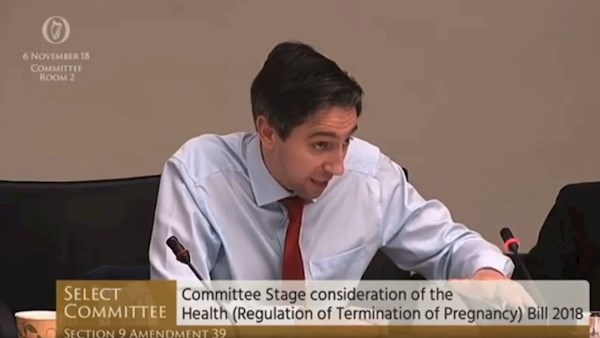
The Government hopes to fast-track the introduction of safe access zones to prevent protests outside hospitals and clinics that provide abortion services.

Health Minister Simon Harris had hoped to pass legislation to ban such demonstrations in tandem with the Health (Regulation of Termination of Pregnancy) Bill, which will come into force from January 1.

Mr Harris says the lack of an exclusion zone around hospitals and clinics “carries a significant likelihood of demonstrations taking place”.

“This is distressing and upsetting for the service user and indeed the staff,” said Mr Harris, who will be pushing to have the legislation brought forward as a matter of urgency.

Gardaí were called to Dublin’s Rotunda Hospital during the referendum campaign when anti-abortion groups displayed banners with extreme and graphic images.

Mr Harris has already secured Government approval to draft legislative proposals which would prevent further protests, however, it will not be in place when abortion services are first rolled out.

The proposals will ensure safe access zones are designated around and outside relevant premises to make sure staff and patients can access them “without fear of intimidation or harassment and without being subjected to unwanted communications by any means, including oral, written and/or visual displays, in relation to services for termination of pregnancy”.

It would also prohibit interfering or communicating with a person in a safe access zone in a way that “causes distress, and to prohibit capturing and/or distributing images of any person in a safe access zone”.

A spokesperson for the minister said: “These provisions would not limit freedom of speech or prevent demonstrations against termination of pregnancy locations other than outside health services. It will also not limit other demonstrations for example, regarding industrial relations, at health service premises.

“The minister’s priority is ensuring service users and staff are protected and not subject to unnecessary intimidation or duress.”

Source: https://www.irishexaminer.com/breakingnews/ireland/health-minister-to-ban-protests-at-abortion-providers-894311.html

Lawmakers in at least three states have already pre-filed “heartbeat” abortion bans. Will this unconstitutional abortion ban be the anti-choice movement’s full-frontal attack on abortion rights in 2019?

Ohio’s so-called heartbeat ban made headlines for the last month of 2018, but the restrictions aren’t going anywhere.
Alex Wong / Getty

On December 21, Ohio Gov. John Kasich vetoed the legislature’s attempt to become the fourth state to pass a law that bans abortion as soon as a fetal heartbeat can be detected. But that doesn’t mean we’re out of the woods—it wasn’t the state’s first try at passing such an extreme abortion restriction, and it won’t be the last. Here at Team Legal, we thought it would be a good idea to provide an overview of what these bans are, whether they’re constitutional, and why anti-choicers are so excited about them.

So what are these bans? The short answer is that they’re bullshit. The long answer is that they are bills that attempt to outlaw abortions as soon as a heartbeat can be detected.

You may be asking: When can a heartbeat be detected?

Aye. There’s the rub. That depends on how strict the heartbeat ban is. Some heartbeat ban bills—like the one Arkansas passed in 2013, and the one the Ohio legislature passed—require fetal heartbeat detection by way of abdominal ultrasound, which generally cannot detect fetal heartbeat until somewhere between nine and 12 weeks.

But the most strict heartbeat bans require that a pregnant person be subjected to a transvaginal ultrasound so that a fetal heartbeat can be detected. This can happen as early as six weeks’ gestation—before many people even know that they’re pregnant.

To put it in laypeople’s terms, if your period is two weeks late, you might think to yourself, “Huh. That’s strange.” You might go to the store, buy a pregnancy test, take the pregnancy test, freak out that it’s positive, make an appointment with a doctor to verify the results and talk about next steps. By the time that all takes place, you would be timed out of getting an abortion, should you choose to get one, because your six weeks would already be up. It is, effectively, a total abortion ban—because you’re either timed out from the get-go or by the time you meet all the other state restrictions, which can include 72-hour mandatory waiting periods, then you’re timed out.

Regardless of the specific timing of the bans, the legal difference is irrelevant. Heartbeat bans are pre-viability abortion bans and, as such, are unconstitutional.

The U.S. Supreme Court, in Roe v. Wade, made it clear that states may not ban abortion outright before the fetus is determined to be viable, recognized by the medical community as around 24 weeks’ gestation. There’s no universe in which a six-week or even 12-week pregnancy is viable. In addition, the Court ruled in Planned Parenthood v. Casey that states may not place an undue burden on a person’s right to choose an abortion.  These bans would qualify as a burden. Obviously.

But states like South Carolina, Missouri, and Kentucky have already pre-filed their 2019 heartbeat ban bills even though no federal court in the country has upheld a heartbeat ban, including North Dakota’sand in Arkansas. Iowa passed a heartbeat ban last year. It, too, was struck down by a state court in Iowa. As the timeline below shows, that hasn’t deterred the anti-choice forces in these states who seem to welcome the challenge.

Why would they continuously file unconstitutional bills then? To provide the Supreme Court as many opportunities as possible to reverse course on abortion rights. After all, Janet Porter, the head of the anti-choice extremist group Faith2Action, the architect of the Ohio bill, and a woman deemed too extreme for Christian talk radio, recently said that it won’t be long before the Supreme Court welcomes the legislation with open arms, according to a Newsweek report. And with Christian evangelical legal advocacy groups like Liberty Counsel offering to defend the Ohio law, more states may be emboldened to enact unconstitutional abortion bans if they don’t have to rely on taxpayer dollars to fund them.

So will we see one of these effective abortion bans making its way to the nation’s highest court, or to Congress? Only time will tell.

Source: https://rewire.news/article/2018/12/26/heartbeat-bans-how-we-got-here-and-where-were-headed/

FILE – In this April 4, 2017 file photo, Ohio Gov. John Kasich speaks in Sandusky, Ohio.
Ron Schwane, AP

COLUMBUS – Ohio Gov. John Kasich just signed one of the most restrictive abortions bans in the nation.

And it wasn’t the “heartbeat bill.”

On Friday, Kasich signed Senate Bill 145, which would ban a common second-trimester abortion procedure called dilation and evacuation and penalize doctors who perform them. Physicians could face a fourth-degree felony, punishable by up to 18 months in prison, for the procedure.

The proposal, which would ban most abortions as early as 12 weeks gestation, has no exception for rape or incest but does allow for an abortion to save a woman’s life.

“I’m pro-life,” Kasich told a crowd at the Columbus Metropolitan Club Wednesday. “I think the issue, whether you’re pro-life or you’re pro-choice, is moving in the direction of the earliest the better and not the latest.”

Kasich once again vetoed a proposed law to ban abortions after a fetal heartbeat is detected, also known as the “heartbeat bill.” House Bill 258 would have banned abortions as early as eight to 10 weeks.

Ohio lawmakers will try to override Kasich’s veto of the heartbeat bill, but it’s not clear if they will have the votes. They would need support from three-fifths of lawmakers in both chambers to override the veto.

“The central provision of (the bill), that an abortion cannot be performed if a heartbeat has been detected in the unborn child, is contrary to the Supreme Court of the United States’ current rulings on abortion,” Kasich said in a veto message accompanying the bill.

By banning dilation and evacuation procedures, Ohio joins two other states, Mississippi and West Virginia, that have halted those types of abortions. A handful of other states have passed laws to penalize the procedure, but federal courts have called them unconstitutional.

In a dilation and evacuation abortion, a woman’s cervix is dilated then surgical instruments, such as forceps, are used to remove the fetus and uterine lining. In 2017, the method was used in 3,441 abortions – nearly one of every six performed in Ohio, according to the Ohio Department of Health’s report.

Doctors testified that dilation and evacuation is the safest option for abortions in the second trimester. Alternatives, such as inducing labor, come with more health risks, said Dr. Wayne Trout, chairman of the American College of Obstetricians and Gynecologists.

Ohio Right to Life, which lobbied for the ban on dilation and evacuation abortions, applauded Kasich’s efforts to restrict abortion in the state.

“Ohio Right to Life is immensely grateful to our governor and our pro-life legislature for prioritizing this crucial legislation,” said Mike Gonidakis, president of Ohio Right to Life, in a statement.

Abortion rights advocates focused on the bill Kasich signed more than the one he vetoed.

“John Kasich is reckless and irresponsible,” NARAL Pro-Choice Ohio Executive Director Kellie Copeland said. “He has ignored pleas from Ohio’s medical community that politicians should not interfere with the doctor-patient relationship or block access to abortion care in our state.”

https://eu.cincinnati.com/story/news/politics/2018/12/21/ohio-gov-john-kasich-signs-one-nations-most-restrictive-abortion-bans-vetoes-heartbeat-bill/2366674002/

Only Hungary backed the United States and voted against an annual resolution on the work of the UN refugee agency

 The US voted against a resolution on the work of the UN refugee agency over concerns about the promotion of abortion and a voluntary plan to address the global refugee crisis. Photograph: Don Emmert/AFP/Getty Images

The United States has found itself isolated at the 193-member United Nationsgeneral assembly over Washington’s concerns about the promotion of abortion and a voluntary plan to address the global refugee crisis.

Only Hungary backed the United States and voted against an annual resolution on the work of the UN refugee agency, while 181 countries voted in favor and three abstained. The resolution has generally been approved by consensus for more than 60 years.

However, this year the resolution included approval of a compact on refugees, which was produced by the UN refugee chief, Filippo Grandi, after it was requested by the general assembly in 2016. The resolution calls on countries to implement the plan.

The US was the only country to oppose the draft resolution last month when it was first negotiated and agreed by the general assembly human rights committee. It said elements of the text ran counter to its sovereign interests, citing the global approach to refugees and migrants.

General assembly resolutions are non-binding but can carry political weight. Donald Trump used his annual address to world leaders at the United Nations in September to tout protection of US sovereignty.

The US also failed in a campaign – which started last month during negotiations on several draft resolutions in the general assembly human rights committee – against references to “sexual and reproductive health” and “sexual and reproductive health-care services”.

It has said the language has “accumulated connotations that suggest the promotion of abortion or a right to abortion that are unacceptable to our administration”.

On Monday, Washington unsuccessfully tried to remove two paragraphs from a general assembly resolution on preventing violence and sexual harassment of women and girls. It was the only country to vote against the language, while 131 countries voted to keep it in the resolution and 31 abstained.

The US also failed in trying to remove similar language in another resolution on child, early and forced marriage on Monday, saying: “We do not recognize abortion as a method of family planning, nor do we support abortion in our reproductive health assistance.“

Only Nauru backed Washington in voting against the language, while 134 countries voted to keep it in the resolution and 32 abstained.

When Trump came to power last year he reinstated the so-called Mexico City Policy that withholds US funding for international organizations that perform abortions or provide information about abortion.

Source: https://www.theguardian.com/world/2018/dec/17/us-united-nations-isolated-abortion-refugees?fbclid=IwAR12QpNtbfBHH6vFHbxheLWEWEX8ipJo_DFzgS-IrOtwihXm0eeptFEZBiA