If this sneak peek at next year’s bills are any indication, 2019 is going to be a doozy.

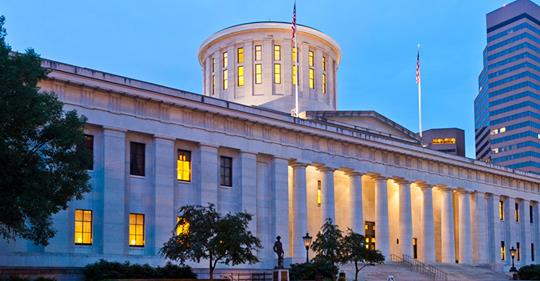
Ohio Gov. John Kasich is mulling what to do about abortion policy in his state. But there’s a good chance he’ll pull a move similar to one he did in 2016. He vetoed a terrible anti-abortion law only to sign a slightly less restrictive but still terrible measure.
Yuri Gripas/AFP/Getty Images

Lawmakers in South Carolina and Missouri are racing to see who can get the most abortion restrictions filed before the new year, Republicans in South Dakota want pregnant patients to listen to their ultrasounds, and the future of reproductive rights in Ohio remains unclear. So … happy holidays?!

South Carolina

Prefiling for South Carolina’s 2019 legislative session has commenced, and anti-abortion lawmakers are making sure they have all their bases covered. On Tuesday, state Rep. Josiah Magnuson (R-Campobello) filed H 3289, which would change the state constitution to grant a right to life to embryos and fetuses. The “Personhood Act of South Carolina” states “[t]he right to life for each born and preborn human being vests at fertilization.” The bill clarifies that the law would not prohibit contraception, in vitro fertilization, or any medical procedure designed to save the life of a pregnant person. Much like the personhood measure recently approved by voters in Alabama, the law wouldn’t actually criminalize anything. But it would pave the way for far more restrictions.

Last week, state Sens. Larry Grooms (R-Charleston) and Greg Hembree (R-Dillon-Horry) prefiled a measureto require testing for a detectable fetal heartbeat prior to an abortion. If a fetal heartbeat is detected—which can occur as early as six weeks into pregnancy—doctors would be be prohibited from performing an abortion. A companion bill was filed Tuesday in the state House by Rep. John McCravy (R-Greenwood). That measure already has more than 50 co-sponsors, including four Democrats. Looking at you, Reps. Jackie HayesFrank AtkinsonIvory Thigpen, and William Wheeler. Except in cases of medical emergency, a person who fails to test for a fetal heartbeat or who performs an abortion once a fetal heartbeat has been detected would be guilty of a felony.

If that doesn’t stick, lawmakers also filed a ban on the safest, most commonly used method of second-trimester abortion. The so-called “Unborn Child Protection from Dismemberment Abortion Act,” would make it a felony to perform the dilation and evacuation (D and E) procedure, which is typically used around 14 weeks’ gestation. A physician who knowingly performs such a procedure would be guilty of a felony and, upon conviction, be fined $10,000 and/or imprisoned for two years. Based on model legislation drafted by the National Right to Life Committee (NRLC), D and E bans have been enacted in nine states in the past four years: Alabama, Arkansas, Kansas, Kentucky, Louisiana, Mississippi, Oklahoma, Texas, and West Virginia. With the exception of Mississippi and West Virginia, courts have blocked or temporarily enjoined the laws in each. A D and E ban in Ohio is awaiting signature, but more on that later.

And finally, Republican lawmakers also filed a pair of bills that would allow college and university student groups to discriminate against LGBTQ students and others by limiting membership based on religious belief. State Sen. Chip Campsen (R-Charleston) filed the “Student Association Freedom of Religion Act,” while state Rep. Garry Smith (R-Greenville) filed the “Forming Open and Robust University Minds (FORUM) Act.” Both bills would prohibit public institutions of higher learning from taking any action or enforcing any policy that denies a religious student association any benefit available to other associations based on the religious student association’s requirement that its leaders or members adhere to its “sincerely held religious beliefs” or standards of conduct.

Missouri

Lawmakers in Missouri continued to prefile legislation in anticipation of the 2019 legislative session set to begin next month. State house Rep. Sonya Anderson (R-Springfield) filed HB 282, which would require abortion providers or family-planning agencies to provide informed consent materials to any pregnant person they refer to an out-of-state abortion clinic. Anderson has tried and failed to pass this measure for the past four years. This issue might be more relevant this year as more and more pregnant people are traveling to Illinois for abortion amid growing restrictions in Missouri.

On Wednesday, state Rep. Adam Schnelting (R-Saint Charles) filed HB 339, which would establish the “Pain Capable Unborn Child Protection Act.” At the time of publication, the actual text of measure had yet to be filed. But according to the bill summary, it’s a 20-week ban. Based on model legislation drafted by the NRLC, “Pain-Capable Unborn Child Protection” measures prohibit abortion after 20 weeks’ gestation on the unfounded claim that fetuses can feel pain at that point of pregnancy. HB 339 would prohibit a person from performing or inducing, or attempting to perform or induce, an abortion of a “fetus capable of feeling pain” unless it’s necessary to prevent serious health risk to the pregnant person. A physician who violates this measure would be at risk of losing their medical license.  An identical bill introduced earlier in the year managed to pass the state house, but failed to advance in the senate.

South Dakota

Republicans in South Dakota last week prefiled a measure prohibiting a physician from performing an abortion on a pregnant person without first displaying the sonogram images of the fetus so that the pregnant person may view the images and hear any heart sounds. Current state law prohibits abortion facilities from performing an abortion without first offering the pregnant person the opportunity to view a sonogram of the fetus. SB 6 would require a physician to provide verbal explanations of both the images and audio resulting from the ultrasound. The abortion facility would need to document any instance where a patient declines to receive such verbal explanations. One of the primary sponsors of the bill, state Sen. Stace Nelson (R-Fulton), is hell-bent on ending abortion, which he says is “an evil, barbaric, pagan, brutal practice [and] the antithesis of liberty.” He seems fun!

Kentucky

In case you missed it, Kentucky became the third state to file a fetal heartbeat abortion ban for the 2019 legislative session. Like most of the others, it would ban abortion as early as six weeks into a pregnancy, unless it’s necessary to save the life of, or prevent serious injury to, the pregnant person. Filed last week by freshman state Rep. Robert Goforth (R-East Bernstadt), the bill would make it a felony to perform or attempt to perform an abortion when a fetal heartbeat has been detected.

Ohio

Despite indicating he would, Ohio Gov. John Kasich (R) still hasn’t vetoed HB 258, an unconstitutional fetal heartbeat abortion ban. While most heartbeat abortion bans would ban abortion as early as six weeks into a pregnancy, HB 258 was amended to clarify that the use of a transvaginal ultrasound would not be required. This change meant that the law would instead ban abortions anywhere from nine to 12 weeks’ gestation. Cool amendment. Still unconstitutional.

Kasich hasn’t yet indicated whether or not he’ll sign SB 145, the law banning the most commonly used method of second-trimester abortion. Which means he’s probably going to pull a 2016: Veto the heartbeat bill and approve the slightly-less restrictive—but still terrible—abortion ban so he can pretend to be more moderate than he actually is. Or maybe he’ll surprise me, and I’ll have to change my New Year’s resolution to stop being such a Debbie Downer. Even if he vetoes both bills, lawmakers have already scheduled a post-Christmas session to override him. Right now, it looks like the heartbeat bill won’t have enough votes for an override—but the D and E ban would. Once again, happy holidays.

Source: https://rewire.news/article/2018/12/21/legislative-lowlights-season-heartbeat-bans/

On December 12, Ohio state lawmakers voted to pass a bill banning abortions as early as six weeks, with no exceptions for rape or incest. But Ohio’s antiabortion bill doesn’t just have implications for women in the state—it’s a threat to women’s reproductive rights around the country. The legislation outlines a ban on abortion after the point at which a fetal heartbeat can be detected. That’s as early as six weeks, when many women don’t even know they’re pregnant yet.

It’s among the stricter abortion bills to pass in the U.S., considering the fact that it would make abortions illegal even in the case of rape or incest. “This is a real threat to abortion access,” says Gabriel Mann, communications manager for the Ohio chapter of NARAL Pro-Choice America. “It would be a traumatic thing to force women to carry unintended pregnancies to term.” (The bill does allow for exceptions in cases where the woman’s health is threatened to avoid “serious risk of substantial and irreversible impairment of a major bodily function.”)

If the bill, which has passed in both the state House and Senate, is signed into law by Ohio’s governor, John Kasich, there are two major implications for women’s reproductive rights:

First up, it will make providing an abortion in Ohio a felony, carrying a potential one-year jail sentence for doctors. But opponents are particularly concerned with what the bill means for women. “This bill to ban nearly all abortions in Ohio is part of a larger movement to ban abortion state by state,” says Ghazaleh Moayedi, M.D., a Texas-based ob-gyn and fellow with Physicians for Reproductive Health. Last month Alabama and West Virginia voted to pass similar laws, restricting statewide access to abortion and criminalizing the procedure for physicians.

“When women do not have access to safe, legal abortion nearby, many women will do whatever they can to try to access care,” says Daniel Grossman, M.D., an abortion provider and director of Advancing New Standards in Reproductive Health. “Some women may travel out of state to access legal services. They may be delayed in the process and end up obtaining the abortion later in pregnancy, which may increase the risks and cost of the procedure.” With that in mind, it’s no surprise abortion bans like this one are especially harsh on women of color, low-income families, and younger women.

Bans like Ohio’s antiabortion “heartbeat bill” challenge abortion rights nationwide. Ohio’s bill previously passed in 2016 but was vetoed by Kasich, who argued it was “clearly contrary to the Supreme Court of the United States’ current rulings on abortion.”

So what’s changed? Thanks to Associate Justice Brett Kavanaugh, who expressed antiabortion views during his confirmation hearings, the U.S. Supreme Court now has a conservative majority—and it’s giving supporters of Ohio’s abortion ban reason to get excited. Representative Ron Hood, a Republican state representative, told Cincinnati.com he’s optimistic that the Supreme Court would back Ohio’s ban if challenged. “I am very confident that we would have a favorable ruling,” Hood said.

The bottom line? These statewide bills restricting women’s reproductive rights aren’t just isolated events, Dr. Moayedi says—that’s important to note. “This is something that we see nationally, where these kinds of bills are introduced simultaneously in multiple states,” she explains. “They are very much part of a movement to restrict access through all sorts of avenues and realms.”

In other words, even if you don’t live in Ohio, it’s worth paying attention to—experts on the Supreme Court have suggested that laws like this one that directly contradict Roe v. Wade won’t be uncommon.

Source: https://www.glamour.com/story/what-ohio-new-anti-abortion-bill-means?mbid=social_facebook_ta&utm_campaign=trueAnthem:+New+Content+(Feed)&utm_content=5c1dc4d21adf640001e9e1ae&utm_medium=social&utm_source=facebook&verso=true

News outlets should all be striving to publish evidence-based journalism rather than repeating misinformation.

Letting the anti-choice movement shape the story was among the oversights news outlets made this year.
Robin Marty / Flickr

I swear, I used to listen to podcasts for fun.

Instead, my morning rituals now often involve a brisk walk around the block or trip to the gym, all while exasperatedly talking back to the podcast hosts at various news outlets for repeating misinformation in the service of “maintaining neutrality.” (Yes, my neighbors do find me delightful, thank you for asking!) I’m not sure when I started to become my own dad—who himself has established a robust retirement habit of yelling at the TV right around sundown every evening—but I look forward to the mid-calf sock collection and fascination with rehabbed vintage 1940s Ford Mustangs that will surely follow.

In all seriousness, it’s not like I delight in extracurricular criticism. These outlets are producing great and necessary journalism; that’s why I follow them in the first place! And I know we’re all trying our hardest to put forth evidence-based work in an increasingly frenzied landscape. But when mainstream media screws up coverage of reproductive health, rights, and justice issues, that has serious consequences. As NPR pointed out in 2006, for example, the use of the term “partial-birth abortion,” which was created by anti-choice activists to undermine a rare medical procedure, made it all the way up to Congress. Ultimately, that procedure was outlawed by the U.S. Supreme Court—thanks, in no small part, to the phrase’s emotional connotations. Even today, though, journalists still uncritically use the term without noting its origin or its inaccuracy.

I asked the Rewire.News staff about which mistakes they still saw news outlets making about issues Rewire.News covers—and how we all can do better going forward. Here are a few of their responses.

Worsening the Secrecy Around Catholic Hospitals

About one in six acute-care hospital beds in the country are in Catholic facilities. But as Rewire.NewsInvestigative Reporter Amy Littlefield has pointed out, many women don’t know their hospitals are Catholic. And that has real consequences: Many Catholic health-care facilities adhere to restrictions on care such as tubal ligations, birth control, vasectomies, transition-related services, and miscarriage management. Rewire.News has uncovered some of the results of the growing Catholic influence on health care, including doctors waiting for their patients to sicken as they miscarried and women being pressuredinto burying their miscarried fetuses. But much of the effects remain unknown—and Catholic health systems want it that way.

Unfortunately, some news outlets fail to even mention that hospitals are Catholic—let alone note their restrictions—in their stories about those facilities. In July, the New York Times ran a lengthy piece detailing the ramifications of rural hospital closures on patients like a woman named Kela Abernathy, who had to travel 100 miles while in labor to deliver twins. But, as Littlefield pointed out in a commentary piece, the Times failed to mention that the hospital Abernathy drove to “follows Catholic religious directives that can put the lives of patients like [Abernathy] at risk.” In other words, if you’re a rural patient who needs the kind of care Catholic hospitals restrict, you might find yourself making a two-hour drive only to be turned away at the door. The Times made a similar mistake in November in a piece about hospital mergers.

As Littlefield wrote, “The Trump administration is acting to expand the ability of health-care providers to deny a range of services by citing religion. It’s more important than ever that news outlets like the Times do their part to address this information gap by noting when a hospital restricts health care on religious grounds.”

Letting the Anti-Choice Movement Shape the Story

The anti-choice movement has a long history of wearing all kinds of disguises to conceal its primary goal: to restrict reproductive autonomy, especially for women. Sometimes, journalists find themselves aiding in the deception. This can be more overt, such as the Atlantic and then the Washington Post hiring on a columnist who once proposed people who have abortions “should be hanged” or the Wall Street Journal‘s Jason L. Riley repeating the racist myth that Black women seeking abortions are participating in “black violent behavior.” As National Network of Abortion Funds Executive Director Yamani Hernandez wrote in July, “Black people who have abortions aren’t being forced to do so, and trying to coerce Black women into continuing their pregnancies or expanding families is advancing white supremacist notions about what Black women are here for …. Strangely, anti-choice interests in the ‘Black population’ always end after birth.”

Other times, it’s more subtle—maybe even inadvertent. Take, for example, this Atlantic piece from January titled “Science Is Giving the Pro-Life Movement a Boost.” First of all, so much about the anti-choice movement has nothing to do with science. But as Rewire.News Editorial and Research Associate Laura Huss posted on Twitter, writer Emma Green repeated inaccuracies about the anti-choice organizations at the heart of her piece. For instance, Green referred to the Charlotte Lozier Institute as “a relatively new D.C. think tank that seeks to bring ‘power of science, medicine and research to bear in life-related policymaking, media, and debates’” and that it “shares an office with Susan B. Anthony List, a prominent pro-life advocacy organization.” Huss noted on Twitter that “sharing office space is not the same as being under the UMBRELLA for a huge and powerful anti-abortion org. And any article that doesn’t explicitly say that is promoting wrong information. Also the Lozier Institute has been around for over 7 years, so new? nope.”

Huss also pointed out another trend in a different Twitter thread: news outlets’ use of anti-choice terminology like “dismemberment abortion” bans to mean dilation and evacuation bans. Like referring to dilation and extraction abortions as “partial-birth abortion,” this is just another way for the anti-choice movement to associate routine medical procedures with grisliness. See also “unborn child” versus “fetus,”or “mother” versus “pregnant person.” As journalists, it’s on us to examine what words really mean, and what ideas they’re reinforcing—before those ideas make it all the way up to Capitol Hill.

Not Thinking Deeply About What “Minority” Means

Speaking of thoughtful language choices, the frequent use of the word “minority” to mean “people of color” scored high on Rewire.News Vice President and Managing Editor Regina Mahone’s aggravation meter. The examples of this are almost too numerous to mention, but it’s worth breaking down the kind of message these outlets are conveying. For one thing, “minority” generally isn’t used accurately based on its definition alone. People who self-identified on the census as “white alone, not Hispanic or Latino” make up about a third of New York City’s population. That rate is similar to the one for the cities of Philadelphia, Los Angeles, and Chicago. So why do stories about those cities—or about the United States, or the world—often refer to “minority” neighborhoods or “minority-owned” businesses when they’re talking about people of color?

Well, a lot of reasons—many of them hinging on the idea of whiteness as the default. In a great breakdownat Splinter (then Fusion), Daniel King noted that “Using the terms racial ‘minorities’ and ‘nonwhite’ center all of us around whiteness …. The words ‘minorities’ and ‘nonwhite’ are contingent on whiteness for meaning and standing in the United States.”

The term “minorities” is also inaccurate when used as a catchall. When you’re writing “minority neighborhoods,” do you mean neighborhoods primarily populated by Black people? Disabled people? Muslim people? LGBTQ people? All of these groups might be considered a “minority” in the sense of numbers, but obscuring their specific presence in a story means, in turn, obscuring the ways that power can specifically affect them (especially for individuals who belong to more than one such group). White gay men have not historically faced the same discrimination in housing, for instance, as Black trans women, and failing to differentiate this means that we’re not holding the people behind that discrimination accountable. Plus, the word itself—”minority”—suggests an inherent “less-than.”

King pointed out that the word “minority” can be useful when it’s highlighting power disparities or in reporting on data. And it’s true: If a scientist has only used the word “minority” in their research without defining it, it may be necessary for us to do so. But as white supremacy creeps its way through our local, state, and federal governments, it’s imperative that news outlets start doing their part to address it—including in their language.

Treating Abortion Like It’s Optional for Democrats

C’mon, y’all. It’s not gonna be good for anyone.

Not Centering the People Most Affected

This is an eternal source of grumpiness for, well, pretty much everyone on staff. Consider, for example, reporting about the United States’ shockingly high maternal mortality rate that buries the fact that Black women are three to four times more likely to die of pregnancy-related causes than white women, or don’t mention it at all. Or stories that feed into stereotypes about trans youth without featuring, as Alex Barasch put it at Slate, “a single happy, well-adjusted trans teen among its host of central characters.” Or a media environment that forces trans people “to perform sadness or pain just to get published,” as Rewire.NewsFederal Policy Reporter Katelyn Burns wrote in November. Or news outlets that portray mass male shooters as “lone wolves” or “mentally ill” when they’re white, and as terrorists when they’re not. Or stories that feature disabled protesters as “inspirational” and missing the driving purpose of their activism. Or photos that suggest people seeking abortions are visibly pregnant. And on, and on, and on.

Look, pobody’s nerfect. We recognize that no one story can do everything and that it’s often a lot easier to critique than to create. It’s more important than ever, though, for us to hold ourselves to the standards of evidence rather than succumbing to hype or “both-sides” journalism that is anything but accurate. We in the media have to interrogate existing narratives that reinforce stereotypes or ignore the ways people are getting left behind by those in power. If we don’t, we’re doing our readers, our beats, our interview subjects, and ourselves a disservice.

Source: https://rewire.news/article/2018/12/21/hall-of-shame-what-news-outlets-got-wrong-about-reproductive-rights-and-justice-this-year/

Women in a crisis pregnancy who need to ring the new 24-hour helpline are to be told explicitly that abortion is an option.

Advertisements for the phone line, which will go live on January 1, will say: “If you are experiencing an unplanned pregnancy, ‘My Options’ is a new helpline that can give you free and confidential counselling.

“We can provide you with information and support on all your options, including continued pregnancy supports and abortion services.”

The use of the word abortion is significant as it does not appear in the Health (Regulation of Termination of Pregnancy) Bill which is due to give effect to the new wider abortion services and may be signed into law by President Michael D Higgins this week.

Health Minister Simon Harris yesterday met the HSE and Dr Peter Boylan, the clinical adviser, on the provision of abortion services.

Updates were provided on the helpline and the public information campaign. It is envisaged the public information campaign will go live when the law is enacted. Doctors will get clinical guidelines and a model of care guide on a safe service today.

The majority of GPs who have signed a contract to provide the service have agreed their names be given to the helpline and passed on.

Source: https://www.independent.ie/irish-news/health/ads-for-crisis-pregnancy-helpline-will-name-abortion-as-option-37636204.html?fbclid=IwAR3Bbe4uBHoYSjyElnH1vUS_EJjK-3xh7W-gl8yPaIUV52tjK6UPX-lOiOw

Janet Porter knew that to get her near-total abortion ban to the U.S. Supreme Court, she first had to get passed in Ohio.

As the former legislative director of Ohio Right to Life, Porter has a lengthy history within the anti-choice movement.
Faith2Action/YouTube

She may not be a household name, but you’ve undoubtedly heard of her handiwork. Anti-choice activist Janet Porter has spent years pushing her “heartbeat” legislation, which would outlaw abortion as early as six weeks into pregnancy—before many even know they are pregnant.

Porter’s push is again gaining momentum in the waning days of Ohio’s legislative session. Its latest iteration, HB 258, was approved by Republicans in the state house in November and passed by an 18-13 vote in the state senate last week. Though Republican Gov. John Kasich vetoed a similar measure in 2016, even if he does so again, there may be enoughvotes for lawmakers to override it. If not, the anti-choice restriction will see a friendlier ally next time around in incoming-Gov. Mike DeWine (R), who has promised to sign such legislation.

Porter is the president and founder of anti-choice group Faith2Action, which claims on its website to be “the nation’s largest network of pro-family groups.” Before founding the organization, she was the national director of the Center for Reclaiming America from 1997 to 2002, according to a biography of Porter provided on her organization’s website. As the Daily Beast reported in a July 2013 feature on Porter, “Among the center’s most prominent projects was ‘Truth in Love,’ a nationwide ad campaign promoting gay-conversion therapy through the testimony of ‘ex-gays’ and accusations that pro-gay forces were trying to stymie discussion.”

Faith2Action’s website is home to anti-LGBTQ sentiment. Under its section on so-called liberty is a 16-page document detailing what it deems to be the “dangers of homosexuality.” Another section outlines biblical quotes against “homosexuality.”

Porter has taken to conservative websites and her own radio program to voice her views on the matter, as has been extensively documented by People for the American Way’s Right Wing Watch. According to a blog post from the organization, Porter “has also long warned that increasing acceptance of gay rights will turn Christians into criminals who will eventually be rounded up and tossed in jail, going so far as to try and prevent the Supreme Court from ruling on the issue of gay marriage. [In 2015,] she produced an anti-gay documentary called ‘Light Wins’ that featured a variety of Republican members of Congress, GOP presidential hopefuls, and anti-gay activists warning that gay activists are ‘grooming’ and endangeringchildren, for which they should be held criminally liable.”

Other bullet points on Porter’s resume include a failed run for the state legislature and losing her radio show with Christian broadcaster VCY America after championing “dominionism,” the belief that Christians should control all institutions, including governmental bodies, and that there should be a return to biblical law. In 2017, during the Alabama special election to replace Jeff Sessions in the U.S. Senate, Porter was one of Republican candidate Roy Moore’s most vocal defenders amid accusations of sexual misconduct with young women and girls. In November of that year, Porter convened a press conference of anti-choice extremists who remained loyal to Moore despite the allegations against him. She continued defending Moore throughout the special election and acted as a spokesperson for the campaign during appearances in media outlets like CNN.

As the former legislative director of anti-choice group Ohio Right to Life (ORTL), Porter has a history within the anti-choice movement. Faith2Action’s website states she worked there from 1988 to 1997 and “successfully lobbied for passage of the nation’s first Partial-Birth Abortion Ban.” So it’s no surprise that she later set her sights ending legal abortion.

Porter’s Crusade for a ‘Heartbeat’ Ban

Though these sorts of near-total abortion bans are becoming increasingly common, they first appeared in the Ohio legislature in 2011. Porter, according to the Daily Beast, was one of the measure’s original architects. Speaking to the publication in 2013, she reminisced about how the idea for the legislation came to her during the funeral for her former boss at ORTL.

“I was overwhelmed by the revelation that we don’t have much time on planet Earth,” she said in the interview. “I thought, ‘We’ve got to end this, and we need to end it now.’” During the funeral, she reportedly began to assemble a team to draft the ban.

In 2011, Republican state Rep. Lynn Wachtmann introduced Porter’s measure. From the beginning, its supporters, including Wachtmann, were upfront that it was meant to be a challenge to overturn or dismantle Roe v. Wade. “I’m introducing this bill to get the debate going to see how far we believe we can push the U.S. Supreme Court in upholding as strong a bill as possible, that is saving as many unborn babies as possible,” Wachtmann said, according to the Times Bulletin. “It’s been bandied around by the pro-life community around the country for a number of years, and Mrs. Porter, like myself, is wanting to take a bigger bite out of the proverbial apple, to try to push the agenda more toward a lot less abortion and a lot more life by going with this Heartbeat Bill.”

But to get it to the Supreme Court, Porter first had to get the measure through the state legislature. It’s a task Porter, who had by then founded Faith2Action, took to heart. After the bill was introduced in 2011, her organization sent red heart-shaped balloons to lawmakers to urge them to vote for it. The next month, the group brought pregnant women to a committee hearing and gave them an ultrasound in front of the group.

In January 2012, Faith2Action sent children to deliver to lawmakers teddy bears that made the sound of a heartbeat when squeezed. The next month, they sent 2,000 roses to Ohio state senators on Valentine’s Day as part of what the Daily Record reported was a “weekly push” to get the lawmakers to take up the anti-choice bill after it was passed in the state house the year prior.

“Republican Senate President Tom Niehaus and other members of the chamber’s leadership received 144 flowers each,” the report noted. “Members of the committee considering the legislation received nine dozen.” According to the Columbus Dispatchthe roses came with a note: “Bring this bill to a vote before the roses and babies die.”

“This is the largest rose delivery in Statehouse history,” Porter told the Toledo Blade at the time. “Last year we had the largest balloon delivery in Statehouse history, but helium balloons aren’t allowed in the Senate as it turns out, so we had a delivery of red roses.”

Versions of Porter’s “heartbeat” bill would continue to be proposed and ultimately fail in the proceeding years. Porter continued to take extreme measures to get it passed. In November 2015, the group sent activists to picket the homes of state lawmakers in hopes of getting the legislation a vote.  In 2016, another version, HB 493, cleared the legislature. Porter attributed “divine intervention” to its passage, but the measure was vetoed by the governor.

The next year, Porter made her way to Washington, D.C., where she worked with Rep. Steve King (R-IA) to introduce the U.S. Congress’ first-ever heartbeat ban in January 2017. As Right Wing Watch reported at the time, Porter said she had first spoken with King about the bill at Phyllis Schlafly’s funeral. “I gave him a packet and he has agreed to introduce a federal Heartbeat Bill, which would protect every baby whose heartbeat can be detected,” she said. “That will actually end abortion in nearly every case. Ninety to 95 percent of the abortions will be ended with that bill.” Porter also claimed she had spoken with Vice President Pence about the measure and that “he seemed very agreeable to that.”

Though King’s measure never got a vote in the GOP-held House, it did get the support of 173 co-sponsors. And later that year, Porter joined former-U.S. House of Representatives Majority Leader Tom DeLay at the White House to lobby for the total abortion ban.

Now, another version of the ban in Ohio is again awaiting Kasich’s signature or veto. And Porter isn’t staying quiet about how she hopes it will end. “The bill itself is one that we believe the Supreme Court is ready for,” she told NBC News last week.

She noted that the current version of the bill had been “‘crafted in such a way that it actually doesn’t have to bring down’ Roe v. Wade but rather changes what marker that the Supreme Court uses for determining life in unborn babies.”

Porter did not respond to an interview request from Rewire.News.

Source: https://rewire.news/article/2018/12/19/janet-porter-architect-heartbeat-bill/

A Salvadoran woman accused of the attempted murder of her newborn baby under the country’s strict abortion laws after she was raped by her stepfather was freed by a court on Monday after more than 18 months in jail.

Imelda Cortez, 20, gave birth in a latrine in April 2017 and left the baby there. When Cortez was treated at a hospital afterward, doctors suspected she had tried to perform an abortion.

The court determined that Cortez, who had not known she was pregnant, did not try to kill her infant daughter. The child survived.

As she left court, Cortez, who was arrested shortly after the birth, was greeted by cheering relatives and human rights activists holding signs demanding her freedom.

Cortez’s stepfather has been arrested and is awaiting trial, Salvadoran prosecutors said.

For the past two decades, El Salvador has had some of the world’s most severe laws against women who have abortions or those who are suspected of assisting them, even when the life of the woman is at risk.

Some 22 more women are serving sentences of up to 35 years for aggravated homicide linked to abortion, according to the Group for Decriminalizing Abortion.

“This sentence … represents hope for women who are still in prison and are also being tried for aggravated homicide,” defense lawyer Ana Martinez said.

President Salvador Sanchez Ceren in 2017 proposed a law to allow abortions in cases of rape or when the mother’s life is at risk, but Congress did not pass it.

https://www.reuters.com/article/us-elsalvador-abortion-idUSKBN1OH050?fbclid=IwAR20-4bv0c0QTV550_cBoLnWQaZD7YwVyzj7intbNCiF3JixjqTipDHe3Ug

Abortion rights foes in Ireland failed to implement a range of provisions that have been pushed by anti-choice legislators across the United States.

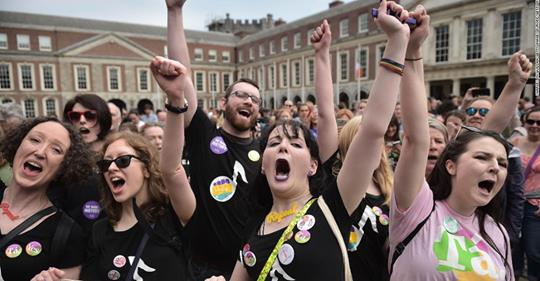
Yes campaigner and ROSA activist Keishia Taylor celebrates as the count in the Irish referendum on the Eighth amendment concerning the country’s abortion laws takes place at the RDS centre on May 26, 2018, in Dublin, Ireland.
Charles McQuillan/Getty Images

Abortion in Ireland will be free, safe, and legal up to 12 weeks into pregnancy starting January 1, a major blow to the Catholic Church and opponents of the country’s abortion rights law, who tried to drag out the legislative process with support from U.S. anti-choice advisers.

To Bríd Smith, People Before Profit member of Irish parliament, the repeal of the Eighth Amendment banning abortion in Ireland was “one of those rare moments in life when you feel such joy, the sheer joy of beating back the Catholic Church’s agenda, really beating it back for once. And pride, because we put a huge amount of effort into it and had witnessed a new generation of young Irish people completely different to what we had known.”

On December 5, Smith and 89 other members of the Dáil Éireann voted to pass the legislation, clearing the way for legal abortions to begin in Ireland in January 2019. And on December 13, the bill passed the Seanad, the upper house of the Irish parliament, meaning that on the president’s signature, abortion care will for the first time be legally available in the Republic of Ireland. Yet Smith notes that as in May after the referendum’s passage, there is still much to be done.

Lynn Boylan, a member of the European Parliament from Sinn Féin and a longtime pro-choice campaigner, told Rewire.News that a “small number of politicians who have disregard for democracy” threw in myriad amendments meant to drag out the process of making abortion care legal in Ireland. Much of the rhetoric and the proposals, she said, would sound familiar to Americans.

There was a proposal to force abortion patients to undergo ultrasounds or watch DVDs describing the procedure; there was a battle over burial of fetal remains, despite, Boylan said, Ireland only recently learning the extent to which babies and children born at infamous “Mother and Baby Homes” for the unmarried were buried in mass graves. “My own brother is buried in a mass grave. He died in childbirth because he wasn’t baptized,” Boylan said. “The hypocrisy of the same people who are saying, ‘You should be burying fetuses … ’—there was disregard given to dead babies for a long time in Ireland.”

Ireland’s abortion services will be based around primary care clinics, and rely mainly on the use of the abortion pill. It will be legal until 12 weeks’ of pregnancy without restrictions. After that point in a pregnancy, if two doctors certify there is risk to the life or “serious harm to the health of” the pregnant person, or in the case of fatal fetal abnormalities, abortion care may be permitted. The legislation includes a three-day forced waiting period, which Smith opposed, noting that with the 12-week deadline and Ireland’s occasional long wait times for physician appointments, this could push some people over the line, putting abortion out of reach.

Abortion access will be free of charge. Ireland does not have a British-style universal health-care system, but, Smith explains, abortion will be covered under the health service’s Maternity and Infant Care Scheme, which was introduced in the 1950s over the objections of the Catholic church and provides free maternity health care.

There was a struggle over the question of conscientious objection from physicians. In a country where the Catholic Church has long been in control of health care, this was a major point of contention. To get around the issue, the state will institute a 24-hour hotline where pregnant people can get information about where they can find a physician who will perform an abortion. Doctors who don’t want to perform it will be instructed to refer people to another physician or to the hotline.

“It is better really that way because then it is up to the health service, the government health service, to make sure that you get a referral rather than the individual [general practitioner (GP)],” Smith said.

The GP model, Boylan said, minimizes the likelihood of protesting outside of clinics where abortions are performed, though it doesn’t prevent it. There will still be a need for some surgical abortions, and organizations like the Irish Family Planning Association, Smith said, are gearing up to provide abortion care at the clinics already in operation.

“They always have been this source of support for information, for counseling, for getting the appointments in Britain in the past. I think that will seamlessly move over to them being a port of call for getting an abortion here,” she told Rewire.News. While not in the legislation, clinic buffer zones to protect people seeking care from protesters will be a priority for pro-choice activists in 2019.

Mandy La Combre of the Trade Union Campaign to Repeal the Eighth points out that by the time it came to a vote on the legislation, “It was done to death. People knew what they were voting for. Every debate was talked about. Every inch of it.”

The benefit of a referendum, she said, was that everyone in the country had debated the issue thoroughly, and the decisive 66.4 percent victory for Repeal meant that anti-choice members of parliament had little excuse for trying to halt the legislation. Yet there is still much to fight over in the coming months. And while many activists, La Combre said, were thoroughly “burnt out” after the Repeal fight, they are not taking the final vote as an excuse to stop working.

“There is no separation, really, in Ireland of church and state,” Lynn Boylan said, noting the ongoing fight over a new National Maternity Hospital to be build with state funding in Dublin. The site chosen for the hospital is owned by St. Vincent’s Healthcare Group, which is owned by the Sisters of Charity. While the St. Vincent’s hospital is no longer run on a daily basis by the nuns, Smith said, “The board of management still run the hospital, still have their Catholic ethos.”

The concern, Smith told Rewire.News, is that the state is handing over to a Catholic organization control of a major site where pregnant people will likely go for abortion care. In a small country like Ireland, she said, where Dublin is only a couple hours away from any other geographical point, “It is no biggie to have just one major place that would look after these things, but to deliver abortion services, we have to be sure that the Catholic Church have no say in anything to do with that hospital.”

Protests have been held and members of multiple parties have expressed deep concern about religious influence over reproductive health care. St. Vincent’s executives have promised the Sisters are no longer involved, but pro-choice campaigners are not satisfied.

Another coming struggle is over the continued criminalization of abortions outside of the strict guidelines the new legislation puts in place. “There was a 14-year [jail] sentence for abortion put into the Protection of Life During Pregnancy Act, which was brought in after Savita Halappanavar died in Galway,” Smith explains. In the new legislation, that 14-year sentence remains, “not for the woman or the pregnant person, but for the doctor or the midwife or whomever might perform an abortion outside of the parameters of the legislation. We want that gone because, if there is any uncertainty about dates, or it might be three days over 12 weeks or you might be 13 weeks, not 12, this will act as a serious chill factor on the medical services.”

Beyond improvements to abortion care, activists are taking lessons from the campaign to other struggles. The trade union repeal campaign, La Combre said, was important because it introduced the issue of class into the reproductive rights battle. “What we were talking about was the real socioeconomic issues: the working women who can’t afford to travel, who can’t afford to have an abortion, who can’t afford to make those choices.”

Their campaign taught trade union members the importance of broadening their definition of what is and is not a “workplace” issue—and the support from older men within the labor movement was key.

The struggle taught important lessons in solidarity for activists who might not have been directly affected, Boylan agrees. Arguments that abortion rights are “identity politics” don’t wash, but activists had to take into account the intersections. “Gathering that solidarity together and mobilizing around it is what the left should be doing,” she said. “I don’t think we give up identity politics, but we have to instill solidarity and bring class back into the narrative. People in Ireland don’t really want to talk about class.”

The repeal process has changed the major political parties in Ireland. While small parties like People Before Profit took a strong pro-choice position, others had only recently come around, led by grassroots activists like La Combre. “They got on board because it was the political will of the people,” La Combre said. “Fine Gael, for example, they knew the young people wanted this and they needed the young Fine Gael vote,” she continued, naming Ireland’s conservative ruling party.

The referendum changed the left-leaning Sinn Féin, which has its roots in Ireland’s long and at times bloody struggle for independence from England. At the party’s annual gathering in June, Boylan handed out T-shirts printed with the total vote count for Repeal and the slogan “The North is Next,” and the party voted decisively to adopt a pro-choice position—while it had campaigned for a Yes vote on repeal, prominent party members were public about their anti-choice politics during the referendum, making the unambiguous shift significant.

“That has been a long struggle for a lot of us who were pro-choice within the party,” Boylan said. “You join a party, and [you don’t] agree with them 100 percent, but you try and advocate for change within the party. It took longer than I would have liked in Sinn Féin, but we have gotten there. I came away very inspired by those who had been fighting for longer even than me.”

The question of the North—of Northern Ireland, which finds itself at the nexus of geopolitical conflict in the Brexit negotiations but still has no legal abortion despite being a part of the United Kingdom—came up repeatedly. Both Sinn Féin and People Before Profit campaign in both the North and South of Ireland, and both have taken part in major post-repeal actions calling for the North to catch up.

The question of Ireland’s health-care system remains. “We have a crisis in GP service just like we have a crisis in Emergency Medicine. We have a crisis in delivering children’s medicine,” Smith told Rewire.News. “There were years and years of austerity and cutbacks, closures of beds, attacks on the pay of doctors and nurses, and we haven’t got over that yet, despite the growing economy.”

Such a crisis has meant waiting periods to see doctors—something that could make accessing an abortion difficult, particularly if some practitioners opt out of providing abortion care.

To make matters worse, Boylan said, “Any scandals that happen in the Irish health-care system tend to be scandals about women’s health. Whether it is about bodily autonomy when it comes to abortion, or the cervical cancer scandal, and that maternalistic approach that was taken to the women not to tell them and it wasn’t in their interest to let them know that they were having these false negatives.”

It is time, she said, to “radically reform the health service in Ireland.”

The political fights upcoming have been in some ways muddled by the fact that Fine Gael, for years considered Ireland’s most conservative party, has become the face of abortion liberalization. “I see Fine Gael as a really right-wing party. Economically, completely right-wing. But, they use being socially aware to win people over,” La Combre said.

Boylan, too, wonders how the excitement among young people for the Repeal campaign will shake out politically.

“I think it is really important that particularly the left-wing parties go out and try and engage those young people, but I would be that little bit cautious that they are not all going to show up. We are not going to have a #hometovote hashtag for the next general election.” It will be important, she said, to continue reaching out to the networks created by Repeal, because, “We do have a serious problem with how we treat women in this country and that hasn’t gone away just because we voted for repeal. There is still an uphill battle there.”

Source: https://rewire.news/article/2018/12/17/sheer-joy-ireland-will-have-free-abortion-care-on-january-1/

Campaigners in Dublin celebrate in May, as Irish voters supported legalizing abortion in a referendum.

Ireland’s Prime Minister has hailed a “historic moment” for women in the country, after a bill to legalize abortion passed through the final stages of parliament.

The bill is now set to be signed into law by President Michael D. Higgins, following a marathon debate in parliament’s upper house Thursday, and will come into force in January.

Two-thirds of Irish voters agreed to amend the constitution and allow women to access abortion in a momentous and emotionally charged referendum in May.
Prime Minister Leo Varadkar thanked the bill’s supporters on Twitter and commended Health Minister Simon Harris for steering it through parliament. The bill passed through parliament’s lower house, the Dáil, last week.
The vote would “end lonely journeys, end the stigma and support women’s choices in our own country,” Harris said on Twitter Thursday.
But its passage also prompted vandals to target a regional office of Ireland’s governing party Fine Gael overnight, writing “baby killers” and “Herods” on its wall.
“I was so disappointed to see this morning (Friday) that my busy constituency office in Sligo has been vandalized and defaced overnight,” Tony McLoughlin, the assistant government whip, wrote on Twitter.
“We live in a proud democracy and despite anyone’s opinion on any referendum, this behavior can never be condoned,” he added.
The new laws make abortion legal and unrestricted in the first 12 weeks of pregnancy, subject to a medical consultation and a cooling-off period. Terminations after 12 weeks would be permitted only under exceptional circumstances.
After the vote, Harris paid tribute to “the campaigners who fought for 35 years to change a nation, to change hearts and minds,” the UK Press Association reported. “I want to thank the minority who fought the battle in here when it was convenient for the majority to ignore.”
“But today, I think mostly of the thousands of women who were forced to make the journey to access care that should have been available in their own country,” he added.
Around 3,000 Irish women annually have traveled to Britain to terminate a pregnancy in recent years, according to UK government figures.
Source: https://edition.cnn.com/2018/12/14/health/ireland-abortion-bill-parliament-scli-intl/index.html

Proposed legislation in Kentucky this week would reportedly make abortion punishable by up to five years in prison.

State Rep. Robert Goforth (R) prefiled a bill on Thursday that would ban abortion after a fetal heartbeat is detected, according to WAVE, an NBC affiliate.

Under the terms of the measure, abortion providers would be required to check for a heartbeat before performing the procedure. If they detect a fetal heartbeat, it would then become a Class D felony to go through with the abortion unless it’s deemed a medical emergency.

In Kentucky, Class D felonies are punishable by up to five years in prison.

“My proposal recognizes that everyone has a right to life,” Goforth said in a statement, according to Kentucky Today. “My personal belief is that life begins at conception and ends at natural death. A heartbeat proves that there’s life that deserves protection under law — if a heart is beating, a baby needs to be protected and given an opportunity to live.”

Anti-abortion groups and lawmakers have been emboldened by the Trump administration and changes to the makeup of the Supreme Court, ramping up their push for restrictions on abortion as part of a strategy to get the Supreme Court to re-examine Roe v. Wade, the landmark decision that legalized abortion.

“We’re talking about viable babies,” Goforth said. “This is the most pro-life piece of the legislation that has ever been filed in the Kentucky Legislature.”

Goforth added that he knows his proposal might face legal challenges if it becomes law but said it is worth the trouble.

“I look forward to the day our laws and our court system give unborn children the legal right to life that they deserve so they can grow and live happy and productive lives,” he said.

The bill will reportedly be considered in the Kentucky General Assembly’s next session, which is scheduled to begin on Jan. 8.

Similar bills, dubbed “heartbeat” bills, have been voted on by lawmakers in Ohio and Iowa earlier this year.

Gov. John Kasich (R-Ohio) has reportedly vowed to veto that legislation if it makes it to his desk. Gov. Kim Reynolds (R-Iowa) has not indicated whether she will sign the measure.

https://thehill.com/homenews/state-watch/421398-bill-proposed-in-kentucky-would-make-abortion-a-felony?fbclid=IwAR1i3H349Elj7QfIxlO6lEv3LBrgZR1-PWpmLFLGN6Ya3U-Lj6RGWt8XUPw

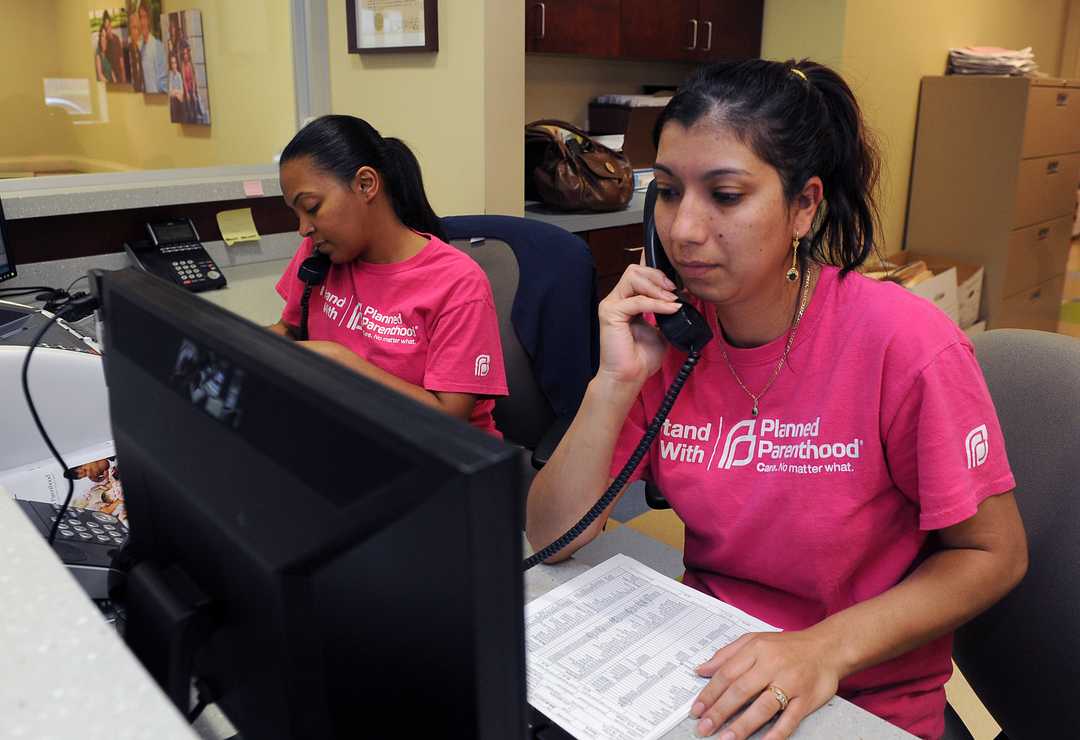
Planned Parenthood staff members Kelana Love, left, and Monica Encalada answer phone calls at the Nashville clinic. A Nashville synagogue will host a fundraiser for the group that the Gordon Jewish Community Center backed out of agreeing to hold at its facilities. Shelley Mays / The Tennessean

NASHVILLE, Tenn. – The only remaining abortion clinic in Tennessee’s capital has ceased offering abortions, instead referring patients to clinics 200 miles away in Knoxville and Memphis.

Officials with Planned Parenthood of Tennessee and North Mississippi, which operates the north Nashville clinic, could not say when its clinic would resume abortions. The organization has a shortage of physicians to do the procedure, a spokeswoman said.

The clinic is also “undergoing a period of quality improvement and will return with these services soon,” a statement said. It is the second clinic in Nashville to stop abortions this year.

The Women’s Center closed in August after the sale of its building, and its operators said they hoped to reopen. No target date was set, and its reopening has not happened yet.

► Dec. 10: Supreme Court won’t consider state efforts to defund Planned Parenthood
► Nov. 20: Mississippi’s 15-week abortion ban overturned by federal judge
► Oct. 26: Fight over abortion comes to Oregon as GOP targets reproductive rights

The suspension of abortion services at Nashville’s only abortion clinic comes at a time when the number of abortion providers in Tennessee and throughout the Southeast continues to dwindle.

Tennessee now has six abortion providers, down from 16 in 2000 but more than in any other neighboring state except North Carolina.

Also Monday, the U.S. Supreme Court refused to consider Republican-led states’ efforts to defund Planned Parenthood. The court let stand federal appeals court rulings that allowed the reproductive health organization’s patients to contest laws in Louisiana and Kansas that stripped its Medicaid money.

In Tennessee, more than 9,700 abortions were performed in 2016, up from about 9,100 in 2015, according to the Tennessee Department of Health’s most recent data.

Nashville’s Planned Parenthood clinic was the largest provider of abortions in the state, serving women in rural Middle Tennessee counties as well as neighboring as Alabama, Kentucky and Mississippi.

► Oct. 25: Abortion cases offer test for the Supreme Court
► Oct. 10: Pope Francis compares abortion to hiring a hit man to solve problems

Some women now will have to travel even further to obtain an abortion. And under Tennessee’s 48-hour waiting-period law, they will have to make the trip twice.

The law, enacted in 2015, requires two trips to an abortion clinic with a two-day wait between the first appointment to obtain counseling and then a subsequent office visit to undergo the procedure.

Tennessee Right to Life, which advocates against abortions, already is seeing a spike in women callers who could not obtain abortion appointments in Nashville, said Brian Harris, the organization’s president. The organization advertises services for women who are pregnant and need help but does not perform abortions or refer women to abortion clinics.

Instead, the organization provides free pregnancy tests and ultrasounds. It also offers to connect women to services intended to assist them in continuing their pregnancies to term.

“The phone has been very busy here with women calling and looking for abortion referrals – busier than they’ve ever been,” Harris said.

► Sept. 28: Federal judge strikes down Kentucky restriction on abortion clinics
► June 29: 72-hour wait for abortions struck down by Iowa Supreme Court

On Monday, the Nashville Planned Parenthood clinic was open for other women’s medical services including birth control and sexually transmitted disease testing, but its waiting room was empty. Operators at the organization’s scheduling line are referring callers who want abortions to other locations.

“As of right now we’re only scheduling for other locations,” said an operator who answered the phone at the clinic’s line. The woman, who did not give her name, said abortion services were suspended “indefinitely.”

The Women’s Center, along with other abortion providers in Tennessee, are still fighting to overturn the 48-hour waiting period rule in federal court.

https://eu.usatoday.com/story/news/nation/2018/12/10/planned-parenthood-nashville-abortions-suspended/2271428002/