Ireland’s imminent abortion services will be completely free to ensure they can be fully accessed by anyone who needs them, end the need to travel abroad for care and to prevent an influx of private abortion clinics into this country.
Health Minister Simon Harris confirmed the new services will not cost anything just 24 hours after President Michael D Higgins signed the referendum result into law, thereby formally removing the eighth amendment from the constitution.
Speaking to reporters at the opening of the new primary care centre in Grangegorman, Dublin, Mr Harris said that even though abortion services are set to be provided in the near future it is essential “cost is not a barrier” to accessing the medical help.
Asked specifically if he will introduce any charge to receive abortions in legislation due to be passed by cabinet next week and put to the Dáil in the first week of October, Mr Harris confirmed no fees will be involved.
The Health Minister said the move is needed, saying that if a price tag was linked to accessing abortion services it would encourage private abortion clinics into Ireland and lead to women continuing to travel abroad for the care they need.
“Yes, it is my intention that the services will be free,” Mr Harris confirmed.
“I’ve said from the start that I don’t want cost to be a barrier, because if cost is a barrier you get into a situation where one of two things happen, you get abortion clinics to develop or you can see people having to continue to travel.
“I want this [abortion services] to be provided as part of our healthcare system, our public healthcare system and part of our primary healthcare system.
I think it’s important to say that Tuesday was an extraordinarily historic day. The President of Ireland signed the bill that has removed the eighth amendment from the constitution, and today is the first day that the eighth amendment is actually gone from Bunreacht na hEireann.
“That now allows us as legislatures to do our job,” he said.
Mr Harris also confirmed that, now that President Higgins has signed the order paper to remove the eighth amendment from the constitution, he will bring planned law changes to allow abortion services to cabinet next week.
The Health Minister said he expects cabinet to pass these new rules immediately in order to allow him to bring them to the Dáil in the first week of October and fully introducing them by the end of this year.
“Next week I will return to cabinet for final approval of the bill that will legislate for termination of pregnancy in certain circumstances.
“I intend to introduce that in the Oireachtas in the first week of October, I hope we can pass it through the Oireachtas in the month of October and November,” he said.
Asked about ongoing concerns pro-life groups may target the three day ‘cooling off’ period for women seeking to access abortion services which is included in the planned new laws, Mr Harris said he was aware of the issue.
However, in a clear message to groups wishing to continue the abortion debate, he said:
“I do note the comments of some groups about the three days. But I would say to anybody regardless of whether you voted yes or no, we made a conscious decision to have a very detailed general scheme available before the referendum, that three day period was part of the discussion and was debated fully during the referendum, which was passed.”
The Pro Life Campaign said that today’s proceedings at the Oireachtas Committee were “a rude awakening” for anyone who thought the new abortion law would be restrictive.
Dr Ruth Cullen of the Pro Life Campaign said: “Today’s committee hearings brought into sharp focus the extreme nature of the abortion law about to be introduced. It’s a definite rude awakening for anyone who thought the law would be somewhat restrictive.”
“It is clear Health Minister Simon Harris and others in government have no interest in hearing perspectives other than ones that zealously back abortion. It is going to take time but the public will realise the full extent of the charade that is going on when the reality of what the abortion law permits starts to sink in,” she said.
Last year’s pro-choice bill, signed by Gov. Bruce Rauner (R), enjoyed widespread support among Illinois voters.
HB40 takes out so-called personhood language from the Illinois Abortion Act and permits coverage of abortion care in state health plans and Medicaid. Tim Boyle/Getty Images
UPDATE, September 19, 2:27 p.m.: The Thomas More Society in a statement to Rewire.Newssaid they plan to challenge HB40 before the state supreme court. The deadline to appeal to the Illinois Supreme Court is October 22.
A state appeals court in Illinois has upheld the dismissal of a lawsuit that tried to overturn a 2017 law expanding state funding of abortion services.
The three-judge appellate court ruled unanimously that a county judge correctly dismissed the lawsuit filed by the conservative law firm Thomas More Society and anti-choice groups last November in an effort to block legislation expanding state-funded coverage of abortions for Medicaid recipients and state workers.
Signed by Republican Gov. Bruce Rauner last fall, HB 40 strikes down provisions of an Illinois “trigger law,” which would outlaw abortion care if Roe v. Wade is overturned. It takes out so-called personhood language from the Illinois Abortion Act that said an “unborn child is a human being from the time of conception and is, therefore, a legal person,” and permits coverage of abortion in state health plans and Medicaid. State law had prohibited public insurance coverage of abortion care, induced miscarriage, or “induced premature birth” except in limited circumstances, as reported by Rewire.News.
Thomas More Society Special Counsel Peter Breen, a state representative, was a lead attorney representing the anti-choice petitioners. The lawsuit claimed lawmakers passed the measure too late in 2017 for it to take effect January 1, that they didn’t appropriate the funding required, and that the law promoted taxpayer-funded abortion services.
“Taxpayer-funded abortion” is a myth pedaled by abortion-rights foes that feeds on public ignorance about abortion funding. Two-thirds of the public is unaware the federal Hyde Amendment prohibits paying for abortions with federal Medicaid dollars, according to a Kaiser Family Foundation poll.
The Thomas More Society and Breen did not respond to emails seeking comment.
Meanwhile, state Sen. Sam McCann (R), a gubernatorial Conservative Party candidate, has filed a bill to repeal the pro-choice law that he called “immoral” and “abominable,” the State Journal-Registerreported. Democratic gubernatorial candidate J.B. Pritzker, who has been endorsed by Planned Parenthood in Illinois, supports the new law.
Rauner called the insurance provision “very controversial,” in apparent reversal of his support for abortion access as a gubernatorial candidate. He later said he would “support a legislative effort to reverse that law.”
An April 2017 poll showed widespread support among Illinois voters for Rauner to “act to protect the reproductive health care of all women in Illinois.”
“I personally am pro-choice, I always have been,” Rauner said last year. “I personally believe a woman should have, must have, the right to decide what goes on in her own body. I also believe that no woman should be forced to make a different decision than another woman could make purely based on her income.”
The American Civil Liberties Union (ACLU) of Illinois supported the law as “a critical victory for women’s health and equality,” and said in a statement the bill “is not about politics; it is about advancing health, economic security, and dignity.”
“We applaud the court’s ruling dismissing the lawsuit. We don’t think there is a basis to this lawsuit and we look forward to continuing to see House Bill 40 be implemented in Illinois for the benefit of the people of our state,” said Lorie Chaiten, director of the Illinois ACLU’s Women’s and Reproductive Rights Project.
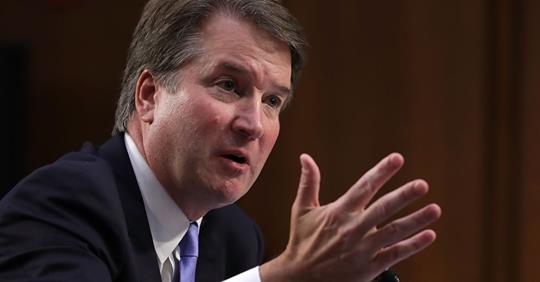
There are a whole slew of reasons why you might not want Judge Brett Kavanaugh on the Supreme Court. For example, the fact that he holds the view that presidents can’t be indicted and yet was hand-selected by a president who is under special counsel investigation-a position Kavanaugh seemed to purposefully avoid answering for during this week’s hearings. Or perhaps it’s his extreme unpopularity, with some polls (like this ABC News/Washington Post one) finding more people opposed to his confirmation than for it. CNN notes that no nominee for the Supreme Court with this low an approval rating has ever been confirmed in the modern era.
Or perhaps it’s because you don’t want a 53-year-old, conservative white male to potentially cast the deciding vote on whether or not you get to make decisions about your own body. And now we can add another reason to think he’s a bad choice for the Supreme Court: In answer to a question posed by Senator Ted Cruz, Kavanaugh referred to birth control as “abortion-inducing drugs.” See the exchange here:
The question is in reference to a case called Priests for Life v. U.S. Department of Health and Human Services, in which Kavanaugh wrote a dissent in favor of employers who wanted to deny their employees’ access to birth control without a co-pay. It’s kind of nitty-gritty, but here’s the line where Kavanaugh shows his real opinion on the issue of women’s reproductive health: “Filling out the form would make them complicit in the provision of the abortion-inducing drugs that they were, as a religious matter, objected to.”
First of all, birth control is not an abortion-inducing drug, and it’s worrisome that the guy who may end up deciding the future of Roe v. Wade might not understand that. Second, for all the claims from the right that fears of Kavanaugh overturning Roe are just histrionics, this is a very telling slip.
The difference between birth control and abortion was actually laid out in an amicus brief submitted to the Supreme Court in 2013, explaining that “a contraceptive method by definition, prevents pregnancy by interfering with ovulation, fertilization, or implantation. Abortion ends an established pregnancy, after implantation.” This scientific definition of pregnancy is also the legal definition, and has long been accepted by federal agencies, according to The Guttmacher Institute. Kavanaugh’s failure to understand this means he not only has a poor grasp of reproductive health terminology, but a poor grasp of the law that guides it.
Photo credit: Mark Wilson – Getty Images
More
In a statement issued Thursday afternoon, Planned Parenthood Executive Vice President Dawn Laguens said as much:
“It’s no wonder Kavanaugh’s nomination has been met with unprecedented protests. Kavanaugh referred to birth control-something more than 95 percent of women use in their lifetime-as an ‘abortion-inducing drug,’ which is not just flat-out wrong, but is anti-woman, anti-science propaganda. Women have every reason to believe their health and their lives are at stake. Kavanaugh has made clear over and over again that he would not uphold women’s ability to access reproductive health care as a constitutional right. Let me break it down for you, Brett: birth control is basic health care. Birth control allows women to plan their futures, participate in the economy, and-for some women with health issues like endometriosis-allows them to get through the day. It is clear from Kavanaugh’s record and answers that his nomination puts access to affordable birth control at risk.”
If Roe v. Wade is important to you, there’s still time to stop the confirmation of Brett Kavanaugh. Most immediately, you should contact your Senator and tell them you want them to oppose Kavanaugh’s nomination. You can head over to Whip the Vote, which will not only put you in touch with your representative, but also sends you to Indivisible, which has provided handy scripts for you to read from based on whether you’re represented by Democrats, Republicans, or pro-choice Republicans, as is the case for those in Alaska who are represented by Senator Lisa Murkowski, or in Maine who are represented by Senator Susan Collins.
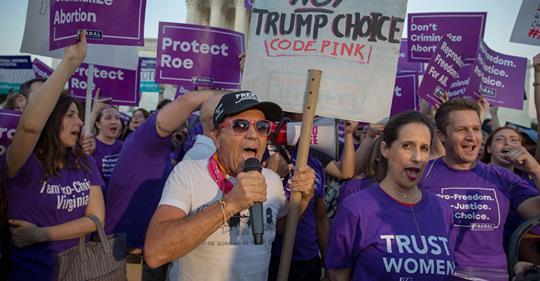
You could also show up to a protest and make your voice heard. If you’re near the Capitol, there’s an entire SCOTUS Week of Action that you can RSVP to here.
When I found out I was pregnant at age 24, there was no decision to make. But even if it felt inconsequential at the time, I don’t take for granted that I had a choice.
Image
CreditCreditPhoto illustration by Emily Keegin; ScienceGenetics (sperm and egg), Wellcome Images (sculpture)
I didn’t notice my skipped period. I had switched birth control pills, and my menstrual cycle had always been a little irregular. It wasn’t like a movie, either. When I started vomiting, it didn’t even dawn on me that I was pregnant. I thought it was some symptom of cancer.
Nor can I remember where or how I ended up getting a pregnancy test. I just know that at some point I figured I couldn’t take a home test for anything else, so I might as well rule this possibility out.
But I had a sex life with my live-in boyfriend and a flighty relationship to Loestrin, I hadn’t had a period in over a month, and I was constantly nauseated. Of course the stick’s indicator turned into a tiny pink plus sign.
There was no decision to make. Or rather, there was only one decision. I would get an abortion. I told my boyfriend in one breath that I was pregnant and would call Planned Parenthood the next morning and make an appointment. His reaction made so little difference to me that I’m not sure what it was — he probably nodded and hugged me.
I was 24 and unsure I ever wanted children, let alone at a time when I spent a great deal of my life journaling about what to do with my life.
I rarely talk about my abortion. My silence is not out of shame, but a lack of it. A friend I’m not all that close to told me about her abortion recently and asked if I had ever had one.
“I have,” I said. “It was a long time ago.” I trailed off, shoving some carrot sticks into my mouth andtrying to evade the ritual of swapping stories. I didn’t want to sound too businesslike or as if I didn’t care enough.
But here’s the truth: It was not a tortured decision. I guess that makes me sound glib, or worse, as if I’m some kind of unfeeling monster. But that’s what getting pregnant was to me: something that needed to be fixed, and that I wanted to be done with as soon as possible.
I know in theory there are other women who feel that way, but I had never really heard their stories. When you read abortion stories there’s often a tinge of regret or a hint of weightiness. What if I was being a woman the wrong way and everyone would be able to tell?
At the time, I ended up telling just one or two friends about my decision (and not my family, though my mother would have certainly been supportive; she had worked at Planned Parenthood when I was very young).
The hardest part was waiting two weeks between finding out I was pregnant and going in for an appointment. I threw up so often in the bathroom of the tiny office of the feminist magazine where I worked that I was convinced everyone thought I had bulimia.
I’d spend oddly wholesome nights in with my boyfriend playing gin rummy in a blue terry cloth bathrobe. I remember taking a bath and thinking, I’m pregnant, I’m pregnant, I’m pregnant, and it would feel like repeating my name over and over until it didn’t register as mine anymore.
When I finally had my appointment, I learned I was eight weeks pregnant — too late to take an abortion pill, so I had to come back in a few days for an in-clinic procedure. This was urban California, so there were no protesters to cross. I had told my boyfriend to pick me up when it was over but not to stay in the waiting room.
A nurse asked me how I planned to prevent pregnancy in the future, and I resented that I had to reassure her I would set a timer to take the pill every day. When it was my turn for the vacuum aspiration, another nurse asked me if I wanted to hold her hand.
“No thanks,” I said, but really meant I didn’t want a big show of her support or anyone else’s. In the recovery room, I drank apple juice and ate graham crackers — the very same snack we had during preschool.
I went home with a giant menstrual pad in my underwear and went to bed flooded with immediate relief. I took a two-hour nap. When I woke up, my friend Rebekah, one of the few I had told, had brought me homemade banana bread and minestrone soup. She knew exactly what kind of care I wanted, something that wasn’t maudlin or expensive. Something that involved carbohydrates.
When I washed the bowl she brought the soup in, I noticed it was from Pottery Barn, which seemed so impressively adult. I still don’t have a matching set of dishes, but I do still use her white bowl all the time. I never did give it back. It has become my favorite bowl.
Having an abortion didn’t end up being the thing I remember most about that year (that goes to spraining both of my middle fingers in a rope swing accident over the summer). In fact, I almost always forget to include it when some medical form asks me the number of pregnancies I’ve had.
It has been 16 years since the abortion, and, at 41, I’m close to the end of my window of fertility. At least I imagine I am; I have never done anything but try to prevent another pregnancy. It turns out I never wavered in not wanting children of my own.
And now I’m ready to stop wondering if my story was typical. I am a woman and something less than ideal happened, and I moved ahead in the only way I knew how. In that sense, it was a reluctant initiation into a sisterhood, that quarter of American women who will have abortions by the age of 45.
Every once in a while — like during the recent confirmation hearings for Brett Kavanaugh — I’ll remember that abortion was a hard-won right that too often is treated like a luxury that could be taken away at any time. Having an abortion didn’t define my life. Or maybe it did, by preventing my nascent adulthood from veering off into a direction I’m not even willing to imagine.
It’s not just a party shift Gov. Jim Justice (R) is attempting to make in the courts by replacing impeached justices with Republicans—it’s an ideological one.
The possibility of a West Virginia Supreme Court of Appeals full of people like Tim Armstead and Evan Jenkins rather than Margaret Workman will hurt abortion access in the state, one of seven states, as of January 2017, with just one abortion provider. Nagel Photography / Shutterstock.com
West Virginia’s Supreme Court of Appeals garnered national attention in August when the state’s House of Delegates voted to impeach the entire bench. This unusual move by the Republican-led state House Judiciary Committee throws not only the fate of the justices into question, but could mean critical changes to reproductive rights in the state.
The Committee adopted articles of impeachment against each of the court’s remaining sitting justices: Chief Justice Margaret Workman, Justice Robin Davis, Justice Beth Walker, and Justice Allen Loughry. The articles accuse the four justices of a variety of different charges, including: “maladministration, corruption, incompetency, neglect of duty, and certain high crimes,” according to USA Today. Prior to the proceedings, the fifth justice of the court, Justice Menis Ketchum, resigned after being charged with wire fraud—a federal charge which he later pleaded guilty to—and personal use of a state vehicle.
The composition of the court hangs in the balance. On Tuesday, the West Virginia Senate rejected a motion to exclude Davis from trial, even though she had announced her retirement soon after the impeachment decision. Significantly for the future of the bench, just two weeks after the announcement of impeachment, Gov. Jim Justice (R) named Republicans Tim Armstead and U.S. Rep. Evan Jenkins as replacements for Davis and Ketchum. Whether the charged justices are convicted or not, both Justice-made replacements will serve until the November special elections. If the remaining three justices are convicted, Gov. Justice—the former Democrat, now Republican—will appoint additional replacements to serve until 2020.
These new appointments could mean crucial changes, including threats to abortion in the state.
Such shifts are possible, according to Terry Madonna, director of the Center for Politics and Public Affairs and professor at Franklin and Marshall College, because a state’s supreme court decides the constitutionality of its laws.
“There’s always a possibility when you have major changes on the court that you could have major changes in philosophy,” Madonna said in an interview with Rewire.News.
West Virginian Margaret Chapman Pomponio seconded this belief, describing the newest composition of the court as “unfriendly towards reproductive health.” She believes that with Gov. Justice’s appointments in power, attacks to abortion access are likely.
“Tim Armstead is one of the most conservative and fundamentalist politicians that the state has ever seen,” Pomponio said in an interview with Rewire.News.
Pomponio is the executive director of WV Free Action Fund, a nonprofit that seeks to “ensure the reproductive health of women and people who can get pregnant at the state and national level and to broaden the base of active and vocal support for reproductive justice in West Virginia,” according to the organization’s mission statement.
“With this takeover, it’s possible that we would see a shift in the balance of ideology … [which] would be very dangerous,” Pomponio said.
Armstead represents the kind of conservative and anti-choice ideology that has the potential to drastically shift West Virginia’s political landscape. His voting record has consistently indicated that he does not support the right to an abortion. The former West Virginia house speaker voted in 2015 to uphold the state’s 20-week abortion ban, though the right to an abortion is a constitutional right guaranteed by Roe v. Wade.
Jenkins’ place on the Supreme Court also spells out danger for reproductive rights and many other progressive issues in West Virginia. Jenkins has voted numerous times to repeal the Affordable Care Act, and has expressed support for President Trump’s heavily-criticized anti-Islamic Muslim ban.
Jenkins is also a supporter of the federal Pain-Capable Unborn Child Protection Act, which would ban abortions after 20 weeks of pregnancy and the Conscience Protection Act, which would allow employers to deny health care coverage to those seeking abortions, without federal consequences.
Both Republican appointees replace Democrats. But it’s not just a party shift Gov. Justice is attempting to make in the courts—it’s an ideological one.
Former Chief Justice Margaret Workman has a long history of support for progressive issues, which makes the appointment of Armstead and Jenkins an even bigger blow to reproductive justice. Workman worked to level the playing field in West Virginia, giving time and energy to legislation meant to aid those in need in a state where almost 18 percent of the population lives in poverty.
“[Workman has] been a champion not just for reproductive health but for children, families, and workers,” Pomponio said. “She has been an advocate for the most disadvantaged West Virginians.”
The possibility of a Supreme Court packed with people like Armstead and Jenkins rather than Workman will hurt abortion access in the state, one of seven states, as of January 2017, with just one abortion provider—Women’s Health Center of West Virginia. Additionally, the state maintains laws that operate to discourage people from abortion, including the requirement for anyone seeking an abortion to receive state-directed counseling, the enforcement of a 24-hour waiting period, and the requirement of parental consent for all minors seeking an abortion.
“The whole point is to dissuade folks,” Madonna said.
With anti-choice politicians in the state supreme court, Roe v. Wade could be threatened on a statewide level beyond these restrictions. Already, abortion is under attack in the state—again: as residents will have the opportunity, on November 6, to vote on Amendment 1, a constitutional amendment that would declare that abortion is not a constitutional right for West Virginians.
That amendment, just 17 words, would overturn the 1993 case Women’s Health Center of WV, et al. v. Panepinto, et al. In that case, the court ruled that Medicaid could be used to fund abortions. The landmark decision—which Workman helped author—exemplifies reproductive justice that centers those in poverty.
West Virginians are not giving up. Since the introduction of Amendment 1, amid the Supreme Court fiasco, grassroots organizers have been mobilized, according to Pomponio. Along with WV Free Action Fund, Pomponio is part of a coalition dedicated to fighting the amendment and showing politicians that West Virginians support choice.
With so many changes up in the air—impeachment, potential new justices, and anti-abortion Amendment 1—there is no predicting the fate of abortion in West Virginia. “If the legislature were to pass restrictions on abortion, would [the West Virginia Supreme Court of Appeals] support it? I don’t know,” Madonna said. For now, residents must wait and see what happens during the coming impeachment trials. Walker’s trial is set for October 1, Workman’s October 15, Davis’ October 29, and suspended Justice Loughry’s on November 12.
According to Pomponio, if Amendment 1 were to pass, it would be the first time in over 100 years that the state has passed an amendment to the constitution to take away a right, something she believes is a backward step for West Virginia.
With Kavanaugh’s confirmation imminent, anti-abortion judges are declaring war on the right to choose.
Pro-choice and anti-abortion protesters demonstrate
in front of the U.S. Supreme Court on July 9 in Washington.
Tasos Katopodis/Getty Images
Brett Kavanaugh hasn’t even been confirmed to the Supreme Court, and lower-court judges have already declared war on Roe v. Wade.
On Monday morning, the 8th U.S. Circuit Court of Appeals issued an astonishing decisionupholding a law that’s virtually identical to an anti-abortion measure the Supreme Court struck down in Whole Woman’s Health v. Hellerstedt. The three-judge panel, composed entirely of Republican appointees (including a Trump judge), essentially defied the Supreme Court in allowing Missouri to saddle abortion clinics with pointless regulations designed to guarantee their closure. It’s a preview of how the courts will overturn Roe—swiftly, ruthlessly, and dishonestly—once Kavanaugh is confirmed.
Monday’s ruling in Comprehensive Health v. Hawleywas authored by Judge Bobby Shepherd, a George W. Bush appointee who has expressed hostility toward Roe before. In a 2015 ruling, Shepherd begrudgingly struck down North Dakota’s “fetal heartbeat” bill, which would’ve banned abortions after six weeks. In making that decision, though, he attacked the Supreme Court precedents he was forced to follow, urging SCOTUS to “reevaluate its jurisprudence” and overturn Roe. Shepherd’s bizarre opinion went on to cite pseudoscience about “the regrets of the women who abort” and the (nonexistent) “connection between abortion and breast cancer” while condemning nefarious abortion “mills.”
Still, for all Shepherd’s anti-abortion rhetoric, he ultimately recognized that if he struck down the law he’d promptly get reversed by the Supreme Court. Three years later, this calculation has clearly changed. With Kavanaugh’s confirmation likely to go through this month, Shepherd no longer feels obliged to comply with Roe or its successor cases. In Planned Parenthood v.Caseyand Whole Woman’s Health, the Supreme Court held that any law that imposes an “undue burden” on a woman’s access to abortion violates the U.S. Constitution. If a court determines that burdens of a certain restriction outweigh the benefits, it must strike down the law.
The Missouri measure in question is nearly indistinguishable from the Texas law that SCOTUS invalidated in Whole Woman’s Health. It imposes two requirements on abortion clinics: They must meet complex, pricey, and medically unnecessary architectural standards; and their doctors must be “privileged to perform surgical procedures” at a hospital that’s no more than 15 minutes away than the clinic in question.
This passage constitutes open defiance of the Supreme Court dressed up in the thin pretext oflegalese.
This first regulation differs slightly from the Texas law in Whole Woman’s Health, because clinics can, in theory, obtain a waiver from individual “physical plant regulations.” The second regulation, however, is actually more severe than its Texas counterpart. That law forced abortion providers to have “admitting privileges” at a hospital within 30 miles of their clinic. The Missouri law, by contrast, forces providers to be allowed to perform surgery—a significantly more stringent standard—at a hospital much closer by.
Recognizing these similarities, U.S. District Judge Howard F. Sachs blocked the Missouri law in 2017. Sachs said the state’s efforts to work around Whole Woman’s Health is akin to an attempt “to undermine Brown v. Board of Education” by insisting that “racial segregation in Missouri is more benign than elsewhere.” The Supreme Court, after all, found that Texas’ targeted restrictions were “useless, from a health standpoint” and addressed “no significant health-related problem,” while placing a “substantial obstacle in the path of a woman’s choice.” Missouri had merely cribbed its laws from the Texas playbook, and so they must also be unconstitutional. The case, Sachs held, was “not a close one” in light of “the lesson” of Whole Woman’s Health.
Shepherd saw things differently. He reversed Sachs’ preliminary injunction, suggesting that the district court judge relied upon “slight implication and vague conjecture” to justify freezing Missouri’s laws. Shepherd distinguished Missouri’s “physical plant regulations” from Texas’ by noting that Missouri clinics can hypothetically obtain waivers from specific design elements. The court, he wrote, could not strike down the law until it had more evidence of how generously the state grants these waivers. It is difficult to square this holding with the Supreme Court’s finding in Whole Woman’s Health that elaborate architectural requirements do not further women’s health.
But Shepherd’s next conclusion was even more egregious. It would be impossible to uphold Missouri’s surgical privileges mandate under a fair reading of Whole Woman’s Health, which emphatically rejected the notion that such rules benefit women. So Shepherd willfully misread the ruling. The Supreme Court, he wrote, “did not find, as a matter of law, that abortion was inherently safe or that provisions similar to the laws it considered would never be constitutional.” Yes, the court found that abortion was extremely safe in Texas—but “no such determination about abortion in Missouri was made here.”
This passage constitutes open defiance of the Supreme Court dressed up in the thin pretext of legalese. No one seriously asserts that abortion is currently more dangerous in Missouri than it is in Texas. And the Supreme Court did not purport to limit its analysis to Texas in Whole Woman’s Health; to the contrary, it noted that similar admitting privileges laws in Wisconsin and Alabama had been struck down as unnecessary for women’s health. That analysis plainly compels the invalidation of Missouri’s surgical privileges law—which, again, is even more draconian than Texas’ analogue. Yet Shepherd refused to block it, dishonestly speculating that Missouri could be “responding to … a unique problem” with abortion in the state. No such problem exists. This claim is mere pretext to ignore Whole Woman’s Health.
There’s no mystery why Shepherd chose this moment to flout the Supreme Court’s abortion jurisprudence. So long as Justice Anthony Kennedy sat on the court, laws like Missouri’s were likely to get struck down at SCOTUS. But as soon as Kennedy retired, Roe’s demise was all but guaranteed. His probable successor, Brett Kavanaugh, has a strong anti-abortion record, and emitted anti-choice dog whistles throughout his confirmation hearings. Once he joins the bench, the court will begin upholding anti-abortion laws—starting, perhaps, with Missouri’s—by defining an “undue burden” downward. And after it has eroded that standard to the point of meaningless, it will overturn Roe altogether.
That’s why judges like Shepherd have been emboldened this summer. He isn’t the first to cheer on Roe’s downfall. In July, 5th U.S. Circuit Court of Appeals Judge James Ho, a Trump appointee, bemoaned the “moral tragedy of abortion” and implied that Roe is illegitimate. In August, 11thU.S. Circuit Court of Appeals Judge Joel Fredrick Dubina, a George H.W. Bush appointee, declared that the right to abortion “has no basis in the Constitution.”
These judges see what’s on the horizon. They have been waiting for this moment for their entire careers, and they will do everything they can to hasten its arrival. It is quite obvious to everyone not named Susan Collins that Kavanaugh’s confirmation will spell the end of Roe. Anyone who doubts that fact should look to the lower courts, where abortion foes are eagerly laying the groundwork for our imminent post-Roe reality.
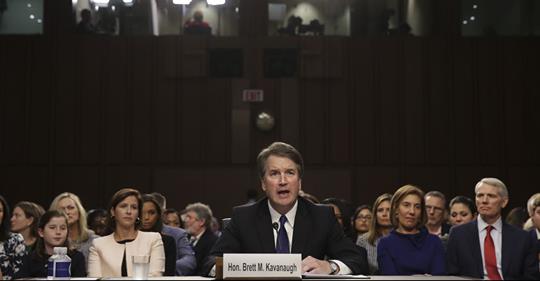
Senate confirmation hearings reveal just how dangerous Brett Kavanaugh’s confirmation would be to reproductive autonomy.
Three days of Senate Judiciary Committee hearings on the nomination of Judge Brett Kavanaugh to replace retired Supreme Court Justice Anthony Kennedy didn’t just confirm that Kavanaugh would fulfill President Donald Trump’s promise to appoint a justice who would overturn Roe v. Wade. They revealed that Kavanaugh has dedicated a significant portion of his legal career to finding a path to do just that.
Even before the confirmation hearings began, it was clear that Kavanaugh poses a very real risk to reproductive rights, no matter how many times he told Sen. Susan Collins (R-ME) he planned to respect court precedent. His public comments praising former Supreme Court Chief Justice William Rehnquist’s dissenting opinion in Roe v. Wade are one great example. As I detailed here, these remarks were a very clear signal to anti-choice advocates that Kavanaugh would be a safe vote against abortion rights—because Rehnquist’s dissent in Roe rejects the constitutional right to privacy altogether.
Then there is Garza v. Hargan, wherein Kavanaugh argued vigorously for the government’s right to “refrain from facilitating” access to an abortion for an undocumented minor in its custody. First, he issued an order in the case that would have effectively pushed the pregnancy at issue too late to obtain an abortion under Texas law. Then, when that order was quickly overturned by his colleagues on the D.C. Circuit Court of Appeals, he issued a dissent in which he accused his colleagues of advancing “abortion on demand,” a refrain commonly shouted by anti-choice activists to describe legal abortion.
Kavanaugh’s own testimony over the course of the past three days has borne this out as well. Kavanaugh frequently talked about Roe as Supreme Court precedent and even “super-precedent,” with Planned Parenthood v. Casey’s affirmation of it.
That sounds good, right? Not so fast.
Precedent can be “unsettled” by the Supreme Court. Kavanaugh reminded us of that time and time again by invoking Brown v. Board of Education.Brown overruled Plessy v. Ferguson, the decision that had endorsed “separate but equal.” Kavanaugh praised Brown not just for correctly finding school segregation unconstitutional, but as one of the greatest moments in Supreme Court history.
Again, this sounds good, right?
It would be if anti-choice activists didn’t consistently use the Plessy and Brown cases as an analogy for their attempted pathway to overturn Roe. So consider every reference Kavanaugh made to Plessy and Brown a wink to those activists, likely intended to reassure the most radical conservatives that he knows how to get the job of overturning Roe done and is clever enough to disguise it before the broader public.
Republican Sens. Lindsey Graham (SC) and Ben Sasse (NE) helped Kavanaugh in this effort by talking about the litigation process and strategy it takes to overturn Supreme Court precedent. Sasse’s entire line of questioning to Kavanaugh was about undermining Roe, starting with the proposition that the Supreme Court can be wrong and moving on to how advocates spent decades building a record, in courts of law and public opinion, to provide the Court cover to ultimately overturn the Plessy decision. The subtext to these exchanges could not be more clear. Anti-choice forces see an opening with a Kavanaugh confirmation to end Roe—and they used their time with him on Wednesday and Thursday to get reassurances from him on that very point.
And Kavanaugh’s consistent reference to Planned Parenthood v. Casey as creating Roe‘s status as “super-precedent” shouldn’t be read as a sign he’s willing to rule in favor of abortion rights either. Yes, Caseyreaffirmed Roe. But it also granted the government broad powers to regulate abortion rights. Casey has done as much to undermine abortion rights as it did to reaffirm themby creating the “undue burden” framework. After all, parental notification provisions, waiting periods, mandated ultrasounds, and forced disclosures are all restrictions on abortion rights federal courts have found to be constitutional under the Casey undue burden framework. Kavanaugh’s consistent reference to Casey suggests he’d uphold restrictions under that framework as well. In that scenario, the Court doesn’t need to overturn Roe. It just needs to uphold enough restrictions on abortion rights to render them legal in name only.
As important as Kavanaugh mentioning Planned Parenthood v. Casey repeatedly is the fact that he failed to mention Whole Woman’s Health v. Hellerstedt at all. Whole Woman’s Health is the 2016 decision that struck as unconstitutional a series of Texas abortion regulations that were deemed an undue burden on abortion rights. In that case, the Supreme Court majority held that when it comes to evaluating undue burdens, courts must weigh the extent to which the restrictions in question actually serve the government’s stated interest in enacting them against the burden they impose. The decision is an important win for abortion rights—not in the least because it forces lawmakers to be able to support their rationale for restricting abortion rights with actual evidence.
By Thursday evening, Judge Kavanaugh had yet to discuss his views on Whole Woman’s Health. When Sen. Kamala Harris (D-CA) asked him if he thought the case was correctly decided, Kavanaugh wouldn’t answer the question.
He also called birth control an abortifacient when responding to a question from Sen. Ted Cruz (R-TX) about litigation challenging the birth control benefit in the Affordable Care Act, echoing another anti-choice talking point that dangerously conflates contraception with abortion.
Then there are Kavanaugh’s documents. The secrecy and lack of transparency around the record of his time in the Bush White House is unprecedented. The process for disclosing documents has been largely controlled by Bill Burck, who marked hundreds of thousands of pages of documents confidential. Democrats objected and finally leaked some of the documents Burck didn’t want the U.S. public to see. Among them were an email where Kavanaugh says that many legal scholars do not see Roe v. Wade as settled law and documents related to Kavanaugh’s shepherding radical Bush judicial nominees like William Pryor through the confirmation process. These nominees themselves have pledged to do all they can to overturn Roe.
So where does this leave us? Kavanaugh’s confirmation hearings are not quite over, and both the Judiciary Committee and the full Senate need to vote on his nomination. But absent some Republicans joining Democratic senators in opposition to Kavanaugh, his confirmation is all but guaranteed. That’s when the clock officially begins to tick on the challenge to Roe.
That’s because 13 abortion cases are already before circuit courts around the country, the last step before reaching the Supreme Court. Reproductive rights advocates say any one of them could provide an opportunity for a Kavanaugh Court to reconsider the right to an abortion set forth in Roe.
Because of Roe, states can’t ban abortion outright. Instead, legislatures have passed a number of measures in recent years that restrict access to the procedure — by imposing onerous and often medically unnecessary restrictions on providers, for example, or by banning particular abortion techniques. Abortion providers and others have challenged these laws in court, arguing that they violate Roe or the 1992 decision Planned Parenthood v. Casey, which states that laws may not place an “undue burden” on a patient’s right to an abortion.
Thirteen of these challenges have now reached federal courts of appeals, meaning they’re one step away from the Supreme Court. If the Court agrees to hear one of them — which could happen as early as this year — it could provide an opportunity for the justices to revisit the right to an abortion guaranteed in Roe.
Even with Kavanaugh replacing Kennedy, the Court might not fully overturn Roe. Many believeit’s more likely that the Court would weaken abortion protections by, for example, altering the “undue burden” standard set forth in Casey.
But such a decision could have nearly the same impact as eliminating Roe since it would allow states to effectively block abortion access by imposing ever more onerous restrictions — a strategy anti-abortion groups have already pursued to great effect in states like Mississippi. Even if the words “‘Roe v. Wade is now overruled’ don’t appear in an opinion, the Court can really harm women,” Julie Rikelman, the senior director for litigation at the Center for Reproductive Rights, told Vox.
Protesters dressed in costumes referencing The Handmaid’s Tale awaiting the confirmation hearing of Supreme Court nominee Judge Brett Kavanaugh. Photo by Win McNamee/Getty Images
Any of these cases could be the one that guts Roe
Planned Parenthood has identified the 13 cases below as potential challenges to Roe v. Wade. Each concerns a state or federal abortion restriction.
Reproductive rights advocates say that because of the complexities of each case, it’s impossible to tell which might make it to the Supreme Court first. And, of course, a new case could come up at any time.
But the court will be taking cases for the 2018-19 session through January, said Helene Krasnoff, vice president of public policy, litigation, and law for the Planned Parenthood Federation of America. If the court takes an abortion case this term, it would issue a decision by the summer of 2019. “This could become a reality very, very soon,” she said.
Louisiana
June Medical Services et al. v. James Caldwell
Abortion providers are challenging a 2014 Louisiana law that would require physicians providing abortions to have admitting privileges at a nearby hospital. Such laws do little to protect patients’ health, and are typically passed in an attempt to shut down abortion providers, who often have difficulty finding a hospital willing to grant them admitting privileges.
In 2016, the Supreme Court ruled in Whole Woman’s Health v. Hellerstedt that a similar law in Texas was unconstitutional, because it placed an undue burden on the right to access an abortion established in Roe. But a court minus Justice Anthony Kennedy, plus Brett Kavanaugh might make a different decision — and could use the case as an opportunity to revisit Roe.
Right now the case is awaiting a decision in the Fifth Circuit Court of Appeals.
Texas
Whole Woman’s Health et al. v. Ken Paxton et al.
In this case, providers are challenging a 2017 Texas law banning a second-trimester abortion procedure called dilation and evacuation, in which the cervix is dilated and the fetus removed by suction. Opponents of the law say that banning dilation and evacuation, the safest and most common method of abortion after 15 weeks’ gestation, would put women at risk and place an undue burden on their right to get an abortion.
The case is awaiting arguments in the Fifth Circuit Court of Appeals.
Kentucky
EMW Women’s Surgical Center et al. v. Andrew Beshear et al.
EMW Women’s Surgical Center, the only licensed abortion provider in Kentucky, is suing to block a 2017 state law that requires doctors to administer an ultrasound to pregnant patients prior to an abortion. Doctors are also required to show and describe the ultrasound to the patient, and to play the sound of the fetal heartbeat if it can be detected. Opponents of the law say it is medically unnecessary and could cause patients trauma, especially if they became pregnant as a result of sexual assault.
The case is waiting for a decision in the Sixth Circuit Court of Appeals.
Ohio
Preterm-Cleveland et al. v. Lance Himes et al.
Planned Parenthood affiliates and other providers are challenging a 2017 Ohio law that would ban abortion if a doctor has any reason to believe the fetus has Down syndrome. The law contains no exception for preserving the life or health of the mother, and opponents say it violates Roe by restricting abortion before a fetus is viable outside the womb.
Briefing in the case is ongoing in the Sixth Circuit Court of Appeals.
Indiana
Planned Parenthood of Indiana & Kentucky v. Commissioner of the Indiana State Department of Health et al.
Planned Parenthood of Indiana & Kentucky is suing to block a 2016 Indiana law that prohibits doctors from performing abortions if the patient is seeking the procedure because of the fetus’s sex, race, disability or potential diagnosis of disability. The law, signed by then-Gov. Mike Pence, also included other provisions such as a mandate that miscarried or aborted fetuses be buried or cremated, and was so restrictive that it disturbed even Republicans in the state Legislature.
Critics said that by banning abortion because of fetal abnormality, the law could keep patients from being honest with their doctors, or force them to carry dangerous pregnancies to term.
A district court blocked the law in 2017, and the Seventh Circuit Court of Appeals upheld the decision. But the state of Indiana could decide to appeal to the Supreme Court.
Planned Parenthood of Indiana & Kentucky et al. v. Commissioner of the Indiana State Department of Health et al.
In a separate challenge to the same Indiana law, Planned Parenthood argued that a provision requiring an 18-hour waiting period between a state-mandated ultrasound and the abortion procedure placed an undue burden on patients.
The state of Indiana has filed a petition for a rehearing of the case with the Seventh Circuit Court of Appeals.
Planned Parenthood of Indiana & Kentucky v. Adams et al.
Planned Parenthood is challenging a 2017 Indiana law governing parental consent for minors seeking abortions. Under the law, parents must show proof of their identity and relationship to the minor when providing consent, and the law would allow judges to notify the minor’s parents that she was seeking an abortion. Critics of parental consent laws, which are in effect in many states, argue that they can leave pregnant minors vulnerable to abuse. Opponents of the Indiana law in particular argue that requiring parental identification could block abortions for minors whose parents don’t have valid ID.
The case is awaiting a decision in the Seventh Circuit Court of Appeals.
Missouri
Comprehensive Health of Planned Parenthood Great Plains et al. v. Williams et al.
Planned Parenthood has challenged Missouri requirements that abortion providers have hospital admitting privileges and that abortion facilities conform to ambulatory surgical center (ASC) standards. According to the Guttmacher Institute, ambulatory surgery centers typically perform riskier procedures than abortion clinics, and laws applying ASC standards to abortion facilities are generally aimed at reducing abortion access, not improving patient care. Planned Parenthood filed suit to challenge the Missouri requirements after the Supreme Court found in Whole Woman’s Health v. Hellerstedtthat similar requirements in Texas were unconstitutional.
The case is awaiting a decision in the Eighth Circuit Court of Appeals.
Arkansas
Frederick W. Hopkins v. Larry Jegley et al.
A provider is challenging four abortion restrictions passed in Arkansas in 2017, including a ban on dilation and evacuation and a measure requiring doctors to request a patient’s “entire pregnancy history” to be sure she is not seeking a sex-selective abortion.
The case is awaiting argument in the Eighth Circuit.
Planned Parenthood Arkansas & Eastern Oklahoma et al. v. Larry Jegley et al.
Planned Parenthood has challenged a 2015 Arkansas law requiring that physicians dispensing medication abortion have a contract with another physician who has hospital admitting privileges. A district court found that the requirement had little benefit for patients, since Planned Parenthood already had a thorough protocol in place to administer medication abortions and treat any complications that arose. The state of Arkansas appealed the decision.
The case is awaiting briefing and argument in the Eighth Circuit.
Alabama
Reproductive Health Services v. Marshall
An abortion provider is suing to block a 2014 Alabama law changing the process by which minors can receive an exemption from parental notification requirements. Most state parental notification laws allow minors to forego parental notification of an abortion if they can get permission from a judge, a process known as judicial bypass.
The Alabama law would make the process of seeking such a bypass much more involved: it would require the judge to notify the county district attorney’s office, appoint a legal guardian for the fetus, and, in some cases, allow the minor’s parents to be part of bypass proceedings. The guardian for the fetus could cross-examine the pregnant minor, call witnesses to testify against her, and appeal the judge’s decision.
“It is terrifying to minors who seek a bypass that the decision about whether she can have an abortion — one that will literally change the course of her life — is in the hands of a stranger,” the lawsuit states. “This fear will be significantly increased due to the Act’s provisions.”
The case is currently awaiting a decision in the Eleventh Circuit Court of Appeals.
West Alabama Women’s Center v. Miller
West Alabama Women’s Center, an abortion provider in Tuscaloosa, Ala., is challenging a 2016 ban on dilation and evacuation.
On August 22, the Eleventh Circuit Court of Appeals sided with the district court, which had ruled against the law. The state of Alabama can now decide whether to appeal the case to the Supreme Court.
Washington, DC
Rochelle Garza et al. v. Alex Azar, II et al.
The ACLU has filed a class-action suit on behalf of pregnant, unauthorized immigrant minors in the custody of the Office of Refugee Resettlement, part of the Department of Health and Human Services. The plaintiffs are seeking to block what they say is an ORR policy of denying minors access to abortion services.
The suit comes after the cases of Jane Doe and other pregnant minors last year, who were initially prohibited from getting abortions while in ORR care. Last year, in a dissenting opinionin Garza v. Hargan, Brett Kavanaugh argued that, rather than allowing Doe to get an abortion while under ORR care, the government would be within its rights to make her wait until she could be released to an immigration sponsor. It’s the only abortion case on which Kavanaugh has ruled.
Oral arguments in the DC Circuit Court of Appeals are scheduled for September 26.
The “fetal burial” law, passed in 2017 by the Texas legislature, was part of expansive anti-choice restrictions signed into law by Republican Gov. Greg Abbott.
A Texas Republican-backed law forcing health-care providers to bury fetal tissue from an abortion or miscarriage could be headed to the Fifth U.S. Circuit Court of Appeals after a judge on Wednesday ruled against the law favored by anti-choice activists.
U.S. District Judge David Ezra ruled on Wednesday that the law created “substantial obstacles” for people seeking abortion services and abortion clinics, while providing “absolutely no health benefit in return,” the Houston Chroniclereported.
The “fetal burial” law, passed in 2017 by the Republican-held Texas legislature, was part of expansive anti-choice restrictionssigned into law by Gov. Greg Abbott (R). The measures were considered a priority for Texas Right to Life, the state’s powerful anti-choice lobby. The anti-choice omnibus law also targeted the common dilation and evacuation (D and E) abortion procedure.
The Center for Reproductive Rights and the Lawyering Project on behalf of Whole Woman’s Health and Whole Woman’s Health Alliance challenged the Texas law in court.
“While Texas lawmakers have shown they will stop at nothing to rob women of their constitutional right to safe and legal abortion, the courts once again recognized these sham laws for what they are,” Nancy Northup, president and CEO of the Center for Reproductive Rights, said in a statement. “We have repeatedly taken Texas to court, and we will continue to challenge each of the state’s unconstitutional attempts to shame women, tie the hands of healthcare providers, and restrict access to safe and legal abortion.”
Forcing people to bury fetal remains could add up to $2,000 to the cost of abortion care, according to the Funeral Consumers Alliance of Texas, as the Austin Chronicle reported.
“Today’s ruling is a victory for all Texan women and their right to access safe, legal abortion with dignity,” Amy Hagstrom Miller, founder and president of Whole Woman’s Health and Whole Woman’s Health Alliance, said in a statement on Wednesday’s ruling. “Make no mistake, these restrictions were designed to shame and stigmatize patients and health care providers.”
A federal judge in January 2017 blocked enforcement of the so-called fetal burial provision after it was introduced by state officials as a rule, before lawmakers took up the issue. Judge Sam Sparks deemed the anti-choice measure an “undue burden” on access to abortion care. “It seems unlikely DSHS’s professed purpose is a valid state interest and not a pretext for restricting abortion access,” Sparks wrote in his decision.
The Pigpen-style swirl of crime around the president who nominated Brett Kavanaugh to the Supreme Court is extraordinary. Still, there is one very standard aspect of the Kavanaugh nomination: the obfuscating code words around abortion. The judicial nominees of Republican presidents in particular have historically said as little as possible about abortion in their hearings, the better not to awaken a public that to this day is overwhelmingly supportive of Roe v. Wade. “Do I have this day an opinion, a personal opinion on the outcome in Roe v. Wade?… [M]y answer to you is that I do not,” Clarence Thomas solemnly declared in his own hearing. Nine months later, as a justice, he joined an opinion stating, “Roe was plainly wrong.”
Candidate Donald Trump broke from the euphemisms to claim that Roe’s demise “will happen automatically in my opinion because I’m putting pro-life justices on the Court.” And when Kavanaugh’s name was first floated to replace retired Justice Anthony Kennedy, conservative insiders publicly reassured their own nervous ranks about his anti-abortion bona fides. “On the vital issues of protecting religious liberty and enforcing restrictions on abortion, no court-of-appeals judge in the nation has a stronger, more consistent record than Judge Brett Kavanaugh,” wrote one former clerk, while a conservative attorney offered, “There is no reason to conclude that Kavanaugh would support Roe and Casey when presented with the question as a Supreme Court justice.” The moment Trump actually named Kavanaugh, however, the gaslighting of abortion supporters began: People who dared worry about the future of the procedure were “scaremongers”consumed by “hysteria” — after all, Kavanaugh was such a stand-up guy he’d chosen female clerks! People, it’s all on the internet; we can read.
Nonetheless, Kavanaugh’s hearings will be full of doublespeak. For help reading between the lines, consult the below.
“Abortion on demand.”
Thrown around by the right — including Kavanaugh, who tellingly used it three times in his one major abortion opinion — to denote women capriciously making decisions for themselves.
“Balls and strikes.”
By his own account, Brett Kavanaugh racked up tens of thousands of dollars of debt on baseball tickets, so perhaps he’ll revert to Chief Justice John Roberts’s aw-shucks mantra in his 2005 confirmation hearings: “I will remember that it’s my job to call balls and strikes and not to pitch or bat.” In other words, he promised to uphold the law and the Constitution, not impose policy preferences, like making abortion illegal. Of course, cases usually get to the Supreme Court because other judges have reasonably disagreed on what the law or Constitution means.
“Between a woman and her doctor” and “safe, legal, and rare.”
Some Democrats still use these vintage pro-choice talking points, but they grate on a new generation of abortion rights activists. “Between a woman …” implicitly defers to a white-coated professional over a pregnant person’s reproductive autonomy and doesn’t acknowledge that trans people have abortions. “Safe and legal” still has lots of fans on the left, but “rare,” as Tracy Weitz put it, “separates ‘good’ abortions from ‘bad’ abortions.’” In 2012, Democrats took the Clintonian slogan out of their platform.
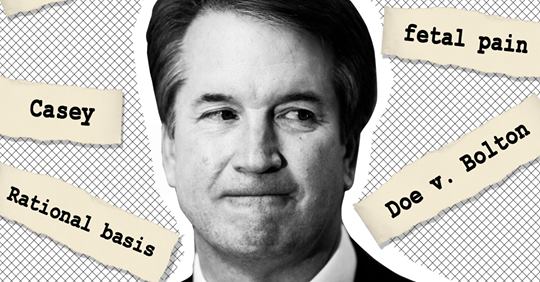
Casey (or Planned Parenthood of Southeastern Pennsylvania v. Casey).
This unloved legal compromise, decided by the Supreme Court in 1992, declined to overturn Roe but said states could erect all kinds of roadblocks to prevent women from exercising that right — as long as the obstacles don’t present a so-called “undue burden.” The legal haggling ever since has been over exactly which burdens are undue. You can thank retiring Justice Anthony Kennedy for this unwieldy creation that at least kept abortion legal for the past 25 years. And then you can thank him for making way for the man who may undo that.
“The democratic process” or “It should go to the states.”
This is what you’re likely to hear from Republicans, and what’s not to like about some good old-fashioned democracy? Well, previously in the democratic process and states’ rights: bans on interracial marriage and other Jim Crow–era restrictions. “The democratic process” would likely mean the loss of abortion access in 22 states, but regardless, these arguments purporting to be about process are really about achieving certain outcomes. Congressional Republicans weren’t exactly respecting states’ rights when they introduced federal personhood bills, prohibitions on race- and sex-selective abortion, or legislation to forbid abortion at 20 weeks or when the fetal heartbeat can be detected. In fact, the GOP platform includes support for a human life amendment that would outlaw all abortion everywhere.
“Dismemberment abortion,” “partial-birth abortion,” and “fetal pain.”
These are political, not medical, concepts cooked up by the anti-abortion movement to refocus the debate on the fetus and on potentially uncomfortable details. In 1995, when the National Right to Life Committee heard about a doctor performing abortions through intact dilation and extraction, they named it “partial-birth abortion” to “foster a growing opposition to abortion,” and the Supreme Court signed off on banning it. The Court has yet to weigh in on laws passed in 17 states blocking abortion after about 20 weeks on the medically unproven theory that the fetus feels pain at that time, or on prohibitions against “dismemberment abortion” —another concocted term for a common and safe abortion method — that was passed in nine states.
Doe v. Bolton (1973).
You don’t hear much about this lesser-known companion case to Roe v. Wade, decided at the same time, but it’s GOP code for “women having abortions willy-nilly.” In this case, brought on behalf of a Georgia woman, seven justices ruled that abortion could be banned at viability as long as there was an exception for a woman’s health, defined broadly by a physician as “all factors — physical, emotional, psychological, familial, and the woman’s age — relevant to the well-being of the patient.” Doe v. Bolton is why Paul Ryan once sneered, “The health exception is a loophole wide enough to drive a Mack truck through it,” and John McCain, when debating the issue, put derisive air quotes around the word “health.”
Dred Scott v. Sanford (1857) and Plessy v. Ferguson (1896).
These irrefutably wrong Supreme Court decisions upholding slavery and segregation are evoked by conservatives in the abortion debate to (1) compare abortion to slavery, and (2) point out that some Supreme Court precedents are actually bad. When George W. Bush brought up Dred Scott in the 2004 presidential debate, one Evangelical leader called it “a poignant moment, a very special gourmet filet mignon dinner.”
Garza v. Hargan or Garza v. Azar (2017).
The rare abortion case on which Kavanaugh has ruled. The Trump administration unsuccessfully tried to bar a raped migrant teenager from leaving detention to have an abortion, even though she’d jumped through all the legal hoops. Some conservatives protested that Kavanaugh didn’t go far enough by not joining another dissent that claimed that legally, an undocumented immigrant is not a person. Kavanaugh’s own dissent would have run out the clock by looking for a sponsor, a process that had already delayed the young woman’s abortion by seven weeks and threatened to push her pregnancy past the legal limit. The biggest tell of all: Kavanaugh deferred to rulings keeping abortion legal but wrote, “As a lower court, our job is to follow the law as it is, not as we might wish it to be.” On the Supreme Court, on the other hand …
“Even Ruth Bader Ginsburg hates Roe v. Wade” and “the Ginsburg rule.”
Yes, Ginsburg has often critiquedRoe, but that’s because she preferred a different strategy (incrementally striking down abortion bans rather than all at once); legal basis (women’s equal citizenship rather than right to privacy); language (maybe a tiny bit less patronizing to women and deferential to doctors); and test case (specifically her own client, a nurse the military was trying to force to abort). So what? It doesn’t make her any less an unbending supporter of reproductive freedom, and it’s irrelevant because Casey, which she likes a bit better, is the standard we now have. As for the so-called Ginsburg rule Senate Republicans invoke to say Kavanaugh doesn’t have to say shit about shit: While Ginsburg did say in her 1993 hearing that she didn’t want to speculate on future cases, this is what she also said in those same hearings: “[Abortion] is something central to a woman’s life, to her dignity. It’s a decision that she must make for herself. And when government controls that decision for her, she’s being treated as less than a fully adult human responsible for her own choices.” By all means, let’s have Kavanaugh follow the Ginsburg rule.
Griswold v. Connecticut (1965).
This opinion struck down a ban on contraception for violating a “right to marital privacy,” forming some of the basis for Roe. Asking about it has been used as a proxy for asking about Roe; those who express reservations about Griswold probably feel the same about Roe, in other words.
“Original public meaning,” and “originalism.”
This is the conservative dictum that judges should stick to the framers’ intentions, popularized by the late Justice Antonin Scalia. Taken to its strictest conclusion, originalism could make it legal to discriminate against women and LGBT people, legalize segregation — and of course ban abortion. Some liberals argue that the framers intentionally used broad language to encourage interpretation over time.
“Rational basis.”
While Casey said states could only restrict abortion as long as it didn’t put an “undue burden” on a woman’s access, “rational basis” would be an even lower bar, one that the conservative Fifth Circuit tried to slip through in Whole Woman’s Health only to be slapped down by the Supreme Court. Under rational basis, almost any restriction on abortion would be allowed to stand without much scrutiny — say, requiring all medical equipment to be gold-plated — as long as it sounded reasonable.
Roe v. Wade (1973).
Only two justices dissented from the opinion that struck down all state abortion bans, and one was Justice William Rehnquist, who in 2017 Brett Kavanaugh called his “first judicial hero.”
“Settled law” or “precedent” or “stare decisis.”
When Kavanaugh told Maine senator Susan Collins that Roe is “settled law,” she was satisfied that he wouldn’t go after the fundamental right to abortion. But mouthing the right words about how the Court is supposed to avoid sudden moves doesn’t mean long-standing decisions can’t be toppled. Chief Justice John Roberts, who called Roe “settled as a precedent of the court,” has never voted against a restriction on abortion. Plus, he’s voted to strike down plenty of long-standingprecedents with regard to voting rights, union rules, and money in politics.
Stenberg v. Carhart (2000)and Gonzales v. Carhart(2007).
With the help of Justice Sandra Day O’Connor, the court struck down Nebraska’s “partial-birth abortion” law because it had no exception for the health of the woman. But when she retired and was replaced by Justice Samuel Alito, the court waved through a federal version. So much for precedent.
Whole Woman’s Health v. Hellerstedt (2016).
In the Court’s last big abortion case, Justice Anthony Kennedy voted with the four Democratic appointees in ruling that states had to have a really good reason for regulating abortion clinics out of business. If the Court would overturn just this single, very recent so-called precedent, the last clinic in Mississippi would be forced to shut down, and quite possibly nearly three-quarters of the clinics in Texas — to name just two states where abortion access would be severely curtailed.











/cdn.vox-cdn.com/uploads/chorus_asset/file/12865337/1026695404.jpg.jpg)




 Abortion - Abortion Clinics, Abortion Pill, Abortion Information