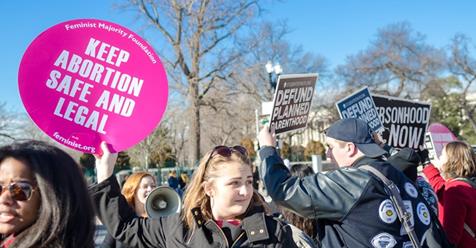
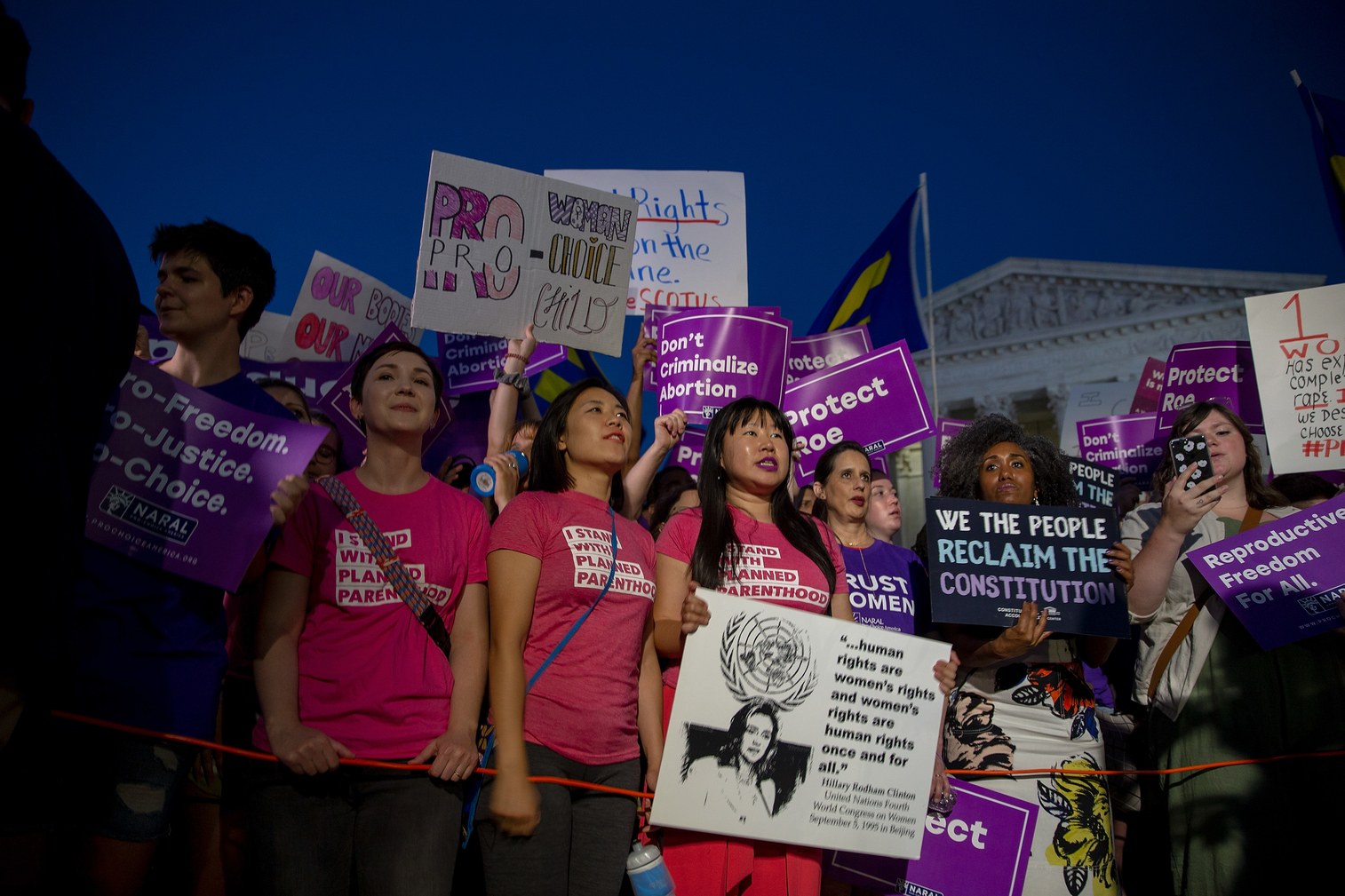
In both being able to choose it and in having it, my abortion gave me the power to determine my life course for myself.

Judge Brett Kavanaugh’s record strongly suggests he would downgrade the right to abortion. Alex Wong / Getty

Summer as a 19-year-old was wonderful. My life was on the track I wanted. I had a paid internship with a prestigious Wall Street firm, a year of an Ivy League education under my belt, and a clear path ahead for wherever I decided to take my career. There was nothing but opportunity on my horizon, until an unintended pregnancy threatened to curb my aspirations.

However, within a week or two of missing my period, I walked into Planned Parenthood, cash in hand, for a medication abortion. Just like that, my life was back on track. I finished my internship, completed my college education, went on to law school, and became a constitutional lawyer.

My situation was ideal, but it was also rare. I lived in New York City, where there were accessible abortion providers; I had no children to arrange care for; I was able to take the time that I needed off my internship; and I could pay up-front for my abortion. Most people in the United States don’t live close to an abortion provider they trust, don’t have paid time off work, or can’t afford the cost of an abortion. Too often, access to abortion care depends on your ZIP code. And instead of making abortion more accessible, President Donald Trump has promised to end federal constitutional protection for abortion and to punish people who seek such health care.

While a candidate for President, Trump vowed to appoint “pro-life” judges to the Supreme Court so that Roe v. Wade, the landmark decision recognizing our fundamental right to abortion, would be overturned “automatically.” And now he has nominated Judge Brett Kavanaugh to replace retiring Justice Anthony Kennedy on our nation’s highest court, with hearings scheduled to begin next week.

Justice Kennedy, though he often upheld restrictions that make accessing abortion difficult, was a reliable vote to ensure that Roe v. Wade still had tangible meaning in the United States. In 1992, Kennedy voted to reaffirm the core holding of Roe in Planned Parenthood v. Casey; he did so again, in Whole Woman’s Health v. Hellerstedt, in 2016. With Justice Kennedy’s retirement, the Supreme Court is split down the middle, with four conservative justices hostile to Roe and the protection of individual liberty, dignity, and equality. As a result, Roe is at risk, and Brett Kavanaugh could tip the scales against it.

Judge Kavanaugh’s record suggests he may have passed Trump’s litmus test for a Supreme Court nomination quite easily. As a judge, he tried to stop a detained immigrant minor from accessing the abortion care she wanted. He denounced the court’s ruling, which vindicated her right to do so, as a “radical” one that guaranteed “abortion on demand.” In a 2017 speech, he praised Chief Justice William Rehnquist’s dissent in Roe and his decades-long mission to overturn the decision. And just last week during his interview with Republican Sen. Susan Collins of Maine, he agreed with Chief Justice John Roberts’ view that Roe is “entitled to respect under principles of stare decisis,” or settled law—the same Chief Justice Roberts who in 2007 and 2016 voted to limit access to abortion.

Should Judge Kavanaugh become Justice Kavanaugh, he will have the power to continue Chief Justice Rehnquist’s work and fulfill Trump’s pledge to overturn Roe v. Wade and leave “the states [with] . . . the power to legislate with regard to this matter,” as Judge Kavanaugh said. The problem is, most states are already seeking to roll back the promise of Roe. In the first quarter of 2018 alone, 37 states introduced 308new abortion restrictions, including pre-viability bans, procedure bans, increased waiting periods, and restrictive requirements placed on abortion providers that are not required of other health-care professionals.

But what does that really mean for people like you and me?

It means that if legislative attacks on Roe stand, the fundamental right to abortion could be stripped away from millions of people, with the impact falling hardest on low-income people, young people, people of color, and immigrants. Clinics will continue to close, getting an abortion will take even longer and thus be more expensive, and more people will be forced into carrying unwanted pregnancies, increasing their chances of falling into poverty and being the victim of domestic violence.

According to a report by the Center for Reproductive Rights, if the Supreme Court were to go so far as to overturn Roe, 22 states could soon thereafter ban abortion outright, with four of them outlawing abortion automatically upon the Court’s decision. An additional 11 states, with their current legislative composition, would likely pass legislation to ban the procedure. At least 37 million people of reproductive age living in those states would be stripped of their liberty and may be forced to take illegal measures. For history has taught us illegal abortion does not lead to less abortion—it leads to unsafe, deadly abortion.

This is not how the Constitution is meant to work. A fundamental, enumerated right like liberty—which includes bodily integrity, autonomy, and basic dignity, and is essential to women’s equal citizenship stature—is not meant to be enjoyed in only certain pockets of our country or only by those who can afford to travel to a place where it’s recognized. Our supreme law must apply to each of us equally.

Judge Kavanaugh’s record strongly suggests he would downgrade the right to abortion. In his dangerous view, it is a part of the “free-wheeling judicial creation of unenumerated rights that were not rooted in the nation’s history and tradition.” But history shows that the framers of the 14th Amendment wrote that amendment with sweeping language to provide broad protections for substantive liberty—not limited to rights enumerated elsewhere in the Constitution—to secure equal citizenship status for men and women of all races and classes alike. During the debates on the amendment, the framers lambasted the treatment of enslaved families. They decried women being forced to bear children, couples being denied the right to marry and often separated, and children being taken from their parents. To remedy this horror, they wrote the 14th Amendment to guarantee basic rights of personal liberty and bodily integrity to all, including if, when, and how to have a family. As Justice Ruth Bader Ginsburg once wrote, the 14th Amendment guarantees “a woman’s autonomy to determine her life course, and thus to enjoy equal citizenship stature.”

In both being able to choose it and in having it, my abortion gave me what Justice Ginsburg described and so many cis men take for granted: the power to determine my life course for myself. I am where I am now because of decisions I made and support provided by my loved ones. I cannot imagine where I would be now had I been forced to carry an unwanted pregnancy to term—if I would have been able to survive childbirth as a Black woman in the United States at all. It is the unimaginable that fuels my concerns about Judge Kavanaugh as a potential Supreme Court justice.

With the constitutional right to abortion on the line, Judge Kavanaugh should not be allowed to evade questions about our fundamental rights during his confirmation hearing next week like he did before, during his nomination hearing to the D.C. Circuit in 2006. The Senate must only confirm a justice who affirmatively declares that they believe the Constitution protects individual liberty and the right of all people to make personal decisions about their bodies and personal relationships—including the right to have an abortion.

Source: https://rewire.news/article/2018/08/29/my-abortion-kept-my-life-on-track-but-with-kavanaugh-on-the-court-millions-could-be-denied-that-choice/

The Massachusetts Democrat vying in Tuesday’s primary to represent the state’s only district that’s majority people of color doesn’t believe there’s a place in the Democratic party for people who vote against abortion rights.

“It is my fundamental belief that the people closest to the pain, should be the closest to the power.”

That’s how Boston City Councilor Ayanna Pressley explained her governing principles in an August campaign video that shows her riding the city bus from Cambridge to Roxbury.

If she’s successful in Tuesday’s primary, she’ll oust incumbent Democratic Rep. Mike Capuano from a U.S. Congressional seat he’s held in Massachusetts for nearly two decades. Capuano, who has served over ten terms in the U.S. House of Representatives, represents Massachusetts’ seventh Congressional district—the state’s only district where the majority of residents are people of color.

“The idea that Democrats must choose whether we are the party of working class white voters or the party that lifts up people of color is a dangerous, false choice,” Pressley told Rewire.News in an email.

With endorsements from the Boston Globe, state Attorney General Maura Healey, progressive groups such as Democracy for America, and Alexandria Ocasio-Cortez, the 28-year old democratic socialist who unseated incumbent Rep. Joe Crowley in New York’s 14th District Congressional Democratic primary, many wonder if Pressley could pull off the next major upset of the 2018 election season.

Pressley became the first woman of color to win a seat on the Boston City Council in 2009. In her first year, she formed the council’s Committee on Healthy Women, Families, and Communities, which addresses issues such as domestic violence and child abuse. She has developed “a comprehensive sexual education and health curriculum … which was successfully adopted as a permanent part of the Boston Public Schools’ wellness policy,” and partnered with a racial justice organization to “convene focus groups in evidence based research to reform school disciplinary policies that contribute to the school to prison pipeline for black and latina girls,” according to her campaign site.

In 2015, Pressley won EMILY’s List’s “Gabrielle Giffords Rising Star” award, which honors state and local officeholders the organization describes as having a “commitment to community, dedication to women and families, and determination and civility.” In her acceptance speech, Pressley spoke of her historic election to Boston’s City Council and how her platform centered progressive policies and advocacy for women and girls.

EMILY’s List hasn’t weighed in on Pressley’s race this year, because, according to the New York Times, the organization has a policy of staying out of primaries involving challengers to Democratic incumbents. Capuano has the support of a number of high-profile members of the House, including Reps. John Lewis (D-GA) and Maxine Waters (D-CA).

Speaking with Elle in an interview published Wednesday, Pressley said her campaign may make some people uncomfortable. “I know our [congressional] campaign is one that is disruptive and makes a lot of people uncomfortable in a dark blue district where we don’t primary Democrats, but I think we are in different times. These are times that require bold activist leadership and a reliable vote,” she said.

Pressley is running on what her campaign calls an “Equity Agenda,” which recognizes how inequities in her district “are the legacy of decades of policies that have hardened systemic racism, increased income inequality, and advantaged the affluent.” She declared her candidacy because “we desperately need inclusive, transformative leadership at this pivotal moment … Activism is no longer an option, but is the expectation of our generation.”

Her agenda tackles ten topics her policies will focus on: public health, economic development, the environment, immigration, issues disproportionately impacting women and girls, transportation, violence and trauma, education, housing, and criminal justice.

Pressley, like many progressive Democrats running in primaries this year, supports passing Medicare-for-All in Congress, which she believes “will meaningfully address disparities in access to health care coverage.” Her health platform addresses both maternal health and reproductive health care. She says she would “work to expand access to alternative birthing options, including licensure for doulas, standards for midwives, improvement in postpartum mental health services, resources to reduce disparities in breastfeeding, and the consistent coverage of holistic care by public and private insurance plans.”

Pressley supports the repeal of the discriminatory Hyde Amendment, which bans federal funds from being used for most abortions; eliminating the Hyde Amendment was included in the 2016 national Democratic platform. The anti-choice restriction “disproportionately impacts low-income women, women of color, immigrants, and young people who rely on Medicaid for their healthcare coverage,” Pressley said.

In an email to Rewire.News, Pressley said that if elected she would “lead a movement and build a coalition to fight to repeal this amendment.”

“With a growing coalition of true progressives in the House—led by progressive women—I will not just vote the right way, I will be an activist leader,” she said. “In the same way that organizers and activists saved the Affordable Care Act by organizing, protesting and demanding action, we must harness and channel this progressive energy to organize and repeal this amendment.”

She also vows on her website to co-sponsor Rep. Barbara Lee’s (D-CA) Real Education for Healthy Youth Act as part of her support for comprehensive sexual education. Pressley’s platform says she would fight the Trump administration’s efforts to defund the Teen Pregnancy Prevention Program (TPP) and protect the Title X federal family planning program.

When asked about the inclusion of reproductive rights under the banner of health care in her platform, Pressley told Rewire.News by email that “Reproductive freedom is a basic human right. Full stop.”

“Equity is at the center of my record and agenda for the 7th District—and while my website lists reproductive rights under the healthcare and public health section, it very well could live under my agenda for economic development, for women and girls or for education,” said Pressley. “That’s because for women, reproductive freedom is not only a healthcare issue, but an economic issue and certainly an issue of civil rights.”

Capuano also supports universal health care and co-sponsored the 2017 Expanded & Improved Medicare For All Act. Reproductive rights are not included on his campaign platform under the banner of health care, but the topic is mentioned in a section titled “Positively Impacting Women’s Lives.”

“Mike’s record in Congress reflects the seriousness with which he protects reproductive freedom,” reads his campaign site. “He has always upheld a woman’s right to choose and her right to make her own decisions about health care.” It points to his 100 percent Congressional record ratings with pro-choice groups such as the Planned Parenthood Action Fund and NARAL Pro-Choice America.

Capuano in an interview with the Boston Globe expressed his opposition to the Hyde Amendment. “Capuano said he is an ardent opponent of that law …. Capuano’s campaign made Representative Rosa DeLauro, a Connecticut Democrat and staunch women’s rights advocate, available to vouch for Capuano on the issue,” the publication reported. “She called him a ‘stalwart supporter’ of abortion rights who vigorously opposes the Hyde Amendment.”

He is listed as a co-sponsor of the Equal Access to Abortion Coverage in Health Insurance (EACH Woman) Act of 2017, which would end the Hyde amendment if passed.

Abortion rights have come up as a point of contention between Capuano and Pressley. As the New York Times reported, Pressley brought up the topic during a recent debate in which she referenced a vote by Capuano for health care reform though it included the anti-choice Stupak Amendment, which was meant to bar the Affordable Care Act’s tax credits from subsidizing health insurance plans that cover abortion care.

“After the debate, [Capuano’s] staff produced documentation that Mr. Capuano had voted against both the Stupak Amendment and the Hyde Amendment,” the Times reported. “At the same time, Ms. Pressley’s staff documented that Mr. Capuano had later supported the landmark health care bill even though it included the Stupak Amendment.”

Though Capuano has a pro-choice voting record, he has opposed a Democratic Party litmus test on abortion rights. “That’s crazy, that’s nuts,” he told the Boston Herald Radio’s “Morning Meeting” in August 2017. “I’m as pro-choice as anybody,” he said. “But again that’s a classic issue. It’s very emotional, very hard to debate, but at the same time I respect people who stand up to say, ‘I’m pro-life.’ I don’t agree with them, and I’ll probably vote against their issues most of the time … but I respect their clarity of vision. And I somewhat envy that to some degree.”

“Democrats should be welcoming to anyone who shares our general values,” he continued, noting that he would support a Democratic candidate who opposes abortion rights if he thought they were running in a district that supported those views. “I have a thousand things on the agenda that are critically important, and we need to move forward,” Capuano said.

Pressley told Rewire.News that “a Democrat who will vote against choice does not have a place in the party.”

“A woman’s right to control her own body is not a political calculation and it is not a bargaining chip—it is a basic human right and a central tenet of our party,” she said. “I believe in expanding our electorate and bringing in people with diverse views, but I will never compromise on upholding basic human rights and equality for women. I understand that there are Democrats, who for personal or faith reasons, are personally opposed to abortion, and I respect their personal views, as long it doesn’t result in policy that infringes on women’s rights.”

“Unlike my opponent, I am opposed to the Democratic Party investing resources into electing candidates who will not take a firm stand and support women’s rights to access legal and safe abortion,” Pressley continued.

Capuano’s campaign did not directly answer questions from Rewire.News about how his position on reproductive rights differs from Pressley’s or whether he stands by his comments about anti-choice Democrats.

According to the New York Times, the MA-07 primary is viewed by some as a “a proxy fight for the future of the party.”

When asked whether the candidate agreed with that characterization, Audrey Coulter, Capuano’s communications director, told Rewire.News in a statement that “Mike believes we are in the fight of our lives against Donald Trump’s destructive policies. We need to keep Mike on the front lines of that fight taking on Trump for the people of the 7th district.” She added that Capuano has been “a tireless progressive champion for working families, immigrants, communities of color, seniors and kids, in the fights critical to protecting our most fundamental values. That’s what he does. That’s who he is.”

Pressley, however, suggested that the race was about more than that. It “is part of a larger fight for active, unapologetic progressive values that will strengthen the Democratic Party and strengthen our communities across the country,” she said.

“As Democrats, we must be about more than simply opposing Donald Trump. As important as it is to resist, it is equally important to passionately move forward,” said Pressley. “The entrenched inequalities and disparities are growing worse under this President, but they existed long before he arrived.”

Source: https://rewire.news/article/2018/08/31/activism-is-no-longer-an-option-could-ayanna-pressley-be-the-next-progressive-upset/

Several student leaders said some of the fiercest critics advocating against the bill behind closed doors have been administrators within the University of California (UC) system.

The California State Assembly passed a bill Wednesday requiring all public college campuses in the state to provide access to medication abortions starting in 2022.

The measure, SB 320, was introduced in February 2017 by state Sen. Connie M. Leyva (D-Inland Empire) and passed the state senate in January 2018. Now that that bill has been passed in both chambers, it will go to the desk of California Gov. Jerry Brown (D).

Medication abortion, often referred to as the abortion pill, is a nonsurgical procedure in which pregnancy is terminated through the use two drugs. While conservative critics say the bill “demands campuses hand out abortion pills,” the legislation would not mandate students receive the pills but instead provide it as an option.

Student leaders said some of the fiercest critics advocating against the bill behind closed doors have been administrators within the University of California (UC) system, which contains campuses such as UC Berkeley, UCLA, and UC San Diego. Those campus officials, however, have not taken a public stance against the bill.

“UC has been doing a lot behind the scenes to actively to work against the bill. They haven’t been very forthcoming about it, they haven’t taken [a] position against it, but they’ve been doing things that [made] it very hard for it to pass,” UC Student Association President Caroline Siegel-Singh said in an interview with Rewire.News. “Implementation of this would not be a huge endeavor.”

To illustrate her point, Siegel-Singh said her campus, UC San Diego, offers access to the procedure across the street at one of the university’s community medical centers, but not through student health services on the campus. “We’re just moving it a few feet closer to campus,” she said.

Siegel-Singh said that as recently as this week, UC administrators told legislators implementation would be too expensive, citing what she called wildly inflated numbers that have no basis in analysis done by advocacy groups.

state Assembly Appropriations Committee analysis notes that the bill will not rely on taxpayer funding. In order to supplement this, the Women’s Foundation of California, Tara Health Foundation, and several private donors are set to create a grant of $200,000 for each campus to assist with training and purchase equipment and an additional $200,000 in grants for the creation of new billing systems and 24-hour medical advice lines. The analysis notes that the UC and California State University (the state’s other largest public university system) are concerned about the cost of implementation.

“UC agrees with Senator Leyva that students should have access to affordable and convenient reproductive health care,” said Claire Doan, UC Office of the President (UCOP) director of media relations in a statement to Rewire.News. “However, as we have made clear to lawmakers, we are concerned that SB 320 does not provide adequate funding to support UC’s student health centers for medication abortion services on site.”

Rewire.News obtained UCOP’s fiscal analysis of SB 320. The analysis specifies that UC will only support a cost-neutral bill, one that doesn’t increase student fees or increase the university’s state general fund budget, and argues that UC already provides enough access to reproductive care services.

“It just seems like their hesitation is to not deal with the political pushback, due to the politically controversial nature of abortion,” Adiba Khan, the former co-director of Students United for Reproductive Justice (SURJ) at UC Berkeley, told Rewire.News. “It’s easier for them not to provide it.”

In California, the push for access to medication abortion on college campuses is often traced back to SURJ, a student organization at UC Berkeley, which started pushing for more access to health care on campus in 2016. Although their advocacy efforts on campus resulted in significant pushback and little administrative support, SURJ continued to advocate for more inclusive health-care services on campus, eventually focusing on advocacy for SB 320.

“It made no sense to us that something as simple as medication abortion wouldn’t be provided on campus when other reproductive and sexual health services are available,” Khan told Rewire.News in 2017. “Our medical insurance covers abortion, and there are trained providers already there at the Tang Center [Berkeley’s student health center], so there’s no reason not to make the medication available—other than to avoid controversy on campus.”

Khan, who graduated this year, is a co-founder of SURJ.

Along with several others, Khan helped legislators write SB 320. “If the bill does become a law, my work will be over,” she said. Khan believes that if Brown signs the bill, student leaders like Siegel-Singh and others around the state will continue to advocate for expanded access to health-care options on university campuses. Even so, Khan expects a slow and cumbersome implementation process.

“They do have until 2022 [to implement the measure] and I suspect that there will be some UC’s that will be more receptive .… And I suspect some of them will wait a while,” Khan said. “And so that’s why we have a solid base of students—to make sure that they can keep in contact with their administration and put pressure to get ready as soon as possible.”

During his 2010 re-election campaign, Brown called himself “an uncompromising champion of a woman’s right to choose.” The bill now goes to his desk, though advocates are unsure of what the outcome will be. Siegel-Singh echoed Khan’s words and said that should Brown sign the bill, she and others will be there to continue the push forward, both statewide and on her own campus.

“I totally expect roadblocks. They don’t want to provide the service,” Siegel-Singh said, referring to medication abortions. “What I hope will come out of this, is that people, especially legislators, become more aware that there are so many issues about access to health care services. Even if a student has health care, do they actually have access to what they need if they aren’t in the right county?”

UPDATE: This story has been updated to reflect the findings of a fiscal analysis of SB 320 from the UC Office of the President.

Source: https://rewire.news/article/2018/08/29/california-legislature-passes-bill-requiring-medication-abortion-at-state-universities-amid-concerns-from-campus-administrators/


We talked about “compassion in a crisis.” But did pro-repeal campaigners miss opportunities to talk about autonomy, the right to abortion, and medication abortion’s safety when we fought the country’s draconian abortion ban?

In May, a two-thirds majority of Irish voters cast ballots to repeal the Eighth Amendment, a constitutional ban on abortion.

Having moved away from Ireland for work, I wasn’t directly involved in this most recent phase of the referendum campaign. But I had been an active member of the Abortion Rights Campaign in the three years leading up to the vote and was heavily invested in the result. Several exit polls made me optimistic, but cautiously so, not wanting to count unhatched chickens or uncounted votes.

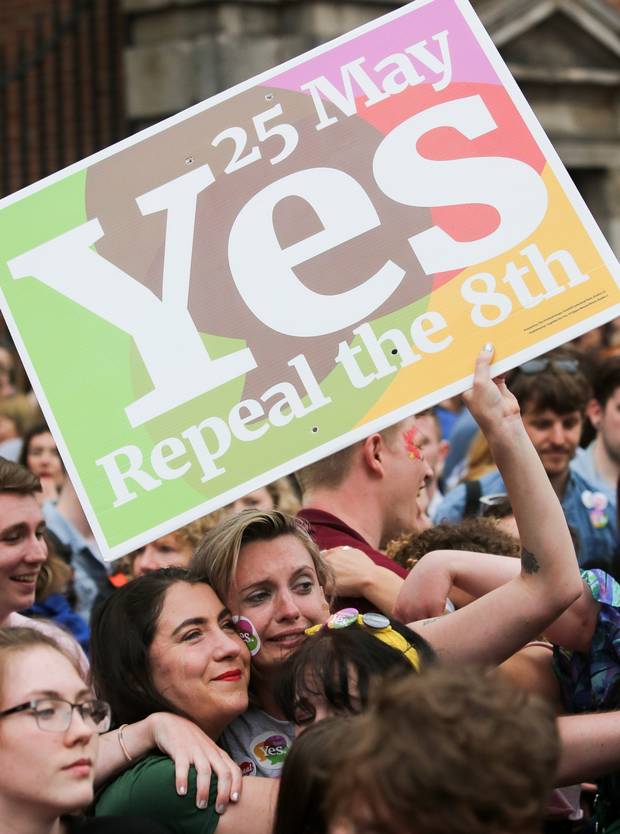
When the official result came in, I hugged friends and fellow campaigners a street chockablock with stark REPEAL sweatersand colorful Together for Yes T-shirts. We repeated, like a happily bewildered broken record, “We did it, we did it!” But overwhelmingly, the mood in Dublin city center that night wasn’t celebration, but relief that we were going to alleviate women’s suffering.
A Yes voter waited anxiously at Dublin Castle for results in the Irish referendum on the Eighth Amendment concerning the country’s abortion laws on May 26. (Charles McQuillan/Getty Images)

Irish society has changed profoundly since the Eighth Amendment debuted in 1983, particularly in the Catholic Church’s diminishing dominance and the increased visibility of women. Together, a combination of cultural change and evidence also won the day. Campaigners worked hard to make sure that information about how Irish women need abortion and how many were accessing it regardless of the ban took center stage.

Waking Up to the Realities

Educating the public was no small task. Ireland’s law said the only grounds for a legal abortion was an immediate, unambiguous danger to the pregnant person’s life. It also made it illegal to share or receive abortion information.

By 2015, this legally imposed silence had done decades of damage. In that year, Amnesty International released the results of the RedC poll, which reported only 9 percent of people knew that the sentence for having an abortion in Ireland was up to 14 years imprisonment.

Still, several legal cases began chipping away at the secrecy and censorship. In 1992, a suicidal child, pregnant by rape, was prevented from leaving the country for an abortion. The resulting X case eventually decided that suicide risk would also be grounds for an abortion, and that Irish women could legally go abroad.

But until recently, few people were aware of the difficulties involved with either concession. A suicidal woman had to go before a panel of six doctors, who judge whether she is “suicidal enough” to qualify—a cruel burden to put on someone struggling with their mental health. Traveling for an abortion, usually to the United Kingdom, was the more common legal option, but not any easier. Such travel requires more than $1,000 in immediately available cash for a first-trimester surgical abortion; navigating at least a full day’s absence from normal life; and a visa for migrant or refugee women. A system that forces a person to sneak away from home and later get back on an airplane following a medical procedure, still bleeding and cramping, callously denies that person any comfort or dignity.

Years of slow and steady work educated the public on the grim realities of the Eighth, but the single biggest event to wake people up to its full horror was the 2012 death of Savita Halappanavar after she was denied a life-saving pregnancy termination. A 31-year-old dentist, she was experiencing a weeklong miscarriage and requested an abortion to end the process. Her doctors denied it because a fetal heartbeat was still detected and, under the ban, treating her miscarriage would have been considered an abortion. The delay cost Savita—known mostly by her first name—her life due to an infection.

Theoretically, the abortion law had a provision that meant women wouldn’t die because of being denied an abortion. No one thought that a woman would be allowed to die surrounded by people and medical inventions that could very easily save her.

Savita became the subject of an international controversy and a symbol. Every year, a vigil is held in her honor in conjunction with her remaining family and friends in Galway. During the Repeal the Eighth campaign, her father called for us to “Remember Savita” by voting yes. After the referendum, people left flowers, notes, and their Together for Yes badges at a mural of her.

In life, Savita was an inspiring woman. For many of us, her death felt like terrifying evidence of how little the Irish state cared about women. Our horror and shame at how Savita had been treated—and our fear—galvanized the campaign to repeal the Eighth Amendment.

Not Politics as Usual

Over time, opinion polls showed strong support to liberalize the country’s abortion law, and the pro-choice movement was gathering momentum and becoming mainstream. But as the ban was constitutional, no reforms could be made without a referendum, and political processes had to take place before the government called one.

In 2016, a “Citizens’ Assembly” was convened by the then-government. About 100 citizens with no strong feelings on abortion were invited to examine arguments, submissions from citizens and groups, and finally make a recommendation to government on the Eighth Amendment.

I wrote an individual submission and collaborated on the Abortion Rights Campaign submission. I loaded them with evidence about the safety of abortion generally and the danger of clandestine terminations, especially in places where women can’t safely access the abortion pills or seek medical advice in the rare event that complications do occur. I included information about how making abortion illegal doesn’t even reduce it. In my individual filing, I discussed how my friends and I earned low salaries and paid high rents; we couldn’t afford to travel and in a crisis would have to take pills at home and risk prison.

newspaper story at the time described the Citizens’ Assembly being unimpressed with the quality of many of the submissions, describing them as polarizing, based on emotion, and lacking complexity. One group unanimously agreed that “pro-life submissions offered no solutions and they did not analyse or address the complexity of the situation.”

Based on evidence—statistics about Irish women were accessing abortion anyway and personal stories—the assembly took a pro-choice position, voting overwhelmingly to recommend access to abortion. The government then convened the Joint Oireachtas Committee, made up of members of both houses of the Irish legislature, to consider the recommendations of the Citizens’ Assembly. They examined evidence and heard from a number of national and international medical and legal experts.

People in the street were beginning to say that there didn’t seem to be many—or any—credible experts speaking out in favour of the status quo.

The Complex Case of Abortion by Pill

Medication abortion—the combined misoprostol-mifepristone regimen—was a game-changer.

More than 170,000 Irish women are known to have accessed abortion in the United Kingdom between 1980 and 2017, with a small number of Irish women also traveling to the Netherlands. These numbers are probably underestimates; I’ve heard from women who, out of fear, gave false U.K. addresses at these clinics.

But the number of women traveling declined as more women accessed medication abortion. A single provider, Women on Web, sent abortion pills to 1,636 women from 2010 to 2012 both here and to Northern Ireland, and 5,650 women in the two countries requested abortion pills from 2010 through 2015.

To policymakers, the increasing availability of the abortion pills made the ban unworkable. OB-GYN professor and former International Federation of Gynecology and Obstetrics President Sabaratnam Arulkumaran led the inquiry into Savita’s death and told the Joint Oireachtas Committee that making abortion illegal only serves to promote illegal abortions and disadvantage poor women. And when estimated numbers of medication abortions in the country were reported in the media, it blew the illusion that Ireland is “abortion-free” right out of the water.

Ironically, popular misconceptions about the abortion pills swayed many votes. The abortion pills are safe, but with no regulation or official guidance on how and where to safely access them, many Irish voters worried medication purchased online couldn’t be trusted as much as a pill acquired from a doctor or pharmacist.

“They’d say things like ‘Sure, that’s so dangerous, you wouldn’t know what these poor girls are taking over the internet,’” recalled Gearóidín McEvoy. She canvassed in my home area of County Laois, where there had been no visible pro-choice presence until months before the referendum.

In the case of medication abortion, evidence took a back seat. Empathy came to the fore.

Evidence Versus Messaging

Yes campaign posters didn’t display facts or statistics. “Sometimes a private matter deserves public support” reminded some posters, while others promised a yes vote was for “compassion in a crisis.”

[PHOTO: A cyclist passes a billboard saying "A woman you love needs your Yes" on a street.]

While some activists used “choice” rhetoric in the fight against Ireland’s abortion ban, many preferred to talk about compassion and worked to make the vote a more personal issue, as did this mobile billboard in Dublin. (Barry Cronin/AFP/Getty Images)

Elaine O’Neill, who also canvassed for the Yes side, said, “I spoke to people that I would never have thought would be ‘yes’ voters and they said, ‘Sure, it’s not my business what other people do. I don’t know other people’s situations.’”

As popular ideas about the safety of medication abortion went against evidence that shows women can take it with few complications, even without a doctor’s monitoring, neither was there much mention of the right to choose or bodily autonomy in much of the mainstream messaging.

That troubles some Irish feminists who feel that messages of free, safe, and legal abortion and a woman’s fundamental right to bodily autonomy were compromised too much.

Did we win by avoiding those issues?

The “soft” messaging that focused on privacy and protecting women suited Ireland, in some ways. The campaign to keep abortion illegal backfired most when it placed graphic and distressing images outside maternity hospitals and schools. Still, it is possible that the repeal movement overestimated the conservatism of the Irish majority. It is also possible that more people would have responded to choice messaging.

We felt we had to play it safe because we needed people who were unsure to side with the repeal: people who were pro-choice in some situations but not in favor of abortion without restriction, people wary of how quickly Ireland seemed to be moving away from its religious past, or people who feared “abortion as contraception.”

There’s an interesting contradiction here. We had to speak directly to people and stayed away from the kind of strident language that could make them feel they were merely watching a debate. But there’s also the fact that talking about a person’s “right to choose” makes it very private and personal. The risk then is that people, especially those unlikely to face a crisis pregnancy themselves, decide it’s not their concern. Reminding voters that “sometimes a private matter deserves public support” almost certainly got more of this group out to vote yes than “my body, my choice” would have done.

I want abortion to be free, safe, and legal, and I want a society that respects a woman’s decision. But if we hadn’t got this vote through, there would be terrifyingly little hope of change. Compromising on messages of choice and bodily autonomy and focusing on more general messages of care and compassion probably won the day.

Armed with this victory, we can now fight those battles and false narratives that disguise anti-abortion messages as care.

I had worried that the No side would try to put a pro-woman spin on their propaganda. I’ve previously had to fact-check misinformation about links between breast cancer and abortion. Despite both international and Irish evidence that the majority of women don’t regret their abortions (and I would argue that a society where abortion is not stigmatized would provide better care for the minority who do), unsound arguments that women are physically and psychologically torn apart by terminations can gain traction. Ireland has had problems with fake “crisis pregnancy” agencies before.

Media campaigns that questioned false narratives helped. Influential news websites ran “fact-check” columns. “In Her Shoes” publicized stories of women who had, in various ways, been affected by the Eighth Amendment. People were very actively looking up their own information and getting the facts for themselves.

In contrast, women didn’t feature very much in the No campaign. It was primarily about “the unborn.” Graphic posters, aggressive canvassing, and hardline tactics on the No side seem, if anything, to have alienated many voters.

[PHOTO: A plane flies across a gray backdrop, towing a banner that says "Save Babies. Save Both. Vote No."]

The day before the referendum vote, a plane towed this anti-choice message across the Dublin sky. In keeping with the No campaign’s focus, it put “babies” first. (Barry Cronin/AFP/Getty Images)

When Evidence Didn’t Matter

It’s not a surprise that many anti-abortion people refused to engage with research or be moved by personal stories.

As evidence mounted that Ireland was ready to change, the No campaign pivoted to a new strategy.

In 2017, a pro-choice activist investigated the false claim that, due to abortion, there have been almost no babies with Down syndrome born in Iceland for a number of years. This myth made the rounds on social media, but in early 2018, Down syndrome advocacy groups requested that no group use the condition in the campaign.

We respected that, even as the No campaign put adorable babies and children with Down syndrome on posters claiming that “abortion discriminates.” The right of a person with Down syndrome to bodily autonomy in the event of their facing an unintended pregnancy wasn’t discussed. Distorted statistics from the United Kingdom and Iceland implied that repeal would wipe people with disabilities out.

To my knowledge, none of the groups who used Down syndrome in their fight to keep abortion illegal have ever provided practical support, donated money or time, or advocated on behalf of this community.

One of the most important pieces I’ve read this year was the op-ed of a father to a young child with Down syndrome who wrote “the idea of her being exposed to voices on the radio and posters on the street declaring that she is only alive because her parents were forbidden from terminating her is heartbreaking.”

‘Home’

I had hoped for a close, knife’s-edge victory at best.

In London’s Heathrow Airport before the vote, everywhere I looked I could see someone wearing a pro-repeal sweater, T-shirt, or badge. It was a huge shift from just a few years ago to see a pro-choice movement so visible. The #HomeToVote hashtag made international news. There was something deeply meaningful about openly crossing the Irish Sea east to west in the hope that no more women should have to secretly journey in the other direction.

Pictures of women with suitcases have been a theme in Irish pro-choice messaging for a long time. On May 26, the group Parents Together for Yes posted a photo of a young woman pulling a suitcase behind her. And in large letters over the picture, a simple message: “She is finally home.”

Although the referendum repealed the Eighth, the government has yet to legislate and organize services. Women are still traveling and will be for months; the minister for health is pressing ahead and hopes to have services in place for January 2019, but service providers are unsure this is realistic.

So she’s not quite home yet, and neither are we.

Source: https://rewire.news/article/2018/08/29/irelands-repeal-eighth-retrospect/

“State politicians, in lock step with the Trump-Pence administration, are bending the rules to take away women’s health and rights any way they can,” said Danielle Wells of Planned Parenthood Federation of America.

Tennessee is the latest state to attempt to prohibit abortion care providers from receiving reimbursements for serving patients with low incomes through the state’s Medicaid program.

Congressional Republicans and GOP-majority state legislatures have long sought to block funding to Planned Parenthood, which received $543.7 million in government funding through federal reimbursements and grants during fiscal year 2016, according the organization’s annual report.

The Hyde Amendment already prohibits the use of federal Medicaid funds for abortion services, except in limited circumstances.

The Trump administration in January rescinded Obama-era guidance that stated excluding Medicaid funding for health-care providers that offer abortion care violates federal law. The Obama administration issued the guidance in response to state-level GOP efforts to defund Planned Parenthood—attacks on health care for people with low incomes.

Danielle Wells, assistant director of state advocacy media for Planned Parenthood Federation of America, told Bloomberg Law that the efforts by state lawmakers are a “backdoor attempt” to block the health-care organization from providing reproductive care.

“State politicians, in lock step with the Trump-Pence administration, are bending the rules to take away women’s health and rights any way they can,” Wells said.

Tennessee Gov. Bill Haslam (R), a staunch opponent of abortion rights, signed legislation in April to avoid the “direct or indirect use of state funds to promote or support elective abortions.”

HB 2251, sponsored by Rep. Jimmy Matlock (R-Lenoir City), directs the state to seek a waiver from the Centers for Medicare and Medicaid Services (CMS) to exclude providers from participating in the state’s Medicaid program if inclusion of the provider in the program would result in the use of state funds for abortion.

The bill, which was passed by wide margins in the GOP-dominated state legislature, is based on copycat legislation drafted by Americans United for Life (AUL), the self-described “legal architect” of the anti-choice movement.

Dr. Wendy Long, director of TennCare, on August 10 submitted a request to exclude from the state’s Section 1115 Medicaid waiver any provider or affiliates of any provider that has performed more than 50 abortions in the previous year.

Sarah Tanksley, spokesperson for TennCare, told Nashville Public Radio that seven providers, including Planned Parenthood, would be prohibited from participating in TennCare. Tanksley declined to identify the other providers.

“I cannot disclose that,” Tanksley said. “Under state law, that is confidential information about reports made to the state regarding abortions, and the identity of the providers is confidential.”

CMS responded to Tennessee officials’ request on Friday to say that the agency had “completed a preliminary review” of the request and “determined that the state’s amendment request has met the requirements for a complete amendment.”

The amendment application has been posted online for public comment, and as of Wednesday only 65 responses were posted. One of the public comments charged that Tennessee “is effectively making abortion services unavailable to the Medicaid insured population. … It is a gross overstep of the state to believe they know more about any women’s health decision than the woman herself. Passing this amendment will only serve to put more women’s lives at risk.”

Another commenter said this anti-choice effort is “not about abortion services as we know federal funds are not used for abortion services. It is about abridging the rights of citizens, particularly women, and this should never be the role of government.”

The public comment period will end on September 23.

After reviewing the public comments, CMS will make a final determination on Tennessee’s request.

Source: https://rewire.news/article/2018/08/29/tennessee-republicans-ask-for-trumps-help-in-defunding-planned-parenthood/

Activists who want church-state separation are staging public withdrawals from the Catholic Church, a new web tool uses emojis to pinpoint legislators’ abortion stance, and the fight to change the law may advance the case for sex education.

On August 9, Argentina’s Senate rejected a bill that would have legalized abortion during the first 14 weeks of pregnancy.

Instead of feeling downtrodden, pro-choice activists are retooling and finding ingenious ways to keep the abortion issue at the forefront. From staging public renunciations of the Catholic Church, deploying social media to hold anti-abortion legislators accountable, and using the debate to advance comprehensive sexual education, they are making lemonade from the defeat.

Dating from the 1920s and before women had the right to vote, the country’s penal code outlaws abortion except when the woman’s health is jeopardized or if a person with mental or cognitive disabilities was raped. In the staunchly Catholic country, women who seek abortions can be punished with up to four years in jail, though prosecutions seem rare.

“We must campaign for [abortion legalization] and demand it, now more than ever,” María Leticia Cazeneuve, a member of Feminist Translators and Interpreters From Argentina. It’s one of many independent associations forming part of the national campaign for the legalization of abortion in Argentina.

Like many of the thousands of activists who donned green handkerchiefs to show their support for legalizing abortion, Cazeneuve was disappointed by the vote but sees it as a mere bump on the road toward legalization. The bill had already passed the lower house by a narrow margin, exceeding the expectations of local campaigners. Rather than hanging up their green handkerchiefs, pro-choice Argentine women are tying them to their school bags, purses, and getting things done.

Because the Senate vote highlighted how Catholic and evangelical groups influenced lawmakers to vote against abortion access (Argentine-born Pope Francis reportedly weighed in), some Argentines were alarmed at misinformed and religion-based arguments presented before the Senate vote. As a result, pro-choice activists found not-so-unlikely partners in advocates who want greater church-state separation. The latter have donned their orange handkerchiefs and taken to the streets alongside the abortion-rights movement—but have also distinguished themselves with their own rather unorthodox initiatives.

The Argentine Coalition for a Secular State (CAEL, for its Spanish acronym) has stepped in with their increasingly popular and public actions of collective apostasy—helping people publicly defect from the Catholic Church.

Marcela Brusa of CAEL explained that “this pressure [from the church] made it clear for a lot of people that, although the church has every right to not support the bill, they do not have the right to legislate on civil matters.”

CAEL members have set up stands on the streets of cities such as Buenos Aires, Mar del Plata, and Mendoza to inform fellow citizens of their right to renounce the church and why they should do it. Volunteers help willing Argentines walk through the process and submit the official apostasy forms to the diocese in each person’s name. They also educate passersby about how to formally withdraw from the church rolls if they want to do it themselves.

Since the August vote, CAEL says that at least 2,000 Argentines fed up with the church’s grip on the country’s lawmakers have disassociated themselves from the Catholic Church.

Renouncing the church sends a very clear message to religious leaders, but also puts a dent in the coffers of the dioceses, which aren’t taxed by the state and receive benefits and allowances based on the number of faithful they have on their dockets.

This invigorated movement is also bringing tongue-in-cheek ingenuity to online activism, too. One developer has created an extension for web browsers that adds a green heart next to the name of representatives and senators who voted in favor of legalizing abortion whenever they come up on the user’s online searches. Legislators who voted against get a poop emoji.

The goal is to make it easier for users to rapidly recognize allies while reading up on politics and getting ready to vote in the 2019 national elections, ensuring citizens are clear on what their political representatives stand for and to make it easier to vote anti-choice politicians out.

While the anti-choice movement is claiming success in gutting the Senate vote, the ongoing abortion debate has strengthened the case for the national Comprehensive Sexual Education program (ESI). The anti-choice movement has traditionally opposed including sexual education in public school curricula, but it was cornered into a Catch-22 of its own making as the abortion measures moved through the legislature.

The movement had to publicly admit that in order to reduce the occurrence of clandestine abortions and “save lives” as they said they intended to do, children must be taught sex ed early on.

Cazeneuve said,“There is no turning back with the implementation of the ESI. We’ve been long calling for it. [Some] people who wear the blue handkerchief [of the anti-choice movement] seem to have just realized that it needs to be urgently enacted.”

The Senate’s vote against legalizing abortion is rippling through the country—and even the national body that regulates drug use and safety. Argentina’s equivalent of the U.S. Food and Drug Administration—the National Medicines, Food and Medical Technology Authority (ANMAT)—authorized the consumption and manufacture of misoprostol in the country after the Senate vote, making sure to note that it is intended to be used “for gynecological or obstetric purposes.” Misoprostol is a drug commonly used in obstetric care; it can be used to induce abortions safely, and it’s often combined with the drug mifepristone for a highly effective way to end a pregnancy.

Since the ANMAT announcement, various laboratories have committed to manufacturing it on Argentine soil. One laboratory in Santa Fe province hopes to have its first batch ready by December, with another in Rio Negro province closely following in 2019. This is not by chance. These two provinces have historically been liberal in making abortions available in public hospitals by interpreting health endangerment to include mental health and overall well-being.  The medication will be dispensed to hospitals throughout both provinces and administered by doctors, but not available for sale in pharmacies.

Yet another step in the right direction might be coming. President Mauricio Macri had promised to present a draft reform to decriminalize abortion on August 21. Although merely a short-term solution, this proposal was supposed to guarantee that women found guilty of undergoing abortions would no longer be punished for it—although this would tentatively be at a judge’s discretion. Yet on the given date, nothing was presented, and rumors speculated that the president believed it was too soon to suggest reforms to the penal code.

His action may have been delayed by an August 19 filing by the the most prominent anti-choice group nongovernmental organization in Argentina, Más Vida, which lodged a complaint to stop abortion decriminalization through constitutional reform.

In the meantime, three Argentine women have died of complications from clandestine abortions since August 9. The most publicized case was that of “Elizabeth,” a mother of two who attempted a self-induced abortion using parsley.

Despite the challenges, activists remain confident and celebrate each small step taken toward legalization. “It will be law!” they still chant, with its Spanish hashtag #seraley firing up social media. The struggle is alive and well, with change slowly seeping in.

Source: https://rewire.news/article/2018/08/28/undaunted-by-senate-loss-argentine-abortion-advocates/

A federal appeals court on Wednesday reportedly upheld a lower court’s ruling barring Alabama from prohibiting a certain kind of abortion.

The ban, which was struck down by U.S. District Judge Myron Thompson in October, criminalized an abortion method that is the most common way of ending pregnancies after 15 weeks.

The court wrote Wednesday that existing Supreme Court decisions bar Alabama from entirely forbidding the “dilation and evacuation” method of abortion.

“In our judicial system, there is only one Supreme Court, and we are not it. As one of the ‘inferior Courts,’ we follow its decisions,” the 11th Circuit Court of Appeals wrote in the Wednesday ruling, according to AL.com. “Our role is to apply the law the Supreme Court has laid down to the facts the district court found.”

Alabama state legislature passed the original ban in 2016, banning what is known in the state as “dismemberment” abortions.

Thompson blocked the law in October in response to a lawsuit from the West Alabama Women’s Center in Tuscaloosa and the Alabama Women’s Center in Huntsville, but the state appealed the ruling.

Thompson said in the October ruling that the law effectively criminalized abortion after 15 weeks, and imposed an “impermissible burden on a woman’s ability to choose an abortion.”

The appeals court’s decision also noted that more than 90 percent of abortions in the state are performed before 15 weeks of pregnancy, and do not use the dilation and evacuation method.

Source: http://thehill.com/policy/healthcare/abortion/403081-appeals-court-upholds-ruling-barring-alabama-from-prohibiting

Family doctors may decline to provide a medical abortion to a woman who is more than nine weeks’ pregnant if access to ultrasound is not available.

Proposed legislation widening the grounds for abortion following repeal of the Eighth Amendment will allow medical terminations up to 12 weeks in pregnancy.

However, draft discussion guidelines from the Irish College of General Practitioners (ICGP) in advance of the legislation warn that it may be difficult to measure how far along the pregnancy is after nine weeks.

In those cases, a scan involving an ultrasound will be needed – but this may not be readily available to the GP.

A draft position paper sent to family doctors by the ICGP pointed to difficulties in correctly measuring gestational age after nine weeks.

A medical abortion involves taking two medications, usually 24 to 48 hours apart, to induce a miscarriage.

One of the issues which the proposed regulation of medical abortion will have to work out is whether a woman who is given the go-ahead for the procedure is dispensed the medication in the GP surgery or whether she will have to go to a pharmacy.

There is currently no consensus among doctors on whether a woman should take the medication at the surgery or at home.

GPs will need to undergo training before becoming involved in the service.

The ICGP document said the second medication could be taken at home as opposed to the doctor’s surgery.

However, there will be a need for an emergency helpline to be available to allow her to seek medical advice in the event of complications.

Most women won’t experience any problems, but there is a small risk of complications, such as excessive bleeding, infection, some of the pregnancy remaining in the womb or damage to the womb.

GPs can exercise conscientious objection and opt not to provide the service.

However, they have a duty of care to the patient and ensure they are not judgemental while referring her on to a doctor who performs medical abortions.

The Government has promised the new law will become effective in early January.

However, it is unlikely this deadline will be met for several reasons, including the need to train GPs and ensuring that it is not launched during what is the most chaotic month in the year for the health service due to the trolley crisis and the spread of flu.

GPs are normally in the front-line during the post-Christmas rush and would be under even more pressure if a significant number of women came forward seeking the new service.

The legislation is due be debated before the Oireachtas over the autumn and winter months.

The fees to be paid to GPs have yet to be agreed and they are expected to be quite sizeable.

Source: Irish Independent

https://www.independent.ie/irish-news/health/gps-may-decide-nineweek-limit-to-allow-abortion-37235995.html

The future of reproductive rights in six states likely hinges on who is elected governor in November, as a state’s top lawmaker is instrumental in the decision to keep pre-Roe abortion bans intact or codify abortion rights into law.

The possibility that, if confirmed to the U.S. Supreme Court, Brett Kavanaugh could help dismantle Roe v. Wade raises the stakes in gubernatorial races across the country this year.

That’s because if Roe is overturned, access to abortion will be determined by state law, giving both governors and legislatures enormous power over the rights and health of women everywhere. People in nearly half the states would be at risk of losingaccess to abortion, according to the Center for Reproductive Rights, due to anti-abortion laws already on the books. Four states have enacted “trigger bans” that would immediately outlaw abortion if Roewere overturned. An additional 10 states have pre-Roe bans (also known as “zombie laws”) still on the books—and Louisiana has both. Some zombie laws could go into effect immediately, while others would require further action before becoming enforceable.

But the future of reproductive rights in six states likely hinges on who is elected governor in November, as a state’s top lawmaker is instrumental in the decision to keep pre-Roe bans intact or sign abortion rights into law.

President Trump vowed on the campaign trail to appoint justices to the Court willing to overturn Roe. His pick to replace Justice Anthony Kennedy has signaled in past rulings that he would vote against abortion rights, worrying abortion rights advocates that Trump has followed through on his campaign promise. That means governors could soon be in a position to determine whether or not abortion is a criminal offense.

Here are the states where abortion is essentially on the ballot in this year’s gubernatorial races.

Kansas

The right to a legal abortion is at “high risk” in Kansas should Roe fall, according to a state-by-state analysis by the Center for Reproductive Rights. That’s because of the state’s anti-choice majority in the legislature and the state code’s recognition of “fetal rights.” A 2007 law that defines murder and other violent crimes says that the rights guaranteed to any person also extend to an unborn child, which the law defines as “a living individual organism” in utero “at any stage of gestation from fertilization to birth,” though it protects against being used against those who have an abortion. A subsequent law passed in 2013 includes broader “personhood” language. This language could open the door to full rights of so-called personhood for blastocysts, embryos, and fetuses, making abortion illegal under any circumstances, including during imminent threats to the life of a pregnant person.

Though abortion is currently legal nationwide, Kansas lawmakers have already begun to chip away at that right. Abortion is banned after 20 weeks of pregnancy, and anyone seeking the procedure must obtain an ultrasound and counseling beforehand. Telemedicine abortion—through which a doctor can provide medication abortion to a patient via remote consultation—is also illegal in the state, despite the safety and efficacy of this method in early abortion care.

In the absence of Roe, the law’s protection of “fetal rights” could mean the state could begin prosecuting anyone who obtains an abortion, unless abortion rights are codified into state law—and the next governor could potentially help lead the fight to pass such legislation. Democratic gubernatorial nominee Laura Kelly will face Republican Kris Kobach on the November ballot. Kelly has the endorsement of reproductive rights groups because of her record voting to uphold abortion rights while serving in the Kansas State Senate.

Although Kobach described himself as pro-choice nearly two decades ago, he says he’s changed his views and has vowed to make abortion illegal in Kansas if elected. “Roe v. Wade‘s days are numbered and Planned Parenthood will be coming state by state to legalize abortion. When they come to Kansas I will fight back and protect Kansas values,” Kobach tweeted last month. “I am 100% pro-life and I have been endorsed by Kansans for Life.”

The Cook Political Report considers the race a toss-up, and Democrats see Kobach’s nomination as an opening to flip the Kansas governor’s mansion from red to blue. As the New York Times notes, “A Kobach candidacy, while pleasing to his party’s most conservative core, would energize liberals and moderates” both in the gubernatorial race and in certain U.S. House districts.

Michigan

Michigan has a pre-Roe abortion ban on the books, so the next governor could ultimately decide whether or not the procedure is legal within the state’s borders by choosing whether to enforce that law or lead an effort for its repeal. The 1931 law, though currently not enforceable, makes it a felony “to procure the miscarriage” of a fetus unless the pregnant person’s life is in danger.

Although a campaign spokesperson for Republican gubernatorial nominee Bill Schuette told the Detroit News that Schuette wouldn’t engage “in hypotheticals about future Supreme Court decisions,” he said he would “enforce the laws on the books, just as he does now as attorney general” if he was elected governor. Meanwhile, Democratic nominee Gretchen Whitmer has promised, if elected, to defend a woman’s right to choose and released a plan for how she would do so if the Supreme Court sends the issue back to the states. Step one: moving to repeal the so-called “zombie law” that would criminalize abortion.

“As governor, should Roe v. Wade be overturned, Gretchen will work with everyone who wants to protect and expand women’s reproductive health by passing legislation that will enshrine Roe v. Wade into state law,” said Nicole Simmons, Whitmer’s press secretary, in a statement to Rewire.News. “Right now, she’s working to pull every Democrat across the finish line this November so we can get it done and protect women and families across the state.”

The current governor, Republican Rick Snyder, is retiring as the 10th least-popular governor in the nation following the Flint water crisis. In a poll taken by NBC News and Marist College before the August 7 primary, Whitmer beat Schuette in a hypothetical matchup by 9 percentage points.

Oklahoma

Oklahoma’s abortion restrictions include forced counseling followed by a 72-hour waiting period, a ban on telemedicine abortion, and a ban on abortions after 20-weeks of pregnancy. But if Roe is overturned, that would trigger a law dating back to 1910 that criminalizes abortion except in cases of life endangerment.

Ahead of the Republican primary runoff election on August 28, neither GOP candidate has explicitly spoken about the pre-Roe ban. Both have vowed to restrict access to abortion, however. Former Oklahoma City Mayor Mick Cornett, who received more votes in the June primary, said in a Republican debate in May that he would sign legislation banning all abortions except in cases of rape, incest, or life endangerment, NewsOK reported.

His runoff opponent, Kevin Stitt, said in the same debate that he wouldn’t sign legislation that allowed abortion under certain circumstances because he believes life begins at conception. In a previous forum, he said that he wants to make Oklahoma the most restrictive state in the nation when it comes to abortion.

While the Democratic nominee for governor, former Oklahoma Attorney General Drew Edmondson, hasn’t been vocal about protecting abortion rights, his campaign manager told NewsOK last month that he believes women should be able to make their own reproductive health decisions. “Those decisions are intensely personal and should not involve the Legislature,” his campaign manager said. Edmondson’s campaign did not return Rewire.News’ request for comment.

Although Democrats have flipped four state legislative seats since the 2016 election, the Cook Political Report rates the Oklahoma governor’s race as solidly Republican.

Pennsylvania

The Center for Reproductive Rights considers Pennsylvania “at risk” of banning abortion in the absence of Roe because state policy extends “equal protection of the laws” to the “unborn,” and states that Pennsylvania encourages “childbirth over abortion.” Similar language expanding the rights of fetuses has already caused the number of people in the United States sent to jail because of their actions during pregnancy to rise even with Roe intact, according to a 2008 study published by the University of Minnesota. Without Roe, Pennsylvania’s Republican-majority state legislature could enforce a fetus’ “equal protection” by outlawing abortion altogether.

In fact, efforts to restrict abortion access are already underway. Democratic Gov. Tom Wolf vetoed a 20-week abortion ban in December that is fully supported by his Republican gubernatorial challenger, former state Sen. Scott Wagner. Earlier this year, Wagner supported another effort to ban abortion at the sign of a heartbeatbefore many people realize they are pregnant—that Wolf promised to veto should it reach his desk. And Wagner co-sponsored a bill last year that sought to defund Planned Parenthood.

Wagner’s record shows he’s committed to restricting access to abortion, though he hasn’t taken an official stance on what action he would take if Roe fell. When local radio station WHYY asked what he would do if an abortion ban came across his desk last month, he responded: “It may, and whatever happens, happens. Right now, in this interview, I’m not committing to anything.” Wolf, on the other hand, promised to veto any abortion ban.

A June poll conducted by Franklin and Marshall College gave Wolf a 19-point lead over Wagner, with 45 percent of registered voters saying they believe Wolf is doing a good job as governor.

Rhode Island

Rhode Island lawmakers have twice failed to pass legislation codifying abortion rights into state law, and a pre-Roe ban on abortion remains on the books. Though it was once struck down in court, the fall of Roewould allow the state to seek a court’s approval to begin enforcing it, according to the Center for Reproductive Rights.

Republican Allan Fung, the current mayor of Cranston, is incumbent Democratic Gov. Gina Raimondo’s strongest challenger ahead of the September 12 primaries. Raimondo beat Fung in the 2014 gubernatorial race by a single-digit margin and similarly leads a recent WPRI 12/Roger Williams University poll by just two points.

Raimondo called out Fung last month for remaining quiet about his views on the Reproductive Health Care Act, the aforementioned legislation aimed at protecting abortion rights in the state in case the U.S. Supreme Court dismantles Roe. In a statement issued to the Providence Journal in May, Fung said he has “always respected a woman’s right to make a medical decision, but with common sense limitations that many of us can agree upon, including a ban on the disgusting practice of late-term abortions, having the option of a plan on the health care exchange that does not include abortion coverage, and parental notification for minors.”

Although Fung hasn’t vowed to criminalize abortion, he and other Republican candidates haven’t backed efforts to codify Roe into state law. Republican candidate and current state representative Patricia Morgan vocally opposed the bill last year, writing in a statement to Rhode Island Catholic that the bill “protects neither mothers nor their babies.”

As governor, Raimondo urged state lawmakers to pass the bill and called the battle over abortion access “more urgent and necessary than ever” after Justice Kennedy announced his retirement, WLNE-TV reports. Nevertheless, NARAL Pro-Choice America claims Raimondo is “mixed-choice,” in part because she signed a budget bill in 2015 that required insurers to offer health plans that omit abortion coverage. Nearly 9,000 Rhode Islanders subsequently lost abortion coverage, Rhode Island Public Radio reported.

Women’s rights activist Gloria Steinem and former NARAL President Kate Michelman also signed an open letter endorsing one of Raimondo’s Democratic challengers—former Rhode Island Secretary of State Matt Brown—specifically because of the current governor’s record on reproductive rights. Raimondo is expected to win the Democratic nomination despite the criticism.

Wisconsin

In Wisconsin, a 19th-century abortion ban could once again be enforceable if Roe falls, making it a felony offense to perform an abortion. The procedure is already heavily restricted in Wisconsin; abortion is banned after 20 weeks of pregnancy, and telemedicine abortions are banned outright. Anyone seeking an abortion before 20 weeks must first attend counseling, undergo an ultrasound, and adhere to a 24-hour waiting period. But if the pre-Roe ban sprang back into effect, it would override these restrictions to outlaw abortion altogether—that is, unless the next governor of Wisconsin works with state lawmakers to keep abortion legal.

Republican Gov. Scott Walker is seeking re-election on the same anti-choice platform he’s maintained since taking office in 2011. Although Walker has said he doesn’t foresee the U.S. Supreme Court overturning Roe, he has a long record of supporting legislation to chip away at abortion rights. Under his tenure, the state approved a 20-week abortion ban that doesn’t include exceptions for rape or incest; forced abortion providers to obtain admitting privileges at a nearby hospital (a practice later deemed unconstitutional by the U.S. Supreme Court); withheld all state funds from Planned Parenthood; prohibited private insurance plans from covering abortion services; and restricted abortion coverage for public workers.

His Democratic opponent, Tony Evers, vows to work with the state legislature to undo the pre-Roe ban. “Government shouldn’t be making personal health decisions for women and we shouldn’t be treating physicians like criminals. Women’s lives will be jeopardized,” he tweeted in June. “We must remove this ban from our statutes.”

It’s a close race, as a Public Policy Polling survey released last week showed Evers ahead by five points. Walker was ranked the eighth least popular governor in America by Morning Consult in April, yet the Cook Political Report still considers the race leaning in Walker’s favor.

Source: https://rewire.news/article/2018/08/22/the-future-of-abortion-rights-may-lie-in-the-fate-of-these-gubernatorial-races/


Non-violent protest should be on the table ahead of Supreme Court nominee Brett Kavanaugh’s confirmation hearing.

In this op-ed, Erin Matson, co-founder and co-director of Reproaction, explains why civil disobedience should be on the table when it comes to preserving abortion rights.

For abortion opponents, Brett Kavanaugh is — to borrow the parlance of baseball — somewhat of a closing pitcher. While there have been other justices who would vote to overturn Roe v. Wade and end the federal constitutional right to abortion, Kavanaugh’s decisions on reproductive rights have anti-abortion groups strongly supporting his nomination. For that reason, many have noted that he could be the one to shut it all down. Nominated to replace Justice Anthony Kennedy, who had been a swing vote in favor of protecting abortion, Kavanaugh would turn the court into an enduring five-vote majority — an all-male majority — opposed to abortion rights. Since the Roe v. Wade decision in 1973 that made outright abortion bans unconstitutional, the threat to maintaining that decision in the United States has never been this pronounced. Congress can’t be counted on to save us, as we’ve seen legislators fail us before, letting laws critical to our health lapse. As the nomination hearings begin, we need to keep that in mind. That’s why strategic, non-violent civil disobedience needs to be on the table.

The conventional paths to stopping this nomination seem slim. Yes, everyone should call their Senators and demand a “no” vote during the confirmation hearings, which begin on September 4, and to delay the confirmation vote until after the midterm elections later this year. But the balance of power is ominous. Senate Majority Leader Mitch McConnell (R-KY) previously triggered a rules change, destroying the filibuster in order to confirm Trump’s first Supreme Court nominee, Justice Neil Gorsuch. Without the possibility of filibuster, only a 51-vote majority is required to confirm Kavanaugh, and Republicans hold 51 seats in the Senate (though it’s not clear whether Sen. John McCain will return to Washington for the vote, as he’s been away following treatment for brain cancer). In order to block his confirmation, Senate Minority Leader Charles Schumer (D-NY) would need every Democrat and two Republicans to vote no.

But, a handful of Democrats are considered vulnerable to voting for Kavanaugh. And, self-proclaimed “pro-choice” Republican Senators Susan Collins (R-ME) and Lisa Murkowski (R-AK) have indicated they may vote to confirm Kavanaugh, even though Trump promised to nominate justices to the Supreme Court who would overturn Roe v. Wade.

If Roe is overturned, some states may make abortion illegal, which is targeted persecution of women and people who can become pregnant. When abortion is made illegal, women may be more vulnerable to being imprisoned not just for abortion but for miscarriages and pregnancy more broadly, as is the case in El Salvador where abortion is punishable by up to eight years in prison and women have been incarcerated for stillbirths and miscarriages. It is already happening here. National Advocates for Pregnant Women has documented that more than 1,200 women have been arrested in the United States in relationship to their pregnancies and pregnancy outcomes between 1973 and 2018. That number could rise if Roe is overturned, because we know that banning abortion doesn’t end abortion — it simply ends the legal ones.

We do not need to calmly accept this. Non-violent civil disobedience is a peaceful refusal to comply with laws as a form of political protest; it has a long tradition within civil and human rights movements. If lobbying, marches, and rallies do not work, we may indeed have a collective moral obligation to resist the dystopia of criminalizing pregnancy in ways that break the law.

Non-violent civil disobedience to resist a Trump nominee to overturn Roe could look like any number of things: Blocking streets so that Senators are not able to get in to vote or attend an in-district event with constituents. Refusing to leave Senate office buildings until Senators commit to blocking the nominee or individuals are arrested, whichever comes first. Chaining human bodies to federal office buildings. Disrupting confirmation hearings. Doing the work relentlessly, in repetition, and being mindful that some bodies are arrested more safely than others, and that this work best begins with frank conversations about identity, privilege, and oppression.

If Roe is overturned or gutted, it is certain that some states will propose and enact new abortion bans. Again, non-violent civil disobedience should remain on the table, this time targeting state and municipal-level lawmakers. We must remember that while in several contexts abortion rights supporters lack immediate political power — in spite of the fact that nearly seven in 10 Americans do not want to see Roe overturned — we always retain the power of using our bodies to slow or stop the machinery of state repression.

Ultimately, it is up to activists to decide — are we willing to break convention if lobbying fails? Are we willing to strategically expose ourselves to the risk of arrest? And if we are not, are we willing to look into the eyes of the future generations who will be incarcerated for abortions, miscarriages, and pregnancy complications?

Source: https://www.teenvogue.com/story/when-it-comes-to-abortion-rights-civil-disobedience-could-be-the-only-option