The measure sought to ban abortions once a “detectable human heartbeat” was present, with some limited exceptions

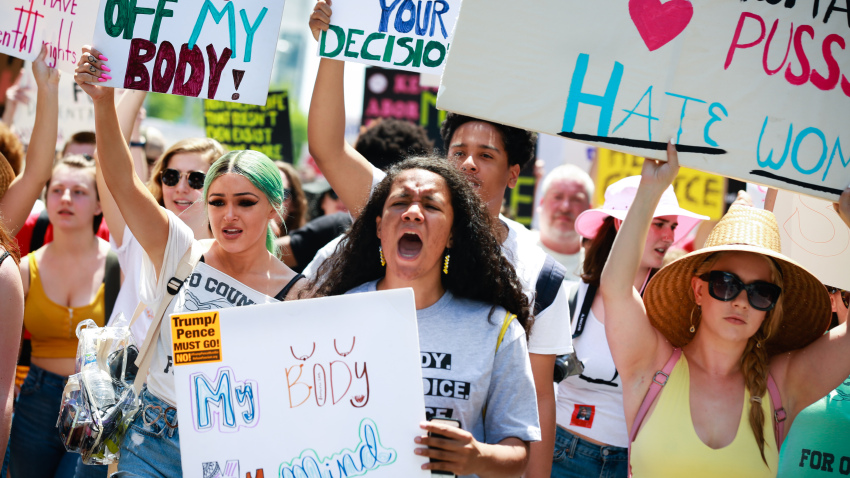
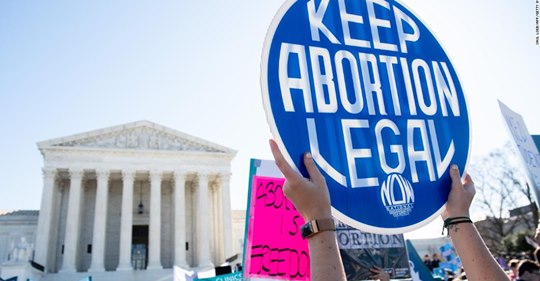
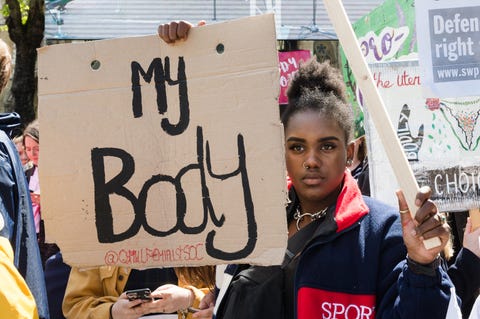
Demonstrators hold signs during a protest against Georgia’s “heartbeat” abortion bill outside of the Georgia State Capitol building in Atlanta, Georgia, U.S., on Saturday, May 25, 2019. Photographer: Elijah Nouvelage/Bloomberg via Getty Images

A federal judge on Monday permanently blocked Georgia’s 2019 “heartbeat” abortion law, finding that it violates the U.S. Constitution.

U.S. District Judge Steve Jones ruled against the state in a lawsuit filed by abortion providers and an advocacy group. Jones had temporarily blocked the law in October, and it never went into effect. The new ruling permanently enjoins the state from ever enforcing House Bill 481.

Georgia’s measure sought to ban abortions once a “detectable human heartbeat” was present, with some limited exceptions. Cardiac activity can be detected by ultrasound as early as six weeks into a pregnancy, before many women realize they’re pregnant, according to a legal challenge. The bill narrowly passed the Georgia General Assembly amid intense lobbying for and against.

Those who challenged the lawsuit said the ruling proves their contention that the measure was unconstitutional. Lead plaintiff SisterSong, an Atlanta-based group that fights abortion restrictions on behalf of African American and other women of color, called it a “huge win for bodily autonomy.”

“No one should have to live in a world where their bodies and reproductive decision making is controlled by the state,” SisterSong Executive Director Monica Simpson said in a statement.

Republican Gov. Brian Kemp, who has supported the restriction, immediately vowed an appeal.

“We will appeal the court’s decision,” Kemp said in a statement. “Georgia values life and we will keep fighting for the rights of the unborn.”

The prospects of an appeal are uncertain, though, considering the U.S. Supreme Court last month struck down other abortion restrictions from Louisiana.

Women in Georgia can currently seek an abortion during the first 20 weeks of a pregnancy.

Both the state and those challenging the law asked Jones to rule without a trial, saying there were no disputed facts. Jones granted the challengers’ motions for summary judgment and denied the state’s motions, finding the law violated the 14th Amendment.

“The court rejects the state defendants’ argument that the statutory purpose solely concerns “promoting fetal well-being,'” Jones wrote. “Instead, HB 481’s specific references to Roe v. Wade and ‘established abortion related precedents’ … lends support to plaintiffs’ argument that the purpose of H.B. 481 was to ban or de facto ban abortion.”

Jones refused to leave any parts of the law in effect, which would have also granted personhood to a fetus, giving it the same legal rights as people have after they’re born. For example, a mother could have claimed a fetus as a dependent to reduce taxes.

U.S. Supreme Court precedent has for nearly five decades held that states cannot ban abortion prior to the viability of a fetus, and since Georgia’s law does just that it is unconstitutional, the law’s opponents argued. The state argued that the law promoted fetal well-being. It was widely considered as one of a number of attempts to create fresh legal challenges to abortion after two new conservative justices were confirmed to the Supreme Court. The high court, by a 5-4 ruling on June 29, struck down another of those challenges involving regulations from Louisiana.

The legal director of the American Civil Liberties Union of Georgia, one of the groups that brought the lawsuit, said any appeal would be fruitless.

“The district court blocked Georgia’s abortion ban, because it violates over 50 years of Supreme Court precedent and fails to trust women to make their own personal decisions,” Sean Young said in a statement. “This case has always been about one thing: letting her decide. It is now up to the state to decide whether to appeal this decision and prolong this lawsuit.”

Georgia Attorney General Chris Carr, a Republican, said he would appeal the ruling but declined further comment.

At least eight states passed so-called heartbeat bills or other sweeping bans in 2019, including Alabama, Georgia, Louisiana Kentucky, Mississippi, Missouri, Ohio and Tennessee. South Carolina is still considering one. All of the new bans joined the fate of earlier heartbeat abortion bans from Arkansas, North Dakota and Iowa in being at least temporarily blocked by judges. Louisiana’s ban wouldn’t take effect unless a court upholds Mississippi’s law.

In a separate ruling Monday, a U.S. district judge in Tennessee blocked a Tennessee law that Republican Gov. Bill had signed hours earlier banning an abortion as early as six weeks into pregnancy and prohibiting abortions based on race, sex or diagnosis of Down syndrome.

Source: https://www.nbcmiami.com/news/national-international/federal-judge-strikes-down-georgia-abortion-restrictions/2261607/?fbclid=IwAR3o0JwcttypUFBXMpBSUWOCgY5hLk4MO1DO_0R3BXlwX92W8Q78YwM3Tv4

For six years, my lawyers have been fighting a law that would have shut down the abortion clinic I run in Shreveport, Louisiana — Hope Medical Group for Women. On Monday, we won in the U.S. Supreme Court, which struck down the law, meaning we can stay open for our patients. I am relieved that the court saw through Louisiana’s deceitful attempts to shut us down, but I’m still deeply worried.

I wish the relentless attempts by politicians to shut down our clinic would finally stop. I know they won’t.

Our win was critical because it saves the few clinics remaining in Louisiana. When I started working at Hope Medical Group 28 years ago, we were one of 11 abortion clinics in Louisiana. Over the years, I’ve watched the other clinics disappear, wondering whether we will be next. Today, there are only three left to serve the roughly 1 million women of reproductive age in Louisiana. This is because of the seemingly endless laws designed to shut down clinics. Louisiana has more abortion restrictions than any other state in the country, 89 to be exact.

It should come as no surprise that these abortion restrictions disproportionately impact Black women and other marginalized communities. Women of color make up 70% of abortion patients in Louisiana, according to 2015 data, and they already face obstacles to accessing health care, as we’ve seen during the COVID-19 pandemic. Privileged people with resources will always be able to access abortion. Largely, it’s vulnerable communities who are being denied the ability to determine their futures and make decisions about their own bodies and families.

Vulnerable women face high obstacles

Many of the women we see each day have traveled hundreds of miles to reach us because there are so few clinics left. By law, our patients must wait 24 hours after their initial visit to the clinic before they can return to have an abortion. Th means many must pay for a hotel room or sleep in their car if they have one; take more time off work and lose wages; and pay for childcare if, like most of our patients, they have children. Given that 75% of abortion patients nationwide are poor or low-income, these are often insurmountable obstacles.

Abortion safety, not politics: I wrote Louisiana’s pro-life law. The Supreme Court ruled against women’s health.

And if that wasn’t enough, in 2016 the Louisiana Legislature passed a law that increased the waiting period to 72 hours, which would triple the height of this hurdle for patients. We are now challenging that law in court as well.

Try explaining these laws to the woman crying on the phone because she has bills due, children to care for and no means to get to a clinic once, let alone twice. The same woman who is afraid to take a few days off her low-paying job because she is one lost paycheck from total despair. Or the woman desperately trying to escape an abusive relationship. These women fuel me to keep fighting.

Our patients frequently ask why they must go to a clinic, often hours away from their home, to have an abortion. Why can’t they get an abortion at a doctor’s office or their OB-GYN? That would seem to make sense, especially because nearly 40% of abortions today are simply done by taking two pills.

Kathaleen Pittman in Washington, D.C., in March 2020. Center for Reproductive Rights

But Louisiana — and many other states — have made commonsense abortion policies illegal. The state forces physicians who provide five or more abortions a year to be licensed as an abortion clinic, meaning they must comply with a mountain of laws and requirements. It is a clever tactic: Prevent people from having an abortion anywhere but an abortion clinic, then pass every law imaginable to shutter those clinics.

Restrictions not about safety

The laws we must comply with are intentionally tedious, dictating even the size of our procedure rooms. The Louisiana Department of Health regularly shows up unannounced to conduct unwarranted, multiday inspections of our clinic, and they can revoke our license for any deficiency, no matter how insignificant. These kinds of exhaustive regulations do not exist for any other medical facilities or doctors’ offices. They only target abortion clinics, and they have nothing to do with improving care for our patients.

Research and evidence: Science prevails in Supreme Court ruling on abortion law that provided no medical benefit

Abortion is one of the safest outpatient medical procedures in the United States, according to a five-year study by Advancing New Standards in Reproductive Health. It should be treated no differently than other medical services, but in reality, being an abortion provider in the South means we must be more than just health care workers. We’re forced to fight every day just so we can do our jobs, whether that means fighting anti-abortion laws in court so our clinic can stay open, or consoling our patients after they’ve been harassed by protesters outside. Our physicians have even had protesters show up at their homes and private offices.

All too frequently, there are new anti-abortion laws passed that we must learn to comply with somehow. I have our lawyers at the Center for Reproductive Rights on speed dial and often call them multiple times a week to make sure the state has no excuse to shut us down.

Lawmakers claim that these restrictions are meant to protect women, that they care about their health and safety. That was the state’s argument in the case we won Monday. This is a laughable claim considering Louisiana has the highest maternal mortality rate in the country — and lawmakers have failed to act to reduce this rate. Maternal mortality has actually increased an alarming 28% in the past four years. The mortality rate for Black women is even more dire.

States have passed more than 450 anti-abortion laws since 2011, and the law struck down by the Supreme Court Monday was just one of them. This week we won the battle, and that means we can stay open to fight another day. But after working at an abortion clinic in the South for nearly three decades, I’m still just as frightened for the future.

If these laws keep piling up, it is not a matter of whether we will be forced to close, but when.

Kathaleen Pittman is the clinic administrator at Hope Medical Group for Women — an abortion clinic in Louisiana and the lead plaintiff in June Medical Services v. Russo.

Source: https://eu.usatoday.com/story/opinion/voices/2020/06/30/supreme-court-june-medical-services-abortion-rights-access-column/3283212001/

Federal judges blocked controversial abortion restrictions out of Georgia and Tennessee on Monday, a pair of key victories for abortion rights advocates after a flurry of so-called “heartbeat bans” swept state legislatures last year.

The bills — passed in Georgia in spring 2019 and in Tennessee last month — ban abortions after the detection of a fetal heartbeat, which can occur as early as six weeks into pregnancy and before many women even know they’re pregnant.
The bills highlight the longstanding battle over abortion rights playing out in state legislatures. That clash most recently made its way up to the Supreme Court, where Supreme Court Chief Justice John Roberts moved to block a controversial Louisiana law restricting abortion access in siding with the liberal justices — while potentially leaving the door open to more state abortion limits.
US District Judge Steve Jones of Georgia, who temporarily blocked the law in October, cited Supreme Court decisions Roe v. Wade and Planned Parenthood v. Casey that uphold a woman’s right to a pre-viability abortion in his decision to permanently strike down the law on Monday.
“In sum, the undisputed material facts in this case lead to one, indisputable conclusion: that Section 4 of H.B. 481, by prohibiting a woman from terminating her pregnancy upon the detection of a fetal heartbeat, constitutes a pre-viability abortion ban,” Jones wrote.
He added, “As this ban directly conflicts with binding Supreme Court precedent (i.e., the core holdings in Roe, Casey, and their progeny) and thereby infringes upon a woman’s constitutional right to obtain an abortion prior to viability, the Court is left with no other choice but to declare it unconstitutional.”
CNN has reached out to the office of Republican Georgia Gov. Brian Kemp, who was named in the lawsuit, for comment.
The American Civil Liberties Union, Planned Parenthood and the Center for Reproductive Rights, representing several abortion care providers, challenged the law in June 2019. Monica Simpson — executive director of the abortion care provider SisterSong Women of Color Reproductive Justice Collective, the top plaintiff in the lawsuit — called the decision “tremendous.”
“No one should have to live in a world where their body and reproductive decision-making is controlled by the state,” she said in a statement. “And we will continue to work to make sure that is never a reality in Georgia or anywhere else.”
In Tennessee, a federal judge temporarily blocked the state’s heartbeat bill from going into effect after Gov. Bill Lee, a Republican, signed it into law earlier that day. The ACLU, the Center for Reproductive Rights, Planned Parenthood and several Tennessee abortion providers had challenged the bill in federal court last month on the same day that state lawmakers passed it, filing suit against Tennessee Attorney General Herbert Slatery and other state officials.
“The Act will immediately impact patients seeking abortions and imposes criminal sanctions on abortion providers,” US District Judge William Campbell wrote of the law, citing “the time-sensitive nature of the procedure.”
Campbell added that the abortion rights groups “have demonstrated a strong or substantial likelihood of success on the merits of their claims that the restrictions (in the law) are unconstitutional under current law.”
CNN has reached out to Lee’s office for comment.
Samantha Fisher, a spokeswoman for Slatery, said in a statement, “The Court issued a temporary restraining order to maintain the status quo. We look forward to the next step, arguing the merits in a preliminary injunction hearing.”
Tennessee had joined not only Georgia but Kentucky, Louisiana, Mississippi, Missouri and Ohio in passing similar bills. All have been kept from going into effect by court actions.
Tennessee’s bill made exceptions to protect the life of the woman but not for instances of rape or incest. Georgia’s had some exceptions for situations of medical futility or where the mother’s health is at risk as well as in cases of rape or incest before the 20-week mark, if an official police report has been filed.

Source: https://edition.cnn.com/2020/07/13/politics/abortion-bans-block-georgia-tennessee/index.html?fbclid=IwAR0xY8oJWERuVq0S5M4QENklABH9RdjwT_GpwayT7wTDVfSb6CHWbLC52g4

A federal judge has agreed to suspend a rule that requires women during the COVID-19 pandemic to visit a hospital, clinic or medical office to obtain an abortion pill

SILVER SPRING, Md. — A federal judge agreed Monday to suspend a rule that requires women during the COVID-19 pandemic to visit a hospital, clinic or medical office to obtain an abortion pill.

U.S. District Judge Theodore Chuang in Maryland concluded that the “in-person requirements” for patients seeking medication abortion care impose a “substantial obstacle” to abortion patients and are likely unconstitutional under the circumstances of the pandemic.

“Particularly in light of the limited timeframe during which a medication abortion or any abortion must occur, such infringement on the right to an abortion would constitute irreparable harm,” the judge wrote in his 80-page decision.

Chuang’s ruling will allow healthcare providers to arrange for mifepristone to be mailed or delivered to patients during the public health emergency declared by the secretary of the U.S. Department of Health and Human Services. The U.S. Food and Drug Administration approved mifepristone to be used in combination with a second drug, misoprostol, to end an early pregnancy or manage a miscarriage.

“By causing certain patients to decide between forgoing or substantially delaying abortion care, or risking exposure to COVID-19 for themselves, their children, and family members, the In-Person Requirements present a serious burden to many abortion patients,” Chuang wrote.

The states of Indiana, Louisiana, Alabama, Arkansas, Idaho, Kentucky, Mississippi, Missouri, Nebraska and Oklahoma had asked to intervene in the lawsuit. The 10 states argued that the case could impact how they enforce their own state laws that relate to or reference the FDA’s regulation of mifepristone.

Chuang rejected their request last month. The judge said the federal case would not eliminate any state’s ability to continue to regulate abortion medication “above and beyond” the FDA’s requirements.

“Nevertheless, this is a tremendous victory for abortion patients and for science and common sense,” said American Civil Liberties Union attorney Julia Kaye.

The American College of Obstetricians and Gynecologists and other groups sued HHS and the FDA in May to challenge the rule. ACLU lawyers represent the groups.

Skye Perryman, chief legal officer for the American College of Obstetricians and Gynecologists, said the FDA’s restrictions on mifepristone are not medically necessary and “do not advance the health and safety of patients.”

“Today’s ruling recognizes the hardship and undue burden that many women have faced obtaining essential health care during the COVID-19 pandemic,” Perryman said.

Plaintiffs’ attorneys argued that the FDA’s in-person requirements infringe on a woman’s constitutional rights to an abortion and violates the due process clause of the Fifth Amendment.

Government lawyers have argued that the requirements are necessary to ensure that patients safely use mifepristone. The FDA rule requires patients to pick up the single tablet of mifepristone at a hospital, clinic or medical office and sign a form that includes information about the medication’s potential risks.

The judge said suspending the requirements aligns with public health guidance to eliminate unnecessary travel and in-person contact.

Chuang granted the ACLU’s request for a preliminary injunction on due process grounds. He noted that federal regulators have waived in-person requirements for many other drugs “for the specific purpose of protecting public health.”

The group’s lawsuit says mifepristone is the only one of more than 20,000 FDA-regulated drugs that patients must receive in person at a hospital, clinic, or medical office “yet may self-administer, unsupervised, at a location of their choosing.”

The judge didn’t set any geographic limitations on the injunction. Referring to the nature of the pandemic, he said that “crafting relief that attempts to account for both the unpredictable changes and nuanced regional differences across 50 different states over an extended period of time is simply infeasible.”

More than 4 million people in the U.S. have used mifepristone and misoprostol to end an early pregnancy; the two-drug combination accounted for 39% of all U.S. abortions in 2017, the lawsuit says.

The lawsuit says the FDA rule has “particularly severe implications for low-income people and people of color, who comprise a disproportionate share of impacted patients and who are already suffering and dying from COVID-19 at substantially higher rates.”

In March, dozens of anti-abortion advocates signed a letter to HHS Secretary Alex Azar in which they called for halting abortion procedures during the pandemic. “Their continued operation depletes sorely needed personal protective equipment and leads to complications that will further overwhelm already overextended emergency rooms,” the letter said.

Azar and FDA Commissioner Stephen Hahn also were named as defendants in the suit.

Marjorie Dannenfelser, president of the Susan B. Anthony List anti-abortion group, expressed disappointment in the judge’s ruling: “The current FDA regulations are reasonable and necessary to protect women from serious and potentially life-threatening complications of abortion drugs, including intense pain, heavy bleeding, infection, and even death,” she said in a statement.

Source: https://abcnews.go.com/Health/wireStory/judge-women-abortion-pill-doctor-visits-71755793?fbclid=IwAR3Df_KeuO7pBj4-3b_XknodzFEUWLGdX5vzUYsajlZdLpWhZ4LWiTmSfWI

  • You can temporarily take it at home during the Coronavirus pandemic

Our ability to offer abortions is a vital part of healthcare and cements the right among women and girls across the world to make decisions about their own bodies.

It’s estimated that that one in three women in the UK will have an abortion by the time they’re 45.

Knowing this, it is essential that we are as informed as possible about what abortions are, the different ways a woman can undergo a termination, how to access the health service and what the process entails.

As well as more invasive procedures, if a pregnancy is at an early enough stage, one of the types of termination offered is the ‘medical abortion’, which involves taking two different medicines in tablet form, to end a pregnancy.

From how an abortion pill works and how to organise a termination, to the cost of an abortion pill and understanding the ‘pill by post’ service, we’ve rounded up everything you need to know about this form of termination.

What are the different methods of abortion?

The are two main types of abortion: a medical abortion (otherwise known as the abortion pill) and a surgical abortion.

The abortion pill involves taking a medicine to terminate the pregnancy, whereas a surgical abortion involves the removal of the pregnancy via a procedure at a doctor’s surgery.

abortion pill
PORNCHAI SODAGETTY IMAGES

In the UK, we allow terminations to occur up to the 24th week of pregnancy. However, in certain circumstances, an abortion can take place after this time period for reasons including a risk to the mother’s life or if there are severe issues with the foetus’ development.

The NHS states that patients should be offered a choice of which method they’d prefer whenever possible. And, according to Dr Yvonne Neubauer, Associate Clinical Director for MSUK, ‘in theory, both medical and surgical abortion can be offered up to the legal limit of 23 weeks and 6 days. However, abortion services may only offer certain methods within a particular pregnancy range depending on local protocols and expertise.’

Between six and nine weeks of pregnancy, the abortion pill is usually the preferred method of termination, as it involves very little time at the clinic.

‘Beyond 10 weeks’ gestation, [while medical abortions are still possible] women have to stay overnight and so most women opt to have a surgical procedure, since it’s a quicker process,’ a spokesperson from the The British Pregnancy Advisory Service (BPAS) tells ELLE UK.

Official government figures show that approximately 180,000 abortions are carried out in England each year, with medical abortions the most common choice to end a pregnancy.

What is the abortion pill?

An abortion pill (actually a series of two different tablets) is not to be confused with a morning after pill. Their chemical components are entirely different.

Planned Parenthood clarifies this common confusion, explaining: ‘The morning-after pill, also known as emergency contraception, helps prevent pregnancy; the abortion pill, also known as medication abortion, ends pregnancy.’

‘There is no evidence that emergency contraception can cause an abortion if it is taken when already pregnant,’ adds a BPAS spokesperson.

A medical abortion involves taking not one tablet but two different types of medicines.

The first tablet contains a medicine called mifepristone. Its job is to block the main pregnancy hormone, progesterone. Without this hormone, the lining of the uterus breaks down, ending the pregnancy’s viability.

The second medicine called misoprostol. This is a chemical that forces the womb to begin cramping, a bit like the contractions of labour. This drug helps your body to eject the now inviable pregnancy.

abortion pill
LIGHTFIELDSTUDIOSGETTY IMAGES

How do you take the tablets?

These medicines are prescribed by the hospital or abortion clinic and are usually taken one to two days apart.

Following an assessment, those who decide to proceed with the termination will usually be asked to sign a consent form and the clinic or hospital will arrange a date for the abortion. Patients are able to change their mind at any point up to the start of the abortion.

‘The mifepristone tablet can be taken at the hospital or clinic, and you’ll be able to go home afterwards and continue your normal activities,’ the NHS explains.

A day or two later, a patient must take the second medicine, the misoprostol. This tablet should be placed under the tongue, between the cheek and gum or inside the vagina.

A BPAS spokesperson tells us that it is inadvisable for someone to take the first pill without the second.

‘The first pill (mifepristone) is regarded as the start of the abortion procedure,’ they explain. ‘Some anti-abortion campaigners have tried to claim that the effects of mifepristone can be reversed, but there is no evidence to support this.’

abortion pill
FRANCKREPORTERGETTY IMAGES

Within a period of four to six hours after taking the second medicine, the lining of the womb will break down, which can involve pain, bleeding and ultimately, the passing of the pregnancy from your body. In most cases, the vaginal bleeding and discomfort should subside within several hours, or up to a day, but some discomfort and bleeding can continue for up to two weeks.

‘Sometimes you need to take more doses of misoprostol to get the pregnancy to pass,’ the NHS adds.

The abortion pill does not require surgery or an anaesthetic. However, occasionally, the pregnancy does not pass and a further procedure is needed to remove it.

Can you take the abortion pill at home?

For years, medical abortions in England have had to be initiated in a hospital, by a specialist provider or a licensed clinic.

However, in March, the governments in England, Wales and Scotland made a landmark decision to change the law, now allowing women and girls to take the abortion pill for early medical abortions (up to 10 weeks into the pregnancy) in their own homes during the Covid-19 outbreak.

‘This measure will be on a temporary basis and must follow a telephone or e-consultation with a doctor,’ the Department of Health in England stated at the time of the announcement.

abortion pill
BONNIN STUDIOGETTY IMAGES

In response to the news, Dr Edward Morris, President of the Royal College of Obstetricians and Gynaecologists, said: ‘This change in practice will reduce pressure on the health system while limiting the unnecessary risk of infection for women, their families and health workers.’

The at-home medical abortion is now commonly referred to as ‘pill by post’ or ‘remote abortion pill treatment’.

This content is imported from Twitter. You may be able to find the same content in another format, or you may be able to find more information, at their web site.

‘This service is a safe and legal way to end a pregnancy at an early gestation without needing to attend a clinic for treatment,’ explains BPAs.

Those wanting a pill by post will have to complete a consultation and medical assessment over the phone. During the consultation, BPAS will explain the known risks and complications of the treatment, which can be read here.

If you opt for a pill by post, you will receive the treatment package from a pharmacy from one to three days after the telephone consultation. If, for any reason, the package is delayed in the post, the organisation advises women take the tablets as directed once they do arrive.

This content is imported from YouTube. You may be able to find the same content in another format, or you may be able to find more information, at their web site.

Note: The package is plain with no indication of its contents, it will be tracked but not signed for.

The package will contain the following:

  • Abortion pill medication (one tablet mifepristone and six tablets of misoprostol – packaged together or separately)
  • Pregnancy test
  • Codeine (only provided if suitable)
  • Progestogen only contraceptive pills (if requested and suitable)

When it comes to passing the pregnancy, BPAS advises women to use sanitary towels to monitor the bleeding and notes that a woman’s next period might be heavier than usual.

The majority of patients will pass their pregnancy at home, or a place of their choosing, and decide how they wish to dispose of its remains. ‘They can be flushed down the lavatory or wrapped in tissue, placed in a small plastic bag and put in the dustbin,’ BPAS notes.

How much does an abortion pill cost?

In the majority of UK cases, the abortion pill is free of charge.

BPAS and abortion provider Marie Stopes UK (MSUK) state that the majority (97-98 per cent) of women who require their services have their treatment paid for by the NHS (or another governing body).

In order to assess a patient’s eligibility for an NHS-paid abortion, BPAS requires their address and the name and address of their GP. Those who choose to be treated privately at the organisation will need to pay for their abortion.

abortion pill
WESTEND61GETTY IMAGES

According to the service’s prices from April 10 2019, the total price (including an initial consultation and treatment) of an abortion pill (under 10 weeks) is £480. You can see the full list of prices here.

BPAS also offers special prices for women from the Republic of Ireland, and the Channel Islands (Jersey and Guernsey).

The majority women who require abortion services have their treatment paid for by the NHS

‘While abortion care is not available on the NHS for women in Northern Ireland, in June 2017 the UK Government announced they would commit to cover the cost of abortion care for women from Northern Ireland who are treated in England,’ explains Marie Stopes.

Visit the Abortion Support Network to donate to fund abortions and travel of clients from outside of the UK here.

What risks are involved with the abortion pill?

Common side effects for women following an early medical abortion can include feeling dizzy, nauseous, a headache and temporary flushes or sweats which usually pass after a few hours.

However, there are more serious risks associated with both a medical and surgical abortion depending on far along you are in your pregnancy.

The NHS explains that before 14 weeks of pregnancy, the main risks of an abortion pill include requiring another procedure to remove parts of the pregnancy that have stayed in the womb, plus heavy bleeding.

From 14 weeks of pregnancy, the risks include needing a follow-up procedure to remove parts of the pregnancy that have stayed in the womb and there is more risk of infection or injury to the womb. Find out more about any complications here.

Abortion is an extremely safe procedure, and it’s even safer the earlier it is performed,’ states a BPAS spokesperson.

‘With early medical abortions, there is a small chance of infection, or that the procedure may not be successful, which is why we provide all women with information on the signs and symptoms to look out for and a pregnancy test to take home with them.’

Dr Neubauer tells us that the majority of women choosing to have an abortion ‘are sure that this is the right option for them, but a small number prefer to have counselling to help them with their decision’. Both BPAS and MSUK offers pre-and post-abortion counselling to all clients.

Does an abortion pill affect fertility?

Having an abortion will not affect your chances of becoming pregnant and having normal pregnancies in the future, the NHS outlines.

abortion pill
CARLO107GETTY IMAGES

BPAS emphasises this in the Q&A section on its website, noting: ‘There is absolutely no evidence that safe, legal abortion will lead to infertility. In fact, after an abortion, fertility returns almost immediately.’

The NHS notes that many women are able to get pregnant immediately after a termination and advises them to start using contraception right away if they don’t want to get pregnant again.

‘There’s a very small risk to your fertility and future pregnancies if you develop a womb infection that is not treated quickly. The infection could spread to your fallopian tubes and ovaries – known as pelvic inflammatory disease (PID).’

However, most infections are treated before they develop to this stage.

Can you buy abortion pills online?

Abortion pills are sold online but it is illegal to take them without medical approval in the UK.

According to data from the Medicines and Healthcare products Regulatory Agency (MHRA), which regulates medicines in the UK, there were 375 abortion pills seized in 2018, up from 270 in 2015 and 180 in 2014. In recent years, some women have been jailed for taking abortion pills bought online.

abortion pill
MARYNA ANDRIICHENKOGETTY IMAGES

In July 2020, The Independent reported that several charities and MPs called for the law to change when it comes to the consumption of online abortion pills at home.

Abortion is an extremely safe procedure, and it’s even safer the earlier it is performed

They argue the law disproportionately affects women and girls in ‘abusive relationships who seek illicit medication online’ who are unable to visit clinics ‘for fear their abuser will discover their pregnancy’.

How do you organise an abortion?

When it comes to getting an abortion, it’s important to note that terminations are only carried out under the care of an NHS hospital or licensed clinic.

There are three main ways to get an abortion on the NHS which include:

  • Speak to a GP and ask for a referral to an abortion service. The GP should refer you to another doctor if he or she has any objections to abortion
  • Contact a sexual health clinic and ask for a referral to an abortion service
  • Self-refer by contacting an abortion provider directly (eg. BPAS or Marie Stopes UK).

A BPAS spokesperson tells us that in the UK, GP surgeries don’t fall under the category of a ‘licensed clinic’ so many women ‘prefer to skip the GP visit and self-refer instead’.

If you want to go ahead with an abortion, you can find pregnancy termination services via the NHS website here. All you need to do is enter your location (postcode or town) into the website and it will give you a list of locations where you can enquire about a termination.

If you want to book a termination through BPAS, for example, you will have to make a consultation before your treatment to ensure it’s legal and safe to proceed. Call 03457 30 40 30 to book an appointment or make an enquiry, request an appointment via this form or request a callback.

abortion pill
10’000 HOURSGETTY IMAGES

You can make an appointment directly with BPAS without first consulting your GP or genitourinary medicine (GUM) clinic.

‘If you come to us for an abortion, we’ll ask for your reasons for wanting one, which we’re required to do by law,’ Marie Stopes explains on its website. ‘Two doctors need to make sure the requirements of the Abortion Act are met, and sign the relevant certificate. We will arrange this for you.’

The NHS notes that you should not have to wait more than two weeks from when you (or a doctor) first contacted an abortion provider regarding the termination.

Will an abortion be on a person’s medical record?

This entirely depends on how a patient has gone about organising their abortion.

‘If you ask your GP to refer you for an abortion it will automatically be put on your medical records at the time of your visit to your GP,’ the UK Health Centre explains.

However, if you go to a private abortion clinic, it won’t be automatically put on your medical records due to confidentially rules.

‘It is possible that sometimes if you are to be referred for an abortion through the Family Planning Association or Sexual Health Clinic that your abortion information is not sent onto your GP,’ the Centre states.

‘This may not be automatically be put onto your medical records even though it would be NHS funded.’

If a patient calls BPAS or Marie Stopes for advice regarding an abortion, they are not required to tell the service who they are and they won’t receive a call back unless they request one.

abortion pill
6OKEANGETTY IMAGES

When it comes to contacting a GP, both BPAS and Marie Stopes state that they won’t disclose information to a patient’s GP or contact them without their permission.

The latter adds that the only circumstance where it would do this would be ‘when needed for emergency medical care or safeguarding concerns’.

It explains: ‘All clinical professionals are bound by the code of confidentiality and data protection laws.’

Additionally, BPAS says that while it wouldn’t contact a GP without a patient’s permission, they might need to share some personal information with other healthcare providers or organisations in order to provide care, such as gaining NHS funding or to understand a person’s medical history. You can read more about how BPAS uses your information here.

What are the laws surrounding abortion in the UK?

According to the Abortion Act 1967, in England, Scotland and Wales, you can legally have an abortion up to 23 weeks and six days of pregnancy.

In March 2020, Northern Ireland changed its abortion laws to allow terminations to be carried out in all circumstances in the first 12 weeks of a pregnancy. After that time period, abortions are legal in some cases – for example, there is no term limit in cases of fatal foetal abnormalities.

abortion pill
NURPHOTOGETTY IMAGES

In England, Scotland and Wales, there is no gestational limit for abortions if there’s proof of a fatal foetal abnormality or a significant risk to the mother’s life if they were to proceed with the pregnancy.

Source: https://www.elle.com/uk/life-and-culture/culture/a33233965/abortion-pill/?fbclid=IwAR2Vf6JUvPpDnBSR_b47ZGukZdxyO6LdtVEtnr4wuyQ9Nw0kbMDeCi75gXk

The Supreme Court ruled broadly Wednesday in favor of the religious rights of employers in two cases that could leave more than 70,000 women without free contraception and tens of thousands of people with no way to sue for job discrimination.

In both cases the court ruled 7-2, with two liberal justices joining conservatives in favor of the Trump administration and religious employers.

In the more prominent of the two cases, involving President Barack Obama’s health care overhaul, the justices greenlighted changes the Trump administration had sought. The administration announced in 2017 that it would allow more employers to opt out of providing the no-cost birth control coverage required under the law, but lower courts had blocked the changes.

The ruling is a significant election-year win for President Donald Trump, who counts on heavy support from evangelicals and other Christian groups for votes and policy backing. It was also good news for the administration, which in recent weeks has seen headline-making Supreme Court decisions go against its positions.

In one of those earlier cases, the court rejected Trump’s effort to end legal protections for 650,000 young immigrants. In another, the justices said a landmark civil rights law protects gay, lesbian and transgender people from discrimination in employment.

Another particularly important decision for Trump is ahead. The justices are expected to announce Thursday whether Congress and the Manhattan district attorney can see the president’s taxes and other financial records he has fought to keep private.

In its second big ruling on Wednesday, the court sided with two Catholic schools in California in a decision underscoring that certain employees of religious schools can’t sue for employment discrimination.

Lay teachers whose contracts had not been renewed had sued their schools. But Justice Samuel Alito wrote in his majority opinion: “When a school with a religious mission entrusts a teacher with the responsibility of educating and forming students in the faith, judicial intervention into disputes between the school and the teacher threatens the school’s independence in a way that the First Amendment does not allow.”

The court’s birth-control decision was cheered by conservative groups, and White House spokeswoman Kayleigh McEnany joined in. “Today’s Supreme Court ruling is a big win for religious freedom and freedom of conscience,” she said in a statement.

Liberal groups and Democrats, including House Speaker Nancy Pelosi, decried the decision, which she called a “fundamental misreading” of the health care law. Presumptive Democratic presidential nominee Joe Biden said the decision will make it “easier for the Trump-Pence Administration to continue to strip health care from women.”

The Trump administration is still seeking to overturn Obama’s Affordable Care Act in its entirety. It has joined Texas and other Republican-led states in calling on the justices to do just that. The case is scheduled to be argued in the court term that begins in October.

Justice Clarence Thomas, writing for the majority of the court, said in Wednesday’s decision that the administration has the authority to make its birth-control coverage changes and followed appropriate procedures in doing so.

The government has estimated that the rule changes would cause between 70,000 women and 126,000 women to lose contraception coverage in one year.

Justice Ruth Bader Ginsburg cited those numbers in dissenting.

“Today, for the first time, the Court casts totally aside countervailing rights and interests in its zeal to secure religious rights to the nth degree,” she wrote in a dissent joined by Justice Sonia Sotomayor.

Birth control coverage has been a topic of contention since the health care law was passed.

“The ACA’s contraceptive mandate … has existed for approximately nine years. Litigation surrounding that requirement has lasted nearly as long,” Thomas wrote.

Initially, churches, synagogues and mosques were exempt from the contraceptive coverage requirement. The Obama administration also created a way by which religiously affiliated organizations including hospitals, universities and charities could opt out of paying for contraception, but women on their health plans would still get no-cost birth control. Some groups complained the opt-out process itself violated their religious beliefs, and years of legal wrangling followed.

After Trump took office, officials announced changes. Under a new policy issued by the Department of Health and Human Services, more categories of employers, including publicly traded companies, can opt out of providing no-cost birth control to women by claiming religious objections. The policy also allows some employers, though not publicly traded companies, to raise moral objections and do the same.

The changes were blocked by courts after New Jersey and Pennsylvania challenged them.

Future administrations could attempt to alter the Trump administration rules. And two liberal justices who sided with the administration, Elena Kagan and Stephen Breyer, suggested the legal fight over the administration’s changes may continue.

Pennsylvania Attorney General Josh Shapiro said in a statement after the ruling, “This fight is not over.”

In the religious-schools discrimination case, the court had ruled unanimously in 2012 that the Constitution prevents ministers from suing their churches for employment discrimination, but the justices didn’t rigidly define who counts as a minister.

___

Associated Press writer Mark Sherman contributed to this report.

Source: https://apnews.com/65d64e383b5b90cb8620c35ab2bcaecc?fbclid=IwAR39Wc7VBl6kFCq7cOHKCzvGuAdtRYD7eYj7_FcaT_lJoSM9Rprp47Pmzwo

For five years, a team of researchers asked women about their experience after having—or not having—an abortion. What do their answers tell us?

The Turnaway Study, about the fallout of receiving or being denied an abortion, will be understood, criticized, and used politically, however carefully conceived and painstakingly executed the research was.Photograph by Ievgeniia Pidgorna / Alamy

There is a kind of social experiment you might think of as a What if? study. It would start with people who are similar in certain basic demographic ways and who are standing at the same significant fork in the road. Researchers could not assign participants to take one path or another—that would be wildly unethical. But let’s say that some more or less arbitrary rule in the world did the assigning for them. In such circumstances, researchers could follow the resulting two groups of people over time, sliding-doors style, to see how their lives panned out differently. It would be like speculative fiction, only true, and with statistical significance.

A remarkable piece of research called the Turnaway Study, which began in 2007, is essentially that sort of experiment. Over three years, a team of researchers, led by a demographer named Diana Greene Foster, at the University of California, San Francisco, recruited 1,132 women from the waiting rooms of thirty abortion clinics in twenty-one states. Some of the women would go on to have abortions, but others would be turned away, because they had missed the fetal gestational limit set by the clinic. Foster and her colleagues decided to compare the women in the two groups—those who received the abortion they sought and those who were compelled to carry their unwanted pregnancy to term—on a variety of measures over time, interviewing them twice a year for up to five years.

The study is important, in part, because of its ingenious design. It included only women whose pregnancies were unwanted enough that they were actively seeking an abortion, which meant the researchers were not making the mistake that some previous studies of unplanned conceptions had—“lumping the happy surprises in with the total disasters,” as Foster puts it. In terms of age, race, income level, and health status, the two groups of women closely resembled each other, as well as abortion patients nationwide. (Foster refers to the study’s participants as women because, to her knowledge, there were no trans men or non-binary people among them.) Seventy per cent of the women who were denied abortions at the first clinic where they sought them carried the unwanted pregnancies to term. Others miscarried or were able to obtain late abortions elsewhere, and Foster and her colleagues followed the trajectories of those in the latter group as well.

While you might guess that those who were turned away had messier lives—after all, they were getting to the clinic later than the seemingly more proactive women who made the deadline—that did not turn out to be the case. Some of the women who got their abortions (half of the total participants) did so just under the wire; among the women in the study who were denied abortions (a quarter of the total), some had missed the limit by a matter of only a few days. (The remaining quarter terminated their pregnancies in the first trimester, which is when ninety per cent of abortions in the United States occur.) The women who were denied abortions were on average more likely to live below the poverty line than the women who managed to get them. (One of the main reasons that people seek abortions later in pregnancy is the need to raise money to pay for the procedure and for travel expenses.) But, in general, Foster writes, the two groups “were remarkably similar at the first interview. Their lives diverged thereafter in ways that were directly attributable to whether they received an abortion.”

Over the past several years, findings from the Turnaway Study have come out in scholarly journals and, on a few occasions, gotten splashy media coverage. Now Foster has published a patiently expository precis of all the findings in a new book, “The Turnaway Study: Ten Years, a Thousand Women, and the Consequences of Having—or Being Denied—an Abortion.” The over-all impression it leaves is that abortion, far from harming most women, helps them in measurable ways. Moreover, when people assess what will happen in their lives if they have to carry an unwanted pregnancy to term, they are quite often proven right. That might seem like an obvious point, but much of contemporary anti-abortion legislation is predicated on the idea that competent adults can’t really know what’s at stake in deciding whether to bear a child or not. Instead, they must be subjected to waiting periods to think it over (as though they can’t be trusted to have done so already), presented with (often misleading) information about the supposed medical risks and emotional fallout of the procedure, and obliged to look at ultrasounds of the embryo or fetus. And such scans are often framed, with breathtaking disingenuousness, as a right extended to people—what the legal scholar Carol Sanger calls “the right to be persuaded against exercising the right you came in with.”

Maybe the first and most fundamental question for a study like this to consider is how women feel afterward about their decisions to have an abortion. In the Turnaway Study, over ninety-five per cent of the women who received an abortion and did an interview five years out said that it had been the right choice for them. It’s possible that the women who remained in the study that long were disproportionately inclined to see things that way—maybe if you were feeling shame or remorse about an abortion you’d be less up for talking about it every six months in a phone interview with a researcher. (Foster suggests that people experiencing regrets might actually be more inclined to participate, but, to me, the first scenario makes more psychological sense.) Still, ninety-five per cent is a striking figure. And it’s especially salient, again, in light of anti-choice arguments, which often stress the notion that many of the quarter to third of all American women who have an abortion will be wracked with guilt about their decision. (That’s an awful lot of abject contrition.) You can pick at the study for its retention rate—and some critics, particularly on the anti-abortion side, have. Nine hundred and fifty-six of the original thousand-plus women who were recruited did the first interview. Fifty-eight per cent of them did the final interview. But, as Foster pointed out in an e-mail to me, on average, the women in the study completed an impressive 8.4 of the eleven interviews, and some of the data in the study—death records and credit reports—cover all 1,132 women who were originally enrolled.

To the former Supreme Court Justice Anthony Kennedy, among others, it seemed “unexceptionable to conclude some women come to regret their choice to abort the infant life they once created and sustained.” In a 2007 abortion-case ruling, he wrote that “severe depression and loss of esteem can follow.” It can, but the epidemiologists, psychologists, statisticians, and other researchers who evaluated the Turnaway Study found it was not likely. “Some events do cause lifetime damage”—childhood abuse is one of them—“but abortion is not common among these,” Foster writes. In the short term, the women who were denied abortions had worse mental health—higher anxiety and lower self-esteem. In the longer run, the researchers found “no long-term differences between women who receive and women who are denied an abortion in depression, anxiety, PTSD, self-esteem, life satisfaction, drug abuse, or alcohol abuse.” Abortion didn’t weigh heavily in determining mental health one way or the other. Foster and her co-authors note, in an earlier article, that “relief remained the most commonly felt emotion” among women who got the abortions they sought. That relief persisted, but its intensity dissipated over time.

Other positive impacts were more lasting. Women in the study who received the abortion they sought were more likely to be in a relationship they described as “very good.” (After two years, the figure was forty-seven per cent, vs. twenty-eight per cent for the women turned away.) If they had been involved with a physically abusive man at the time of the unwanted pregnancy, they were less likely to still be experiencing violence, for the simple reason that they were less likely to be in contact with him. (Several of the participants interviewed for the book talk about not wanting to be tethered to a terrible partner by having a child together.) Women who got the abortion were more likely to become pregnant intentionally in the next five years than women who did not. They were less likely to be on public assistance and to report that they did not have enough money to pay for food, housing, and transportation. When they had children at home already, those children were less likely to be living in poverty. Based on self-reports, their physical health was somewhat better. Two of the women in the study who were denied abortions died from childbirth-related complications; none of the women who received abortions died as a result. That is in keeping with other data attesting to the general safety of abortion. One of Foster’s colleagues, Ushma Upadhyay, analyzed complications after abortions in California’s state Medicaid program, for example, and found that they occurred in two per cent of the cases—a lower percentage than for wisdom-tooth extraction (seven per cent) and certainly for childbirth (twenty-nine per cent). Indeed, maternal mortality has been rising in the U.S.—it’s now more than twice as high as it was in 1987, and has risen even more steeply for Black women, due, in part, to racial disparities in prenatal care and the quality of hospitals where women deliver.

Yet, as Foster points out, many of the new state laws restricting abortion suggest that it is a uniquely dangerous procedure, one for which layers of regulation must be concocted, allegedly to protect women. The Louisiana law that the Supreme Court struck down last Monday imposed just such a rule—namely, a requirement that doctors performing abortions hold admitting privileges at a hospital no more than thirty miles away. As Justice Stephen Breyer’s majority opinion noted, “The evidence shows, among other things, that the fact that hospital admissions for abortion are vanishingly rare means that, unless they also maintain active OB/GYN practices, abortion providers in Louisiana are unlikely to have any recent in-hospital experience.” Since hospitals often require such experience in order to issue admitting privileges, abortion providers would be caught in a Catch-22, unable to obtain the privileges because, on actual medical grounds, they didn’t need them. The result of such a law, had it gone into effect, would have been exactly what was intended: a drastic reduction in the number of doctors legally offering abortions in the state.

The Turnaway Study’s findings are welcome ones for anyone who supports reproductive justice. But they shouldn’t be necessary for it. The overwhelming majority of women who received abortions and stayed in the study for the full five years did not regret their decision. But the vast majority of women who’d been denied abortions reported that they no longer wished that they’d been able to end the pregnancy, after an actual child of four or five was in the world. And that’s good, too—you’d hope they would love that child wholeheartedly, and you’d root for their resilience and happiness.

None of that changes the fundamental principle of human autonomy: people have to be able to make their own decisions in matters that profoundly and intimately affect their own bodies and the course of their lives. Regret and ambivalence, the ways that one decision necessarily precludes others, are inextricable facts of life, and they are also fluid and personal. Guessing the extent to which individuals may feel such emotions, hypothetically, in the future, is not a basis for legislative bans and restrictions.

The Turnaway Study will be understood, criticized, and used politically, however carefully conceived and painstakingly executed the research was. Given that inevitability, it’s worth underlining the most helpful political work that the study does. In light of its findings, the rationale for so many recent abortion restrictions—namely, that abortion is uniquely harmful to the people who choose it—simply topples.

Source: https://www.newyorker.com/books/under-review/the-study-that-debunks-most-anti-abortion-arguments?fbclid=IwAR3dAGDZnHYQYaX0HOm6F5_OGRYFmXF4VeWIPjZTq261Ig4TRFa_zWbIUy4

Planned Parenthood also received funding from Paycheck Protection Program, which some lawmakers demanded it return

Anti-abortion advocates hold signs as they stand in front of the US supreme court while participating in the 47th annual March For Life in Washington. Photograph: Roberto Schmidt/AFP via Getty Images

Christian anti-abortion lobbying organizations received millions in taxpayer-backed forgivable loans from the US government’s coronavirus aid program, even as lawmakers demanded the nation’s largest abortion provider return federal loans.

Pro-reproductive rights groups have also received funding from the Paycheck Protection Program (PPP). Planned Parenthood, America’s largest network of abortion and sexual health clinics, received $80m in PPP loans.

However, the government agency that oversees the program later tried to claw back loans from Planned Parenthood after Republican criticism, whereas Christian conservative groups were not subject to such efforts.

“What we’re seeing with this is a lightyear leap into direct government financing of major Christian right political entities on a scale we’ve never seen before,” said Frederick Clarkson, a senior research analyst at Political Research Associates, an expert on the American religious right.

The discrepancy in how Planned Parenthood and Christian anti-abortion groups were treated after they received coronavirus stimulus money, “is absolutely a double standard”, Clarkson said. “That’s an egregious violation of ethical norms.”

A spokesperson for Planned Parenthood Federation of America, the vice-president of government relations, Jacqueline Ayers, called the clawback, “a clear political attack on Planned Parenthood health centers and access to reproductive healthcare”.

Among the Christian right organizations that received Cares Act funding were the American Family Association (AFA), an influential conservative Christian group which opposes abortion and LGBTQ+ rights.

The AFA has been described as a hate group by tracking experts at the Southern Poverty Law Center. In the past, AFA has described homosexuality as, “a poor and dangerous choice” and blamed the Holocaust on gay people.

The American Center for Law & Justice, an anti-abortion group led by Trump’s personal attorney Jay Sekulow, also received funding.

Notably, the groups received PPP loans in early April, about a week before the loan program ran out of money, and at a time when many large companies were under intense scrutiny to return loans.

The US treasury department released the names of companies that received more than $150,000 in funding on Monday. The disclosure represents less than 15% of all the loans made under the PPP, according to a Washington Post database. Nearly 11,000 religious organizations received at least $3bn in funding from the Paycheck Protection Program.

The AFA, which is based in Tupelo, Mississippi, received between $1-2m, and said it protected 124 jobs with the money. Its non-profit mission statement is, “to promote the biblical ethic of decency in society”. A recent AFA blogpost described abortion as, “an evil running rampant in the United States for a long time”.

The AFA also invests a huge amount of money in lobbying every year. Between 2014-2017 the group spent more than $874,000 trying to change public opinion, according to its non-profit disclosures.

One of the most important efforts housed by the AFA, according to Clarkson, is the American Renewal Project, an electoral project of the Republican campaign strategist David Lane. Lane believes the United States needs to “re-establish a Christian culture”, and called for a religious war in a 2013 essay headlined “Wage war to restore a Christian nation”.

American Center for Law & Justice also works to end abortion, and also received between $1-2m in PPP loans. In the past, the ACLJ has hired telemarketers to raise money off the back of the Trump administration’s investigations of Planned Parenthood, saying in a script that abortion providers had been put “on their heels”, and before citing Sekulow in their pitch.

“Can I let Jay know you’re standing with him with a gift?” telemarketers asked potential donors. More recently, the ACLJ promised to sue California for restricting singing inside churches, because it is believed to spread Covid-19.

Pay to the ACLJ’s staff of attorneys could amount for a large proportion of their PPP loan. The group’s senior litigator alone earns more than $514,000 a year. He is one of a dozen key employees, most of whom earn six-figure salaries.

Neither the AFA nor the ACLJ responded to the Guardian’s request for comment.

Source: https://www.theguardian.com/world/2020/jul/08/anti-abortion-groups-covid-19-ppp-aid

A bill by state Rep. Mandie Landry, D-New Orleans, to expand mail-in voting failed Tuesday, May 19, 2020, in a House committee. Photo provided by Rep. Mandie Landry

All eyes were on Louisiana as the U.S. Supreme Court released its decision in June on Medical Services vs. Russo, striking down a clearly unconstitutional law passed by the Louisiana Legislature several years ago.

The case in question involved an admitting privileges requirement for abortion health care providers which, had it taken effect, would have left Louisiana with a single clinic, leaving only one doctor to provide needed abortion care for nearly one million of our residents. In a state with high rates of poverty and limited access to health care, the effects would have been devastating for many. Politically motivated, medically unnecessary abortion restrictions are always harmful, and this one would have hurt pregnant people throughout our entire country had it been upheld.

As a lawyer who has represented one of our state’s last three remaining abortion clinics, and now as a state representative elected on a strong pro-choice platform, I join hundreds of local and state officials in working to protect abortion care and reproductive freedom in our communities. All of us — no matter where we live or how much money we have — must be able to make our own decisions about our bodies and families, free from coercion and stigma.

Like all modern abortion restrictions, the law that was challenged had nothing to do with the safety of women, and everything to do with making abortion access inaccessible and burdensome, particularly for poor women and women of color. Since the passage of Roe v. Wade, Louisiana has passed 89 abortion restrictions, more than any other state in the nation. This long, oppressive list includes burdens such as requiring a medically unnecessary ultrasound and forcing a patient to undergo an in-person “counseling” session with patently false and stigmatizing information prior to receiving a medication or surgical abortion. Notably, these barriers are not required for any other medical service.

Louisiana’s admitting privileges law, the focus of the June Medical case, was yet another deceptive ploy by politicians whose goal is to politicize health care and eliminate access to abortion care completely. The fact that a nearly identical law out of Texas was struck down by the Supreme Court in 2016 makes it clear that their intention was to harm. The court’s commitment to upholding precedent and striking down this bad law is important, but it’s not the end of the story for women in Louisiana or for lawmakers in this country.

Research shows that states with the most abortion restrictions have fewer supportive policies in place for women and families. As elected officials in Louisiana, we should ask ourselves: Have we done everything we can to ensure better maternal and infant health? What are we doing to promote pay equity and paid family leave for working families? Louisiana has no minimum wage requirement; not surprisingly, two-thirds of the people in our state who make the federal minimum wage of $7.25 an hour are women. Why aren’t we working toward a living wage instead of creating imaginary problems about abortion care, which is already extremely safe and overly regulated?

Louisiana has the worst maternal mortality rate in the country, and ranks 48th in the health of women and children. Black women in the state are four times more likely to experience pregnancy-related death than White women. For our most marginalized communities who already face inequities in our health care system, these abortion restrictions have a particularly devastating impact.

We cannot keep doing the same thing over and over and expect a different result. As lawmakers, we have a duty to support the people of Louisiana and chart a new course, one where our residents make a living wage; where they have access to health care, including abortion care; where they have paid family and sick leave; and where all Louisiana residents are protected and supported — not actively harmed — by their own state government. The future of our country depends on it.

Mandie Landry is a member of the Louisiana House of Representatives, representing District 91 in New Orleans.

Source: https://www.theadvocate.com/baton_rouge/opinion/article_27795ce2-bb0f-11ea-a024-4f87e28fd54e.html

The Supreme Court on Wednesday cleared the way for the Trump administration to expand exemptions for employers who have religious or moral objections to complying with the Affordable Care Act’s contraceptive mandate.

The 7-2 ruling reverses a lower court decision that had blocked Trump’s move nationwide.
The ruling is a win for President Donald Trump, who has vowed to act aggressively to protect what he and other conservatives frame as religious liberty, as well as for the Little Sisters of the Poor, a Roman Catholic religious order for women who, along with the Trump administration, asked the court to step in.
It came the same day the court also sided with religious schools in a different case, ruling that teachers at religious institutions aren’t covered by employment discrimination laws.
The White House called it a “big win for religious freedom and freedom of conscience” in a statement from press secretary Kayleigh McEnany.
Trump had complained in recent weeks when the court ruled against him on issues such as abortion, LGBTQ rights and the Obama-era Deferred Action for Childhood Arrivals program. After Chief Justice John Roberts sided with liberals in significant cases in recent weeks, he joined the conservative majority in Wednesday’s two cases.
The Little Sisters case required the justices to balance concerns for women’s health care against claims of religious liberty. The law requires that employer-provided health insurance plans cover birth control as a preventive service at no cost. Wednesday’s ruling means that by the government’s own estimate, thousands of women will have to search elsewhere for coverage.
Justice Clarence Thomas, who wrote the majority opinion, wrote that the justices held that the government “had the statutory authority to craft that exemption, as well as the contemporaneously issued moral exemption.” He was joined in full by Roberts and Justices Samuel Alito, Neil Gorsuch and Brett Kavanaugh.
Thomas commended the Little Sisters of the Poor for their efforts.
“For the past seven years, they — like many other religious objectors who have participated in the litigation and rulemakings leading up to today’s decision — have had to fight for the ability to continue in their noble work without violating their sincerely held religious beliefs,” he wrote.
Thomas continued, “After two decisions from this Court and multiple failed regulatory attempts, the Federal Government has arrived at a solution that exempts the Little Sisters from the source of their complicity-based concerns — the administratively imposed contraceptive mandate.”
Liberal justices Stephen Breyer and Elena Kagan agreed with the court’s judgment but under different rationale. They said that the Trump administration had the authority to issue a rule expanding exemptions from the contraceptive mandate, but suggested that a lower court might still find that the government’s rule was “arbitrary and capricious.”
“That issue remains open for the lower courts to address,” Breyer wrote, opening up the possibility of future challenges — though the rules can go into effect for now.
Justice Ruth Bader Ginsburg dissented from the Court’s opinion, joined by Justice Sonia Sotomayor.
“Today, for the first time, the Court casts totally aside countervailing rights and interests in its zeal to secure religious rights to the nth degree,” Ginsburg wrote.
“This Court leaves women workers to fend for themselves, to seek contraceptive coverage from sources other than their employer’s insurer, and, absent another available source of funding, to pay for contraceptive services out of their own pockets,” she said and noted that the government had acknowledged that the rules would cause thousands of women — “between 70,500 and 126,400 women of childbearing age,” she wrote — to lose coverage.
The dispute — the latest concerning the Affordable Care Act to come before the justices — pit supporters of the contraceptive provision against those who said it violated their religious and moral beliefs.
Churches and some other religious entities could get an exemption and others such as religious universities, hospitals or charities with religious objections get an accommodation. The accommodation means that plan participants could still receive the coverage, but it would be paid for by the insurer or employer’s health insurance administrator.
Over 61.4 million women in the US have birth control coverage with zero out-of-pocket costs, according the National Women’s Law Center.
After Trump took office, the government moved in 2017 to allow exemptions for more employers.
Under the religious exception rule, any private employer, including publicly traded corporations, could receive exemptions based on a “sincerely held religious belief.” A second rule extends the same provision to organizations and small businesses that have objections “on the basis of moral conviction which is not based in any particular religious belief.”
By the government’s own estimate, between 75,000 to 125,000 women would lose coverage. At oral arguments held over the phone because of the coronavirus, Justice Ruth Bader Ginsburg — participating from a hospital bed because of a gall bladder condition — lambasted the government’s position, arguing it would leave women “to hunt for other government programs that might cover them.”
Pennsylvania and other states challenged the federal government move in court, arguing in part that they would have to step in and provide coverage for women seeking coverage.
A federal appeals court blocked the rules nationwide, holding that the states would suffer irreparable harm and “unredressable financial consequences” from subsidizing contraceptive services and “providing funds for medical care associated with unintended pregnancies.” The court said that the states’ financial injury “outweighs any purported injury to religious exercise.”
The Trump administration and the Little Sisters of the Poor asked the Supreme Court to reverse the lower court.
Solicitor General Noel Francisco had argued that the accommodation still made some entities feel complicit in providing contraceptive coverage to their employees. The Religious Freedom Restoration Act, designed to prohibit the federal government from “substantially burdening” a person’s exercise of religion, gives agencies discretion to offer an exemption, he said.
But Pennsylvania Attorney General Josh Shapiro, joined by New Jersey’s attorney general, told the Supreme Court that the lower court got it right. He pointed out that an accommodation is already in place that allows certain objecting employers to exclude contraception for the benefit packages and allowing third parties to provide the coverage directly.
“This approach,” Shapiro said, “balances the employers’ sincere religious belief with the health of their female employees.”
He said that such a balance was “disrupted” when the Trump administration moved to allow more people, including publicly traded corporations and large universities, to receive an exemption.
“The existing accommodation respects both the health of women and the religious liberty interests of employers,” he argued.
Shapiro lamented the court’s decision Wednesday, but vowed to continue fighting the administration’s rule in the lower courts.
“While I am disappointed with much of the majority opinion, I am pleased the Court allowed our challenge to the Administration’s overly broad rules to proceed,” he said. “We now return to the lower courts to address whether the exemptions are arbitrary and capricious. This fight is not over.”
Shapiro added that the challenge brought by Pennsylvania and other states against the rule “was never about requiring religious groups to provide contraception — organizations like the Little Sisters are already exempt. Our case is about an overly broad rule that allows the personal beliefs of CEOs to dictate womens’ guaranteed access to contraceptive medicine.”
Twenty states and the District of Columbia supported the states, as well as House Speaker Nancy Pelosi and 185 other members of Congress.
Texas and 19 other states, meanwhile, supported the Trump administration and the Little Sisters, arguing that some employers “believe sincerely that it is incompatible with their religious convictions to provide health insurance when it means contracting with a company that then, because of that relationship, becomes obligated to provide contraceptives that the employers regard as abortifacients.”
The lawyers who brought the challenge indicated they also plan to carry on fighting.
“America deserves better than petty governments harassing nuns. The Court did the right thing by protecting the Little Sisters from an unnecessary mandate that would have gutted their ministry,” said Mark Rienzi, a lawyer behind the challenge and the president of Becket, a law firm that specializes in religious liberty issues.
“Governments don’t need nuns to distribute contraceptives. But they do need religious groups to care for the elderly, heal the sick and feed the hungry,” Rienzi said. “These governments all have real work they ought to be doing rather than dividing people with old and unnecessary culture wars.”
This story has been updated with additional details from the ruling, as well as reaction to it.

Source: https://edition.cnn.com/2020/07/08/politics/supreme-court-obamacare-contraceptive-mandate/index.html?fbclid=IwAR0KQlFHSXY40FUSLULhOXnquTlJ_y7BA9ITvNWxgnhpbDCOkrIkAQFYesM